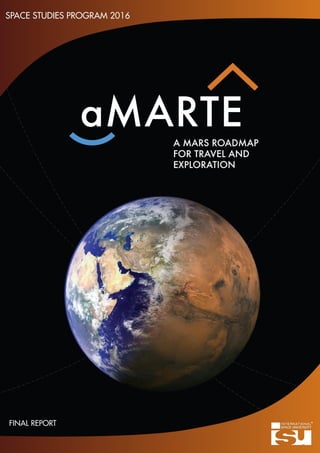
aMARTE
A MARS ROADMAP FOR TRAVEL AND EXPLORATION
Final Report
International Space University
Space Studies Program 2016
© International Space University. All Rights Reserved.
The 2016 Space Studies Program of the International Space University (ISU) was hosted by the
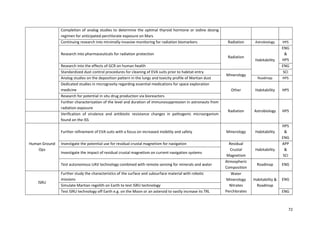
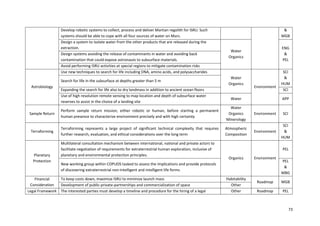
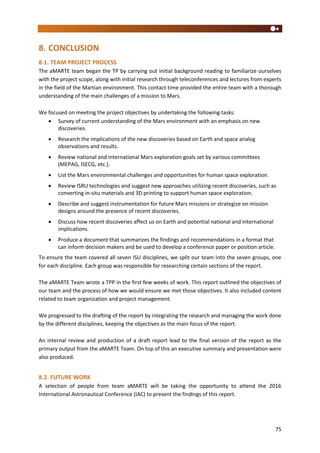
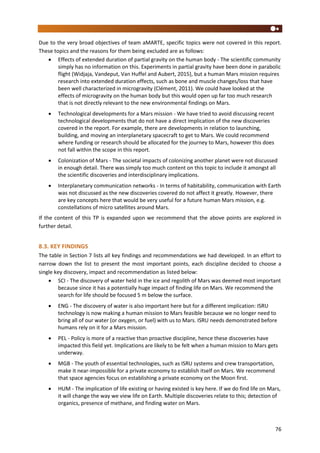
Technion – Israel Institute of Technology in Haifa, Israel.
aMARTE has been selected as the name representing the Mars Team Project. This choice was
motivated by the dual meaning the term conveys. aMARTE first stands for A Mars Roadmap for
Travel and Exploration, the official label the team has adopted for the project. Alternatively, aMARTE
can be interpreted from its Spanish roots "amarte," meaning "to love," or can also be viewed as
"a Marte," meaning "going to Mars." This play on words represents the mission and spirit of the
team, which is to put together a roadmap including various disciplines for a human mission to Mars
and demonstrate a profound commitment to Mars exploration.
The aMARTE title logo was developed based on sections of the astrological symbols for Earth and
Mars. The blue symbol under the team's name represents Earth, and the orange arrow symbol is
reminiscent of the characteristic color of Mars. The arrow also serves as an invitation to go beyond
the Earth and explore our neighboring planet.
Electronic copies of the Final Report and the Executive Summary can be downloaded from the ISU
Library website at http://isulibrary.isunet.edu/
International Space University
Strasbourg Central Campus
Parc d’Innovation
1 rue Jean-Dominique Cassini
67400 Illkirch-Graffenstaden
France
Tel +33 (0)3 88 65 54 30
Fax +33 (0)3 88 65 54 47
e-mail: publications@isu.isunet.edu
website: www.isunet.edu
i
I. ACKNOWLEDGMENTS
The International Space University Space Studies Program 2016 and the work of Team Project
aMARTE were made possible through the generous support of the following organizations and
individuals:
Chair:
Jacob Cohen NASA Ames Research Center
Teaching Associate:
Josh Richards International Space University
Staff Editors:
Ruth McAvinia International Space University
Vanessa Stroh International Space University
Visiting lecturers and supporters:
John F. Connolly NASA Lyndon B. Johnson Space Center, International Space University
Michael Hecht Massachusetts Institute of Technology
Chris McKay NASA Ames Research Center
Doug Archer NASA Lyndon B. Johnson Space Center
Vincent Guillard Airbus Defense and Space
Richard Quinn NASA Ames Research Center, SETI Institute
François Spiero Centre National d’Etudes Spatiales
Alfonso Davila Carl Sagan Centre at the SETI Institute, NASA Ames Research Center
Kris Lehnhardt School of Medicine and Health Sciences at George Washington University
John Hogan NASA Ames Research Center
Michael Flynn NASA Ames Research Center
David Beaty NASA Jet Propulsion Laboratory
Gerald Sanders NASA Lyndon B. Johnson Space Center
Raymond M. Wheeler NASA Kennedy Space Center
Jonathan Faull International Space University
Petter Skanke International Space University
Sponsor:
ISU and Team Project aMARTE wish to express their sincere appreciation to the NASA Mars
Exploration Program for its sponsorship of this project.
ii
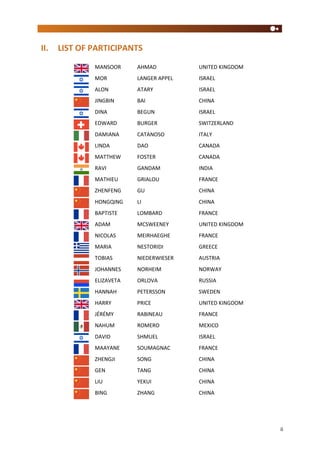
II. LIST OF PARTICIPANTS
MANSOOR AHMAD UNITED KINGDOM
MOR LANGER APPEL ISRAEL
ALON ATARY ISRAEL
JINGBIN BAI CHINA
DINA BEGUN ISRAEL
EDWARD BURGER SWITZERLAND
DAMIANA CATANOSO ITALY
LINDA DAO CANADA
MATTHEW FOSTER CANADA
RAVI GANDAM INDIA
MATHIEU GRIALOU FRANCE
ZHENFENG GU CHINA
HONGQING LI CHINA
BAPTISTE LOMBARD FRANCE
ADAM MCSWEENEY UNITED KINGDOM
NICOLAS MEIRHAEGHE FRANCE
MARIA NESTORIDI GREECE
TOBIAS NIEDERWIESER AUSTRIA
JOHANNES NORHEIM NORWAY
ELIZAVETA ORLOVA RUSSIA
HANNAH PETERSSON SWEDEN
HARRY PRICE UNITED KINGDOM
JÉRÉMY RABINEAU FRANCE
NAHUM ROMERO MEXICO
DAVID SHMUEL ISRAEL
MAAYANE SOUMAGNAC FRANCE
ZHENGJI SONG CHINA
GEN TANG CHINA
LIU YEKUI CHINA
BING ZHANG CHINA
iii
III. ABSTRACT
Recent science results from robotic Mars programs revealed a new perspective on the Martian
environment that is directly relevant to human exploration. New discoveries that have been
identified are the detection of shallow ground ice at middle latitudes, hydrated soils at the equator,
nitrates, perchlorates, organic material, methane, and residual crustal magnetism, as well as first
measurements of radiation, mineralogy, and the upper atmosphere. These findings may provide
important resources for human exploration and insight into Martian history while at the same time
pose new challenges.
As part of the 2016 Space Studies Program of the International Space University, hosted at the
Technion Israel Institute of Technology in Haifa, an international, intercultural, and interdisciplinary
team of professionals participated in a project to explore the implications of new discoveries in the
Martian environment on a future human exploration mission to Mars. Water, and in particular
flowing water, is essential for life as we know it on Earth and is an important resource for any future
human presence on Mars. While perchlorates may pose a significant hazard to future space missions,
they may also be leveraged as a resource. The detection of organics and the measurement of the
radiation environment at the surface indicate potential for subsurface life, which will influence
human surface operations. In-situ resource utilization for life support and habitability will reduce the
mass needing to be sent from Earth and reduce mission risk. The link between the identified
implications and policy, law, and business considerations is discussed. Presented in this report is a
Mars human exploration science and technology roadmap of priorities needed to further understand
the potential use and effect of the Mars environment on crew and hardware. This roadmap is needed
to further understand the potential use and effect of the Mars environment on crew and hardware.
iv
IV. FACULTY PREFACE
‘‘I’ve still got the greatest enthusiasm and confidence in the mission.”
- HAL9000, 2001 – A Space Odyssey
With their deadline approaching and the hours winding down, the aMARTE team is still hard at work.
Their objective to create a Mars roadmap for travel and exploration was set particularly in the
context of new discoveries about the Martian environment. Faced with the task of learning old
discoveries as well as the new ones, and proposing strategies for future missions, the project team
demonstrated dedication, teamwork, and ownership of the future; a future that will get us to Mars.
Assembled in Israel, the team gathered from all over the world to set their sights on their new
destination in space. The Mars environment presents both challenges and opportunities for space
exploration and for finding Martian life. What will it take to make humans on Mars a reality and not
science fiction? When will our species truly step out of our nest called Earth? The aMARTE team
looked at the problem from every angle, discussing and debating their priorities and preconceived
ideas.
While the search for knowledge and economic growth are critical, without a space exploration
destination we will not move forward. Is the overarching goal of space exploration the present or is it
to create a better future for humanity through collaboration? It is the shared imagination,
persistence, and compassion of humanity that will lead to a better future.
Working together, the ISU SSP16 family not only advanced space education, but also developed
strong bonds that will last forever. These friendships lead to future collaborations and change space
exploration.
I thank all the ISU staff, lecturers, our host Israel and the Technion and most of all Josh Richards, my
Teaching Associate, and the participants of this project. In the words of the aMARTE team, this
project was wonderful, unforgettable, eye-opening, Sababa, intense, revelatory, expanding,
inconceivable, Martianic, mind-opening, forward-thinking, intensifying, and awesome.
Jacob Cohen, Ph.D.
“No! Try not! Do. Or Do Not. There Is No Try.”
- Master Yoda, Star Wars -Episode V: The Empire Strikes Back
URSE
v
V. PARTICIPANT PREFACE
Greetings Martian enthusiasts! Prepare to learn that solely living off potatoes will NOT attain human
survivability on Mars.
Space exploration has always piqued the interest of humanity. Taking this interest one step further is
the idea to investigate our neighboring planet, Mars, where the potential for the establishment of a
human presence is ever growing. Can humans live on Mars? For how long? What are the benefits of
living on Mars? What do we need there, and what do we need to bring? What do we need to know
before going there? As new discoveries about the Martian environment are made by sending robotic
rovers to Mars, the implications for a human mission are increasing and extending. The challenge has
been set to prepare for the human exploration of Mars in the coming years.
In this report, the aMARTE Team connects the new discoveries with various implications for a human
mission to Mars. As you read, you will find information giving a snapshot of the Martian environment
before diving into the advancements of seven unique disciplines in the context of establishing a
human presence on Mars. Individually, members of the aMARTE Team scoured a diverse range of
resources within their familiarized discipline. Together, the team then tied the information in a
unique format that is coherent and unified. We brainstormed future developments and
recommendations to accomplish a human Mars mission and end with a clear, visual roadmap to
Mars. The roadmap of recommendations is targeted towards a wide audience including, but not
limited to researchers, engineers, policy makers, financial analysts, and risk analysts.
The aMARTE Team is an international, intercultural, and interdisciplinary group composed of 30
participants from 16 different countries. Given a timeline of only 40.876 sols (6 Earth weeks) to
complete this entire report, along with a visual executive summary, and a presentation, the group
overcame many challenges along the way. Despite all obstacles, however, team cohesion grew as we
ensured the inclusion of everyone’s best contribution.
We were very fortunate to have Dr. Jacob Cohen (NASA Ames Chief Scientist) as the aMARTE team
project chair. Dr. Cohen’s expertise ranges from synthetic biology to viruses, both on Earth and on
Mars too. We benefited significantly as well from our teaching associate, Josh Richards, who has
guided us from the start, and dreams of being the first Australian on Mars. We hope that he and his
koala arrive there safely. Lastly, we were grateful to have the opportunity to produce this report
under their supervision as well as the coordination by experienced ISU faculty and the guidance of
other space professionals.
Clear skies,
Team aMARTE
vi
VI. TABLE OF CONTENTS
I. Acknowledgments............................................................................................................................ i
II. List of participants........................................................................................................................... ii
III. Abstract.......................................................................................................................................... iii
IV. Faculty Preface............................................................................................................................... iv
V. Participant Preface.......................................................................................................................... v
VI. Table of Contents........................................................................................................................... vi
VII. List of Figures .............................................................................................................................. ix
VIII. List of Tables ................................................................................................................................ x
IX. List of Acronyms............................................................................................................................. xi
1. Introduction ....................................................................................................................................1
1.1. Project Background..................................................................................................................1
1.2. Mission Statement...................................................................................................................2
1.3. Project Approach & Definitions ...............................................................................................2
2. Going to Mars..................................................................................................................................3
2.1. Current Understanding of Mars...............................................................................................3
2.2. Rationales.................................................................................................................................4
2.3. Current Roadmaps...................................................................................................................5
3. Overview of the New Discoveries ...................................................................................................7
3.1. Shallow Ground Ice at Middle Latitudes Revealed by Small Impact Craters...........................7
3.2. Hydration in Surface Soils at the Equator................................................................................8
3.3. Mineralogy Measurements of Soils .........................................................................................9
3.4. Nitrates ..................................................................................................................................10
3.5. Perchlorates...........................................................................................................................10
3.6. Organics .................................................................................................................................11
3.7. Methane.................................................................................................................................11
3.8. Atmospheric Composition .....................................................................................................13
3.9. Crustal Magnetism.................................................................................................................15
3.10. Radiation............................................................................................................................16
4. Discovery Implication Spider Chart...............................................................................................18
5. Implications...................................................................................................................................19
5.1. Habitability.............................................................................................................................19
5.2. Life Support System ...............................................................................................................24
5.2.1. Environmental Control and Monitoring.........................................................................24
5.2.2. Life Support Atmosphere...............................................................................................25
5.2.3. Water System.................................................................................................................26
5.2.4. Waste Management.......................................................................................................27
5.2.5. Radiation Mitigation ......................................................................................................27
vii
5.3. Human Health........................................................................................................................28
5.3.1. Martian Perchlorates and Human Health......................................................................28
5.3.2. Martian Radiation and Human Health...........................................................................29
5.3.3. Occupational Medicine on the Surface of Mars ............................................................30
5.3.4. Pharmacology ................................................................................................................31
5.3.5. The Immune System ......................................................................................................32
5.4. Human Ground Operation .....................................................................................................33
5.4.1. Space Suits .....................................................................................................................33
5.4.2. Local Navigation System ................................................................................................33
5.4.3. Human-Robot Collaboration..........................................................................................34
5.4.4. Autonomous Vehicles for Exploration ...........................................................................34
5.4.5. Assistive Robots .............................................................................................................34
5.4.6. Pressurized Rover...........................................................................................................35
5.5. ISRU........................................................................................................................................35
5.5.1. Water ISRU.....................................................................................................................36
5.5.2. Oxygen ISRU...................................................................................................................37
5.5.3. Fuel ISRU ........................................................................................................................39
5.5.4. ISRU for Manufacturing .................................................................................................40
5.5.5. Power Generation..........................................................................................................41
5.5.6. Conclusion......................................................................................................................41
5.6. Astrobiology...........................................................................................................................42
5.7. Sample Return Missions.........................................................................................................44
5.8. Terraforming..........................................................................................................................45
5.8.1. Time Frame ....................................................................................................................45
5.8.2. Methods of Terraforming ..............................................................................................45
5.8.3. Ethical Considerations....................................................................................................46
5.9. Planetary Protection and Human Missions ...........................................................................47
5.10. Ethical Issues and Cultural Impact .....................................................................................49
6. Considerations...............................................................................................................................50
6.1. Finanical .................................................................................................................................50
6.1.1. Scenarios........................................................................................................................50
6.1.2. Budgets ..........................................................................................................................51
6.1.3. Space Agencies’ Roles....................................................................................................52
6.1.4. Nonprofit Organizations ................................................................................................53
6.1.5. Cost Estimation ..............................................................................................................54
6.1.6. Business opportunities...................................................................................................56
6.2. Legal Foundation....................................................................................................................61
6.2.1. Introduction ...................................................................................................................61
6.2.2. Historical and Contemporary Foundational Documents ...............................................62
viii
6.2.3. Synthesis ........................................................................................................................63
6.2.4. Conclusion & Recommendations...................................................................................63
6.3. Technology Demonstration Missions.....................................................................................64
6.4. The Moon as a Stepping Stone ..............................................................................................64
6.5. Public Outreach......................................................................................................................65
6.6. Spin-Offs.................................................................................................................................66
7. Roadmap .......................................................................................................................................69
8. Conclusion.....................................................................................................................................75
8.1. Team Project Process.............................................................................................................75
8.2. Future Work...........................................................................................................................75
8.3. Key Findings ...........................................................................................................................76
8.4. Closing Remarks.....................................................................................................................77
X. References.....................................................................................................................................78
ix
VII. LIST OF FIGURES
Figure 1. Differences between short and long mission types. Credit: NASA...........................................3
Figure 2: Global Exploration Roadmap. Credit: NASA .............................................................................5
Figure 3: NASA’s Journey to Mars. Credit: NASA.....................................................................................6
Figure 4: Ice-exposing impact craters observed by HiRISE......................................................................8
Figure 5: Recurring slope lineae in Newton Crater. Credit: NASA...........................................................9
Figure 6: Equatorial and midlatitude chlorine distribution in the surface. ...........................................10
Figure 7: Possible methane sources and sinks. Credit: NASA................................................................12
Figure 8: Discovery Implication Spider Chart.........................................................................................18
Figure 9: Module network concept. ......................................................................................................19
Figure 10: Module deployment schematics...........................................................................................20
Figure 11: Concept of inflatable hydroponic cultivation system...........................................................23
Figure 12: The MDRS in the desert of Utah ...........................................................................................54
Figure 13 Inflation rate from year 1960 to 2015. Data: (US Inflation Calculator, 2016) .......................55
x
VIII. LIST OF TABLES
Table 1: Summary of key factors for different water ISRU sources. Data:(Abbud-Madrid et al.,2016) 38
Table 2: Potential fuel substances. ........................................................................................................39
Table 3 Yearly Human Exploration Space Agency Budget. ....................................................................52
Table 4: Overview figures of ratio cost/kg for each mission type. ........................................................55
Table 5: Technology Companies Table. .................................................................................................58
Table 6: Symbiotic Companies Table .....................................................................................................59
Table 7: Potential Mars mission spin-offs..............................................................................................66
xi
IX. LIST OF ACRONYMS AND ABBREVIATIONS
ALS Advanced Life Support
aMARTE A Mars Roadmap for Travel
and Exploration
AMS Acute Mountain Sickness
AMS Atmosphere Management
System
APP Applications
ASI Agenzia Spaziale Italiana
AU Astronomical Unit
BRICS Brazil Russia India China
South Africa
CB Cumberland
CERN European Organization for
Nuclear Research
CFD Computational Fluid
Dynamics
CM Command Module
CNES Centre National d’Etudes
Spatiales
CNSA China National Space
Administration
COPUOS Committee on the Peaceful
Uses of Outer Space
COSPAR Committee on Space
Research
CRISM Compact Rconnaissance
Imaging Spectometer for
Mars
CSA Canadian Space Agency
CSHELL Cryogenic Echelle
Spectrograph
CTX Context Camera
DLR German Aerospace Center
(Deutsches Zentrum für Luft-
und Raumfahrt)
DNA Deoxyribonucleic Acid
DSI Deep Space Industry
DSN Deep Station Network
ECLSS Environment Control and Life
Support System
EDL Entry, Descent and Landing
EMMT Earth Moon Mars
Transporter
EMU Extravehicular Mobility Unit
ENG Engineering
ESA European Space Agency
EVA Extravehicular Activity
FDM Fused Deposition Modeling
GCR Galactic Cosmic Ray
GDP Gross Domestic Product
GHANZ Geothermal Heat-pump
Association of New-Zealand
HiRISE High Resolution Imaging
Science Experiment
HPS Human Performance in Space
HUM Humanities
HZE High atomic number and
Energy
IAC International Astronautical
Congress
IDP Interplanetary Dust Particles
ILN International Lunar Network
IPCC Intergovernmental Panel on
Climate Change
IRTF Infrared Telescope Facility
ISECG International Space
Exploration Coordination
Group
ISP Specific Impulse
ISRO Indian Space Research
Organization
ISRPS In-Situ Resource Processing
System
ISRU In-Situ Resource Utilization
ISU International Space
University
ISS International Space Station
ITAR International Traffic in Arms
Regulation
JAXA Japan Aerospace Exploration
Agency
JK John Klein
JPL Jet Propulsion Laboratory
KARI Korean Aerospace Research
Institute
LED Light-Emitting Diode
xii
LEM Lunar Excursion Module
LEO Low Earth Orbit
LLC Limited Liability Company
MAVEN Mars Atmosphere and
Volatile EvolutioN Mission
MDRS Mars Desert Research Station
MELiSSA Micro-Ecological Life Support
System Alternative
MEPAG Mars Exploration Program
Analysis Group
MER Mars Exploration Rover
MEX Mars Express
MGB Management and Business
MGS Mars Global Surveyor
MIT Massachusetts Institute of
Technology
MMRTG Multi-Mission Radioisotope
Thermoelectric Generator
MOXIE Mars Oxygen ISRU
Experiment
MRO Mars Reconnaissance Orbiter
MSL Mars Science Laboratory
N-11 Next Eleven
NASA National Aeronautics and
Space Administration
NSRL NASA Space Radiation
Laboratory
OST Outer Space Treaty
OST Open Systems Technologies
P3HT Poly(3-Hexylthiophene)
PEDOT Poly(3,4-
Ethylenedioxythiophene)
Polystyrene Sulfonate
PEL Policy, Economics, and Law
PFS Planetary Fourier
Spectrometer
PLSS Portable Life Support System
ppbv Parts per billion by volume
PPP Public-Private Partnership
PSS Polystyrene Sulfonate
R&D Research and Development
RAD Radiation Assessment
Detector
RASSOR Regolith Advanced Surface
Systems Operations Robot
RSL Recurring Slope Lineae
SAM Sample Analysis at Mars
SCIM Sample Collection for
Investigation of Mars
SEP Solar Energetic Particle
SETI Search for Extra-Terrestrial
Intelligence
SLM Selective Laser Melting
SLS Space Launch System
SN Space Network
SSAU State Space Agency of
Ukraine
SSP Space Studies Program
STEM Science Technology
Engineering Mathematics
STEAM Science Technology
Engineering Art Mathematics
Sv Sieverts
TCS Thermal Control System
TDRS Tracking and Data Relay
Satellites
TES Thermal Emission
Spectrograph
TGO Trace Gas Orbiter
THEMIS Thermal Emission Imaging
System
TLS Tunable Laser Spectrometer
TP Team Project
TPP Team Project Plan
TRL Technology Readiness Level
TSH Thyroid-Stimulating
Hormone
UAV Unmanned Aerial Vehicle
UDDT Urine-Diverting Dry Toilets
UKSA United Kingdom Space
Agency
UN United Nations
US United States
USA United States of America
USD US Dollar
UV Ultraviolet
WMS Water Management System
WWPS Wet Waste Processing
System
1
1. INTRODUCTION
Humanity first successfully flew past Mars in 1965 with Mariner 4. The Mars 3 lander touched down
seven years later and worked for 15 seconds. This was followed by the successful Viking landers in
1976 (Huntress, JR. and Marov, 2011). Data and images sent back to Earth showed Mars as a barren
wasteland apparently devoid of life. Over the last 40 years, our understanding of Mars has improved
as we have sent more technologically advanced landers and rovers to the red planet. Of particular
note are the Phoenix probe and Mars Science Laboratory (MSL), also known as Curiosity that landed
on Mars in 2008 and 2012 respectively.
Landing in the northern polar regions of the planet, Phoenix’s major finding came from scooping up
and analyzing the Martian regolith. It found ice buried slightly under the surface and perchlorates in
the regolith (NASA, 2015b). These discoveries changed our understanding of the Martian
environment and of the prospects for life on Mars, as well as opening up more questions. Now we
had proof of ice on Mars, was there much more ice, or even water, earlier in its history? Could
microbial life be found in the ice? The discovery of perchlorates brings up opportunities as well as
questions. Perchlorates are used as a rocket fuel component on Earth (NASA Mars Exploration,
2016a). If we can extract the perchlorates from the Martian environment, then we would not need
to bring fuel to Mars for the potential return journey to Earth.
The Curiosity rover landed using the most cutting-edge entry, descent and landing (EDL) technology
ever developed (NASA JPL, 2012). The rover conducted a range of experiments on the Martian soil.
The burning and sniffing of this soil displayed indications of nitrates. These nitrates can potentially
be used for plant growth or habitat heat extraction (Crawford, 1995). The results of Curiosity’s
experiments also displayed the presence of organics. This does not necessarily mean that life once
existed on Mars, but it does show that Mars has some of the ingredients to support life (NASA Mars
Exploration, 2015a).
This small sample of recent discoveries about the Martian environment has implications for those of
us on Earth. One day, they will have a large impact on those of us in transit to or living on Mars.
1.1. PROJECT BACKGROUND
The 29th Space Studies Program (SSP) held in the Technion Israel Institute of Technology in Haifa
allocated a Team Project (TP) to investigate the “Implications of New Discoveries in the Martian
Environment”. Our TP is an international, intercultural, and interdisciplinary group following the 3I
(Interdisciplinary, Intercultural, and International) philosophy of the International Space University
(ISU). Disciplines included in our interdisciplinary program are Engineering (ENG), Science (SCI),
Applications (APP), Human Performance in Space (HPS), Humanities (HUM), Management and
Business (MGB), and Policy, Economics, and Law (PEL). Together we included participants of 16
nationalities and range in background from engineer to artist, and from doctor to teacher. The
objectives for our TP were as follows:
 Review the geological and atmospheric environment of Mars, with an emphasis on recent
Martian environment findings.
2
 Study the implications of the new discoveries on future human space exploration missions to
Mars and how they can be used as in-situ resources for life support and habitability.
 Discuss the biological implications of the recent Mars findings on space biology,
astrobiology, human health, terraforming, and synthetic biology.
 Draft a Mars human space exploration science and technology roadmap that outlines the
priorities needed to further understand the potential use and effect of the new discoveries
on crew and hardware.
 Produce a final report with recommendations that will inform decision makers and influence
future human space exploration missions to Mars.
Through six weeks of work, our team of 30 participants and two staff worked tirelessly to produce a
Team Project Plan (TPP), this report, an executive summary, and a presentation all about the
Martian environment.
1.2. MISSION STATEMENT
“The mission of the aMARTE Team is to review the most recent discoveries on the Martian
environment, evaluate the different implications for human Mars exploration, and produce a
comprehensive set of scientific and technological recommendations for future development.”
1.3. PROJECT APPROACH & DEFINITIONS
To begin the report, we describe and discuss the discoveries themselves. This is followed by an in-
depth look into what the implications of these discoveries are on a future human mission to Mars.
Included in these are science, human performance in space, applications, policy, economics, and
law, management and business, humanities, and engineering implications; the seven disciplines of
ISU. Before developing the roadmap, we look at the current state of events in the space industry
that are relevant to a future human mission to Mars. We then introduce a scientific and
technological roadmap with recommendations to bring the human race closer to setting foot on
Mars. Finally, we draw conclusions from the research and discussion produced by the aMARTE
Team.
To fulfill the objectives of the TP, we needed to comprehend the meaning of “new discoveries.” We
returned several times to the question of what constitutes “new”? In the context of this TP “new”
does not necessarily mean “in the last 10 years” for example. Since research on the Martian
environment is highly restricted due to its cost, “new” is a highly restrictive term. Instead Team
aMARTE decided to interpret the term as “recent.” By using “recent” we could look at results older
than 10 years, as these may be the latest results in that field.
3
2. GOING TO MARS
2.1. CURRENT UNDERSTANDING OF MARS
Before introducing the new discoveries, we are going to detail essential background knowledge
about Mars to outline our starting point. Mars is roughly half the size and one tenth of the mass of
Earth, meaning that the gravity there is 37.5 % of Earth's. No studies have been done on humans in
partial gravity (between 0 g and 1 g) for an extended amount of time, but it is widely expected that
health problems seen in microgravity as on the International Space Station (ISS) will also occur on
Mars (for example bone loss). Due to the tilt of Mars, at 25 ° very similar to Earth, there are seasons
on the red planet. The different conditions during the seasons are responsible for the build-up and
sublimation of ice at the Martian poles. Temperatures on Mars average -63 °C. The atmosphere of
Mars is composed of 96 % carbon dioxide, a hazardous substance for humans to breathe. Other
components of the Martian atmosphere include small (<2 %) amounts of nitrogen and argon. There
is very little molecular oxygen on Mars. The combination of the low temperatures and an
atmosphere that people cannot breathe, presents significant challenges to human exploration.
Additionally, the atmosphere is over 100 times less dense than on Earth, making landing on Mars
challenging, as we cannot use atmospheric drag to sufficiently slow down a large spacecraft (NASA
Mars Exploration, 2016a).
Mars is on average 1.5 astronomical units (AU) from the Sun and has an elliptical orbit. A day on
Mars lasts 24 hours and 47 minutes, and a year is 687 Earth days (NASA Mars Exploration, 2016a).
Due to the different radii of their orbits, Earth and Mars have a conjunction once every 26 months.
This conjunction is used as a launch window since it is the quickest and often cheapest (at least from
an energy perspective) time to travel to Mars. This launch window provided by the orbital mechanics
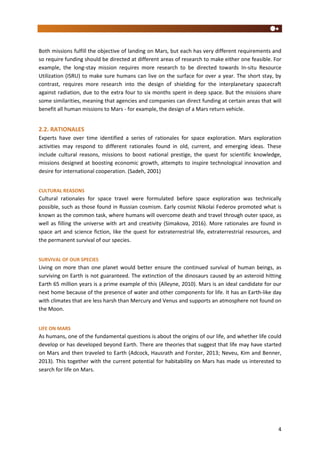
of the Sun-Earth-Mars system has produced two widely accepted mission types; a “short-stay”
opposition mission and a “long-stay” conjunction mission (Drake, 2010). Both missions include a
journey from Earth to Mars of six to eight months’ duration. The short stay mission contains of
roughly one month on the surface of Mars and is followed by a return journey to Earth through the
orbit of Venus, taking about one year. The long stay mission contains a 1.5 year stay on the surface
of Mars before returning to Earth in a six to eight-month journey. See Figure 1 for reference.
Figure 1. Differences between short and long mission types. Credit: NASA.
4
Both missions fulfill the objective of landing on Mars, but each has very different requirements and
so require funding should be directed at different areas of research to make either one feasible. For
example, the long-stay mission requires more research to be directed towards In-situ Resource
Utilization (ISRU) to make sure humans can live on the surface for over a year. The short stay, by
contrast, requires more research into the design of shielding for the interplanetary spacecraft
against radiation, due to the extra four to six months spent in deep space. But the missions share
some similarities, meaning that agencies and companies can direct funding at certain areas that will
benefit all human missions to Mars - for example, the design of a Mars return vehicle.
2.2. RATIONALES
Experts have over time identified a series of rationales for space exploration. Mars exploration
activities may respond to different rationales found in old, current, and emerging ideas. These
include cultural reasons, missions to boost national prestige, the quest for scientific knowledge,
missions designed at boosting economic growth, attempts to inspire technological innovation and
desire for international cooperation. (Sadeh, 2001)
CULTURAL REASONS
Cultural rationales for space travel were formulated before space exploration was technically
possible, such as those found in Russian cosmism. Early cosmist Nikolai Federov promoted what is
known as the common task, where humans will overcome death and travel through outer space, as
well as filling the universe with art and creativity (Simakova, 2016). More rationales are found in
space art and science fiction, like the quest for extraterrestrial life, extraterrestrial resources, and
the permanent survival of our species.
SURVIVAL OF OUR SPECIES
Living on more than one planet would better ensure the continued survival of human beings, as
surviving on Earth is not guaranteed. The extinction of the dinosaurs caused by an asteroid hitting
Earth 65 million years is a prime example of this (Alleyne, 2010). Mars is an ideal candidate for our
next home because of the presence of water and other components for life. It has an Earth-like day
with climates that are less harsh than Mercury and Venus and supports an atmosphere not found on
the Moon.
LIFE ON MARS
As humans, one of the fundamental questions is about the origins of our life, and whether life could
develop or has developed beyond Earth. There are theories that suggest that life may have started
on Mars and then traveled to Earth (Adcock, Hausrath and Forster, 2013; Neveu, Kim and Benner,
2013). This together with the current potential for habitability on Mars has made us interested to
search for life on Mars.
5
SCIENTIFIC INNOVATION
A human space mission to Mars will push the boundaries of science and technology. It will bring
benefits and new applications of technology to Earth. This will extend the work of outreach by acting
as a catalyst to attract more people into the space sector.
POLITICAL AND ECONOMIC
It would also be difficult to envisage such a mission without international cooperation and
collaboration in place between space agencies and corporations. Any nation or conglomerate that
succeeds in placing a human on the surface of Mars will have a significant political and economic
edge in this competitive world. This was clearly demonstrated when the US became the first and
only nation so far to place a human on the Moon.
Mars is indeed one of the most important frontiers for humankind in our time, as its exploration will
bring a unique perspective about life, and our role in the universe. The reasons and policies for going
to Mars will require “some sort of reconciliation between vision and reality… Modern governments
require the reconciliation of imagination, popular culture, and real events” (McCurdy, 1993 in Sadeh,
2001. A mission to Mars that stimulates this kind of cooperation could accelerate worldwide
developments and achieve results that cannot be achieved by a single nation.
2.3. CURRENT ROADMAPS
Before we plan our own roadmap for a human mission to Mars there are three existing roadmaps
that we need to examine.
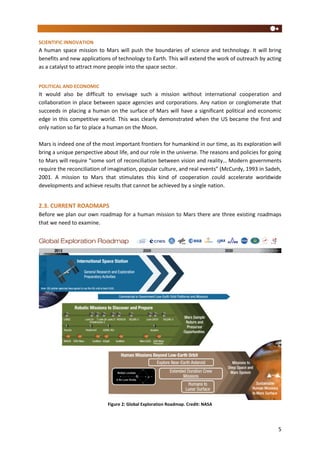
Figure 2: Global Exploration Roadmap. Credit: NASA
6
The International Space Exploration Coordination Group (ISECG) has published its global exploration
roadmap regularly since 2011 (ISECG, 2013). This roadmap (Figure 2) is notable as it has input from
14 different space agencies including the National Aeronautics and Space Administration (NASA),
Roscosmos, the European Space Agency (ESA), and China National Space Administration (CNSA).
Common goals shared by these space-faring nations include the search for life, extension of human
presence in the Solar System, development of exploration technology, and performance of science
to support human exploration. All these goals are directly applicable to a Mars mission and the long-
term goal of the ISECG roadmap is to go to Mars. Stepping stones before a Mars mission include
missions to the Moon and to near-Earth asteroids.
The Mars Exploration Program Analysis Group (MEPAG) aligns itself towards four different goals
which are to:
1. Determine if Mars ever supported life
2. Understand the processes and history of the climate on Mars
3. Understand the origin and evolution of Mars as a geological system
4. Prepare for human exploration
These goals are divided into objectives addressing in depth the key knowledge gaps that are
currently preventing us from successfully getting to Mars. (MEPAG, 2015)
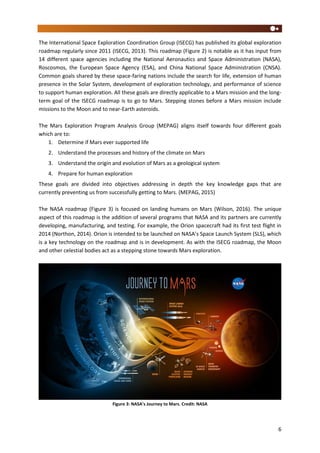
The NASA roadmap (Figure 3) is focused on landing humans on Mars (Wilson, 2016). The unique
aspect of this roadmap is the addition of several programs that NASA and its partners are currently
developing, manufacturing, and testing. For example, the Orion spacecraft had its first test flight in
2014 (Northon, 2014). Orion is intended to be launched on NASA’s Space Launch System (SLS), which
is a key technology on the roadmap and is in development. As with the ISECG roadmap, the Moon
and other celestial bodies act as a stepping stone towards Mars exploration.
Figure 3: NASA’s Journey to Mars. Credit: NASA
7
3. OVERVIEW OF THE NEW DISCOVERIES
Since the origin of spaceflight, Mars has been a target destination for exploration missions. Starting
with the first visit in 1965 with the successful flyby of Mariner 4, a variety of missions have greatly
enhanced our understanding of Mars (Howell, 2015). As Mars has had, and continues to have, the
potential for habitability, it is the most frequently visited planet in our Solar System (NASA Mars
Exploration, 2016a). In the last 10 years, a variety of operational orbiters, landers, and rover
missions have returned data that have led to new discoveries that altered our view of Mars. The
discoveries we present in this section originated from the latest missions including Mars Atmosphere
and Volatile Evolution Mission (MAVEN), MSL also known as Curiosity, Phoenix, Mars
Reconnaissance Orbiter (MRO), Mars Exploration Rover (MER) mission consisting out of Spirit and
Opportunity, Mars Express (MEX), Mars Global Surveyor (MGS) and Mars Odyssey.
3.1. SHALLOW GROUND ICE AT MIDDLE LATITUDES REVEALED BY SMALL IMPACT CRATERS
Water in the form of near-surface ice has been primarily detected in the
polar regions of Mars (Boynton et al., 2002). Despite the scientific
importance of these regions in our understanding of the dynamics of
the Martian water cycle, it is widely accepted that human exploration of
the Martian poles is an endeavor that encompasses major engineering
challenges including power requirements, ground instrumentation, and
transportation (MEPAG HSO-SAG, 2015; Cockell, 2001). Landings at the
poles are especially difficult because of the reduced rotational speed of
the surface with increasing latitudes.
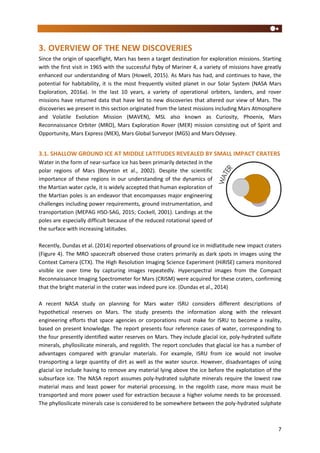
Recently, Dundas et al. (2014) reported observations of ground ice in midlatitude new impact craters
(Figure 4). The MRO spacecraft observed those craters primarily as dark spots in images using the
Context Camera (CTX). The High Resolution Imaging Science Experiment (HiRISE) camera monitored
visible ice over time by capturing images repeatedly. Hyperspectral images from the Compact
Reconnaissance Imaging Spectrometer for Mars (CRISM) were acquired for these craters, confirming
that the bright material in the crater was indeed pure ice. (Dundas et al., 2014)
A recent NASA study on planning for Mars water ISRU considers different descriptions of
hypothetical reserves on Mars. The study presents the information along with the relevant
engineering efforts that space agencies or corporations must make for ISRU to become a reality,
based on present knowledge. The report presents four reference cases of water, corresponding to
the four presently identified water reserves on Mars. They include glacial ice, poly-hydrated sulfate
minerals, phyllosilicate minerals, and regolith. The report concludes that glacial ice has a number of
advantages compared with granular materials. For example, ISRU from ice would not involve
transporting a large quantity of dirt as well as the water source. However, disadvantages of using
glacial ice include having to remove any material lying above the ice before the exploitation of the
subsurface ice. The NASA report assumes poly-hydrated sulphate minerals require the lowest raw
material mass and least power for material processing. In the regolith case, more mass must be
transported and more power used for extraction because a higher volume needs to be processed.
The phyllosilicate minerals case is considered to be somewhere between the poly-hydrated sulphate
8
and regolith cases when comparing advantages and disadvantages for water ISRU. (Abbud-madrid et
al., 2016)
Figure 4: Ice-exposing impact craters observed by HiRISE
Copyright: American Geophysical Union. (Dundas et al., 2014) Used with permission.
3.2. HYDRATION IN SURFACE SOILS AT THE EQUATOR
New measurements by Curiosity describe water hydration in surface
soils at the equator. Data from the John Klein and Cumberland drilling
areas showed that the most abundant gas evolved was water, with
phyllosilicates present at 17 wt% and 16 wt% respectively. (Ming et al.,
2014)
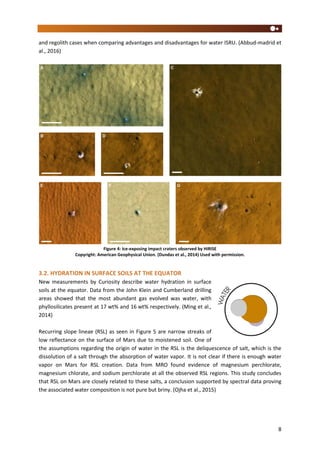
Recurring slope lineae (RSL) as seen in Figure 5 are narrow streaks of
low reflectance on the surface of Mars due to moistened soil. One of
the assumptions regarding the origin of water in the RSL is the deliquescence of salt, which is the
dissolution of a salt through the absorption of water vapor. It is not clear if there is enough water
vapor on Mars for RSL creation. Data from MRO found evidence of magnesium perchlorate,
magnesium chlorate, and sodium perchlorate at all the observed RSL regions. This study concludes
that RSL on Mars are closely related to these salts, a conclusion supported by spectral data proving
the associated water composition is not pure but briny. (Ojha et al., 2015)
9
RSL have previously been considered important in our understanding of the water cycle and the
feasibility of life on Mars. Recent data from NASA’s Mars Odyssey’s Thermal Emission Imaging
System (THEMIS) do not contradict the presence of these salts. The lack of a temperature gradient
between RSL and surrounding ground formations provides evidence opposing previous beliefs
associating RSL formation with evaporating brines. (NASA JPL, 2016)
Figure 5: Recurring slope lineae in Newton Crater. Credit: NASA.
3.3. MINERALOGY MEASUREMENTS OF SOILS
Orbiters and rovers carry tools that study the composition and
mineralogy of the Martian surface. The on-orbit method has the
advantage of large coverage of the surface, but it does not have the
resolution to detect isolated outcrops of unique composition. The data
collected by rovers on the surface is more complete spatially and
mineralogically, but rovers can only cover very small areas. (Ehlmann
and Edwards, 2014) As a result, the global geologic map is based mainly
on morphology and not rock composition (Tanaka et al., 2014).
The upper crust of Mars is more homogenous than that of Earth, and overall it has a basaltic
composition. Soil is created from crust mainly through physical processes, but chemical alteration is
also present, including weathering by water. Minerals that point to the presence of water are found
throughout the geologic history of Mars, but with the majority dated to the Noachian epoch (up to
3.7 million years ago). The relatively homogenous composition of the crust and the similarity in soil
composition sampled by MER and MSL in different locations, brought about the “generic soil”
concept that states that most of the soil on Mars is of similar composition. (Ehlmann and Edwards,
2014)
Minerals detected on the surface of Mars including phyllosilicates and sulfates, are of interest in the
context of human exploration because it is possible to extract water from their molecular structure.
10
Phyllosilicates (clay minerals) are found where a Noachian-era outcrop exists on the surface of Mars.
Hydrated sulfates like gypsum are less commonly found, possibly because they formed in lakes, and
the spatial distribution of the occurrence of such lakes is not well known. (Ehlmann and Edwards,
2014) Both phyllosilicates and sulfates appear lithified, except for a known area of gypsum dunes,
where the material is in the form of loose grains (Archer, 2016).
3.4. NITRATES
The Martian atmosphere has ~2 % nitrogen in the form of N2 gas (Owen
et al., 1977), but nitrates in the soil were not detected until recently. The
Sample Analysis at Mars (SAM) instrument onboard the Curiosity rover
measured nitrates in the Martian regolith to be ~0.01 - 0.1 wt%. These
levels are 10 times smaller than in the Atacama Desert and Antarctica on
Earth. These Earth sites are chosen for comparison because there is very
little biological activity, which, in normal Earth conditions, is responsible
for most of the nitrates available in the soil. The nitrates on Mars were
detected in aeolian and mudstone samples from the Gale crater. The existence of nitrates in two
different types of regolith indicates that the process that transformed atmospheric nitrogen to
nitrates is likely a global one, such as an impact event or volcanic activity. This suggests we may find
nitrates globally on Mars. (Stern et al., 2015)
Figure 6: Equatorial and midlatitude chlorine distribution in the surface.
Copyright: American Geophysical Union. (Keller et al., 2007) Used with permission.
3.5. PERCHLORATES
Preliminary test results from the Viking landers indicate that
perchlorate salts may exist at the mid-northern latitudes on Mars. The
Phoenix probe and Curiosity rover have proven the existence of
perchlorate on Mars, supporting the idea of a global distribution of
perchlorate in the Martian regolith. Elemental chlorite has been
11
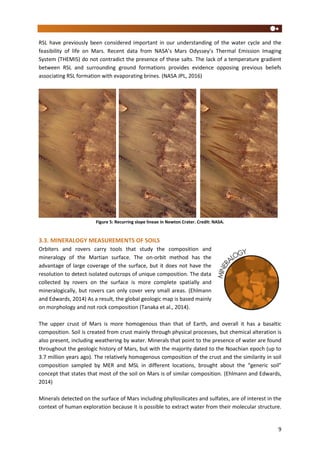
detected in every soil sample on Mars, showing that chlorine is distributed at similar levels (0.49
wt% average, 0.1 - 1.0 wt% range) from the equator to midlatitudes in both hemispheres, further
supporting the idea of global perchlorate distribution. Lastly, the gamma Ray Spectrometer onboard
NASA's Mars Odyssey orbiter has measured the chlorine distribution in the top meter of Martian soil
as seen in Figure 6 emphasizes this idea (Keller et al., 2007). Besides from having detrimental effects
on human health, perchlorate is also a source of oxygen for life support and propellant oxidizers.
Additionally, its strong attraction to water can drastically lower the freezing point of water, and
allow liquid water to flow on the Martian surface, even with the very low atmospheric pressure.
Recent research has hypothesized two mechanisms for perchlorate production on Mars. The
proposed mechanisms are very similar, with the primary difference being that one proposes
atmospheric formation and the other proposes formation on the Martian surface. The first is an
atmospheric process where gas phase oxidation of chlorine by oxygen atoms or ozone produces
perchloric acid, with dry deposition followed by surface mineral reactions that results in perchlorates
(Catling et al., 2010). The second mechanism is the formation of perchlorates on the Martian surface
by the ultraviolet (UV) photo-oxidation of chlorides aided by mineral catalysts (Schuttlefield et al.,
2011). Explaining the origin of perchlorates would help us to understand the geochemical evolution
of Mars.
3.6. ORGANICS
Looking for life is one of the main drivers for scientific missions to Mars.
Carbon-containing compounds known as organics are an essential
component of life as we know it on Earth. Organic compounds can be
produced abiotically in an active geological site, or biologically. Finding
organic compounds is a strong indicator for life, but because of the
possibility of non-biological origins the detection of organics does not
exclusively indicate the evidence of life. (McKay and García, 2014)
The Viking landers in 1976, which to date are the only spacecraft to carry instruments to look for life
on Mars, surprisingly did not detect any organics (Klein, 1978). With the recent detection of
perchlorate, we now understand that the Viking instrument was unable to detect organics, as all
organics would have become oxidized through sample heating before the measurement. In 2013 the
SAM instrument on MSL detected simple organics such as chloromethane (CH3Cl), dichloromethane
(CH2Cl2), trichloromethane (CHCl3), and chloromethylpropene (C4H7Cl) at Rocknest (Leshin et al.,
2013). The measurements are not conclusive, but are a promising indicator for life on Mars. The
2016 ExoMars Trace Gas Orbiter is expected to map potential organics in the atmosphere, which will
enhance our understanding of the origin (ESA, 2016b).
3.7. METHANE
Methane has been detected on Mars by orbital and Earth-based remote
sensing. In 2004, the Planetary Fourier Spectrometer (PFS) onboard the
MEX orbiter measured a global average of 10±5 parts per billion by
volume (ppbv) (Formisano et al., 2004). Later that year the Canada-
12
France-Hawaii Telescope detected an atmospheric methane mixing ratio of 10±3 ppbv
(Krasnopolsky, Maillard and Owen, 2004). In 2009, the Infrared Telescope Facility (IRTF) and the
Cryogenic Echelle Spectrograph (CSHELL) made observations of high concentration plumes of
methane, seemingly originating from discrete locations (Mumma et al., 2009). In response to these
claimed observations, Fonti and Marzo (2010) reviewed data archives from the Thermal Emission
Spectrograph (TES) onboard MGS. They found seasonal methane levels similar to previous studies
(Fonti and Marzo, 2010). For comparison, the atmospheric methane concentration of Earth is
approximately 1800 ppbv (Blasing, 2009).
With the exception of the results published by Krasnopolsky in 2004 that showed persistent
methane, all these observations of Martian atmospheric methane varied, both spatially and
temporally. These variations could be due to either localized concentrations of methane sources
and/or sinks, and seasonal changes. Variations ranged between 0 and up to 60 ppbv. The length of
these periods of variation is on the scale of weeks and months. (Formisano et al., 2004; Geminale,
Formisano and Giuranna, 2008; Mumma et al., 2009)
Figure 7: Possible methane sources and sinks. Credit: NASA.
We need to investigate why these variations occur with time. The varying levels of methane are
interesting because they result from unknown ongoing mechanisms, suggesting the planet may still
be “alive” as seen in Figure 7 (Formisano et al., 2004). Atmospheric models predict that methane
should have a lifetime of around 300 years before photochemical decomposition (Summers, Lieb,
Chapman and Yung, 2002), implying that with such a long geologic timeframe, background methane
13
levels on Mars should be uniform but the fluctuations in the measured background level occur over
significantly shorter timescales.
The Curiosity rover made in-situ measurements using the Tunable Laser Spectrometer (TLS) of the
SAM instrumentation suite in 2015. Over a 20-month period, it detected methane at a background
level of 7.2 ± 2.1 ppbv at the 95 % confidence interval on sols 466, 474, 504, and 526. The MSL team
observed that the high-level observations of methane did not correlate significantly with readings of
relative humidity, atmospheric pressure (CO2 abundance), ground or air temperature, or radiation
levels. The MSL rover also detected a possible weak inverse correlation with water abundance, and
atmospheric opacity. The findings imply that Mars is rapidly producing methane from unknown
sources (Webster et al., 2015).
Around 90% of methane found in the Earth’s atmosphere comes from living things, predominantly
cattle Mumma et al., 2009). The remaining contribution of terrestrial methane is introduced by
abiotic means. These include magmatic/volcanic and hydrothermal processes. Abiotic, extraneous,
or even biological sources may all plausibly be the origin of methane on Mars. There are no known
processes that can produce methane in an atmosphere (Krasnopolsky, Maillard and Owen, 2004). Of
the possible abiotic processes, (Krasnopolsky, Maillard and Owen, 2004) suggest volcanic and
hydrothermal sources of methane production are unlikely. Volcanism has not occurred for 10 million
years, and the Mars Odyssey orbiter did not detect any discernable hotspots for such activity
(Christensen, 2013; Krasnopolsky, Maillard and Owen, 2004).
Methane could be brought to Mars through interplanetary dust particles (IDPs) and
micrometeoroids. Laboratory experiments show that should this extraneous material contain
organics, UV irradiation may cause a breakdown and release of organics, including methane, to the
atmosphere (Schuerger et al., 2012). However, models that supply methane through such a
mechanism cannot account for the short scale variations or peaks in methane observations detected
by Curiosity (Geminale, Formisano and Sindoni, 2011; Mumma et al., 2009; Schuerger et al., 2012;
Webster et al., 2015). It remains plausible that methane could arise from biogenic sources, extinct or
extant. Should the methane be produced by subterranean microbial life forms on Mars,
measurements of methane abundance and comparison with terrestrial atmospheric measurements
(e. g., Blasing, 2009) greatly constrain the amount of biomass present on the planet. Such life would
be expected to have very small populations and would be constrained to specific discrete local oases
(Krasnopolsky, Maillard and Owen, 2004).
3.8. ATMOSPHERIC COMPOSITION
We must understand the Martian atmosphere to be able to design of a
human exploration roadmap, as the atmosphere plays a role in a broad
range of mission design aspects. For example, understanding
atmospheric density, structure, and composition are essential for the
design of EDL and ISRU systems. If we investigate the atmosphere’s
ability to support life we will also gain useful information for
characterizing the needs and constraints of future human missions, and
for scientific benefits in determining whether living organisms could
14
have developed on the surface of Mars in the past or could be doing so at present. This section gives
a short overview of the atmospheric characteristics and their implications.
DENSITY AND STRUCTURE
The Martian atmosphere is much thinner than Earth’s atmosphere and shows a thermally layered
structure with the troposphere (relatively warm, heated by the ground and airborne dust), the
mesosphere, the thermosphere (a layer heated by the Sun to high temperature) and the exosphere
(the unclear transition between the Martian atmosphere and outer space). (Gonzalez–Galindo,
Forget, Coll and Lopez-Valverde, 2008)
In addition, Mars shows a seasonal ozone layer at the south pole. The atmosphere also consists of a
complex ionosphere, and a layered structure of ions and neutral gas revealed by the MAVEN orbiter
in 2015 (Mahaffy et al., 2015).
PRESSURE
On average, the atmospheric pressure on Mars is ~600 Pa, just 0.6 % of Earth’s mean sea level
pressure of 101.3 kPa. The pressure, however, varies with altitude, just as on Earth. 600 Pa is well
below the absolute minimum 6.3 kPa of pressure required for human survival, below which exposed
body liquids boil away at a normal body temperature of 37 °C. This low pressure has direct
implications on human mission design. (NASA Mars Exploration, 2016a)
COMPOSITION
The Martian atmosphere is mainly composed of carbon dioxide, with 96 ± 0.7 % CO2,
1.93 ± 0.01 % Ar, 1.89 ± 0.03 % N2, 0.145 ±0.009 % O2, and CO to a level smaller than 0.1 % (Mahaffy
et al., 2013). Several mission studies suggest that the atmospheric CO2 could be used to make large
amounts of rocket fuel for the return journey from Mars. There are two methods of extracting this
fuel: The Sabatier reaction and electrolysis. The Sabatier reaction involves producing methane and
oxygen from carbon dioxide and hydrogen gas. Electrolysis involves splitting carbon dioxide into
oxygen and carbon monoxide. (Rapp, Hoffman, Meyen and Hecht, 2015)
OUTCOMES FROM MARS ATMOSPHERIC MEASUREMENTS
The atmosphere of Mars contains a wealth of information about its present and past, as reflected by
recent discoveries by the Curiosity rover (Mahaffy et al., 2013). From variations in the atmospheric
composition, scientists can obtain information about the current state and dynamics of the planet.
For example, a peak in the methane amount detected by the Curiosity rover in 2014 is an indication
that it is either geologically active, or hosts organics. The isotopic composition provides scientists
with precious information about the Martian past climate and atmospheric history. Measurements
of the ratio of hydrogen isotopes (deuterium to hydrogen) by the Curiosity rover, suggest that the
Gale crater used to contain large amounts of liquid water that has been lost over the planet’s
history. Measurements of argon and xenon isotopes by SAM on-board the Curiosity rover, as well as
measurements by the MAVEN orbiter, converge to suggest that Mars used to have an atmosphere
that was stripped away, most likely by the solar wind (NASA, 2015a; Carlisle, 2015). The
identification of the most scientifically interesting sites and the complexity of the instruments
available to investigate those areas such as complex drills will affect the selection of landing site for
any future human mission.
15
3.9. CRUSTAL MAGNETISM
Mars lacks any discernable global magnetic field. With no liquid metal
core, the planet has no active dynamo deep in its interior to generate
such a phenomenon. Magnetometer readings made by MGS in 1998
surprisingly showed anomalous regions of strong localized magnetism
were recorded during the mission’s repeated aerobraking orbits (Acuña
et al., 1998). The crust itself was observed to be the source of this local
magnetism. Such regions of intensely magnetized crust reveal that Mars
must once have had an active convecting and electrically conducting
core, which may explain the origins of the anomalous regions of
magnetization. (Connerney et al., 2004)
Residual crustal magnetism on Mars is seen to be mostly in the southern hemisphere and almost
totally absent in the northern hemisphere. Mars also exhibits significant geological differences
between its northern and southern hemispheres. Studies of crustal magnetism may hold the key to
understanding the history of the hemispherical dichotomy of Mars, as there is a level of correlation
between the age of the Martian crust and the level of measured magnetism it exhibits. (Connerney
et al., 2004)
The southern highlands exhibit the most intensely magnetized crustal regions. These regions are
hypothesized to be the oldest parts of the surface. Magnetization is notably absent in the southern
Hellas and Argyre impact basins. In the northern lowlands magnetization is much weaker, with the
exception of a few higher latitude regions at around 330° west longitude meridian. (Acuña et al.,
1999; Connerney et al., 2004)
Researchers hypothesize that the regions of crust may have lost their magnetization through
volcanism and extraneous impacts. These processes could heat the magnetized crust above its Curie
temperature, a critical point at which materials lose their permanent magnetic properties
(Encyclopaedia Britannica, 2015). Should the crust be heated beyond its Curie temperature, its
collective magnetization would be lost if such heating processes occurred following the shutdown of
the planet’s internal dynamo. As the crust cools without the presence of a global magnetic field, the
individual internal molecular magnetic moments within have no external field to align with. These
magnetic moments then assume random orientations and their magnetic “coherence” is lost.
Volcanic activity could also be a heating mechanism causing magnetization to be is lost if it heats the
crust beyond its Curie temperature (Connerney et al., 2004). These processes could explain the lack
of magnetization in the Hellas and Argyre impact basins and the northern hemisphere.
Alternating polarized patterns and lineations in the intensely magnetized southern crust provides
good evidence of tectonic activity in the last days of the active internal dynamo (Connerney et al.,
1999). These magnetic lineations are similar to those seen in terrestrial oceanic ridges where
tectonic spreading occurs. The Earth’s magnetic dynamo is known to reverse polarity periodically,
and this is seen in the magnetic record of the newly formed oceanic crust (Vine and Matthews,
1963). The similarity in these magnetic patterns to those seen on Mars suggests that the highly
magnetized southern crust formed during an era of plate tectonics (Connerney et al., 1999).
16
The magnetic environment of Mars tells us more about the history of the planet, and may influence
our future exploration as we select landing sites.
3.10. RADIATION
The Earth is shielded from harmful radiation from solar and galactic
sources such as solar energetic particles (SEP) and galactic cosmic rays
(GCR) by both its strong global magnetic field or magnetosphere, and its
thick atmosphere. These prevent harmful radiation from reaching the
surface by deflecting and absorbing highly energetic particles.
Following the shutdown of the internal dynamo at the core of Mars four
billion years ago (Acuña et al., 1999) its global magnetic field was lost.
This left its ancient atmosphere exposed to the solar wind and it was gradually stripped away. The
remnant thin atmosphere and the lack of any global magnetosphere leave the surface of Mars
largely exposed to space radiation. Measurements made on the surface provide the only means to
understand the unique Martian radiation environment. Terrestrial observations, models, and
simulations are unable provide the same level of insight as a surface probe. Earth-based analog
studies to replicate the hazardous environment are also impossible. (Hassler et al., 2014)
Since arriving on Mars on the 6 August 2012, the Radiation Assessment Detector (RAD) instrument
onboard MSL has been measuring the radiation dose levels on the surface at Gale crater. These new
measurements allow an evaluation of the radiation risk to human health during a mission to Mars
for the first time, revealing the variability of surface radiation over time. (Hassler et al., 2014)
Observations made during a 300-day period were reported in January 2014. Notably, these
measurements were made during a period of solar maximum. There is an inverse relationship
between solar activity and the expected number of GCRs received. During solar maximum, more SEP
events are expected with few incident GCRs. Separate measurements were made for the radiative
dose rate contributions arising from GCRs and SEPs. During the observational period the GCR dose
rate measured was seen to vary between 180 and 225 microgray (μGy)/ day. The variations in these
measurements are expected due to variations in solar activity, seasonal and diurnal changes and
atmospheric pressure fluctuations. The average result obtained over the period of measurement
was reported as 0.210 mGy/day. (Hassler et al., 2014)
During this study, measurements were also made of the dose received from a SEP event. This
measurement was obtained by subtracting the average GCR radiation dose during the period of the
event from the total recorded dose yielding a value of 50 mGy. The dose equivalent from this event
was measured to be approximately 25% of the dose equivalent received per day from GCRs. (Hassler
et al., 2014)
If humans travel to Mars, they will also be subjected to the radiation environment of interplanetary
space after leaving the Earth’s magnetosphere. The MSL mission collected data in transit and
provided RAD measurements of the radiation doses received from interplanetary space from the
spacecraft's interior on the journey to Mars. In-transit shielding is only provided by the spacecraft
17
itself for the duration of the 253-day, 560-million-kilometer journey. From these measurements,
estimates of the equivalent dose during a hypothetical, shortest-duration return trip to Mars were
found to be 0.66 Sievert (Zeitlin et al., 2013). This is representative of a received dose of 0.48
mGy/day. (Hassler et al., 2014). Comparison with measurements on the surface highlight the greater
radiation risk associated with interplanetary travel to Mars. Humans traveling will need to be
protected from this radiation. This can be achieved through shielding the spacecraft and minimizing
the transit time.
The combined MSL RAD results have allowed estimates of the total radiation risk for human missions
to Mars to be made. A human mission consisting of a 180-day transit (each way) combined with a
500-day stay on the surface would present a total mission dose of around 1.01 Sv (Hassler et al.,
2014; Zeitlin et al., 2013). Such a mission is proposed within the latest NASA Mars mission design
reference architecture (Drake, 2010).
18
4. DISCOVERY IMPLICATIONS CHART
All of these discoveries have specific impacts on the likelihood of a human Mars mission. At first it
may not be clear how each discovery relates to each implication, especially since multiple
discoveries have multiple implications. For example, the recent findings of perchlorate in the
Martian regolith have implications for ISRU since they can be used for fuel or oxygen extraction but
they also have implications for human health having negative effects on the thyroid gland. To
combat this issue team aMARTE has produced the following diagram visually linking all discoveries to
their implications (Figure 8).
Figure 8: Discovery Implications Chart
19
5. IMPLICATIONS
These new discoveries have all come from robotic missions or remote sensing of the red planet.
When planning a human mission to Mars we need to consider the implications these discoveries will
have on interplanetary life. In this section we will discuss those implications and provide
recommendations on how to handle these implications to bring humans one step closer to our
nearest neighbor.
5.1. HABITABILITY
New discoveries on the surface of Mars such as perchlorate, nitrates, and water availability, have
numerous implications for the technology related to human habitat. This section outlines our
concept for a habitat that relies on the use of those new discoveries. The aMARTE Team expects the
habitat for the first long-stay human Mars mission to be composed of several modules. This
settlement shall include all basic life support systems and provide isolation from the red planet’s
atmosphere to its residents. Here we discuss all of the major technical aspects of each module.
HABITAT STRUCTURE
We suggest the following architecture, illustrated in the Figure 9 below: a network of modules that
could be sent separately to Mars and then be connected together after landing on Mars (Green on
the Red planet, 2013).
Figure 9: Module network concept.
Copyright: Dilermando Ferreira. Used with permission.
The proposed deployment sequence is as follows:
 Due to mass and volume constraints of the modules launched from Earth, each module
consists of deployable parts. The module is landed in a folded configuration.
20
 Two arms are then deployed, each of them with its own airlock located at the end of the
arm. Although the arms are deployable, they are rigid structures. The human habitat is
composed of the central dome and its arms.
 The third phase is the deployment of the inflatable greenhouses, perpendicularly to the
arms. Inflatable greenhouses will be used to host plants.
Figure 10 shows the deployment phases of a single module (Green on the Red planet, 2013).
Figure 10: Module deployment schematics.
Copyright: (Green on the Red planet, 2013) Used with permission.
The average area needed for cultivation is about 40 m2
per person. This will provide each astronaut
with roughly 2500 kcal. If the crew is made of four astronauts, we will require a surface of 160 m2
(Wheeler, 2003). It is easy to understand how difficult it is to bring a non-inflatable structure from
Earth. Inflatable structures are the only way to minimize both mass and volume during module
transportation from Earth.
One feature of Mars is the low density of its atmosphere. Winds on the planet such as dust devils are
not strong enough to damage the habitat (NASA Mars Exploration, 2015b). Assuming that plants can
survive in an environment with a total pressure lower than the Earth pressure, there is no reason
why a rigid structure should be used for the greenhouses.
The first mission should be robotic only with the following objectives:
 to better assess the Mars environment before sending any humans;
 to start plant production automatically, so that the subsequent human missions could
benefit from the accumulated O2.
The first module, dedicated to future Extravehicular Activity (EVA) activities, should contain a lab, a
clean room, and an airlock. A remotely controlled automatic system allows the deployment and
inflation of the modules. The second mission will bring a module, that should be entirely dedicated
21
to the crew living area. This module will provide the astronauts with all the facilities required for
their life on the planet: toilets, living room, bedroom. Unlike in the first module, greenhouses
inflated from this second module will have a section dedicated to soil treatment. This system will
exploit nitrates and perchlorates in soil to produce nitrogen and oxygen for the internal atmosphere
of the module. The setup of such a system will require human presence. Since the first module will
be automatic, it's greenhouses will contain only an automatic hydroponic plants growing system.
Further missions could add more modules to expand the habitat or the working area. The
greenhouse and human habitats should be separate because, having different purposes, they will
have different atmospheric pressures. In addition, the greenhouses will have an atmosphere rich in
CO2, which will allow higher yields from the plants growing there, but would be harmful for humans.
GREENHOUSE PRESSURE AND COMPOSITION
While the human habitat will have a rigid structure and therefore high resistance to mechanical
stresses, the greenhouses are inflatable sections. Inflatable fabric has a weaker resistance and
cannot survive the high mechanical stresses caused by the gradient of pressure between the inside
and the outside environment. This is the reason why low pressure should be maintained in the
greenhouse.
An ideal value of the total inner pressure is 34.5 kPa (Stojanovski, 2016). The difference in pressure
between the habitat and greenhouse could cause problems when astronauts enter and exit the
greenhouse. A system to contain leakages and support pressure fluctuations is required between the
two environments. If the pressure in the greenhouse is not lower than that of the space suits,
astronauts entering the greenhouse would only require an O2 mask to prevent CO2 intoxication
(Lange, Perka, Duffield and Jeng, 2005).
To perform photosynthesis, plants absorb light, CO2 and water and then release molecular oxygen
and edible matter. Light on Mars is weak because of two factors: the planet’s greater distance from
the Sun, and suspended dust in the atmosphere. A small amount of light is sufficient for plants to
survive but not to produce enough crops to feed the crew. Experiments demonstrate that the
increase of yields with the increment of light and CO2 is approximately linear. This means that with
artificial illumination and with a great amount of CO2 and water, plants can produce much more than
they do on Earth. To limit the huge power demand, test conducted by several NASA programs have
showed that plants need more light at certain wavelengths than at others. In particular, crops thrive
under red and blue LED lights more than other colors. The crew could increase yields by
concentrating power in these wavelengths and also save energy, which will be a precious resource.
(Wheeler, 2010)
The increase of CO2 has a limit. Experiments have been conducted with different concentrations of
CO2 showing that an increase CO2 partial pressure of 10 times the value on Earth has a negative
influence not only on the growth of the plant but also on the development of seeds. (Wheeler, 2010)
Plants also need a small amount of oxygen for mitochondrial respiration, which takes place in every
single cell of the plant. The optimal amount of oxygen varies from plant to plant. One of the
proposed compromises for a Martian greenhouse is the following: a total pressure of 34.5 kPa, an O2
partial pressure of 12 kPa and a CO2 partial pressure of 21.6 kPa. The great advantage of this choice
22
is that it is simply achievable through compressing Mars air and adding the right amount of
molecular oxygen. (Stojanovski, 2016)
Thanks to the Curiosity mission, we know the Martian soil is rich in perchlorates. This is a precious
resource for human settlement because it is possible to get molecular oxygen from perchlorates
using simple bacteria. The ion ClO4
-
can be reduced to Cl-
and O2 through two different phases. The
first is the reduction of perchlorate to chlorite. The second transforms ClO2
-
to chloride and oxygen.
More than fifty types of bacteria are able to do this process. The simplest way to get the ions from
the soil is putting surface regolith in water and letting perchlorates dissolve. After the removal of the
purified regolith it is possible to put those micro-organisms in the “polluted” water. This is the way
to obtain not only an oxygen machine but also the soil where healthy crops can grow. (Davila,
Willson, Coates and McKay, 2013)
The use of perchlorates for oxygen production could be combined with the one produced by plants.
Plants absorb carbon dioxide generated by human respiration as well. For this reason, a system of
gas exchange between the greenhouses and the human habitat shall be designed, along with an
oxygen storage system. Stored oxygen could be used to refill the spacesuits after each EVA.
SOIL & WATER FOR PLANTS
The first module will not be human but it will contain greenhouse modules with automated systems
for crops cultivation without soil. Those systems can be hydroponic, where plants roots lie in water
enriched with the needed chemicals as seen in Figure 11, or aeroponic, spraying nutrients directly on
the roots. Historically aeroponic methods that require less water were preferred but the discoveries
about water on Mars mean a more efficient hydroponic culture is a viable option. It means that
plants will grow while astronauts are coming to Mars. Right after their arrival, astronauts will not be
able to access and process Martian soil to grow plants. For this reason, the early cultivation on Mars
will keep using the hydroponic system to produce food to live until the stocks of chemicals brought
from Earth are finished. Later astronauts would use the soil of Mars, treating it in the specific section
of the greenhouse. Soil is a precious resource for plants’ growth. Soil allows roots to anchor and to
distribute water and nutrients. It represents the habitat for all the micro-organisms helping plants to
absorb chemicals.
Plants need nitrates (NO3
-
) -
to make proteins and build DNA. Nitrogen cycle bacteria are able to
transform molecular nitrogen present in the atmosphere into nitrates (NO3
-
). Evidence of nitrates
and ammonia in very small quantities has been found in the Gale crater by the SAM instrument and
reported by Stern et al. (2015). If future missions reveal bigger amounts of those compounds and a
global distribution, the opposite process could be used to process N2, so that it could be used as
inert gas in the habitat. Mars atmosphere contains 2 % of molecular nitrogen. If we obtain the
greenhouse air through compression of Mars air, as previously explained, our environment will have
N2 available. Further missions would allow to discover where a greater concentration of nitrates is
and how it is distributed on the planet. (Stern et al., 2015)
23
Figure 11: Concept of inflatable hydroponic cultivation system.
Copyright: Dilermando Ferreira. Used with permission.
Not all parts of plants are edible. Precious oxygen as well as water and other nutrients are stored in
the inedible part of the crops so recycling waste crops products is essential. A way to do it is
composting or processing them and mixing them with available soil. This compost will be more
efficient than the raw soil for new plants to grow (Wheeler, 2003).
Among the primary chemical needs for almost all types of plants are potassium and phosphorus. The
composition of Martian soil indicates the presence of those elements in molecular form in the
following percentages: 0.6 % of K2O (potassium) and 0.9 % of P2O5 (phosphorus). Many other
nutrients are available in soil on Mars, such as magnesium and calcium. (Clark et al., 1982)
FUTURE DEVELOPMENTS
We consider aquaculture to be a reasonable extension in the development of a long term human
presence on Mars. Far in the future it would be possible use water on Mars to farm rice, fish,
crustacean, and shellfish cultivation. A few methods have already been developed (McKay and
García, 2014).
Astronauts will need a nutritious and palatable diet for long-term missions. If they are to consume
animal proteins, we will need new ways of producing them. It is easy to recognize how difficult the
practice of raising animals can be if we are on another planet. Raising cattle, for example, would be
difficult for two reasons: first, the animal would have to grow a reduced level of gravity. Second, it
will augment the risk of bacterial contamination of the closed environment. Living in water, fish
hardly suffer from the lack of gravity, they are fast-growing, and can be managed easily (McKay and
García, 2014).
24
RECOMMENDATIONS
5.2. LIFE SUPPORT SYSTEM
The life support system is a complex integration of a number of subsystems designed to enable
human survival in harsh environments. It has a number of essential elements, however in relation to
the new discoveries on Mars only the life support atmosphere, water system, waste system,
radiation protection, and environmental control and monitoring will be discussed.
5.2.1. ENVIRONMENTAL CONTROL AND MONITORING
The environmental control and monitoring system assesses and adjusts for any physical, chemical, or
biologic factors that contribute to health in a life support system, and are primarily focused on air
quality, water quality, and microbiology control.
A closed-loop bioregenerative life support system will likely be the optimal choice for a Mars
mission. This is a system that does not require any extra material to be added to function, and
everything is biologically recycled. To accomplish this, plants and animals will be necessary for the
management of air, water, waste and food supply. These biologic components, though beneficial,
can produce a hazard as they can adapt, mutate and colonize to new areas. (Clément, 2011) This is
particularly true of microorganisms and so they will require microbiologic monitoring and control,
particularly with astronaut immune system depression from the space environment being present
(see Section 5.3.5 for further discussion).
The atmosphere and water systems for bioregenerative systems will need to be monitored and
controlled not only for human needs, but also for the plants and animals as well (Qin et al., 2014).
Determining the needs of plants in space has been ongoing for 40 years and is continuing, so that
optimal integration of bioregenerative systems can be attained (Zabel, Bamsey, Schubert and
Tajmar, 2016). Due to the complexity of a bioregenerative system, real-time measurement and
highly integrated sensors will need further development to account for the numerous dependent
and independent factors occurring simultaneously in the life support system (Anderson, Ewert,
Keener and Wagner, 2015).
 Investigate the availability of nitrates elsewhere on Mars for the prospect of plant
growth and conversion to nitrogen
 Use of deployable and inflatable structures to reduce the mass of the habitat.
 Development of a gas exchange system between greenhouses and human habitats along
with an oxygen storage system
 Replicate Mars’ regolith samples for ISRU nitrate and perchlorate testing
 Test which bacteria are able to dissociate perchlorates in the widest range of
temperature
 Investigate which bacteria we can produce directly on Mars, i.e. from human or plant
wastes
25
The effects of Martian dust are anticipated to be pervasive on all life support systems causing
blockage, reduced efficiency, or overt failure. This would affect air, water, and environment control.
The Martian dust has a tendency to stick to surfaces, and is composed of magnetite, which is
strongly magnetic. To combat the dust, surfaces should be smooth and resistant to abrasion.
(Anderson et al., 2015) The latter can be accomplished through generating electric fields in
structures that repel the dust from the structure’s surface and allow it to fall to the ground (Bullis,
2010).
The environmental control and monitoring subsystem will need to optimize the needs of humans,
plants, and animals while controlling microorganisms and the dust of the Martian surface. This will
require further development and integration to ensure a robust and functional system.
RECOMMENDATIONS
5.2.2. LIFE SUPPORT ATMOSPHERE
The unique atmosphere of Mars will dictate a different approach for the habitat environment
compared with the ISS. NASA performs reviews of recent evidence for protecting human health in
space, and this information has formed the backbone of this discussion on pressure and human
health.
The habitat atmosphere on Mars will need to be lower than the sea-level pressure of 14.7 psia with
21 % oxygen if astronauts are to complete multiple EVAs efficiently (Conkin et al., 2013). To safely
adjust to lower pressures for an EVA, astronauts need to pre-breathe pure O2 so that the nitrogen is
displaced from the body, and this can take hours if the habitat pressure is high (Norcross et al.,
2015). NASA has reviewed the issue, and current consensus is for a hypobaric (low pressure) hypoxic
(low O2) environment that is 8.2 psia and 34 % O2 (Norcross et al., 2015). This pressure system is
hypoxic as the biologic response to a gas is dependent on its partial pressure and not its overall
percentage of the atmosphere (Clément, 2011). In this configuration, the inspired O2 pressure is 128
mmHg, which is below sea level O2 pressure of 156 mmHg, hence the term hypoxic. The aim is to
operate at the lowest safe atmospheric pressure to minimize decompression sickness risk for EVAs,
while limiting the negative effects of hypoxia (Norcross et al., 2015). Decompression sickness is the
formation of nitrogen bubbles in the human body tissues as it comes out of solution from the blood
due to rapid reduction in atmospheric pressure (Clément, 2011). The advantages of the hypobaric
environment include quicker pre-breathing before use of an EVA spacesuit, and the ability to use a
suitport (Norcross et al., 2015). A suitport is a rear-entry spacesuit, the back of which is attached to
the exterior of the habitat, and one can climb into it from the interior of the habitat so that an
airlock is not required (Azriel, 2016). Drawbacks of the hypobaric hypoxic environment include an
increased baseline risk for acute mountain sickness (AMS), reduced immune function, and poor
sleep (Norcross et al., 2015). Acute mountain sickness is a constellation of symptoms associated with
low O2 pressure at high altitude and it can be fatal. The goal of the hypobaric hypoxic environment is
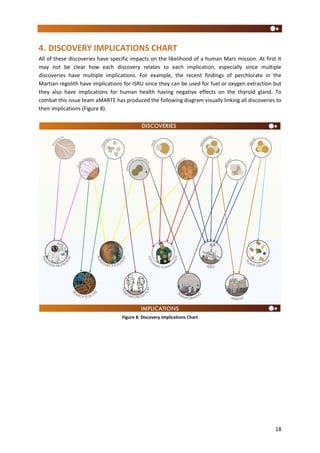
to reduce the risk of decompression sickness; however there is evidence that weightlessness may
 Research into bioregenerative life support systems
 Research into dust accumulation prevention
26
confer a protective effect on decompression sickness (Karlsson et al., 2009). Extrapolating this
evidence, the reduced gravity of Mars may also have a protective effect on decompression sickness
meaning the atmospheric pressure does not need to be as low as 8.2 psia.
The inert gas component of the Martian atmosphere at 2.7% N2 and 1.6% Ar has a different chemical
composition from that of the Earth and poses different problems for maintaining the habitat
atmosphere. The inert gas could be entirely N2 as it is on Earth, or a combination of Ar and N2. The
convenient option would be direct use of the Martian atmosphere for the habitat, however one
study concluded that Ar resulted in more dissolved gas present in the body than nitrogen and so
posed a higher decompression sickness risk if used (Pilmanis, Balldin, Webb and Krause, 2003). Since
N2 is not very prevalent on Mars, improved means of ISRU generation or shipping it from Earth
would be needed if it is to be the only inert gas in the habitat atmosphere (Norcross et al., 2015).
Despite the toxicity of CO2 to humans at elevated levels, the CO2 from the Martian environment can
be helpful for the life support system. From a chemical standpoint, the Sabatier and Bosch processes
can be used to produce O2 by catalytically reducing CO2 with H2 (Vilekar et al., 2012), and this has the
potential to create a closed loop system where oxygen and hydrogen are recycled with only carbon
as a waste product. With long-term missions, a closed life support system is preferred, and so the
Bosch system is the ideal choice of the two; however there are technical limitations such as slow
reaction rates that need further refinement (Vilekar et al., 2012). CO2 is also useful for
bioregenerative life support. Plants use CO2 as their energy source and output O2, and this can be
used along with a number of other functions of plants to supply the necessary water, oxygen, and
food for human survival (Qin et al., 2014). The abundant supply of CO2 on Mars would require initial
atmospheric modifications for plants to prosper (Anderson et al., 2015), however ideally the process
becomes self-sustaining.
For maintenance of the life support atmosphere, the discovery of perchlorate on Mars has
significant implications. It is a known oxidizer, and with the correct reaction, perchlorate
decomposes to O2 (Gu and Coates, 2006) that can be used for the life support system. This can
significantly increase the independence of a Mars mission and reduce mass.
RECOMMENDATIONS
5.2.3. WATER SYSTEM
Water is now known to be present on Mars, and this will save on mission mass as well as
accommodate for any water losses during a mission. Identifying the optimal source between ice or
the Martian regolith requires further clarification and is discussed further in Section 5.5. The
perchlorate present in the environment does present a challenge however, as perchlorate is highly
water soluble (Gu and Coates, 2006) and will contaminate the water that is extracted. Fortunately,
perchlorate can be removed by a number of methods including bio-reduction, chemical reduction,
 Further research to clarify if the dissolving of Ar in the body is consistent across
different percentages or partial pressures of the atmosphere
 Clarification of any protective effect of reduced gravity on decompression sickness
27
adsorption, membrane filtration, ion exchange and electro-reduction (Kumarathilaka, Oze,
Indraratne and Vithanage, 2016). Bio-reduction is a process where microorganisms remove electrons
from the perchlorate and eliminate its toxicity (Gu and Coates, 2006). The detoxification of
perchlorate in Martian water is simplest using bio-reduction; it is appropriate for large-scale
treatment (Kumarathilaka et al., 2016) and has been implemented on Earth for ex-situ use, however
in-situ use needs further investigation (Gu and Coates, 2006).
RECOMMENDATIONS
5.2.4. WASTE MANAGEMENT
Oxidation of solid waste is used to enable water recycling for life support systems (Anderson et al.,
2015). The discovery of perchlorate can be applied to waste management as it could be used as an
oxidizer, to further maximize mission independence and ISRU.
RECOMMENDATIONS
5.2.5. RADIATION MITIGATION
GCRs, SEP, and secondary neutrons produced from radiation interactions are the greatest concerns
for astronauts (Straume, 2015).
GCR are composed of 85 % high-energy protons, 14 % helium nuclei, with 1 % as high-Z, high-energy
(HZE) nuclei that include all elements heavier than helium(Straume, 2015). The flux density of GCR
radiation is relatively low, but their high energies make it difficult to shield against, and the high
biological damage they can cause contributes to the significant hazard of GCRs. GCR particles create
secondary radiation/neutrons from a process known as the electromagnetic cascade and neutron
build-up when they interact with materials such as metal and biological tissue. The secondary
radiation/neutrons created then inflict biological damage at a high level; up to 10-50 times worse
than other typically observed radiation. (Straume, 2015)
SEP are composed of 98% protons and the rest being helium nuclei and heavier elements that are
accelerated to high energies by the Sun from solar flares and coronal mass ejections. Mars has a thin
CO2 atmosphere that, as detected by the RAD, does reduce SEP radiation substantially, but only
somewhat lowers the GCR. (Straume, 2015)
Radiation shielding can be effective however it has problems regarding mass and potentially
increasing radiation exposure due to electromagnetic cascade and neutron build-up. The GCR can
interact with the shield creating a large number of secondary particles, including neutrons, and this
can increase the radiation dose rather than reduce it. SEP shielding however, allows most events to
be well controlled and is less logistically challenging than GCR. Radiation shielding improves with the
lower the atomic number as secondary neutron production decreases, and so polyethylene (C2H4)n
 Research into in-situ perchlorate bio-reduction
 Research into use of perchlorate as an oxidizer for solid waste
28
may be a good compromise. The regolith of Mars is also under consideration for use as a shielding
source. Unfortunately, the regolith on the Martian surface may not be suitable as a shield due to its
chemical composition and potential secondary particle generation from interaction with the GCR.
(Huff et al., 2016)
We considered whether the residual crustal magnetism of Mars could provide a source of shielding
from solar and galactic radiation. The strength of these magnetic fields however is reasoned to be
too weak to provide significant shelter from charged radiation particles. The effect of such shielding
may also be negated by the fact that the southern regions where magnetism is strongest are also
higher in altitude, meaning that atmospheric radiation protection is diminished. It remains a
question whether the unique magnetic landscape forms hotspots: regions of higher concentrated
radiation that could pose great risk to human activity. These may occur in a similar manner to the
radiation belts that reside within the Earth’s magnetosphere.
There are currently a number of challenges with radiation mitigation as the Martian atmosphere
provides only minimal protection, the crustal magnetism is unlikely to provide significant protection,
and shielding has problems resolving mass and effectiveness.
RECOMMENDATIONS
5.3. HUMAN HEALTH
5.3.1. MARTIAN PERCHLORATES AND HUMAN HEALTH
Recent findings document high perchlorate levels in the Martian soil, and perchlorate is known to
interfere with iodine uptake in the thyroid gland (Kumarathilaka et al., 2016). The thyroid is a gland
in the body that releases hormones to help regulate a wide array of functions, such as the metabolic
rate and many organ processes (Hall, 2016). Iodine is a critical component in the production of the
hormones in the thyroid gland, known as T3 and T4 (Gu and Coates, 2006). Perchlorate competes
with iodine in the thyroid, resulting in blocked or suppressed hormone production. Its effect on
thyroid function is reversible when perchlorate consumption is stopped, or with the
supplementation of synthetic thyroid derivatives of T3 or T4. Since it reduces thyroid function,
perchlorate was previously used for treatment of excessively high thyroid function, which is known
as hyperthyroidism. (Wolff, 1998)
On Earth, perchlorate is found in surface water, groundwater, soil, and food at much lower levels
than Mars. It is absorbed typically through drinking and eating, but may also be inhaled or absorbed
through the skin(Gu and Coates, 2006). On Mars, the high levels of perchlorate will affect the quality
of ISRU consumable water that is mined, and this is a significant concern. Inhalation and skin
absorption are considered minor risks for exposure (Gu and Coates, 2006), and this can occur from
the Martian dust being inhaled or resting on the skin. Epidemiological studies have attempted to
 Materials science research for mass to protection optimization of shielding
 Development of artificial magnetic fields for radiation deflection
 Measure levels of radiation and magnetism in areas of strong crustal magnetism
29
characterize the cut-off value for perchlorate toxicity for the general population; however, they have
unfortunately been inconclusive with determining exact perchlorate cut off levels, and mice studies
for toxicity did not represent human findings (Gu and Coates, 2006). When used to treat
hyperthyroidism, perchlorate has minimal side effects at low levels however at dosages from 1200
to 2000 mg/day side effects were noted with an incidence of 16-18% overall (Wolff, 1998). Most of
the side effects were mild, however there were reported rare fatalities (Wolff, 1998).
Currently, the medical recommendations regarding perchlorate on Earth are directed towards those
vulnerable to low thyroid function: pregnant and lactating women (Gu and Coates, 2006). The best
evidence recommends the optimization of iodine nutrition in pregnant and lactating women where
low iodine levels are a concern (Leung, Pearce and Braverman, 2010). Astronauts will need their own
guidelines for perchlorate exposure due to the environment of Mars. To mitigate this problem,
perchlorate can be removed from the environment by bio-reduction, chemical reduction,
adsorption, membrane filtration, ion exchange, or electro-reduction (Kumarathilaka et al., 2016).
Supplementation of thyroid hormones can also combat the reduced thyroid function.
RECOMMENDATIONS
5.3.2. MARTIAN RADIATION AND HUMAN HEALTH
For a Mars mission, radiation shielding, biological countermeasures, and/or reducing exposure time,
are available for radiation mitigation. In this section, exposure time and biologic countermeasures
will be discussed. Section 5.2 on Radiation and Life Support discusses the use of shielding.
On Mars, exposure to the GCR and SEP are the largest radiation threats to human health. The effect
of radiation is determined by the amount of radiation absorbed by tissue, measured in Sieverts (Sv).
To put it in context for the Earth and low Earth orbit environment, the average background radiation
dose is approximately 3.5 mSv/year on the Earth, and an average radiation dose over 6-months on
the ISS is 72 to 330 mSv (Clément, 2011). The effect of GCR on human health is not well understood
and the NASA Space Radiation Laboratory (NSRL) is being upgraded to a GCR simulator capable of
delivering protons and ions that are more representative of the space environment for further
experimentation (Huff et al., 2016). SEP radiation is currently better characterized than the GCR.
The evidence for cancer risk is strong for doses above 50 mSv, however acceptable levels of risk are
often guided by norms of society or ethics (Huff et al., 2016). Current radiation risk estimates for a
Mars mission are at ~1 Sv for a three-year mission (Clément, 2011). With the exception of acute
radiation sickness, radiation exposure does not cause new disease but it increases the frequency of
 Detailed analysis of human studies examining perchlorate toxicity and the relevant
effect on thyroid gland function to further characterize safe levels for human exposure
 Begin crop cultivation experiments on Earth simulating Martian soil perchlorate content,
to investigate whether cultivated crops would contain perchlorate concentrations
beyond acceptable doses for humans
 Completion of analog studies to determine the optimal thyroid hormone or iodine
dosing regimen for anticipated perchlorate exposure on Mars

30
certain diseases in a dose-dependent manner such as cancer, cardiovascular disease, reduced
fertility, and genetic abnormalities (Straume, 2015). To help monitor radiation damage, biomarkers
are in development to determine when and if biological countermeasures are needed. These are to
be based on blood cell indicators, proteins, and metabolites (Huff et al., 2016).
There are drugs that appear to have radiation-protective effects such as Amifostine and aminothiol
(Huff et al., 2016). However, there are limitations with certain medications due to toxicity at
radiation protective levels (Huff et al., 2016), and so this needs further research and development.
Gamma-tocotrienol and the statin class of medications are also being investigated as a biologic
countermeasure, with a focus on cardiovascular protection from radiation (Patel et al., 2015).
Antioxidants are less effective for radiation protection, but are less toxic. Antioxidants however also
may not confer a protective effect for cancer as they may allow the survival of damaged cells that
eventually become cancerous (Huff et al., 2016), and this is an area that needs further investigation
as well.
Currently, the radiation experienced on a Mars mission will exceed the dose normally absorbed
during ISS missions and the biologic countermeasures available require further research and
development.
RECOMMENDATIONS
5.3.3. OCCUPATIONAL MEDICINE ON THE SURFACE OF MARS
The surface of Mars offers occupational challenges beyond radiation, including physical, biological,
and chemical hazards.
Physical hazards from activity include minor to major direct physical trauma, repetitive strain,
radiation, and heat stresses (Wetherill, 2014). In particular, direct trauma from the EVA suit itself is a
strong concern (Chappell, Norcross, Abercromby and Gernhardt, 2015) and can range from hand to
foot and shoulder injuries resulting from the body putting pressure against the rigid suit. Different
levels of work risk and injury come from increasingly active motion, ranging from translation
(walking), light stationary, heavy stationary, light mobile, and heavy mobile activity (Chappell et al.,
2015). Physical hazards will be further increased as astronauts engage in mining and/or drilling
activities on the Martian surface.
Biological hazards are present, either from Earth microorganisms (Wetherill, 2014) or potentially
native Martian organisms that have yet to be discovered. With closed-loop life support systems,
biologics can be a significant health hazard (Clément, 2011). This is discussed further in Section 5.2.
Chemical hazards (Wetherill, 2014) are a large concern, particularly from Martian mineral dusts as
Mars has an atmosphere with a constant dust load (Lemmon et al., 2004). Long-term exposure to
 Continuing research into minimally-invasive monitoring for radiation biomarkers
 Research into pharmaceuticals for radiation protection
 Research into the effects of GCR on human health
31
silica and other mineral dust exposure are known to cause respiratory problems (Wetherill, 2014),
and with extended time on Mars this can be a significant health issue. For example, dust was shown
to have spread from the EVA suits to the lunar lander when exploring the Moon (Anderson et al.,
2015). This dust can deposit in the lungs, and the general reaction to mineral dust in the lungs is
fibrosis, which is a thickening and scarring of the lung tissue (Broaddus et al., 2016). This lung
damage can lead to difficulty breathing and increased risk for lung infection. Exposure to dust on
Mars will increase as a result of mining and/or drilling on the Martian surface, as the EVA suits will
be exposed to higher than normal dust levels. The Martian dust does have a significant silicon
percentage (Lemmon et al., 2004), and this adds a particular lung medical risk as silicon is known to
cause the lung disease silicosis, a specific type of lung fibrosis that is also linked to lung cancer
(Wetherill, 2014).
Maintaining maximal physical performance for the astronauts, along with minimizing cancer risk is
very important for success living on the Martian surface, and so steps to ensure occupational health
will be important.
RECOMMENDATIONS
5.3.4. PHARMACOLOGY
The knowledge of pharmaceuticals in the space environment is incomplete. For a Mars mission, a
thorough understanding of drug behavior in altered gravity, along with maintaining a biologically
active medication reserve is essential to ensure the safety of astronauts for medical problems.
The effects of how the body distributes a drug, known as pharmacokinetics, and how the drug
affects the body, known as pharmacodynamics, are not well understood in microgravity (Clément,
2011). The Martian environment’s effect on drugs, with its partial gravity, is unknown but likely will
demonstrate an effect in between full and microgravity. Some information is known about
microgravity, as research of select drugs including ibuprofen demonstrate an increased speed of
effect under microgravity (Idkaidek and Arafat, 2011). However this, along with other effects, cannot
be generalized to all drugs, particularly ones that depend on the emptying rate of the stomach
(Idkaidek and Arafat, 2011). Different routes of drug administration may also cause a drug to have
less of an effect in microgravity (Clément, 2011), and so different formulations of medications may
be needed just so they can be given to a patient in altered gravity. Currently, decisions about
pharmaceuticals for space missions are made by the best evidence from Earth (Wotring, 2011),
though this may not hold true in the space environment.
The shelf life of medications is a significant issue for long distance space travel, as most
pharmaceuticals are only guaranteed biologically effective for up to one year (Wotring, 2011). To
combat the poor shelf life of drugs, production of medications en route to Mars is an option.
Synthetic biology can help with this, as yeast that can be programmable to produce different
medications such as antibiotics is currently under development (Perez-Pinera et al., 2016). This
 Standardized dust control procedures for cleaning of EVA suits prior to habitat entry
 Analog studies on the deposition pattern in the lungs and toxicity profile of Martian dust
32
would allow astronauts to produce their own pharmaceuticals on-demand, reducing mass and
providing the security of having a diverse range of medications available when needed. The ability to
create new medications is a critical feature if new diseases are encountered on Mars either from
mutated microorganisms from Earth or native Martian organisms if they are present.
RECOMMENDATIONS
5.3.5. THE IMMUNE SYSTEM
Immune system function is known to be depressed from a variety of factors in the space
environment, including radiation exposure (Li et al., 2015). Only radiation as a cause will be
discussed here as the Martian radiation environment has only recently been characterized.
Improper function of the immune system in a closed environment is a significant concern, and this
involves its ability to control bacteria, viruses, fungi, parasites, and normal cancer suppression (Li et
al., 2015). There is concern that radiation exposure in the space environment may be synergistic in
depressing the immune system (Crucian, Kunz and Sams, 2015), leaving astronauts more vulnerable
to infections or cancer. This potential effect is currently under investigation by the Triplelux
experiment (Ullrich and Thiel, 2015). There is also a noted increase in the virulence of selected
microorganisms in space, meaning that the space environment increases the ability of certain
microorganisms to cause an infection. Along with the discovery of opportunistic organisms on the
ISS that were not expected, this could expose immunosuppressed astronauts to unexpected disease-
causing microorganisms that have increased virulence, putting their health at risk. These
microorganisms may mutate or grow faster in the space environment as well; however, this has not
been accurately determined. (Chatterjee, Bhattacharya and Ott, 2012) If microorganisms grow faster
or mutate quicker, this could also have an impact on the severity of infections experienced.
For treatment of infections, there has been conflicting evidence for antibiotic resistance rates
(Chatterjee, Bhattacharya and Ott, 2012), either for increased or decreased resistance. In
conjunction with the potentially altered drug behavior in microgravity, altered antibiotic resistance
rates could lead to an inability to actively fight an infection. A new approach for infection treatment
is with Granulocyte Colony Stimulating Factor (G-CSF) in conjunction with antibiotics. G-CSF is a
compound that stimulates the bone marrow to create certain types of white blood cells to help
boost the immune system. In mice under simulated microgravity and SEP-like radiation, the
combination of G-CSF and antibiotics is showing evidence of reducing infection rates (Li et al., 2015).
The space environment, which includes radiation exposure, can have a direct impact on the immune
system function of astronauts, as well as alter the characteristics of microorganisms. This can elevate
the risk of infection in the Martian environment, and so further research into human immune
system function and microorganism changes in the space environment is needed.
 Dedicated studies in microgravity regarding essential medications for space exploration
medicine
 Research for potential in situ production via bioreactors
33
RECOMMENDATIONS
5.4. HUMAN GROUND OPERATION
5.4.1. SPACE SUITS
An extravehicular mobility unit (EMU) is the combination of a space suit, gloves, helmet, and a
portable life support system (PLSS). Outside the habitat, it is the only protection for the astronaut to
survive in such hostile conditions as those encountered on the surface of Mars, which is why it is
often referred to as a “personal spaceship”.
The EMU is also one of the only elements that will interact both with the interior of the habitat and
the surface of the planet. It may therefore be one of the main vectors of dust and particle exchange
between these two environments. Abrasive Martian dust will not only damage the spacesuits, but
also contaminate the habitat with consequences for the health of the crew (Ferguson et al., 1999).
This is all the truer given the harmful effects of perchlorates (see Perchlorate Section 5.3.1).
Conversely, the crew could also accidentally contaminate the Martian surface because of biological
material they would bring during an EVA (Clément, 2011). This risk has to be controlled as much as
possible to avoid jeopardizing potential forms of life that could be the source behind new findings
related to methane or the presence of organics.
The EVA room will have to be specifically designed to address these issues by preventing any contact
between the crew and the outer surface of the EMU (Frankel, 2007), once washed or even sterilized.
In that case, special protocols will have to be designed for particular operations such as repairing the
suits or changing parts.
RECOMMENDATIONS
5.4.2. LOCAL NAVIGATION SYSTEM
Discovery of intense residual crustal magnetism in the Martian environment could potentially be
used as a “first-order” localization system, in a similar way to how compasses are used on Earth.
However, the Martian magnetic field is highly fragmented over the surface so it would only be used
for local navigation. This technique would require the preliminary mapping of an extended area of
the surface. In the long run, the use of the crustal magnetic field would most likely be overtaken by
more conventional satellite-based navigation systems that offer a more reliable and global coverage.
 Further refinement of EVA suits with a focus on increased mobility and safety

 Further characterization of the level and duration of immunosuppression in astronauts
from radiation exposure
 Verification of virulence and antibiotic resistance changes in pathogenic microorganism
found on the ISS.
34
RECOMMENDATIONS
5.4.3. HUMAN-ROBOT COLLABORATION
A question often asked when it comes to exploration of space is whether humans or autonomous
systems should be sent to explore. The advantages of sending robots are clear: no risk to human life,
no need for advanced life support systems, and no return mission requirement. Robotic missions
come with the challenges of semi-autonomous operations: where mission control can only decide
upon which sites to further investigate based on information from the rovers’ sensors, a feedback
loop that poses challenges, especially due to significant communication delays. Humans can operate
with a much larger degree of autonomy and can use reason and curiosity to perform science, but are
limited in sensing and actuation - they have limited mobility, and limited strength for transportation
of equipment. In light of this, recent support has been drawn towards the idea that you should avoid
not choosing one or the other, but opt for both in a synergic relationship. In researching the concept
and the recent discoveries, the aMARTE Team supports this concept. The next section outlines
capabilities autonomous vehicles could significantly contribute in such endeavors.
5.4.4. AUTONOMOUS VEHICLES FOR EXPLORATION
An important preparation for human exploration is having as much information as possible about
locations on Mars to choose a suitable landing site. Orbiters only provide limited knowledge due to
spatial resolution, temporal resolution, and instrument limitations. Autonomous vehicles offer a
solution to these challenges. Not only would such a solution be useful for resource prospecting as
outlined in Section 5.5 but also mapping the environment in high definition for the purpose of
exploration missions. Mapping on Earth is ever more frequently done using Unmanned Aerial
Vehicles (UAVs). This can also be done on Mars. NASA has proposed drone missions, such as the
Aerial Regional-scale Environmental Scanner (Mraz, 2003) that never passed the conceptual design
phase. Advances in autonomous flights, have led to the proposal of new concepts, such as one that
might fly on the Mars 2020 rover proposed by the Jet Propulsion Laboratory (JPL). (NASA JPL, 2015)
Key developments enabling such missions are the miniaturization of electronics, advances in
processing power, and developments towards more advanced flight algorithms. Discoveries pushing
the relevance of this technology include mineralogy and the discovery of subsurface ice since UAVs
could quickly and efficiently scout the nearby area to search for these deposits for use with ISRU.
5.4.5. ASSISTIVE ROBOTS
Limited strength restricts the amount of equipment an astronaut could carry. A heavy lift vehicle
could be used to solve this problem. Such a vehicle would be limited to smooth terrain so an
alternative solution would be using a rover capable in harsher terrains, being able to carry and
deploy heavy instrumentation. Advances in robotic technology, have led to recent developments in
this field, as exemplified by the company Boston Dynamics. They manufactured the Big Dog (Boston
Dynamics, 2016b) originally developed for equipment carrying for the military and Atlas (Boston
Dynamics, 2016a), a humanoid robot robust to harsh environments. With further development,
 Investigate the potential use for residual crustal magnetism for navigation
 Investigate the impact of residual crustal magnetism on current navigation systems

35
these robots might have the capability of autonomously do basic research and tedious tasks whereas
the astronaut could focus on the higher level research and exploration. Such developments could be
used to deploy drills to gather resources or search for life. To maximize astronaut time spent doing
research you would want to minimize the astronauts time collecting resources for ISRU. This can be
achieved by using robots to collect resources and bring them back to the habitat for extraction. The
Regolith Advanced Surface Systems Operations Robot (RASSOR) project is looking into building a
robot capable of doing this (NASA Technology Transfer Program, 2016).
RECOMMENDATIONS
5.4.6. PRESSURIZED ROVER
Supplying the crew with a rover can have a number of benefits: less crew fatigue, lighter EVA suits,
wider exploration range, longer exploration time (Drake, 2010).
The design, manufacture, and delivery of a pressurized rover to Mars is very expensive. Two rovers
would be necessary for redundancy and to increase range but that would add to the cost. The use of
a pressurized rover may not be necessary for all mission types: for a short mission, the crew could
perform without the rover. Alternatively, they may live in the rover itself, and not use a more
expensive habitat. For a long mission, a rover would have more value since it would be used for 500
days rather than 30.
NASA has tested its own pressurized rover, the Space Exploration Vehicle, in an Earth analog mission
(NASA, 2012). Designed for both the Moon and Mars, it features highly innovative suitports allowing
the crew to enter their EVA suits within a matter of minutes rather than hours. There are minimal
other new developments in this field. When a human mission to Mars is announced the
development of a pressurized rover will need further research.
5.5. ISRU
In-Situ Resource Utilization (ISRU) can be defined as the “collection, processing, storing and use of
materials encountered in the course of human or robotic space exploration that replace materials
that would otherwise be brought from Earth” (Sacksteder and Sanders, 2007). It is a set of hardware
and protocols that are meant to reduce the initial mass of materials needed, as well as the price of
the mission, while increasing mission and crew safety.
To be fully efficient, ISRU needs local resource exploration and planning. This includes the way the
resources can be reached, transported and transformed, as well as the need for dedicated facilities.
For instance, the distance between the resource, the mining infrastructure, and habitat must be
reasonable for conducting mission operations. The fact that a resource is available does not mean
that it can or has to be exploited, and it is necessary to know if it is technically feasible and profitable
to collect, extract and process it. (Sanders, 2016).
 Test autonomous UAV technology combined with remote sensing for minerals and
water.
36
5.5.1. WATER ISRU
Water is a basic requirement for humans and plants. Bringing from Earth all the water necessary to
support long exploration missions and long-term human presence on Mars would be extremely
expensive since astronauts will require 3.56 L of potable water and 26 L of hygiene water per day
(Clément, 2011). In addition to this is the risk of re-supply missions being unsuccessful, delayed or
canceled, negatively affecting the life of astronauts on Mars due to water shortages. Finding a way
to produce water on the surface of Mars is therefore crucial.
The discovery of water on the surface of Mars, either as ice at the poles or in the soil at the equator,
represents a critical factor in the feasibility of a human mission to Mars. Being able to extract water
from the Martian environment using ISRU techniques drastically reduces the mission cost and risk.
EXTRACTION OF WATER FROM REGOLITH
We know that the amount of water in the atmosphere is too scarce to be a viable resource for a
future human mission. However, water was identified on the surface of Mars in the form of ice in
the polar caps. In addition, shallow subsurface ice was found in mid-latitudes. Water inside hydrated
minerals (gypsum, jarosite, opal and hydrated silica, phyllosilicates) has been detected on the
surface, and although the concentrations are very low at 3%, it still provides tremendous mission
design mass benefits (Sanders, 2016). Also, when water is either frozen or locked in the soil, minimal
planetary protection issues are expected, compared with the presence of liquid water.
In mid-latitudes, Abbud-Madrid et al. (2016) identified four types of sources that have a reasonable
potential to produce water on Mars and whose characteristics have been studied from Mars robotic
landers and rovers. These four sources are ice, poly-hydrated sulfate minerals, phyllosilicates, and
regolith, and are discussed below. From our research, the Mars Water In-Situ Resource Utilization
(ISRU) Planning (M-WIP) Study was found to be an excellent resource regarding water ISRU and so
has formed the backbone of the discussion for this section (Abbud-madrid et al., 2016).
ICE
In mid-latitudes, ice is present in two forms. Permafrost has been evidenced within the top five
meters and shallow icy soils from 0.3-2 m depth. Icy soils have been found in newly formed craters
and are made of nearly pure ice (Sanders, 2016). Mining subsurface ice for water would present
numerous challenges. It is dependent on thickness of the overburden and the mechanical properties
of the ice. However, this process would produce larger quantities of water as compared to surface
mining of hydrated minerals or regolith (Abbud-madrid et al., 2016).
POLY-HYDRATED SULFATES
The extraction of water from deposits of poly-hydrated sulfate minerals offers the most advantages
compared to other methods. However, the efficiency of the process is highly dependent on the
distance between the location of the deposit and the extraction plant which can be several
kilometers from the base. This distance might be accommodated through the use of robotics as
outlined in Section 5.4 or by processing the ore into water/ice at the site of mining before
transportation to avoid carrying excess material back to the base. Currently, the excavation
technologies for surface granular material are at a relatively high technology readiness levels (TRL).
37
The compactness of poly-hydrated sulfate minerals on Mars is not yet well known however, and it is
possible that crushing will be required before extraction of water, requiring more power than if ice
were harvested (Abbud-madrid et al., 2016).
PHYLLOSILICATES
The extraction of water from phyllosilicates is inefficient compared to extraction from poly-hydrated
sulfate minerals and Martian regolith, mainly due to the high temperature required for extraction.
However, in areas rich in the phyllosilicate smectite, the use of this type of ore could be favorable
(Abbud-madrid et al., 2016).
REGOLITH
Using regolith as the source for producing water would require both collecting the most soil and
using the largest amount of processing power in comparison to other surface mining approaches. In
addition, the efficiency of the process is dependent on the distance from the base. The benefit of
this source lies in its flexibility in choosing a landing site options (Abbud-madrid et al., 2016).
Each source of water can be used to establish reserves used for a human mission, with
improvements in the production process of each being ongoing. Unfortunately, we do not have
adequate data to single out the most promising water source and as result all need to be considered
for the supply of water on Mars. Table 1 provides an overview of the various strategies that can be
employed for different types of deposits and the estimated cost benefit for transportation and
tailings per mission. Most of the time, for processing, the resource needs to be heated in order to
collect water. The required temperature is a critical parameter since it is directly related to energy
consumption and to the hardware to be designed for this purpose. An optimal temperature has to
be found in each case, as though the quantity of collected water increases when the temperature
increases, other hazardous elements as contaminants can also be unwillingly extracted during this
process (Abbud-madrid et al., 2016)
There are also risks associated with the complexity of infrastructure needs for the mining,
transportation, and extraction of water and dependency on local water resource. Should an ISRU
system break then this can cause the failure of the mission.
5.5.2. OXYGEN ISRU
Producing oxygen in-situ is a key enabling capability for human missions as it can be used for life
support as well as rocket fuel. Oxygen is bound in the CO2 in the atmosphere, surface oxides such as
Fe2SO3 in the regolith, and H2O in the ice. A device called the Mars Oxygen In-situ resource
utilization Experiment (MOXIE) being developed at the Massachusetts Institute of Technology (MIT)
is currently able to create oxygen purity of 99.6% from carbon dioxide. The process, called solid
oxide electrolysis, is separating 2CO2 into 2CO + O2. This experiment is planned to be part of the
NASA’s Mars 2020 rover (Rapp et al., 2015).
38
Table 1: Summary of key factors for different water ISRU sources. Data:(Abbud-Madrid et al.,2016)
Source Strategy
Landing
Proximity
Excavation
Approach
Ore Quantity
(Hydration)
Transport to
Refinery
Refinery
Retort
Transport
to Plant
Fuel
Processing
Total
Power
Estimated
Regolith
Surface Mining,
Central Processing
(higher temp,
lower mass)
Land on
Batch
Rovers
~1,300 mT
(@1.25%)
Minimal 300 °C
Not
required
Common
(~20 kW)
~28 kW
Regolith
Surface Mining,
Central Processing
(higher temp,
lower mass)
Land on
Batch
Rovers
~2,000 mT
(@0.75%)
Minimal 150 °C
Not
required
Common
(~20 kW)
~28 kW
Clays
Surface Mining,
Central Processing
several km
from base
Batch
Rovers
~600 mT
(@3%)
Ore Transport
Rover (~600
tons
300 °C
Not
required
Common
(~20 kW)
~25 kW
Hydrated
Sulfates
Surface Mining,
Central Processing
several km
from base
Batch
Rovers
~200 mT
(@9%)
Ore Transport
Rover (~200
tons)
150 °C
Not
required
Common
(~20 kW)
~22 kW
Subsurface
Ice
Surface Mining
several km
from base
Prohibitive
beyond TBD
meters
Not required Not required Not required
Ice
Transport
Rover (16
tons)
Common
(~20 kW)
TBD (field)
+ ~20 kW
Subsurface
Ice
Down-hole heat
probe + In-situ
Recovery
several km
from base
Drill / Kerf
only,
Downhole
"Cryobot"
heat probe
Not required Not required
Subsurface
Heating with
Gas phase
Recovery
with cold trap.
Ice
Transport
Rover (16
tons)
Common
(~20 kW)
TBD (field)
+ ~20 kW
39
The detection of subsurface water ice and perchlorates allows for new methods for extracting
oxygen. For the extraction of oxygen from H2O, ice is first melted. Several different chemical
reactions can then be used. Electrical energy is used to split H2O into both hydrogen and oxygen.
Due to the use of this technology in the Oxygen Generation System onboard the ISS, electrolysis is a
promising candidate. This approach would reduce risk and cost by raising the TRL to its maximum
(Cloud et al., 1999). Alternatively, oxygen from the water can also be extracted using bacteria or
plants performing photosynthesis as described in Section 5.2.
Due to the high solubility, perchlorates can be easily obtained by rinsing the regolith with water. The
process of decomposition from pure perchlorate to produce oxygen needs high temperatures. We
could decrease the decomposition temperature by choosing efficient catalysts and using microbial
degradation (El-Awad, 1991). These techniques still need further research. A big risk in this
technology is the ability to control the reaction rate as high temperatures together with the
presence of oxygen can lead to unwanted oxidation. (Sutter, 2014)
5.5.3. FUEL ISRU
With the exception of the Mars One mission concept, all proposed Mars mission designs share the
common element of a return vehicle. Whereas the Apollo missions carried all the fuel required to
return to Earth in the landing vehicle. A comparable design for Mars missions would imply a
prohibitively massive vehicle; As in the case of chemical propulsion, up to 90 % of mission mass
(Drake, 2010) is fuel. The same percentage could be saved through ISRU for fuel production. In fact,
this mass is so significant it exceeds the mass savings due to other systems such as water for crew
consumption, or oxygen for metabolism. As a result, this is today's main motivator behind ISRU
research.
Table 2: Potential fuel substances.
Data: (Mars ISRU: State-of-the-Art and System Level Considerations, 2016)
Hypergolic
Hydrazine
Methane
Propane
Methanol
Ethanol
Ethylene
Kerosene
Hydrogen(l)
ISP 328 2365 362 357 335 343 364 352 441
MR 1.9 1.0 3.5 3.25 1.5 2 2.75 3.0 5.25
Density 890 1020 422
500-
600
792 799 566 810 71
Liquid Phase
temperature (K)
360 387 111.7 230.9 337.8 351.5 189.5 20.3
40
Chemical propulsion can be achieved through several methods, with the most common being solid
rocket boosters, and liquid propellant. Liquid propellants offer the greatest potential for ISRU, as
they all rely on combustion: the reaction between oxygen and a second substance. As outlined in the
previous Section 5.5.2, oxygen could be extracted using several different methods. Although all
combustion processes share oxygen as a common element, several fuel substances could be used as
outlined in Table 2.
Several methods have been proposed for ISRU to produce some of the fuel proposed in Table 2
(Drake, 2010), most significantly hydrogen extraction from water processing, and methane
production from the carbon dioxide in the atmosphere via the Sabatier reaction.
Of these two methods, methane has been evaluated as the more beneficial. One of the few excess
substances on Mars is CO2, and if we split it up into carbon atoms and oxygen molecules and mix
them both with hydrogen we get both water and methane that can turned into propellant (Wu,
2016) This could also be combined with the method of electric swing adsorption that cleans the air
of the living area and get rid of excess CO2. (Lee, 2015)
This process is favorable since it offers a single step process, versus a two or more step process for
most other hydrocarbon fuels, and a very high efficiency conversion ratio, yielding more than 99%
methane when producing methane from hydrogen and carbon dioxide (Mars ISRU: State-of-the-Art
and System Level Considerations, 2016). The simplicity of the process lowers the risks and the
technology development. In addition, methane relies on the same existing technology, insulation,
cryocoolers, and tanks as used for liquid oxygen.
The fluctuation of methane in the atmosphere could indicate large quantities of methane hidden
under the Martian crust (Thomas, Mousis, Picaud and Ballenegger, 2009). In the far future we could
learn to extract these hypothetical sources and use them as fuel for the journey home.
ALTERNATIVE METHODS FOR FUEL PRODUCTION
A special bacterium called anammox has been found in urine. Normally this would have no impact
but if you mix this bacterium with recently discovered perchlorate you can form rocket propellant
(phys.org, 2011). Alternatively, urine can also be used as fertilizer that combines with the Sun’s
energy, carbon dioxide, and water to create fuel. This technology is nicknamed “the artificial leaf”.
5.5.4. ISRU FOR MANUFACTURING
HABITAT FABRICATION
One important mass driver for any Mars mission is the Mars surface habitat; this mass could be
significantly reduced through the use of in-situ resources, as the regolith could be converted to
building material for habitat fabrication.
Recent findings concerning the content of the Martian regolith have allowed for the development of
Martian analog regolith. Researchers have shown that the significant Sulfur contents on the Martian
Surface (SO3 up to 37 wt%, average 6 wt%) could be used in a 50 % Martian regolith, 50 % sulfur mix,
yielding strong material with the potential application of habitat fabrication (Wan L, 2016).
41
A second method for fabrication has recently seen big developments: the use of additive
manufacturing methods, commonly referenced as 3D printing. Recent research show that one 3D
printing method: Selective Laser Melting (SLM) could be used for manufacturing parts. The methods
involve refining the Martian regolith to produce fine powder, and using a high power laser to melt
the powder on a 2D slice in a way that it builds up a 3D shape. This method is normally used for
smaller structures, but if deployed in advance of a mission, it could produce larger ones as well.
Another method is fused deposition modeling (FDM). Research shows large 3D printers, such as the
ones we have seen on Earth for manufacturing buildings, could melt the regolith of Mars and use it
as the building material (Grunewald, 2015). Furthermore, aluminum products could be combined
with concrete (Giannakopoulos, 2016). A way to obtain concrete is mixing Martian soil and sulfur
(Wan, Wendner and Cusatis, 2016) or extracting it from CO2, present on Mars (Foulsham, 2016).
3D PRINTING FOR SPARE PARTS MANUFACTURING
Transportation or generation of spare parts on Mars is a significant challenge. For Mars One, an
estimated 13,465 kg are needed for a two year stay on Mars (Do et al., 2016). Without the capability
of quick resupply, there are two options: either bring a large amount of spare parts to Mars or
manufacture spares on site. Bringing the resources on the mission is one option: this saves the
weight of having to have prefabricated spare parts for all failures, and instead brings a common
feedstock pool that can be used on demand as failures require new spare parts. This is already being
pursued by companies, such as Made in Space (Madeinspace, 2016). In reality, one would expect to
see a combination of both, carrying 3D printing resources on-board the flight to Mars, and using
Martian regolith upon landing.
One challenge of 3D printing is not having tested it on the Martian surface. With the small 3D
printers available on Earth today one could envision testing on the Martian surface as a potential
candidate for future technology demonstrations. This leads to our recommendation of sending a 3D
printer demo on future Mars rover missions.
5.5.5. POWER GENERATION
Classical power generation for spacecraft is done using solar panels. Since Mars is further from the
Moon and has an atmosphere obscuring the Moon, this method is less favorable for a Mars mission.
Nuclear power is constant and reliable and may be a preferred option. It is already used to power
MSL on Mars (LaMonica, 2012). Other high TRL options are wind and geothermal power but the thin
atmosphere and cold planet respectively mean that these options are not viable. A low TRL option is
the use of ion power. This concept uses a set of ion collectors to collect energy from the charged
ions flying through the Martian atmosphere (Ion Power Group LLC, 2016).
5.5.6. CONCLUSION
As a future recommendation and to verify the conclusions of MEPAG report on water reservoir cases
(MEPAG,2015), it is proposed to investigate the consistency of Martian soil. For example, if the
relevant materials are not loose but rather bound on rocks or compact, the amount of power
required to extract materials could be different.
ISRU technology needs to be demonstrated to reduce as much system risk as possible. This can be
done in analog missions on Earth, on the Moon or on a rover on Mars before humans arrive. ISRU
42
systems should be pre-deployed ahead of a human mission to allow time for the systems to gather
resources.
Further characterization of the chemical composition of the manganese oxides in Mars is important.
Relevant use of those compounds according to the relevant composition should be investigated
using terrestrial examples; for example, the use of manganese in alkaline batteries in Earth.
Considering the short distances that have been covered up to today by rover missions on Mars, and
the importance of the data provided so far, it is important to identify the limitations of rovers and
design a new generation of landers and rovers for future Mars exploration missions. This would
intensify the relevant research and enhance our Martian environment understanding prior to human
exploration on Mars.
Future construction work in ISRU systems on the Martian surface should consider a combination of
surface and underground construction ideas. We should take full advantage of the Martian surface
soil heat capacity, reduce the impact of temperature differences between day and night, and shield
astronauts from radiation.
Finally, Mars in-situ resource utilization must be based on the premise of protecting the
environment, ensuring that the impact on the Martian environment is kept to a minimum, or to alter
the environment of Mars toward human habitation.
RECOMMENDATIONS
5.6. ASTROBIOLOGY
There is strong evidence that Mars was once a habitable planet with warmer temperatures, liquid
surface water, an atmosphere, and a magnetic field. Knowing meteoroid interactions between Earth
and Mars have occurred, this indicates a possibility of life having formed on Mars and further
inspires our search for it there. Only the Viking landers looked for evidence of life by putting a soil
 Further study the characteristics of the surface and subsurface material with robotic
missions.
 Simulate Martian regolith on Earth to test ISRU technology.
 Test ISRU technology off Earth e.g. on the Moon or an asteroid to vastly increase its
TRL.
 Develop robotic systems to collect, process and deliver Martian regolith for ISRU. Such
systems should be able to cope with all four sources of water on Mars.
 Design a system to isolate water from the other products that are released during the
extraction.
 Design systems avoiding the release of contaminants in water and avoiding back
contamination that could expose astronauts to subsurface materials.
 Avoid performing ISRU activities at special regions to mitigate contamination risks.
43
sample in a habitable environment. The landers created the habitable environment by heating the
sample and adding carbon and water. If there were a bacterial bloom, then the metabolic
production of CO2 would have been detected. Unfortunately, the results contradicted each other
(Klein, 1978). We think this is because of the presence of perchlorates as later detected by the
Phoenix lander (Glavin et al., 2013). There have been no further experiments searching for life on
Mars since the Viking landers (NASA Mars Exploration, 2016b). Other experiments have found
indicators for life such as organic compounds as shown in Section 3.6, but have not identified a
single biological origin.
With the advancement of biotechnology over the last 40 years, there are new detection
technologies available today. More sensitive instruments are capable of looking for evidence of DNA,
amino acids, and polysaccharides. As Mars only has a very thin atmosphere, the surface is directly
exposed to high levels of radiation. Because of that the maximum of radiation, known as the Pfotzer
maximum, is in the top meters of Martian soil (Quinn et al., 2011). As life on Mars is thought to have
started dying four billion years ago (around the period that Mars lost its magnetic field) and because
radiation exposed biomolecules in the soil will be eliminated within 450,000 years, we are interested
in searching for life deeper than five meters (Ward, 2016). In depths greater than this, biomolecules
are more protected and were able to reproduce for longer times because of increased temperatures
(Ward, 2016).
Another approach for detecting life focuses on the sudden loss of the atmosphere. We have
evidence for this fast climate change by looking at the Martian geology. By examining the global
distribution of clay in the Noachian crust across the Martian surface Ehlmann and Edwards (2014)
obtained indications of early aquatic environments on Mars. Limited local occurrences of sulfates
and silicas from the Hesperian mineralogic records show a retraction of global water towards local
ground and surface waters (Ehlmann and Edwards, 2014). The hypothesis suggests that life in a dry
Martian environment was biologically active longer than the life in water (Davila et al., 2013). This
idea is a result of applying the concept of the terrestrial evolution of life to Mars. The development
of life from aquatic habitats to landmass gives organisms the ability to slowly adapt to new
environments. As organisms in the landmass could have been adapted to dry environments when
the oceans retracted, it is possible that life sustained in dry areas longer, if not until today. We
therefore recommend expanding the search for life also to dry landmass in addition to ancient ocean
floors.
The organics detections by MSL are an indicator for life on Mars. Further missions to search for life
should be conducted. Due to the recent findings of subsurface water and the radiation environment
life should be looked for in depth greater than 5 m. As deep drilling operations are difficult to
perform using rovers, they are dependent on human missions that have such capabilities. McKay
suggests that areas of strong crustal magnetism may reveal good locations for drilling missions to
search for evidence of ancient remnants of subsurface life, especially if these correlate with
locations potentially holding ground ice. This is because regions where magnetism remains have not
been significantly heated or shocked, potentially preserving subsurface artifacts. (McKay, 2010)
Astrobiological questions arise from the short-scale variations of methane abundance should be
addressed. Observations imply unknown sources rapidly releasing methane into the atmosphere
44
from specific locations. It remains plausible that these may partially be due to life on Mars, whether
solely or from a combination with other abiotic and extraneous sources. Understanding these
processes, and the extent to which life may be involved, may shape future human missions. Should
an active source of subsurface methane release be precisely located and the origin remains plausibly
biological, the finding would significantly affect the location of human activities on the surface. The
hypothetical region will either be one to avoid (due to planetary protection constraints) or to further
explore through subsurface drilling missions.
Determining the source of Martian atmospheric methane is a key objective for future scientific
studies. In the coming years this question will be addressed by the ExoMars Trace Gas Orbiter (TGO)
mission. Expected to arrive at Mars in late 2016, it carries instrumentation to identify whether the
atmospheric methane is geological or biological in origin among other objectives (Korablev et al.,
2014; Vandaele et al., 2013). Performing high resolution and real time tracking of the changes to
atmospheric methane concentrations is advised. These activities will enable the sources and sinks of
methane to be identified and studied. In the event that the source is found to be biological, this
finding will greatly influence the location of human exploration on the surface of Mars. If the source
of methane is however geological, identifying the location and amounts of methane is
recommended as this will have potential ISRU applications. Methane is also a fundamental
greenhouse gas in the Earth’s atmosphere. In the far future, locating potential reserves of
subsurface methane on Mars could allow for its use in terraforming the red planet or for ISRU.
RECOMMENDATIONS
5.7. SAMPLE RETURN MISSIONS
Sample return missions are continuously proposed as they are expected to yield a high scientific
return due to the broad spectrum of experimental instruments available on Earth. This variety of
experiments would not be possible in-situ due to the mass of the instruments required. The
uncertainty of the measurements would also be lower on Earth, as measurements could be repeated
and the instruments calibrated without data link or power constraints. Another key benefit of
sample return missions is the ability to replicate measurements in different independent research
groups, increasing the significance of results.
The timing of sample return missions with regard to human missions is dependent on their duration.
In the case of short duration human mission, which is not dependent on ISRU technology, a previous
sample return mission is not required. In fact, such a human mission could actually be used for
sample return similar to in the Apollo missions. For a long-term stay implementing significantly more
 Use new techniques to search for life including DNA, amino acids, and polysaccharides.
 Search for life in the subsurface at depths greater than 5 m.
 Expanding the search for life also to dry landmass in addition to ancient ocean floors.
 Use of high resolution remote sensing to map location and depth of subsurface water
reserves to assist in the choice of a landing site.
 Use of high resolution remote sensing to track changes in the levels of methane to
identify sources and sinks.
45
infrastructure and ISRU technologies, we would certainly need a precise analysis of the soil, so a
sample return in advance of such a mission is recommended.
The potential back contamination of Earth by a Martian sample is a major concern for health on
Earth. Due to the nature of the sample, the uncertainty of its composition is high and therefore the
risk for biological contamination is difficult to determine. A common hypothesis in the scientific
community is that the risk of back contamination is low due to the constant exchange of materials
between Earth and Mars in the form of meteorites. (European Science Foundation -European Space
Science Committee, 2012)
Several missions to date have been proposed to include sample return capabilities, such as the
ExoMars mission and the Mars 2018 rover, but the sample return component has been canceled due
to complex mission design and budget cuts. The next potential opportunity for a Mars sample return
is the Mars 2020 rover.
RECOMMENDATIONS
5.8. TERRAFORMING
Terraforming is the hypothetical process of altering the atmosphere, temperature, and ecology of a
planet, so that it is more Earth-like and suitable for human survival (Clément, 2011). This can be a
controversial subject, however this process has been and continues to be considered for Mars, and
so this section will focus a brief discussion on the topic of terraforming.
5.8.1. TIME FRAME
If undertaken, the alteration of the environmental conditions on Mars is expected to take between
hundreds and tens of thousands of years, however the initial activation process might be as short as
a few tens of years (Zubrin and McKay, 1997). An initial process of Martian surface warming,
followed by deep warming and then O2 production is anticipated (McKay, 2016). This can be viewed
as a chain of improvingly habitable conditions for humans on Mars, but this would still involve
habitations with life support systems in the early stages.
5.8.2. METHODS OF TERRAFORMING
Though technically challenging, there are many concepts of how terraforming can be done and a few
of these will be discussed here.
1. ARTIFICIAL GREENHOUSE GASES
The aim of this method is increasing the greenhouse effect on Mars through the injection of
synthetic gases, in particular fluorine-based gases. These gases can even be made in-situ on Mars
from elements already existing on the planet (McKay, 2016). Among them, Octafluoropropane (C3F8)
is particularly efficient in terms of atmospheric warming capacity, due to minimal reactions with
 Perform sample return mission, either robotic or human, before starting a permanent
human presence to characterize environment precisely and with high certainty.
46
other gases in the atmosphere (Shiga, 2006). At sufficient warming levels, the carbon dioxide and
water ices that create the polar caps will sublimate and the gasses produced will contribute further
to the greenhouse effect. This positive feedback loop would cause not only a temperature increase
but ultimately also a thicker atmosphere with higher pressure that would further the process of
terraforming (Dicairea et al., 2013). Currently we are not Once this process is started, it will be
difficult to stop (e.g. current Earth greenhouse gasses situation)
2. ORBITAL MIRROR
This method involves placing 300 reflective balloons that are 150 meters across side-by-side to
create a 1.5-kilometre-wide mirror in orbit around Mars. With such a mirror, the Moonlight would
be reflected to the surface, raising the surface temperatures up to 20°C and initiating the warming
needed for terraforming. Once the required temperature is reached, the mirrors could be used for
energy production. The mirrors could also heat a smaller area and focus the heat to make liquid
water available. This method for heating the Martian surface has significant challenges, not least
being the deployment of the mirrors as well as the risk of high radiation levels directed onto the
surface. (Woida in Piquepaille, 2006) To prevent the increased radiation on the surface, the balloons
will need to be coated by materials reflecting only visible and infrared light. (Shiga, 2006)
3. INTRODUCTION OF AMMONIA THROUGH ASTEROID COLLISION
Ammonia is a greenhouse gas and can be found in abundance in some asteroids. As such, one
method of increasing the greenhouse gases on Mars could involve the deflection of an ammonia-rich
asteroid into Mars, with the resulting collision releasing the asteroid’s gases. A great challenge in this
method lies in identifying an asteroid with sufficient ammonia. Further, it has been noted that “an
asteroid hitting Mars with an energy yield equal to about 70,000 megaton. This can make this
project incompatible with the objective of making Mars suitable for human settlement”. (Lovelock
and Allaby, 1985; Zubrin and McKay, 1997).
5.8.3. ETHICAL CONSIDERATIONS
The terraforming of Mars faces two primary ethical considerations. From an anthropocentric point
of view, terraforming Mars would provide a second habitable home and aid the survival of the
human species. It can be argued that humanity must protect itself by establishing new homes on
other planets. Related to this, in the Solar System there are no other suitable places for human
habitation without the need for extensive terraforming (York, 2002). However, from a biocentric
point of view, terraforming is considered unethical because it implies interfering with a foreign
planet and its possible life forms. Does Mars have an intrinsic and/or extrinsic value? Paul York
argues that “although Mars harbors no life forms of any kind, as far as we know, it has significant
intrinsic value – a value that exists irrespective of any value that humanity may place on it.” (Paul
York) (McMahon, 2016, French, 2013). Debate surrounding the issues of terraforming is not easily
resolved and will require further consideration in the future as humans explore and invest in Mars.
RECOMMENDATIONS
 Terraforming represents a large project of significant technical complexity that requires
further research, evaluation, and ethical considerations over the long term
47
5.9. PLANETARY PROTECTION AND HUMAN MISSIONS
At present, there are no common protocols in the United Nations Outer Space Treaty (OST) system
defining operational requirements for human-robotic missions. Likewise, there are no guidelines
applicable to discovery of non-intelligent and intelligent life beyond Earth, no “regulations covering
more than biological and organic contamination” (Race, 2011; Race and Randolph, 2002). As noted
by Margaret Race, author of Policies for Scientific Exploration and Environmental Protection:
Comparison of the Antarctic and Outer Space Treaties, “all legal and ethical systems on Earth are
based on life as we know it” (Race, 2011).
We hypothesize that methanogens could survive on Mars or Europa. It was not the case during the
Apollo program, which remains the sole episode when an agency implemented back contamination
and sample quarantine procedures in human missions. Protocols and elaborate facilities, crew
decontamination within the Lunar Excursion Module (LEM) and atmosphere sterilization in the
Command Module (CM), did not guarantee immunity to “operationally-derived” breaches in the
quarantine process. During the return of Apollo 11 lunar contaminants may have been released into
the Earth’s atmosphere through: 1) a vent, 2) spacecraft hatch, 3) during transportation of crew
from the CM to the shipboard mobile quarantine facility. (De Vincenzi, Klein and Bagby Jr., 1990;
Race, 1995)
Today, NASA is crafting new agency-level requirements for human extraterrestrial missions, but the
overarching OST framework, in contrast to the Antarctic Treaty international arrangements, does not
seem to be adaptable to our evolving understanding of life potential in extreme environments and
the ways this life might transfer. Recent dynamics in the Planetary Protection Policy developed by
the Committee on Space Research (COSPAR) do not go beyond the lines of Article IX OST that
stipulates two core imperatives: “avoidance of harmful contamination and also adverse changes in
the environment of Earth”. In compliance with this provision, COSPAR set uniform principles for
robotic and human missions, and “planetary protection goals should not be relaxed to accommodate
a human mission to Mars” (COSPAR, 2002). Launching states choose to adhere to these unbinding
rules.
As national, international, and private actors are preparing to invest substantial capabilities and
resources into future crewed exploration, the results of the Viking mission life detection experiments
remain a subject of scientific reinterpretation (Apak, 2008). We do not know what are the
biochemical characteristics of subsurface ice and water that are more easily accessible, for example,
in Mars Special Regions. These areas where “terrestrial organisms are likely to replicate” can also be
“interpreted to have a high potential for the existence of extant Martian life forms” (COSPAR, 2002).
Best landing spots in terms of access to in-situ resources for mission and human life support are
located in special regions, but astronaut safety and forward contamination considerations limit the
mission operational scope to “Safe Zones,” identified by robotic reconnaissance (Conley and
Rummel, 2008). Data collected by robots has been driving the development of a “one-size-fits-all”
planetary protection policy, with forward contamination control requirements based on our
knowledge of the Earth’s biological systems and elements, their ability to proliferate. But what
propagates major concerns about cross-contamination of the two planetary environments is really
48
the question of whether Mars is devoid of indigenous life. Should ExoMars or the 2020 NASA Mars
rovers come across interesting biomarkers that compromise our paradigms, it could put a halt to
human exploration. This circumstance is indicative of a potential policy gridlock over planetary
protection rules versus objectives of future international missions, and it can happen on the
preparation stage.
What if this occurs during the stay on Mars? According to the COSPAR guidelines for missions under
Category V “restricted Earth return”, in case of “a change in the circumstances … or a mission failure,
e.g. the sample containment system of a mission classified as “restricted Earth return” is thought to
be compromised, and sample sterilization is impossible, then the sample to be returned shall be
abandoned, and if already collected the spacecraft carrying the sample must not be allowed to
return to the Earth or the Moon.” (COSPAR, 2002). Sterilization procedures are not becoming
cheaper, and prolonged quarantine measures during the long stay landed mission would be
counterproductive to its planned activities and goals. The COSPAR principles rule out any possibility
that crew could conduct surface operations “within entirely closed systems” (COSPAR, 2002).
Experts also associate major risks of forward and back contamination with unknown consequences
of exposure to Martian materials. Earth microbial populations can compromise the local
environment through ISRU. In turn, local resources risk affecting human performance and
functioning of life support systems. The same logic applies to the circulation of materials and crew
rotation between Earth and Mars, as well as hypothetical “transfer of genetic material and traits”
between Martian and human organisms, should they stem from one tree of life (Rummel, 2016).
The likelihood of keeping the crew, robots, and the entire landed system sterile throughout all
mission phases is low. Overall, COSPAR will be reluctant to relax the current regime unless
information about past or present biochemical activity on Mars reaches a critical mass and quality
(Rummel, 2016). As for Special Regions, which “neither robotic systems nor human activities should
contaminate”, in theory, a diversified policy approach could help circumvent emerging tensions
between responsibilities to protect these areas and implementation of ISRU to reduce mission costs.
NASA/ESA planetary protection communities cooperated with expert groups on advanced life
support systems (ALS), EVA, and in-situ sampling operations and support (Ops) to identify
requirements for contamination control for different mission phases. They proposed a model
comprising non-special regions (low potential for the existence of Martian life and growth of Earth
organisms), regions of local contamination risk, and regions of global contamination risk (human-
carried microbes spread, and local life is present) (Race, Kminek and Rummel, 2008).
Subsequently, MEPAG released the SR-SAG2 report that acknowledged the need to reconsider the
definition of special regions based on new data we have about Martian environments, as well as
“capabilities of terrestrial organisms” (Rummel et al., 2014). With that, peer reviews stressed that
“the impact of human spaceflight, in general, and Special Regions, in particular, was not granted
much attention(Committee to Review the MEPAG Report on Mars Special Regions;, 2015).
Meanwhile, NASA has been translating the knowledge gaps related to COSPAR guidelines into more
specific requirements for human extraterrestrial missions. Among key gaps areas: human health
monitoring; technology and operations for mitigating microbial and organic contamination; the
implications of mission duration. (NASA Planetary Protection, 2016)
49
RECOMMENDATIONS
5.10. ETHICAL ISSUES AND CULTURAL IMPACT
As we gain more knowledge about the Martian environment and its geological history, researchers
have started considering the prospect of finding life, or at least traces of previous life. A decade ago
it seemed to be a rushed obsession to find life on Mars without sufficient scientific evidence to
support this claim (Steve Conner). An example of this is when in 2019 NASA promoted a conference
that aimed "to discuss an astrobiology finding that will impact the search for evidence of
extraterrestrial life." (NASA Press release). Although biological activity has not been found outside of
Earth, hopes for finding it have intensified. There are findings in Mars that suggest that the presence
of methane on the Martian atmosphere could be the product of biological activity, as we know it on
Earth. (refer to Section 5.6). Additionally, the new discovery of detecting organics is a strong
indicator for this hypothesis. The cultural consequences following the discovery of life on Mars are
unknown but it remains important to address these questions.
Today ethicists need to embrace astrobiology to reflect on what is the ethical valuation we will give
to extraterrestrial life forms. If we argue that life has intrinsic value, meaning that it is valuable for
what it is, we would not be able to make any distinctions between different life forms. If bacteria is
thought of having intrinsic value in a universal way then “the bacteria in my bathroom have every
bit as much potential to develop into fascinating philosophical interlocutors as those on Mars.”
(Smith, 2014)
There are various positions towards the different approaches to this discussion. A starting point
could be to clarify if this issue is about conservation and preservation or about our needs, wants,
and desires? The ethical dilemma of confronting new life forms will ask “when must my needs give
way to another’s? How can we make life better for ourselves and for others? And how do we correct
course once we realize we’ve made something worse? Discussing how we’ll answer those questions
in relation to alien life is our greatest chance to wrestle with who we want to be as a species”.
(Wade, 2015)Global discussion will be required to answer these questions and eventually it will be
critical to think about how these ethics are embodied in actual policies (Horneck, 2008).
If Mars is strategically important for establishing human civilization as multi-planetary, the core
principles of the OST relating to planetary protection and peaceful use of outer space, as well as
the COSPAR guidelines should be supported by:
 A multilateral consultation mechanism between international, national and private
actors to facilitate negotiation of requirements for extraterrestrial human exploration,
inclusive of planetary and environmental protection principles.
 A new working group within The United Nations Committee on the Peaceful Uses of
Outer Space (COPUOS) tasked to assess the implications of discovering non-intelligent
and intelligent life forms that originate from extraterrestrial areas of space and develop
guidelines and an operational protocol for cases of their detection in and beyond areas
of human habitation.
50
6. FINANCE, LEGAL AND BUSINESS CONSIDERATIONS
The roadmap the aMARTE Team has produced is specifically focused on scientific and technological
recommendations. However, there are other aspects of a human mission to Mars that extend away
from these strict guidelines. For example, the big question of how we are going to fund the mission
or which nations or corporations collaborate on what will be the greatest undertaking of human kind
to date. Other issues such as planetary protection, and the use of the Moon or other celestial bodies
as demonstrator missions are also covered. The discussion so far has been primarily scientific. There
has been little mention of the international nature of this mission to Mars up to now. The aMARTE
Team would like to stress at this point that we consider international collaboration an essential
aspect of bringing humans to Mars.
6.1. FINANICAL
It is important to focus on how governments will be able to fund a human exploration mission to
Mars. Such an endeavor will be highly political and will depend on several factors including economic
and political situations that may change drastically with time. The following analysis is highly
hypothetical and assumes that humans will likely not land on Mars before the 2030s. The other basic
assumptions are that:
 There will be no “space race” in the coming decades
 Mars exploration will be led by the United States of America (USA), as it is currently the
country with the largest budget dedicated to space exploration
 The countries currently involved in the ISS will pursue human activities in space after the end
of its life (2024 or more likely 2028)
6.1.1. SCENARIOS
In this section we describe three cases affecting the budget available for the crewed exploration of
Mars after the end of the ISS. We adopt the standard procedure of any prospective exercise (e.g.
Intergovernmental Panel on Climate Change or IPCC report) studying long-term effects depending on
a large number of parameters and consider three cases: a normal case (“business as usual”), a
pessimistic case, and an optimistic case.
NORMAL
Within the “normal” scenario, countries already involved in human exploration (such as the ISS or
the Chinese human activities) are expected to sustain their efforts for a future Mars project. It is also
assumed that no significant political or economic change - like a major crisis - will happen before
they undertake this mission. The main focus of the USA and Europe will be on human exploration.
Other countries will contribute to the effort on a smaller scale, directly and indirectly. The funding
will be predominantly governmental.
OPTIMISTIC
This scenario considers that the governments currently involved in space exploration are willing to
fund activities to levels higher than currently provided. It also envisions that the future political and
economic environment will allow the upcoming space faring nations to invest in human exploration.
51
In addition, it is assumed that these governments will encourage participation from the commercial
sector with additional funding.
PESSIMISTIC
In this scenario, we consider that the international, economic, or political environment will lead the
major space-faring countries to decrease their current funding for exploration. The main player in a
mission to Mars will be the USA, but with a reduced budget. Other countries will not be significantly
active in this effort.
6.1.2. BUDGETS
USA BUDGET AVAILABILITY
The exploration of Mars seems currently fully aligned with the space policy of the USA. According to
the “NASA Fiscal Year 2017 Budget Estimates” report (NASA, 2016), NASA is providing each year
between US$4 billion and US$4.5 billion for exploration including systems development like SLS and
Orion, commercial spaceflight, and Research and Development (R&D) as well as between
US$3 billion and US$4 billion for ISS operations.
CHINA BUDGET AVAILABILITY
China implements its space activities based on five-year plans. The human exploration of Mars
currently doesn’t fit with China’s space policy, which seems more oriented towards a LEO space
station and lunar human exploration for the next decades. If we consider that China follows through
on its lunar program and lands taikonauts on the Moon in 2030, we could envision that China’s next
step would be a mission to Mars, especially if other space agencies turn towards this planet. Another
possibility is that China does not take part in a Mars program led by Western countries and
continues to focus only on the Moon. (Jones, 2016)
The available figures describing China’s funding for space activities are very scarce and often
inaccurate. According to the figures of the last “Profiles of Government Space Programs” report
(2015) of Euroconsult, the leading international, fully independent consulting and analysis firm
specializing in space markets, we can consider that China is investing US$4.5 billion each year for
space (civilian and military).
EUROPE BUDGET AVAILABILITY
Currently, human exploration of Mars is not directly included in ESA policy. Newly appointed ESA
Director General Dr. Woerner recently made a statement about a Moon Village, implying a priority
of lunar exploration over Martian. (ESA, 2016a)
In 2016, ESA dedicated over US$400 million to human spaceflight, mainly for its activities with the
ISS. It also dedicated US$1 billion for launchers, mainly for the development of the new European
launcher Ariane-6, scheduled to be fully developed in 2020.
52
RUSSIA BUDGET AVAILABILITY
As with China, the available figures describing the exact Russian funding for space activities are not
completely known. According to Euroconsult’s 2014 figures, we can consider that Russia is investing
US$8.7 billion each year for space (civilian and military). We assume that US$1 billion goes each year
to the ISS program, and that the same level of funding would be available for a human Mars mission.
JAPAN BUDGET AVAILABILITY
According to Euroconsult’s 2014 figures, we can consider that Japan is investing US$2.6 billion each
year for space (civilian and military). Further, the Cabinet of Japan published its Basic Space Plan in
April 2016, in which it calls for a strengthening of the USA-Japan alliance. We can then consider that
Japan would follow the USA in a Mars initiative.
INDIA BUDGET AVAILABILITY
According to Euroconsult’s 2014 figures, we can consider that India is investing US$1 billion each
year for space (civilian and military), including projects around satellites, human spaceflights, and
launches, among others.
BUDGET AVAILABILITY FROM OTHER COUNTRIES
We envision that other countries (such as Mexico, Brazil, and Indonesia) could have reached a level
of Gross Domestic Product (GDP) by 2030 that will allow them to be ready to invest more
significantly in space exploration and take part in a Mars initiative. If the mission governance allows
for these countries to take part, we foresee they will bring significant funding.
Error! Reference source not found. shows a summary of the scenarios described above and the
nternational space budgets for each:
Table 3 Yearly Human Exploration Space Agency Budget.
Country
Pessimistic hypothesis
[US$ billion]
Normal hypothesis
[US$ billion]
Optimistic hypothesis
[US$ billion]
USA 5 7.5 10
China 0 0.25 2
Europe 0.5 1 2
Russia 0 1 2
Japan 0.2 0.4 1
India 0 0.2 1
Others 0 0.25 1
TOTAL
[US$ billion]
5.7 10.35 19
6.1.3. SPACE AGENCIES’ ROLES
In addition to direct and indirect funding, governments have various ways to contribute to the
project. With a project of this scale, not only is it important to have the international community and
53
governments involved, but also the commercial sector and general public. NASA, for instance,
develops Public-Private-Partnerships (PPP) by contracting for fixed-price services (e.g., lift capacities
from SpaceX and Bigelow Expandable Activity Module from Bigelow Aerospace) and by awarding
specific contracts for outer space exploration technologies (e.g. NASA’s NextStep habitat study
(FedBizOpps.gov, 2016)).
Compared with the legal environment in which NASA operates, and in particular considering US
export regulations, ESA is considered to hold a more neutral position allowing deeper strategic
cooperation with other space agencies from countries like China and Russia. In this way, ESA is in a
good position to contribute to the global effort of international collaboration. The Indian Space
Research Organization (ISRO) has launched a relatively cheap Mars orbiter (called Mangalyaan,
costing US$74million), and its main contribution in a future Mars mission might be in R&D for lower-
cost technologies. In summary, when considering such a mission, we should not focus only on direct
funding, but look for cooperation with partners that can contribute in other ways.
6.1.4. NONPROFIT ORGANIZATIONS
In addition to governments, there are multiple nonprofit organizations interested in human Mars
exploration. While they probably won’t directly donate to the overall budget due to lack of financial
resources or because they would prefer to subsidize their own projects, they can contribute in other
ways.
The Mars One Foundation’s objective is to establish a permanent human settlement on Mars, and it
wants to be the first organization to complete a human mission to the planet. To reduce costs and
complexity, they are planning a one-way mission. The funding of the mission will come from various
sources, ranging from broadcast rights to crowdfunding. Since Mars One’s mission does not go hand-
in-hand with NASA’s goal, it is not likely to use mutual funding. However, it is possible they will
combine forces to develop technology. The main contribution of Mars One to human Mars
exploration will probably be R&D and outreach to the general public with their documentary series
on candidate training.
It is important to mention that not everyone believes this project is feasible, especially not as
described on the Mars One website (Mars One, 2016). According to MIT’s assessment of the Mars
One project’s feasibility, last revised in 2015, Mars One’s budget is too low, the timeline is
unrealistic, and in general they are not prepared to face the Mars environment with their current
plans (Do et al., 2016). Regardless, we believe that their contribution to Mars exploration will be
significant.
In addition to Mars One, other organizations might offer interesting contributions in addition to
public outreach. The Mars Society organizes analog missions on a regular basis at two different
stations: the Mars Desert Research Station (MDRS) (see Figure 12) in the desert of Utah and the
Flashline Mars Arctic Research Station (FMARS) in Canada. They will help in the understanding of
human sociological aspects and operations in an environment similar to Mars. It will also help with
research and education, political efforts, and organizing reports concerning Mars.
54
Figure 12: The MDRS in the desert of Utah
The Google Lunar XPRIZE is a competition that encourages development of a cheap lunar lander,
which may create technology relevant for a Mars mission, and it further encourages smaller
organizations for human exploration.
6.1.5. COST ESTIMATION
The mass of the spacecraft and equipment sent to Mars will be the major driver for the mission cost,
and each kilogram launched will come at a high price (that reflects the extremely significant cost-
saving potential of ISRU). To estimate the approximate cost of a future mission, we will calculate the
average cost/mass ratio of previous deep space missions.
Since the first mission in October 1960, Mars and its moons have been targets for a variety of
spacecraft mission types (flyby, orbiter, lander, rover, and sample missions). About 50 missions have
been considered as an input for this database, dated Aug. 2016. (Choudhury and Sugden, 2014;
NASA, 2016; NASA Planetary Protection, 2016; Kiran Krishnan Nair, 2015) However, due to the
difficulty in finding precise and reliable information related to the cost and weight of some of the
missions, the database only contains NASA, ESA, Roscosmos, and ISRO missions data, with 27
records in total.
To compare each mission cost occurring over more than a 60-year period (for example, to compare
1970s dollars with 2000s dollars), we needed to take into account inflation. We then downloaded
and referenced the historical annual averages for rates of inflation from 1914 to June 2016 published
by the US Bureau of Labor Statistics (see Figure 13). This allowed us to measure the buying power of
the dollar over time and normalize all the missions’ costs to the same year (2015). We then used a
tool that we designed to calculate the accumulative total inflation rates to year 2015, and the final,
verified result is similar to the US Inflation Calculator outputs:
55
Figure 13 Inflation rate from year 1960 to 2015. Data: (US Inflation Calculator, 2016)
To extract a trend for our future mission estimation, we needed to link the mission cost to the
performance. As a primary approximation, we selected the mass as a key spaceship characteristic.
We were then able to calculate the normalized ratio of cost over mass for each mission type. In
Table 4, statistics are shown for various mission types, providing a more precise prediction of future
mission cost.
We made the distinction between various combinations of Mars missions (orbiter and/or lander
and/or rover) to show how the complexity of a mission impacts the cost. The cost of NASA and ESA
lunar robotic missions is significantly higher than that of CNSA and ISRO missions, demonstrating
that other methods and approaches are beneficial to the overall budget.
The total cost of India’s Mangalyaan mission was about US$74 million, in comparison with NASA’s
MAVEN Mars orbiter, which has a total mission cost of around US$672 million (Whitwam, 2013). The
Indian orbiter itself cost around US$25 million, with the rest of the budget being consumed by
launch services and upgraded ground stations to support the mission (which will also aid future ISRO
missions). This can be compared with NASA’s MAVEN orbiter, which cost about US$485 million to
develop and around US$187 million for the launch and further ground support. This means ISRO’s
mission cost around 11 % of NASA’s MAVEN mission (Anthony, 2014).
Of course, a direct comparison of only cost to mass does not represent a thorough comparison of
mission cost effectiveness. While Mangalyaan is a technology demonstration mission with 5
scientific instruments that analyze both the atmosphere and surface of Mars (for a total mass of 15
kg), the NASA MAVEN spacecraft features 65 kg of scientific equipment. MAVEN is a much larger
device, with a launch mass of over 2,500 kg, requiring a much larger (and more expensive) launch
vehicle as compared with Mangalyaan, which had a launch mass of just over 1,000 kg. Other factors
should be considered as well, like the purchasing power of the dollar in India compared with the
USA, along with the different management structures and human resources internal policies of ISRO
and NASA.
Table 4: Overview figures of ratio cost/kg for each mission type.
56
Typical mission # of
missions
Period Average
Mass
(kg)
Average
Cost
($M present
value)
Average of
Ratio
cost/mass
($M/kg)
Std.
Deviation of
Ratio
($M/kg)
Mars Orbiter
(NASA/ESA)
9 1971-
2003
1,211 1180 1.15 1.24
Mars Lander
(NASA/ESA)
3 1999-
2007
236 302 1.51 0.66
Mars
orbiter+lander
(NASA/ESA)
3 1975-
2016
2,414 3,470 2.14 1.53
Mars
Lander+rover
(NASA/ESA)
4 1996-
2011
386* 1016 2.49 0.69
Lunar orbiter**
(NASA/ESA)
5 2003-
2013
656 305 0.68 0.35
Lunar orbiter**
(CNSA/ISRO)
3 2007-
2010
2070 145 0.07 0.13
Lunar
lander+rover**
(CNSA)
1 2013 1200 328 0.27 --
Lunar human
Apollo missions,
(for 3 people)
11 1959-
1973
50,000
(LM:16t)
10,780 0.22
(LM:0.67)
--
(*) Curiosity mission is 900kg whereas the other ”lander+rover” missions are less than 275kg. This is
why specialists usually state that current landing technology has been pushed to its limits.
(**) Lunar missions launched after 2000; CNSA/ISRO mission statistics are separated from NASA/ESA
missions to better demonstrate the difference in terms of the cost/mass Ratio.
According to our results as shown in Table 4, we calculated an average ratio of US$2.5 million per
kilogram for a Mars lander and rover mission. Extrapolating this number to the mass of the Apollo
Lunar Module (15-16 mT), we can roughly estimate that a single Martian, human exploration mission
will cost $37.5-40 billion. However, international cooperation may provide for cost-effective
solutions (like the CNSA and ISRO lunar mission showed) and the development of new technologies
(like high-thrust electric propulsion) that would probably reduce the overall cost. Ultimately, every
kilogram saved would reduce the total cost by a few million US dollars. With regard to the new
discoveries on Mars, if it becomes possible to process water and rocket fuel in-situ, then the initial
payload mass would be significantly lower, and therefore the cost as well.
6.1.6. BUSINESS OPPORTUNITIES
Opportunities for new businesses are possible when an appropriate market is foreseen to be large
and stable enough for investment in the long term. This section will provide a short analysis of the
private sector dynamics that are emerging and that could support deep space missions, such as to
Mars.
57
Space agencies play a very critical role when contracting private companies to develop new
knowledge, technologies, and capabilities. However, private technology companies look for a
relatively short-term return on investment, which is usually not compatible with space exploration
technology developments.
We have identified two types of commercial space companies that might eventually participate in
later Mars mission activities:
 Technology companies, involved in deep space activities, that will open new markets thanks
to PPP funding;
 Symbiotic companies, that will contract with technology companies to provide non-space
users with new types of services.
Through PPPs with space agencies, technology companies would emerge more quickly. They would
develop, provide, and sell capabilities to support deep space missions. Their markets would be
public, addressing space agencies’ regular needs for equipment manufacturing, transportation, and
telecommunications, etc. Depending on the development of these capabilities, a private economy
could emerge. And as those technology companies succeed in lowering their costs, they will also
open new markets.
Other companies may benefit from these technology companies in buying mature and recurrent
space capabilities to support their own services, and as such could be called symbiotic. Their markets
will probably address non-traditional targets (space leisure, space manufacturing, and cultural &
social services, for example), and as a result they will indirectly contribute to the financial effort of
human exploration, in relaying space agencies’ funding role.
Table 5 lists major integrated service providers that are actively involved in deep space exploration.
LEO and lunar service providers are also listed below if they are precursors in developing
technologies that could support future Mars missions as discussed in Section 6.4 (they could serve
the Mars vicinity as soon as there is a market there).
Table 6 lists several examples of businesses that build the bridge between the space sector and the
rest of the world economy. It follows with examples of emerging or potential markets that could do
the same in the mid- to long-term.
58
Table 5: Technology Companies Table.
Technology
companies
Technology / Services provided
SpaceX Supply chain and human space transportation, including potential private tourism.
Develops the Falcon heavy launch vehicle to adapt the Dragon capsule (NASA
contracts): $90-130m per launch depending on the payload mass (13,600 kg
capability to Mars orbit).
Plans to land a Red Dragon capsule (about 7,000 kg) on Mars by 2019 and then land
people on Mars by 2025.
(V. Patel, 2016; spaceflight101.com, 2016; SpaceX, 2016; Kane, 2016)
Blue Origin Supply chain and human transportation, including potential private tourism.
Long-term vision of going to Mars (after 2024) and developing activities from tourism
to off-planet heavy industry.
(Blue Origin, 2016; BOYLE, 2016)
Deep Space
Industries
(DSI)
Space mining with the long-term goal of setting up a supply chain, building materials
in space, and processing rocket fuel.
Develops new technologies like micro-satellite electric propulsion and avionics. In
selling these new products to the current space market, they could support more
advanced technology development.
(Planetary resources, 2016)
Planetary
resources
Space mining with the long-term goal of building materials in space and processing
rocket fuel.
Develops new technologies like microsatellite high delta-v propulsion, optical
telecommunications, and space-based planet/asteroid scans.
(Deep Space Industries, 2016)
Audacy End-to-end telecommunication relay services to relay satellite communications from
any spaceship in the Earth/Moon vicinity to/from the Earth ground network.
This service would allow fast-deployment and lower cost regarding spectrum
regulation issues and ground segment operations.
(Audacy company, 2016)
Sen Media coverage and outreach resources.
Develops autonomous space TV cameras, able to record space activities for
broadcasting.
(Black, 2012)
Made In
Space
Space manufacturing of plastic and metal parts.
Demonstrator is being tested on the ISS since 2014. On-going project to design a
robotic factory able to build and assemble large structures like antennas.
(Madeinspace, 2016; Werner, 2016)
Bigelow Space habitat and deep space spaceship (EMMT - Earth Moon Mars Transporter)
59
Technology
companies
Technology / Services provided
Aerospace Contracts with NASA for LEO space module demonstrator.
Plans to expand and support deep space exploration.
(Seemangal, 2016a)
Lockheed
Martin
Orion capsule for LEO and deep space transportation.
First crewed launch to Mars could happen in the 2020s.
(Howell, 2016; Seemangal, 2016b)
Table 6: Symbiotic Companies Table
Symbiotic
companies
Market assessment
(potential external private funding)
Mars One Program management and system engineering to support its own Martian mission:
to land 4 people on Mars by 2027 for US$6b.
Develops technology with partners, holding the license rights.
Subcontracts spaceship design/launch hardware and services. Example: Surrey
Satellite Technology Ltd is engaged in preliminary studies for telecommunication
capabilities (Foust, 2015).
External markets reached:
Movie broadcasting and media rights (Mars journey documentary, already begun)
Sale of technological licenses for royalties.
Naming rights sold to private investors including individuals (for Mars village,
spaceship)
The company plans to be funded by private investment (Venture Capitalists and stock
market release), completed with donations through a not-for-profit corporation.
One must note that in 2014 MIT students published a report highlighting major
issues for Mars One to address to ensure the feasibility of the mission.
(Atreya, Mahaffy and Wong, 2007; Black, 2012; Chu, 2014)
Space
Adventures
Sells all-inclusive suborbital, orbital, and Moon flyby experiences.
Today’s pricing: US$20m for a 10-day experience on ISS, US$15m more to add 8 days
including a 90-minute spacewalk; US$150m for a 10-day circumlunar mission. First
launch to the Moon is expected before 2020 with a Russian spacecraft.
(Szoldra, 2016)
Celestis Provides memorial services and transportation of ashes into space.
Most flights are delivered in LEO.
First Luna Service Flight occurred in 1998. Next flight is scheduled in late 2017 for
US$12,500/gram. Deep space travels are also possible for the same price.
This business could rapidly expand to the Mars vicinity as a secondary payload on an
orbiter/rover for instance, though this market is quite niche. (Celestis, 2016)
60
The following section covers some ideas for markets that do not currently exist in the space industry
but could "spin-off" from the benefits of a human mission to Mars.
SPACE MANUFACTURING FOR EARTH INDUSTRIES:
The main issues to overcome are the power supply to high-demand manufacturing equipment and
the cost of the equipment itself. Once those barriers are removed, profitable markets could be
established. However, it is most likely that the products would be made in LEO (or on the Moon in
case of large facilities) so that they could be delivered to Earth easily. For instance, a microgravity
and vacuum environment could ease the manufacturing process of high purity alloys and proteins. It
is also possible to take advantage of the high vacuum of space to develop high quality electronic
chips.
ADVERTISING
Brand advertising and sponsorship are possibilities for particular missions. Felix Baumgartner
stratospheric jump sponsored by Red Bull in 2012 is an example of this possibility, with a successful
worldwide marketing campaign. (Red Bull company, 2015)
NAMING
Naming of human facilities on celestial bodies like the Moon or Mars could become an additional
source of funding. Obviously, this is limited to private-funding facilities, so it will likely be possible in
the long-term.
VIDEO GAMES AND VIRTUAL REALITY
The video game industry is a large market. A few initiatives have been developing, like Space
Reindeers (France), aiming to send and operate hardware as part of the game dynamics (either for
rewards or to interact with the space environment). Due to the cost of space activities, the right
business model still has to be found.
TOURISM AND LEISURE
Short time leisure and business seminars can be designed, including space activities for individuals
and team building, etc. This market is likely to occur in LEO and the Moon vicinity. For Mars tourism,
Elon Musk estimates that the amount that approximately one million people would pay is
US$500,000. In the long-term, he envisions a 100 person spaceship, making possible such a low price
(Dickson, 2015). However, it can be argued that the market for a 2.5-year commercial mission would
be significantly smaller, and the regular tourism market is certainly not ready for this duration (even
if people could afford to leave Earth for this length of time, similar comfort, leisure, and health
services as those on Earth would be required).
INSURANCE POLICIES
While tourism will develop, health and comprehensive insurance markets will rise to cover private
space activities. Some private insurance companies have already started to design insurance plans to
cover space travelers, such as Allianz Global Assistance. (Lander, 2011)
61
PROFESSIONAL SPORT
We can even think about sport competitions in microgravity or in low gravity environments with the
potential for completely new sports that could be inspired by science fiction. Future space
competitions could be organized and sponsored by high net worth athletic champions.
6.2. LEGAL FOUNDATION
6.2.1. INTRODUCTION
A crewed Mars mission will follow a long tradition of international research endeavors, both on and
off the Earth, requiring massive coordination of operations, resources, and financing. The operations
of all megaprojects – such as the Large Hadron Collider at the European Organization for Nuclear
Research (CERN) and the ISS, among others – are facilitated by a legal foundation. And while the
eventual Agency which will organize a Mars mission (hereafter the Agency) will pursue
unprecedented scientific and exploration objectives, from the legal perspective it will pursue them
through precedented methods.
As with other megaprojects, the Agency’s legal foundation will need to stipulate its leadership,
membership, objectives, financing, operations (and the management and staffing thereof), and its
physical sites of activity. It will additionally need to establish its legal personality, conditions
concerning intellectual property, data exchange platforms and protection, means of transfer of
goods and technical materials, as well as discuss cross-waivers of liability and criminal jurisdiction,
among other questions that must be clarified for operations to begin.
Major mission decisions and changes will need to be made well into the preparation period, even
well after the Agency’s founding, and so its legal foundation will need be flexible to and facilitative of
this. (For example, such decisions will concern whether to pursue a long or short mission profile, the
design and development of propulsion and launch systems, crew size, specific research objectives,
and size of sample returns, etc.) The legal foundation will also need to provide for a multifaceted,
diversified financing structure and enable the Agency to enter into public-private partnerships and
direct contracts with space operators and service providers. The mission will also need to make use
of various implementing arrangements and memoranda of understanding for the sourcing and/or
exchange of certain services and resources, in order to meet mission objectives.
For these reasons, the Agency will need to look to historical and contemporary examples of
successful contractual tools and international legal agreements, from the science community, to
draft a foundational document enabling it to:
 Incorporate as its member’s state actors as well as private entities, including for-profit
companies, non-profits, and research institutions
 Acquire funding through diverse financial sources
 Make use of memoranda of understanding with various partners around exchanges for
resources, services, or financing
 Rapidly increase or decrease the scale of its operations in financial terms (regarding both
inflows and expenditures)
62
 Quickly move financial resources across organizational departments or sites of activity
 Increase its hiring as well as expand its operations (regarding real estate and acquisition of
new assets) rapidly
 Adopt, abandon, or alter mission objectives significantly, even during of operations planning
 Operate under low financial and existential risk, concerning both its own liability to other
entities as well as the liability of its members to each other in the course of operations
 Operate in desired countries
 Address disputes within and without the organization
 Address issues of criminality during the mission
 Engage in other methods of operation as they become necessary
Lastly, the legal foundation must also provide for the mission to pursue a wide range of objectives
and decisions, as well as provide for a deliberation mechanism to decide on controversial issues,
such as:
 Return of samples to Earth
 Mining
 Diverse methods of in-situ resource utilization
 Employment of diverse habitat systems on Mars
 The search for and scientific study of life on Mars
 Other issues of planetary protection, such as exploring possibilities and/or plans for Martian
terraforming (locally or globally)
 Employment of nuclear power sources during the mission
 The inclusion of organizational members, staff, or crew with certain citizenships or based in
certain countries
 Other issues unforeseen during the Agency’s establishment, but that may prove
controversial
6.2.2. HISTORICAL AND CONTEMPORARY FOUNDATIONAL DOCUMENTS
Several models, past and present, of international agreements and foundational documents, as well
as generally the organizational and management structures of various entities or projects, can
provide guidance in the drafting of an international agreement to establish the Agency. These
include:
 The 1953 Convention for the Establishment of a European Organization for Nuclear Research
 The 1975 Convention for the Establishment of a European Space Agency
 The 1992 US and Russian Agreement Concerning Cooperation in the Exploration and Use of
Outer Space for Peaceful Purposes
 The 1998 ISS Intergovernmental Agreement
63
 The 1998 Memorandum of Understanding between NASA and ESA Concerning Cooperation
on the Civil ISS
 The Sentinel Asia initiative (developed 2005), specifically its organizational structure under
the Asia-Pacific Regional Space Agency Forum, as well as its coordination of operations vis-à-
vis its partners (JAXA, 2015; Kaku and Held, 2013)
 The 2007 Memorandum of Understanding on the James Webb Space Telescope between
NASA and ESA
 The 2010 Inter-agency Cooperation Agreement with Italian, Norwegian, and French Space
Agencies and the Japan Aerospace Exploration Agency (JAXA, 2010)
 The 2014 Memorandum of Understanding for cooperation on Japan Aerospace Exploration
Agencies (JAXA) Hayabusa2 mission and NASA’s Origins, Spectral Interpretation, Resource
Identification, Security – Regolith Explorer (Phillips, 2014)
6.2.3. SYNTHESIS
The above provide a range of models on addressing all aspects of legal foundation decision-making
and drafting and additionally provide a basis for brainstorming new practices and/or instruments
altogether.
Due to the large scale of operations necessary for a Mars mission, even in the case of a short-
duration mission, it may be worthwhile to consider founding the Agency from its inception as a
permanent international space agency, such as ESA, or as a permanent research organization with
international membership, such as CERN. In either case, the foundational document for a permanent
entity pursuing a single major mission may come in the form of a charter that 1, discusses
organizational composition, programing, and long-term vision, as in the ESA Charter, as well as 2,
addresses the details of its operations and management, as in the memoranda of understanding
between the space agencies active in the ISS.
6.2.4. CONCLUSION & RECOMMENDATIONS
To successfully pursue a crewed Mars mission, aMARTE will require a legal foundation that provides
for its establishment, leadership structure, organizational structure, management of operations,
funding, budget, partnerships, and employment of human as well as fixed and service-based
resources. The aMARTE team offers the following recommendations:
 The interested parties must develop a timeline and procedure for the hiring of a legal team
to act in a consultative and guiding capacity in the agreement drafting process.
 This legal team, along with the heads of operation of all fields of activity within each party’s
respective structure, as well as the heads of operation to be employed by the aMARTE
organization, shall convene to discuss mission objectives and their legal considerations, as
well as their financing and budgeting.
 A subsequent discussion period needs to define the legal personality and status aMARTE
shall possess and its organizational structure. Additionally, the nature of the contractual and
operative relations between partners (within and without aMARTE) needs to be defined.
 Finally, the decisions reached up to this point need to be expressed in the drafting of the
foundational document, to be signed by its constituent parties.
64
6.3. TECHNOLOGY DEMONSTRATION MISSIONS
Key technologies are currently underdeveloped for a human mission to Mars to be feasible.
Technology demonstration missions should be performed to increase the TRL of these technologies.
EDL systems are currently limited to around 1 ton as demonstrated by the landing of the Curiosity
Rover (NASA JPL, 2012). Propulsive landing systems for missions weighing around 40 tons (as
expected for a human Mars mission) need to be demonstrated to reduce the risk (Drake, 2010). The
SpaceX Red Dragon is one spacecraft said to be capable of succeeding in this mission since
propulsive landing for the Red Dragon is in testing (Karcz et al., 2011). A successful landing highly
depends on our understanding of the Martian atmosphere: MEPAG suggest that the atmosphere of
Mars should be continually studied for 10 years so that Computational Fluid Dynamics (CFD) systems
can be developed to reliably analyze landing on Mars (MEPAG, 2015). Any future Mars landing
systems should be fully instrumented to gather data on the atmosphere at every altitude of Mars,
especially in relation to aerodynamics.
Aerocapture is a technique that can be used to enter Mars orbit without using a lot of fuel.
Aerocapture uses the drag caused by the atmosphere of a celestial body to slow down a spacecraft,
rather than using thrusters. This is a currently untested method but the Sample Collection for
Investigation of Mars (SCIM) project plans to use it for a sample return mission (scim-mars.org,
2016). Nuclear propulsion is likely to be the solution to interplanetary travel due to its high thrust
and specific impulse (ISP) (Drake, 2010, p. 25). Unless breakthroughs occur in fusion power, nuclear
propulsion for Mars is going to be fission based. Russia is working on nuclear propulsion with a
prototype intended to be complete as soon as 2018 (Deniston, 2012). These early prototypes and
tests, if going forward, could pave the way toward a quick journey to Mars. Such technology could
be demonstrated on missions to asteroids or even the Martian moons, Phobos and Deimos.
6.4. THE MOON AS A STEPPING STONE
As previously discussed, the TRLs of many technologies needed for a Mars mission remain low. To
increase the TRL, and confidence in sending humans to Mars in general, successful flight
demonstrations and smaller-scale missions must first take place. Discussing the details of these
missions does not fall in the scope of this paper; however, the relevant technologies are outlined
below.
From an engineering perspective, the key technology barrier for a long-duration human Mars
mission is the current early stage of ISRU technology as expanded upon in Section 5.5. Each
technology, before being chosen for a Mars mission, needs to be tested in a closer environment such
as the Moon or through robotic missions. NASA is planning to test oxygen ISRU feasibility with an
experiment called MOXIE, put on the Mars 2020 rover (Hecht M. et al), which would certainly help
advance ISRU TRL.
Demonstration of alternative methods of propulsion need to occur before interplanetary travel
begins. Nuclear propulsion is the favorable option here since the physics is well understood and the
mass previously occupied by chemical propellant could be replaced by payload mass (Mattfeld et al.,
65
2014). Human missions to the Martian moons could test nuclear propulsion while avoiding EDL
problems of a mission to Mars. Precursor missions to these moons can demonstrate Mars mission
technology ((ISU MSS Team Project, 2013), but will not capture the attention of the public as well as
a Mars mission would.
From the private sector point of view, the Moon could become a very useful outpost for human
Mars exploration. Indeed, the cost of a human Mars mission is mostly related to launch capability, in
particular concerning rocket propellant, and producing the propellant on the Moon would
significantly reduce the total launch cost. The reasons relate to the Moon’s lower gravitational field
and necessary escape velocity as well as the absence of an atmosphere causing drag.
Today there is no profitable business model to support Mars human missions that is not funded by
public space agencies since the market for such a mission is not there yet. As a result, no private
company is currently investing money specifically for Mars missions. SpaceX may be the exception,
with a possible 300 million dollars of self-funding to develop the Red Dragon capsule (Foust, 2016).
However, we have identified potential business opportunities that could support lunar exploration
and settlement. For instance, the provision and operation of a supply chain, a crew transportation
capability, a permanent lunar base, a telecommunication relay system, lunar mining facilities, and a
lunar manufacturing business for rocket fuel and spare parts, etc. Naveen Jain, Co-founder and
Chairman of Moon Express recently emphasized this: “In 15 years, the Moon will be an important
part of Earth’s economy, and potentially our second home. Imagine that.”(Moon Express, 2016)
Those business opportunities would then become part of Mars exploration, providing services at
lower cost. This would be made possible due to mature technologies (R&D already paid off), larger
customer bases (including space and non-space sector activities), and competition that would
eventually draw the prices down for a mission to Mars.
By supporting the development of easy access to the Moon, space agencies would also provide
private space companies with the incentive to grow the economic power for missions beyond Earth
orbit.
6.5. PUBLIC OUTREACH
Public support would be essential for motivating public policies to invest in a high-cost mission.
Outreach for a mission to Mars would require the involvement of the space agencies and
collaborators, by engaging the general public from the very inception of the mission.
A human spaceflight to Mars is going to be extremely expensive and hardly it is going to happen
without government funding with its infrastructure and expertise as the primary source of input for
the mission. Taxpayers need to be assured that their money is well spent. To achieve this, the space
agency needs to conduct an extensive public relations exercise that is similar to the marketing
campaigns of the world’s largest corporations.
66
Outreach activities should learn from the Apollo experience, when all the attention of the world was
focused on that “giant leap” journey. The recent Rosetta outreach program was also a great success
in using social media and cartoon series for instance, to involve the public in the scientific and
technological activities of the mission.
The Mars landing and the first steps of humans on Mars would be an unforgettable milestone in
human history. This event in itself will be imprinted in society’s minds and imaginations for all time.
Education is one goal of public outreach. Space agencies involved in the mission should make funds
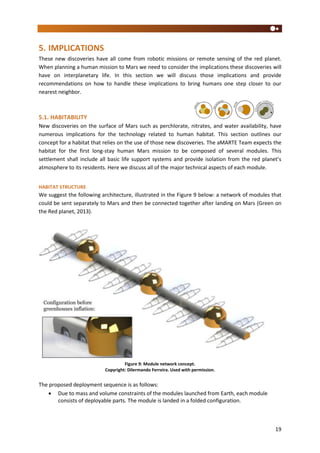
available for that particular activity. A good education should be reflected in inspiring children to
engage in Science Technology Engineering Mathematics (STEM) with having an appreciation for
Science Technology Engineering Art Mathematics (STEAM), and to raise awareness of the space-
related careers in research and industry.
Even in countries like the USA, the proportion of public who are interested in space exploration is
lower than that in other policy issues. The General Social Survey of 2010 placed the estimate of
those who are “very interested” in space exploration at 21 % versus related topics such as new
technologies and inventions (38 %) and new scientific discoveries (39 %). (Committee on Human
Spaceflight;, 2014)
Communication campaigns should be set up by the space agencies and their partners using
traditional media and social media such as Twitter and Facebook with regular updates of key
milestones and findings.
Consideration should be given to developing a coordinated International outreach effort involving all
members of the space community. A comprehensive and coordinated public outreach should also be
a part of mission planning to develop the future of human space exploration.
6.6. SPIN-OFFS
Space spin-offs are technologies and byproducts that were developed for space missions and then
found a new application for non-space activities, usually to benefit to a larger market. Spin-offs are
and always have been a very important part of the space industry, since all of humanity can benefit
from the new technologies discovered. Two famous examples of this are freeze drying technology
and light-emitting diodes (NASA Technologies Benefit Our Lives, 2016). A summary of the expected
spin-offs from missions to Mars are outlined in Table 7.
Table 7: Potential Mars mission spin-offs.
Space technologies
developed on the way of Mars
exploration
Spin-off applications
Synthetic biology
Human waste treatment (green toilets), water treatment (lake,
swimming pool...), air filter and treatment (office, factory), soil
depollution
Life support equipment
Miniaturized / high performance life support equipment for
workers of mining industry, hospitals, laboratories, sensitive
67
environment
Miniature nuclear power battery
Remote location power supply, backup power supply in critical
environment, noiseless power supply for construction and
public road works
More efficient solar panels Hyper-efficient Earth-surface solar array
Renewable fuel
Extraction of fuel from perchlorates and CO2 (e.g. methane,
butane for daily use like cooking and heating) that can help us
reduce the greenhouse effect
6.7. SPIN-INNS
The opposite process, Spin-in, consists of adapting already existing technologies to space use with
the advantage of not spending money in researching and testing them. An example is the extraction
of water and oxygen from Martian regolith. The following are technologies suitable for spin-in for
short-term robotic missions, and long-term human and/or robotic exploration missions.
ELECTRIC CARS
Nissan and NASA have developed a prototype of self-driven robotic car (Culler, 2015). Robotic rovers
for fast commuting on the surface of Mars could use the sensors and guidance systems developed
for this electric car.
SMALL SCALE WASTE RECYCLING
Technologies that clean extract useful material from human waste have been developed. Human
excrement contains water and nutrients, and it is possible to extract these. This kind of technology is
essential of a closed loop system, in which waste products are reintroduced as resources through
treatment.
The need for such systems for a mission to Mars lead to research focused on the development and
improvement of waste recycling systems. (Bill & Melinda Gates Foundation, 2016). This issue is
highly correlated to the water recycling problem. For this reason, toilets with the capability of
diverting urine from feces, the so-called urine-diverting dry toilets (UDDT), are necessary (Eawag,
Wafler and Spuhler, 2014). The capability to separate nutrients from waste is the focus of the study
that the Bill and Melinda Gates foundation is conducting. (Bill & Melinda Gates Foundation, 2016)
3D PRINTING
3D printing would greatly assist a human Mars mission. The possibility to build both habitats and
furniture directly on the surface of Mars using ISRU materials could prevent humans from living in
landing vehicles, in a restricted space. 3D printing is a fast growing technology that has been
adopted in the manufacturing field. The printers usually have a box structure with a chamber where
the printing takes place. One limit of this structure is that the dimensions of the final product cannot
exceed the size of the box. A possible solution is using a multi-axis robotic arm. The arm is free to
move along the ground and print material around itself, effectively removing the constraints of the
box. (MX3D, 2016)
68
PRINTED ELECTRONICS
The in situ production of electronics through 3D printers would be a requirement for a long duration
mission. In this case, only the electronic files containing digital templates should be sent from Earth.
Electronic components materials have a base of carbon, which has been found on Mars, silver, and
organic polymers (P3HT or PEDOT:PSS). Among new materials showing semiconductor properties we
find indigo, jeans’ dye. Indigo has organic electronic characteristics. It is also cheap and has a long
shelf life. (Acreo, 2016)
MEMBRANE TECHNOLOGIES
An essential element of a close environment is water recycling. Currently ISS has a 93% a reuse rate.
We want to raise it closer to 100%. Among the most efficient membrane technologies we find
electrocoagulation, forward osmosis, membrane distillation, eutectic freeze crystallization, and
dewvaporation (Brandhuber, Kinser, 2012). These technologies need further development to reduce
resupply missions.
These membrane technologies could generate electricity as well. An extant technology uses
chemical reactions due to the encounter of fluids with different salt concentrations. The previous
processes, fed by salt water found on Mars, might increase the electricity budget. (Feng, 2016)
UAV TECHNOLOGY
Use of UAV technology provides an opportunity for Mars exploration. To cover the 145 million
square km surface of Mars a robotic rover is not enough. A UAV could provide essential help in
studying the surface and provide in-situ measurements of the atmosphere. UAV/Airplane technology
must be adapter to Mars’ thin atmosphere and lower gravity. A proposed experiment to study the
feasibility of this technology is dropping a drone during the descent phase of the lander spacecraft
on to the Mars surface. The drone would have the required instrumentation and would explore a
wider area from the skies providing vital information on eventual exploration sites. As a next step,
drones with multiple lift-off and landing missions could give a large panorama of the whole planet.
ROLLABLE SOLAR PANELS
A new kind of solar panel has the ability to be rolled-up. This allows engineers to tackle the issue of
fragility of conventional solar panels. They have more flexibility and they are easier to store and
transport. They are still the object of numerous studies because their efficiency is low (10-16 %). No
space application has yet been tested (renovagen.com, 2016). By the time of a Mars mission flexible
panels could feasibly replace the traditional ones.
VIRTUAL REALITY
The technology of virtual reality has potential when used for training purposes. NASA is currently
using it (Mahoney, 2015)and ESA is integrating virtual reality systems in its training programs to
prepare astronauts for specific mission. (Mahoney, 2015; F. Nicolicni , R. Seine , L. Ravagnolo, 2015)
69
7. ROADMAP
The aMARTE Team started out the report by covering the key discoveries about the Martian
atmosphere. This was followed by the potential implications of the discoveries. Within the
implications Section 5 were a number of recommendations to bring us closer to stepping foot on
Mars.
The following table is a collection of those recommendations. The table is sorted by discoveries. The
discoveries are linked to implications with a recommendation given for each implication. To ensure
we met all of our objectives the table includes a column for which TP objective each
recommendation falls under. The interdisciplinary nature of the TP is also demonstrated by
associating an ISU discipline to each recommendation. For ease of reading, a page number is
attached against each recommendation to allow our readers to refer back to our reasoning.
The objectives in Table 8 are all simplified to one word
Environment - Reviewing Mars geological and atmospheric environment with an emphasis on recent
Mars environment findings.
Habitability - Studying the implications of the new discoveries on future Human space exploration
missions to Mars and how they can be used as in-situ resources for life support and habitability.
Astrobiology - Discussing the biological implications of the recent Mars findings on Space Biology,
Astrobiology, Human health, terraforming and Synthetic Biology.
Roadmap - Drafting a Mars Human space exploration science and technology roadmap that outlines
the priorities needed to further understand the potential use and effect of the new discoveries on
crew and hardware.
Non Applicable - Producing a final report with recommendations that will inform decision makers
and influence future Human space exploration missions to Mars.
Our roadmap is presented in Figure 14. We developed it by identifying the key recommendations
collected in Table 8. Our roadmap divides the recommendations into those that can be fulfilled by
research on Earth, those that need analog or precursor missions, and those that will be researched
on the Moon and other celestial bodies. Recommendations are roughly correlated with the time we
expect them to be completed, and each recommendation is visually aligned to at least one key
discovery. Our roadmap is focused on technological and scientific recommendations so some
interdisciplinary aspects covered in the table are not present.
70Figure 14: aMARTE roadmap
71
Table 8: List of aMARTE recommendations
Implication Recommendation Discovery Objective Dept.
Habitability
Investigate the availability of nitrates elsewhere on Mars for the prospect of plant growth
and conversion to nitrogen
Nitrates
Habitability
ENG
&
SCI
Use of deployable and inflatable structures to reduce the mass of the habitat. Other
ENG
Development of a gas exchange system between greenhouses and human habitats along
with an oxygen storage system
Atmospheric
Composition
Replicate Mars’ regolith samples for ISRU nitrate and perchlorate testing
Nitrates
Perchlorates.
Roadmap
Test which bacteria are able to dissociate perchlorates in the widest range of temperature Perchlorates
Astrobiology
Investigate which bacteria we can produce directly on Mars, i.e. from human or plant wastes Other
Life Support
Research into bioregenerative life support systems Other
Habitability
HPS
&
ENG
Research into dust accumulation prevention Minerology
Further research to clarify if the dissolving of Ar in the body is consistent across different
percentages or partial pressures of the atmosphere
Atmospheric
Composition
Habitability
HPS
Clarification of any protective effect of reduced gravity on decompression sickness Other
Research into in-situ perchlorate bio-reduction
Perchlorates
Research into use of perchlorate as an oxidizer for solid waste
SCI
Materials science research for mass to protection optimization of shielding Radiation
Development of artificial magnetic fields for radiation deflection Magnetism ENG
Measure levels of radiation and magnetism in areas of strong crustal magnetism Radiation SCI
Human Health
Begin crop cultivation experiments on Earth simulating Martian soil perchlorate content, to
investigate whether cultivated crops would contain perchlorate concentrations beyond
acceptable doses for humans Perchlorates
Astrobiology
HPS
Detailed analysis of human studies examining perchlorate toxicity and the relevant effect on
thyroid gland function to further characterize safe levels for human exposure
Habitability
72
Completion of analog studies to determine the optimal thyroid hormone or iodine dosing
regimen for anticipated perchlorate exposure on Mars
Continuing research into minimally-invasive monitoring for radiation biomarkers Radiation Astrobiology HPS
Research into pharmaceuticals for radiation protection
Radiation
Habitability
ENG
&
HPS
Research into the effects of GCR on human health ENG
Standardized dust control procedures for cleaning of EVA suits prior to habitat entry
Minerology
SCI
Analog studies on the deposition pattern in the lungs and toxicity profile of Martian dust Roadmap HPS
Dedicated studies in microgravity regarding essential medications for space exploration
medicine Other Habitability HPS
Research for potential in situ drug production via bioreactors
Further characterization of the level and duration of immunosuppression in astronauts from
radiation exposure
Radiation Astrobiology HPS
Verification of virulence and antibiotic resistance changes in pathogenic microorganism
found on the ISS
Human Ground
Ops
Further refinement of EVA suits with a focus on increased mobility and safety Minerology Habitability
HPS
&
ENG
Investigate the potential use for residual crustal magnetism for navigation Residual
Crustal
Magnetism
Habitability
APP
&
SCI
Investigate the impact of residual crustal magnetism on current navigation systems
Test autonomous UAV technology combined with remote sensing for minerals and water
Atmospheric
Composition
Roadmap ENG
ISRU
Further study the characteristics of the surface and subsurface material with robotic
missions
Water
Minerology
Nitrates
Perchlorates
Habitability &
Roadmap
ENG
Simulate Martian regolith on Earth to test ISRU technology
Test ISRU technology off Earth e.g. on the Moon or an asteroid to vastly increase its TRL ENG
73
Develop robotic systems to collect, process and deliver Martian regolith for ISRU. Such
systems should be able to cope with all four sources of water on Mars.
&
MGB
Design a system to isolate water from the other products that are released during the
extraction.
Water
Organics
ENG
&
PEL
Design systems avoiding the release of contaminants in water and avoiding back
contamination that could expose astronauts to subsurface materials.
Avoid performing ISRU activities at special regions to mitigate contamination risks
Astrobiology
Use new techniques to search for life including DNA, amino acids, and polysaccharides
Water
Organics
Environment
SCI
&
HUM
Search for life in the subsurface at depths greater than 5 m
Expanding the search for life also to dry landmass in addition to ancient ocean floors SCI
Use of high resolution remote sensing to map location and depth of subsurface water
reserves to assist in the choice of a landing site
Water APP
Sample Return
Perform sample return mission, either robotic or human, before starting a permanent
human presence to characterize environment precisely and with high certainty
Water
Organics
Minerology
Environment SCI
Terraforming
Terraforming represents a large project of significant technical complexity that requires
further research, evaluation, and ethical considerations over the long term
Atmospheric
Composition
Environment
SCI
&
HUM
Planetary
Protection
Multilateral consultation mechanism between international, national and private actors to
facilitate negotiation of requirements for extraterrestrial human exploration, inclusive of
planetary and environmental protection principles.
Organics Environment
PEL
New working group within COPUOS tasked to assess the implications and provide protocols
of discovering extraterrestrial non-intelligent and intelligent life forms
PEL
&
MBG
Financial
Consideration
To keep costs down, maximize ISRU to minimize launch mass Habitability
Roadmap MGB
Development of public-private-partnerships and commercialization of space Other
Legal Framework The interested parties must develop a timeline and procedure for the hiring of a legal Other Roadmap PEL
74
consultative team
Legal team shall convene to discuss mission objectives and their legal considerations, as well
as their financing and budgeting. The nature of the contractual and operative relations
between partners needs to be defined
Finally, the decisions reached up to this point need to be expressed in the drafting of the
foundational document, to be signed by its constituent parties
75
8. CONCLUSION
8.1. TEAM PROJECT PROCESS
The aMARTE team began the TP by carrying out initial background reading to familiarize ourselves
with the project scope, along with initial research through teleconferences and lectures from experts
in the field of the Martian environment. This contact time provided the entire team with a thorough
understanding of the main challenges of a mission to Mars.
We focused on meeting the project objectives by undertaking the following tasks:
 Survey of current understanding of the Mars environment with an emphasis on new
discoveries.
 Research the implications of the new discoveries based on Earth and space analog
observations and results.
 Review national and international Mars exploration goals set by various committees
(MEPAG, ISECG, etc.).
 List the Mars environmental challenges and opportunities for human space exploration.
 Review ISRU technologies and suggest new approaches utilizing recent discoveries, such as
converting in-situ materials and 3D printing to support human space exploration.
 Describe and suggest instrumentation for future Mars missions or strategize on mission
designs around the presence of recent discoveries.
 Discuss how recent discoveries affect us on Earth and potential national and international
implications.
 Produce a document that summarizes the findings and recommendations in a format that
can inform decision makers and be used to develop a conference paper or position article.
To ensure the team covered all seven ISU disciplines, we split our team into the seven groups, one
for each discipline. Each group was responsible for researching certain sections of the report.
The aMARTE Team wrote a TPP in the first few weeks of work. This report outlined the objectives of
our team and the process of how we would ensure we met those objectives. It also included content
related to team organization and project management.
We progressed to the drafting of the report by integrating the research and managing the work done
by the different disciplines, keeping the objectives as the main focus of the report.
An internal review and production of a draft report lead to the final version of the report as the
primary output from the aMARTE Team. On top of this an executive summary and presentation were
also produced.
8.2. FUTURE WORK
A selection of people from team aMARTE will be taking the opportunity to attend the 2016
International Astronautical Conference (IAC) to present the findings of this report.
76
Due to the very broad objectives of team aMARTE, specific topics were not covered in this report.
These topics and the reasons for them being excluded are as follows:
 Effects of extended duration of partial gravity on the human body - The scientific community
simply has no information on this. Experiments in partial gravity have been done in parabolic
flight (Widjaja, Vandeput, Van Huffel and Aubert, 2015), but a human Mars mission requires
research into extended duration effects, such as bone and muscle changes/loss that have
been well characterized in microgravity (Clément, 2011). We could have looked at the
effects of microgravity on the human body but this would open up far too much research
that is not directly relevant to the new environmental findings on Mars.
 Technological developments for a Mars mission - We have tried to avoid discussing recent
technological developments that do not have a direct implication of the new discoveries
covered in the report. For example, there are developments in relation to launching,
building, and moving an interplanetary spacecraft to get to Mars. We could recommend
where funding or research should be allocated for the journey to Mars, however this does
not fall within the scope in this report.
 Colonization of Mars - The societal impacts of colonizing another planet were not discussed
in enough detail. There was simply too much content on this topic to include it amongst all
the scientific discoveries and interdisciplinary implications.
 Interplanetary communication networks - In terms of habitability, communication with Earth
was not discussed as the new discoveries covered do not affect it greatly. However, there
are key concepts here that would be very useful for a future human Mars mission, e.g.
constellations of micro satellites around Mars.
If the content of this TP is expanded upon we recommend that the above points are explored in
further detail.
8.3. KEY FINDINGS
The table in Section 7 lists all key findings and recommendations we had developed. In an effort to
narrow down the list to present the most important points, each discipline decided to choose a
single key discovery, impact and recommendation as listed below:
 SCI - The discovery of water held in the ice and regolith of Mars was deemed most important
because since it has a potentially huge impact of finding life on Mars. We recommend the
search for life should be focused 5 m below the surface.
 ENG - The discovery of water is also important here but for a different implication: ISRU
technology is now making a human mission to Mars feasible because we no longer need to
bring all of our water (or oxygen, or fuel) with us to Mars. ISRU needs demonstrated before
humans rely on it for a Mars mission.
 PEL - Policy is more of a reactive than proactive discipline, hence these discoveries have
impacted this field yet. Implications are likely to be felt when a human mission to Mars gets
underway.
 MGB - The youth of essential technologies, such as ISRU systems and crew transportation,
make it near-impossible for a private economy to establish itself on Mars. We recommend
that space agencies focus on establishing a private economy on the Moon first.
 HUM - The implication of life existing or having existed is key here. If we do find life on Mars,
it will change the way we view life on Earth. Multiple discoveries relate to this; detection of
organics, presence of methane, and finding water on Mars.
77
 APP - The discoveries of subsurface water and perchlorates on Mars were identified as
equally important. No direct implications for APP have been found, but advancing remote
sensing is recommended to find further sources of these resources.
 HPS – The discovery of perchlorate on Mars is a key development for human performance
and health. At high levels, it is toxic to humans, particularly for thyroid function. To mitigate
the health risks, further development and testing of in-situ perchlorate removal systems are
needed.
8.4. CLOSING REMARKS
Mars has been present in our cultural imaginaries for thousands of years. Cultures all around the
world have wondered about the mysteries waiting for us in our neighboring planet. The excitement
has never faded away and today it is even stronger. The latest discoveries of the red planet are
fueling new hypotheses and ideas that are taken as an invitation to explore it further. However, this
invitation comes with problems to solve and unknown challenges to overcome. Nonetheless we are
an ingenious and creative species, with a unique drive to unravel the secrets of life.
78
X. REFERENCES
Abbud-madrid, A., Beaty, D., Boucher, D., Bussey, B., Davis, R., Hays, L., Kleinhenz, J., Meyer, M.,
Moats, M., Mueller, R., Paz, A., Suzuki, N., Susante, P. Van, Whetsel, C. and Zbinden, E., 2016. Mars
Water In-Situ Resource Utilization (ISRU) Planning (M-WI) Study. [online] Available at:
<http://mepag.nasa.gov/reports/Mars_Water_ISRU_Study.pptx> [Accessed 24 Aug. 2016].
Acreo, 2016. Printed electronic technologies. [online] Acreo. Available at:
<https://www.acreo.se/expertise/printed-electronic-technologies> [Accessed 24 Aug. 2016].
Acuña, M.H., Connerney, J.E.P., Ness, N.F., Lin, R.P., Mitchell, D.L., Carlson, C.W., McFadden, J.,
Anderson, K.A., Reme, H., Vignes, D., Wasilewski, P.J. and Cloutier, P.A., 1999. Global Distribution of
Crustal Magnetization Discovered by the Mars Global Surveyor MAG/ER Experiment. Science,
[online] 284(5415), pp.790–793. Available at:
<http://www.sciencemag.org/cgi/doi/10.1126/science.284.5415.790> [Accessed 20 Aug. 2016].
Acuña, M.H., Connerney, J.E.P., Wasilewski, P., Lin, R.P., Anderson, K.A., Carlson, C.W., McFadden, J.,
Curtis, D.W., Mitchell, D., Reme, H., Mazelle, C., Sauvaud, J.A., D’Uston, C., Cros, A., Medale, J.L.,
Bauer, S.J., Cloutier, P., Mayhew, M., Winterhalter, D. and Ness, N.F., 1998. Magnetic Field and
Plasma Observations at Mars: Initial Results of the Mars Global Surveyor Mission. Science, [online]
279(5357), pp.1676–1680. Available at:
<http://www.sciencemag.org/content/279/5357/1676.full.html> [Accessed 27 Aug. 2016].
Adcock, C.T., Hausrath, E.M. and Forster, P.M., 2013. Readily available phosphate from minerals in
early aqueous environments on Mars. Nature Geoscience, [online] 6(10), pp.824–827. Available at:
<http://www.nature.com/doifinder/10.1038/ngeo1923> [Accessed 27 Aug. 2016].
Alleyne, R., 2010. Dinosaurs wiped out by asteroid impact that turned earth into a ‘hellish’ place. The
Telegraph. [online] 4 Mar. Available at:
<http://www.telegraph.co.uk/news/science/dinosaurs/7368548/Dinosaurs-wiped-out-by-asteroid-
impact-that-turned-earth-into-a-hellish-place.html> [Accessed 27 Aug. 2016].
Anderson, M.S., Ewert, M.K., Keener, J.F. and Wagner, S.A., 2015. Life Support Baseline Values and
Assumptions Document.
Anon 2016. NASA Technologies Benefit Our Lives. [online] NASA. Available at:
<https://spinoff.nasa.gov/Spinoff2008/tech_benefits.html> [Accessed 25 Aug. 2016].
Anthony, S., 2014. India’s first Mars satellite enters orbit, costing just 11% of NASA’s own Mars
mission. ExtremeTech. [online] Sep. Available at: <http://www.extremetech.com/extreme/190772-
indias-first-mars-satellite-enters-orbit-costing-just-11-of-nasas-own-mars-mission> [Accessed 21
Aug. 2016].
Apak, R., 2008. Life detection experiments of the Viking Mission on Mars can be best interpreted
with a Fenton oxidation reaction composed of H2O2 and Fe2+ and iron-catalysed decomposition of
H2O. International Journal of Astrobiology, [online] 7(3-4). Available at:
<http://journals.cambridge.org> [Accessed 27 Aug. 2016].
Archer, D.P., 2016. Mars Resources for Human Missions.
Atreya, S.K., Mahaffy, P.R. and Wong, A.S., 2007. Methane and related trace species on Mars: Origin,
loss, implications for life, and habitability. Planetary and Space Science, 55(3), pp.358–369.
Audacy company, 2016. Audacy Homepage. [online] Available at: <http://audacy.space> [Accessed
20 Aug. 2016].
Azriel, M., 2016. Suitports could be the new airlock. Space Safety Magazine. [online] Available at:
<http://www.spacesafetymagazine.com/aerospace-engineering/space-suit-design/suitports-
79
airlock/>.
Bill & Melinda Gates Foundation, 2016. About the Reinvent the Toilet Challenge. [online] Bill &
Melinda Gates Foundation. Available at: <http://www.gatesfoundation.org/What-We-Do/Global-
Development/Reinvent-the-Toilet-Challenge> [Accessed 24 Aug. 2016].
Black, C., 2012. Mars One plans human settlement on the Red Planet by 2023 (now 2027). [online]
Available at: <http://sen.com/features/mars-one-plans-for-human-settlement-on-mars> [Accessed
20 Aug. 2016].
Blasing, T.J., 2009. Recent Greenhouse Gas Concentrations. [online] Available at:
<http://digital.library.unt.edu/ark:/67531/metadc11963/> [Accessed 25 Aug. 2016].
Blue Origin, 2016. Blue Origin Technology page. [online] Available at:
<https://www.blueorigin.com/technology> [Accessed 20 Aug. 2016].
Boston Dynamics, 2016a. Atlas - The Agile Anthropomorphic Robot. [online] Available at:
<http://www.bostondynamics.com/robot_Atlas.html> [Accessed 22 Aug. 2016].
Boston Dynamics, 2016b. BigDog - The Most Advanced Rough-Terrain Robot on Earth. [online]
Available at: <http://www.bostondynamics.com/robot_bigdog.html> [Accessed 22 Aug. 2016].
BOYLE, A., 2016. Interview: Jeff Bezos lays out Blue Origin’s space vision, from tourism to off-planet
heavy industry. GeekWire. [online] Apr. Available at: <http://www.geekwire.com/2016/interview-
jeff-bezos> [Accessed 20 Aug. 2016].
Boynton, W. V, Feldman, W.C., Squyres, S.W., Prettyman, T.H., Brückner, J., Evans, L.G., Reedy, R.C.,
Starr, R., Arnold, J.R., Drake, D.M., Englert, P.A.J., Metzger, A.E., Mitrofanov, I., Trombka, J.I., Uston,
C., Wänke, H., Gasnault, O., Hamara, D.K., Janes, D.M., Marcialis, R.L., Maurice, S., Mikheeva, I.,
Taylor, G.J., Tokar, R. and Shinohara, C., 2002. Distribution of Hydrogen in the Near Surface of Mars:
Evidence for Subsurface Ice Deposits. Science, [online] 297(5578), pp.81–85. Available at:
<http://science.sciencemag.org/content/297/5578/81> [Accessed 20 Aug. 2016].
Broaddus, V.C., Mason, R.J., Ernst, J.D., King, T.E., Lazarus, S.C., Murray, J.F., Nadel, J.A., Slutsky, A.S.
and Gotway, M.B., 2016. Murray and Nadal’s Textbook of Respiratory Medicine. Sixth ed.
Philadelphia: Saunders.
Bullis, K., 2010. Self-Cleaning Solar Panels. [online] MIT Technology Review. Available at:
<https://www.technologyreview.com/s/420524/self-cleaning-solar-panels/> [Accessed 28 Aug.
2016].
Carlisle, C.M., 2015. Mars Losing Gas to Solar Wind. Sky and Telescope. [online] Nov. Available at:
<http://www.skyandtelescope.com/astronomy-news/mars-losing-gas-to-solar-wind-0911201523/>
[Accessed 27 Aug. 2016].
Catling, D.C., Claire, M.W., Zahnle, K.J., Quinn, R.C., Clark, B.C., Hecht, M.H. and Kounaves, S., 2010.
Atmospheric origins of perchlorate on Mars and in the Atacama. Journal of Geophysical Research,
[online] 115(1), p.E00E11. Available at: <http://doi.wiley.com/10.1029/2009JE003425> [Accessed 22
Aug. 2016].
Celestis, 2016. Celestis website. [online] Available at: <http://www.celestis.com> [Accessed 22 Aug.
2016].
Chappell, S.P., Norcross, J.R., Abercromby, A.F.J. and Gernhardt, M.L., 2015. Evidence Report: Risk of
injury and compromised performance due to EVA operations.
Chatterjee, A., Bhattacharya, S. and Ott, M.C., 2012. Evidence Report : Risk of Adverse Health Effects
Due to Alterations in Host-Microorganism Interactions. [online] Available at:
<https://www.nationalacademies.org/hmd/~/media/Files/Activity
Files/Research/NASAEvidenceReports/2014-JUL-17/James Wilson.pdf> [Accessed 27 Aug. 2016].
80
Choudhury, S. and Sugden, J., 2014. How India Mounted the World’s Cheapest Mission to Mars. The
Wall Street Journal. [online] 23 Sep. Available at:
<http://blogs.wsj.com/indiarealtime/2014/09/23/how-india-mounted-the-worlds-cheapest-mission-
to-mars/> [Accessed 25 Aug. 2016].
Christensen, P.R., 2013. Mars as seen from the 2001 Mars Odyssey Thermal Emission Imaging
System Experiment. AGU Fall Meeting Abstracts. [online] Available at:
<http://adsabs.harvard.edu/abs/2003AGUFM.P21A..02C> [Accessed 25 Aug. 2016].
Chu, J., 2014. Mars One (and done?). [online] Available at: <http://news.mit.edu/2014/technical-
feasibility-mars-one-1014> [Accessed 22 Aug. 2016].
Clark, B.C., Baird, A.K., Weldon, R.J., Tsusaki, D.M., Schnabel, L. and Candelaria, M.P., 1982. Chemical
composition of Martian fines. Journal of Geophysical Research: Solid Earth, [online] 87(B12),
pp.10059–10067. Available at: <http://dx.doi.org/10.1029/JB087iB12p10059> [Accessed 28 Aug.
2016].
Clément, G., 2011. Fundamentals of space medicine. Second ed. New York, NY: Springer-Verlag.
Cloud, D., Devin, M., Schneider, S., Roy, R., Bagdigian, R. and Erickson, R., 1999. ISS Oxygen
Generation Design Status. SAE Technical Paper, (1999-01-2116).
Cockell, C.S., 2001. Martian Polar Expeditions: Problems and Solutions. Acta Astronautica, [online]
49(12), pp.693–706. Available at: <http://linkinghub.elsevier.com/retrieve/pii/S0094576501001424>
[Accessed 23 Aug. 2016].
Committee on Human Spaceflight;, 2014. Public and Stakeholder Attitudes. In: Pathways to
Exploration: Rationales and Approaches for a U.S. Program of Human Space Exploration. [online] The
National Academies Press, p.279. Available at: <http://www.nap.edu/catalog/18801/pathways-to-
exploration-rationales-and-approaches-for-a-us-program>.
Committee to Review the MEPAG Report on Mars Special Regions;, 2015. Review of the MEPAG
Report on Mars Special Regions. [online] The National Academies of Sciences, Engineering, Medicine
and the European Science Foundation, Washington, D.C.: National Academies Press. Available at:
<http://www.nap.edu/catalog/21816>.
Conkin, J., Norcross, J.R., Wessel, J.H.I., Abercromby, A.F.J., Klein, J.S., Dervay, J.P. and Gernhardt,
M.L., 2013. Evidence Report: Risk of Decompression Sickness (DCS). [online] Houston, Texas.
Available at: <http://ntrs.nasa.gov/archive/nasa/casi.ntrs.nasa.gov/20160006723.pdf> [Accessed 27
Aug. 2016].
Conley, C.A. and Rummel, J.D., 2008. Planetary protection for humans in space: Mars and the Moon.
Acta Astronautica, 63(7-10), pp.1025–1030.
Connerney, J.E.P., Acuña, M.H., Ness, N.F., Spohn, T. and Schubert, G., 2004. Mars Crustal
Magnetism. Space Science Reviews, [online] 111(1), pp.1–32. Available at:
<http://link.springer.com/10.1023/B:SPAC.0000032719.40094.1d> [Accessed 27 Aug. 2016].
Connerney, J.E.P., Acuña, M.H., Wasilewski, P.J., Ness, N.F., Rème, H., Mazelle, C., Vignes, D., Lin,
R.P., Mitchell, D.L. and Cloutier, P.A., 1999. Magnetic Lineations in the Ancient Crust of Mars.
Science, [online] 284(5415), pp.794–798. Available at:
<http://www.sciencemag.org/cgi/doi/10.1126/science.284.5415.794> [Accessed 27 Aug. 2016].
COSPAR, 2002. Cospar planetary protection policy.
Crawford, N.M., 1995. Nitrate: Nutrient and Signal for Plant Growth. The Plant Cell, 7(7), pp.859–
868.
Crucian, B., Kunz, H. and Sams, C.F., 2015. Evidence Report : Risk of Crew Adverse Health Event Due
to Altered Immune Response. [online] Houston, Texas. Available at:
81
<http://ntrs.nasa.gov/archive/nasa/casi.ntrs.nasa.gov/20150008177.pdf> [Accessed 27 Aug. 2016].
Culler, J., 2015. From Rovers to Self-Driving Cars: NASA Ames and Nissan North America Sign
Agreement for Autonomous Vehicle Research. NASA Technology. [online] 31 Jul. Available at:
<http://www.nasa.gov/ames/from-rovers-to-self-driving-cars-nasa-ames-and-nissan-north-america-
sign-agreement> [Accessed 27 Aug. 2016].
Davila, A.F., Willson, D., Coates, J.D. and McKay, C.P., 2013. Perchlorate on Mars: a chemical hazard
and a resource for humans. International Journal of Astrobiology, [online] 12(04), pp.321–325.
Available at: <http://www.journals.cambridge.org/abstract_S1473550413000189> [Accessed 27
Aug. 2016].
Deep Space Industries, 2016. Deep Space Industries Mission page. [online] Available at:
<http://deepspaceindustries.com/missions> [Accessed 20 Aug. 2016].
Deniston, B., 2012. An Inside Look at Russia’s Nuclear Power Propulsion System. 21st Century,
[online] Dec., pp.57–59. Available at: <https://www.21stcenturysciencetech.com/Articles_2012/Fall-
Winter_2012/Interview_Koroteyev.pdf> [Accessed 27 Aug. 2016].
Dicairea, I., Forget, F., Millour, E., Maan, D.C., Nachon, M. and Summerer, L., 2013.
http://www.esa.int/gsp/ACT/doc/ESS/ACT-RPR-ESS-2013-IAC-MarsClimateEngineering.pdf. [online]
Available at: <http://www.esa.int/gsp/ACT/doc/ESS/ACT-RPR-ESS-2013-IAC-
MarsClimateEngineering.pdf> [Accessed 27 Aug. 2016].
Dickson, K., 2015. Elon Musk’s Plans for Sending 1 Million People to Mars for $500,000 Each. [online]
Available at: <https://www.outerplaces.com/science/item/9914-elon-musk-s-plans-for-sending-1-
million-people-to-mars-for-500-000-each> [Accessed 21 Aug. 2016].
Do, S., Owens, A., Ho, K., Schreiner, S. and De Weck, O., 2016. An independent assessment of the
technical feasibility of the Mars One mission plan - Updated analysis. Acta Astronautica, [online] 120,
pp.192–228. Available at: <http://www.sciencedirect.com/science/article/pii/S0094576515004294>
[Accessed 27 Aug. 2016].
Drake, B.G., 2010. Human Exploration of Mars Design Reference Architecture 5.0. [online] Available
at: <http://ntrs.nasa.gov/search.jsp?R=20100028285> [Accessed 26 Aug. 2016].
Dundas, C.M., Byrne, S., McEwen, A.S., Mellon, M.T., Kennedy, M.R., Daubar, I.J. and Saper, L., 2014.
HiRISE observations of new impact craters exposing Martian ground ice. Journal of Geophysical
Research: Planets, [online] 119(1), pp.109–127. Available at:
<http://doi.wiley.com/10.1002/2013JE004482> [Accessed 22 Aug. 2016].
Eawag, D., Wafler, M. and Spuhler, D., 2014. UDDT (Executive Summary). [online] Available at:
<http://www.sswm.info/category/implementation-tools/water-use/hardware/toilet-systems/uddt>
[Accessed 24 Aug. 2016].
Ehlmann, B.L. and Edwards, C.S., 2014. Mineralogy of the Martian Surface. Annual Review of Earth
and Planetary Sciences, [online] 42(1), pp.291–315. Available at:
<http://www.annualreviews.org/doi/abs/10.1146/annurev-earth-060313-055024> [Accessed 20
Aug. 2016].
Encyclopaedia Britannica, 2015. Curie point. 8th ed. [online] Chicago: Encyclopaedia Britannica.
Available at: <https://www.britannica.com/science/Curie-point> [Accessed 27 Aug. 2016].
ESA, 2016a. ESA 2016 Budget by Domain. [online] European Space Agency. Available at:
<http://www.esa.int/About_Us/Welcome_to_ESA/Funding> [Accessed 24 Aug. 2016].
ESA, 2016b. EXOMARS TRACE GAS ORBITER (TGO). [online] Available at:
<http://exploration.esa.int/mars/46475-trace-gas-orbiter/> [Accessed 27 Aug. 2016].
European Science Foundation -European Space Science Committee, 2012. Mars Sample Return
82
backward contamination – Strategic advice and requirements Report from the ESF-ESSC Study Group
on MSR Planetary Protection Requirements.
FedBizOpps.gov, 2016. Next Space Technologies for Exploration Partnerships -2 (NextSTEP-2)
Omnibus BAA and Appendix A: Habitat Systems. [online] Available at:
<https://www.fbo.gov/index?s=opportunity&mode=form&tab=core&id=cc98f982cc85bc0c9d1461b
c5edd9286> [Accessed 26 Aug. 2016].
Ferguson, D.C., Kolecki, J.C., Siebert, M.W., Wilt, D.M. and Matijevic, J.R., 1999. Evidence for Martian
electrostatic charging and abrasive wheel wear from the Wheel Abrasion Experiment on the
Pathfinder Sojourner rover. Journal of Geophysical Research-Planets, [online] 104(25), pp.8747–
8759. Available at: <<Go to ISI>://WOS:000079836900019> [Accessed 27 Aug. 2016].
Fonti, S. and Marzo, G.A., 2010. Mapping the methane on Mars. Astronomy and Astrophysics,
[online] 512, p.A51. Available at: <http://www.aanda.org/10.1051/0004-6361/200913178>
[Accessed 24 Aug. 2016].
Formisano, V., Atreya, S., Encrenaz, T., Ignatiev, N. and Giuranna, M., 2004. Detection of methane in
the atmosphere of Mars. Science, [online] 306(5702), pp.1758–1761. Available at:
<http://www.sciencemag.org/content/306/5702/1758> [Accessed 22 Aug. 2016].
Foulsham, G., 2016. UCLA researchers turn carbon dioxide into sustainable concrete. [online] 14
Mar. Available at: <http://newsroom.ucla.edu/releases/ucla-researchers-turn-carbon-dioxide-into-
sustainable-concrete> [Accessed 27 Aug. 2016].
Foust, J., 2015. Mars One Suspends Work on Robotic Missions. [online] http://spacenews.com/.
Available at: <http://spacenews.com/mars-one-suspends-work-on-robotic-missions> [Accessed 20
Aug. 2016].
Foust, J., 2016. Astrobotic unveils Peregrine lunar lander. [online] Available at:
<http://spacenews.com/astrobotic-unveils-peregrine-lunar-lander> [Accessed 21 Aug. 2016].
Frankel, C., 2007. L’Homme sur Mars: Science ou Fiction ?. 1st ed.
Geminale, A., Formisano, V. and Giuranna, M., 2008. Methane in Martian atmosphere: Average
spatial, diurnal, and seasonal behaviour. Planetary and Space Science, [online] 56(9), pp.1194–1203.
Available at: <http://linkinghub.elsevier.com/retrieve/pii/S0032063308000743> [Accessed 26 Aug.
2016].
Geminale, A., Formisano, V. and Sindoni, G., 2011. Mapping methane in Martian atmosphere with
PFS-MEX data. Planetary and Space Science, 59(2-3), pp.137–148.
Giannakopoulos, S., 2016. 3D Printing with Soil and Natural Materials. [online] PYLOS. Available at:
<http://pylos.iaac.net/main.html#abstract> [Accessed 21 Aug. 2016].
Glavin, D.P., Freissinet, C., Miller, K.E., Eigenbrode, J.L., Brunner, A.E., Buch, A., Sutter, B., Archer,
D.P., Atreya, S.K., Brinckerhoff, W.B., Cabane, M., Coll, P., Conrad, P.G., Coscia, D., Dworkin, J.P.,
Franz, H.B., Grotzinger, J.P., Leshin, L.A., Martin, M.G., McKay, C.P., Ming, D.W., Navarro-González,
R., Pavlov, A., Steele, A., Summons, R.E., Szopa, C., Teinturier, S. and Mahaffy, P.R., 2013. Evidence
for perchlorates and the origin of chlorinated hydrocarbons detected by SAM at the Rocknest
aeolian deposit in Gale Crater. Journal of Geophysical Research E: Planets, 118(10), pp.1955–1973.
Gonzalez–Galindo, F., Forget, F., Coll, M.A.I. and Lopez-Valverde, M.A., 2008. The Martian Upper
Atmosphere. In: A. Ulla and M. Manteiga, eds., Lecture Notes and Essays in Astrophysics Volume III.
[online] Granada, Spain: Spanish Royal Physical Society, pp.151–162. Available at: <http://www.sea-
astronomia.es/drupal/sites/default/files/archivos/imagenes/LNEAIII.pdf> [Accessed 28 Aug. 2016].
Green on the Red planet, 2013. Green on the Red planet. [online] Available at:
<https://2013.spaceappschallenge.org/project/green-on-the-red-planet/> [Accessed 24 Aug. 2016].
83
Grunewald, S.J., 2015. Colonizing Mars With 3D Printed Sfero Habitats Made from Local Materials.
[online] Available at: <https://3dprint.com/95170/mars-3d-printed-sfero-habitats/> [Accessed 29
Aug. 2016].
Gu, B. and Coates, J.D., 2006. Perchlorate. [online] Boston: Kluwer Academic Publishers. Available at:
<http://link.springer.com/10.1007/0-387-31113-0> [Accessed 27 Aug. 2016].
Hall, J.E., 2016. Guyton and Hall Textbook of Medical Physiology. Thirteenth ed. [online] Philadelphia:
Elsevier. Available at: <http://www.us.elsevierhealth.com/guyton-and-hall-textbook-of-medical-
physiology-9781455770052.html>.
Hassler, D.M., Zeitlin, C., Wimmer-Schweingruber, R.F., Ehresmann, B., Rafkin, S., Eigenbrode, J.L.,
Brinza, D.E., Weigle, G., Bottcher, S., Bohm, E., Burmeister, S., Guo, J., Kohler, J., Martin, C., Reitz, G.,
Cucinotta, F.A., Kim, M.-H., Grinspoon, D., Bullock, M.A., Posner, A., Gomez-Elvira, J., Vasavada, A.,
Grotzinger, J.P. and MSL Science Team, 2014. Mars’ Surface Radiation Environment Measured with
the Mars Science Laboratory's Curiosity Rover. Science, [online] 343(6169), pp.1244797–1244797.
Available at: <http://www.sciencemag.org/cgi/doi/10.1126/science.1244797> [Accessed 27 Aug.
2016].
Horneck, G., 2008. The microbial case for Mars and its implication for human expeditions to Mars.
Acta Astronautica, 63(7-10), pp.1015–1024.
Howell, E., 2015. A Brief History of Mars Missions. Space.com. [online] 17 Mar. Available at:
<http://www.space.com/13558-historic-mars-missions.html> [Accessed 23 Aug. 2016].
Howell, E., 2016. Lockheed Martin: Prime Contractor for Orion Spacecraft. Space.com. [online] 24
Jun. Available at: <http://www.space.com/19528-lockheed-martin.html> [Accessed 25 Aug. 2016].
Huff, J., Carnell, L., Blattnig, S., Chappell, L., Kerry, G., Lumpkins, S., Simonsen, L., Slaba, T. and
Werneth, C., 2016. Evidence Report: Risk of Radiation Carcinogenesis. [online] Houston, Texas.
Available at: <http://ntrs.nasa.gov/archive/nasa/casi.ntrs.nasa.gov/20160004369.pdf> [Accessed 28
Aug. 2016].
Huntress, JR., W.T. and Marov, M., 2011. Soviet Robots in the Solar System. [online] New York, NY:
Springer New York. Available at: <http://link.springer.com/10.1007/978-1-4419-7898-1>.
Idkaidek, N. and Arafat, T., 2011. Effect of Microgravity on the Pharmacokinetics of Ibuprofen in
Humans. The Journal of Clinical Pharmacology, [online] 51(12), pp.1685–1689. Available at:
<http://doi.wiley.com/10.1177/0091270010388652> [Accessed 27 Aug. 2016].
ISECG, 2013. The Global Exploration Roadmap. [online] Available at:
<http://www.globalspaceexploration.org/wordpress/wp-content/uploads/2013/10/GER_2013.pdf>
[Accessed 20 Aug. 2016].
ISU MSS Team Project, 2013. Mars X: Human Exploration of Mars from Martian Orbit. [online]
Strasbourg. Available at:
<https://isulibrary.isunet.edu/opac/index.php?lvl=notice_display&id=8860#docnum> [Accessed 27
Aug. 2016].
JAXA, 2010. Inter-agency Cooperation Agreement with Italian, Norwegian, and French Space
Agencies. [online] Available at: <http://global.jaxa.jp/press/2010/09/20100930_iac_e.html>
[Accessed 27 Aug. 2016].
JAXA, 2015. JAXA’s examples of International Mechanisms for Cooperation in the Peaceful
Exploration and Use of Outer Space. [online] Vienna. Available at:
<http://www.unoosa.org/pdf/pres/lsc2015/tech-05.pdf> [Accessed 27 Aug. 2016].
Jones, A., 2016. China’s space program China is racing to make the 2020 launch window to Mars.
GBtimes.com. [online] 22 Feb. Available at: <http://gbtimes.com/china/china-racing-make-2020-
84
launch-window-mars> [Accessed 27 Aug. 2016].
Kaku, K. and Held, A., 2013. Sentinel Asia: A space-based disaster management support system in
the Asia-Pacific region. International Journal of Disaster Risk Reduction, [online] 6, pp.1–17. Available
at: <http://linkinghub.elsevier.com/retrieve/pii/S2212420913000411> [Accessed 27 Aug. 2016].
Kane, V., 2016. Red Dragon and Planetary Exploration. [online] Available at:
<http://www.planetary.org/blogs/guest-blogs/van-kane/20160610-red-dragon-and-planetary-
exploration.html> [Accessed 20 Aug. 2016].
Karcz, A.R.C.J., Allen, G., Davila, A., Heldmann, J., Lemke, L., Marinova, M., Stoker, C. and Trumble, K.,
2011. Red Dragon: Feasibility of a Dragon-derived Mars lander for scientific and human-precursor
investigations. [online] pp.1–14. Available at: <http://digitalvideo.8m.net/SpaceX/RedDragon/karcz-
red_dragon-nac-2011-10-29-1.pdf> [Accessed 27 Aug. 2016].
Karlsson, L.L., Blogg, S.L., Lindholm, P., Gennser, M., Hemmingsson, T. and Linnarsson, D., 2009.
Venous gas emboli and exhaled nitric oxide with simulated and actual extravehicular activity.
Respiratory Physiology & Neurobiology, [online] 169(SUPPL.), pp.S59–S62. Available at:
<http://linkinghub.elsevier.com/retrieve/pii/S1569904809000895> [Accessed 27 Aug. 2016].
Keller, J.M., Boynton, W. V., Karunatillake, S., Baker, V.R., Dohm, J.M., Evans, L.G., Finch, M.J., Hahn,
B.C., Hamara, D.K., Janes, D.M., Kerry, K.E., Newsom, H.E., Reedy, R.C., Sprague, A.L., Squyres, S.W.,
Starr, R.D., Taylor, G.J. and Williams, R.M.S., 2007. Equatorial and midlatitude distribution of chlorine
measured by Mars Odyssey GRS. Journal of Geophysical Research, [online] 112(E3), p.E03S08.
Available at: <http://doi.wiley.com/10.1029/2006JE002679> [Accessed 22 Aug. 2016].
Kiran Krishnan Nair, 2015. One-Way Ticket to Mars: Examining the Law and Options to Regulate
Adventurism on Celestial Bodies. Space and Evolution. [online] Available at:
<http://www.eaglehill.us/programs/journals/spaevo/2015a2/> [Accessed 25 Aug. 2016].
Klein, H.P., 1978. The Viking biological experiments on Mars. Icarus, [online] 34(3), pp.666–674.
Available at: <http://linkinghub.elsevier.com/retrieve/pii/0019103578900532> [Accessed 24 Aug.
2016].
Korablev, O., Trokhimovsky, A., Grigoriev, A. V, Shakun, A., Ivanov, Y.S., Moshkin, B., Anufreychik, K.,
Timonin, D., Dziuban, I., Kalinnikov, Y.K. and Montmessin, F., 2014. Three infrared spectrometers, an
atmospheric chemistry suite for the ExoMars 2016 trace gas orbiter. Journal of Applied Remote
Sensing, [online] 8(1), p.84983. Available at: <http://dx.doi.org/10.1117/1.JRS.8.084983> [Accessed
27 Aug. 2016].
Krasnopolsky, V.A., Maillard, J.P. and Owen, T.C., 2004. Detection of methane in the martian
atmosphere: evidence for life? Icarus, [online] 172(2), pp.537–547. Available at:
<http://linkinghub.elsevier.com/retrieve/pii/S0019103504002222> [Accessed 24 Aug. 2016].
Kumarathilaka, P., Oze, C., Indraratne, S.P. and Vithanage, M., 2016. Perchlorate as an emerging
contaminant in soil, water and food. Chemosphere, [online] 150, pp.667–677. Available at:
<http://linkinghub.elsevier.com/retrieve/pii/S0045653516301242> [Accessed 27 Aug. 2016].
LaMonica, M., 2012. Nuclear Generator Powers Curiosity Mars Mission. MIT Technology Review.
[online] Aug. Available at: <https://www.technologyreview.com/s/428751/nuclear-generator-
powers-curiosity-mars-mission/>.
Lander, S., 2011. Lost (baggage) in space: Travel insurance firm announces plans to cover
intergalactic tourists. [online] Available at: <http://www.dailymail.co.uk/travel/article-
2062193/Travel-insurance-space-tourists-Firm-announces-plans-cover-intergalactic-travellers.html>
[Accessed 22 Aug. 2016].
Lange, K.E., Perka, A.T., Duffield, B.E. and Jeng, F.F., 2005. Bounding the Spacecraft Atmosphere
Design Space for Future Exploration Missions. [online] Available at:
85
<http://ntrs.nasa.gov/search.jsp?R=20050185597> [Accessed 22 Aug. 2016].
Lemmon, M.T., Wolff, M.J., Smith, M.D., Clancy, R.T., Banfield, D., Landis, G. a, Ghosh, A., Smith, P.H.,
Spanovich, N., Whitney, B., Whelley, P., Greeley, R., Thompson, S., Bell, J.F. and Squyres, S.W., 2004.
Atmospheric imaging results from the Mars exploration rovers: Spirit and Opportunity. Science,
[online] 306(5702), pp.1753–1756. Available at:
<http://www.sciencemag.org/cgi/doi/10.1126/science.1104474>.
Leshin, L.A., Mahaffy, P.R., Webster, C.R., Cabane, M., Coll, P., Conrad, P.G., Archer, D.P., Atreya,
S.K., Brunner, A.E., Buch, A., Eigenbrode, J.L., Flesch, G.J., Franz, H.B., Freissinet, C., Glavin, D.P.,
McAdam, A.C., Miller, K.E., Ming, D.W., Morris, R. V, Navarro-González, R., Niles, P.B., Owen, T.,
Pepin, R.O., Squyres, S.W., Steele, A., Stern, J.C., Summons, R.E., Sumner, D.Y., Sutter, B., Szopa, C.,
Teinturier, S., Trainer, M.G., Wray, J.J., Grotzinger, J.P. and MSL Science Team, 2013. Volatile,
isotope, and organic analysis of martian fines with the Mars Curiosity rover. Science, [online]
341(6153), p.1238937. Available at: <http://www.ncbi.nlm.nih.gov/pubmed/24072926> [Accessed
22 Aug. 2016].
Leung, A.M., Pearce, E.N. and Braverman, L.E., 2010. Perchlorate, iodine and the thyroid. Best
Practice & Research Clinical Endocrinology & Metabolism, [online] 24(1), pp.133–141. Available at:
<http://linkinghub.elsevier.com/retrieve/pii/S1521690X09001018>.
Li, M., Holmes, V., Ni, H., Sanzari, J.K., Romero-Weaver, A.L., Lin, L., Carabe-Fernandez, A.,
Diffenderfer, E.S., Kennedy, A.R. and Weissman, D., 2015. Broad-spectrum antibiotic or G-CSF as
potential countermeasures for impaired control of bacterial infection associated with an SPE
Exposure during spaceflight. PLoS ONE, 10(3).
Lovelock, J. and Allaby, M., 1985. Greening of Mars. Warner Books.
Madeinspace, 2016. Madeinspace Archinaut project page. [online] Available at:
<http://www.madeinspace.us/projects/archinaut> [Accessed 20 Aug. 2016].
Mahaffy, P.R., Benna, M., Elrod, M., Bougher, S.W., Yelle, R. and Jakosky, B., 2015. Early
Composition, Structure, and Isotope Measurements in the Upper Atmosphere of Mars From
Maven’s Neutral Gas And Ion Mass Spectrometer (Ngims). In: 46th Lunar and Planetary Science
Conference.
Mahaffy, P.R., Webster, C.R., Atreya, S.K., Franz, H.B., Wong, M., Conrad, P.G., Harpold, D.N., Jones,
J.J., Leshin, L.A., Manning, H., Owen, T., Pepin, R.O., Squyres, S.W. and Trainer, M., 2013. Abundance
and Isotopic Composition of Gases in the Martian Atmosphere from the Curiosity Rover. Science,
[online] 341(July), pp.263–266. Available at:
<http://www.sciencemag.org/cgi/doi/10.1126/science.1237966> [Accessed 27 Aug. 2016].
Mahoney, E., 2015. Mars Immersion: NASA Concepts Bring Precision to New Virtual Reality
Experience. [online] Available at: <https://www.nasa.gov/feature/nasa-concepts-bring-precision-
mars-to-virtual-reality> [Accessed 28 Aug. 2016].
Mars One, 2016. Mars One. [online] Mars One Official Website. Available at: <http://www.mars-
one.com/> [Accessed 21 Aug. 2016].
Mattfeld, B., Stromgren, C., Shyface, H., Komar, D.R., Cirillo, W. and Goodliff, K., 2014. Trades
Between Opposition and Conjunction Class Trajectories for Early Human Missions to Mars. American
Institute of Aeronautics and Astronautics, [online] pp.1–17. Available at:
<http://ntrs.nasa.gov/archive/nasa/casi.ntrs.nasa.gov/20150001240.pdf> [Accessed 27 Aug. 2016].
McKay, C.P. and García, V.P., 2014. How to Search for Life on Mars. Scientific American, [online]
310(6), pp.44–49. Available at: <http://www.nature.com/doifinder/10.1038/scientificamerican0614-
44> [Accessed 25 Aug. 2016].
McKay, C.P., 2010. An origin of life on Mars. Cold Spring Harbor perspectives in biology, .
86
McKay, C.P., 2016. Human exploration of Mars and Terraforming.
McMahon, S., 2016. The Aesthetic Objection to Terraforming Mars. In: T. Milligan and J.S.J.
Schwartz, eds., The Ethics of Space Exploration. [online] pp.209–218. Available at:
<http://link.springer.com/chapter/10.1007/978-3-319-39827-3_15> [Accessed 27 Aug. 2016].
MEPAG HSO-SAG, 2015. Candidate Scientific Objectives for the Human Exploration of Mars, and
Implications for the Identification of Martian Exploration Zones. [online] Available at:
<https://mepag.jpl.nasa.gov/reports/HSO summary presentation FINAL.pdf> [Accessed 25 Aug.
2016].
MEPAG, 2015. Mars Science Goals, Objectives, Investigations, and Priorities. [online] Available at:
<https://mepag.jpl.nasa.gov/reports/MEPAG Goals_Document_2015_v18_FINAL.pdf> [Accessed 22
Aug. 2016].
Ming, D.W., Archer, D.P., Glavin, D.P., Eigenbrode, J.L., Franz, H.B., Sutter, B., Brunner, A.E., Stern,
J.C., Freissinet, C., McAdam, A.C., Mahaffy, P.R., Cabane, M., Coll, P., Campbell, J.L., Atreya, S.K.,
Niles, P.B., Bell, J.F., Bish, D.L., Brinckerhoff, W.B., Buch, A., Conrad, P.G., Des Marais, D.J., Ehlmann,
B.L., Fairén, A.G., Farley, K., Flesch, G.J., Francois, P., Gellert, R., Grant, J.A., Grotzinger, J.P., Gupta,
S., Herkenhoff, K.E., Hurowitz, J.A., Leshin, L.A., Lewis, K.W., McLennan, S.M., Miller, K.E., Moersch,
J., Morris, R. V, Navarro-González, R., Pavlov, A.A., Perrett, G.M., Pradler, I., Squyres, S.W.,
Summons, R.E., Steele, A., Stolper, E.M., Sumner, D.Y., Szopa, C., Teinturier, S., Trainer, M.G.,
Treiman, A.H., Vaniman, D.T., Vasavada, A.R., Webster, C.R., Wray, J.J. and Yingst, R.A., 2014. Volatile
and Organic Compositions of Sedimentary Rocks in Yellowknife Bay, Gale Crater, Mars. Science,
[online] 343(6169). Available at:
<http://science.sciencemag.org/content/343/6169/1245267.abstract> [Accessed 25 Aug. 2016].
Moon Express, 2016. Moon Express Press Kit. [online] Available at:
<www.moonexpress.com/files/moon-express-press-kit.pdf> [Accessed 20 Aug. 2016].
Mraz, S.J., 2003. Candidates for Exploring Mars. Machine Design, [online] 10 Jul., pp.44–47. Available
at: <http://machinedesign.com/> [Accessed 24 Aug. 2016].
Mumma, M.J., Villanueva, G.L., Novak, R.E., Hewagama, T., Bonev, B.P., Disanti, M. a, Mandell, A.M.
and Smith, M.D., 2009. Strong release of methane on Mars in northern summer 2003. Science,
323(5917), pp.1041–1045.
MX3D, 2016. MX3D - Printing outside the box. [online] Available at: <http://mx3d.com/news/>
[Accessed 21 Aug. 2016].
NASA JPL, 2012. Curiosity’s Seven Minutes of Terror. [online] Available at:
<http://www.jpl.nasa.gov/video/details.php?id=1090> [Accessed 25 Aug. 2016].
NASA JPL, 2015. Mission to Mars: Mars Helicopter. [online] Available at:
<http://www.jpl.nasa.gov/missions/mars-helicopter/> [Accessed 22 Aug. 2016].
NASA JPL, 2016. Test for Damp Ground at Mars’ Seasonal Streaks Finds None. [online] Available at:
<http://www.jpl.nasa.gov/news/news.php?feature=6597> [Accessed 25 Aug. 2016].
NASA Mars Exploration, 2015a. Curiosity Rover Mission Results. [online] Available at:
<http://mars.nasa.gov/msl/mission/science/results/> [Accessed 24 Aug. 2016].
NASA Mars Exploration, 2015b. The Fact and Fiction of Martian Dust Storms. [online] Available at:
<http://mars.nasa.gov/news/whatsnew/index.cfm?FuseAction=ShowNews&NewsID=1854>
[Accessed 28 Aug. 2016].
NASA Mars Exploration, 2016a. Mars Facts. [online] NASA. Available at:
<http://mars.nasa.gov/allaboutmars/facts/#detailedFacts> [Accessed 24 Aug. 2016].
NASA Mars Exploration, 2016b. Viking 1 & 2. [online] Available at:
87
<http://mars.nasa.gov/programmissions/missions/past/viking/> [Accessed 24 Aug. 2016].
NASA Planetary Protection, 2016. Planetary Protection Knowledge Gaps for Human Extraterrestrial
Missions (Executive Summary). [online] Available at:
<https://planetaryprotection.nasa.gov/file_download/118/BBC1333B.pdf> [Accessed 24 Aug. 2016].
NASA Technology Transfer Program, 2016. Regolith Advanced Surface Systems Operations Robot
(RASSOR) Excavator. [online] Available at: <https://technology.nasa.gov/patent/KSC-TOPS-7>
[Accessed 28 Aug. 2016].
NASA, 2012. Next Generation Vehicle for Space Exploration Driving New Tech Here On Earth. [online]
Available at: <http://www.nasa.gov/exploration/technology/space_exploration_vehicle/index.html>
[Accessed 22 Aug. 2016].
NASA, 2015a. NASA Mission Reveals Speed of Solar Wind Stripping Martian Atmosphere. [online]
Available at: <http://www.nasa.gov/press-release/nasa-mission-reveals-speed-of-solar-wind-
stripping-martian-atmosphere> [Accessed 28 Aug. 2016].
NASA, 2015b. Phoenix Mars Lander. [online] Available at:
<https://www.nasa.gov/redplanet/phoenix.html> [Accessed 24 Aug. 2016].
NASA, 2016. Chronology of Mars Exploration: Mission Timeline. [online] NASA. Available at:
<http://nssdc.gsfc.nasa.gov/planetary/chronology_mars.html> [Accessed 26 Aug. 2016].
NASA, 2016. NASA Budget request Fiscal Year 2017. [online] Available at:
<http://www.nasa.gov/sites/default/files/atoms/files/final_nasa_fy2017_summary_brief_02_5_16.
pdf> [Accessed 24 Aug. 2016].
Neveu, M., Kim, H.-J. and Benner, S.A., 2013. The ‘Strong’ RNA World Hypothesis: Fifty Years Old.
Astrobiology, [online] 13(4), pp.391–403. Available at:
<http://online.liebertpub.com/doi/abs/10.1089/ast.2012.0868> [Accessed 27 Aug. 2016].
Nicolini , F., Seine, R., Ravagnolo, L. and Scott, C., 2015. 3D ViT - 3D Visual Training. [online] Erasmus
Experiment Archive (ESA). Available at: <http://eea.spaceflight.esa.int/portal/exp/?id=9504>
[Accessed 22 Aug. 2016].
Norcross, J.R., Conkin, J., Wessel, J.H.I., Norsk, P., Law, J., Arias, D., Goodwin, T., Crucian, B.,
Whitmire, A., Bloomberg, J., Platts, S., Ploutz-Snyder, L. and Douglas, G., 2015. Evidence Report: Risk
of Hypobaric Hypoxia from the Exploration Atmosphere. [online] Houston, Texas. Available at:
<http://ntrs.nasa.gov/archive/nasa/casi.ntrs.nasa.gov/20150021491.pdf> [Accessed 28 Aug. 2016].
Northon, K., 2014. NASA’s New Orion Spacecraft Completes First Spaceflight Test. [online] Available
at: <http://www.nasa.gov/press/2014/december/nasa-s-new-orion-spacecraft-completes-first-
spaceflight-test> [Accessed 24 Aug. 2016].
Ojha, L., Wilhelm, M.B., Murchie, S.L., McEwen, A.S., Wray, J.J., Hanley, J., Massé, M. and Chojnacki,
M., 2015. Spectral evidence for hydrated salts in recurring slope lineae on Mars. Nature Geoscience,
[online] 8(11), pp.829–832. Available at: <http://www.nature.com/doifinder/10.1038/ngeo2546>
[Accessed 25 Aug. 2016].
Owen, T., Biemann, K., Rushneck, D.R., Biller, J.E., Howarth, D.W. and Lafleur, A.L., 1977. The
composition of the atmosphere at the surface of Mars. Journal of Geophysical Research, [online]
82(28), pp.4635–4639. Available at: <http://doi.wiley.com/10.1029/JS082i028p04635> [Accessed 23
Aug. 2016].
V. Patel, N., 2016. What SpaceX Needs to Accomplish Before Colonizing Mars. [online] Available at:
<https://www.inverse.com/article/17723-spacex-mars-elon-musk-2025-colony-mission> [Accessed
20 Aug. 2016].
Patel, Z., Huff, J., Saha, J., Wang, M., Blattnig, S., Wu, H. and Cucinotta, F.A., 2015. Evidence Report:
88
Risk of Cardiovascular Disease and Other Degenerative Tissue Effects from Radiation Exposure.
Available at: <http://ntrs.nasa.gov/archive/nasa/casi.ntrs.nasa.gov/20150016006.pdf> [Accessed 27
Aug. 2016].
Perez-Pinera, P., Han, N., Cleto, S., Cao, J., Purcell, O., Shah, K.A., Lee, K., Ram, R. and Lu, T.K., 2016.
Synthetic biology and microbioreactor platforms for programmable production of biologics at the
point-of-care. Nature Communications, [online] 7, p.12211. Available at:
<http://www.nature.com/doifinder/10.1038/ncomms12211> [Accessed 27 Aug. 2016].
Phillips, T., 2014. Japan Launches Asteroid Mission. [online] Available at:
<http://science.nasa.gov/science-news/science-at-nasa/2014/04dec_hayabusa2/> [Accessed 27
Aug. 2016].
Pilmanis, A.A., Balldin, U.I., Webb, J.T. and Krause, K.M., 2003. Staged Decompression to 3.5 psi
Using Argon-Oxygen and 100% Oxygen Breathing Mixtures. Aviation Space and Environmental
Medicine, [online] 74(12), pp.1243–1250. Available at:
<http://www.ncbi.nlm.nih.gov/pubmed/14692466> [Accessed 27 Aug. 2016].
Piquepaille, R., 2006. Heating Mars with mirrors. Emerging Tech. [online] Nov. Available at:
<http://www.zdnet.com/article/heating-mars-with-mirrors/> [Accessed 27 Aug. 2016].
Planetary resources, 2016. Planetary resources Technology page. [online] Available at:
<http://www.planetaryresources.com/technology> [Accessed 20 Aug. 2016].
Qin, L., Yu, Q., Ai, W., Tang, Y., Ren, J. and Guo, S., 2014. Response of cyanobacteria to low
atmospheric pressure. Life Sciences in Space Research, [online] 3, pp.55–62. Available at:
<http://linkinghub.elsevier.com/retrieve/pii/S2214552414000479> [Accessed 28 Aug. 2016].
Quinn, R.C., Grunthaner, P.J., Taylor, C.L., Bryson, C.E. and Grunthaner, F.J., 2011. The Radiolytic
Decomposition of Soil Perchlorates on Mars. In: Lunar and Planetary Science Conference. The
Woodlands, Texas, pp.2–3.
Race, M.S., Kminek, G. and Rummel, J.D., 2008. Planetary protection and humans on Mars:
NASA/ESA workshop results. Advances in Space Research, 42(6), pp.1128–1138.
Race, M.S. and Randolph, R.O., 2002. The need for operating guidelines and a decision making
framework applicable to the discovery of non-intelligent extraterrestrial life. Advances in Space
Research, 30(6), pp.1583–1591.
Race, M.S., 1995. Societal issues as Mars mission impediments: Planetary protection and
contamination concerns. Advances in Space Research, 15(3), pp.285–292.
Race, M.S., 2011. Policies for Scientific Exploration and Environmental Protection: Comparison of the
Antarctic and Outer Space Treaties. In: O.Y. P. Berkman, M. Lang, D. Walton, ed., Science Diplomacy:
Science, Antarctica, and the Governance of International Spaces. [online] Washington DC:
Smithsonian Institution Scholarly Press, pp.143–152. Available at:
<http://smithsonianrex.si.edu/index.php/pop/article/view/406> [Accessed 27 Aug. 2016].
Rapp, D., Hoffman, J.A., Meyen, F. and Hecht, M.H., 2015. The Mars Oxygen ISRU Experiment
(MOXIE) on the Mars 2020 Rover. In: SPACE Conferences and Exposition. [online] Pasadena,
California: American Institute of Aeronautics and Astronautics, pp.1–12. Available at:
<https://www.scopus.com/inward/record.uri?eid=2-s2.0-
84960364599&partnerID=40&md5=d61d458bc8145d04a38e039da21d6994> [Accessed 27 Aug.
2016].
Red Bull company, 2015. RED BULL STRATOS. [online] Available at:
<http://www.redbullstratos.com/> [Accessed 22 Aug. 2016].
renovagen.com, 2016. Innovation in Renewable Energy. [online] Available at:
89
<http://www.renovagen.com/> [Accessed 22 Aug. 2016].
Rummel, J.D., Beaty, D.W., Jones, M.A., Bakermans, C., Barlow, N.G., Boston, P.J., Chevrier, V.F.,
Clark, B.C., de Vera, J.-P.P., Gough, R. V, Hallsworth, J.E., Head, J.W., Hipkin, V.J., Kieft, T.L., McEwen,
A.S., Mellon, M.T., Mikucki, J.A., Nicholson, W.L., Omelon, C.R., Peterson, R., Roden, E.E., Sherwood
Lollar, B., Tanaka, K.L., Viola, D. and Wray, J.J., 2014. A New Analysis of Mars ‘Special Regions’:
Findings of the Second MEPAG Special Regions Science Analysis Group (SR-SAG2). Astrobiology,
[online] 14(11), pp.887–968. Available at: <http://www.ncbi.nlm.nih.gov/pubmed/25401393>
[Accessed 24 Aug. 2016].
Rummel, J.D., 2016. Planetary Protection for Human Missions: Options and Implications. In:
Aerospace Conference, IEEE. pp.1–6.
Sacksteder, K.R. and Sanders, G.B., 2007. In-Situ Resource Utilization for Lunar and Mars Exploration.
In: 45th AIAA Aerospace Science Meeting and Exhibit. Reno, Nevada: American Institute of
Aeronautics and Astronautics.
Sadeh, E., 2001. Human Mission from Planet Earth: Finding a rationale for exploration of the Moon
and Mars. Space Policy, 17(3), pp.205–212.
Sanders, G.B., 2016. Mars ISRU and Environment Biological Implications.
Schuerger, A.C., Moores, J.E., Clausen, C.A., Barlow, N.G. and Britt, D.T., 2012. Methane from UV-
irradiated carbonaceous chondrites under simulated Martian conditions. Journal of Geophysical
Research: Planets, [online] 117(E8). Available at: <http://doi.wiley.com/10.1029/2011JE004023>
[Accessed 26 Aug. 2016].
Schuttlefield, J.D., Sambur, J.B., Gelwicks, M., Eggleston, C.M. and Parkinson, B.A., 2011.
Photooxidation of Chloride by Oxide Minerals: Implications for Perchlorate on Mars. Journal of the
American Chemical Society, [online] 133(44), pp.17521–17523. Available at:
<http://dx.doi.org/10.1021/ja2064878> [Accessed 22 Aug. 2016].
scim-mars.org, 2016. SCIM: Sample Collection to Investigate Mars. [online] Available at:
<http://scim-mars.org/mars-mission> [Accessed 22 Aug. 2016].
Seemangal, R., 2016a. BEAM Us Up! Bigelow Aerospace President Talks Mars Mission Habitat, Space
Radiation. [online] Available at: <http://observer.com/2016/04/beam-us-up-bigelow-aerospace-
president-talks-mars-mission-habitat-space-radiation> [Accessed 25 Aug. 2016].
Seemangal, R., 2016b. With Mars in Mind, Lockheed Martin Designs Human Habitat to Orbit Moon.
[online] http://observer.com/. Available at: <http://observer.com/2016/03/with-mars-in-mind-
lockheed-martin-designs-human-habitat-to-orbit-moon/> [Accessed 27 Aug. 2016].
Shiga, D., 2006. Space mirrors could create Earth-like haven on Mars. new scientist. [online] 14 Nov.
Available at: <https://www.newscientist.com/article/dn10573-space-mirrors-could-create-earth-
like-haven-on-mars/> [Accessed 24 Aug. 2016].
Simakova, M., 2016. No Man’s Space: On Russian Cosmism. e-flux. [online] Jun. Available at:
<http://www.e-flux.com/journal/no-mans-space-on-russian-cosmism/> [Accessed 25 Aug. 2016].
Smith, K.C., 2014. Manifest complexity: A foundational ethic for astrobiology? Space Policy, [online]
30(4), pp.209–214. Available at: <http://linkinghub.elsevier.com/retrieve/pii/S026596461400085X>
[Accessed 27 Aug. 2016].
spaceflight101, 2016. Falcon Heavy description. [online] spaceflight101.com. Available at:
<http://spaceflight101.com/spacerockets/falcon-heavy> [Accessed 20 Aug. 2016].
SpaceX, 2016. Falcon heavy. [online] Available at: <http://www.spacex.com/falcon-heavy> [Accessed
20 Aug. 2016].
90
Stern, J.C., Sutter, B., Freissinet, C., Navarro-González, R., McKay, C.P., Archer, D.P., Buch, A.,
Brunner, A.E., Coll, P., Eigenbrode, J.L., Fairen, A.G., Franz, H.B., Glavin, D.P., Kashyap, S., McAdam,
A.C., Ming, D.W., Steele, A., Szopa, C., Wray, J.J., Javier Martín-Torres, F., Zorzano, M.-P., Conrad,
P.G., Mahaffy, P.R., Archer, D.P., Buch, A., Brunner, A.E., Coll, P., Eigenbrode, J.L., Fairen, A.G., Franz,
H.B., Glavin, D.P., Kashyap, S., McAdam, A.C., Ming, D.W., Steele, A., Szopa, C., Wray, J.J., Martín-
Torres, F.J., Zorzano, M.-P., Conrad, P.G., Mahaffy, P.R. and Team, M.S., 2015. Evidence for
indigenous nitrogen in sedimentary and aeolian deposits from the Curiosity rover investigations at
Gale crater, Mars. Proceedings of the National Academy of Sciences of the United States of America,
[online] 112(14), pp.4245–50. Available at: <http://www.pnas.org/cgi/content/long/112/14/4245>
[Accessed 22 Aug. 2016].
Stojanovski, L., 2016. Breathing life into the red planet: Potential atmospheres for a Martian
greenhouse.
Straume, T., 2015. Medical Concerns with Space Radiation and Radiobiological Effects. In: J.N. Pelton
and F. Allahdadi, eds., Handbook of Cosmic Hazards and Planetary Defense. [online] Cham: Springer
International Publishing, pp.259–293. Available at: <http://link.springer.com/10.1007/978-3-319-
03952-7_4> [Accessed 27 Aug. 2016].
Summers, M.E., Lieb, B.J., Chapman, E. and Yung, Y.L., 2002. Atmospheric biomarkers of subsurface
life on Mars. Geophysical Research Letters, [online] 29(24), pp.24–1–24–4. Available at:
<http://doi.wiley.com/10.1029/2002GL015377> [Accessed 24 Aug. 2016].
Szoldra, P., 2016. 3 people are going to the moon — here’s how a private company will pull off the
historic mission. [online] Available at: <http://www.techinsider.io/space-adventures-moon-launch-
2016-1> [Accessed 20 Aug. 2016].
Tanaka, K.L., Skinner, J. a., Dohm, J.M., Irwin, R.P., Kolb, E.J., Fortezzo, C.M., Platz, T., Michael, G.G.
and Hare, T.M., 2014. Geologic Map of Mars. [online] U.S. Geological Survey Geologic Investigations.
Available at: <http://pubs.usgs.gov/sim/3292/> [Accessed 20 Aug. 2016].
Thomas, C., Mousis, O., Picaud, S. and Ballenegger, V., 2009. Variability of the methane trapping in
martian subsurface clathrate hydrates. Planetary and Space Science, [online] 57(1), pp.42–47.
Available at: <http://linkinghub.elsevier.com/retrieve/pii/S0032063308003188> [Accessed 29 Aug.
2016].
Ullrich, O. and Thiel, C.S., 2015. TRIPLE-LUX A. [online] Available at:
<http://eea.spaceflight.esa.int/portal/exp/?id=9447> [Accessed 20 Aug. 2016].
Vandaele, A.-C., Drummond, R., Robert, S., Willame, Y., Lopez-Moreno, J.J., Patel, M., Belluci, G.,
Daerden, F., Neefs, E. and Rodriguez-Gomez, J., 2013. NOMAD, a spectrometer suite for Nadir and
Solar Occultation observations on the ExoMars Trace Gas Orbiter. EGU General Assembly 2013.
[online] Available at: <http://adsabs.harvard.edu/abs/2013EGUGA..15.3103D> [Accessed 27 Aug.
2016].
Vilekar, S., Hawley, K., Junaedi, C., Walsh, D., Roychoudhury, S., Abney, M. and Mansell, J., 2012.
Performance Evaluation of Staged Bosch Process for CO2 Reduction to Produce Life Support
Consumables (AIAA). In: 42nd International Conference on Environmental Systems. [online] Available
at: <http://arc.aiaa.org/doi/abs/10.2514/6.2012-3555> [Accessed 28 Aug. 2016].
De Vincenzi, D.L., Klein, H.P. and Bagby Jr., J.R., 1990. Planetary protection issues and the future
Mars Missions. In: D.L. De Vincenzi, ed., NASA Conference Publication 10086. [online] Moffett Field,
California: NASA AMES. Available at:
<http://linkinghub.elsevier.com/retrieve/pii/027311779290165T>.
Vine, F.J. and Matthews, D.H., 1963. Magnetic Anomalies Over Oceanic Ridges. Nature, [online]
199(4897), pp.947–949. Available at: <http://dx.doi.org/10.1038/199947a0> [Accessed 27 Aug.
2016].
91
Wade, L., 2015. Alien rights. [online] aeon.co. Available at: <https://aeon.co/essays/what-are-our-
rights-and-duties-towards-alien-life> [Accessed 24 Aug. 2016].
Wan, L., Wendner, R. and Cusatis, G., 2016. A novel material for in situ construction on Mars:
experiments and numerical simulations. Construction and Building Materials, [online] 120, pp.222–
231. Available at: <http://linkinghub.elsevier.com/retrieve/pii/S095006181630770X> [Accessed 27
Aug. 2016].
Ward, J., 2016. Astrobiology. Microbiology Today. [online] May. Available at:
<http://www.microbiologysociety.org/all-microsite-sections/microbiology-
today/index.cfm/article/5B90D973-5B39-4442-9EA05237AD8DFCA5> [Accessed 21 Aug. 2016].
Webster, C.R., Mahaffy, P.R., Atreya, S.K., Flesch, G.J., Mischna, M.A., Meslin, P.-Y., Farley, K.A.,
Conrad, P.G., Christensen, L.E., Pavlov, A.A., Martin-Torres, J., Zorzano, M.-P., McConnochie, T.H.,
Owen, T., Eigenbrode, J.L., Glavin, D.P., Steele, A., Malespin, C.A., Archer, P.D., Sutter, B., Coll, P.,
Freissinet, C., McKay, C.P., Moores, J.E., Schwenzer, S.P., Bridges, J.C., Navarro-Gonzalez, R., Gellert,
R. and Lemmon, M.T., 2015. Mars methane detection and variability at Gale crater. Science, [online]
347(6220), pp.415–417. Available at:
<http://www.sciencemag.org/cgi/doi/10.1126/science.1261713> [Accessed 27 Aug. 2016].
Werner, D., 2016. NASA, Made in Space think big with Archinaut, a robotic 3D printing demo bound
for ISSWerner, D. (2016). NASA, Made in Space think big with Archinaut, a robotic 3D printing demo
bound for ISS. Retrieved August 20, 2016, from http://spacenews.com/nasa-made. [online] Available
at: <http://spacenews.com/nasa-made-in-space-think-big-with-archinaut-a-robotic-3d-printing-
demo-bound-for-iss> [Accessed 20 Aug. 2016].
Wetherill, P.E., 2014. Prevention of Infectious Diseases. In: Jekel’s Epidemiology, Biostatistics,
Preventive Medicine, and Public Health, Fourth. [online] Elsevier, pp.238–251. Available at:
<http://linkinghub.elsevier.com/retrieve/pii/B9781455706587000207>.
Wheeler, R.M., 2003. Carbon balance in bioregenerative life support systems: Some effects of
system closure, waste management, and crop harvest index. Advances in Space Research, 31(1),
pp.169–175.
Wheeler, R.M., 2010. Plants for human life support in space: from Myers to Mars. Gravitational and
Space Biology, [online] 23(2), pp.25–36. Available at:
<http://gravitationalandspacebiology.org/index.php/journal/article/view/490> [Accessed 27 Aug.
2016].
Whitwam, R., 2013. NASA’s MAVEN mission lifts off on its way to Mars. [online] Available at:
<http://www.extremetech.com/extreme/171159-nasas-maven-mission-lifts-off-on-its-way-to-mars-
live-video> [Accessed 20 Aug. 2016].
Widjaja, D., Vandeput, S., Van Huffel, S. and Aubert, A.E., 2015. Cardiovascular autonomic
adaptation in lunar and martian gravity during parabolic flight. European Journal of Applied
Physiology.
Wilson, J., 2016. NASA’s Journey to Mars. [online] Available at:
<https://www.nasa.gov/content/journey-to-mars-overview> [Accessed 24 Aug. 2016].
Wolff, J., 1998. Perchlorate and the Thyroid Gland. Pharmacological reviews, [online] 50(1), pp.89–
105. Available at: <http://www.ncbi.nlm.nih.gov/pubmed/9549759> [Accessed 27 Aug. 2016].
Wotring, V.E., 2011. Evidence Report : Risk of Therapeutic Failure Due to Ineffectiveness of
Medication. [online] Houston, TX. Available at:
<http://ntrs.nasa.gov/archive/nasa/casi.ntrs.nasa.gov/20110015816.pdf> [Accessed 27 Aug. 2016].
York, P., 2002. The Ethics of Terraforming. Philosophy Now, [online] (38), Oct. Available at:
<https://philosophynow.org/issues/38/The_Ethics_of_Terraforming> [Accessed 27 Aug. 2016].
92
Zabel, P., Bamsey, M., Schubert, D. and Tajmar, M., 2016. Review and analysis of over 40 years of
space plant growth systems. Life Sciences in Space Research, [online] 10, pp.1–16. Available at:
<http://linkinghub.elsevier.com/retrieve/pii/S2214552415300092> [Accessed 28 Aug. 2016].
Zeitlin, C., Hassler, D.M., Cucinotta, F. a, Ehresmann, B., Wimmer-Schweingruber, R.F., Brinza, D.E.,
Kang, S., Weigle, G., Bottcher, S., Bohm, E., Burmeister, S., Guo, J., Kohler, J., Martin, C., Posner, A.,
Rafkin, S. and Reitz, G., 2013. Measurements of Energetic Particle Radiation in Transit to Mars on the
Mars Science Laboratory. Science, [online] 340(6136), pp.1080–1084. Available at:
<http://www.sciencemag.org/cgi/doi/10.1126/science.1235989> [Accessed 27 Aug. 2016].
Zubrin, R.M. and McKay, C.P., 1997. Technological Requirements for Terraforming Mars. Journal of
the British Interplanetary Society, 92(3), p.309.
93

Mars_TP_Final_Report_20160829

  • 2.
    aMARTE A MARS ROADMAPFOR TRAVEL AND EXPLORATION Final Report International Space University Space Studies Program 2016 © International Space University. All Rights Reserved.
  • 3.
    The 2016 SpaceStudies Program of the International Space University (ISU) was hosted by the Technion – Israel Institute of Technology in Haifa, Israel. aMARTE has been selected as the name representing the Mars Team Project. This choice was motivated by the dual meaning the term conveys. aMARTE first stands for A Mars Roadmap for Travel and Exploration, the official label the team has adopted for the project. Alternatively, aMARTE can be interpreted from its Spanish roots "amarte," meaning "to love," or can also be viewed as "a Marte," meaning "going to Mars." This play on words represents the mission and spirit of the team, which is to put together a roadmap including various disciplines for a human mission to Mars and demonstrate a profound commitment to Mars exploration. The aMARTE title logo was developed based on sections of the astrological symbols for Earth and Mars. The blue symbol under the team's name represents Earth, and the orange arrow symbol is reminiscent of the characteristic color of Mars. The arrow also serves as an invitation to go beyond the Earth and explore our neighboring planet. Electronic copies of the Final Report and the Executive Summary can be downloaded from the ISU Library website at http://isulibrary.isunet.edu/ International Space University Strasbourg Central Campus Parc d’Innovation 1 rue Jean-Dominique Cassini 67400 Illkirch-Graffenstaden France Tel +33 (0)3 88 65 54 30 Fax +33 (0)3 88 65 54 47 e-mail: publications@isu.isunet.edu website: www.isunet.edu
  • 4.
    i I. ACKNOWLEDGMENTS The InternationalSpace University Space Studies Program 2016 and the work of Team Project aMARTE were made possible through the generous support of the following organizations and individuals: Chair: Jacob Cohen NASA Ames Research Center Teaching Associate: Josh Richards International Space University Staff Editors: Ruth McAvinia International Space University Vanessa Stroh International Space University Visiting lecturers and supporters: John F. Connolly NASA Lyndon B. Johnson Space Center, International Space University Michael Hecht Massachusetts Institute of Technology Chris McKay NASA Ames Research Center Doug Archer NASA Lyndon B. Johnson Space Center Vincent Guillard Airbus Defense and Space Richard Quinn NASA Ames Research Center, SETI Institute François Spiero Centre National d’Etudes Spatiales Alfonso Davila Carl Sagan Centre at the SETI Institute, NASA Ames Research Center Kris Lehnhardt School of Medicine and Health Sciences at George Washington University John Hogan NASA Ames Research Center Michael Flynn NASA Ames Research Center David Beaty NASA Jet Propulsion Laboratory Gerald Sanders NASA Lyndon B. Johnson Space Center Raymond M. Wheeler NASA Kennedy Space Center Jonathan Faull International Space University Petter Skanke International Space University Sponsor: ISU and Team Project aMARTE wish to express their sincere appreciation to the NASA Mars Exploration Program for its sponsorship of this project.
  • 5.
    ii II. LIST OFPARTICIPANTS MANSOOR AHMAD UNITED KINGDOM MOR LANGER APPEL ISRAEL ALON ATARY ISRAEL JINGBIN BAI CHINA DINA BEGUN ISRAEL EDWARD BURGER SWITZERLAND DAMIANA CATANOSO ITALY LINDA DAO CANADA MATTHEW FOSTER CANADA RAVI GANDAM INDIA MATHIEU GRIALOU FRANCE ZHENFENG GU CHINA HONGQING LI CHINA BAPTISTE LOMBARD FRANCE ADAM MCSWEENEY UNITED KINGDOM NICOLAS MEIRHAEGHE FRANCE MARIA NESTORIDI GREECE TOBIAS NIEDERWIESER AUSTRIA JOHANNES NORHEIM NORWAY ELIZAVETA ORLOVA RUSSIA HANNAH PETERSSON SWEDEN HARRY PRICE UNITED KINGDOM JÉRÉMY RABINEAU FRANCE NAHUM ROMERO MEXICO DAVID SHMUEL ISRAEL MAAYANE SOUMAGNAC FRANCE ZHENGJI SONG CHINA GEN TANG CHINA LIU YEKUI CHINA BING ZHANG CHINA
  • 6.
    iii III. ABSTRACT Recent scienceresults from robotic Mars programs revealed a new perspective on the Martian environment that is directly relevant to human exploration. New discoveries that have been identified are the detection of shallow ground ice at middle latitudes, hydrated soils at the equator, nitrates, perchlorates, organic material, methane, and residual crustal magnetism, as well as first measurements of radiation, mineralogy, and the upper atmosphere. These findings may provide important resources for human exploration and insight into Martian history while at the same time pose new challenges. As part of the 2016 Space Studies Program of the International Space University, hosted at the Technion Israel Institute of Technology in Haifa, an international, intercultural, and interdisciplinary team of professionals participated in a project to explore the implications of new discoveries in the Martian environment on a future human exploration mission to Mars. Water, and in particular flowing water, is essential for life as we know it on Earth and is an important resource for any future human presence on Mars. While perchlorates may pose a significant hazard to future space missions, they may also be leveraged as a resource. The detection of organics and the measurement of the radiation environment at the surface indicate potential for subsurface life, which will influence human surface operations. In-situ resource utilization for life support and habitability will reduce the mass needing to be sent from Earth and reduce mission risk. The link between the identified implications and policy, law, and business considerations is discussed. Presented in this report is a Mars human exploration science and technology roadmap of priorities needed to further understand the potential use and effect of the Mars environment on crew and hardware. This roadmap is needed to further understand the potential use and effect of the Mars environment on crew and hardware.
  • 7.
    iv IV. FACULTY PREFACE ‘‘I’vestill got the greatest enthusiasm and confidence in the mission.” - HAL9000, 2001 – A Space Odyssey With their deadline approaching and the hours winding down, the aMARTE team is still hard at work. Their objective to create a Mars roadmap for travel and exploration was set particularly in the context of new discoveries about the Martian environment. Faced with the task of learning old discoveries as well as the new ones, and proposing strategies for future missions, the project team demonstrated dedication, teamwork, and ownership of the future; a future that will get us to Mars. Assembled in Israel, the team gathered from all over the world to set their sights on their new destination in space. The Mars environment presents both challenges and opportunities for space exploration and for finding Martian life. What will it take to make humans on Mars a reality and not science fiction? When will our species truly step out of our nest called Earth? The aMARTE team looked at the problem from every angle, discussing and debating their priorities and preconceived ideas. While the search for knowledge and economic growth are critical, without a space exploration destination we will not move forward. Is the overarching goal of space exploration the present or is it to create a better future for humanity through collaboration? It is the shared imagination, persistence, and compassion of humanity that will lead to a better future. Working together, the ISU SSP16 family not only advanced space education, but also developed strong bonds that will last forever. These friendships lead to future collaborations and change space exploration. I thank all the ISU staff, lecturers, our host Israel and the Technion and most of all Josh Richards, my Teaching Associate, and the participants of this project. In the words of the aMARTE team, this project was wonderful, unforgettable, eye-opening, Sababa, intense, revelatory, expanding, inconceivable, Martianic, mind-opening, forward-thinking, intensifying, and awesome. Jacob Cohen, Ph.D. “No! Try not! Do. Or Do Not. There Is No Try.” - Master Yoda, Star Wars -Episode V: The Empire Strikes Back URSE
  • 8.
    v V. PARTICIPANT PREFACE GreetingsMartian enthusiasts! Prepare to learn that solely living off potatoes will NOT attain human survivability on Mars. Space exploration has always piqued the interest of humanity. Taking this interest one step further is the idea to investigate our neighboring planet, Mars, where the potential for the establishment of a human presence is ever growing. Can humans live on Mars? For how long? What are the benefits of living on Mars? What do we need there, and what do we need to bring? What do we need to know before going there? As new discoveries about the Martian environment are made by sending robotic rovers to Mars, the implications for a human mission are increasing and extending. The challenge has been set to prepare for the human exploration of Mars in the coming years. In this report, the aMARTE Team connects the new discoveries with various implications for a human mission to Mars. As you read, you will find information giving a snapshot of the Martian environment before diving into the advancements of seven unique disciplines in the context of establishing a human presence on Mars. Individually, members of the aMARTE Team scoured a diverse range of resources within their familiarized discipline. Together, the team then tied the information in a unique format that is coherent and unified. We brainstormed future developments and recommendations to accomplish a human Mars mission and end with a clear, visual roadmap to Mars. The roadmap of recommendations is targeted towards a wide audience including, but not limited to researchers, engineers, policy makers, financial analysts, and risk analysts. The aMARTE Team is an international, intercultural, and interdisciplinary group composed of 30 participants from 16 different countries. Given a timeline of only 40.876 sols (6 Earth weeks) to complete this entire report, along with a visual executive summary, and a presentation, the group overcame many challenges along the way. Despite all obstacles, however, team cohesion grew as we ensured the inclusion of everyone’s best contribution. We were very fortunate to have Dr. Jacob Cohen (NASA Ames Chief Scientist) as the aMARTE team project chair. Dr. Cohen’s expertise ranges from synthetic biology to viruses, both on Earth and on Mars too. We benefited significantly as well from our teaching associate, Josh Richards, who has guided us from the start, and dreams of being the first Australian on Mars. We hope that he and his koala arrive there safely. Lastly, we were grateful to have the opportunity to produce this report under their supervision as well as the coordination by experienced ISU faculty and the guidance of other space professionals. Clear skies, Team aMARTE
  • 9.
    vi VI. TABLE OFCONTENTS I. Acknowledgments............................................................................................................................ i II. List of participants........................................................................................................................... ii III. Abstract.......................................................................................................................................... iii IV. Faculty Preface............................................................................................................................... iv V. Participant Preface.......................................................................................................................... v VI. Table of Contents........................................................................................................................... vi VII. List of Figures .............................................................................................................................. ix VIII. List of Tables ................................................................................................................................ x IX. List of Acronyms............................................................................................................................. xi 1. Introduction ....................................................................................................................................1 1.1. Project Background..................................................................................................................1 1.2. Mission Statement...................................................................................................................2 1.3. Project Approach & Definitions ...............................................................................................2 2. Going to Mars..................................................................................................................................3 2.1. Current Understanding of Mars...............................................................................................3 2.2. Rationales.................................................................................................................................4 2.3. Current Roadmaps...................................................................................................................5 3. Overview of the New Discoveries ...................................................................................................7 3.1. Shallow Ground Ice at Middle Latitudes Revealed by Small Impact Craters...........................7 3.2. Hydration in Surface Soils at the Equator................................................................................8 3.3. Mineralogy Measurements of Soils .........................................................................................9 3.4. Nitrates ..................................................................................................................................10 3.5. Perchlorates...........................................................................................................................10 3.6. Organics .................................................................................................................................11 3.7. Methane.................................................................................................................................11 3.8. Atmospheric Composition .....................................................................................................13 3.9. Crustal Magnetism.................................................................................................................15 3.10. Radiation............................................................................................................................16 4. Discovery Implication Spider Chart...............................................................................................18 5. Implications...................................................................................................................................19 5.1. Habitability.............................................................................................................................19 5.2. Life Support System ...............................................................................................................24 5.2.1. Environmental Control and Monitoring.........................................................................24 5.2.2. Life Support Atmosphere...............................................................................................25 5.2.3. Water System.................................................................................................................26 5.2.4. Waste Management.......................................................................................................27 5.2.5. Radiation Mitigation ......................................................................................................27
  • 10.
    vii 5.3. Human Health........................................................................................................................28 5.3.1.Martian Perchlorates and Human Health......................................................................28 5.3.2. Martian Radiation and Human Health...........................................................................29 5.3.3. Occupational Medicine on the Surface of Mars ............................................................30 5.3.4. Pharmacology ................................................................................................................31 5.3.5. The Immune System ......................................................................................................32 5.4. Human Ground Operation .....................................................................................................33 5.4.1. Space Suits .....................................................................................................................33 5.4.2. Local Navigation System ................................................................................................33 5.4.3. Human-Robot Collaboration..........................................................................................34 5.4.4. Autonomous Vehicles for Exploration ...........................................................................34 5.4.5. Assistive Robots .............................................................................................................34 5.4.6. Pressurized Rover...........................................................................................................35 5.5. ISRU........................................................................................................................................35 5.5.1. Water ISRU.....................................................................................................................36 5.5.2. Oxygen ISRU...................................................................................................................37 5.5.3. Fuel ISRU ........................................................................................................................39 5.5.4. ISRU for Manufacturing .................................................................................................40 5.5.5. Power Generation..........................................................................................................41 5.5.6. Conclusion......................................................................................................................41 5.6. Astrobiology...........................................................................................................................42 5.7. Sample Return Missions.........................................................................................................44 5.8. Terraforming..........................................................................................................................45 5.8.1. Time Frame ....................................................................................................................45 5.8.2. Methods of Terraforming ..............................................................................................45 5.8.3. Ethical Considerations....................................................................................................46 5.9. Planetary Protection and Human Missions ...........................................................................47 5.10. Ethical Issues and Cultural Impact .....................................................................................49 6. Considerations...............................................................................................................................50 6.1. Finanical .................................................................................................................................50 6.1.1. Scenarios........................................................................................................................50 6.1.2. Budgets ..........................................................................................................................51 6.1.3. Space Agencies’ Roles....................................................................................................52 6.1.4. Nonprofit Organizations ................................................................................................53 6.1.5. Cost Estimation ..............................................................................................................54 6.1.6. Business opportunities...................................................................................................56 6.2. Legal Foundation....................................................................................................................61 6.2.1. Introduction ...................................................................................................................61 6.2.2. Historical and Contemporary Foundational Documents ...............................................62
  • 11.
    viii 6.2.3. Synthesis ........................................................................................................................63 6.2.4.Conclusion & Recommendations...................................................................................63 6.3. Technology Demonstration Missions.....................................................................................64 6.4. The Moon as a Stepping Stone ..............................................................................................64 6.5. Public Outreach......................................................................................................................65 6.6. Spin-Offs.................................................................................................................................66 7. Roadmap .......................................................................................................................................69 8. Conclusion.....................................................................................................................................75 8.1. Team Project Process.............................................................................................................75 8.2. Future Work...........................................................................................................................75 8.3. Key Findings ...........................................................................................................................76 8.4. Closing Remarks.....................................................................................................................77 X. References.....................................................................................................................................78
  • 12.
    ix VII. LIST OFFIGURES Figure 1. Differences between short and long mission types. Credit: NASA...........................................3 Figure 2: Global Exploration Roadmap. Credit: NASA .............................................................................5 Figure 3: NASA’s Journey to Mars. Credit: NASA.....................................................................................6 Figure 4: Ice-exposing impact craters observed by HiRISE......................................................................8 Figure 5: Recurring slope lineae in Newton Crater. Credit: NASA...........................................................9 Figure 6: Equatorial and midlatitude chlorine distribution in the surface. ...........................................10 Figure 7: Possible methane sources and sinks. Credit: NASA................................................................12 Figure 8: Discovery Implication Spider Chart.........................................................................................18 Figure 9: Module network concept. ......................................................................................................19 Figure 10: Module deployment schematics...........................................................................................20 Figure 11: Concept of inflatable hydroponic cultivation system...........................................................23 Figure 12: The MDRS in the desert of Utah ...........................................................................................54 Figure 13 Inflation rate from year 1960 to 2015. Data: (US Inflation Calculator, 2016) .......................55
  • 13.
    x VIII. LIST OFTABLES Table 1: Summary of key factors for different water ISRU sources. Data:(Abbud-Madrid et al.,2016) 38 Table 2: Potential fuel substances. ........................................................................................................39 Table 3 Yearly Human Exploration Space Agency Budget. ....................................................................52 Table 4: Overview figures of ratio cost/kg for each mission type. ........................................................55 Table 5: Technology Companies Table. .................................................................................................58 Table 6: Symbiotic Companies Table .....................................................................................................59 Table 7: Potential Mars mission spin-offs..............................................................................................66
  • 14.
    xi IX. LIST OFACRONYMS AND ABBREVIATIONS ALS Advanced Life Support aMARTE A Mars Roadmap for Travel and Exploration AMS Acute Mountain Sickness AMS Atmosphere Management System APP Applications ASI Agenzia Spaziale Italiana AU Astronomical Unit BRICS Brazil Russia India China South Africa CB Cumberland CERN European Organization for Nuclear Research CFD Computational Fluid Dynamics CM Command Module CNES Centre National d’Etudes Spatiales CNSA China National Space Administration COPUOS Committee on the Peaceful Uses of Outer Space COSPAR Committee on Space Research CRISM Compact Rconnaissance Imaging Spectometer for Mars CSA Canadian Space Agency CSHELL Cryogenic Echelle Spectrograph CTX Context Camera DLR German Aerospace Center (Deutsches Zentrum für Luft- und Raumfahrt) DNA Deoxyribonucleic Acid DSI Deep Space Industry DSN Deep Station Network ECLSS Environment Control and Life Support System EDL Entry, Descent and Landing EMMT Earth Moon Mars Transporter EMU Extravehicular Mobility Unit ENG Engineering ESA European Space Agency EVA Extravehicular Activity FDM Fused Deposition Modeling GCR Galactic Cosmic Ray GDP Gross Domestic Product GHANZ Geothermal Heat-pump Association of New-Zealand HiRISE High Resolution Imaging Science Experiment HPS Human Performance in Space HUM Humanities HZE High atomic number and Energy IAC International Astronautical Congress IDP Interplanetary Dust Particles ILN International Lunar Network IPCC Intergovernmental Panel on Climate Change IRTF Infrared Telescope Facility ISECG International Space Exploration Coordination Group ISP Specific Impulse ISRO Indian Space Research Organization ISRPS In-Situ Resource Processing System ISRU In-Situ Resource Utilization ISU International Space University ISS International Space Station ITAR International Traffic in Arms Regulation JAXA Japan Aerospace Exploration Agency JK John Klein JPL Jet Propulsion Laboratory KARI Korean Aerospace Research Institute LED Light-Emitting Diode
  • 15.
    xii LEM Lunar ExcursionModule LEO Low Earth Orbit LLC Limited Liability Company MAVEN Mars Atmosphere and Volatile EvolutioN Mission MDRS Mars Desert Research Station MELiSSA Micro-Ecological Life Support System Alternative MEPAG Mars Exploration Program Analysis Group MER Mars Exploration Rover MEX Mars Express MGB Management and Business MGS Mars Global Surveyor MIT Massachusetts Institute of Technology MMRTG Multi-Mission Radioisotope Thermoelectric Generator MOXIE Mars Oxygen ISRU Experiment MRO Mars Reconnaissance Orbiter MSL Mars Science Laboratory N-11 Next Eleven NASA National Aeronautics and Space Administration NSRL NASA Space Radiation Laboratory OST Outer Space Treaty OST Open Systems Technologies P3HT Poly(3-Hexylthiophene) PEDOT Poly(3,4- Ethylenedioxythiophene) Polystyrene Sulfonate PEL Policy, Economics, and Law PFS Planetary Fourier Spectrometer PLSS Portable Life Support System ppbv Parts per billion by volume PPP Public-Private Partnership PSS Polystyrene Sulfonate R&D Research and Development RAD Radiation Assessment Detector RASSOR Regolith Advanced Surface Systems Operations Robot RSL Recurring Slope Lineae SAM Sample Analysis at Mars SCIM Sample Collection for Investigation of Mars SEP Solar Energetic Particle SETI Search for Extra-Terrestrial Intelligence SLM Selective Laser Melting SLS Space Launch System SN Space Network SSAU State Space Agency of Ukraine SSP Space Studies Program STEM Science Technology Engineering Mathematics STEAM Science Technology Engineering Art Mathematics Sv Sieverts TCS Thermal Control System TDRS Tracking and Data Relay Satellites TES Thermal Emission Spectrograph TGO Trace Gas Orbiter THEMIS Thermal Emission Imaging System TLS Tunable Laser Spectrometer TP Team Project TPP Team Project Plan TRL Technology Readiness Level TSH Thyroid-Stimulating Hormone UAV Unmanned Aerial Vehicle UDDT Urine-Diverting Dry Toilets UKSA United Kingdom Space Agency UN United Nations US United States USA United States of America USD US Dollar UV Ultraviolet WMS Water Management System WWPS Wet Waste Processing System
  • 16.
    1 1. INTRODUCTION Humanity firstsuccessfully flew past Mars in 1965 with Mariner 4. The Mars 3 lander touched down seven years later and worked for 15 seconds. This was followed by the successful Viking landers in 1976 (Huntress, JR. and Marov, 2011). Data and images sent back to Earth showed Mars as a barren wasteland apparently devoid of life. Over the last 40 years, our understanding of Mars has improved as we have sent more technologically advanced landers and rovers to the red planet. Of particular note are the Phoenix probe and Mars Science Laboratory (MSL), also known as Curiosity that landed on Mars in 2008 and 2012 respectively. Landing in the northern polar regions of the planet, Phoenix’s major finding came from scooping up and analyzing the Martian regolith. It found ice buried slightly under the surface and perchlorates in the regolith (NASA, 2015b). These discoveries changed our understanding of the Martian environment and of the prospects for life on Mars, as well as opening up more questions. Now we had proof of ice on Mars, was there much more ice, or even water, earlier in its history? Could microbial life be found in the ice? The discovery of perchlorates brings up opportunities as well as questions. Perchlorates are used as a rocket fuel component on Earth (NASA Mars Exploration, 2016a). If we can extract the perchlorates from the Martian environment, then we would not need to bring fuel to Mars for the potential return journey to Earth. The Curiosity rover landed using the most cutting-edge entry, descent and landing (EDL) technology ever developed (NASA JPL, 2012). The rover conducted a range of experiments on the Martian soil. The burning and sniffing of this soil displayed indications of nitrates. These nitrates can potentially be used for plant growth or habitat heat extraction (Crawford, 1995). The results of Curiosity’s experiments also displayed the presence of organics. This does not necessarily mean that life once existed on Mars, but it does show that Mars has some of the ingredients to support life (NASA Mars Exploration, 2015a). This small sample of recent discoveries about the Martian environment has implications for those of us on Earth. One day, they will have a large impact on those of us in transit to or living on Mars. 1.1. PROJECT BACKGROUND The 29th Space Studies Program (SSP) held in the Technion Israel Institute of Technology in Haifa allocated a Team Project (TP) to investigate the “Implications of New Discoveries in the Martian Environment”. Our TP is an international, intercultural, and interdisciplinary group following the 3I (Interdisciplinary, Intercultural, and International) philosophy of the International Space University (ISU). Disciplines included in our interdisciplinary program are Engineering (ENG), Science (SCI), Applications (APP), Human Performance in Space (HPS), Humanities (HUM), Management and Business (MGB), and Policy, Economics, and Law (PEL). Together we included participants of 16 nationalities and range in background from engineer to artist, and from doctor to teacher. The objectives for our TP were as follows:  Review the geological and atmospheric environment of Mars, with an emphasis on recent Martian environment findings.
  • 17.
    2  Study theimplications of the new discoveries on future human space exploration missions to Mars and how they can be used as in-situ resources for life support and habitability.  Discuss the biological implications of the recent Mars findings on space biology, astrobiology, human health, terraforming, and synthetic biology.  Draft a Mars human space exploration science and technology roadmap that outlines the priorities needed to further understand the potential use and effect of the new discoveries on crew and hardware.  Produce a final report with recommendations that will inform decision makers and influence future human space exploration missions to Mars. Through six weeks of work, our team of 30 participants and two staff worked tirelessly to produce a Team Project Plan (TPP), this report, an executive summary, and a presentation all about the Martian environment. 1.2. MISSION STATEMENT “The mission of the aMARTE Team is to review the most recent discoveries on the Martian environment, evaluate the different implications for human Mars exploration, and produce a comprehensive set of scientific and technological recommendations for future development.” 1.3. PROJECT APPROACH & DEFINITIONS To begin the report, we describe and discuss the discoveries themselves. This is followed by an in- depth look into what the implications of these discoveries are on a future human mission to Mars. Included in these are science, human performance in space, applications, policy, economics, and law, management and business, humanities, and engineering implications; the seven disciplines of ISU. Before developing the roadmap, we look at the current state of events in the space industry that are relevant to a future human mission to Mars. We then introduce a scientific and technological roadmap with recommendations to bring the human race closer to setting foot on Mars. Finally, we draw conclusions from the research and discussion produced by the aMARTE Team. To fulfill the objectives of the TP, we needed to comprehend the meaning of “new discoveries.” We returned several times to the question of what constitutes “new”? In the context of this TP “new” does not necessarily mean “in the last 10 years” for example. Since research on the Martian environment is highly restricted due to its cost, “new” is a highly restrictive term. Instead Team aMARTE decided to interpret the term as “recent.” By using “recent” we could look at results older than 10 years, as these may be the latest results in that field.
  • 18.
    3 2. GOING TOMARS 2.1. CURRENT UNDERSTANDING OF MARS Before introducing the new discoveries, we are going to detail essential background knowledge about Mars to outline our starting point. Mars is roughly half the size and one tenth of the mass of Earth, meaning that the gravity there is 37.5 % of Earth's. No studies have been done on humans in partial gravity (between 0 g and 1 g) for an extended amount of time, but it is widely expected that health problems seen in microgravity as on the International Space Station (ISS) will also occur on Mars (for example bone loss). Due to the tilt of Mars, at 25 ° very similar to Earth, there are seasons on the red planet. The different conditions during the seasons are responsible for the build-up and sublimation of ice at the Martian poles. Temperatures on Mars average -63 °C. The atmosphere of Mars is composed of 96 % carbon dioxide, a hazardous substance for humans to breathe. Other components of the Martian atmosphere include small (<2 %) amounts of nitrogen and argon. There is very little molecular oxygen on Mars. The combination of the low temperatures and an atmosphere that people cannot breathe, presents significant challenges to human exploration. Additionally, the atmosphere is over 100 times less dense than on Earth, making landing on Mars challenging, as we cannot use atmospheric drag to sufficiently slow down a large spacecraft (NASA Mars Exploration, 2016a). Mars is on average 1.5 astronomical units (AU) from the Sun and has an elliptical orbit. A day on Mars lasts 24 hours and 47 minutes, and a year is 687 Earth days (NASA Mars Exploration, 2016a). Due to the different radii of their orbits, Earth and Mars have a conjunction once every 26 months. This conjunction is used as a launch window since it is the quickest and often cheapest (at least from an energy perspective) time to travel to Mars. This launch window provided by the orbital mechanics of the Sun-Earth-Mars system has produced two widely accepted mission types; a “short-stay” opposition mission and a “long-stay” conjunction mission (Drake, 2010). Both missions include a journey from Earth to Mars of six to eight months’ duration. The short stay mission contains of roughly one month on the surface of Mars and is followed by a return journey to Earth through the orbit of Venus, taking about one year. The long stay mission contains a 1.5 year stay on the surface of Mars before returning to Earth in a six to eight-month journey. See Figure 1 for reference. Figure 1. Differences between short and long mission types. Credit: NASA.
  • 19.
    4 Both missions fulfillthe objective of landing on Mars, but each has very different requirements and so require funding should be directed at different areas of research to make either one feasible. For example, the long-stay mission requires more research to be directed towards In-situ Resource Utilization (ISRU) to make sure humans can live on the surface for over a year. The short stay, by contrast, requires more research into the design of shielding for the interplanetary spacecraft against radiation, due to the extra four to six months spent in deep space. But the missions share some similarities, meaning that agencies and companies can direct funding at certain areas that will benefit all human missions to Mars - for example, the design of a Mars return vehicle. 2.2. RATIONALES Experts have over time identified a series of rationales for space exploration. Mars exploration activities may respond to different rationales found in old, current, and emerging ideas. These include cultural reasons, missions to boost national prestige, the quest for scientific knowledge, missions designed at boosting economic growth, attempts to inspire technological innovation and desire for international cooperation. (Sadeh, 2001) CULTURAL REASONS Cultural rationales for space travel were formulated before space exploration was technically possible, such as those found in Russian cosmism. Early cosmist Nikolai Federov promoted what is known as the common task, where humans will overcome death and travel through outer space, as well as filling the universe with art and creativity (Simakova, 2016). More rationales are found in space art and science fiction, like the quest for extraterrestrial life, extraterrestrial resources, and the permanent survival of our species. SURVIVAL OF OUR SPECIES Living on more than one planet would better ensure the continued survival of human beings, as surviving on Earth is not guaranteed. The extinction of the dinosaurs caused by an asteroid hitting Earth 65 million years is a prime example of this (Alleyne, 2010). Mars is an ideal candidate for our next home because of the presence of water and other components for life. It has an Earth-like day with climates that are less harsh than Mercury and Venus and supports an atmosphere not found on the Moon. LIFE ON MARS As humans, one of the fundamental questions is about the origins of our life, and whether life could develop or has developed beyond Earth. There are theories that suggest that life may have started on Mars and then traveled to Earth (Adcock, Hausrath and Forster, 2013; Neveu, Kim and Benner, 2013). This together with the current potential for habitability on Mars has made us interested to search for life on Mars.
  • 20.
    5 SCIENTIFIC INNOVATION A humanspace mission to Mars will push the boundaries of science and technology. It will bring benefits and new applications of technology to Earth. This will extend the work of outreach by acting as a catalyst to attract more people into the space sector. POLITICAL AND ECONOMIC It would also be difficult to envisage such a mission without international cooperation and collaboration in place between space agencies and corporations. Any nation or conglomerate that succeeds in placing a human on the surface of Mars will have a significant political and economic edge in this competitive world. This was clearly demonstrated when the US became the first and only nation so far to place a human on the Moon. Mars is indeed one of the most important frontiers for humankind in our time, as its exploration will bring a unique perspective about life, and our role in the universe. The reasons and policies for going to Mars will require “some sort of reconciliation between vision and reality… Modern governments require the reconciliation of imagination, popular culture, and real events” (McCurdy, 1993 in Sadeh, 2001. A mission to Mars that stimulates this kind of cooperation could accelerate worldwide developments and achieve results that cannot be achieved by a single nation. 2.3. CURRENT ROADMAPS Before we plan our own roadmap for a human mission to Mars there are three existing roadmaps that we need to examine. Figure 2: Global Exploration Roadmap. Credit: NASA
  • 21.
    6 The International SpaceExploration Coordination Group (ISECG) has published its global exploration roadmap regularly since 2011 (ISECG, 2013). This roadmap (Figure 2) is notable as it has input from 14 different space agencies including the National Aeronautics and Space Administration (NASA), Roscosmos, the European Space Agency (ESA), and China National Space Administration (CNSA). Common goals shared by these space-faring nations include the search for life, extension of human presence in the Solar System, development of exploration technology, and performance of science to support human exploration. All these goals are directly applicable to a Mars mission and the long- term goal of the ISECG roadmap is to go to Mars. Stepping stones before a Mars mission include missions to the Moon and to near-Earth asteroids. The Mars Exploration Program Analysis Group (MEPAG) aligns itself towards four different goals which are to: 1. Determine if Mars ever supported life 2. Understand the processes and history of the climate on Mars 3. Understand the origin and evolution of Mars as a geological system 4. Prepare for human exploration These goals are divided into objectives addressing in depth the key knowledge gaps that are currently preventing us from successfully getting to Mars. (MEPAG, 2015) The NASA roadmap (Figure 3) is focused on landing humans on Mars (Wilson, 2016). The unique aspect of this roadmap is the addition of several programs that NASA and its partners are currently developing, manufacturing, and testing. For example, the Orion spacecraft had its first test flight in 2014 (Northon, 2014). Orion is intended to be launched on NASA’s Space Launch System (SLS), which is a key technology on the roadmap and is in development. As with the ISECG roadmap, the Moon and other celestial bodies act as a stepping stone towards Mars exploration. Figure 3: NASA’s Journey to Mars. Credit: NASA
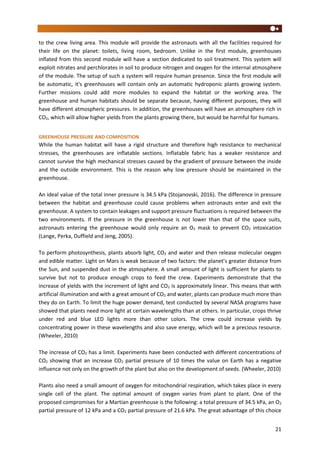
  • 22.
    7 3. OVERVIEW OFTHE NEW DISCOVERIES Since the origin of spaceflight, Mars has been a target destination for exploration missions. Starting with the first visit in 1965 with the successful flyby of Mariner 4, a variety of missions have greatly enhanced our understanding of Mars (Howell, 2015). As Mars has had, and continues to have, the potential for habitability, it is the most frequently visited planet in our Solar System (NASA Mars Exploration, 2016a). In the last 10 years, a variety of operational orbiters, landers, and rover missions have returned data that have led to new discoveries that altered our view of Mars. The discoveries we present in this section originated from the latest missions including Mars Atmosphere and Volatile Evolution Mission (MAVEN), MSL also known as Curiosity, Phoenix, Mars Reconnaissance Orbiter (MRO), Mars Exploration Rover (MER) mission consisting out of Spirit and Opportunity, Mars Express (MEX), Mars Global Surveyor (MGS) and Mars Odyssey. 3.1. SHALLOW GROUND ICE AT MIDDLE LATITUDES REVEALED BY SMALL IMPACT CRATERS Water in the form of near-surface ice has been primarily detected in the polar regions of Mars (Boynton et al., 2002). Despite the scientific importance of these regions in our understanding of the dynamics of the Martian water cycle, it is widely accepted that human exploration of the Martian poles is an endeavor that encompasses major engineering challenges including power requirements, ground instrumentation, and transportation (MEPAG HSO-SAG, 2015; Cockell, 2001). Landings at the poles are especially difficult because of the reduced rotational speed of the surface with increasing latitudes. Recently, Dundas et al. (2014) reported observations of ground ice in midlatitude new impact craters (Figure 4). The MRO spacecraft observed those craters primarily as dark spots in images using the Context Camera (CTX). The High Resolution Imaging Science Experiment (HiRISE) camera monitored visible ice over time by capturing images repeatedly. Hyperspectral images from the Compact Reconnaissance Imaging Spectrometer for Mars (CRISM) were acquired for these craters, confirming that the bright material in the crater was indeed pure ice. (Dundas et al., 2014) A recent NASA study on planning for Mars water ISRU considers different descriptions of hypothetical reserves on Mars. The study presents the information along with the relevant engineering efforts that space agencies or corporations must make for ISRU to become a reality, based on present knowledge. The report presents four reference cases of water, corresponding to the four presently identified water reserves on Mars. They include glacial ice, poly-hydrated sulfate minerals, phyllosilicate minerals, and regolith. The report concludes that glacial ice has a number of advantages compared with granular materials. For example, ISRU from ice would not involve transporting a large quantity of dirt as well as the water source. However, disadvantages of using glacial ice include having to remove any material lying above the ice before the exploitation of the subsurface ice. The NASA report assumes poly-hydrated sulphate minerals require the lowest raw material mass and least power for material processing. In the regolith case, more mass must be transported and more power used for extraction because a higher volume needs to be processed. The phyllosilicate minerals case is considered to be somewhere between the poly-hydrated sulphate
  • 23.
    8 and regolith caseswhen comparing advantages and disadvantages for water ISRU. (Abbud-madrid et al., 2016) Figure 4: Ice-exposing impact craters observed by HiRISE Copyright: American Geophysical Union. (Dundas et al., 2014) Used with permission. 3.2. HYDRATION IN SURFACE SOILS AT THE EQUATOR New measurements by Curiosity describe water hydration in surface soils at the equator. Data from the John Klein and Cumberland drilling areas showed that the most abundant gas evolved was water, with phyllosilicates present at 17 wt% and 16 wt% respectively. (Ming et al., 2014) Recurring slope lineae (RSL) as seen in Figure 5 are narrow streaks of low reflectance on the surface of Mars due to moistened soil. One of the assumptions regarding the origin of water in the RSL is the deliquescence of salt, which is the dissolution of a salt through the absorption of water vapor. It is not clear if there is enough water vapor on Mars for RSL creation. Data from MRO found evidence of magnesium perchlorate, magnesium chlorate, and sodium perchlorate at all the observed RSL regions. This study concludes that RSL on Mars are closely related to these salts, a conclusion supported by spectral data proving the associated water composition is not pure but briny. (Ojha et al., 2015)
  • 24.
    9 RSL have previouslybeen considered important in our understanding of the water cycle and the feasibility of life on Mars. Recent data from NASA’s Mars Odyssey’s Thermal Emission Imaging System (THEMIS) do not contradict the presence of these salts. The lack of a temperature gradient between RSL and surrounding ground formations provides evidence opposing previous beliefs associating RSL formation with evaporating brines. (NASA JPL, 2016) Figure 5: Recurring slope lineae in Newton Crater. Credit: NASA. 3.3. MINERALOGY MEASUREMENTS OF SOILS Orbiters and rovers carry tools that study the composition and mineralogy of the Martian surface. The on-orbit method has the advantage of large coverage of the surface, but it does not have the resolution to detect isolated outcrops of unique composition. The data collected by rovers on the surface is more complete spatially and mineralogically, but rovers can only cover very small areas. (Ehlmann and Edwards, 2014) As a result, the global geologic map is based mainly on morphology and not rock composition (Tanaka et al., 2014). The upper crust of Mars is more homogenous than that of Earth, and overall it has a basaltic composition. Soil is created from crust mainly through physical processes, but chemical alteration is also present, including weathering by water. Minerals that point to the presence of water are found throughout the geologic history of Mars, but with the majority dated to the Noachian epoch (up to 3.7 million years ago). The relatively homogenous composition of the crust and the similarity in soil composition sampled by MER and MSL in different locations, brought about the “generic soil” concept that states that most of the soil on Mars is of similar composition. (Ehlmann and Edwards, 2014) Minerals detected on the surface of Mars including phyllosilicates and sulfates, are of interest in the context of human exploration because it is possible to extract water from their molecular structure.
  • 25.
    10 Phyllosilicates (clay minerals)are found where a Noachian-era outcrop exists on the surface of Mars. Hydrated sulfates like gypsum are less commonly found, possibly because they formed in lakes, and the spatial distribution of the occurrence of such lakes is not well known. (Ehlmann and Edwards, 2014) Both phyllosilicates and sulfates appear lithified, except for a known area of gypsum dunes, where the material is in the form of loose grains (Archer, 2016). 3.4. NITRATES The Martian atmosphere has ~2 % nitrogen in the form of N2 gas (Owen et al., 1977), but nitrates in the soil were not detected until recently. The Sample Analysis at Mars (SAM) instrument onboard the Curiosity rover measured nitrates in the Martian regolith to be ~0.01 - 0.1 wt%. These levels are 10 times smaller than in the Atacama Desert and Antarctica on Earth. These Earth sites are chosen for comparison because there is very little biological activity, which, in normal Earth conditions, is responsible for most of the nitrates available in the soil. The nitrates on Mars were detected in aeolian and mudstone samples from the Gale crater. The existence of nitrates in two different types of regolith indicates that the process that transformed atmospheric nitrogen to nitrates is likely a global one, such as an impact event or volcanic activity. This suggests we may find nitrates globally on Mars. (Stern et al., 2015) Figure 6: Equatorial and midlatitude chlorine distribution in the surface. Copyright: American Geophysical Union. (Keller et al., 2007) Used with permission. 3.5. PERCHLORATES Preliminary test results from the Viking landers indicate that perchlorate salts may exist at the mid-northern latitudes on Mars. The Phoenix probe and Curiosity rover have proven the existence of perchlorate on Mars, supporting the idea of a global distribution of perchlorate in the Martian regolith. Elemental chlorite has been
  • 26.
    11 detected in everysoil sample on Mars, showing that chlorine is distributed at similar levels (0.49 wt% average, 0.1 - 1.0 wt% range) from the equator to midlatitudes in both hemispheres, further supporting the idea of global perchlorate distribution. Lastly, the gamma Ray Spectrometer onboard NASA's Mars Odyssey orbiter has measured the chlorine distribution in the top meter of Martian soil as seen in Figure 6 emphasizes this idea (Keller et al., 2007). Besides from having detrimental effects on human health, perchlorate is also a source of oxygen for life support and propellant oxidizers. Additionally, its strong attraction to water can drastically lower the freezing point of water, and allow liquid water to flow on the Martian surface, even with the very low atmospheric pressure. Recent research has hypothesized two mechanisms for perchlorate production on Mars. The proposed mechanisms are very similar, with the primary difference being that one proposes atmospheric formation and the other proposes formation on the Martian surface. The first is an atmospheric process where gas phase oxidation of chlorine by oxygen atoms or ozone produces perchloric acid, with dry deposition followed by surface mineral reactions that results in perchlorates (Catling et al., 2010). The second mechanism is the formation of perchlorates on the Martian surface by the ultraviolet (UV) photo-oxidation of chlorides aided by mineral catalysts (Schuttlefield et al., 2011). Explaining the origin of perchlorates would help us to understand the geochemical evolution of Mars. 3.6. ORGANICS Looking for life is one of the main drivers for scientific missions to Mars. Carbon-containing compounds known as organics are an essential component of life as we know it on Earth. Organic compounds can be produced abiotically in an active geological site, or biologically. Finding organic compounds is a strong indicator for life, but because of the possibility of non-biological origins the detection of organics does not exclusively indicate the evidence of life. (McKay and García, 2014) The Viking landers in 1976, which to date are the only spacecraft to carry instruments to look for life on Mars, surprisingly did not detect any organics (Klein, 1978). With the recent detection of perchlorate, we now understand that the Viking instrument was unable to detect organics, as all organics would have become oxidized through sample heating before the measurement. In 2013 the SAM instrument on MSL detected simple organics such as chloromethane (CH3Cl), dichloromethane (CH2Cl2), trichloromethane (CHCl3), and chloromethylpropene (C4H7Cl) at Rocknest (Leshin et al., 2013). The measurements are not conclusive, but are a promising indicator for life on Mars. The 2016 ExoMars Trace Gas Orbiter is expected to map potential organics in the atmosphere, which will enhance our understanding of the origin (ESA, 2016b). 3.7. METHANE Methane has been detected on Mars by orbital and Earth-based remote sensing. In 2004, the Planetary Fourier Spectrometer (PFS) onboard the MEX orbiter measured a global average of 10±5 parts per billion by volume (ppbv) (Formisano et al., 2004). Later that year the Canada-
  • 27.
    12 France-Hawaii Telescope detectedan atmospheric methane mixing ratio of 10±3 ppbv (Krasnopolsky, Maillard and Owen, 2004). In 2009, the Infrared Telescope Facility (IRTF) and the Cryogenic Echelle Spectrograph (CSHELL) made observations of high concentration plumes of methane, seemingly originating from discrete locations (Mumma et al., 2009). In response to these claimed observations, Fonti and Marzo (2010) reviewed data archives from the Thermal Emission Spectrograph (TES) onboard MGS. They found seasonal methane levels similar to previous studies (Fonti and Marzo, 2010). For comparison, the atmospheric methane concentration of Earth is approximately 1800 ppbv (Blasing, 2009). With the exception of the results published by Krasnopolsky in 2004 that showed persistent methane, all these observations of Martian atmospheric methane varied, both spatially and temporally. These variations could be due to either localized concentrations of methane sources and/or sinks, and seasonal changes. Variations ranged between 0 and up to 60 ppbv. The length of these periods of variation is on the scale of weeks and months. (Formisano et al., 2004; Geminale, Formisano and Giuranna, 2008; Mumma et al., 2009) Figure 7: Possible methane sources and sinks. Credit: NASA. We need to investigate why these variations occur with time. The varying levels of methane are interesting because they result from unknown ongoing mechanisms, suggesting the planet may still be “alive” as seen in Figure 7 (Formisano et al., 2004). Atmospheric models predict that methane should have a lifetime of around 300 years before photochemical decomposition (Summers, Lieb, Chapman and Yung, 2002), implying that with such a long geologic timeframe, background methane
  • 28.
    13 levels on Marsshould be uniform but the fluctuations in the measured background level occur over significantly shorter timescales. The Curiosity rover made in-situ measurements using the Tunable Laser Spectrometer (TLS) of the SAM instrumentation suite in 2015. Over a 20-month period, it detected methane at a background level of 7.2 ± 2.1 ppbv at the 95 % confidence interval on sols 466, 474, 504, and 526. The MSL team observed that the high-level observations of methane did not correlate significantly with readings of relative humidity, atmospheric pressure (CO2 abundance), ground or air temperature, or radiation levels. The MSL rover also detected a possible weak inverse correlation with water abundance, and atmospheric opacity. The findings imply that Mars is rapidly producing methane from unknown sources (Webster et al., 2015). Around 90% of methane found in the Earth’s atmosphere comes from living things, predominantly cattle Mumma et al., 2009). The remaining contribution of terrestrial methane is introduced by abiotic means. These include magmatic/volcanic and hydrothermal processes. Abiotic, extraneous, or even biological sources may all plausibly be the origin of methane on Mars. There are no known processes that can produce methane in an atmosphere (Krasnopolsky, Maillard and Owen, 2004). Of the possible abiotic processes, (Krasnopolsky, Maillard and Owen, 2004) suggest volcanic and hydrothermal sources of methane production are unlikely. Volcanism has not occurred for 10 million years, and the Mars Odyssey orbiter did not detect any discernable hotspots for such activity (Christensen, 2013; Krasnopolsky, Maillard and Owen, 2004). Methane could be brought to Mars through interplanetary dust particles (IDPs) and micrometeoroids. Laboratory experiments show that should this extraneous material contain organics, UV irradiation may cause a breakdown and release of organics, including methane, to the atmosphere (Schuerger et al., 2012). However, models that supply methane through such a mechanism cannot account for the short scale variations or peaks in methane observations detected by Curiosity (Geminale, Formisano and Sindoni, 2011; Mumma et al., 2009; Schuerger et al., 2012; Webster et al., 2015). It remains plausible that methane could arise from biogenic sources, extinct or extant. Should the methane be produced by subterranean microbial life forms on Mars, measurements of methane abundance and comparison with terrestrial atmospheric measurements (e. g., Blasing, 2009) greatly constrain the amount of biomass present on the planet. Such life would be expected to have very small populations and would be constrained to specific discrete local oases (Krasnopolsky, Maillard and Owen, 2004). 3.8. ATMOSPHERIC COMPOSITION We must understand the Martian atmosphere to be able to design of a human exploration roadmap, as the atmosphere plays a role in a broad range of mission design aspects. For example, understanding atmospheric density, structure, and composition are essential for the design of EDL and ISRU systems. If we investigate the atmosphere’s ability to support life we will also gain useful information for characterizing the needs and constraints of future human missions, and for scientific benefits in determining whether living organisms could
  • 29.
    14 have developed onthe surface of Mars in the past or could be doing so at present. This section gives a short overview of the atmospheric characteristics and their implications. DENSITY AND STRUCTURE The Martian atmosphere is much thinner than Earth’s atmosphere and shows a thermally layered structure with the troposphere (relatively warm, heated by the ground and airborne dust), the mesosphere, the thermosphere (a layer heated by the Sun to high temperature) and the exosphere (the unclear transition between the Martian atmosphere and outer space). (Gonzalez–Galindo, Forget, Coll and Lopez-Valverde, 2008) In addition, Mars shows a seasonal ozone layer at the south pole. The atmosphere also consists of a complex ionosphere, and a layered structure of ions and neutral gas revealed by the MAVEN orbiter in 2015 (Mahaffy et al., 2015). PRESSURE On average, the atmospheric pressure on Mars is ~600 Pa, just 0.6 % of Earth’s mean sea level pressure of 101.3 kPa. The pressure, however, varies with altitude, just as on Earth. 600 Pa is well below the absolute minimum 6.3 kPa of pressure required for human survival, below which exposed body liquids boil away at a normal body temperature of 37 °C. This low pressure has direct implications on human mission design. (NASA Mars Exploration, 2016a) COMPOSITION The Martian atmosphere is mainly composed of carbon dioxide, with 96 ± 0.7 % CO2, 1.93 ± 0.01 % Ar, 1.89 ± 0.03 % N2, 0.145 ±0.009 % O2, and CO to a level smaller than 0.1 % (Mahaffy et al., 2013). Several mission studies suggest that the atmospheric CO2 could be used to make large amounts of rocket fuel for the return journey from Mars. There are two methods of extracting this fuel: The Sabatier reaction and electrolysis. The Sabatier reaction involves producing methane and oxygen from carbon dioxide and hydrogen gas. Electrolysis involves splitting carbon dioxide into oxygen and carbon monoxide. (Rapp, Hoffman, Meyen and Hecht, 2015) OUTCOMES FROM MARS ATMOSPHERIC MEASUREMENTS The atmosphere of Mars contains a wealth of information about its present and past, as reflected by recent discoveries by the Curiosity rover (Mahaffy et al., 2013). From variations in the atmospheric composition, scientists can obtain information about the current state and dynamics of the planet. For example, a peak in the methane amount detected by the Curiosity rover in 2014 is an indication that it is either geologically active, or hosts organics. The isotopic composition provides scientists with precious information about the Martian past climate and atmospheric history. Measurements of the ratio of hydrogen isotopes (deuterium to hydrogen) by the Curiosity rover, suggest that the Gale crater used to contain large amounts of liquid water that has been lost over the planet’s history. Measurements of argon and xenon isotopes by SAM on-board the Curiosity rover, as well as measurements by the MAVEN orbiter, converge to suggest that Mars used to have an atmosphere that was stripped away, most likely by the solar wind (NASA, 2015a; Carlisle, 2015). The identification of the most scientifically interesting sites and the complexity of the instruments available to investigate those areas such as complex drills will affect the selection of landing site for any future human mission.
  • 30.
    15 3.9. CRUSTAL MAGNETISM Marslacks any discernable global magnetic field. With no liquid metal core, the planet has no active dynamo deep in its interior to generate such a phenomenon. Magnetometer readings made by MGS in 1998 surprisingly showed anomalous regions of strong localized magnetism were recorded during the mission’s repeated aerobraking orbits (Acuña et al., 1998). The crust itself was observed to be the source of this local magnetism. Such regions of intensely magnetized crust reveal that Mars must once have had an active convecting and electrically conducting core, which may explain the origins of the anomalous regions of magnetization. (Connerney et al., 2004) Residual crustal magnetism on Mars is seen to be mostly in the southern hemisphere and almost totally absent in the northern hemisphere. Mars also exhibits significant geological differences between its northern and southern hemispheres. Studies of crustal magnetism may hold the key to understanding the history of the hemispherical dichotomy of Mars, as there is a level of correlation between the age of the Martian crust and the level of measured magnetism it exhibits. (Connerney et al., 2004) The southern highlands exhibit the most intensely magnetized crustal regions. These regions are hypothesized to be the oldest parts of the surface. Magnetization is notably absent in the southern Hellas and Argyre impact basins. In the northern lowlands magnetization is much weaker, with the exception of a few higher latitude regions at around 330° west longitude meridian. (Acuña et al., 1999; Connerney et al., 2004) Researchers hypothesize that the regions of crust may have lost their magnetization through volcanism and extraneous impacts. These processes could heat the magnetized crust above its Curie temperature, a critical point at which materials lose their permanent magnetic properties (Encyclopaedia Britannica, 2015). Should the crust be heated beyond its Curie temperature, its collective magnetization would be lost if such heating processes occurred following the shutdown of the planet’s internal dynamo. As the crust cools without the presence of a global magnetic field, the individual internal molecular magnetic moments within have no external field to align with. These magnetic moments then assume random orientations and their magnetic “coherence” is lost. Volcanic activity could also be a heating mechanism causing magnetization to be is lost if it heats the crust beyond its Curie temperature (Connerney et al., 2004). These processes could explain the lack of magnetization in the Hellas and Argyre impact basins and the northern hemisphere. Alternating polarized patterns and lineations in the intensely magnetized southern crust provides good evidence of tectonic activity in the last days of the active internal dynamo (Connerney et al., 1999). These magnetic lineations are similar to those seen in terrestrial oceanic ridges where tectonic spreading occurs. The Earth’s magnetic dynamo is known to reverse polarity periodically, and this is seen in the magnetic record of the newly formed oceanic crust (Vine and Matthews, 1963). The similarity in these magnetic patterns to those seen on Mars suggests that the highly magnetized southern crust formed during an era of plate tectonics (Connerney et al., 1999).
  • 31.
    16 The magnetic environmentof Mars tells us more about the history of the planet, and may influence our future exploration as we select landing sites. 3.10. RADIATION The Earth is shielded from harmful radiation from solar and galactic sources such as solar energetic particles (SEP) and galactic cosmic rays (GCR) by both its strong global magnetic field or magnetosphere, and its thick atmosphere. These prevent harmful radiation from reaching the surface by deflecting and absorbing highly energetic particles. Following the shutdown of the internal dynamo at the core of Mars four billion years ago (Acuña et al., 1999) its global magnetic field was lost. This left its ancient atmosphere exposed to the solar wind and it was gradually stripped away. The remnant thin atmosphere and the lack of any global magnetosphere leave the surface of Mars largely exposed to space radiation. Measurements made on the surface provide the only means to understand the unique Martian radiation environment. Terrestrial observations, models, and simulations are unable provide the same level of insight as a surface probe. Earth-based analog studies to replicate the hazardous environment are also impossible. (Hassler et al., 2014) Since arriving on Mars on the 6 August 2012, the Radiation Assessment Detector (RAD) instrument onboard MSL has been measuring the radiation dose levels on the surface at Gale crater. These new measurements allow an evaluation of the radiation risk to human health during a mission to Mars for the first time, revealing the variability of surface radiation over time. (Hassler et al., 2014) Observations made during a 300-day period were reported in January 2014. Notably, these measurements were made during a period of solar maximum. There is an inverse relationship between solar activity and the expected number of GCRs received. During solar maximum, more SEP events are expected with few incident GCRs. Separate measurements were made for the radiative dose rate contributions arising from GCRs and SEPs. During the observational period the GCR dose rate measured was seen to vary between 180 and 225 microgray (μGy)/ day. The variations in these measurements are expected due to variations in solar activity, seasonal and diurnal changes and atmospheric pressure fluctuations. The average result obtained over the period of measurement was reported as 0.210 mGy/day. (Hassler et al., 2014) During this study, measurements were also made of the dose received from a SEP event. This measurement was obtained by subtracting the average GCR radiation dose during the period of the event from the total recorded dose yielding a value of 50 mGy. The dose equivalent from this event was measured to be approximately 25% of the dose equivalent received per day from GCRs. (Hassler et al., 2014) If humans travel to Mars, they will also be subjected to the radiation environment of interplanetary space after leaving the Earth’s magnetosphere. The MSL mission collected data in transit and provided RAD measurements of the radiation doses received from interplanetary space from the spacecraft's interior on the journey to Mars. In-transit shielding is only provided by the spacecraft
  • 32.
    17 itself for theduration of the 253-day, 560-million-kilometer journey. From these measurements, estimates of the equivalent dose during a hypothetical, shortest-duration return trip to Mars were found to be 0.66 Sievert (Zeitlin et al., 2013). This is representative of a received dose of 0.48 mGy/day. (Hassler et al., 2014). Comparison with measurements on the surface highlight the greater radiation risk associated with interplanetary travel to Mars. Humans traveling will need to be protected from this radiation. This can be achieved through shielding the spacecraft and minimizing the transit time. The combined MSL RAD results have allowed estimates of the total radiation risk for human missions to Mars to be made. A human mission consisting of a 180-day transit (each way) combined with a 500-day stay on the surface would present a total mission dose of around 1.01 Sv (Hassler et al., 2014; Zeitlin et al., 2013). Such a mission is proposed within the latest NASA Mars mission design reference architecture (Drake, 2010).
  • 33.
    18 4. DISCOVERY IMPLICATIONSCHART All of these discoveries have specific impacts on the likelihood of a human Mars mission. At first it may not be clear how each discovery relates to each implication, especially since multiple discoveries have multiple implications. For example, the recent findings of perchlorate in the Martian regolith have implications for ISRU since they can be used for fuel or oxygen extraction but they also have implications for human health having negative effects on the thyroid gland. To combat this issue team aMARTE has produced the following diagram visually linking all discoveries to their implications (Figure 8). Figure 8: Discovery Implications Chart
  • 34.
    19 5. IMPLICATIONS These newdiscoveries have all come from robotic missions or remote sensing of the red planet. When planning a human mission to Mars we need to consider the implications these discoveries will have on interplanetary life. In this section we will discuss those implications and provide recommendations on how to handle these implications to bring humans one step closer to our nearest neighbor. 5.1. HABITABILITY New discoveries on the surface of Mars such as perchlorate, nitrates, and water availability, have numerous implications for the technology related to human habitat. This section outlines our concept for a habitat that relies on the use of those new discoveries. The aMARTE Team expects the habitat for the first long-stay human Mars mission to be composed of several modules. This settlement shall include all basic life support systems and provide isolation from the red planet’s atmosphere to its residents. Here we discuss all of the major technical aspects of each module. HABITAT STRUCTURE We suggest the following architecture, illustrated in the Figure 9 below: a network of modules that could be sent separately to Mars and then be connected together after landing on Mars (Green on the Red planet, 2013). Figure 9: Module network concept. Copyright: Dilermando Ferreira. Used with permission. The proposed deployment sequence is as follows:  Due to mass and volume constraints of the modules launched from Earth, each module consists of deployable parts. The module is landed in a folded configuration.
  • 35.
    20  Two armsare then deployed, each of them with its own airlock located at the end of the arm. Although the arms are deployable, they are rigid structures. The human habitat is composed of the central dome and its arms.  The third phase is the deployment of the inflatable greenhouses, perpendicularly to the arms. Inflatable greenhouses will be used to host plants. Figure 10 shows the deployment phases of a single module (Green on the Red planet, 2013). Figure 10: Module deployment schematics. Copyright: (Green on the Red planet, 2013) Used with permission. The average area needed for cultivation is about 40 m2 per person. This will provide each astronaut with roughly 2500 kcal. If the crew is made of four astronauts, we will require a surface of 160 m2 (Wheeler, 2003). It is easy to understand how difficult it is to bring a non-inflatable structure from Earth. Inflatable structures are the only way to minimize both mass and volume during module transportation from Earth. One feature of Mars is the low density of its atmosphere. Winds on the planet such as dust devils are not strong enough to damage the habitat (NASA Mars Exploration, 2015b). Assuming that plants can survive in an environment with a total pressure lower than the Earth pressure, there is no reason why a rigid structure should be used for the greenhouses. The first mission should be robotic only with the following objectives:  to better assess the Mars environment before sending any humans;  to start plant production automatically, so that the subsequent human missions could benefit from the accumulated O2. The first module, dedicated to future Extravehicular Activity (EVA) activities, should contain a lab, a clean room, and an airlock. A remotely controlled automatic system allows the deployment and inflation of the modules. The second mission will bring a module, that should be entirely dedicated
  • 36.
    21 to the crewliving area. This module will provide the astronauts with all the facilities required for their life on the planet: toilets, living room, bedroom. Unlike in the first module, greenhouses inflated from this second module will have a section dedicated to soil treatment. This system will exploit nitrates and perchlorates in soil to produce nitrogen and oxygen for the internal atmosphere of the module. The setup of such a system will require human presence. Since the first module will be automatic, it's greenhouses will contain only an automatic hydroponic plants growing system. Further missions could add more modules to expand the habitat or the working area. The greenhouse and human habitats should be separate because, having different purposes, they will have different atmospheric pressures. In addition, the greenhouses will have an atmosphere rich in CO2, which will allow higher yields from the plants growing there, but would be harmful for humans. GREENHOUSE PRESSURE AND COMPOSITION While the human habitat will have a rigid structure and therefore high resistance to mechanical stresses, the greenhouses are inflatable sections. Inflatable fabric has a weaker resistance and cannot survive the high mechanical stresses caused by the gradient of pressure between the inside and the outside environment. This is the reason why low pressure should be maintained in the greenhouse. An ideal value of the total inner pressure is 34.5 kPa (Stojanovski, 2016). The difference in pressure between the habitat and greenhouse could cause problems when astronauts enter and exit the greenhouse. A system to contain leakages and support pressure fluctuations is required between the two environments. If the pressure in the greenhouse is not lower than that of the space suits, astronauts entering the greenhouse would only require an O2 mask to prevent CO2 intoxication (Lange, Perka, Duffield and Jeng, 2005). To perform photosynthesis, plants absorb light, CO2 and water and then release molecular oxygen and edible matter. Light on Mars is weak because of two factors: the planet’s greater distance from the Sun, and suspended dust in the atmosphere. A small amount of light is sufficient for plants to survive but not to produce enough crops to feed the crew. Experiments demonstrate that the increase of yields with the increment of light and CO2 is approximately linear. This means that with artificial illumination and with a great amount of CO2 and water, plants can produce much more than they do on Earth. To limit the huge power demand, test conducted by several NASA programs have showed that plants need more light at certain wavelengths than at others. In particular, crops thrive under red and blue LED lights more than other colors. The crew could increase yields by concentrating power in these wavelengths and also save energy, which will be a precious resource. (Wheeler, 2010) The increase of CO2 has a limit. Experiments have been conducted with different concentrations of CO2 showing that an increase CO2 partial pressure of 10 times the value on Earth has a negative influence not only on the growth of the plant but also on the development of seeds. (Wheeler, 2010) Plants also need a small amount of oxygen for mitochondrial respiration, which takes place in every single cell of the plant. The optimal amount of oxygen varies from plant to plant. One of the proposed compromises for a Martian greenhouse is the following: a total pressure of 34.5 kPa, an O2 partial pressure of 12 kPa and a CO2 partial pressure of 21.6 kPa. The great advantage of this choice
  • 37.
    22 is that itis simply achievable through compressing Mars air and adding the right amount of molecular oxygen. (Stojanovski, 2016) Thanks to the Curiosity mission, we know the Martian soil is rich in perchlorates. This is a precious resource for human settlement because it is possible to get molecular oxygen from perchlorates using simple bacteria. The ion ClO4 - can be reduced to Cl- and O2 through two different phases. The first is the reduction of perchlorate to chlorite. The second transforms ClO2 - to chloride and oxygen. More than fifty types of bacteria are able to do this process. The simplest way to get the ions from the soil is putting surface regolith in water and letting perchlorates dissolve. After the removal of the purified regolith it is possible to put those micro-organisms in the “polluted” water. This is the way to obtain not only an oxygen machine but also the soil where healthy crops can grow. (Davila, Willson, Coates and McKay, 2013) The use of perchlorates for oxygen production could be combined with the one produced by plants. Plants absorb carbon dioxide generated by human respiration as well. For this reason, a system of gas exchange between the greenhouses and the human habitat shall be designed, along with an oxygen storage system. Stored oxygen could be used to refill the spacesuits after each EVA. SOIL & WATER FOR PLANTS The first module will not be human but it will contain greenhouse modules with automated systems for crops cultivation without soil. Those systems can be hydroponic, where plants roots lie in water enriched with the needed chemicals as seen in Figure 11, or aeroponic, spraying nutrients directly on the roots. Historically aeroponic methods that require less water were preferred but the discoveries about water on Mars mean a more efficient hydroponic culture is a viable option. It means that plants will grow while astronauts are coming to Mars. Right after their arrival, astronauts will not be able to access and process Martian soil to grow plants. For this reason, the early cultivation on Mars will keep using the hydroponic system to produce food to live until the stocks of chemicals brought from Earth are finished. Later astronauts would use the soil of Mars, treating it in the specific section of the greenhouse. Soil is a precious resource for plants’ growth. Soil allows roots to anchor and to distribute water and nutrients. It represents the habitat for all the micro-organisms helping plants to absorb chemicals. Plants need nitrates (NO3 - ) - to make proteins and build DNA. Nitrogen cycle bacteria are able to transform molecular nitrogen present in the atmosphere into nitrates (NO3 - ). Evidence of nitrates and ammonia in very small quantities has been found in the Gale crater by the SAM instrument and reported by Stern et al. (2015). If future missions reveal bigger amounts of those compounds and a global distribution, the opposite process could be used to process N2, so that it could be used as inert gas in the habitat. Mars atmosphere contains 2 % of molecular nitrogen. If we obtain the greenhouse air through compression of Mars air, as previously explained, our environment will have N2 available. Further missions would allow to discover where a greater concentration of nitrates is and how it is distributed on the planet. (Stern et al., 2015)
  • 38.
    23 Figure 11: Conceptof inflatable hydroponic cultivation system. Copyright: Dilermando Ferreira. Used with permission. Not all parts of plants are edible. Precious oxygen as well as water and other nutrients are stored in the inedible part of the crops so recycling waste crops products is essential. A way to do it is composting or processing them and mixing them with available soil. This compost will be more efficient than the raw soil for new plants to grow (Wheeler, 2003). Among the primary chemical needs for almost all types of plants are potassium and phosphorus. The composition of Martian soil indicates the presence of those elements in molecular form in the following percentages: 0.6 % of K2O (potassium) and 0.9 % of P2O5 (phosphorus). Many other nutrients are available in soil on Mars, such as magnesium and calcium. (Clark et al., 1982) FUTURE DEVELOPMENTS We consider aquaculture to be a reasonable extension in the development of a long term human presence on Mars. Far in the future it would be possible use water on Mars to farm rice, fish, crustacean, and shellfish cultivation. A few methods have already been developed (McKay and García, 2014). Astronauts will need a nutritious and palatable diet for long-term missions. If they are to consume animal proteins, we will need new ways of producing them. It is easy to recognize how difficult the practice of raising animals can be if we are on another planet. Raising cattle, for example, would be difficult for two reasons: first, the animal would have to grow a reduced level of gravity. Second, it will augment the risk of bacterial contamination of the closed environment. Living in water, fish hardly suffer from the lack of gravity, they are fast-growing, and can be managed easily (McKay and García, 2014).
  • 39.
    24 RECOMMENDATIONS 5.2. LIFE SUPPORTSYSTEM The life support system is a complex integration of a number of subsystems designed to enable human survival in harsh environments. It has a number of essential elements, however in relation to the new discoveries on Mars only the life support atmosphere, water system, waste system, radiation protection, and environmental control and monitoring will be discussed. 5.2.1. ENVIRONMENTAL CONTROL AND MONITORING The environmental control and monitoring system assesses and adjusts for any physical, chemical, or biologic factors that contribute to health in a life support system, and are primarily focused on air quality, water quality, and microbiology control. A closed-loop bioregenerative life support system will likely be the optimal choice for a Mars mission. This is a system that does not require any extra material to be added to function, and everything is biologically recycled. To accomplish this, plants and animals will be necessary for the management of air, water, waste and food supply. These biologic components, though beneficial, can produce a hazard as they can adapt, mutate and colonize to new areas. (Clément, 2011) This is particularly true of microorganisms and so they will require microbiologic monitoring and control, particularly with astronaut immune system depression from the space environment being present (see Section 5.3.5 for further discussion). The atmosphere and water systems for bioregenerative systems will need to be monitored and controlled not only for human needs, but also for the plants and animals as well (Qin et al., 2014). Determining the needs of plants in space has been ongoing for 40 years and is continuing, so that optimal integration of bioregenerative systems can be attained (Zabel, Bamsey, Schubert and Tajmar, 2016). Due to the complexity of a bioregenerative system, real-time measurement and highly integrated sensors will need further development to account for the numerous dependent and independent factors occurring simultaneously in the life support system (Anderson, Ewert, Keener and Wagner, 2015).  Investigate the availability of nitrates elsewhere on Mars for the prospect of plant growth and conversion to nitrogen  Use of deployable and inflatable structures to reduce the mass of the habitat.  Development of a gas exchange system between greenhouses and human habitats along with an oxygen storage system  Replicate Mars’ regolith samples for ISRU nitrate and perchlorate testing  Test which bacteria are able to dissociate perchlorates in the widest range of temperature  Investigate which bacteria we can produce directly on Mars, i.e. from human or plant wastes
  • 40.
    25 The effects ofMartian dust are anticipated to be pervasive on all life support systems causing blockage, reduced efficiency, or overt failure. This would affect air, water, and environment control. The Martian dust has a tendency to stick to surfaces, and is composed of magnetite, which is strongly magnetic. To combat the dust, surfaces should be smooth and resistant to abrasion. (Anderson et al., 2015) The latter can be accomplished through generating electric fields in structures that repel the dust from the structure’s surface and allow it to fall to the ground (Bullis, 2010). The environmental control and monitoring subsystem will need to optimize the needs of humans, plants, and animals while controlling microorganisms and the dust of the Martian surface. This will require further development and integration to ensure a robust and functional system. RECOMMENDATIONS 5.2.2. LIFE SUPPORT ATMOSPHERE The unique atmosphere of Mars will dictate a different approach for the habitat environment compared with the ISS. NASA performs reviews of recent evidence for protecting human health in space, and this information has formed the backbone of this discussion on pressure and human health. The habitat atmosphere on Mars will need to be lower than the sea-level pressure of 14.7 psia with 21 % oxygen if astronauts are to complete multiple EVAs efficiently (Conkin et al., 2013). To safely adjust to lower pressures for an EVA, astronauts need to pre-breathe pure O2 so that the nitrogen is displaced from the body, and this can take hours if the habitat pressure is high (Norcross et al., 2015). NASA has reviewed the issue, and current consensus is for a hypobaric (low pressure) hypoxic (low O2) environment that is 8.2 psia and 34 % O2 (Norcross et al., 2015). This pressure system is hypoxic as the biologic response to a gas is dependent on its partial pressure and not its overall percentage of the atmosphere (Clément, 2011). In this configuration, the inspired O2 pressure is 128 mmHg, which is below sea level O2 pressure of 156 mmHg, hence the term hypoxic. The aim is to operate at the lowest safe atmospheric pressure to minimize decompression sickness risk for EVAs, while limiting the negative effects of hypoxia (Norcross et al., 2015). Decompression sickness is the formation of nitrogen bubbles in the human body tissues as it comes out of solution from the blood due to rapid reduction in atmospheric pressure (Clément, 2011). The advantages of the hypobaric environment include quicker pre-breathing before use of an EVA spacesuit, and the ability to use a suitport (Norcross et al., 2015). A suitport is a rear-entry spacesuit, the back of which is attached to the exterior of the habitat, and one can climb into it from the interior of the habitat so that an airlock is not required (Azriel, 2016). Drawbacks of the hypobaric hypoxic environment include an increased baseline risk for acute mountain sickness (AMS), reduced immune function, and poor sleep (Norcross et al., 2015). Acute mountain sickness is a constellation of symptoms associated with low O2 pressure at high altitude and it can be fatal. The goal of the hypobaric hypoxic environment is to reduce the risk of decompression sickness; however there is evidence that weightlessness may  Research into bioregenerative life support systems  Research into dust accumulation prevention
  • 41.
    26 confer a protectiveeffect on decompression sickness (Karlsson et al., 2009). Extrapolating this evidence, the reduced gravity of Mars may also have a protective effect on decompression sickness meaning the atmospheric pressure does not need to be as low as 8.2 psia. The inert gas component of the Martian atmosphere at 2.7% N2 and 1.6% Ar has a different chemical composition from that of the Earth and poses different problems for maintaining the habitat atmosphere. The inert gas could be entirely N2 as it is on Earth, or a combination of Ar and N2. The convenient option would be direct use of the Martian atmosphere for the habitat, however one study concluded that Ar resulted in more dissolved gas present in the body than nitrogen and so posed a higher decompression sickness risk if used (Pilmanis, Balldin, Webb and Krause, 2003). Since N2 is not very prevalent on Mars, improved means of ISRU generation or shipping it from Earth would be needed if it is to be the only inert gas in the habitat atmosphere (Norcross et al., 2015). Despite the toxicity of CO2 to humans at elevated levels, the CO2 from the Martian environment can be helpful for the life support system. From a chemical standpoint, the Sabatier and Bosch processes can be used to produce O2 by catalytically reducing CO2 with H2 (Vilekar et al., 2012), and this has the potential to create a closed loop system where oxygen and hydrogen are recycled with only carbon as a waste product. With long-term missions, a closed life support system is preferred, and so the Bosch system is the ideal choice of the two; however there are technical limitations such as slow reaction rates that need further refinement (Vilekar et al., 2012). CO2 is also useful for bioregenerative life support. Plants use CO2 as their energy source and output O2, and this can be used along with a number of other functions of plants to supply the necessary water, oxygen, and food for human survival (Qin et al., 2014). The abundant supply of CO2 on Mars would require initial atmospheric modifications for plants to prosper (Anderson et al., 2015), however ideally the process becomes self-sustaining. For maintenance of the life support atmosphere, the discovery of perchlorate on Mars has significant implications. It is a known oxidizer, and with the correct reaction, perchlorate decomposes to O2 (Gu and Coates, 2006) that can be used for the life support system. This can significantly increase the independence of a Mars mission and reduce mass. RECOMMENDATIONS 5.2.3. WATER SYSTEM Water is now known to be present on Mars, and this will save on mission mass as well as accommodate for any water losses during a mission. Identifying the optimal source between ice or the Martian regolith requires further clarification and is discussed further in Section 5.5. The perchlorate present in the environment does present a challenge however, as perchlorate is highly water soluble (Gu and Coates, 2006) and will contaminate the water that is extracted. Fortunately, perchlorate can be removed by a number of methods including bio-reduction, chemical reduction,  Further research to clarify if the dissolving of Ar in the body is consistent across different percentages or partial pressures of the atmosphere  Clarification of any protective effect of reduced gravity on decompression sickness
  • 42.
    27 adsorption, membrane filtration,ion exchange and electro-reduction (Kumarathilaka, Oze, Indraratne and Vithanage, 2016). Bio-reduction is a process where microorganisms remove electrons from the perchlorate and eliminate its toxicity (Gu and Coates, 2006). The detoxification of perchlorate in Martian water is simplest using bio-reduction; it is appropriate for large-scale treatment (Kumarathilaka et al., 2016) and has been implemented on Earth for ex-situ use, however in-situ use needs further investigation (Gu and Coates, 2006). RECOMMENDATIONS 5.2.4. WASTE MANAGEMENT Oxidation of solid waste is used to enable water recycling for life support systems (Anderson et al., 2015). The discovery of perchlorate can be applied to waste management as it could be used as an oxidizer, to further maximize mission independence and ISRU. RECOMMENDATIONS 5.2.5. RADIATION MITIGATION GCRs, SEP, and secondary neutrons produced from radiation interactions are the greatest concerns for astronauts (Straume, 2015). GCR are composed of 85 % high-energy protons, 14 % helium nuclei, with 1 % as high-Z, high-energy (HZE) nuclei that include all elements heavier than helium(Straume, 2015). The flux density of GCR radiation is relatively low, but their high energies make it difficult to shield against, and the high biological damage they can cause contributes to the significant hazard of GCRs. GCR particles create secondary radiation/neutrons from a process known as the electromagnetic cascade and neutron build-up when they interact with materials such as metal and biological tissue. The secondary radiation/neutrons created then inflict biological damage at a high level; up to 10-50 times worse than other typically observed radiation. (Straume, 2015) SEP are composed of 98% protons and the rest being helium nuclei and heavier elements that are accelerated to high energies by the Sun from solar flares and coronal mass ejections. Mars has a thin CO2 atmosphere that, as detected by the RAD, does reduce SEP radiation substantially, but only somewhat lowers the GCR. (Straume, 2015) Radiation shielding can be effective however it has problems regarding mass and potentially increasing radiation exposure due to electromagnetic cascade and neutron build-up. The GCR can interact with the shield creating a large number of secondary particles, including neutrons, and this can increase the radiation dose rather than reduce it. SEP shielding however, allows most events to be well controlled and is less logistically challenging than GCR. Radiation shielding improves with the lower the atomic number as secondary neutron production decreases, and so polyethylene (C2H4)n  Research into in-situ perchlorate bio-reduction  Research into use of perchlorate as an oxidizer for solid waste
  • 43.
    28 may be agood compromise. The regolith of Mars is also under consideration for use as a shielding source. Unfortunately, the regolith on the Martian surface may not be suitable as a shield due to its chemical composition and potential secondary particle generation from interaction with the GCR. (Huff et al., 2016) We considered whether the residual crustal magnetism of Mars could provide a source of shielding from solar and galactic radiation. The strength of these magnetic fields however is reasoned to be too weak to provide significant shelter from charged radiation particles. The effect of such shielding may also be negated by the fact that the southern regions where magnetism is strongest are also higher in altitude, meaning that atmospheric radiation protection is diminished. It remains a question whether the unique magnetic landscape forms hotspots: regions of higher concentrated radiation that could pose great risk to human activity. These may occur in a similar manner to the radiation belts that reside within the Earth’s magnetosphere. There are currently a number of challenges with radiation mitigation as the Martian atmosphere provides only minimal protection, the crustal magnetism is unlikely to provide significant protection, and shielding has problems resolving mass and effectiveness. RECOMMENDATIONS 5.3. HUMAN HEALTH 5.3.1. MARTIAN PERCHLORATES AND HUMAN HEALTH Recent findings document high perchlorate levels in the Martian soil, and perchlorate is known to interfere with iodine uptake in the thyroid gland (Kumarathilaka et al., 2016). The thyroid is a gland in the body that releases hormones to help regulate a wide array of functions, such as the metabolic rate and many organ processes (Hall, 2016). Iodine is a critical component in the production of the hormones in the thyroid gland, known as T3 and T4 (Gu and Coates, 2006). Perchlorate competes with iodine in the thyroid, resulting in blocked or suppressed hormone production. Its effect on thyroid function is reversible when perchlorate consumption is stopped, or with the supplementation of synthetic thyroid derivatives of T3 or T4. Since it reduces thyroid function, perchlorate was previously used for treatment of excessively high thyroid function, which is known as hyperthyroidism. (Wolff, 1998) On Earth, perchlorate is found in surface water, groundwater, soil, and food at much lower levels than Mars. It is absorbed typically through drinking and eating, but may also be inhaled or absorbed through the skin(Gu and Coates, 2006). On Mars, the high levels of perchlorate will affect the quality of ISRU consumable water that is mined, and this is a significant concern. Inhalation and skin absorption are considered minor risks for exposure (Gu and Coates, 2006), and this can occur from the Martian dust being inhaled or resting on the skin. Epidemiological studies have attempted to  Materials science research for mass to protection optimization of shielding  Development of artificial magnetic fields for radiation deflection  Measure levels of radiation and magnetism in areas of strong crustal magnetism
  • 44.
    29 characterize the cut-offvalue for perchlorate toxicity for the general population; however, they have unfortunately been inconclusive with determining exact perchlorate cut off levels, and mice studies for toxicity did not represent human findings (Gu and Coates, 2006). When used to treat hyperthyroidism, perchlorate has minimal side effects at low levels however at dosages from 1200 to 2000 mg/day side effects were noted with an incidence of 16-18% overall (Wolff, 1998). Most of the side effects were mild, however there were reported rare fatalities (Wolff, 1998). Currently, the medical recommendations regarding perchlorate on Earth are directed towards those vulnerable to low thyroid function: pregnant and lactating women (Gu and Coates, 2006). The best evidence recommends the optimization of iodine nutrition in pregnant and lactating women where low iodine levels are a concern (Leung, Pearce and Braverman, 2010). Astronauts will need their own guidelines for perchlorate exposure due to the environment of Mars. To mitigate this problem, perchlorate can be removed from the environment by bio-reduction, chemical reduction, adsorption, membrane filtration, ion exchange, or electro-reduction (Kumarathilaka et al., 2016). Supplementation of thyroid hormones can also combat the reduced thyroid function. RECOMMENDATIONS 5.3.2. MARTIAN RADIATION AND HUMAN HEALTH For a Mars mission, radiation shielding, biological countermeasures, and/or reducing exposure time, are available for radiation mitigation. In this section, exposure time and biologic countermeasures will be discussed. Section 5.2 on Radiation and Life Support discusses the use of shielding. On Mars, exposure to the GCR and SEP are the largest radiation threats to human health. The effect of radiation is determined by the amount of radiation absorbed by tissue, measured in Sieverts (Sv). To put it in context for the Earth and low Earth orbit environment, the average background radiation dose is approximately 3.5 mSv/year on the Earth, and an average radiation dose over 6-months on the ISS is 72 to 330 mSv (Clément, 2011). The effect of GCR on human health is not well understood and the NASA Space Radiation Laboratory (NSRL) is being upgraded to a GCR simulator capable of delivering protons and ions that are more representative of the space environment for further experimentation (Huff et al., 2016). SEP radiation is currently better characterized than the GCR. The evidence for cancer risk is strong for doses above 50 mSv, however acceptable levels of risk are often guided by norms of society or ethics (Huff et al., 2016). Current radiation risk estimates for a Mars mission are at ~1 Sv for a three-year mission (Clément, 2011). With the exception of acute radiation sickness, radiation exposure does not cause new disease but it increases the frequency of  Detailed analysis of human studies examining perchlorate toxicity and the relevant effect on thyroid gland function to further characterize safe levels for human exposure  Begin crop cultivation experiments on Earth simulating Martian soil perchlorate content, to investigate whether cultivated crops would contain perchlorate concentrations beyond acceptable doses for humans  Completion of analog studies to determine the optimal thyroid hormone or iodine dosing regimen for anticipated perchlorate exposure on Mars 
  • 45.
    30 certain diseases ina dose-dependent manner such as cancer, cardiovascular disease, reduced fertility, and genetic abnormalities (Straume, 2015). To help monitor radiation damage, biomarkers are in development to determine when and if biological countermeasures are needed. These are to be based on blood cell indicators, proteins, and metabolites (Huff et al., 2016). There are drugs that appear to have radiation-protective effects such as Amifostine and aminothiol (Huff et al., 2016). However, there are limitations with certain medications due to toxicity at radiation protective levels (Huff et al., 2016), and so this needs further research and development. Gamma-tocotrienol and the statin class of medications are also being investigated as a biologic countermeasure, with a focus on cardiovascular protection from radiation (Patel et al., 2015). Antioxidants are less effective for radiation protection, but are less toxic. Antioxidants however also may not confer a protective effect for cancer as they may allow the survival of damaged cells that eventually become cancerous (Huff et al., 2016), and this is an area that needs further investigation as well. Currently, the radiation experienced on a Mars mission will exceed the dose normally absorbed during ISS missions and the biologic countermeasures available require further research and development. RECOMMENDATIONS 5.3.3. OCCUPATIONAL MEDICINE ON THE SURFACE OF MARS The surface of Mars offers occupational challenges beyond radiation, including physical, biological, and chemical hazards. Physical hazards from activity include minor to major direct physical trauma, repetitive strain, radiation, and heat stresses (Wetherill, 2014). In particular, direct trauma from the EVA suit itself is a strong concern (Chappell, Norcross, Abercromby and Gernhardt, 2015) and can range from hand to foot and shoulder injuries resulting from the body putting pressure against the rigid suit. Different levels of work risk and injury come from increasingly active motion, ranging from translation (walking), light stationary, heavy stationary, light mobile, and heavy mobile activity (Chappell et al., 2015). Physical hazards will be further increased as astronauts engage in mining and/or drilling activities on the Martian surface. Biological hazards are present, either from Earth microorganisms (Wetherill, 2014) or potentially native Martian organisms that have yet to be discovered. With closed-loop life support systems, biologics can be a significant health hazard (Clément, 2011). This is discussed further in Section 5.2. Chemical hazards (Wetherill, 2014) are a large concern, particularly from Martian mineral dusts as Mars has an atmosphere with a constant dust load (Lemmon et al., 2004). Long-term exposure to  Continuing research into minimally-invasive monitoring for radiation biomarkers  Research into pharmaceuticals for radiation protection  Research into the effects of GCR on human health
  • 46.
    31 silica and othermineral dust exposure are known to cause respiratory problems (Wetherill, 2014), and with extended time on Mars this can be a significant health issue. For example, dust was shown to have spread from the EVA suits to the lunar lander when exploring the Moon (Anderson et al., 2015). This dust can deposit in the lungs, and the general reaction to mineral dust in the lungs is fibrosis, which is a thickening and scarring of the lung tissue (Broaddus et al., 2016). This lung damage can lead to difficulty breathing and increased risk for lung infection. Exposure to dust on Mars will increase as a result of mining and/or drilling on the Martian surface, as the EVA suits will be exposed to higher than normal dust levels. The Martian dust does have a significant silicon percentage (Lemmon et al., 2004), and this adds a particular lung medical risk as silicon is known to cause the lung disease silicosis, a specific type of lung fibrosis that is also linked to lung cancer (Wetherill, 2014). Maintaining maximal physical performance for the astronauts, along with minimizing cancer risk is very important for success living on the Martian surface, and so steps to ensure occupational health will be important. RECOMMENDATIONS 5.3.4. PHARMACOLOGY The knowledge of pharmaceuticals in the space environment is incomplete. For a Mars mission, a thorough understanding of drug behavior in altered gravity, along with maintaining a biologically active medication reserve is essential to ensure the safety of astronauts for medical problems. The effects of how the body distributes a drug, known as pharmacokinetics, and how the drug affects the body, known as pharmacodynamics, are not well understood in microgravity (Clément, 2011). The Martian environment’s effect on drugs, with its partial gravity, is unknown but likely will demonstrate an effect in between full and microgravity. Some information is known about microgravity, as research of select drugs including ibuprofen demonstrate an increased speed of effect under microgravity (Idkaidek and Arafat, 2011). However this, along with other effects, cannot be generalized to all drugs, particularly ones that depend on the emptying rate of the stomach (Idkaidek and Arafat, 2011). Different routes of drug administration may also cause a drug to have less of an effect in microgravity (Clément, 2011), and so different formulations of medications may be needed just so they can be given to a patient in altered gravity. Currently, decisions about pharmaceuticals for space missions are made by the best evidence from Earth (Wotring, 2011), though this may not hold true in the space environment. The shelf life of medications is a significant issue for long distance space travel, as most pharmaceuticals are only guaranteed biologically effective for up to one year (Wotring, 2011). To combat the poor shelf life of drugs, production of medications en route to Mars is an option. Synthetic biology can help with this, as yeast that can be programmable to produce different medications such as antibiotics is currently under development (Perez-Pinera et al., 2016). This  Standardized dust control procedures for cleaning of EVA suits prior to habitat entry  Analog studies on the deposition pattern in the lungs and toxicity profile of Martian dust
  • 47.
    32 would allow astronautsto produce their own pharmaceuticals on-demand, reducing mass and providing the security of having a diverse range of medications available when needed. The ability to create new medications is a critical feature if new diseases are encountered on Mars either from mutated microorganisms from Earth or native Martian organisms if they are present. RECOMMENDATIONS 5.3.5. THE IMMUNE SYSTEM Immune system function is known to be depressed from a variety of factors in the space environment, including radiation exposure (Li et al., 2015). Only radiation as a cause will be discussed here as the Martian radiation environment has only recently been characterized. Improper function of the immune system in a closed environment is a significant concern, and this involves its ability to control bacteria, viruses, fungi, parasites, and normal cancer suppression (Li et al., 2015). There is concern that radiation exposure in the space environment may be synergistic in depressing the immune system (Crucian, Kunz and Sams, 2015), leaving astronauts more vulnerable to infections or cancer. This potential effect is currently under investigation by the Triplelux experiment (Ullrich and Thiel, 2015). There is also a noted increase in the virulence of selected microorganisms in space, meaning that the space environment increases the ability of certain microorganisms to cause an infection. Along with the discovery of opportunistic organisms on the ISS that were not expected, this could expose immunosuppressed astronauts to unexpected disease- causing microorganisms that have increased virulence, putting their health at risk. These microorganisms may mutate or grow faster in the space environment as well; however, this has not been accurately determined. (Chatterjee, Bhattacharya and Ott, 2012) If microorganisms grow faster or mutate quicker, this could also have an impact on the severity of infections experienced. For treatment of infections, there has been conflicting evidence for antibiotic resistance rates (Chatterjee, Bhattacharya and Ott, 2012), either for increased or decreased resistance. In conjunction with the potentially altered drug behavior in microgravity, altered antibiotic resistance rates could lead to an inability to actively fight an infection. A new approach for infection treatment is with Granulocyte Colony Stimulating Factor (G-CSF) in conjunction with antibiotics. G-CSF is a compound that stimulates the bone marrow to create certain types of white blood cells to help boost the immune system. In mice under simulated microgravity and SEP-like radiation, the combination of G-CSF and antibiotics is showing evidence of reducing infection rates (Li et al., 2015). The space environment, which includes radiation exposure, can have a direct impact on the immune system function of astronauts, as well as alter the characteristics of microorganisms. This can elevate the risk of infection in the Martian environment, and so further research into human immune system function and microorganism changes in the space environment is needed.  Dedicated studies in microgravity regarding essential medications for space exploration medicine  Research for potential in situ production via bioreactors
  • 48.
    33 RECOMMENDATIONS 5.4. HUMAN GROUNDOPERATION 5.4.1. SPACE SUITS An extravehicular mobility unit (EMU) is the combination of a space suit, gloves, helmet, and a portable life support system (PLSS). Outside the habitat, it is the only protection for the astronaut to survive in such hostile conditions as those encountered on the surface of Mars, which is why it is often referred to as a “personal spaceship”. The EMU is also one of the only elements that will interact both with the interior of the habitat and the surface of the planet. It may therefore be one of the main vectors of dust and particle exchange between these two environments. Abrasive Martian dust will not only damage the spacesuits, but also contaminate the habitat with consequences for the health of the crew (Ferguson et al., 1999). This is all the truer given the harmful effects of perchlorates (see Perchlorate Section 5.3.1). Conversely, the crew could also accidentally contaminate the Martian surface because of biological material they would bring during an EVA (Clément, 2011). This risk has to be controlled as much as possible to avoid jeopardizing potential forms of life that could be the source behind new findings related to methane or the presence of organics. The EVA room will have to be specifically designed to address these issues by preventing any contact between the crew and the outer surface of the EMU (Frankel, 2007), once washed or even sterilized. In that case, special protocols will have to be designed for particular operations such as repairing the suits or changing parts. RECOMMENDATIONS 5.4.2. LOCAL NAVIGATION SYSTEM Discovery of intense residual crustal magnetism in the Martian environment could potentially be used as a “first-order” localization system, in a similar way to how compasses are used on Earth. However, the Martian magnetic field is highly fragmented over the surface so it would only be used for local navigation. This technique would require the preliminary mapping of an extended area of the surface. In the long run, the use of the crustal magnetic field would most likely be overtaken by more conventional satellite-based navigation systems that offer a more reliable and global coverage.  Further refinement of EVA suits with a focus on increased mobility and safety   Further characterization of the level and duration of immunosuppression in astronauts from radiation exposure  Verification of virulence and antibiotic resistance changes in pathogenic microorganism found on the ISS.
  • 49.
    34 RECOMMENDATIONS 5.4.3. HUMAN-ROBOT COLLABORATION Aquestion often asked when it comes to exploration of space is whether humans or autonomous systems should be sent to explore. The advantages of sending robots are clear: no risk to human life, no need for advanced life support systems, and no return mission requirement. Robotic missions come with the challenges of semi-autonomous operations: where mission control can only decide upon which sites to further investigate based on information from the rovers’ sensors, a feedback loop that poses challenges, especially due to significant communication delays. Humans can operate with a much larger degree of autonomy and can use reason and curiosity to perform science, but are limited in sensing and actuation - they have limited mobility, and limited strength for transportation of equipment. In light of this, recent support has been drawn towards the idea that you should avoid not choosing one or the other, but opt for both in a synergic relationship. In researching the concept and the recent discoveries, the aMARTE Team supports this concept. The next section outlines capabilities autonomous vehicles could significantly contribute in such endeavors. 5.4.4. AUTONOMOUS VEHICLES FOR EXPLORATION An important preparation for human exploration is having as much information as possible about locations on Mars to choose a suitable landing site. Orbiters only provide limited knowledge due to spatial resolution, temporal resolution, and instrument limitations. Autonomous vehicles offer a solution to these challenges. Not only would such a solution be useful for resource prospecting as outlined in Section 5.5 but also mapping the environment in high definition for the purpose of exploration missions. Mapping on Earth is ever more frequently done using Unmanned Aerial Vehicles (UAVs). This can also be done on Mars. NASA has proposed drone missions, such as the Aerial Regional-scale Environmental Scanner (Mraz, 2003) that never passed the conceptual design phase. Advances in autonomous flights, have led to the proposal of new concepts, such as one that might fly on the Mars 2020 rover proposed by the Jet Propulsion Laboratory (JPL). (NASA JPL, 2015) Key developments enabling such missions are the miniaturization of electronics, advances in processing power, and developments towards more advanced flight algorithms. Discoveries pushing the relevance of this technology include mineralogy and the discovery of subsurface ice since UAVs could quickly and efficiently scout the nearby area to search for these deposits for use with ISRU. 5.4.5. ASSISTIVE ROBOTS Limited strength restricts the amount of equipment an astronaut could carry. A heavy lift vehicle could be used to solve this problem. Such a vehicle would be limited to smooth terrain so an alternative solution would be using a rover capable in harsher terrains, being able to carry and deploy heavy instrumentation. Advances in robotic technology, have led to recent developments in this field, as exemplified by the company Boston Dynamics. They manufactured the Big Dog (Boston Dynamics, 2016b) originally developed for equipment carrying for the military and Atlas (Boston Dynamics, 2016a), a humanoid robot robust to harsh environments. With further development,  Investigate the potential use for residual crustal magnetism for navigation  Investigate the impact of residual crustal magnetism on current navigation systems 
  • 50.
    35 these robots mighthave the capability of autonomously do basic research and tedious tasks whereas the astronaut could focus on the higher level research and exploration. Such developments could be used to deploy drills to gather resources or search for life. To maximize astronaut time spent doing research you would want to minimize the astronauts time collecting resources for ISRU. This can be achieved by using robots to collect resources and bring them back to the habitat for extraction. The Regolith Advanced Surface Systems Operations Robot (RASSOR) project is looking into building a robot capable of doing this (NASA Technology Transfer Program, 2016). RECOMMENDATIONS 5.4.6. PRESSURIZED ROVER Supplying the crew with a rover can have a number of benefits: less crew fatigue, lighter EVA suits, wider exploration range, longer exploration time (Drake, 2010). The design, manufacture, and delivery of a pressurized rover to Mars is very expensive. Two rovers would be necessary for redundancy and to increase range but that would add to the cost. The use of a pressurized rover may not be necessary for all mission types: for a short mission, the crew could perform without the rover. Alternatively, they may live in the rover itself, and not use a more expensive habitat. For a long mission, a rover would have more value since it would be used for 500 days rather than 30. NASA has tested its own pressurized rover, the Space Exploration Vehicle, in an Earth analog mission (NASA, 2012). Designed for both the Moon and Mars, it features highly innovative suitports allowing the crew to enter their EVA suits within a matter of minutes rather than hours. There are minimal other new developments in this field. When a human mission to Mars is announced the development of a pressurized rover will need further research. 5.5. ISRU In-Situ Resource Utilization (ISRU) can be defined as the “collection, processing, storing and use of materials encountered in the course of human or robotic space exploration that replace materials that would otherwise be brought from Earth” (Sacksteder and Sanders, 2007). It is a set of hardware and protocols that are meant to reduce the initial mass of materials needed, as well as the price of the mission, while increasing mission and crew safety. To be fully efficient, ISRU needs local resource exploration and planning. This includes the way the resources can be reached, transported and transformed, as well as the need for dedicated facilities. For instance, the distance between the resource, the mining infrastructure, and habitat must be reasonable for conducting mission operations. The fact that a resource is available does not mean that it can or has to be exploited, and it is necessary to know if it is technically feasible and profitable to collect, extract and process it. (Sanders, 2016).  Test autonomous UAV technology combined with remote sensing for minerals and water.
  • 51.
    36 5.5.1. WATER ISRU Wateris a basic requirement for humans and plants. Bringing from Earth all the water necessary to support long exploration missions and long-term human presence on Mars would be extremely expensive since astronauts will require 3.56 L of potable water and 26 L of hygiene water per day (Clément, 2011). In addition to this is the risk of re-supply missions being unsuccessful, delayed or canceled, negatively affecting the life of astronauts on Mars due to water shortages. Finding a way to produce water on the surface of Mars is therefore crucial. The discovery of water on the surface of Mars, either as ice at the poles or in the soil at the equator, represents a critical factor in the feasibility of a human mission to Mars. Being able to extract water from the Martian environment using ISRU techniques drastically reduces the mission cost and risk. EXTRACTION OF WATER FROM REGOLITH We know that the amount of water in the atmosphere is too scarce to be a viable resource for a future human mission. However, water was identified on the surface of Mars in the form of ice in the polar caps. In addition, shallow subsurface ice was found in mid-latitudes. Water inside hydrated minerals (gypsum, jarosite, opal and hydrated silica, phyllosilicates) has been detected on the surface, and although the concentrations are very low at 3%, it still provides tremendous mission design mass benefits (Sanders, 2016). Also, when water is either frozen or locked in the soil, minimal planetary protection issues are expected, compared with the presence of liquid water. In mid-latitudes, Abbud-Madrid et al. (2016) identified four types of sources that have a reasonable potential to produce water on Mars and whose characteristics have been studied from Mars robotic landers and rovers. These four sources are ice, poly-hydrated sulfate minerals, phyllosilicates, and regolith, and are discussed below. From our research, the Mars Water In-Situ Resource Utilization (ISRU) Planning (M-WIP) Study was found to be an excellent resource regarding water ISRU and so has formed the backbone of the discussion for this section (Abbud-madrid et al., 2016). ICE In mid-latitudes, ice is present in two forms. Permafrost has been evidenced within the top five meters and shallow icy soils from 0.3-2 m depth. Icy soils have been found in newly formed craters and are made of nearly pure ice (Sanders, 2016). Mining subsurface ice for water would present numerous challenges. It is dependent on thickness of the overburden and the mechanical properties of the ice. However, this process would produce larger quantities of water as compared to surface mining of hydrated minerals or regolith (Abbud-madrid et al., 2016). POLY-HYDRATED SULFATES The extraction of water from deposits of poly-hydrated sulfate minerals offers the most advantages compared to other methods. However, the efficiency of the process is highly dependent on the distance between the location of the deposit and the extraction plant which can be several kilometers from the base. This distance might be accommodated through the use of robotics as outlined in Section 5.4 or by processing the ore into water/ice at the site of mining before transportation to avoid carrying excess material back to the base. Currently, the excavation technologies for surface granular material are at a relatively high technology readiness levels (TRL).
  • 52.
    37 The compactness ofpoly-hydrated sulfate minerals on Mars is not yet well known however, and it is possible that crushing will be required before extraction of water, requiring more power than if ice were harvested (Abbud-madrid et al., 2016). PHYLLOSILICATES The extraction of water from phyllosilicates is inefficient compared to extraction from poly-hydrated sulfate minerals and Martian regolith, mainly due to the high temperature required for extraction. However, in areas rich in the phyllosilicate smectite, the use of this type of ore could be favorable (Abbud-madrid et al., 2016). REGOLITH Using regolith as the source for producing water would require both collecting the most soil and using the largest amount of processing power in comparison to other surface mining approaches. In addition, the efficiency of the process is dependent on the distance from the base. The benefit of this source lies in its flexibility in choosing a landing site options (Abbud-madrid et al., 2016). Each source of water can be used to establish reserves used for a human mission, with improvements in the production process of each being ongoing. Unfortunately, we do not have adequate data to single out the most promising water source and as result all need to be considered for the supply of water on Mars. Table 1 provides an overview of the various strategies that can be employed for different types of deposits and the estimated cost benefit for transportation and tailings per mission. Most of the time, for processing, the resource needs to be heated in order to collect water. The required temperature is a critical parameter since it is directly related to energy consumption and to the hardware to be designed for this purpose. An optimal temperature has to be found in each case, as though the quantity of collected water increases when the temperature increases, other hazardous elements as contaminants can also be unwillingly extracted during this process (Abbud-madrid et al., 2016) There are also risks associated with the complexity of infrastructure needs for the mining, transportation, and extraction of water and dependency on local water resource. Should an ISRU system break then this can cause the failure of the mission. 5.5.2. OXYGEN ISRU Producing oxygen in-situ is a key enabling capability for human missions as it can be used for life support as well as rocket fuel. Oxygen is bound in the CO2 in the atmosphere, surface oxides such as Fe2SO3 in the regolith, and H2O in the ice. A device called the Mars Oxygen In-situ resource utilization Experiment (MOXIE) being developed at the Massachusetts Institute of Technology (MIT) is currently able to create oxygen purity of 99.6% from carbon dioxide. The process, called solid oxide electrolysis, is separating 2CO2 into 2CO + O2. This experiment is planned to be part of the NASA’s Mars 2020 rover (Rapp et al., 2015).
  • 53.
    38 Table 1: Summaryof key factors for different water ISRU sources. Data:(Abbud-Madrid et al.,2016) Source Strategy Landing Proximity Excavation Approach Ore Quantity (Hydration) Transport to Refinery Refinery Retort Transport to Plant Fuel Processing Total Power Estimated Regolith Surface Mining, Central Processing (higher temp, lower mass) Land on Batch Rovers ~1,300 mT (@1.25%) Minimal 300 °C Not required Common (~20 kW) ~28 kW Regolith Surface Mining, Central Processing (higher temp, lower mass) Land on Batch Rovers ~2,000 mT (@0.75%) Minimal 150 °C Not required Common (~20 kW) ~28 kW Clays Surface Mining, Central Processing several km from base Batch Rovers ~600 mT (@3%) Ore Transport Rover (~600 tons 300 °C Not required Common (~20 kW) ~25 kW Hydrated Sulfates Surface Mining, Central Processing several km from base Batch Rovers ~200 mT (@9%) Ore Transport Rover (~200 tons) 150 °C Not required Common (~20 kW) ~22 kW Subsurface Ice Surface Mining several km from base Prohibitive beyond TBD meters Not required Not required Not required Ice Transport Rover (16 tons) Common (~20 kW) TBD (field) + ~20 kW Subsurface Ice Down-hole heat probe + In-situ Recovery several km from base Drill / Kerf only, Downhole "Cryobot" heat probe Not required Not required Subsurface Heating with Gas phase Recovery with cold trap. Ice Transport Rover (16 tons) Common (~20 kW) TBD (field) + ~20 kW
  • 54.
    39 The detection ofsubsurface water ice and perchlorates allows for new methods for extracting oxygen. For the extraction of oxygen from H2O, ice is first melted. Several different chemical reactions can then be used. Electrical energy is used to split H2O into both hydrogen and oxygen. Due to the use of this technology in the Oxygen Generation System onboard the ISS, electrolysis is a promising candidate. This approach would reduce risk and cost by raising the TRL to its maximum (Cloud et al., 1999). Alternatively, oxygen from the water can also be extracted using bacteria or plants performing photosynthesis as described in Section 5.2. Due to the high solubility, perchlorates can be easily obtained by rinsing the regolith with water. The process of decomposition from pure perchlorate to produce oxygen needs high temperatures. We could decrease the decomposition temperature by choosing efficient catalysts and using microbial degradation (El-Awad, 1991). These techniques still need further research. A big risk in this technology is the ability to control the reaction rate as high temperatures together with the presence of oxygen can lead to unwanted oxidation. (Sutter, 2014) 5.5.3. FUEL ISRU With the exception of the Mars One mission concept, all proposed Mars mission designs share the common element of a return vehicle. Whereas the Apollo missions carried all the fuel required to return to Earth in the landing vehicle. A comparable design for Mars missions would imply a prohibitively massive vehicle; As in the case of chemical propulsion, up to 90 % of mission mass (Drake, 2010) is fuel. The same percentage could be saved through ISRU for fuel production. In fact, this mass is so significant it exceeds the mass savings due to other systems such as water for crew consumption, or oxygen for metabolism. As a result, this is today's main motivator behind ISRU research. Table 2: Potential fuel substances. Data: (Mars ISRU: State-of-the-Art and System Level Considerations, 2016) Hypergolic Hydrazine Methane Propane Methanol Ethanol Ethylene Kerosene Hydrogen(l) ISP 328 2365 362 357 335 343 364 352 441 MR 1.9 1.0 3.5 3.25 1.5 2 2.75 3.0 5.25 Density 890 1020 422 500- 600 792 799 566 810 71 Liquid Phase temperature (K) 360 387 111.7 230.9 337.8 351.5 189.5 20.3
  • 55.
    40 Chemical propulsion canbe achieved through several methods, with the most common being solid rocket boosters, and liquid propellant. Liquid propellants offer the greatest potential for ISRU, as they all rely on combustion: the reaction between oxygen and a second substance. As outlined in the previous Section 5.5.2, oxygen could be extracted using several different methods. Although all combustion processes share oxygen as a common element, several fuel substances could be used as outlined in Table 2. Several methods have been proposed for ISRU to produce some of the fuel proposed in Table 2 (Drake, 2010), most significantly hydrogen extraction from water processing, and methane production from the carbon dioxide in the atmosphere via the Sabatier reaction. Of these two methods, methane has been evaluated as the more beneficial. One of the few excess substances on Mars is CO2, and if we split it up into carbon atoms and oxygen molecules and mix them both with hydrogen we get both water and methane that can turned into propellant (Wu, 2016) This could also be combined with the method of electric swing adsorption that cleans the air of the living area and get rid of excess CO2. (Lee, 2015) This process is favorable since it offers a single step process, versus a two or more step process for most other hydrocarbon fuels, and a very high efficiency conversion ratio, yielding more than 99% methane when producing methane from hydrogen and carbon dioxide (Mars ISRU: State-of-the-Art and System Level Considerations, 2016). The simplicity of the process lowers the risks and the technology development. In addition, methane relies on the same existing technology, insulation, cryocoolers, and tanks as used for liquid oxygen. The fluctuation of methane in the atmosphere could indicate large quantities of methane hidden under the Martian crust (Thomas, Mousis, Picaud and Ballenegger, 2009). In the far future we could learn to extract these hypothetical sources and use them as fuel for the journey home. ALTERNATIVE METHODS FOR FUEL PRODUCTION A special bacterium called anammox has been found in urine. Normally this would have no impact but if you mix this bacterium with recently discovered perchlorate you can form rocket propellant (phys.org, 2011). Alternatively, urine can also be used as fertilizer that combines with the Sun’s energy, carbon dioxide, and water to create fuel. This technology is nicknamed “the artificial leaf”. 5.5.4. ISRU FOR MANUFACTURING HABITAT FABRICATION One important mass driver for any Mars mission is the Mars surface habitat; this mass could be significantly reduced through the use of in-situ resources, as the regolith could be converted to building material for habitat fabrication. Recent findings concerning the content of the Martian regolith have allowed for the development of Martian analog regolith. Researchers have shown that the significant Sulfur contents on the Martian Surface (SO3 up to 37 wt%, average 6 wt%) could be used in a 50 % Martian regolith, 50 % sulfur mix, yielding strong material with the potential application of habitat fabrication (Wan L, 2016).
  • 56.
    41 A second methodfor fabrication has recently seen big developments: the use of additive manufacturing methods, commonly referenced as 3D printing. Recent research show that one 3D printing method: Selective Laser Melting (SLM) could be used for manufacturing parts. The methods involve refining the Martian regolith to produce fine powder, and using a high power laser to melt the powder on a 2D slice in a way that it builds up a 3D shape. This method is normally used for smaller structures, but if deployed in advance of a mission, it could produce larger ones as well. Another method is fused deposition modeling (FDM). Research shows large 3D printers, such as the ones we have seen on Earth for manufacturing buildings, could melt the regolith of Mars and use it as the building material (Grunewald, 2015). Furthermore, aluminum products could be combined with concrete (Giannakopoulos, 2016). A way to obtain concrete is mixing Martian soil and sulfur (Wan, Wendner and Cusatis, 2016) or extracting it from CO2, present on Mars (Foulsham, 2016). 3D PRINTING FOR SPARE PARTS MANUFACTURING Transportation or generation of spare parts on Mars is a significant challenge. For Mars One, an estimated 13,465 kg are needed for a two year stay on Mars (Do et al., 2016). Without the capability of quick resupply, there are two options: either bring a large amount of spare parts to Mars or manufacture spares on site. Bringing the resources on the mission is one option: this saves the weight of having to have prefabricated spare parts for all failures, and instead brings a common feedstock pool that can be used on demand as failures require new spare parts. This is already being pursued by companies, such as Made in Space (Madeinspace, 2016). In reality, one would expect to see a combination of both, carrying 3D printing resources on-board the flight to Mars, and using Martian regolith upon landing. One challenge of 3D printing is not having tested it on the Martian surface. With the small 3D printers available on Earth today one could envision testing on the Martian surface as a potential candidate for future technology demonstrations. This leads to our recommendation of sending a 3D printer demo on future Mars rover missions. 5.5.5. POWER GENERATION Classical power generation for spacecraft is done using solar panels. Since Mars is further from the Moon and has an atmosphere obscuring the Moon, this method is less favorable for a Mars mission. Nuclear power is constant and reliable and may be a preferred option. It is already used to power MSL on Mars (LaMonica, 2012). Other high TRL options are wind and geothermal power but the thin atmosphere and cold planet respectively mean that these options are not viable. A low TRL option is the use of ion power. This concept uses a set of ion collectors to collect energy from the charged ions flying through the Martian atmosphere (Ion Power Group LLC, 2016). 5.5.6. CONCLUSION As a future recommendation and to verify the conclusions of MEPAG report on water reservoir cases (MEPAG,2015), it is proposed to investigate the consistency of Martian soil. For example, if the relevant materials are not loose but rather bound on rocks or compact, the amount of power required to extract materials could be different. ISRU technology needs to be demonstrated to reduce as much system risk as possible. This can be done in analog missions on Earth, on the Moon or on a rover on Mars before humans arrive. ISRU
  • 57.
    42 systems should bepre-deployed ahead of a human mission to allow time for the systems to gather resources. Further characterization of the chemical composition of the manganese oxides in Mars is important. Relevant use of those compounds according to the relevant composition should be investigated using terrestrial examples; for example, the use of manganese in alkaline batteries in Earth. Considering the short distances that have been covered up to today by rover missions on Mars, and the importance of the data provided so far, it is important to identify the limitations of rovers and design a new generation of landers and rovers for future Mars exploration missions. This would intensify the relevant research and enhance our Martian environment understanding prior to human exploration on Mars. Future construction work in ISRU systems on the Martian surface should consider a combination of surface and underground construction ideas. We should take full advantage of the Martian surface soil heat capacity, reduce the impact of temperature differences between day and night, and shield astronauts from radiation. Finally, Mars in-situ resource utilization must be based on the premise of protecting the environment, ensuring that the impact on the Martian environment is kept to a minimum, or to alter the environment of Mars toward human habitation. RECOMMENDATIONS 5.6. ASTROBIOLOGY There is strong evidence that Mars was once a habitable planet with warmer temperatures, liquid surface water, an atmosphere, and a magnetic field. Knowing meteoroid interactions between Earth and Mars have occurred, this indicates a possibility of life having formed on Mars and further inspires our search for it there. Only the Viking landers looked for evidence of life by putting a soil  Further study the characteristics of the surface and subsurface material with robotic missions.  Simulate Martian regolith on Earth to test ISRU technology.  Test ISRU technology off Earth e.g. on the Moon or an asteroid to vastly increase its TRL.  Develop robotic systems to collect, process and deliver Martian regolith for ISRU. Such systems should be able to cope with all four sources of water on Mars.  Design a system to isolate water from the other products that are released during the extraction.  Design systems avoiding the release of contaminants in water and avoiding back contamination that could expose astronauts to subsurface materials.  Avoid performing ISRU activities at special regions to mitigate contamination risks.
  • 58.
    43 sample in ahabitable environment. The landers created the habitable environment by heating the sample and adding carbon and water. If there were a bacterial bloom, then the metabolic production of CO2 would have been detected. Unfortunately, the results contradicted each other (Klein, 1978). We think this is because of the presence of perchlorates as later detected by the Phoenix lander (Glavin et al., 2013). There have been no further experiments searching for life on Mars since the Viking landers (NASA Mars Exploration, 2016b). Other experiments have found indicators for life such as organic compounds as shown in Section 3.6, but have not identified a single biological origin. With the advancement of biotechnology over the last 40 years, there are new detection technologies available today. More sensitive instruments are capable of looking for evidence of DNA, amino acids, and polysaccharides. As Mars only has a very thin atmosphere, the surface is directly exposed to high levels of radiation. Because of that the maximum of radiation, known as the Pfotzer maximum, is in the top meters of Martian soil (Quinn et al., 2011). As life on Mars is thought to have started dying four billion years ago (around the period that Mars lost its magnetic field) and because radiation exposed biomolecules in the soil will be eliminated within 450,000 years, we are interested in searching for life deeper than five meters (Ward, 2016). In depths greater than this, biomolecules are more protected and were able to reproduce for longer times because of increased temperatures (Ward, 2016). Another approach for detecting life focuses on the sudden loss of the atmosphere. We have evidence for this fast climate change by looking at the Martian geology. By examining the global distribution of clay in the Noachian crust across the Martian surface Ehlmann and Edwards (2014) obtained indications of early aquatic environments on Mars. Limited local occurrences of sulfates and silicas from the Hesperian mineralogic records show a retraction of global water towards local ground and surface waters (Ehlmann and Edwards, 2014). The hypothesis suggests that life in a dry Martian environment was biologically active longer than the life in water (Davila et al., 2013). This idea is a result of applying the concept of the terrestrial evolution of life to Mars. The development of life from aquatic habitats to landmass gives organisms the ability to slowly adapt to new environments. As organisms in the landmass could have been adapted to dry environments when the oceans retracted, it is possible that life sustained in dry areas longer, if not until today. We therefore recommend expanding the search for life also to dry landmass in addition to ancient ocean floors. The organics detections by MSL are an indicator for life on Mars. Further missions to search for life should be conducted. Due to the recent findings of subsurface water and the radiation environment life should be looked for in depth greater than 5 m. As deep drilling operations are difficult to perform using rovers, they are dependent on human missions that have such capabilities. McKay suggests that areas of strong crustal magnetism may reveal good locations for drilling missions to search for evidence of ancient remnants of subsurface life, especially if these correlate with locations potentially holding ground ice. This is because regions where magnetism remains have not been significantly heated or shocked, potentially preserving subsurface artifacts. (McKay, 2010) Astrobiological questions arise from the short-scale variations of methane abundance should be addressed. Observations imply unknown sources rapidly releasing methane into the atmosphere
  • 59.
    44 from specific locations.It remains plausible that these may partially be due to life on Mars, whether solely or from a combination with other abiotic and extraneous sources. Understanding these processes, and the extent to which life may be involved, may shape future human missions. Should an active source of subsurface methane release be precisely located and the origin remains plausibly biological, the finding would significantly affect the location of human activities on the surface. The hypothetical region will either be one to avoid (due to planetary protection constraints) or to further explore through subsurface drilling missions. Determining the source of Martian atmospheric methane is a key objective for future scientific studies. In the coming years this question will be addressed by the ExoMars Trace Gas Orbiter (TGO) mission. Expected to arrive at Mars in late 2016, it carries instrumentation to identify whether the atmospheric methane is geological or biological in origin among other objectives (Korablev et al., 2014; Vandaele et al., 2013). Performing high resolution and real time tracking of the changes to atmospheric methane concentrations is advised. These activities will enable the sources and sinks of methane to be identified and studied. In the event that the source is found to be biological, this finding will greatly influence the location of human exploration on the surface of Mars. If the source of methane is however geological, identifying the location and amounts of methane is recommended as this will have potential ISRU applications. Methane is also a fundamental greenhouse gas in the Earth’s atmosphere. In the far future, locating potential reserves of subsurface methane on Mars could allow for its use in terraforming the red planet or for ISRU. RECOMMENDATIONS 5.7. SAMPLE RETURN MISSIONS Sample return missions are continuously proposed as they are expected to yield a high scientific return due to the broad spectrum of experimental instruments available on Earth. This variety of experiments would not be possible in-situ due to the mass of the instruments required. The uncertainty of the measurements would also be lower on Earth, as measurements could be repeated and the instruments calibrated without data link or power constraints. Another key benefit of sample return missions is the ability to replicate measurements in different independent research groups, increasing the significance of results. The timing of sample return missions with regard to human missions is dependent on their duration. In the case of short duration human mission, which is not dependent on ISRU technology, a previous sample return mission is not required. In fact, such a human mission could actually be used for sample return similar to in the Apollo missions. For a long-term stay implementing significantly more  Use new techniques to search for life including DNA, amino acids, and polysaccharides.  Search for life in the subsurface at depths greater than 5 m.  Expanding the search for life also to dry landmass in addition to ancient ocean floors.  Use of high resolution remote sensing to map location and depth of subsurface water reserves to assist in the choice of a landing site.  Use of high resolution remote sensing to track changes in the levels of methane to identify sources and sinks.
  • 60.
    45 infrastructure and ISRUtechnologies, we would certainly need a precise analysis of the soil, so a sample return in advance of such a mission is recommended. The potential back contamination of Earth by a Martian sample is a major concern for health on Earth. Due to the nature of the sample, the uncertainty of its composition is high and therefore the risk for biological contamination is difficult to determine. A common hypothesis in the scientific community is that the risk of back contamination is low due to the constant exchange of materials between Earth and Mars in the form of meteorites. (European Science Foundation -European Space Science Committee, 2012) Several missions to date have been proposed to include sample return capabilities, such as the ExoMars mission and the Mars 2018 rover, but the sample return component has been canceled due to complex mission design and budget cuts. The next potential opportunity for a Mars sample return is the Mars 2020 rover. RECOMMENDATIONS 5.8. TERRAFORMING Terraforming is the hypothetical process of altering the atmosphere, temperature, and ecology of a planet, so that it is more Earth-like and suitable for human survival (Clément, 2011). This can be a controversial subject, however this process has been and continues to be considered for Mars, and so this section will focus a brief discussion on the topic of terraforming. 5.8.1. TIME FRAME If undertaken, the alteration of the environmental conditions on Mars is expected to take between hundreds and tens of thousands of years, however the initial activation process might be as short as a few tens of years (Zubrin and McKay, 1997). An initial process of Martian surface warming, followed by deep warming and then O2 production is anticipated (McKay, 2016). This can be viewed as a chain of improvingly habitable conditions for humans on Mars, but this would still involve habitations with life support systems in the early stages. 5.8.2. METHODS OF TERRAFORMING Though technically challenging, there are many concepts of how terraforming can be done and a few of these will be discussed here. 1. ARTIFICIAL GREENHOUSE GASES The aim of this method is increasing the greenhouse effect on Mars through the injection of synthetic gases, in particular fluorine-based gases. These gases can even be made in-situ on Mars from elements already existing on the planet (McKay, 2016). Among them, Octafluoropropane (C3F8) is particularly efficient in terms of atmospheric warming capacity, due to minimal reactions with  Perform sample return mission, either robotic or human, before starting a permanent human presence to characterize environment precisely and with high certainty.
  • 61.
    46 other gases inthe atmosphere (Shiga, 2006). At sufficient warming levels, the carbon dioxide and water ices that create the polar caps will sublimate and the gasses produced will contribute further to the greenhouse effect. This positive feedback loop would cause not only a temperature increase but ultimately also a thicker atmosphere with higher pressure that would further the process of terraforming (Dicairea et al., 2013). Currently we are not Once this process is started, it will be difficult to stop (e.g. current Earth greenhouse gasses situation) 2. ORBITAL MIRROR This method involves placing 300 reflective balloons that are 150 meters across side-by-side to create a 1.5-kilometre-wide mirror in orbit around Mars. With such a mirror, the Moonlight would be reflected to the surface, raising the surface temperatures up to 20°C and initiating the warming needed for terraforming. Once the required temperature is reached, the mirrors could be used for energy production. The mirrors could also heat a smaller area and focus the heat to make liquid water available. This method for heating the Martian surface has significant challenges, not least being the deployment of the mirrors as well as the risk of high radiation levels directed onto the surface. (Woida in Piquepaille, 2006) To prevent the increased radiation on the surface, the balloons will need to be coated by materials reflecting only visible and infrared light. (Shiga, 2006) 3. INTRODUCTION OF AMMONIA THROUGH ASTEROID COLLISION Ammonia is a greenhouse gas and can be found in abundance in some asteroids. As such, one method of increasing the greenhouse gases on Mars could involve the deflection of an ammonia-rich asteroid into Mars, with the resulting collision releasing the asteroid’s gases. A great challenge in this method lies in identifying an asteroid with sufficient ammonia. Further, it has been noted that “an asteroid hitting Mars with an energy yield equal to about 70,000 megaton. This can make this project incompatible with the objective of making Mars suitable for human settlement”. (Lovelock and Allaby, 1985; Zubrin and McKay, 1997). 5.8.3. ETHICAL CONSIDERATIONS The terraforming of Mars faces two primary ethical considerations. From an anthropocentric point of view, terraforming Mars would provide a second habitable home and aid the survival of the human species. It can be argued that humanity must protect itself by establishing new homes on other planets. Related to this, in the Solar System there are no other suitable places for human habitation without the need for extensive terraforming (York, 2002). However, from a biocentric point of view, terraforming is considered unethical because it implies interfering with a foreign planet and its possible life forms. Does Mars have an intrinsic and/or extrinsic value? Paul York argues that “although Mars harbors no life forms of any kind, as far as we know, it has significant intrinsic value – a value that exists irrespective of any value that humanity may place on it.” (Paul York) (McMahon, 2016, French, 2013). Debate surrounding the issues of terraforming is not easily resolved and will require further consideration in the future as humans explore and invest in Mars. RECOMMENDATIONS  Terraforming represents a large project of significant technical complexity that requires further research, evaluation, and ethical considerations over the long term
  • 62.
    47 5.9. PLANETARY PROTECTIONAND HUMAN MISSIONS At present, there are no common protocols in the United Nations Outer Space Treaty (OST) system defining operational requirements for human-robotic missions. Likewise, there are no guidelines applicable to discovery of non-intelligent and intelligent life beyond Earth, no “regulations covering more than biological and organic contamination” (Race, 2011; Race and Randolph, 2002). As noted by Margaret Race, author of Policies for Scientific Exploration and Environmental Protection: Comparison of the Antarctic and Outer Space Treaties, “all legal and ethical systems on Earth are based on life as we know it” (Race, 2011). We hypothesize that methanogens could survive on Mars or Europa. It was not the case during the Apollo program, which remains the sole episode when an agency implemented back contamination and sample quarantine procedures in human missions. Protocols and elaborate facilities, crew decontamination within the Lunar Excursion Module (LEM) and atmosphere sterilization in the Command Module (CM), did not guarantee immunity to “operationally-derived” breaches in the quarantine process. During the return of Apollo 11 lunar contaminants may have been released into the Earth’s atmosphere through: 1) a vent, 2) spacecraft hatch, 3) during transportation of crew from the CM to the shipboard mobile quarantine facility. (De Vincenzi, Klein and Bagby Jr., 1990; Race, 1995) Today, NASA is crafting new agency-level requirements for human extraterrestrial missions, but the overarching OST framework, in contrast to the Antarctic Treaty international arrangements, does not seem to be adaptable to our evolving understanding of life potential in extreme environments and the ways this life might transfer. Recent dynamics in the Planetary Protection Policy developed by the Committee on Space Research (COSPAR) do not go beyond the lines of Article IX OST that stipulates two core imperatives: “avoidance of harmful contamination and also adverse changes in the environment of Earth”. In compliance with this provision, COSPAR set uniform principles for robotic and human missions, and “planetary protection goals should not be relaxed to accommodate a human mission to Mars” (COSPAR, 2002). Launching states choose to adhere to these unbinding rules. As national, international, and private actors are preparing to invest substantial capabilities and resources into future crewed exploration, the results of the Viking mission life detection experiments remain a subject of scientific reinterpretation (Apak, 2008). We do not know what are the biochemical characteristics of subsurface ice and water that are more easily accessible, for example, in Mars Special Regions. These areas where “terrestrial organisms are likely to replicate” can also be “interpreted to have a high potential for the existence of extant Martian life forms” (COSPAR, 2002). Best landing spots in terms of access to in-situ resources for mission and human life support are located in special regions, but astronaut safety and forward contamination considerations limit the mission operational scope to “Safe Zones,” identified by robotic reconnaissance (Conley and Rummel, 2008). Data collected by robots has been driving the development of a “one-size-fits-all” planetary protection policy, with forward contamination control requirements based on our knowledge of the Earth’s biological systems and elements, their ability to proliferate. But what propagates major concerns about cross-contamination of the two planetary environments is really
  • 63.
    48 the question ofwhether Mars is devoid of indigenous life. Should ExoMars or the 2020 NASA Mars rovers come across interesting biomarkers that compromise our paradigms, it could put a halt to human exploration. This circumstance is indicative of a potential policy gridlock over planetary protection rules versus objectives of future international missions, and it can happen on the preparation stage. What if this occurs during the stay on Mars? According to the COSPAR guidelines for missions under Category V “restricted Earth return”, in case of “a change in the circumstances … or a mission failure, e.g. the sample containment system of a mission classified as “restricted Earth return” is thought to be compromised, and sample sterilization is impossible, then the sample to be returned shall be abandoned, and if already collected the spacecraft carrying the sample must not be allowed to return to the Earth or the Moon.” (COSPAR, 2002). Sterilization procedures are not becoming cheaper, and prolonged quarantine measures during the long stay landed mission would be counterproductive to its planned activities and goals. The COSPAR principles rule out any possibility that crew could conduct surface operations “within entirely closed systems” (COSPAR, 2002). Experts also associate major risks of forward and back contamination with unknown consequences of exposure to Martian materials. Earth microbial populations can compromise the local environment through ISRU. In turn, local resources risk affecting human performance and functioning of life support systems. The same logic applies to the circulation of materials and crew rotation between Earth and Mars, as well as hypothetical “transfer of genetic material and traits” between Martian and human organisms, should they stem from one tree of life (Rummel, 2016). The likelihood of keeping the crew, robots, and the entire landed system sterile throughout all mission phases is low. Overall, COSPAR will be reluctant to relax the current regime unless information about past or present biochemical activity on Mars reaches a critical mass and quality (Rummel, 2016). As for Special Regions, which “neither robotic systems nor human activities should contaminate”, in theory, a diversified policy approach could help circumvent emerging tensions between responsibilities to protect these areas and implementation of ISRU to reduce mission costs. NASA/ESA planetary protection communities cooperated with expert groups on advanced life support systems (ALS), EVA, and in-situ sampling operations and support (Ops) to identify requirements for contamination control for different mission phases. They proposed a model comprising non-special regions (low potential for the existence of Martian life and growth of Earth organisms), regions of local contamination risk, and regions of global contamination risk (human- carried microbes spread, and local life is present) (Race, Kminek and Rummel, 2008). Subsequently, MEPAG released the SR-SAG2 report that acknowledged the need to reconsider the definition of special regions based on new data we have about Martian environments, as well as “capabilities of terrestrial organisms” (Rummel et al., 2014). With that, peer reviews stressed that “the impact of human spaceflight, in general, and Special Regions, in particular, was not granted much attention(Committee to Review the MEPAG Report on Mars Special Regions;, 2015). Meanwhile, NASA has been translating the knowledge gaps related to COSPAR guidelines into more specific requirements for human extraterrestrial missions. Among key gaps areas: human health monitoring; technology and operations for mitigating microbial and organic contamination; the implications of mission duration. (NASA Planetary Protection, 2016)
  • 64.
    49 RECOMMENDATIONS 5.10. ETHICAL ISSUESAND CULTURAL IMPACT As we gain more knowledge about the Martian environment and its geological history, researchers have started considering the prospect of finding life, or at least traces of previous life. A decade ago it seemed to be a rushed obsession to find life on Mars without sufficient scientific evidence to support this claim (Steve Conner). An example of this is when in 2019 NASA promoted a conference that aimed "to discuss an astrobiology finding that will impact the search for evidence of extraterrestrial life." (NASA Press release). Although biological activity has not been found outside of Earth, hopes for finding it have intensified. There are findings in Mars that suggest that the presence of methane on the Martian atmosphere could be the product of biological activity, as we know it on Earth. (refer to Section 5.6). Additionally, the new discovery of detecting organics is a strong indicator for this hypothesis. The cultural consequences following the discovery of life on Mars are unknown but it remains important to address these questions. Today ethicists need to embrace astrobiology to reflect on what is the ethical valuation we will give to extraterrestrial life forms. If we argue that life has intrinsic value, meaning that it is valuable for what it is, we would not be able to make any distinctions between different life forms. If bacteria is thought of having intrinsic value in a universal way then “the bacteria in my bathroom have every bit as much potential to develop into fascinating philosophical interlocutors as those on Mars.” (Smith, 2014) There are various positions towards the different approaches to this discussion. A starting point could be to clarify if this issue is about conservation and preservation or about our needs, wants, and desires? The ethical dilemma of confronting new life forms will ask “when must my needs give way to another’s? How can we make life better for ourselves and for others? And how do we correct course once we realize we’ve made something worse? Discussing how we’ll answer those questions in relation to alien life is our greatest chance to wrestle with who we want to be as a species”. (Wade, 2015)Global discussion will be required to answer these questions and eventually it will be critical to think about how these ethics are embodied in actual policies (Horneck, 2008). If Mars is strategically important for establishing human civilization as multi-planetary, the core principles of the OST relating to planetary protection and peaceful use of outer space, as well as the COSPAR guidelines should be supported by:  A multilateral consultation mechanism between international, national and private actors to facilitate negotiation of requirements for extraterrestrial human exploration, inclusive of planetary and environmental protection principles.  A new working group within The United Nations Committee on the Peaceful Uses of Outer Space (COPUOS) tasked to assess the implications of discovering non-intelligent and intelligent life forms that originate from extraterrestrial areas of space and develop guidelines and an operational protocol for cases of their detection in and beyond areas of human habitation.
  • 65.
    50 6. FINANCE, LEGALAND BUSINESS CONSIDERATIONS The roadmap the aMARTE Team has produced is specifically focused on scientific and technological recommendations. However, there are other aspects of a human mission to Mars that extend away from these strict guidelines. For example, the big question of how we are going to fund the mission or which nations or corporations collaborate on what will be the greatest undertaking of human kind to date. Other issues such as planetary protection, and the use of the Moon or other celestial bodies as demonstrator missions are also covered. The discussion so far has been primarily scientific. There has been little mention of the international nature of this mission to Mars up to now. The aMARTE Team would like to stress at this point that we consider international collaboration an essential aspect of bringing humans to Mars. 6.1. FINANICAL It is important to focus on how governments will be able to fund a human exploration mission to Mars. Such an endeavor will be highly political and will depend on several factors including economic and political situations that may change drastically with time. The following analysis is highly hypothetical and assumes that humans will likely not land on Mars before the 2030s. The other basic assumptions are that:  There will be no “space race” in the coming decades  Mars exploration will be led by the United States of America (USA), as it is currently the country with the largest budget dedicated to space exploration  The countries currently involved in the ISS will pursue human activities in space after the end of its life (2024 or more likely 2028) 6.1.1. SCENARIOS In this section we describe three cases affecting the budget available for the crewed exploration of Mars after the end of the ISS. We adopt the standard procedure of any prospective exercise (e.g. Intergovernmental Panel on Climate Change or IPCC report) studying long-term effects depending on a large number of parameters and consider three cases: a normal case (“business as usual”), a pessimistic case, and an optimistic case. NORMAL Within the “normal” scenario, countries already involved in human exploration (such as the ISS or the Chinese human activities) are expected to sustain their efforts for a future Mars project. It is also assumed that no significant political or economic change - like a major crisis - will happen before they undertake this mission. The main focus of the USA and Europe will be on human exploration. Other countries will contribute to the effort on a smaller scale, directly and indirectly. The funding will be predominantly governmental. OPTIMISTIC This scenario considers that the governments currently involved in space exploration are willing to fund activities to levels higher than currently provided. It also envisions that the future political and economic environment will allow the upcoming space faring nations to invest in human exploration.
  • 66.
    51 In addition, itis assumed that these governments will encourage participation from the commercial sector with additional funding. PESSIMISTIC In this scenario, we consider that the international, economic, or political environment will lead the major space-faring countries to decrease their current funding for exploration. The main player in a mission to Mars will be the USA, but with a reduced budget. Other countries will not be significantly active in this effort. 6.1.2. BUDGETS USA BUDGET AVAILABILITY The exploration of Mars seems currently fully aligned with the space policy of the USA. According to the “NASA Fiscal Year 2017 Budget Estimates” report (NASA, 2016), NASA is providing each year between US$4 billion and US$4.5 billion for exploration including systems development like SLS and Orion, commercial spaceflight, and Research and Development (R&D) as well as between US$3 billion and US$4 billion for ISS operations. CHINA BUDGET AVAILABILITY China implements its space activities based on five-year plans. The human exploration of Mars currently doesn’t fit with China’s space policy, which seems more oriented towards a LEO space station and lunar human exploration for the next decades. If we consider that China follows through on its lunar program and lands taikonauts on the Moon in 2030, we could envision that China’s next step would be a mission to Mars, especially if other space agencies turn towards this planet. Another possibility is that China does not take part in a Mars program led by Western countries and continues to focus only on the Moon. (Jones, 2016) The available figures describing China’s funding for space activities are very scarce and often inaccurate. According to the figures of the last “Profiles of Government Space Programs” report (2015) of Euroconsult, the leading international, fully independent consulting and analysis firm specializing in space markets, we can consider that China is investing US$4.5 billion each year for space (civilian and military). EUROPE BUDGET AVAILABILITY Currently, human exploration of Mars is not directly included in ESA policy. Newly appointed ESA Director General Dr. Woerner recently made a statement about a Moon Village, implying a priority of lunar exploration over Martian. (ESA, 2016a) In 2016, ESA dedicated over US$400 million to human spaceflight, mainly for its activities with the ISS. It also dedicated US$1 billion for launchers, mainly for the development of the new European launcher Ariane-6, scheduled to be fully developed in 2020.
  • 67.
    52 RUSSIA BUDGET AVAILABILITY Aswith China, the available figures describing the exact Russian funding for space activities are not completely known. According to Euroconsult’s 2014 figures, we can consider that Russia is investing US$8.7 billion each year for space (civilian and military). We assume that US$1 billion goes each year to the ISS program, and that the same level of funding would be available for a human Mars mission. JAPAN BUDGET AVAILABILITY According to Euroconsult’s 2014 figures, we can consider that Japan is investing US$2.6 billion each year for space (civilian and military). Further, the Cabinet of Japan published its Basic Space Plan in April 2016, in which it calls for a strengthening of the USA-Japan alliance. We can then consider that Japan would follow the USA in a Mars initiative. INDIA BUDGET AVAILABILITY According to Euroconsult’s 2014 figures, we can consider that India is investing US$1 billion each year for space (civilian and military), including projects around satellites, human spaceflights, and launches, among others. BUDGET AVAILABILITY FROM OTHER COUNTRIES We envision that other countries (such as Mexico, Brazil, and Indonesia) could have reached a level of Gross Domestic Product (GDP) by 2030 that will allow them to be ready to invest more significantly in space exploration and take part in a Mars initiative. If the mission governance allows for these countries to take part, we foresee they will bring significant funding. Error! Reference source not found. shows a summary of the scenarios described above and the nternational space budgets for each: Table 3 Yearly Human Exploration Space Agency Budget. Country Pessimistic hypothesis [US$ billion] Normal hypothesis [US$ billion] Optimistic hypothesis [US$ billion] USA 5 7.5 10 China 0 0.25 2 Europe 0.5 1 2 Russia 0 1 2 Japan 0.2 0.4 1 India 0 0.2 1 Others 0 0.25 1 TOTAL [US$ billion] 5.7 10.35 19 6.1.3. SPACE AGENCIES’ ROLES In addition to direct and indirect funding, governments have various ways to contribute to the project. With a project of this scale, not only is it important to have the international community and
  • 68.
    53 governments involved, butalso the commercial sector and general public. NASA, for instance, develops Public-Private-Partnerships (PPP) by contracting for fixed-price services (e.g., lift capacities from SpaceX and Bigelow Expandable Activity Module from Bigelow Aerospace) and by awarding specific contracts for outer space exploration technologies (e.g. NASA’s NextStep habitat study (FedBizOpps.gov, 2016)). Compared with the legal environment in which NASA operates, and in particular considering US export regulations, ESA is considered to hold a more neutral position allowing deeper strategic cooperation with other space agencies from countries like China and Russia. In this way, ESA is in a good position to contribute to the global effort of international collaboration. The Indian Space Research Organization (ISRO) has launched a relatively cheap Mars orbiter (called Mangalyaan, costing US$74million), and its main contribution in a future Mars mission might be in R&D for lower- cost technologies. In summary, when considering such a mission, we should not focus only on direct funding, but look for cooperation with partners that can contribute in other ways. 6.1.4. NONPROFIT ORGANIZATIONS In addition to governments, there are multiple nonprofit organizations interested in human Mars exploration. While they probably won’t directly donate to the overall budget due to lack of financial resources or because they would prefer to subsidize their own projects, they can contribute in other ways. The Mars One Foundation’s objective is to establish a permanent human settlement on Mars, and it wants to be the first organization to complete a human mission to the planet. To reduce costs and complexity, they are planning a one-way mission. The funding of the mission will come from various sources, ranging from broadcast rights to crowdfunding. Since Mars One’s mission does not go hand- in-hand with NASA’s goal, it is not likely to use mutual funding. However, it is possible they will combine forces to develop technology. The main contribution of Mars One to human Mars exploration will probably be R&D and outreach to the general public with their documentary series on candidate training. It is important to mention that not everyone believes this project is feasible, especially not as described on the Mars One website (Mars One, 2016). According to MIT’s assessment of the Mars One project’s feasibility, last revised in 2015, Mars One’s budget is too low, the timeline is unrealistic, and in general they are not prepared to face the Mars environment with their current plans (Do et al., 2016). Regardless, we believe that their contribution to Mars exploration will be significant. In addition to Mars One, other organizations might offer interesting contributions in addition to public outreach. The Mars Society organizes analog missions on a regular basis at two different stations: the Mars Desert Research Station (MDRS) (see Figure 12) in the desert of Utah and the Flashline Mars Arctic Research Station (FMARS) in Canada. They will help in the understanding of human sociological aspects and operations in an environment similar to Mars. It will also help with research and education, political efforts, and organizing reports concerning Mars.
  • 69.
    54 Figure 12: TheMDRS in the desert of Utah The Google Lunar XPRIZE is a competition that encourages development of a cheap lunar lander, which may create technology relevant for a Mars mission, and it further encourages smaller organizations for human exploration. 6.1.5. COST ESTIMATION The mass of the spacecraft and equipment sent to Mars will be the major driver for the mission cost, and each kilogram launched will come at a high price (that reflects the extremely significant cost- saving potential of ISRU). To estimate the approximate cost of a future mission, we will calculate the average cost/mass ratio of previous deep space missions. Since the first mission in October 1960, Mars and its moons have been targets for a variety of spacecraft mission types (flyby, orbiter, lander, rover, and sample missions). About 50 missions have been considered as an input for this database, dated Aug. 2016. (Choudhury and Sugden, 2014; NASA, 2016; NASA Planetary Protection, 2016; Kiran Krishnan Nair, 2015) However, due to the difficulty in finding precise and reliable information related to the cost and weight of some of the missions, the database only contains NASA, ESA, Roscosmos, and ISRO missions data, with 27 records in total. To compare each mission cost occurring over more than a 60-year period (for example, to compare 1970s dollars with 2000s dollars), we needed to take into account inflation. We then downloaded and referenced the historical annual averages for rates of inflation from 1914 to June 2016 published by the US Bureau of Labor Statistics (see Figure 13). This allowed us to measure the buying power of the dollar over time and normalize all the missions’ costs to the same year (2015). We then used a tool that we designed to calculate the accumulative total inflation rates to year 2015, and the final, verified result is similar to the US Inflation Calculator outputs:
  • 70.
    55 Figure 13 Inflationrate from year 1960 to 2015. Data: (US Inflation Calculator, 2016) To extract a trend for our future mission estimation, we needed to link the mission cost to the performance. As a primary approximation, we selected the mass as a key spaceship characteristic. We were then able to calculate the normalized ratio of cost over mass for each mission type. In Table 4, statistics are shown for various mission types, providing a more precise prediction of future mission cost. We made the distinction between various combinations of Mars missions (orbiter and/or lander and/or rover) to show how the complexity of a mission impacts the cost. The cost of NASA and ESA lunar robotic missions is significantly higher than that of CNSA and ISRO missions, demonstrating that other methods and approaches are beneficial to the overall budget. The total cost of India’s Mangalyaan mission was about US$74 million, in comparison with NASA’s MAVEN Mars orbiter, which has a total mission cost of around US$672 million (Whitwam, 2013). The Indian orbiter itself cost around US$25 million, with the rest of the budget being consumed by launch services and upgraded ground stations to support the mission (which will also aid future ISRO missions). This can be compared with NASA’s MAVEN orbiter, which cost about US$485 million to develop and around US$187 million for the launch and further ground support. This means ISRO’s mission cost around 11 % of NASA’s MAVEN mission (Anthony, 2014). Of course, a direct comparison of only cost to mass does not represent a thorough comparison of mission cost effectiveness. While Mangalyaan is a technology demonstration mission with 5 scientific instruments that analyze both the atmosphere and surface of Mars (for a total mass of 15 kg), the NASA MAVEN spacecraft features 65 kg of scientific equipment. MAVEN is a much larger device, with a launch mass of over 2,500 kg, requiring a much larger (and more expensive) launch vehicle as compared with Mangalyaan, which had a launch mass of just over 1,000 kg. Other factors should be considered as well, like the purchasing power of the dollar in India compared with the USA, along with the different management structures and human resources internal policies of ISRO and NASA. Table 4: Overview figures of ratio cost/kg for each mission type.
  • 71.
    56 Typical mission #of missions Period Average Mass (kg) Average Cost ($M present value) Average of Ratio cost/mass ($M/kg) Std. Deviation of Ratio ($M/kg) Mars Orbiter (NASA/ESA) 9 1971- 2003 1,211 1180 1.15 1.24 Mars Lander (NASA/ESA) 3 1999- 2007 236 302 1.51 0.66 Mars orbiter+lander (NASA/ESA) 3 1975- 2016 2,414 3,470 2.14 1.53 Mars Lander+rover (NASA/ESA) 4 1996- 2011 386* 1016 2.49 0.69 Lunar orbiter** (NASA/ESA) 5 2003- 2013 656 305 0.68 0.35 Lunar orbiter** (CNSA/ISRO) 3 2007- 2010 2070 145 0.07 0.13 Lunar lander+rover** (CNSA) 1 2013 1200 328 0.27 -- Lunar human Apollo missions, (for 3 people) 11 1959- 1973 50,000 (LM:16t) 10,780 0.22 (LM:0.67) -- (*) Curiosity mission is 900kg whereas the other ”lander+rover” missions are less than 275kg. This is why specialists usually state that current landing technology has been pushed to its limits. (**) Lunar missions launched after 2000; CNSA/ISRO mission statistics are separated from NASA/ESA missions to better demonstrate the difference in terms of the cost/mass Ratio. According to our results as shown in Table 4, we calculated an average ratio of US$2.5 million per kilogram for a Mars lander and rover mission. Extrapolating this number to the mass of the Apollo Lunar Module (15-16 mT), we can roughly estimate that a single Martian, human exploration mission will cost $37.5-40 billion. However, international cooperation may provide for cost-effective solutions (like the CNSA and ISRO lunar mission showed) and the development of new technologies (like high-thrust electric propulsion) that would probably reduce the overall cost. Ultimately, every kilogram saved would reduce the total cost by a few million US dollars. With regard to the new discoveries on Mars, if it becomes possible to process water and rocket fuel in-situ, then the initial payload mass would be significantly lower, and therefore the cost as well. 6.1.6. BUSINESS OPPORTUNITIES Opportunities for new businesses are possible when an appropriate market is foreseen to be large and stable enough for investment in the long term. This section will provide a short analysis of the private sector dynamics that are emerging and that could support deep space missions, such as to Mars.
  • 72.
    57 Space agencies playa very critical role when contracting private companies to develop new knowledge, technologies, and capabilities. However, private technology companies look for a relatively short-term return on investment, which is usually not compatible with space exploration technology developments. We have identified two types of commercial space companies that might eventually participate in later Mars mission activities:  Technology companies, involved in deep space activities, that will open new markets thanks to PPP funding;  Symbiotic companies, that will contract with technology companies to provide non-space users with new types of services. Through PPPs with space agencies, technology companies would emerge more quickly. They would develop, provide, and sell capabilities to support deep space missions. Their markets would be public, addressing space agencies’ regular needs for equipment manufacturing, transportation, and telecommunications, etc. Depending on the development of these capabilities, a private economy could emerge. And as those technology companies succeed in lowering their costs, they will also open new markets. Other companies may benefit from these technology companies in buying mature and recurrent space capabilities to support their own services, and as such could be called symbiotic. Their markets will probably address non-traditional targets (space leisure, space manufacturing, and cultural & social services, for example), and as a result they will indirectly contribute to the financial effort of human exploration, in relaying space agencies’ funding role. Table 5 lists major integrated service providers that are actively involved in deep space exploration. LEO and lunar service providers are also listed below if they are precursors in developing technologies that could support future Mars missions as discussed in Section 6.4 (they could serve the Mars vicinity as soon as there is a market there). Table 6 lists several examples of businesses that build the bridge between the space sector and the rest of the world economy. It follows with examples of emerging or potential markets that could do the same in the mid- to long-term.
  • 73.
    58 Table 5: TechnologyCompanies Table. Technology companies Technology / Services provided SpaceX Supply chain and human space transportation, including potential private tourism. Develops the Falcon heavy launch vehicle to adapt the Dragon capsule (NASA contracts): $90-130m per launch depending on the payload mass (13,600 kg capability to Mars orbit). Plans to land a Red Dragon capsule (about 7,000 kg) on Mars by 2019 and then land people on Mars by 2025. (V. Patel, 2016; spaceflight101.com, 2016; SpaceX, 2016; Kane, 2016) Blue Origin Supply chain and human transportation, including potential private tourism. Long-term vision of going to Mars (after 2024) and developing activities from tourism to off-planet heavy industry. (Blue Origin, 2016; BOYLE, 2016) Deep Space Industries (DSI) Space mining with the long-term goal of setting up a supply chain, building materials in space, and processing rocket fuel. Develops new technologies like micro-satellite electric propulsion and avionics. In selling these new products to the current space market, they could support more advanced technology development. (Planetary resources, 2016) Planetary resources Space mining with the long-term goal of building materials in space and processing rocket fuel. Develops new technologies like microsatellite high delta-v propulsion, optical telecommunications, and space-based planet/asteroid scans. (Deep Space Industries, 2016) Audacy End-to-end telecommunication relay services to relay satellite communications from any spaceship in the Earth/Moon vicinity to/from the Earth ground network. This service would allow fast-deployment and lower cost regarding spectrum regulation issues and ground segment operations. (Audacy company, 2016) Sen Media coverage and outreach resources. Develops autonomous space TV cameras, able to record space activities for broadcasting. (Black, 2012) Made In Space Space manufacturing of plastic and metal parts. Demonstrator is being tested on the ISS since 2014. On-going project to design a robotic factory able to build and assemble large structures like antennas. (Madeinspace, 2016; Werner, 2016) Bigelow Space habitat and deep space spaceship (EMMT - Earth Moon Mars Transporter)
  • 74.
    59 Technology companies Technology / Servicesprovided Aerospace Contracts with NASA for LEO space module demonstrator. Plans to expand and support deep space exploration. (Seemangal, 2016a) Lockheed Martin Orion capsule for LEO and deep space transportation. First crewed launch to Mars could happen in the 2020s. (Howell, 2016; Seemangal, 2016b) Table 6: Symbiotic Companies Table Symbiotic companies Market assessment (potential external private funding) Mars One Program management and system engineering to support its own Martian mission: to land 4 people on Mars by 2027 for US$6b. Develops technology with partners, holding the license rights. Subcontracts spaceship design/launch hardware and services. Example: Surrey Satellite Technology Ltd is engaged in preliminary studies for telecommunication capabilities (Foust, 2015). External markets reached: Movie broadcasting and media rights (Mars journey documentary, already begun) Sale of technological licenses for royalties. Naming rights sold to private investors including individuals (for Mars village, spaceship) The company plans to be funded by private investment (Venture Capitalists and stock market release), completed with donations through a not-for-profit corporation. One must note that in 2014 MIT students published a report highlighting major issues for Mars One to address to ensure the feasibility of the mission. (Atreya, Mahaffy and Wong, 2007; Black, 2012; Chu, 2014) Space Adventures Sells all-inclusive suborbital, orbital, and Moon flyby experiences. Today’s pricing: US$20m for a 10-day experience on ISS, US$15m more to add 8 days including a 90-minute spacewalk; US$150m for a 10-day circumlunar mission. First launch to the Moon is expected before 2020 with a Russian spacecraft. (Szoldra, 2016) Celestis Provides memorial services and transportation of ashes into space. Most flights are delivered in LEO. First Luna Service Flight occurred in 1998. Next flight is scheduled in late 2017 for US$12,500/gram. Deep space travels are also possible for the same price. This business could rapidly expand to the Mars vicinity as a secondary payload on an orbiter/rover for instance, though this market is quite niche. (Celestis, 2016)
  • 75.
    60 The following sectioncovers some ideas for markets that do not currently exist in the space industry but could "spin-off" from the benefits of a human mission to Mars. SPACE MANUFACTURING FOR EARTH INDUSTRIES: The main issues to overcome are the power supply to high-demand manufacturing equipment and the cost of the equipment itself. Once those barriers are removed, profitable markets could be established. However, it is most likely that the products would be made in LEO (or on the Moon in case of large facilities) so that they could be delivered to Earth easily. For instance, a microgravity and vacuum environment could ease the manufacturing process of high purity alloys and proteins. It is also possible to take advantage of the high vacuum of space to develop high quality electronic chips. ADVERTISING Brand advertising and sponsorship are possibilities for particular missions. Felix Baumgartner stratospheric jump sponsored by Red Bull in 2012 is an example of this possibility, with a successful worldwide marketing campaign. (Red Bull company, 2015) NAMING Naming of human facilities on celestial bodies like the Moon or Mars could become an additional source of funding. Obviously, this is limited to private-funding facilities, so it will likely be possible in the long-term. VIDEO GAMES AND VIRTUAL REALITY The video game industry is a large market. A few initiatives have been developing, like Space Reindeers (France), aiming to send and operate hardware as part of the game dynamics (either for rewards or to interact with the space environment). Due to the cost of space activities, the right business model still has to be found. TOURISM AND LEISURE Short time leisure and business seminars can be designed, including space activities for individuals and team building, etc. This market is likely to occur in LEO and the Moon vicinity. For Mars tourism, Elon Musk estimates that the amount that approximately one million people would pay is US$500,000. In the long-term, he envisions a 100 person spaceship, making possible such a low price (Dickson, 2015). However, it can be argued that the market for a 2.5-year commercial mission would be significantly smaller, and the regular tourism market is certainly not ready for this duration (even if people could afford to leave Earth for this length of time, similar comfort, leisure, and health services as those on Earth would be required). INSURANCE POLICIES While tourism will develop, health and comprehensive insurance markets will rise to cover private space activities. Some private insurance companies have already started to design insurance plans to cover space travelers, such as Allianz Global Assistance. (Lander, 2011)
  • 76.
    61 PROFESSIONAL SPORT We caneven think about sport competitions in microgravity or in low gravity environments with the potential for completely new sports that could be inspired by science fiction. Future space competitions could be organized and sponsored by high net worth athletic champions. 6.2. LEGAL FOUNDATION 6.2.1. INTRODUCTION A crewed Mars mission will follow a long tradition of international research endeavors, both on and off the Earth, requiring massive coordination of operations, resources, and financing. The operations of all megaprojects – such as the Large Hadron Collider at the European Organization for Nuclear Research (CERN) and the ISS, among others – are facilitated by a legal foundation. And while the eventual Agency which will organize a Mars mission (hereafter the Agency) will pursue unprecedented scientific and exploration objectives, from the legal perspective it will pursue them through precedented methods. As with other megaprojects, the Agency’s legal foundation will need to stipulate its leadership, membership, objectives, financing, operations (and the management and staffing thereof), and its physical sites of activity. It will additionally need to establish its legal personality, conditions concerning intellectual property, data exchange platforms and protection, means of transfer of goods and technical materials, as well as discuss cross-waivers of liability and criminal jurisdiction, among other questions that must be clarified for operations to begin. Major mission decisions and changes will need to be made well into the preparation period, even well after the Agency’s founding, and so its legal foundation will need be flexible to and facilitative of this. (For example, such decisions will concern whether to pursue a long or short mission profile, the design and development of propulsion and launch systems, crew size, specific research objectives, and size of sample returns, etc.) The legal foundation will also need to provide for a multifaceted, diversified financing structure and enable the Agency to enter into public-private partnerships and direct contracts with space operators and service providers. The mission will also need to make use of various implementing arrangements and memoranda of understanding for the sourcing and/or exchange of certain services and resources, in order to meet mission objectives. For these reasons, the Agency will need to look to historical and contemporary examples of successful contractual tools and international legal agreements, from the science community, to draft a foundational document enabling it to:  Incorporate as its member’s state actors as well as private entities, including for-profit companies, non-profits, and research institutions  Acquire funding through diverse financial sources  Make use of memoranda of understanding with various partners around exchanges for resources, services, or financing  Rapidly increase or decrease the scale of its operations in financial terms (regarding both inflows and expenditures)
  • 77.
    62  Quickly movefinancial resources across organizational departments or sites of activity  Increase its hiring as well as expand its operations (regarding real estate and acquisition of new assets) rapidly  Adopt, abandon, or alter mission objectives significantly, even during of operations planning  Operate under low financial and existential risk, concerning both its own liability to other entities as well as the liability of its members to each other in the course of operations  Operate in desired countries  Address disputes within and without the organization  Address issues of criminality during the mission  Engage in other methods of operation as they become necessary Lastly, the legal foundation must also provide for the mission to pursue a wide range of objectives and decisions, as well as provide for a deliberation mechanism to decide on controversial issues, such as:  Return of samples to Earth  Mining  Diverse methods of in-situ resource utilization  Employment of diverse habitat systems on Mars  The search for and scientific study of life on Mars  Other issues of planetary protection, such as exploring possibilities and/or plans for Martian terraforming (locally or globally)  Employment of nuclear power sources during the mission  The inclusion of organizational members, staff, or crew with certain citizenships or based in certain countries  Other issues unforeseen during the Agency’s establishment, but that may prove controversial 6.2.2. HISTORICAL AND CONTEMPORARY FOUNDATIONAL DOCUMENTS Several models, past and present, of international agreements and foundational documents, as well as generally the organizational and management structures of various entities or projects, can provide guidance in the drafting of an international agreement to establish the Agency. These include:  The 1953 Convention for the Establishment of a European Organization for Nuclear Research  The 1975 Convention for the Establishment of a European Space Agency  The 1992 US and Russian Agreement Concerning Cooperation in the Exploration and Use of Outer Space for Peaceful Purposes  The 1998 ISS Intergovernmental Agreement
  • 78.
    63  The 1998Memorandum of Understanding between NASA and ESA Concerning Cooperation on the Civil ISS  The Sentinel Asia initiative (developed 2005), specifically its organizational structure under the Asia-Pacific Regional Space Agency Forum, as well as its coordination of operations vis-à- vis its partners (JAXA, 2015; Kaku and Held, 2013)  The 2007 Memorandum of Understanding on the James Webb Space Telescope between NASA and ESA  The 2010 Inter-agency Cooperation Agreement with Italian, Norwegian, and French Space Agencies and the Japan Aerospace Exploration Agency (JAXA, 2010)  The 2014 Memorandum of Understanding for cooperation on Japan Aerospace Exploration Agencies (JAXA) Hayabusa2 mission and NASA’s Origins, Spectral Interpretation, Resource Identification, Security – Regolith Explorer (Phillips, 2014) 6.2.3. SYNTHESIS The above provide a range of models on addressing all aspects of legal foundation decision-making and drafting and additionally provide a basis for brainstorming new practices and/or instruments altogether. Due to the large scale of operations necessary for a Mars mission, even in the case of a short- duration mission, it may be worthwhile to consider founding the Agency from its inception as a permanent international space agency, such as ESA, or as a permanent research organization with international membership, such as CERN. In either case, the foundational document for a permanent entity pursuing a single major mission may come in the form of a charter that 1, discusses organizational composition, programing, and long-term vision, as in the ESA Charter, as well as 2, addresses the details of its operations and management, as in the memoranda of understanding between the space agencies active in the ISS. 6.2.4. CONCLUSION & RECOMMENDATIONS To successfully pursue a crewed Mars mission, aMARTE will require a legal foundation that provides for its establishment, leadership structure, organizational structure, management of operations, funding, budget, partnerships, and employment of human as well as fixed and service-based resources. The aMARTE team offers the following recommendations:  The interested parties must develop a timeline and procedure for the hiring of a legal team to act in a consultative and guiding capacity in the agreement drafting process.  This legal team, along with the heads of operation of all fields of activity within each party’s respective structure, as well as the heads of operation to be employed by the aMARTE organization, shall convene to discuss mission objectives and their legal considerations, as well as their financing and budgeting.  A subsequent discussion period needs to define the legal personality and status aMARTE shall possess and its organizational structure. Additionally, the nature of the contractual and operative relations between partners (within and without aMARTE) needs to be defined.  Finally, the decisions reached up to this point need to be expressed in the drafting of the foundational document, to be signed by its constituent parties.
  • 79.
    64 6.3. TECHNOLOGY DEMONSTRATIONMISSIONS Key technologies are currently underdeveloped for a human mission to Mars to be feasible. Technology demonstration missions should be performed to increase the TRL of these technologies. EDL systems are currently limited to around 1 ton as demonstrated by the landing of the Curiosity Rover (NASA JPL, 2012). Propulsive landing systems for missions weighing around 40 tons (as expected for a human Mars mission) need to be demonstrated to reduce the risk (Drake, 2010). The SpaceX Red Dragon is one spacecraft said to be capable of succeeding in this mission since propulsive landing for the Red Dragon is in testing (Karcz et al., 2011). A successful landing highly depends on our understanding of the Martian atmosphere: MEPAG suggest that the atmosphere of Mars should be continually studied for 10 years so that Computational Fluid Dynamics (CFD) systems can be developed to reliably analyze landing on Mars (MEPAG, 2015). Any future Mars landing systems should be fully instrumented to gather data on the atmosphere at every altitude of Mars, especially in relation to aerodynamics. Aerocapture is a technique that can be used to enter Mars orbit without using a lot of fuel. Aerocapture uses the drag caused by the atmosphere of a celestial body to slow down a spacecraft, rather than using thrusters. This is a currently untested method but the Sample Collection for Investigation of Mars (SCIM) project plans to use it for a sample return mission (scim-mars.org, 2016). Nuclear propulsion is likely to be the solution to interplanetary travel due to its high thrust and specific impulse (ISP) (Drake, 2010, p. 25). Unless breakthroughs occur in fusion power, nuclear propulsion for Mars is going to be fission based. Russia is working on nuclear propulsion with a prototype intended to be complete as soon as 2018 (Deniston, 2012). These early prototypes and tests, if going forward, could pave the way toward a quick journey to Mars. Such technology could be demonstrated on missions to asteroids or even the Martian moons, Phobos and Deimos. 6.4. THE MOON AS A STEPPING STONE As previously discussed, the TRLs of many technologies needed for a Mars mission remain low. To increase the TRL, and confidence in sending humans to Mars in general, successful flight demonstrations and smaller-scale missions must first take place. Discussing the details of these missions does not fall in the scope of this paper; however, the relevant technologies are outlined below. From an engineering perspective, the key technology barrier for a long-duration human Mars mission is the current early stage of ISRU technology as expanded upon in Section 5.5. Each technology, before being chosen for a Mars mission, needs to be tested in a closer environment such as the Moon or through robotic missions. NASA is planning to test oxygen ISRU feasibility with an experiment called MOXIE, put on the Mars 2020 rover (Hecht M. et al), which would certainly help advance ISRU TRL. Demonstration of alternative methods of propulsion need to occur before interplanetary travel begins. Nuclear propulsion is the favorable option here since the physics is well understood and the mass previously occupied by chemical propellant could be replaced by payload mass (Mattfeld et al.,
  • 80.
    65 2014). Human missionsto the Martian moons could test nuclear propulsion while avoiding EDL problems of a mission to Mars. Precursor missions to these moons can demonstrate Mars mission technology ((ISU MSS Team Project, 2013), but will not capture the attention of the public as well as a Mars mission would. From the private sector point of view, the Moon could become a very useful outpost for human Mars exploration. Indeed, the cost of a human Mars mission is mostly related to launch capability, in particular concerning rocket propellant, and producing the propellant on the Moon would significantly reduce the total launch cost. The reasons relate to the Moon’s lower gravitational field and necessary escape velocity as well as the absence of an atmosphere causing drag. Today there is no profitable business model to support Mars human missions that is not funded by public space agencies since the market for such a mission is not there yet. As a result, no private company is currently investing money specifically for Mars missions. SpaceX may be the exception, with a possible 300 million dollars of self-funding to develop the Red Dragon capsule (Foust, 2016). However, we have identified potential business opportunities that could support lunar exploration and settlement. For instance, the provision and operation of a supply chain, a crew transportation capability, a permanent lunar base, a telecommunication relay system, lunar mining facilities, and a lunar manufacturing business for rocket fuel and spare parts, etc. Naveen Jain, Co-founder and Chairman of Moon Express recently emphasized this: “In 15 years, the Moon will be an important part of Earth’s economy, and potentially our second home. Imagine that.”(Moon Express, 2016) Those business opportunities would then become part of Mars exploration, providing services at lower cost. This would be made possible due to mature technologies (R&D already paid off), larger customer bases (including space and non-space sector activities), and competition that would eventually draw the prices down for a mission to Mars. By supporting the development of easy access to the Moon, space agencies would also provide private space companies with the incentive to grow the economic power for missions beyond Earth orbit. 6.5. PUBLIC OUTREACH Public support would be essential for motivating public policies to invest in a high-cost mission. Outreach for a mission to Mars would require the involvement of the space agencies and collaborators, by engaging the general public from the very inception of the mission. A human spaceflight to Mars is going to be extremely expensive and hardly it is going to happen without government funding with its infrastructure and expertise as the primary source of input for the mission. Taxpayers need to be assured that their money is well spent. To achieve this, the space agency needs to conduct an extensive public relations exercise that is similar to the marketing campaigns of the world’s largest corporations.
  • 81.
    66 Outreach activities shouldlearn from the Apollo experience, when all the attention of the world was focused on that “giant leap” journey. The recent Rosetta outreach program was also a great success in using social media and cartoon series for instance, to involve the public in the scientific and technological activities of the mission. The Mars landing and the first steps of humans on Mars would be an unforgettable milestone in human history. This event in itself will be imprinted in society’s minds and imaginations for all time. Education is one goal of public outreach. Space agencies involved in the mission should make funds available for that particular activity. A good education should be reflected in inspiring children to engage in Science Technology Engineering Mathematics (STEM) with having an appreciation for Science Technology Engineering Art Mathematics (STEAM), and to raise awareness of the space- related careers in research and industry. Even in countries like the USA, the proportion of public who are interested in space exploration is lower than that in other policy issues. The General Social Survey of 2010 placed the estimate of those who are “very interested” in space exploration at 21 % versus related topics such as new technologies and inventions (38 %) and new scientific discoveries (39 %). (Committee on Human Spaceflight;, 2014) Communication campaigns should be set up by the space agencies and their partners using traditional media and social media such as Twitter and Facebook with regular updates of key milestones and findings. Consideration should be given to developing a coordinated International outreach effort involving all members of the space community. A comprehensive and coordinated public outreach should also be a part of mission planning to develop the future of human space exploration. 6.6. SPIN-OFFS Space spin-offs are technologies and byproducts that were developed for space missions and then found a new application for non-space activities, usually to benefit to a larger market. Spin-offs are and always have been a very important part of the space industry, since all of humanity can benefit from the new technologies discovered. Two famous examples of this are freeze drying technology and light-emitting diodes (NASA Technologies Benefit Our Lives, 2016). A summary of the expected spin-offs from missions to Mars are outlined in Table 7. Table 7: Potential Mars mission spin-offs. Space technologies developed on the way of Mars exploration Spin-off applications Synthetic biology Human waste treatment (green toilets), water treatment (lake, swimming pool...), air filter and treatment (office, factory), soil depollution Life support equipment Miniaturized / high performance life support equipment for workers of mining industry, hospitals, laboratories, sensitive
  • 82.
    67 environment Miniature nuclear powerbattery Remote location power supply, backup power supply in critical environment, noiseless power supply for construction and public road works More efficient solar panels Hyper-efficient Earth-surface solar array Renewable fuel Extraction of fuel from perchlorates and CO2 (e.g. methane, butane for daily use like cooking and heating) that can help us reduce the greenhouse effect 6.7. SPIN-INNS The opposite process, Spin-in, consists of adapting already existing technologies to space use with the advantage of not spending money in researching and testing them. An example is the extraction of water and oxygen from Martian regolith. The following are technologies suitable for spin-in for short-term robotic missions, and long-term human and/or robotic exploration missions. ELECTRIC CARS Nissan and NASA have developed a prototype of self-driven robotic car (Culler, 2015). Robotic rovers for fast commuting on the surface of Mars could use the sensors and guidance systems developed for this electric car. SMALL SCALE WASTE RECYCLING Technologies that clean extract useful material from human waste have been developed. Human excrement contains water and nutrients, and it is possible to extract these. This kind of technology is essential of a closed loop system, in which waste products are reintroduced as resources through treatment. The need for such systems for a mission to Mars lead to research focused on the development and improvement of waste recycling systems. (Bill & Melinda Gates Foundation, 2016). This issue is highly correlated to the water recycling problem. For this reason, toilets with the capability of diverting urine from feces, the so-called urine-diverting dry toilets (UDDT), are necessary (Eawag, Wafler and Spuhler, 2014). The capability to separate nutrients from waste is the focus of the study that the Bill and Melinda Gates foundation is conducting. (Bill & Melinda Gates Foundation, 2016) 3D PRINTING 3D printing would greatly assist a human Mars mission. The possibility to build both habitats and furniture directly on the surface of Mars using ISRU materials could prevent humans from living in landing vehicles, in a restricted space. 3D printing is a fast growing technology that has been adopted in the manufacturing field. The printers usually have a box structure with a chamber where the printing takes place. One limit of this structure is that the dimensions of the final product cannot exceed the size of the box. A possible solution is using a multi-axis robotic arm. The arm is free to move along the ground and print material around itself, effectively removing the constraints of the box. (MX3D, 2016)
  • 83.
    68 PRINTED ELECTRONICS The insitu production of electronics through 3D printers would be a requirement for a long duration mission. In this case, only the electronic files containing digital templates should be sent from Earth. Electronic components materials have a base of carbon, which has been found on Mars, silver, and organic polymers (P3HT or PEDOT:PSS). Among new materials showing semiconductor properties we find indigo, jeans’ dye. Indigo has organic electronic characteristics. It is also cheap and has a long shelf life. (Acreo, 2016) MEMBRANE TECHNOLOGIES An essential element of a close environment is water recycling. Currently ISS has a 93% a reuse rate. We want to raise it closer to 100%. Among the most efficient membrane technologies we find electrocoagulation, forward osmosis, membrane distillation, eutectic freeze crystallization, and dewvaporation (Brandhuber, Kinser, 2012). These technologies need further development to reduce resupply missions. These membrane technologies could generate electricity as well. An extant technology uses chemical reactions due to the encounter of fluids with different salt concentrations. The previous processes, fed by salt water found on Mars, might increase the electricity budget. (Feng, 2016) UAV TECHNOLOGY Use of UAV technology provides an opportunity for Mars exploration. To cover the 145 million square km surface of Mars a robotic rover is not enough. A UAV could provide essential help in studying the surface and provide in-situ measurements of the atmosphere. UAV/Airplane technology must be adapter to Mars’ thin atmosphere and lower gravity. A proposed experiment to study the feasibility of this technology is dropping a drone during the descent phase of the lander spacecraft on to the Mars surface. The drone would have the required instrumentation and would explore a wider area from the skies providing vital information on eventual exploration sites. As a next step, drones with multiple lift-off and landing missions could give a large panorama of the whole planet. ROLLABLE SOLAR PANELS A new kind of solar panel has the ability to be rolled-up. This allows engineers to tackle the issue of fragility of conventional solar panels. They have more flexibility and they are easier to store and transport. They are still the object of numerous studies because their efficiency is low (10-16 %). No space application has yet been tested (renovagen.com, 2016). By the time of a Mars mission flexible panels could feasibly replace the traditional ones. VIRTUAL REALITY The technology of virtual reality has potential when used for training purposes. NASA is currently using it (Mahoney, 2015)and ESA is integrating virtual reality systems in its training programs to prepare astronauts for specific mission. (Mahoney, 2015; F. Nicolicni , R. Seine , L. Ravagnolo, 2015)
  • 84.
    69 7. ROADMAP The aMARTETeam started out the report by covering the key discoveries about the Martian atmosphere. This was followed by the potential implications of the discoveries. Within the implications Section 5 were a number of recommendations to bring us closer to stepping foot on Mars. The following table is a collection of those recommendations. The table is sorted by discoveries. The discoveries are linked to implications with a recommendation given for each implication. To ensure we met all of our objectives the table includes a column for which TP objective each recommendation falls under. The interdisciplinary nature of the TP is also demonstrated by associating an ISU discipline to each recommendation. For ease of reading, a page number is attached against each recommendation to allow our readers to refer back to our reasoning. The objectives in Table 8 are all simplified to one word Environment - Reviewing Mars geological and atmospheric environment with an emphasis on recent Mars environment findings. Habitability - Studying the implications of the new discoveries on future Human space exploration missions to Mars and how they can be used as in-situ resources for life support and habitability. Astrobiology - Discussing the biological implications of the recent Mars findings on Space Biology, Astrobiology, Human health, terraforming and Synthetic Biology. Roadmap - Drafting a Mars Human space exploration science and technology roadmap that outlines the priorities needed to further understand the potential use and effect of the new discoveries on crew and hardware. Non Applicable - Producing a final report with recommendations that will inform decision makers and influence future Human space exploration missions to Mars. Our roadmap is presented in Figure 14. We developed it by identifying the key recommendations collected in Table 8. Our roadmap divides the recommendations into those that can be fulfilled by research on Earth, those that need analog or precursor missions, and those that will be researched on the Moon and other celestial bodies. Recommendations are roughly correlated with the time we expect them to be completed, and each recommendation is visually aligned to at least one key discovery. Our roadmap is focused on technological and scientific recommendations so some interdisciplinary aspects covered in the table are not present.
  • 85.
  • 86.
    71 Table 8: Listof aMARTE recommendations Implication Recommendation Discovery Objective Dept. Habitability Investigate the availability of nitrates elsewhere on Mars for the prospect of plant growth and conversion to nitrogen Nitrates Habitability ENG & SCI Use of deployable and inflatable structures to reduce the mass of the habitat. Other ENG Development of a gas exchange system between greenhouses and human habitats along with an oxygen storage system Atmospheric Composition Replicate Mars’ regolith samples for ISRU nitrate and perchlorate testing Nitrates Perchlorates. Roadmap Test which bacteria are able to dissociate perchlorates in the widest range of temperature Perchlorates Astrobiology Investigate which bacteria we can produce directly on Mars, i.e. from human or plant wastes Other Life Support Research into bioregenerative life support systems Other Habitability HPS & ENG Research into dust accumulation prevention Minerology Further research to clarify if the dissolving of Ar in the body is consistent across different percentages or partial pressures of the atmosphere Atmospheric Composition Habitability HPS Clarification of any protective effect of reduced gravity on decompression sickness Other Research into in-situ perchlorate bio-reduction Perchlorates Research into use of perchlorate as an oxidizer for solid waste SCI Materials science research for mass to protection optimization of shielding Radiation Development of artificial magnetic fields for radiation deflection Magnetism ENG Measure levels of radiation and magnetism in areas of strong crustal magnetism Radiation SCI Human Health Begin crop cultivation experiments on Earth simulating Martian soil perchlorate content, to investigate whether cultivated crops would contain perchlorate concentrations beyond acceptable doses for humans Perchlorates Astrobiology HPS Detailed analysis of human studies examining perchlorate toxicity and the relevant effect on thyroid gland function to further characterize safe levels for human exposure Habitability
  • 87.
    72 Completion of analogstudies to determine the optimal thyroid hormone or iodine dosing regimen for anticipated perchlorate exposure on Mars Continuing research into minimally-invasive monitoring for radiation biomarkers Radiation Astrobiology HPS Research into pharmaceuticals for radiation protection Radiation Habitability ENG & HPS Research into the effects of GCR on human health ENG Standardized dust control procedures for cleaning of EVA suits prior to habitat entry Minerology SCI Analog studies on the deposition pattern in the lungs and toxicity profile of Martian dust Roadmap HPS Dedicated studies in microgravity regarding essential medications for space exploration medicine Other Habitability HPS Research for potential in situ drug production via bioreactors Further characterization of the level and duration of immunosuppression in astronauts from radiation exposure Radiation Astrobiology HPS Verification of virulence and antibiotic resistance changes in pathogenic microorganism found on the ISS Human Ground Ops Further refinement of EVA suits with a focus on increased mobility and safety Minerology Habitability HPS & ENG Investigate the potential use for residual crustal magnetism for navigation Residual Crustal Magnetism Habitability APP & SCI Investigate the impact of residual crustal magnetism on current navigation systems Test autonomous UAV technology combined with remote sensing for minerals and water Atmospheric Composition Roadmap ENG ISRU Further study the characteristics of the surface and subsurface material with robotic missions Water Minerology Nitrates Perchlorates Habitability & Roadmap ENG Simulate Martian regolith on Earth to test ISRU technology Test ISRU technology off Earth e.g. on the Moon or an asteroid to vastly increase its TRL ENG
  • 88.
    73 Develop robotic systemsto collect, process and deliver Martian regolith for ISRU. Such systems should be able to cope with all four sources of water on Mars. & MGB Design a system to isolate water from the other products that are released during the extraction. Water Organics ENG & PEL Design systems avoiding the release of contaminants in water and avoiding back contamination that could expose astronauts to subsurface materials. Avoid performing ISRU activities at special regions to mitigate contamination risks Astrobiology Use new techniques to search for life including DNA, amino acids, and polysaccharides Water Organics Environment SCI & HUM Search for life in the subsurface at depths greater than 5 m Expanding the search for life also to dry landmass in addition to ancient ocean floors SCI Use of high resolution remote sensing to map location and depth of subsurface water reserves to assist in the choice of a landing site Water APP Sample Return Perform sample return mission, either robotic or human, before starting a permanent human presence to characterize environment precisely and with high certainty Water Organics Minerology Environment SCI Terraforming Terraforming represents a large project of significant technical complexity that requires further research, evaluation, and ethical considerations over the long term Atmospheric Composition Environment SCI & HUM Planetary Protection Multilateral consultation mechanism between international, national and private actors to facilitate negotiation of requirements for extraterrestrial human exploration, inclusive of planetary and environmental protection principles. Organics Environment PEL New working group within COPUOS tasked to assess the implications and provide protocols of discovering extraterrestrial non-intelligent and intelligent life forms PEL & MBG Financial Consideration To keep costs down, maximize ISRU to minimize launch mass Habitability Roadmap MGB Development of public-private-partnerships and commercialization of space Other Legal Framework The interested parties must develop a timeline and procedure for the hiring of a legal Other Roadmap PEL
  • 89.
    74 consultative team Legal teamshall convene to discuss mission objectives and their legal considerations, as well as their financing and budgeting. The nature of the contractual and operative relations between partners needs to be defined Finally, the decisions reached up to this point need to be expressed in the drafting of the foundational document, to be signed by its constituent parties
  • 90.
    75 8. CONCLUSION 8.1. TEAMPROJECT PROCESS The aMARTE team began the TP by carrying out initial background reading to familiarize ourselves with the project scope, along with initial research through teleconferences and lectures from experts in the field of the Martian environment. This contact time provided the entire team with a thorough understanding of the main challenges of a mission to Mars. We focused on meeting the project objectives by undertaking the following tasks:  Survey of current understanding of the Mars environment with an emphasis on new discoveries.  Research the implications of the new discoveries based on Earth and space analog observations and results.  Review national and international Mars exploration goals set by various committees (MEPAG, ISECG, etc.).  List the Mars environmental challenges and opportunities for human space exploration.  Review ISRU technologies and suggest new approaches utilizing recent discoveries, such as converting in-situ materials and 3D printing to support human space exploration.  Describe and suggest instrumentation for future Mars missions or strategize on mission designs around the presence of recent discoveries.  Discuss how recent discoveries affect us on Earth and potential national and international implications.  Produce a document that summarizes the findings and recommendations in a format that can inform decision makers and be used to develop a conference paper or position article. To ensure the team covered all seven ISU disciplines, we split our team into the seven groups, one for each discipline. Each group was responsible for researching certain sections of the report. The aMARTE Team wrote a TPP in the first few weeks of work. This report outlined the objectives of our team and the process of how we would ensure we met those objectives. It also included content related to team organization and project management. We progressed to the drafting of the report by integrating the research and managing the work done by the different disciplines, keeping the objectives as the main focus of the report. An internal review and production of a draft report lead to the final version of the report as the primary output from the aMARTE Team. On top of this an executive summary and presentation were also produced. 8.2. FUTURE WORK A selection of people from team aMARTE will be taking the opportunity to attend the 2016 International Astronautical Conference (IAC) to present the findings of this report.
  • 91.
    76 Due to thevery broad objectives of team aMARTE, specific topics were not covered in this report. These topics and the reasons for them being excluded are as follows:  Effects of extended duration of partial gravity on the human body - The scientific community simply has no information on this. Experiments in partial gravity have been done in parabolic flight (Widjaja, Vandeput, Van Huffel and Aubert, 2015), but a human Mars mission requires research into extended duration effects, such as bone and muscle changes/loss that have been well characterized in microgravity (Clément, 2011). We could have looked at the effects of microgravity on the human body but this would open up far too much research that is not directly relevant to the new environmental findings on Mars.  Technological developments for a Mars mission - We have tried to avoid discussing recent technological developments that do not have a direct implication of the new discoveries covered in the report. For example, there are developments in relation to launching, building, and moving an interplanetary spacecraft to get to Mars. We could recommend where funding or research should be allocated for the journey to Mars, however this does not fall within the scope in this report.  Colonization of Mars - The societal impacts of colonizing another planet were not discussed in enough detail. There was simply too much content on this topic to include it amongst all the scientific discoveries and interdisciplinary implications.  Interplanetary communication networks - In terms of habitability, communication with Earth was not discussed as the new discoveries covered do not affect it greatly. However, there are key concepts here that would be very useful for a future human Mars mission, e.g. constellations of micro satellites around Mars. If the content of this TP is expanded upon we recommend that the above points are explored in further detail. 8.3. KEY FINDINGS The table in Section 7 lists all key findings and recommendations we had developed. In an effort to narrow down the list to present the most important points, each discipline decided to choose a single key discovery, impact and recommendation as listed below:  SCI - The discovery of water held in the ice and regolith of Mars was deemed most important because since it has a potentially huge impact of finding life on Mars. We recommend the search for life should be focused 5 m below the surface.  ENG - The discovery of water is also important here but for a different implication: ISRU technology is now making a human mission to Mars feasible because we no longer need to bring all of our water (or oxygen, or fuel) with us to Mars. ISRU needs demonstrated before humans rely on it for a Mars mission.  PEL - Policy is more of a reactive than proactive discipline, hence these discoveries have impacted this field yet. Implications are likely to be felt when a human mission to Mars gets underway.  MGB - The youth of essential technologies, such as ISRU systems and crew transportation, make it near-impossible for a private economy to establish itself on Mars. We recommend that space agencies focus on establishing a private economy on the Moon first.  HUM - The implication of life existing or having existed is key here. If we do find life on Mars, it will change the way we view life on Earth. Multiple discoveries relate to this; detection of organics, presence of methane, and finding water on Mars.
  • 92.
    77  APP -The discoveries of subsurface water and perchlorates on Mars were identified as equally important. No direct implications for APP have been found, but advancing remote sensing is recommended to find further sources of these resources.  HPS – The discovery of perchlorate on Mars is a key development for human performance and health. At high levels, it is toxic to humans, particularly for thyroid function. To mitigate the health risks, further development and testing of in-situ perchlorate removal systems are needed. 8.4. CLOSING REMARKS Mars has been present in our cultural imaginaries for thousands of years. Cultures all around the world have wondered about the mysteries waiting for us in our neighboring planet. The excitement has never faded away and today it is even stronger. The latest discoveries of the red planet are fueling new hypotheses and ideas that are taken as an invitation to explore it further. However, this invitation comes with problems to solve and unknown challenges to overcome. Nonetheless we are an ingenious and creative species, with a unique drive to unravel the secrets of life.
  • 93.
    78 X. REFERENCES Abbud-madrid, A.,Beaty, D., Boucher, D., Bussey, B., Davis, R., Hays, L., Kleinhenz, J., Meyer, M., Moats, M., Mueller, R., Paz, A., Suzuki, N., Susante, P. Van, Whetsel, C. and Zbinden, E., 2016. Mars Water In-Situ Resource Utilization (ISRU) Planning (M-WI) Study. [online] Available at: <http://mepag.nasa.gov/reports/Mars_Water_ISRU_Study.pptx> [Accessed 24 Aug. 2016]. Acreo, 2016. Printed electronic technologies. [online] Acreo. Available at: <https://www.acreo.se/expertise/printed-electronic-technologies> [Accessed 24 Aug. 2016]. Acuña, M.H., Connerney, J.E.P., Ness, N.F., Lin, R.P., Mitchell, D.L., Carlson, C.W., McFadden, J., Anderson, K.A., Reme, H., Vignes, D., Wasilewski, P.J. and Cloutier, P.A., 1999. Global Distribution of Crustal Magnetization Discovered by the Mars Global Surveyor MAG/ER Experiment. Science, [online] 284(5415), pp.790–793. Available at: <http://www.sciencemag.org/cgi/doi/10.1126/science.284.5415.790> [Accessed 20 Aug. 2016]. Acuña, M.H., Connerney, J.E.P., Wasilewski, P., Lin, R.P., Anderson, K.A., Carlson, C.W., McFadden, J., Curtis, D.W., Mitchell, D., Reme, H., Mazelle, C., Sauvaud, J.A., D’Uston, C., Cros, A., Medale, J.L., Bauer, S.J., Cloutier, P., Mayhew, M., Winterhalter, D. and Ness, N.F., 1998. Magnetic Field and Plasma Observations at Mars: Initial Results of the Mars Global Surveyor Mission. Science, [online] 279(5357), pp.1676–1680. Available at: <http://www.sciencemag.org/content/279/5357/1676.full.html> [Accessed 27 Aug. 2016]. Adcock, C.T., Hausrath, E.M. and Forster, P.M., 2013. Readily available phosphate from minerals in early aqueous environments on Mars. Nature Geoscience, [online] 6(10), pp.824–827. Available at: <http://www.nature.com/doifinder/10.1038/ngeo1923> [Accessed 27 Aug. 2016]. Alleyne, R., 2010. Dinosaurs wiped out by asteroid impact that turned earth into a ‘hellish’ place. The Telegraph. [online] 4 Mar. Available at: <http://www.telegraph.co.uk/news/science/dinosaurs/7368548/Dinosaurs-wiped-out-by-asteroid- impact-that-turned-earth-into-a-hellish-place.html> [Accessed 27 Aug. 2016]. Anderson, M.S., Ewert, M.K., Keener, J.F. and Wagner, S.A., 2015. Life Support Baseline Values and Assumptions Document. Anon 2016. NASA Technologies Benefit Our Lives. [online] NASA. Available at: <https://spinoff.nasa.gov/Spinoff2008/tech_benefits.html> [Accessed 25 Aug. 2016]. Anthony, S., 2014. India’s first Mars satellite enters orbit, costing just 11% of NASA’s own Mars mission. ExtremeTech. [online] Sep. Available at: <http://www.extremetech.com/extreme/190772- indias-first-mars-satellite-enters-orbit-costing-just-11-of-nasas-own-mars-mission> [Accessed 21 Aug. 2016]. Apak, R., 2008. Life detection experiments of the Viking Mission on Mars can be best interpreted with a Fenton oxidation reaction composed of H2O2 and Fe2+ and iron-catalysed decomposition of H2O. International Journal of Astrobiology, [online] 7(3-4). Available at: <http://journals.cambridge.org> [Accessed 27 Aug. 2016]. Archer, D.P., 2016. Mars Resources for Human Missions. Atreya, S.K., Mahaffy, P.R. and Wong, A.S., 2007. Methane and related trace species on Mars: Origin, loss, implications for life, and habitability. Planetary and Space Science, 55(3), pp.358–369. Audacy company, 2016. Audacy Homepage. [online] Available at: <http://audacy.space> [Accessed 20 Aug. 2016]. Azriel, M., 2016. Suitports could be the new airlock. Space Safety Magazine. [online] Available at: <http://www.spacesafetymagazine.com/aerospace-engineering/space-suit-design/suitports-
  • 94.
    79 airlock/>. Bill & MelindaGates Foundation, 2016. About the Reinvent the Toilet Challenge. [online] Bill & Melinda Gates Foundation. Available at: <http://www.gatesfoundation.org/What-We-Do/Global- Development/Reinvent-the-Toilet-Challenge> [Accessed 24 Aug. 2016]. Black, C., 2012. Mars One plans human settlement on the Red Planet by 2023 (now 2027). [online] Available at: <http://sen.com/features/mars-one-plans-for-human-settlement-on-mars> [Accessed 20 Aug. 2016]. Blasing, T.J., 2009. Recent Greenhouse Gas Concentrations. [online] Available at: <http://digital.library.unt.edu/ark:/67531/metadc11963/> [Accessed 25 Aug. 2016]. Blue Origin, 2016. Blue Origin Technology page. [online] Available at: <https://www.blueorigin.com/technology> [Accessed 20 Aug. 2016]. Boston Dynamics, 2016a. Atlas - The Agile Anthropomorphic Robot. [online] Available at: <http://www.bostondynamics.com/robot_Atlas.html> [Accessed 22 Aug. 2016]. Boston Dynamics, 2016b. BigDog - The Most Advanced Rough-Terrain Robot on Earth. [online] Available at: <http://www.bostondynamics.com/robot_bigdog.html> [Accessed 22 Aug. 2016]. BOYLE, A., 2016. Interview: Jeff Bezos lays out Blue Origin’s space vision, from tourism to off-planet heavy industry. GeekWire. [online] Apr. Available at: <http://www.geekwire.com/2016/interview- jeff-bezos> [Accessed 20 Aug. 2016]. Boynton, W. V, Feldman, W.C., Squyres, S.W., Prettyman, T.H., Brückner, J., Evans, L.G., Reedy, R.C., Starr, R., Arnold, J.R., Drake, D.M., Englert, P.A.J., Metzger, A.E., Mitrofanov, I., Trombka, J.I., Uston, C., Wänke, H., Gasnault, O., Hamara, D.K., Janes, D.M., Marcialis, R.L., Maurice, S., Mikheeva, I., Taylor, G.J., Tokar, R. and Shinohara, C., 2002. Distribution of Hydrogen in the Near Surface of Mars: Evidence for Subsurface Ice Deposits. Science, [online] 297(5578), pp.81–85. Available at: <http://science.sciencemag.org/content/297/5578/81> [Accessed 20 Aug. 2016]. Broaddus, V.C., Mason, R.J., Ernst, J.D., King, T.E., Lazarus, S.C., Murray, J.F., Nadel, J.A., Slutsky, A.S. and Gotway, M.B., 2016. Murray and Nadal’s Textbook of Respiratory Medicine. Sixth ed. Philadelphia: Saunders. Bullis, K., 2010. Self-Cleaning Solar Panels. [online] MIT Technology Review. Available at: <https://www.technologyreview.com/s/420524/self-cleaning-solar-panels/> [Accessed 28 Aug. 2016]. Carlisle, C.M., 2015. Mars Losing Gas to Solar Wind. Sky and Telescope. [online] Nov. Available at: <http://www.skyandtelescope.com/astronomy-news/mars-losing-gas-to-solar-wind-0911201523/> [Accessed 27 Aug. 2016]. Catling, D.C., Claire, M.W., Zahnle, K.J., Quinn, R.C., Clark, B.C., Hecht, M.H. and Kounaves, S., 2010. Atmospheric origins of perchlorate on Mars and in the Atacama. Journal of Geophysical Research, [online] 115(1), p.E00E11. Available at: <http://doi.wiley.com/10.1029/2009JE003425> [Accessed 22 Aug. 2016]. Celestis, 2016. Celestis website. [online] Available at: <http://www.celestis.com> [Accessed 22 Aug. 2016]. Chappell, S.P., Norcross, J.R., Abercromby, A.F.J. and Gernhardt, M.L., 2015. Evidence Report: Risk of injury and compromised performance due to EVA operations. Chatterjee, A., Bhattacharya, S. and Ott, M.C., 2012. Evidence Report : Risk of Adverse Health Effects Due to Alterations in Host-Microorganism Interactions. [online] Available at: <https://www.nationalacademies.org/hmd/~/media/Files/Activity Files/Research/NASAEvidenceReports/2014-JUL-17/James Wilson.pdf> [Accessed 27 Aug. 2016].
  • 95.
    80 Choudhury, S. andSugden, J., 2014. How India Mounted the World’s Cheapest Mission to Mars. The Wall Street Journal. [online] 23 Sep. Available at: <http://blogs.wsj.com/indiarealtime/2014/09/23/how-india-mounted-the-worlds-cheapest-mission- to-mars/> [Accessed 25 Aug. 2016]. Christensen, P.R., 2013. Mars as seen from the 2001 Mars Odyssey Thermal Emission Imaging System Experiment. AGU Fall Meeting Abstracts. [online] Available at: <http://adsabs.harvard.edu/abs/2003AGUFM.P21A..02C> [Accessed 25 Aug. 2016]. Chu, J., 2014. Mars One (and done?). [online] Available at: <http://news.mit.edu/2014/technical- feasibility-mars-one-1014> [Accessed 22 Aug. 2016]. Clark, B.C., Baird, A.K., Weldon, R.J., Tsusaki, D.M., Schnabel, L. and Candelaria, M.P., 1982. Chemical composition of Martian fines. Journal of Geophysical Research: Solid Earth, [online] 87(B12), pp.10059–10067. Available at: <http://dx.doi.org/10.1029/JB087iB12p10059> [Accessed 28 Aug. 2016]. Clément, G., 2011. Fundamentals of space medicine. Second ed. New York, NY: Springer-Verlag. Cloud, D., Devin, M., Schneider, S., Roy, R., Bagdigian, R. and Erickson, R., 1999. ISS Oxygen Generation Design Status. SAE Technical Paper, (1999-01-2116). Cockell, C.S., 2001. Martian Polar Expeditions: Problems and Solutions. Acta Astronautica, [online] 49(12), pp.693–706. Available at: <http://linkinghub.elsevier.com/retrieve/pii/S0094576501001424> [Accessed 23 Aug. 2016]. Committee on Human Spaceflight;, 2014. Public and Stakeholder Attitudes. In: Pathways to Exploration: Rationales and Approaches for a U.S. Program of Human Space Exploration. [online] The National Academies Press, p.279. Available at: <http://www.nap.edu/catalog/18801/pathways-to- exploration-rationales-and-approaches-for-a-us-program>. Committee to Review the MEPAG Report on Mars Special Regions;, 2015. Review of the MEPAG Report on Mars Special Regions. [online] The National Academies of Sciences, Engineering, Medicine and the European Science Foundation, Washington, D.C.: National Academies Press. Available at: <http://www.nap.edu/catalog/21816>. Conkin, J., Norcross, J.R., Wessel, J.H.I., Abercromby, A.F.J., Klein, J.S., Dervay, J.P. and Gernhardt, M.L., 2013. Evidence Report: Risk of Decompression Sickness (DCS). [online] Houston, Texas. Available at: <http://ntrs.nasa.gov/archive/nasa/casi.ntrs.nasa.gov/20160006723.pdf> [Accessed 27 Aug. 2016]. Conley, C.A. and Rummel, J.D., 2008. Planetary protection for humans in space: Mars and the Moon. Acta Astronautica, 63(7-10), pp.1025–1030. Connerney, J.E.P., Acuña, M.H., Ness, N.F., Spohn, T. and Schubert, G., 2004. Mars Crustal Magnetism. Space Science Reviews, [online] 111(1), pp.1–32. Available at: <http://link.springer.com/10.1023/B:SPAC.0000032719.40094.1d> [Accessed 27 Aug. 2016]. Connerney, J.E.P., Acuña, M.H., Wasilewski, P.J., Ness, N.F., Rème, H., Mazelle, C., Vignes, D., Lin, R.P., Mitchell, D.L. and Cloutier, P.A., 1999. Magnetic Lineations in the Ancient Crust of Mars. Science, [online] 284(5415), pp.794–798. Available at: <http://www.sciencemag.org/cgi/doi/10.1126/science.284.5415.794> [Accessed 27 Aug. 2016]. COSPAR, 2002. Cospar planetary protection policy. Crawford, N.M., 1995. Nitrate: Nutrient and Signal for Plant Growth. The Plant Cell, 7(7), pp.859– 868. Crucian, B., Kunz, H. and Sams, C.F., 2015. Evidence Report : Risk of Crew Adverse Health Event Due to Altered Immune Response. [online] Houston, Texas. Available at:
  • 96.
    81 <http://ntrs.nasa.gov/archive/nasa/casi.ntrs.nasa.gov/20150008177.pdf> [Accessed 27Aug. 2016]. Culler, J., 2015. From Rovers to Self-Driving Cars: NASA Ames and Nissan North America Sign Agreement for Autonomous Vehicle Research. NASA Technology. [online] 31 Jul. Available at: <http://www.nasa.gov/ames/from-rovers-to-self-driving-cars-nasa-ames-and-nissan-north-america- sign-agreement> [Accessed 27 Aug. 2016]. Davila, A.F., Willson, D., Coates, J.D. and McKay, C.P., 2013. Perchlorate on Mars: a chemical hazard and a resource for humans. International Journal of Astrobiology, [online] 12(04), pp.321–325. Available at: <http://www.journals.cambridge.org/abstract_S1473550413000189> [Accessed 27 Aug. 2016]. Deep Space Industries, 2016. Deep Space Industries Mission page. [online] Available at: <http://deepspaceindustries.com/missions> [Accessed 20 Aug. 2016]. Deniston, B., 2012. An Inside Look at Russia’s Nuclear Power Propulsion System. 21st Century, [online] Dec., pp.57–59. Available at: <https://www.21stcenturysciencetech.com/Articles_2012/Fall- Winter_2012/Interview_Koroteyev.pdf> [Accessed 27 Aug. 2016]. Dicairea, I., Forget, F., Millour, E., Maan, D.C., Nachon, M. and Summerer, L., 2013. http://www.esa.int/gsp/ACT/doc/ESS/ACT-RPR-ESS-2013-IAC-MarsClimateEngineering.pdf. [online] Available at: <http://www.esa.int/gsp/ACT/doc/ESS/ACT-RPR-ESS-2013-IAC- MarsClimateEngineering.pdf> [Accessed 27 Aug. 2016]. Dickson, K., 2015. Elon Musk’s Plans for Sending 1 Million People to Mars for $500,000 Each. [online] Available at: <https://www.outerplaces.com/science/item/9914-elon-musk-s-plans-for-sending-1- million-people-to-mars-for-500-000-each> [Accessed 21 Aug. 2016]. Do, S., Owens, A., Ho, K., Schreiner, S. and De Weck, O., 2016. An independent assessment of the technical feasibility of the Mars One mission plan - Updated analysis. Acta Astronautica, [online] 120, pp.192–228. Available at: <http://www.sciencedirect.com/science/article/pii/S0094576515004294> [Accessed 27 Aug. 2016]. Drake, B.G., 2010. Human Exploration of Mars Design Reference Architecture 5.0. [online] Available at: <http://ntrs.nasa.gov/search.jsp?R=20100028285> [Accessed 26 Aug. 2016]. Dundas, C.M., Byrne, S., McEwen, A.S., Mellon, M.T., Kennedy, M.R., Daubar, I.J. and Saper, L., 2014. HiRISE observations of new impact craters exposing Martian ground ice. Journal of Geophysical Research: Planets, [online] 119(1), pp.109–127. Available at: <http://doi.wiley.com/10.1002/2013JE004482> [Accessed 22 Aug. 2016]. Eawag, D., Wafler, M. and Spuhler, D., 2014. UDDT (Executive Summary). [online] Available at: <http://www.sswm.info/category/implementation-tools/water-use/hardware/toilet-systems/uddt> [Accessed 24 Aug. 2016]. Ehlmann, B.L. and Edwards, C.S., 2014. Mineralogy of the Martian Surface. Annual Review of Earth and Planetary Sciences, [online] 42(1), pp.291–315. Available at: <http://www.annualreviews.org/doi/abs/10.1146/annurev-earth-060313-055024> [Accessed 20 Aug. 2016]. Encyclopaedia Britannica, 2015. Curie point. 8th ed. [online] Chicago: Encyclopaedia Britannica. Available at: <https://www.britannica.com/science/Curie-point> [Accessed 27 Aug. 2016]. ESA, 2016a. ESA 2016 Budget by Domain. [online] European Space Agency. Available at: <http://www.esa.int/About_Us/Welcome_to_ESA/Funding> [Accessed 24 Aug. 2016]. ESA, 2016b. EXOMARS TRACE GAS ORBITER (TGO). [online] Available at: <http://exploration.esa.int/mars/46475-trace-gas-orbiter/> [Accessed 27 Aug. 2016]. European Science Foundation -European Space Science Committee, 2012. Mars Sample Return
  • 97.
    82 backward contamination –Strategic advice and requirements Report from the ESF-ESSC Study Group on MSR Planetary Protection Requirements. FedBizOpps.gov, 2016. Next Space Technologies for Exploration Partnerships -2 (NextSTEP-2) Omnibus BAA and Appendix A: Habitat Systems. [online] Available at: <https://www.fbo.gov/index?s=opportunity&mode=form&tab=core&id=cc98f982cc85bc0c9d1461b c5edd9286> [Accessed 26 Aug. 2016]. Ferguson, D.C., Kolecki, J.C., Siebert, M.W., Wilt, D.M. and Matijevic, J.R., 1999. Evidence for Martian electrostatic charging and abrasive wheel wear from the Wheel Abrasion Experiment on the Pathfinder Sojourner rover. Journal of Geophysical Research-Planets, [online] 104(25), pp.8747– 8759. Available at: <<Go to ISI>://WOS:000079836900019> [Accessed 27 Aug. 2016]. Fonti, S. and Marzo, G.A., 2010. Mapping the methane on Mars. Astronomy and Astrophysics, [online] 512, p.A51. Available at: <http://www.aanda.org/10.1051/0004-6361/200913178> [Accessed 24 Aug. 2016]. Formisano, V., Atreya, S., Encrenaz, T., Ignatiev, N. and Giuranna, M., 2004. Detection of methane in the atmosphere of Mars. Science, [online] 306(5702), pp.1758–1761. Available at: <http://www.sciencemag.org/content/306/5702/1758> [Accessed 22 Aug. 2016]. Foulsham, G., 2016. UCLA researchers turn carbon dioxide into sustainable concrete. [online] 14 Mar. Available at: <http://newsroom.ucla.edu/releases/ucla-researchers-turn-carbon-dioxide-into- sustainable-concrete> [Accessed 27 Aug. 2016]. Foust, J., 2015. Mars One Suspends Work on Robotic Missions. [online] http://spacenews.com/. Available at: <http://spacenews.com/mars-one-suspends-work-on-robotic-missions> [Accessed 20 Aug. 2016]. Foust, J., 2016. Astrobotic unveils Peregrine lunar lander. [online] Available at: <http://spacenews.com/astrobotic-unveils-peregrine-lunar-lander> [Accessed 21 Aug. 2016]. Frankel, C., 2007. L’Homme sur Mars: Science ou Fiction ?. 1st ed. Geminale, A., Formisano, V. and Giuranna, M., 2008. Methane in Martian atmosphere: Average spatial, diurnal, and seasonal behaviour. Planetary and Space Science, [online] 56(9), pp.1194–1203. Available at: <http://linkinghub.elsevier.com/retrieve/pii/S0032063308000743> [Accessed 26 Aug. 2016]. Geminale, A., Formisano, V. and Sindoni, G., 2011. Mapping methane in Martian atmosphere with PFS-MEX data. Planetary and Space Science, 59(2-3), pp.137–148. Giannakopoulos, S., 2016. 3D Printing with Soil and Natural Materials. [online] PYLOS. Available at: <http://pylos.iaac.net/main.html#abstract> [Accessed 21 Aug. 2016]. Glavin, D.P., Freissinet, C., Miller, K.E., Eigenbrode, J.L., Brunner, A.E., Buch, A., Sutter, B., Archer, D.P., Atreya, S.K., Brinckerhoff, W.B., Cabane, M., Coll, P., Conrad, P.G., Coscia, D., Dworkin, J.P., Franz, H.B., Grotzinger, J.P., Leshin, L.A., Martin, M.G., McKay, C.P., Ming, D.W., Navarro-González, R., Pavlov, A., Steele, A., Summons, R.E., Szopa, C., Teinturier, S. and Mahaffy, P.R., 2013. Evidence for perchlorates and the origin of chlorinated hydrocarbons detected by SAM at the Rocknest aeolian deposit in Gale Crater. Journal of Geophysical Research E: Planets, 118(10), pp.1955–1973. Gonzalez–Galindo, F., Forget, F., Coll, M.A.I. and Lopez-Valverde, M.A., 2008. The Martian Upper Atmosphere. In: A. Ulla and M. Manteiga, eds., Lecture Notes and Essays in Astrophysics Volume III. [online] Granada, Spain: Spanish Royal Physical Society, pp.151–162. Available at: <http://www.sea- astronomia.es/drupal/sites/default/files/archivos/imagenes/LNEAIII.pdf> [Accessed 28 Aug. 2016]. Green on the Red planet, 2013. Green on the Red planet. [online] Available at: <https://2013.spaceappschallenge.org/project/green-on-the-red-planet/> [Accessed 24 Aug. 2016].
  • 98.
    83 Grunewald, S.J., 2015.Colonizing Mars With 3D Printed Sfero Habitats Made from Local Materials. [online] Available at: <https://3dprint.com/95170/mars-3d-printed-sfero-habitats/> [Accessed 29 Aug. 2016]. Gu, B. and Coates, J.D., 2006. Perchlorate. [online] Boston: Kluwer Academic Publishers. Available at: <http://link.springer.com/10.1007/0-387-31113-0> [Accessed 27 Aug. 2016]. Hall, J.E., 2016. Guyton and Hall Textbook of Medical Physiology. Thirteenth ed. [online] Philadelphia: Elsevier. Available at: <http://www.us.elsevierhealth.com/guyton-and-hall-textbook-of-medical- physiology-9781455770052.html>. Hassler, D.M., Zeitlin, C., Wimmer-Schweingruber, R.F., Ehresmann, B., Rafkin, S., Eigenbrode, J.L., Brinza, D.E., Weigle, G., Bottcher, S., Bohm, E., Burmeister, S., Guo, J., Kohler, J., Martin, C., Reitz, G., Cucinotta, F.A., Kim, M.-H., Grinspoon, D., Bullock, M.A., Posner, A., Gomez-Elvira, J., Vasavada, A., Grotzinger, J.P. and MSL Science Team, 2014. Mars’ Surface Radiation Environment Measured with the Mars Science Laboratory's Curiosity Rover. Science, [online] 343(6169), pp.1244797–1244797. Available at: <http://www.sciencemag.org/cgi/doi/10.1126/science.1244797> [Accessed 27 Aug. 2016]. Horneck, G., 2008. The microbial case for Mars and its implication for human expeditions to Mars. Acta Astronautica, 63(7-10), pp.1015–1024. Howell, E., 2015. A Brief History of Mars Missions. Space.com. [online] 17 Mar. Available at: <http://www.space.com/13558-historic-mars-missions.html> [Accessed 23 Aug. 2016]. Howell, E., 2016. Lockheed Martin: Prime Contractor for Orion Spacecraft. Space.com. [online] 24 Jun. Available at: <http://www.space.com/19528-lockheed-martin.html> [Accessed 25 Aug. 2016]. Huff, J., Carnell, L., Blattnig, S., Chappell, L., Kerry, G., Lumpkins, S., Simonsen, L., Slaba, T. and Werneth, C., 2016. Evidence Report: Risk of Radiation Carcinogenesis. [online] Houston, Texas. Available at: <http://ntrs.nasa.gov/archive/nasa/casi.ntrs.nasa.gov/20160004369.pdf> [Accessed 28 Aug. 2016]. Huntress, JR., W.T. and Marov, M., 2011. Soviet Robots in the Solar System. [online] New York, NY: Springer New York. Available at: <http://link.springer.com/10.1007/978-1-4419-7898-1>. Idkaidek, N. and Arafat, T., 2011. Effect of Microgravity on the Pharmacokinetics of Ibuprofen in Humans. The Journal of Clinical Pharmacology, [online] 51(12), pp.1685–1689. Available at: <http://doi.wiley.com/10.1177/0091270010388652> [Accessed 27 Aug. 2016]. ISECG, 2013. The Global Exploration Roadmap. [online] Available at: <http://www.globalspaceexploration.org/wordpress/wp-content/uploads/2013/10/GER_2013.pdf> [Accessed 20 Aug. 2016]. ISU MSS Team Project, 2013. Mars X: Human Exploration of Mars from Martian Orbit. [online] Strasbourg. Available at: <https://isulibrary.isunet.edu/opac/index.php?lvl=notice_display&id=8860#docnum> [Accessed 27 Aug. 2016]. JAXA, 2010. Inter-agency Cooperation Agreement with Italian, Norwegian, and French Space Agencies. [online] Available at: <http://global.jaxa.jp/press/2010/09/20100930_iac_e.html> [Accessed 27 Aug. 2016]. JAXA, 2015. JAXA’s examples of International Mechanisms for Cooperation in the Peaceful Exploration and Use of Outer Space. [online] Vienna. Available at: <http://www.unoosa.org/pdf/pres/lsc2015/tech-05.pdf> [Accessed 27 Aug. 2016]. Jones, A., 2016. China’s space program China is racing to make the 2020 launch window to Mars. GBtimes.com. [online] 22 Feb. Available at: <http://gbtimes.com/china/china-racing-make-2020-
  • 99.
    84 launch-window-mars> [Accessed 27Aug. 2016]. Kaku, K. and Held, A., 2013. Sentinel Asia: A space-based disaster management support system in the Asia-Pacific region. International Journal of Disaster Risk Reduction, [online] 6, pp.1–17. Available at: <http://linkinghub.elsevier.com/retrieve/pii/S2212420913000411> [Accessed 27 Aug. 2016]. Kane, V., 2016. Red Dragon and Planetary Exploration. [online] Available at: <http://www.planetary.org/blogs/guest-blogs/van-kane/20160610-red-dragon-and-planetary- exploration.html> [Accessed 20 Aug. 2016]. Karcz, A.R.C.J., Allen, G., Davila, A., Heldmann, J., Lemke, L., Marinova, M., Stoker, C. and Trumble, K., 2011. Red Dragon: Feasibility of a Dragon-derived Mars lander for scientific and human-precursor investigations. [online] pp.1–14. Available at: <http://digitalvideo.8m.net/SpaceX/RedDragon/karcz- red_dragon-nac-2011-10-29-1.pdf> [Accessed 27 Aug. 2016]. Karlsson, L.L., Blogg, S.L., Lindholm, P., Gennser, M., Hemmingsson, T. and Linnarsson, D., 2009. Venous gas emboli and exhaled nitric oxide with simulated and actual extravehicular activity. Respiratory Physiology & Neurobiology, [online] 169(SUPPL.), pp.S59–S62. Available at: <http://linkinghub.elsevier.com/retrieve/pii/S1569904809000895> [Accessed 27 Aug. 2016]. Keller, J.M., Boynton, W. V., Karunatillake, S., Baker, V.R., Dohm, J.M., Evans, L.G., Finch, M.J., Hahn, B.C., Hamara, D.K., Janes, D.M., Kerry, K.E., Newsom, H.E., Reedy, R.C., Sprague, A.L., Squyres, S.W., Starr, R.D., Taylor, G.J. and Williams, R.M.S., 2007. Equatorial and midlatitude distribution of chlorine measured by Mars Odyssey GRS. Journal of Geophysical Research, [online] 112(E3), p.E03S08. Available at: <http://doi.wiley.com/10.1029/2006JE002679> [Accessed 22 Aug. 2016]. Kiran Krishnan Nair, 2015. One-Way Ticket to Mars: Examining the Law and Options to Regulate Adventurism on Celestial Bodies. Space and Evolution. [online] Available at: <http://www.eaglehill.us/programs/journals/spaevo/2015a2/> [Accessed 25 Aug. 2016]. Klein, H.P., 1978. The Viking biological experiments on Mars. Icarus, [online] 34(3), pp.666–674. Available at: <http://linkinghub.elsevier.com/retrieve/pii/0019103578900532> [Accessed 24 Aug. 2016]. Korablev, O., Trokhimovsky, A., Grigoriev, A. V, Shakun, A., Ivanov, Y.S., Moshkin, B., Anufreychik, K., Timonin, D., Dziuban, I., Kalinnikov, Y.K. and Montmessin, F., 2014. Three infrared spectrometers, an atmospheric chemistry suite for the ExoMars 2016 trace gas orbiter. Journal of Applied Remote Sensing, [online] 8(1), p.84983. Available at: <http://dx.doi.org/10.1117/1.JRS.8.084983> [Accessed 27 Aug. 2016]. Krasnopolsky, V.A., Maillard, J.P. and Owen, T.C., 2004. Detection of methane in the martian atmosphere: evidence for life? Icarus, [online] 172(2), pp.537–547. Available at: <http://linkinghub.elsevier.com/retrieve/pii/S0019103504002222> [Accessed 24 Aug. 2016]. Kumarathilaka, P., Oze, C., Indraratne, S.P. and Vithanage, M., 2016. Perchlorate as an emerging contaminant in soil, water and food. Chemosphere, [online] 150, pp.667–677. Available at: <http://linkinghub.elsevier.com/retrieve/pii/S0045653516301242> [Accessed 27 Aug. 2016]. LaMonica, M., 2012. Nuclear Generator Powers Curiosity Mars Mission. MIT Technology Review. [online] Aug. Available at: <https://www.technologyreview.com/s/428751/nuclear-generator- powers-curiosity-mars-mission/>. Lander, S., 2011. Lost (baggage) in space: Travel insurance firm announces plans to cover intergalactic tourists. [online] Available at: <http://www.dailymail.co.uk/travel/article- 2062193/Travel-insurance-space-tourists-Firm-announces-plans-cover-intergalactic-travellers.html> [Accessed 22 Aug. 2016]. Lange, K.E., Perka, A.T., Duffield, B.E. and Jeng, F.F., 2005. Bounding the Spacecraft Atmosphere Design Space for Future Exploration Missions. [online] Available at:
  • 100.
    85 <http://ntrs.nasa.gov/search.jsp?R=20050185597> [Accessed 22Aug. 2016]. Lemmon, M.T., Wolff, M.J., Smith, M.D., Clancy, R.T., Banfield, D., Landis, G. a, Ghosh, A., Smith, P.H., Spanovich, N., Whitney, B., Whelley, P., Greeley, R., Thompson, S., Bell, J.F. and Squyres, S.W., 2004. Atmospheric imaging results from the Mars exploration rovers: Spirit and Opportunity. Science, [online] 306(5702), pp.1753–1756. Available at: <http://www.sciencemag.org/cgi/doi/10.1126/science.1104474>. Leshin, L.A., Mahaffy, P.R., Webster, C.R., Cabane, M., Coll, P., Conrad, P.G., Archer, D.P., Atreya, S.K., Brunner, A.E., Buch, A., Eigenbrode, J.L., Flesch, G.J., Franz, H.B., Freissinet, C., Glavin, D.P., McAdam, A.C., Miller, K.E., Ming, D.W., Morris, R. V, Navarro-González, R., Niles, P.B., Owen, T., Pepin, R.O., Squyres, S.W., Steele, A., Stern, J.C., Summons, R.E., Sumner, D.Y., Sutter, B., Szopa, C., Teinturier, S., Trainer, M.G., Wray, J.J., Grotzinger, J.P. and MSL Science Team, 2013. Volatile, isotope, and organic analysis of martian fines with the Mars Curiosity rover. Science, [online] 341(6153), p.1238937. Available at: <http://www.ncbi.nlm.nih.gov/pubmed/24072926> [Accessed 22 Aug. 2016]. Leung, A.M., Pearce, E.N. and Braverman, L.E., 2010. Perchlorate, iodine and the thyroid. Best Practice & Research Clinical Endocrinology & Metabolism, [online] 24(1), pp.133–141. Available at: <http://linkinghub.elsevier.com/retrieve/pii/S1521690X09001018>. Li, M., Holmes, V., Ni, H., Sanzari, J.K., Romero-Weaver, A.L., Lin, L., Carabe-Fernandez, A., Diffenderfer, E.S., Kennedy, A.R. and Weissman, D., 2015. Broad-spectrum antibiotic or G-CSF as potential countermeasures for impaired control of bacterial infection associated with an SPE Exposure during spaceflight. PLoS ONE, 10(3). Lovelock, J. and Allaby, M., 1985. Greening of Mars. Warner Books. Madeinspace, 2016. Madeinspace Archinaut project page. [online] Available at: <http://www.madeinspace.us/projects/archinaut> [Accessed 20 Aug. 2016]. Mahaffy, P.R., Benna, M., Elrod, M., Bougher, S.W., Yelle, R. and Jakosky, B., 2015. Early Composition, Structure, and Isotope Measurements in the Upper Atmosphere of Mars From Maven’s Neutral Gas And Ion Mass Spectrometer (Ngims). In: 46th Lunar and Planetary Science Conference. Mahaffy, P.R., Webster, C.R., Atreya, S.K., Franz, H.B., Wong, M., Conrad, P.G., Harpold, D.N., Jones, J.J., Leshin, L.A., Manning, H., Owen, T., Pepin, R.O., Squyres, S.W. and Trainer, M., 2013. Abundance and Isotopic Composition of Gases in the Martian Atmosphere from the Curiosity Rover. Science, [online] 341(July), pp.263–266. Available at: <http://www.sciencemag.org/cgi/doi/10.1126/science.1237966> [Accessed 27 Aug. 2016]. Mahoney, E., 2015. Mars Immersion: NASA Concepts Bring Precision to New Virtual Reality Experience. [online] Available at: <https://www.nasa.gov/feature/nasa-concepts-bring-precision- mars-to-virtual-reality> [Accessed 28 Aug. 2016]. Mars One, 2016. Mars One. [online] Mars One Official Website. Available at: <http://www.mars- one.com/> [Accessed 21 Aug. 2016]. Mattfeld, B., Stromgren, C., Shyface, H., Komar, D.R., Cirillo, W. and Goodliff, K., 2014. Trades Between Opposition and Conjunction Class Trajectories for Early Human Missions to Mars. American Institute of Aeronautics and Astronautics, [online] pp.1–17. Available at: <http://ntrs.nasa.gov/archive/nasa/casi.ntrs.nasa.gov/20150001240.pdf> [Accessed 27 Aug. 2016]. McKay, C.P. and García, V.P., 2014. How to Search for Life on Mars. Scientific American, [online] 310(6), pp.44–49. Available at: <http://www.nature.com/doifinder/10.1038/scientificamerican0614- 44> [Accessed 25 Aug. 2016]. McKay, C.P., 2010. An origin of life on Mars. Cold Spring Harbor perspectives in biology, .
  • 101.
    86 McKay, C.P., 2016.Human exploration of Mars and Terraforming. McMahon, S., 2016. The Aesthetic Objection to Terraforming Mars. In: T. Milligan and J.S.J. Schwartz, eds., The Ethics of Space Exploration. [online] pp.209–218. Available at: <http://link.springer.com/chapter/10.1007/978-3-319-39827-3_15> [Accessed 27 Aug. 2016]. MEPAG HSO-SAG, 2015. Candidate Scientific Objectives for the Human Exploration of Mars, and Implications for the Identification of Martian Exploration Zones. [online] Available at: <https://mepag.jpl.nasa.gov/reports/HSO summary presentation FINAL.pdf> [Accessed 25 Aug. 2016]. MEPAG, 2015. Mars Science Goals, Objectives, Investigations, and Priorities. [online] Available at: <https://mepag.jpl.nasa.gov/reports/MEPAG Goals_Document_2015_v18_FINAL.pdf> [Accessed 22 Aug. 2016]. Ming, D.W., Archer, D.P., Glavin, D.P., Eigenbrode, J.L., Franz, H.B., Sutter, B., Brunner, A.E., Stern, J.C., Freissinet, C., McAdam, A.C., Mahaffy, P.R., Cabane, M., Coll, P., Campbell, J.L., Atreya, S.K., Niles, P.B., Bell, J.F., Bish, D.L., Brinckerhoff, W.B., Buch, A., Conrad, P.G., Des Marais, D.J., Ehlmann, B.L., Fairén, A.G., Farley, K., Flesch, G.J., Francois, P., Gellert, R., Grant, J.A., Grotzinger, J.P., Gupta, S., Herkenhoff, K.E., Hurowitz, J.A., Leshin, L.A., Lewis, K.W., McLennan, S.M., Miller, K.E., Moersch, J., Morris, R. V, Navarro-González, R., Pavlov, A.A., Perrett, G.M., Pradler, I., Squyres, S.W., Summons, R.E., Steele, A., Stolper, E.M., Sumner, D.Y., Szopa, C., Teinturier, S., Trainer, M.G., Treiman, A.H., Vaniman, D.T., Vasavada, A.R., Webster, C.R., Wray, J.J. and Yingst, R.A., 2014. Volatile and Organic Compositions of Sedimentary Rocks in Yellowknife Bay, Gale Crater, Mars. Science, [online] 343(6169). Available at: <http://science.sciencemag.org/content/343/6169/1245267.abstract> [Accessed 25 Aug. 2016]. Moon Express, 2016. Moon Express Press Kit. [online] Available at: <www.moonexpress.com/files/moon-express-press-kit.pdf> [Accessed 20 Aug. 2016]. Mraz, S.J., 2003. Candidates for Exploring Mars. Machine Design, [online] 10 Jul., pp.44–47. Available at: <http://machinedesign.com/> [Accessed 24 Aug. 2016]. Mumma, M.J., Villanueva, G.L., Novak, R.E., Hewagama, T., Bonev, B.P., Disanti, M. a, Mandell, A.M. and Smith, M.D., 2009. Strong release of methane on Mars in northern summer 2003. Science, 323(5917), pp.1041–1045. MX3D, 2016. MX3D - Printing outside the box. [online] Available at: <http://mx3d.com/news/> [Accessed 21 Aug. 2016]. NASA JPL, 2012. Curiosity’s Seven Minutes of Terror. [online] Available at: <http://www.jpl.nasa.gov/video/details.php?id=1090> [Accessed 25 Aug. 2016]. NASA JPL, 2015. Mission to Mars: Mars Helicopter. [online] Available at: <http://www.jpl.nasa.gov/missions/mars-helicopter/> [Accessed 22 Aug. 2016]. NASA JPL, 2016. Test for Damp Ground at Mars’ Seasonal Streaks Finds None. [online] Available at: <http://www.jpl.nasa.gov/news/news.php?feature=6597> [Accessed 25 Aug. 2016]. NASA Mars Exploration, 2015a. Curiosity Rover Mission Results. [online] Available at: <http://mars.nasa.gov/msl/mission/science/results/> [Accessed 24 Aug. 2016]. NASA Mars Exploration, 2015b. The Fact and Fiction of Martian Dust Storms. [online] Available at: <http://mars.nasa.gov/news/whatsnew/index.cfm?FuseAction=ShowNews&NewsID=1854> [Accessed 28 Aug. 2016]. NASA Mars Exploration, 2016a. Mars Facts. [online] NASA. Available at: <http://mars.nasa.gov/allaboutmars/facts/#detailedFacts> [Accessed 24 Aug. 2016]. NASA Mars Exploration, 2016b. Viking 1 & 2. [online] Available at:
  • 102.
    87 <http://mars.nasa.gov/programmissions/missions/past/viking/> [Accessed 24Aug. 2016]. NASA Planetary Protection, 2016. Planetary Protection Knowledge Gaps for Human Extraterrestrial Missions (Executive Summary). [online] Available at: <https://planetaryprotection.nasa.gov/file_download/118/BBC1333B.pdf> [Accessed 24 Aug. 2016]. NASA Technology Transfer Program, 2016. Regolith Advanced Surface Systems Operations Robot (RASSOR) Excavator. [online] Available at: <https://technology.nasa.gov/patent/KSC-TOPS-7> [Accessed 28 Aug. 2016]. NASA, 2012. Next Generation Vehicle for Space Exploration Driving New Tech Here On Earth. [online] Available at: <http://www.nasa.gov/exploration/technology/space_exploration_vehicle/index.html> [Accessed 22 Aug. 2016]. NASA, 2015a. NASA Mission Reveals Speed of Solar Wind Stripping Martian Atmosphere. [online] Available at: <http://www.nasa.gov/press-release/nasa-mission-reveals-speed-of-solar-wind- stripping-martian-atmosphere> [Accessed 28 Aug. 2016]. NASA, 2015b. Phoenix Mars Lander. [online] Available at: <https://www.nasa.gov/redplanet/phoenix.html> [Accessed 24 Aug. 2016]. NASA, 2016. Chronology of Mars Exploration: Mission Timeline. [online] NASA. Available at: <http://nssdc.gsfc.nasa.gov/planetary/chronology_mars.html> [Accessed 26 Aug. 2016]. NASA, 2016. NASA Budget request Fiscal Year 2017. [online] Available at: <http://www.nasa.gov/sites/default/files/atoms/files/final_nasa_fy2017_summary_brief_02_5_16. pdf> [Accessed 24 Aug. 2016]. Neveu, M., Kim, H.-J. and Benner, S.A., 2013. The ‘Strong’ RNA World Hypothesis: Fifty Years Old. Astrobiology, [online] 13(4), pp.391–403. Available at: <http://online.liebertpub.com/doi/abs/10.1089/ast.2012.0868> [Accessed 27 Aug. 2016]. Nicolini , F., Seine, R., Ravagnolo, L. and Scott, C., 2015. 3D ViT - 3D Visual Training. [online] Erasmus Experiment Archive (ESA). Available at: <http://eea.spaceflight.esa.int/portal/exp/?id=9504> [Accessed 22 Aug. 2016]. Norcross, J.R., Conkin, J., Wessel, J.H.I., Norsk, P., Law, J., Arias, D., Goodwin, T., Crucian, B., Whitmire, A., Bloomberg, J., Platts, S., Ploutz-Snyder, L. and Douglas, G., 2015. Evidence Report: Risk of Hypobaric Hypoxia from the Exploration Atmosphere. [online] Houston, Texas. Available at: <http://ntrs.nasa.gov/archive/nasa/casi.ntrs.nasa.gov/20150021491.pdf> [Accessed 28 Aug. 2016]. Northon, K., 2014. NASA’s New Orion Spacecraft Completes First Spaceflight Test. [online] Available at: <http://www.nasa.gov/press/2014/december/nasa-s-new-orion-spacecraft-completes-first- spaceflight-test> [Accessed 24 Aug. 2016]. Ojha, L., Wilhelm, M.B., Murchie, S.L., McEwen, A.S., Wray, J.J., Hanley, J., Massé, M. and Chojnacki, M., 2015. Spectral evidence for hydrated salts in recurring slope lineae on Mars. Nature Geoscience, [online] 8(11), pp.829–832. Available at: <http://www.nature.com/doifinder/10.1038/ngeo2546> [Accessed 25 Aug. 2016]. Owen, T., Biemann, K., Rushneck, D.R., Biller, J.E., Howarth, D.W. and Lafleur, A.L., 1977. The composition of the atmosphere at the surface of Mars. Journal of Geophysical Research, [online] 82(28), pp.4635–4639. Available at: <http://doi.wiley.com/10.1029/JS082i028p04635> [Accessed 23 Aug. 2016]. V. Patel, N., 2016. What SpaceX Needs to Accomplish Before Colonizing Mars. [online] Available at: <https://www.inverse.com/article/17723-spacex-mars-elon-musk-2025-colony-mission> [Accessed 20 Aug. 2016]. Patel, Z., Huff, J., Saha, J., Wang, M., Blattnig, S., Wu, H. and Cucinotta, F.A., 2015. Evidence Report:
  • 103.
    88 Risk of CardiovascularDisease and Other Degenerative Tissue Effects from Radiation Exposure. Available at: <http://ntrs.nasa.gov/archive/nasa/casi.ntrs.nasa.gov/20150016006.pdf> [Accessed 27 Aug. 2016]. Perez-Pinera, P., Han, N., Cleto, S., Cao, J., Purcell, O., Shah, K.A., Lee, K., Ram, R. and Lu, T.K., 2016. Synthetic biology and microbioreactor platforms for programmable production of biologics at the point-of-care. Nature Communications, [online] 7, p.12211. Available at: <http://www.nature.com/doifinder/10.1038/ncomms12211> [Accessed 27 Aug. 2016]. Phillips, T., 2014. Japan Launches Asteroid Mission. [online] Available at: <http://science.nasa.gov/science-news/science-at-nasa/2014/04dec_hayabusa2/> [Accessed 27 Aug. 2016]. Pilmanis, A.A., Balldin, U.I., Webb, J.T. and Krause, K.M., 2003. Staged Decompression to 3.5 psi Using Argon-Oxygen and 100% Oxygen Breathing Mixtures. Aviation Space and Environmental Medicine, [online] 74(12), pp.1243–1250. Available at: <http://www.ncbi.nlm.nih.gov/pubmed/14692466> [Accessed 27 Aug. 2016]. Piquepaille, R., 2006. Heating Mars with mirrors. Emerging Tech. [online] Nov. Available at: <http://www.zdnet.com/article/heating-mars-with-mirrors/> [Accessed 27 Aug. 2016]. Planetary resources, 2016. Planetary resources Technology page. [online] Available at: <http://www.planetaryresources.com/technology> [Accessed 20 Aug. 2016]. Qin, L., Yu, Q., Ai, W., Tang, Y., Ren, J. and Guo, S., 2014. Response of cyanobacteria to low atmospheric pressure. Life Sciences in Space Research, [online] 3, pp.55–62. Available at: <http://linkinghub.elsevier.com/retrieve/pii/S2214552414000479> [Accessed 28 Aug. 2016]. Quinn, R.C., Grunthaner, P.J., Taylor, C.L., Bryson, C.E. and Grunthaner, F.J., 2011. The Radiolytic Decomposition of Soil Perchlorates on Mars. In: Lunar and Planetary Science Conference. The Woodlands, Texas, pp.2–3. Race, M.S., Kminek, G. and Rummel, J.D., 2008. Planetary protection and humans on Mars: NASA/ESA workshop results. Advances in Space Research, 42(6), pp.1128–1138. Race, M.S. and Randolph, R.O., 2002. The need for operating guidelines and a decision making framework applicable to the discovery of non-intelligent extraterrestrial life. Advances in Space Research, 30(6), pp.1583–1591. Race, M.S., 1995. Societal issues as Mars mission impediments: Planetary protection and contamination concerns. Advances in Space Research, 15(3), pp.285–292. Race, M.S., 2011. Policies for Scientific Exploration and Environmental Protection: Comparison of the Antarctic and Outer Space Treaties. In: O.Y. P. Berkman, M. Lang, D. Walton, ed., Science Diplomacy: Science, Antarctica, and the Governance of International Spaces. [online] Washington DC: Smithsonian Institution Scholarly Press, pp.143–152. Available at: <http://smithsonianrex.si.edu/index.php/pop/article/view/406> [Accessed 27 Aug. 2016]. Rapp, D., Hoffman, J.A., Meyen, F. and Hecht, M.H., 2015. The Mars Oxygen ISRU Experiment (MOXIE) on the Mars 2020 Rover. In: SPACE Conferences and Exposition. [online] Pasadena, California: American Institute of Aeronautics and Astronautics, pp.1–12. Available at: <https://www.scopus.com/inward/record.uri?eid=2-s2.0- 84960364599&partnerID=40&md5=d61d458bc8145d04a38e039da21d6994> [Accessed 27 Aug. 2016]. Red Bull company, 2015. RED BULL STRATOS. [online] Available at: <http://www.redbullstratos.com/> [Accessed 22 Aug. 2016]. renovagen.com, 2016. Innovation in Renewable Energy. [online] Available at:
  • 104.
    89 <http://www.renovagen.com/> [Accessed 22Aug. 2016]. Rummel, J.D., Beaty, D.W., Jones, M.A., Bakermans, C., Barlow, N.G., Boston, P.J., Chevrier, V.F., Clark, B.C., de Vera, J.-P.P., Gough, R. V, Hallsworth, J.E., Head, J.W., Hipkin, V.J., Kieft, T.L., McEwen, A.S., Mellon, M.T., Mikucki, J.A., Nicholson, W.L., Omelon, C.R., Peterson, R., Roden, E.E., Sherwood Lollar, B., Tanaka, K.L., Viola, D. and Wray, J.J., 2014. A New Analysis of Mars ‘Special Regions’: Findings of the Second MEPAG Special Regions Science Analysis Group (SR-SAG2). Astrobiology, [online] 14(11), pp.887–968. Available at: <http://www.ncbi.nlm.nih.gov/pubmed/25401393> [Accessed 24 Aug. 2016]. Rummel, J.D., 2016. Planetary Protection for Human Missions: Options and Implications. In: Aerospace Conference, IEEE. pp.1–6. Sacksteder, K.R. and Sanders, G.B., 2007. In-Situ Resource Utilization for Lunar and Mars Exploration. In: 45th AIAA Aerospace Science Meeting and Exhibit. Reno, Nevada: American Institute of Aeronautics and Astronautics. Sadeh, E., 2001. Human Mission from Planet Earth: Finding a rationale for exploration of the Moon and Mars. Space Policy, 17(3), pp.205–212. Sanders, G.B., 2016. Mars ISRU and Environment Biological Implications. Schuerger, A.C., Moores, J.E., Clausen, C.A., Barlow, N.G. and Britt, D.T., 2012. Methane from UV- irradiated carbonaceous chondrites under simulated Martian conditions. Journal of Geophysical Research: Planets, [online] 117(E8). Available at: <http://doi.wiley.com/10.1029/2011JE004023> [Accessed 26 Aug. 2016]. Schuttlefield, J.D., Sambur, J.B., Gelwicks, M., Eggleston, C.M. and Parkinson, B.A., 2011. Photooxidation of Chloride by Oxide Minerals: Implications for Perchlorate on Mars. Journal of the American Chemical Society, [online] 133(44), pp.17521–17523. Available at: <http://dx.doi.org/10.1021/ja2064878> [Accessed 22 Aug. 2016]. scim-mars.org, 2016. SCIM: Sample Collection to Investigate Mars. [online] Available at: <http://scim-mars.org/mars-mission> [Accessed 22 Aug. 2016]. Seemangal, R., 2016a. BEAM Us Up! Bigelow Aerospace President Talks Mars Mission Habitat, Space Radiation. [online] Available at: <http://observer.com/2016/04/beam-us-up-bigelow-aerospace- president-talks-mars-mission-habitat-space-radiation> [Accessed 25 Aug. 2016]. Seemangal, R., 2016b. With Mars in Mind, Lockheed Martin Designs Human Habitat to Orbit Moon. [online] http://observer.com/. Available at: <http://observer.com/2016/03/with-mars-in-mind- lockheed-martin-designs-human-habitat-to-orbit-moon/> [Accessed 27 Aug. 2016]. Shiga, D., 2006. Space mirrors could create Earth-like haven on Mars. new scientist. [online] 14 Nov. Available at: <https://www.newscientist.com/article/dn10573-space-mirrors-could-create-earth- like-haven-on-mars/> [Accessed 24 Aug. 2016]. Simakova, M., 2016. No Man’s Space: On Russian Cosmism. e-flux. [online] Jun. Available at: <http://www.e-flux.com/journal/no-mans-space-on-russian-cosmism/> [Accessed 25 Aug. 2016]. Smith, K.C., 2014. Manifest complexity: A foundational ethic for astrobiology? Space Policy, [online] 30(4), pp.209–214. Available at: <http://linkinghub.elsevier.com/retrieve/pii/S026596461400085X> [Accessed 27 Aug. 2016]. spaceflight101, 2016. Falcon Heavy description. [online] spaceflight101.com. Available at: <http://spaceflight101.com/spacerockets/falcon-heavy> [Accessed 20 Aug. 2016]. SpaceX, 2016. Falcon heavy. [online] Available at: <http://www.spacex.com/falcon-heavy> [Accessed 20 Aug. 2016].
  • 105.
    90 Stern, J.C., Sutter,B., Freissinet, C., Navarro-González, R., McKay, C.P., Archer, D.P., Buch, A., Brunner, A.E., Coll, P., Eigenbrode, J.L., Fairen, A.G., Franz, H.B., Glavin, D.P., Kashyap, S., McAdam, A.C., Ming, D.W., Steele, A., Szopa, C., Wray, J.J., Javier Martín-Torres, F., Zorzano, M.-P., Conrad, P.G., Mahaffy, P.R., Archer, D.P., Buch, A., Brunner, A.E., Coll, P., Eigenbrode, J.L., Fairen, A.G., Franz, H.B., Glavin, D.P., Kashyap, S., McAdam, A.C., Ming, D.W., Steele, A., Szopa, C., Wray, J.J., Martín- Torres, F.J., Zorzano, M.-P., Conrad, P.G., Mahaffy, P.R. and Team, M.S., 2015. Evidence for indigenous nitrogen in sedimentary and aeolian deposits from the Curiosity rover investigations at Gale crater, Mars. Proceedings of the National Academy of Sciences of the United States of America, [online] 112(14), pp.4245–50. Available at: <http://www.pnas.org/cgi/content/long/112/14/4245> [Accessed 22 Aug. 2016]. Stojanovski, L., 2016. Breathing life into the red planet: Potential atmospheres for a Martian greenhouse. Straume, T., 2015. Medical Concerns with Space Radiation and Radiobiological Effects. In: J.N. Pelton and F. Allahdadi, eds., Handbook of Cosmic Hazards and Planetary Defense. [online] Cham: Springer International Publishing, pp.259–293. Available at: <http://link.springer.com/10.1007/978-3-319- 03952-7_4> [Accessed 27 Aug. 2016]. Summers, M.E., Lieb, B.J., Chapman, E. and Yung, Y.L., 2002. Atmospheric biomarkers of subsurface life on Mars. Geophysical Research Letters, [online] 29(24), pp.24–1–24–4. Available at: <http://doi.wiley.com/10.1029/2002GL015377> [Accessed 24 Aug. 2016]. Szoldra, P., 2016. 3 people are going to the moon — here’s how a private company will pull off the historic mission. [online] Available at: <http://www.techinsider.io/space-adventures-moon-launch- 2016-1> [Accessed 20 Aug. 2016]. Tanaka, K.L., Skinner, J. a., Dohm, J.M., Irwin, R.P., Kolb, E.J., Fortezzo, C.M., Platz, T., Michael, G.G. and Hare, T.M., 2014. Geologic Map of Mars. [online] U.S. Geological Survey Geologic Investigations. Available at: <http://pubs.usgs.gov/sim/3292/> [Accessed 20 Aug. 2016]. Thomas, C., Mousis, O., Picaud, S. and Ballenegger, V., 2009. Variability of the methane trapping in martian subsurface clathrate hydrates. Planetary and Space Science, [online] 57(1), pp.42–47. Available at: <http://linkinghub.elsevier.com/retrieve/pii/S0032063308003188> [Accessed 29 Aug. 2016]. Ullrich, O. and Thiel, C.S., 2015. TRIPLE-LUX A. [online] Available at: <http://eea.spaceflight.esa.int/portal/exp/?id=9447> [Accessed 20 Aug. 2016]. Vandaele, A.-C., Drummond, R., Robert, S., Willame, Y., Lopez-Moreno, J.J., Patel, M., Belluci, G., Daerden, F., Neefs, E. and Rodriguez-Gomez, J., 2013. NOMAD, a spectrometer suite for Nadir and Solar Occultation observations on the ExoMars Trace Gas Orbiter. EGU General Assembly 2013. [online] Available at: <http://adsabs.harvard.edu/abs/2013EGUGA..15.3103D> [Accessed 27 Aug. 2016]. Vilekar, S., Hawley, K., Junaedi, C., Walsh, D., Roychoudhury, S., Abney, M. and Mansell, J., 2012. Performance Evaluation of Staged Bosch Process for CO2 Reduction to Produce Life Support Consumables (AIAA). In: 42nd International Conference on Environmental Systems. [online] Available at: <http://arc.aiaa.org/doi/abs/10.2514/6.2012-3555> [Accessed 28 Aug. 2016]. De Vincenzi, D.L., Klein, H.P. and Bagby Jr., J.R., 1990. Planetary protection issues and the future Mars Missions. In: D.L. De Vincenzi, ed., NASA Conference Publication 10086. [online] Moffett Field, California: NASA AMES. Available at: <http://linkinghub.elsevier.com/retrieve/pii/027311779290165T>. Vine, F.J. and Matthews, D.H., 1963. Magnetic Anomalies Over Oceanic Ridges. Nature, [online] 199(4897), pp.947–949. Available at: <http://dx.doi.org/10.1038/199947a0> [Accessed 27 Aug. 2016].
  • 106.
    91 Wade, L., 2015.Alien rights. [online] aeon.co. Available at: <https://aeon.co/essays/what-are-our- rights-and-duties-towards-alien-life> [Accessed 24 Aug. 2016]. Wan, L., Wendner, R. and Cusatis, G., 2016. A novel material for in situ construction on Mars: experiments and numerical simulations. Construction and Building Materials, [online] 120, pp.222– 231. Available at: <http://linkinghub.elsevier.com/retrieve/pii/S095006181630770X> [Accessed 27 Aug. 2016]. Ward, J., 2016. Astrobiology. Microbiology Today. [online] May. Available at: <http://www.microbiologysociety.org/all-microsite-sections/microbiology- today/index.cfm/article/5B90D973-5B39-4442-9EA05237AD8DFCA5> [Accessed 21 Aug. 2016]. Webster, C.R., Mahaffy, P.R., Atreya, S.K., Flesch, G.J., Mischna, M.A., Meslin, P.-Y., Farley, K.A., Conrad, P.G., Christensen, L.E., Pavlov, A.A., Martin-Torres, J., Zorzano, M.-P., McConnochie, T.H., Owen, T., Eigenbrode, J.L., Glavin, D.P., Steele, A., Malespin, C.A., Archer, P.D., Sutter, B., Coll, P., Freissinet, C., McKay, C.P., Moores, J.E., Schwenzer, S.P., Bridges, J.C., Navarro-Gonzalez, R., Gellert, R. and Lemmon, M.T., 2015. Mars methane detection and variability at Gale crater. Science, [online] 347(6220), pp.415–417. Available at: <http://www.sciencemag.org/cgi/doi/10.1126/science.1261713> [Accessed 27 Aug. 2016]. Werner, D., 2016. NASA, Made in Space think big with Archinaut, a robotic 3D printing demo bound for ISSWerner, D. (2016). NASA, Made in Space think big with Archinaut, a robotic 3D printing demo bound for ISS. Retrieved August 20, 2016, from http://spacenews.com/nasa-made. [online] Available at: <http://spacenews.com/nasa-made-in-space-think-big-with-archinaut-a-robotic-3d-printing- demo-bound-for-iss> [Accessed 20 Aug. 2016]. Wetherill, P.E., 2014. Prevention of Infectious Diseases. In: Jekel’s Epidemiology, Biostatistics, Preventive Medicine, and Public Health, Fourth. [online] Elsevier, pp.238–251. Available at: <http://linkinghub.elsevier.com/retrieve/pii/B9781455706587000207>. Wheeler, R.M., 2003. Carbon balance in bioregenerative life support systems: Some effects of system closure, waste management, and crop harvest index. Advances in Space Research, 31(1), pp.169–175. Wheeler, R.M., 2010. Plants for human life support in space: from Myers to Mars. Gravitational and Space Biology, [online] 23(2), pp.25–36. Available at: <http://gravitationalandspacebiology.org/index.php/journal/article/view/490> [Accessed 27 Aug. 2016]. Whitwam, R., 2013. NASA’s MAVEN mission lifts off on its way to Mars. [online] Available at: <http://www.extremetech.com/extreme/171159-nasas-maven-mission-lifts-off-on-its-way-to-mars- live-video> [Accessed 20 Aug. 2016]. Widjaja, D., Vandeput, S., Van Huffel, S. and Aubert, A.E., 2015. Cardiovascular autonomic adaptation in lunar and martian gravity during parabolic flight. European Journal of Applied Physiology. Wilson, J., 2016. NASA’s Journey to Mars. [online] Available at: <https://www.nasa.gov/content/journey-to-mars-overview> [Accessed 24 Aug. 2016]. Wolff, J., 1998. Perchlorate and the Thyroid Gland. Pharmacological reviews, [online] 50(1), pp.89– 105. Available at: <http://www.ncbi.nlm.nih.gov/pubmed/9549759> [Accessed 27 Aug. 2016]. Wotring, V.E., 2011. Evidence Report : Risk of Therapeutic Failure Due to Ineffectiveness of Medication. [online] Houston, TX. Available at: <http://ntrs.nasa.gov/archive/nasa/casi.ntrs.nasa.gov/20110015816.pdf> [Accessed 27 Aug. 2016]. York, P., 2002. The Ethics of Terraforming. Philosophy Now, [online] (38), Oct. Available at: <https://philosophynow.org/issues/38/The_Ethics_of_Terraforming> [Accessed 27 Aug. 2016].
  • 107.
    92 Zabel, P., Bamsey,M., Schubert, D. and Tajmar, M., 2016. Review and analysis of over 40 years of space plant growth systems. Life Sciences in Space Research, [online] 10, pp.1–16. Available at: <http://linkinghub.elsevier.com/retrieve/pii/S2214552415300092> [Accessed 28 Aug. 2016]. Zeitlin, C., Hassler, D.M., Cucinotta, F. a, Ehresmann, B., Wimmer-Schweingruber, R.F., Brinza, D.E., Kang, S., Weigle, G., Bottcher, S., Bohm, E., Burmeister, S., Guo, J., Kohler, J., Martin, C., Posner, A., Rafkin, S. and Reitz, G., 2013. Measurements of Energetic Particle Radiation in Transit to Mars on the Mars Science Laboratory. Science, [online] 340(6136), pp.1080–1084. Available at: <http://www.sciencemag.org/cgi/doi/10.1126/science.1235989> [Accessed 27 Aug. 2016]. Zubrin, R.M. and McKay, C.P., 1997. Technological Requirements for Terraforming Mars. Journal of the British Interplanetary Society, 92(3), p.309.
  • 108.