1
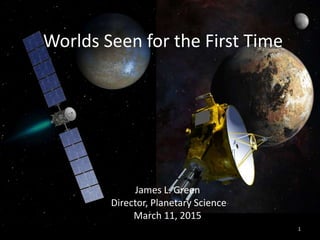
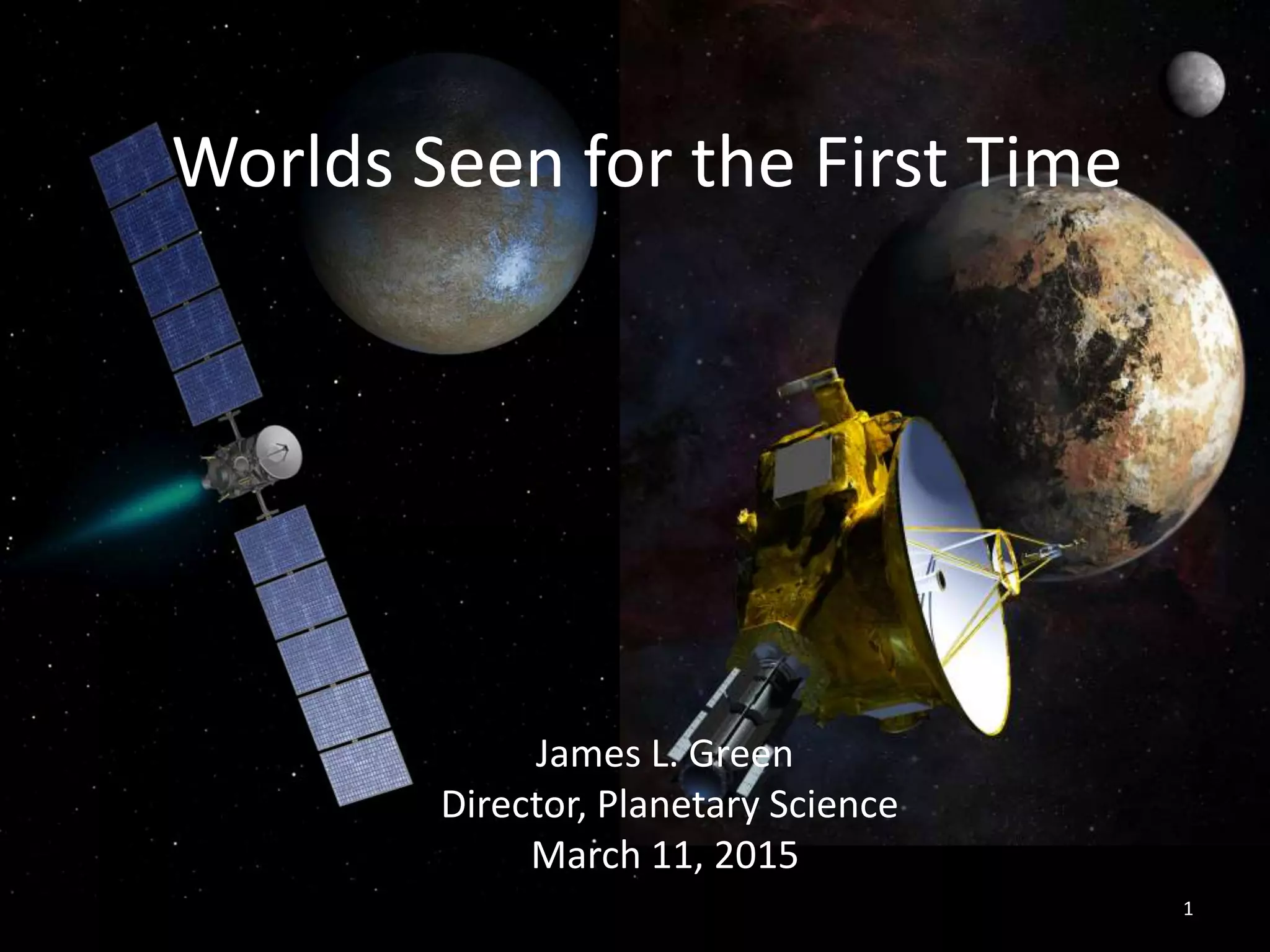
Worlds Seen for the First Time
James L. Green
Director, Planetary Science
March 11, 2015
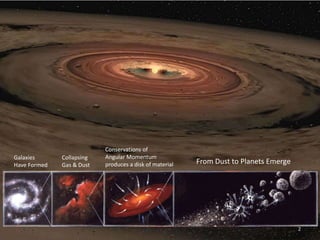
Galaxies
Have Formed
Collapsing
Gas & Dust
Conservations of
Angular Momentum
produces a disk of material From Dust to Planets Emerge
2
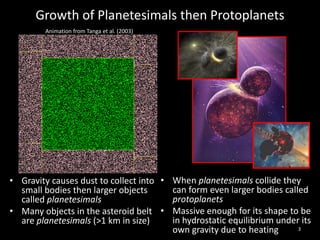
Growth of Planetesimals then Protoplanets
• When planetesimals collide they
can form even larger bodies called
protoplanets
• Massive enough for its shape to be
in hydrostatic equilibrium under its
own gravity due to heating
Animation from Tanga et al. (2003)
• Gravity causes dust to collect into
small bodies then larger objects
called planetesimals
• Many objects in the asteroid belt
are planetesimals (>1 km in size)
3
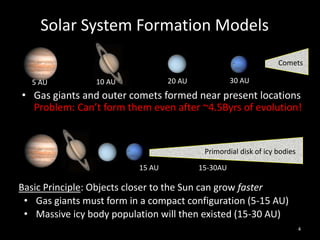
Solar System Formation Models
Basic Principle: Objects closer to the Sun can grow faster
Comets
Primordial disk of icy bodies
• Gas giants and outer comets formed near present locations
Problem: Can’t form them even after ~4.5Byrs of evolution!
• Gas giants must form in a compact configuration (5-15 AU)
• Massive icy body population will then existed (15-30 AU)
5 AU 10 AU 20 AU 30 AU
15-30AU
4
15 AU
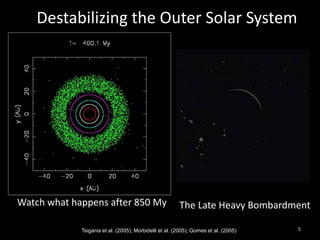
Destabilizing the Outer Solar System
Watch what happens after 850 My
Tsiganis et al. (2005); Morbidelli et al. (2005); Gomes et al. (2005)
The Late Heavy Bombardment
5
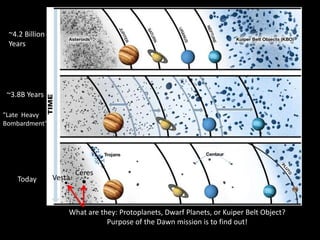
Today
~4.2 Billion
Years
~3.8B Years
"Late Heavy
Bombardment"
What are they: Protoplanets, Dwarf Planets, or Kuiper Belt Object?
Purpose of the Dawn mission is to find out!
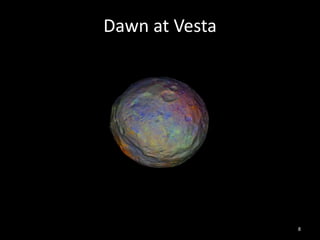
Vesta
••
Ceres
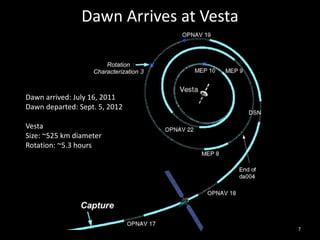
Dawn Arrives at Vesta
Dawn arrived: July 16, 2011
Dawn departed: Sept. 5, 2012
Vesta
Size: ~525 km diameter
Rotation: ~5.3 hours
7
Dawn at Vesta
8
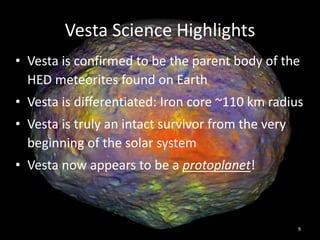
Vesta Science Highlights
• Vesta is confirmed to be the parent body of the
HED meteorites found on Earth
• Vesta is differentiated: Iron core ~110 km radius
• Vesta is truly an intact survivor from the very
beginning of the solar system
• Vesta now appears to be a protoplanet!
9
10
11
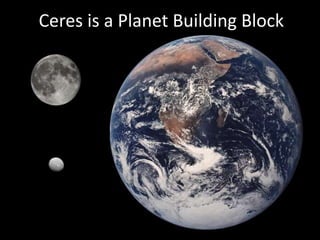
Ceres is a Planet Building Block
Is Ceres Active?
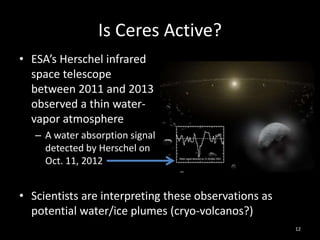
• ESA’s Herschel infrared
space telescope
between 2011 and 2013
observed a thin water-
vapor atmosphere
– A water absorption signal
detected by Herschel on
Oct. 11, 2012
• Scientists are interpreting these observations as
potential water/ice plumes (cryo-volcanos?)
12
13
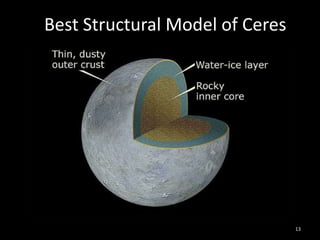
Best Structural Model of Ceres
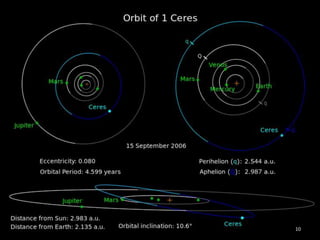
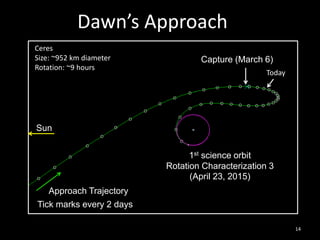
Dawn’s Approach
Approach Trajectory
Sun
Capture (March 6)
1st science orbit
Rotation Characterization 3
(April 23, 2015)
Tick marks every 2 days
Ceres
Size: ~952 km diameter
Rotation: ~9 hours
Today
14
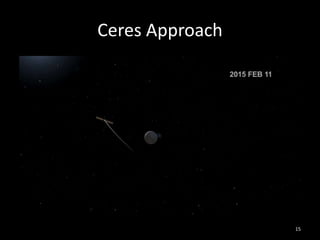
Ceres Approach
15
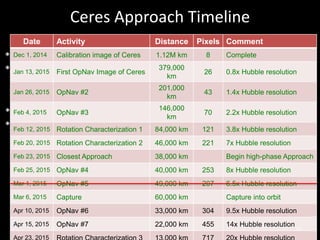
Ceres Approach Timeline
Date Activity Distance Pixels Comment
Dec 1, 2014 Calibration image of Ceres 1.12M km 8 Complete
Jan 13, 2015 First OpNav Image of Ceres
379,000
km
26 0.8x Hubble resolution
Jan 26, 2015 OpNav #2
201,000
km
43 1.4x Hubble resolution
Feb 4, 2015 OpNav #3
146,000
km
70 2.2x Hubble resolution
Feb 12, 2015 Rotation Characterization 1 84,000 km 121 3.8x Hubble resolution
Feb 20, 2015 Rotation Characterization 2 46,000 km 221 7x Hubble resolution
Feb 23, 2015 Closest Approach 38,000 km Begin high-phase Approach
Feb 25, 2015 OpNav #4 40,000 km 253 8x Hubble resolution
Mar 1, 2015 OpNav #5 49,000 km 207 6.5x Hubble resolution
Mar 6, 2015 Capture 60,000 km Capture into orbit
Apr 10, 2015 OpNav #6 33,000 km 304 9.5x Hubble resolution
Apr 15, 2015 OpNav #7 22,000 km 455 14x Hubble resolution
Apr 23, 2015
*
*
*
*
16
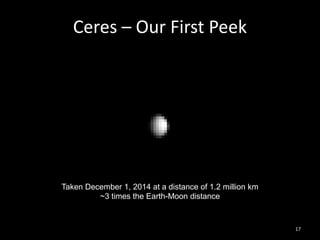
Ceres – Our First Peek
17
Taken December 1, 2014 at a distance of 1.2 million km
~3 times the Earth-Moon distance
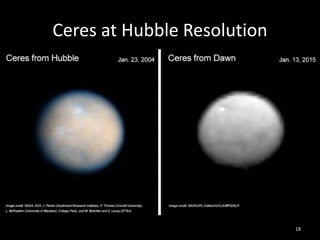
Ceres at Hubble Resolution
18
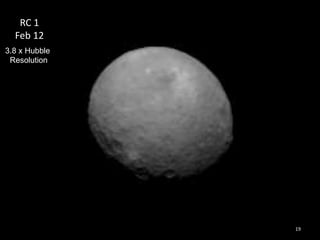
RC 1
Feb 12
19
3.8 x Hubble
Resolution
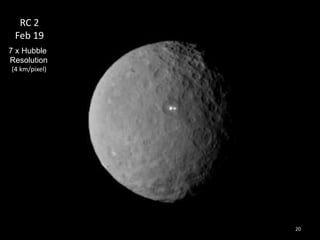
RC 2
Feb 19
(4 km/pixel)
20
7 x Hubble
Resolution
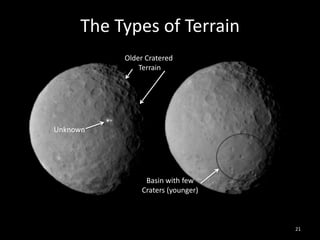
The Types of Terrain
Older Cratered
Terrain
Basin with few
Craters (younger)
Unknown
21
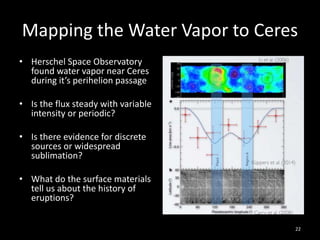
Mapping the Water Vapor to Ceres
• Herschel Space Observatory
found water vapor near Ceres
during it’s perihelion passage
• Is the flux steady with variable
intensity or periodic?
• Is there evidence for discrete
sources or widespread
sublimation?
• What do the surface materials
tell us about the history of
eruptions?
22
RC3
equator
RC3
south
HGA-to-Earth
HGA-to-Earth
Nadir
Nadir
Nadir
Nadir
Nadir
High Phase
south &
north
Limb
north
RC3
north
Limb
south
Ceres
Off-Nadir
Off-Nadir
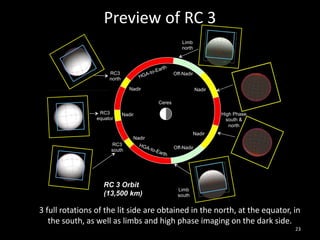
Preview of RC 3
3 full rotations of the lit side are obtained in the north, at the equator, in
the south, as well as limbs and high phase imaging on the dark side.
RC 3 Orbit
(13,500 km)
23
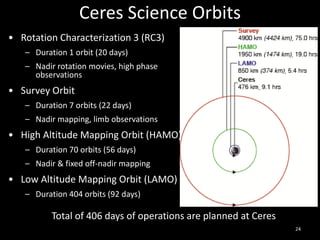
Ceres Science Orbits
• Rotation Characterization 3 (RC3)
– Duration 1 orbit (20 days)
– Nadir rotation movies, high phase
observations
• Survey Orbit
– Duration 7 orbits (22 days)
– Nadir mapping, limb observations
• High Altitude Mapping Orbit (HAMO)
– Duration 70 orbits (56 days)
– Nadir & fixed off-nadir mapping
• Low Altitude Mapping Orbit (LAMO)
– Duration 404 orbits (92 days)
Total of 406 days of operations are planned at Ceres
24
What will we find out?
• Is Ceres an active body?
– Models of Ceres interior suggest there could be
subsurface oceans and an outer ice-rich layer
• Is Ceres a protoplanet whose development into a
planet was disrupted by Jupiter’s gravity?
– Core, mantel, crust?
• Or is Ceres a Kuiper Belt object?
– Came into the asteroid belt during the LHB?
– An icy body more like Pluto than like Vesta
– On to Pluto to find out – we can compare the two!
25
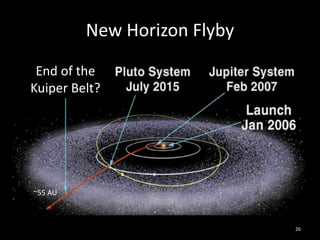
New Horizon Flyby
~55 AU
26
End of the
Kuiper Belt?
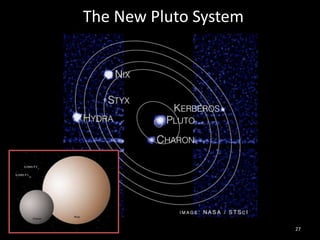
The New Pluto System
27
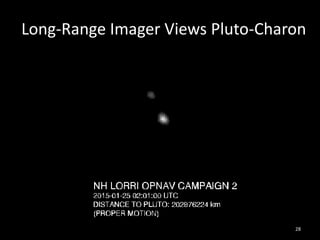
Long-Range Imager Views Pluto-Charon
28
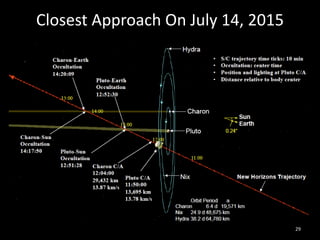
Closest Approach On July 14, 2015
29
Questions?
30

Goddard 2015: James Green, NASA

  • 1.
    1 Worlds Seen forthe First Time James L. Green Director, Planetary Science March 11, 2015
  • 2.
    Galaxies Have Formed Collapsing Gas &Dust Conservations of Angular Momentum produces a disk of material From Dust to Planets Emerge 2
  • 3.
    Growth of Planetesimalsthen Protoplanets • When planetesimals collide they can form even larger bodies called protoplanets • Massive enough for its shape to be in hydrostatic equilibrium under its own gravity due to heating Animation from Tanga et al. (2003) • Gravity causes dust to collect into small bodies then larger objects called planetesimals • Many objects in the asteroid belt are planetesimals (>1 km in size) 3
  • 4.
    Solar System FormationModels Basic Principle: Objects closer to the Sun can grow faster Comets Primordial disk of icy bodies • Gas giants and outer comets formed near present locations Problem: Can’t form them even after ~4.5Byrs of evolution! • Gas giants must form in a compact configuration (5-15 AU) • Massive icy body population will then existed (15-30 AU) 5 AU 10 AU 20 AU 30 AU 15-30AU 4 15 AU
  • 5.
    Destabilizing the OuterSolar System Watch what happens after 850 My Tsiganis et al. (2005); Morbidelli et al. (2005); Gomes et al. (2005) The Late Heavy Bombardment 5
  • 6.
    Today ~4.2 Billion Years ~3.8B Years "LateHeavy Bombardment" What are they: Protoplanets, Dwarf Planets, or Kuiper Belt Object? Purpose of the Dawn mission is to find out! Vesta •• Ceres
  • 7.
    Dawn Arrives atVesta Dawn arrived: July 16, 2011 Dawn departed: Sept. 5, 2012 Vesta Size: ~525 km diameter Rotation: ~5.3 hours 7
  • 8.
  • 9.
    Vesta Science Highlights •Vesta is confirmed to be the parent body of the HED meteorites found on Earth • Vesta is differentiated: Iron core ~110 km radius • Vesta is truly an intact survivor from the very beginning of the solar system • Vesta now appears to be a protoplanet! 9
  • 10.
  • 11.
    11 Ceres is aPlanet Building Block
  • 12.
    Is Ceres Active? •ESA’s Herschel infrared space telescope between 2011 and 2013 observed a thin water- vapor atmosphere – A water absorption signal detected by Herschel on Oct. 11, 2012 • Scientists are interpreting these observations as potential water/ice plumes (cryo-volcanos?) 12
  • 13.
  • 14.
    Dawn’s Approach Approach Trajectory Sun Capture(March 6) 1st science orbit Rotation Characterization 3 (April 23, 2015) Tick marks every 2 days Ceres Size: ~952 km diameter Rotation: ~9 hours Today 14
  • 15.
  • 16.
    Ceres Approach Timeline DateActivity Distance Pixels Comment Dec 1, 2014 Calibration image of Ceres 1.12M km 8 Complete Jan 13, 2015 First OpNav Image of Ceres 379,000 km 26 0.8x Hubble resolution Jan 26, 2015 OpNav #2 201,000 km 43 1.4x Hubble resolution Feb 4, 2015 OpNav #3 146,000 km 70 2.2x Hubble resolution Feb 12, 2015 Rotation Characterization 1 84,000 km 121 3.8x Hubble resolution Feb 20, 2015 Rotation Characterization 2 46,000 km 221 7x Hubble resolution Feb 23, 2015 Closest Approach 38,000 km Begin high-phase Approach Feb 25, 2015 OpNav #4 40,000 km 253 8x Hubble resolution Mar 1, 2015 OpNav #5 49,000 km 207 6.5x Hubble resolution Mar 6, 2015 Capture 60,000 km Capture into orbit Apr 10, 2015 OpNav #6 33,000 km 304 9.5x Hubble resolution Apr 15, 2015 OpNav #7 22,000 km 455 14x Hubble resolution Apr 23, 2015 * * * * 16
  • 17.
    Ceres – OurFirst Peek 17 Taken December 1, 2014 at a distance of 1.2 million km ~3 times the Earth-Moon distance
  • 18.
    Ceres at HubbleResolution 18
  • 19.
    RC 1 Feb 12 19 3.8x Hubble Resolution
  • 20.
    RC 2 Feb 19 (4km/pixel) 20 7 x Hubble Resolution
  • 21.
    The Types ofTerrain Older Cratered Terrain Basin with few Craters (younger) Unknown 21
  • 22.
    Mapping the WaterVapor to Ceres • Herschel Space Observatory found water vapor near Ceres during it’s perihelion passage • Is the flux steady with variable intensity or periodic? • Is there evidence for discrete sources or widespread sublimation? • What do the surface materials tell us about the history of eruptions? 22
  • 23.
    RC3 equator RC3 south HGA-to-Earth HGA-to-Earth Nadir Nadir Nadir Nadir Nadir High Phase south & north Limb north RC3 north Limb south Ceres Off-Nadir Off-Nadir Previewof RC 3 3 full rotations of the lit side are obtained in the north, at the equator, in the south, as well as limbs and high phase imaging on the dark side. RC 3 Orbit (13,500 km) 23
  • 24.
    Ceres Science Orbits •Rotation Characterization 3 (RC3) – Duration 1 orbit (20 days) – Nadir rotation movies, high phase observations • Survey Orbit – Duration 7 orbits (22 days) – Nadir mapping, limb observations • High Altitude Mapping Orbit (HAMO) – Duration 70 orbits (56 days) – Nadir & fixed off-nadir mapping • Low Altitude Mapping Orbit (LAMO) – Duration 404 orbits (92 days) Total of 406 days of operations are planned at Ceres 24
  • 25.
    What will wefind out? • Is Ceres an active body? – Models of Ceres interior suggest there could be subsurface oceans and an outer ice-rich layer • Is Ceres a protoplanet whose development into a planet was disrupted by Jupiter’s gravity? – Core, mantel, crust? • Or is Ceres a Kuiper Belt object? – Came into the asteroid belt during the LHB? – An icy body more like Pluto than like Vesta – On to Pluto to find out – we can compare the two! 25
  • 26.
    New Horizon Flyby ~55AU 26 End of the Kuiper Belt?
  • 27.
    The New PlutoSystem 27
  • 28.
    Long-Range Imager ViewsPluto-Charon 28
  • 29.
    Closest Approach OnJuly 14, 2015 29
  • 30.

Editor's Notes

  • #4 A planetesimal is a solid object arising during the accumulation of planets whose internal strength is dominated by self-gravity and whose orbital dynamics is not significantly affected by gas drag. This corresponds to objects larger than approximately 1 km in the solar nebula. Protoplanets are bodies large enough not only to keep together by gravitation but to change the path of approaching rocks over distances of several radii start to grow faster. These bodies, larger than 100 km to 1000 km, are also called embryos
  • #15 Capture of Ceres is estimated to occur on the evening of March 5 at 9:30 Pacific Time 2/19 Dawn is 50,000 km from Ceres (13% of the Earth-moon distance) approaching at a relative velocity of 45 meters/second (100 mph) The Dawn spacecraft was launched September 27, 2007 The present Sun distance is 2.857 AU The present Earth distance is 3.478 AU The present Ceres distance is 0.0003097 AU End of Mission is scheduled for July 2016
  • #20 3.8x Hubble resolution
  • #21 7x Hubble resolution