Setting Goals


 Welcome to the
   first section
 „Setting Goals“.
Setting Goals


    Did you already
      print out the
     corresponding
   worksheet? Let´s
   then get started!
Setting Goals

Learning Objectives


 This goal setting chapter helps you to clearly identify your goals for the
 e-learning-course "Basics of Pressure Measurement". Further this
 chapter ensures that your goals are SMART.
Setting Goals


      What is your goal for the e-
             training course?
     •To reach as much points as
                 possible?
     •To understand all content of
               the training?
   •To complete the training as fast
    as possible independent from
         the number of points?
   •Or do you want to complete the
       training without effort?...
Setting Goals


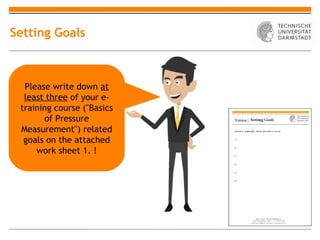
  Please write down at
  least three of your e-
 training course ("Basics
       of Pressure
 Measurement") related
  goals on the attached
     work sheet 1. !
Setting Goals


                Why should you set
                goals for yourself?
                Why is it important
                to set goals?
Why Should You Set Goals For Yourself?


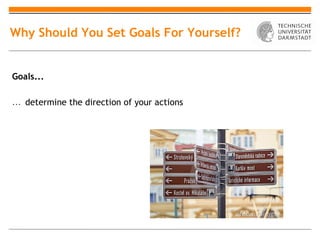
Goals...

… determine the direction of your actions
Why Should You Set Goals For Yourself?


Goals...

… determine the direction of your actions

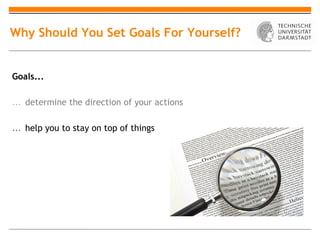
… help you to stay on top of things
Why Should You Set Goals For Yourself?


Goals...

… determine the direction of your actions

… help you stay on top of things

… help you focus on the more important things
Why Should You Set Goals For Yourself?


Goals...

… determine the direction of your actions

… help you stay on top of things

… help you focus on the important things

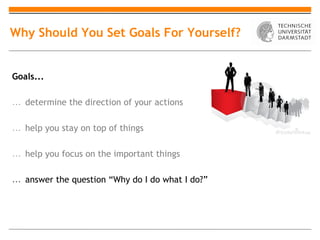
… answer the question “Why do I do what I do?”
Why Should You Set Goals For Yourself?


Goals...

… determine the direction of your actions

… helps you stay on top of things

… helps you focus on the important things

… answer the question “Why do I do what I do?”

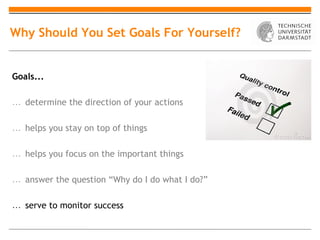
… serve to monitor success
Setting Goals...based on time frames

You need to differentiate…


 Long – Term Goals


 Medium – Term Goals


 Short – Term Goals
Setting Goals...based on time frames

You need to differentiate    Include, for example, your
                              professional career and retirement
                              plans.
                             Continue throughout numerous years
 Long – Term Goals          Are visionary but realistic


 Medium – Term Goals


 Short – Term Goals
Setting Goals...based on time frames

You need to differentiate    e.g. operative goals that are specific
                              for a department of a large
                              corporation (yearly and/or quarterly
                              goals)
 Long – Term Goals


 Medium – Term Goals


 Short – Term Goals
Setting Goals...based on time frames
                             Are related to short-term and
You need to differentiate
                              reasonable time periods. For the
                              management of a company for example
                               it is often common practice to use the
                              fiscal year. However, it could also be
 Long – Term Goals
                              extremely short – term goals and/or
                              seasonal goals such as the successful
                              completion of the e-training course.
 Medium – Term Goals


 Short – Term Goals
Setting Goals...based on time frames


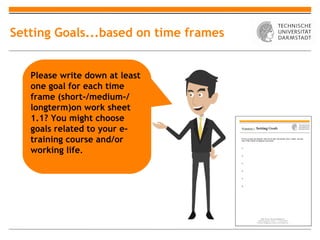
   Please write down at least
   one goal for each time
   frame (short-/medium-/
   longterm)on work sheet
   1.1? You might choose
   goals related to your e-
   training course and/or
   working life.
Setting Goals – The SMART-Formula


      Let us have a look at
      the SMART-formula
Setting Goals – The SMART-Formula

 In project management you usually have the ultimate project goal as
  well as intermediate goals (milestones)

 Respectively there are major goals and minor goals, as well as
  intermediate goals in your professional career

 Often we do not reach our goals because they were not clearly defined,
  we expect too much, or we do not define intermediate goals.
Setting Goals – The SMART-Formula

 Management sometimes sets very vague goals such as: „we
  have to improve customer satisfaction, increase profitability,
  and improve productivity and efficiency.“

 With the implementation of „SMART“, goals turn into clear
  messages that can be measured, reviewed, and monitored
  which we will see in the next example...
Setting Goals – The SMART-Formula

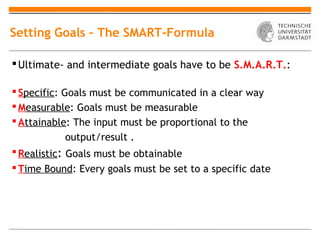
 Ultimate- and intermediate goals have to be S.M.A.R.T.:

 Specific: Goals must be communicated in a clear way
 Measurable: Goals must be measurable
 Attainable: The input must be proportional to the
           output/result .
 Realistic: Goals must be obtainable
 Time Bound: Every goals must be set to a specific date
Setting Goals – The SMART-Formula

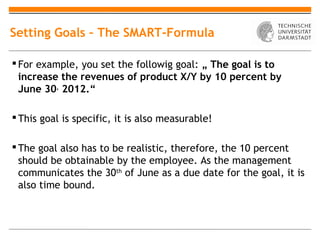
 For example, you set the followig goal: „ The goal is to
  increase the revenues of product X/Y by 10 percent by
  June 30, 2012.“

 This goal is specific, it is also measurable!

 The goal also has to be realistic, therefore, the 10 percent
  should be obtainable by the employee. As the management
  communicates the 30th of June as a due date for the goal, it is
  also time bound.
Setting Goals – The SMART-Formula

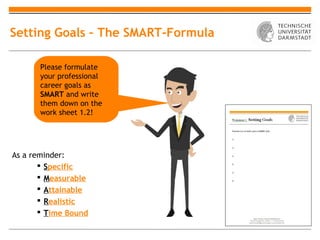
       Please formulate
       your professional
       career goals as
       SMART and write
       them down on the
       work sheet 1.2!


As a reminder:
        Specific
        Measurable
        Attainable
        Realistic
        Time Bound
Setting Goals – The SMART-Formula


    Specific
    Measurable
    Attainable
    Realistic
    Time Bound

Goalsetting überarbeitet

  • 1.
    Setting Goals Welcometo the first section „Setting Goals“.
  • 2.
    Setting Goals Did you already print out the corresponding worksheet? Let´s then get started!
  • 3.
    Setting Goals Learning Objectives This goal setting chapter helps you to clearly identify your goals for the e-learning-course "Basics of Pressure Measurement". Further this chapter ensures that your goals are SMART.
  • 4.
    Setting Goals What is your goal for the e- training course? •To reach as much points as possible? •To understand all content of the training? •To complete the training as fast as possible independent from the number of points? •Or do you want to complete the training without effort?...
  • 5.
    Setting Goals Please write down at least three of your e- training course ("Basics of Pressure Measurement") related goals on the attached work sheet 1. !
  • 6.
    Setting Goals Why should you set goals for yourself? Why is it important to set goals?
  • 7.
    Why Should YouSet Goals For Yourself? Goals... … determine the direction of your actions
  • 8.
    Why Should YouSet Goals For Yourself? Goals... … determine the direction of your actions … help you to stay on top of things
  • 9.
    Why Should YouSet Goals For Yourself? Goals... … determine the direction of your actions … help you stay on top of things … help you focus on the more important things
  • 10.
    Why Should YouSet Goals For Yourself? Goals... … determine the direction of your actions … help you stay on top of things … help you focus on the important things … answer the question “Why do I do what I do?”
  • 11.
    Why Should YouSet Goals For Yourself? Goals... … determine the direction of your actions … helps you stay on top of things … helps you focus on the important things … answer the question “Why do I do what I do?” … serve to monitor success
  • 12.
    Setting Goals...based ontime frames You need to differentiate…  Long – Term Goals  Medium – Term Goals  Short – Term Goals
  • 13.
    Setting Goals...based ontime frames You need to differentiate  Include, for example, your professional career and retirement plans.  Continue throughout numerous years  Long – Term Goals  Are visionary but realistic  Medium – Term Goals  Short – Term Goals
  • 14.
    Setting Goals...based ontime frames You need to differentiate  e.g. operative goals that are specific for a department of a large corporation (yearly and/or quarterly goals)  Long – Term Goals  Medium – Term Goals  Short – Term Goals
  • 15.
    Setting Goals...based ontime frames  Are related to short-term and You need to differentiate reasonable time periods. For the management of a company for example it is often common practice to use the fiscal year. However, it could also be  Long – Term Goals extremely short – term goals and/or seasonal goals such as the successful completion of the e-training course.  Medium – Term Goals  Short – Term Goals
  • 16.
    Setting Goals...based ontime frames Please write down at least one goal for each time frame (short-/medium-/ longterm)on work sheet 1.1? You might choose goals related to your e- training course and/or working life.
  • 17.
    Setting Goals –The SMART-Formula Let us have a look at the SMART-formula
  • 18.
    Setting Goals –The SMART-Formula  In project management you usually have the ultimate project goal as well as intermediate goals (milestones)  Respectively there are major goals and minor goals, as well as intermediate goals in your professional career  Often we do not reach our goals because they were not clearly defined, we expect too much, or we do not define intermediate goals.
  • 19.
    Setting Goals –The SMART-Formula  Management sometimes sets very vague goals such as: „we have to improve customer satisfaction, increase profitability, and improve productivity and efficiency.“  With the implementation of „SMART“, goals turn into clear messages that can be measured, reviewed, and monitored which we will see in the next example...
  • 20.
    Setting Goals –The SMART-Formula  Ultimate- and intermediate goals have to be S.M.A.R.T.:  Specific: Goals must be communicated in a clear way  Measurable: Goals must be measurable  Attainable: The input must be proportional to the output/result .  Realistic: Goals must be obtainable  Time Bound: Every goals must be set to a specific date
  • 21.
    Setting Goals –The SMART-Formula  For example, you set the followig goal: „ The goal is to increase the revenues of product X/Y by 10 percent by June 30, 2012.“  This goal is specific, it is also measurable!  The goal also has to be realistic, therefore, the 10 percent should be obtainable by the employee. As the management communicates the 30th of June as a due date for the goal, it is also time bound.
  • 22.
    Setting Goals –The SMART-Formula Please formulate your professional career goals as SMART and write them down on the work sheet 1.2! As a reminder:  Specific  Measurable  Attainable  Realistic  Time Bound
  • 23.
    Setting Goals –The SMART-Formula Specific Measurable Attainable Realistic Time Bound

Editor's Notes

  • #2 01.11.12 | | - Muss das worksheet auch übersetzt werden? 1. November 2012 | |
  • #3 01.11.12 | | - Muss das worksheet auch übersetzt werden? 1. November 2012 | |
  • #4 01.11.12 | | - Muss das worksheet auch übersetzt werden? 1. November 2012 | |
  • #5 01.11.12 | | - Muss das worksheet auch übersetzt werden? 1. November 2012 | |
  • #6 01.11.12 | | - Muss das worksheet auch übersetzt werden? 1. November 2012 | |
  • #7 01.11.12 | | 1. November 2012 | |
  • #8 01.11.12 | |
  • #9 01.11.12 | |
  • #10 01.11.12 | |
  • #11 01.11.12 | |
  • #12 01.11.12 | |
  • #13 01.11.12 | |
  • #14 01.11.12 | |
  • #15 01.11.12 | |
  • #16 01.11.12 | |
  • #17 01.11.12 | |
  • #18 01.11.12 | |
  • #19 01.11.12 | |
  • #20 01.11.12 | |
  • #21 01.11.12 | |
  • #22 01.11.12 | | 01.11.12 | |
  • #23 01.11.12 | |
  • #24 01.11.12 | |