Go-To-Market Strategy
                 GTM
                              By:
                        Magdy Abdelsattar


LinkedIn.com/pub/Magdy-abdelsattar-omar

magdysattar@gmail.com
+201270000970
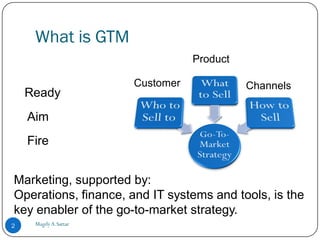
What is GTM
                                 Product

                      Customer             Channels
    Ready
    Aim
    Fire


Marketing, supported by:
Operations, finance, and IT systems and tools, is the
key enabler of the go-to-market strategy.
2    Magdy A.Sattar
Formulating the GTM plan
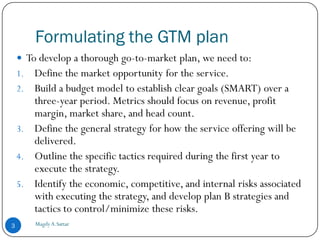
     To develop a thorough go-to-market plan, we need to:
    1.   Define the market opportunity for the service.
    2.   Build a budget model to establish clear goals (SMART) over a
         three-year period. Metrics should focus on revenue, profit
         margin, market share, and head count.
    3.   Define the general strategy for how the service offering will be
         delivered.
    4.   Outline the specific tactics required during the first year to
         execute the strategy.
    5.   Identify the economic, competitive, and internal risks associated
         with executing the strategy, and develop plan B strategies and
         tactics to control/minimize these risks.
3        Magdy A.Sattar
Define the market opportunity
     Reviewing and understanding the market regarding the market
        opportunity and relative market size of different
        segments/products
       Reviewing and understanding of market dynamics and
        segmentation .
       Reviewing Market trend data from trade publications, analysts,
        and industry groups.
       Developing a clear hypothesis regarding the opportunity.
       Conducting workshops to test the hypothesis.
       Defining the primary customers who will be served by the new
        offering, and determine what would compel them to buy the
        service from your organization.

4   Magdy A.Sattar
Define the market opportunity
     Understanding the market environment:
    A. The new-product-launch market, a high-growth and low-challenge
       environment, calls for a product-focused go-to-market model.
    B. A transition market, with greater competition and expectations, calls
       for an increasing focus on channel.
    C. A mature market, with slowing growth, calls for the most balance
       among the three key enabler, maintaining product and channel strength
       while starting to focus on customers.
    D. A dead-end market, reflects the end of a product's life cycle and
       requires customer focus to develop new, more marketable products.


5        Magdy A.Sattar
Build a budget $ (short & long term)

     Developing a revenue model based on expectations for
      market penetration, market size, and the impact of new
      marketing efforts.
     Estimate margins over one-year and three-year periods,
      based on startup (CAPX) and ongoing costs (OPEX).
     Based on how the market is defined, set clear goals for
      market share penetration.


6   Magdy A.Sattar
Identify the strategy
     It should focus on:
     How will the service be delivered?
     Why do clients need this service?
     Why will clients buy the service from you?
     How will activities such as hiring, marketing, and training
      affect the ability to deliver during the startup phase of the
      new service?
     How will the strategy evolve or grow after the startup phase
      (average of three month)


7   Magdy A.Sattar
Tactics required for 1st year
     Defining how the organizational structure needs to be
      changed to accommodate the new service.
     Identifying the new skill sets that need to be developed to sell
      and implement the service.
     Outlining the marketing activities needed to generate
      awareness in and to create leads from the targeted
      market/client base.
     Determining the tools and systems required to support
      operations.


8   Magdy A.Sattar
Risk management plan


     Outlining the biggest risks that may affect your ability to
      reach the goals of the new service line.
     Developing strategies to address how risks can be controlled
      and minimize


9   Magdy A.Sattar
Measuring Go-to-Market Strategy
     Success (Monitoring)
      We have to set specific milestones for metric progression,
       long-term goals, and adjust the strategy based on the story
       the metrics are telling. (KPI’s should manage NOT just
       record history).
     1. Revenue per sales rep cost.
     2. Selling time.
     3. Targets achievements indicator.
     4. Customer acquisition cost.
     5. Customer life time value.
     6. Sales rep network efficiency.

10   Magdy A.Sattar

Go to-market strategy (gtm)

  • 1.
    Go-To-Market Strategy GTM By: Magdy Abdelsattar LinkedIn.com/pub/Magdy-abdelsattar-omar magdysattar@gmail.com +201270000970
  • 2.
    What is GTM Product Customer Channels Ready Aim Fire Marketing, supported by: Operations, finance, and IT systems and tools, is the key enabler of the go-to-market strategy. 2 Magdy A.Sattar
  • 3.
    Formulating the GTMplan  To develop a thorough go-to-market plan, we need to: 1. Define the market opportunity for the service. 2. Build a budget model to establish clear goals (SMART) over a three-year period. Metrics should focus on revenue, profit margin, market share, and head count. 3. Define the general strategy for how the service offering will be delivered. 4. Outline the specific tactics required during the first year to execute the strategy. 5. Identify the economic, competitive, and internal risks associated with executing the strategy, and develop plan B strategies and tactics to control/minimize these risks. 3 Magdy A.Sattar
  • 4.
    Define the marketopportunity  Reviewing and understanding the market regarding the market opportunity and relative market size of different segments/products  Reviewing and understanding of market dynamics and segmentation .  Reviewing Market trend data from trade publications, analysts, and industry groups.  Developing a clear hypothesis regarding the opportunity.  Conducting workshops to test the hypothesis.  Defining the primary customers who will be served by the new offering, and determine what would compel them to buy the service from your organization. 4 Magdy A.Sattar
  • 5.
    Define the marketopportunity  Understanding the market environment: A. The new-product-launch market, a high-growth and low-challenge environment, calls for a product-focused go-to-market model. B. A transition market, with greater competition and expectations, calls for an increasing focus on channel. C. A mature market, with slowing growth, calls for the most balance among the three key enabler, maintaining product and channel strength while starting to focus on customers. D. A dead-end market, reflects the end of a product's life cycle and requires customer focus to develop new, more marketable products. 5 Magdy A.Sattar
  • 6.
    Build a budget$ (short & long term)  Developing a revenue model based on expectations for market penetration, market size, and the impact of new marketing efforts.  Estimate margins over one-year and three-year periods, based on startup (CAPX) and ongoing costs (OPEX).  Based on how the market is defined, set clear goals for market share penetration. 6 Magdy A.Sattar
  • 7.
    Identify the strategy  It should focus on:  How will the service be delivered?  Why do clients need this service?  Why will clients buy the service from you?  How will activities such as hiring, marketing, and training affect the ability to deliver during the startup phase of the new service?  How will the strategy evolve or grow after the startup phase (average of three month) 7 Magdy A.Sattar
  • 8.
    Tactics required for1st year  Defining how the organizational structure needs to be changed to accommodate the new service.  Identifying the new skill sets that need to be developed to sell and implement the service.  Outlining the marketing activities needed to generate awareness in and to create leads from the targeted market/client base.  Determining the tools and systems required to support operations. 8 Magdy A.Sattar
  • 9.
    Risk management plan  Outlining the biggest risks that may affect your ability to reach the goals of the new service line.  Developing strategies to address how risks can be controlled and minimize 9 Magdy A.Sattar
  • 10.
    Measuring Go-to-Market Strategy Success (Monitoring)  We have to set specific milestones for metric progression, long-term goals, and adjust the strategy based on the story the metrics are telling. (KPI’s should manage NOT just record history). 1. Revenue per sales rep cost. 2. Selling time. 3. Targets achievements indicator. 4. Customer acquisition cost. 5. Customer life time value. 6. Sales rep network efficiency. 10 Magdy A.Sattar