GO GREEN
GO PAPERLESS
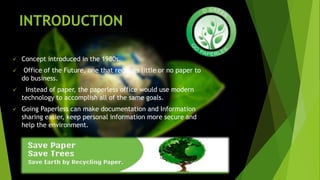
INTRODUCTION
 Concept introduced in the 1980s.
 Office of the Future, one that requires little or no paper to
do business.
 Instead of paper, the paperless office would use modern
technology to accomplish all of the same goals.
 Going Paperless can make documentation and Information
sharing easier, keep personal information more secure and
help the environment.
Going paperless is a big tick for the environment.
WHY?
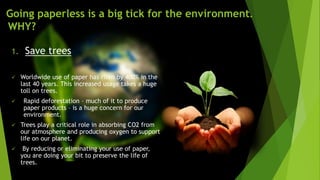
1. Save trees
 Worldwide use of paper has risen by 400% in the
last 40 years. This increased usage takes a huge
toll on trees.
 Rapid deforestation – much of it to produce
paper products – is a huge concern for our
environment.
 Trees play a critical role in absorbing CO2 from
our atmosphere and producing oxygen to support
life on our planet.
 By reducing or eliminating your use of paper,
you are doing your bit to preserve the life of
trees.
2. Cut down on pollution
Did you know that paper manufacturing
is one of the worst offenders when it
comes to pollution? Making one tonne of
paper emits more than 1.5 tonnes of
CO2 equivalent. Using less of the stuff
will help to reduce the number of
pollutants in our atmosphere.
3. Reduce transport
Every document that is transported
across town or across the world uses up
fuel. And the burning of fuel releases
greenhouse gases. By switching to a
digital document sending solution –
where a signed and secure document is
sent with the click of a button – a lot of
fuel can be saved.
4. Save water
It takes 1.5 cups of water to make 1 sheet of
paper. In a world in which fresh drinking water is a
growing concern, this is certainly food for
thought. By going paperless in your office, you are
helping to conserve our world’s water sources.
5. Use less of the other stuff
It’s not just the use of paper that’s bad for the
environment. There are the other consumables that go
along with it – like ink. Production of ink uses fossil fuels;
most inks contain chemicals and other substances that are
harmful to our environment.
How to Reduce paper usage in home and
office?
 Think twice before you print.
 If you can forward, share or use the document
digitally, do so instead.
 Use cloud computing to store documents online,
instead of printing them out on paper.
 Instead of printing paperwork to sign them, sinn
documents digitally.
 Subscribe to online magazines or newspaper instead of
their offline versions
 Use cloth napkin,towels and regular plates instead of
paper one.
Of paper…
 Reduce your paper
consumption by working with
the purchasing department
to reduce the amount of
paper purchased and switch
to buying recycled paper.
 Recycle paper that has been
used.
 Reuse paper by placing bins
next to the copiers and
printers for easy reuse of
single sided scanned paper. 3
R’s Reduce, Reuse and
Recycle the Paper
1. Central government ministries and departments have now
begun rewarding the successful implementation of e-Office or
'paperless offices'.
2. The Employees Provident Fund Organisation (EPFO) will go
paperless in another year as part of Digital India initiative.
3. Ministry of Panchayati Raj has completely transformed itself
to an e-Office platform, while the Ministry of Rural
Development is close to achieving it
Organizations in India which are going
paperless and we should follow them:
Some Organization around the World which
are going paperless and we should follow
them:
1. Idea rebel: The digital agency which went digital
2. Young and Thompson: The law firm that met the brief
3. Dain insurance: insuring the future
4. Virginia cancer institute: curing the paper addiction
5. Cleveland department of public health: when
government shows the way
REALITY
 Paper is the number one material
thrown away and also one of the
biggest polluting industries.
 Companies interested in reducing
cost and building business
sustainability are actively pursuing
PAPERLESS OFFICE.
 While a completely 100% paperless
office may be unattainable, a few
decisive steps applied over the
time can dramatically reduce if
not eliminate the vast majority of
paper in office.
“nature provides us free lunch only if we know
we are the only caretakers of this planet”

Go green, Go paperless!

  • 1.
  • 2.
    INTRODUCTION  Concept introducedin the 1980s.  Office of the Future, one that requires little or no paper to do business.  Instead of paper, the paperless office would use modern technology to accomplish all of the same goals.  Going Paperless can make documentation and Information sharing easier, keep personal information more secure and help the environment.
  • 3.
    Going paperless isa big tick for the environment. WHY? 1. Save trees  Worldwide use of paper has risen by 400% in the last 40 years. This increased usage takes a huge toll on trees.  Rapid deforestation – much of it to produce paper products – is a huge concern for our environment.  Trees play a critical role in absorbing CO2 from our atmosphere and producing oxygen to support life on our planet.  By reducing or eliminating your use of paper, you are doing your bit to preserve the life of trees.
  • 4.
    2. Cut downon pollution Did you know that paper manufacturing is one of the worst offenders when it comes to pollution? Making one tonne of paper emits more than 1.5 tonnes of CO2 equivalent. Using less of the stuff will help to reduce the number of pollutants in our atmosphere. 3. Reduce transport Every document that is transported across town or across the world uses up fuel. And the burning of fuel releases greenhouse gases. By switching to a digital document sending solution – where a signed and secure document is sent with the click of a button – a lot of fuel can be saved.
  • 5.
    4. Save water Ittakes 1.5 cups of water to make 1 sheet of paper. In a world in which fresh drinking water is a growing concern, this is certainly food for thought. By going paperless in your office, you are helping to conserve our world’s water sources. 5. Use less of the other stuff It’s not just the use of paper that’s bad for the environment. There are the other consumables that go along with it – like ink. Production of ink uses fossil fuels; most inks contain chemicals and other substances that are harmful to our environment.
  • 6.
    How to Reducepaper usage in home and office?  Think twice before you print.  If you can forward, share or use the document digitally, do so instead.  Use cloud computing to store documents online, instead of printing them out on paper.  Instead of printing paperwork to sign them, sinn documents digitally.  Subscribe to online magazines or newspaper instead of their offline versions  Use cloth napkin,towels and regular plates instead of paper one.
  • 7.
    Of paper…  Reduceyour paper consumption by working with the purchasing department to reduce the amount of paper purchased and switch to buying recycled paper.  Recycle paper that has been used.  Reuse paper by placing bins next to the copiers and printers for easy reuse of single sided scanned paper. 3 R’s Reduce, Reuse and Recycle the Paper
  • 9.
    1. Central governmentministries and departments have now begun rewarding the successful implementation of e-Office or 'paperless offices'. 2. The Employees Provident Fund Organisation (EPFO) will go paperless in another year as part of Digital India initiative. 3. Ministry of Panchayati Raj has completely transformed itself to an e-Office platform, while the Ministry of Rural Development is close to achieving it Organizations in India which are going paperless and we should follow them:
  • 10.
    Some Organization aroundthe World which are going paperless and we should follow them: 1. Idea rebel: The digital agency which went digital 2. Young and Thompson: The law firm that met the brief 3. Dain insurance: insuring the future 4. Virginia cancer institute: curing the paper addiction 5. Cleveland department of public health: when government shows the way
  • 11.
    REALITY  Paper isthe number one material thrown away and also one of the biggest polluting industries.  Companies interested in reducing cost and building business sustainability are actively pursuing PAPERLESS OFFICE.  While a completely 100% paperless office may be unattainable, a few decisive steps applied over the time can dramatically reduce if not eliminate the vast majority of paper in office.
  • 12.
    “nature provides usfree lunch only if we know we are the only caretakers of this planet”