Copyright © 2008, The McGraw-Hill Companies, Inc.McGraw-Hill/Irwin
Chapter 11
Flexible Budgets and
Overhead Analysis
Copyright © 2008, The McGraw-Hill Companies, Inc.McGraw-Hill/Irwin
11-2
Learning Objective 1
Prepare a flexiblePrepare a flexible
budget and explain thebudget and explain the
advantages of the flexibleadvantages of the flexible
budget approach over thebudget approach over the
static budget approach.static budget approach.
Copyright © 2008, The McGraw-Hill Companies, Inc.McGraw-Hill/Irwin
11-3
Static Budgets and Performance Reports
Static budgets
are prepared for
a single, planned
level of activity.
Performance
evaluation is difficult
when actual activity
differs from the
planned level of
activity.
Hmm! Comparing
static budgets with
actual costs is like
comparing apples
and oranges.
Copyright © 2008, The McGraw-Hill Companies, Inc.McGraw-Hill/Irwin
11-4
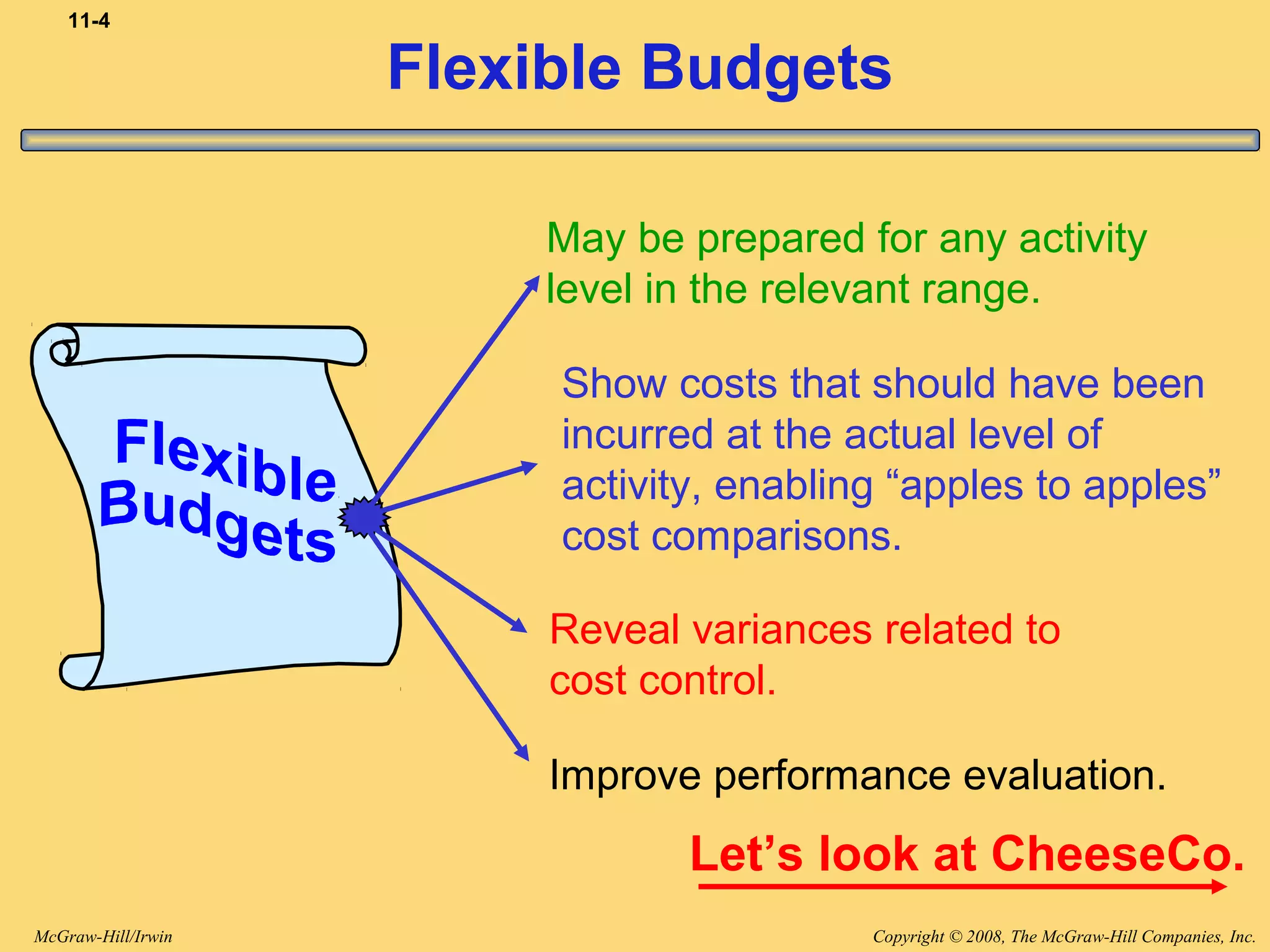
Flexible Budgets
Improve performance evaluation.
May be prepared for any activity
level in the relevant range.
Show costs that should have been
incurred at the actual level of
activity, enabling “apples to apples”
cost comparisons.
Reveal variances related to
cost control.
Let’s look at CheeseCo.
Copyright © 2008, The McGraw-Hill Companies, Inc.McGraw-Hill/Irwin
11-5
CheeseCo
Static Actual
Budget Results Variances
Machine hours 10,000
Variable costs
Indirect labor 40,000$
Indirect materials 30,000
Power 5,000
Fixed costs
Depreciation 12,000
Insurance 2,000
Total overhead costs 89,000$
Static Budgets and Performance Reports
Copyright © 2008, The McGraw-Hill Companies, Inc.McGraw-Hill/Irwin
11-6
CheeseCo
Static Actual
Budget Results Variances
Machine hours 10,000 8,000
Variable costs
Indirect labor 40,000$ 34,000$
Indirect materials 30,000 25,500
Power 5,000 3,800
Fixed costs
Depreciation 12,000 12,000
Insurance 2,000 2,050
Total overhead costs 89,000$ 77,350$
Static Budgets and Performance Reports
Copyright © 2008, The McGraw-Hill Companies, Inc.McGraw-Hill/Irwin
11-7
Static Actual
Budget Results Variances
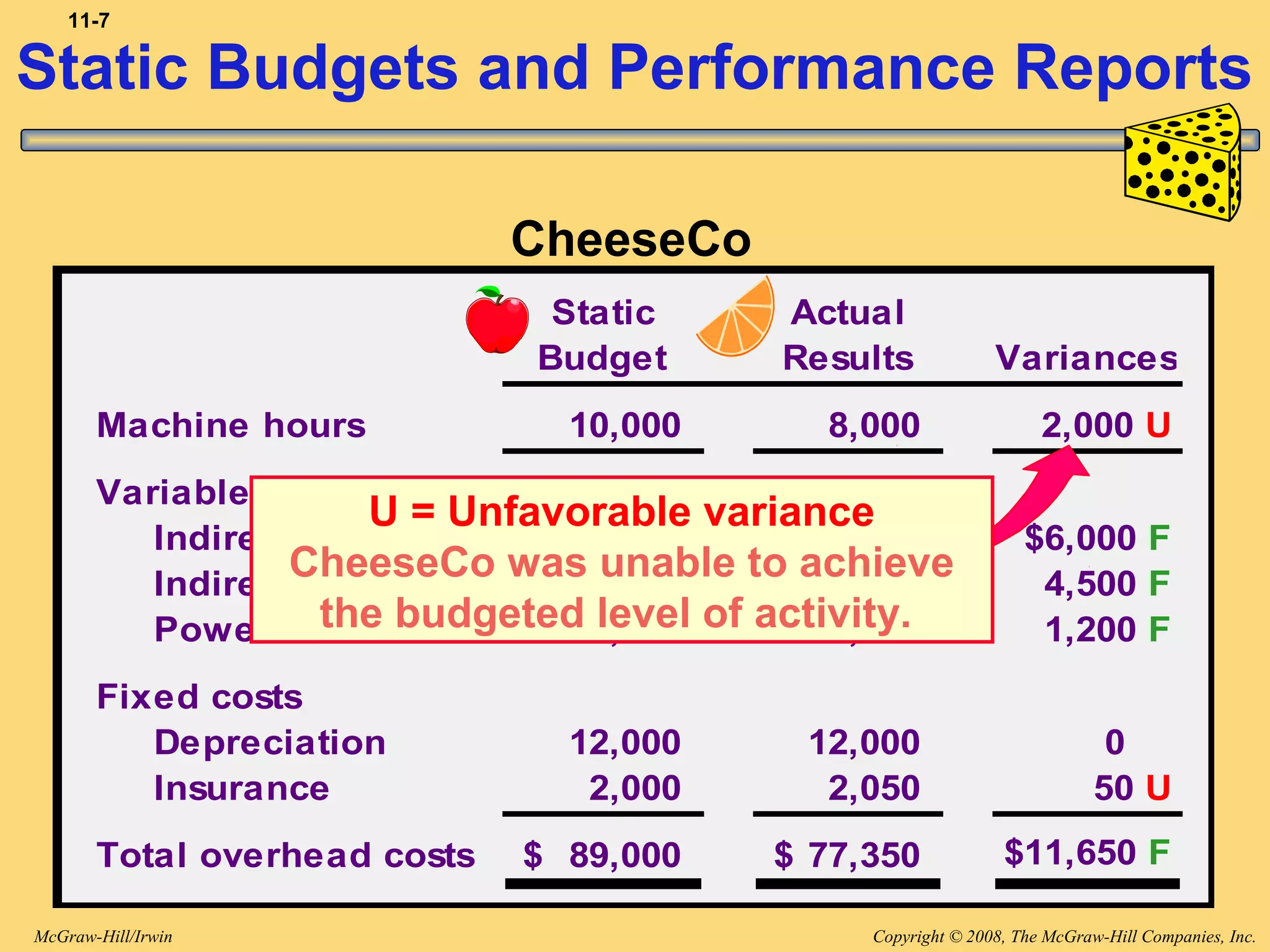
Machine hours 10,000 8,000 2,000 U
Variable costs
Indirect labor 40,000$ 34,000$ $6,000 F
Indirect materials 30,000 25,500 4,500 F
Power 5,000 3,800 1,200 F
Fixed costs
Depreciation 12,000 12,000 0
Insurance 2,000 2,050 50 U
Total overhead costs 89,000$ 77,350$ $11,650 F
U = Unfavorable variance
CheeseCo was unable to achieve
the budgeted level of activity.
CheeseCo
Static Budgets and Performance Reports
Copyright © 2008, The McGraw-Hill Companies, Inc.McGraw-Hill/Irwin
11-8
Static Actual
Budget Results Variances
Machine hours 10,000 8,000 2,000 U
Variable costs
Indirect labor 40,000$ 34,000$ $6,000 F
Indirect materials 30,000 25,500 4,500 F
Power 5,000 3,800 1,200 F
Fixed costs
Depreciation 12,000 12,000 0
Insurance 2,000 2,050 50 U
Total overhead costs 89,000$ 77,350$ $11,650 F
CheeseCo
F = Favorable variance that occurs when
actual costs are less than budgeted costs.
Static Budgets and Performance Reports
Copyright © 2008, The McGraw-Hill Companies, Inc.McGraw-Hill/Irwin
11-9
Static Actual
Budget Results Variances
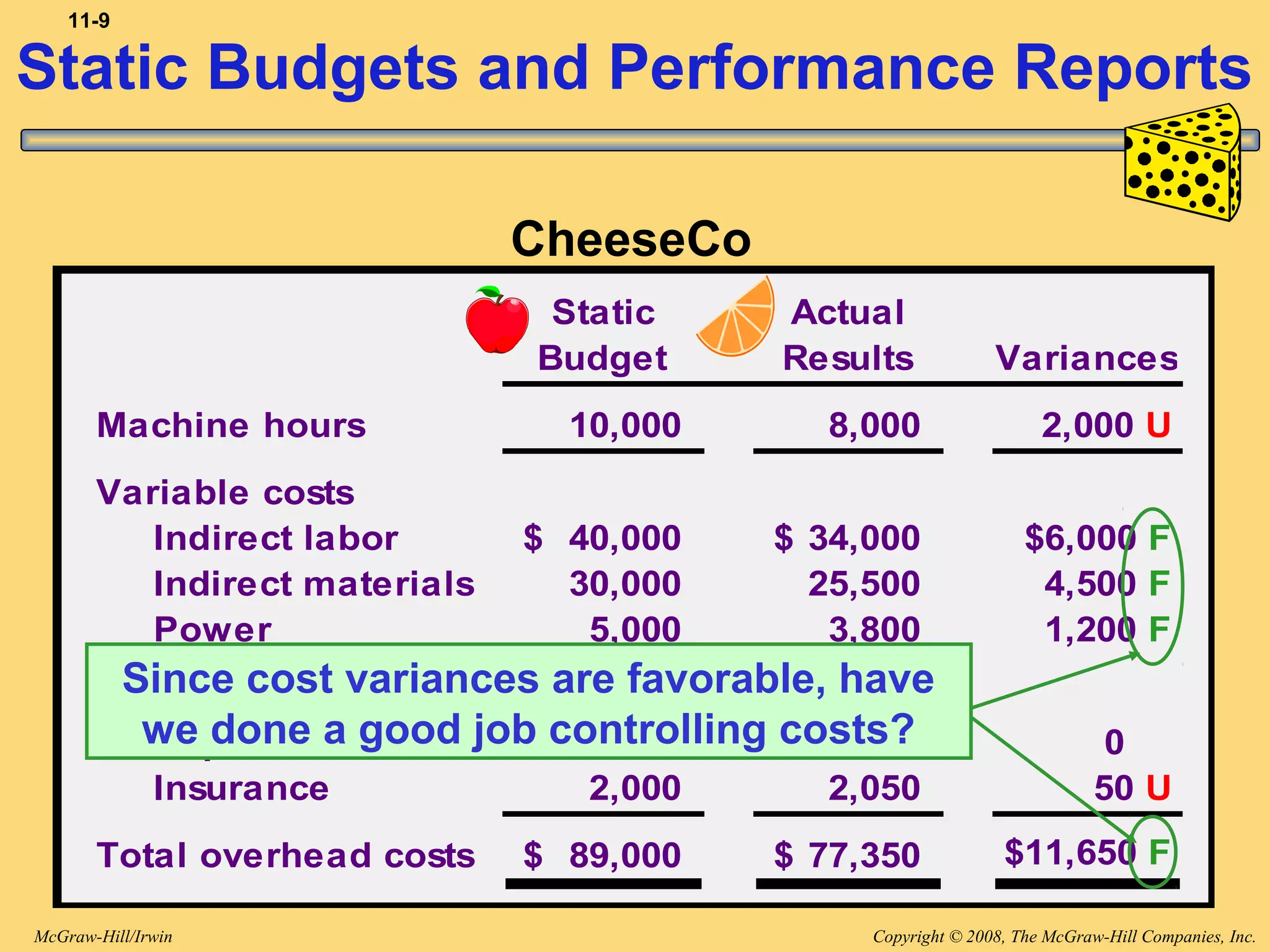
Machine hours 10,000 8,000 2,000 U
Variable costs
Indirect labor 40,000$ 34,000$ $6,000 F
Indirect materials 30,000 25,500 4,500 F
Power 5,000 3,800 1,200 F
Fixed costs
Depreciation 12,000 12,000 0
Insurance 2,000 2,050 50 U
Total overhead costs 89,000$ 77,350$ $11,650 F
Since cost variances are favorable, have
we done a good job controlling costs?
CheeseCo
Static Budgets and Performance Reports
Copyright © 2008, The McGraw-Hill Companies, Inc.McGraw-Hill/Irwin
11-10
I don’t think I
can answer the
question using
a static budget.
Actual activity is below
budgeted activity.
So, shouldn’t variable costs
be lower if actual activity
is lower?
Static Budgets and Performance Reports
Copyright © 2008, The McGraw-Hill Companies, Inc.McGraw-Hill/Irwin
11-11
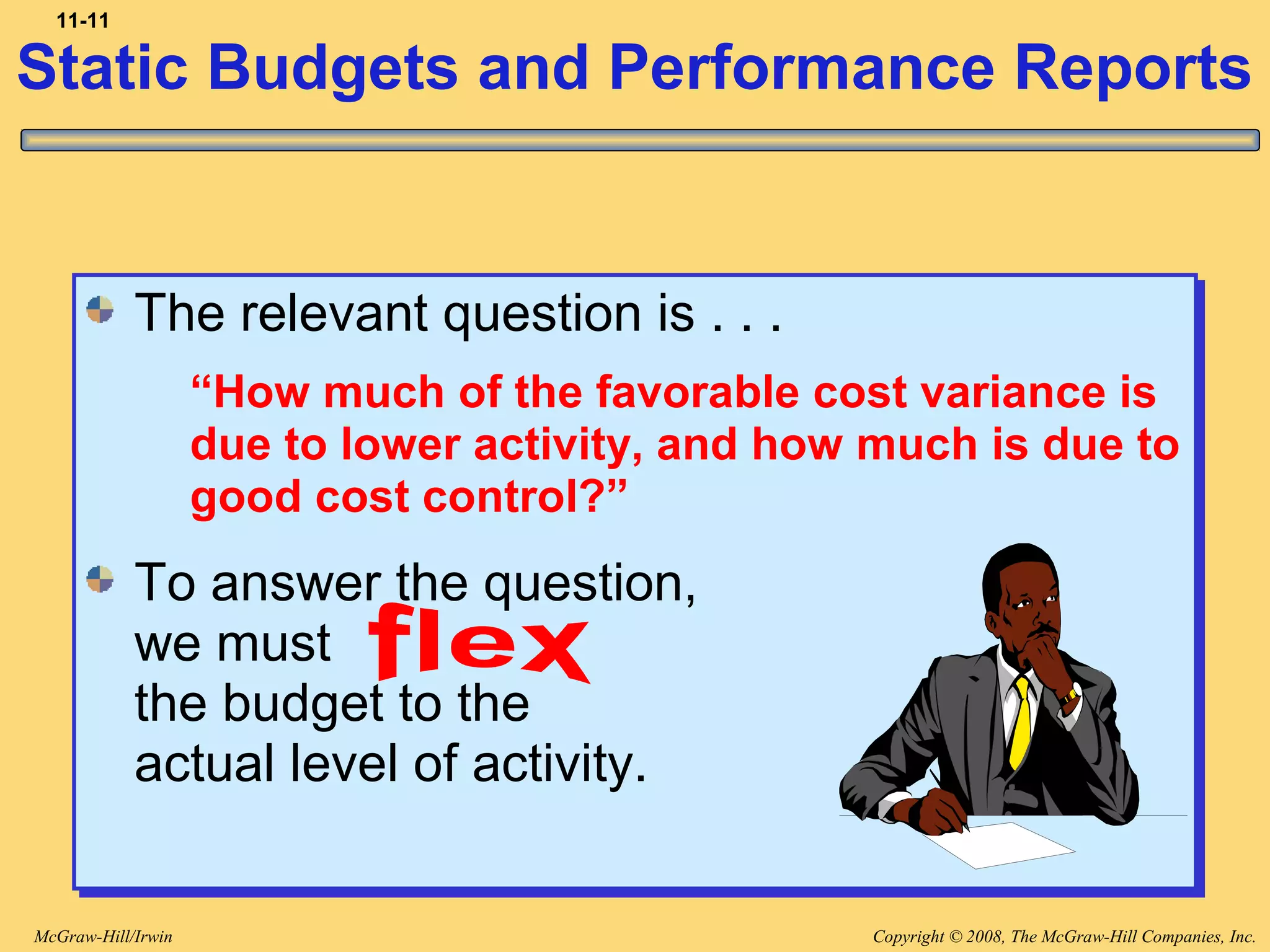
The relevant question is . . .
“How much of the favorable cost variance is
due to lower activity, and how much is due to
good cost control?”
To answer the question,
we must
the budget to the
actual level of activity.
The relevant question is . . .
“How much of the favorable cost variance is
due to lower activity, and how much is due to
good cost control?”
To answer the question,
we must
the budget to the
actual level of activity.
Static Budgets and Performance Reports
Copyright © 2008, The McGraw-Hill Companies, Inc.McGraw-Hill/Irwin
11-12
Preparing a Flexible Budget
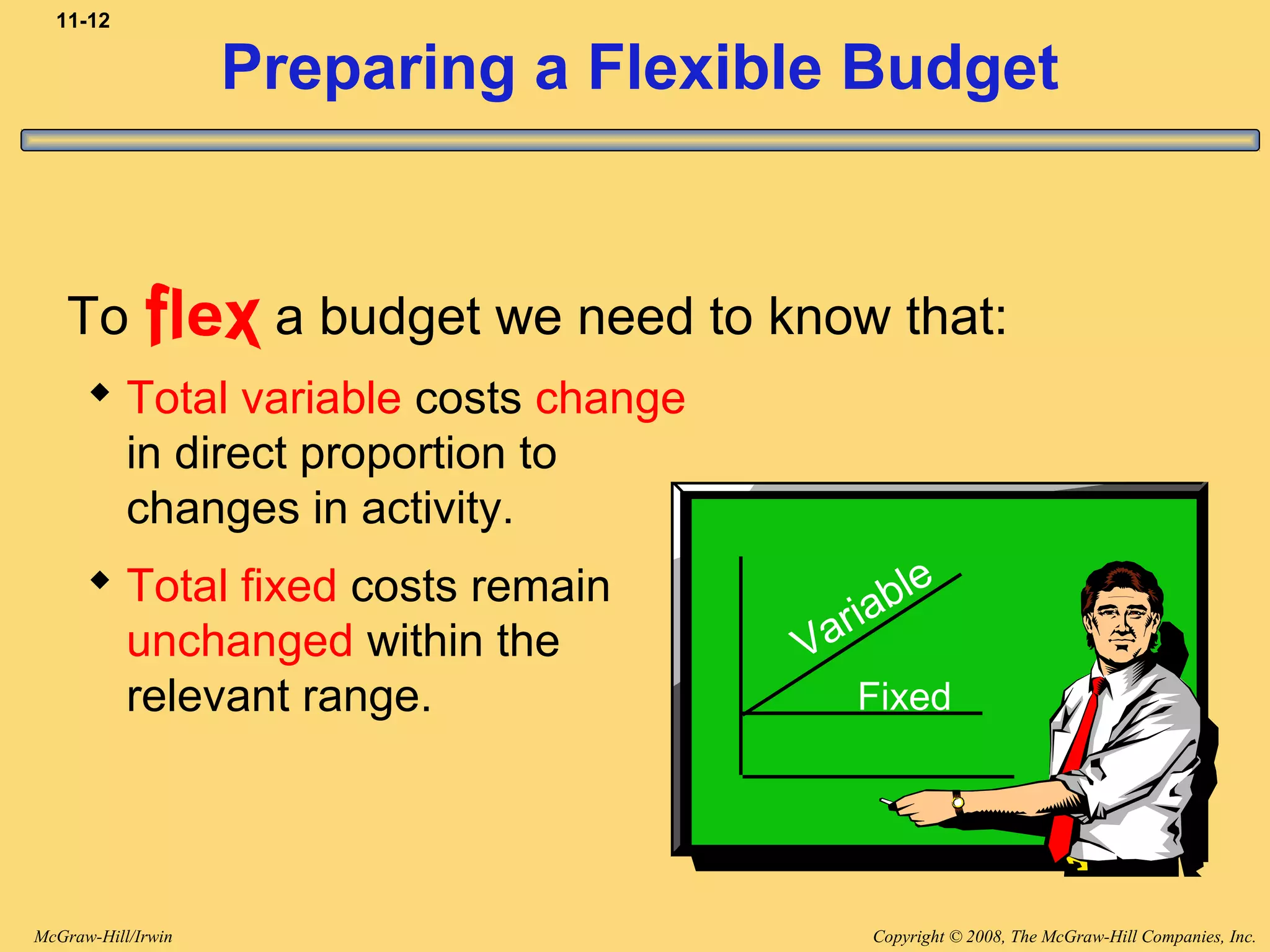
To a budget we need to know that:
 Total variable costs change
in direct proportion to
changes in activity.
 Total fixed costs remain
unchanged within the
relevant range. Fixed
Variable
Copyright © 2008, The McGraw-Hill Companies, Inc.McGraw-Hill/Irwin
11-13
Preparing a Flexible Budget
Let’s prepare
budgets
for CheeseCo.
Copyright © 2008, The McGraw-Hill Companies, Inc.McGraw-Hill/Irwin
11-14
Cost Total
Formula Fixed 8,000 10,000 12,000
per Hour Cost Hours Hours Hours
Machine hours 8,000 10,000 12,000
Variable costs
Indirect labor 4.00$
Indirect material 3.00
Power 0.50
Total variable cost 7.50$
Fixed costs
Depreciation 12,000$
Insurance 2,000
Total fixed cost
Total overhead costs
Flexible Budgets
Preparing a Flexible Budget
Fixed costs are
expressed as a
total amount.
Variable costs are expressed as
a constant amount per hour.
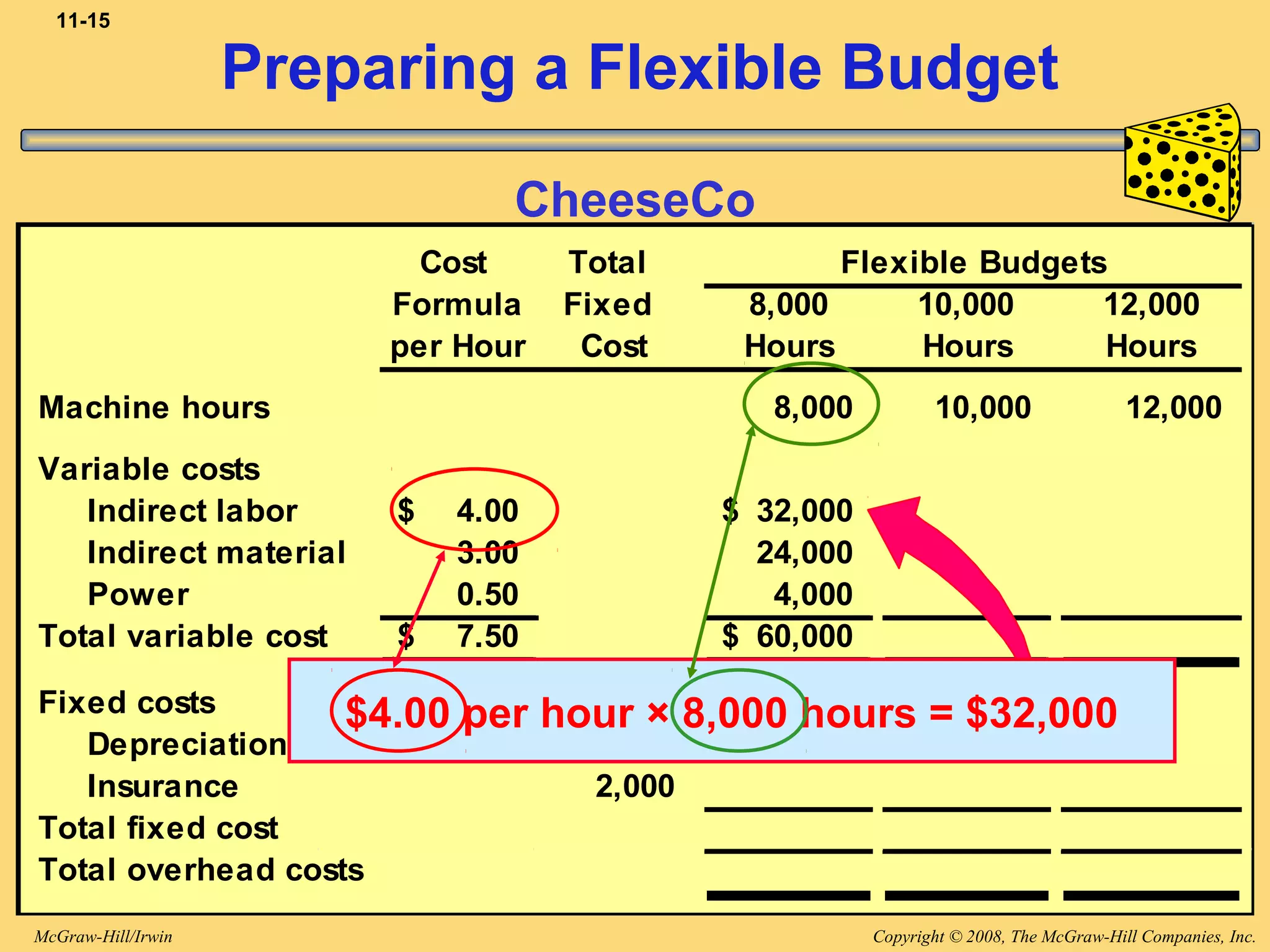
$40,000 ÷ 10,000 hours is
$4.00 per hour.
CheeseCo
Copyright © 2008, The McGraw-Hill Companies, Inc.McGraw-Hill/Irwin
11-15
Cost Total
Formula Fixed 8,000 10,000 12,000
per Hour Cost Hours Hours Hours
Machine hours 8,000 10,000 12,000
Variable costs
Indirect labor 4.00$ 32,000$
Indirect material 3.00 24,000
Power 0.50 4,000
Total variable cost 7.50$ 60,000$
Fixed costs
Depreciation 12,000$
Insurance 2,000
Total fixed cost
Total overhead costs
Flexible Budgets
Preparing a Flexible Budget
$4.00 per hour × 8,000 hours = $32,000
CheeseCo
Copyright © 2008, The McGraw-Hill Companies, Inc.McGraw-Hill/Irwin
11-16
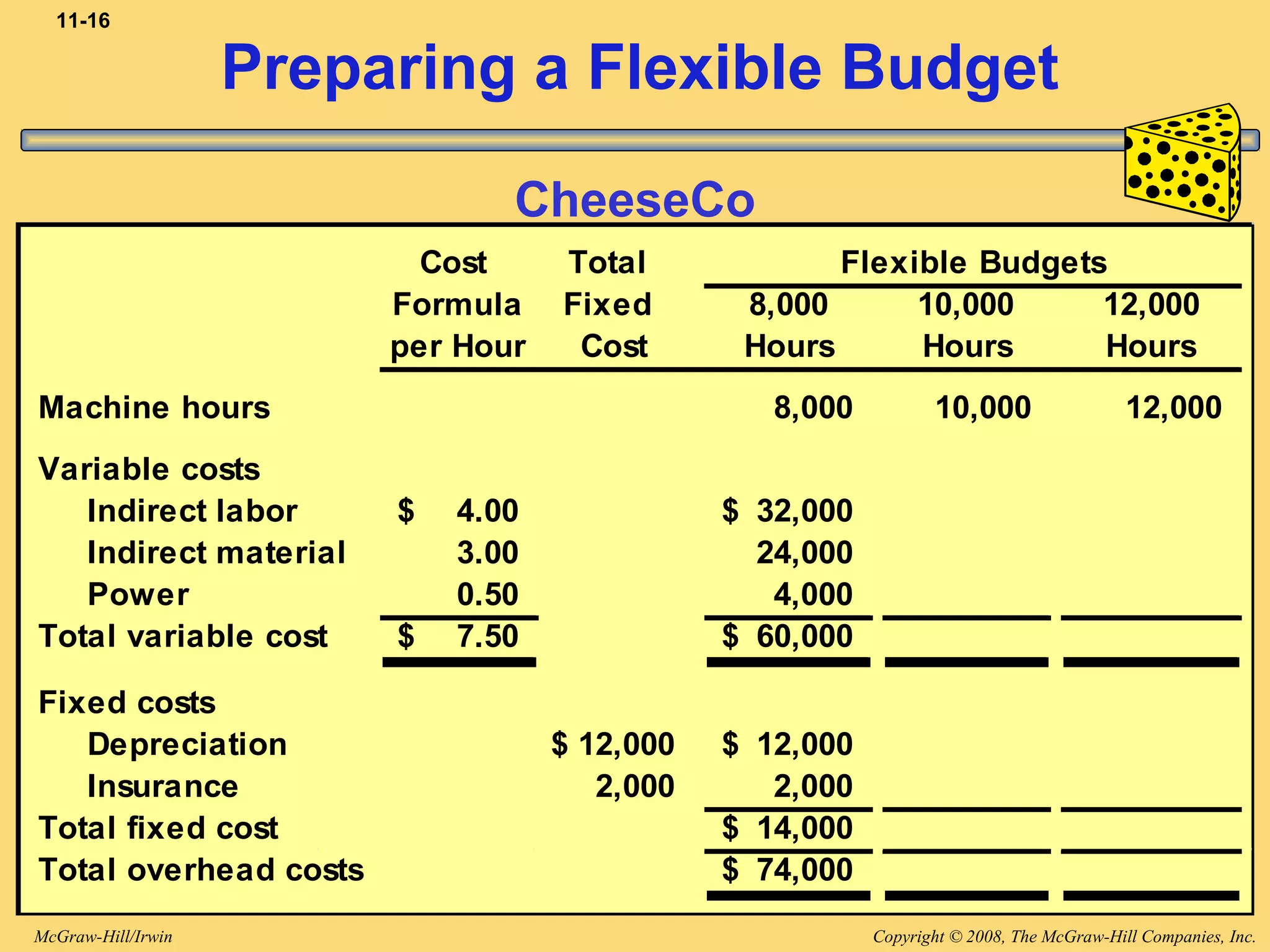
Preparing a Flexible Budget
CheeseCo
Cost Total
Formula Fixed 8,000 10,000 12,000
per Hour Cost Hours Hours Hours
Machine hours 8,000 10,000 12,000
Variable costs
Indirect labor 4.00$ 32,000$
Indirect material 3.00 24,000
Power 0.50 4,000
Total variable cost 7.50$ 60,000$
Fixed costs
Depreciation 12,000$ 12,000$
Insurance 2,000 2,000
Total fixed cost 14,000$
Total overhead costs 74,000$
Flexible Budgets
Copyright © 2008, The McGraw-Hill Companies, Inc.McGraw-Hill/Irwin
11-17
Cost Total
Formula Fixed 8,000 10,000 12,000
per Hour Cost Hours Hours Hours
Machine hours 8,000 10,000 12,000
Variable costs
Indirect labor 4.00$ 32,000$ 40,000$
Indirect material 3.00 24,000 30,000
Power 0.50 4,000 5,000
Total variable cost 7.50$ 60,000$ 75,000$
Fixed costs
Depreciation 12,000$ 12,000$ 12,000$
Insurance 2,000 2,000 2,000
Total fixed cost 14,000$ 14,000$
Total overhead costs 74,000$ 89,000$ ?
Flexible Budgets
Preparing a Flexible Budget
Total fixed costs
do not change in
the relevant range.
CheeseCo
Copyright © 2008, The McGraw-Hill Companies, Inc.McGraw-Hill/Irwin
11-18
Quick Check 
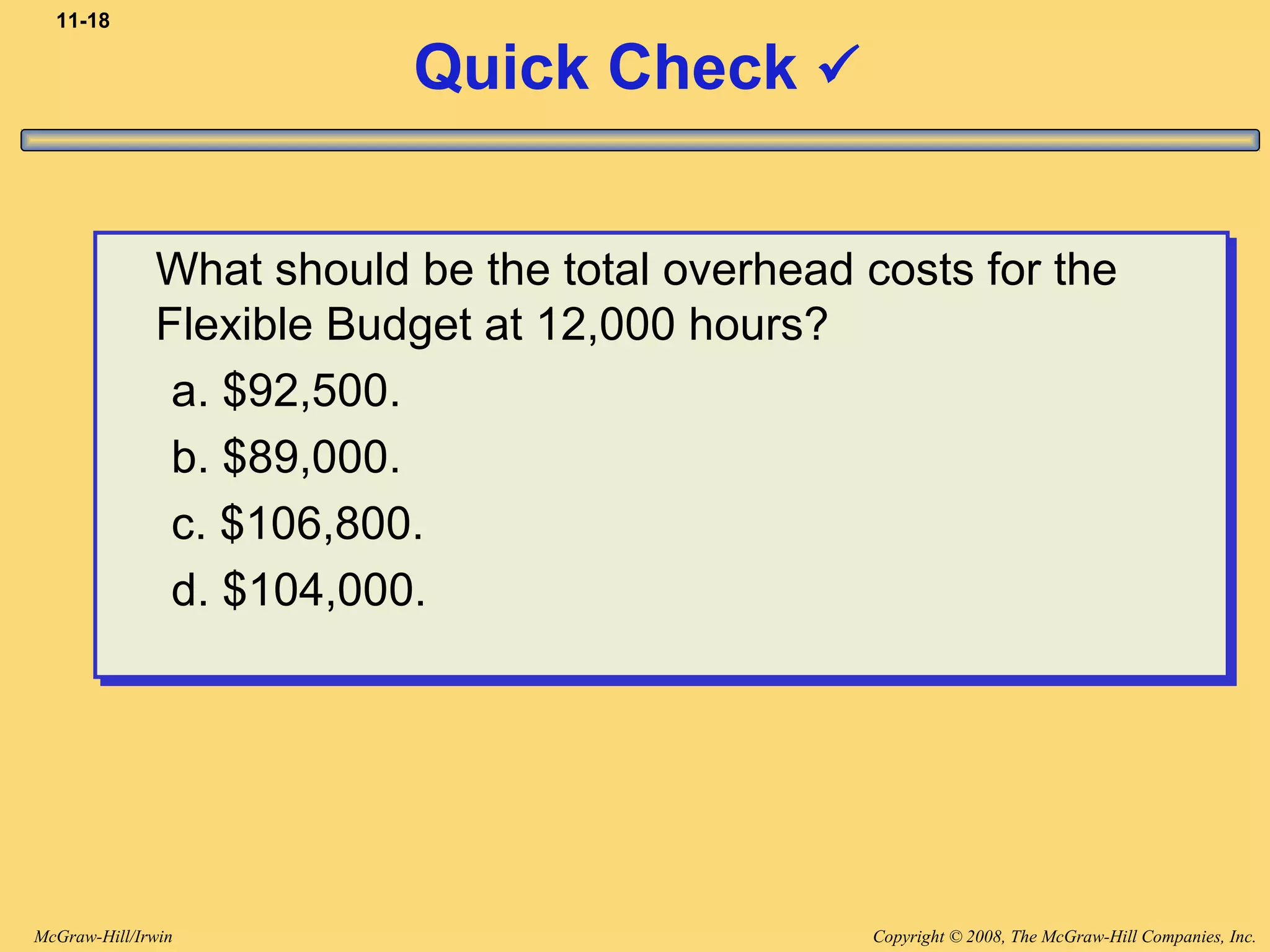
What should be the total overhead costs for the
Flexible Budget at 12,000 hours?
a. $92,500.
b. $89,000.
c. $106,800.
d. $104,000.
What should be the total overhead costs for the
Flexible Budget at 12,000 hours?
a. $92,500.
b. $89,000.
c. $106,800.
d. $104,000.
Copyright © 2008, The McGraw-Hill Companies, Inc.McGraw-Hill/Irwin
11-19
What should be the total overhead costs for the
Flexible Budget at 12,000 hours?
a. $92,500.
b. $89,000.
c. $106,800.
d. $104,000.
What should be the total overhead costs for the
Flexible Budget at 12,000 hours?
a. $92,500.
b. $89,000.
c. $106,800.
d. $104,000.
Quick Check 
Total overhead cost
= $14,000 + $7.50 per hour × 12,000 hours
= $14,000 + $90,000 = $104,000
Copyright © 2008, The McGraw-Hill Companies, Inc.McGraw-Hill/Irwin
11-20
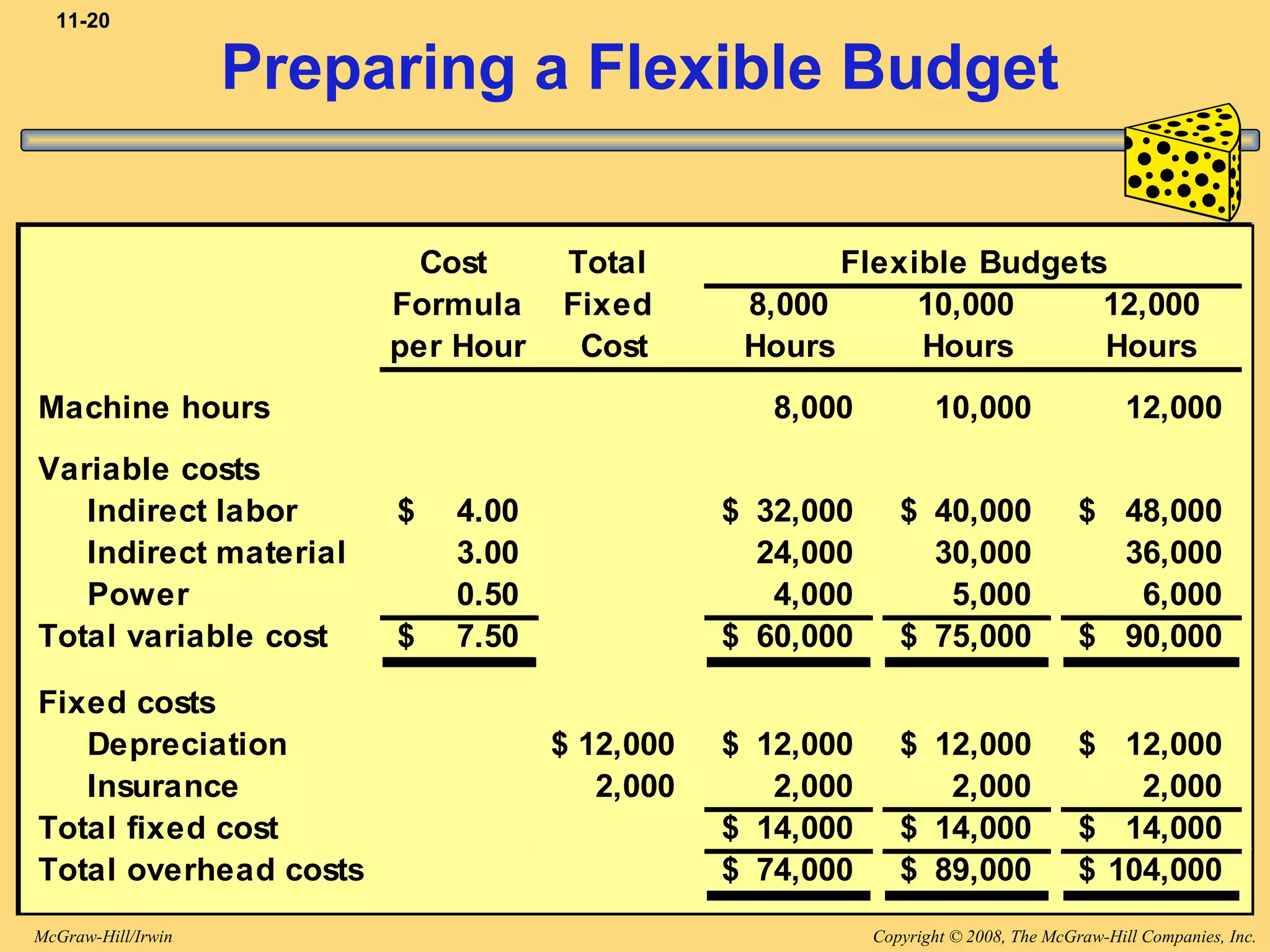
Preparing a Flexible Budget
Cost Total
Formula Fixed 8,000 10,000 12,000
per Hour Cost Hours Hours Hours
Machine hours 8,000 10,000 12,000
Variable costs
Indirect labor 4.00$ 32,000$ 40,000$ 48,000$
Indirect material 3.00 24,000 30,000 36,000
Power 0.50 4,000 5,000 6,000
Total variable cost 7.50$ 60,000$ 75,000$ 90,000$
Fixed costs
Depreciation 12,000$ 12,000$ 12,000$ 12,000$
Insurance 2,000 2,000 2,000 2,000
Total fixed cost 14,000$ 14,000$ 14,000$
Total overhead costs 74,000$ 89,000$ 104,000$
Flexible Budgets
Copyright © 2008, The McGraw-Hill Companies, Inc.McGraw-Hill/Irwin
11-21
Learning Objective 2
Prepare a performancePrepare a performance
report for both variablereport for both variable
and fixed overhead costsand fixed overhead costs
using the flexible budgetusing the flexible budget
approach.approach.
Copyright © 2008, The McGraw-Hill Companies, Inc.McGraw-Hill/Irwin
11-22
Let’s prepare a
budget performance report
for CheeseCo.
Flexible Budget Performance Report
Copyright © 2008, The McGraw-Hill Companies, Inc.McGraw-Hill/Irwin
11-23
Cost Total
Formula Fixed Flexible Actual
per Hour Cost Budget Results Variances
Machine hours 8,000 8,000 0
Variable costs
Indirect labor 4.00$ 34,000$
Indirect material 3.00 25,500
Power 0.50 3,800
Total variable cost 7.50$ 63,300$
Fixed costs
Depreciation 12,000$ 12,000$
Insurance 2,000 2,050
Total fixed cost 14,050$
Total overhead costs 77,350$
CheeseCo
Flexible budget is
prepared for the
same activity level
(8,000 hours) as
actually achieved.
Flexible Budget Performance Report
Copyright © 2008, The McGraw-Hill Companies, Inc.McGraw-Hill/Irwin
11-24
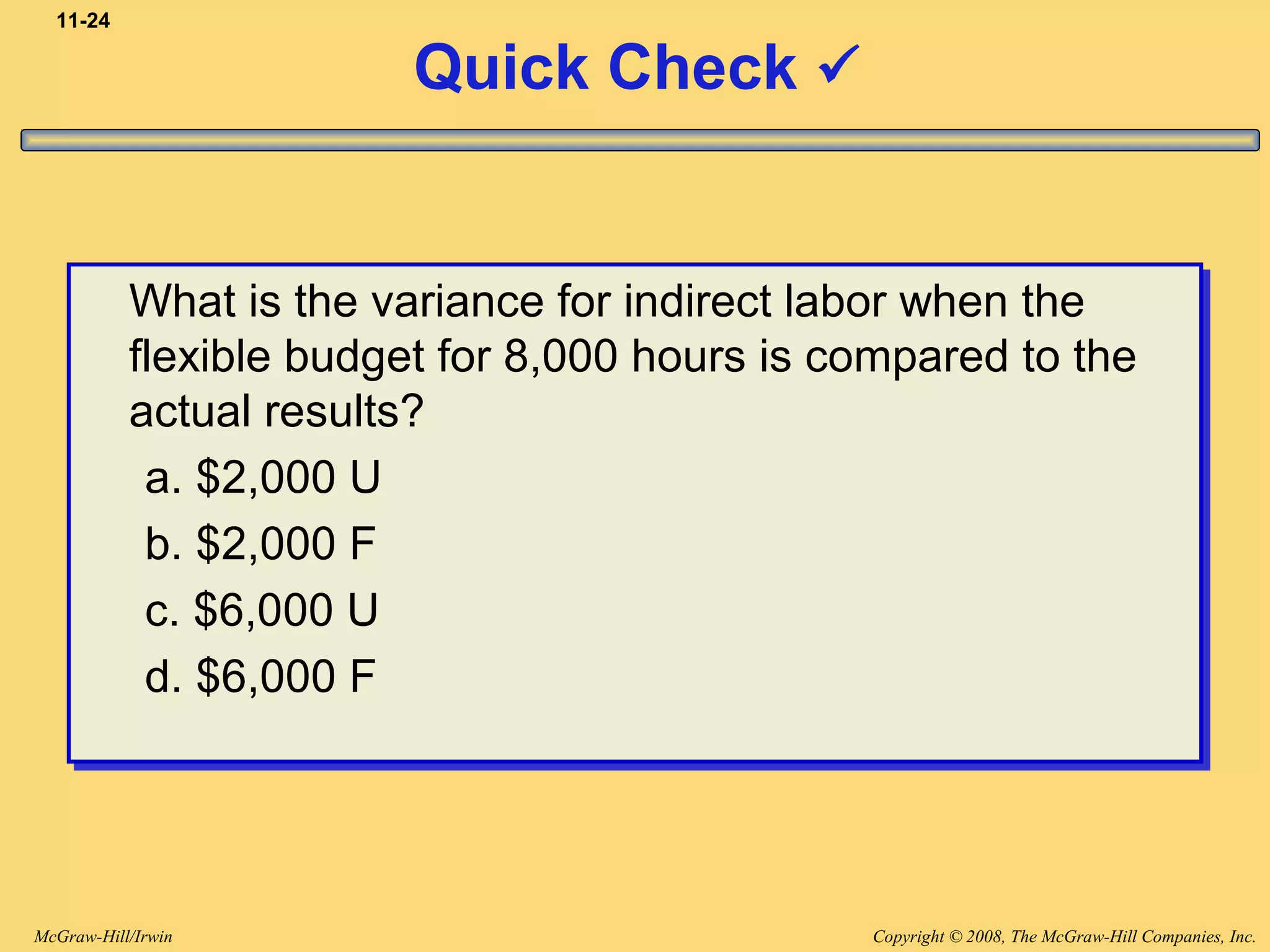
Quick Check 
What is the variance for indirect labor when the
flexible budget for 8,000 hours is compared to the
actual results?
a. $2,000 U
b. $2,000 F
c. $6,000 U
d. $6,000 F
What is the variance for indirect labor when the
flexible budget for 8,000 hours is compared to the
actual results?
a. $2,000 U
b. $2,000 F
c. $6,000 U
d. $6,000 F
Copyright © 2008, The McGraw-Hill Companies, Inc.McGraw-Hill/Irwin
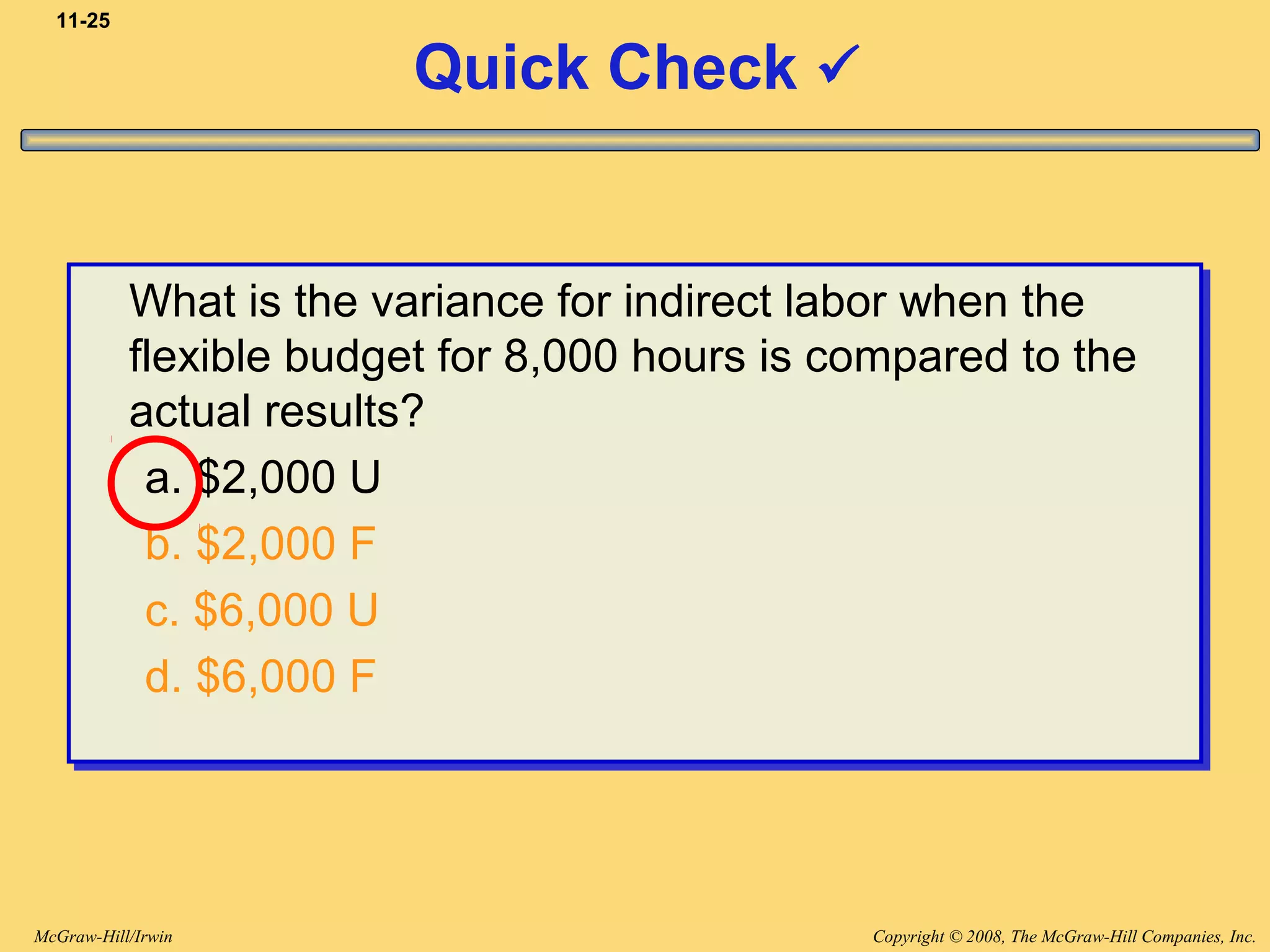
11-25
What is the variance for indirect labor when the
flexible budget for 8,000 hours is compared to the
actual results?
a. $2,000 U
b. $2,000 F
c. $6,000 U
d. $6,000 F
What is the variance for indirect labor when the
flexible budget for 8,000 hours is compared to the
actual results?
a. $2,000 U
b. $2,000 F
c. $6,000 U
d. $6,000 F
Quick Check 
Copyright © 2008, The McGraw-Hill Companies, Inc.McGraw-Hill/Irwin
11-26
Cost Total
Formula Fixed Flexible Actual
per Hour Cost Budget Results Variances
Machine hours 8,000 8,000 0
Variable costs
Indirect labor 4.00$ 32,000$ 34,000$ $ 2,000 U
Indirect material 3.00 25,500
Power 0.50 3,800
Total variable cost 7.50$ 63,300$
Fixed costs
Depreciation 12,000$ 12,000$
Insurance 2,000 2,050
Total fixed cost 14,050$
Total overhead costs 77,350$
CheeseCo
Flexible Budget Performance Report
Copyright © 2008, The McGraw-Hill Companies, Inc.McGraw-Hill/Irwin
11-27
Quick Check 
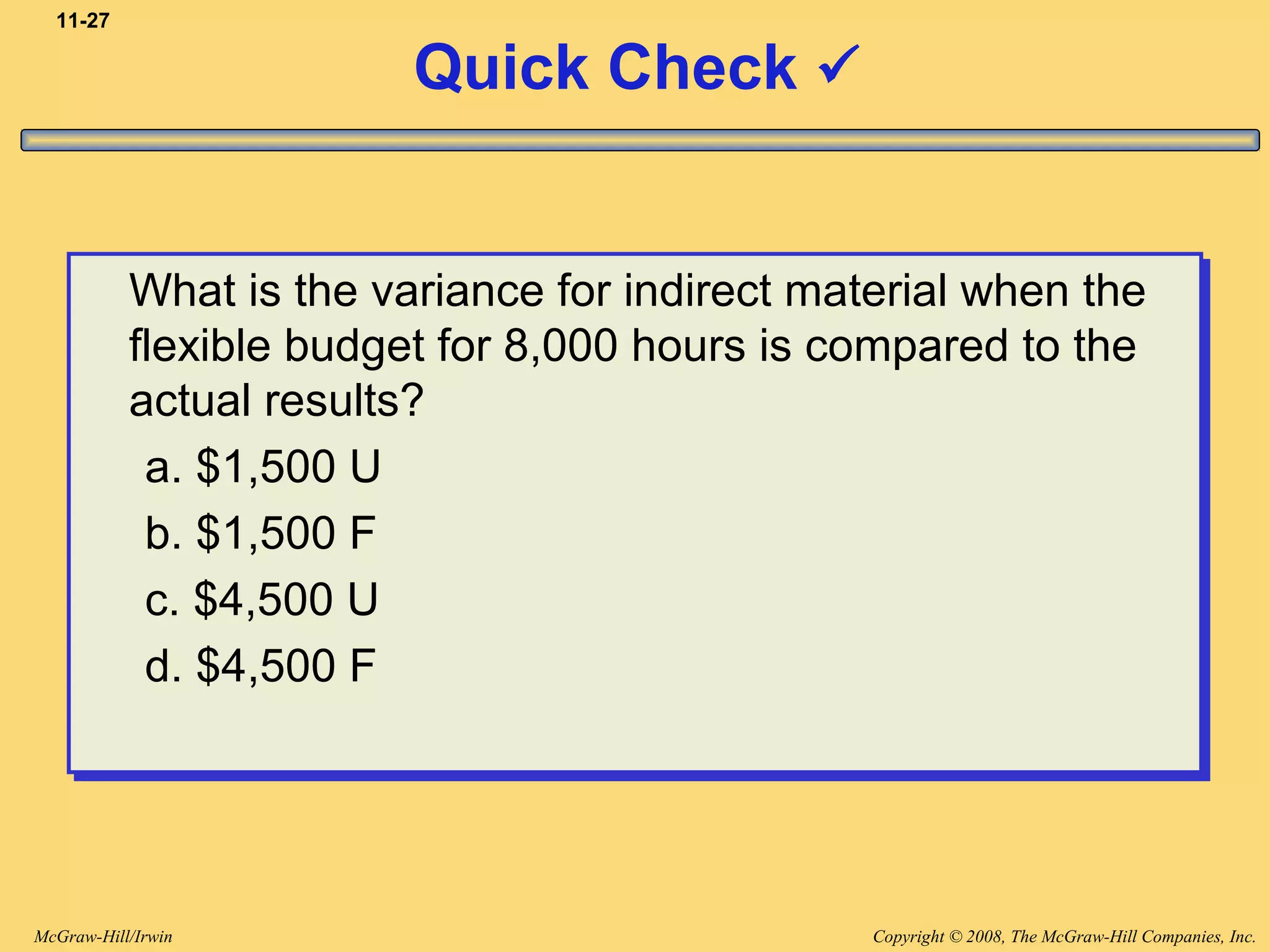
What is the variance for indirect material when the
flexible budget for 8,000 hours is compared to the
actual results?
a. $1,500 U
b. $1,500 F
c. $4,500 U
d. $4,500 F
What is the variance for indirect material when the
flexible budget for 8,000 hours is compared to the
actual results?
a. $1,500 U
b. $1,500 F
c. $4,500 U
d. $4,500 F
Copyright © 2008, The McGraw-Hill Companies, Inc.McGraw-Hill/Irwin
11-28
What is the variance for indirect material when the
flexible budget for 8,000 hours is compared to the
actual results?
a. $1,500 U
b. $1,500 F
c. $4,500 U
d. $4,500 F
What is the variance for indirect material when the
flexible budget for 8,000 hours is compared to the
actual results?
a. $1,500 U
b. $1,500 F
c. $4,500 U
d. $4,500 F
Quick Check 
Copyright © 2008, The McGraw-Hill Companies, Inc.McGraw-Hill/Irwin
11-29
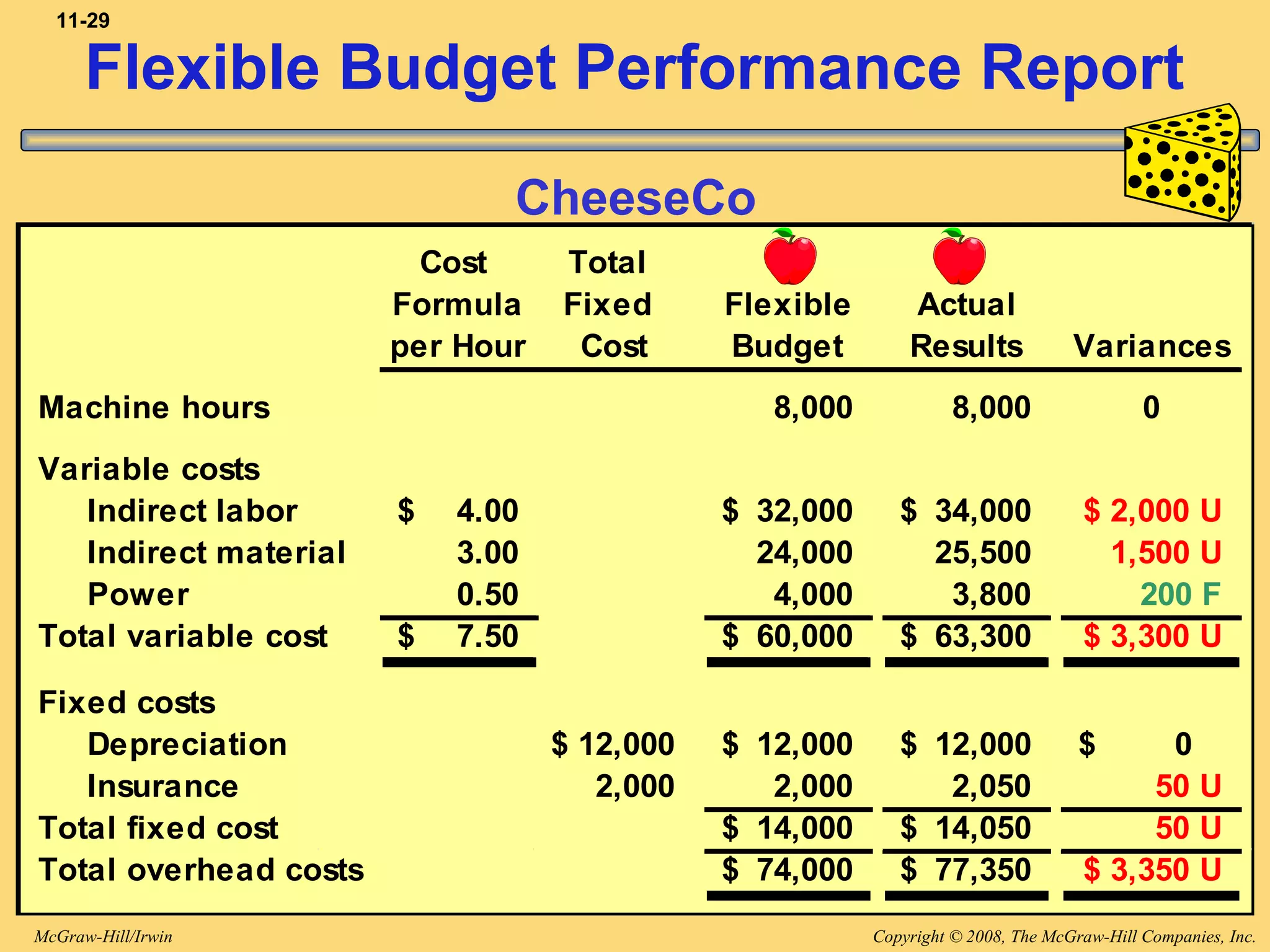
Cost Total
Formula Fixed Flexible Actual
per Hour Cost Budget Results Variances
Machine hours 8,000 8,000 0
Variable costs
Indirect labor 4.00$ 32,000$ 34,000$ $ 2,000 U
Indirect material 3.00 24,000 25,500 1,500 U
Power 0.50 4,000 3,800 200 F
Total variable cost 7.50$ 60,000$ 63,300$ $ 3,300 U
Fixed costs
Depreciation 12,000$ 12,000$ 12,000$ $ 0
Insurance 2,000 2,000 2,050 50 U
Total fixed cost 14,000$ 14,050$ 50 U
Total overhead costs 74,000$ 77,350$ $ 3,350 U
CheeseCo
Flexible Budget Performance Report
Copyright © 2008, The McGraw-Hill Companies, Inc.McGraw-Hill/Irwin
11-30
Remember the question:
“How much of the total
variance is due to loweractivity and how much is
due to cost control?”
Flexible Budget Performance Report
Copyright © 2008, The McGraw-Hill Companies, Inc.McGraw-Hill/Irwin
11-31
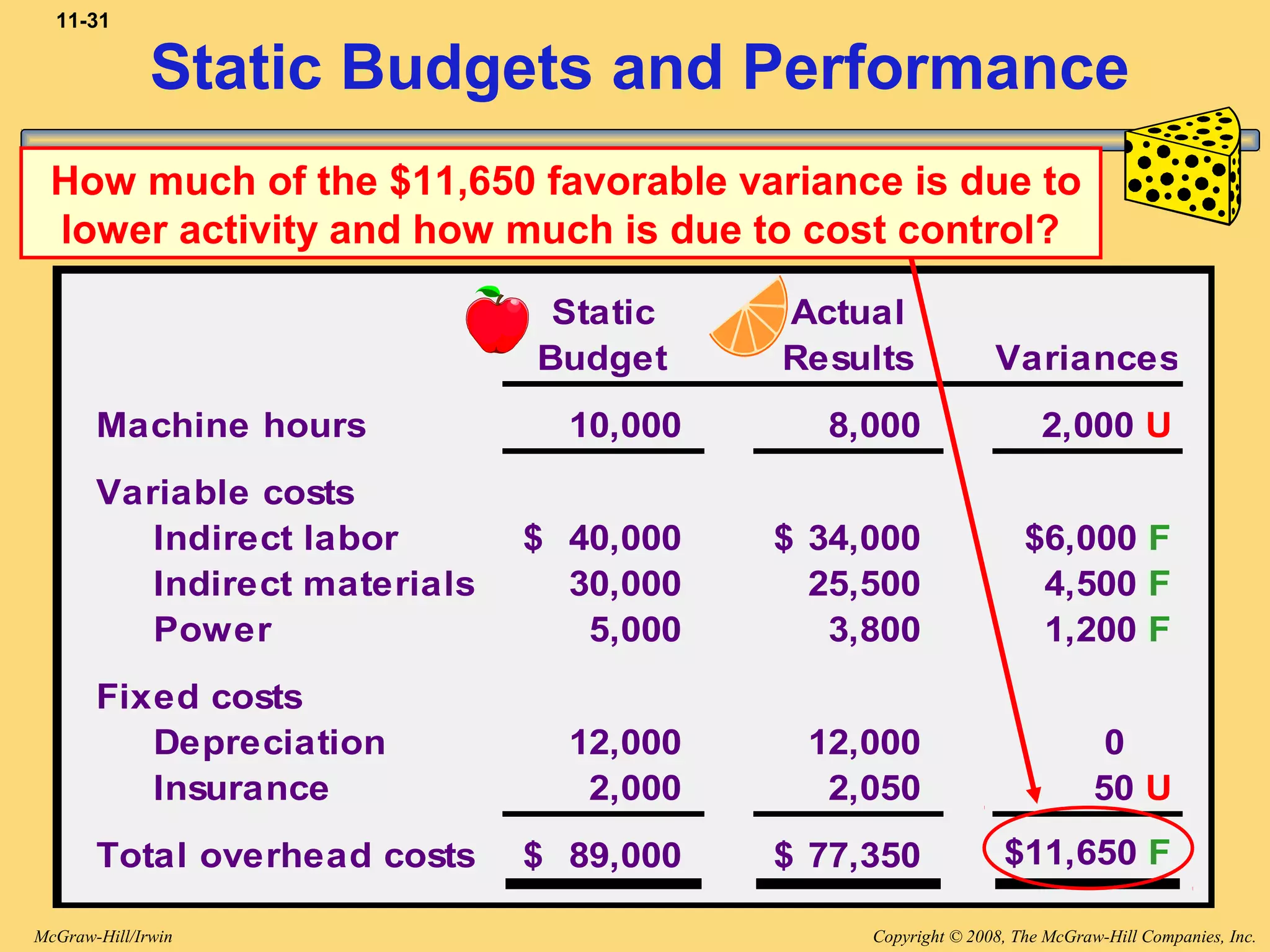
Static Actual
Budget Results Variances
Machine hours 10,000 8,000 2,000 U
Variable costs
Indirect labor 40,000$ 34,000$ $6,000 F
Indirect materials 30,000 25,500 4,500 F
Power 5,000 3,800 1,200 F
Fixed costs
Depreciation 12,000 12,000 0
Insurance 2,000 2,050 50 U
Total overhead costs 89,000$ 77,350$ $11,650 F
Static Budgets and Performance
How much of the $11,650 favorable variance is due to
lower activity and how much is due to cost control?
Copyright © 2008, The McGraw-Hill Companies, Inc.McGraw-Hill/Irwin
11-32
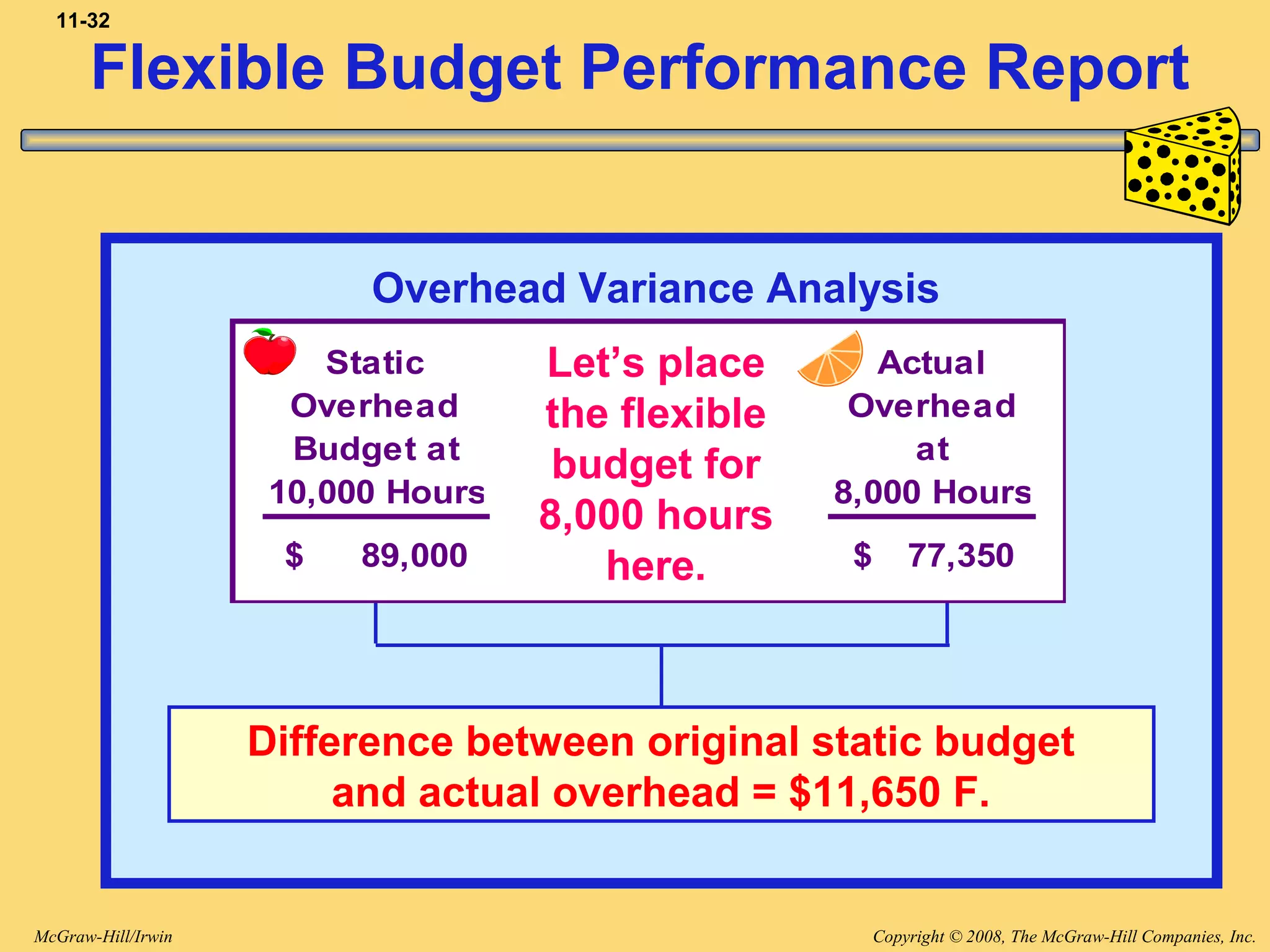
Difference between original static budget
and actual overhead = $11,650 F.
Overhead Variance Analysis
Static Actual
Overhead Overhead
Budget at at
10,000 Hours 8,000 Hours
89,000$ 77,350$
Let’s place
the flexible
budget for
8,000 hours
here.
Flexible Budget Performance Report
Copyright © 2008, The McGraw-Hill Companies, Inc.McGraw-Hill/Irwin
11-33
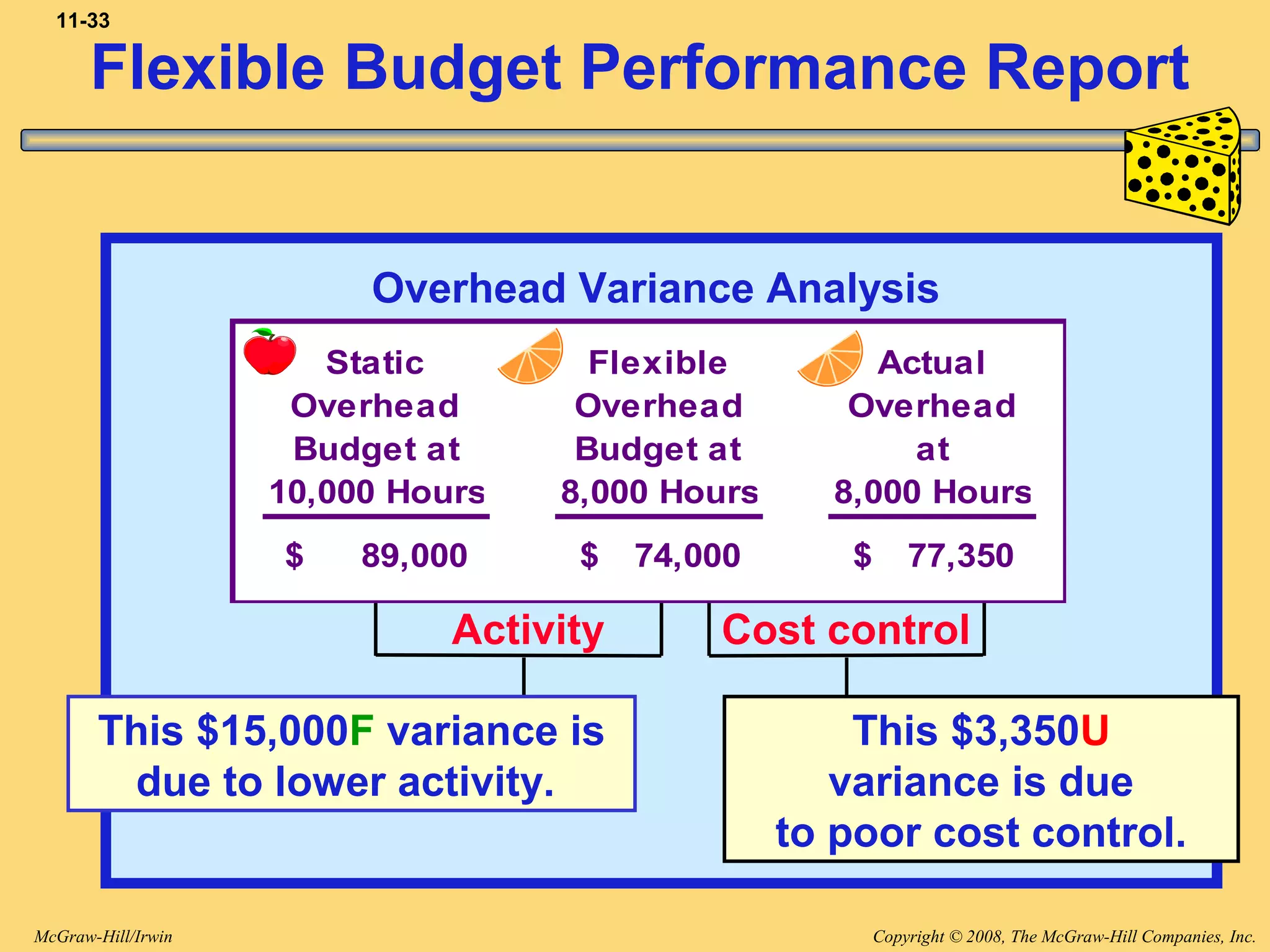
Overhead Variance Analysis
This $15,000F variance is
due to lower activity.
Activity
This $3,350U
variance is due
to poor cost control.
Cost control
Static Flexible Actual
Overhead Overhead Overhead
Budget at Budget at at
10,000 Hours 8,000 Hours 8,000 Hours
89,000$ 74,000$ 77,350$
Flexible Budget Performance Report
Copyright © 2008, The McGraw-Hill Companies, Inc.McGraw-Hill/Irwin
11-34
The Measure of Activity– A Critical Choice
Three important
factors in selecting an
activity base for an overhead
flexible budget
Activity base and
variable overhead
should be
causally related.
Activity base and
variable overhead
should be
causally related.
Activity base should
not be expressed
in dollars or
other currency.
Activity base should
not be expressed
in dollars or
other currency.
Activity base should
be simple and
easily understood.
Activity base should
be simple and
easily understood.
Copyright © 2008, The McGraw-Hill Companies, Inc.McGraw-Hill/Irwin
11-35
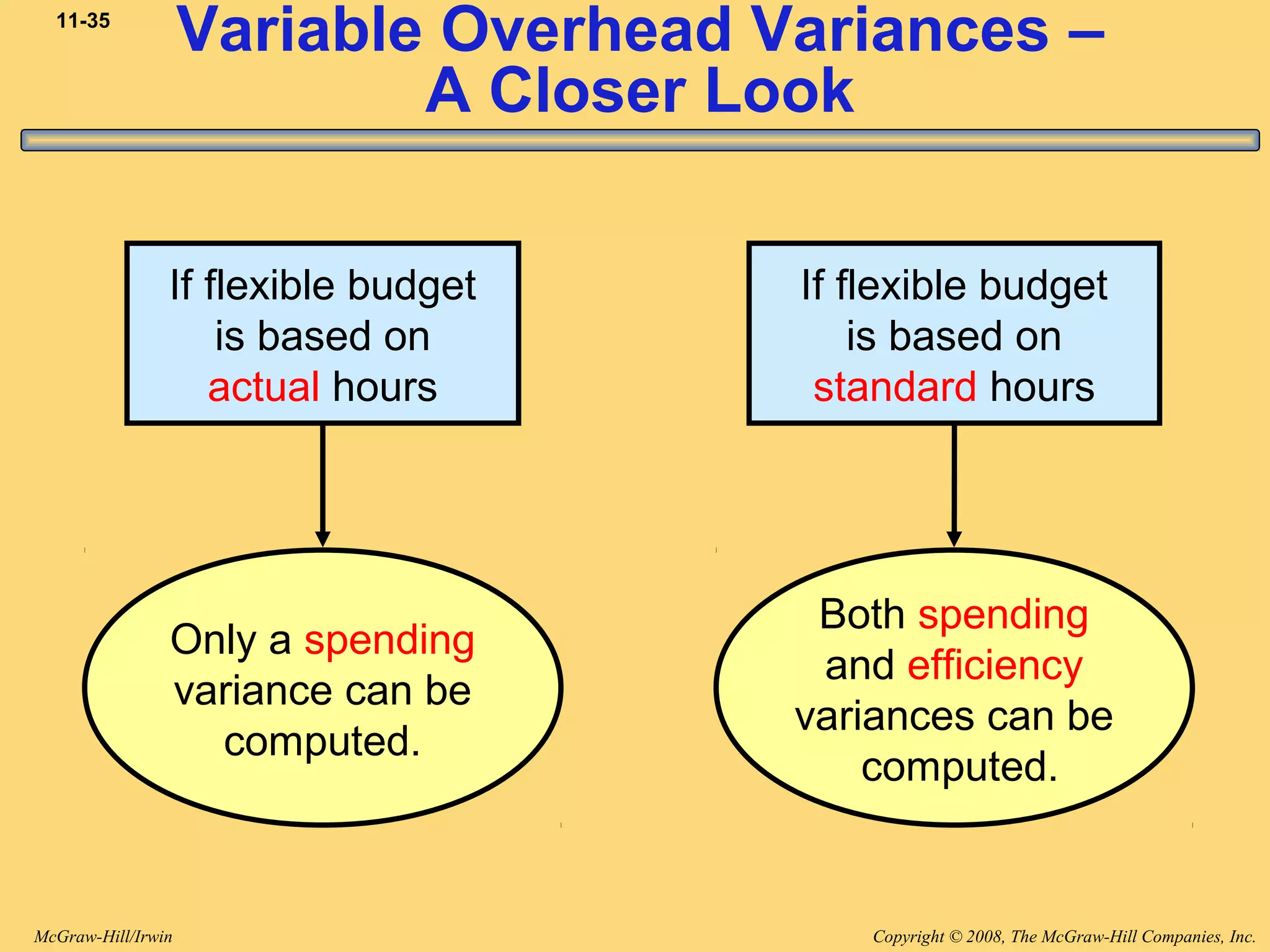
Variable Overhead Variances –
A Closer Look
If flexible budget
is based on
actual hours
If flexible budget
is based on
standard hours
Only a spending
variance can be
computed.
Both spending
and efficiency
variances can be
computed.
Copyright © 2008, The McGraw-Hill Companies, Inc.McGraw-Hill/Irwin
11-36
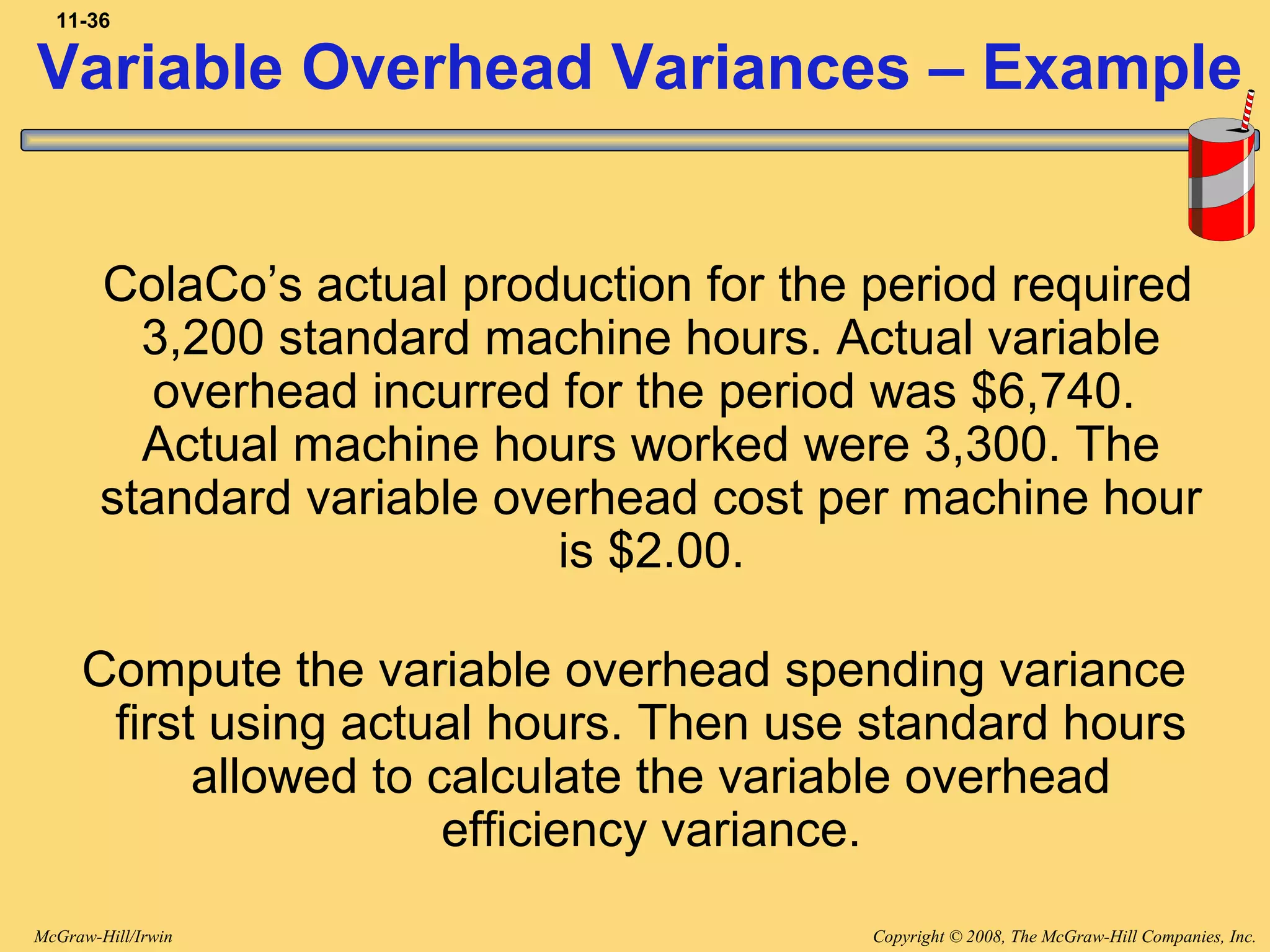
ColaCo’s actual production for the period required
3,200 standard machine hours. Actual variable
overhead incurred for the period was $6,740.
Actual machine hours worked were 3,300. The
standard variable overhead cost per machine hour
is $2.00.
Compute the variable overhead spending variance
first using actual hours. Then use standard hours
allowed to calculate the variable overhead
efficiency variance.
Variable Overhead Variances – Example
Copyright © 2008, The McGraw-Hill Companies, Inc.McGraw-Hill/Irwin
11-37
Learning Objective 3
Use a flexible budgetUse a flexible budget
to prepare a variableto prepare a variable
overhead performanceoverhead performance
report containing onlyreport containing only
a spending variance.a spending variance.
Copyright © 2008, The McGraw-Hill Companies, Inc.McGraw-Hill/Irwin
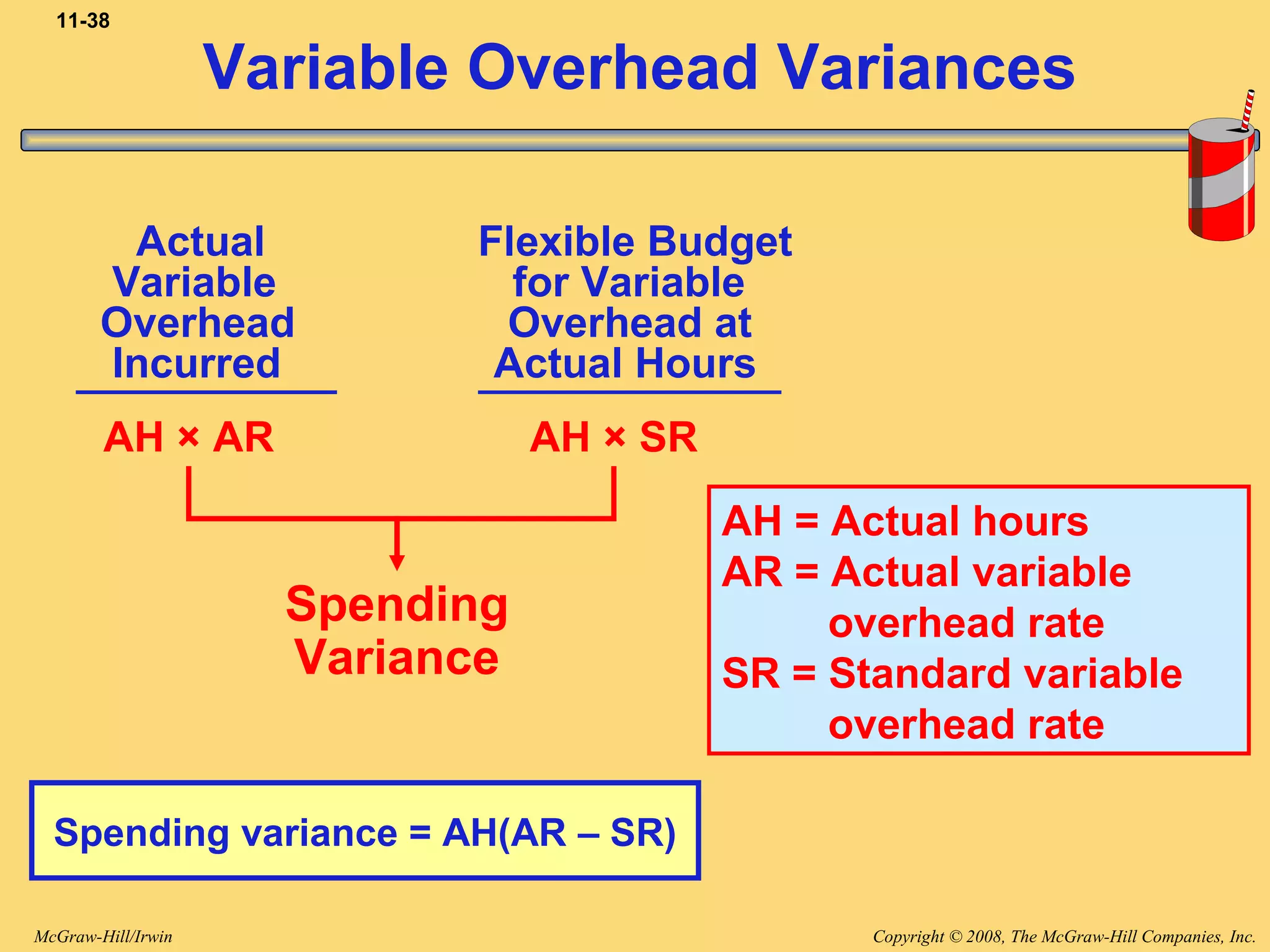
11-38
Actual Flexible Budget
Variable for Variable
Overhead Overhead at
Incurred Actual Hours
AH × SRAH × AR
Spending
Variance
Spending variance = AH(AR – SR)
Variable Overhead Variances
AH = Actual hours
AR = Actual variable
overhead rate
SR = Standard variable
overhead rate
Copyright © 2008, The McGraw-Hill Companies, Inc.McGraw-Hill/Irwin
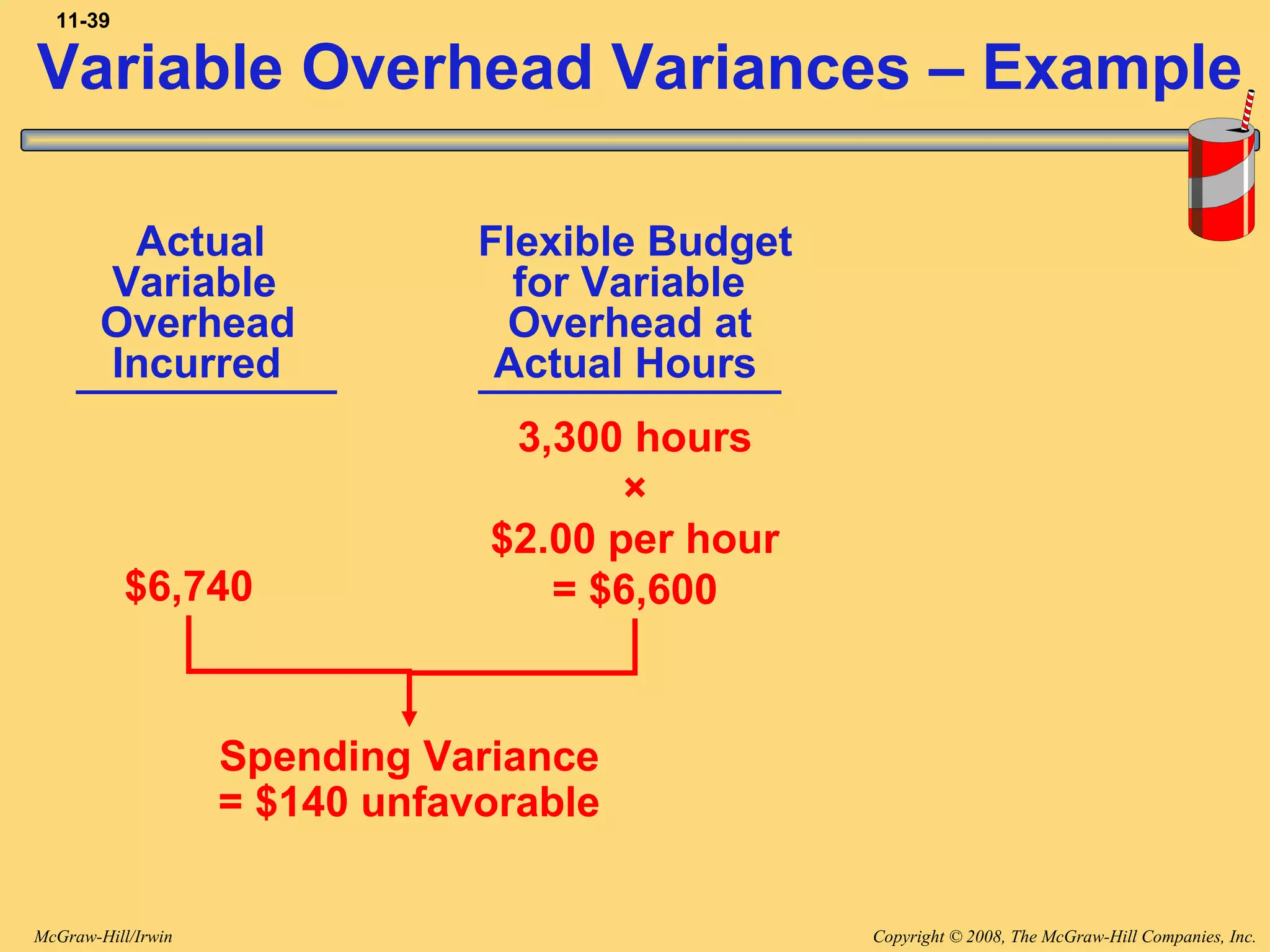
11-39
Actual Flexible Budget
Variable for Variable
Overhead Overhead at
Incurred Actual Hours
3,300 hours
×
$2.00 per hour
= $6,600$6,740
Spending Variance
= $140 unfavorable
Variable Overhead Variances – Example
Copyright © 2008, The McGraw-Hill Companies, Inc.McGraw-Hill/Irwin
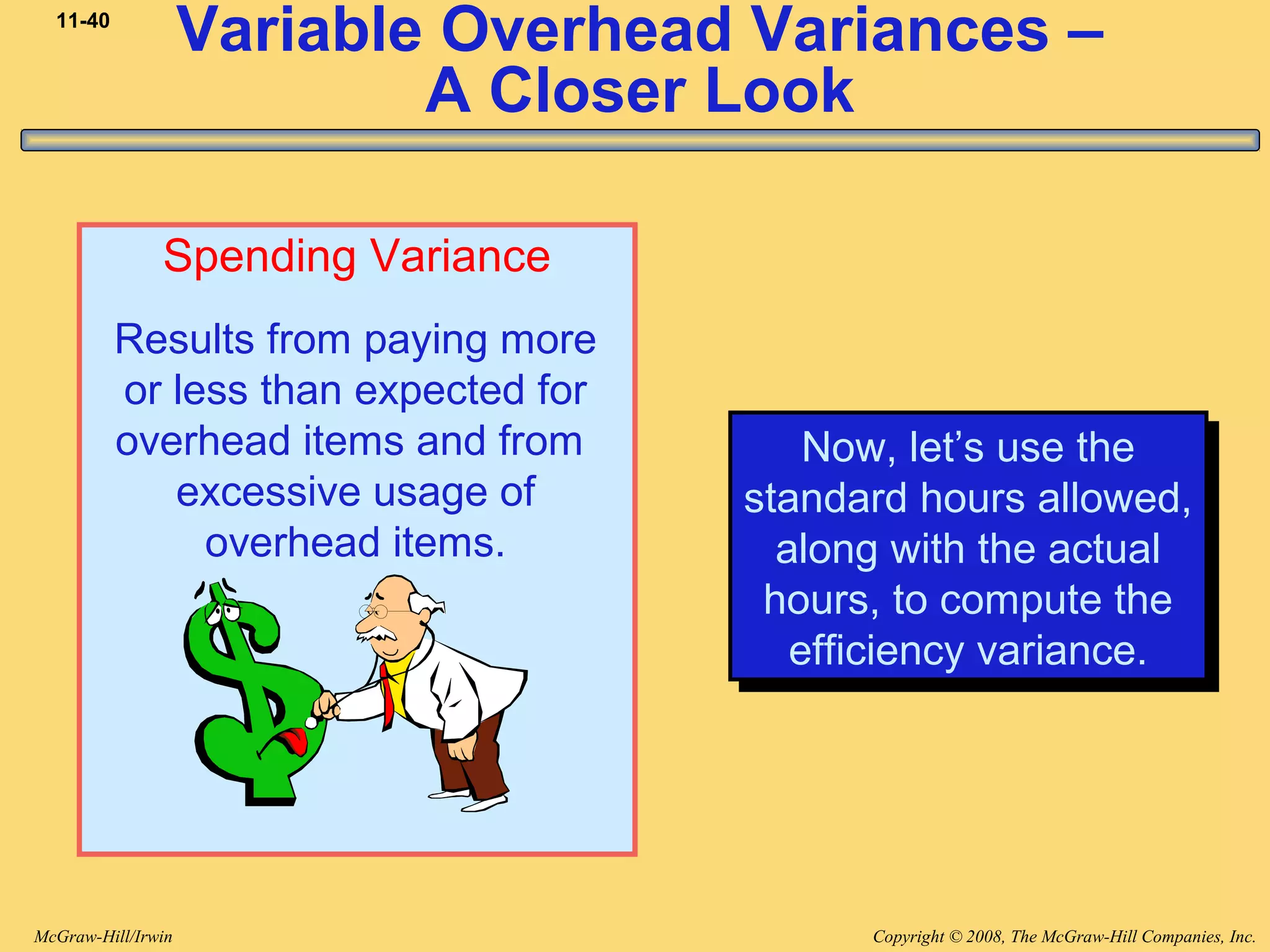
11-40
Variable Overhead Variances –
A Closer Look
Spending Variance
Results from paying more
or less than expected for
overhead items and from
excessive usage of
overhead items.
Now, let’s use the
standard hours allowed,
along with the actual
hours, to compute the
efficiency variance.
Now, let’s use the
standard hours allowed,
along with the actual
hours, to compute the
efficiency variance.
Copyright © 2008, The McGraw-Hill Companies, Inc.McGraw-Hill/Irwin
11-41
Learning Objective 4
Use a flexible budgetUse a flexible budget
to prepare a variableto prepare a variable
overhead performanceoverhead performance
report containing both areport containing both a
spending and an efficiencyspending and an efficiency
variance.variance.
Copyright © 2008, The McGraw-Hill Companies, Inc.McGraw-Hill/Irwin
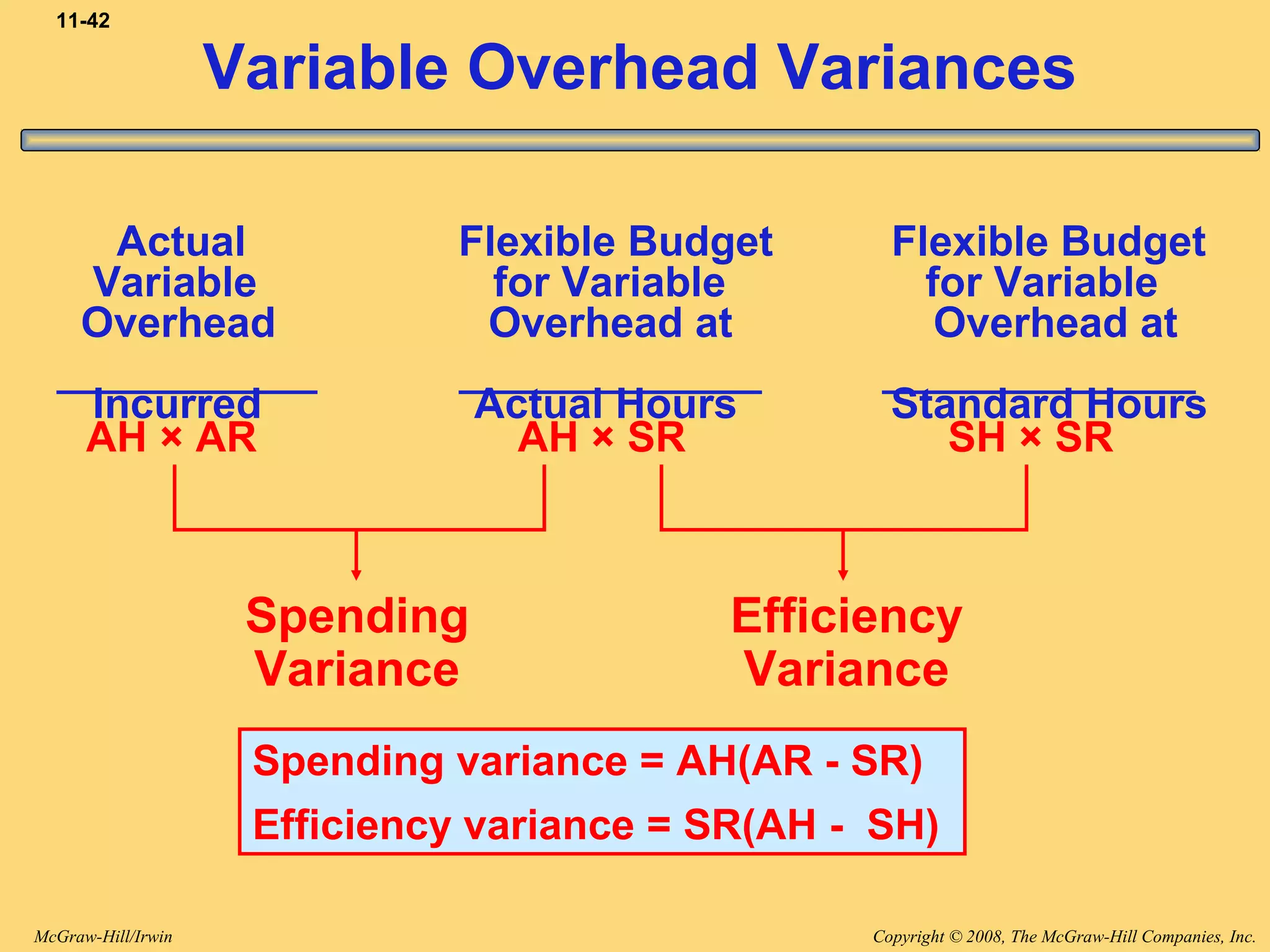
11-42
AH × SRAH × AR
Spending variance = AH(AR - SR)
Efficiency variance = SR(AH - SH)
SH × SR
Spending
Variance
Efficiency
Variance
Actual Flexible Budget Flexible Budget
Variable for Variable for Variable
Overhead Overhead at Overhead at
Incurred Actual Hours Standard Hours
Variable Overhead Variances
Copyright © 2008, The McGraw-Hill Companies, Inc.McGraw-Hill/Irwin
11-43
3,300 hours 3,200 hours
× ×
$2.00 per hour $2.00 per hour
Variable Overhead Variances – Example
$6,740 $6,600 $6,400
Spending variance
$140 unfavorable
Efficiency variance
$200 unfavorable
$340 unfavorable flexible budget total variance$340 unfavorable flexible budget total variance
Actual Flexible Budget Flexible Budget
Variable for Variable for Variable
Overhead Overhead at Overhead at
Incurred Actual Hours Standard Hours
Copyright © 2008, The McGraw-Hill Companies, Inc.McGraw-Hill/Irwin
11-44
Efficiency Variance
Controlled by
managing the
overhead cost driver.
Variable Overhead Variances –
A Closer Look
Copyright © 2008, The McGraw-Hill Companies, Inc.McGraw-Hill/Irwin
11-45
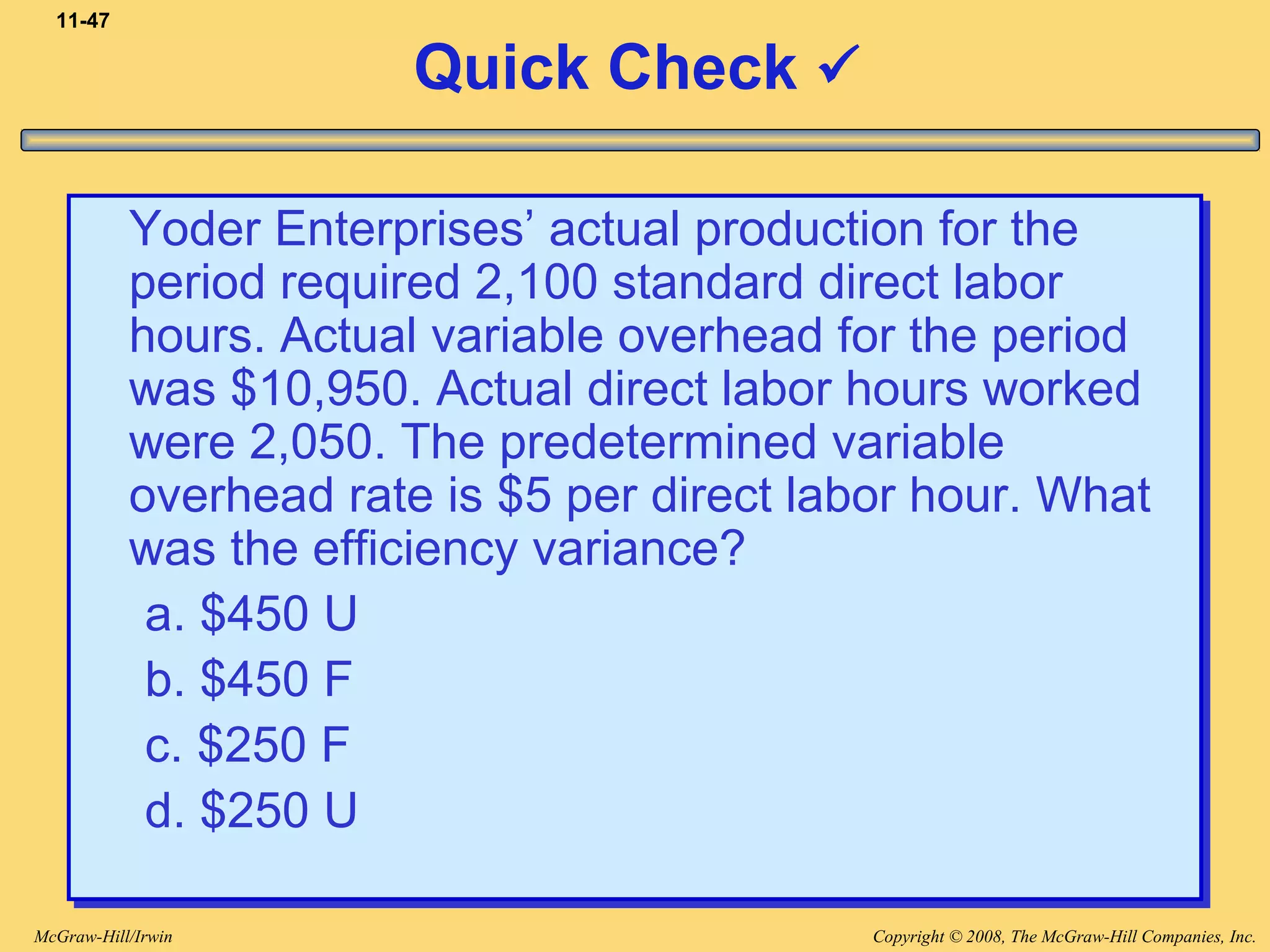
Quick Check 
Yoder Enterprises’ actual production for the
period required 2,100 standard direct labor
hours. Actual variable overhead for the period
was $10,950. Actual direct labor hours worked
were 2,050. The predetermined variable
overhead rate is $5 per direct labor hour. What
was the spending variance?
a. $450 U
b. $450 F
c. $700 F
d. $700 U
Yoder Enterprises’ actual production for the
period required 2,100 standard direct labor
hours. Actual variable overhead for the period
was $10,950. Actual direct labor hours worked
were 2,050. The predetermined variable
overhead rate is $5 per direct labor hour. What
was the spending variance?
a. $450 U
b. $450 F
c. $700 F
d. $700 U
Copyright © 2008, The McGraw-Hill Companies, Inc.McGraw-Hill/Irwin
11-46
Yoder Enterprises’ actual production for the
period required 2,100 standard direct labor
hours. Actual variable overhead for the period
was $10,950. Actual direct labor hours worked
were 2,050. The predetermined variable
overhead rate is $5 per direct labor hour. What
was the spending variance?
a. $450 U
b. $450 F
c. $700 F
d. $700 U
Yoder Enterprises’ actual production for the
period required 2,100 standard direct labor
hours. Actual variable overhead for the period
was $10,950. Actual direct labor hours worked
were 2,050. The predetermined variable
overhead rate is $5 per direct labor hour. What
was the spending variance?
a. $450 U
b. $450 F
c. $700 F
d. $700 U
Quick Check 
Spending variance = AH (AR - SR)
= Actual variable overhead incurred – (AH × SR)
= $10,950 – (2,050 hours × $5 per hour)
= $10,950 – $10,250
= $700 U
Copyright © 2008, The McGraw-Hill Companies, Inc.McGraw-Hill/Irwin
11-47
Quick Check 
Yoder Enterprises’ actual production for the
period required 2,100 standard direct labor
hours. Actual variable overhead for the period
was $10,950. Actual direct labor hours worked
were 2,050. The predetermined variable
overhead rate is $5 per direct labor hour. What
was the efficiency variance?
a. $450 U
b. $450 F
c. $250 F
d. $250 U
Yoder Enterprises’ actual production for the
period required 2,100 standard direct labor
hours. Actual variable overhead for the period
was $10,950. Actual direct labor hours worked
were 2,050. The predetermined variable
overhead rate is $5 per direct labor hour. What
was the efficiency variance?
a. $450 U
b. $450 F
c. $250 F
d. $250 U
Copyright © 2008, The McGraw-Hill Companies, Inc.McGraw-Hill/Irwin
11-48
Yoder Enterprises’ actual production for the
period required 2,100 standard direct labor
hours. Actual variable overhead for the period
was $10,950. Actual direct labor hours worked
were 2,050. The predetermined variable
overhead rate is $5 per direct labor hour. What
was the efficiency variance?
a. $450 U
b. $450 F
c. $250 F
d. $250 U
Yoder Enterprises’ actual production for the
period required 2,100 standard direct labor
hours. Actual variable overhead for the period
was $10,950. Actual direct labor hours worked
were 2,050. The predetermined variable
overhead rate is $5 per direct labor hour. What
was the efficiency variance?
a. $450 U
b. $450 F
c. $250 F
d. $250 U
Quick Check 
Efficiency variance = SR (AH – SH)
= $5 per hour (2,050 hours – 2,100 hours)
= $250 F
Copyright © 2008, The McGraw-Hill Companies, Inc.McGraw-Hill/Irwin
11-49
2,050 hours 2,100 hours
× ×
$5 per hour $5 per hour
Quick Check Summary
Actual Flexible Budget Flexible Budget
Variable for Variable for Variable
Overhead Overhead at Overhead at
Incurred Actual Hours Standard Hours
$10,950 $10,250 $10,500
Spending variance
$700 unfavorable
Efficiency variance
$250 favorable
$450 unfavorable flexible budget total variance$450 unfavorable flexible budget total variance
Copyright © 2008, The McGraw-Hill Companies, Inc.McGraw-Hill/Irwin
11-50
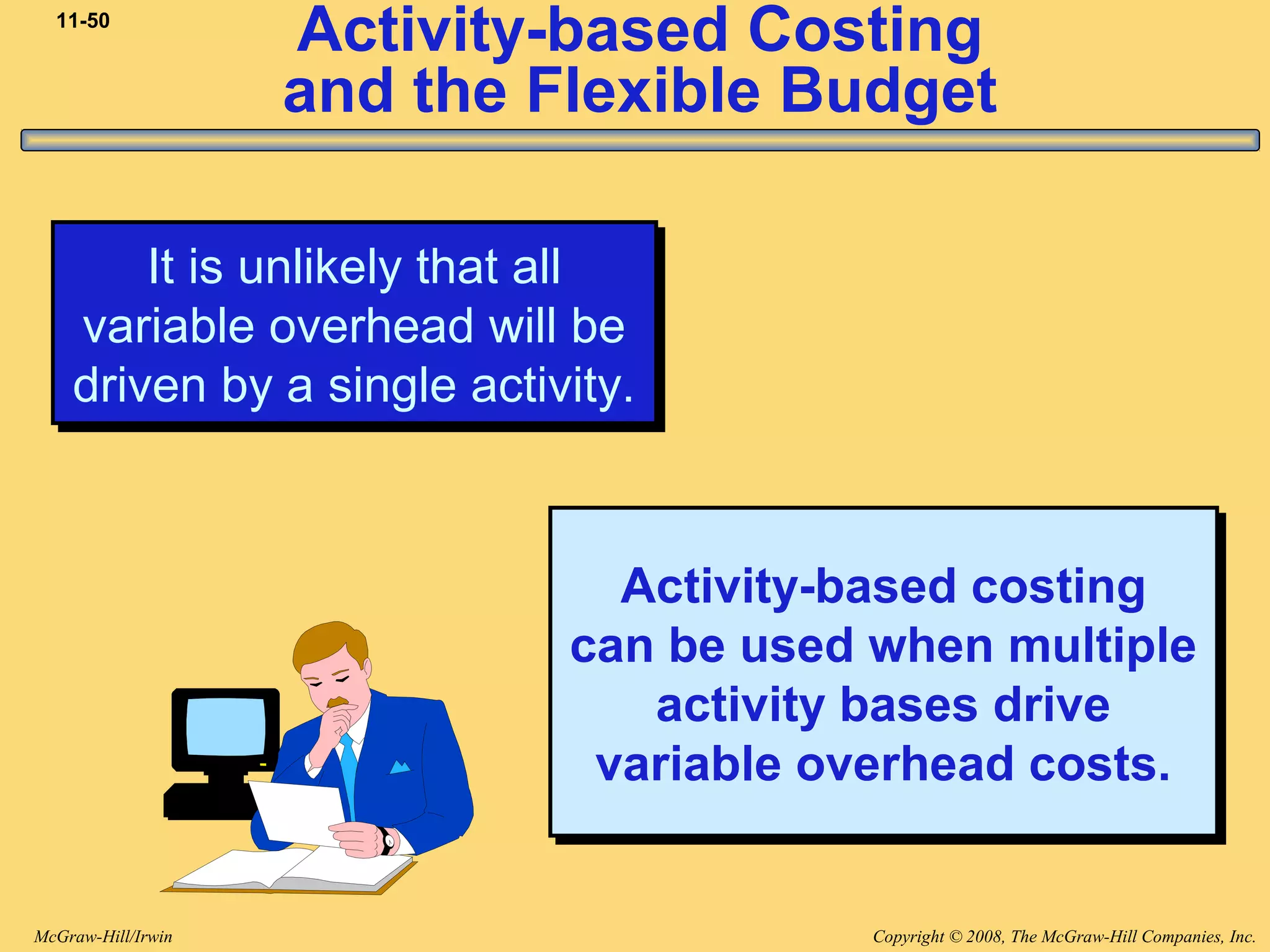
Activity-based Costing
and the Flexible Budget
It is unlikely that all
variable overhead will be
driven by a single activity.
It is unlikely that all
variable overhead will be
driven by a single activity.
Activity-based costing
can be used when multiple
activity bases drive
variable overhead costs.
Activity-based costing
can be used when multiple
activity bases drive
variable overhead costs.
Copyright © 2008, The McGraw-Hill Companies, Inc.McGraw-Hill/Irwin
11-51
Learning Objective 5
Compute theCompute the
predetermined overheadpredetermined overhead
rate and apply overheadrate and apply overhead
to products in a standardto products in a standard
cost system.cost system.
Copyright © 2008, The McGraw-Hill Companies, Inc.McGraw-Hill/Irwin
11-52
Overhead Rates and Overhead Analysis
Overhead from the
flexible budget for the
denominator level of activity
POHR =
Recall that overhead costs are assigned to
products and services using a predetermined
overhead rate (POHR):
Assigned Overhead = POHR × Standard Activity
Denominator level of activity
Copyright © 2008, The McGraw-Hill Companies, Inc.McGraw-Hill/Irwin
11-53
The predetermined overhead rate
can be broken down into fixed
and variable components.
The variable
component is useful
for preparing and analyzing
variable overhead
variances.
The fixed
component is useful
for preparing and analyzing
fixed overhead
variances.
Overhead Rates and Overhead Analysis
Copyright © 2008, The McGraw-Hill Companies, Inc.McGraw-Hill/Irwin
11-54
Normal versus Standard Cost Systems
In a normal cost
system, overhead is
applied to work in
process based on
the actual number
of hours worked
in the period.
In a standard cost
system, overhead is
applied to work in
process based on
the standard hours
allowed for the actual
output of the period.
Copyright © 2008, The McGraw-Hill Companies, Inc.McGraw-Hill/Irwin
11-55
Learning Objective 6
Compute and interpretCompute and interpret
the fixed overhead budgetthe fixed overhead budget
and volume variances.and volume variances.
Copyright © 2008, The McGraw-Hill Companies, Inc.McGraw-Hill/Irwin
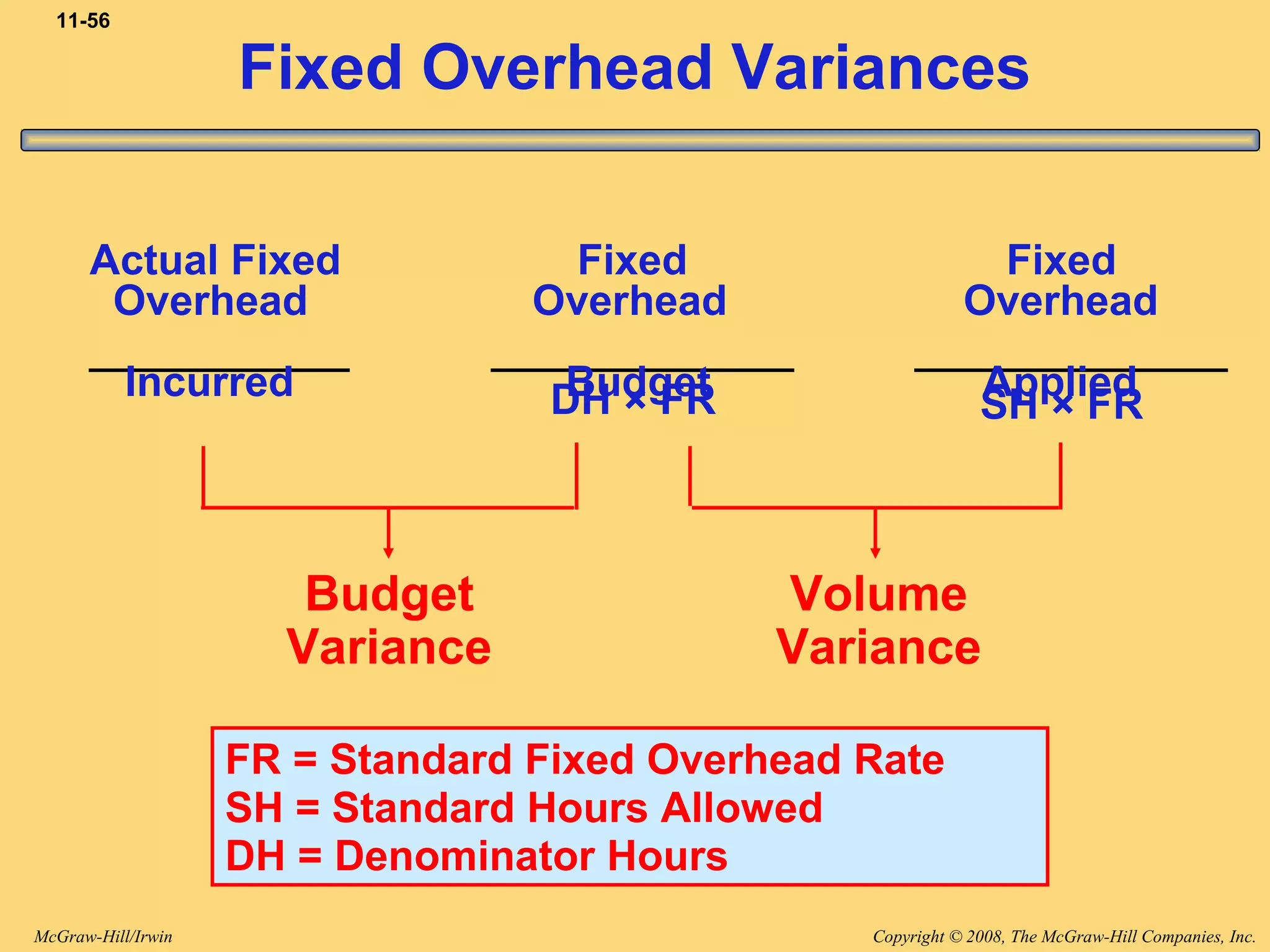
11-56
Budget
Variance
Volume
Variance
FR = Standard Fixed Overhead Rate
SH = Standard Hours Allowed
DH = Denominator Hours
SH × FR
Actual Fixed Fixed Fixed
Overhead Overhead Overhead
Incurred Budget Applied
Fixed Overhead Variances
DH × FR
Copyright © 2008, The McGraw-Hill Companies, Inc.McGraw-Hill/Irwin
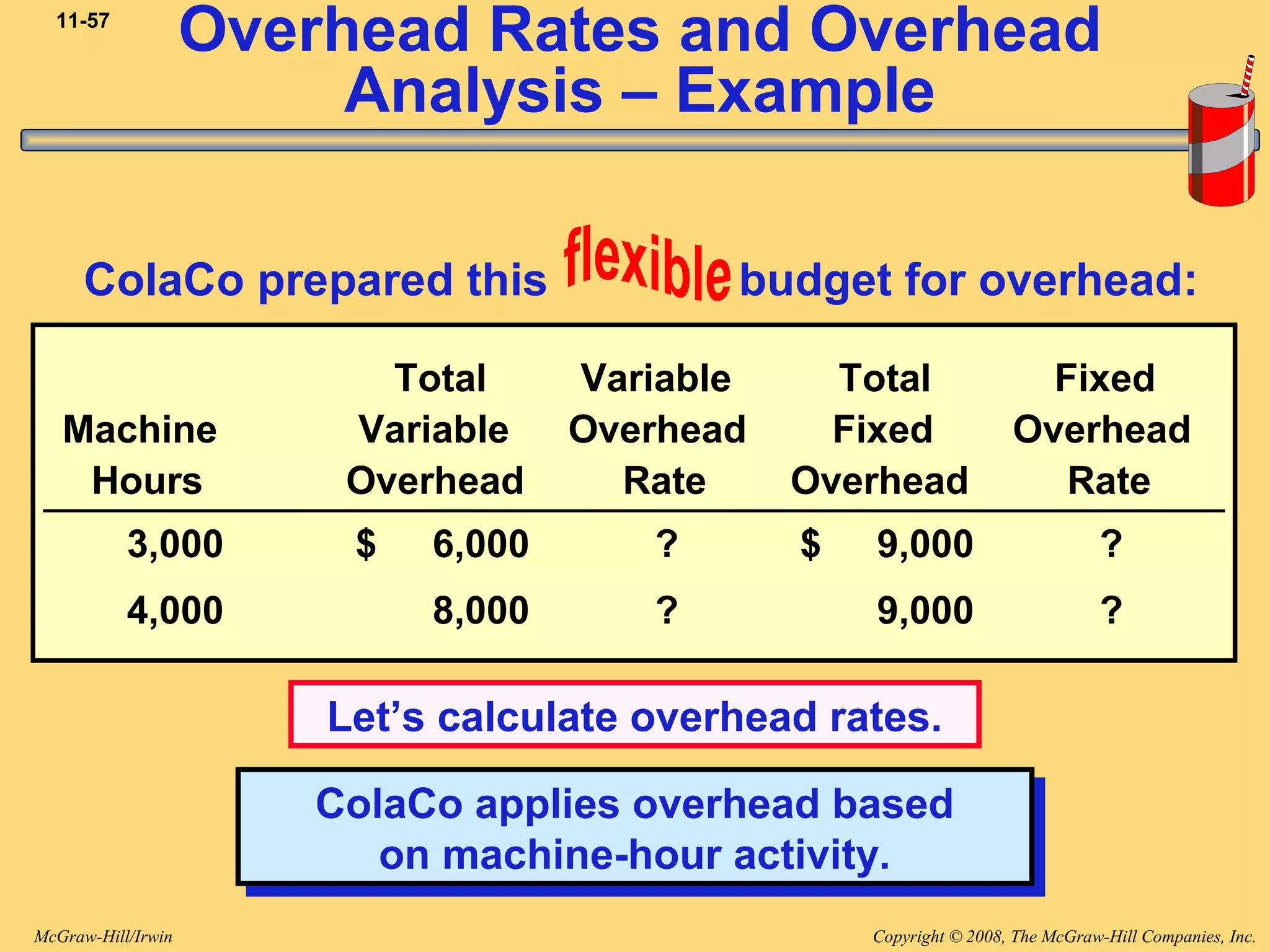
11-57
ColaCo prepared this budget for overhead:
Overhead Rates and Overhead
Analysis – Example
Total Variable Total Fixed
Machine Variable Overhead Fixed Overhead
Hours Overhead Rate Overhead Rate
3,000 6,000$ ? 9,000$ ?
4,000 8,000 ? 9,000 ?
ColaCo applies overhead based
on machine-hour activity.
ColaCo applies overhead based
on machine-hour activity.
Let’s calculate overhead rates.
Copyright © 2008, The McGraw-Hill Companies, Inc.McGraw-Hill/Irwin
11-58
Rate = Total Variable Overhead ÷ Machine Hours
This rate is constant at all levels of activity.
Total Variable Total Fixed
Machine Variable Overhead Fixed Overhead
Hours Overhead Rate Overhead Rate
3,000 6,000$ 2.00$ 9,000$ ?
4,000 8,000 2.00 9,000 ?
ColaCo prepared this budget for overhead:
Overhead Rates and Overhead
Analysis – Example
Copyright © 2008, The McGraw-Hill Companies, Inc.McGraw-Hill/Irwin
11-59
Total Variable Total Fixed
Machine Variable Overhead Fixed Overhead
Hours Overhead Rate Overhead Rate
3,000 6,000$ 2.00$ 9,000$ 3.00$
4,000 8,000 2.00 9,000 2.25
Rate = Total Fixed Overhead ÷ Machine Hours
This rate decreases when activity increases.
ColaCo prepared this budget for overhead:
Overhead Rates and Overhead
Analysis – Example
Copyright © 2008, The McGraw-Hill Companies, Inc.McGraw-Hill/Irwin
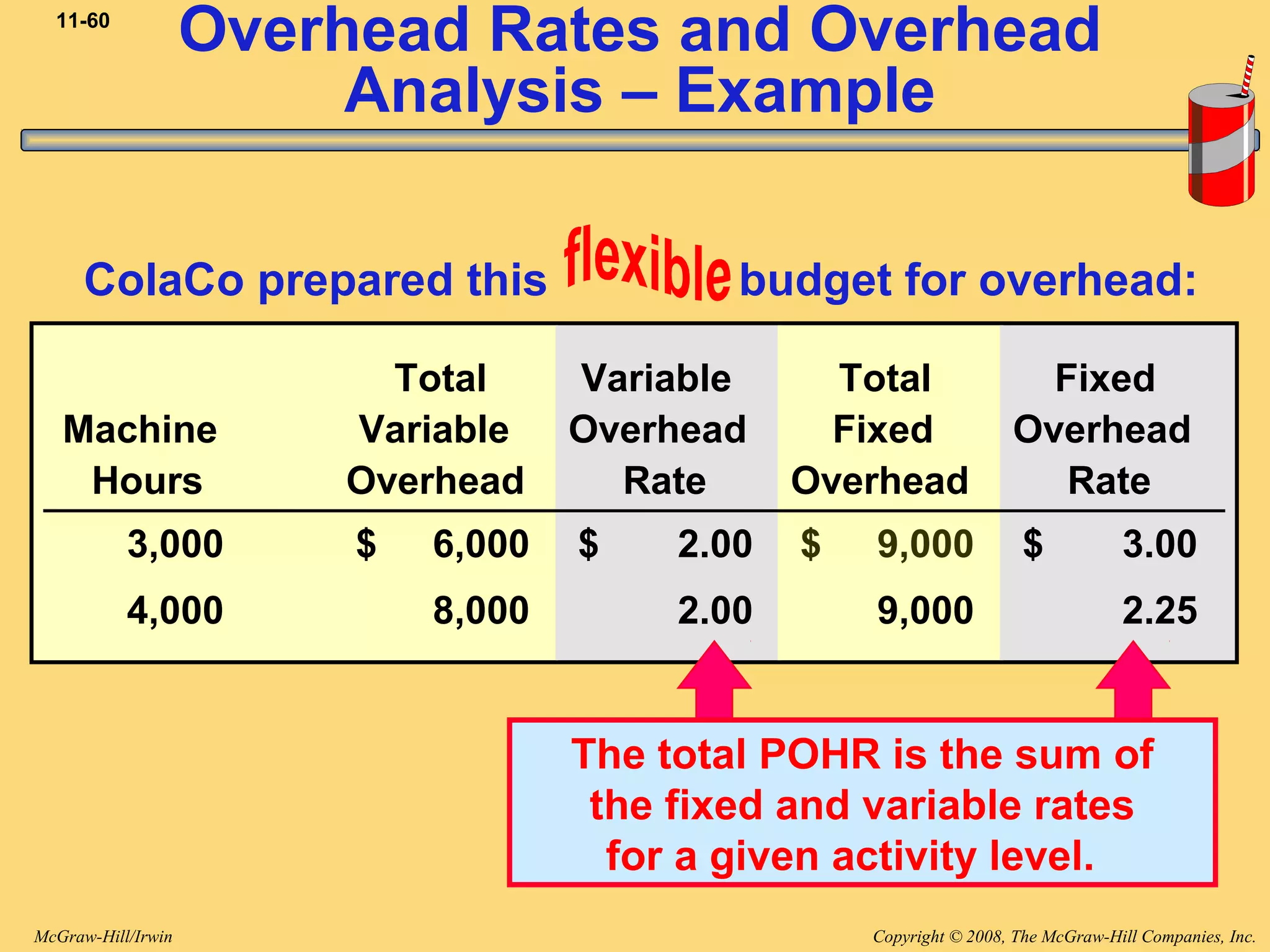
11-60
Total Variable Total Fixed
Machine Variable Overhead Fixed Overhead
Hours Overhead Rate Overhead Rate
3,000 6,000$ 2.00$ 9,000$ 3.00$
4,000 8,000 2.00 9,000 2.25
The total POHR is the sum of
the fixed and variable rates
for a given activity level.
ColaCo prepared this budget for overhead:
Overhead Rates and Overhead
Analysis – Example
Copyright © 2008, The McGraw-Hill Companies, Inc.McGraw-Hill/Irwin
11-61
ColaCo’s actual production required 3,200
standard machine hours. Actual fixed overhead
was $8,450. The predetermined overhead rate
is based on 3,000 machine hours.
Fixed Overhead Variances – Example
Copyright © 2008, The McGraw-Hill Companies, Inc.McGraw-Hill/Irwin
11-62
Overhead Variances
Now let’s turn
our attention
to calculating
fixed overhead
variances.
Copyright © 2008, The McGraw-Hill Companies, Inc.McGraw-Hill/Irwin
11-63
Fixed Overhead Variances – Example
Budget variance
$550 favorable
$8,450 $9,000
Actual Fixed Fixed Fixed
Overhead Overhead Overhead
Incurred Budget Applied
Copyright © 2008, The McGraw-Hill Companies, Inc.McGraw-Hill/Irwin
11-64
Fixed Overhead Variances –
A Closer Look
Budget Variance
Results from spending
more or less than
expected for fixed
overhead items.
Now, let’s use the
standard hours allowed
to compute the fixed
overhead volume
variance.
Now, let’s use the
standard hours allowed
to compute the fixed
overhead volume
variance.
Copyright © 2008, The McGraw-Hill Companies, Inc.McGraw-Hill/Irwin
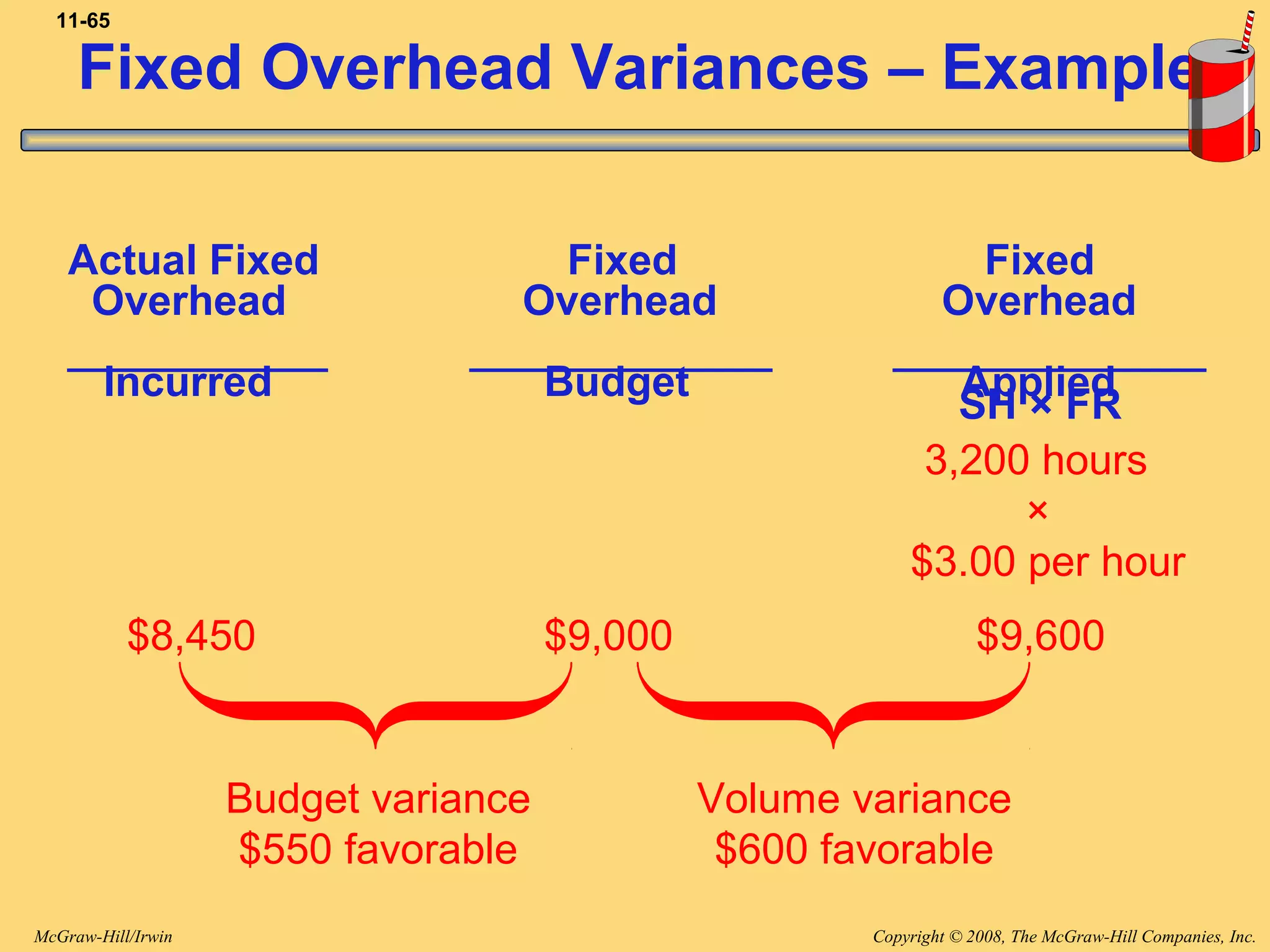
11-65
3,200 hours
×
$3.00 per hour
Budget variance
$550 favorable
Fixed Overhead Variances – Example
$8,450 $9,000 $9,600
Volume variance
$600 favorable
SH × FR
Actual Fixed Fixed Fixed
Overhead Overhead Overhead
Incurred Budget Applied
Copyright © 2008, The McGraw-Hill Companies, Inc.McGraw-Hill/Irwin
11-66
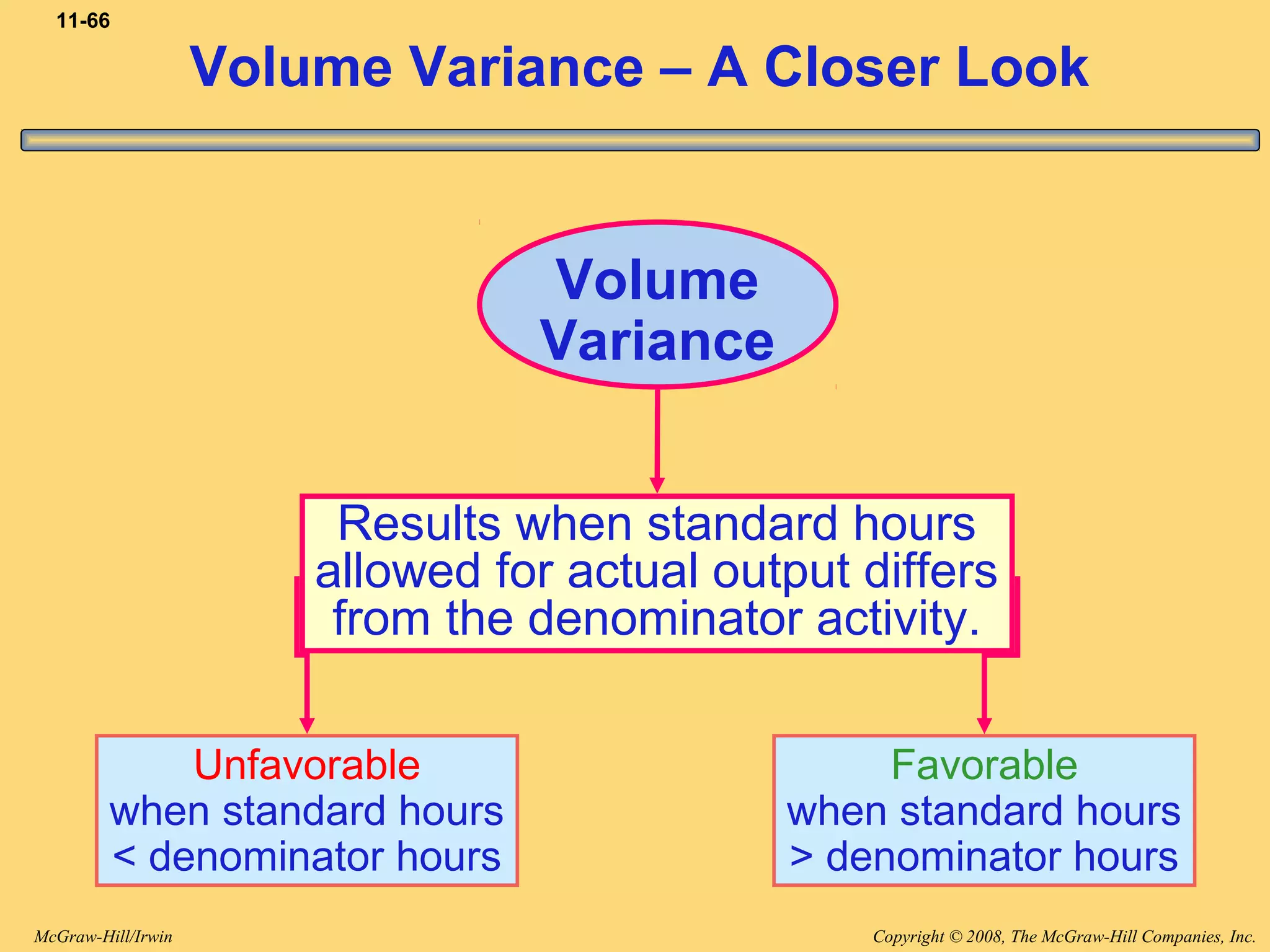
Volume Variance – A Closer Look
Volume
Variance
Results when standard hours
allowed for actual output differs
from the denominator activity.
Unfavorable
when standard hours
< denominator hours
Favorable
when standard hours
> denominator hours
Copyright © 2008, The McGraw-Hill Companies, Inc.McGraw-Hill/Irwin
11-67
Volume Variance – A Closer Look
Volume
Variance
Results when standard hours
allowed for actual output differs
from the denominator activity.
Unfavorable
when standard hours
< denominator hours
Favorable
when standard hours
> denominator hours
Does not measure over-
or under spending
It results from treating fixed
overhead as if it were a
variable cost.
Copyright © 2008, The McGraw-Hill Companies, Inc.McGraw-Hill/Irwin
11-68
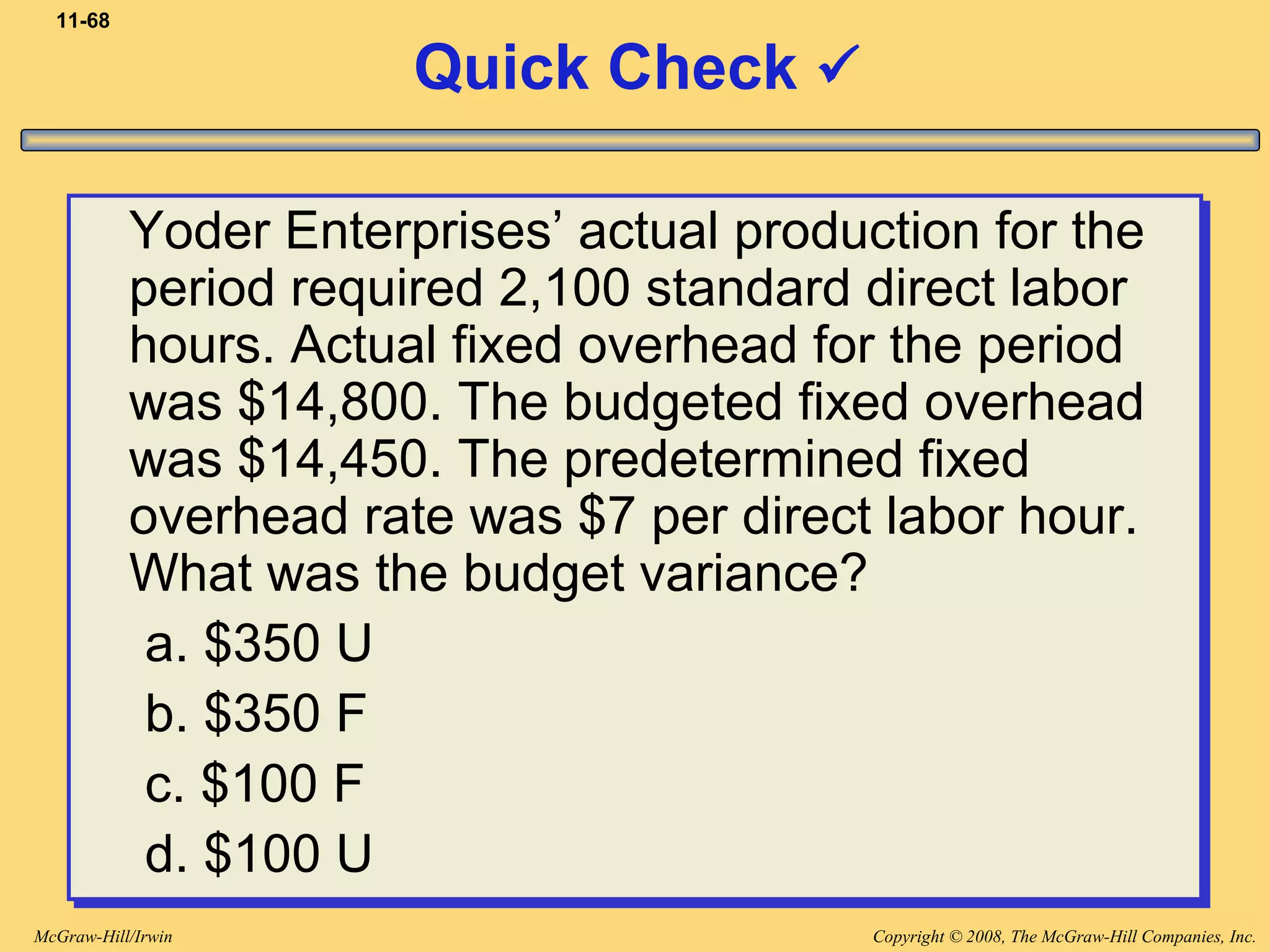
Quick Check 
Yoder Enterprises’ actual production for the
period required 2,100 standard direct labor
hours. Actual fixed overhead for the period
was $14,800. The budgeted fixed overhead
was $14,450. The predetermined fixed
overhead rate was $7 per direct labor hour.
What was the budget variance?
a. $350 U
b. $350 F
c. $100 F
d. $100 U
Yoder Enterprises’ actual production for the
period required 2,100 standard direct labor
hours. Actual fixed overhead for the period
was $14,800. The budgeted fixed overhead
was $14,450. The predetermined fixed
overhead rate was $7 per direct labor hour.
What was the budget variance?
a. $350 U
b. $350 F
c. $100 F
d. $100 U
Copyright © 2008, The McGraw-Hill Companies, Inc.McGraw-Hill/Irwin
11-69
Yoder Enterprises’ actual production for the
period required 2,100 standard direct labor
hours. Actual fixed overhead for the period
was $14,800. The budgeted fixed overhead
was $14,450. The predetermined fixed
overhead rate was $7 per direct labor hour.
What was the budget variance?
a. $350 U
b. $350 F
c. $100 F
d. $100 U
Yoder Enterprises’ actual production for the
period required 2,100 standard direct labor
hours. Actual fixed overhead for the period
was $14,800. The budgeted fixed overhead
was $14,450. The predetermined fixed
overhead rate was $7 per direct labor hour.
What was the budget variance?
a. $350 U
b. $350 F
c. $100 F
d. $100 U
Quick Check 
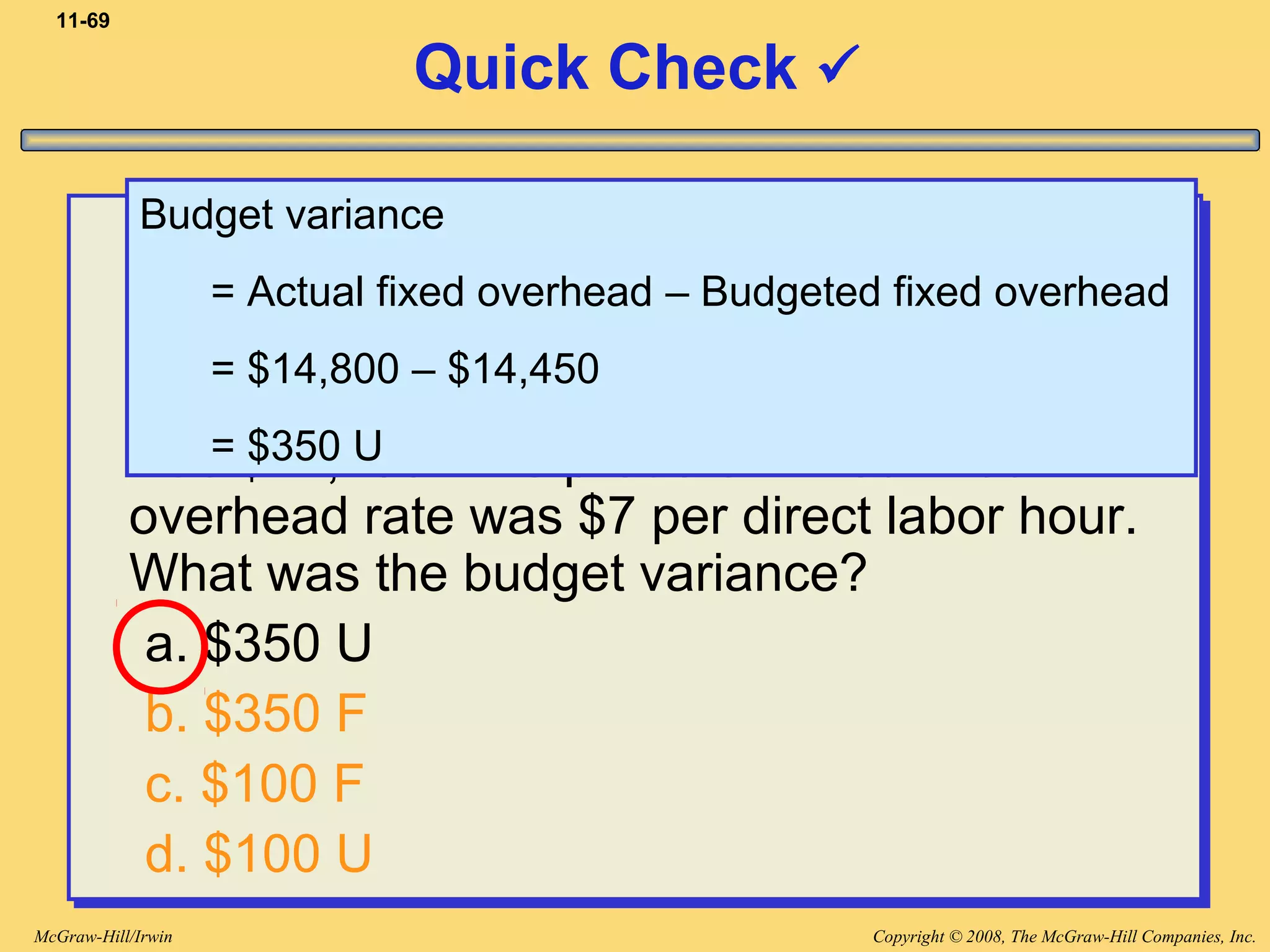
Budget variance
= Actual fixed overhead – Budgeted fixed overhead
= $14,800 – $14,450
= $350 U
Copyright © 2008, The McGraw-Hill Companies, Inc.McGraw-Hill/Irwin
11-70
Quick Check 
Yoder Enterprises’ actual production for the
period required 2,100 standard direct labor
hours. Actual fixed overhead for the period
was $14,800. The budgeted fixed overhead
was $14,450. The predetermined fixed
overhead rate was $7 per direct labor hour.
What was the volume variance?
a. $250 U
b. $250 F
c. $100 F
d. $100 U
Yoder Enterprises’ actual production for the
period required 2,100 standard direct labor
hours. Actual fixed overhead for the period
was $14,800. The budgeted fixed overhead
was $14,450. The predetermined fixed
overhead rate was $7 per direct labor hour.
What was the volume variance?
a. $250 U
b. $250 F
c. $100 F
d. $100 U
Copyright © 2008, The McGraw-Hill Companies, Inc.McGraw-Hill/Irwin
11-71
Yoder Enterprises’ actual production for the
period required 2,100 standard direct labor
hours. Actual fixed overhead for the period
was $14,800. The budgeted fixed overhead
was $14,450. The predetermined fixed
overhead rate was $7 per direct labor hour.
What was the volume variance?
a. $250 U
b. $250 F
c. $100 F
d. $100 U
Yoder Enterprises’ actual production for the
period required 2,100 standard direct labor
hours. Actual fixed overhead for the period
was $14,800. The budgeted fixed overhead
was $14,450. The predetermined fixed
overhead rate was $7 per direct labor hour.
What was the volume variance?
a. $250 U
b. $250 F
c. $100 F
d. $100 U
Quick Check 
Volume variance
= Budgeted fixed overhead – (SH × FR)
= $14,450 – (2,100 hours × $7 per hour)
= $14,450 – $14,700
= $250 F
Copyright © 2008, The McGraw-Hill Companies, Inc.McGraw-Hill/Irwin
11-72
2,100 hours
×
$7.00 per hour
Budget variance
$350 unfavorable
$14,800 $14,450 $14,700
Actual Fixed Fixed Fixed
Overhead Overhead Overhead
Incurred Budget Applied
Volume variance
$250 favorable
SH × FR
Quick Check Summary
Copyright © 2008, The McGraw-Hill Companies, Inc.McGraw-Hill/Irwin
11-73
Fixed Overhead Variances –
A Graphic Approach
Let’s look at a
graph showing
fixed overhead
variances. We will
use ColaCo’s
numbers from the
previous example.
Copyright © 2008, The McGraw-Hill Companies, Inc.McGraw-Hill/Irwin
11-74
Activity
Cost
3,000 Hours
Expected
Activity
$9,000 budgeted fixed OH
Fixed overhead
applied to products
Fixed Overhead Variances –
A Graphic Approach
Copyright © 2008, The McGraw-Hill Companies, Inc.McGraw-Hill/Irwin
11-75
$8,450 actual fixed OH
Activity
Cost
3,000 Hours
Expected
Activity
$9,000 budgeted fixed OH
Fixed overhead
applied to products
$8,450 actual fixed OH$550
Favorable
Budget
Variance
{
Fixed Overhead Variances –
A Graphic Approach
Copyright © 2008, The McGraw-Hill Companies, Inc.McGraw-Hill/Irwin
11-76
{
$8,450 actual fixed OH
3,200 machine hours × $3.00 fixed overhead rate
$600
Favorable
Volume
Variance
$9,600 applied fixed OH
3,200
Standard
Hours
Activity
Cost
3,000 Hours
Expected
Activity
$9,000 budgeted fixed OH
Fixed overhead
applied to products
$550
Favorable
Budget
Variance
{ $8,450 actual fixed OH
Fixed Overhead Variances –
A Graphic Approach
Copyright © 2008, The McGraw-Hill Companies, Inc.McGraw-Hill/Irwin
11-77
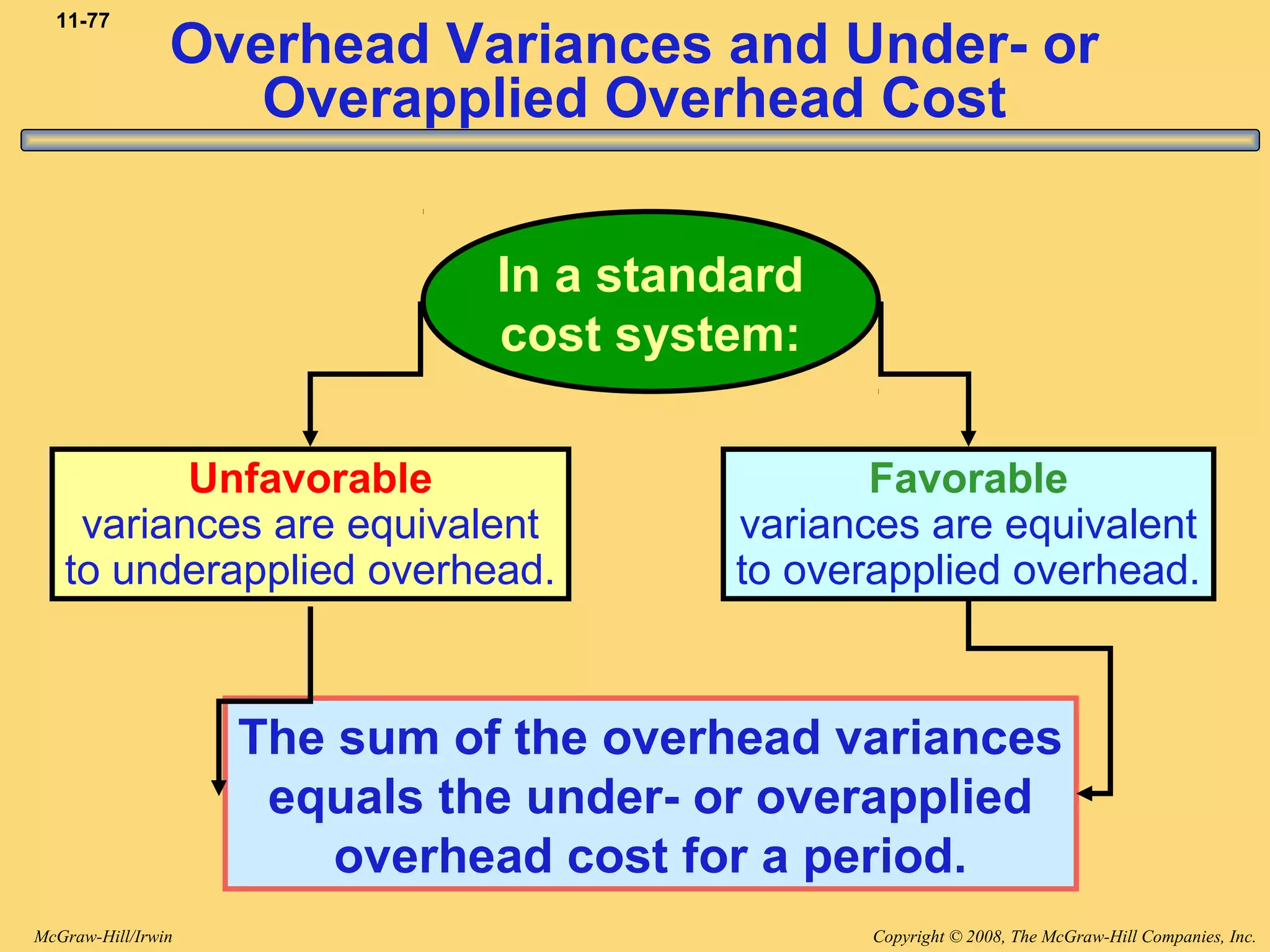
Overhead Variances and Under- or
Overapplied Overhead Cost
In a standard
cost system:
Unfavorable
variances are equivalent
to underapplied overhead.
Favorable
variances are equivalent
to overapplied overhead.
The sum of the overhead variances
equals the under- or overapplied
overhead cost for a period.
Copyright © 2008, The McGraw-Hill Companies, Inc.McGraw-Hill/Irwin
11-78
End of Chapter 11

Gnb 11 12e

  • 1.
    Copyright © 2008,The McGraw-Hill Companies, Inc.McGraw-Hill/Irwin Chapter 11 Flexible Budgets and Overhead Analysis
  • 2.
    Copyright © 2008,The McGraw-Hill Companies, Inc.McGraw-Hill/Irwin 11-2 Learning Objective 1 Prepare a flexiblePrepare a flexible budget and explain thebudget and explain the advantages of the flexibleadvantages of the flexible budget approach over thebudget approach over the static budget approach.static budget approach.
  • 3.
    Copyright © 2008,The McGraw-Hill Companies, Inc.McGraw-Hill/Irwin 11-3 Static Budgets and Performance Reports Static budgets are prepared for a single, planned level of activity. Performance evaluation is difficult when actual activity differs from the planned level of activity. Hmm! Comparing static budgets with actual costs is like comparing apples and oranges.
  • 4.
    Copyright © 2008,The McGraw-Hill Companies, Inc.McGraw-Hill/Irwin 11-4 Flexible Budgets Improve performance evaluation. May be prepared for any activity level in the relevant range. Show costs that should have been incurred at the actual level of activity, enabling “apples to apples” cost comparisons. Reveal variances related to cost control. Let’s look at CheeseCo.
  • 5.
    Copyright © 2008,The McGraw-Hill Companies, Inc.McGraw-Hill/Irwin 11-5 CheeseCo Static Actual Budget Results Variances Machine hours 10,000 Variable costs Indirect labor 40,000$ Indirect materials 30,000 Power 5,000 Fixed costs Depreciation 12,000 Insurance 2,000 Total overhead costs 89,000$ Static Budgets and Performance Reports
  • 6.
    Copyright © 2008,The McGraw-Hill Companies, Inc.McGraw-Hill/Irwin 11-6 CheeseCo Static Actual Budget Results Variances Machine hours 10,000 8,000 Variable costs Indirect labor 40,000$ 34,000$ Indirect materials 30,000 25,500 Power 5,000 3,800 Fixed costs Depreciation 12,000 12,000 Insurance 2,000 2,050 Total overhead costs 89,000$ 77,350$ Static Budgets and Performance Reports
  • 7.
    Copyright © 2008,The McGraw-Hill Companies, Inc.McGraw-Hill/Irwin 11-7 Static Actual Budget Results Variances Machine hours 10,000 8,000 2,000 U Variable costs Indirect labor 40,000$ 34,000$ $6,000 F Indirect materials 30,000 25,500 4,500 F Power 5,000 3,800 1,200 F Fixed costs Depreciation 12,000 12,000 0 Insurance 2,000 2,050 50 U Total overhead costs 89,000$ 77,350$ $11,650 F U = Unfavorable variance CheeseCo was unable to achieve the budgeted level of activity. CheeseCo Static Budgets and Performance Reports
  • 8.
    Copyright © 2008,The McGraw-Hill Companies, Inc.McGraw-Hill/Irwin 11-8 Static Actual Budget Results Variances Machine hours 10,000 8,000 2,000 U Variable costs Indirect labor 40,000$ 34,000$ $6,000 F Indirect materials 30,000 25,500 4,500 F Power 5,000 3,800 1,200 F Fixed costs Depreciation 12,000 12,000 0 Insurance 2,000 2,050 50 U Total overhead costs 89,000$ 77,350$ $11,650 F CheeseCo F = Favorable variance that occurs when actual costs are less than budgeted costs. Static Budgets and Performance Reports
  • 9.
    Copyright © 2008,The McGraw-Hill Companies, Inc.McGraw-Hill/Irwin 11-9 Static Actual Budget Results Variances Machine hours 10,000 8,000 2,000 U Variable costs Indirect labor 40,000$ 34,000$ $6,000 F Indirect materials 30,000 25,500 4,500 F Power 5,000 3,800 1,200 F Fixed costs Depreciation 12,000 12,000 0 Insurance 2,000 2,050 50 U Total overhead costs 89,000$ 77,350$ $11,650 F Since cost variances are favorable, have we done a good job controlling costs? CheeseCo Static Budgets and Performance Reports
  • 10.
    Copyright © 2008,The McGraw-Hill Companies, Inc.McGraw-Hill/Irwin 11-10 I don’t think I can answer the question using a static budget. Actual activity is below budgeted activity. So, shouldn’t variable costs be lower if actual activity is lower? Static Budgets and Performance Reports
  • 11.
    Copyright © 2008,The McGraw-Hill Companies, Inc.McGraw-Hill/Irwin 11-11 The relevant question is . . . “How much of the favorable cost variance is due to lower activity, and how much is due to good cost control?” To answer the question, we must the budget to the actual level of activity. The relevant question is . . . “How much of the favorable cost variance is due to lower activity, and how much is due to good cost control?” To answer the question, we must the budget to the actual level of activity. Static Budgets and Performance Reports
  • 12.
    Copyright © 2008,The McGraw-Hill Companies, Inc.McGraw-Hill/Irwin 11-12 Preparing a Flexible Budget To a budget we need to know that:  Total variable costs change in direct proportion to changes in activity.  Total fixed costs remain unchanged within the relevant range. Fixed Variable
  • 13.
    Copyright © 2008,The McGraw-Hill Companies, Inc.McGraw-Hill/Irwin 11-13 Preparing a Flexible Budget Let’s prepare budgets for CheeseCo.
  • 14.
    Copyright © 2008,The McGraw-Hill Companies, Inc.McGraw-Hill/Irwin 11-14 Cost Total Formula Fixed 8,000 10,000 12,000 per Hour Cost Hours Hours Hours Machine hours 8,000 10,000 12,000 Variable costs Indirect labor 4.00$ Indirect material 3.00 Power 0.50 Total variable cost 7.50$ Fixed costs Depreciation 12,000$ Insurance 2,000 Total fixed cost Total overhead costs Flexible Budgets Preparing a Flexible Budget Fixed costs are expressed as a total amount. Variable costs are expressed as a constant amount per hour. $40,000 ÷ 10,000 hours is $4.00 per hour. CheeseCo
  • 15.
    Copyright © 2008,The McGraw-Hill Companies, Inc.McGraw-Hill/Irwin 11-15 Cost Total Formula Fixed 8,000 10,000 12,000 per Hour Cost Hours Hours Hours Machine hours 8,000 10,000 12,000 Variable costs Indirect labor 4.00$ 32,000$ Indirect material 3.00 24,000 Power 0.50 4,000 Total variable cost 7.50$ 60,000$ Fixed costs Depreciation 12,000$ Insurance 2,000 Total fixed cost Total overhead costs Flexible Budgets Preparing a Flexible Budget $4.00 per hour × 8,000 hours = $32,000 CheeseCo
  • 16.
    Copyright © 2008,The McGraw-Hill Companies, Inc.McGraw-Hill/Irwin 11-16 Preparing a Flexible Budget CheeseCo Cost Total Formula Fixed 8,000 10,000 12,000 per Hour Cost Hours Hours Hours Machine hours 8,000 10,000 12,000 Variable costs Indirect labor 4.00$ 32,000$ Indirect material 3.00 24,000 Power 0.50 4,000 Total variable cost 7.50$ 60,000$ Fixed costs Depreciation 12,000$ 12,000$ Insurance 2,000 2,000 Total fixed cost 14,000$ Total overhead costs 74,000$ Flexible Budgets
  • 17.
    Copyright © 2008,The McGraw-Hill Companies, Inc.McGraw-Hill/Irwin 11-17 Cost Total Formula Fixed 8,000 10,000 12,000 per Hour Cost Hours Hours Hours Machine hours 8,000 10,000 12,000 Variable costs Indirect labor 4.00$ 32,000$ 40,000$ Indirect material 3.00 24,000 30,000 Power 0.50 4,000 5,000 Total variable cost 7.50$ 60,000$ 75,000$ Fixed costs Depreciation 12,000$ 12,000$ 12,000$ Insurance 2,000 2,000 2,000 Total fixed cost 14,000$ 14,000$ Total overhead costs 74,000$ 89,000$ ? Flexible Budgets Preparing a Flexible Budget Total fixed costs do not change in the relevant range. CheeseCo
  • 18.
    Copyright © 2008,The McGraw-Hill Companies, Inc.McGraw-Hill/Irwin 11-18 Quick Check  What should be the total overhead costs for the Flexible Budget at 12,000 hours? a. $92,500. b. $89,000. c. $106,800. d. $104,000. What should be the total overhead costs for the Flexible Budget at 12,000 hours? a. $92,500. b. $89,000. c. $106,800. d. $104,000.
  • 19.
    Copyright © 2008,The McGraw-Hill Companies, Inc.McGraw-Hill/Irwin 11-19 What should be the total overhead costs for the Flexible Budget at 12,000 hours? a. $92,500. b. $89,000. c. $106,800. d. $104,000. What should be the total overhead costs for the Flexible Budget at 12,000 hours? a. $92,500. b. $89,000. c. $106,800. d. $104,000. Quick Check  Total overhead cost = $14,000 + $7.50 per hour × 12,000 hours = $14,000 + $90,000 = $104,000
  • 20.
    Copyright © 2008,The McGraw-Hill Companies, Inc.McGraw-Hill/Irwin 11-20 Preparing a Flexible Budget Cost Total Formula Fixed 8,000 10,000 12,000 per Hour Cost Hours Hours Hours Machine hours 8,000 10,000 12,000 Variable costs Indirect labor 4.00$ 32,000$ 40,000$ 48,000$ Indirect material 3.00 24,000 30,000 36,000 Power 0.50 4,000 5,000 6,000 Total variable cost 7.50$ 60,000$ 75,000$ 90,000$ Fixed costs Depreciation 12,000$ 12,000$ 12,000$ 12,000$ Insurance 2,000 2,000 2,000 2,000 Total fixed cost 14,000$ 14,000$ 14,000$ Total overhead costs 74,000$ 89,000$ 104,000$ Flexible Budgets
  • 21.
    Copyright © 2008,The McGraw-Hill Companies, Inc.McGraw-Hill/Irwin 11-21 Learning Objective 2 Prepare a performancePrepare a performance report for both variablereport for both variable and fixed overhead costsand fixed overhead costs using the flexible budgetusing the flexible budget approach.approach.
  • 22.
    Copyright © 2008,The McGraw-Hill Companies, Inc.McGraw-Hill/Irwin 11-22 Let’s prepare a budget performance report for CheeseCo. Flexible Budget Performance Report
  • 23.
    Copyright © 2008,The McGraw-Hill Companies, Inc.McGraw-Hill/Irwin 11-23 Cost Total Formula Fixed Flexible Actual per Hour Cost Budget Results Variances Machine hours 8,000 8,000 0 Variable costs Indirect labor 4.00$ 34,000$ Indirect material 3.00 25,500 Power 0.50 3,800 Total variable cost 7.50$ 63,300$ Fixed costs Depreciation 12,000$ 12,000$ Insurance 2,000 2,050 Total fixed cost 14,050$ Total overhead costs 77,350$ CheeseCo Flexible budget is prepared for the same activity level (8,000 hours) as actually achieved. Flexible Budget Performance Report
  • 24.
    Copyright © 2008,The McGraw-Hill Companies, Inc.McGraw-Hill/Irwin 11-24 Quick Check  What is the variance for indirect labor when the flexible budget for 8,000 hours is compared to the actual results? a. $2,000 U b. $2,000 F c. $6,000 U d. $6,000 F What is the variance for indirect labor when the flexible budget for 8,000 hours is compared to the actual results? a. $2,000 U b. $2,000 F c. $6,000 U d. $6,000 F
  • 25.
    Copyright © 2008,The McGraw-Hill Companies, Inc.McGraw-Hill/Irwin 11-25 What is the variance for indirect labor when the flexible budget for 8,000 hours is compared to the actual results? a. $2,000 U b. $2,000 F c. $6,000 U d. $6,000 F What is the variance for indirect labor when the flexible budget for 8,000 hours is compared to the actual results? a. $2,000 U b. $2,000 F c. $6,000 U d. $6,000 F Quick Check 
  • 26.
    Copyright © 2008,The McGraw-Hill Companies, Inc.McGraw-Hill/Irwin 11-26 Cost Total Formula Fixed Flexible Actual per Hour Cost Budget Results Variances Machine hours 8,000 8,000 0 Variable costs Indirect labor 4.00$ 32,000$ 34,000$ $ 2,000 U Indirect material 3.00 25,500 Power 0.50 3,800 Total variable cost 7.50$ 63,300$ Fixed costs Depreciation 12,000$ 12,000$ Insurance 2,000 2,050 Total fixed cost 14,050$ Total overhead costs 77,350$ CheeseCo Flexible Budget Performance Report
  • 27.
    Copyright © 2008,The McGraw-Hill Companies, Inc.McGraw-Hill/Irwin 11-27 Quick Check  What is the variance for indirect material when the flexible budget for 8,000 hours is compared to the actual results? a. $1,500 U b. $1,500 F c. $4,500 U d. $4,500 F What is the variance for indirect material when the flexible budget for 8,000 hours is compared to the actual results? a. $1,500 U b. $1,500 F c. $4,500 U d. $4,500 F
  • 28.
    Copyright © 2008,The McGraw-Hill Companies, Inc.McGraw-Hill/Irwin 11-28 What is the variance for indirect material when the flexible budget for 8,000 hours is compared to the actual results? a. $1,500 U b. $1,500 F c. $4,500 U d. $4,500 F What is the variance for indirect material when the flexible budget for 8,000 hours is compared to the actual results? a. $1,500 U b. $1,500 F c. $4,500 U d. $4,500 F Quick Check 
  • 29.
    Copyright © 2008,The McGraw-Hill Companies, Inc.McGraw-Hill/Irwin 11-29 Cost Total Formula Fixed Flexible Actual per Hour Cost Budget Results Variances Machine hours 8,000 8,000 0 Variable costs Indirect labor 4.00$ 32,000$ 34,000$ $ 2,000 U Indirect material 3.00 24,000 25,500 1,500 U Power 0.50 4,000 3,800 200 F Total variable cost 7.50$ 60,000$ 63,300$ $ 3,300 U Fixed costs Depreciation 12,000$ 12,000$ 12,000$ $ 0 Insurance 2,000 2,000 2,050 50 U Total fixed cost 14,000$ 14,050$ 50 U Total overhead costs 74,000$ 77,350$ $ 3,350 U CheeseCo Flexible Budget Performance Report
  • 30.
    Copyright © 2008,The McGraw-Hill Companies, Inc.McGraw-Hill/Irwin 11-30 Remember the question: “How much of the total variance is due to loweractivity and how much is due to cost control?” Flexible Budget Performance Report
  • 31.
    Copyright © 2008,The McGraw-Hill Companies, Inc.McGraw-Hill/Irwin 11-31 Static Actual Budget Results Variances Machine hours 10,000 8,000 2,000 U Variable costs Indirect labor 40,000$ 34,000$ $6,000 F Indirect materials 30,000 25,500 4,500 F Power 5,000 3,800 1,200 F Fixed costs Depreciation 12,000 12,000 0 Insurance 2,000 2,050 50 U Total overhead costs 89,000$ 77,350$ $11,650 F Static Budgets and Performance How much of the $11,650 favorable variance is due to lower activity and how much is due to cost control?
  • 32.
    Copyright © 2008,The McGraw-Hill Companies, Inc.McGraw-Hill/Irwin 11-32 Difference between original static budget and actual overhead = $11,650 F. Overhead Variance Analysis Static Actual Overhead Overhead Budget at at 10,000 Hours 8,000 Hours 89,000$ 77,350$ Let’s place the flexible budget for 8,000 hours here. Flexible Budget Performance Report
  • 33.
    Copyright © 2008,The McGraw-Hill Companies, Inc.McGraw-Hill/Irwin 11-33 Overhead Variance Analysis This $15,000F variance is due to lower activity. Activity This $3,350U variance is due to poor cost control. Cost control Static Flexible Actual Overhead Overhead Overhead Budget at Budget at at 10,000 Hours 8,000 Hours 8,000 Hours 89,000$ 74,000$ 77,350$ Flexible Budget Performance Report
  • 34.
    Copyright © 2008,The McGraw-Hill Companies, Inc.McGraw-Hill/Irwin 11-34 The Measure of Activity– A Critical Choice Three important factors in selecting an activity base for an overhead flexible budget Activity base and variable overhead should be causally related. Activity base and variable overhead should be causally related. Activity base should not be expressed in dollars or other currency. Activity base should not be expressed in dollars or other currency. Activity base should be simple and easily understood. Activity base should be simple and easily understood.
  • 35.
    Copyright © 2008,The McGraw-Hill Companies, Inc.McGraw-Hill/Irwin 11-35 Variable Overhead Variances – A Closer Look If flexible budget is based on actual hours If flexible budget is based on standard hours Only a spending variance can be computed. Both spending and efficiency variances can be computed.
  • 36.
    Copyright © 2008,The McGraw-Hill Companies, Inc.McGraw-Hill/Irwin 11-36 ColaCo’s actual production for the period required 3,200 standard machine hours. Actual variable overhead incurred for the period was $6,740. Actual machine hours worked were 3,300. The standard variable overhead cost per machine hour is $2.00. Compute the variable overhead spending variance first using actual hours. Then use standard hours allowed to calculate the variable overhead efficiency variance. Variable Overhead Variances – Example
  • 37.
    Copyright © 2008,The McGraw-Hill Companies, Inc.McGraw-Hill/Irwin 11-37 Learning Objective 3 Use a flexible budgetUse a flexible budget to prepare a variableto prepare a variable overhead performanceoverhead performance report containing onlyreport containing only a spending variance.a spending variance.
  • 38.
    Copyright © 2008,The McGraw-Hill Companies, Inc.McGraw-Hill/Irwin 11-38 Actual Flexible Budget Variable for Variable Overhead Overhead at Incurred Actual Hours AH × SRAH × AR Spending Variance Spending variance = AH(AR – SR) Variable Overhead Variances AH = Actual hours AR = Actual variable overhead rate SR = Standard variable overhead rate
  • 39.
    Copyright © 2008,The McGraw-Hill Companies, Inc.McGraw-Hill/Irwin 11-39 Actual Flexible Budget Variable for Variable Overhead Overhead at Incurred Actual Hours 3,300 hours × $2.00 per hour = $6,600$6,740 Spending Variance = $140 unfavorable Variable Overhead Variances – Example
  • 40.
    Copyright © 2008,The McGraw-Hill Companies, Inc.McGraw-Hill/Irwin 11-40 Variable Overhead Variances – A Closer Look Spending Variance Results from paying more or less than expected for overhead items and from excessive usage of overhead items. Now, let’s use the standard hours allowed, along with the actual hours, to compute the efficiency variance. Now, let’s use the standard hours allowed, along with the actual hours, to compute the efficiency variance.
  • 41.
    Copyright © 2008,The McGraw-Hill Companies, Inc.McGraw-Hill/Irwin 11-41 Learning Objective 4 Use a flexible budgetUse a flexible budget to prepare a variableto prepare a variable overhead performanceoverhead performance report containing both areport containing both a spending and an efficiencyspending and an efficiency variance.variance.
  • 42.
    Copyright © 2008,The McGraw-Hill Companies, Inc.McGraw-Hill/Irwin 11-42 AH × SRAH × AR Spending variance = AH(AR - SR) Efficiency variance = SR(AH - SH) SH × SR Spending Variance Efficiency Variance Actual Flexible Budget Flexible Budget Variable for Variable for Variable Overhead Overhead at Overhead at Incurred Actual Hours Standard Hours Variable Overhead Variances
  • 43.
    Copyright © 2008,The McGraw-Hill Companies, Inc.McGraw-Hill/Irwin 11-43 3,300 hours 3,200 hours × × $2.00 per hour $2.00 per hour Variable Overhead Variances – Example $6,740 $6,600 $6,400 Spending variance $140 unfavorable Efficiency variance $200 unfavorable $340 unfavorable flexible budget total variance$340 unfavorable flexible budget total variance Actual Flexible Budget Flexible Budget Variable for Variable for Variable Overhead Overhead at Overhead at Incurred Actual Hours Standard Hours
  • 44.
    Copyright © 2008,The McGraw-Hill Companies, Inc.McGraw-Hill/Irwin 11-44 Efficiency Variance Controlled by managing the overhead cost driver. Variable Overhead Variances – A Closer Look
  • 45.
    Copyright © 2008,The McGraw-Hill Companies, Inc.McGraw-Hill/Irwin 11-45 Quick Check  Yoder Enterprises’ actual production for the period required 2,100 standard direct labor hours. Actual variable overhead for the period was $10,950. Actual direct labor hours worked were 2,050. The predetermined variable overhead rate is $5 per direct labor hour. What was the spending variance? a. $450 U b. $450 F c. $700 F d. $700 U Yoder Enterprises’ actual production for the period required 2,100 standard direct labor hours. Actual variable overhead for the period was $10,950. Actual direct labor hours worked were 2,050. The predetermined variable overhead rate is $5 per direct labor hour. What was the spending variance? a. $450 U b. $450 F c. $700 F d. $700 U
  • 46.
    Copyright © 2008,The McGraw-Hill Companies, Inc.McGraw-Hill/Irwin 11-46 Yoder Enterprises’ actual production for the period required 2,100 standard direct labor hours. Actual variable overhead for the period was $10,950. Actual direct labor hours worked were 2,050. The predetermined variable overhead rate is $5 per direct labor hour. What was the spending variance? a. $450 U b. $450 F c. $700 F d. $700 U Yoder Enterprises’ actual production for the period required 2,100 standard direct labor hours. Actual variable overhead for the period was $10,950. Actual direct labor hours worked were 2,050. The predetermined variable overhead rate is $5 per direct labor hour. What was the spending variance? a. $450 U b. $450 F c. $700 F d. $700 U Quick Check  Spending variance = AH (AR - SR) = Actual variable overhead incurred – (AH × SR) = $10,950 – (2,050 hours × $5 per hour) = $10,950 – $10,250 = $700 U
  • 47.
    Copyright © 2008,The McGraw-Hill Companies, Inc.McGraw-Hill/Irwin 11-47 Quick Check  Yoder Enterprises’ actual production for the period required 2,100 standard direct labor hours. Actual variable overhead for the period was $10,950. Actual direct labor hours worked were 2,050. The predetermined variable overhead rate is $5 per direct labor hour. What was the efficiency variance? a. $450 U b. $450 F c. $250 F d. $250 U Yoder Enterprises’ actual production for the period required 2,100 standard direct labor hours. Actual variable overhead for the period was $10,950. Actual direct labor hours worked were 2,050. The predetermined variable overhead rate is $5 per direct labor hour. What was the efficiency variance? a. $450 U b. $450 F c. $250 F d. $250 U
  • 48.
    Copyright © 2008,The McGraw-Hill Companies, Inc.McGraw-Hill/Irwin 11-48 Yoder Enterprises’ actual production for the period required 2,100 standard direct labor hours. Actual variable overhead for the period was $10,950. Actual direct labor hours worked were 2,050. The predetermined variable overhead rate is $5 per direct labor hour. What was the efficiency variance? a. $450 U b. $450 F c. $250 F d. $250 U Yoder Enterprises’ actual production for the period required 2,100 standard direct labor hours. Actual variable overhead for the period was $10,950. Actual direct labor hours worked were 2,050. The predetermined variable overhead rate is $5 per direct labor hour. What was the efficiency variance? a. $450 U b. $450 F c. $250 F d. $250 U Quick Check  Efficiency variance = SR (AH – SH) = $5 per hour (2,050 hours – 2,100 hours) = $250 F
  • 49.
    Copyright © 2008,The McGraw-Hill Companies, Inc.McGraw-Hill/Irwin 11-49 2,050 hours 2,100 hours × × $5 per hour $5 per hour Quick Check Summary Actual Flexible Budget Flexible Budget Variable for Variable for Variable Overhead Overhead at Overhead at Incurred Actual Hours Standard Hours $10,950 $10,250 $10,500 Spending variance $700 unfavorable Efficiency variance $250 favorable $450 unfavorable flexible budget total variance$450 unfavorable flexible budget total variance
  • 50.
    Copyright © 2008,The McGraw-Hill Companies, Inc.McGraw-Hill/Irwin 11-50 Activity-based Costing and the Flexible Budget It is unlikely that all variable overhead will be driven by a single activity. It is unlikely that all variable overhead will be driven by a single activity. Activity-based costing can be used when multiple activity bases drive variable overhead costs. Activity-based costing can be used when multiple activity bases drive variable overhead costs.
  • 51.
    Copyright © 2008,The McGraw-Hill Companies, Inc.McGraw-Hill/Irwin 11-51 Learning Objective 5 Compute theCompute the predetermined overheadpredetermined overhead rate and apply overheadrate and apply overhead to products in a standardto products in a standard cost system.cost system.
  • 52.
    Copyright © 2008,The McGraw-Hill Companies, Inc.McGraw-Hill/Irwin 11-52 Overhead Rates and Overhead Analysis Overhead from the flexible budget for the denominator level of activity POHR = Recall that overhead costs are assigned to products and services using a predetermined overhead rate (POHR): Assigned Overhead = POHR × Standard Activity Denominator level of activity
  • 53.
    Copyright © 2008,The McGraw-Hill Companies, Inc.McGraw-Hill/Irwin 11-53 The predetermined overhead rate can be broken down into fixed and variable components. The variable component is useful for preparing and analyzing variable overhead variances. The fixed component is useful for preparing and analyzing fixed overhead variances. Overhead Rates and Overhead Analysis
  • 54.
    Copyright © 2008,The McGraw-Hill Companies, Inc.McGraw-Hill/Irwin 11-54 Normal versus Standard Cost Systems In a normal cost system, overhead is applied to work in process based on the actual number of hours worked in the period. In a standard cost system, overhead is applied to work in process based on the standard hours allowed for the actual output of the period.
  • 55.
    Copyright © 2008,The McGraw-Hill Companies, Inc.McGraw-Hill/Irwin 11-55 Learning Objective 6 Compute and interpretCompute and interpret the fixed overhead budgetthe fixed overhead budget and volume variances.and volume variances.
  • 56.
    Copyright © 2008,The McGraw-Hill Companies, Inc.McGraw-Hill/Irwin 11-56 Budget Variance Volume Variance FR = Standard Fixed Overhead Rate SH = Standard Hours Allowed DH = Denominator Hours SH × FR Actual Fixed Fixed Fixed Overhead Overhead Overhead Incurred Budget Applied Fixed Overhead Variances DH × FR
  • 57.
    Copyright © 2008,The McGraw-Hill Companies, Inc.McGraw-Hill/Irwin 11-57 ColaCo prepared this budget for overhead: Overhead Rates and Overhead Analysis – Example Total Variable Total Fixed Machine Variable Overhead Fixed Overhead Hours Overhead Rate Overhead Rate 3,000 6,000$ ? 9,000$ ? 4,000 8,000 ? 9,000 ? ColaCo applies overhead based on machine-hour activity. ColaCo applies overhead based on machine-hour activity. Let’s calculate overhead rates.
  • 58.
    Copyright © 2008,The McGraw-Hill Companies, Inc.McGraw-Hill/Irwin 11-58 Rate = Total Variable Overhead ÷ Machine Hours This rate is constant at all levels of activity. Total Variable Total Fixed Machine Variable Overhead Fixed Overhead Hours Overhead Rate Overhead Rate 3,000 6,000$ 2.00$ 9,000$ ? 4,000 8,000 2.00 9,000 ? ColaCo prepared this budget for overhead: Overhead Rates and Overhead Analysis – Example
  • 59.
    Copyright © 2008,The McGraw-Hill Companies, Inc.McGraw-Hill/Irwin 11-59 Total Variable Total Fixed Machine Variable Overhead Fixed Overhead Hours Overhead Rate Overhead Rate 3,000 6,000$ 2.00$ 9,000$ 3.00$ 4,000 8,000 2.00 9,000 2.25 Rate = Total Fixed Overhead ÷ Machine Hours This rate decreases when activity increases. ColaCo prepared this budget for overhead: Overhead Rates and Overhead Analysis – Example
  • 60.
    Copyright © 2008,The McGraw-Hill Companies, Inc.McGraw-Hill/Irwin 11-60 Total Variable Total Fixed Machine Variable Overhead Fixed Overhead Hours Overhead Rate Overhead Rate 3,000 6,000$ 2.00$ 9,000$ 3.00$ 4,000 8,000 2.00 9,000 2.25 The total POHR is the sum of the fixed and variable rates for a given activity level. ColaCo prepared this budget for overhead: Overhead Rates and Overhead Analysis – Example
  • 61.
    Copyright © 2008,The McGraw-Hill Companies, Inc.McGraw-Hill/Irwin 11-61 ColaCo’s actual production required 3,200 standard machine hours. Actual fixed overhead was $8,450. The predetermined overhead rate is based on 3,000 machine hours. Fixed Overhead Variances – Example
  • 62.
    Copyright © 2008,The McGraw-Hill Companies, Inc.McGraw-Hill/Irwin 11-62 Overhead Variances Now let’s turn our attention to calculating fixed overhead variances.
  • 63.
    Copyright © 2008,The McGraw-Hill Companies, Inc.McGraw-Hill/Irwin 11-63 Fixed Overhead Variances – Example Budget variance $550 favorable $8,450 $9,000 Actual Fixed Fixed Fixed Overhead Overhead Overhead Incurred Budget Applied
  • 64.
    Copyright © 2008,The McGraw-Hill Companies, Inc.McGraw-Hill/Irwin 11-64 Fixed Overhead Variances – A Closer Look Budget Variance Results from spending more or less than expected for fixed overhead items. Now, let’s use the standard hours allowed to compute the fixed overhead volume variance. Now, let’s use the standard hours allowed to compute the fixed overhead volume variance.
  • 65.
    Copyright © 2008,The McGraw-Hill Companies, Inc.McGraw-Hill/Irwin 11-65 3,200 hours × $3.00 per hour Budget variance $550 favorable Fixed Overhead Variances – Example $8,450 $9,000 $9,600 Volume variance $600 favorable SH × FR Actual Fixed Fixed Fixed Overhead Overhead Overhead Incurred Budget Applied
  • 66.
    Copyright © 2008,The McGraw-Hill Companies, Inc.McGraw-Hill/Irwin 11-66 Volume Variance – A Closer Look Volume Variance Results when standard hours allowed for actual output differs from the denominator activity. Unfavorable when standard hours < denominator hours Favorable when standard hours > denominator hours
  • 67.
    Copyright © 2008,The McGraw-Hill Companies, Inc.McGraw-Hill/Irwin 11-67 Volume Variance – A Closer Look Volume Variance Results when standard hours allowed for actual output differs from the denominator activity. Unfavorable when standard hours < denominator hours Favorable when standard hours > denominator hours Does not measure over- or under spending It results from treating fixed overhead as if it were a variable cost.
  • 68.
    Copyright © 2008,The McGraw-Hill Companies, Inc.McGraw-Hill/Irwin 11-68 Quick Check  Yoder Enterprises’ actual production for the period required 2,100 standard direct labor hours. Actual fixed overhead for the period was $14,800. The budgeted fixed overhead was $14,450. The predetermined fixed overhead rate was $7 per direct labor hour. What was the budget variance? a. $350 U b. $350 F c. $100 F d. $100 U Yoder Enterprises’ actual production for the period required 2,100 standard direct labor hours. Actual fixed overhead for the period was $14,800. The budgeted fixed overhead was $14,450. The predetermined fixed overhead rate was $7 per direct labor hour. What was the budget variance? a. $350 U b. $350 F c. $100 F d. $100 U
  • 69.
    Copyright © 2008,The McGraw-Hill Companies, Inc.McGraw-Hill/Irwin 11-69 Yoder Enterprises’ actual production for the period required 2,100 standard direct labor hours. Actual fixed overhead for the period was $14,800. The budgeted fixed overhead was $14,450. The predetermined fixed overhead rate was $7 per direct labor hour. What was the budget variance? a. $350 U b. $350 F c. $100 F d. $100 U Yoder Enterprises’ actual production for the period required 2,100 standard direct labor hours. Actual fixed overhead for the period was $14,800. The budgeted fixed overhead was $14,450. The predetermined fixed overhead rate was $7 per direct labor hour. What was the budget variance? a. $350 U b. $350 F c. $100 F d. $100 U Quick Check  Budget variance = Actual fixed overhead – Budgeted fixed overhead = $14,800 – $14,450 = $350 U
  • 70.
    Copyright © 2008,The McGraw-Hill Companies, Inc.McGraw-Hill/Irwin 11-70 Quick Check  Yoder Enterprises’ actual production for the period required 2,100 standard direct labor hours. Actual fixed overhead for the period was $14,800. The budgeted fixed overhead was $14,450. The predetermined fixed overhead rate was $7 per direct labor hour. What was the volume variance? a. $250 U b. $250 F c. $100 F d. $100 U Yoder Enterprises’ actual production for the period required 2,100 standard direct labor hours. Actual fixed overhead for the period was $14,800. The budgeted fixed overhead was $14,450. The predetermined fixed overhead rate was $7 per direct labor hour. What was the volume variance? a. $250 U b. $250 F c. $100 F d. $100 U
  • 71.
    Copyright © 2008,The McGraw-Hill Companies, Inc.McGraw-Hill/Irwin 11-71 Yoder Enterprises’ actual production for the period required 2,100 standard direct labor hours. Actual fixed overhead for the period was $14,800. The budgeted fixed overhead was $14,450. The predetermined fixed overhead rate was $7 per direct labor hour. What was the volume variance? a. $250 U b. $250 F c. $100 F d. $100 U Yoder Enterprises’ actual production for the period required 2,100 standard direct labor hours. Actual fixed overhead for the period was $14,800. The budgeted fixed overhead was $14,450. The predetermined fixed overhead rate was $7 per direct labor hour. What was the volume variance? a. $250 U b. $250 F c. $100 F d. $100 U Quick Check  Volume variance = Budgeted fixed overhead – (SH × FR) = $14,450 – (2,100 hours × $7 per hour) = $14,450 – $14,700 = $250 F
  • 72.
    Copyright © 2008,The McGraw-Hill Companies, Inc.McGraw-Hill/Irwin 11-72 2,100 hours × $7.00 per hour Budget variance $350 unfavorable $14,800 $14,450 $14,700 Actual Fixed Fixed Fixed Overhead Overhead Overhead Incurred Budget Applied Volume variance $250 favorable SH × FR Quick Check Summary
  • 73.
    Copyright © 2008,The McGraw-Hill Companies, Inc.McGraw-Hill/Irwin 11-73 Fixed Overhead Variances – A Graphic Approach Let’s look at a graph showing fixed overhead variances. We will use ColaCo’s numbers from the previous example.
  • 74.
    Copyright © 2008,The McGraw-Hill Companies, Inc.McGraw-Hill/Irwin 11-74 Activity Cost 3,000 Hours Expected Activity $9,000 budgeted fixed OH Fixed overhead applied to products Fixed Overhead Variances – A Graphic Approach
  • 75.
    Copyright © 2008,The McGraw-Hill Companies, Inc.McGraw-Hill/Irwin 11-75 $8,450 actual fixed OH Activity Cost 3,000 Hours Expected Activity $9,000 budgeted fixed OH Fixed overhead applied to products $8,450 actual fixed OH$550 Favorable Budget Variance { Fixed Overhead Variances – A Graphic Approach
  • 76.
    Copyright © 2008,The McGraw-Hill Companies, Inc.McGraw-Hill/Irwin 11-76 { $8,450 actual fixed OH 3,200 machine hours × $3.00 fixed overhead rate $600 Favorable Volume Variance $9,600 applied fixed OH 3,200 Standard Hours Activity Cost 3,000 Hours Expected Activity $9,000 budgeted fixed OH Fixed overhead applied to products $550 Favorable Budget Variance { $8,450 actual fixed OH Fixed Overhead Variances – A Graphic Approach
  • 77.
    Copyright © 2008,The McGraw-Hill Companies, Inc.McGraw-Hill/Irwin 11-77 Overhead Variances and Under- or Overapplied Overhead Cost In a standard cost system: Unfavorable variances are equivalent to underapplied overhead. Favorable variances are equivalent to overapplied overhead. The sum of the overhead variances equals the under- or overapplied overhead cost for a period.
  • 78.
    Copyright © 2008,The McGraw-Hill Companies, Inc.McGraw-Hill/Irwin 11-78 End of Chapter 11

Editor's Notes

  • #2 This chapter expands the study of overhead variances that was started in Chapter 10. It also explains how flexible budgets can be used to control variable and fixed overhead costs.
  • #3 Learning objective number 1 is to prepare a flexible budget and explain the advantages of the flexible budget approach over the static budget approach.  
  • #4 &amp;lt;number&amp;gt; 11-&amp;lt;number&amp;gt; A static budget is prepared at the beginning of the budgeting period and is valid for only the planned level of activity. It is suitable for planning, but it is inadequate for evaluating how well costs are controlled because the actual level of activity is unlikely to equal the planned level of activity, thus resulting in “apples-to-oranges” cost comparisons.
  • #5 &amp;lt;number&amp;gt; 11-&amp;lt;number&amp;gt; A flexible budget provides estimates of what costs should be for any level of activity, within a specified range. When used for performance evaluation purposes, actual costs are compared to what the costs should have been for the actual level of activity during the period. This enables “apples-to-apples” cost comparisons.
  • #6 &amp;lt;number&amp;gt; 11-&amp;lt;number&amp;gt; Assume that CheeseCo prepared the static budget as shown. Notice that the budget is based on an activity level of 10,000 machine hours.
  • #7 &amp;lt;number&amp;gt; 11-&amp;lt;number&amp;gt; Assume that the actual results for the period were as shown. Notice that only 8,000 machine hours were actually worked, thus resulting in “apples-to-oranges” comparisons with the static budget.
  • #8 &amp;lt;number&amp;gt; 11-&amp;lt;number&amp;gt; The variances between the static budget and actual results would be as shown. Notice that the machine hour variance is 2,000 unfavorable because CheeseCo was unable to achieve the budgeted level of activity.
  • #9 &amp;lt;number&amp;gt; 11-&amp;lt;number&amp;gt; All of the variable manufacturing overhead variances are favorable because the actual costs are less than the budgeted costs.
  • #10 &amp;lt;number&amp;gt; 11-&amp;lt;number&amp;gt; These favorable variances beg the question – Has CheeseCo done a good job of controlling costs?
  • #11 &amp;lt;number&amp;gt; 11-&amp;lt;number&amp;gt; The answer is unclear because the actual activity level (8,000 machine hours) does not equal the budgeted activity level (10,000 machine hours).
  • #12 &amp;lt;number&amp;gt; 11-&amp;lt;number&amp;gt; This raises an additional question, namely – How much of the favorable cost variance is due to lower activity, and how much is due to good cost control? To answer this question, we must “flex” the budget.
  • #13 &amp;lt;number&amp;gt; 11-&amp;lt;number&amp;gt; Flexing a budget involves two key assumptions about cost behavior: Total variable costs change in direct proportion to changes in activity; and Total fixed costs remain unchanged within a specified activity range.
  • #14 &amp;lt;number&amp;gt; 11-&amp;lt;number&amp;gt; Let’s continue the CheeseCo example by preparing flexible budgets at several different levels of activity.
  • #15 &amp;lt;number&amp;gt; 11-&amp;lt;number&amp;gt; The key to preparing a flexible budget is to specify the amount of each variable cost per unit of activity. Notice that indirect labor is $4.00 per machine hour, indirect material is $3.00 per machine hour, and power is $0.50 per machine hour. We can verify these numbers by dividing the total cost according to the static budget by the total amount of the activity per the static budget.While variable costs are expressed per unit of activity, fixed costs are not. They are expressed as a total amount.
  • #16 &amp;lt;number&amp;gt; 11-&amp;lt;number&amp;gt; The flexible budget for an activity level of 8,000 machine hours would be prepared by multiplying the cost per hour for each type of variable cost by the activity level of 8,000 hours. In the case of indirect labor, multiply $4.00 per hour by 8,000 hours to yield a budgeted amount of $32,000.
  • #17 &amp;lt;number&amp;gt; 11-&amp;lt;number&amp;gt; Add the fixed costs, which remain unchanged, to yield a total overhead of $74,000.
  • #18 &amp;lt;number&amp;gt; 11-&amp;lt;number&amp;gt; The flexible budget at 10,000 hours of activity is $89,000. This equals the amount from the static budget that was presented earlier in this example. Notice that the total variable costs changed (compared to the flexible budget at 8,000 hours), while the total fixed costs did not change. Can you prepare a flexible budget for 12,000 machine hours? The question on the following screen will ask you to do that.
  • #19 &amp;lt;number&amp;gt; 11-&amp;lt;number&amp;gt; Here’s the question. You can compute the total overhead amount directly, or you can flex the budget to 12,000 machine hours and sum the amounts to get the total overhead costs for 12,000 hours.
  • #20 &amp;lt;number&amp;gt; 11-&amp;lt;number&amp;gt; Total overhead is the sum of the $14,000 of total fixed overhead plus the $90,000 of total variable overhead. The total variable overhead is computed by multiplying the $7.50 total variable overhead rate per machine hour times 12,000 machine hours.
  • #21 &amp;lt;number&amp;gt; 11-&amp;lt;number&amp;gt; The flexible budget at 12,000 hours is as shown. The answer to the Quick Check of $104,000 is shown in the bottom right-hand corner.
  • #22 Learning objective number 2 is to prepare a performance report for both variable and fixed overhead costs using the flexible budget approach.
  • #23 &amp;lt;number&amp;gt; 11-&amp;lt;number&amp;gt; Now that we can prepare flexible budgets, let’s see how we can use them to develop performance reports. We will again use the CheeseCo data.
  • #24 &amp;lt;number&amp;gt; 11-&amp;lt;number&amp;gt; Recall from earlier in our example that CheeseCo’s actual level of activity was 8,000 machine hours and its actual costs were as shown. To enable an “apples to apples” comparison, a flexible budget based on an activity level of 8,000 machine hours should be used to calculate variances that will be used to evaluate performance. Now, let’s look at some questions that will require us to compute cost variances.
  • #25 &amp;lt;number&amp;gt; 11-&amp;lt;number&amp;gt; Here’s your first question.
  • #26 &amp;lt;number&amp;gt; 11-&amp;lt;number&amp;gt; To flex the budget for indirect labor, we multiply $4.00 per machine hour times 8,000 machine hours to get $32,000. When we compare the flexed budget amount of $32,000 with the actual cost of $34,000, we see that the indirect labor cost variance is $2,000 unfavorable.
  • #27 &amp;lt;number&amp;gt; 11-&amp;lt;number&amp;gt; As shown in the solution to the Quick Check question, the indirect labor variance is $2,000 unfavorable.
  • #28 &amp;lt;number&amp;gt; 11-&amp;lt;number&amp;gt; Here’s your second question.
  • #29 &amp;lt;number&amp;gt; 11-&amp;lt;number&amp;gt; To flex the budget for indirect material, we multiply $3.00 per machine hour times 8,000 machine hours to get $24,000. When we compare the flexed budget amount of $24,000 with the actual cost of $25,500, we see that the indirect material cost variance is $1,500 unfavorable.
  • #30 &amp;lt;number&amp;gt; 11-&amp;lt;number&amp;gt; As shown in the Quick Check question, the indirect material and power variances are $1,500 unfavorable and $200 favorable. In addition, the fixed cost variances for Depreciation and Insurance are $0 and $50 unfavorable, respectively.
  • #31 &amp;lt;number&amp;gt; 11-&amp;lt;number&amp;gt; The flexible budget that we just prepared enables us to answer the previously posed compound question: How much of the the total variance is due to lower activity and how much is due to cost control?
  • #32 &amp;lt;number&amp;gt; 11-&amp;lt;number&amp;gt; Recall from our “apples-to-oranges” comparison which was presented earlier that CheeseCo’s static budget variance was $11,650 favorable. How much of the $11,650 favorable variance is due to lower activity and how much is due to cost control?
  • #33 &amp;lt;number&amp;gt; 11-&amp;lt;number&amp;gt; The difference of $11,650 can be depicted pictorially as shown. If we insert the flexible budget at 8,000 machine hours in the middle of this diagram, it enables us to compute two variances that answer the aforementioned question.
  • #34 &amp;lt;number&amp;gt; 11-&amp;lt;number&amp;gt; The $15,000 favorable variance resulting from the difference between the static budget at 10,000 hours and the flexible budget at 8,000 hours is due to lower activity. The $3,350 unfavorable variance resulting from the difference between the flexible budget at 8,000 hours and actual costs at 8,000 hours is due to poor cost control. These two amounts net to $11,650 favorable.
  • #35 &amp;lt;number&amp;gt; 11-&amp;lt;number&amp;gt; At least three factors are important in selecting an activity base for an overhead flexible budget: The activity base and variable overhead should be causally related. The activity base should not be expressed in dollars or other currency. For example, direct labor cost is usually a poor choice for an activity base because changes in wage rates do not result in proportionate changes in overhead. The activity base should be simple and easily understood.
  • #36 &amp;lt;number&amp;gt; 11-&amp;lt;number&amp;gt; When the flexible budget is based on hours of activity, the quantity of hours chosen can be based on actual hours or standard hours allowed for the actual output. If actual hours are used, only a spending variance can be computed. If both the actual and standard hours are used, both a spending and an efficiency variance can be computed.
  • #37 &amp;lt;number&amp;gt; 11-&amp;lt;number&amp;gt; We can illustrate the computation of variable overhead spending and efficiency variances with an example. Assume the following:   1.    ColaCo’s actual production for the period required 3,200 standard machine hours. 2.    Actual variable cost incurred during the period was $6,740. 3.    3,300 machine-hours were actually worked during the period. 4.    The standard variable overhead cost per machine hour is $2.00.
  • #38 Learning objective number 3 is to use a flexible budget to prepare a variable overhead performance report containing only a spending variance.
  • #39 &amp;lt;number&amp;gt; 11-&amp;lt;number&amp;gt; The general model for calculating the variable overhead spending variance is as shown. Notice, actual hours are used instead of standard hours allowed.
  • #40 &amp;lt;number&amp;gt; 11-&amp;lt;number&amp;gt; In the case of ColaCo, the variable overhead spending variance is $140 unfavorable.
  • #41 &amp;lt;number&amp;gt; 11-&amp;lt;number&amp;gt; This variance is useful only to the extent that the cost driver for variable overhead really is the actual machine hours worked. The spending variance may contain both price and quantity components. The unfavorable variance may be due to the variable overhead items costing more to purchase than the standards allow. The unfavorable variance may be due to using more of the variable overhead items than the standards allow.
  • #42 Learning objective number 4 is to use a flexible budget to prepare a variable overhead performance report containing both a spending and an efficiency variance.
  • #43 &amp;lt;number&amp;gt; 11-&amp;lt;number&amp;gt; The general model for calculating the variable overhead efficiency variance is now shown in addition to the spending variance. Notice that standard hours allowed is used to compute the efficiency variance.
  • #44 &amp;lt;number&amp;gt; 11-&amp;lt;number&amp;gt; If both actual hours and the standard hours allowed are used (in essence computing two sets of budget allowances), it results in a spending variance of $140 unfavorable, an efficiency variance of $200 unfavorable, and a total variance of $340 unfavorable. Notice that the spending variance has not changed from the prior scenario. Rather, we have just added an efficiency variance.
  • #45 &amp;lt;number&amp;gt; 11-&amp;lt;number&amp;gt; The efficiency variance is useful only to the extent that the cost driver for variable overhead really is the actual machine hours worked. The efficiency variance estimates the indirect effect on variable overhead costs of inefficiency in the use of the activity base. Therefore, whoever controls the activity base is responsible for this variance. Next, we will look at two questions that will require us to compute variable overhead spending and efficiency variances.
  • #46 &amp;lt;number&amp;gt; 11-&amp;lt;number&amp;gt; Here’s the first question asking us to compute a spending variance.
  • #47 &amp;lt;number&amp;gt; 11-&amp;lt;number&amp;gt; The spending variance is the difference between the actual variable overhead incurred and the flexible budget at the actual hours. Actual variable overhead is $10,950. The flexible budget amount is obtained by multiplying the standard rate of $5.00 per hour times 2,050 actual hours.
  • #48 &amp;lt;number&amp;gt; 11-&amp;lt;number&amp;gt; Here’s the second question asking us to compute an efficiency variance.
  • #49 &amp;lt;number&amp;gt; 11-&amp;lt;number&amp;gt; The variable overhead efficiency variance is found by multiplying the standard variable overhead rate of $5.00 per hour times the difference between 2,050 actual hours and 2,100 standard hours. Since actual hours are less than standard hours, the efficiency variance is favorable.
  • #50 &amp;lt;number&amp;gt; 11-&amp;lt;number&amp;gt; Here we see a summary of our computations from the previous two questions in a convenient three-column format. The total variable overhead variance is the combination of the spending variance and the efficiency variance, $450 unfavorable.
  • #51 &amp;lt;number&amp;gt; 11-&amp;lt;number&amp;gt; It is unlikely that all variable overhead costs within a company are driven by a single factor such as the number of units produced, labor hours, or machine hours. Activity-based costing offers a way to recognize the presence of more than one activity base within a company. It enables a company to evaluate overhead spending for each activity cost pool that has its own respective activity measure.
  • #52 Learning objective number 5 is to compute the predetermined overhead rate and apply overhead to products in a standard cost system.
  • #53 &amp;lt;number&amp;gt; 11-&amp;lt;number&amp;gt; Overhead costs are assigned to products using a predetermined overhead rate. The estimated total units in the base of the rate is called the denominator activity.
  • #54 &amp;lt;number&amp;gt; 11-&amp;lt;number&amp;gt; The predetermined overhead rate can be broken down into variable and fixed components. As we have seen, the variable component is useful in preparing variable overhead variances. As will be shown shortly, the fixed component is useful in preparing fixed overhead variances.
  • #55 &amp;lt;number&amp;gt; 11-&amp;lt;number&amp;gt; In a normal cost system (as discussed in Chapter 3), overhead is applied to work in process on the basis of the actual number of hours worked. In a standard cost system, overhead is applied to work in process based on the standard hours allowed for the actual output of the period.
  • #56 Learning objective number 6 is to compute and interpret the fixed overhead budget and volume variances.
  • #57 &amp;lt;number&amp;gt; 11-&amp;lt;number&amp;gt; Here we see the general model for computing fixed overhead variances. The budget variance is the actual fixed overhead cost minus the budgeted fixed overhead cost. The volume variance is budgeted fixed overhead minus the fixed overhead applied to production. In equation form, it can be computed by multiplying the fixed portion of the predetermined overhead rate by the difference between the denominator hours and the standard hours allowed.
  • #58 &amp;lt;number&amp;gt; 11-&amp;lt;number&amp;gt; ColaCo prepared a flexible budget for overhead at two levels of activity, 3,000 and 4,000 machine hours. Its total variable and fixed overhead at these two activity levels is as shown. Notice that total variable overhead increases when activity increases, while total fixed overhead is the same at both levels of activity.
  • #59 &amp;lt;number&amp;gt; 11-&amp;lt;number&amp;gt; We calculate the variable overhead rate by dividing total variable overhead by the activity in machine hours. The variable overhead rate is constant at $2.00 per machine hour. Notice that this rate agrees with the standard variable overhead cost per machine hour that was previously used in the variable overhead portion of this example.
  • #60 &amp;lt;number&amp;gt; 11-&amp;lt;number&amp;gt; We calculate the fixed overhead rate by dividing total fixed overhead by the activity in machine hours. The fixed overhead rate is $3.00 per machine hour at an activity level of 3,000 machine hours, and it is $2.25 at an activity level of 4,000 machine hours. Notice, the fixed overhead rate decreases as the activity level increases.
  • #61 &amp;lt;number&amp;gt; 11-&amp;lt;number&amp;gt; The total predetermined overhead rate at either activity level is the sum of the variable and fixed overhead rates.
  • #62 &amp;lt;number&amp;gt; 11-&amp;lt;number&amp;gt; Because the fixed overhead rate differs at different activity levels, an activity level must be chosen. ColaCo decided to base its predetermined overhead rate on 3,000 machine hours. It required 3,200 standard machine hours to meet its actual production requirements. The company incurred actual fixed overhead costs of $8,450.
  • #63 &amp;lt;number&amp;gt; 11-&amp;lt;number&amp;gt; Now, let’s focus on the computations for fixed overhead variances.
  • #64 &amp;lt;number&amp;gt; 11-&amp;lt;number&amp;gt; The budget variance of $550 favorable is computed by comparing the actual fixed overhead incurred ($8,450) to the budgeted fixed overhead ($9,000).
  • #65 &amp;lt;number&amp;gt; 11-&amp;lt;number&amp;gt; This variance represents the difference between how much should have been spent and how much was actually spent. A favorable (unfavorable) variance results when actual spending is less (more) than the budget.
  • #66 &amp;lt;number&amp;gt; 11-&amp;lt;number&amp;gt; The volume variance of $600 favorable is computed by comparing the budgeted fixed overhead ($9,000) to the fixed overhead applied ($9,600). Since the budgeted fixed overhead is less than the applied fixed overhead, the volume variance is favorable.
  • #67 &amp;lt;number&amp;gt; 11-&amp;lt;number&amp;gt; The fixed overhead applied is computed by multiplying the standard hours allowed for the actual output (3,200 hours) by the fixed portion of the predetermined overhead rate ($3.00). A favorable (unfavorable) variance results when the denominator activity is less (greater) than the standard hours allowed for the output of the period.
  • #68 &amp;lt;number&amp;gt; 11-&amp;lt;number&amp;gt; The volume variance does not measure over-or under-spending. It is a measure of utilization of facilities. In essence, this variance variance is the error that occurs as a result of treating fixed overhead as though it were a variable cost. Next, we will look at two questions that will require us to compute fixed overhead budget and volume variances.
  • #69 &amp;lt;number&amp;gt; 11-&amp;lt;number&amp;gt; Here’s the first question asking us to compute a fixed overhead budget variance.
  • #70 &amp;lt;number&amp;gt; 11-&amp;lt;number&amp;gt; The fixed overhead budget variance is the difference between $14,800 of actual fixed overhead incurred and the $14,450 fixed overhead budget. Since the actual fixed overhead is greater than the budget for fixed overhead, the budget variance is unfavorable.
  • #71 &amp;lt;number&amp;gt; 11-&amp;lt;number&amp;gt; Here’s the second question asking us to compute a fixed overhead volume variance.
  • #72 &amp;lt;number&amp;gt; 11-&amp;lt;number&amp;gt; The volume variance is the difference between the $14,450 fixed overhead budget and the $14,700 of fixed overhead applied to production. The fixed overhead applied is computed by multiplying the 2,100 standard hours allowed times the $7.00 fixed portion of the predetermined overhead rate. Since the budgeted fixed overhead is less than the applied fixed overhead, the volume variance is favorable.
  • #73 &amp;lt;number&amp;gt; 11-&amp;lt;number&amp;gt; Here we see a summary of our computations from the previous two questions in a convenient three-column format. The total fixed overhead variance is the combination of the unfavorable budget variance and the favorable volume variance, $100 unfavorable.
  • #74 &amp;lt;number&amp;gt; 11-&amp;lt;number&amp;gt; Often it’s helpful to look at the fixed overhead relationships in graphical form. We will use the ColaCo data from the previous example for our graphical approach.
  • #75 &amp;lt;number&amp;gt; 11-&amp;lt;number&amp;gt; The vertical axis is used to graph fixed overhead cost. The first cost that ColaCo would plot on this axis is $9,000 of budgeted fixed overhead. The horizontal axis is used to graph the volume of activity. The first activity level that ColaCo would plot is its denominator activity level of 3,000 machine hours.The linear manner in which fixed overhead is applied to products is depicted by drawing a straight line from the origin to the intersection of the budgeted fixed overhead ($9,000) and the denominator activity (3,000 hours). The slope of this line indicates that fixed overhead is applied at a rate of $3.00 per machine hour.
  • #76 &amp;lt;number&amp;gt; 11-&amp;lt;number&amp;gt; Next, plot the actual amount of fixed overhead costs on the vertical axis. The broken horizontal line below the budgeted fixed overhead represents the $8,450 of actual fixed manufacturing overhead. The vertical distance between the budgeted fixed overhead line and the actual fixed overhead line represents the fixed overhead budget variance of $550. Since the actual fixed overhead is less than the budgeted fixed overhead, the fixed overhead budget variance is favorable.
  • #77 &amp;lt;number&amp;gt; 11-&amp;lt;number&amp;gt; Finally, identify the standard hours allowed for the actual level of output (3,200 hours) on the horizontal axis. Draw a vertical line from this activity level until it intersects the sloped line that depicts the fixed overhead applied to products. From this point, draw a horizontal line that intersects the vertical axis. This dollar amount ($9,600) represents the fixed overhead applied. The vertical distance between the budgeted fixed overhead line and the applied fixed overhead line represents the fixed overhead volume variance of $600. Since the budgeted fixed overhead is less than the applied fixed overhead, the volume variance is favorable.
  • #78 &amp;lt;number&amp;gt; 11-&amp;lt;number&amp;gt; In a standard cost system, the sum of the overhead variances equals the under-or overapplied overhead cost for a period. Unfavorable variances are equivalent to underapplied overhead. Favorable variances are equivalent to overapplied overhead.
  • #79 &amp;lt;number&amp;gt; 11-&amp;lt;number&amp;gt; End of Chapter 11.