The glucose triad and its role in
        comprehensive
glycemic control: current status,
     future management

          REVIEW ARTICLE
             A. Ceriello
What is “Glucose Triad”?
INTRODUCTION to “GLUCOSE TRIAD”

Type 2 diabetes mellitus (T2DM) has reached
 pandemic levels in India.
It is characterized by worsening metabolic
 control as the disease progresses incessantly
 in spite of all known treatments, causing
 micro- and macrovascular
 complications, leading to severe morbidity
 and mortality.
Since the publication of the seminal UK
 Prospective Diabetes Study (UKPDS) in the late
 1990s, controlling blood glucose as measured by
 glycosylated hemoglobin (HbA1c) has been the
 cornerstone for the management of T2DM.
HbA1c in turn is a function of the values of fasting
 plasma glucose (FPG) and postprandial plasma
 glucose (PPPG), an integrator of fasting and
 prandial glycemic disorders.
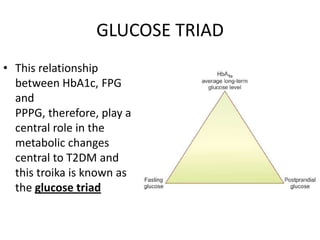
GLUCOSE TRIAD
• This relationship
  between HbA1c, FPG
  and
  PPPG, therefore, play a
  central role in the
  metabolic changes
  central to T2DM and
  this troika is known as
  the glucose triad
The glucose triad and its role in
comprehensive glycemic control:
current status, future management

A.   Ceriello

Review article
2010 Blackwell Publishing Ltd Int J Clin
    Pract, November 2010, 64, 12, 1705–1711
Introduction
• Based on the outcomes of several landmark
  studies, guidelines for good glycemic control

  have been agreed upon and a patient is

  generally considered to have achieved
  successful disease control when their HbA1C is
  < 7%
• it was previously accepted that HbA1C should be
  as low as is realistically achievable.

• The strategy of ‘the lower, the better’ was
  reinforced by data from the UK Prospective
  Diabetes Study (UKPDS) in nineties that showed
  that any reduction in HbA1C in patients with type
  2 diabetes is likely to reduce the risk of
  complications, with the lowest risk being in those
  with HbA1C values < 6%
Changing the paradigm
However, more recent studies have raised
 concerns that intensive treatment and stringent
 HbA1C targets may be detrimental in some
 patients.

The Action to Control Cardiovascular Risk in
 Diabetes (ACCORD) trial was stopped early when
 it was found that there was an increased risk of
 death in patients who received intensive blood
 glucose-lowering therapy with an HbA1C target
 of < 6%
Changing the paradigm
• Both ACCORD (target HbA1C < 6%) and
  ADVANCE (the Action in Diabetes and Vascular
  Disease: Preterax and Diamicron Modified
  Release Controlled Evaluation) (target HbA1C
  < 6.5%) trials failed to show that achievement
  of good glycemic control was associated with
  reduction of cardiovascular risk.
Changing the paradigm
• These findings appear to be supported by
  results from a retrospective cohort study that
  was conducted in the UK which showed that
  both Low and high HbA1C levels were
  associated with increased mortality and
  cardiac events, with the lowest risk seen at an
  intermediate HbA1C of 7.5%.
Question
 So if driving HbA1C down to lower target
 levels is not the answer, what other factors
 involved in glucose homeostasis can or
 should be targeted?
• Following phenomenon have been described
  as the possible explanations :


  daily plasma glucose variability
  postprandial glucose excursions
Comprehensive glycemic control –
the role of postprandial glucose and
         glucose variability
• In individuals with normal glucose tolerance, the
  plasma glucose concentrations generally rise no
  higher than 7.8 mmol ⁄ l after a meal and return
  to normal levels within 2–3 h. In contrast, in
  individuals with type 2 diabetes, postprandial
  plasma glucose levels > 7.8 mmol ⁄ l are common,
  even in those who are considered to have good
  overall glycemic control according to
  measurement of HbA1C.
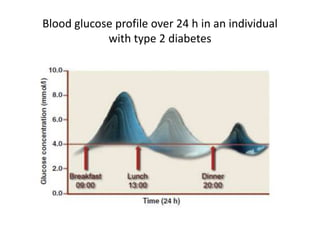
Blood glucose profile over 24 h in an individual
            with type 2 diabetes
• In fact, achievement of target HbA1C and
  fasting plasma glucose levels does not
  necessarily indicate that good glycemic control
  is continuous throughout the day.
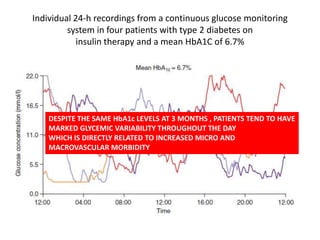
Individual 24-h recordings from a continuous glucose monitoring
         system in four patients with type 2 diabetes on
            insulin therapy and a mean HbA1C of 6.7%


    DESPITE THE SAME HbA1c LEVELS AT 3 MONTHS , PATIENTS TEND TO HAVE
    MARKED GLYCEMIC VARIABILITY THROUGHOUT THE DAY
    WHICH IS DIRECTLY RELATED TO INCREASED MICRO AND
    MACROVASCULAR MORBIDITY
• Patients who have impaired glucose tolerance, but
  have not yet developed type 2 diabetes tend to have
  near normal fasting plasma glucose, but show
  variable glucose excursions after the three meals of the
  day.
• The key pathological effect at this prediabetes stage is
  loss of first phase insulin secretion. This is the early
  surge of insulin that occurs within 5 min of eating and
  is critical for suppression of hepatic glucose production
  and priming the liver and peripheral
  tissues, particularly muscle and fat, for glucose uptake.
• The onset of frank type 2 diabetes is characterised by
  a progressive decline in insulin sensitivity together with
  progressive deterioration in beta-cell function leading
  to reduced insulin secretion.
• Increased fasting plasma glucose levels in patients
  with type 2 diabetes are largely attributable to reduced
  hepatic sensitivity to insulin leading to overproduction
  of glucose by the liver during the overnight fast.
• As diabetes progresses, these effects persist into the
  morning and result in particularly marked
  hyperglycaemia following breakfast
• Type 2 diabetes is a progressive disease. The typical course
  is ....

  a gradual loss of glycemic control after meals, followed by


  the development of fasting hyperglycaemia in the morning
  and finally


  sustained hyperglycaemia during the night
Postprandial Hyperglycemia….


• Postprandial glucose levels are influenced by
  the blood glucose level before the meal and
  the glucose load from the meal, as well as
  physiological factors such as insulin secretion
  and insulin sensitivity in the peripheral
  tissues.
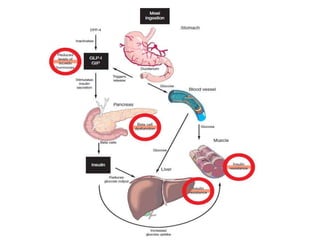
• The incretin hormones, glucagon-like peptide
  (GLP)-1 and gastric inhibitory polypeptide
  (GIP) are released by the intestine in response
  to ingestion of carbohydrate.These hormones-
         enhance insulin secretion,
         Suppress hepatic glucose production and
         decrease gastric emptying
         and have a greater effect on postprandial glucose levels than
          fasting glucose levels.
• Patients with type 2 diabetes have reduced
  levels of the incretin hormones
“the glucose triad…..

 It is important to understand the relationships
 between HbA1C, and fasting and postprandial
 blood glucose, and how these change during
 progression of the disease, if type 2 diabetes is to
 be managed optimally.
 Fasting and postprandial plasma glucose both
 contribute to HbA1C. However, the relative
 contribution of these two factors depends on the
 HbA1C level, with postprandial glucose
 contributing relatively more at lower HbA1C
 levels
• Early in the course of the disease, when fasting
  plasma glucose levels are near normal, postprandial
  glucose is more important in determining HbA1C.

• Measurement of 24-h plasma glucose profiles in
  patients with HbA1C of < 6.5%, > 6.5% to < 7%
  and >7% to 8% showed that fasting plasma
  glucose levels were very similar in these three
  groups, with the principal difference being in
  postprandial glucose.

• These data suggest that reduction of HbA1C in
  patients who are close to target (< 8%) is best
  achieved by specifically targeting postprandial
  glucose levels.
• As glucose control deteriorates and HbA1C
  rises, the contribution of fasting plasma
  glucose becomes more significant.
• In groups of patients with HbA1C of > 8% to <
  9% and > 9%, fasting plasma glucose
  progressively increased, indicating that
  control of both fasting and postprandial
  glucose is important at these higher HbA1C
  levels .
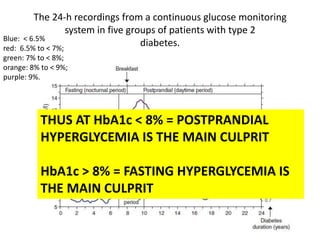
The 24-h recordings from a continuous glucose monitoring
                   system in five groups of patients with type 2
Blue: < 6.5%
red: 6.5% to < 7%;
                                     diabetes.
green: 7% to < 8%;
orange: 8% to < 9%;
purple: 9%.


          THUS AT HbA1c < 8% = POSTPRANDIAL
          HYPERGLYCEMIA IS THE MAIN CULPRIT

          HbA1c > 8% = FASTING HYPERGLYCEMIA IS
          THE MAIN CULPRIT
Impact of HbA1c, fasting plasma
glucose and postprandial glucose
              on
    management approaches
              and
        treatment choice
• Foods with a lower glycemic index contain
  carbohydrates that are more slowly digested
  and absorbed. There is some evidence that
  diets with a low glycemic load are beneficial in
  reducing postprandial glucose excursions.
• Treatment of both fasting and postprandial
  hyperglycaemia should be initiated
  simultaneously at all levels of HbA1C above
  agreed levels.
• Traditional treatments such as metformin and
  thiazolidinediones primarily lower fasting
  plasma glucose.
• An ideal approach to the treatment of a patient with
  newly diagnosed type 2 diabetes might be to start with
  the combination of metformin and a DPP-4 inhibitor.
• This combination effectively targets the two key
  pathophysiological features of type 2 diabetes: loss of
  first phase insulin secretion and insulin resistance.
• Combination of a DPP-4 inhibitor with metformin is
  likely to be better tolerated than combination with a
  sulphonylurea, with a lower incidence of weight gain
  and a very low risk of hypoglycaemia.
Conclusions
• The optimal glycemic control equation equates
                        to
                 HbA1C (target)
                        +
        fasting plasma glucose (target)
                        +
          postprandial glucose (target)

   without hypoglycaemia and weight gain.
• Although target HbA1C levels can be reached
  by lifestyle modification together with
  combination drug therapy…….


• optimal glycemic control may be best
 achieved by selection of agents that target
 both fasting and postprandial
 Hyperglycaemia.
THANK YOU
• The postprandial state, with respect to glucose, is defined as a 4-h
  period that immediately follows ingestion of a meal. During this
  period, dietary carbohydrates are progressively hydrolyzed through
  several sequential enzymatic actions. Even though the insulin
  response rapidly reduces the postprandial glucose excursion with a
  return to baseline levels within2 h, the overall period of absorption
  has approximately a 4-h duration that corresponds to the
  postprandial state.
• The postabsorptive state consists of a 6-h period that follows the
  postprandial period. During this time interval, glucose
  concentrations remain within a normal range in nondiabetic
  individuals through the breakdown of the glycogen (glycogenolysis)
  stored during the postprandial period.
• The “real” fasting state commences only at
  the end of the postabsorptive period(10–12 h
  after the beginning of the
• last meal intake). During the fasting state,
• plasma glucose is maintained at a nearnormal
• level by the gluconeogenesis: glucose
• derived from lactate, alanine, and
• glycerol.
• Therefore, it appears that in a nondiabetic patient who
  takes three meals per day at relatively fixed hours, the 24-h
  period of the day can be divided into three periods
  corresponding to fasting, postprandial, and postabsorptive
  states. The postprandial period (4 h each) is equal to 12 h
  and covers a full half-day period of time. The real fasting
  period is only limited to a 3- to 4-h period of time at the
  end of the night. Furthermore, taking into account the
  overlap
• between the postprandial and postabsorptive
• periods, it can be asserted that all
• the remaining parts of daytime correspond
• to postabsorptive states

Glucose triad

  • 1.
    The glucose triadand its role in comprehensive glycemic control: current status, future management REVIEW ARTICLE A. Ceriello
  • 3.
  • 4.
    INTRODUCTION to “GLUCOSETRIAD” Type 2 diabetes mellitus (T2DM) has reached pandemic levels in India. It is characterized by worsening metabolic control as the disease progresses incessantly in spite of all known treatments, causing micro- and macrovascular complications, leading to severe morbidity and mortality.
  • 5.
    Since the publicationof the seminal UK Prospective Diabetes Study (UKPDS) in the late 1990s, controlling blood glucose as measured by glycosylated hemoglobin (HbA1c) has been the cornerstone for the management of T2DM. HbA1c in turn is a function of the values of fasting plasma glucose (FPG) and postprandial plasma glucose (PPPG), an integrator of fasting and prandial glycemic disorders.
  • 6.
    GLUCOSE TRIAD • Thisrelationship between HbA1c, FPG and PPPG, therefore, play a central role in the metabolic changes central to T2DM and this troika is known as the glucose triad
  • 7.
    The glucose triadand its role in comprehensive glycemic control: current status, future management A. Ceriello Review article 2010 Blackwell Publishing Ltd Int J Clin Pract, November 2010, 64, 12, 1705–1711
  • 8.
    Introduction • Based onthe outcomes of several landmark studies, guidelines for good glycemic control have been agreed upon and a patient is generally considered to have achieved successful disease control when their HbA1C is < 7%
  • 9.
    • it waspreviously accepted that HbA1C should be as low as is realistically achievable. • The strategy of ‘the lower, the better’ was reinforced by data from the UK Prospective Diabetes Study (UKPDS) in nineties that showed that any reduction in HbA1C in patients with type 2 diabetes is likely to reduce the risk of complications, with the lowest risk being in those with HbA1C values < 6%
  • 10.
    Changing the paradigm However,more recent studies have raised concerns that intensive treatment and stringent HbA1C targets may be detrimental in some patients. The Action to Control Cardiovascular Risk in Diabetes (ACCORD) trial was stopped early when it was found that there was an increased risk of death in patients who received intensive blood glucose-lowering therapy with an HbA1C target of < 6%
  • 11.
    Changing the paradigm •Both ACCORD (target HbA1C < 6%) and ADVANCE (the Action in Diabetes and Vascular Disease: Preterax and Diamicron Modified Release Controlled Evaluation) (target HbA1C < 6.5%) trials failed to show that achievement of good glycemic control was associated with reduction of cardiovascular risk.
  • 12.
    Changing the paradigm •These findings appear to be supported by results from a retrospective cohort study that was conducted in the UK which showed that both Low and high HbA1C levels were associated with increased mortality and cardiac events, with the lowest risk seen at an intermediate HbA1C of 7.5%.
  • 13.
    Question So ifdriving HbA1C down to lower target levels is not the answer, what other factors involved in glucose homeostasis can or should be targeted?
  • 14.
    • Following phenomenonhave been described as the possible explanations : daily plasma glucose variability postprandial glucose excursions
  • 15.
    Comprehensive glycemic control– the role of postprandial glucose and glucose variability
  • 16.
    • In individualswith normal glucose tolerance, the plasma glucose concentrations generally rise no higher than 7.8 mmol ⁄ l after a meal and return to normal levels within 2–3 h. In contrast, in individuals with type 2 diabetes, postprandial plasma glucose levels > 7.8 mmol ⁄ l are common, even in those who are considered to have good overall glycemic control according to measurement of HbA1C.
  • 17.
    Blood glucose profileover 24 h in an individual with type 2 diabetes
  • 18.
    • In fact,achievement of target HbA1C and fasting plasma glucose levels does not necessarily indicate that good glycemic control is continuous throughout the day.
  • 19.
    Individual 24-h recordingsfrom a continuous glucose monitoring system in four patients with type 2 diabetes on insulin therapy and a mean HbA1C of 6.7% DESPITE THE SAME HbA1c LEVELS AT 3 MONTHS , PATIENTS TEND TO HAVE MARKED GLYCEMIC VARIABILITY THROUGHOUT THE DAY WHICH IS DIRECTLY RELATED TO INCREASED MICRO AND MACROVASCULAR MORBIDITY
  • 20.
    • Patients whohave impaired glucose tolerance, but have not yet developed type 2 diabetes tend to have near normal fasting plasma glucose, but show variable glucose excursions after the three meals of the day. • The key pathological effect at this prediabetes stage is loss of first phase insulin secretion. This is the early surge of insulin that occurs within 5 min of eating and is critical for suppression of hepatic glucose production and priming the liver and peripheral tissues, particularly muscle and fat, for glucose uptake.
  • 21.
    • The onsetof frank type 2 diabetes is characterised by a progressive decline in insulin sensitivity together with progressive deterioration in beta-cell function leading to reduced insulin secretion. • Increased fasting plasma glucose levels in patients with type 2 diabetes are largely attributable to reduced hepatic sensitivity to insulin leading to overproduction of glucose by the liver during the overnight fast. • As diabetes progresses, these effects persist into the morning and result in particularly marked hyperglycaemia following breakfast
  • 22.
    • Type 2diabetes is a progressive disease. The typical course is .... a gradual loss of glycemic control after meals, followed by the development of fasting hyperglycaemia in the morning and finally sustained hyperglycaemia during the night
  • 23.
    Postprandial Hyperglycemia…. • Postprandialglucose levels are influenced by the blood glucose level before the meal and the glucose load from the meal, as well as physiological factors such as insulin secretion and insulin sensitivity in the peripheral tissues.
  • 24.
    • The incretinhormones, glucagon-like peptide (GLP)-1 and gastric inhibitory polypeptide (GIP) are released by the intestine in response to ingestion of carbohydrate.These hormones-  enhance insulin secretion,  Suppress hepatic glucose production and  decrease gastric emptying  and have a greater effect on postprandial glucose levels than fasting glucose levels. • Patients with type 2 diabetes have reduced levels of the incretin hormones
  • 26.
    “the glucose triad….. It is important to understand the relationships between HbA1C, and fasting and postprandial blood glucose, and how these change during progression of the disease, if type 2 diabetes is to be managed optimally.  Fasting and postprandial plasma glucose both contribute to HbA1C. However, the relative contribution of these two factors depends on the HbA1C level, with postprandial glucose contributing relatively more at lower HbA1C levels
  • 27.
    • Early inthe course of the disease, when fasting plasma glucose levels are near normal, postprandial glucose is more important in determining HbA1C. • Measurement of 24-h plasma glucose profiles in patients with HbA1C of < 6.5%, > 6.5% to < 7% and >7% to 8% showed that fasting plasma glucose levels were very similar in these three groups, with the principal difference being in postprandial glucose. • These data suggest that reduction of HbA1C in patients who are close to target (< 8%) is best achieved by specifically targeting postprandial glucose levels.
  • 28.
    • As glucosecontrol deteriorates and HbA1C rises, the contribution of fasting plasma glucose becomes more significant. • In groups of patients with HbA1C of > 8% to < 9% and > 9%, fasting plasma glucose progressively increased, indicating that control of both fasting and postprandial glucose is important at these higher HbA1C levels .
  • 29.
    The 24-h recordingsfrom a continuous glucose monitoring system in five groups of patients with type 2 Blue: < 6.5% red: 6.5% to < 7%; diabetes. green: 7% to < 8%; orange: 8% to < 9%; purple: 9%. THUS AT HbA1c < 8% = POSTPRANDIAL HYPERGLYCEMIA IS THE MAIN CULPRIT HbA1c > 8% = FASTING HYPERGLYCEMIA IS THE MAIN CULPRIT
  • 30.
    Impact of HbA1c,fasting plasma glucose and postprandial glucose on management approaches and treatment choice
  • 31.
    • Foods witha lower glycemic index contain carbohydrates that are more slowly digested and absorbed. There is some evidence that diets with a low glycemic load are beneficial in reducing postprandial glucose excursions.
  • 32.
    • Treatment ofboth fasting and postprandial hyperglycaemia should be initiated simultaneously at all levels of HbA1C above agreed levels. • Traditional treatments such as metformin and thiazolidinediones primarily lower fasting plasma glucose.
  • 33.
    • An idealapproach to the treatment of a patient with newly diagnosed type 2 diabetes might be to start with the combination of metformin and a DPP-4 inhibitor. • This combination effectively targets the two key pathophysiological features of type 2 diabetes: loss of first phase insulin secretion and insulin resistance. • Combination of a DPP-4 inhibitor with metformin is likely to be better tolerated than combination with a sulphonylurea, with a lower incidence of weight gain and a very low risk of hypoglycaemia.
  • 34.
  • 35.
    • The optimalglycemic control equation equates to HbA1C (target) + fasting plasma glucose (target) + postprandial glucose (target) without hypoglycaemia and weight gain.
  • 36.
    • Although targetHbA1C levels can be reached by lifestyle modification together with combination drug therapy……. • optimal glycemic control may be best achieved by selection of agents that target both fasting and postprandial Hyperglycaemia.
  • 37.
  • 39.
    • The postprandialstate, with respect to glucose, is defined as a 4-h period that immediately follows ingestion of a meal. During this period, dietary carbohydrates are progressively hydrolyzed through several sequential enzymatic actions. Even though the insulin response rapidly reduces the postprandial glucose excursion with a return to baseline levels within2 h, the overall period of absorption has approximately a 4-h duration that corresponds to the postprandial state. • The postabsorptive state consists of a 6-h period that follows the postprandial period. During this time interval, glucose concentrations remain within a normal range in nondiabetic individuals through the breakdown of the glycogen (glycogenolysis) stored during the postprandial period.
  • 40.
    • The “real”fasting state commences only at the end of the postabsorptive period(10–12 h after the beginning of the • last meal intake). During the fasting state, • plasma glucose is maintained at a nearnormal • level by the gluconeogenesis: glucose • derived from lactate, alanine, and • glycerol.
  • 41.
    • Therefore, itappears that in a nondiabetic patient who takes three meals per day at relatively fixed hours, the 24-h period of the day can be divided into three periods corresponding to fasting, postprandial, and postabsorptive states. The postprandial period (4 h each) is equal to 12 h and covers a full half-day period of time. The real fasting period is only limited to a 3- to 4-h period of time at the end of the night. Furthermore, taking into account the overlap • between the postprandial and postabsorptive • periods, it can be asserted that all • the remaining parts of daytime correspond • to postabsorptive states

Editor's Notes

  • #15 For several years, the related phenomena of daily plasma glucose variability and postprandial glucose levels have been under scrutiny, particularly in relation to HbA1C and fasting plasma glucose. Although their position in the so-called glucose triad is gaining acceptance (Figure1), there is ongoing debate regarding the contribution of postprandial glucose levels to overall glycemic control and the role of postprandial glucose targets in the management of a patient with type 2 diabetes.