Homeostasis 
1
Homeostasis is the maintenance of a stable
internal environment within an organism, and
maintaining a stable internal environment in a
human means having to carefully regulate
many parameters.
Glucose homeostasis reflects a balance between
hepatic glucose production and peripheral
glucose uptake and utilization.
Homeostasis Of Blood Glucose
Levels2
 Glucose is an obligate metabolic fuel for the
brain under physiologic conditions.
 The brain cannot synthesize glucose or store it
as glycogen
 Therefore requires a continuous supply of
glucose from the arterial circulation.
Plasma glucose concentrations
3
Plasma glucose concentrations are normally
maintained within a relatively narrow range,
roughly 70–110 mg/dL (3.9–6.1 mmol/L) in the
fasting state with transient higher excursions
after a meal, despite wide variations in
exogenous glucose delivery from meals and in
endogenous glucose utilization by, for
example, exercising muscle.
Plasma glucose concentrations
4
Between meals and during fasting, plasma
glucose levels are maintained by-
 Endogenous glucose production, hepatic (and
renal) gluconeogenesis,
 Hepatic glycogenolysis.
Hepatic glycogen stores
5
Although hepatic glycogen stores are usually
sufficient to maintain plasma glucose levels for
approximately 8 hour.
This time period can be shorter if glucose
demand is increased by exercise or if glycogen
stores are depleted by illness or starvation.
Phases of glucose homeostasis
06/03/19Biochemistry for medics- Lecture notes
6
Phase 1 Phase 2 Phase 3 Phase 4
Nutritional
status
Well fed
state
Post- Absorptive
state
Fasting Prolonged
fasting/
Starvation
Source of
glucose
Diet Hepatic glycogen
and
Gluconeogenesis
Hepatic and
Renal
gluconeogenesi
s
Renal and
hepatic
gluconeogenesi
s
Tissues
using
glucose
All All tissues, but in
Liver, muscle and
adipose tissue,
the rate of
utilization is
slowed.
Brain and
RBCs and cells
lacking
mitochondria;
small amount
by muscle.
Brain at a
slower rate,
RBCs normal
rate
Major fuel
of brain
Glucose Glucose Glucose and
ketone bodies
Ketone bodies
and glucose
Variations in blood glucose
levels7
A) Hypoglycemia- In a long period of starvation,
adequate amount of glucose is not provided in the
diet, and the blood glucose concentration falls below
the normal, a condition called hypoglycemia.
 A decrease in insulin secretion is the first defense
against hypoglycemia.
 As plasma glucose levels decline just below the
physiologic range, glucose counter regulatory
(plasma glucose–raising) hormones are released.
Among these, pancreatic α cell glucagon, which
stimulates hepatic glycogenolysis, plays a primary
role.
Glucagon is the second defense against
hypoglycemia.
A) Hypoglycemia (contd.)
8
 Adreno- medullary epinephrine, which
stimulates hepatic glycogenolysis and
gluconeogenesis (and renal gluconeogenesis),
is not normally critical, however, it becomes
critical when glucagon is deficient.
Epinephrine is the third defense against
hypoglycemia.
 When hypoglycemia is prolonged, cortisol and
growth hormone also support glucose
production and limit glucose utilization.
Hypoglycemia
9
 Hypoglycemia is a laboratory ‘diagnosis’ which
is usually considered a blood glucose level
below 60 mg/dL.
 Symptoms begin at plasma glucose levels in
the range of 60 mg/dL and
 Impairment of brain function at approximately
50 mg/dL.
B) Hyperglycemia
10
Increase in blood glucose level above the normal
physiological limit is called as Hyperglycemia
Causes of hyperglycemia
Diabetes mellitus
Diseases of pancreas(pancreatitis,
hemochromatosis, carcinoma head of pancreas,
Cystic fibrosis)
Infections and sepsis
Anesthesia
Asphyxia
Blood glucose homeostasis
(Summary)11
 Glucose homeostasis reflects a balance between
hepatic glucose production and peripheral glucose
uptake and utilization. Insulin is the most
important regulator of this metabolic equilibrium.
 In the fasting state, low insulin levels increase
glucose production by promoting hepatic
Gluconeogenesis and glycogenolysis and reduce
glucose uptake in insulin-sensitive tissues
 Glucagon, secreted by pancreatic alpha cells
when blood glucose or insulin levels are low,
stimulates glycogenolysis and gluconeogenesis
by the liver and renal medulla.
Blood glucose homeostasis
(Summary)12
 Postprandially, the glucose load elicits a rise in
insulin and fall in glucagon, leading to a
reversal of these processes.
 Insulin, an anabolic hormone, promotes the
storage of carbohydrate and fat and protein
synthesis.
 The major portion of postprandial glucose is
utilized by skeletal muscle, an effect of insulin-
stimulated glucose uptake.
 Other tissues, most notably the brain, utilize
glucose in an insulin-independent fashion.
06/03/19Biochemistry for medics- Lecture notes13
Gluconeogenesis
gluco neo genesis
sugar (re)new make/
create
glycolysis
glucose
pyruvate
lactate
gluconeogenesis
Topics: Gluconeogenesis
1. Principles, substrates & relationship to
glycolysis
2. Bypass of irreversible steps in glycolysis
3. Link between liver gluconeogenesis and
muscle/RBC/brain glycolysis; the Cori and
Alanine cycles
Gluconeogenesis
• Occurs in all animals, plants, fungi and
microbes
• Occurs largely in the liver; some in renal
cortex
• Of 10 enzymatic steps, 7 are reversals of
glycolytic reactions
Carbohydrate
synthesis
from simple
precursors
Metabolites feed into
gluconeogenesis at various points
main
path
All AA can
feed into
gluconeogenesis
except
leucine
and
lysine
TCA
intermediates
are
gluconeogenic;
funnel
through
oxaloacetate
Bypass of irreversible
steps in glycolysis
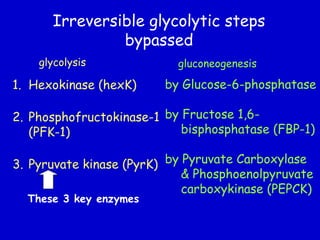
Irreversible glycolytic steps
bypassed
1. Hexokinase (hexK)
2. Phosphofructokinase-1
(PFK-1)
3. Pyruvate kinase (PyrK)
by Glucose-6-phosphatase
by Fructose 1,6-
bisphosphatase (FBP-1)
by Pyruvate Carboxylase
& Phosphoenolpyruvate
carboxykinase (PEPCK)
These 3 key enzymes
glycolysis gluconeogenesis
Pyruvate can go
“up” or “down”
depending upon
energy needs
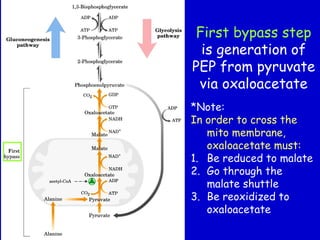
First bypass step
is generation of
PEP from pyruvate
via oxaloacetate
*Note:
In order to cross the
mito membrane,
oxaloacetate must:
1. Be reduced to malate
2. Go through the
malate shuttle
3. Be reoxidized to
oxaloacetate
Addition of CO2 to pyruvate to
form oxaloacetate
• Hydrolysis of ATP
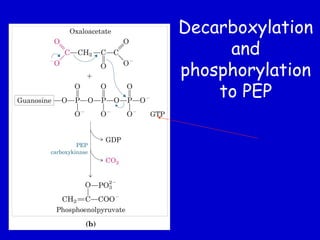
Decarboxylation
and
phosphorylation
to PEP
2nd
& 3rd
bypass
steps are near
the end of
gluconeogenesis
(“top” of
glycolysis)
Regulation of FBP-1
by AMP and F2,6P
Dephosphorylation of G6P,
3rd
bypass reaction
Glucose 6-phosphatase removes the
phosphate to liberate free glucose
• This is primarily a function of the liver to buffer
blood glucose levels
• G6Pase is NOT present in brain and muscle!
(Gluconeogenesis does not occur in these tissues)
glucose-6-P + H2O  glucose + Pi
G6Pase
Gluconeogenesis is energetically
expensive to cells (hepatocytes)
cost
Liver is the major source of
blood glucose from GN
Is the primary
gluconeogenic organ
Produces glucose for
export to brain, muscle,
RBC’s
Uses many small
metabolites and fatty
acids to feed GN
Liver function is highly
sensitive to insulin &
glucagon
The Cori Cycle
2 ATP
6 ATP
2
Lactate and glucose shuttle
between active
muscle/RBC and liver
(glucagon/insulin reg.)
Liver gluconeogenesis
buffers the blood
glucose for use by
muscle, RBC’s and brain
(120 g/day)
*Note: the brain fully
oxidizes glucose, so it
does not funnel back
lactate
GN
GL
RBCs
The Alanine Cycle
The liver can also use the
amino acid Alanine similarly
to Lactate
Following transamination to
pyruvate, gluconeogenesis
allows the liver to convert it
to glucose for secretion into
the blood
Significance
Remove lactate in muscle
Increase blood sugar level using amino
acids(alanine) in special situation
You should know:
1. Chemical steps of GN; associate enzymes
2. Requirement for mito shuttle system
3. Precursors that can enter GN;
4. Relationship of GL to GN; shared enzymes, irreversible
steps
5. Liver as the primary GN organ; Cori Cycle, Alanine Cycle

Gluconeogenesis

  • 1.
    Homeostasis  1 Homeostasis is the maintenanceof a stable internal environment within an organism, and maintaining a stable internal environment in a human means having to carefully regulate many parameters. Glucose homeostasis reflects a balance between hepatic glucose production and peripheral glucose uptake and utilization.
  • 2.
    Homeostasis Of BloodGlucose Levels2  Glucose is an obligate metabolic fuel for the brain under physiologic conditions.  The brain cannot synthesize glucose or store it as glycogen  Therefore requires a continuous supply of glucose from the arterial circulation.
  • 3.
    Plasma glucose concentrations 3 Plasmaglucose concentrations are normally maintained within a relatively narrow range, roughly 70–110 mg/dL (3.9–6.1 mmol/L) in the fasting state with transient higher excursions after a meal, despite wide variations in exogenous glucose delivery from meals and in endogenous glucose utilization by, for example, exercising muscle.
  • 4.
    Plasma glucose concentrations 4 Betweenmeals and during fasting, plasma glucose levels are maintained by-  Endogenous glucose production, hepatic (and renal) gluconeogenesis,  Hepatic glycogenolysis.
  • 5.
    Hepatic glycogen stores 5 Althoughhepatic glycogen stores are usually sufficient to maintain plasma glucose levels for approximately 8 hour. This time period can be shorter if glucose demand is increased by exercise or if glycogen stores are depleted by illness or starvation.
  • 6.
    Phases of glucosehomeostasis 06/03/19Biochemistry for medics- Lecture notes 6 Phase 1 Phase 2 Phase 3 Phase 4 Nutritional status Well fed state Post- Absorptive state Fasting Prolonged fasting/ Starvation Source of glucose Diet Hepatic glycogen and Gluconeogenesis Hepatic and Renal gluconeogenesi s Renal and hepatic gluconeogenesi s Tissues using glucose All All tissues, but in Liver, muscle and adipose tissue, the rate of utilization is slowed. Brain and RBCs and cells lacking mitochondria; small amount by muscle. Brain at a slower rate, RBCs normal rate Major fuel of brain Glucose Glucose Glucose and ketone bodies Ketone bodies and glucose
  • 7.
    Variations in bloodglucose levels7 A) Hypoglycemia- In a long period of starvation, adequate amount of glucose is not provided in the diet, and the blood glucose concentration falls below the normal, a condition called hypoglycemia.  A decrease in insulin secretion is the first defense against hypoglycemia.  As plasma glucose levels decline just below the physiologic range, glucose counter regulatory (plasma glucose–raising) hormones are released. Among these, pancreatic α cell glucagon, which stimulates hepatic glycogenolysis, plays a primary role. Glucagon is the second defense against hypoglycemia.
  • 8.
    A) Hypoglycemia (contd.) 8 Adreno- medullary epinephrine, which stimulates hepatic glycogenolysis and gluconeogenesis (and renal gluconeogenesis), is not normally critical, however, it becomes critical when glucagon is deficient. Epinephrine is the third defense against hypoglycemia.  When hypoglycemia is prolonged, cortisol and growth hormone also support glucose production and limit glucose utilization.
  • 9.
    Hypoglycemia 9  Hypoglycemia isa laboratory ‘diagnosis’ which is usually considered a blood glucose level below 60 mg/dL.  Symptoms begin at plasma glucose levels in the range of 60 mg/dL and  Impairment of brain function at approximately 50 mg/dL.
  • 10.
    B) Hyperglycemia 10 Increase inblood glucose level above the normal physiological limit is called as Hyperglycemia Causes of hyperglycemia Diabetes mellitus Diseases of pancreas(pancreatitis, hemochromatosis, carcinoma head of pancreas, Cystic fibrosis) Infections and sepsis Anesthesia Asphyxia
  • 11.
    Blood glucose homeostasis (Summary)11 Glucose homeostasis reflects a balance between hepatic glucose production and peripheral glucose uptake and utilization. Insulin is the most important regulator of this metabolic equilibrium.  In the fasting state, low insulin levels increase glucose production by promoting hepatic Gluconeogenesis and glycogenolysis and reduce glucose uptake in insulin-sensitive tissues  Glucagon, secreted by pancreatic alpha cells when blood glucose or insulin levels are low, stimulates glycogenolysis and gluconeogenesis by the liver and renal medulla.
  • 12.
    Blood glucose homeostasis (Summary)12 Postprandially, the glucose load elicits a rise in insulin and fall in glucagon, leading to a reversal of these processes.  Insulin, an anabolic hormone, promotes the storage of carbohydrate and fat and protein synthesis.  The major portion of postprandial glucose is utilized by skeletal muscle, an effect of insulin- stimulated glucose uptake.  Other tissues, most notably the brain, utilize glucose in an insulin-independent fashion.
  • 13.
  • 14.
  • 15.
    gluco neo genesis sugar(re)new make/ create glycolysis glucose pyruvate lactate gluconeogenesis
  • 16.
    Topics: Gluconeogenesis 1. Principles,substrates & relationship to glycolysis 2. Bypass of irreversible steps in glycolysis 3. Link between liver gluconeogenesis and muscle/RBC/brain glycolysis; the Cori and Alanine cycles
  • 17.
    Gluconeogenesis • Occurs inall animals, plants, fungi and microbes • Occurs largely in the liver; some in renal cortex • Of 10 enzymatic steps, 7 are reversals of glycolytic reactions
  • 18.
  • 19.
    Metabolites feed into gluconeogenesisat various points main path
  • 20.
    All AA can feedinto gluconeogenesis except leucine and lysine
  • 21.
  • 22.
  • 23.
    Irreversible glycolytic steps bypassed 1.Hexokinase (hexK) 2. Phosphofructokinase-1 (PFK-1) 3. Pyruvate kinase (PyrK) by Glucose-6-phosphatase by Fructose 1,6- bisphosphatase (FBP-1) by Pyruvate Carboxylase & Phosphoenolpyruvate carboxykinase (PEPCK) These 3 key enzymes glycolysis gluconeogenesis
  • 24.
    Pyruvate can go “up”or “down” depending upon energy needs
  • 25.
    First bypass step isgeneration of PEP from pyruvate via oxaloacetate *Note: In order to cross the mito membrane, oxaloacetate must: 1. Be reduced to malate 2. Go through the malate shuttle 3. Be reoxidized to oxaloacetate
  • 26.
    Addition of CO2to pyruvate to form oxaloacetate • Hydrolysis of ATP
  • 27.
  • 28.
    2nd & 3rd bypass steps arenear the end of gluconeogenesis (“top” of glycolysis) Regulation of FBP-1 by AMP and F2,6P
  • 29.
  • 30.
    Glucose 6-phosphatase removesthe phosphate to liberate free glucose • This is primarily a function of the liver to buffer blood glucose levels • G6Pase is NOT present in brain and muscle! (Gluconeogenesis does not occur in these tissues) glucose-6-P + H2O  glucose + Pi G6Pase
  • 31.
    Gluconeogenesis is energetically expensiveto cells (hepatocytes) cost
  • 32.
    Liver is themajor source of blood glucose from GN Is the primary gluconeogenic organ Produces glucose for export to brain, muscle, RBC’s Uses many small metabolites and fatty acids to feed GN Liver function is highly sensitive to insulin & glucagon
  • 33.
    The Cori Cycle 2ATP 6 ATP 2 Lactate and glucose shuttle between active muscle/RBC and liver (glucagon/insulin reg.) Liver gluconeogenesis buffers the blood glucose for use by muscle, RBC’s and brain (120 g/day) *Note: the brain fully oxidizes glucose, so it does not funnel back lactate GN GL RBCs
  • 34.
    The Alanine Cycle Theliver can also use the amino acid Alanine similarly to Lactate Following transamination to pyruvate, gluconeogenesis allows the liver to convert it to glucose for secretion into the blood
  • 35.
    Significance Remove lactate inmuscle Increase blood sugar level using amino acids(alanine) in special situation
  • 36.
    You should know: 1.Chemical steps of GN; associate enzymes 2. Requirement for mito shuttle system 3. Precursors that can enter GN; 4. Relationship of GL to GN; shared enzymes, irreversible steps 5. Liver as the primary GN organ; Cori Cycle, Alanine Cycle