BlockChain
By SriHari
Decentralized Applications
Agenda
1. What is Blockchain
2. Categories of Blockchain
3. Why Blockchain required
4. Traditional vs. Smart Contracts
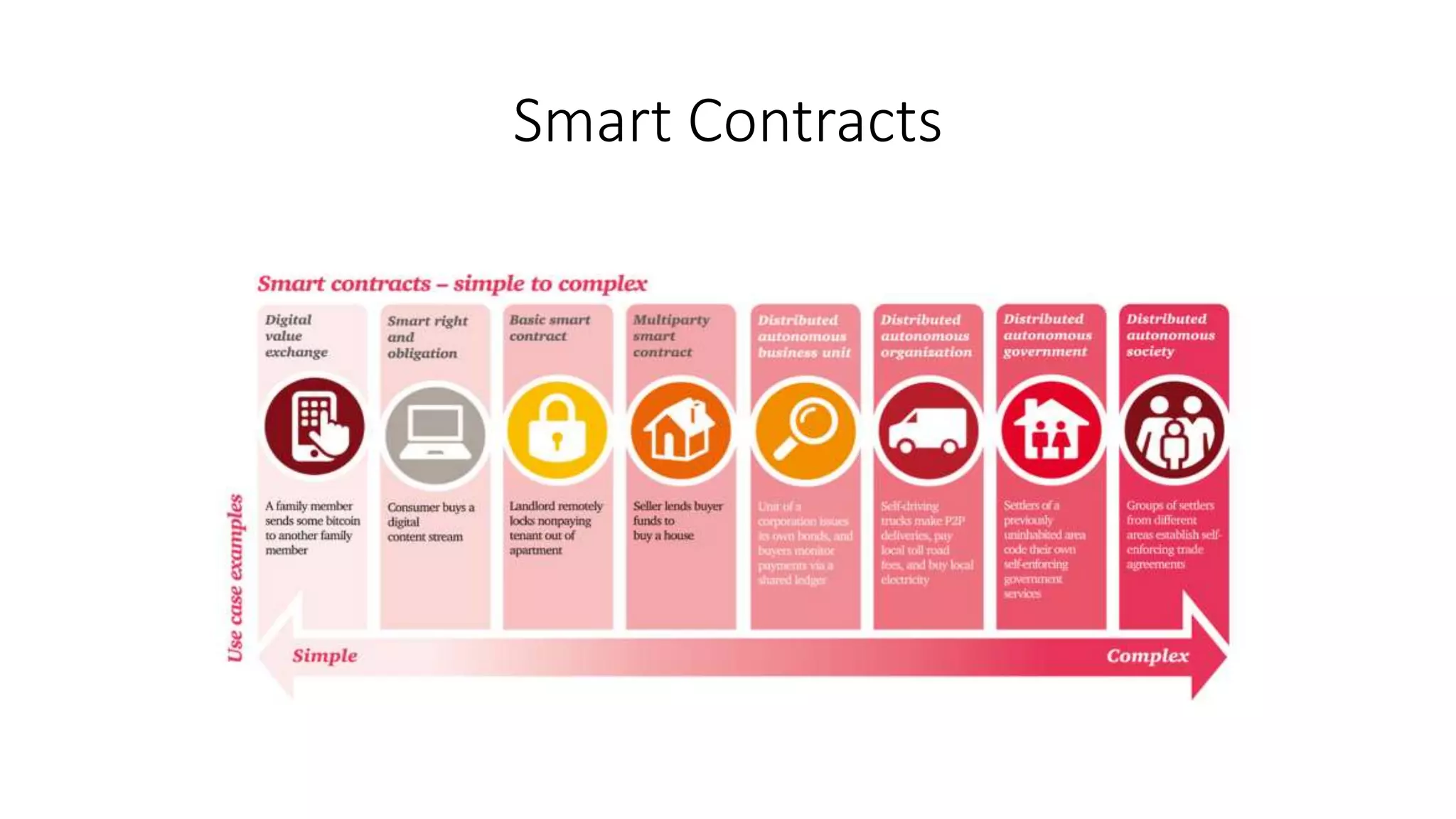
5. Use Cases of Smart contracts
6. BlockChain viability check
7. Typical ad workflow
8. Digital Advertising – Use Case
9. Block chain ad workflow
10. Taxonomy standardization – Use Case
11. Onboarding Process – Use Case
12. Reference / Appendix
Block Chain
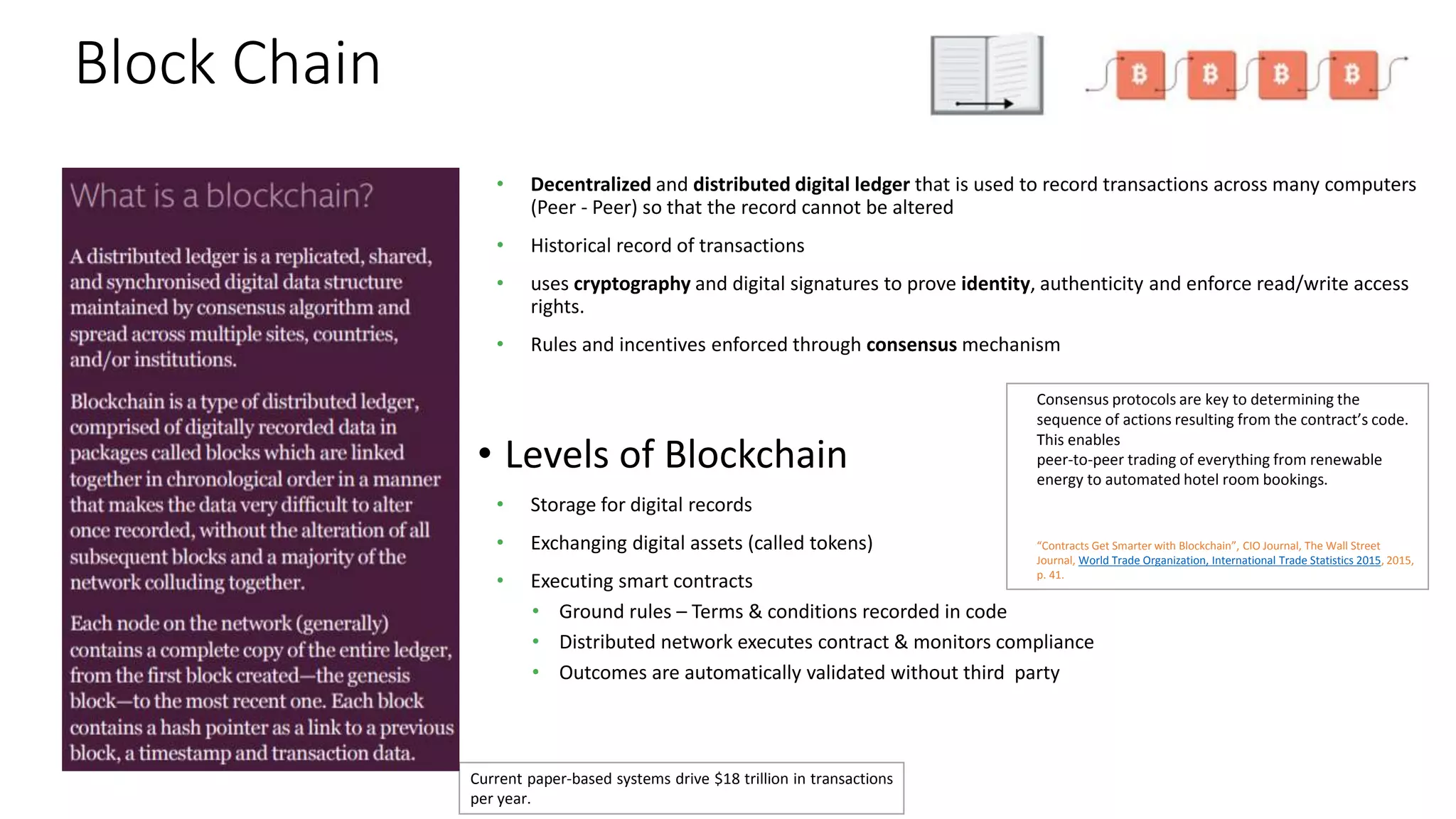
• Decentralized and distributed digital ledger that is used to record transactions across many computers
(Peer - Peer) so that the record cannot be altered
• Historical record of transactions
• uses cryptography and digital signatures to prove identity, authenticity and enforce read/write access
rights.
• Rules and incentives enforced through consensus mechanism
• Levels of Blockchain
• Storage for digital records
• Exchanging digital assets (called tokens)
• Executing smart contracts
• Ground rules – Terms & conditions recorded in code
• Distributed network executes contract & monitors compliance
• Outcomes are automatically validated without third party
Current paper-based systems drive $18 trillion in transactions
per year.
Consensus protocols are key to determining the
sequence of actions resulting from the contract’s code.
This enables
peer-to-peer trading of everything from renewable
energy to automated hotel room bookings.
“Contracts Get Smarter with Blockchain”, CIO Journal, The Wall Street
Journal, World Trade Organization, International Trade Statistics 2015, 2015,
p. 41.
Categories of Blockchain
Public Blockchain
a public blockchain is a blockchain that anyone in the world can read, anyone
in the world can send transactions to and expect to see them included if they
are valid, and anyone in the world can participate in the consensus process
Consortium Blockchains
a consortium blockchain is a blockchain where the consensus process is
controlled by a pre-selected set of nodes; for example, one might imagine a
consortium of 15 financial institutions, each of which operates a node and of
which 10 must sign every block in order for the block to be valid.
Fully private Blockchain
a fully private blockchain is a blockchain where write permissions are kept
centralized to one organization. Read permissions may be public or restricted
to an arbitrary extent.
Contracts, Transactions and Recordkeeping in
the Digital Age
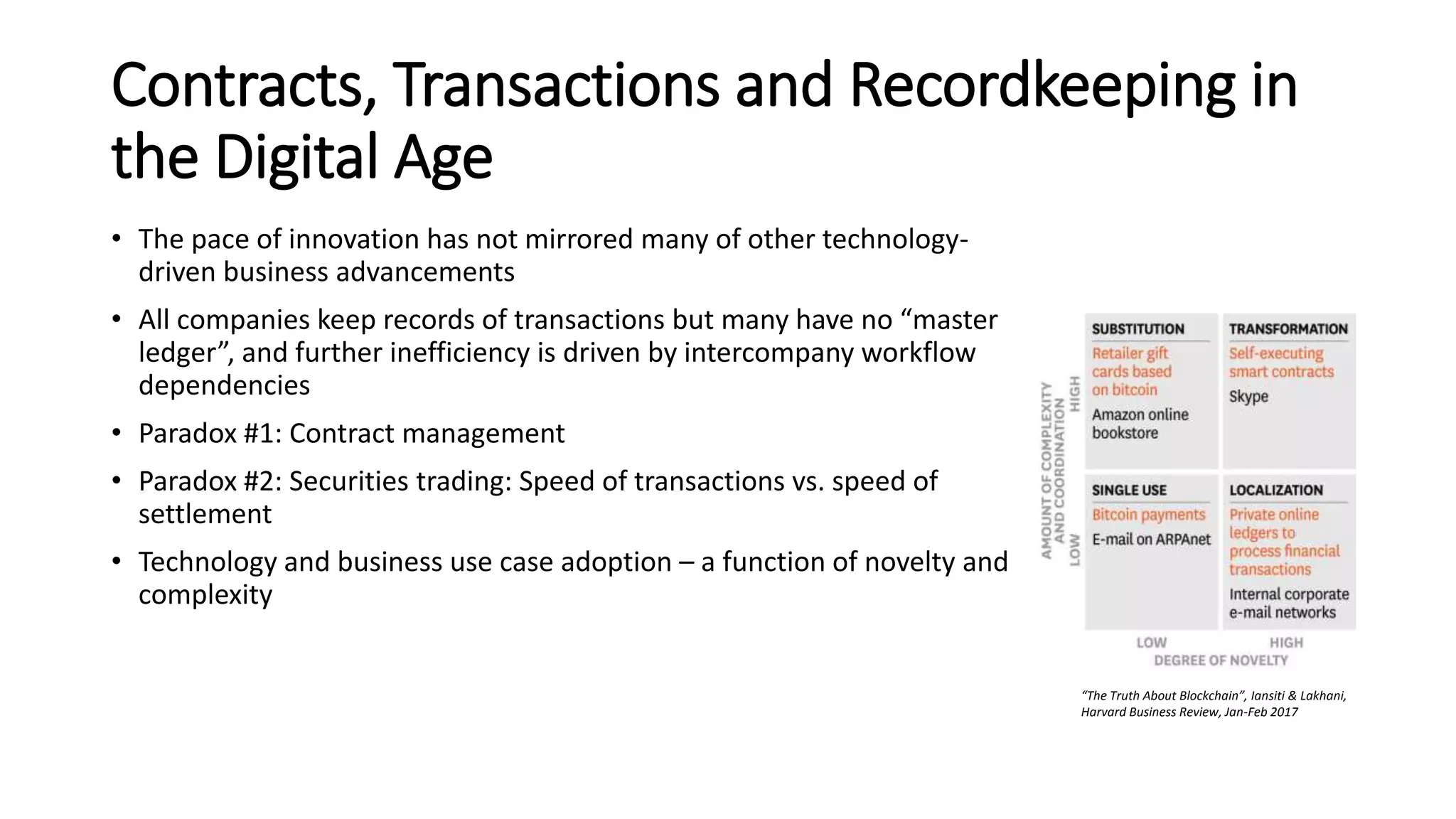
• The pace of innovation has not mirrored many of other technology-
driven business advancements
• All companies keep records of transactions but many have no “master
ledger”, and further inefficiency is driven by intercompany workflow
dependencies
• Paradox #1: Contract management
• Paradox #2: Securities trading: Speed of transactions vs. speed of
settlement
• Technology and business use case adoption – a function of novelty and
complexity
“The Truth About Blockchain”, Iansiti & Lakhani,
Harvard Business Review, Jan-Feb 2017
Transactional Vs Smart contracts
Block chain Viability check
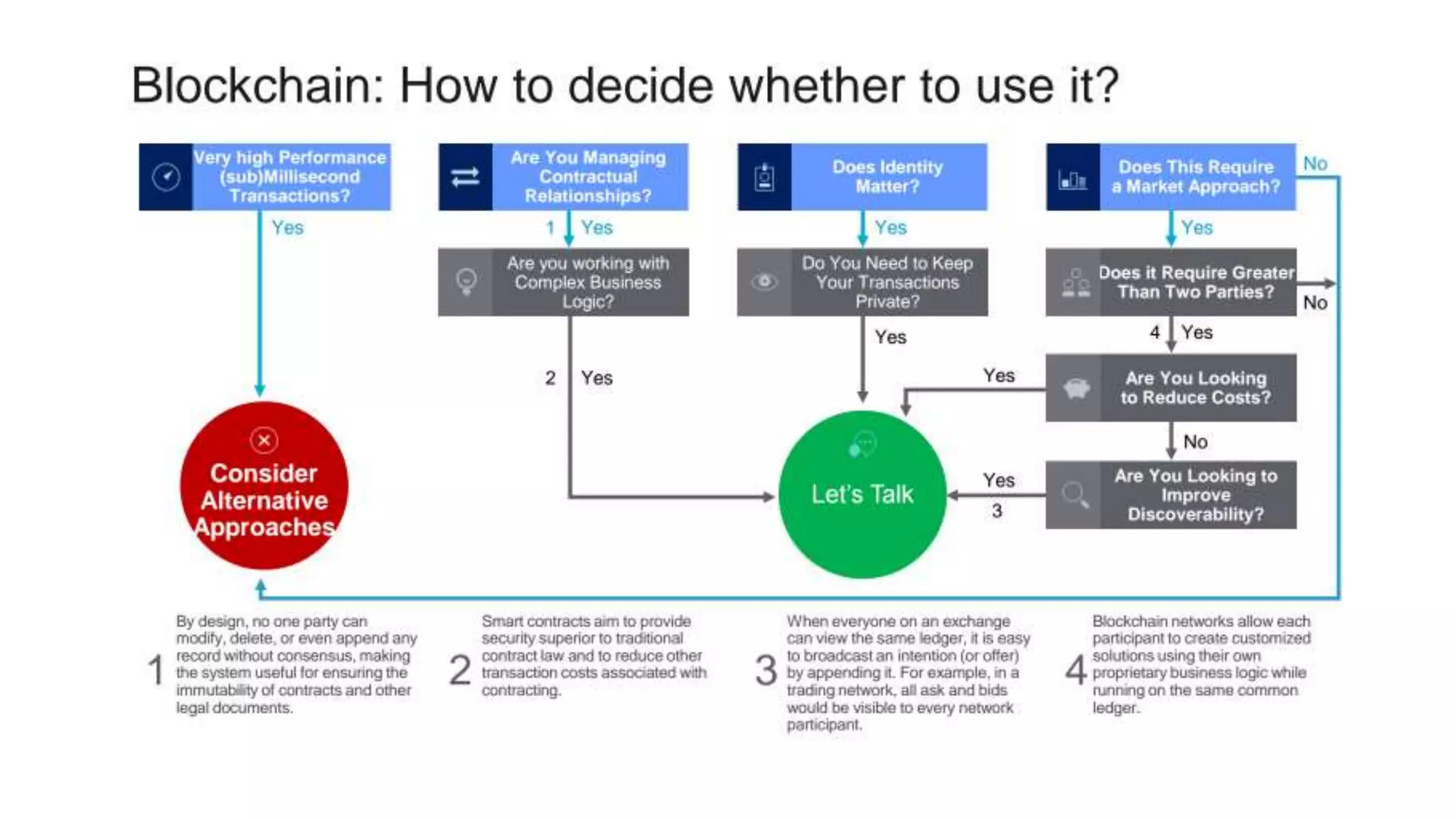
• A blockchain must be used as a transactional settlement record and immutable proof of the solution’s overlying
transactions — whether that “transaction” is storing data, sending money, or shipping something. Note, that transactions
do not just encompass financial operations — any action that causes an effect between 2 + n parties is a “transaction”
• Any use case that needs a blockchain must be. . .
• a process that currently requires middlemen entities to transact between parties, or provide a (centralized) third
party service to a client
• one that operates in a broader environment where there exists a low amount of trust between parties (one that can
benefit from ‘trustless consensus’ amongst involved parties)
• one that leverages a transactional assumption between parties (i.e. a client assumes that after they pay the
producer, the client will receive some service) — so that there is a need for automated transparency on a viewable
and referenceable settlement
• Will perform more rapidly and more securely with blockchain implementation that the current state (must at least be
an operational improvement)
• Right of owner ship of any asset (digital asset, Research document, Video/music album)
• Proof of Existence
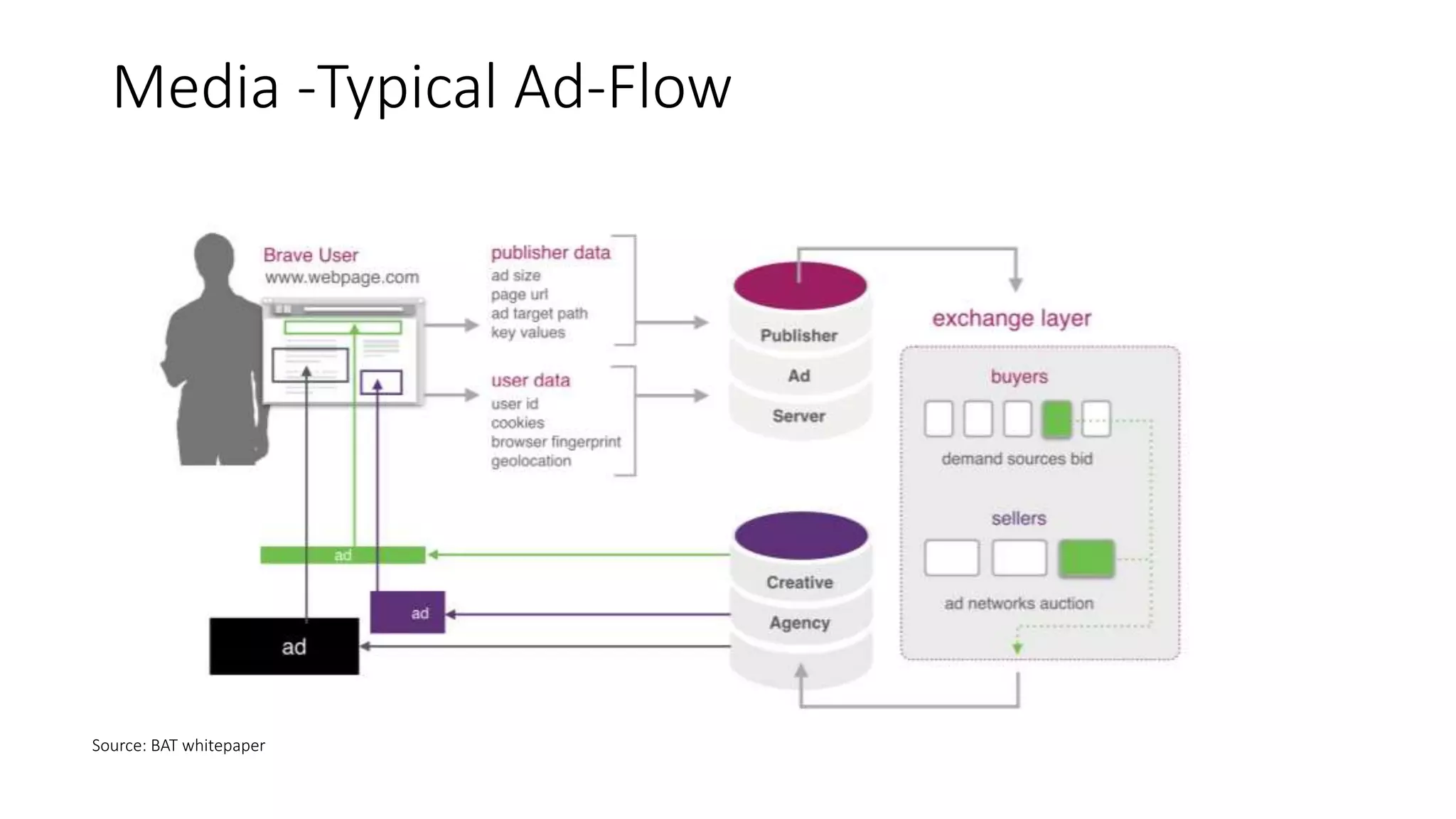
Media -Typical Ad-Flow
Source: BAT whitepaper
Block chain – Media
• Digital Advertising - Challenges
• Advertisers and Publishers Cannot Accurately Verify
One Another Throughout the Supply Chain
• Ad Blockers
• The Cost Per Mille - CPM is an Industry Standard that
Encourages Fraud
• Duopoly of Facebook and Google
Solution
Blockchains provide entities with competing interests the ability to directly coordinate and trust one another without the need for 3rd party intermediaries.
Programmable blockchains, like Ethereum, adChain, permit the creation of tokenized protocols and decentralized applications (dApps). These protocols use
economic incentives and game theory optimization to draw power from a large pool of individual participants to drive a particular outcome or, “the
completion of a process.”
The adChain Registry is a smart contract on the Ethereum blockchain, which keeps a cryptographically secure record of publisher domain names. The
domains listed in the adChain Registry are, “accredited as non-fraudulent by adToken holders.”
• Description
Block chain – BAT Ad-Flow
Source: BAT whitepaper
Media – Reasons for using ad blocker
Block chain – Media
• Onboarding Process – Challenge eliminating middle man
• Companies invest huge on customer onboarding process, in order to maintain identity across
traditional marketing channels, email, and affiliate marketing programs. Customer data that can be
linked by their unique identifier to an individual’s identity graph.
• Companies use CRM process called “onboarding process” which is time consuming and complex
workflows.
Solution
Blockchain reduces the role of the trusted third party to one of providing intelligence (i.e. the algorithms) to
the network for identity matching without the onboarding overhead, thus lowering the cost of maintaining
the identity graph.
Ref: Slide no 18 for Identity mechanism based on Sovrin Provisional TrustFramework
Block chain – Media
• Taxonomy standardization- Challenge
• One operational problem that has truly vexed the advertising industry it is standardizing taxonomies
between participants’ data sets. The Interactive Advertising Bureau (IAB) has at least two on-going
working groups that are constantly providing standards and seeking solutions for these problems
because they have been so intractable and expensive for their members.
• Things like names or abbreviations of advertisers and publishers in the transactional record do not
match. (Microsoft, Microsoft technologies, Microsoft technologies pvt ltd)
• Audience taxonomies between data brokers, partners and others almost never match. (AGE,
AGE_OF_HH, Age Head of HouseHold)
Solution
Blockchain could offer an incredibly simple way to reconcile taxonomies automatically through a shared
ledger and “taxonomy by consensus” algorithms
Reference Material
• “Blockchain 101 – A Visual Demo” - https://www.youtube.com/watch?v=_160oMzblY8
• “The Truth About Blockchain”, Harvard Business Review, https://hbr.org/2017/01/the-truth-about-
blockchain
• “Blockchain Basics: A Primer”, Pillsbury Winthrop Shaw Pittman LLP,
https://www.pillsburylaw.com/images/content/1/0/v2/104160/AdvisoryMay2016CSTechBlockchainBasicsAP
rimer.pdf
• “Blockchain: The Invisible Technology That’s Changing the World”, PC Magazine, Feb 6, 2017,
http://www.pcmag.com/article/351486/blockchain-the-invisible-technology-thats-changing-the-wor
• “Bits on Blocks”, Blog by Antony Lewis, https://bitsonblocks.net/
• “Blockchain and Smart Contract Automation”, PwC Technology Forecast,
http://www.pwc.com/us/en/technology-forecast/blockchain.html
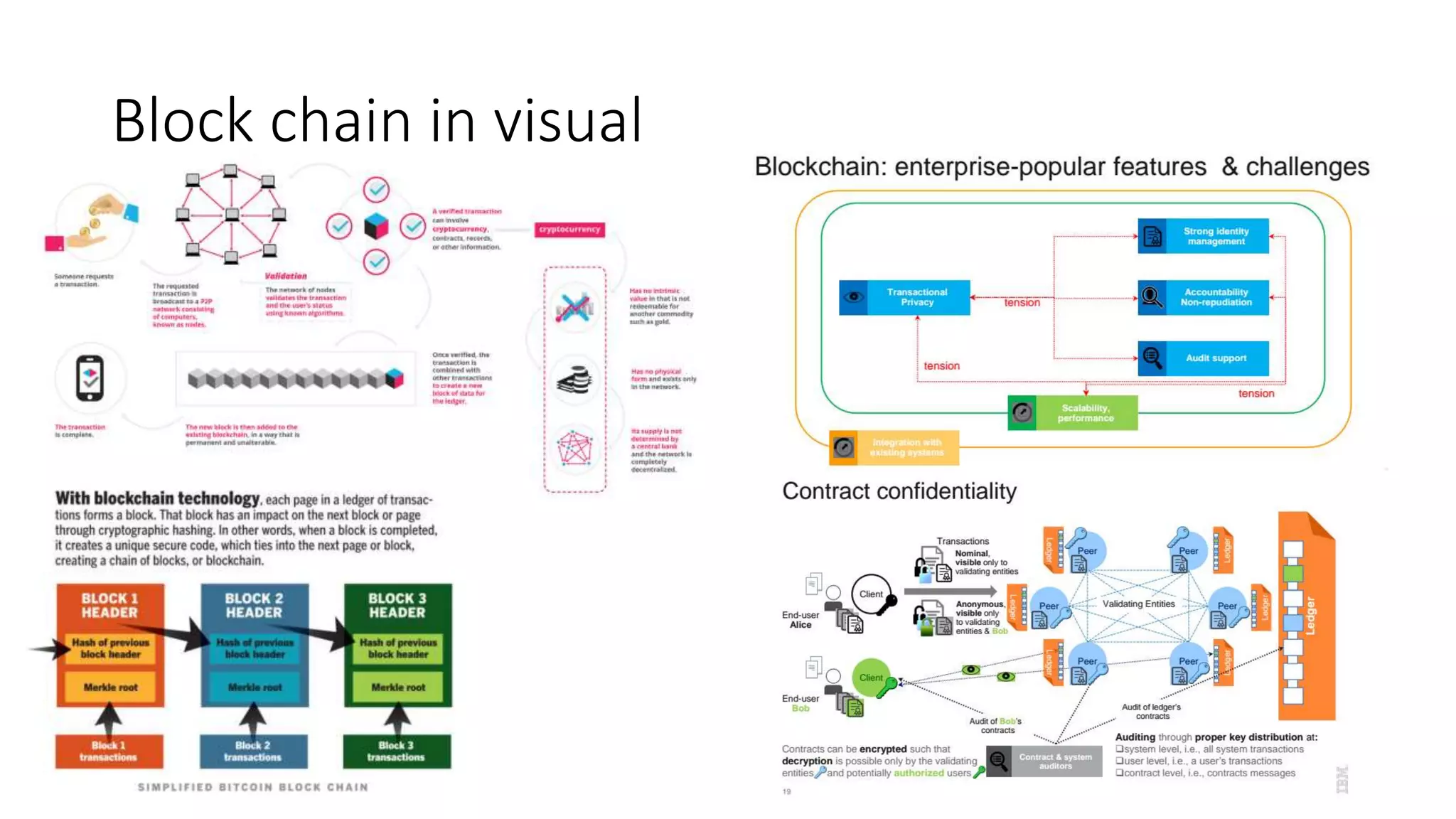
Block chain in visual
Smart Contracts
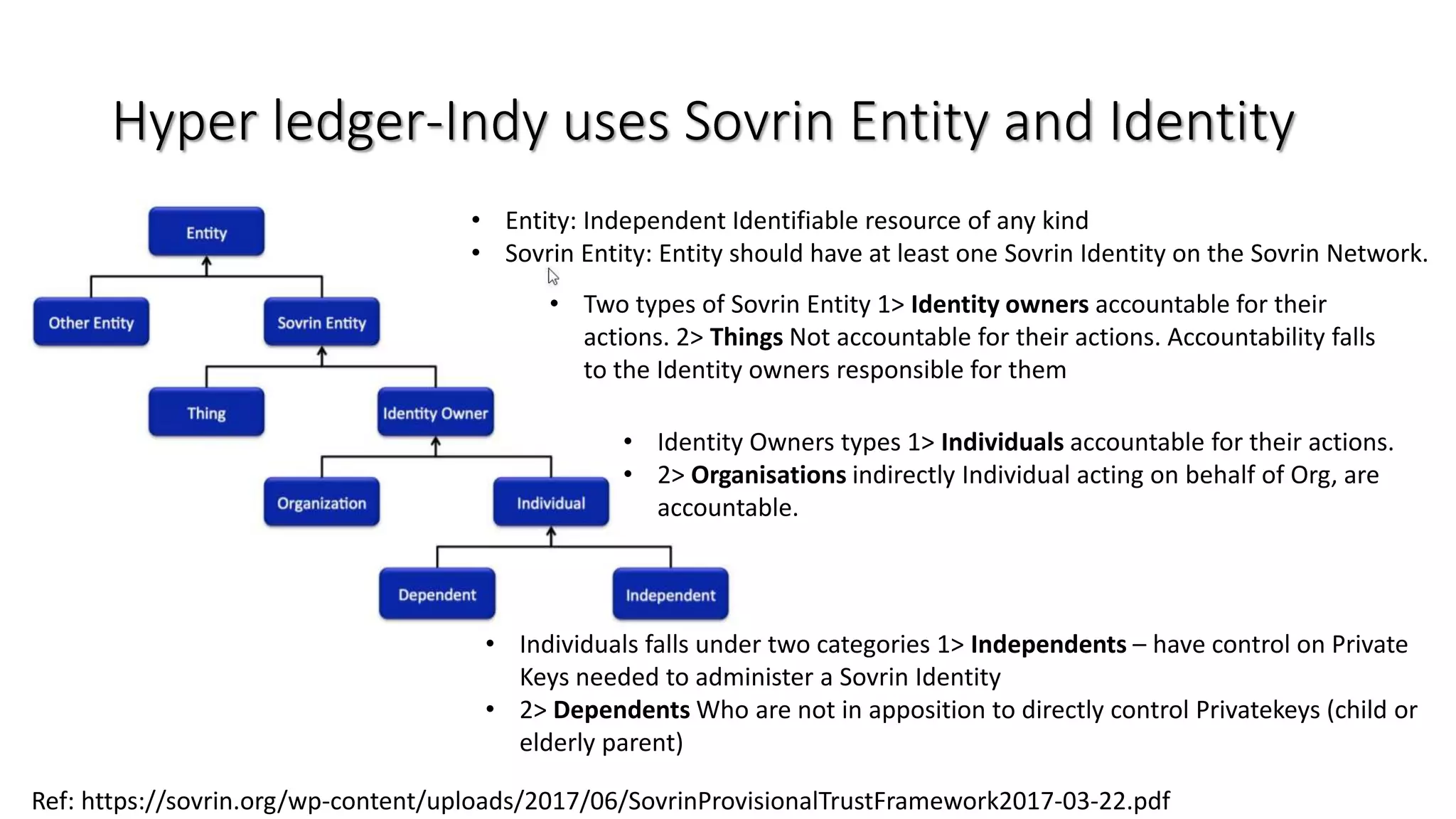
Hyper ledger-Indy uses Sovrin Entity and Identity
• Entity: Independent Identifiable resource of any kind
• Sovrin Entity: Entity should have at least one Sovrin Identity on the Sovrin Network.
• Two types of Sovrin Entity 1> Identity owners accountable for their
actions. 2> Things Not accountable for their actions. Accountability falls
to the Identity owners responsible for them
• Identity Owners types 1> Individuals accountable for their actions.
• 2> Organisations indirectly Individual acting on behalf of Org, are
accountable.
• Individuals falls under two categories 1> Independents – have control on Private
Keys needed to administer a Sovrin Identity
• 2> Dependents Who are not in apposition to directly control Privatekeys (child or
elderly parent)
Ref: https://sovrin.org/wp-content/uploads/2017/06/SovrinProvisionalTrustFramework2017-03-22.pdf

Blockchain in Media

  • 1.
  • 2.
    Agenda 1. What isBlockchain 2. Categories of Blockchain 3. Why Blockchain required 4. Traditional vs. Smart Contracts 5. Use Cases of Smart contracts 6. BlockChain viability check 7. Typical ad workflow 8. Digital Advertising – Use Case 9. Block chain ad workflow 10. Taxonomy standardization – Use Case 11. Onboarding Process – Use Case 12. Reference / Appendix
  • 3.
    Block Chain • Decentralizedand distributed digital ledger that is used to record transactions across many computers (Peer - Peer) so that the record cannot be altered • Historical record of transactions • uses cryptography and digital signatures to prove identity, authenticity and enforce read/write access rights. • Rules and incentives enforced through consensus mechanism • Levels of Blockchain • Storage for digital records • Exchanging digital assets (called tokens) • Executing smart contracts • Ground rules – Terms & conditions recorded in code • Distributed network executes contract & monitors compliance • Outcomes are automatically validated without third party Current paper-based systems drive $18 trillion in transactions per year. Consensus protocols are key to determining the sequence of actions resulting from the contract’s code. This enables peer-to-peer trading of everything from renewable energy to automated hotel room bookings. “Contracts Get Smarter with Blockchain”, CIO Journal, The Wall Street Journal, World Trade Organization, International Trade Statistics 2015, 2015, p. 41.
  • 4.
    Categories of Blockchain PublicBlockchain a public blockchain is a blockchain that anyone in the world can read, anyone in the world can send transactions to and expect to see them included if they are valid, and anyone in the world can participate in the consensus process Consortium Blockchains a consortium blockchain is a blockchain where the consensus process is controlled by a pre-selected set of nodes; for example, one might imagine a consortium of 15 financial institutions, each of which operates a node and of which 10 must sign every block in order for the block to be valid. Fully private Blockchain a fully private blockchain is a blockchain where write permissions are kept centralized to one organization. Read permissions may be public or restricted to an arbitrary extent.
  • 5.
    Contracts, Transactions andRecordkeeping in the Digital Age • The pace of innovation has not mirrored many of other technology- driven business advancements • All companies keep records of transactions but many have no “master ledger”, and further inefficiency is driven by intercompany workflow dependencies • Paradox #1: Contract management • Paradox #2: Securities trading: Speed of transactions vs. speed of settlement • Technology and business use case adoption – a function of novelty and complexity “The Truth About Blockchain”, Iansiti & Lakhani, Harvard Business Review, Jan-Feb 2017
  • 6.
  • 7.
    Block chain Viabilitycheck • A blockchain must be used as a transactional settlement record and immutable proof of the solution’s overlying transactions — whether that “transaction” is storing data, sending money, or shipping something. Note, that transactions do not just encompass financial operations — any action that causes an effect between 2 + n parties is a “transaction” • Any use case that needs a blockchain must be. . . • a process that currently requires middlemen entities to transact between parties, or provide a (centralized) third party service to a client • one that operates in a broader environment where there exists a low amount of trust between parties (one that can benefit from ‘trustless consensus’ amongst involved parties) • one that leverages a transactional assumption between parties (i.e. a client assumes that after they pay the producer, the client will receive some service) — so that there is a need for automated transparency on a viewable and referenceable settlement • Will perform more rapidly and more securely with blockchain implementation that the current state (must at least be an operational improvement) • Right of owner ship of any asset (digital asset, Research document, Video/music album) • Proof of Existence
  • 9.
  • 10.
    Block chain –Media • Digital Advertising - Challenges • Advertisers and Publishers Cannot Accurately Verify One Another Throughout the Supply Chain • Ad Blockers • The Cost Per Mille - CPM is an Industry Standard that Encourages Fraud • Duopoly of Facebook and Google Solution Blockchains provide entities with competing interests the ability to directly coordinate and trust one another without the need for 3rd party intermediaries. Programmable blockchains, like Ethereum, adChain, permit the creation of tokenized protocols and decentralized applications (dApps). These protocols use economic incentives and game theory optimization to draw power from a large pool of individual participants to drive a particular outcome or, “the completion of a process.” The adChain Registry is a smart contract on the Ethereum blockchain, which keeps a cryptographically secure record of publisher domain names. The domains listed in the adChain Registry are, “accredited as non-fraudulent by adToken holders.” • Description
  • 11.
    Block chain –BAT Ad-Flow Source: BAT whitepaper
  • 12.
    Media – Reasonsfor using ad blocker
  • 13.
    Block chain –Media • Onboarding Process – Challenge eliminating middle man • Companies invest huge on customer onboarding process, in order to maintain identity across traditional marketing channels, email, and affiliate marketing programs. Customer data that can be linked by their unique identifier to an individual’s identity graph. • Companies use CRM process called “onboarding process” which is time consuming and complex workflows. Solution Blockchain reduces the role of the trusted third party to one of providing intelligence (i.e. the algorithms) to the network for identity matching without the onboarding overhead, thus lowering the cost of maintaining the identity graph. Ref: Slide no 18 for Identity mechanism based on Sovrin Provisional TrustFramework
  • 14.
    Block chain –Media • Taxonomy standardization- Challenge • One operational problem that has truly vexed the advertising industry it is standardizing taxonomies between participants’ data sets. The Interactive Advertising Bureau (IAB) has at least two on-going working groups that are constantly providing standards and seeking solutions for these problems because they have been so intractable and expensive for their members. • Things like names or abbreviations of advertisers and publishers in the transactional record do not match. (Microsoft, Microsoft technologies, Microsoft technologies pvt ltd) • Audience taxonomies between data brokers, partners and others almost never match. (AGE, AGE_OF_HH, Age Head of HouseHold) Solution Blockchain could offer an incredibly simple way to reconcile taxonomies automatically through a shared ledger and “taxonomy by consensus” algorithms
  • 15.
    Reference Material • “Blockchain101 – A Visual Demo” - https://www.youtube.com/watch?v=_160oMzblY8 • “The Truth About Blockchain”, Harvard Business Review, https://hbr.org/2017/01/the-truth-about- blockchain • “Blockchain Basics: A Primer”, Pillsbury Winthrop Shaw Pittman LLP, https://www.pillsburylaw.com/images/content/1/0/v2/104160/AdvisoryMay2016CSTechBlockchainBasicsAP rimer.pdf • “Blockchain: The Invisible Technology That’s Changing the World”, PC Magazine, Feb 6, 2017, http://www.pcmag.com/article/351486/blockchain-the-invisible-technology-thats-changing-the-wor • “Bits on Blocks”, Blog by Antony Lewis, https://bitsonblocks.net/ • “Blockchain and Smart Contract Automation”, PwC Technology Forecast, http://www.pwc.com/us/en/technology-forecast/blockchain.html
  • 16.
  • 17.
  • 18.
    Hyper ledger-Indy usesSovrin Entity and Identity • Entity: Independent Identifiable resource of any kind • Sovrin Entity: Entity should have at least one Sovrin Identity on the Sovrin Network. • Two types of Sovrin Entity 1> Identity owners accountable for their actions. 2> Things Not accountable for their actions. Accountability falls to the Identity owners responsible for them • Identity Owners types 1> Individuals accountable for their actions. • 2> Organisations indirectly Individual acting on behalf of Org, are accountable. • Individuals falls under two categories 1> Independents – have control on Private Keys needed to administer a Sovrin Identity • 2> Dependents Who are not in apposition to directly control Privatekeys (child or elderly parent) Ref: https://sovrin.org/wp-content/uploads/2017/06/SovrinProvisionalTrustFramework2017-03-22.pdf