“GLOBALISATION”
By
Dr.D.Ilangovan, Professor & Head, Dept. of
Commerce,
Annamalai University, Annamalainagar-608 002
TN
E.Mail: dil2691@yahoo.co.in Mob:
What is Globalization?
 “process in which the constraints of geography recede
and in which people become aware that they are
receding”
 “widening, deepening and speeding up of worldwide
interconnectedness in all aspects of life”
 process by which networks of interdependence
become large and continuous, or “thick”
2
Prof.D.Ilangovan, HD Commerce AU
18-04-2020
What is Globalization?
 a quantitative and qualitative change
 not only economic
 4 dimensions:
 Space - extensiveness of global networks
 Regularity - intensity of global interactions
 Speed - velocity of global flows
 Depth – impact of global interconnections on
quality of life
3
Prof.D.Ilangovan, HD Commerce AU
18-04-2020
When did globalization begin?
 Underway since dawn of history
 Emerged with industrialization and capitalism
 Recent development of Information Age
 Globalization not linear
 Ebbs and flows with politics
4
Prof.D.Ilangovan, HD Commerce AU
18-04-2020
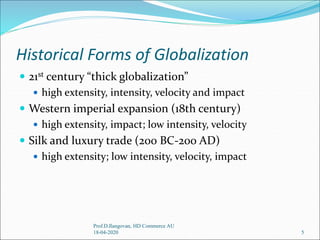
Historical Forms of Globalization
 21st century “thick globalization”
 high extensity, intensity, velocity and impact
 Western imperial expansion (18th century)
 high extensity, impact; low intensity, velocity
 Silk and luxury trade (200 BC-200 AD)
 high extensity; low intensity, velocity, impact
5
Prof.D.Ilangovan, HD Commerce AU
18-04-2020
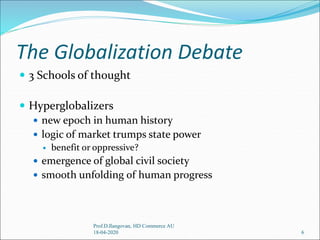
The Globalization Debate
 3 Schools of thought
 Hyperglobalizers
 new epoch in human history
 logic of market trumps state power
 benefit or oppressive?
 emergence of global civil society
 smooth unfolding of human progress
6
Prof.D.Ilangovan, HD Commerce AU
18-04-2020
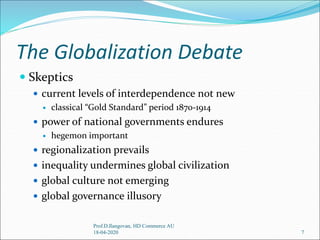
The Globalization Debate
 Skeptics
 current levels of interdependence not new
 classical “Gold Standard” period 1870-1914
 power of national governments endures
 hegemon important
 regionalization prevails
 inequality undermines global civilization
 global culture not emerging
 global governance illusory
7
Prof.D.Ilangovan, HD Commerce AU
18-04-2020
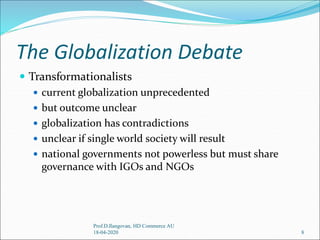
The Globalization Debate
 Transformationalists
 current globalization unprecedented
 but outcome unclear
 globalization has contradictions
 unclear if single world society will result
 national governments not powerless but must share
governance with IGOs and NGOs
8
Prof.D.Ilangovan, HD Commerce AU
18-04-2020
Theme 1: Integration-Fragmentation
 Integration - breaking down barriers historically
separating people
 communications, economics, security, ideas
 Fragmentation
 nationalism, regionalization, religion, ethnic conflict,
inequality
9
Prof.D.Ilangovan, HD Commerce AU
18-04-2020
Theme 1: Integration-Fragmentation
Dilemma
 integration satisfies material needs, freedom from
want
 fragmentation satisfies non-material desires, freedom
from fear
10
Prof.D.Ilangovan, HD Commerce AU
18-04-2020
Theme 1: Integration-Fragmentation
 Examples of fragmentation and inequality
 Africa – region of the world most excluded from global
economy
 Access to information technology – the “digital divide”
 Science and technology for public health and food
production skewed to solve problems of developed world
over those of poor countries
11
Prof.D.Ilangovan, HD Commerce AU
18-04-2020
Theme 1: Integration-Fragmentation
Summary - Fragmentation can be viewed as:
 Nationalism, ethnic conflict, identity
 Regionalization
 Inequality
12
Prof.D.Ilangovan, HD Commerce AU
18-04-2020
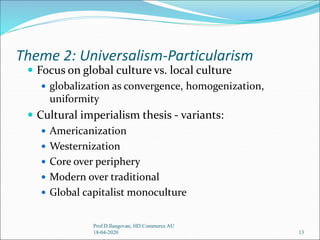
Theme 2: Universalism-Particularism
 Focus on global culture vs. local culture
 globalization as convergence, homogenization,
uniformity
 Cultural imperialism thesis - variants:
 Americanization
 Westernization
 Core over periphery
 Modern over traditional
 Global capitalist monoculture
13
Prof.D.Ilangovan, HD Commerce AU
18-04-2020
Theme 3: Borderless World-Sovereignty
 What are states?
 Why are states under pressure?
 Causes of state decline
 market forces; technology; skills revolution
 But states not powerless
 Historically rooted political agents interact with
increasingly globalized economic agents
14
Prof.D.Ilangovan, HD Commerce AU
18-04-2020
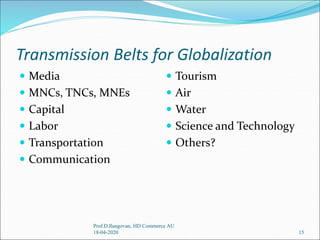
Transmission Belts for Globalization
 Media
 MNCs, TNCs, MNEs
 Capital
 Labor
 Transportation
 Communication
 Tourism
 Air
 Water
 Science and Technology
 Others?
15
Prof.D.Ilangovan, HD Commerce AU
18-04-2020
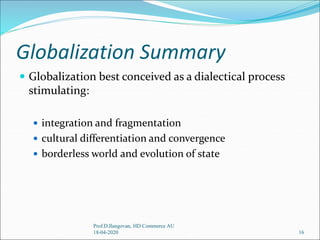
Globalization Summary
 Globalization best conceived as a dialectical process
stimulating:
 integration and fragmentation
 cultural differentiation and convergence
 borderless world and evolution of state
16
Prof.D.Ilangovan, HD Commerce AU
18-04-2020
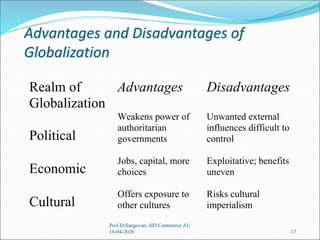
Advantages and Disadvantages of
Globalization
Realm of
Globalization
Advantages Disadvantages
Political
Weakens power of
authoritarian
governments
Unwanted external
influences difficult to
control
Economic
Jobs, capital, more
choices
Exploitative; benefits
uneven
Cultural
Offers exposure to
other cultures
Risks cultural
imperialism
17
Prof.D.Ilangovan, HD Commerce AU
18-04-2020
THANK YOU ALL
Prof.D.Ilangovan, HD Commerce AU
18-04-2020 18

Globalization.ppt

  • 1.
    “GLOBALISATION” By Dr.D.Ilangovan, Professor &Head, Dept. of Commerce, Annamalai University, Annamalainagar-608 002 TN E.Mail: dil2691@yahoo.co.in Mob:
  • 2.
    What is Globalization? “process in which the constraints of geography recede and in which people become aware that they are receding”  “widening, deepening and speeding up of worldwide interconnectedness in all aspects of life”  process by which networks of interdependence become large and continuous, or “thick” 2 Prof.D.Ilangovan, HD Commerce AU 18-04-2020
  • 3.
    What is Globalization? a quantitative and qualitative change  not only economic  4 dimensions:  Space - extensiveness of global networks  Regularity - intensity of global interactions  Speed - velocity of global flows  Depth – impact of global interconnections on quality of life 3 Prof.D.Ilangovan, HD Commerce AU 18-04-2020
  • 4.
    When did globalizationbegin?  Underway since dawn of history  Emerged with industrialization and capitalism  Recent development of Information Age  Globalization not linear  Ebbs and flows with politics 4 Prof.D.Ilangovan, HD Commerce AU 18-04-2020
  • 5.
    Historical Forms ofGlobalization  21st century “thick globalization”  high extensity, intensity, velocity and impact  Western imperial expansion (18th century)  high extensity, impact; low intensity, velocity  Silk and luxury trade (200 BC-200 AD)  high extensity; low intensity, velocity, impact 5 Prof.D.Ilangovan, HD Commerce AU 18-04-2020
  • 6.
    The Globalization Debate 3 Schools of thought  Hyperglobalizers  new epoch in human history  logic of market trumps state power  benefit or oppressive?  emergence of global civil society  smooth unfolding of human progress 6 Prof.D.Ilangovan, HD Commerce AU 18-04-2020
  • 7.
    The Globalization Debate Skeptics  current levels of interdependence not new  classical “Gold Standard” period 1870-1914  power of national governments endures  hegemon important  regionalization prevails  inequality undermines global civilization  global culture not emerging  global governance illusory 7 Prof.D.Ilangovan, HD Commerce AU 18-04-2020
  • 8.
    The Globalization Debate Transformationalists  current globalization unprecedented  but outcome unclear  globalization has contradictions  unclear if single world society will result  national governments not powerless but must share governance with IGOs and NGOs 8 Prof.D.Ilangovan, HD Commerce AU 18-04-2020
  • 9.
    Theme 1: Integration-Fragmentation Integration - breaking down barriers historically separating people  communications, economics, security, ideas  Fragmentation  nationalism, regionalization, religion, ethnic conflict, inequality 9 Prof.D.Ilangovan, HD Commerce AU 18-04-2020
  • 10.
    Theme 1: Integration-Fragmentation Dilemma integration satisfies material needs, freedom from want  fragmentation satisfies non-material desires, freedom from fear 10 Prof.D.Ilangovan, HD Commerce AU 18-04-2020
  • 11.
    Theme 1: Integration-Fragmentation Examples of fragmentation and inequality  Africa – region of the world most excluded from global economy  Access to information technology – the “digital divide”  Science and technology for public health and food production skewed to solve problems of developed world over those of poor countries 11 Prof.D.Ilangovan, HD Commerce AU 18-04-2020
  • 12.
    Theme 1: Integration-Fragmentation Summary- Fragmentation can be viewed as:  Nationalism, ethnic conflict, identity  Regionalization  Inequality 12 Prof.D.Ilangovan, HD Commerce AU 18-04-2020
  • 13.
    Theme 2: Universalism-Particularism Focus on global culture vs. local culture  globalization as convergence, homogenization, uniformity  Cultural imperialism thesis - variants:  Americanization  Westernization  Core over periphery  Modern over traditional  Global capitalist monoculture 13 Prof.D.Ilangovan, HD Commerce AU 18-04-2020
  • 14.
    Theme 3: BorderlessWorld-Sovereignty  What are states?  Why are states under pressure?  Causes of state decline  market forces; technology; skills revolution  But states not powerless  Historically rooted political agents interact with increasingly globalized economic agents 14 Prof.D.Ilangovan, HD Commerce AU 18-04-2020
  • 15.
    Transmission Belts forGlobalization  Media  MNCs, TNCs, MNEs  Capital  Labor  Transportation  Communication  Tourism  Air  Water  Science and Technology  Others? 15 Prof.D.Ilangovan, HD Commerce AU 18-04-2020
  • 16.
    Globalization Summary  Globalizationbest conceived as a dialectical process stimulating:  integration and fragmentation  cultural differentiation and convergence  borderless world and evolution of state 16 Prof.D.Ilangovan, HD Commerce AU 18-04-2020
  • 17.
    Advantages and Disadvantagesof Globalization Realm of Globalization Advantages Disadvantages Political Weakens power of authoritarian governments Unwanted external influences difficult to control Economic Jobs, capital, more choices Exploitative; benefits uneven Cultural Offers exposure to other cultures Risks cultural imperialism 17 Prof.D.Ilangovan, HD Commerce AU 18-04-2020
  • 18.
    THANK YOU ALL Prof.D.Ilangovan,HD Commerce AU 18-04-2020 18