








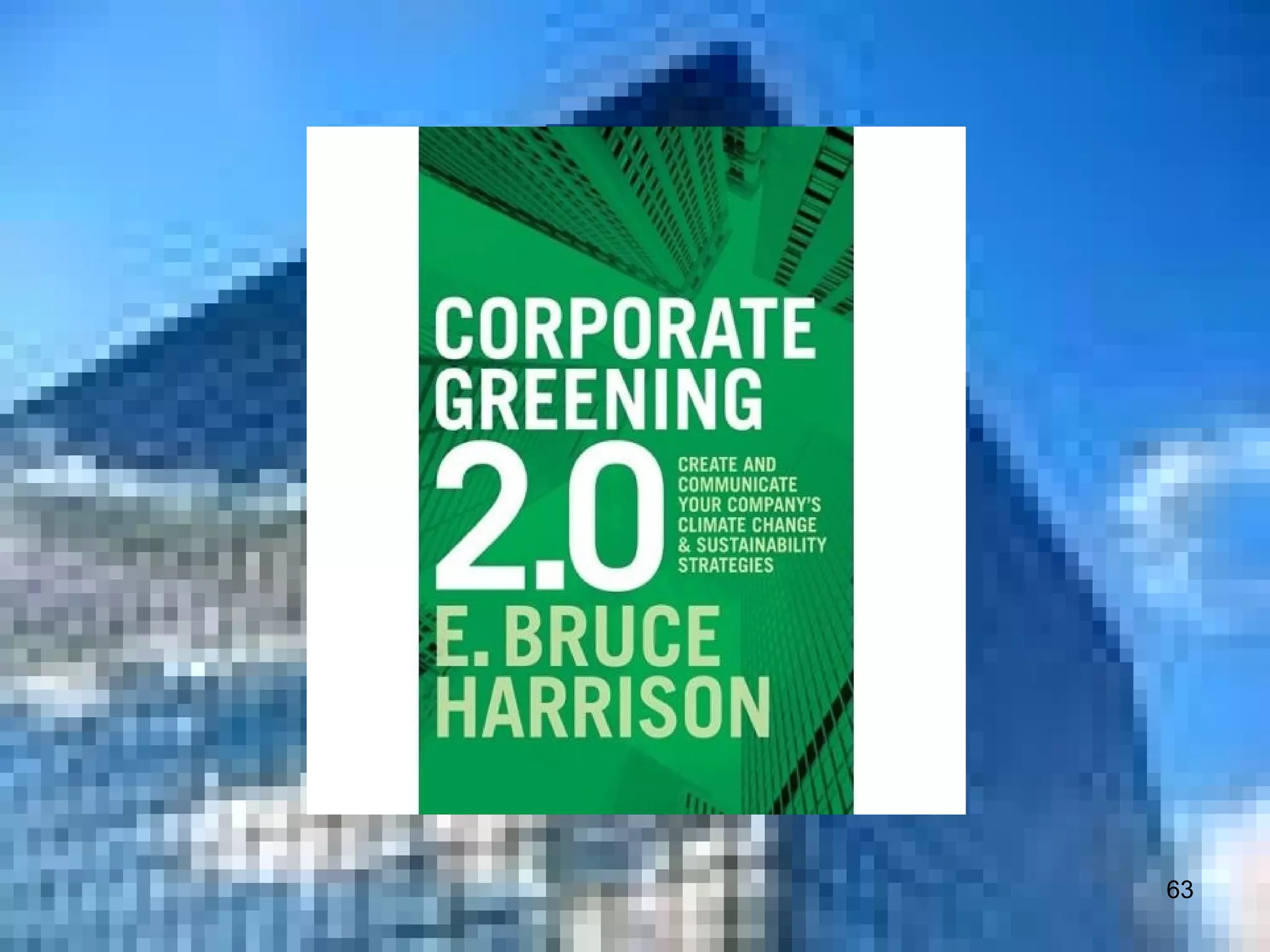










Corporate  Greening  2.0 E. Bruce Harrison EnviroComm International
“ I’m in PR.” What do you  do ?
Who are the stakeholders? What do they need to know? Therefore, what do I do?
“ I’m in PR.” What do you  do ?
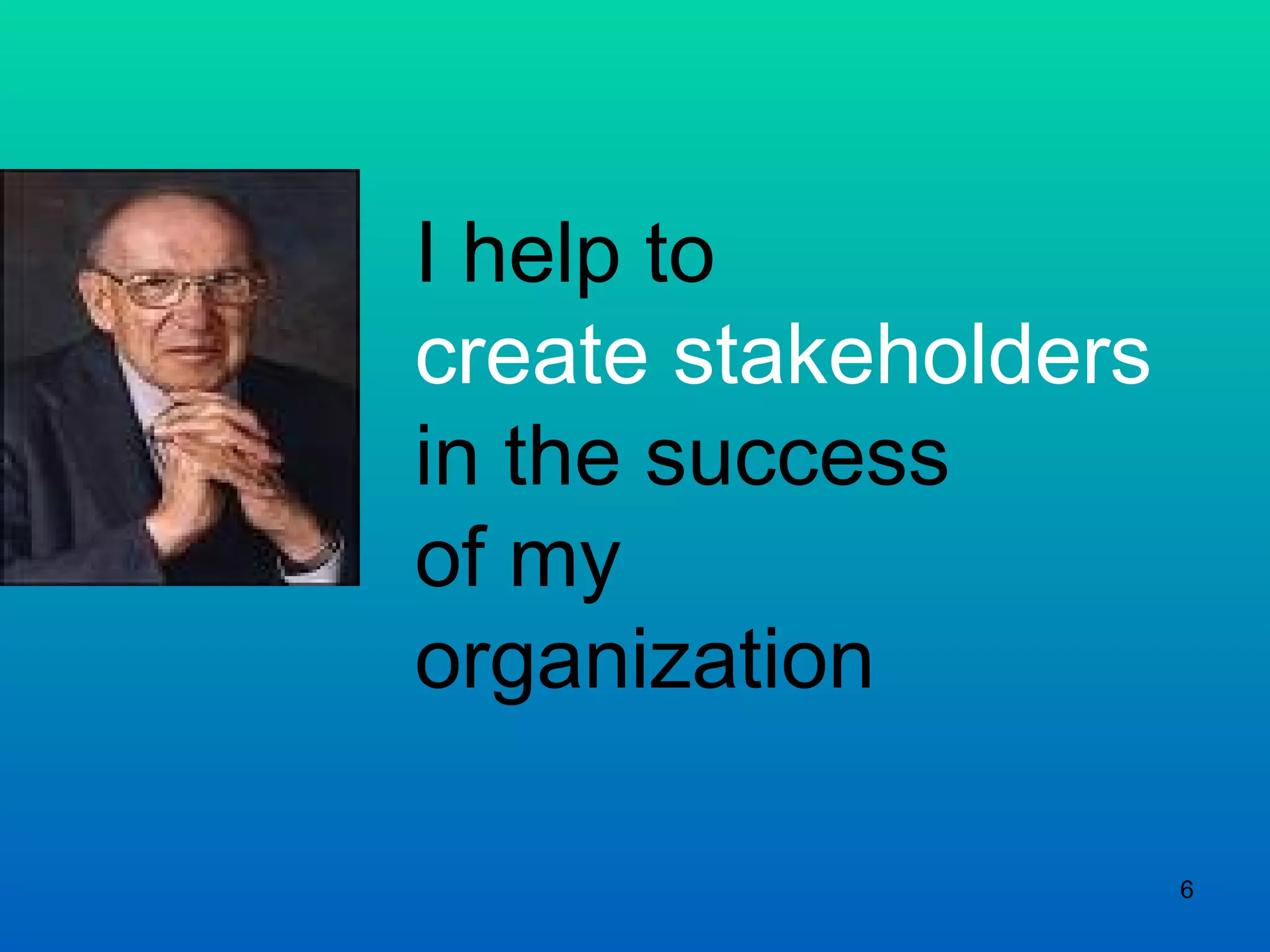
I help to  create stakeholders in the success  of my  organization
Company  success  depends on  stakeholder permission
A definition of PR The  management process  of  creating stakeholders in the  success  of the organization .
I am Bruce Harrison My topic today is… Creating and communicating corporate climate change and sustainability strategies
CORPORATE GREENING What’s happened? When and how did it change? What’s likely to happen? Who are the  stakeholders ? What do they need from communicators? What do we need to know? What do public relations people  do ?
As the chief communicator,  what value can you bring?
"If you don't have a seat at the table,  you'll wind up on the menu.“ - Jim Rogers, CEO, Duke Energy
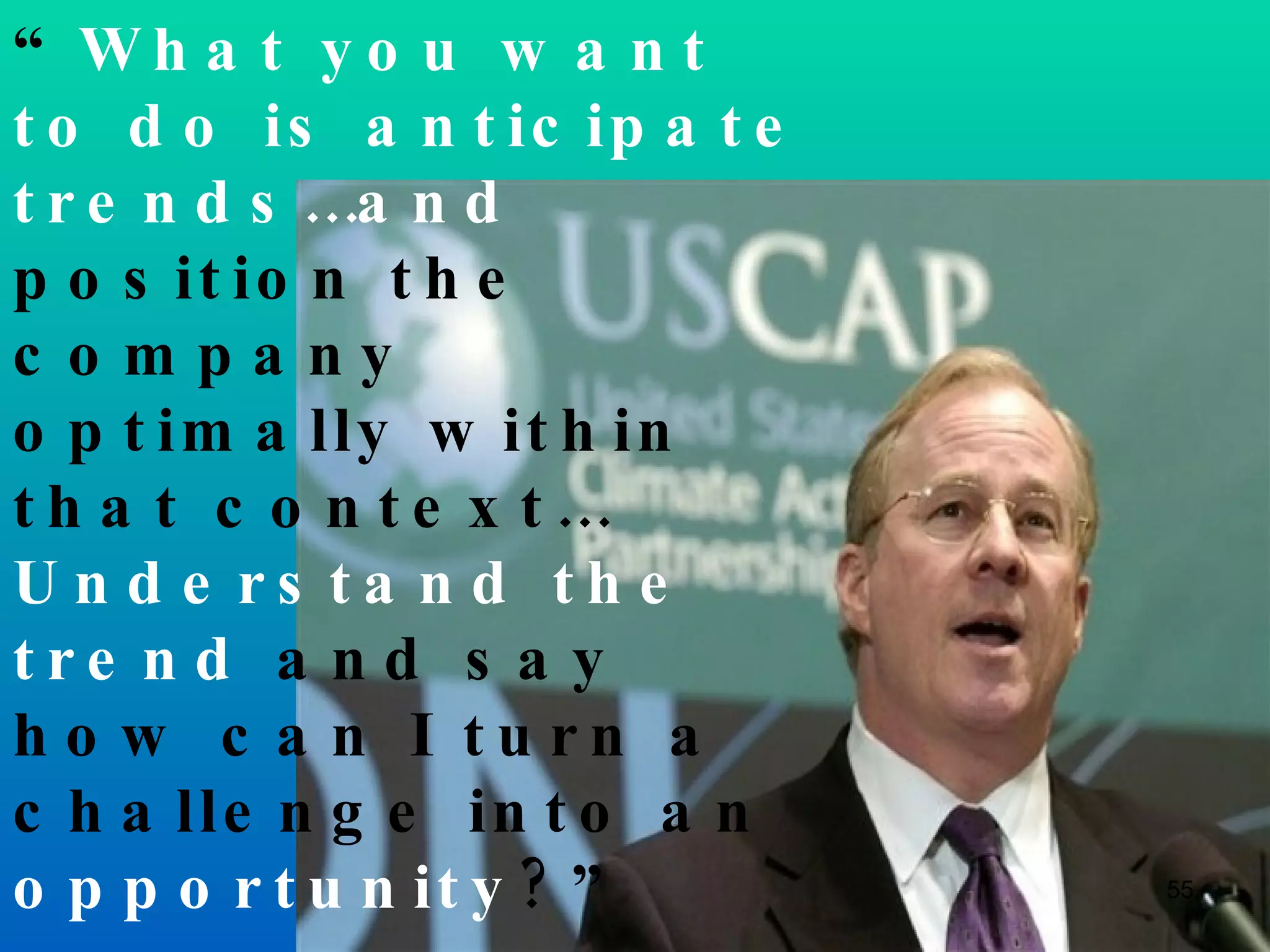
“ What you want to do is anticipate trends…and position the company optimally within that context… Understand the trend and say how can I turn a challenge into an opportunity?” Peter Darbee  PG&E, 2007
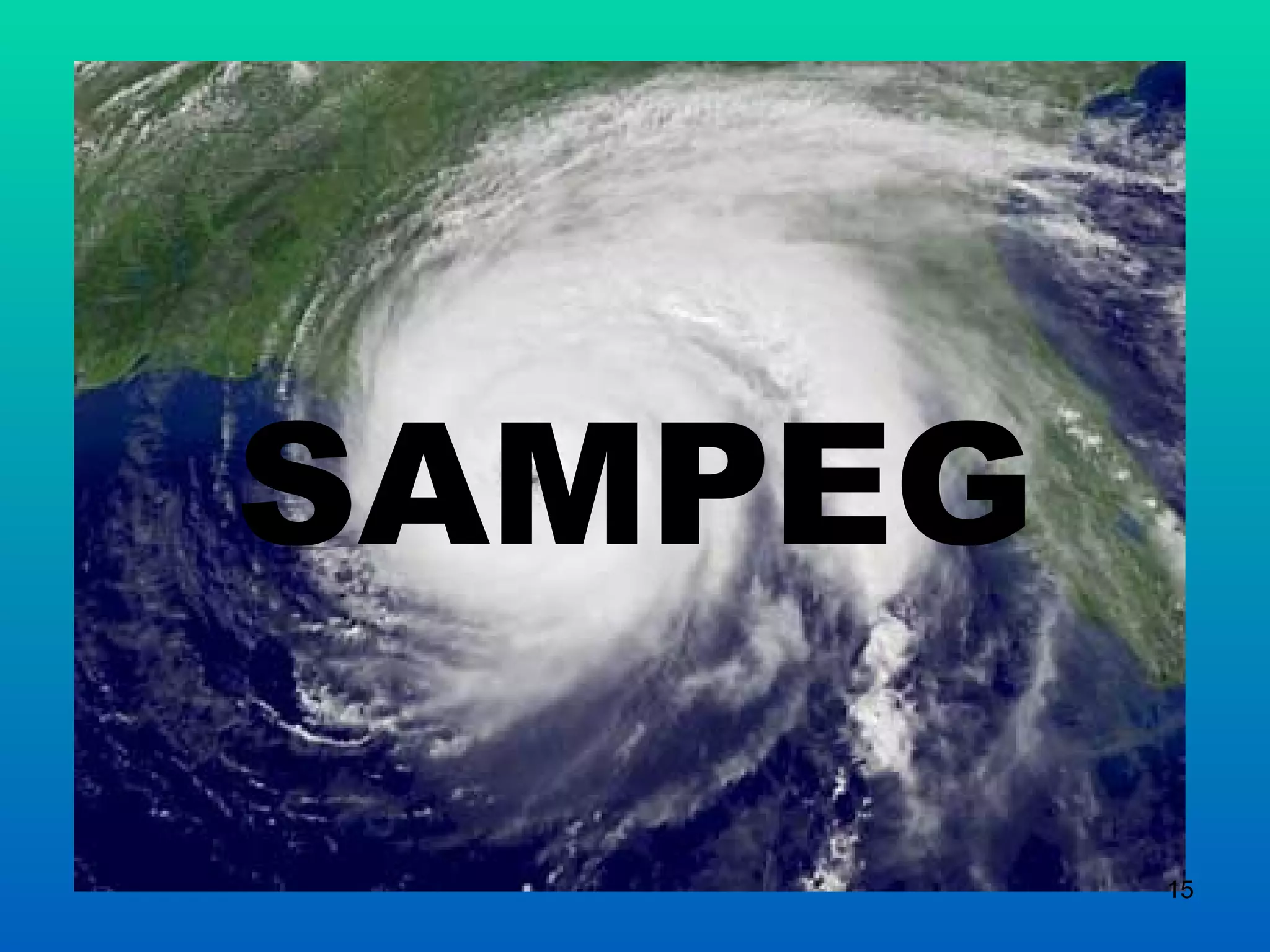
SAMPEG
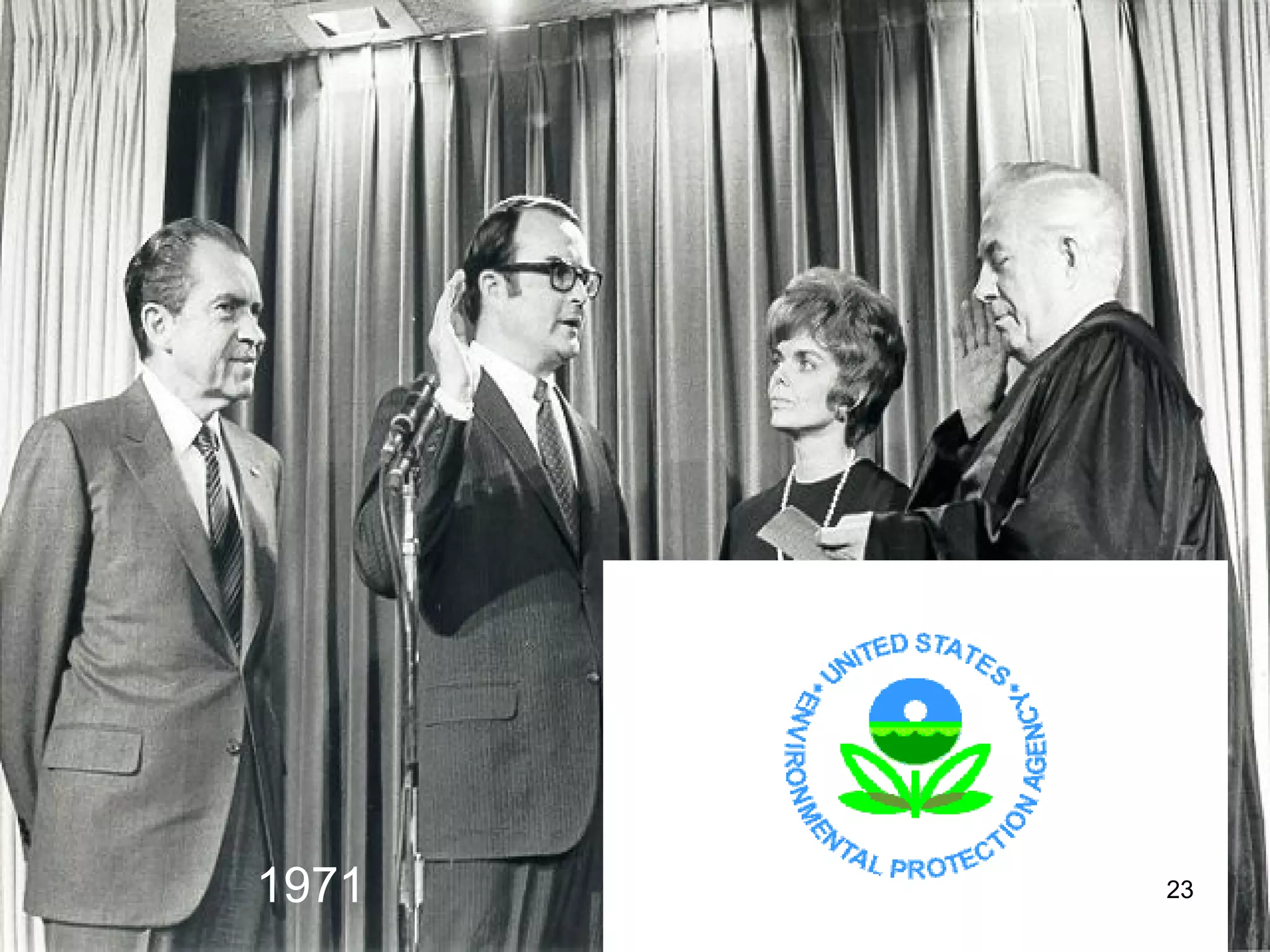
1971
1973
1971
1987
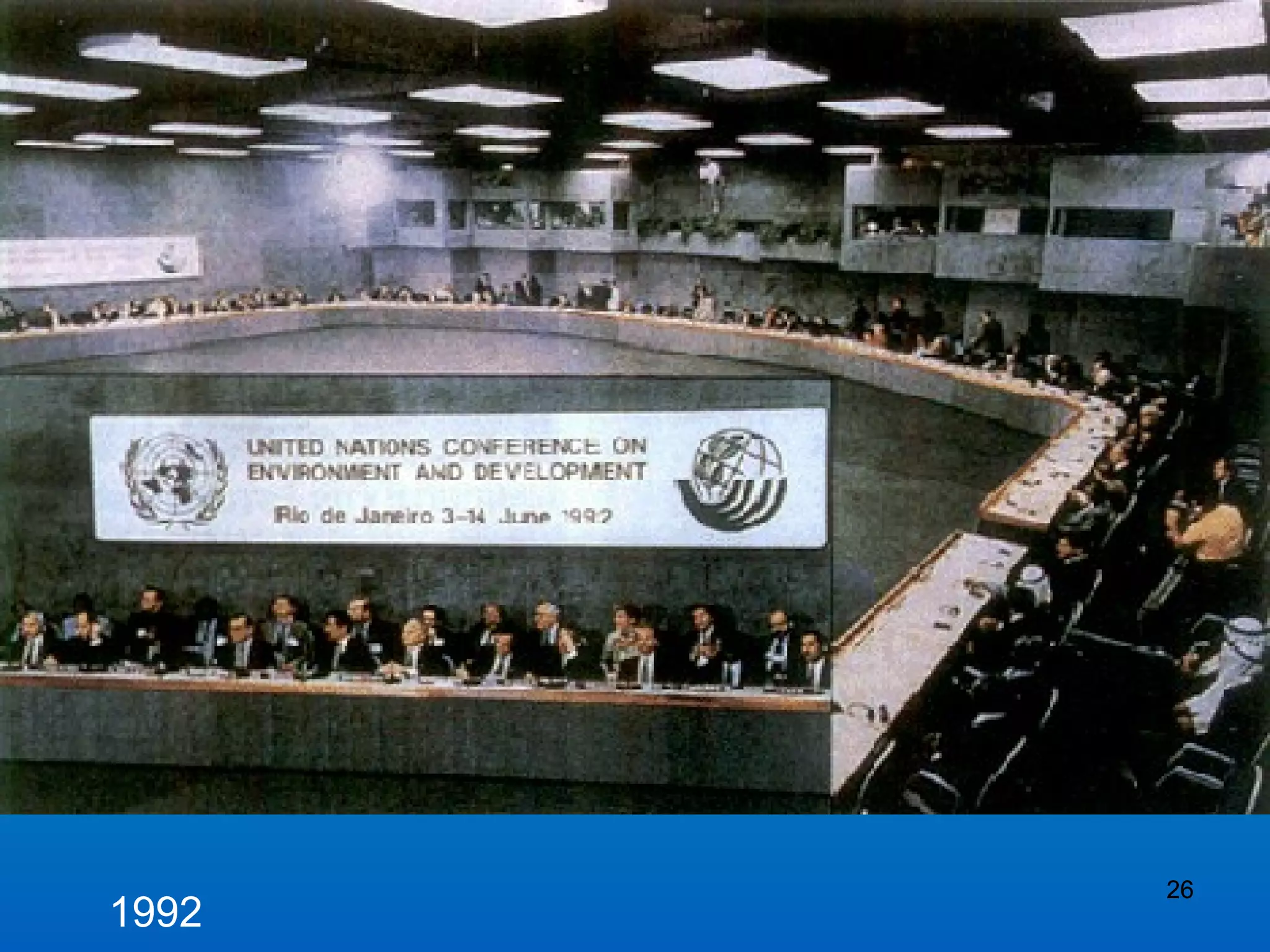
1992
Implications of  Corporate Greening 1.0 1960s – 1990s
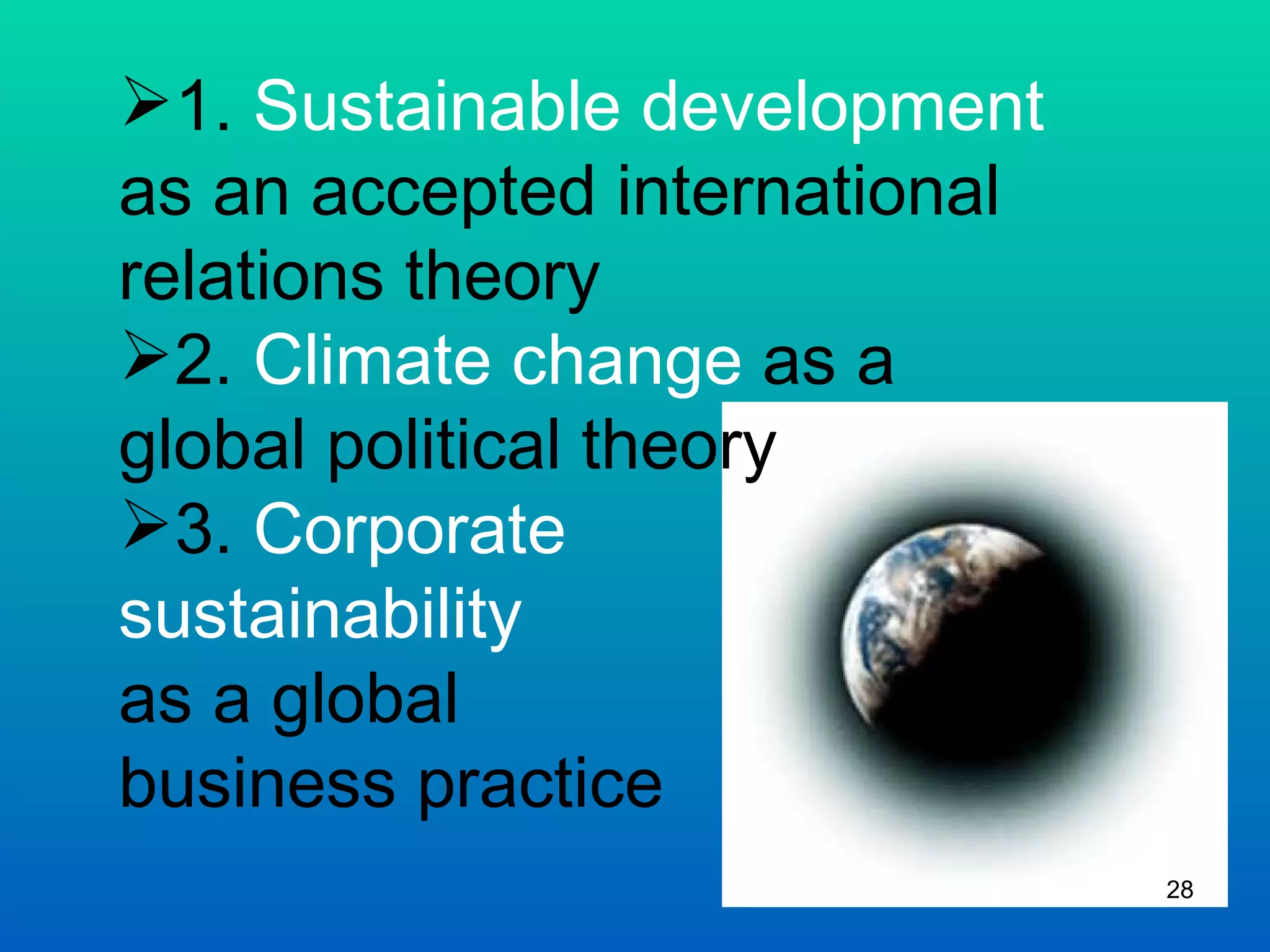
1.  Sustainable development  as an accepted international relations theory 2.  Climate change  as a  global political theory 3.  Corporate  sustainability as a global  business practice
Key sociopolitical Implications Backpackers as activists Scientists as originators US politicians as policy leaders
Corporate Greening 2.0
Forward Factors Engaging  Corporate Communications Approval of cap and trade Application of state-led CO2 air rules Transparency of business data More sophisticated score keeping Highly active carbon trading market Well funded carbon-constraint R&D Well funded public interest campaigns
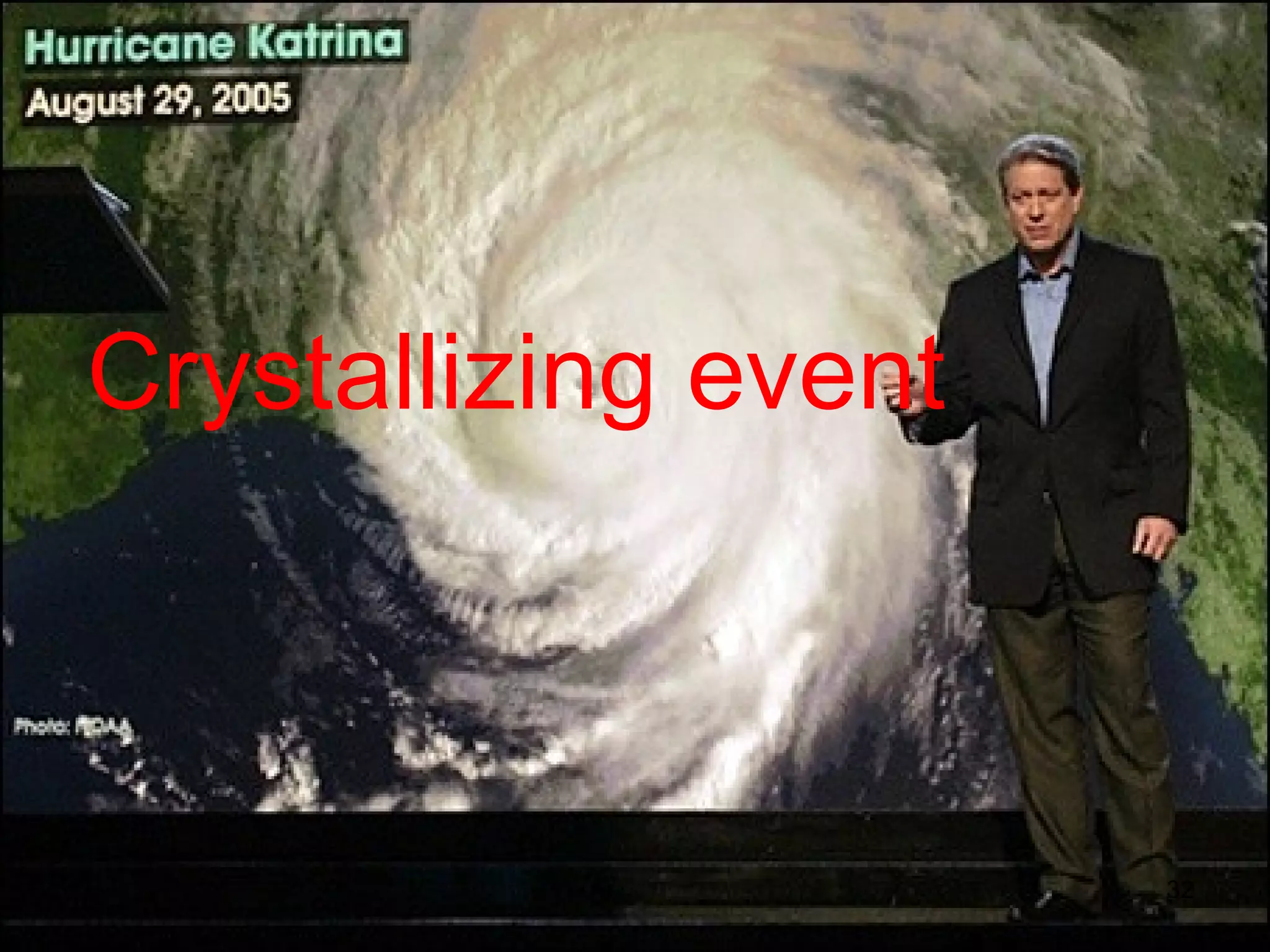
Crystallizing event
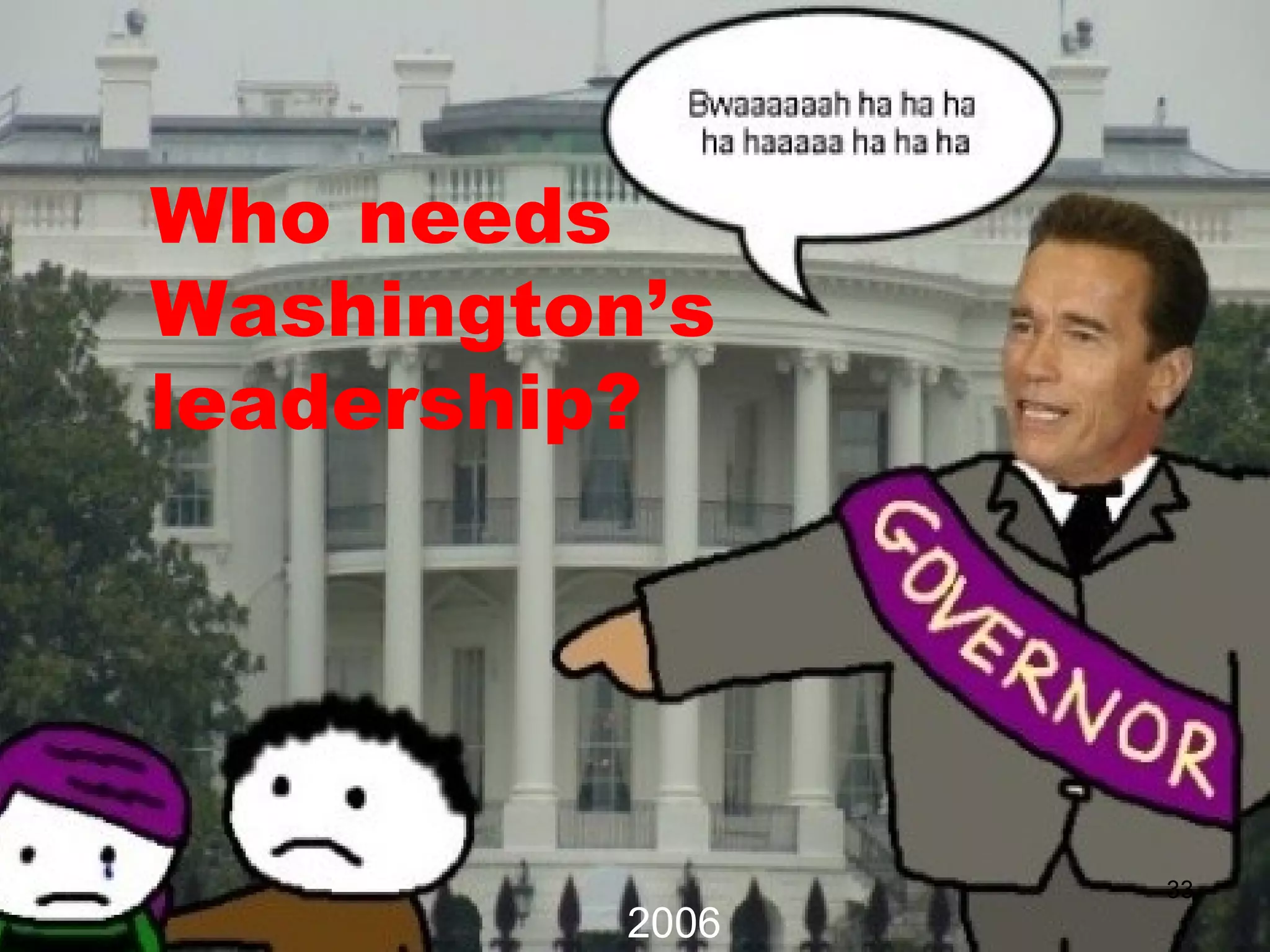
Who needs Washington’s leadership? 2006
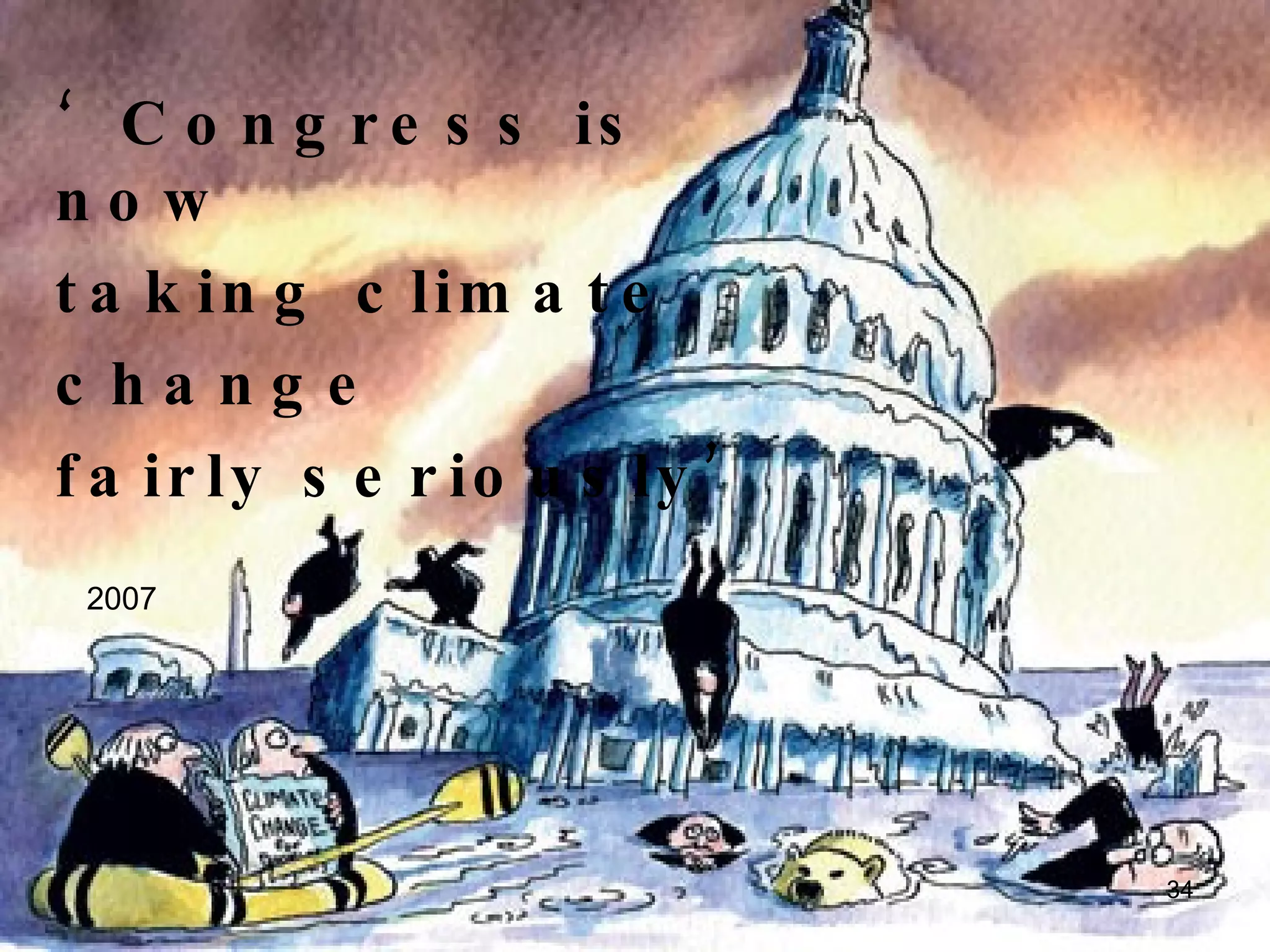
‘ Congress is now  taking climate  change  fairly seriously’ 2007
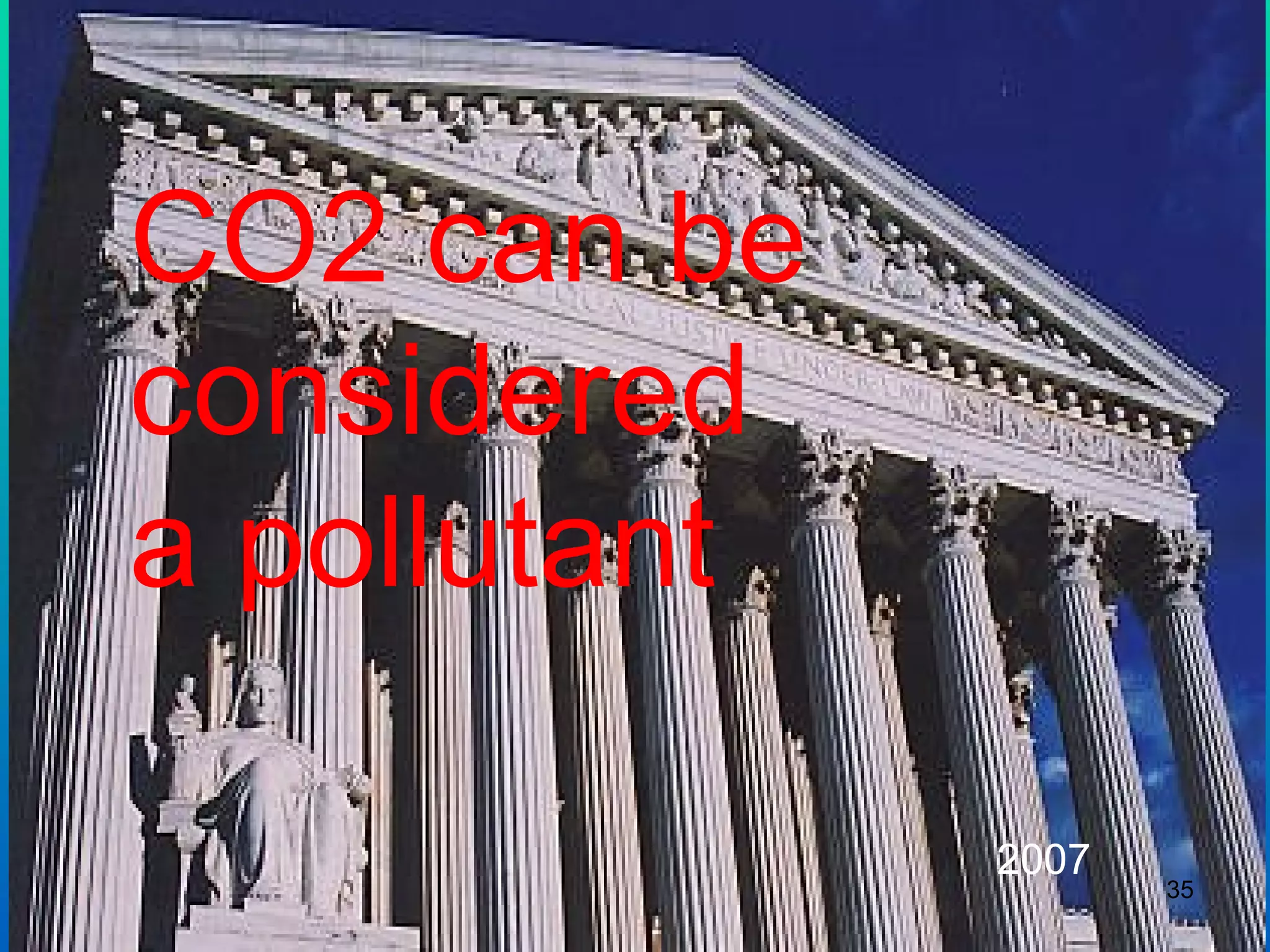
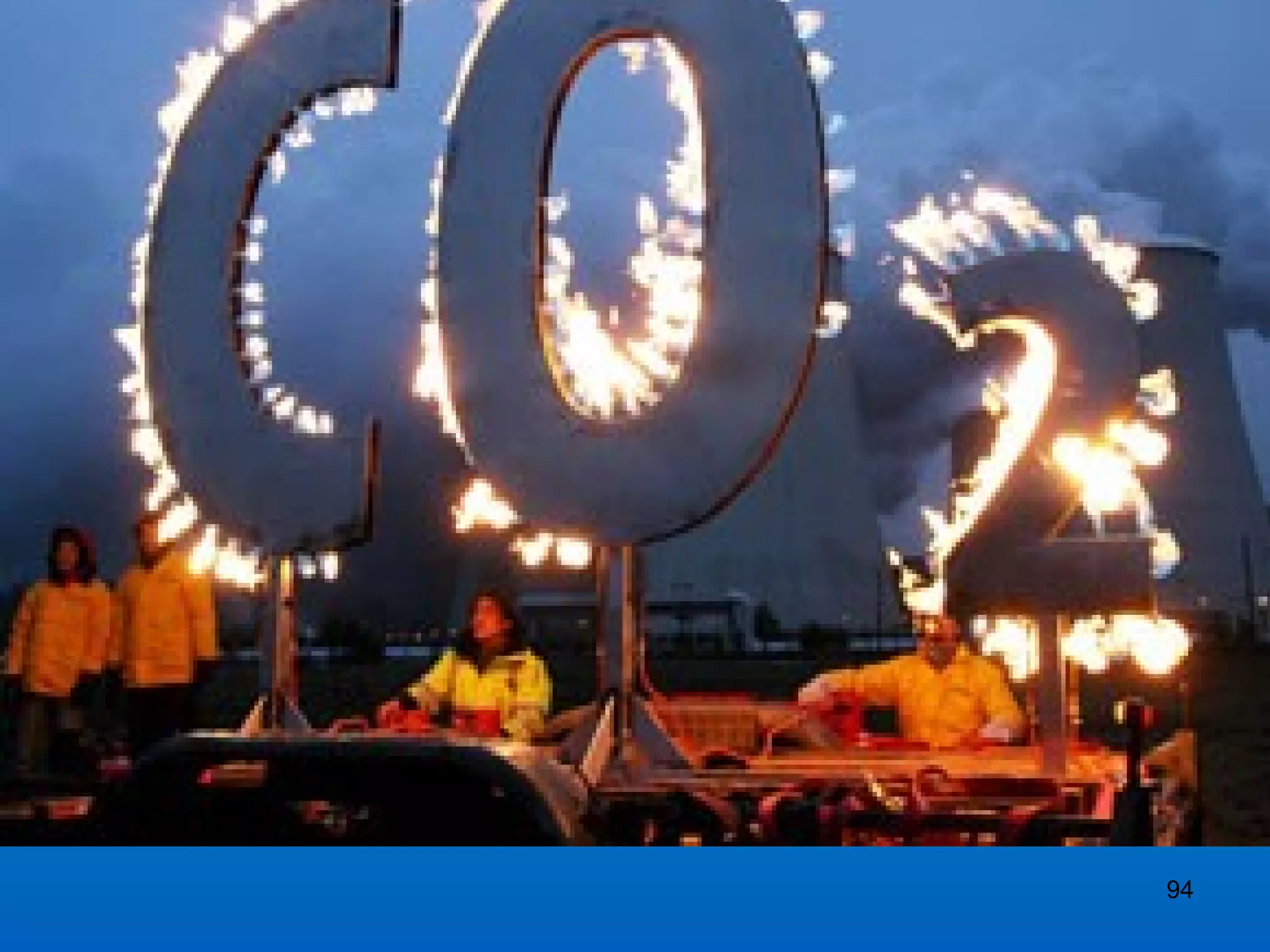
CO2 can be  considered a pollutant 2007
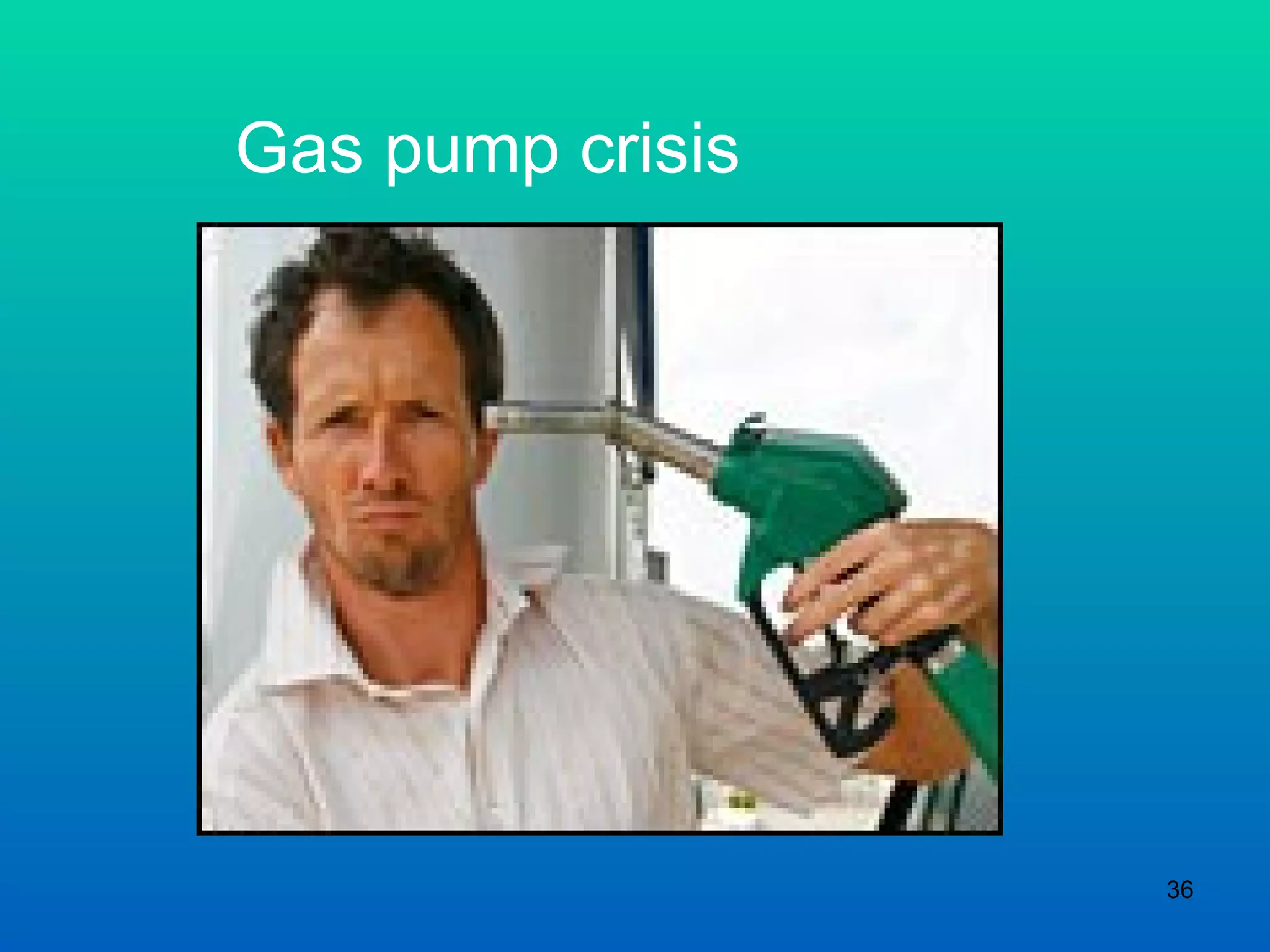
Gas pump crisis
Katrina Gore Governors Congress Supreme Court Fuel prices ‘ GREEN’ BECOMES THE COMEBACK KID
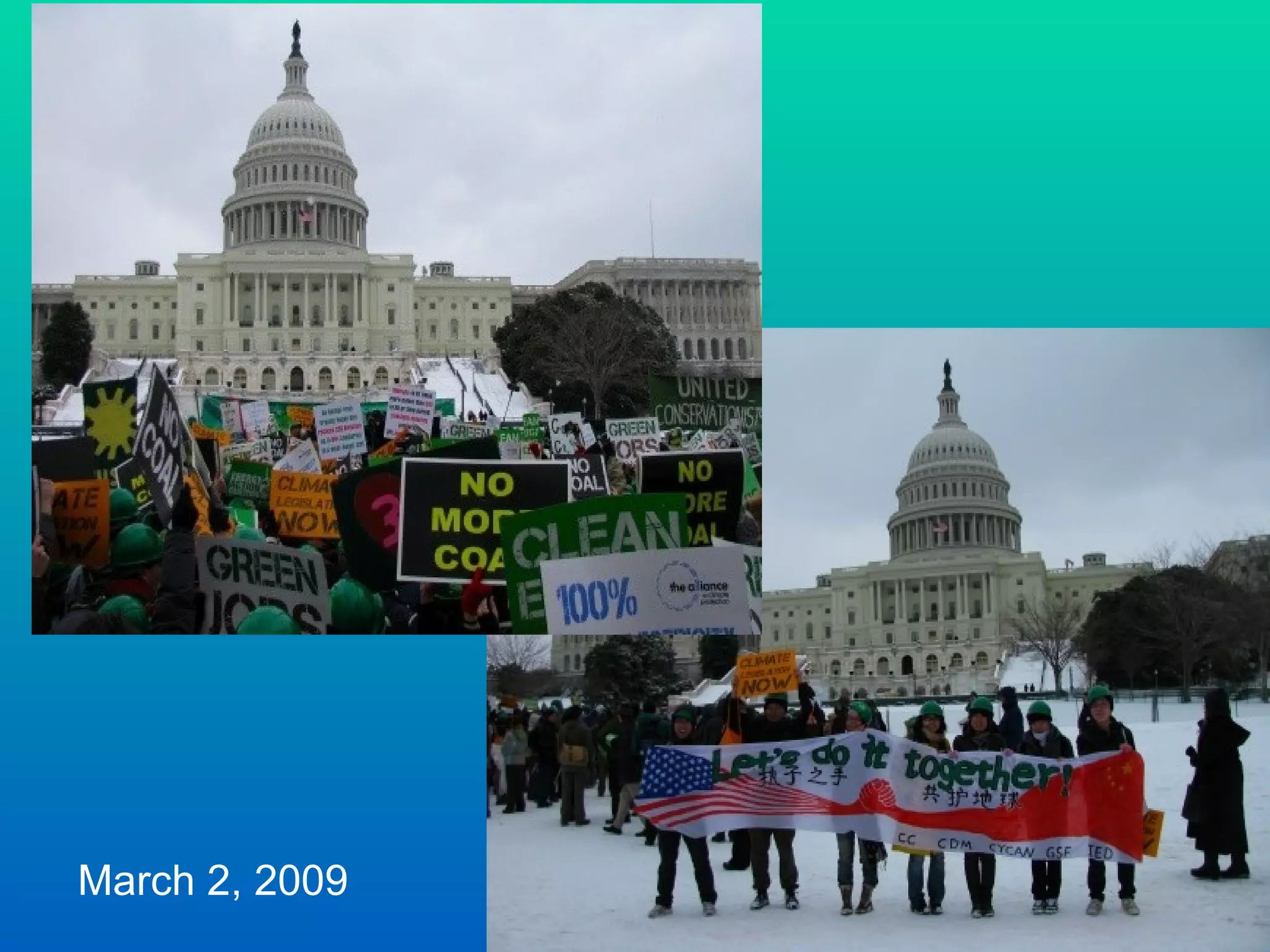
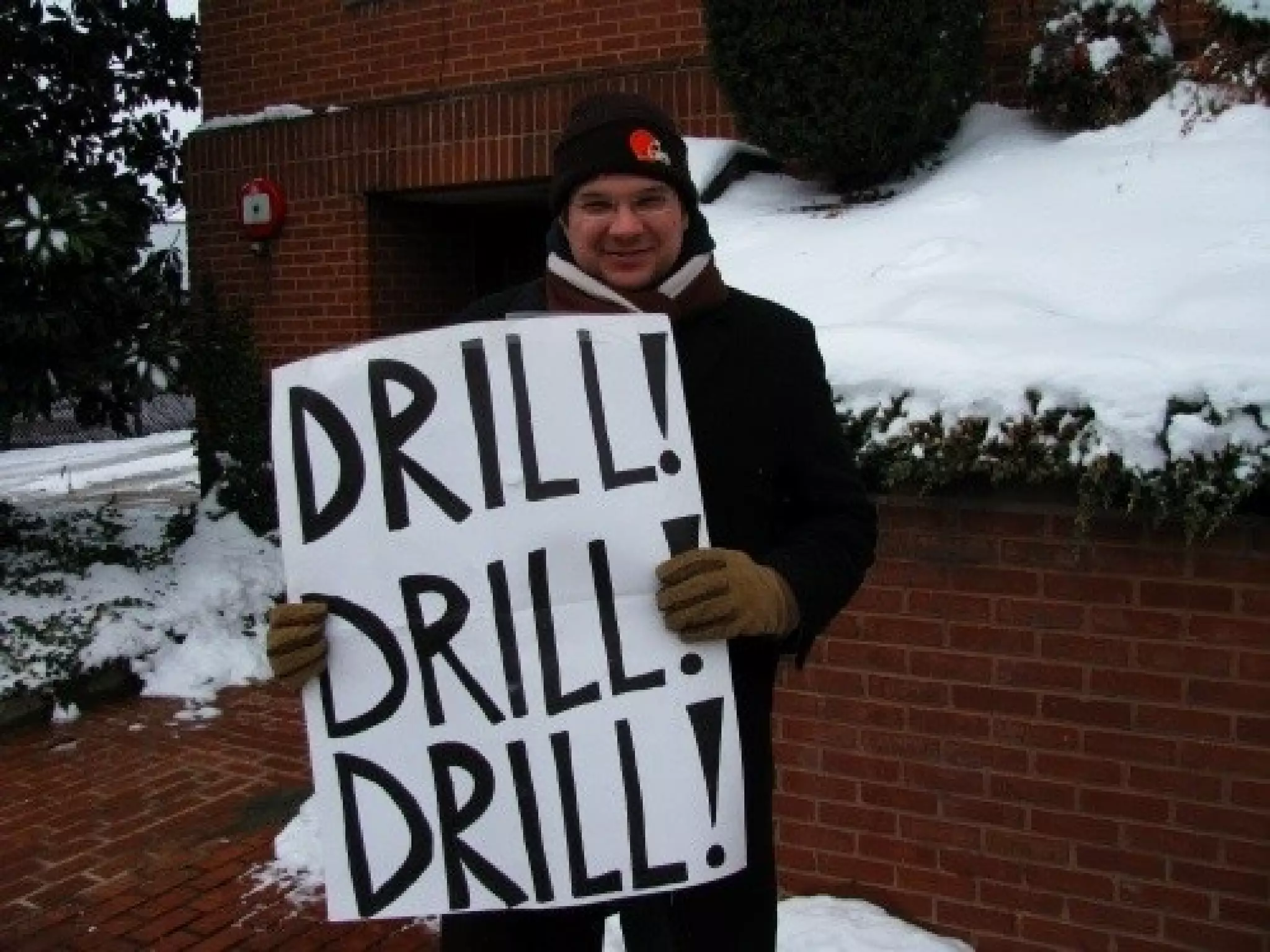
Revival of green activism
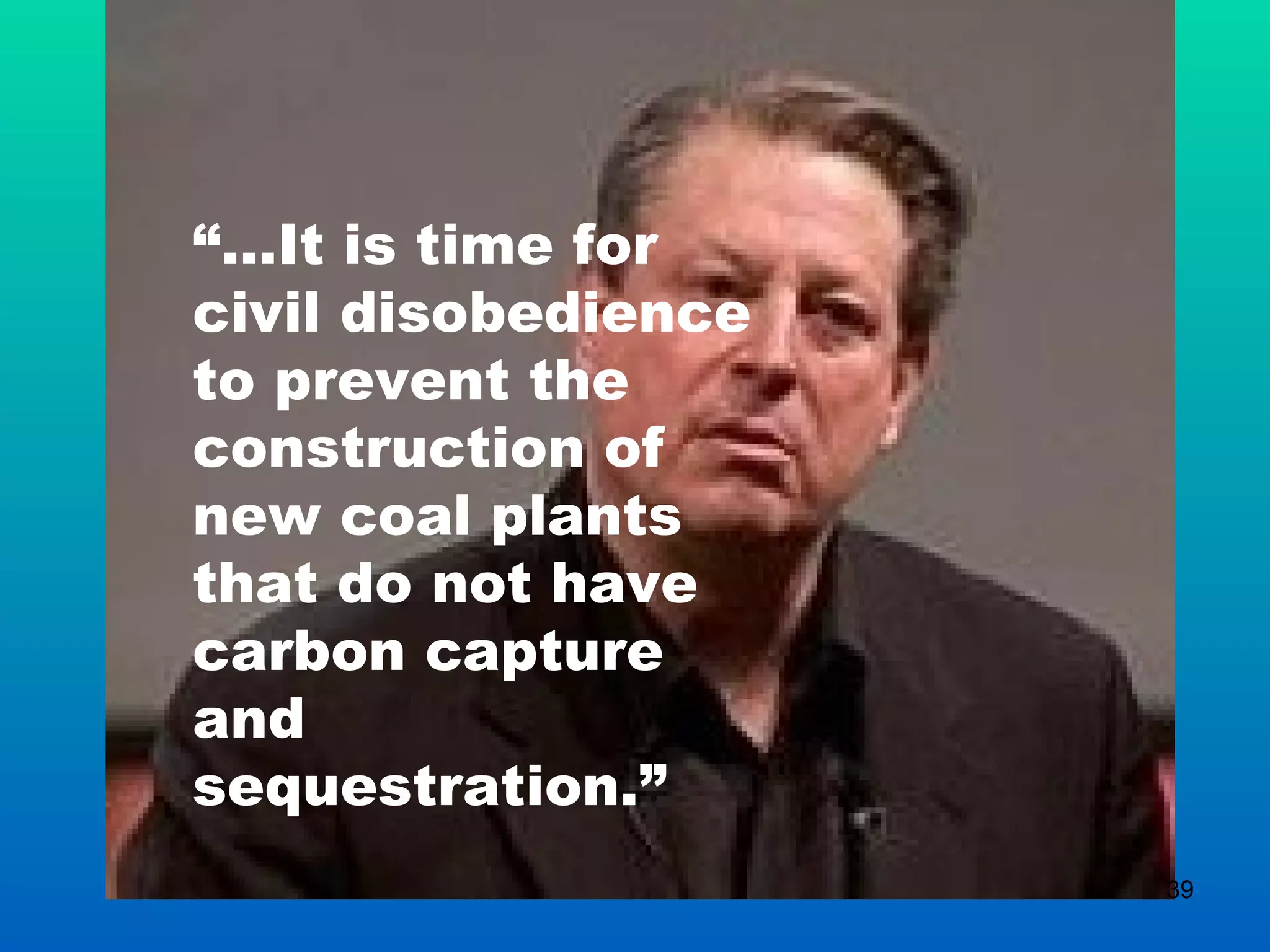
“… It is time for civil disobedience to prevent the construction of new coal plants that do not have carbon capture and sequestration.”
March 2, 2009
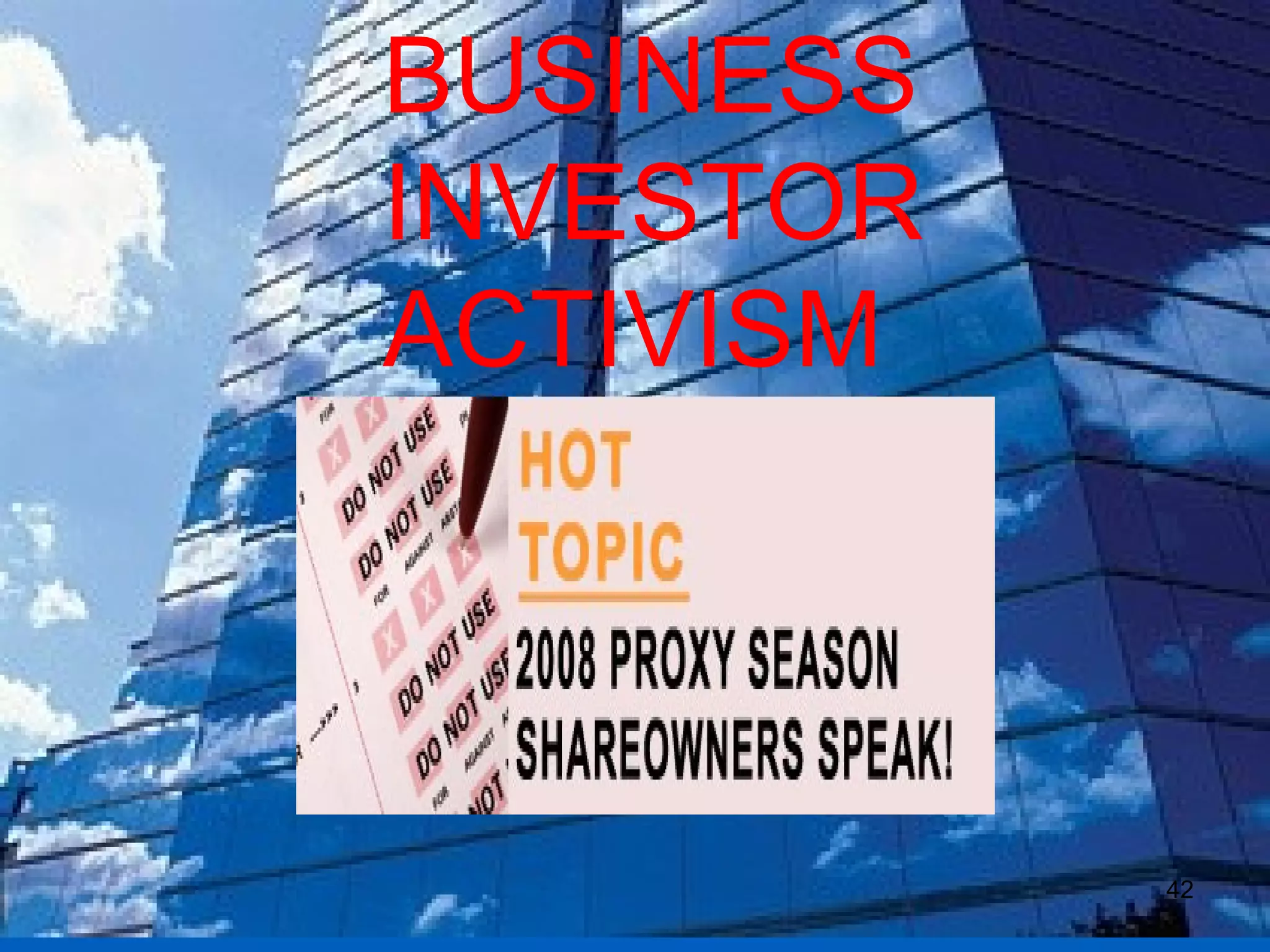
BUSINESS INVESTOR ACTIVISM
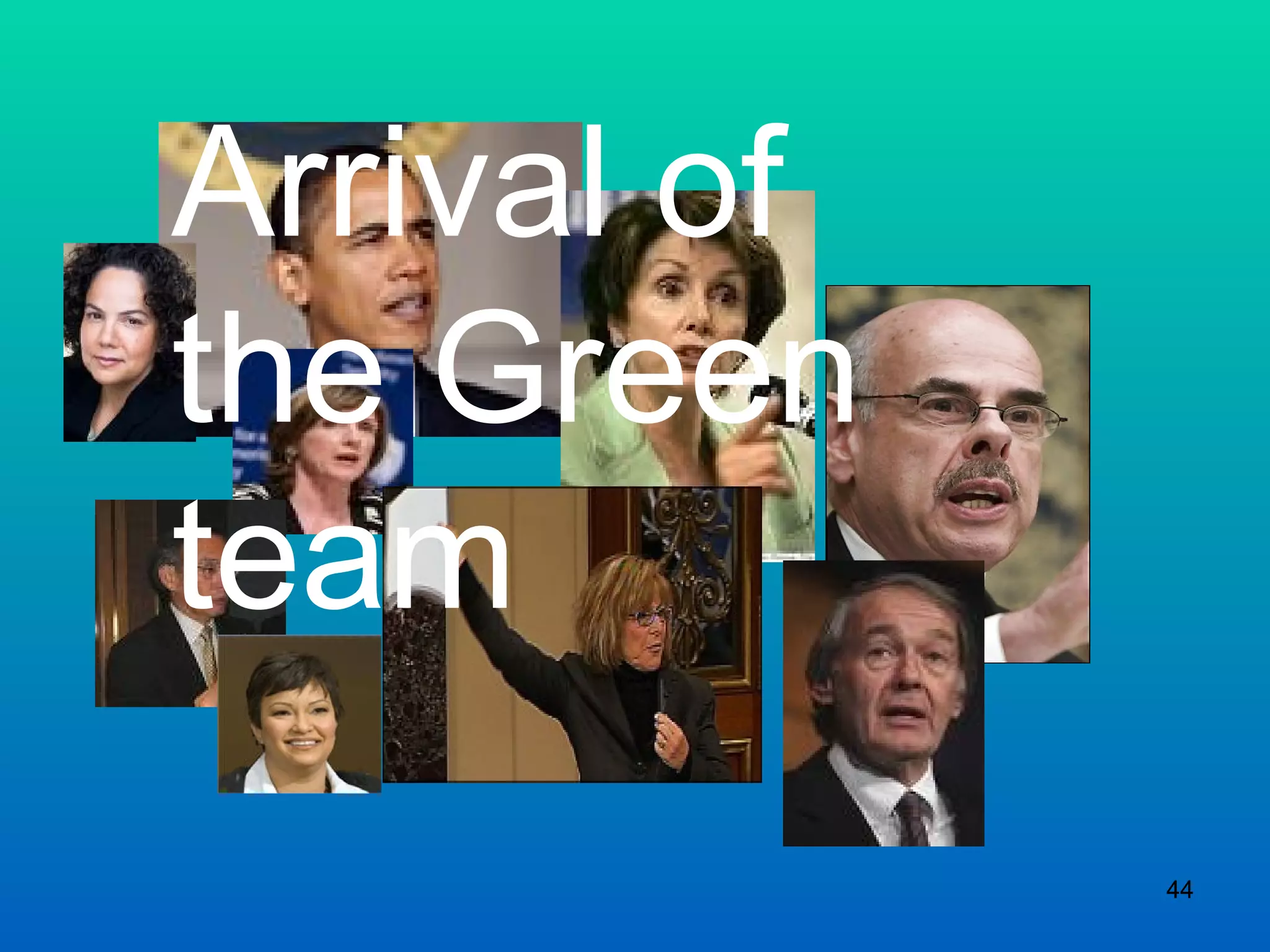
Arrival of the Green team
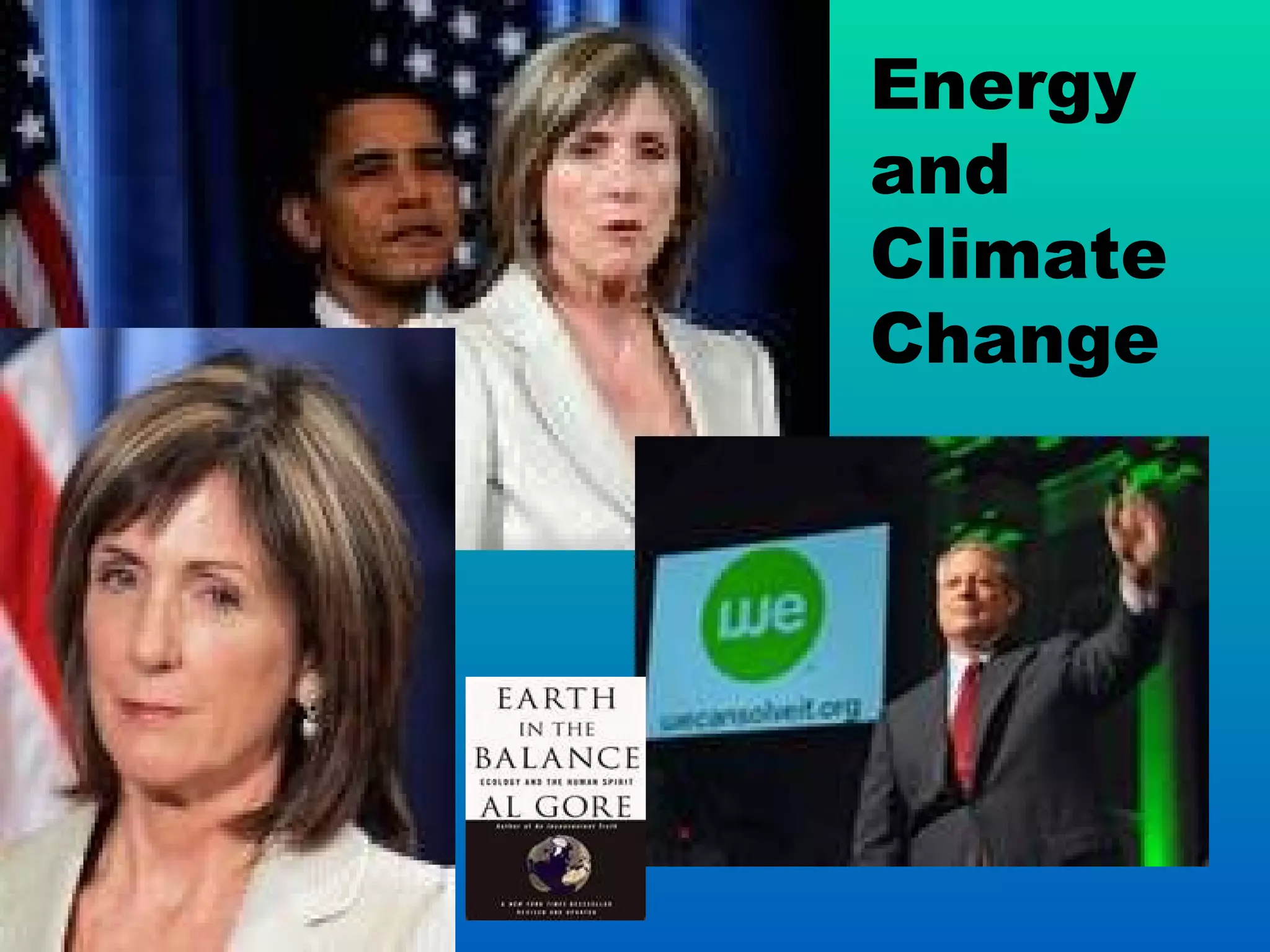
Energy  and  Climate  Change
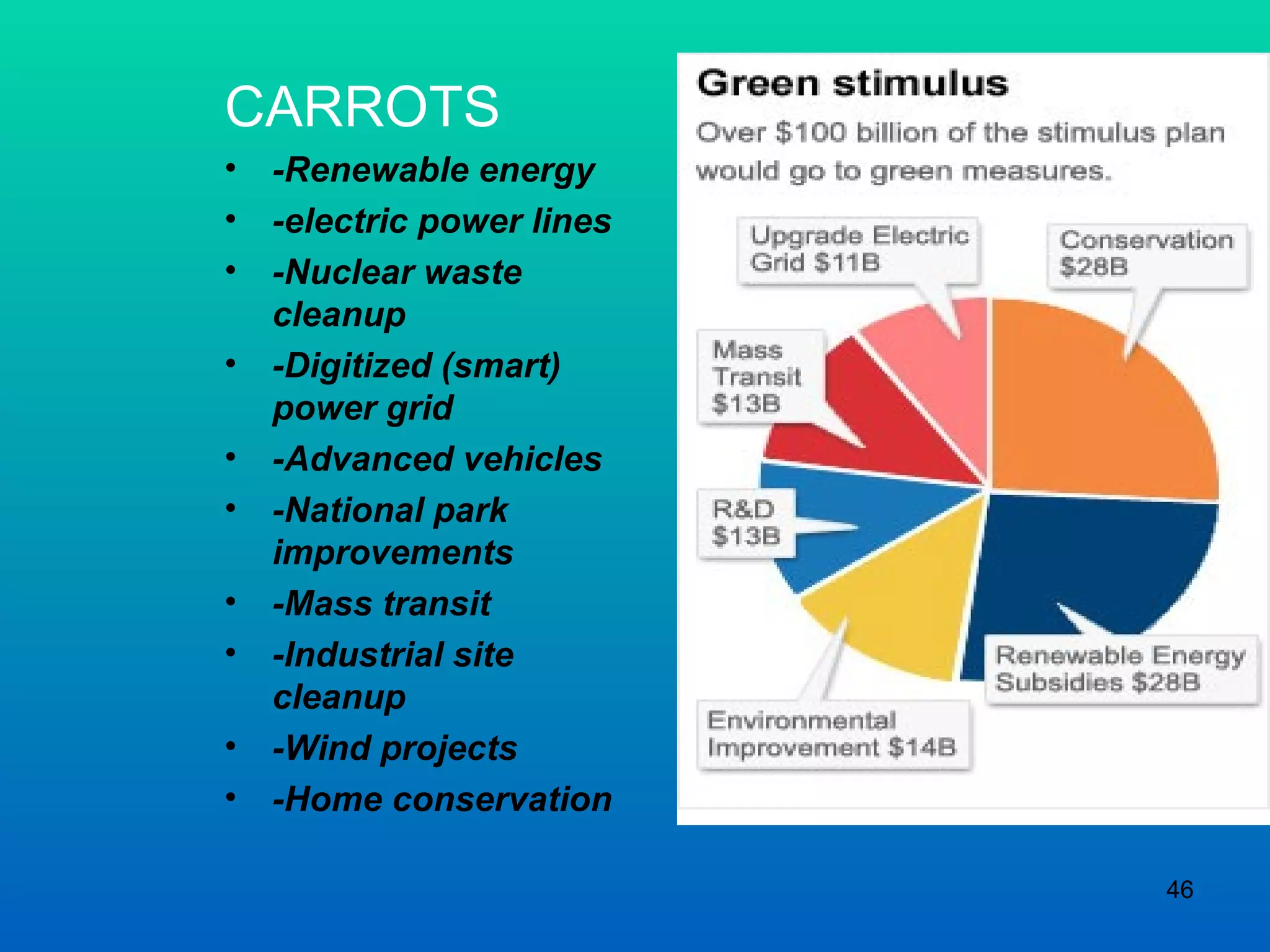
CARROTS -Renewable energy  -electric power lines -Nuclear waste cleanup -Digitized (smart) power grid -Advanced vehicles -National park improvements -Mass transit  -Industrial site cleanup -Wind projects -Home conservation
STICKS
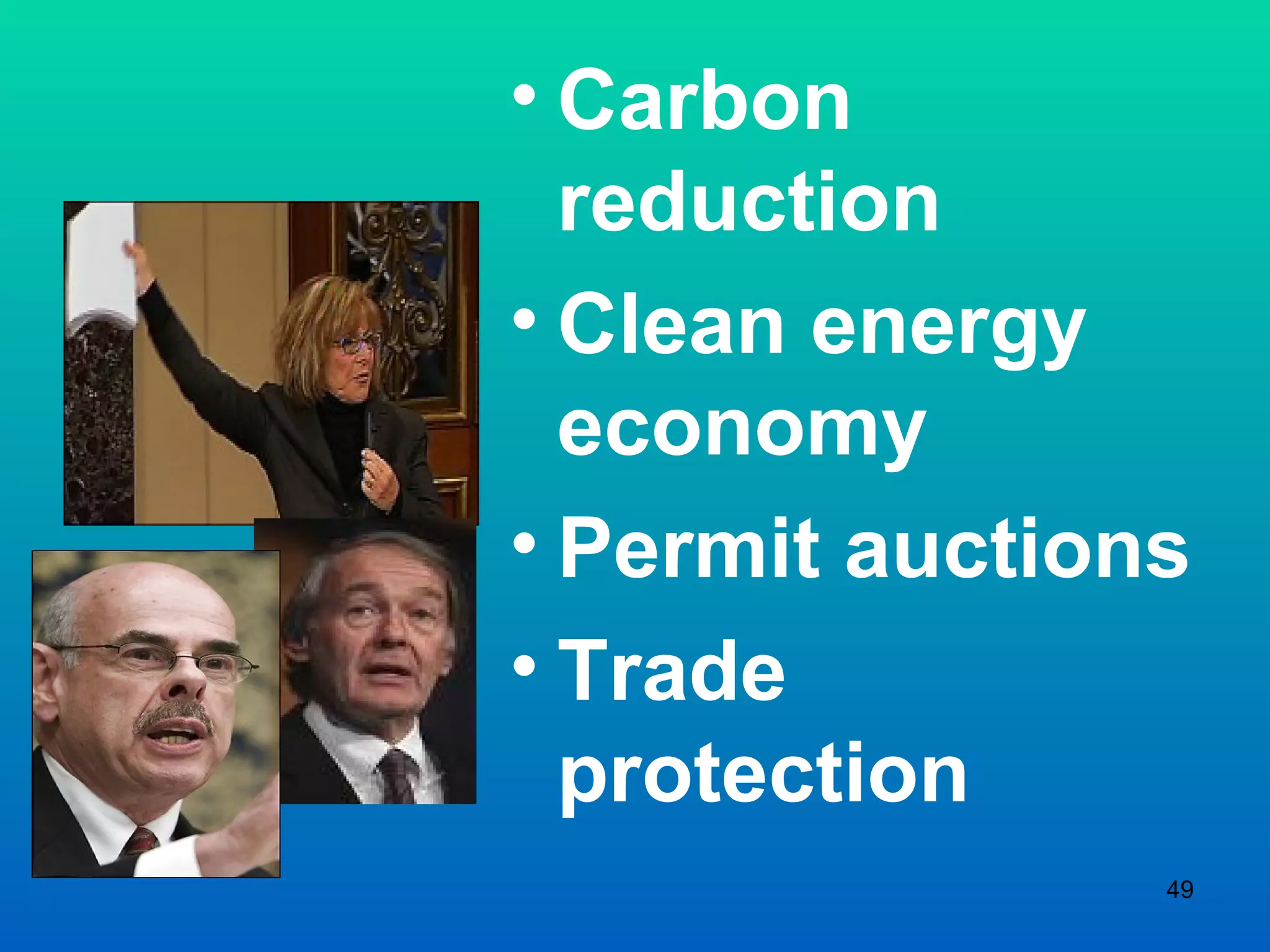
Carbon reduction Clean energy economy Permit auctions Trade protection
IMPLICATIONS OF THE NEW GREEN ERA Links green action, energy and climate change Introduces carbonomics to the corporate strategy table Touches off innovation, encouraged by government Supplants the dynamics of CSR with those of corporate sustainability
Corporate communication  moves toward corporate sustainability
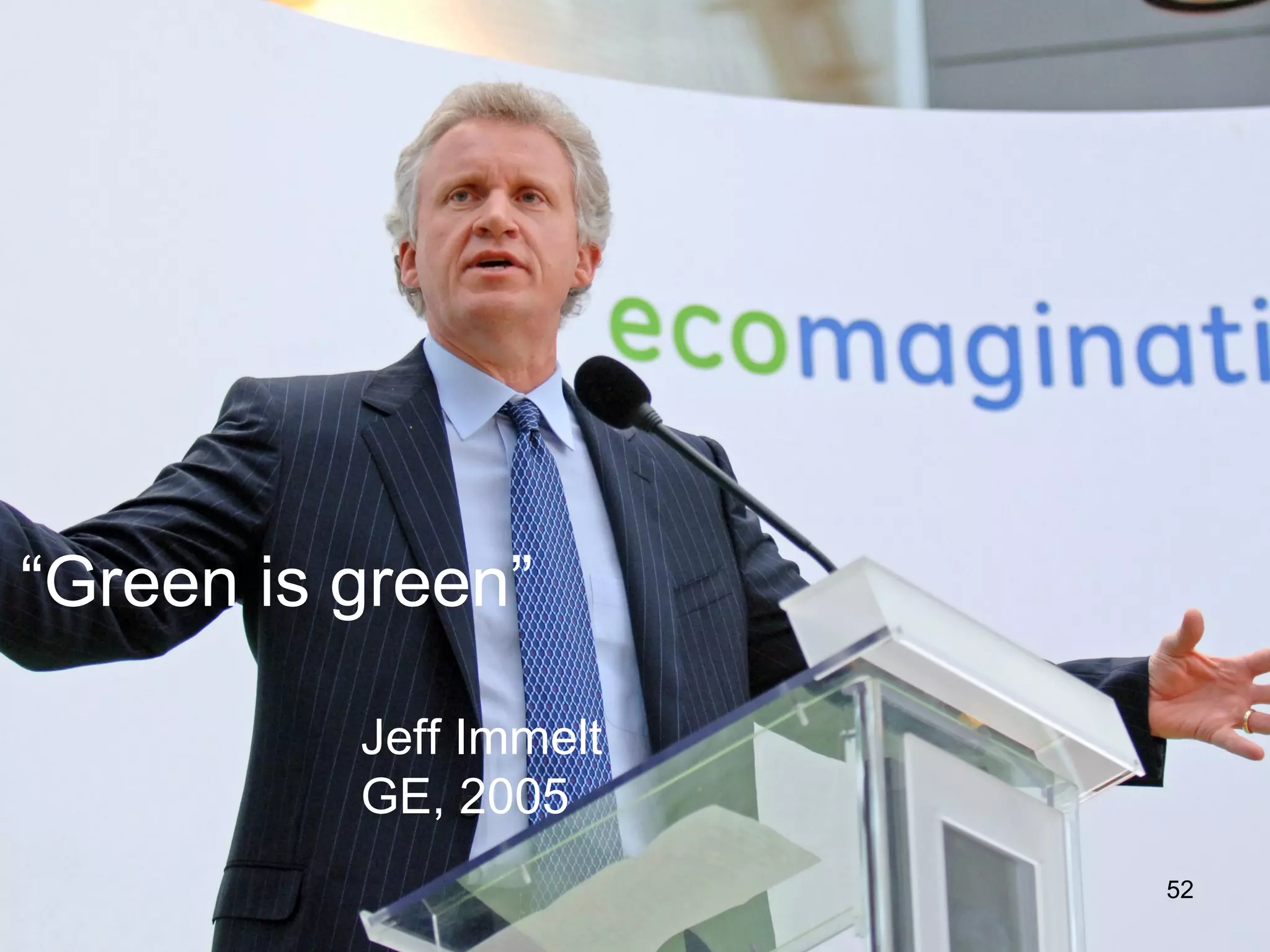
“ Green is green” Jeff Immelt  GE, 2005
US  CLIMATE ACTION PARTNERSHIP  "We are committed to a pathway that will slow, stop and reverse the growth of U.S. emissions."
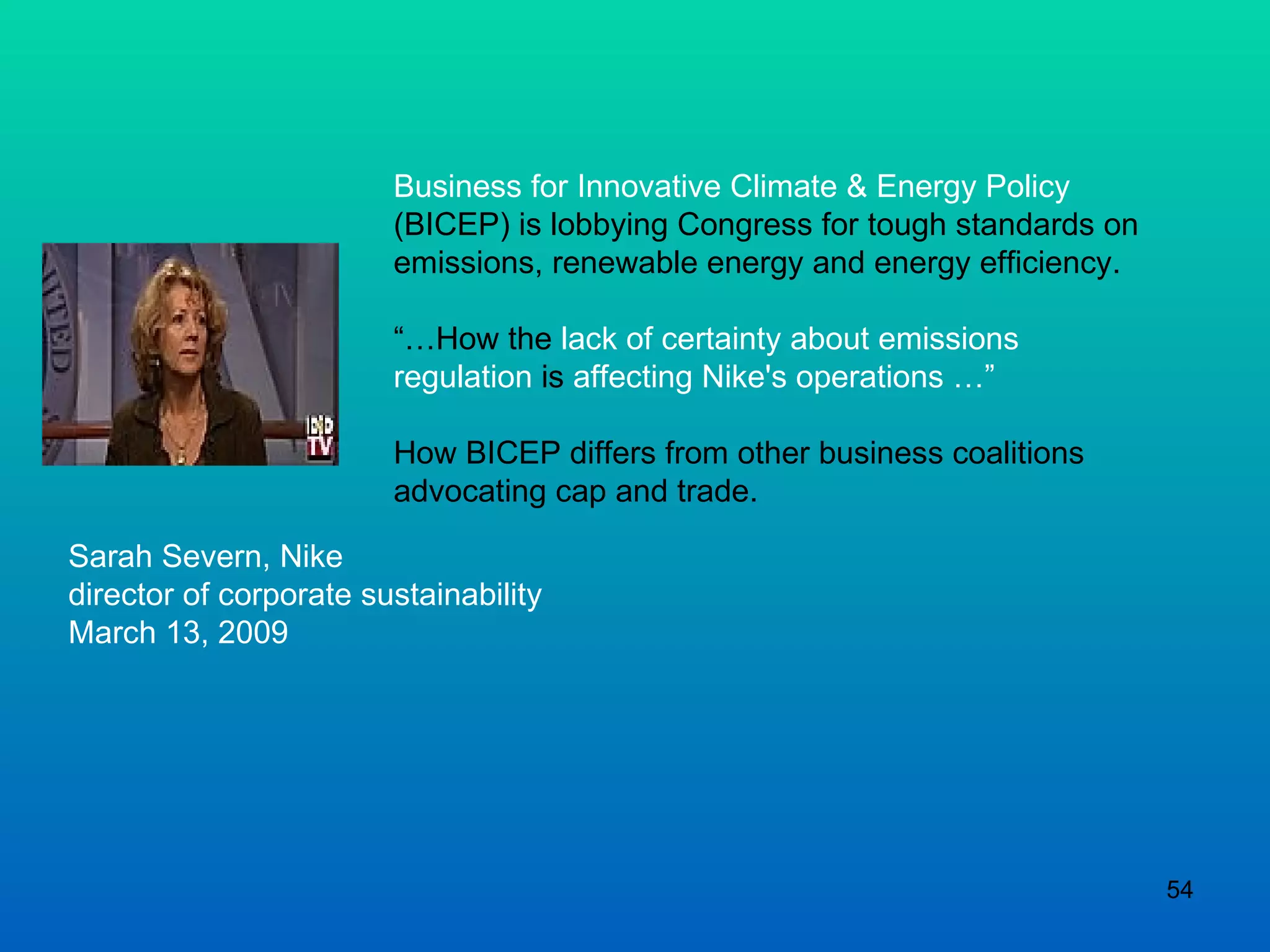
Business for Innovative Climate & Energy Policy  (BICEP) is lobbying Congress for tough standards on emissions, renewable energy and energy efficiency.  “… How the  lack of certainty about emissions regulation  is  affecting Nike's operations …” How BICEP differs from other business coalitions advocating cap and trade. Sarah Severn, Nike director of corporate sustainability March 13, 2009
“ What you want to do is anticipate trends…and  position the company optimally within that context… Understand the trend  and say how can I turn a challenge into an  opportunity ?” Peter Darbee  PG&E, 2007
‘ I NEVER PREDICT.  I JUST LOOK OUT  THE WINDOW  AND  SEE WHAT’S VISIBLE--  BUT NOT YET SEEN’
As corporate communicator, what value do you bring?
Information Confidence Trust Permission
Sustainability communication Business case Take it upstairs Internal  Stakeholders Collaboration Transparency Feedback, two-way
What do PR people do? Diogenes lamp holder
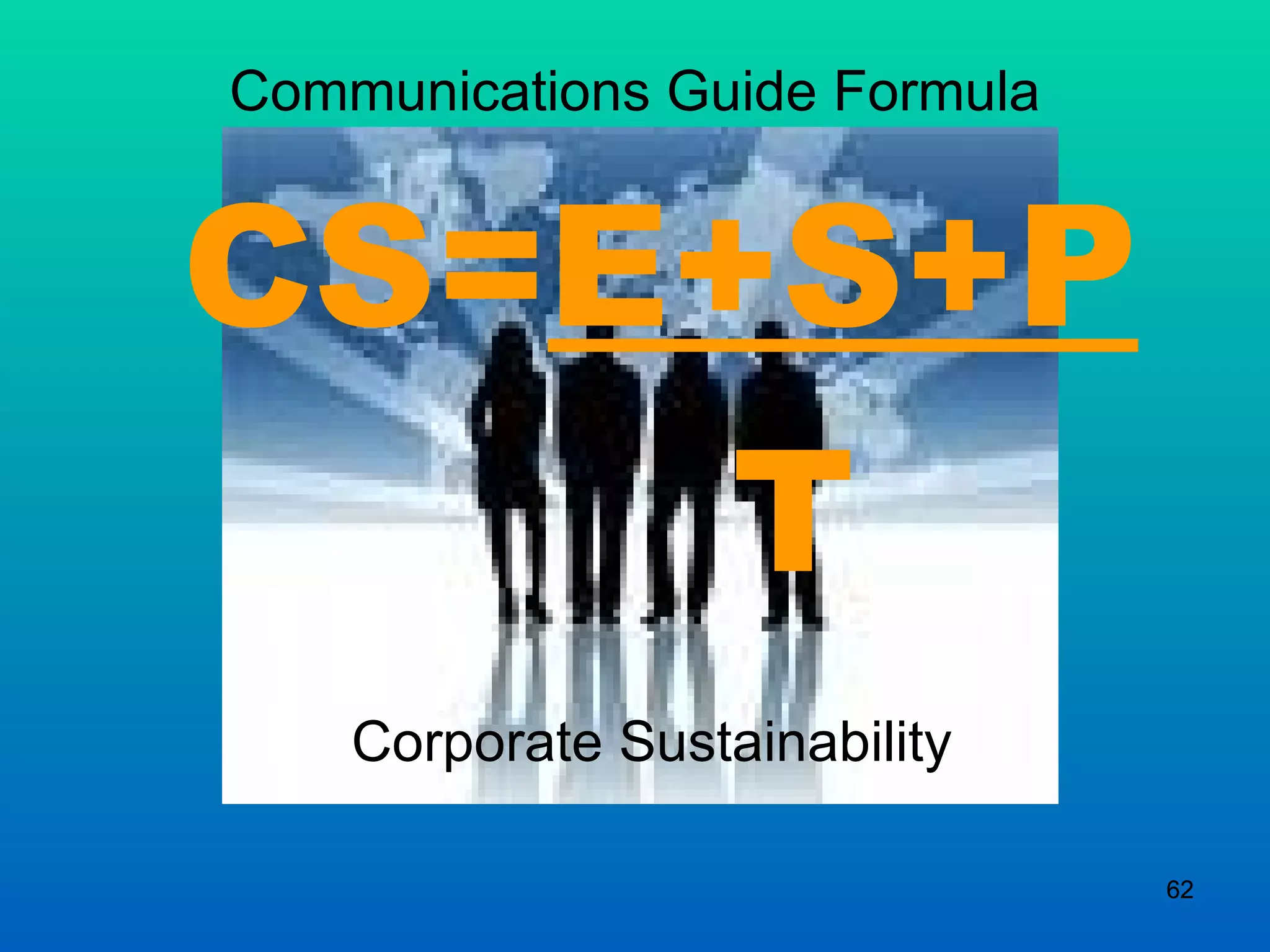
Communications Guide Formula Corporate Sustainability CS= E+S+P     T
 
Truth Proof Accountability Transparency Collaboration
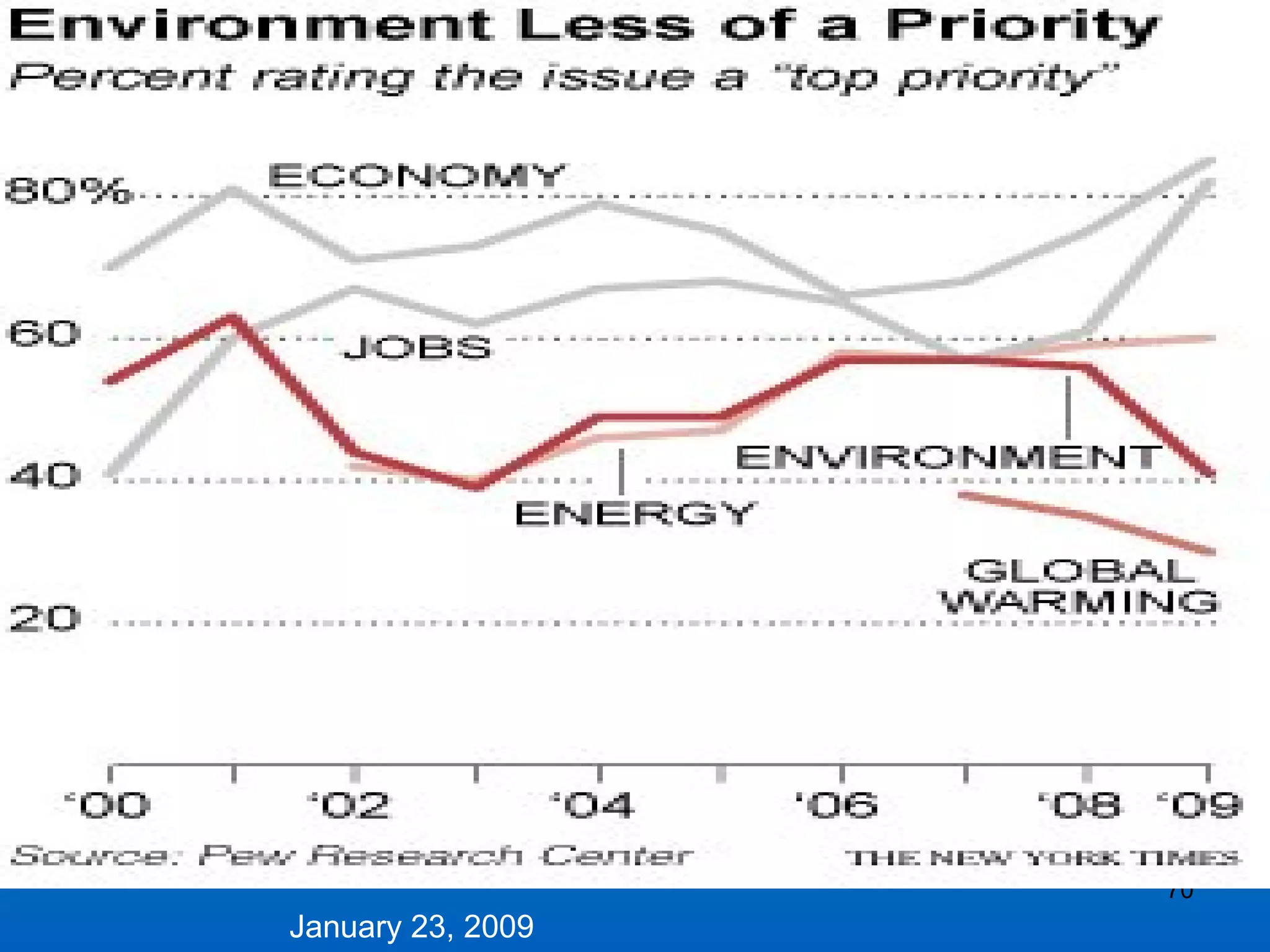
January 23, 2009
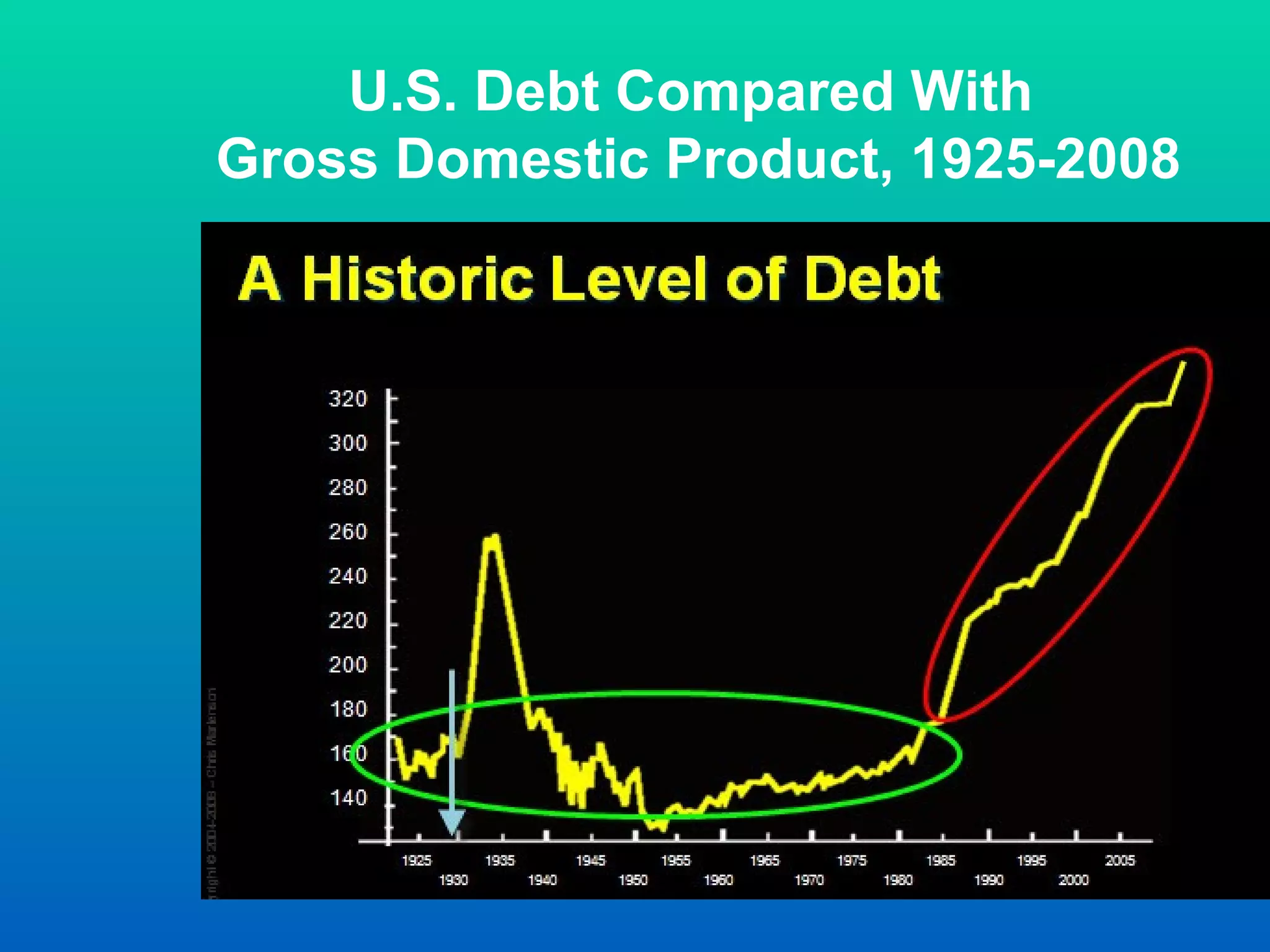
U.S. Debt Compared With  Gross Domestic Product, 1925-2008
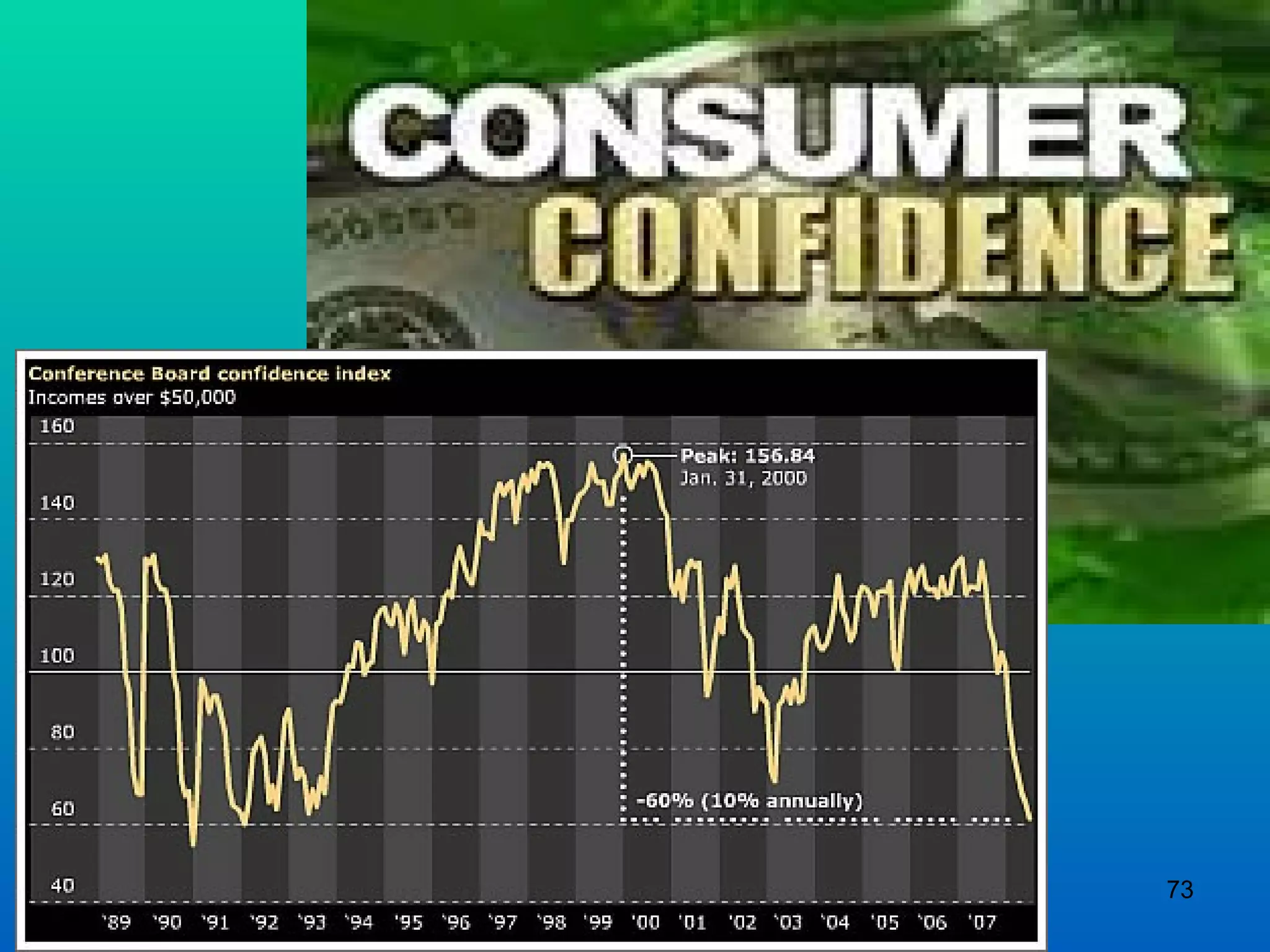
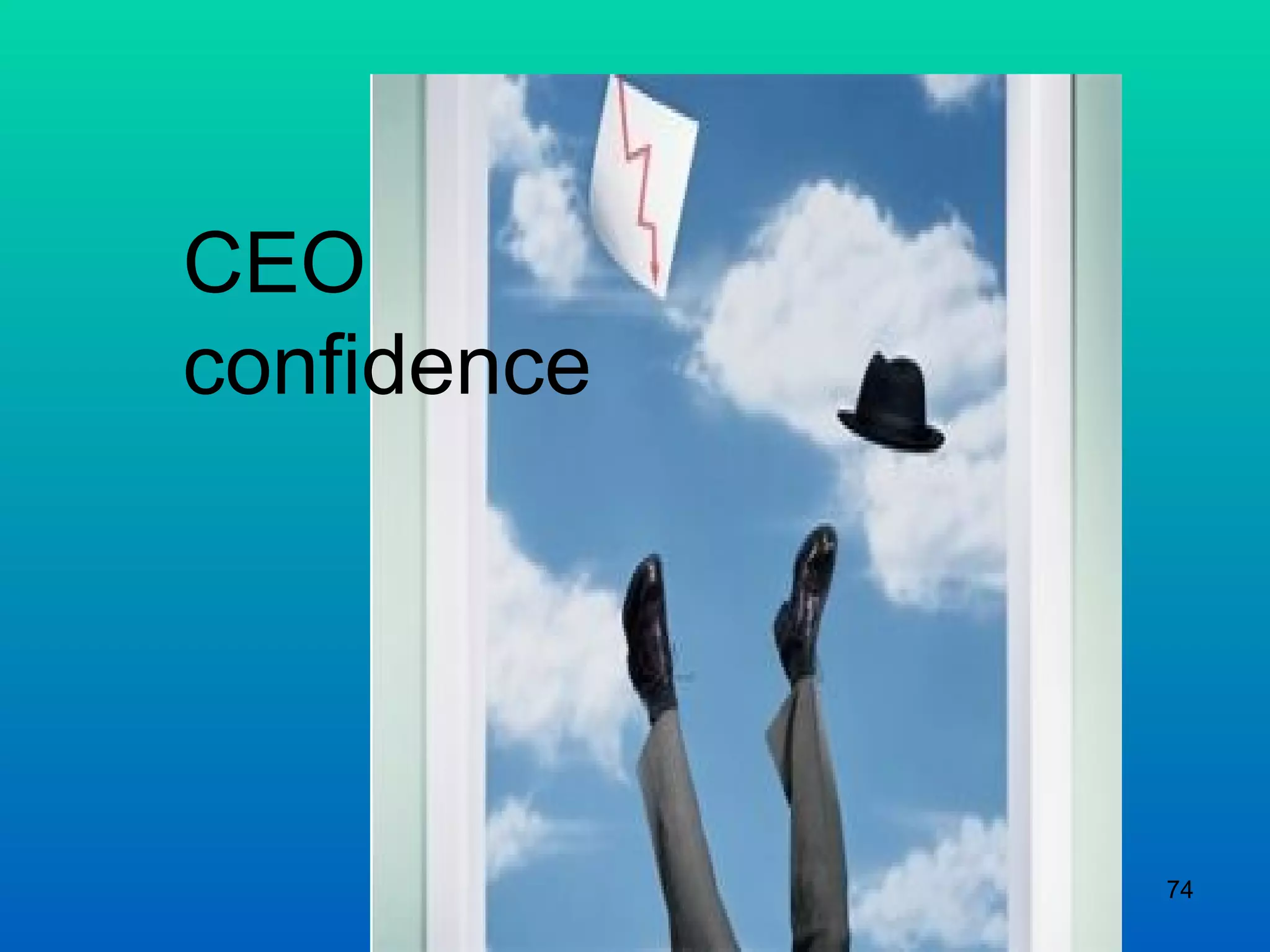
CEO confidence
“ While tackling the economic crisis , Obama is asking Congress to: cut subsidies for big farms; combat global warming with a pollution tax on industries; raise taxes on the wealthy; make big changes to health care, including lower reimbursements for Medicare and Medicaid treatments and prescription drugs.”
“ We need to have a reflationary package, which lays the foundation for future growth. And if we look into the future, it’s actually quite exciting. Because what we see is the biggest technological opportunity that we’ve had for a very long time: as big as the railways, as big as electricity, as big as the motorcar, and, most recently, information technology.  It’s the opportunity to go for low-carbon growth.  “  Nicholas Stern, March 2009
How does Obama create stakeholders? How do the Obama stakeholders create their stakeholders? What’s the COMMUNICATIONS role?
Why is the medical lobby enthusiastically working to  support the President’s health care proposals?
"Obama's opening gambit to dramatically expand the health care system has attracted surprising notes of support from insurers, hospitals and other players in the powerful medical lobby…  The lure for the industry is the prospect of  tens of millions of new customers : If Obama succeeds in fulfilling his pledge to cover many more Americans, those newly insured people will get checkups, purchase medicine, undergo physical therapy and get surgeries they cannot afford today.“  –  Dan Eggen, Ceci Connolly, Washington Post, March 2009
What do PR people DO?
What do PR people do? create stakeholders
What do PR people do? stakeholder  stalker
What do PR people do? deal  maker
Jittery public, Twittery pundits… Will anyone give CONFIDENCE a chance?
What do they have in common? Optisolar Ausra Heliovolt SunPower SolarCraft Clipper Windpower LM Glasbiber DMI NextEra  T. Boone Pickens
Most Trusted Companies
Creating stakeholders in government success " We are asking the American people to  trust  their government  with an unprecedented level of funding to address the economic emergency. In return, we must  prove to them  that their dollars are being invested in initiatives and strategies that make a difference in  their communities  and across the country. Following through on our commitments for  accountability and openness   will create a foundation upon which we can build…"  President Obama memo to Federal Agencies, February 9, 2009, on the new website, recovery.gov
Do you agree? The most powerful item Obama is selling is his brand, and for now it’s tied up in perceptions of how he achieves things almost as much as what he actually achieves.
 
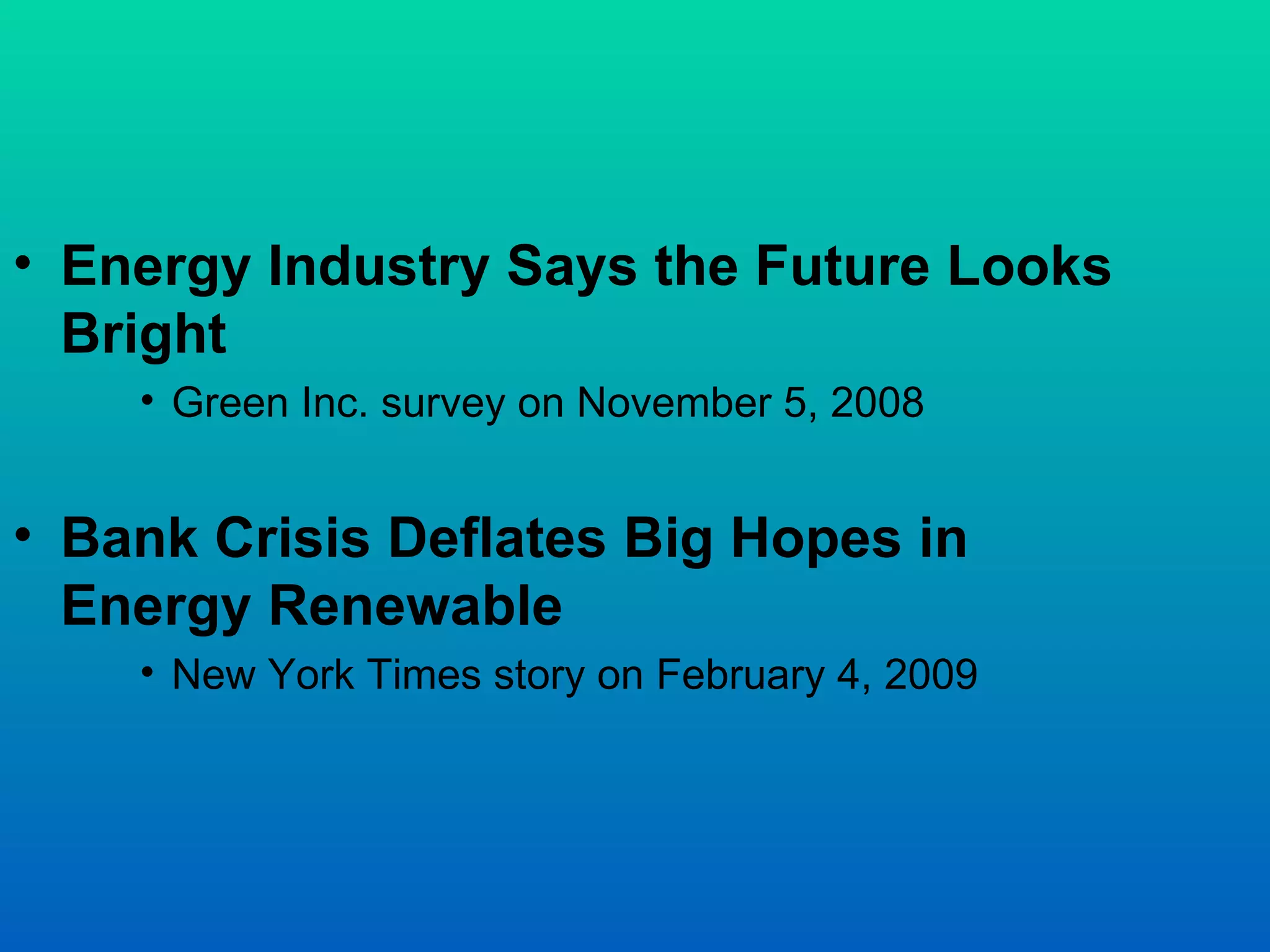
Energy Industry Says the Future Looks Bright Green Inc. survey on November 5, 2008 Bank Crisis Deflates Big Hopes in Energy Renewable New York Times story on February 4, 2009
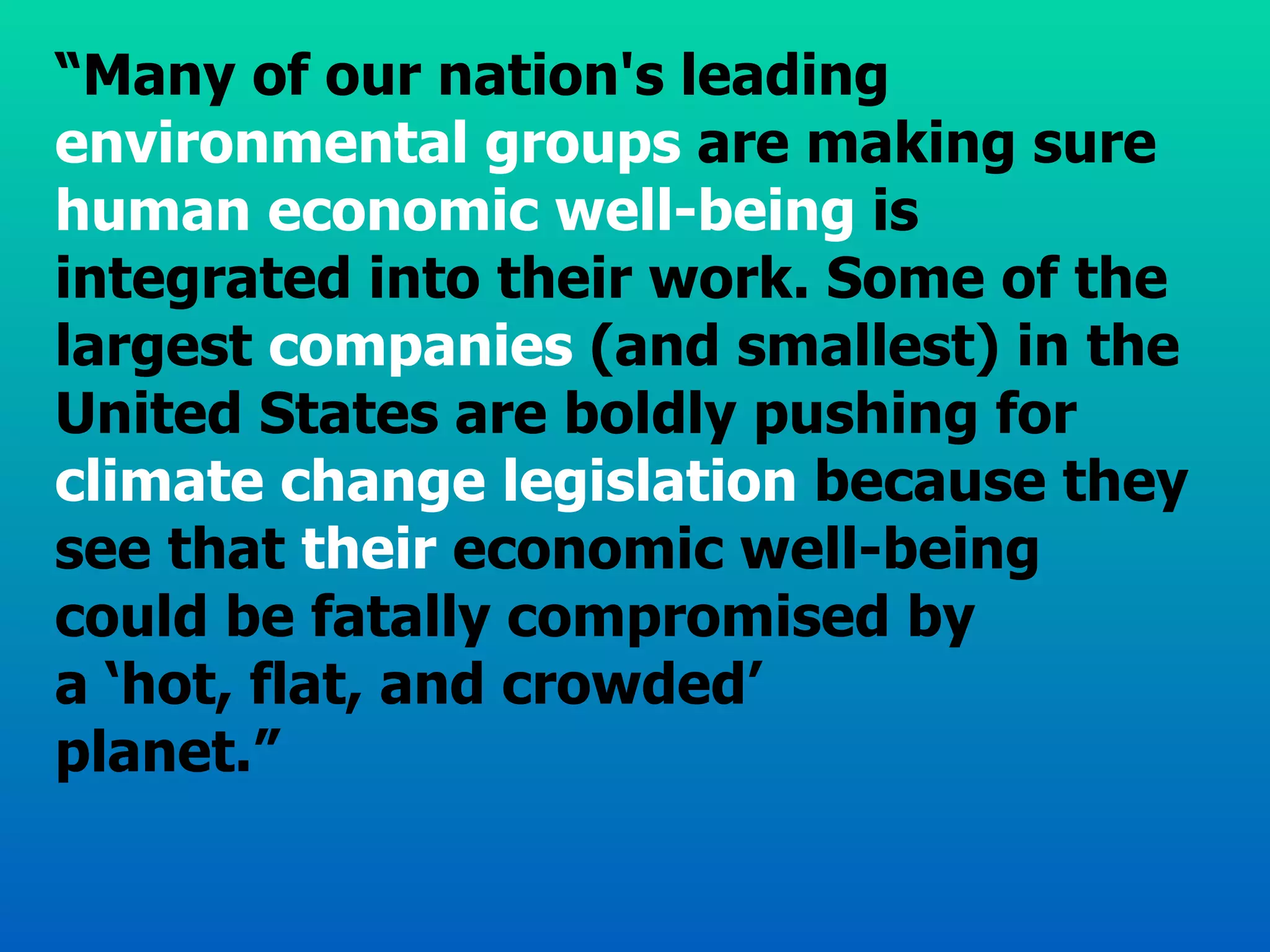
“ Many of our nation's leading  environmental groups  are making sure  human economic well-being  is integrated into their work. Some of the largest  companies  (and smallest) in the United States are boldly pushing for  climate change legislation  because they see that  their  economic well-being could be fatally compromised by  a ‘hot, flat, and crowded’  planet.”
What are the two basic emotions that drive your company’s stakeholders?
Fear Greed
LUD
Fear Love
Lower the fears Build the love Create confidence Therefore:  Earn PERMISSION
The C-suite question is: do we  get  it? And, if so, what do we  do  about it? ‘ It’ is how fundamentally American  economic, social and political  conditions have changed. An economic bubble has burst Social expectations have increased Politics have shifted to the left What should these fundamental changes mean to our company, our sustainability strategies, our communications?
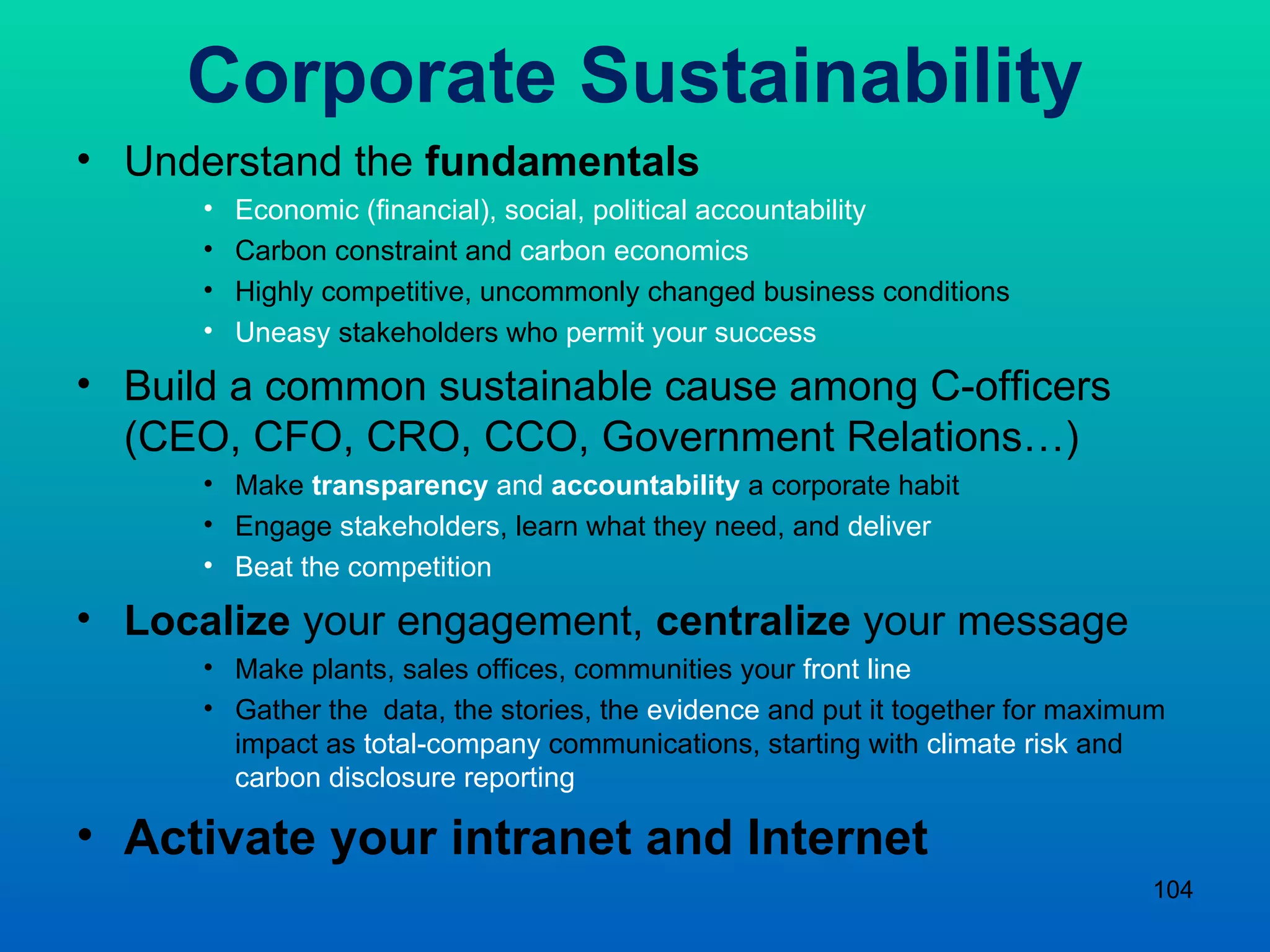
Corporate Sustainability Understand the  fundamentals Economic (financial), social, political accountability Carbon constraint and  carbon economics Highly competitive, uncommonly changed business conditions Uneasy  stakeholders who  permit your success  Build a common sustainable cause among C-officers (CEO, CFO, CRO, CCO, Government Relations…) Make  transparency  and  accountability   a corporate habit  Engage  stakeholders , learn what they need, and  deliver  Beat the competition Localize  your engagement,  centralize  your message Make plants, sales offices, communities your  front line Gather the  data, the stories, the  evidence  and put it together for maximum impact as  total-company  communications, starting with  climate risk  and  carbon disclosure reporting Activate your intranet and Internet
THEY GET IT Plug-in electric car goes on sale first in Washington, DC and San Francisco Social… Economic… Political… Chevy Volt 2009
How can you talk about climate change in this economy? “ Obama can effectively tie conservation, efficiency and renewable energy to  jobs, sustainable growth and national security .” Riley Dunlap, Oklahoma State sociologist, quoted in article by Andrew Revkin, NYTimes 1/23/09
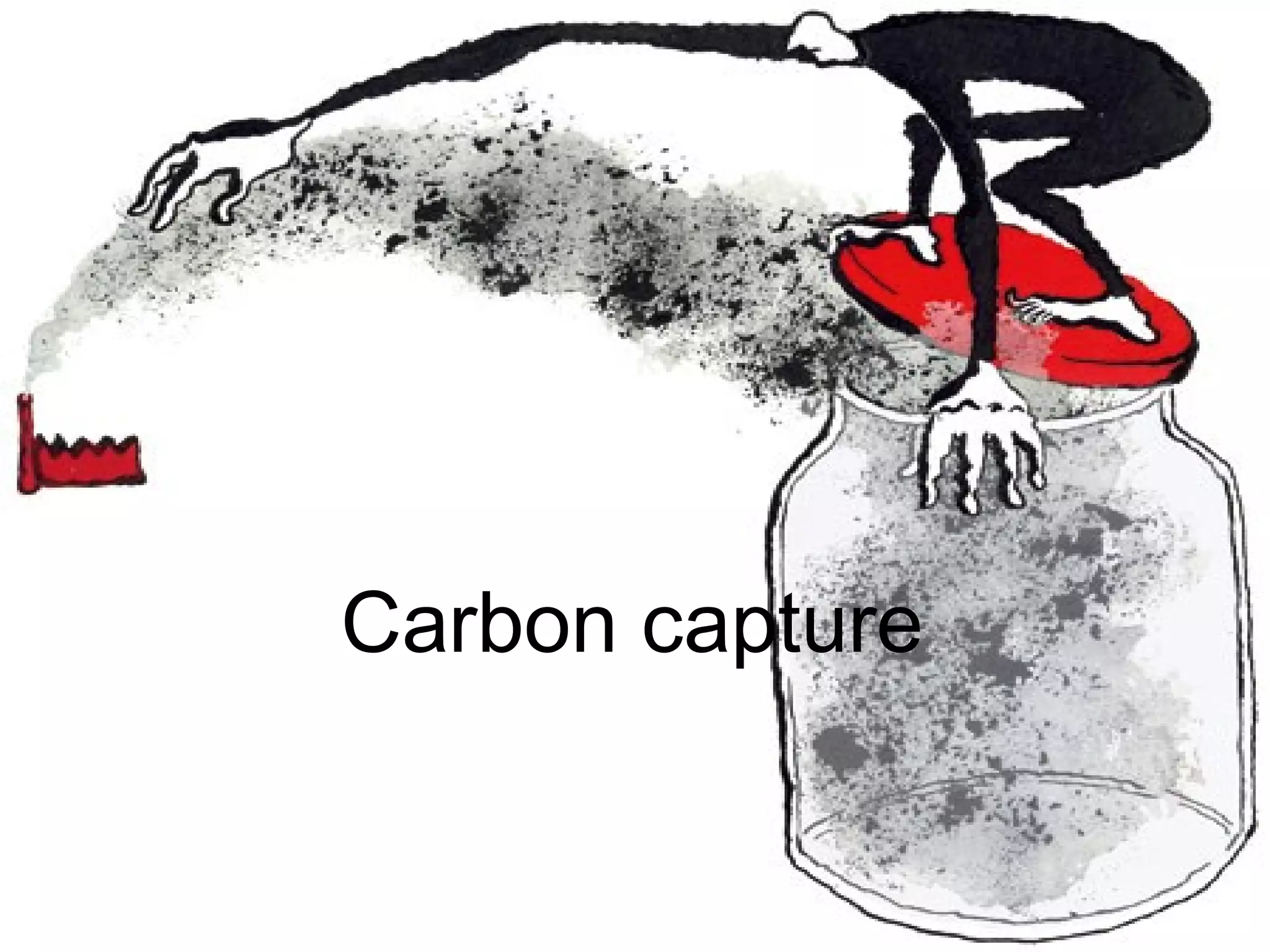
Carbon capture
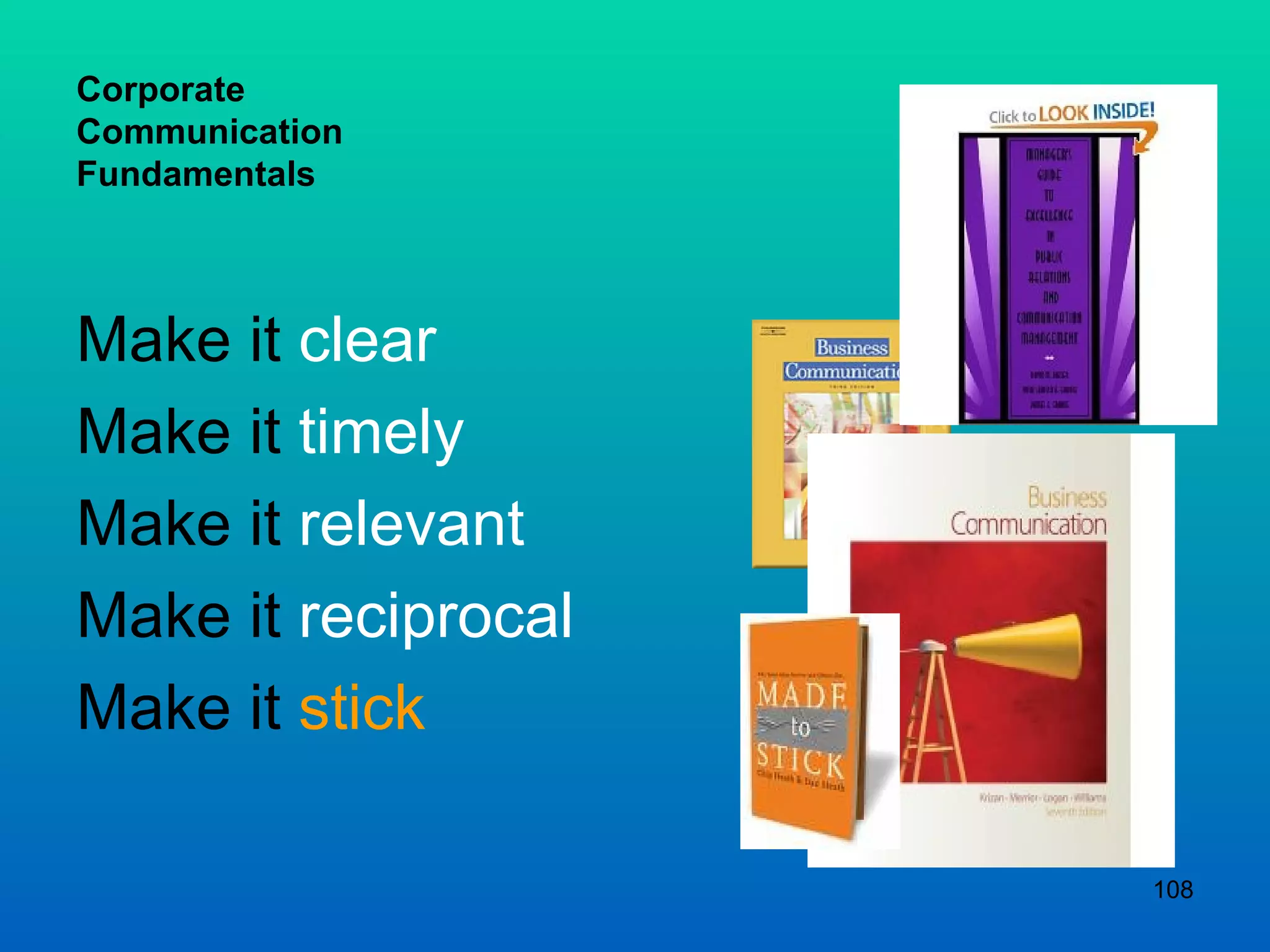
Corporate Communication Fundamentals Make it  clear Make it  timely Make it  relevant Make it  reciprocal Make it  stick
Making the  climate  message  stick Carol Browner,  White House “ Taking action now…will drive the creation of a clean energy economy, in which we exchange carbon-dependency for  greater energy independence and new clean energy jobs . ” Dave Hawkins,  NRDC "I think that politicians and the average person are going to sit up and take notice and listen to [President Obama] when he explains, as he did very clearly [on Jan. 26], the  linkage between climate, energy security and the economy ."
‘ CLIMATE CHANGE’ ‘ GREEN ENERGY’ ‘ CARBON POLLUTION’
Create stakeholders in your success
Ideas of the book Corporate greening has changed to embrace energy issues Major factors in the change
Competition insights Stakeholder social capital Political climate Carbonomics factors GHG disclosure Collaboration  options
Crystallizing event

Corporate Greening 2.0

  • 1.
    Corporate Greening 2.0 E. Bruce Harrison EnviroComm International
  • 2.
    “ I’m inPR.” What do you do ?
  • 4.
    Who are thestakeholders? What do they need to know? Therefore, what do I do?
  • 5.
    “ I’m inPR.” What do you do ?
  • 6.
    I help to create stakeholders in the success of my organization
  • 7.
    Company success depends on stakeholder permission
  • 8.
    A definition ofPR The management process of creating stakeholders in the success of the organization .
  • 10.
    I am BruceHarrison My topic today is… Creating and communicating corporate climate change and sustainability strategies
  • 11.
    CORPORATE GREENING What’shappened? When and how did it change? What’s likely to happen? Who are the stakeholders ? What do they need from communicators? What do we need to know? What do public relations people do ?
  • 12.
    As the chiefcommunicator, what value can you bring?
  • 13.
    "If you don'thave a seat at the table, you'll wind up on the menu.“ - Jim Rogers, CEO, Duke Energy
  • 14.
    “ What youwant to do is anticipate trends…and position the company optimally within that context… Understand the trend and say how can I turn a challenge into an opportunity?” Peter Darbee PG&E, 2007
  • 15.
  • 21.
  • 22.
  • 23.
  • 25.
  • 26.
  • 27.
    Implications of Corporate Greening 1.0 1960s – 1990s
  • 28.
    1. Sustainabledevelopment as an accepted international relations theory 2. Climate change as a global political theory 3. Corporate sustainability as a global business practice
  • 29.
    Key sociopolitical ImplicationsBackpackers as activists Scientists as originators US politicians as policy leaders
  • 30.
  • 31.
    Forward Factors Engaging Corporate Communications Approval of cap and trade Application of state-led CO2 air rules Transparency of business data More sophisticated score keeping Highly active carbon trading market Well funded carbon-constraint R&D Well funded public interest campaigns
  • 32.
  • 33.
    Who needs Washington’sleadership? 2006
  • 34.
    ‘ Congress isnow taking climate change fairly seriously’ 2007
  • 35.
    CO2 can be considered a pollutant 2007
  • 36.
  • 37.
    Katrina Gore GovernorsCongress Supreme Court Fuel prices ‘ GREEN’ BECOMES THE COMEBACK KID
  • 38.
  • 39.
    “… It istime for civil disobedience to prevent the construction of new coal plants that do not have carbon capture and sequestration.”
  • 40.
  • 42.
  • 44.
    Arrival of theGreen team
  • 45.
    Energy and Climate Change
  • 46.
    CARROTS -Renewable energy -electric power lines -Nuclear waste cleanup -Digitized (smart) power grid -Advanced vehicles -National park improvements -Mass transit -Industrial site cleanup -Wind projects -Home conservation
  • 48.
  • 49.
    Carbon reduction Cleanenergy economy Permit auctions Trade protection
  • 50.
    IMPLICATIONS OF THENEW GREEN ERA Links green action, energy and climate change Introduces carbonomics to the corporate strategy table Touches off innovation, encouraged by government Supplants the dynamics of CSR with those of corporate sustainability
  • 51.
    Corporate communication moves toward corporate sustainability
  • 52.
    “ Green isgreen” Jeff Immelt GE, 2005
  • 53.
    US CLIMATEACTION PARTNERSHIP "We are committed to a pathway that will slow, stop and reverse the growth of U.S. emissions."
  • 54.
    Business for InnovativeClimate & Energy Policy (BICEP) is lobbying Congress for tough standards on emissions, renewable energy and energy efficiency. “… How the lack of certainty about emissions regulation is affecting Nike's operations …” How BICEP differs from other business coalitions advocating cap and trade. Sarah Severn, Nike director of corporate sustainability March 13, 2009
  • 55.
    “ What youwant to do is anticipate trends…and position the company optimally within that context… Understand the trend and say how can I turn a challenge into an opportunity ?” Peter Darbee PG&E, 2007
  • 56.
    ‘ I NEVERPREDICT. I JUST LOOK OUT THE WINDOW AND SEE WHAT’S VISIBLE-- BUT NOT YET SEEN’
  • 57.
    As corporate communicator,what value do you bring?
  • 58.
  • 59.
    Sustainability communication Businesscase Take it upstairs Internal Stakeholders Collaboration Transparency Feedback, two-way
  • 61.
    What do PRpeople do? Diogenes lamp holder
  • 62.
    Communications Guide FormulaCorporate Sustainability CS= E+S+P T
  • 67.
  • 68.
    Truth Proof AccountabilityTransparency Collaboration
  • 70.
  • 72.
    U.S. Debt ComparedWith Gross Domestic Product, 1925-2008
  • 74.
  • 75.
    “ While tacklingthe economic crisis , Obama is asking Congress to: cut subsidies for big farms; combat global warming with a pollution tax on industries; raise taxes on the wealthy; make big changes to health care, including lower reimbursements for Medicare and Medicaid treatments and prescription drugs.”
  • 76.
    “ We needto have a reflationary package, which lays the foundation for future growth. And if we look into the future, it’s actually quite exciting. Because what we see is the biggest technological opportunity that we’ve had for a very long time: as big as the railways, as big as electricity, as big as the motorcar, and, most recently, information technology. It’s the opportunity to go for low-carbon growth. “ Nicholas Stern, March 2009
  • 77.
    How does Obamacreate stakeholders? How do the Obama stakeholders create their stakeholders? What’s the COMMUNICATIONS role?
  • 78.
    Why is themedical lobby enthusiastically working to support the President’s health care proposals?
  • 79.
    "Obama's opening gambitto dramatically expand the health care system has attracted surprising notes of support from insurers, hospitals and other players in the powerful medical lobby… The lure for the industry is the prospect of tens of millions of new customers : If Obama succeeds in fulfilling his pledge to cover many more Americans, those newly insured people will get checkups, purchase medicine, undergo physical therapy and get surgeries they cannot afford today.“ – Dan Eggen, Ceci Connolly, Washington Post, March 2009
  • 80.
    What do PRpeople DO?
  • 81.
    What do PRpeople do? create stakeholders
  • 82.
    What do PRpeople do? stakeholder stalker
  • 83.
    What do PRpeople do? deal maker
  • 84.
    Jittery public, Twitterypundits… Will anyone give CONFIDENCE a chance?
  • 85.
    What do theyhave in common? Optisolar Ausra Heliovolt SunPower SolarCraft Clipper Windpower LM Glasbiber DMI NextEra T. Boone Pickens
  • 89.
  • 90.
  • 91.
    Creating stakeholders ingovernment success " We are asking the American people to trust their government with an unprecedented level of funding to address the economic emergency. In return, we must prove to them that their dollars are being invested in initiatives and strategies that make a difference in their communities and across the country. Following through on our commitments for accountability and openness will create a foundation upon which we can build…" President Obama memo to Federal Agencies, February 9, 2009, on the new website, recovery.gov
  • 92.
    Do you agree?The most powerful item Obama is selling is his brand, and for now it’s tied up in perceptions of how he achieves things almost as much as what he actually achieves.
  • 95.
  • 96.
    Energy Industry Saysthe Future Looks Bright Green Inc. survey on November 5, 2008 Bank Crisis Deflates Big Hopes in Energy Renewable New York Times story on February 4, 2009
  • 97.
    “ Many ofour nation's leading environmental groups are making sure human economic well-being is integrated into their work. Some of the largest companies (and smallest) in the United States are boldly pushing for climate change legislation because they see that their economic well-being could be fatally compromised by a ‘hot, flat, and crowded’ planet.”
  • 98.
    What are thetwo basic emotions that drive your company’s stakeholders?
  • 99.
  • 100.
  • 101.
  • 102.
    Lower the fearsBuild the love Create confidence Therefore: Earn PERMISSION
  • 103.
    The C-suite questionis: do we get it? And, if so, what do we do about it? ‘ It’ is how fundamentally American economic, social and political conditions have changed. An economic bubble has burst Social expectations have increased Politics have shifted to the left What should these fundamental changes mean to our company, our sustainability strategies, our communications?
  • 104.
    Corporate Sustainability Understandthe fundamentals Economic (financial), social, political accountability Carbon constraint and carbon economics Highly competitive, uncommonly changed business conditions Uneasy stakeholders who permit your success Build a common sustainable cause among C-officers (CEO, CFO, CRO, CCO, Government Relations…) Make transparency and accountability a corporate habit Engage stakeholders , learn what they need, and deliver Beat the competition Localize your engagement, centralize your message Make plants, sales offices, communities your front line Gather the data, the stories, the evidence and put it together for maximum impact as total-company communications, starting with climate risk and carbon disclosure reporting Activate your intranet and Internet
  • 105.
    THEY GET ITPlug-in electric car goes on sale first in Washington, DC and San Francisco Social… Economic… Political… Chevy Volt 2009
  • 106.
    How can youtalk about climate change in this economy? “ Obama can effectively tie conservation, efficiency and renewable energy to jobs, sustainable growth and national security .” Riley Dunlap, Oklahoma State sociologist, quoted in article by Andrew Revkin, NYTimes 1/23/09
  • 107.
  • 108.
    Corporate Communication FundamentalsMake it clear Make it timely Make it relevant Make it reciprocal Make it stick
  • 109.
    Making the climate message stick Carol Browner, White House “ Taking action now…will drive the creation of a clean energy economy, in which we exchange carbon-dependency for greater energy independence and new clean energy jobs . ” Dave Hawkins, NRDC "I think that politicians and the average person are going to sit up and take notice and listen to [President Obama] when he explains, as he did very clearly [on Jan. 26], the linkage between climate, energy security and the economy ."
  • 110.
    ‘ CLIMATE CHANGE’‘ GREEN ENERGY’ ‘ CARBON POLLUTION’
  • 115.
  • 116.
    Ideas of thebook Corporate greening has changed to embrace energy issues Major factors in the change
  • 117.
    Competition insights Stakeholdersocial capital Political climate Carbonomics factors GHG disclosure Collaboration options
  • 118.