D I G I T A L I N D I A
Digital India
A programme to transform India into a digitally
empowered society and knowledge economy
D I G I T A L I N D I A
What is Digital India?
 Digital India is a Programme to prepare India for a knowledge future.
 The focus is on being transformative – to realize IT + IT = IT
 The focus is on making technology central to enabling change.
 It is an Umbrella Programme – covering many departments.
 It weaves together a large number of ideas and thoughts into a single, comprehensive vision so that
each of them is seen as part of a larger goal.
 Each individual element stands on its own. But is also part of the larger picture.
 It is coordinated by DeitY, implemented by the entire government.
 The weaving together makes the Mission transformative in totality
 The Programme:
 Pulls together many existing schemes.
 These schemes will be restructured and re-focused.
 They will be implemented in a synchronized manner.
 Many elements are only process improvements with minimal cost.
 The common branding of programmes as Digital India highlights their transformative impact.
D I G I T A L I N D I A
Vision of Digital India
Centered on 3 Key Areas
• Digital Infrastructure as a Utility to Every Citizen
• Governance & Services on Demand
• Digital Empowerment of Citizens
D I G I T A L I N D I A
Vision Area 1: Infrastructure as a Utility to Every Citizen
• High speed internet as a core utility
• Cradle to grave digital identity -unique, lifelong, online,
authenticable
• Mobile phone & Bank account enabling participation in
digital & financial space
• Easy access to a Common Service Centre
• Shareable private space on a public cloud
• Safe and secure Cyber-space
D I G I T A L I N D I A
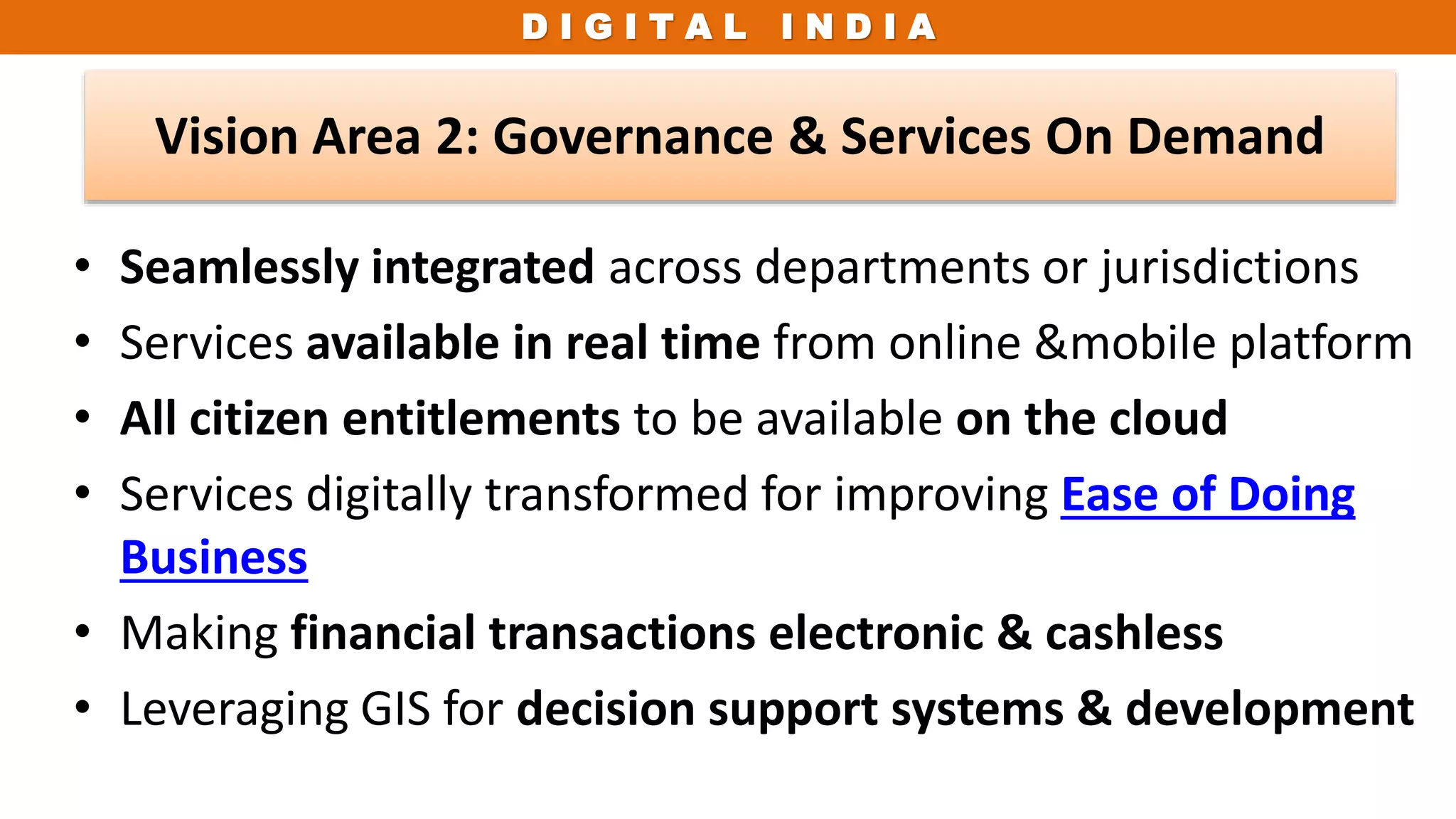
• Seamlessly integrated across departments or jurisdictions
• Services available in real time from online &mobile platform
• All citizen entitlements to be available on the cloud
• Services digitally transformed for improving Ease of Doing
Business
• Making financial transactions electronic & cashless
• Leveraging GIS for decision support systems & development
Vision Area 2: Governance & Services On Demand
D I G I T A L I N D I A
five Pillars of Digital India
1. Broadband
Highways
2. Universal Access
to Phones
3. Public Internet
Access Programme
4. E-Governance –
Reforming government
through Technology
5. eKranti –
Electronic delivery of
services
ElectronicsManufacturing
D I G I T A L I N D I A
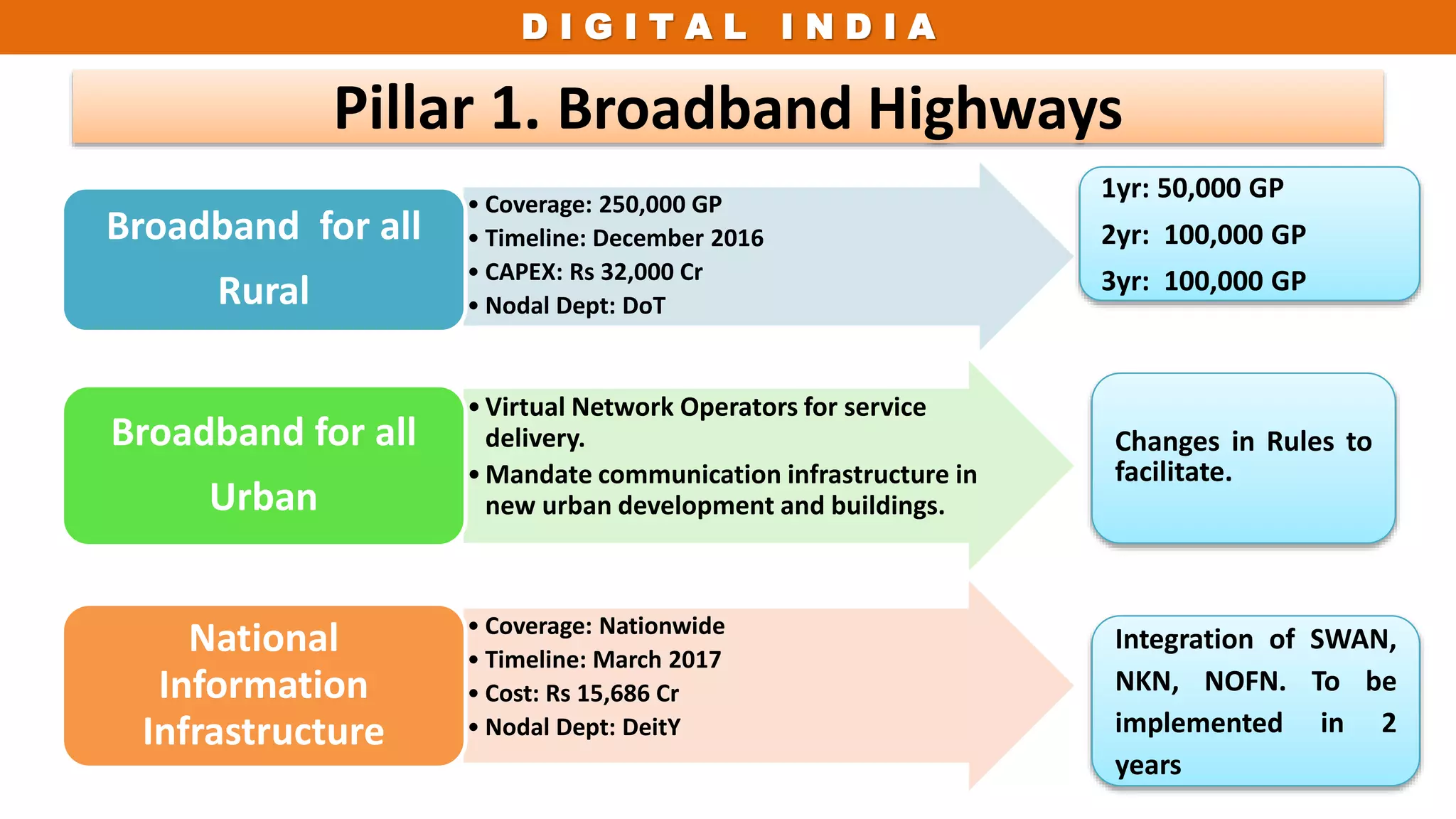
Pillar 1. Broadband Highways
• Coverage: 250,000 GP
• Timeline: December 2016
• CAPEX: Rs 32,000 Cr
• Nodal Dept: DoT
Broadband for all
Rural
•Virtual Network Operators for service
delivery.
•Mandate communication infrastructure in
new urban development and buildings.
Broadband for all
Urban
• Coverage: Nationwide
• Timeline: March 2017
• Cost: Rs 15,686 Cr
• Nodal Dept: DeitY
National
Information
Infrastructure
1yr: 50,000 GP
2yr: 100,000 GP
3yr: 100,000 GP
Changes in Rules to
facilitate.
Integration of SWAN,
NKN, NOFN. To be
implemented in 2
years
D I G I T A L I N D I A
Pillar 2. Universal Access to Mobile connectivity
• Coverage: Remaining
uncovered villages (~
42,300 villages)
• Timeline: FY 2014-18
• Cost: Rs 16,000 Cr
• Nodal Dept: DoT
Universal Access to
mobile
connectivity
Ongoing Programme
Increased network
penetration &
coverage of gaps
D I G I T A L I N D I A
Pillar 3. Public Internet Access Programme – National Rural Internet Mission
•Coverage: 2,50,000 villages (now 130,000)
•Timeline: 3 Years - March 2017
•Cost: Rs 4750 Cr
•Nodal Agency: DeitY
CSCs –
made viable, multi-
functional end-points
for service delivery
•Coverage: 1,50,000 Post Offices
•Timeline: 2 Years
•Nodal Agency: D/o Posts
Post Offices
to become
Multi-Service Centres
Ongoing Programme
Reach of Govt.
services to all GPs
This should be
long term vision
for POs
D I G I T A L I N D I A
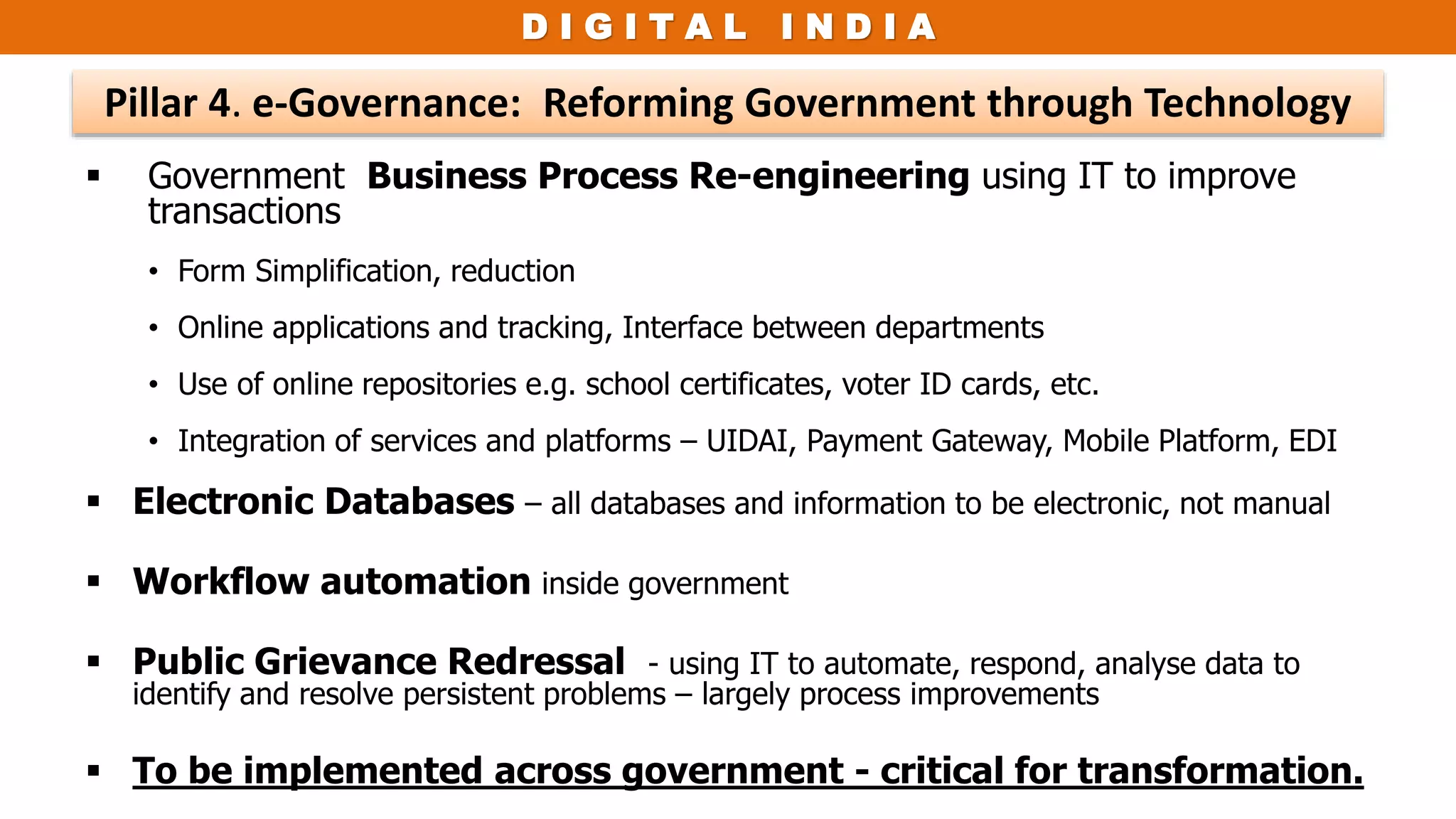
 Government Business Process Re-engineering using IT to improve
transactions
• Form Simplification, reduction
• Online applications and tracking, Interface between departments
• Use of online repositories e.g. school certificates, voter ID cards, etc.
• Integration of services and platforms – UIDAI, Payment Gateway, Mobile Platform, EDI
 Electronic Databases – all databases and information to be electronic, not manual
 Workflow automation inside government
 Public Grievance Redressal - using IT to automate, respond, analyse data to
identify and resolve persistent problems – largely process improvements
 To be implemented across government - critical for transformation.
Pillar 4. e-Governance: Reforming Government through Technology
D I G I T A L I N D I A
Pillar 5. eKranti - Electronic Delivery of Services
 Technology for Education – e-Education
• All Schools connected with broadband
• Free wifi in all schools (250,000)
• Digital Literacy program
• MOOCs – develop pilot Massive Online Open
Courses
 Technology for Health – e-Healthcare
• Online medical consultation
• Online medical records
• Online medicine supply
• Pan-India exchange for patient information
• Pilots – 2015; Full coverage in 3 years
 Technology for Planning
• GIS based decision making
• National GIS Mission Mode Project
 Technology for Farmers
• Real time price information
• Online ordering of inputs
• Online cash, loan, relief payment with mobile
banking
 Technology for Security
• Mobile Emergency Services
 Technology for Financial Inclusion
• Mobile Banking
• Micro-ATM program
• CSCs/ Post Offices
 Technology for Justice
• e-Courts, e-Police, e-Jails, e-Prosecution
 Technology for Security
 National Cyber Security Co-ordination Center
Ongoing Programme (NeGP) – will be revamped to cover these elements
D I G I T A L I N D I A
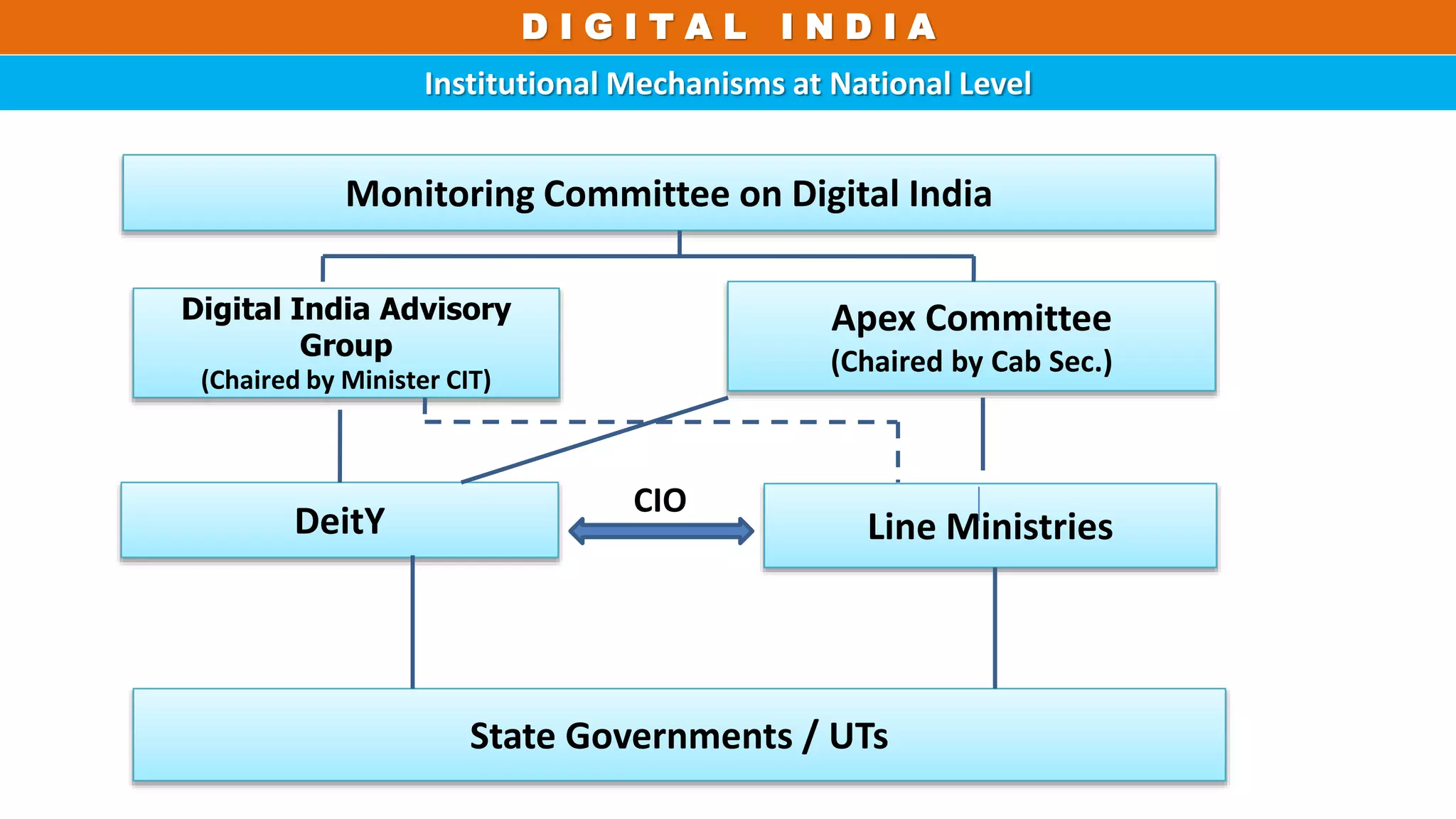
Institutional Mechanisms at National Level
D I G I T A L I N D I A
Monitoring Committee on Digital India
Digital India Advisory
Group
(Chaired by Minister CIT)
DeitY Line Ministries
Apex Committee
(Chaired by Cab Sec.)
State Governments / UTs
CIO
D I G I T A L I N D I A
Composition of Monitoring Committee on Digital India
• Prime Minister – Chairman
• Finance Minister
• Minister of Communications & IT
• Minister of RD
• Minister of HRD
• Minister of Health
Special Invitees:
• Principal Secretary to PM
• Cabinet Secretary
• Secretaries of Expenditure, Planning, DoT and Posts
• Secretary, DeitY – Convener
D I G I T A L I N D I A
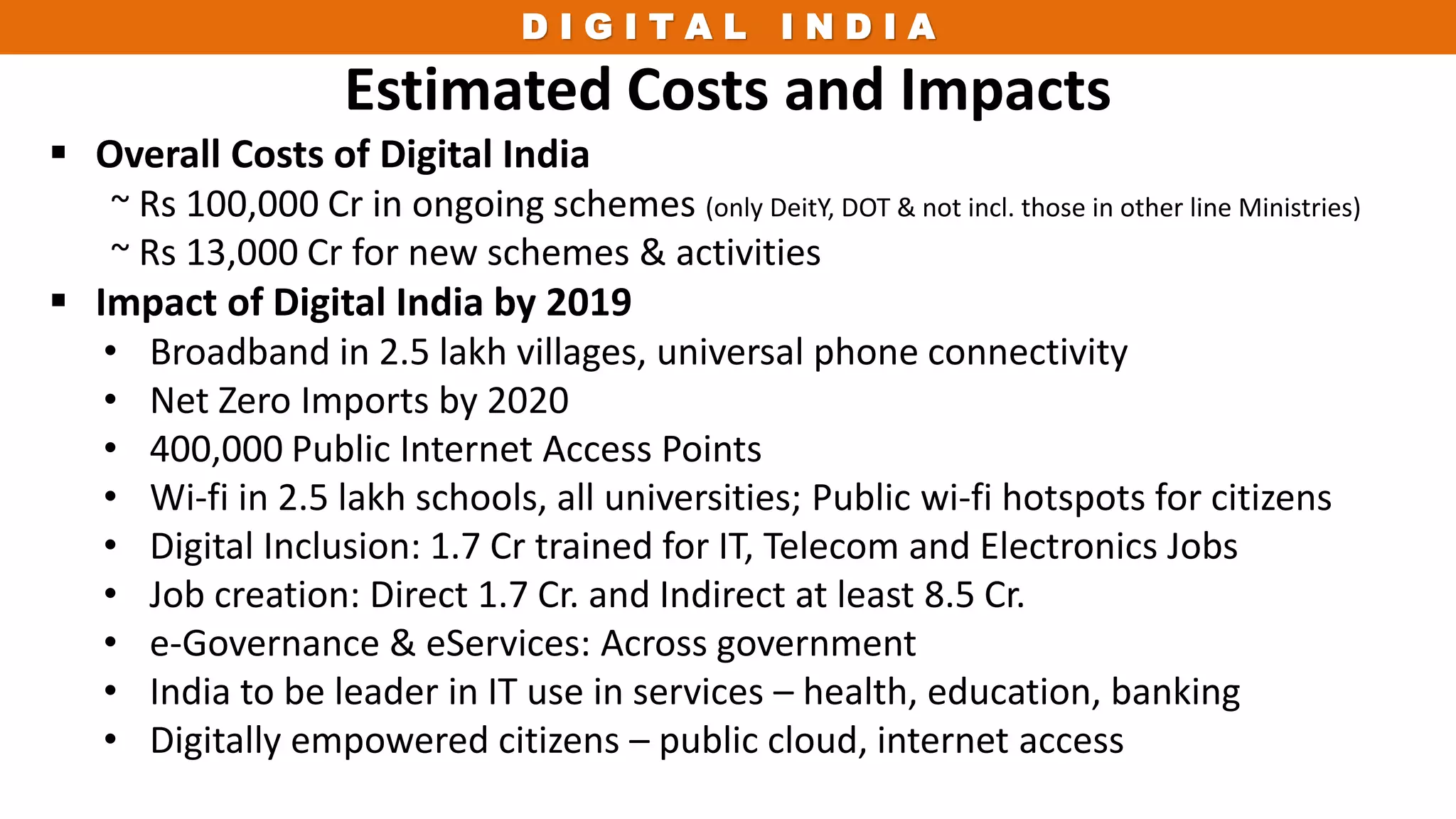
Estimated Costs and Impacts
 Overall Costs of Digital India
~ Rs 100,000 Cr in ongoing schemes (only DeitY, DOT & not incl. those in other line Ministries)
~ Rs 13,000 Cr for new schemes & activities
 Impact of Digital India by 2019
• Broadband in 2.5 lakh villages, universal phone connectivity
• Net Zero Imports by 2020
• 400,000 Public Internet Access Points
• Wi-fi in 2.5 lakh schools, all universities; Public wi-fi hotspots for citizens
• Digital Inclusion: 1.7 Cr trained for IT, Telecom and Electronics Jobs
• Job creation: Direct 1.7 Cr. and Indirect at least 8.5 Cr.
• e-Governance & eServices: Across government
• India to be leader in IT use in services – health, education, banking
• Digitally empowered citizens – public cloud, internet access
D I G I T A L I N D I A
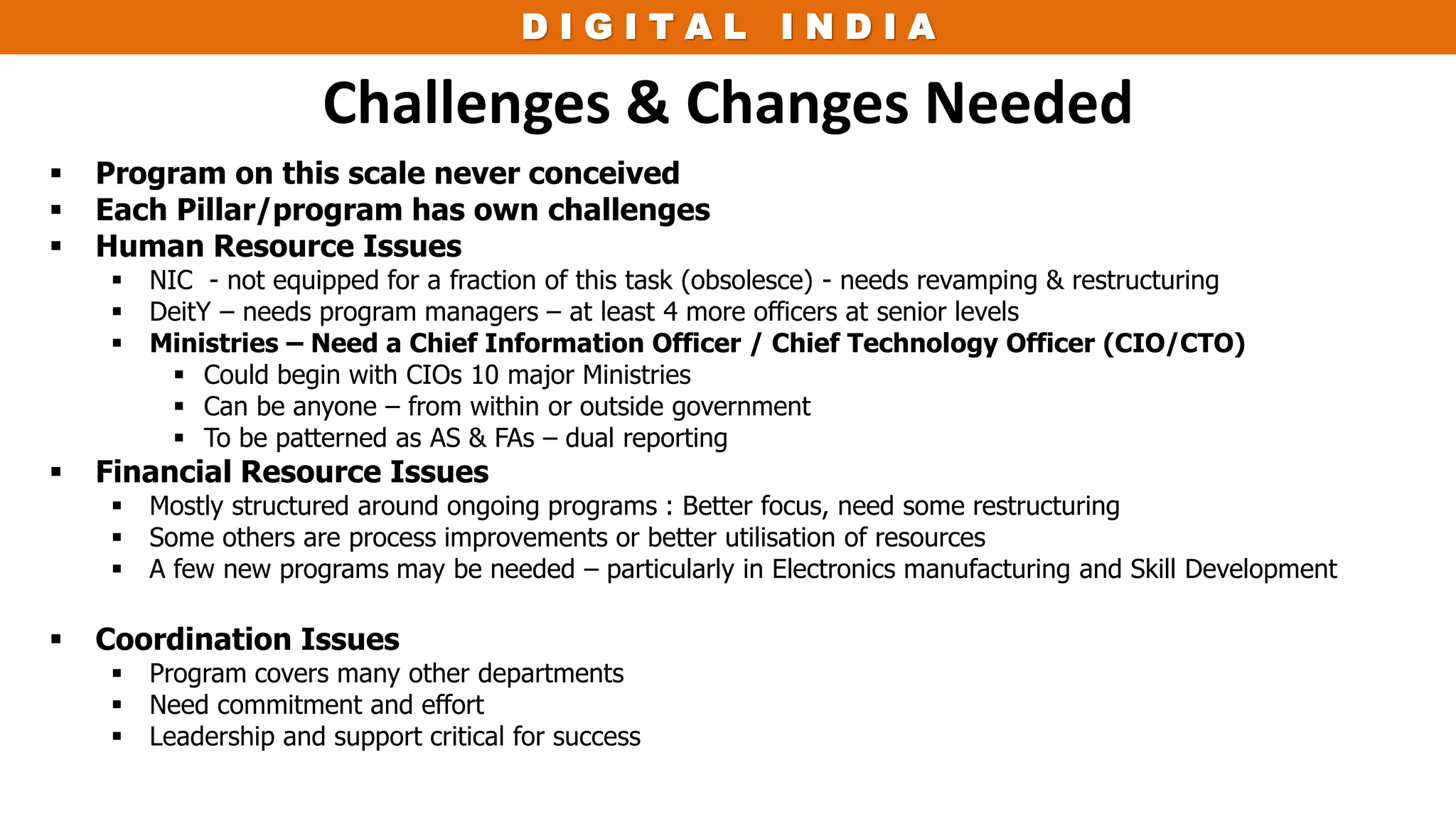
Challenges & Changes Needed
 Program on this scale never conceived
 Each Pillar/program has own challenges
 Human Resource Issues
 NIC - not equipped for a fraction of this task (obsolesce) - needs revamping & restructuring
 DeitY – needs program managers – at least 4 more officers at senior levels
 Ministries – Need a Chief Information Officer / Chief Technology Officer (CIO/CTO)
 Could begin with CIOs 10 major Ministries
 Can be anyone – from within or outside government
 To be patterned as AS & FAs – dual reporting
 Financial Resource Issues
 Mostly structured around ongoing programs : Better focus, need some restructuring
 Some others are process improvements or better utilisation of resources
 A few new programs may be needed – particularly in Electronics manufacturing and Skill Development
 Coordination Issues
 Program covers many other departments
 Need commitment and effort
 Leadership and support critical for success
D I G I T A L I N D I A

Digital india pawan copy

  • 1.
    D I GI T A L I N D I A Digital India A programme to transform India into a digitally empowered society and knowledge economy
  • 2.
    D I GI T A L I N D I A What is Digital India?  Digital India is a Programme to prepare India for a knowledge future.  The focus is on being transformative – to realize IT + IT = IT  The focus is on making technology central to enabling change.  It is an Umbrella Programme – covering many departments.  It weaves together a large number of ideas and thoughts into a single, comprehensive vision so that each of them is seen as part of a larger goal.  Each individual element stands on its own. But is also part of the larger picture.  It is coordinated by DeitY, implemented by the entire government.  The weaving together makes the Mission transformative in totality  The Programme:  Pulls together many existing schemes.  These schemes will be restructured and re-focused.  They will be implemented in a synchronized manner.  Many elements are only process improvements with minimal cost.  The common branding of programmes as Digital India highlights their transformative impact.
  • 3.
    D I GI T A L I N D I A Vision of Digital India Centered on 3 Key Areas • Digital Infrastructure as a Utility to Every Citizen • Governance & Services on Demand • Digital Empowerment of Citizens
  • 4.
    D I GI T A L I N D I A Vision Area 1: Infrastructure as a Utility to Every Citizen • High speed internet as a core utility • Cradle to grave digital identity -unique, lifelong, online, authenticable • Mobile phone & Bank account enabling participation in digital & financial space • Easy access to a Common Service Centre • Shareable private space on a public cloud • Safe and secure Cyber-space
  • 5.
    D I GI T A L I N D I A • Seamlessly integrated across departments or jurisdictions • Services available in real time from online &mobile platform • All citizen entitlements to be available on the cloud • Services digitally transformed for improving Ease of Doing Business • Making financial transactions electronic & cashless • Leveraging GIS for decision support systems & development Vision Area 2: Governance & Services On Demand
  • 6.
    D I GI T A L I N D I A five Pillars of Digital India 1. Broadband Highways 2. Universal Access to Phones 3. Public Internet Access Programme 4. E-Governance – Reforming government through Technology 5. eKranti – Electronic delivery of services ElectronicsManufacturing
  • 7.
    D I GI T A L I N D I A Pillar 1. Broadband Highways • Coverage: 250,000 GP • Timeline: December 2016 • CAPEX: Rs 32,000 Cr • Nodal Dept: DoT Broadband for all Rural •Virtual Network Operators for service delivery. •Mandate communication infrastructure in new urban development and buildings. Broadband for all Urban • Coverage: Nationwide • Timeline: March 2017 • Cost: Rs 15,686 Cr • Nodal Dept: DeitY National Information Infrastructure 1yr: 50,000 GP 2yr: 100,000 GP 3yr: 100,000 GP Changes in Rules to facilitate. Integration of SWAN, NKN, NOFN. To be implemented in 2 years
  • 8.
    D I GI T A L I N D I A Pillar 2. Universal Access to Mobile connectivity • Coverage: Remaining uncovered villages (~ 42,300 villages) • Timeline: FY 2014-18 • Cost: Rs 16,000 Cr • Nodal Dept: DoT Universal Access to mobile connectivity Ongoing Programme Increased network penetration & coverage of gaps
  • 9.
    D I GI T A L I N D I A Pillar 3. Public Internet Access Programme – National Rural Internet Mission •Coverage: 2,50,000 villages (now 130,000) •Timeline: 3 Years - March 2017 •Cost: Rs 4750 Cr •Nodal Agency: DeitY CSCs – made viable, multi- functional end-points for service delivery •Coverage: 1,50,000 Post Offices •Timeline: 2 Years •Nodal Agency: D/o Posts Post Offices to become Multi-Service Centres Ongoing Programme Reach of Govt. services to all GPs This should be long term vision for POs
  • 10.
    D I GI T A L I N D I A  Government Business Process Re-engineering using IT to improve transactions • Form Simplification, reduction • Online applications and tracking, Interface between departments • Use of online repositories e.g. school certificates, voter ID cards, etc. • Integration of services and platforms – UIDAI, Payment Gateway, Mobile Platform, EDI  Electronic Databases – all databases and information to be electronic, not manual  Workflow automation inside government  Public Grievance Redressal - using IT to automate, respond, analyse data to identify and resolve persistent problems – largely process improvements  To be implemented across government - critical for transformation. Pillar 4. e-Governance: Reforming Government through Technology
  • 11.
    D I GI T A L I N D I A Pillar 5. eKranti - Electronic Delivery of Services  Technology for Education – e-Education • All Schools connected with broadband • Free wifi in all schools (250,000) • Digital Literacy program • MOOCs – develop pilot Massive Online Open Courses  Technology for Health – e-Healthcare • Online medical consultation • Online medical records • Online medicine supply • Pan-India exchange for patient information • Pilots – 2015; Full coverage in 3 years  Technology for Planning • GIS based decision making • National GIS Mission Mode Project  Technology for Farmers • Real time price information • Online ordering of inputs • Online cash, loan, relief payment with mobile banking  Technology for Security • Mobile Emergency Services  Technology for Financial Inclusion • Mobile Banking • Micro-ATM program • CSCs/ Post Offices  Technology for Justice • e-Courts, e-Police, e-Jails, e-Prosecution  Technology for Security  National Cyber Security Co-ordination Center Ongoing Programme (NeGP) – will be revamped to cover these elements
  • 12.
    D I GI T A L I N D I A Institutional Mechanisms at National Level D I G I T A L I N D I A Monitoring Committee on Digital India Digital India Advisory Group (Chaired by Minister CIT) DeitY Line Ministries Apex Committee (Chaired by Cab Sec.) State Governments / UTs CIO
  • 13.
    D I GI T A L I N D I A Composition of Monitoring Committee on Digital India • Prime Minister – Chairman • Finance Minister • Minister of Communications & IT • Minister of RD • Minister of HRD • Minister of Health Special Invitees: • Principal Secretary to PM • Cabinet Secretary • Secretaries of Expenditure, Planning, DoT and Posts • Secretary, DeitY – Convener
  • 14.
    D I GI T A L I N D I A Estimated Costs and Impacts  Overall Costs of Digital India ~ Rs 100,000 Cr in ongoing schemes (only DeitY, DOT & not incl. those in other line Ministries) ~ Rs 13,000 Cr for new schemes & activities  Impact of Digital India by 2019 • Broadband in 2.5 lakh villages, universal phone connectivity • Net Zero Imports by 2020 • 400,000 Public Internet Access Points • Wi-fi in 2.5 lakh schools, all universities; Public wi-fi hotspots for citizens • Digital Inclusion: 1.7 Cr trained for IT, Telecom and Electronics Jobs • Job creation: Direct 1.7 Cr. and Indirect at least 8.5 Cr. • e-Governance & eServices: Across government • India to be leader in IT use in services – health, education, banking • Digitally empowered citizens – public cloud, internet access
  • 15.
    D I GI T A L I N D I A Challenges & Changes Needed  Program on this scale never conceived  Each Pillar/program has own challenges  Human Resource Issues  NIC - not equipped for a fraction of this task (obsolesce) - needs revamping & restructuring  DeitY – needs program managers – at least 4 more officers at senior levels  Ministries – Need a Chief Information Officer / Chief Technology Officer (CIO/CTO)  Could begin with CIOs 10 major Ministries  Can be anyone – from within or outside government  To be patterned as AS & FAs – dual reporting  Financial Resource Issues  Mostly structured around ongoing programs : Better focus, need some restructuring  Some others are process improvements or better utilisation of resources  A few new programs may be needed – particularly in Electronics manufacturing and Skill Development  Coordination Issues  Program covers many other departments  Need commitment and effort  Leadership and support critical for success
  • 16.
    D I GI T A L I N D I A

Editor's Notes

  • #15 1,00,000 – 36,000 Fab+575 Skill+15600 NII+24,000 Incentives+500 Cluster+5000 Innovation+500 Digital Literacy+4750 CSC 2.0+200 Training+790 WiFi+98 email.