DEPARMENTAL SEMINAR
GLOBAL WARMING AND ITS IMPACT
IMPLICATION FOR SOCIAL WORK
PRESENTED BY
ANKUR MISHRA
CHAIRED BY:
DR. SUBHASIS BHADRA
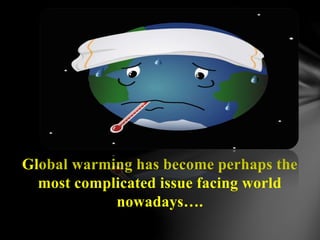
Global warming has become perhaps the
most complicated issue facing world
nowadays….
GLOBAL WARMING
Global Warming is the increase of Earth's
average surface temperature due to effect
of greenhouse gases, such as carbon
dioxide emissions from burning fossil
fuels or from deforestation, which trap
heat that would otherwise escape from
Earth.
WHAT IS GREENHOUSE?
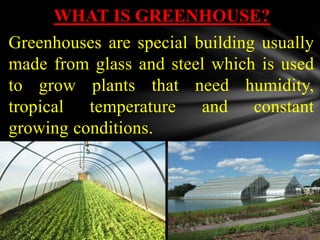
Greenhouses are special building usually
made from glass and steel which is used
to grow plants that need humidity,
tropical temperature and constant
growing conditions.
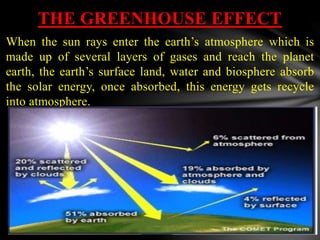
THE GREENHOUSE EFFECT
When the sun rays enter the earth’s atmosphere which is
made up of several layers of gases and reach the planet
earth, the earth’s surface land, water and biosphere absorb
the solar energy, once absorbed, this energy gets recycle
into atmosphere.
CAUSES OF GLOBAL WARMING
Electrical Pollution
Garbage
Increasing population
Deforestation
Burning of fossil fuels
 Methane from rice paddies and
mining operation
 Nitrous oxide from fertilizers and
other chemicals.
 Rapid increase of CO2
IMPACTS OF GLOBAL WARMING
 Accelerating sea level rise & increased
coastal flooding.
 Longer and more damaging wildlife
seasons.
 More frequent and intense heat waves.
 Widespread forest health in the rocky
mountain.
 Costly and growing health impact.
 An increase in extreme weather events.
 Reduced rainfall due to deforestation.
 Increased in hurricanes
 Polar ice cap melting.
A change in global or regional climate
patterns, in particular a change apparent
from the mid to late 20th century onwards
and attributed largely to the increased
levels of atmospheric carbon dioxide
produced by the use of fossil fuels.
CLIMATE CHANGE
CONSEQUENCES
The consequences of climate change are enormous. Scarce natural
resources such as drinking water are likely to become even more
limited. Many crops and some livestock are unlikely to survive in
certain locations if conditions become too hot and dry, or too cold
and wet. Food security, already a significant concern, will become
even more challenging.(Source-UNHCR,2013)
CONCLUSION
As a result people will have to try and adapt to this situation, but for
many this will mean a conscious move to another place to survive.
Such moves, or the adverse effects that climate change may have on
natural resources, may spark conflict with other communities, as an
increasing number of people compete for a decreasing amount of
resources. (Source-UNHCR,2013)
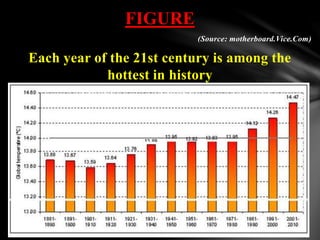
FIGURE
(Source: motherboard.Vice.Com)
Each year of the 21st century is among the
hottest in history
Global Warming Emissions by Economic Sector
(Source: IPCC Fourth Assessment Report: Climate Change 2007, Working Group III: Mitigation of
Climate Change, Chapter 1. This is a snapshot of emissions in 2004)
A carbon footprint is defined as the total amount of
greenhouse gases produced to directly and indirectly support
human activities, usually expressed in equivalent tons of
carbon dioxide (CO2).
Your carbon footprint is the sum of all emissions of CO2
(carbon dioxide), which were induced by your activities in
a given time frame. Usually a carbon footprint is calculated
for the time period of a year.
CARBON FOOTPRINTS
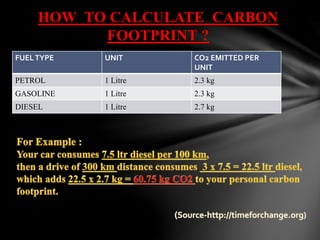
FUELTYPE UNIT CO2 EMITTED PER
UNIT
PETROL 1 Litre 2.3 kg
GASOLINE 1 Litre 2.3 kg
DIESEL 1 Litre 2.7 kg
HOW TO CALCULATE CARBON
FOOTPRINT ?
Environmental refugees are those people who have been
forced to leave their traditional habitat, temporarily or
permanently, because of a marked environmental
disruption (natural or triggered by people) that
jeopardized their existence or seriously affected the
quality of their life.” – Source United Nations Environment Programme(UNEP)
ENVIORNMENTAL REFUGEE
Green social work is a form of holistic professional social
work practice that focuses on the-
Interdependencies amongst people.
The social organisation of relationships between people
and the flora and fauna in their physical habitats.
The interactions between socio-economic and physical
environmental crises and interpersonal behaviours that
undermine the well-being of human beings and planet
earth.
(Lena Dominelli, 2012)
GREEN SOCIAL WORK
IMPLICATIONS OF SOCIAL WORKER
 Social worker can actively play a part in
raising environmental awareness and
promoting sustainable development.
 Social workers, advocating to change
public policies that will have major impact
on the future.
 Organizing workshops with the children’s
in the schools on recycling as well as reuse.
 Collaboration with the different
organizations working on protection of
the environment.
 Act as an educator to the nearby
surroundings by making them aware
about the pros & cons of dumping the
garbage etc properly.
 Promoting the concepts of green social
work among the social work students.
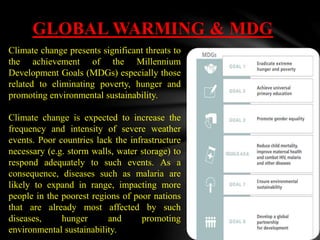
GLOBAL WARMING & MDG
Climate change presents significant threats to
the achievement of the Millennium
Development Goals (MDGs) especially those
related to eliminating poverty, hunger and
promoting environmental sustainability.
Climate change is expected to increase the
frequency and intensity of severe weather
events. Poor countries lack the infrastructure
necessary (e.g. storm walls, water storage) to
respond adequately to such events. As a
consequence, diseases such as malaria are
likely to expand in range, impacting more
people in the poorest regions of poor nations
that are already most affected by such
diseases, hunger and promoting
environmental sustainability.
PROGRAM AND POLICY
National Action Plan on Climate Change
On June 30, 2008, Prime Minister Manmohan Singh
released India’s first National Action Plan on
Climate Change (NAPCC) outlining existing and
future policies and programs addressing climate
mitigation and adaptation. The plan identifies eight
core “national missions” running through 2017 and
directs ministries to submit detailed implementation
plans to the Prime Minister’s Council on Climate
Change by December 2008.
The National Forest Policy, 1988
Policy statement for Abatement of
Pollution, 1992
National Conservation Strategy and
Policy Statement on Environment
and Development, 1992
ENVIORNMENTAL LAWS IN INDIA
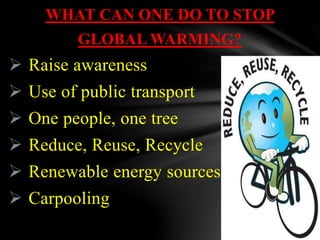
WHAT CAN ONE DO TO STOP
GLOBAL WARMING?
 Raise awareness
 Use of public transport
 One people, one tree
 Reduce, Reuse, Recycle
 Renewable energy sources
 Carpooling
HOW GLOBAL WARMING HAS
EMERGED AS AN ISSUE IN
PUBLIC SPHERE???
THANK YOU
For Details: ankur1989@yahoo.com

Global Warming

  • 1.
    DEPARMENTAL SEMINAR GLOBAL WARMINGAND ITS IMPACT IMPLICATION FOR SOCIAL WORK PRESENTED BY ANKUR MISHRA CHAIRED BY: DR. SUBHASIS BHADRA
  • 2.
    Global warming hasbecome perhaps the most complicated issue facing world nowadays….
  • 3.
    GLOBAL WARMING Global Warmingis the increase of Earth's average surface temperature due to effect of greenhouse gases, such as carbon dioxide emissions from burning fossil fuels or from deforestation, which trap heat that would otherwise escape from Earth.
  • 4.
    WHAT IS GREENHOUSE? Greenhousesare special building usually made from glass and steel which is used to grow plants that need humidity, tropical temperature and constant growing conditions.
  • 5.
    THE GREENHOUSE EFFECT Whenthe sun rays enter the earth’s atmosphere which is made up of several layers of gases and reach the planet earth, the earth’s surface land, water and biosphere absorb the solar energy, once absorbed, this energy gets recycle into atmosphere.
  • 6.
    CAUSES OF GLOBALWARMING Electrical Pollution Garbage Increasing population Deforestation Burning of fossil fuels
  • 7.
     Methane fromrice paddies and mining operation  Nitrous oxide from fertilizers and other chemicals.  Rapid increase of CO2
  • 8.
    IMPACTS OF GLOBALWARMING  Accelerating sea level rise & increased coastal flooding.  Longer and more damaging wildlife seasons.  More frequent and intense heat waves.  Widespread forest health in the rocky mountain.
  • 9.
     Costly andgrowing health impact.  An increase in extreme weather events.  Reduced rainfall due to deforestation.  Increased in hurricanes  Polar ice cap melting.
  • 10.
    A change inglobal or regional climate patterns, in particular a change apparent from the mid to late 20th century onwards and attributed largely to the increased levels of atmospheric carbon dioxide produced by the use of fossil fuels. CLIMATE CHANGE
  • 11.
    CONSEQUENCES The consequences ofclimate change are enormous. Scarce natural resources such as drinking water are likely to become even more limited. Many crops and some livestock are unlikely to survive in certain locations if conditions become too hot and dry, or too cold and wet. Food security, already a significant concern, will become even more challenging.(Source-UNHCR,2013) CONCLUSION As a result people will have to try and adapt to this situation, but for many this will mean a conscious move to another place to survive. Such moves, or the adverse effects that climate change may have on natural resources, may spark conflict with other communities, as an increasing number of people compete for a decreasing amount of resources. (Source-UNHCR,2013)
  • 12.
    FIGURE (Source: motherboard.Vice.Com) Each yearof the 21st century is among the hottest in history
  • 13.
    Global Warming Emissionsby Economic Sector (Source: IPCC Fourth Assessment Report: Climate Change 2007, Working Group III: Mitigation of Climate Change, Chapter 1. This is a snapshot of emissions in 2004)
  • 14.
    A carbon footprintis defined as the total amount of greenhouse gases produced to directly and indirectly support human activities, usually expressed in equivalent tons of carbon dioxide (CO2). Your carbon footprint is the sum of all emissions of CO2 (carbon dioxide), which were induced by your activities in a given time frame. Usually a carbon footprint is calculated for the time period of a year. CARBON FOOTPRINTS
  • 15.
    FUELTYPE UNIT CO2EMITTED PER UNIT PETROL 1 Litre 2.3 kg GASOLINE 1 Litre 2.3 kg DIESEL 1 Litre 2.7 kg HOW TO CALCULATE CARBON FOOTPRINT ?
  • 16.
    Environmental refugees arethose people who have been forced to leave their traditional habitat, temporarily or permanently, because of a marked environmental disruption (natural or triggered by people) that jeopardized their existence or seriously affected the quality of their life.” – Source United Nations Environment Programme(UNEP) ENVIORNMENTAL REFUGEE
  • 17.
    Green social workis a form of holistic professional social work practice that focuses on the- Interdependencies amongst people. The social organisation of relationships between people and the flora and fauna in their physical habitats. The interactions between socio-economic and physical environmental crises and interpersonal behaviours that undermine the well-being of human beings and planet earth. (Lena Dominelli, 2012) GREEN SOCIAL WORK
  • 18.
    IMPLICATIONS OF SOCIALWORKER  Social worker can actively play a part in raising environmental awareness and promoting sustainable development.  Social workers, advocating to change public policies that will have major impact on the future.  Organizing workshops with the children’s in the schools on recycling as well as reuse.
  • 19.
     Collaboration withthe different organizations working on protection of the environment.  Act as an educator to the nearby surroundings by making them aware about the pros & cons of dumping the garbage etc properly.  Promoting the concepts of green social work among the social work students.
  • 20.
    GLOBAL WARMING &MDG Climate change presents significant threats to the achievement of the Millennium Development Goals (MDGs) especially those related to eliminating poverty, hunger and promoting environmental sustainability. Climate change is expected to increase the frequency and intensity of severe weather events. Poor countries lack the infrastructure necessary (e.g. storm walls, water storage) to respond adequately to such events. As a consequence, diseases such as malaria are likely to expand in range, impacting more people in the poorest regions of poor nations that are already most affected by such diseases, hunger and promoting environmental sustainability.
  • 21.
    PROGRAM AND POLICY NationalAction Plan on Climate Change On June 30, 2008, Prime Minister Manmohan Singh released India’s first National Action Plan on Climate Change (NAPCC) outlining existing and future policies and programs addressing climate mitigation and adaptation. The plan identifies eight core “national missions” running through 2017 and directs ministries to submit detailed implementation plans to the Prime Minister’s Council on Climate Change by December 2008.
  • 22.
    The National ForestPolicy, 1988 Policy statement for Abatement of Pollution, 1992 National Conservation Strategy and Policy Statement on Environment and Development, 1992 ENVIORNMENTAL LAWS IN INDIA
  • 23.
    WHAT CAN ONEDO TO STOP GLOBAL WARMING?  Raise awareness  Use of public transport  One people, one tree  Reduce, Reuse, Recycle  Renewable energy sources  Carpooling
  • 24.
    HOW GLOBAL WARMINGHAS EMERGED AS AN ISSUE IN PUBLIC SPHERE???
  • 25.
    THANK YOU For Details:ankur1989@yahoo.com