Presented
By:
-Satyam Jaiswal
-Vishal Asojwal
WELCOME
CONTENTS:
 What is Global Warming?
 Greenhouse Effects
 Causes of Global Warming.
 Effects of Global Warming.
 Ozone Layer Depletion.
 Global Warming Statistics
 Projection of Global Warming.
 Future Predictions
 Precaution to prevent Global
Warming.
TOPIC – GLOBAL WARMING
 Global warming relates to
the increase in the average
temperature of the Earth's
surface that has been
observed in recent
years, and it is projected to
continue. It is debated as
to whether this is a natural
occurrence or whether
human activity has
impacted or accelerated it.
...
WHAT IS GLOBAL WARMING?
 The greenhouse effect is the process by which
absorption and emission of infrared radiation by
gases in the atmosphere are purported to warm
a planet's lower atmosphere and surface.
 Naturally occurring greenhouse gases have a
mean warming effect of about 33 °C (59 °F).
 The major greenhouse gases are water
vapor, which causes about 36–70 percent of the
greenhouse effect; carbon dioxide (CO2), which
causes 9–26 percent; methane (CH4), which
causes 4–9 percent; and ozone (O3), which
causes 3–7 percent. Clouds also affect the
radiation balance, but they are composed of
liquid water or ice and so have different effects
on radiation from water vapour.
GREEN HOUSE EFFECT
• Global warming is caused by
several things, which include
man-made or anthropogenic
causes, and global warming is
also caused by natural causes.
• There are many causes, some
are as follows:
• Natural Causes
• Man-made Causes of Global
Warming
CAUSES OF GLOBAL WARMING!
 Natural causes are causes
that are created by nature.
One natural cause is a
release of methane gas
from arctic tundra and
wetlands. Methane is a
greenhouse gas and a very
dangerous gas to our
environment. A greenhouse
gas is a gas that traps heat
in the earth's atmosphere.
Another natural cause is
that the earth goes through
a cycle of climate change.
This climate change
usually lasts about 40,000
years.
NATURAL CAUSES OF GLOBAL WARMING
Volcanoes
Volcanoes are one of the largest natural
contributors to global warming. The ash and
smoke emitted during volcanic eruptions
goes out into the atmosphere and affects the
climate.
Water Vapour
Water Vapour is a kind of greenhouse gas.
Due to the increase in the earth’s
temperature more water gets evaporated
from the water bodies and stays in the
atmosphere adding to global warming.
Melting Permafrost
Permafrost is there where glaciers are
present. It is a frozen soil that has
environmental gases trapped in it for several
years. As the permafrost melts, it releases
the gases back into the atmosphere
increasing the earth’s temperature.
Forest Blazes
Forest blazes or forest fires emit a large
amount of carbon-containing smoke. These
gases are released into the atmosphere and
increase the earth’s temperature resulting in
global warming.
 Man-made causes probably do
the most damage to our planet.
There are many man-made
causes of global warming.
Pollution is one of the biggest
man-made problems. Pollution
comes in many shapes and
sizes. Burning fossil fuels is one
thing that causes pollution. Fossil
fuels are fuels made of organic
matter such as coal, or oil. When
fossil fuels are burned they give
off a green house gas called
CO2. When you dig up the fossil
fuels you dig up the methane as
well letting it escape into the
atmosphere.
MAN-MADE CAUSES OF GLOBAL WARMING
 Deforestation
Plants are the main source of oxygen.
They take in carbon dioxide and release
oxygen thereby maintaining
environmental balance. Forests are being
depleted for many domestic and
commercial purposes. This has led to an
environmental imbalance, thereby giving
rise to global warming.
Use of Vehicles
The use of vehicles, even for a very short
distance results in various gaseous
emissions. Vehicles burn fossil fuels
which emit a large amount of carbon
dioxide and other toxins into the
atmosphere resulting in a temperature
increase.
Chlorofluorocarbon
With the excessive use of air conditioners and
refrigerators, humans have been adding CFCs into
the environment which affects the atmospheric
ozone layer. The ozone layer protects the earth
surface from the harmful ultraviolet rays emitted by
the sun. The CFCs has led toozone layer
depletionmaking way for the ultraviolet rays,
thereby increasing the temperature of the earth.
Industrial Development
With the advent of industrialization, the
temperature of the earth has been increasing
rapidly. The harmful emissions from the factories
add to the increasing temperature of the earth.
Agriculture
Various farming activities produce carbon dioxide
and methane gas. These add to the greenhouse
gases in the atmosphere and increase the
temperature of the earth.
Overpopulation
Increase in population means more people
breathing. This leads to an increase in the level of
carbon dioxide, the primary gas causing global
warming, in the atmosphere.
 The effects of Global Warming can
already be seen
The IPCC's Third Assessment
Report finds that in the last 40
years, the global average sea
level has risen, ocean heat
content has increased, and snow
cover and ice extent have
decreased, which threatens to
inundate low-lying island nations
and coastal regions throughout the
world.
o Effects of global warming already
being felt on plants and
animals worldwide
o Global Warming Effects that will
happen in the future:
EFFECTS OF GLOBAL WARMING
 Rising sea levels: Melting ice in Greenland and Antarctica leads to
accelerated sea-level rise, posing risks to coastal regions and low-lying
areas.
 Ecosystem disruption: Rapid warming outpaces the ability of many plant
and animal species to adapt, resulting in ecosystem disruption, species
extinction, and loss of biodiversity.
 Agricultural challenges: Higher temperatures may enable crop growth in
colder regions, but increased pests and diseases can offset these benefits,
impacting crop yields and food security.
 Water scarcity: Altered precipitation patterns and increased evaporation
rates due to global warming disrupt hydrological cycles, leading to water
scarcity in many regions.
EFFECTS OF GLOBAL WARMING ON EARTH
IN FUTURE
 Global warming is having a
significant impact on
hundreds of plant and
animal species around the
world -- although the most
dramatic effects may not
be felt for
decades, according to a
new study in the journal
Nature.
EFFECTS OF GLOBAL WARMING FELT ON PLANTS
AND ANIMALS
 The ozone layer protects the
Earth from the ultraviolet rays
sent down by the sun. If the
ozone layer is depleted by
human action, the effects on the
planet could be catastrophic.
 Ozone is a bluish gas that is
formed by three atoms of
oxygen. The form of oxygen
that humans breathe in consists
of two oxygen atoms, O2. When
found on the surface of the
planet, ozone is considered a
dangerous pollutant and is one
substance responsible for
producing the greenhouse
OZONE LAYER DEPLETION
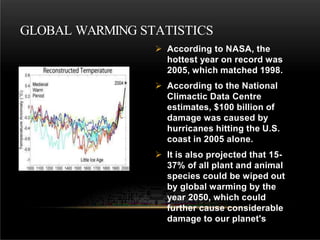
 According to NASA, the
hottest year on record was
2005, which matched 1998.
 According to the National
Climactic Data Centre
estimates, $100 billion of
damage was caused by
hurricanes hitting the U.S.
coast in 2005 alone.
 It is also projected that 15-
37% of all plant and animal
species could be wiped out
by global warming by the
year 2050, which could
further cause considerable
damage to our planet's
GLOBAL WARMING STATISTICS
PROJECTION OF GLOBAL WARMING
Calculations of global warming prepared in
or before 2001 from a range of climate
models under the SRES A2 emissions
scenario, which assumes no action is taken
to reduce emissions and regionally divided
economic development.
The geographic distribution of surface
warming during the 21st century
calculated by the HadCM3 climate model
if a business as usual scenario is
assumed for economic growth and
greenhouse gas emissions. In this
figure, the globally averaged warming
corresponds to 3.0 °C (5.4 °F).
Some basic predictions of global warming on
temperature and sea level:
 Global mean temperature should increase by between 1.4
and 5.8�C (2.5 to 10�F).
 The Northern Hemisphere cover should decrease further, but
the Antarctic ice sheet should increase.
 The sea level should rise by between 9 and 88 cm (3.5" to
35").
 Other changes should occur, including an increase in some
extreme weather events.
 TheUnitedStates is rankednr.1amonglarge nationsof beingaglobal
warmingpolluter
 Thesoonerwetakeheedofthesestatisticsandimplementchangesthat
addressglobal warming,the quickerwecanreversethe disturbing trends
FUTURE PREDICTIONS
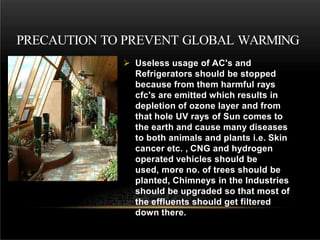
 Useless usage of AC's and
Refrigerators should be stopped
because from them harmful rays
cfc's are emitted which results in
depletion of ozone layer and from
that hole UV rays of Sun comes to
the earth and cause many diseases
to both animals and plants i.e. Skin
cancer etc. , CNG and hydrogen
operated vehicles should be
used, more no. of trees should be
planted, Chimneys in the Industries
should be upgraded so that most of
the effluents should get filtered
down there.
PRECAUTION TO PREVENT GLOBAL WARMING
 Useless usage of AC's and
Refrigerators should be stopped
because from them harmful rays
cfc's are emitted which results in
depletion of ozone layer and from
that hole UV rays of Sun comes to
the earth and cause many diseases
to both animals and plants i.e. Skin
cancer etc. , CNG and hydrogen
operated vehicles should be
used, more no. of trees should be
planted, Chimneys in the Industries
should be upgraded so that most of
the effluents should get filtered
down there.
PRECAUTION TO PREVENT GLOBAL WARMING
SAVE ENVIRONMENT
SAVE EARTH

satyam.pptx

  • 1.
  • 2.
    CONTENTS:  What isGlobal Warming?  Greenhouse Effects  Causes of Global Warming.  Effects of Global Warming.  Ozone Layer Depletion.  Global Warming Statistics  Projection of Global Warming.  Future Predictions  Precaution to prevent Global Warming. TOPIC – GLOBAL WARMING
  • 3.
     Global warmingrelates to the increase in the average temperature of the Earth's surface that has been observed in recent years, and it is projected to continue. It is debated as to whether this is a natural occurrence or whether human activity has impacted or accelerated it. ... WHAT IS GLOBAL WARMING?
  • 4.
     The greenhouseeffect is the process by which absorption and emission of infrared radiation by gases in the atmosphere are purported to warm a planet's lower atmosphere and surface.  Naturally occurring greenhouse gases have a mean warming effect of about 33 °C (59 °F).  The major greenhouse gases are water vapor, which causes about 36–70 percent of the greenhouse effect; carbon dioxide (CO2), which causes 9–26 percent; methane (CH4), which causes 4–9 percent; and ozone (O3), which causes 3–7 percent. Clouds also affect the radiation balance, but they are composed of liquid water or ice and so have different effects on radiation from water vapour. GREEN HOUSE EFFECT
  • 5.
    • Global warmingis caused by several things, which include man-made or anthropogenic causes, and global warming is also caused by natural causes. • There are many causes, some are as follows: • Natural Causes • Man-made Causes of Global Warming CAUSES OF GLOBAL WARMING!
  • 6.
     Natural causesare causes that are created by nature. One natural cause is a release of methane gas from arctic tundra and wetlands. Methane is a greenhouse gas and a very dangerous gas to our environment. A greenhouse gas is a gas that traps heat in the earth's atmosphere. Another natural cause is that the earth goes through a cycle of climate change. This climate change usually lasts about 40,000 years. NATURAL CAUSES OF GLOBAL WARMING
  • 7.
    Volcanoes Volcanoes are oneof the largest natural contributors to global warming. The ash and smoke emitted during volcanic eruptions goes out into the atmosphere and affects the climate. Water Vapour Water Vapour is a kind of greenhouse gas. Due to the increase in the earth’s temperature more water gets evaporated from the water bodies and stays in the atmosphere adding to global warming.
  • 8.
    Melting Permafrost Permafrost isthere where glaciers are present. It is a frozen soil that has environmental gases trapped in it for several years. As the permafrost melts, it releases the gases back into the atmosphere increasing the earth’s temperature. Forest Blazes Forest blazes or forest fires emit a large amount of carbon-containing smoke. These gases are released into the atmosphere and increase the earth’s temperature resulting in global warming.
  • 9.
     Man-made causesprobably do the most damage to our planet. There are many man-made causes of global warming. Pollution is one of the biggest man-made problems. Pollution comes in many shapes and sizes. Burning fossil fuels is one thing that causes pollution. Fossil fuels are fuels made of organic matter such as coal, or oil. When fossil fuels are burned they give off a green house gas called CO2. When you dig up the fossil fuels you dig up the methane as well letting it escape into the atmosphere. MAN-MADE CAUSES OF GLOBAL WARMING
  • 10.
     Deforestation Plants arethe main source of oxygen. They take in carbon dioxide and release oxygen thereby maintaining environmental balance. Forests are being depleted for many domestic and commercial purposes. This has led to an environmental imbalance, thereby giving rise to global warming. Use of Vehicles The use of vehicles, even for a very short distance results in various gaseous emissions. Vehicles burn fossil fuels which emit a large amount of carbon dioxide and other toxins into the atmosphere resulting in a temperature increase.
  • 11.
    Chlorofluorocarbon With the excessiveuse of air conditioners and refrigerators, humans have been adding CFCs into the environment which affects the atmospheric ozone layer. The ozone layer protects the earth surface from the harmful ultraviolet rays emitted by the sun. The CFCs has led toozone layer depletionmaking way for the ultraviolet rays, thereby increasing the temperature of the earth. Industrial Development With the advent of industrialization, the temperature of the earth has been increasing rapidly. The harmful emissions from the factories add to the increasing temperature of the earth.
  • 12.
    Agriculture Various farming activitiesproduce carbon dioxide and methane gas. These add to the greenhouse gases in the atmosphere and increase the temperature of the earth. Overpopulation Increase in population means more people breathing. This leads to an increase in the level of carbon dioxide, the primary gas causing global warming, in the atmosphere.
  • 13.
     The effectsof Global Warming can already be seen The IPCC's Third Assessment Report finds that in the last 40 years, the global average sea level has risen, ocean heat content has increased, and snow cover and ice extent have decreased, which threatens to inundate low-lying island nations and coastal regions throughout the world. o Effects of global warming already being felt on plants and animals worldwide o Global Warming Effects that will happen in the future: EFFECTS OF GLOBAL WARMING
  • 14.
     Rising sealevels: Melting ice in Greenland and Antarctica leads to accelerated sea-level rise, posing risks to coastal regions and low-lying areas.  Ecosystem disruption: Rapid warming outpaces the ability of many plant and animal species to adapt, resulting in ecosystem disruption, species extinction, and loss of biodiversity.  Agricultural challenges: Higher temperatures may enable crop growth in colder regions, but increased pests and diseases can offset these benefits, impacting crop yields and food security.  Water scarcity: Altered precipitation patterns and increased evaporation rates due to global warming disrupt hydrological cycles, leading to water scarcity in many regions. EFFECTS OF GLOBAL WARMING ON EARTH IN FUTURE
  • 15.
     Global warmingis having a significant impact on hundreds of plant and animal species around the world -- although the most dramatic effects may not be felt for decades, according to a new study in the journal Nature. EFFECTS OF GLOBAL WARMING FELT ON PLANTS AND ANIMALS
  • 16.
     The ozonelayer protects the Earth from the ultraviolet rays sent down by the sun. If the ozone layer is depleted by human action, the effects on the planet could be catastrophic.  Ozone is a bluish gas that is formed by three atoms of oxygen. The form of oxygen that humans breathe in consists of two oxygen atoms, O2. When found on the surface of the planet, ozone is considered a dangerous pollutant and is one substance responsible for producing the greenhouse OZONE LAYER DEPLETION
  • 17.
     According toNASA, the hottest year on record was 2005, which matched 1998.  According to the National Climactic Data Centre estimates, $100 billion of damage was caused by hurricanes hitting the U.S. coast in 2005 alone.  It is also projected that 15- 37% of all plant and animal species could be wiped out by global warming by the year 2050, which could further cause considerable damage to our planet's GLOBAL WARMING STATISTICS
  • 18.
    PROJECTION OF GLOBALWARMING Calculations of global warming prepared in or before 2001 from a range of climate models under the SRES A2 emissions scenario, which assumes no action is taken to reduce emissions and regionally divided economic development. The geographic distribution of surface warming during the 21st century calculated by the HadCM3 climate model if a business as usual scenario is assumed for economic growth and greenhouse gas emissions. In this figure, the globally averaged warming corresponds to 3.0 °C (5.4 °F).
  • 19.
    Some basic predictionsof global warming on temperature and sea level:  Global mean temperature should increase by between 1.4 and 5.8�C (2.5 to 10�F).  The Northern Hemisphere cover should decrease further, but the Antarctic ice sheet should increase.  The sea level should rise by between 9 and 88 cm (3.5" to 35").  Other changes should occur, including an increase in some extreme weather events.  TheUnitedStates is rankednr.1amonglarge nationsof beingaglobal warmingpolluter  Thesoonerwetakeheedofthesestatisticsandimplementchangesthat addressglobal warming,the quickerwecanreversethe disturbing trends FUTURE PREDICTIONS
  • 20.
     Useless usageof AC's and Refrigerators should be stopped because from them harmful rays cfc's are emitted which results in depletion of ozone layer and from that hole UV rays of Sun comes to the earth and cause many diseases to both animals and plants i.e. Skin cancer etc. , CNG and hydrogen operated vehicles should be used, more no. of trees should be planted, Chimneys in the Industries should be upgraded so that most of the effluents should get filtered down there. PRECAUTION TO PREVENT GLOBAL WARMING
  • 21.
     Useless usageof AC's and Refrigerators should be stopped because from them harmful rays cfc's are emitted which results in depletion of ozone layer and from that hole UV rays of Sun comes to the earth and cause many diseases to both animals and plants i.e. Skin cancer etc. , CNG and hydrogen operated vehicles should be used, more no. of trees should be planted, Chimneys in the Industries should be upgraded so that most of the effluents should get filtered down there. PRECAUTION TO PREVENT GLOBAL WARMING
  • 22.