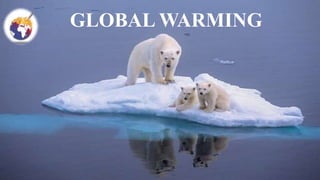
GLOBAL WARMING
What is Global Warming?
• the increase in Earth’s average surface temperature due to rising levels of
greenhouse gases.
• Its first use was in a 1975 Science article by geochemist Wallace Broecker of
Columbia University's Lamont-Doherty Geological Observatory: "Climatic
Change: Are We on the Brink of a Pronounced Global Warming?[1]
[1] Wallace Broecker, "Climatic Change: Are We on the Brink of a Pronounced Global Warming?" Science, vol. 189 (8 August 1975), 460-463.
Global Mean Temperature Anomaly (U.K. Met. Office) 1900-2016
Purple shade
shows the
uncertainty in
measurements.
The solid line
represents the
actual
measurements.
0.6 oC of
increased
temperature
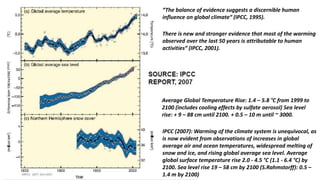
IPCC (2007): Warming of the climate system is unequivocal, as
is now evident from observations of increases in global
average air and ocean temperatures, widespread melting of
snow and ice, and rising global average sea level. Average
global surface temperature rise 2.0 - 4.5 °C (1.1 - 6.4 °C) by
2100. Sea level rise 19 – 58 cm by 2100 (S.Rahmstorff): 0.5 –
1.4 m by 2100)
“The balance of evidence suggests a discernible human
influence on global climate“ (IPCC, 1995).
There is new and stronger evidence that most of the warming
observed over the last 50 years is attributable to human
activities“ (IPCC, 2001).
Average Global Temperature Rise: 1.4 – 5.8 °C from 1999 to
2100 (includes cooling effects by sulfate aerosol) Sea level
rise: + 9 – 88 cm until 2100. + 0.5 – 10 m until ~ 3000.
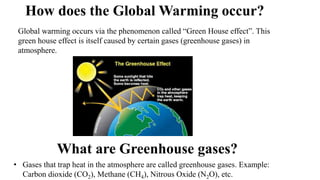
How does the Global Warming occur?
Global warming occurs via the phenomenon called “Green House effect”. This
green house effect is itself caused by certain gases (greenhouse gases) in
atmosphere.
What are Greenhouse gases?
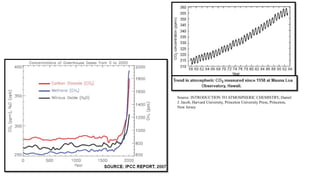
• Gases that trap heat in the atmosphere are called greenhouse gases. Example:
Carbon dioxide (CO2), Methane (CH4), Nitrous Oxide (N2O), etc.
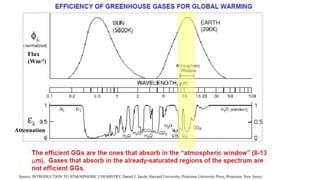
Flux
(Wm-2)
Attenuation
Source: INTRODUCTION TO ATMOSPHERIC CHEMISTRY, Daniel J. Jacob, Harvard University, Princeton University Press, Princeton, New Jersey
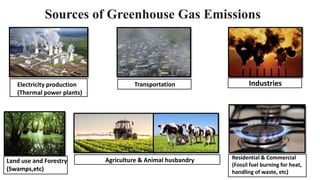
Sources of Greenhouse Gas Emissions
Electricity production
(Thermal power plants)
Transportation Industries
Residential & Commercial
(Fossil fuel burning for heat,
handling of waste, etc)
Agriculture & Animal husbandryLand use and Forestry
(Swamps,etc)
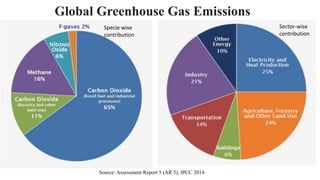
Global Greenhouse Gas Emissions
Source: Assessment Report 5 (AR 5), IPCC 2014
Specie wise
contribution
Sector-wise
contribution
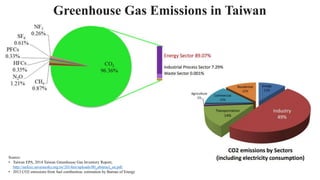
Source:
• Taiwan EPA, 2014 Taiwan Greenhouse Gas Inventory Report,
http://unfccc.saveoursky.org.tw/2014nir/uploads/00_abstract_en.pdf.
• 2013 CO2 emissions from fuel combustion, estimation by Bureau of Energy
Greenhouse Gas Emissions in Taiwan
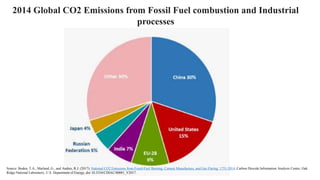
2014 Global CO2 Emissions from Fossil Fuel combustion and Industrial
processes
Source: Boden, T.A., Marland, G., and Andres, R.J. (2017). National CO2 Emissions from Fossil-Fuel Burning, Cement Manufacture, and Gas Flaring: 1751-2014, Carbon Dioxide Information Analysis Center, Oak
Ridge National Laboratory, U.S. Department of Energy, doi 10.3334/CDIAC/00001_V2017.
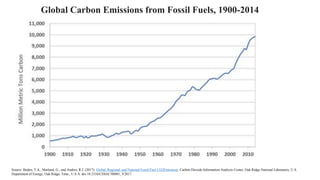
Global Carbon Emissions from Fossil Fuels, 1900-2014
Source: Boden, T.A., Marland, G., and Andres, R.J. (2017). Global, Regional, and National Fossil-Fuel CO2Emissions. Carbon Dioxide Information Analysis Center, Oak Ridge National Laboratory, U.S.
Department of Energy, Oak Ridge, Tenn., U.S.A. doi 10.3334/CDIAC/00001_V2017.
Source: INTRODUCTION TO ATMOSPHERIC CHEMISTRY, Daniel
J. Jacob, Harvard University, Princeton University Press, Princeton,
New Jersey
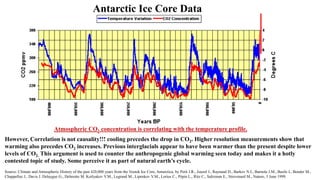
Antarctic Ice Core Data
Source: Climate and Atmospheric History of the past 420,000 years from the Vostok Ice Core, Antarctica, by Petit J.R., Jouzel J., Raynaud D., Barkov N.I., Barnola J.M., Basile I., Bender M.,
Chappellaz J., Davis J. Delaygue G., Delmotte M. Kotlyakov V.M., Legrand M., Lipenkov V.M., Lorius C., Pépin L., Ritz C., Saltzman E., Stievenard M., Nature, 3 June 1999.
Atmospheric CO2 concentration is correlating with the temperature profile.
However, Correlation is not causality!!! cooling precedes the drop in CO2. Higher resolution measurements show that
warming also precedes CO2 increases. Previous interglacials appear to have been warmer than the present despite lower
levels of CO2. This argument is used to counter the anthropogenic global warming seen today and makes it a hotly
contested topic of study. Some perceive it as part of natural earth’s cycle.
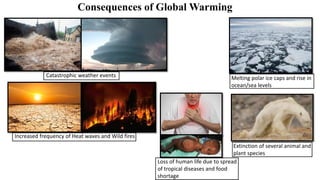
Consequences of Global Warming
Catastrophic weather events Melting polar ice caps and rise in
ocean/sea levels
Increased frequency of Heat waves and Wild fires
Extinction of several animal and
plant species
Loss of human life due to spread
of tropical diseases and food
shortage
Global warming: Causes and Consequences

Global warming: Causes and Consequences

  • 1.
  • 2.
    What is GlobalWarming? • the increase in Earth’s average surface temperature due to rising levels of greenhouse gases. • Its first use was in a 1975 Science article by geochemist Wallace Broecker of Columbia University's Lamont-Doherty Geological Observatory: "Climatic Change: Are We on the Brink of a Pronounced Global Warming?[1] [1] Wallace Broecker, "Climatic Change: Are We on the Brink of a Pronounced Global Warming?" Science, vol. 189 (8 August 1975), 460-463. Global Mean Temperature Anomaly (U.K. Met. Office) 1900-2016 Purple shade shows the uncertainty in measurements. The solid line represents the actual measurements. 0.6 oC of increased temperature
  • 3.
    IPCC (2007): Warmingof the climate system is unequivocal, as is now evident from observations of increases in global average air and ocean temperatures, widespread melting of snow and ice, and rising global average sea level. Average global surface temperature rise 2.0 - 4.5 °C (1.1 - 6.4 °C) by 2100. Sea level rise 19 – 58 cm by 2100 (S.Rahmstorff): 0.5 – 1.4 m by 2100) “The balance of evidence suggests a discernible human influence on global climate“ (IPCC, 1995). There is new and stronger evidence that most of the warming observed over the last 50 years is attributable to human activities“ (IPCC, 2001). Average Global Temperature Rise: 1.4 – 5.8 °C from 1999 to 2100 (includes cooling effects by sulfate aerosol) Sea level rise: + 9 – 88 cm until 2100. + 0.5 – 10 m until ~ 3000.
  • 4.
    How does theGlobal Warming occur? Global warming occurs via the phenomenon called “Green House effect”. This green house effect is itself caused by certain gases (greenhouse gases) in atmosphere. What are Greenhouse gases? • Gases that trap heat in the atmosphere are called greenhouse gases. Example: Carbon dioxide (CO2), Methane (CH4), Nitrous Oxide (N2O), etc.
  • 5.
    Flux (Wm-2) Attenuation Source: INTRODUCTION TOATMOSPHERIC CHEMISTRY, Daniel J. Jacob, Harvard University, Princeton University Press, Princeton, New Jersey
  • 6.
    Sources of GreenhouseGas Emissions Electricity production (Thermal power plants) Transportation Industries Residential & Commercial (Fossil fuel burning for heat, handling of waste, etc) Agriculture & Animal husbandryLand use and Forestry (Swamps,etc)
  • 7.
    Global Greenhouse GasEmissions Source: Assessment Report 5 (AR 5), IPCC 2014 Specie wise contribution Sector-wise contribution
  • 8.
    Source: • Taiwan EPA,2014 Taiwan Greenhouse Gas Inventory Report, http://unfccc.saveoursky.org.tw/2014nir/uploads/00_abstract_en.pdf. • 2013 CO2 emissions from fuel combustion, estimation by Bureau of Energy Greenhouse Gas Emissions in Taiwan
  • 9.
    2014 Global CO2Emissions from Fossil Fuel combustion and Industrial processes Source: Boden, T.A., Marland, G., and Andres, R.J. (2017). National CO2 Emissions from Fossil-Fuel Burning, Cement Manufacture, and Gas Flaring: 1751-2014, Carbon Dioxide Information Analysis Center, Oak Ridge National Laboratory, U.S. Department of Energy, doi 10.3334/CDIAC/00001_V2017.
  • 10.
    Global Carbon Emissionsfrom Fossil Fuels, 1900-2014 Source: Boden, T.A., Marland, G., and Andres, R.J. (2017). Global, Regional, and National Fossil-Fuel CO2Emissions. Carbon Dioxide Information Analysis Center, Oak Ridge National Laboratory, U.S. Department of Energy, Oak Ridge, Tenn., U.S.A. doi 10.3334/CDIAC/00001_V2017.
  • 11.
    Source: INTRODUCTION TOATMOSPHERIC CHEMISTRY, Daniel J. Jacob, Harvard University, Princeton University Press, Princeton, New Jersey
  • 12.
    Antarctic Ice CoreData Source: Climate and Atmospheric History of the past 420,000 years from the Vostok Ice Core, Antarctica, by Petit J.R., Jouzel J., Raynaud D., Barkov N.I., Barnola J.M., Basile I., Bender M., Chappellaz J., Davis J. Delaygue G., Delmotte M. Kotlyakov V.M., Legrand M., Lipenkov V.M., Lorius C., Pépin L., Ritz C., Saltzman E., Stievenard M., Nature, 3 June 1999. Atmospheric CO2 concentration is correlating with the temperature profile. However, Correlation is not causality!!! cooling precedes the drop in CO2. Higher resolution measurements show that warming also precedes CO2 increases. Previous interglacials appear to have been warmer than the present despite lower levels of CO2. This argument is used to counter the anthropogenic global warming seen today and makes it a hotly contested topic of study. Some perceive it as part of natural earth’s cycle.
  • 13.
    Consequences of GlobalWarming Catastrophic weather events Melting polar ice caps and rise in ocean/sea levels Increased frequency of Heat waves and Wild fires Extinction of several animal and plant species Loss of human life due to spread of tropical diseases and food shortage