
Regus Workplace Trends 1100 locations  |  500 cities  |  85 countries
Economic Volatility What is driving  today’s business challenges?
Environmental Responsibilities What is driving  today’s business challenges?
Cost control What is driving  today’s business challenges?
Workforce productivity What is driving  today’s business challenges?
Preserving Capital What is driving  today’s business challenges?
Agility @ Work Researched  best in class  workplaces 6 trends transforming  the workplace
Increase in work efficiency Benefits  of ‘Agile Working’
Decrease Company Carbon Foot Print Benefits  of ‘Agile Working’
Greater flexibility Benefits  of ‘Agile Working’
Engaging the workforce Benefits  of ‘Agile Working’
Prepare people for change Benefits  of ‘Agile Working’
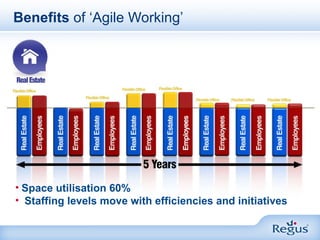
Benefits  of ‘Agile Working’ Space utilisation 60% Staffing levels move with efficiencies and initiatives
No.1 concern  for business  - Cost Control
How the office is  changing
Example:  Interpolis,  Netherlands Overview: Over 3000 people based in their purpose-designed building work  in activity based work settings. Results: Substantial impact on the  recruitment & retention of staff.  Business Benefit: Saved  €90m  on Capex and over  €8m  per annum on Opex as churn costs have been reduced to zero.
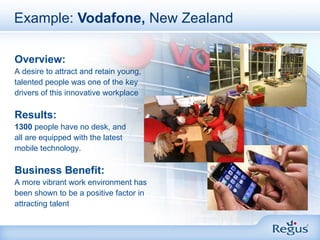
Example:  Vodafone,  New Zealand Overview: A desire to attract and retain young, talented people was one of the key drivers of this innovative workplace Results: 1300  people have no desk, and all are equipped with the latest  mobile technology.  Business Benefit: A more vibrant work environment has been shown to be a positive factor in attracting talent
Example:  Microsoft , Amsterdam Overview: Nobody has a desk and the work style is activity based working Results: Everyone uses a laptop, and the space has no fixed phones Business Benefit: A move away from fixed telephony to true ‘fixed-mobile’ convergence.
Final  thought …

Global Property Trends

  • 1.
    Regus Workplace Trends1100 locations | 500 cities | 85 countries
  • 2.
    Economic Volatility Whatis driving today’s business challenges?
  • 3.
    Environmental Responsibilities Whatis driving today’s business challenges?
  • 4.
    Cost control Whatis driving today’s business challenges?
  • 5.
    Workforce productivity Whatis driving today’s business challenges?
  • 6.
    Preserving Capital Whatis driving today’s business challenges?
  • 7.
    Agility @ WorkResearched best in class workplaces 6 trends transforming the workplace
  • 8.
    Increase in workefficiency Benefits of ‘Agile Working’
  • 9.
    Decrease Company CarbonFoot Print Benefits of ‘Agile Working’
  • 10.
    Greater flexibility Benefits of ‘Agile Working’
  • 11.
    Engaging the workforceBenefits of ‘Agile Working’
  • 12.
    Prepare people forchange Benefits of ‘Agile Working’
  • 13.
    Benefits of‘Agile Working’ Space utilisation 60% Staffing levels move with efficiencies and initiatives
  • 14.
    No.1 concern for business - Cost Control
  • 15.
    How the officeis changing
  • 16.
    Example: Interpolis, Netherlands Overview: Over 3000 people based in their purpose-designed building work in activity based work settings. Results: Substantial impact on the recruitment & retention of staff. Business Benefit: Saved €90m on Capex and over €8m per annum on Opex as churn costs have been reduced to zero.
  • 17.
    Example: Vodafone, New Zealand Overview: A desire to attract and retain young, talented people was one of the key drivers of this innovative workplace Results: 1300 people have no desk, and all are equipped with the latest mobile technology. Business Benefit: A more vibrant work environment has been shown to be a positive factor in attracting talent
  • 18.
    Example: Microsoft, Amsterdam Overview: Nobody has a desk and the work style is activity based working Results: Everyone uses a laptop, and the space has no fixed phones Business Benefit: A move away from fixed telephony to true ‘fixed-mobile’ convergence.
  • 19.

Editor's Notes

  • #3 Market unpredictability Hard to forecast Access to capital
  • #4 Workplace commuting accounts for 20% of all carbon emissions Environmental legislation forcing less commuting and lower emissions
  • #5 It is no surprise that the workplace is changing. There is a total transformation of the workplace in play. There are many factors which are contributing to this. The aging baby boomers resulting in a smaller pool of applicants, new entries to the workplace are technologically more savvy a than ever and have different values, technology it self is changing faster each year, the global marketplace, M & A ’ s, etc. This creates quite a challenge when trying to guess the size and location of space that will work in a 5 to 10 year window.
  • #6 It is no surprise that the workplace is changing. There is a total transformation of the workplace in play. There are many factors which are contributing to this. The aging baby boomers resulting in a smaller pool of applicants, new entries to the workplace are technologically more savvy a than ever and have different values, technology it self is changing faster each year, the global marketplace, M & A ’ s, etc. This creates quite a challenge when trying to guess the size and location of space that will work in a 5 to 10 year window.
  • #7 It is no surprise that the workplace is changing. There is a total transformation of the workplace in play. There are many factors which are contributing to this. The aging baby boomers resulting in a smaller pool of applicants, new entries to the workplace are technologically more savvy a than ever and have different values, technology it self is changing faster each year, the global marketplace, M & A ’ s, etc. This creates quite a challenge when trying to guess the size and location of space that will work in a 5 to 10 year window.
  • #15 Not only is your workplace changing, all of them are. In fact, there is not an industry today which is not significantly different than it was 5 years ago. It is unlikely that this trend will reverse in the next 5-10 years