Downloaded 95 times


![Infrastructure Stack [I. Infrastructure Layer]
Stack
Cloud OS
Server Storage
Data Center](https://image.slidesharecdn.com/globalplatform-120426230706-phpapp02/85/Global-platform-5-320.jpg)
![Data Center [I. Infrastructure Layer]
Location
• Regulation
• Bandwidth
• Climate (Cooling)
• Recruitment
• Operation (24x7, Follow The Sun)
PUE
Global Center vs Regional Center
Zone
컨테이너 기반
4세대 데이타 센터](https://image.slidesharecdn.com/globalplatform-120426230706-phpapp02/85/Global-platform-6-320.jpg)
![Server [I. Infrastructure Layer]
Commodity Server
• Cost
• Density
POD
• Standard Design Google Server Design
• Scale Out Unit [Procurement]
Network
• Management Line
• Service Line
• VM Movement Line Microsoft Server Design
• SAN (iSCSI)
Resiliency vs Redundancy
Facebook Server Design](https://image.slidesharecdn.com/globalplatform-120426230706-phpapp02/85/Global-platform-7-320.jpg)
![Storage [I. Infrastructure Layer]
IO Segregation](https://image.slidesharecdn.com/globalplatform-120426230706-phpapp02/85/Global-platform-8-320.jpg)
![Cloud OS [I. Infrastructure Layer]
Open Source vs Commercial
• Open Source is not so cheap
[ Development Cost , Server H/W Cost, SW License Cost, Maintenance Fee]
※ Open Source : Open Stack Nova
Level Approach
And DevOps](https://image.slidesharecdn.com/globalplatform-120426230706-phpapp02/85/Global-platform-9-320.jpg)
![Use or Build? [I. Infrastructure Layer]
Use first for Time to Market !!
Build later after learning](https://image.slidesharecdn.com/globalplatform-120426230706-phpapp02/85/Global-platform-10-320.jpg)
![Software Stack [ II. Software Layer ]
Common Server Software Layer
Proxy Identity Management
Business Logic
Data Storage](https://image.slidesharecdn.com/globalplatform-120426230706-phpapp02/85/Global-platform-12-320.jpg)
![IDM and PROXY [ II. Software Layer ]
Identity Management
• Authentication & Authorization and Profile Management
• IM (Master Data), AM (Authentication Only/LDAP),PM (Provisioning)
• Integrate with Legacy System (Telco)
• Global Replication across Data Center
• Regulation
Proxy
• Similar to SOA Enterprise Service Bus
• Routing
• Message Transformation (※ HTTP Header change)
• Throttling
• Logging
+ External or Internal Interface (like Enterprise Application Integration)
Protocol
• REST, Thrift, Protocol Buffer](https://image.slidesharecdn.com/globalplatform-120426230706-phpapp02/85/Global-platform-13-320.jpg)
![Business Logic [ II. Software Layer ]
Biz Logic
• No shared data, Stateless
Prevent Trouble Propagation, Provides Scalability
• Think about productivity
Python, Erlang](https://image.slidesharecdn.com/globalplatform-120426230706-phpapp02/85/Global-platform-14-320.jpg)
![Data Storage [ II. Software Layer ]
Data - Storage
• File Storage – COST and Consistency, Availibility
• Simple Data Storage - NoSQL Combination
• Relational Data Storage – RDBMS with Sharding , Query Off Loading
• Small & High Performance Data Storage – In Memory Data Grid
Data Implementation Technology
• Big Data Processing - Map & Reduce
• Data Replication (across data center) – ETL, CDC and Filtering](https://image.slidesharecdn.com/globalplatform-120426230706-phpapp02/85/Global-platform-15-320.jpg)


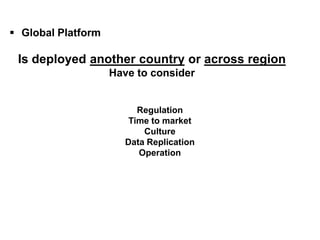
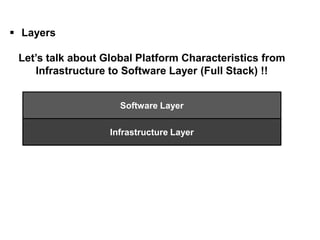
The document discusses the key considerations for building a global platform across multiple countries and regions. It covers two main layers: the infrastructure layer and the software layer. The infrastructure layer includes factors like data center location, regulations, server and storage design, and cloud operating systems. Commodity servers need to balance cost and density, while storage must separate IO and consider replication across data centers. The software layer outlines common services like proxies, identity management, business logic, and data storage. Identity management needs to handle authentication, authorization, and user profiles at a global scale. Data storage choices include file, NoSQL, relational, and in-memory options. Data replication and processing also require technologies like ETL and data


![Getting Started with Apache Spark: Big Data Made Simple [Free Meetup]](https://cdn.slidesharecdn.com/ss_thumbnails/apachesparkgettingstarted-260203175547-8361bcc3-thumbnail.jpg?width=640&height=640&fit=bounds)


