v/s
Presented by
Mounika Ramachandruni
In the esteemed presence of
Mrs.B.Sowjanya
Introduction
 “Logistics management is the process of strategically managing the
procurement, movement and storage of materials, parts and finished
inventory (and the related information flows) through the organization
and its marketing channels in such as way that current and future
profitability are maximized through the cost-effective fulfillment of
orders. ”
Source: Christopher, M.(1998).Logistics and Supply Chain
Management: Strategies for reducing cost and improving service,
(2nd Ed.). New York: Prentice Hall.
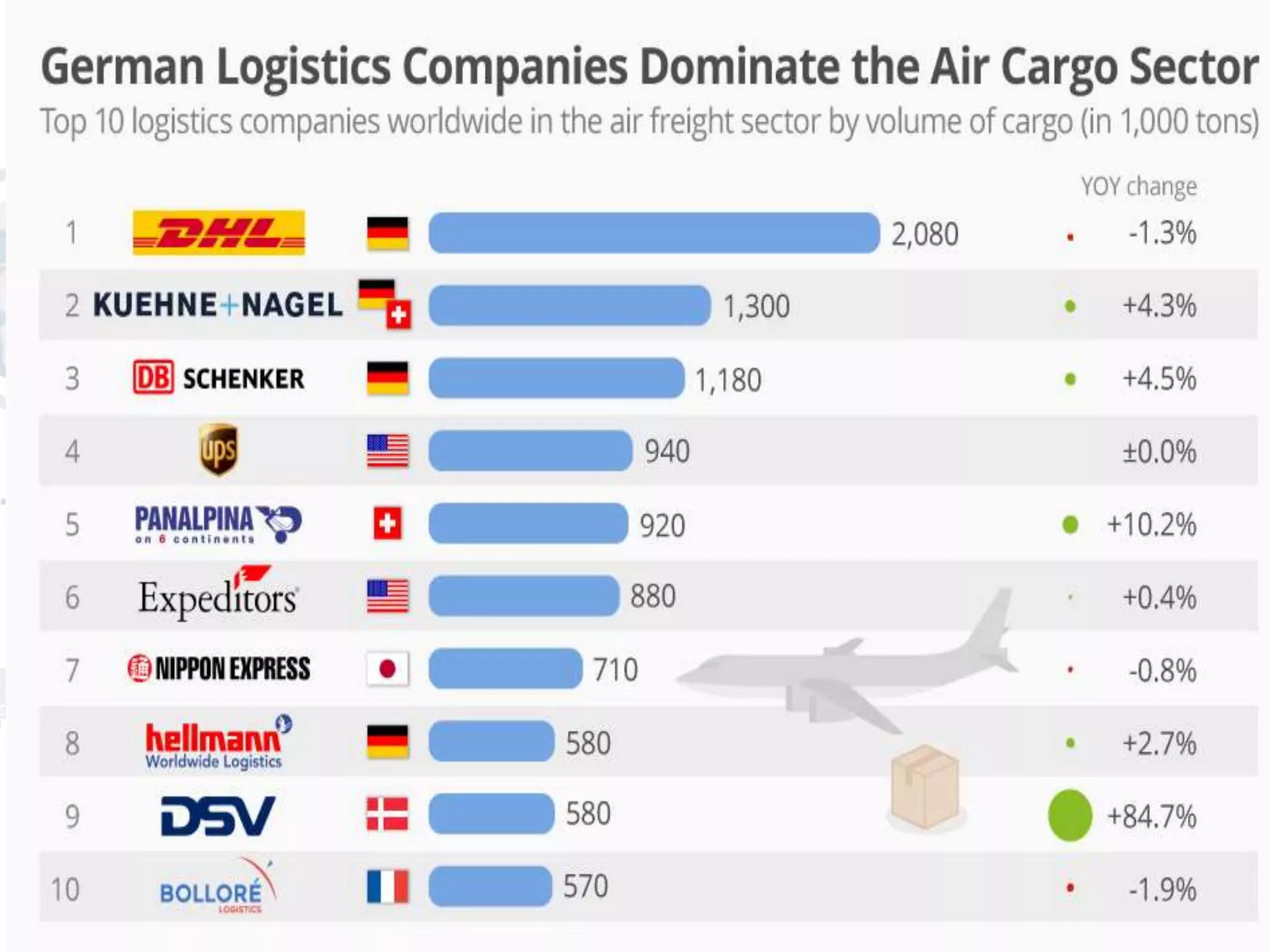
How Germany gets its logistics right
German logistics industry occupies the third position in
the country's GDP — weighing just behind its
international trade and the automotive sector.
German innovations in logistics — especially in
telematics and navigation — are considered world-class.
There are several scientific institutes in Germany
working on logistics innovations of the future. And, many
universities and centres of excellence offer training and
advance training programmes in logistics.
How Germany gets its logistics right
The logistics sector employs about three million people and
has an annual turnover of €200 billion, representing
approximately 7 per cent of the gross domestic product. The
logistics sector also displays far-above-average growth.
Around €15 billion is invested in logistics annually in
Germany.
The European logistics market totals approximately €600
billion, and Germany has a massive 30 per cent market
share. The German creativity, flexibility and know-how in the
improvement of value-added processes are appreciated
throughout the world.
Engineering Intelligence
• Numerous lessons can be learnt from the European,
especially the German, experience
• The sheer density of the country's highway network is twice
the EU average. And, conditions are constantly being
improved. Through 2015, the German Government aims to
spend an average of €15 billion a year on transportation
infrastructure.
• Altogether, Germany's highways, railways and inland
waterways cover nearly 60,000 km. The German rail network
alone encompasses 40,327 km. The country's inland
waterways provide 7,450 km of navigable territory.
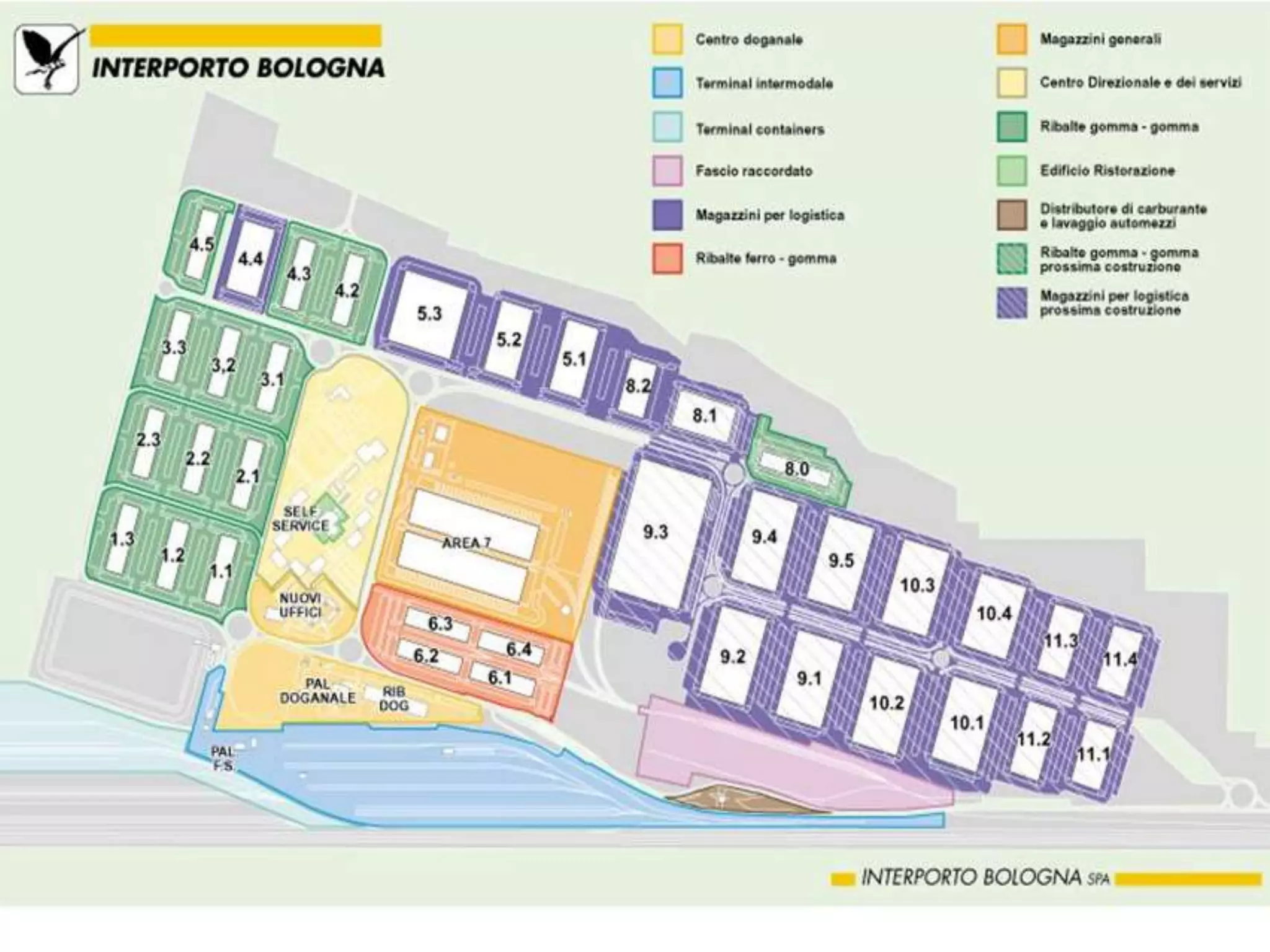
Freight Villages
• To maximize the efficiency of Germany's distribution
infrastructure, Government agencies in cooperation
with the logistics industry have set up “freight
villages”.
• Known as GVZ or Güterverkehrszentren in German,
these cargo support centers act as regional nodes
with optimal access to long-haul networks and local
delivery points. They also provide essential services
such as Customs clearance, security and vehicle
maintenance.
Speech-based picking
• In many European warehouses of modern companies,
picking from paper-based lists is history. Today, speech-
based picking (Pick by Voice) is relied upon by those
responsible for logistics centers.
• The complete process takes place in a continual speech input
and output dialogue, which requires the employee to confirm
every step with the system.
• The demands being placed on European logisticians today
are highest speed, highest reliability and highest quality. In
the process, demand for time-critical express services such
as international overnight shipment is rising
Tracking system
• For instance, in the European cut-flower business,
freshness is everything. How long a load of flowers sits
on the dock before being delivered to a cooled storage
area can determine how much those flowers can fetch
on the auction floor.
• For that reason, radio frequency identification reader
antennae installed at strategic locations are used to
track carts, or trolleys, as they travel between the
receiving dock and storage areas.
• The system not only tracks the location of the trolleys,
but also how long it takes the trolleys to get from the
dock to a climate-controlled storage area.
Image-based Readers
• In Europe, e-commerce is growing. The high volume and frequency
of orders placed over the Internet, combined with a multitude of
available products from retailers, have made automated scanning at
logistics centers inevitable.
• Most European retail distribution centers have meticulous stock
control, which includes careful management of purchasing, shipping
and warehouse inventory.
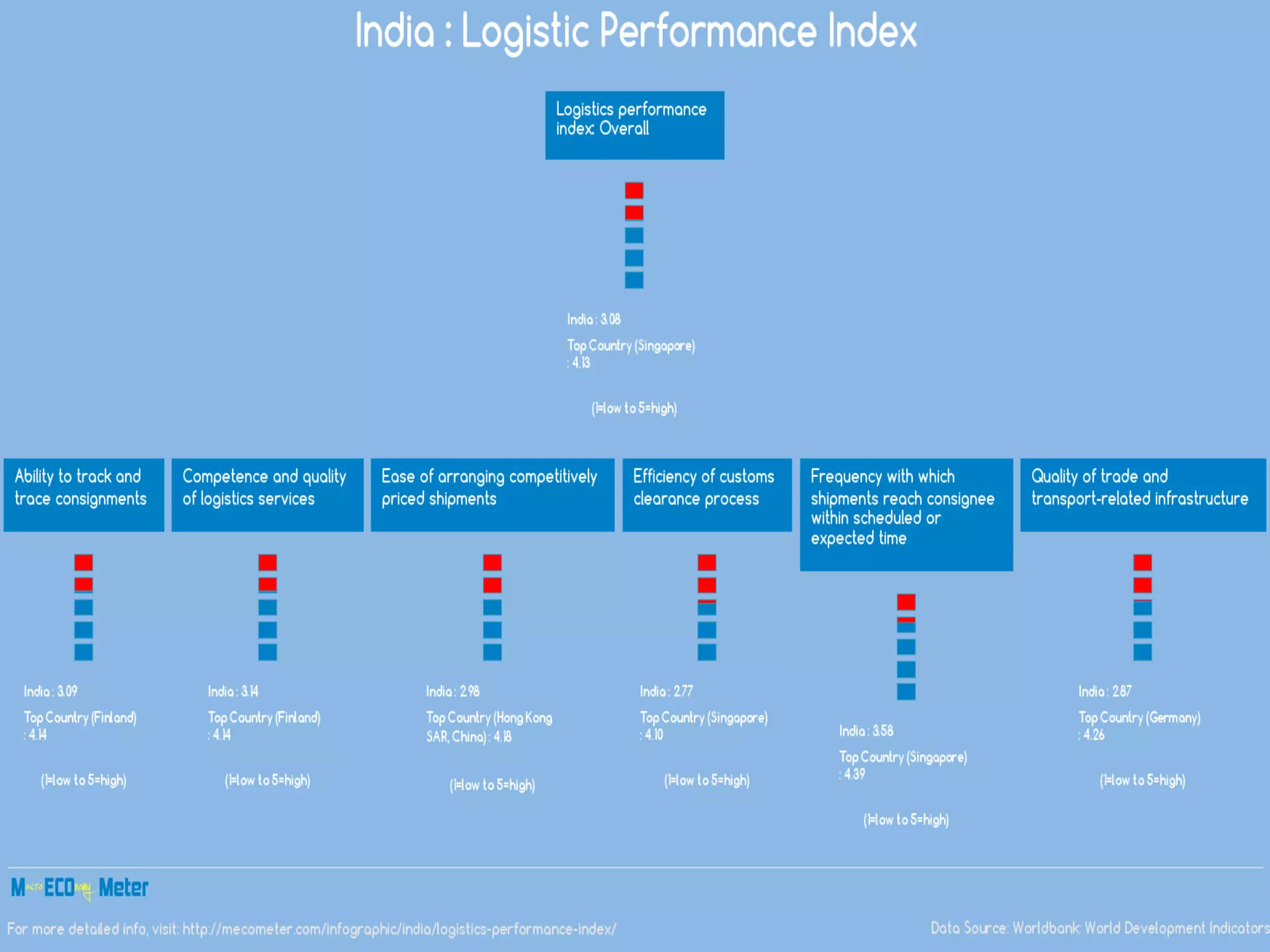
• With 8-9 per cent growth rates in India, the logistics requirements
don't differ too markedly from logistics anywhere else in the world.
• It is obvious that only with the political will in India can create the
infrastructure and logistics networks that can connect the 1.1 billion
consumers to speed up the processes and reduce transaction costs.
Indian logistics industry: Current scenario &
future outlook
Abhishek Chakraborty Executive Director – (DTDC Courier & Cargo Ltd.)
penned down the key challenges facing the logistics industry while
throwing up possible solutions.
 Logistics is the backbone of the economy, providing the efficient,
cost effective flow of goods on which other commercial sectors
depend.
 Despite weak economic sentiments, the logistics & warehousing
industry continued to witness growth largely due to growth in retail, e-
commerce and manufacturing sectors.
 The Global Logistics sector is expected to grow at around 10-15% in
the period 2013-14. With this forward looking attitude and a promise
of growth and improvements, the service oriented logistics industry is
all set to expand beyond the horizons in the latter half of this decade,
utilizing this fiscal year as its launch pad.
Following are the key challenges faced
by logistics industry:
 Poor Infrastructure.
 Trade Regulations
 Trained Manpower
 Poor Warehousing and Storage
 Lack of research and development (R & D) of the industry
 Lack of Training Institutions
 Information and Communications Technology
Possible solutions to some of the
challenges:
 Infrastructural Improvements
 Creating Awareness & Establishing Training Institutions
 Improving Warehousing facilities
 Encouraging Research and Development (R&D)
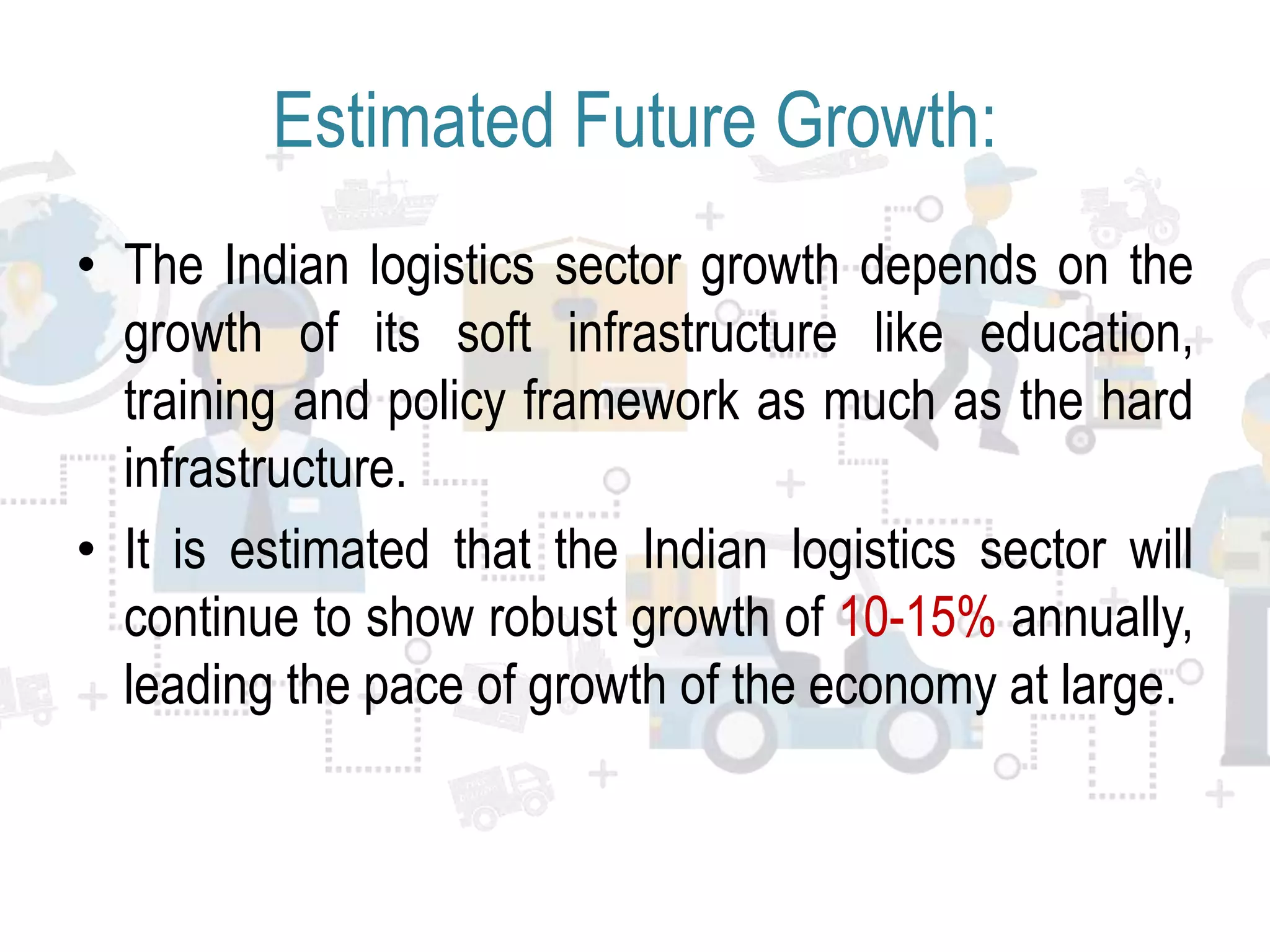
Estimated Future Growth:
• The Indian logistics sector growth depends on the
growth of its soft infrastructure like education,
training and policy framework as much as the hard
infrastructure.
• It is estimated that the Indian logistics sector will
continue to show robust growth of 10-15% annually,
leading the pace of growth of the economy at large.
Main demand drivers:
• In 2014 the Global economic outlook and indeed that of
India is expected to significantly improve as India Inc
begins to tackle the economic downturn.
• The biggest boost to the growth of the industry is coming
from the increasing consumer demand, particularly in the
Tier 2 and 3 sections of the country.
• This is being further fueled by the revolutionary growth
being seen in e-commerce since logistics is the most
critical ingredient in the success of an online business.
Conclusion
With a substantial volume of goods transported by
road in India, traffic congestion is growing. But its
costs due to delays are underestimated because
official statistics do not take into account the intangible
benefits of the remedial measures used to maintain
supply-chain reliability.
In the end, logistics done well means that sellers more
efficiently connect with buyers. And, that means more
profitability and growth opportunities.
Global LSCM

Global LSCM

  • 1.
    v/s Presented by Mounika Ramachandruni Inthe esteemed presence of Mrs.B.Sowjanya
  • 2.
    Introduction  “Logistics managementis the process of strategically managing the procurement, movement and storage of materials, parts and finished inventory (and the related information flows) through the organization and its marketing channels in such as way that current and future profitability are maximized through the cost-effective fulfillment of orders. ” Source: Christopher, M.(1998).Logistics and Supply Chain Management: Strategies for reducing cost and improving service, (2nd Ed.). New York: Prentice Hall.
  • 3.
    How Germany getsits logistics right German logistics industry occupies the third position in the country's GDP — weighing just behind its international trade and the automotive sector. German innovations in logistics — especially in telematics and navigation — are considered world-class. There are several scientific institutes in Germany working on logistics innovations of the future. And, many universities and centres of excellence offer training and advance training programmes in logistics.
  • 4.
    How Germany getsits logistics right The logistics sector employs about three million people and has an annual turnover of €200 billion, representing approximately 7 per cent of the gross domestic product. The logistics sector also displays far-above-average growth. Around €15 billion is invested in logistics annually in Germany. The European logistics market totals approximately €600 billion, and Germany has a massive 30 per cent market share. The German creativity, flexibility and know-how in the improvement of value-added processes are appreciated throughout the world.
  • 6.
    Engineering Intelligence • Numerouslessons can be learnt from the European, especially the German, experience • The sheer density of the country's highway network is twice the EU average. And, conditions are constantly being improved. Through 2015, the German Government aims to spend an average of €15 billion a year on transportation infrastructure. • Altogether, Germany's highways, railways and inland waterways cover nearly 60,000 km. The German rail network alone encompasses 40,327 km. The country's inland waterways provide 7,450 km of navigable territory.
  • 7.
    Freight Villages • Tomaximize the efficiency of Germany's distribution infrastructure, Government agencies in cooperation with the logistics industry have set up “freight villages”. • Known as GVZ or Güterverkehrszentren in German, these cargo support centers act as regional nodes with optimal access to long-haul networks and local delivery points. They also provide essential services such as Customs clearance, security and vehicle maintenance.
  • 9.
    Speech-based picking • Inmany European warehouses of modern companies, picking from paper-based lists is history. Today, speech- based picking (Pick by Voice) is relied upon by those responsible for logistics centers. • The complete process takes place in a continual speech input and output dialogue, which requires the employee to confirm every step with the system. • The demands being placed on European logisticians today are highest speed, highest reliability and highest quality. In the process, demand for time-critical express services such as international overnight shipment is rising
  • 10.
    Tracking system • Forinstance, in the European cut-flower business, freshness is everything. How long a load of flowers sits on the dock before being delivered to a cooled storage area can determine how much those flowers can fetch on the auction floor. • For that reason, radio frequency identification reader antennae installed at strategic locations are used to track carts, or trolleys, as they travel between the receiving dock and storage areas. • The system not only tracks the location of the trolleys, but also how long it takes the trolleys to get from the dock to a climate-controlled storage area.
  • 11.
    Image-based Readers • InEurope, e-commerce is growing. The high volume and frequency of orders placed over the Internet, combined with a multitude of available products from retailers, have made automated scanning at logistics centers inevitable. • Most European retail distribution centers have meticulous stock control, which includes careful management of purchasing, shipping and warehouse inventory. • With 8-9 per cent growth rates in India, the logistics requirements don't differ too markedly from logistics anywhere else in the world. • It is obvious that only with the political will in India can create the infrastructure and logistics networks that can connect the 1.1 billion consumers to speed up the processes and reduce transaction costs.
  • 13.
    Indian logistics industry:Current scenario & future outlook Abhishek Chakraborty Executive Director – (DTDC Courier & Cargo Ltd.) penned down the key challenges facing the logistics industry while throwing up possible solutions.  Logistics is the backbone of the economy, providing the efficient, cost effective flow of goods on which other commercial sectors depend.  Despite weak economic sentiments, the logistics & warehousing industry continued to witness growth largely due to growth in retail, e- commerce and manufacturing sectors.  The Global Logistics sector is expected to grow at around 10-15% in the period 2013-14. With this forward looking attitude and a promise of growth and improvements, the service oriented logistics industry is all set to expand beyond the horizons in the latter half of this decade, utilizing this fiscal year as its launch pad.
  • 15.
    Following are thekey challenges faced by logistics industry:  Poor Infrastructure.  Trade Regulations  Trained Manpower  Poor Warehousing and Storage  Lack of research and development (R & D) of the industry  Lack of Training Institutions  Information and Communications Technology
  • 17.
    Possible solutions tosome of the challenges:  Infrastructural Improvements  Creating Awareness & Establishing Training Institutions  Improving Warehousing facilities  Encouraging Research and Development (R&D)
  • 18.
    Estimated Future Growth: •The Indian logistics sector growth depends on the growth of its soft infrastructure like education, training and policy framework as much as the hard infrastructure. • It is estimated that the Indian logistics sector will continue to show robust growth of 10-15% annually, leading the pace of growth of the economy at large.
  • 19.
    Main demand drivers: •In 2014 the Global economic outlook and indeed that of India is expected to significantly improve as India Inc begins to tackle the economic downturn. • The biggest boost to the growth of the industry is coming from the increasing consumer demand, particularly in the Tier 2 and 3 sections of the country. • This is being further fueled by the revolutionary growth being seen in e-commerce since logistics is the most critical ingredient in the success of an online business.
  • 20.
    Conclusion With a substantialvolume of goods transported by road in India, traffic congestion is growing. But its costs due to delays are underestimated because official statistics do not take into account the intangible benefits of the remedial measures used to maintain supply-chain reliability. In the end, logistics done well means that sellers more efficiently connect with buyers. And, that means more profitability and growth opportunities.