+
Global Financial Systems
Submitted To:
Dr. Navleen Kaur
Faculty (Banking Environment)
Amity International Business School
Submitted By:
Abhishek Gupta, Dheeraj Gupta & Tarun Jain
+
Learning Outcomes
 In this presentation you will understand the financial system of :
 Singapore
 Dubai (UAE)
 United Kingdom
+
SINGAPORE
FINANCIAL
SYSTEM
+
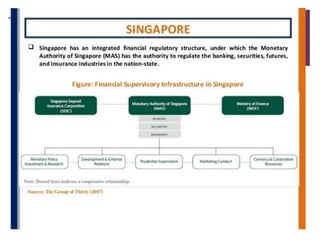
 Singapore has a highly developed trade-oriented market
economy. Singapore's economy has been ranked as the most open in
the world, 7th least corrupt, most pro-business, with low tax rates
(14.2% of Gross Domestic Product, GDP) and has the third highest
per-capita GDP in the world in terms of Purchasing Power Parity
(PPP). APEC is headquartered in Singapore.
 Government-linked companies play a substantial role in Singapore's
economy, which are owned through the sovereign wealth
fund Temasek Holdings, which holds majority stakes in several of the
nation's largest companies, such as Singapore Airlines,SingTel, ST
Engineering and MediaCorp.
 The economy of Singapore is a major Foreign Direct Investment
(FDI) outflow financier in the world. Singapore has also benefited from
the inward flow of FDI from global investors and institutions due to its
highly attractive investment climate and a stable political environment.
+
 Exports, particularly in electronics , chemicals and services including Singapore's
position as the regional hub for wealth management provide the main source of
revenue for the economy, which allows it to purchase natural resources and raw
goods which it lacks. Moreover, water is scarce in Singapore herefore water is defined
as a precious resource in Singapore along with the scarcity of land to be treated
with land fill of Pulau Semakau. Singapore has limited arable land, meaning that
Singapore has to rely on the agrotechnology park for agricultural production and
consumption. Human resources is another vital issue for the health of the Singaporean
economy. The economy of Singapore ranks 2nd overall in the Scientific American
Biotechnology ranking in 2014, with the featuring of Biopolis.
 Singapore could thus be said to rely on an extended concept of intermediary trade
to Entrepôt trade, by purchasing raw goods and refining them for re-export, such as in
the wafer fabrication industry and oil refining. Singapore also has a strategic port which
makes it more competitive than many of its neighbours in carrying out such entrepot
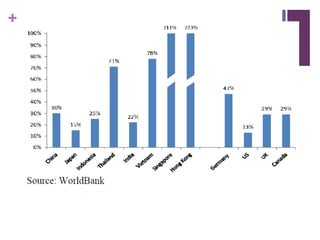
activities. Singapore has the highest trade to GDP ratio in the world, averaging around
400% during 2008–11. The Port of Singapore is the second-busiest in the world by
cargo tonnage. In addition, Singapore's port infrastructure and skilled workforce, which
is due to the success of the country's education policy in producing skilled workers, is
also fundamental in this aspect as they provide easier access to markets for
both importing and exporting, and also provide the skill(s) needed to refine imports into
exports.
+
+
Trade and investment
 Singapore‘s total trade in 2014 amounted to S$982 billion. Despite its
small size, Singapore is currently the fifteenth-largest trading partner of
the United States. In 2014, Singapore's imports totalled $464 billion, and
exports totalled $519 billion. Malaysia was Singapore's main import
source, as well as its largest export market, absorbing 18% of
Singapore's exports, with the United States close behind.
 Malaysia is Singapore's biggest trading partner, with bilateral trade
totalling roughly 91 billion US dollars in 2012, accounting for over a fifth
of total trade within ASEAN. Singapore’s trade with major trading
partners such as Malaysia, China, Indonesia and South Korea increased
in 2012, while trade with EU27, United States, Hong
Kong and Japan decreased in 2012. Since 2009, the value of exports
exceeds imports for Singapore’s trade with China. In comparison, the
value of imports exceeds exports for Singapore’s trade with the US since
2006.
+
+
Banking
 Singapore is considered a global financial hub, with Singapore banks
offering world-class corporate bank account facilities. These include
multiple currencies, internet banking, telephone banking, checking
accounts, savings accounts, debit and credit cards, fixed term deposits
and wealth management services.According to the Human Rights Watch,
due to its role as a financial hub for the region, Singapore has continually
been criticised for reportedly hosting bank accounts containing ill-gotten
gains of corrupt leaders and their associates, including billions of dollars
of Burma’s state gas revenues hidden from national accounts. Singapore
has attracted assets formerly held in Swiss banks for several reasons,
including new taxes imposed on Swiss accounts and a weakening of
Swiss bank secrecy. Credit Suisse, the second largest Swiss bank, moved
its head of international private banking to Singapore in 2005.
 Tax evasion is illegal in Singapore; however, according to an Organisation
for Economic Co-operation and Development official, Singaporean
authorities tend to cooperate with other countries' tax authorities only
when evasion of Singaporean taxes is involved.
+
+
DUBAI FINANCIAL
SYSTEM
A NEWYORK OF THE MIDDLE EAST
+
+
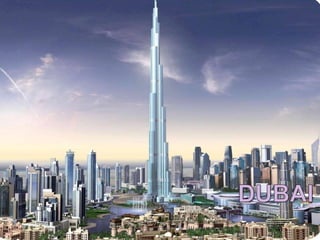
Introduction to dubai
 It is the most populous city in the UAE.
 Dubai has emerged as a global city and business hub of the
Middle East.
 By the 1960s dubai's economy was based on revenues from
trade and, to a smaller extent, oil exploration concessions, but
oil was not discovered until 1966. oil revenue first started to
flow in 1969.[7] dubai's oil revenue helped accelerate the early
development of the city, but its reserves are limited and
production levels are low: today, less than 5% of the emirate's
revenue comes from oil
+
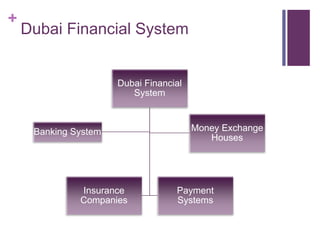
Dubai Financial System
Dubai Financial
System
Banking System Money Exchange
Houses
Insurance
Companies
Payment
Systems
+
Banking System
 The U.A.E. banking sector is well developed and gaining in
sophistication
 The bank ownership structure reflects the prevalent role of the
state and of government related entities, complemented by an
active private sector.
 The impact of the sharp correction in the equity market on the
banking sector has been limited.
 The CBU i.e. Commercial Bank Of United Arab Emirates has
jusdriction has overall banks, financial institutions.
+
Money Exchange Markets
 The U.A.E. capital markets are served by a number of
exchanges varying in size and focus.
 Despite relatively high trading volumes, U.A.E. equity markets
lack depth and diversification.
 The market for debt instruments is also thin and there are no
debt securities listed by the federal government.
+
Insurance Companies
 The U.A.E insurance sector is small and not yet
systemically important.
 There is considerable potential for further development
and growth in the insurance industry
 Since enactment of the 1984 Insurance Law, insurance
supervision has been carried out on a limited basis by a
small section in the Ministry of Economy.
+
Payment Systems
 Under the Banking Law, the CBU operates and oversees
the payment system.
 Licensed commercial bank are required to maintain three
separate accounts with the CBU.
+
DIFC
 DIFC is a federal financial free zone. The DIFC was
established in 2002
 The DIFC has physical territory of approximately 110 acres. It
has its own legal system and courts distinct from the wider
UAE, with jurisdiction over corporate, commercial, civil,
employment, trusts and securities law matters.
 The DIFC is also home to a leading international stock
exchange. NASDAQ Dubai has developed from equity –
focused market to one which now offers a trading platform for
structured financial products, equity derivatives and Islamic
Bonds
+
BENEFITS OF DIFC
 100% foreign business ownership
 Zero personal and corporate tax rate
 100% capital repatriation and no currency restrictions
 Strategic location on Sheikh Zayed Road, connecting Abu
Dhabi and Dubai, and in close proximity to Airport
 State of art infrastructure
 Availability of skilled workforce and professionals
 Independent regulatory services.
+
UNITED KINGDOM FINANCIAL
SYSTEM
+
About the growth
 The financial system is an ever-present feature of most
people’s lives and a critical part of the economy. It is very large
relative to the amounts of money most people deal with on a
daily basis even when summed over the whole country: for
instance, while UK residents earn around £1 trillion in wages
per year, the balance sheets of UK financial firms are around
£20 trillion. These balance sheets have grown rapidly in recent
decades and the UK financial system is bigger, relative to the
size of the economy, than that of most other countries.
+
+
HOW BIG IS THE UK FINANCIAL
SYSTEM
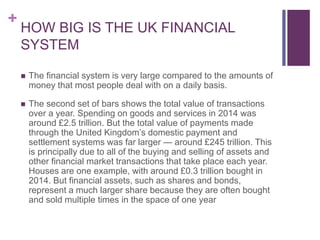
 The financial system is very large compared to the amounts of
money that most people deal with on a daily basis.
 The second set of bars shows the total value of transactions
over a year. Spending on goods and services in 2014 was
around £2.5 trillion. But the total value of payments made
through the United Kingdom’s domestic payment and
settlement systems was far larger — around £245 trillion. This
is principally due to all of the buying and selling of assets and
other financial market transactions that take place each year.
Houses are one example, with around £0.3 trillion bought in
2014. But financial assets, such as shares and bonds,
represent a much larger share because they are often bought
and sold multiple times in the space of one year
+
BANKING
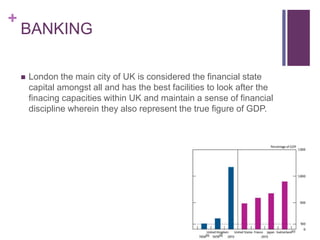
 London the main city of UK is considered the financial state
capital amongst all and has the best facilities to look after the
finacing capacities within UK and maintain a sense of financial
discipline wherein they also represent the true figure of GDP.
+
Thank You for your Kind
Support
Respected Madam
& All our colleagues

Global financial systems

  • 1.
    + Global Financial Systems SubmittedTo: Dr. Navleen Kaur Faculty (Banking Environment) Amity International Business School Submitted By: Abhishek Gupta, Dheeraj Gupta & Tarun Jain
  • 2.
    + Learning Outcomes  Inthis presentation you will understand the financial system of :  Singapore  Dubai (UAE)  United Kingdom
  • 3.
  • 4.
    +  Singapore hasa highly developed trade-oriented market economy. Singapore's economy has been ranked as the most open in the world, 7th least corrupt, most pro-business, with low tax rates (14.2% of Gross Domestic Product, GDP) and has the third highest per-capita GDP in the world in terms of Purchasing Power Parity (PPP). APEC is headquartered in Singapore.  Government-linked companies play a substantial role in Singapore's economy, which are owned through the sovereign wealth fund Temasek Holdings, which holds majority stakes in several of the nation's largest companies, such as Singapore Airlines,SingTel, ST Engineering and MediaCorp.  The economy of Singapore is a major Foreign Direct Investment (FDI) outflow financier in the world. Singapore has also benefited from the inward flow of FDI from global investors and institutions due to its highly attractive investment climate and a stable political environment.
  • 5.
    +  Exports, particularlyin electronics , chemicals and services including Singapore's position as the regional hub for wealth management provide the main source of revenue for the economy, which allows it to purchase natural resources and raw goods which it lacks. Moreover, water is scarce in Singapore herefore water is defined as a precious resource in Singapore along with the scarcity of land to be treated with land fill of Pulau Semakau. Singapore has limited arable land, meaning that Singapore has to rely on the agrotechnology park for agricultural production and consumption. Human resources is another vital issue for the health of the Singaporean economy. The economy of Singapore ranks 2nd overall in the Scientific American Biotechnology ranking in 2014, with the featuring of Biopolis.  Singapore could thus be said to rely on an extended concept of intermediary trade to Entrepôt trade, by purchasing raw goods and refining them for re-export, such as in the wafer fabrication industry and oil refining. Singapore also has a strategic port which makes it more competitive than many of its neighbours in carrying out such entrepot activities. Singapore has the highest trade to GDP ratio in the world, averaging around 400% during 2008–11. The Port of Singapore is the second-busiest in the world by cargo tonnage. In addition, Singapore's port infrastructure and skilled workforce, which is due to the success of the country's education policy in producing skilled workers, is also fundamental in this aspect as they provide easier access to markets for both importing and exporting, and also provide the skill(s) needed to refine imports into exports.
  • 6.
  • 7.
    + Trade and investment Singapore‘s total trade in 2014 amounted to S$982 billion. Despite its small size, Singapore is currently the fifteenth-largest trading partner of the United States. In 2014, Singapore's imports totalled $464 billion, and exports totalled $519 billion. Malaysia was Singapore's main import source, as well as its largest export market, absorbing 18% of Singapore's exports, with the United States close behind.  Malaysia is Singapore's biggest trading partner, with bilateral trade totalling roughly 91 billion US dollars in 2012, accounting for over a fifth of total trade within ASEAN. Singapore’s trade with major trading partners such as Malaysia, China, Indonesia and South Korea increased in 2012, while trade with EU27, United States, Hong Kong and Japan decreased in 2012. Since 2009, the value of exports exceeds imports for Singapore’s trade with China. In comparison, the value of imports exceeds exports for Singapore’s trade with the US since 2006.
  • 8.
  • 9.
    + Banking  Singapore isconsidered a global financial hub, with Singapore banks offering world-class corporate bank account facilities. These include multiple currencies, internet banking, telephone banking, checking accounts, savings accounts, debit and credit cards, fixed term deposits and wealth management services.According to the Human Rights Watch, due to its role as a financial hub for the region, Singapore has continually been criticised for reportedly hosting bank accounts containing ill-gotten gains of corrupt leaders and their associates, including billions of dollars of Burma’s state gas revenues hidden from national accounts. Singapore has attracted assets formerly held in Swiss banks for several reasons, including new taxes imposed on Swiss accounts and a weakening of Swiss bank secrecy. Credit Suisse, the second largest Swiss bank, moved its head of international private banking to Singapore in 2005.  Tax evasion is illegal in Singapore; however, according to an Organisation for Economic Co-operation and Development official, Singaporean authorities tend to cooperate with other countries' tax authorities only when evasion of Singaporean taxes is involved.
  • 10.
  • 11.
  • 12.
  • 13.
    + Introduction to dubai It is the most populous city in the UAE.  Dubai has emerged as a global city and business hub of the Middle East.  By the 1960s dubai's economy was based on revenues from trade and, to a smaller extent, oil exploration concessions, but oil was not discovered until 1966. oil revenue first started to flow in 1969.[7] dubai's oil revenue helped accelerate the early development of the city, but its reserves are limited and production levels are low: today, less than 5% of the emirate's revenue comes from oil
  • 14.
    + Dubai Financial System DubaiFinancial System Banking System Money Exchange Houses Insurance Companies Payment Systems
  • 15.
    + Banking System  TheU.A.E. banking sector is well developed and gaining in sophistication  The bank ownership structure reflects the prevalent role of the state and of government related entities, complemented by an active private sector.  The impact of the sharp correction in the equity market on the banking sector has been limited.  The CBU i.e. Commercial Bank Of United Arab Emirates has jusdriction has overall banks, financial institutions.
  • 16.
    + Money Exchange Markets The U.A.E. capital markets are served by a number of exchanges varying in size and focus.  Despite relatively high trading volumes, U.A.E. equity markets lack depth and diversification.  The market for debt instruments is also thin and there are no debt securities listed by the federal government.
  • 17.
    + Insurance Companies  TheU.A.E insurance sector is small and not yet systemically important.  There is considerable potential for further development and growth in the insurance industry  Since enactment of the 1984 Insurance Law, insurance supervision has been carried out on a limited basis by a small section in the Ministry of Economy.
  • 18.
    + Payment Systems  Underthe Banking Law, the CBU operates and oversees the payment system.  Licensed commercial bank are required to maintain three separate accounts with the CBU.
  • 19.
    + DIFC  DIFC isa federal financial free zone. The DIFC was established in 2002  The DIFC has physical territory of approximately 110 acres. It has its own legal system and courts distinct from the wider UAE, with jurisdiction over corporate, commercial, civil, employment, trusts and securities law matters.  The DIFC is also home to a leading international stock exchange. NASDAQ Dubai has developed from equity – focused market to one which now offers a trading platform for structured financial products, equity derivatives and Islamic Bonds
  • 20.
    + BENEFITS OF DIFC 100% foreign business ownership  Zero personal and corporate tax rate  100% capital repatriation and no currency restrictions  Strategic location on Sheikh Zayed Road, connecting Abu Dhabi and Dubai, and in close proximity to Airport  State of art infrastructure  Availability of skilled workforce and professionals  Independent regulatory services.
  • 21.
  • 22.
    + About the growth The financial system is an ever-present feature of most people’s lives and a critical part of the economy. It is very large relative to the amounts of money most people deal with on a daily basis even when summed over the whole country: for instance, while UK residents earn around £1 trillion in wages per year, the balance sheets of UK financial firms are around £20 trillion. These balance sheets have grown rapidly in recent decades and the UK financial system is bigger, relative to the size of the economy, than that of most other countries.
  • 23.
  • 24.
    + HOW BIG ISTHE UK FINANCIAL SYSTEM  The financial system is very large compared to the amounts of money that most people deal with on a daily basis.  The second set of bars shows the total value of transactions over a year. Spending on goods and services in 2014 was around £2.5 trillion. But the total value of payments made through the United Kingdom’s domestic payment and settlement systems was far larger — around £245 trillion. This is principally due to all of the buying and selling of assets and other financial market transactions that take place each year. Houses are one example, with around £0.3 trillion bought in 2014. But financial assets, such as shares and bonds, represent a much larger share because they are often bought and sold multiple times in the space of one year
  • 25.
    + BANKING  London themain city of UK is considered the financial state capital amongst all and has the best facilities to look after the finacing capacities within UK and maintain a sense of financial discipline wherein they also represent the true figure of GDP.
  • 26.
    + Thank You foryour Kind Support Respected Madam & All our colleagues