Dubai’s Diversification Strategy in the Service Sector Julia Stohlmann and Francesco Grosso
Service sector Part 2 Dubai’s Diversification Strategy Dubai’s Financial Service Cluster Financial Service Cluster Diamond Analysis Our evaluation of Porter’s Financial Cluster Model in Dubai. Conclusions and Questions.
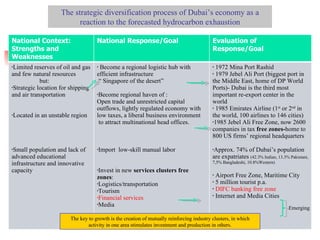
The strategic diversification process of Dubai’s economy as a reaction to the forecasted hydrocarbon exhaustion Emerging The key to growth is the creation of mutually reinforcing industry clusters, in which activity in one area stimulates investment and production in others. National Context: Strengths and Weaknesses National Response/Goal Evaluation of Response/Goal Limited reserves of oil and gas and few natural resources  but: Strategic location for shipping and air transportation Located in an unstable region Small population and lack of advanced educational infrastructure and innovative capacity Become a regional logistic hub with  efficient infrastructure “  Singapore of the desert” Become regional haven of : Open trade and unrestricted capital outflows, lightly regulated economy with low taxes, a liberal business environment to attract multinational head offices. Import  low-skill manual labor Invest in new  services clusters free zones : Logistics/transportation Tourism Financial services Media 1972 Mina Port Rashid  1979 Jebel Ali Port (biggest port in the Middle East, home of DP World Ports)- Dubai is the third most important re-export center in the world 1985 Emirates Airline (1 st  or 2 nd  in the world, 100 airlines to 146 cities) 1985 Jebel Ali Free Zone, now 2600 companies in tax  free zones- home to 800 US firms’ regional headquarters Approx. 74% of Dubai’s population are expatriates  (42.3% Indian, 13.3% Pakistani, 7,5% Bangladeshi, 10.8%Western)  Airport Free Zone, Maritime City  5 million tourist p.a. DIFC banking free zone Internet and Media Cities
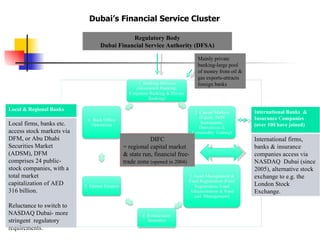
Regulatory Body Dubai Financial Service Authority (DFSA) DIFC = regional capital market & state run, financial free-trade zone  (opened in 2004) Mainly private banking-large pool of money from oil & gas exports-attracts foreign banks Dubai’s Financial Service Cluster   Local & Regional Banks Local firms, banks etc. access stock markets via DFM, or Abu Dhabi Securities Market (ADSM), DFM comprises 24 public- stock companies, with a total market capitalization of AED 316 billion. Reluctance to switch to NASDAQ Dubai- more stringent  regulatory requirements. International Banks  & Insurance Companies (over 100 have joined) International firms, banks & insurance companies access via NASDAQ  Dubai (since 2005), alternative stock exchange to e.g. the London Stock Exchange.
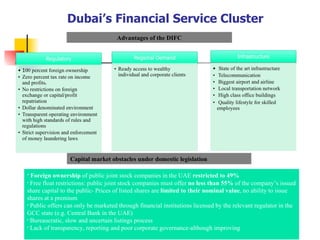
Dubai’s Financial Service Cluster  Advantages of the DIFC Foreign ownership  of public joint stock companies in the UAE  restricted to 49% Free float restrictions: public joint stock companies must offer  no less than 55%  of the company’s issued share capital to the public- Prices of listed shares are  limited to their nominal value , no ability to issue shares at a premium Public offers can only be marketed through financial institutions licensed by the relevant regulator in the GCC state (e.g. Central Bank in the UAE) Bureaucratic, slow and uncertain listings process Lack of transparency, reporting and poor corporate governance-although improving
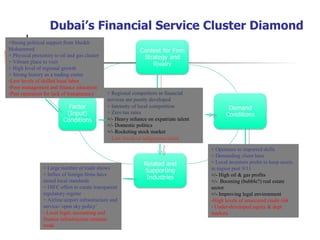
Dubai’s Financial Service Cluster Diamond +Strong political support from Sheikh Mohammed + Physical proximity to oil and gas cluster  + Vibrant place to visit + High level of regional growth + Strong history as a trading center Low levels of skilled local labor Poor management and finance education Past reputation for lack of transparency + Openness to imported skills + Demanding client base + Local investors prefer to keep assets in region post 9/11 +/- High oil & gas profits +/-  Booming (bubble?) real estate sector +/- Improving legal environment High levels of unsecured credit risk Under-developed equity & dept markets + Large number of trade shows + Influx of foreign firms have raised local standards + DIFC effort to create transparent regulatory regime + Airline/airport infrastructure and service-’open sky policy’ - Local legal, accounting and finance infrastructure remains weak
The successful Cluster “ A nation’s prosperity depends on its competitiveness, which is based on the productivity with which it produces goods and services. Sound macroeconomic policies and stable political and legal institutions are necessary but not sufficient conditions to ensure a prosperous economy. Competitiveness is rooted in a nation’s microeconomic fundamentals—the sophistication of company operations and strategies and the quality of the microeconomic business environment in which companies compete. An understanding of the microeconomic foundations of competitiveness is fundamental to national economic policy.”  http://www.isc.hbs.edu/economicdevelopment.html
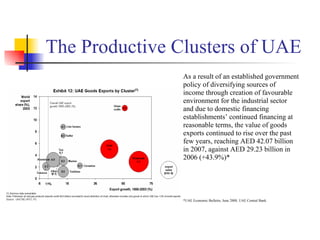
The Productive Clusters of UAE   As a result of an established government  policy of diversifying sources of income through creation of favourable  environment for the industrial sector and due to domestic financing  establishments’ continued financing at reasonable terms, the value of goods  exports continued to rise over the past few years, reaching AED 42.07 billion  in 2007, against AED 29.23 billion in 2006 (+43.9%)* *UAE Economic Bulletin, June 2008, UAE Central Bank.
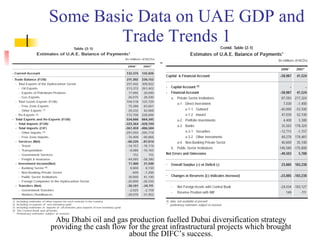
Some Basic Data on UAE GDP and Trade Trends 1 Abu Dhabi oil and gas production fuelled Dubai diversification strategy providing the cash flow for the great infrastructural projects which brought about the DIFC’s success.
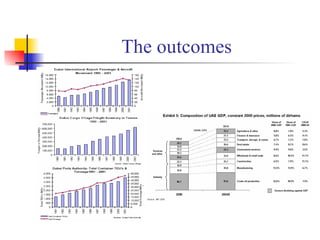
The outcomes
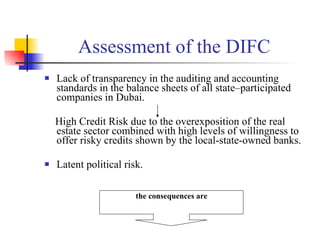
Assessment of the DIFC  Lack of transparency in the auditing and accounting standards in the balance sheets of all state–participated companies in Dubai. High Credit Risk due to the overexposition of the real estate sector combined with high levels of willingness to offer risky credits shown by the local-state-owned banks. Latent political risk. the consequences are
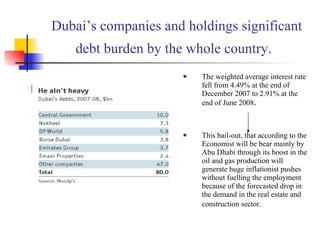
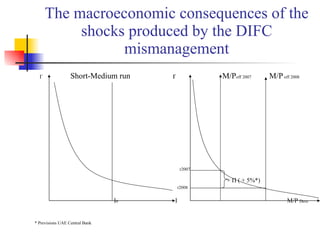
Dubai’s companies and holdings significant debt burden by the whole country.   The weighted average interest rate fell from 4.49% at the end of December 2007 to 2.91% at the end of June 2008 . This bail-out, that according to the Economist will be bear mainly by Abu Dhabi through its boost in the oil and gas production will generate huge inflationist pushes without fuelling the employment because of the forecasted drop in the demand in the real estate and construction sector.
The macroeconomic consequences of the shocks produced by the DIFC mismanagement Γ  Short-Medium run   ґ   M/P off 2007  M/P  off 2008  r2007 +  Π  ( + 5%*) r2008 I 0   I   M/P  Dem * Previsions UAE Central Bank
Dubai and the UAE face the credit crisis  INFLATION and UNEMPLOYMENT. Investors fear about the bail-out effect on the demand side for new investments on the real estate and construction sectors ( viz. Jumeira Garden shelved development or Burj Dubai and so on).* “ The UAE hold a meeting session on its bail-out strategy with World Bank and IMF which has not been published in order to not let foreign investors concerns grow about their future assets especially in Dubai” (MEED 03/06/2009). All the other Dubai clusters will be deeply affected by a spread of mistrust amongst FIs toward the DIFC’s assets. The consequences of this could be very serious (Employment, Economic Growth and so on). * UAE Bulletin 2008 and WB.
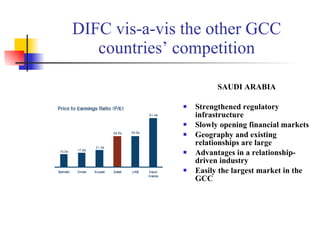
DIFC vis-a-vis the other GCC countries’ competition SAUDI ARABIA Strengthened regulatory infrastructure Slowly opening financial markets Geography and existing relationships are large Advantages in a relationship-driven industry Easily the largest market in the GCC
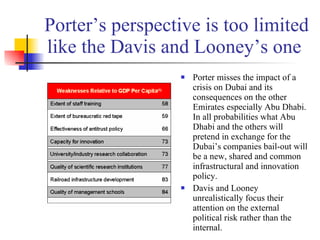
Porter’s perspective is too limited like the Davis and Looney’s one  Porter misses the impact of a crisis on Dubai and its consequences on the other Emirates especially Abu Dhabi. In all probabilities what Abu Dhabi and the others will pretend in exchange for the Dubai’s companies bail-out will be a new, shared and common infrastructural and innovation policy. Davis and Looney unrealistically focus their attention on the external political risk rather than the internal.
Conclusions and Crucial Points Over- exposure/ excess supply in the  real estate and construction sector,  influx of cash due to high oil prices- bears high levels of credit risk- banks- real estate burst. Lack of track record , transparency and  illiquidity of the DIFX and overheated stock markets. Lack of  sound macroeconomic policies and unstable political and legal institutions Under-developed equity and dept market. Heavy reliance on expatriates,  lack of skilled indigenous employees. High extend of bureaucratic red tape. Political Risk.  Infrastructure problems- congested roads and rising population (2.1 million in 2010). Dubai World Ports Fiasco- reputation as a financial hub for Islamic military groups-”terrorist connection”, runs a black economy as an insurance policy against terrorist attacks. Do you agree with us?
Ashai, Zaid & El Dahshan & Kubba, Joanne  & Talati & Youssefi & Michael E. Porter (2007) The Transport and Logistics Cluster in the United Arab Emirates. Microeconomics of Competitiveness Group Project, Harvard University, May 2007. Economic Bulletin (2008), Central Bank of the United Arab Emirates. Davis, Mike (2006), Fear and Money in Dubai, in New Left Review 41, Sept/Oct. 2006, pp. 47-68. Foreman, Colin (2009), “Meraas stops work on Dubai towers”, MEED. Looney, Robert (2006), “ Trends ” Article on Dubai in The Milken Institute Review, 4 th  Quarter 2006. M. Porter et al. (2006), The Dubai Financial Services Cluster.  http://www.isc.hbs.edu/pdf/Student_Projects/Dubai_Financial_Services_2006.pdf Matley, Michael and Dillon, Laura (2007), “Dubai Strategy: Past, Present, Future”, Harvard Business School. Porter, Michael (1990), The Competitive Advantage of Nations. New York Woertz, Eckart (2008), “Impact of the US Financial Crisis on  GCC Countries”, Gulf Research Center Report . References:

Dubai’S Diversification Strategy

  • 1.
    Dubai’s Diversification Strategyin the Service Sector Julia Stohlmann and Francesco Grosso
  • 2.
    Service sector Part2 Dubai’s Diversification Strategy Dubai’s Financial Service Cluster Financial Service Cluster Diamond Analysis Our evaluation of Porter’s Financial Cluster Model in Dubai. Conclusions and Questions.
  • 3.
    The strategic diversificationprocess of Dubai’s economy as a reaction to the forecasted hydrocarbon exhaustion Emerging The key to growth is the creation of mutually reinforcing industry clusters, in which activity in one area stimulates investment and production in others. National Context: Strengths and Weaknesses National Response/Goal Evaluation of Response/Goal Limited reserves of oil and gas and few natural resources but: Strategic location for shipping and air transportation Located in an unstable region Small population and lack of advanced educational infrastructure and innovative capacity Become a regional logistic hub with efficient infrastructure “ Singapore of the desert” Become regional haven of : Open trade and unrestricted capital outflows, lightly regulated economy with low taxes, a liberal business environment to attract multinational head offices. Import low-skill manual labor Invest in new services clusters free zones : Logistics/transportation Tourism Financial services Media 1972 Mina Port Rashid 1979 Jebel Ali Port (biggest port in the Middle East, home of DP World Ports)- Dubai is the third most important re-export center in the world 1985 Emirates Airline (1 st or 2 nd in the world, 100 airlines to 146 cities) 1985 Jebel Ali Free Zone, now 2600 companies in tax free zones- home to 800 US firms’ regional headquarters Approx. 74% of Dubai’s population are expatriates (42.3% Indian, 13.3% Pakistani, 7,5% Bangladeshi, 10.8%Western) Airport Free Zone, Maritime City 5 million tourist p.a. DIFC banking free zone Internet and Media Cities
  • 4.
    Regulatory Body DubaiFinancial Service Authority (DFSA) DIFC = regional capital market & state run, financial free-trade zone (opened in 2004) Mainly private banking-large pool of money from oil & gas exports-attracts foreign banks Dubai’s Financial Service Cluster Local & Regional Banks Local firms, banks etc. access stock markets via DFM, or Abu Dhabi Securities Market (ADSM), DFM comprises 24 public- stock companies, with a total market capitalization of AED 316 billion. Reluctance to switch to NASDAQ Dubai- more stringent regulatory requirements. International Banks & Insurance Companies (over 100 have joined) International firms, banks & insurance companies access via NASDAQ Dubai (since 2005), alternative stock exchange to e.g. the London Stock Exchange.
  • 5.
    Dubai’s Financial ServiceCluster Advantages of the DIFC Foreign ownership of public joint stock companies in the UAE restricted to 49% Free float restrictions: public joint stock companies must offer no less than 55% of the company’s issued share capital to the public- Prices of listed shares are limited to their nominal value , no ability to issue shares at a premium Public offers can only be marketed through financial institutions licensed by the relevant regulator in the GCC state (e.g. Central Bank in the UAE) Bureaucratic, slow and uncertain listings process Lack of transparency, reporting and poor corporate governance-although improving
  • 6.
    Dubai’s Financial ServiceCluster Diamond +Strong political support from Sheikh Mohammed + Physical proximity to oil and gas cluster + Vibrant place to visit + High level of regional growth + Strong history as a trading center Low levels of skilled local labor Poor management and finance education Past reputation for lack of transparency + Openness to imported skills + Demanding client base + Local investors prefer to keep assets in region post 9/11 +/- High oil & gas profits +/- Booming (bubble?) real estate sector +/- Improving legal environment High levels of unsecured credit risk Under-developed equity & dept markets + Large number of trade shows + Influx of foreign firms have raised local standards + DIFC effort to create transparent regulatory regime + Airline/airport infrastructure and service-’open sky policy’ - Local legal, accounting and finance infrastructure remains weak
  • 7.
    The successful Cluster“ A nation’s prosperity depends on its competitiveness, which is based on the productivity with which it produces goods and services. Sound macroeconomic policies and stable political and legal institutions are necessary but not sufficient conditions to ensure a prosperous economy. Competitiveness is rooted in a nation’s microeconomic fundamentals—the sophistication of company operations and strategies and the quality of the microeconomic business environment in which companies compete. An understanding of the microeconomic foundations of competitiveness is fundamental to national economic policy.” http://www.isc.hbs.edu/economicdevelopment.html
  • 8.
    The Productive Clustersof UAE As a result of an established government policy of diversifying sources of income through creation of favourable environment for the industrial sector and due to domestic financing establishments’ continued financing at reasonable terms, the value of goods exports continued to rise over the past few years, reaching AED 42.07 billion in 2007, against AED 29.23 billion in 2006 (+43.9%)* *UAE Economic Bulletin, June 2008, UAE Central Bank.
  • 9.
    Some Basic Dataon UAE GDP and Trade Trends 1 Abu Dhabi oil and gas production fuelled Dubai diversification strategy providing the cash flow for the great infrastructural projects which brought about the DIFC’s success.
  • 10.
  • 11.
    Assessment of theDIFC Lack of transparency in the auditing and accounting standards in the balance sheets of all state–participated companies in Dubai. High Credit Risk due to the overexposition of the real estate sector combined with high levels of willingness to offer risky credits shown by the local-state-owned banks. Latent political risk. the consequences are
  • 12.
    Dubai’s companies andholdings significant debt burden by the whole country. The weighted average interest rate fell from 4.49% at the end of December 2007 to 2.91% at the end of June 2008 . This bail-out, that according to the Economist will be bear mainly by Abu Dhabi through its boost in the oil and gas production will generate huge inflationist pushes without fuelling the employment because of the forecasted drop in the demand in the real estate and construction sector.
  • 13.
    The macroeconomic consequencesof the shocks produced by the DIFC mismanagement Γ Short-Medium run ґ M/P off 2007 M/P off 2008 r2007 + Π ( + 5%*) r2008 I 0 I M/P Dem * Previsions UAE Central Bank
  • 14.
    Dubai and theUAE face the credit crisis INFLATION and UNEMPLOYMENT. Investors fear about the bail-out effect on the demand side for new investments on the real estate and construction sectors ( viz. Jumeira Garden shelved development or Burj Dubai and so on).* “ The UAE hold a meeting session on its bail-out strategy with World Bank and IMF which has not been published in order to not let foreign investors concerns grow about their future assets especially in Dubai” (MEED 03/06/2009). All the other Dubai clusters will be deeply affected by a spread of mistrust amongst FIs toward the DIFC’s assets. The consequences of this could be very serious (Employment, Economic Growth and so on). * UAE Bulletin 2008 and WB.
  • 15.
    DIFC vis-a-vis theother GCC countries’ competition SAUDI ARABIA Strengthened regulatory infrastructure Slowly opening financial markets Geography and existing relationships are large Advantages in a relationship-driven industry Easily the largest market in the GCC
  • 16.
    Porter’s perspective istoo limited like the Davis and Looney’s one Porter misses the impact of a crisis on Dubai and its consequences on the other Emirates especially Abu Dhabi. In all probabilities what Abu Dhabi and the others will pretend in exchange for the Dubai’s companies bail-out will be a new, shared and common infrastructural and innovation policy. Davis and Looney unrealistically focus their attention on the external political risk rather than the internal.
  • 17.
    Conclusions and CrucialPoints Over- exposure/ excess supply in the real estate and construction sector, influx of cash due to high oil prices- bears high levels of credit risk- banks- real estate burst. Lack of track record , transparency and illiquidity of the DIFX and overheated stock markets. Lack of sound macroeconomic policies and unstable political and legal institutions Under-developed equity and dept market. Heavy reliance on expatriates, lack of skilled indigenous employees. High extend of bureaucratic red tape. Political Risk. Infrastructure problems- congested roads and rising population (2.1 million in 2010). Dubai World Ports Fiasco- reputation as a financial hub for Islamic military groups-”terrorist connection”, runs a black economy as an insurance policy against terrorist attacks. Do you agree with us?
  • 18.
    Ashai, Zaid &El Dahshan & Kubba, Joanne & Talati & Youssefi & Michael E. Porter (2007) The Transport and Logistics Cluster in the United Arab Emirates. Microeconomics of Competitiveness Group Project, Harvard University, May 2007. Economic Bulletin (2008), Central Bank of the United Arab Emirates. Davis, Mike (2006), Fear and Money in Dubai, in New Left Review 41, Sept/Oct. 2006, pp. 47-68. Foreman, Colin (2009), “Meraas stops work on Dubai towers”, MEED. Looney, Robert (2006), “ Trends ” Article on Dubai in The Milken Institute Review, 4 th Quarter 2006. M. Porter et al. (2006), The Dubai Financial Services Cluster. http://www.isc.hbs.edu/pdf/Student_Projects/Dubai_Financial_Services_2006.pdf Matley, Michael and Dillon, Laura (2007), “Dubai Strategy: Past, Present, Future”, Harvard Business School. Porter, Michael (1990), The Competitive Advantage of Nations. New York Woertz, Eckart (2008), “Impact of the US Financial Crisis on GCC Countries”, Gulf Research Center Report . References: