George Paul
Glorin Sebastian
Jithin KV
Joseph Cherian
Xime
 MCX Stock Exchange Limited (MCX-SX), India‟s new stock
exchange, commenced operations in the Currency Derivatives
(CD) segment on October 7, 2008 under the regulatory
framework of Securities & Exchange Board of India (SEBI) and
Reserve Bank of India (RBI).
 The Exchange is recognised by SEBI under Section 4 of
Securities Contracts (Regulation) Act, 1956.
 In line with global best practices and regulatory requirements,
clearing and settlement is conducted through a separate clearing
corporation, MCX-SX Clearing Corporation Ltd. (MCX-SX
CCL).
 MCX-SX received permissions to deal in Interest Rate
Derivatives, Equity, Futures & Options on Equity and Wholesale
Debt Segment, vide SEBI‟s letter dated July 10, 2012.
 Headquartered in Mumbai
 Having started operations in November
2003, today, MCX holds a market share of over 80%*
(87.3% during the nine months ended December
31, 2011 and 82.4% inFY2011) of the Indian
commodity futures market
 Has more than 2,153 registered members operating
through over 2,96,896 including computer-to-computer
link (CTCL) trading terminals spread over 1,572 cities
and towns across India
 The Exchange was the fifth largest commodity
exchange, among all the commodity exchanges
considered in the Futures Industry Association
survey, in terms of the number of contracts traded for
the six months ended June 30, 2011

 MCX offers more than 40 commodities across various
segments such as bullion , ferrous and non-ferrous
metals, energy, and a number of agri-commodities on
its platform
 It was the first exchange in India to offer futures trading in steel,
crude oil, and almond.
 MCX HAS introduced several other indices, including
MCXAgri (agriculturalcommodities index), MCXEnergy (energy
commodities index) and MCXMetal (metalcommodities index).
 It also has three rain indices, namely RAINDEXMUM
(Mumbai), RAINDEXIDR(Indore), and RAINDEXJAI (Jaipur)
which track the progress of monsoon rains in their respective
geographic locations .
 In December 2009, it launched EFP transactions for the first time
in India, which enables parties with futures positions to swap
their positions in the physical markets and vice versa
 MCX offers futures trading in bullion, ferrous and
non-ferrous metals, energy, and a number of
agricultural commodities (mentha oil, cardamom,
potatoes, palm oil and others)
 A futures contract is a standardised contract between
two parties to buy or sell a specified asset of
standardized quantity and quality for a price agreed
upon today (the futures price or strike price) with
delivery and payment occurring at a specified future
date, the delivery date.
 The contracts are negotiated at a futures exchange,
which acts as an intermediary between the two parties
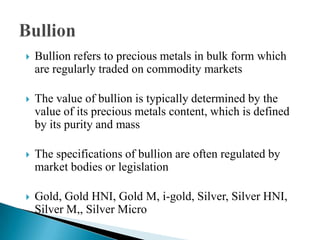
 Bullion refers to precious metals in bulk form which
are regularly traded on commodity markets
 The value of bullion is typically determined by the
value of its precious metals content, which is defined
by its purity and mass
 The specifications of bullion are often regulated by
market bodies or legislation
 Gold, Gold HNI, Gold M, i-gold, Silver, Silver HNI,
Silver M,, Silver Micro
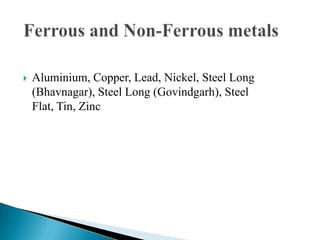
 Aluminium, Copper, Lead, Nickel, Steel Long
(Bhavnagar), Steel Long (Govindgarh), Steel
Flat, Tin, Zinc
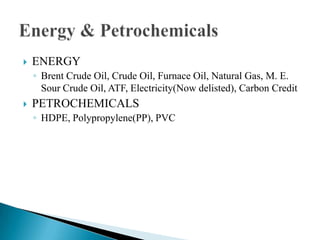
 ENERGY
◦ Brent Crude Oil, Crude Oil, Furnace Oil, Natural Gas, M. E.
Sour Crude Oil, ATF, Electricity(Now delisted), Carbon Credit
 PETROCHEMICALS
◦ HDPE, Polypropylene(PP), PVC
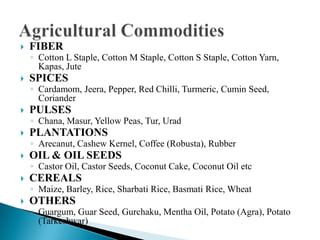
 FIBER
◦ Cotton L Staple, Cotton M Staple, Cotton S Staple, Cotton Yarn,
Kapas, Jute
 SPICES
◦ Cardamom, Jeera, Pepper, Red Chilli, Turmeric, Cumin Seed,
Coriander
 PULSES
◦ Chana, Masur, Yellow Peas, Tur, Urad
 PLANTATIONS
◦ Arecanut, Cashew Kernel, Coffee (Robusta), Rubber
 OIL & OIL SEEDS
◦ Castor Oil, Castor Seeds, Coconut Cake, Coconut Oil etc
 CEREALS
◦ Maize, Barley, Rice, Sharbati Rice, Basmati Rice, Wheat
 OTHERS
◦ Guargum, Guar Seed, Gurchaku, Mentha Oil, Potato (Agra), Potato
(Tarkeshwar)
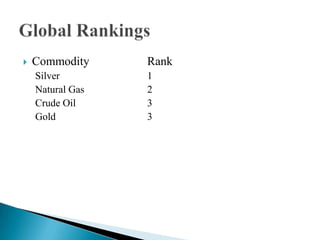
 Commodity Rank
Silver 1
Natural Gas 2
Crude Oil 3
Gold 3
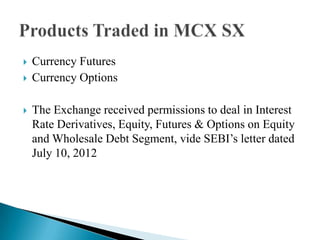
 Currency Futures
 Currency Options
 The Exchange received permissions to deal in Interest
Rate Derivatives, Equity, Futures & Options on Equity
and Wholesale Debt Segment, vide SEBI‟s letter dated
July 10, 2012
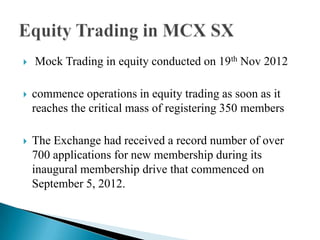
 Mock Trading in equity conducted on 19th Nov 2012
 commence operations in equity trading as soon as it
reaches the critical mass of registering 350 members
 The Exchange had received a record number of over
700 applications for new membership during its
inaugural membership drive that commenced on
September 5, 2012.
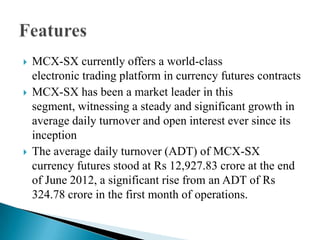
 MCX-SX currently offers a world-class
electronic trading platform in currency futures contracts
 MCX-SX has been a market leader in this
segment, witnessing a steady and significant growth in
average daily turnover and open interest ever since its
inception
 The average daily turnover (ADT) of MCX-SX
currency futures stood at Rs 12,927.83 crore at the end
of June 2012, a significant rise from an ADT of Rs
324.78 crore in the first month of operations.
 The latest move by MCX-SX is bound to increase the
competition in the currency options segment, which is
currently dominated by the National Stock Exchange
(NSE).
 In July „12, NSE registered a total turnover of R1.32
lakh crore in currency options.
 The United Stock Exchange (USE) also offers trading
in currency options but the volume is negligible.
ADVANTAGES OF MCX
• MCX has been at the forefront to spread awareness and
benefits of the commodity futures market by
conducting series of seminars and tie ups across India.
• India‟s largest and the world‟s 8th largest commodity
exchange.
• With more than 80% market share the exchange
provides high liquidity and its strong risk management
systems assure participants of secure transactions on an
online trading platform.
 With a strong technology-backed trading platform and
infrastructure MCX is able to provide high liquidity
and low impact cost of transactions
 Rapid growth in operations has been supported by best
practices in risk management
 Strong competitive position in the market
 Product portfolio geared towards commodities linked to
global price movements
 85% of MCX‟s turnover is through metal and energy
commodities
 These commodities have higher volumes but they also
have higher turnover which generates higher
transaction fees compared to agricultural commodities.
 FTIL‟s expertise in exchange technology solutions
bodes well for MCX
MCX‟s electronic platform is supported by its infrastructure and
advanced technology, allowing faster trade execution, anonymity,
price transparency, prompt and reliable order routing, trade
reporting, market data dissemination and market surveillance.
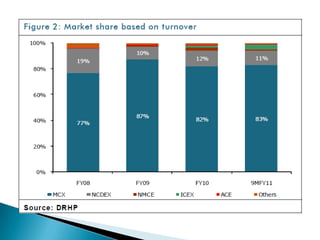
 MCX‟s share in the overall commodities market has
skyrocketed from 29% in FY04 to 82.3% as of FY10
primarily due to its focus on metals and energy
commodities benchmarked to international prices.
 MCX‟s sources of operating income are a) transaction
fees, b) membership admission fees, c) annual
subscription fees and d) terminal charges.
 Globally, MCX is the largest silver exchange; 2ndlargest
gold, copper and natural gas exchange
 3rd largest crude oil exchange in terms of the number of
contracts traded in each of these commodities
MCX has also pioneered several innovations in the Indian
commodities market:
 MCX was the first national commodity futures exchange in
India to offer futures trading in steel, crude oil and several
other commodities, including carbon credits.
 In December 2009, MCX launched the exchange of futures for
physicals facility for the first time in India.
 In May 2010 and June 2010, the exchange launched zinc mini
futures and lead mini futures contracts, which offer trading in
these metals in smaller lot sizes.
 In January 2011, the exchange launched iron ore future
contracts.
 In February 2011, it launched silver micro and
aluminium mini contracts, which offer trading in these
metals in smaller lot sizes.
 MCX is also the first exchange in India to initiate
evening sessions to synchronise with the trading hours
of global exchanges in London, New York and other
major international markets to meet the needs of the
physical markets that operate in such time zones.
 The membership fees that MCX-SX is planning to
offer, could trigger a price war causing the BSE and the
NSE to revise their membership fee structure
 The exchange‟s introductory membership fee is Rs 25
lakh of net outlay for entry-level membership (includes
admission fees and deposit). This offer is valid only till
October 18, following which the total outlay for the
MCX-SX membership would be Rs 50 lakh.
 competitive membership fees come at a time when the
Indian equity markets are facing tough times and
exchanges are struggling to grow revenues.
 BSE fees are almost at par with the MCX-SX‟s
membership fee, while the NSE‟s membership fees are
slightly higher
 “MCX-SX has a tendency of going aggressive. Their
membership fees and membership categories will help
drive financial inclusion,” said Jagannadham
Thunuguntla, Strategist & Head of Research, SMC
Global Securities.
 Ahead of launching trading in
multiple assets, MCX-SX has
signed up 700 members across
the country. The BSE and the
NSE had launched operations
with 318 members in 1875 and
nearly 200 members in
1994, respectively.
 the high membership clause
was a major entry barrier to
becoming a stock broker in
India. Currently, NSE has
1,500 broker members, while
BSE accounts for about 1,000.
 NSE responded by cutting its deposit and net worth
criteria by up to 50 per cent for a class of brokers
under the new „Alpha‟ category, compared to earlier
charges of Rs 75 lakh-Rs 1.5 crore.
 BSE‟s charges are much lower compared to the other
exchanges.
 MCX- SX offers three categories of membership —
 Composite professionally qualified and rural
entrepreneur.
 The second category is for members who have
experience in the capital markets.
MBAs, lawyers, engineers, chartered
accountants, doctors would also be eligible under this
category
 The „Rural Entrepreneur
Membership‟ category is for
people living in sub-districts
and taluks, where there is no
capital market penetration.
 Membership is being offered
in the categories of Trading
Member, Self-Clearing
Member, Trading-cum-
Clearing Member and
Professional Clearing
Member.
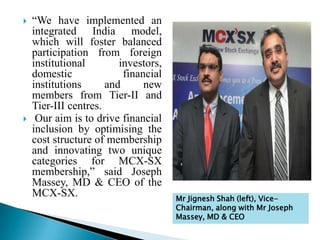
 “We have implemented an
integrated India model,
which will foster balanced
participation from foreign
institutional investors,
domestic financial
institutions and new
members from Tier-II and
Tier-III centres.
 Our aim is to drive financial
inclusion by optimising the
cost structure of membership
and innovating two unique
categories for MCX-SX
membership,” said Joseph
Massey, MD & CEO of the
MCX-SX. Mr Jignesh Shah (left), Vice-
Chairman, along with Mr Joseph
Massey, MD & CEO
 THANK YOU

Mcx

  • 1.
  • 2.
     MCX StockExchange Limited (MCX-SX), India‟s new stock exchange, commenced operations in the Currency Derivatives (CD) segment on October 7, 2008 under the regulatory framework of Securities & Exchange Board of India (SEBI) and Reserve Bank of India (RBI).  The Exchange is recognised by SEBI under Section 4 of Securities Contracts (Regulation) Act, 1956.  In line with global best practices and regulatory requirements, clearing and settlement is conducted through a separate clearing corporation, MCX-SX Clearing Corporation Ltd. (MCX-SX CCL).  MCX-SX received permissions to deal in Interest Rate Derivatives, Equity, Futures & Options on Equity and Wholesale Debt Segment, vide SEBI‟s letter dated July 10, 2012.
  • 4.
     Headquartered inMumbai  Having started operations in November 2003, today, MCX holds a market share of over 80%* (87.3% during the nine months ended December 31, 2011 and 82.4% inFY2011) of the Indian commodity futures market  Has more than 2,153 registered members operating through over 2,96,896 including computer-to-computer link (CTCL) trading terminals spread over 1,572 cities and towns across India
  • 5.
     The Exchangewas the fifth largest commodity exchange, among all the commodity exchanges considered in the Futures Industry Association survey, in terms of the number of contracts traded for the six months ended June 30, 2011   MCX offers more than 40 commodities across various segments such as bullion , ferrous and non-ferrous metals, energy, and a number of agri-commodities on its platform
  • 6.
     It wasthe first exchange in India to offer futures trading in steel, crude oil, and almond.  MCX HAS introduced several other indices, including MCXAgri (agriculturalcommodities index), MCXEnergy (energy commodities index) and MCXMetal (metalcommodities index).  It also has three rain indices, namely RAINDEXMUM (Mumbai), RAINDEXIDR(Indore), and RAINDEXJAI (Jaipur) which track the progress of monsoon rains in their respective geographic locations .  In December 2009, it launched EFP transactions for the first time in India, which enables parties with futures positions to swap their positions in the physical markets and vice versa
  • 7.
     MCX offersfutures trading in bullion, ferrous and non-ferrous metals, energy, and a number of agricultural commodities (mentha oil, cardamom, potatoes, palm oil and others)
  • 8.
     A futurescontract is a standardised contract between two parties to buy or sell a specified asset of standardized quantity and quality for a price agreed upon today (the futures price or strike price) with delivery and payment occurring at a specified future date, the delivery date.  The contracts are negotiated at a futures exchange, which acts as an intermediary between the two parties
  • 9.
     Bullion refersto precious metals in bulk form which are regularly traded on commodity markets  The value of bullion is typically determined by the value of its precious metals content, which is defined by its purity and mass  The specifications of bullion are often regulated by market bodies or legislation  Gold, Gold HNI, Gold M, i-gold, Silver, Silver HNI, Silver M,, Silver Micro
  • 10.
     Aluminium, Copper,Lead, Nickel, Steel Long (Bhavnagar), Steel Long (Govindgarh), Steel Flat, Tin, Zinc
  • 11.
     ENERGY ◦ BrentCrude Oil, Crude Oil, Furnace Oil, Natural Gas, M. E. Sour Crude Oil, ATF, Electricity(Now delisted), Carbon Credit  PETROCHEMICALS ◦ HDPE, Polypropylene(PP), PVC
  • 12.
     FIBER ◦ CottonL Staple, Cotton M Staple, Cotton S Staple, Cotton Yarn, Kapas, Jute  SPICES ◦ Cardamom, Jeera, Pepper, Red Chilli, Turmeric, Cumin Seed, Coriander  PULSES ◦ Chana, Masur, Yellow Peas, Tur, Urad  PLANTATIONS ◦ Arecanut, Cashew Kernel, Coffee (Robusta), Rubber  OIL & OIL SEEDS ◦ Castor Oil, Castor Seeds, Coconut Cake, Coconut Oil etc  CEREALS ◦ Maize, Barley, Rice, Sharbati Rice, Basmati Rice, Wheat  OTHERS ◦ Guargum, Guar Seed, Gurchaku, Mentha Oil, Potato (Agra), Potato (Tarkeshwar)
  • 13.
     Commodity Rank Silver1 Natural Gas 2 Crude Oil 3 Gold 3
  • 14.
     Currency Futures Currency Options  The Exchange received permissions to deal in Interest Rate Derivatives, Equity, Futures & Options on Equity and Wholesale Debt Segment, vide SEBI‟s letter dated July 10, 2012
  • 15.
     Mock Tradingin equity conducted on 19th Nov 2012  commence operations in equity trading as soon as it reaches the critical mass of registering 350 members  The Exchange had received a record number of over 700 applications for new membership during its inaugural membership drive that commenced on September 5, 2012.
  • 16.
     MCX-SX currentlyoffers a world-class electronic trading platform in currency futures contracts  MCX-SX has been a market leader in this segment, witnessing a steady and significant growth in average daily turnover and open interest ever since its inception  The average daily turnover (ADT) of MCX-SX currency futures stood at Rs 12,927.83 crore at the end of June 2012, a significant rise from an ADT of Rs 324.78 crore in the first month of operations.
  • 17.
     The latestmove by MCX-SX is bound to increase the competition in the currency options segment, which is currently dominated by the National Stock Exchange (NSE).  In July „12, NSE registered a total turnover of R1.32 lakh crore in currency options.  The United Stock Exchange (USE) also offers trading in currency options but the volume is negligible.
  • 18.
  • 19.
    • MCX hasbeen at the forefront to spread awareness and benefits of the commodity futures market by conducting series of seminars and tie ups across India. • India‟s largest and the world‟s 8th largest commodity exchange. • With more than 80% market share the exchange provides high liquidity and its strong risk management systems assure participants of secure transactions on an online trading platform.
  • 20.
     With astrong technology-backed trading platform and infrastructure MCX is able to provide high liquidity and low impact cost of transactions  Rapid growth in operations has been supported by best practices in risk management  Strong competitive position in the market  Product portfolio geared towards commodities linked to global price movements
  • 21.
     85% ofMCX‟s turnover is through metal and energy commodities  These commodities have higher volumes but they also have higher turnover which generates higher transaction fees compared to agricultural commodities.  FTIL‟s expertise in exchange technology solutions bodes well for MCX MCX‟s electronic platform is supported by its infrastructure and advanced technology, allowing faster trade execution, anonymity, price transparency, prompt and reliable order routing, trade reporting, market data dissemination and market surveillance.
  • 22.
     MCX‟s sharein the overall commodities market has skyrocketed from 29% in FY04 to 82.3% as of FY10 primarily due to its focus on metals and energy commodities benchmarked to international prices.  MCX‟s sources of operating income are a) transaction fees, b) membership admission fees, c) annual subscription fees and d) terminal charges.
  • 23.
     Globally, MCXis the largest silver exchange; 2ndlargest gold, copper and natural gas exchange  3rd largest crude oil exchange in terms of the number of contracts traded in each of these commodities
  • 25.
    MCX has alsopioneered several innovations in the Indian commodities market:  MCX was the first national commodity futures exchange in India to offer futures trading in steel, crude oil and several other commodities, including carbon credits.  In December 2009, MCX launched the exchange of futures for physicals facility for the first time in India.  In May 2010 and June 2010, the exchange launched zinc mini futures and lead mini futures contracts, which offer trading in these metals in smaller lot sizes.  In January 2011, the exchange launched iron ore future contracts.
  • 26.
     In February2011, it launched silver micro and aluminium mini contracts, which offer trading in these metals in smaller lot sizes.  MCX is also the first exchange in India to initiate evening sessions to synchronise with the trading hours of global exchanges in London, New York and other major international markets to meet the needs of the physical markets that operate in such time zones.
  • 28.
     The membershipfees that MCX-SX is planning to offer, could trigger a price war causing the BSE and the NSE to revise their membership fee structure  The exchange‟s introductory membership fee is Rs 25 lakh of net outlay for entry-level membership (includes admission fees and deposit). This offer is valid only till October 18, following which the total outlay for the MCX-SX membership would be Rs 50 lakh.
  • 29.
     competitive membershipfees come at a time when the Indian equity markets are facing tough times and exchanges are struggling to grow revenues.  BSE fees are almost at par with the MCX-SX‟s membership fee, while the NSE‟s membership fees are slightly higher  “MCX-SX has a tendency of going aggressive. Their membership fees and membership categories will help drive financial inclusion,” said Jagannadham Thunuguntla, Strategist & Head of Research, SMC Global Securities.
  • 30.
     Ahead oflaunching trading in multiple assets, MCX-SX has signed up 700 members across the country. The BSE and the NSE had launched operations with 318 members in 1875 and nearly 200 members in 1994, respectively.  the high membership clause was a major entry barrier to becoming a stock broker in India. Currently, NSE has 1,500 broker members, while BSE accounts for about 1,000.
  • 31.
     NSE respondedby cutting its deposit and net worth criteria by up to 50 per cent for a class of brokers under the new „Alpha‟ category, compared to earlier charges of Rs 75 lakh-Rs 1.5 crore.  BSE‟s charges are much lower compared to the other exchanges.  MCX- SX offers three categories of membership —  Composite professionally qualified and rural entrepreneur.  The second category is for members who have experience in the capital markets. MBAs, lawyers, engineers, chartered accountants, doctors would also be eligible under this category
  • 32.
     The „RuralEntrepreneur Membership‟ category is for people living in sub-districts and taluks, where there is no capital market penetration.  Membership is being offered in the categories of Trading Member, Self-Clearing Member, Trading-cum- Clearing Member and Professional Clearing Member.
  • 33.
     “We haveimplemented an integrated India model, which will foster balanced participation from foreign institutional investors, domestic financial institutions and new members from Tier-II and Tier-III centres.  Our aim is to drive financial inclusion by optimising the cost structure of membership and innovating two unique categories for MCX-SX membership,” said Joseph Massey, MD & CEO of the MCX-SX. Mr Jignesh Shah (left), Vice- Chairman, along with Mr Joseph Massey, MD & CEO
  • 34.

Editor's Notes

  • #10 In the European Union, the minimum purity for gold bullion, which is treated as investment gold with regards to taxation, is 99.5% for gold bullion bars and 90% for bullion coins.Highest traded Item is gold