PROBLEM SOLVING
PROBLEM SOLVING
Why do companies hire
employees?
PROBLEM SOLVING
Problem Solving
Most occupations require good problem-solving
skills. For instance, architects and engineers must
solve many complicated problems as they design
and construct modern buildings that are
aesthetically pleasing, functional, and that meet
stringent safety requirements.
Engage competently in a variety of
related independent freelance work;
Innovate creative audio-visual materials e.g. films,
music, multimedia works, advertisement, among others,
intended for academic, and commercial utilization.
PROBLEM SOLVING
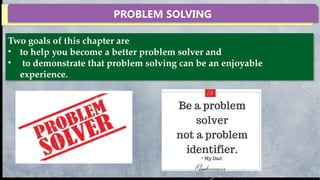
Two goals of this chapter are
• to help you become a better problem solver and
• to demonstrate that problem solving can be an enjoyable
experience.
PROBLEM SOLVING
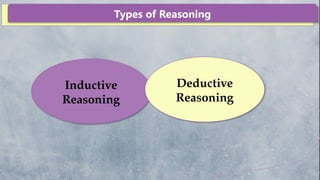
Types of Reasoning
Inductive
Reasoning
Deductive
Reasoning
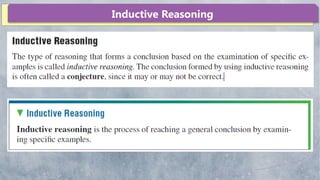
Inductive Reasoning
Inductive Reasoning
Example 1. When you examine a list
of numbers and predict
the next number in the
list according to some
pattern you have
observed, you are using
inductive reasoning.
1, 4, 7, 10, 13, ? , . . .
1, 4, 9, 16, 25, ? , . . .
1, 3, 6, 10, 15, ? , . . .
1, 4, 7, 10, 13, 16 , . . .
1, 4, 9, 16, 25, 36, . . .
1, 3, 6, 10, 15, 21, . . .
Inductive Reasoning
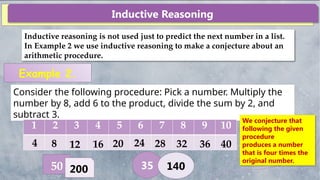
Inductive reasoning is not used just to predict the next number in a list.
In Example 2 we use inductive reasoning to make a conjecture about an
arithmetic procedure.
Consider the following procedure: Pick a number. Multiply the
number by 8, add 6 to the product, divide the sum by 2, and
subtract 3.
Example 2.
1 2 3 4 5 6 7 8 9 10
4 8 12 16 24 28 32 36 40
20
35 140
50 200
We conjecture that
following the given
procedure
produces a number
that is four times the
original number.
Inductive Reasoning
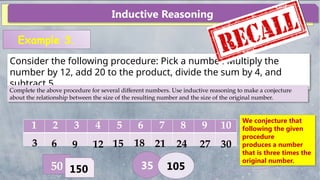
Example 3.
1 2 3 4 5 6 7 8 9 10
3 6 9 12 18 21 24 27 30
15
35 105
50 150
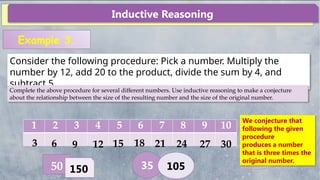
Consider the following procedure: Pick a number. Multiply the
number by 12, add 20 to the product, divide the sum by 4, and
subtract 5.
Complete the above procedure for several different numbers. Use inductive reasoning to make a conjecture
about the relationship between the size of the resulting number and the size of the original number.
We conjecture that
following the given
procedure
produces a number
that is three times the
original number.
Inductive Reasoning
Inductive Reasoning
Example 4.
Use Inductive Reasoning to Solve an Application
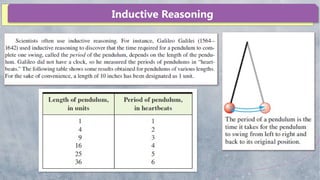
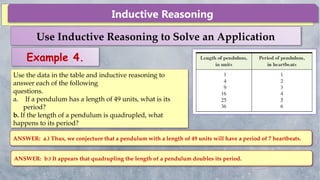
Use the data in the table and inductive reasoning to
answer each of the following
questions.
a. If a pendulum has a length of 49 units, what is its
period?
b. If the length of a pendulum is quadrupled, what
happens to its period?
ANSWER: a.) Thus, we conjecture that a pendulum with a length of 49 units will have a period of 7 heartbeats.
ANSWER: b.) It appears that quadrupling the length of a pendulum doubles its period.
Inductive Reasoning
Example 5.
Use Inductive Reasoning to Solve an Application
A tsunami is a sea wave produced by an underwater
earthquake. The height of a tsunami as it approaches land
depends on the velocity of the tsunami. Use the table at the
right and inductive reasoning to answer each of the
following questions.
a. What happens to the height of a tsunami when its velocity
is doubled?
b. What should be the height of a tsunami if its velocity is 30
feet per second?
ANSWER: a.) It appears that when the velocity of a tsunami is doubled, its height is quadrupled.
ANSWER: b.) A tsunami with a velocity of 30 feet per second will have a height that is four times that of a
tsunami with a speed of 15 feet per second. Thus, we predict a height of 4 X 25 = 100 feet for a tsunami with
a velocity of 30 feet per second.
Inductive Reasoning
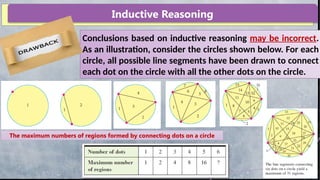
Conclusions based on inductive reasoning may be incorrect.
As an illustration, consider the circles shown below. For each
circle, all possible line segments have been drawn to connect
each dot on the circle with all the other dots on the circle.
The maximum numbers of regions formed by connecting dots on a circle
Inductive Reasoning
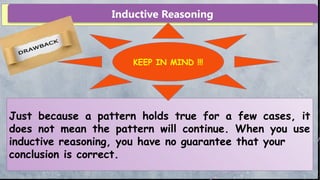
Just because a pattern holds true for a few cases, it
does not mean the pattern will continue. When you use
inductive reasoning, you have no guarantee that your
conclusion is correct.
KEEP IN MIND !!!
Inductive Reasoning
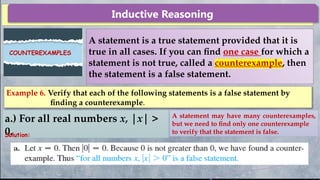
A statement is a true statement provided that it is
true in all cases. If you can find one case for which a
statement is not true, called a counterexample, then
the statement is a false statement.
COUNTEREXAMPLES
Example 6. Verify that each of the following statements is a false statement by
finding a counterexample.
a.) For all real numbers x, |x| >
0.
A statement may have many counterexamples,
but we need to find only one counterexample
to verify that the statement is false.
Solution:
Inductive Reasoning
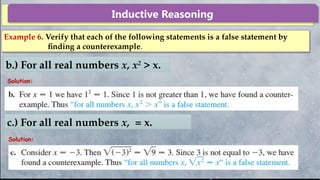
Example 6. Verify that each of the following statements is a false statement by
finding a counterexample.
b.) For all real numbers x, x2
> x.
Solution:
c.) For all real numbers x, = x.
Solution:
Deductive Reasoning
Use Deductive Reasoning to Establish a Conjecture
Another type of reasoning is called deductive reasoning. Deductive
reasoning is distinguished from inductive reasoning in that it is the
process of reaching a conclusion by applying general principles and
procedures.
Inductive Reasoning
Consider the following procedure: Pick a number. Multiply the
number by 8, add 6 to the product, divide the sum by 2, and
subtract 3.
Example 2.
1 2 3 4 5 6 7 8 9 10
4 8 12 16 24 28 32 36 40
20
35 140
50 200
We conjecture that
following the given
procedure
produces a number
that is four times the
original number.
Use deductive reasoning to show that the
following procedure produces a number that
is four times the original number.
Deductive Reasoning
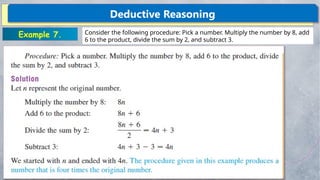
Example 7. Consider the following procedure: Pick a number. Multiply the number by 8, add
6 to the product, divide the sum by 2, and subtract 3.
Inductive Reasoning
Example 3.
1 2 3 4 5 6 7 8 9 10
3 6 9 12 18 21 24 27 30
15
35 105
50 150
Consider the following procedure: Pick a number. Multiply the
number by 12, add 20 to the product, divide the sum by 4, and
subtract 5.
Complete the above procedure for several different numbers. Use inductive reasoning to make a conjecture
about the relationship between the size of the resulting number and the size of the original number.
We conjecture that
following the given
procedure
produces a number
that is three times the
original number.
Deductive Reasoning
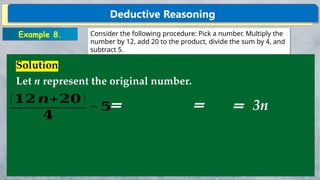
Example 8. Consider the following procedure: Pick a number. Multiply the
number by 12, add 20 to the product, divide the sum by 4, and
subtract 5.
(𝟏𝟐𝒏+𝟐𝟎)
𝟒
−𝟓
Solution
Let n represent the original number.
= = = 3n
Deductive Reasoning
Example 9. Use deductive reasoning to show that the following procedure
always produces the number 5.
Procedure: Give any number. Add 4 to the number and
multiply the sum by 3. Subtract 7 and then decrease this
difference by the triple of the number you gave.
[3( – 7] – 3n
Solution
Let n represent the number you gave.
=[3 – 7] – 3n
= 3 – 3n
=
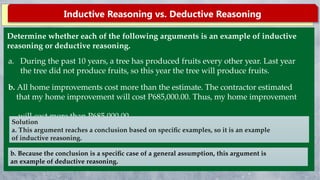
Inductive Reasoning vs. Deductive Reasoning
Determine whether each of the following arguments is an example of inductive
reasoning or deductive reasoning.
a. During the past 10 years, a tree has produced fruits every other year. Last year
the tree did not produce fruits, so this year the tree will produce fruits.
b. All home improvements cost more than the estimate. The contractor estimated
that my home improvement will cost P685,000.00. Thus, my home improvement
will cost more than P685,000.00.
Solution
a. This argument reaches a conclusion based on specific examples, so it is an example
of inductive reasoning.
b. Because the conclusion is a specific case of a general assumption, this argument is
an example of deductive reasoning.
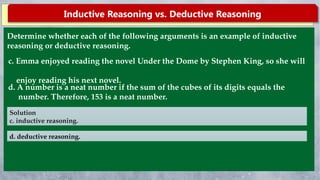
Inductive Reasoning vs. Deductive Reasoning
Determine whether each of the following arguments is an example of inductive
reasoning or deductive reasoning.
c. Emma enjoyed reading the novel Under the Dome by Stephen King, so she will
enjoy reading his next novel.
d. A number is a neat number if the sum of the cubes of its digits equals the
number. Therefore, 153 is a neat number.
Solution
c. inductive reasoning.
d. deductive reasoning.
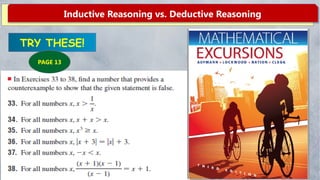
TRY THESE!
Inductive Reasoning vs. Deductive Reasoning
PAGE 13

Inductive-and-Deductive-Reasoning AB.pptx

  • 1.
  • 2.
    PROBLEM SOLVING Why docompanies hire employees?
  • 3.
    PROBLEM SOLVING Problem Solving Mostoccupations require good problem-solving skills. For instance, architects and engineers must solve many complicated problems as they design and construct modern buildings that are aesthetically pleasing, functional, and that meet stringent safety requirements. Engage competently in a variety of related independent freelance work; Innovate creative audio-visual materials e.g. films, music, multimedia works, advertisement, among others, intended for academic, and commercial utilization.
  • 4.
    PROBLEM SOLVING Two goalsof this chapter are • to help you become a better problem solver and • to demonstrate that problem solving can be an enjoyable experience.
  • 5.
  • 6.
  • 7.
  • 8.
    Inductive Reasoning Example 1.When you examine a list of numbers and predict the next number in the list according to some pattern you have observed, you are using inductive reasoning. 1, 4, 7, 10, 13, ? , . . . 1, 4, 9, 16, 25, ? , . . . 1, 3, 6, 10, 15, ? , . . . 1, 4, 7, 10, 13, 16 , . . . 1, 4, 9, 16, 25, 36, . . . 1, 3, 6, 10, 15, 21, . . .
  • 9.
    Inductive Reasoning Inductive reasoningis not used just to predict the next number in a list. In Example 2 we use inductive reasoning to make a conjecture about an arithmetic procedure. Consider the following procedure: Pick a number. Multiply the number by 8, add 6 to the product, divide the sum by 2, and subtract 3. Example 2. 1 2 3 4 5 6 7 8 9 10 4 8 12 16 24 28 32 36 40 20 35 140 50 200 We conjecture that following the given procedure produces a number that is four times the original number.
  • 10.
    Inductive Reasoning Example 3. 12 3 4 5 6 7 8 9 10 3 6 9 12 18 21 24 27 30 15 35 105 50 150 Consider the following procedure: Pick a number. Multiply the number by 12, add 20 to the product, divide the sum by 4, and subtract 5. Complete the above procedure for several different numbers. Use inductive reasoning to make a conjecture about the relationship between the size of the resulting number and the size of the original number. We conjecture that following the given procedure produces a number that is three times the original number.
  • 11.
  • 12.
    Inductive Reasoning Example 4. UseInductive Reasoning to Solve an Application Use the data in the table and inductive reasoning to answer each of the following questions. a. If a pendulum has a length of 49 units, what is its period? b. If the length of a pendulum is quadrupled, what happens to its period? ANSWER: a.) Thus, we conjecture that a pendulum with a length of 49 units will have a period of 7 heartbeats. ANSWER: b.) It appears that quadrupling the length of a pendulum doubles its period.
  • 13.
    Inductive Reasoning Example 5. UseInductive Reasoning to Solve an Application A tsunami is a sea wave produced by an underwater earthquake. The height of a tsunami as it approaches land depends on the velocity of the tsunami. Use the table at the right and inductive reasoning to answer each of the following questions. a. What happens to the height of a tsunami when its velocity is doubled? b. What should be the height of a tsunami if its velocity is 30 feet per second? ANSWER: a.) It appears that when the velocity of a tsunami is doubled, its height is quadrupled. ANSWER: b.) A tsunami with a velocity of 30 feet per second will have a height that is four times that of a tsunami with a speed of 15 feet per second. Thus, we predict a height of 4 X 25 = 100 feet for a tsunami with a velocity of 30 feet per second.
  • 14.
    Inductive Reasoning Conclusions basedon inductive reasoning may be incorrect. As an illustration, consider the circles shown below. For each circle, all possible line segments have been drawn to connect each dot on the circle with all the other dots on the circle. The maximum numbers of regions formed by connecting dots on a circle
  • 15.
    Inductive Reasoning Just becausea pattern holds true for a few cases, it does not mean the pattern will continue. When you use inductive reasoning, you have no guarantee that your conclusion is correct. KEEP IN MIND !!!
  • 16.
    Inductive Reasoning A statementis a true statement provided that it is true in all cases. If you can find one case for which a statement is not true, called a counterexample, then the statement is a false statement. COUNTEREXAMPLES Example 6. Verify that each of the following statements is a false statement by finding a counterexample. a.) For all real numbers x, |x| > 0. A statement may have many counterexamples, but we need to find only one counterexample to verify that the statement is false. Solution:
  • 17.
    Inductive Reasoning Example 6.Verify that each of the following statements is a false statement by finding a counterexample. b.) For all real numbers x, x2 > x. Solution: c.) For all real numbers x, = x. Solution:
  • 18.
    Deductive Reasoning Use DeductiveReasoning to Establish a Conjecture Another type of reasoning is called deductive reasoning. Deductive reasoning is distinguished from inductive reasoning in that it is the process of reaching a conclusion by applying general principles and procedures.
  • 19.
    Inductive Reasoning Consider thefollowing procedure: Pick a number. Multiply the number by 8, add 6 to the product, divide the sum by 2, and subtract 3. Example 2. 1 2 3 4 5 6 7 8 9 10 4 8 12 16 24 28 32 36 40 20 35 140 50 200 We conjecture that following the given procedure produces a number that is four times the original number. Use deductive reasoning to show that the following procedure produces a number that is four times the original number.
  • 20.
    Deductive Reasoning Example 7.Consider the following procedure: Pick a number. Multiply the number by 8, add 6 to the product, divide the sum by 2, and subtract 3.
  • 21.
    Inductive Reasoning Example 3. 12 3 4 5 6 7 8 9 10 3 6 9 12 18 21 24 27 30 15 35 105 50 150 Consider the following procedure: Pick a number. Multiply the number by 12, add 20 to the product, divide the sum by 4, and subtract 5. Complete the above procedure for several different numbers. Use inductive reasoning to make a conjecture about the relationship between the size of the resulting number and the size of the original number. We conjecture that following the given procedure produces a number that is three times the original number.
  • 22.
    Deductive Reasoning Example 8.Consider the following procedure: Pick a number. Multiply the number by 12, add 20 to the product, divide the sum by 4, and subtract 5. (𝟏𝟐𝒏+𝟐𝟎) 𝟒 −𝟓 Solution Let n represent the original number. = = = 3n
  • 23.
    Deductive Reasoning Example 9.Use deductive reasoning to show that the following procedure always produces the number 5. Procedure: Give any number. Add 4 to the number and multiply the sum by 3. Subtract 7 and then decrease this difference by the triple of the number you gave. [3( – 7] – 3n Solution Let n represent the number you gave. =[3 – 7] – 3n = 3 – 3n =
  • 24.
    Inductive Reasoning vs.Deductive Reasoning Determine whether each of the following arguments is an example of inductive reasoning or deductive reasoning. a. During the past 10 years, a tree has produced fruits every other year. Last year the tree did not produce fruits, so this year the tree will produce fruits. b. All home improvements cost more than the estimate. The contractor estimated that my home improvement will cost P685,000.00. Thus, my home improvement will cost more than P685,000.00. Solution a. This argument reaches a conclusion based on specific examples, so it is an example of inductive reasoning. b. Because the conclusion is a specific case of a general assumption, this argument is an example of deductive reasoning.
  • 25.
    Inductive Reasoning vs.Deductive Reasoning Determine whether each of the following arguments is an example of inductive reasoning or deductive reasoning. c. Emma enjoyed reading the novel Under the Dome by Stephen King, so she will enjoy reading his next novel. d. A number is a neat number if the sum of the cubes of its digits equals the number. Therefore, 153 is a neat number. Solution c. inductive reasoning. d. deductive reasoning.
  • 26.
    TRY THESE! Inductive Reasoningvs. Deductive Reasoning PAGE 13