62yr old male pt with pmh of HTN, ESRD,  with severe  headache , chest pain and nausea since last 3 days Pt was medically stabilized transferred to medicine floor for further management  Hgb  between 7-9 and FOBT was positive
-GI consulted , recommended endoscopy - Endoscopy revealed 3cm sub mucosal mass in proximal body stomach Multiple biopsies were taken
Spindle cells from biopsy specimen were positive for  CD117  and CD 34
 
Epidemiology The most common nonepithelial benign neoplasm involving the GI tract the annual incidence of GIST in the United States is at least 4000 to 6000 new cases   Although the majority of GISTs appear to be sporadic, several kindreds with heritable mutations in the KIT gene have been identified.
MOLECULAR PATHOLOGY They are characterized by expression of a tyrosine kinase growth   factor receptor, also called kit receptor or CD117. This expression   allows unchecked growth of tumor and resistance to apoptosis. KIT gene mutations  is present in exon 9, 13, or 17, that results in uncontrolled KIT signaling
- These tumors differ immunohistologically and behaviorally from   other mesenchymal tumors such as leiomyosarcomas, which do not   express kit antigen
Cellular origin of GISTs Interstitial cells of Cajal (ICC) GI pacemaker cells  form the interface between the autonomic innervation of the bowel wall and the smooth muscle itself immunophenotypic and ultrastructural features of both smooth muscle and neuronal differentiation and serve to regulate peristalsis
Histopathology Spindle cell type — 70 percent Epithelioid type — 20 percent Mixed type — 10 percent
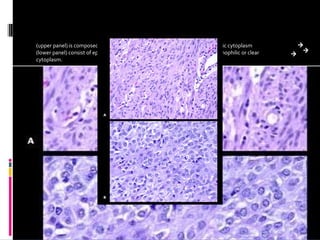
(upper panel) is composed of spindle cells with elongated nuclei and eosinophilic cytoplasm (lower panel) consist of epithelioid cells having round central nuclei within eosinophilic or clear cytoplasm.
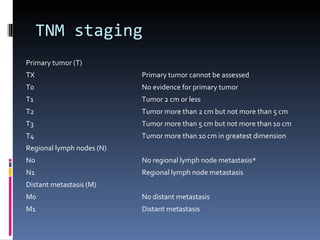
TNM staging Primary tumor (T) TX Primary tumor cannot be assessed T0 No evidence for primary tumor T1 Tumor 2 cm or less T2 Tumor more than 2 cm but not more than 5 cm T3 Tumor more than 5 cm but not more than 10 cm T4 Tumor more than 10 cm in greatest dimension Regional lymph nodes (N) N0 No regional lymph node metastasis* N1 Regional lymph node metastasis Distant metastasis (M) M0 No distant metastasis M1 Distant metastasis
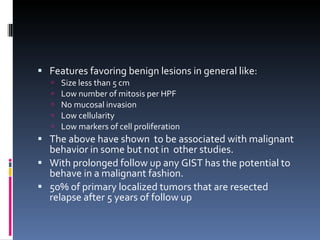
Features favoring benign lesions in general like: Size less than 5 cm Low number of mitosis per HPF No mucosal invasion Low cellularity Low markers of cell proliferation The above have shown  to be associated with malignant behavior in some but not in  other studies. With prolonged follow up any GIST has the potential to behave in a malignant fashion. 50% of primary localized tumors that are resected relapse after 5 years of follow up
CLINICAL MANIFESTATIONS  Overt GI bleeding — 40 percent Abdominal mass — 40 percent Abdominal pain — 20 percent GISTs frequently metastasize to liver and peritoneum and rarely to regional lymph nodes.
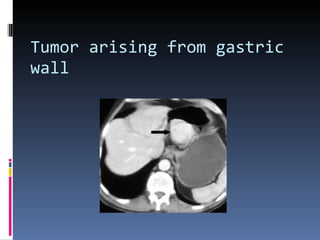
DIAGNOSTIC WORK-UP  CT scan : to characterize an abdominal mass, evaluate its extent, and the presence or absence of metastatic disease. The usual CT appearance of a GIST is that of a solid smoothly contoured mass that enhances brightly with IV contrast.
Tumor arising from gastric wall
Upper endoscopy  Endoscopy may be useful to further characterize the lesion if a gastric mass is identified Endoscopic biopsies using standard techniques usually do not obtain sufficient tissue for a definite diagnosis
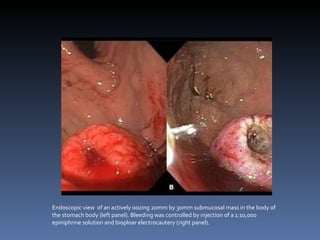
Endoscopic view  of an actively oozing 20mm by 30mm submucosal mass in the body of the stomach body (left panel). Bleeding was controlled by injection of a 1:10,000 epiniphrine solution and bioploar electrocautery (right panel).
Endoscopic ultrasonography  EUS-guided fine-needle aspiration — for cytologic analysis, immunohistochemistry, and  KIT mutations  If metastatic disease is suspected or if preoperative imatinib is considered prior to attempted resection
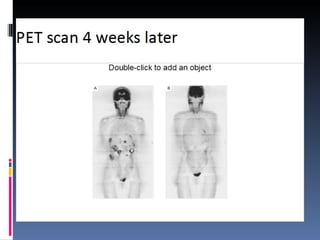
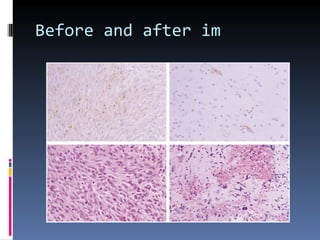
First patient to be treated with Imatinib 54 year old female with metastatic GIST diagnosed in 1996 Liver metastases and multiple small intra-abdominal metastases were excised in February 1998 and in September 1998  Seven cycles of chemotherapy with doxorubicin, ifosfamide, and dacarbazine with no response
In March 1999 had bowel obstruction and on laparotomy had diffuse intraabdominal mets. Received thalidomide and interferon with no response Treatment with 400 mg Imatinib once daily was started in March 2000.
 
Before and after im
IMATINIB FOR GIST Imatinib is approved in the United States for use as adjuvant therapy for any primary GIST ≥3 cm.  tyrosine kinase inhibitors such as imatinib block signaling via KIT and PDGFRA, thus halting tumor proliferation. median survival of patients with advanced GIST increased from an average of 18 to 57 months in the trial with the longest follow-up to date
  Assessing response  PET scanning :  responses can be observed within 24 hours of starting therapy. Rarely used to assess the response of therapy Can be used for a patient with a borderline resectable GIST or a potentially resectable tumor that requires extensive organ disruption who is being treated with initial imatinib
contd….. CT scan: re-evaluation should be done  two to three months after starting therapy
Side effects: fluid retention: diuretics useless, upright during day diarrhea: loperamide, atropine nausea:antacid, proton pump inhibitor muscle cramps: Ca or Mg supplements  Rash: resolves with continued treatment
MANAGEMENT OF REFRACTORY OR INTOLERANT PATIENTS Switching to an alternative TKI, sunitinib Dose escalation may be considered in patients started on imatinib 400 mg daily who, after careful review of radiologic studies, are judged to have clear evidence of disease progression.
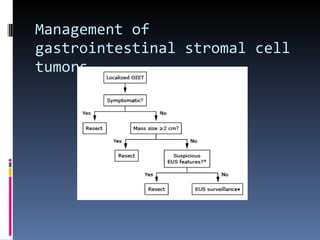
GENERAL SURGICAL PRINCIPLES  Preoperative biopsy:biopsy is preferred to confirm the diagnosis if metastatic disease is suspected or if preoperative imatinib is considered prior to attempted resection in a patient who has a large locally advanced lesion thought to represent a GIST. All GISTs ≥2 cm in size should be resected.
The natural history of these and other GISTs between 1 and 2 cm, including their growth rate and metastatic potential, remains unknown. initial therapy with imatinib may be preferred if a tumor is borderline resectable, or if resection would necessitate extensive organ disruption.
Management of  gastrointestinal stromal cell tumors
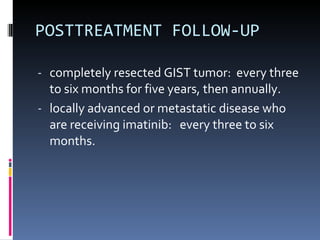
POSTTREATMENT FOLLOW-UP completely resected GIST tumor:  every three to six months for five years, then annually.  locally advanced or metastatic disease who are receiving imatinib:  every three to six months.
Further reading Abeloff: Abeloff's Clinical Oncology, 4th ed. Feldman: Sleisenger & Fordtran's Gastrointestinal and Liver Disease, 9th ed. Quek R -  Hematol Oncol Clin North Am  - 01-FEB-2009; 23(1): 69-78, viii

Gist2011

  • 1.
    62yr old malept with pmh of HTN, ESRD, with severe headache , chest pain and nausea since last 3 days Pt was medically stabilized transferred to medicine floor for further management Hgb between 7-9 and FOBT was positive
  • 2.
    -GI consulted ,recommended endoscopy - Endoscopy revealed 3cm sub mucosal mass in proximal body stomach Multiple biopsies were taken
  • 3.
    Spindle cells frombiopsy specimen were positive for CD117 and CD 34
  • 4.
  • 5.
    Epidemiology The mostcommon nonepithelial benign neoplasm involving the GI tract the annual incidence of GIST in the United States is at least 4000 to 6000 new cases   Although the majority of GISTs appear to be sporadic, several kindreds with heritable mutations in the KIT gene have been identified.
  • 6.
    MOLECULAR PATHOLOGY Theyare characterized by expression of a tyrosine kinase growth factor receptor, also called kit receptor or CD117. This expression allows unchecked growth of tumor and resistance to apoptosis. KIT gene mutations is present in exon 9, 13, or 17, that results in uncontrolled KIT signaling
  • 7.
    - These tumorsdiffer immunohistologically and behaviorally from other mesenchymal tumors such as leiomyosarcomas, which do not express kit antigen
  • 8.
    Cellular origin ofGISTs Interstitial cells of Cajal (ICC) GI pacemaker cells form the interface between the autonomic innervation of the bowel wall and the smooth muscle itself immunophenotypic and ultrastructural features of both smooth muscle and neuronal differentiation and serve to regulate peristalsis
  • 9.
    Histopathology Spindle celltype — 70 percent Epithelioid type — 20 percent Mixed type — 10 percent
  • 10.
    (upper panel) iscomposed of spindle cells with elongated nuclei and eosinophilic cytoplasm (lower panel) consist of epithelioid cells having round central nuclei within eosinophilic or clear cytoplasm.
  • 11.
    TNM staging Primarytumor (T) TX Primary tumor cannot be assessed T0 No evidence for primary tumor T1 Tumor 2 cm or less T2 Tumor more than 2 cm but not more than 5 cm T3 Tumor more than 5 cm but not more than 10 cm T4 Tumor more than 10 cm in greatest dimension Regional lymph nodes (N) N0 No regional lymph node metastasis* N1 Regional lymph node metastasis Distant metastasis (M) M0 No distant metastasis M1 Distant metastasis
  • 12.
    Features favoring benignlesions in general like: Size less than 5 cm Low number of mitosis per HPF No mucosal invasion Low cellularity Low markers of cell proliferation The above have shown to be associated with malignant behavior in some but not in other studies. With prolonged follow up any GIST has the potential to behave in a malignant fashion. 50% of primary localized tumors that are resected relapse after 5 years of follow up
  • 13.
    CLINICAL MANIFESTATIONS  OvertGI bleeding — 40 percent Abdominal mass — 40 percent Abdominal pain — 20 percent GISTs frequently metastasize to liver and peritoneum and rarely to regional lymph nodes.
  • 14.
    DIAGNOSTIC WORK-UP  CTscan : to characterize an abdominal mass, evaluate its extent, and the presence or absence of metastatic disease. The usual CT appearance of a GIST is that of a solid smoothly contoured mass that enhances brightly with IV contrast.
  • 15.
    Tumor arising fromgastric wall
  • 16.
    Upper endoscopy  Endoscopymay be useful to further characterize the lesion if a gastric mass is identified Endoscopic biopsies using standard techniques usually do not obtain sufficient tissue for a definite diagnosis
  • 17.
    Endoscopic view of an actively oozing 20mm by 30mm submucosal mass in the body of the stomach body (left panel). Bleeding was controlled by injection of a 1:10,000 epiniphrine solution and bioploar electrocautery (right panel).
  • 18.
    Endoscopic ultrasonography  EUS-guidedfine-needle aspiration — for cytologic analysis, immunohistochemistry, and KIT mutations If metastatic disease is suspected or if preoperative imatinib is considered prior to attempted resection
  • 19.
    First patient tobe treated with Imatinib 54 year old female with metastatic GIST diagnosed in 1996 Liver metastases and multiple small intra-abdominal metastases were excised in February 1998 and in September 1998 Seven cycles of chemotherapy with doxorubicin, ifosfamide, and dacarbazine with no response
  • 20.
    In March 1999had bowel obstruction and on laparotomy had diffuse intraabdominal mets. Received thalidomide and interferon with no response Treatment with 400 mg Imatinib once daily was started in March 2000.
  • 21.
  • 22.
  • 23.
    IMATINIB FOR GISTImatinib is approved in the United States for use as adjuvant therapy for any primary GIST ≥3 cm. tyrosine kinase inhibitors such as imatinib block signaling via KIT and PDGFRA, thus halting tumor proliferation. median survival of patients with advanced GIST increased from an average of 18 to 57 months in the trial with the longest follow-up to date
  • 24.
      Assessing response PET scanning : responses can be observed within 24 hours of starting therapy. Rarely used to assess the response of therapy Can be used for a patient with a borderline resectable GIST or a potentially resectable tumor that requires extensive organ disruption who is being treated with initial imatinib
  • 25.
    contd….. CT scan:re-evaluation should be done two to three months after starting therapy
  • 26.
    Side effects: fluidretention: diuretics useless, upright during day diarrhea: loperamide, atropine nausea:antacid, proton pump inhibitor muscle cramps: Ca or Mg supplements Rash: resolves with continued treatment
  • 27.
    MANAGEMENT OF REFRACTORYOR INTOLERANT PATIENTS Switching to an alternative TKI, sunitinib Dose escalation may be considered in patients started on imatinib 400 mg daily who, after careful review of radiologic studies, are judged to have clear evidence of disease progression.
  • 28.
    GENERAL SURGICAL PRINCIPLES Preoperative biopsy:biopsy is preferred to confirm the diagnosis if metastatic disease is suspected or if preoperative imatinib is considered prior to attempted resection in a patient who has a large locally advanced lesion thought to represent a GIST. All GISTs ≥2 cm in size should be resected.
  • 29.
    The natural historyof these and other GISTs between 1 and 2 cm, including their growth rate and metastatic potential, remains unknown. initial therapy with imatinib may be preferred if a tumor is borderline resectable, or if resection would necessitate extensive organ disruption.
  • 30.
    Management of gastrointestinal stromal cell tumors
  • 31.
    POSTTREATMENT FOLLOW-UP completelyresected GIST tumor: every three to six months for five years, then annually. locally advanced or metastatic disease who are receiving imatinib: every three to six months.
  • 32.
    Further reading Abeloff:Abeloff's Clinical Oncology, 4th ed. Feldman: Sleisenger & Fordtran's Gastrointestinal and Liver Disease, 9th ed. Quek R - Hematol Oncol Clin North Am - 01-FEB-2009; 23(1): 69-78, viii

Editor's Notes

  • #31 EUS: endoscopic ultrasonography; GIST: gastrointestinal stromal cell tumor. * Possible high-risk endoscopic ultrasonography features include irregular border, cystic spaces, ulceration, echogenic foci, and heterogeneity. • Endoscopic ultrasonography surveillance should only be considered after a thorough discussion with the patient regarding the risks and benefits.