FEB
12
Taking a Stand: A Middle School Studio Lesson
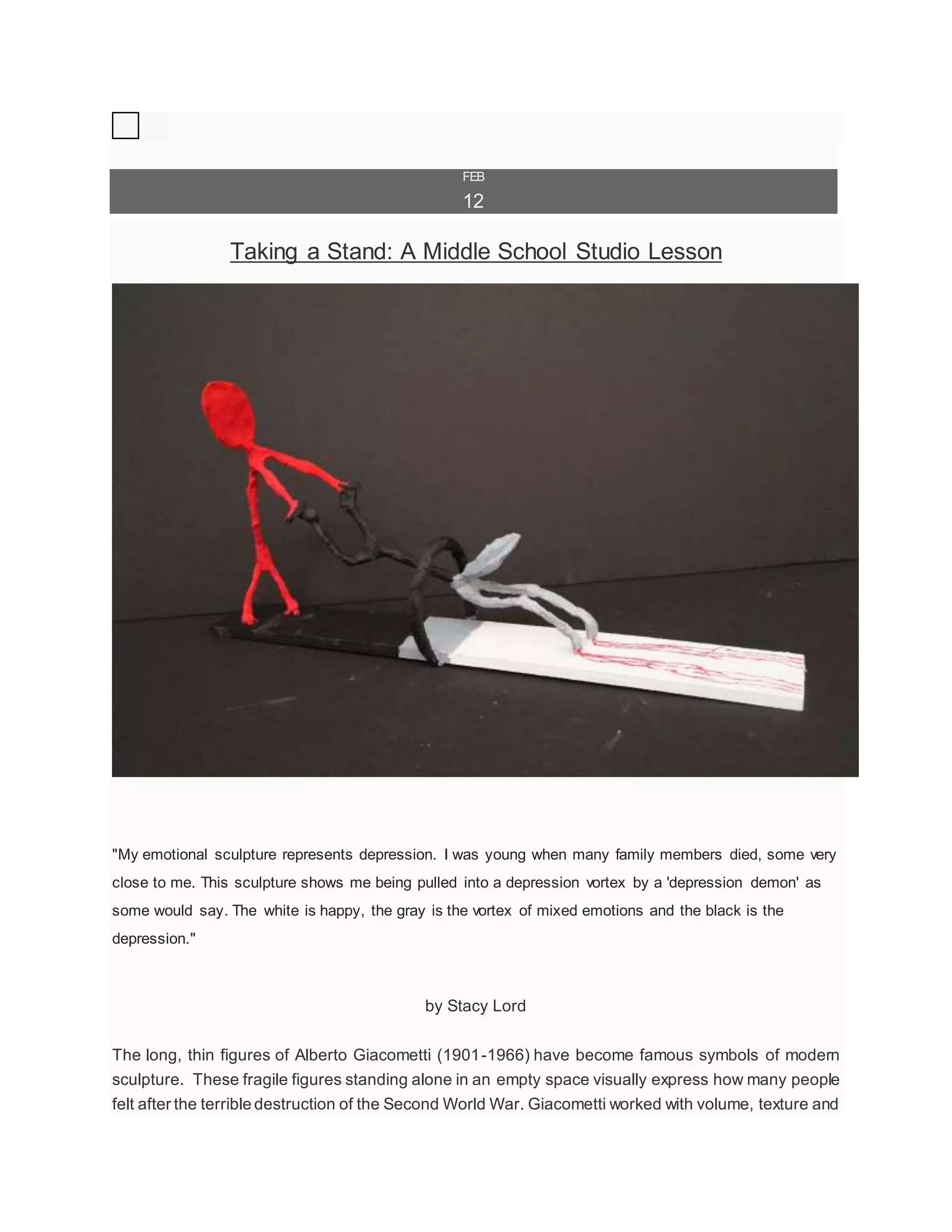
"My emotional sculpture represents depression. I was young when many family members died, some very
close to me. This sculpture shows me being pulled into a depression vortex by a 'depression demon' as
some would say. The white is happy, the gray is the vortex of mixed emotions and the black is the
depression."
by Stacy Lord
The long, thin figures of Alberto Giacometti (1901-1966) have become famous symbols of modern
sculpture. These fragile figures standing alone in an empty space visually express how many people
felt after the terrible destruction of the Second World War. Giacometti worked with volume, texture and
negative space to express a feeling of isolation in his work. The thin, gaunt bodies of his sculptures
suggest the hard times many people experienced after the war. A very limited color scheme adds to
the solemn mood.
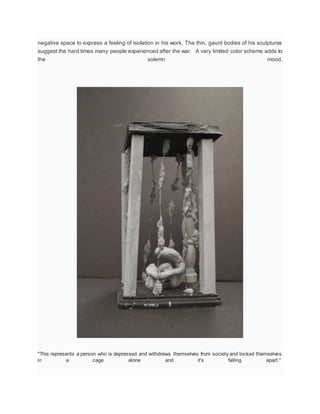
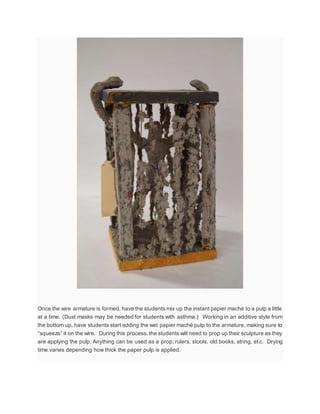
"This represents a person who is depressed and withdraws themselves from society and locked themselves
in a cage alone and it's falling apart."
Making a sculptural figure involves critical thinking and problem solving. In this project students use
an instant papiermaché such as Celluclay over a wire armature to make a figure. Making the sculpture
stand up on its own is not easy and students have to figure out the best way to prop up the sculptures
up as they work on them. The process of this project is additive, working from the bottom up. The
instant papier maché is heavy when mixed and, if the armature is thin and flimsy, applying little bits of
material at a time is crucial to maintaining the overall form.
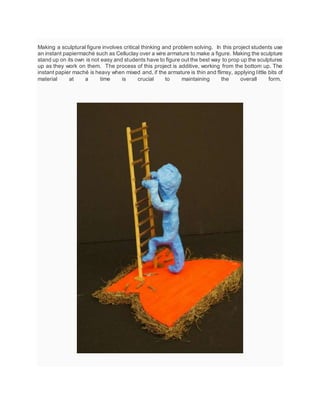
"My emotional sculpture represents the emotion of struggling and being puzzled. The person is trying to
climb up the ladder but pieces are broken and missing. The ladder represents my life and since I have so
many expectations on me I can't make my way through because of the broken and missing pieces."
Setting the Mood
After sharing works by Giacometti, tell students: “Think back to a time when you felt alone and
isolated. If you had to sketch an idea for a sculpture based on Giacometti’s work, how would it
look? Would it be one lone figure or more? Would you be suspended in space or trapped within a
cage? Would you be standing alone on a large or small platform? What would your stance (posture)
be? Would you be by yourself or would you have props? Would you have exaggerated and/or distorted
proportions?”
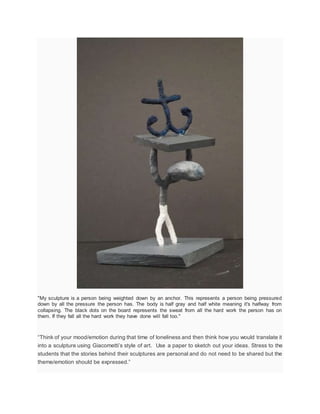
"My sculpture is a person being weighted down by an anchor. This represents a person being pressured
down by all the pressure the person has. The body is half gray and half white meaning it's halfway from
collapsing. The black dots on the board represents the sweat from all the hard work the person has on
them. If they fall all the hard work they have done will fall too."
“Think of your mood/emotion during that time of loneliness and then think how you would translate it
into a sculpture using Giacometti’s style of art. Use a paper to sketch out your ideas. Stress to the
students that the stories behind their sculptures are personal and do not need to be shared but the
theme/emotion should be expressed.”
"This sculpture is about when times are suppose to be happy but there is always a sad time in me that I will
always remember but I leave it behind. The black part is I feel lonely and feeling sad that my parents are
always arguing and always talks about divorcing."
Procedures
Once the designs have been sketched, have students begin with an armature of a figure using wire
and tape. Stress that the smaller they work the more challenging it will be to apply the instant
papier maché. Working extremely large will stress the wire into distorting the figure, causing
frustration. Finished sizes that work the best range between six to fourteen inches in height.
Once the wire armature is formed, have the students mix up the instant papier maché to a pulp a little
at a time. (Dust masks may be needed for students with asthma.) Working in an additive style from
the bottom up, have students start adding the wet papier maché pulp to the armature, making sure to
“squeeze” it on the wire. During this process, the students will need to prop up their sculpture as they
are applying the pulp. Anything can be used as a prop; rulers, stools, old books, string, etc. Drying
time varies depending how thick the paper pulp is applied.
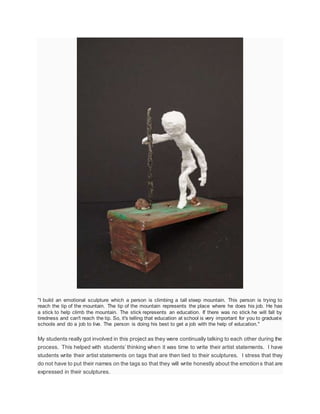
"I build an emotional sculpture which a person is climbing a tall steep mountain. This person is trying to
reach the tip of the mountain. The tip of the mountain represents the place where he does his job. He has
a stick to help climb the mountain. The stick represents an education. If there was no stick he will fall by
tiredness and can't reach the tip. So, it's telling that education at school is very important for you to graduate
schools and do a job to live. The person is doing his best to get a job with the help of education."
My students really got involved in this project as they were continually talking to each other during the
process. This helped with students’ thinking when it was time to write their artist statements. I have
students write their artist statements on tags that are then tied to their sculptures. I stress that they
do not have to put their names on the tags so that they will write honestly about the emotions that are
expressed in their sculptures.
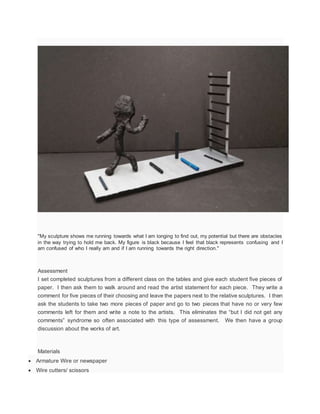
"My sculpture shows me running towards what I am longing to find out, my potential but there are obstacles
in the way trying to hold me back. My figure is black because I feel that black represents confusing and I
am confused of who I really am and if I am running towards the right direction."
Assessment
I set completed sculptures from a different class on the tables and give each student five pieces of
paper. I then ask them to walk around and read the artist statement for each piece. They write a
comment for five pieces of their choosing and leave the papers next to the relative sculptures. I then
ask the students to take two more pieces of paper and go to two pieces that have no or very few
comments left for them and write a note to the artists. This eliminates the “but I did not get any
comments” syndrome so often associated with this type of assessment. We then have a group
discussion about the works of art.
Materials
 Armature Wire or newspaper
 Wire cutters/ scissors
 Masking tape
 Celluclay (plan on two 5 pound bags per 15 students)
 Metallic spray paint
 Tempera or acrylic paints
Stacy Lord is an art teacher at Worcester East Middle School in Worcester,Massachusetts, a member
of the SchoolArts advisory board, and NAEA Middle School Director Elect.
This article was published in the March 2014 SchoolArts Magazine.
Posted 12th February 2014 by SchoolArtsRoom
0
Add a comment
SchoolArtsRoom | Art
Education Blog for K-12 Art
Teachers
Sharing the world of art education by
providing art news; entertaining or
thought-provoking artists, ideas, stories,
and issues; professional opportunities;
and project and lesson ideas and
exhibition possibilities for your students.
We can be 24-hour art teachers
together!
Flipcard







 Home
 Subscribe
 About Nancy
 Follow Nancy
 Art Advocacy
 Recent
 Date
 Label
 Author
Nov 18th
Nov 17th
Nov 17th
Nov 17th
Oct 23rd
1
Oct 23rd
Oct 7th
1
Sep 22nd
1
Sep 3rd
Aug 8th
Aug 8th
Aug 8th
1
Aug 8th
Jul 12th
Jul 12th
1
Jul 12th
Apr 28th
Apr 7th
Mar 31st
Mar 21st
Mar 19th
Mar 19th
Mar 18th
Mar 14th
Mar 12th
Mar 5th
2
Feb 28th
1
Feb 23rd
Feb 12th
Feb 8th
Jan 22nd
Jan 15th
1
Jan 13th
1
Jan 11th
Jan 9th
1
Jan 9th
Dec 18th
1
Dec 17th
1
Dec 13th
Dec 4th
1
Nov 24th
Nov 17th
Nov 10th
Nov 10th
Oct 22nd
1
Oct 22nd
Oct 10th
Oct 6th
Sep 30th
Sep 22nd
Sep 22nd
Sep 13th
Sep 8th
Sep 7th
Sep 5th
Sep 3rd
Aug 19th
Aug 5th
Jul 31st
Jul 29th
Jul 28th
Jul 27th
Jul 27th
Jul 26th
Jul 26th
Jul 25th
Jul 24th
1
Jul 24th
Jul 22nd
Jul 20th
Jul 19th
Jul 18th
Jul 17th
Jul 16th
Jul 15th
Jul 15th
Jul 13th
Jul 12th
Jul 12th
Jul 11th
Jul 10th
Jul 9th
Jul 9th
Jul 9th
Jul 8th
Jul 7th
Jul 6th
Jun 30th
Jun 28th
Jun 23rd
1
Jun 23rd
Jun 11th
Jun 10th
Jun 2nd
May 26th
May 26th
3
May 6th
Apr 26th
Apr 17th
Apr 11th
1
Apr 7th
Apr 5th
Apr 3rd
Apr 2nd
Mar 31st
Mar 31st
Mar 31st
Mar 31st
Mar 31st
Mar 31st
Mar 30th
1
Mar 30th
Mar 28th
Mar 26th
2
Mar 24th
Mar 21st
Mar 20th
Mar 17th
Mar 12th
12
Mar 6th
Mar 4th
1
Feb 27th
1
Feb 25th
Feb 16th
Feb 13th
2
Feb 12th
Feb 11th
Feb 11th
Feb 7th
Feb 5th
Feb 4th
Feb 3rd
Feb 2nd
Jan 30th
Jan 27th
Jan 27th
Jan 24th
Jan 18th
1
Jan 12th
Jan 10th
5
Jan 10th
Jan 9th
Jan 7th
Dec 19th
Dec 12th
Dec 11th
1
Dec 8th
Dec 6th
Dec 5th
Dec 3rd
Loading

Giocommetti sculptures

  • 1.
    FEB 12 Taking a Stand:A Middle School Studio Lesson "My emotional sculpture represents depression. I was young when many family members died, some very close to me. This sculpture shows me being pulled into a depression vortex by a 'depression demon' as some would say. The white is happy, the gray is the vortex of mixed emotions and the black is the depression." by Stacy Lord The long, thin figures of Alberto Giacometti (1901-1966) have become famous symbols of modern sculpture. These fragile figures standing alone in an empty space visually express how many people felt after the terrible destruction of the Second World War. Giacometti worked with volume, texture and
  • 2.
    negative space toexpress a feeling of isolation in his work. The thin, gaunt bodies of his sculptures suggest the hard times many people experienced after the war. A very limited color scheme adds to the solemn mood. "This represents a person who is depressed and withdraws themselves from society and locked themselves in a cage alone and it's falling apart."
  • 3.
    Making a sculpturalfigure involves critical thinking and problem solving. In this project students use an instant papiermaché such as Celluclay over a wire armature to make a figure. Making the sculpture stand up on its own is not easy and students have to figure out the best way to prop up the sculptures up as they work on them. The process of this project is additive, working from the bottom up. The instant papier maché is heavy when mixed and, if the armature is thin and flimsy, applying little bits of material at a time is crucial to maintaining the overall form.
  • 4.
    "My emotional sculpturerepresents the emotion of struggling and being puzzled. The person is trying to climb up the ladder but pieces are broken and missing. The ladder represents my life and since I have so many expectations on me I can't make my way through because of the broken and missing pieces." Setting the Mood After sharing works by Giacometti, tell students: “Think back to a time when you felt alone and isolated. If you had to sketch an idea for a sculpture based on Giacometti’s work, how would it look? Would it be one lone figure or more? Would you be suspended in space or trapped within a cage? Would you be standing alone on a large or small platform? What would your stance (posture) be? Would you be by yourself or would you have props? Would you have exaggerated and/or distorted proportions?”
  • 5.
    "My sculpture isa person being weighted down by an anchor. This represents a person being pressured down by all the pressure the person has. The body is half gray and half white meaning it's halfway from collapsing. The black dots on the board represents the sweat from all the hard work the person has on them. If they fall all the hard work they have done will fall too." “Think of your mood/emotion during that time of loneliness and then think how you would translate it into a sculpture using Giacometti’s style of art. Use a paper to sketch out your ideas. Stress to the students that the stories behind their sculptures are personal and do not need to be shared but the theme/emotion should be expressed.”
  • 6.
    "This sculpture isabout when times are suppose to be happy but there is always a sad time in me that I will always remember but I leave it behind. The black part is I feel lonely and feeling sad that my parents are always arguing and always talks about divorcing." Procedures Once the designs have been sketched, have students begin with an armature of a figure using wire and tape. Stress that the smaller they work the more challenging it will be to apply the instant papier maché. Working extremely large will stress the wire into distorting the figure, causing frustration. Finished sizes that work the best range between six to fourteen inches in height.
  • 7.
    Once the wirearmature is formed, have the students mix up the instant papier maché to a pulp a little at a time. (Dust masks may be needed for students with asthma.) Working in an additive style from the bottom up, have students start adding the wet papier maché pulp to the armature, making sure to “squeeze” it on the wire. During this process, the students will need to prop up their sculpture as they are applying the pulp. Anything can be used as a prop; rulers, stools, old books, string, etc. Drying time varies depending how thick the paper pulp is applied.
  • 8.
    "I build anemotional sculpture which a person is climbing a tall steep mountain. This person is trying to reach the tip of the mountain. The tip of the mountain represents the place where he does his job. He has a stick to help climb the mountain. The stick represents an education. If there was no stick he will fall by tiredness and can't reach the tip. So, it's telling that education at school is very important for you to graduate schools and do a job to live. The person is doing his best to get a job with the help of education." My students really got involved in this project as they were continually talking to each other during the process. This helped with students’ thinking when it was time to write their artist statements. I have students write their artist statements on tags that are then tied to their sculptures. I stress that they do not have to put their names on the tags so that they will write honestly about the emotions that are expressed in their sculptures.
  • 9.
    "My sculpture showsme running towards what I am longing to find out, my potential but there are obstacles in the way trying to hold me back. My figure is black because I feel that black represents confusing and I am confused of who I really am and if I am running towards the right direction." Assessment I set completed sculptures from a different class on the tables and give each student five pieces of paper. I then ask them to walk around and read the artist statement for each piece. They write a comment for five pieces of their choosing and leave the papers next to the relative sculptures. I then ask the students to take two more pieces of paper and go to two pieces that have no or very few comments left for them and write a note to the artists. This eliminates the “but I did not get any comments” syndrome so often associated with this type of assessment. We then have a group discussion about the works of art. Materials  Armature Wire or newspaper  Wire cutters/ scissors
  • 10.
     Masking tape Celluclay (plan on two 5 pound bags per 15 students)  Metallic spray paint  Tempera or acrylic paints Stacy Lord is an art teacher at Worcester East Middle School in Worcester,Massachusetts, a member of the SchoolArts advisory board, and NAEA Middle School Director Elect. This article was published in the March 2014 SchoolArts Magazine. Posted 12th February 2014 by SchoolArtsRoom 0 Add a comment SchoolArtsRoom | Art Education Blog for K-12 Art Teachers
  • 11.
    Sharing the worldof art education by providing art news; entertaining or thought-provoking artists, ideas, stories, and issues; professional opportunities; and project and lesson ideas and exhibition possibilities for your students. We can be 24-hour art teachers together! Flipcard         Home  Subscribe  About Nancy
  • 12.
     Follow Nancy Art Advocacy  Recent  Date  Label  Author Nov 18th Nov 17th Nov 17th Nov 17th Oct 23rd 1 Oct 23rd Oct 7th 1 Sep 22nd 1 Sep 3rd Aug 8th Aug 8th Aug 8th 1 Aug 8th Jul 12th Jul 12th 1 Jul 12th Apr 28th Apr 7th Mar 31st Mar 21st Mar 19th Mar 19th Mar 18th Mar 14th Mar 12th Mar 5th 2 Feb 28th 1 Feb 23rd Feb 12th Feb 8th Jan 22nd Jan 15th 1 Jan 13th 1 Jan 11th
  • 13.
    Jan 9th 1 Jan 9th Dec18th 1 Dec 17th 1 Dec 13th Dec 4th 1 Nov 24th Nov 17th Nov 10th Nov 10th Oct 22nd 1 Oct 22nd Oct 10th Oct 6th Sep 30th Sep 22nd Sep 22nd Sep 13th Sep 8th Sep 7th Sep 5th Sep 3rd Aug 19th Aug 5th Jul 31st Jul 29th Jul 28th Jul 27th Jul 27th Jul 26th Jul 26th Jul 25th Jul 24th 1 Jul 24th Jul 22nd Jul 20th Jul 19th Jul 18th Jul 17th Jul 16th Jul 15th Jul 15th Jul 13th Jul 12th Jul 12th Jul 11th Jul 10th Jul 9th Jul 9th Jul 9th
  • 14.
    Jul 8th Jul 7th Jul6th Jun 30th Jun 28th Jun 23rd 1 Jun 23rd Jun 11th Jun 10th Jun 2nd May 26th May 26th 3 May 6th Apr 26th Apr 17th Apr 11th 1 Apr 7th Apr 5th Apr 3rd Apr 2nd Mar 31st Mar 31st Mar 31st Mar 31st Mar 31st Mar 31st Mar 30th 1 Mar 30th Mar 28th Mar 26th 2 Mar 24th Mar 21st Mar 20th Mar 17th Mar 12th 12 Mar 6th Mar 4th 1 Feb 27th 1 Feb 25th Feb 16th Feb 13th 2 Feb 12th Feb 11th Feb 11th Feb 7th Feb 5th Feb 4th
  • 15.
    Feb 3rd Feb 2nd Jan30th Jan 27th Jan 27th Jan 24th Jan 18th 1 Jan 12th Jan 10th 5 Jan 10th Jan 9th Jan 7th Dec 19th Dec 12th Dec 11th 1 Dec 8th Dec 6th Dec 5th Dec 3rd Loading