CREATIVE DISCIPLINES:
SCULPTURE
Sophie Kennedy
G00416685
VISUAL CULTURE
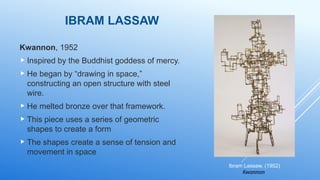
IBRAM LASSAW
Kwannon, 1952
 Inspired by the Buddhist goddess of mercy.
 He began by “drawing in space,”
constructing an open structure with steel
wire.
 He melted bronze over that framework.
 This piece uses a series of geometric
shapes to create a form
 The shapes create a sense of tension and
movement in space
Ibram Lassaw, (1952)
Kwannon
KAREN AKHIKYAN
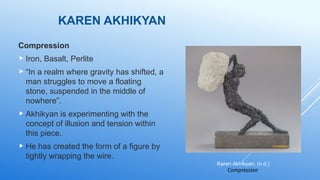
Compression
 Iron, Basalt, Perlite
 “In a realm where gravity has shifted, a
man struggles to move a floating
stone, suspended in the middle of
nowhere”.
 Akhikyan is experimenting with the
concept of illusion and tension within
this piece.
 He has created the form of a figure by
tightly wrapping the wire.
Karen Akhikyan, (n.d.)
Compression
KAREN AKHIKYAN
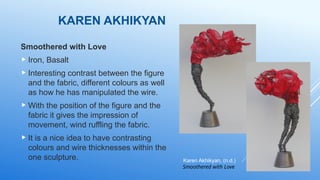
Smoothered with Love
 Iron, Basalt
 Interesting contrast between the figure
and the fabric, different colours as well
as how he has manipulated the wire.
 With the position of the figure and the
fabric it gives the impression of
movement, wind ruffling the fabric.
 It is a nice idea to have contrasting
colours and wire thicknesses within the
one sculpture. Karen Akhikyan, (n.d.)
Smoothered with Love
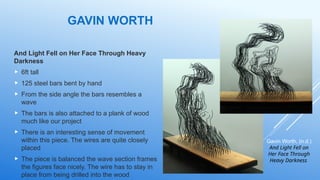
GAVIN WORTH
And Light Fell on Her Face Through Heavy
Darkness
 6ft tall
 125 steel bars bent by hand
 From the side angle the bars resembles a
wave
 The bars is also attached to a plank of wood
much like our project
 There is an interesting sense of movement
within this piece. The wires are quite closely
placed
 The piece is balanced the wave section frames
the figures face nicely. The wire has to stay in
place from being drilled into the wood
Gavin Worth, (n.d.)
And Light Fell on
Her Face Through
Heavy Darkness
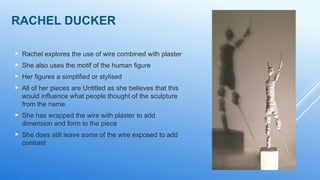
RACHEL DUCKER
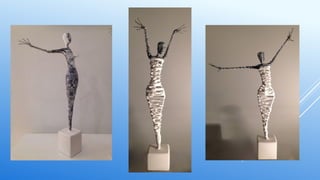
 Rachel explores the use of wire combined with plaster
 She also uses the motif of the human figure
 Her figures a simplified or stylised
 All of her pieces are Untitled as she believes that this
would influence what people thought of the sculpture
from the name.
 She has wrapped the wire with plaster to add
dimension and form to the piece
 She does still leave some of the wire exposed to add
contrast
WORKING IN REAL SPACE
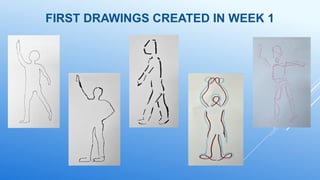
FIRST DRAWINGS CREATED IN WEEK 1
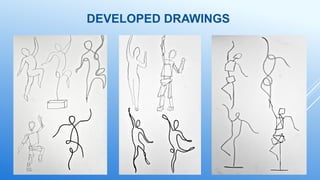
DEVELOPED DRAWINGS
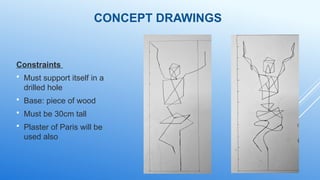
CONCEPT DRAWINGS
Constraints
 Must support itself in a
drilled hole
 Base: piece of wood
 Must be 30cm tall
 Plaster of Paris will be
used also
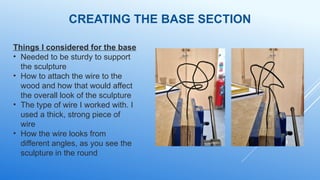
CREATING THE BASE SECTION
Things I considered for the base
‱ Needed to be sturdy to support
the sculpture
‱ How to attach the wire to the
wood and how that would affect
the overall look of the sculpture
‱ The type of wire I worked with. I
used a thick, strong piece of
wire
‱ How the wire looks from
different angles, as you see the
sculpture in the round
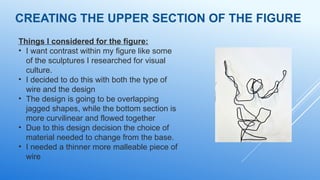
CREATING THE UPPER SECTION OF THE FIGURE
Things I considered for the figure:
‱ I want contrast within my figure like some
of the sculptures I researched for visual
culture.
‱ I decided to do this with both the type of
wire and the design
‱ The design is going to be overlapping
jagged shapes, while the bottom section is
more curvilinear and flowed together
‱ Due to this design decision the choice of
material needed to change from the base.
‱ I needed a thinner more malleable piece of
wire
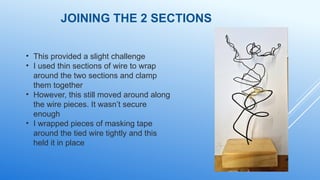
JOINING THE 2 SECTIONS
‱ This provided a slight challenge
‱ I used thin sections of wire to wrap
around the two sections and clamp
them together
‱ However, this still moved around along
the wire pieces. It wasn’t secure
enough
‱ I wrapped pieces of masking tape
around the tied wire tightly and this
held it in place
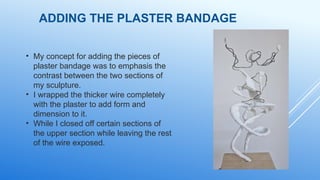
ADDING THE PLASTER BANDAGE
‱ My concept for adding the pieces of
plaster bandage was to emphasis the
contrast between the two sections of
my sculpture.
‱ I wrapped the thicker wire completely
with the plaster to add form and
dimension to it.
‱ While I closed off certain sections of
the upper section while leaving the rest
of the wire exposed.
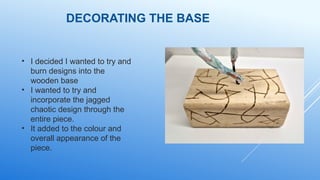
DECORATING THE BASE
‱ I decided I wanted to try and
burn designs into the
wooden base
‱ I wanted to try and
incorporate the jagged
chaotic design through the
entire piece.
‱ It added to the colour and
overall appearance of the
piece.
COLOUR CONSIDERATION
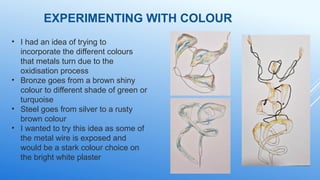
EXPERIMENTING WITH COLOUR
‱ I had an idea of trying to
incorporate the different colours
that metals turn due to the
oxidisation process
‱ Bronze goes from a brown shiny
colour to different shade of green or
turquoise
‱ Steel goes from silver to a rusty
brown colour
‱ I wanted to try this idea as some of
the metal wire is exposed and
would be a stark colour choice on
the bright white plaster
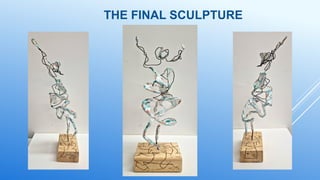
THE FINAL SCULPTURE
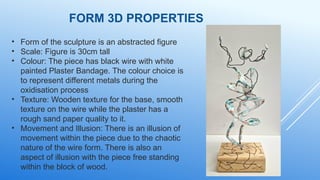
FORM 3D PROPERTIES
‱ Form of the sculpture is an abstracted figure
‱ Scale: Figure is 30cm tall
‱ Colour: The piece has black wire with white
painted Plaster Bandage. The colour choice is
to represent different metals during the
oxidisation process
‱ Texture: Wooden texture for the base, smooth
texture on the wire while the plaster has a
rough sand paper quality to it.
‱ Movement and Illusion: There is an illusion of
movement within the piece due to the chaotic
nature of the wire form. There is also an
aspect of illusion with the piece free standing
within the block of wood.
REFLECTION
REFLECTION ON MY SCULPTURE
 At the beginning of this project, I struggled with creating human form drawings. I started to abstract the
drawings to create more interesting concepts.
 I developed my idea and experimented; this helped me create this sculpture as in the beginning I had a
different idea but changed it completely.
 I originally thought about creating a sculpture inspired by Ibram Lassaw with interlocking geometric
shapes.
 I decided to create contrast within my piece like the other sculptures I researched by having a slight
difference in the wire as well as having some sections wrapped in Plaster Bandage while others would
be bare wire.
 I feel like I completed the task to a good standard, the piece followed the constraints, and you can see
some of the 3D Principles within my piece such as: form, proportion, colour, texture, movement and
tension.
 For my colour choice I wanted to experiment with the colours of rusted metals such as steel or bronze. I
am interested in how the metals can change colour and texture due to the oxidising process.
REFLECTION ON THIS TASK FOR SCHOOL
 This was an interesting and thought-provoking task of creating this
sculpture.
 It brings the students work off the page and into real space which can be
tricky for students to visualise and work with 3D objects.
 It is a good task to set students as it makes them think about the human
form and what is needed to be able to recognise the form.
 The idea of abstracting the form is something each person must draw and
experiment for themselves.
 Every form will be unique and different.
 This sculpture also allows students to gain a deeper understanding of the
3D Principles as they need to consider them as they make their piece.
 It also allows the students to work in 2 different mediums which may be
new for them. This will encourage them to experiment and push the
boundaries of the material.
SCULPTURE IN SCHOOL
SCULPTURE IN A SCHOOL SETTING
Health and Safety Procedures
 The wire can be difficult to cut using the sharp pliers, the teacher could
oversee the use of the pliers.
 Another thing to consider is that the wire is sharp and could cut a student.
 Also, with them manipulating the wire if students are sitting close together, they
could hit each other accidently.
 When using Plaster Bandage, it is important to check if all students can use it
and won’t be affected by the powder.
 Using the plaster is quite a messy task, so it would be important to have
aprons for the students and possibly gloves.
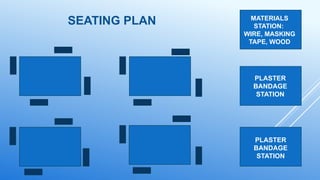
 It would be good practice to have a station set up for the Plaster Bandage.
 Make sure to dispose of the water used for the plaster correctly.
SEATING PLAN
PLASTER
BANDAGE
STATION
PLASTER
BANDAGE
STATION
MATERIALS
STATION:
WIRE, MASKING
TAPE, WOOD
POSSIBLE IDEAS FOR THE STUDENTS
 Explore public art in the locality of the school:
 Show the students images or even go on a trip to visit the public art.
 They could then be tasked to design a piece of sculpture inspired by the
public artwork and experiment with it.
 Create a 2D drawing and try create it in real space:
 Give a theme to the students for them to explore with drawings and 2D
mediums.
 Then ask the students to bring on of their drawings to life in real space.
 Need to consider if the design needs to be simplified or stylised, how it will
be supported in space. What material to use.
 Pair up students for Sculpture:
 Pair students together and get them to work on the sculpture. This will allow the
students to create larger works of sculpture. It will reinforce the importance of
teamwork and communication.
 Another idea would be to get students to work on a piece in wire an abstract
design and then they swap with the person beside them and do their own spin on
the piece in front of them.
 3D Form Principles:
 Give each student one of the principles and ask them to explore that principle in
particular with wire.
 They can then use the Plaster Bandage to reinforce the principle if necessary
 Students can give an artist statement on their sculpture explaining their 3D Form
Principle and describe any other of the principles seen within their sculpture.
POSSIBLE IDEAS FOR THE STUDENTS
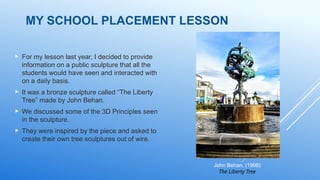
MY SCHOOL PLACEMENT LESSON
 For my lesson last year, I decided to provide
information on a public sculpture that all the
students would have seen and interacted with
on a daily basis.
 It was a bronze sculpture called “The Liberty
Tree” made by John Behan.
 We discussed some of the 3D Principles seen
in the sculpture.
 They were inspired by the piece and asked to
create their own tree sculptures out of wire.
John Behan, (1998)
The Liberty Tree
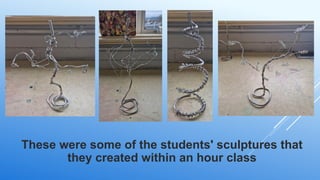
These were some of the students' sculptures that
they created within an hour class
REFERENCES
 Gavin Worth. (2023). Biography. https://www.gavinworth.com/bio.html
 Gavin Worth. (2023). https://www.gavinworth.com/index.html
 Gavin Worth. (2023). https://www.gavinworth.com/andlightfellonherface.html
 Karen Akhikyan. (n.d.). Karen Akhikyan. https://akhikyan.com
 Karen Akhikyan. (n.d.). Karen Akhikyan. https://akhikyan.com/about
 MoMA. (2024). Ibram Lassaw.
https://www.moma.org/collection/works/81118?artist_id=3400&page=1&sov_referrer=artist
 Rachel Ducker Wire Sculpture. (2024). About Rachel.
https://www.rachel-ducker.co.uk/about-Rachel/
 Rachel Ducker Wire Sculpture. (2024). Plaster and Wire.
https://www.rachel-ducker.co.uk/plaster-and-wire/
 Renaissance Art Gallery. (2017). Darius Hulea.
http://www.renaissance-artgallery.com/sculpture-en/darius-hulea-2

Sculpture Figure Project for Creative Disciplines

  • 1.
  • 2.
  • 3.
    IBRAM LASSAW Kwannon, 1952 Inspired by the Buddhist goddess of mercy.  He began by “drawing in space,” constructing an open structure with steel wire.  He melted bronze over that framework.  This piece uses a series of geometric shapes to create a form  The shapes create a sense of tension and movement in space Ibram Lassaw, (1952) Kwannon
  • 4.
    KAREN AKHIKYAN Compression  Iron,Basalt, Perlite  “In a realm where gravity has shifted, a man struggles to move a floating stone, suspended in the middle of nowhere”.  Akhikyan is experimenting with the concept of illusion and tension within this piece.  He has created the form of a figure by tightly wrapping the wire. Karen Akhikyan, (n.d.) Compression
  • 5.
    KAREN AKHIKYAN Smoothered withLove  Iron, Basalt  Interesting contrast between the figure and the fabric, different colours as well as how he has manipulated the wire.  With the position of the figure and the fabric it gives the impression of movement, wind ruffling the fabric.  It is a nice idea to have contrasting colours and wire thicknesses within the one sculpture. Karen Akhikyan, (n.d.) Smoothered with Love
  • 6.
    GAVIN WORTH And LightFell on Her Face Through Heavy Darkness  6ft tall  125 steel bars bent by hand  From the side angle the bars resembles a wave  The bars is also attached to a plank of wood much like our project  There is an interesting sense of movement within this piece. The wires are quite closely placed  The piece is balanced the wave section frames the figures face nicely. The wire has to stay in place from being drilled into the wood Gavin Worth, (n.d.) And Light Fell on Her Face Through Heavy Darkness
  • 7.
    RACHEL DUCKER  Rachelexplores the use of wire combined with plaster  She also uses the motif of the human figure  Her figures a simplified or stylised  All of her pieces are Untitled as she believes that this would influence what people thought of the sculpture from the name.  She has wrapped the wire with plaster to add dimension and form to the piece  She does still leave some of the wire exposed to add contrast
  • 9.
  • 10.
  • 11.
  • 12.
    CONCEPT DRAWINGS Constraints  Mustsupport itself in a drilled hole  Base: piece of wood  Must be 30cm tall  Plaster of Paris will be used also
  • 13.
    CREATING THE BASESECTION Things I considered for the base ‱ Needed to be sturdy to support the sculpture ‱ How to attach the wire to the wood and how that would affect the overall look of the sculpture ‱ The type of wire I worked with. I used a thick, strong piece of wire ‱ How the wire looks from different angles, as you see the sculpture in the round
  • 14.
    CREATING THE UPPERSECTION OF THE FIGURE Things I considered for the figure: ‱ I want contrast within my figure like some of the sculptures I researched for visual culture. ‱ I decided to do this with both the type of wire and the design ‱ The design is going to be overlapping jagged shapes, while the bottom section is more curvilinear and flowed together ‱ Due to this design decision the choice of material needed to change from the base. ‱ I needed a thinner more malleable piece of wire
  • 15.
    JOINING THE 2SECTIONS ‱ This provided a slight challenge ‱ I used thin sections of wire to wrap around the two sections and clamp them together ‱ However, this still moved around along the wire pieces. It wasn’t secure enough ‱ I wrapped pieces of masking tape around the tied wire tightly and this held it in place
  • 16.
    ADDING THE PLASTERBANDAGE ‱ My concept for adding the pieces of plaster bandage was to emphasis the contrast between the two sections of my sculpture. ‱ I wrapped the thicker wire completely with the plaster to add form and dimension to it. ‱ While I closed off certain sections of the upper section while leaving the rest of the wire exposed.
  • 17.
    DECORATING THE BASE ‱I decided I wanted to try and burn designs into the wooden base ‱ I wanted to try and incorporate the jagged chaotic design through the entire piece. ‱ It added to the colour and overall appearance of the piece.
  • 18.
  • 19.
    EXPERIMENTING WITH COLOUR ‱I had an idea of trying to incorporate the different colours that metals turn due to the oxidisation process ‱ Bronze goes from a brown shiny colour to different shade of green or turquoise ‱ Steel goes from silver to a rusty brown colour ‱ I wanted to try this idea as some of the metal wire is exposed and would be a stark colour choice on the bright white plaster
  • 20.
  • 21.
    FORM 3D PROPERTIES ‱Form of the sculpture is an abstracted figure ‱ Scale: Figure is 30cm tall ‱ Colour: The piece has black wire with white painted Plaster Bandage. The colour choice is to represent different metals during the oxidisation process ‱ Texture: Wooden texture for the base, smooth texture on the wire while the plaster has a rough sand paper quality to it. ‱ Movement and Illusion: There is an illusion of movement within the piece due to the chaotic nature of the wire form. There is also an aspect of illusion with the piece free standing within the block of wood.
  • 22.
  • 23.
    REFLECTION ON MYSCULPTURE  At the beginning of this project, I struggled with creating human form drawings. I started to abstract the drawings to create more interesting concepts.  I developed my idea and experimented; this helped me create this sculpture as in the beginning I had a different idea but changed it completely.  I originally thought about creating a sculpture inspired by Ibram Lassaw with interlocking geometric shapes.  I decided to create contrast within my piece like the other sculptures I researched by having a slight difference in the wire as well as having some sections wrapped in Plaster Bandage while others would be bare wire.  I feel like I completed the task to a good standard, the piece followed the constraints, and you can see some of the 3D Principles within my piece such as: form, proportion, colour, texture, movement and tension.  For my colour choice I wanted to experiment with the colours of rusted metals such as steel or bronze. I am interested in how the metals can change colour and texture due to the oxidising process.
  • 24.
    REFLECTION ON THISTASK FOR SCHOOL  This was an interesting and thought-provoking task of creating this sculpture.  It brings the students work off the page and into real space which can be tricky for students to visualise and work with 3D objects.  It is a good task to set students as it makes them think about the human form and what is needed to be able to recognise the form.  The idea of abstracting the form is something each person must draw and experiment for themselves.  Every form will be unique and different.  This sculpture also allows students to gain a deeper understanding of the 3D Principles as they need to consider them as they make their piece.  It also allows the students to work in 2 different mediums which may be new for them. This will encourage them to experiment and push the boundaries of the material.
  • 25.
  • 26.
    SCULPTURE IN ASCHOOL SETTING Health and Safety Procedures  The wire can be difficult to cut using the sharp pliers, the teacher could oversee the use of the pliers.  Another thing to consider is that the wire is sharp and could cut a student.  Also, with them manipulating the wire if students are sitting close together, they could hit each other accidently.  When using Plaster Bandage, it is important to check if all students can use it and won’t be affected by the powder.  Using the plaster is quite a messy task, so it would be important to have aprons for the students and possibly gloves.  It would be good practice to have a station set up for the Plaster Bandage.  Make sure to dispose of the water used for the plaster correctly.
  • 27.
  • 28.
    POSSIBLE IDEAS FORTHE STUDENTS  Explore public art in the locality of the school:  Show the students images or even go on a trip to visit the public art.  They could then be tasked to design a piece of sculpture inspired by the public artwork and experiment with it.  Create a 2D drawing and try create it in real space:  Give a theme to the students for them to explore with drawings and 2D mediums.  Then ask the students to bring on of their drawings to life in real space.  Need to consider if the design needs to be simplified or stylised, how it will be supported in space. What material to use.
  • 29.
     Pair upstudents for Sculpture:  Pair students together and get them to work on the sculpture. This will allow the students to create larger works of sculpture. It will reinforce the importance of teamwork and communication.  Another idea would be to get students to work on a piece in wire an abstract design and then they swap with the person beside them and do their own spin on the piece in front of them.  3D Form Principles:  Give each student one of the principles and ask them to explore that principle in particular with wire.  They can then use the Plaster Bandage to reinforce the principle if necessary  Students can give an artist statement on their sculpture explaining their 3D Form Principle and describe any other of the principles seen within their sculpture. POSSIBLE IDEAS FOR THE STUDENTS
  • 30.
    MY SCHOOL PLACEMENTLESSON  For my lesson last year, I decided to provide information on a public sculpture that all the students would have seen and interacted with on a daily basis.  It was a bronze sculpture called “The Liberty Tree” made by John Behan.  We discussed some of the 3D Principles seen in the sculpture.  They were inspired by the piece and asked to create their own tree sculptures out of wire. John Behan, (1998) The Liberty Tree
  • 31.
    These were someof the students' sculptures that they created within an hour class
  • 32.
    REFERENCES  Gavin Worth.(2023). Biography. https://www.gavinworth.com/bio.html  Gavin Worth. (2023). https://www.gavinworth.com/index.html  Gavin Worth. (2023). https://www.gavinworth.com/andlightfellonherface.html  Karen Akhikyan. (n.d.). Karen Akhikyan. https://akhikyan.com  Karen Akhikyan. (n.d.). Karen Akhikyan. https://akhikyan.com/about  MoMA. (2024). Ibram Lassaw. https://www.moma.org/collection/works/81118?artist_id=3400&page=1&sov_referrer=artist  Rachel Ducker Wire Sculpture. (2024). About Rachel. https://www.rachel-ducker.co.uk/about-Rachel/  Rachel Ducker Wire Sculpture. (2024). Plaster and Wire. https://www.rachel-ducker.co.uk/plaster-and-wire/  Renaissance Art Gallery. (2017). Darius Hulea. http://www.renaissance-artgallery.com/sculpture-en/darius-hulea-2