GINGIVA
• Introduction
• Macroanatomy of Gingiva
-Marginal Gingiva
-Gingival Sulcus
-Attached Gingiva
-Interdental Gingiva
• Microanatomy of Gingiva
-Gingival Epithelium
-General Aspects
-Outer / Oral Epithelium
-Sulcular Epithelium
-Junctional Epithelium
-Interface Between Epithelium And
Connective Tissue
-Gingival Connective Tissue
-Cellular Elements
-Gingival Fibers
• Blood Supply
• Lymphatic Drainage
• Gingival Innervation
• Correlation of Normal Clinical and Microscopic Features
-Color
-Size
-Contour
-Shape
-Consistency
-Surface Texture
-Position
• Effects of Aging on Gingival Epithelium and Connective
Tissue
• Conclusion
• References
INTRODUCTION
The gingiva covers the alveolar process, and it is the
only one of the periodontal tissues that under
healthy conditions is directly visible upon inspection.
Glickman :
“Gingiva is the part of the oral mucosa that
covers the alveolar processes of the jaws and
surrounds the necks of the teeth”.
A A P 1992 :
The fibrous investing tissue, covered by
keratinized epithelium, which immediately
surrounds a tooth and is contiguous with its
periodontal ligament and with the mucosal
tissues of the mouth.
Oral Mucosa consists of :
Masticatory Mucosa - Gingiva
- covering of Hard palate.
Specialized Mucosa - Dorsum of Tongue.
OMM lining remainder of oral cavity.
Structurally :
Keratinized – - masticatory mucosa
- vermilion border of the lip.
Non keratinized - lining or reflecting mucosa,
- specialized mucosa.
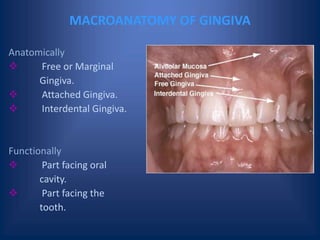
MACROANATOMY OF GINGIVA
Anatomically
 Free or Marginal
Gingiva.
 Attached Gingiva.
 Interdental Gingiva.
Functionally
 Part facing oral
cavity.
 Part facing the
tooth.
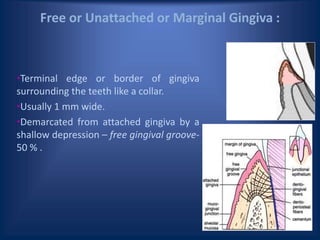
Free or Unattached or Marginal Gingiva :
•Terminal edge or border of gingiva
surrounding the teeth like a collar.
•Usually 1 mm wide.
•Demarcated from attached gingiva by a
shallow depression – free gingival groove-
50 % .
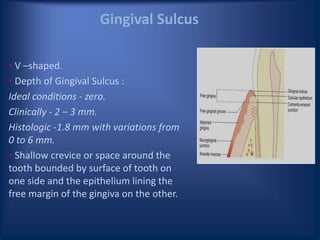
Gingival Sulcus
• V –shaped.
• Depth of Gingival Sulcus :
Ideal conditions - zero.
Clinically - 2 – 3 mm.
Histologic -1.8 mm with variations from
0 to 6 mm.
• Shallow crevice or space around the
tooth bounded by surface of tooth on
one side and the epithelium lining the
free margin of the gingiva on the other.
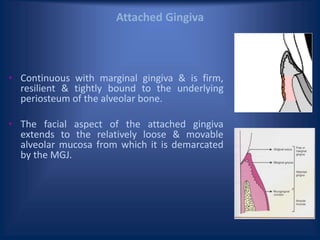
Attached Gingiva
• Continuous with marginal gingiva & is firm,
resilient & tightly bound to the underlying
periosteum of the alveolar bone.
• The facial aspect of the attached gingiva
extends to the relatively loose & movable
alveolar mucosa from which it is demarcated
by the MGJ.
Width of AG
• distance b/w the MGJ & projection on the external
surface of the bottom of gingival sulcus/ periodontal
pocket.
• Greatest in incisor region :
3.5 to 4.5 mm in maxilla
3.3 to 3.9 mm in mandible
• 1.9 mm in maxilla
1.8mm in mandible
Least in the first premolar area :
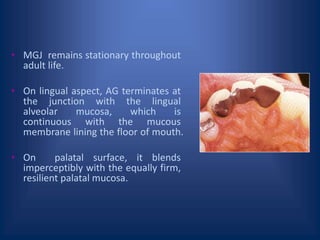
• MGJ remains stationary throughout
adult life.
• On lingual aspect, AG terminates at
the junction with the lingual
alveolar mucosa, which is
continuous with the mucous
membrane lining the floor of mouth.
• On palatal surface, it blends
imperceptibly with the equally firm,
resilient palatal mucosa.
Significance of attached gingiva for the maintenance of
periodontal health :
• To protect the periodontium from injury caused by
frictional forces encountered during mastication
• To dissipate the pull on the gingival margin created by
the muscles of the adjacent alveolar mucosa.
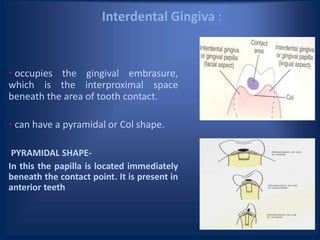
Interdental Gingiva :
• occupies the gingival embrasure,
which is the interproximal space
beneath the area of tooth contact.
• can have a pyramidal or Col shape.
PYRAMIDAL SHAPE-
In this the papilla is located immediately
beneath the contact point. It is present in
anterior teeth
COL SHAPE
• It is valley like depression that connects the facial and lingual
papilla and conforms to the shape of interproximal contact
and present in posterior teeth
• Its epithelium is non keratinised and same as junctional
epithelium
gingiva_lect.ppt

gingiva_lect.ppt

  • 1.
  • 2.
    • Introduction • Macroanatomyof Gingiva -Marginal Gingiva -Gingival Sulcus -Attached Gingiva -Interdental Gingiva • Microanatomy of Gingiva -Gingival Epithelium -General Aspects -Outer / Oral Epithelium -Sulcular Epithelium -Junctional Epithelium -Interface Between Epithelium And Connective Tissue -Gingival Connective Tissue -Cellular Elements -Gingival Fibers
  • 3.
    • Blood Supply •Lymphatic Drainage • Gingival Innervation • Correlation of Normal Clinical and Microscopic Features -Color -Size -Contour -Shape -Consistency -Surface Texture -Position • Effects of Aging on Gingival Epithelium and Connective Tissue • Conclusion • References
  • 4.
    INTRODUCTION The gingiva coversthe alveolar process, and it is the only one of the periodontal tissues that under healthy conditions is directly visible upon inspection.
  • 5.
    Glickman : “Gingiva isthe part of the oral mucosa that covers the alveolar processes of the jaws and surrounds the necks of the teeth”. A A P 1992 : The fibrous investing tissue, covered by keratinized epithelium, which immediately surrounds a tooth and is contiguous with its periodontal ligament and with the mucosal tissues of the mouth.
  • 6.
    Oral Mucosa consistsof : Masticatory Mucosa - Gingiva - covering of Hard palate. Specialized Mucosa - Dorsum of Tongue. OMM lining remainder of oral cavity. Structurally : Keratinized – - masticatory mucosa - vermilion border of the lip. Non keratinized - lining or reflecting mucosa, - specialized mucosa.
  • 7.
    MACROANATOMY OF GINGIVA Anatomically Free or Marginal Gingiva.  Attached Gingiva.  Interdental Gingiva. Functionally  Part facing oral cavity.  Part facing the tooth.
  • 8.
    Free or Unattachedor Marginal Gingiva : •Terminal edge or border of gingiva surrounding the teeth like a collar. •Usually 1 mm wide. •Demarcated from attached gingiva by a shallow depression – free gingival groove- 50 % .
  • 9.
    Gingival Sulcus • V–shaped. • Depth of Gingival Sulcus : Ideal conditions - zero. Clinically - 2 – 3 mm. Histologic -1.8 mm with variations from 0 to 6 mm. • Shallow crevice or space around the tooth bounded by surface of tooth on one side and the epithelium lining the free margin of the gingiva on the other.
  • 10.
    Attached Gingiva • Continuouswith marginal gingiva & is firm, resilient & tightly bound to the underlying periosteum of the alveolar bone. • The facial aspect of the attached gingiva extends to the relatively loose & movable alveolar mucosa from which it is demarcated by the MGJ.
  • 11.
    Width of AG •distance b/w the MGJ & projection on the external surface of the bottom of gingival sulcus/ periodontal pocket. • Greatest in incisor region : 3.5 to 4.5 mm in maxilla 3.3 to 3.9 mm in mandible • 1.9 mm in maxilla 1.8mm in mandible Least in the first premolar area :
  • 12.
    • MGJ remainsstationary throughout adult life. • On lingual aspect, AG terminates at the junction with the lingual alveolar mucosa, which is continuous with the mucous membrane lining the floor of mouth. • On palatal surface, it blends imperceptibly with the equally firm, resilient palatal mucosa.
  • 13.
    Significance of attachedgingiva for the maintenance of periodontal health : • To protect the periodontium from injury caused by frictional forces encountered during mastication • To dissipate the pull on the gingival margin created by the muscles of the adjacent alveolar mucosa.
  • 14.
    Interdental Gingiva : •occupies the gingival embrasure, which is the interproximal space beneath the area of tooth contact. • can have a pyramidal or Col shape. PYRAMIDAL SHAPE- In this the papilla is located immediately beneath the contact point. It is present in anterior teeth
  • 15.
    COL SHAPE • Itis valley like depression that connects the facial and lingual papilla and conforms to the shape of interproximal contact and present in posterior teeth • Its epithelium is non keratinised and same as junctional epithelium