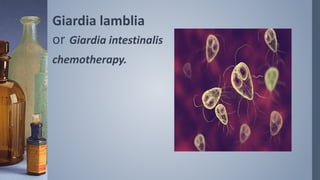
Giardia lamblia
or Giardia intestinalis
chemotherapy.
About the parasite:
 Are anaerobes, flagellated parasite that colonizes and
reproduces in the small intestine.
 Attaches to the epithelium by a ventral adhesive disc, remains
confined to the lumen of the small intestine.
 Pathways of human infection include ingestion of
untreated sewage, a phenomenon particularly common in many
developing countries; contamination of natural waters.
History:
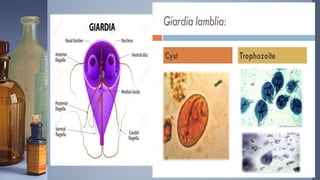
 The trophozoite form of Giardia was first observed in 1681 by Antonie
van Leeuwenhoek in his own diarrhoea stools.
 In 1998, a highly publicised Giardia and Cryptosporidium outbreak was
reported in Sydney, Australia.
 In 2008, Giardia was identified as one of the causes of
the dysentery afflicting Crusaders in Palestine in the 12th and 13th
centuries.
In December 2008, Nature published an article showing the discovery
of an RNA interference mechanism that allows Giardia to switch
variant-specific surface proteins to avoid host immune response. The
discovery was made by the team working at the Biochemistry and
Molecular Biology Laboratory, School of Medicine, Catholic University
of Cordoba, Argentina, led by Dr. Hugo Lujan.
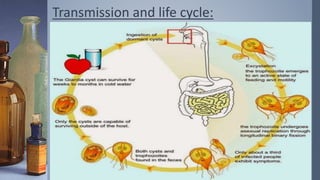
Transmission and life cycle:
Metabolism:
› Giardia relies on glucose as its major energy source and breaks
glucose down into ethanol, acetate and carbon dioxide.
› It can also use arginine as an energy source.
› B vitamins and bile salts, as well as glucose, are necessary
for Giardia to survive, and a low-carbohydrate diet was shown
in mice to reduce the number of Giardia organisms present.
Symptoms:
› The most common manifestations of giardiasis
are diarrhoea and abdominal pain, particularly cramping;
however, diarrhoea is not invariable and occurs in 60% to 90% of
patients.
› Nausea with or without vomiting,
› Malaise, and
› Fatigue.
› Fever is unusual.
› Foul smelling stools, when the Giardia interferes with the
absorption of fat from the intestine (malabsorption). → weight
loss.
Symptoms (continue):
› Symptoms and signs of giardiasis do not begin for at least seven
days following infection.
› In most patients the illness is self-limiting and lasts 2-4 weeks.
› In many patients who are not treated, infection can last for
several months to years with continuing symptoms.
› Some patients recover from their giardiasis, with or without
treatment, but symptoms continue, perhaps because of a
condition referred to as post infectious irritable bowel syndrome.
Diagnosis:
› The best single test for diagnosing giardiasis is antigen testing of
the stool.
› Giardia also can be diagnosed by examination of stool under the
microscope for cysts or trophozoites; however, it takes three
samples of stool to diagnose.
› Other tests that can be used for diagnosing giardiasis are
collection and examination of fluid from the duodenum or biopsy
of the small intestine. (string test).
Treatment:
METRONIDAZOLE → tinidazole
› The most common treatment for giardiasis is metronidazole for 5-
10 days. It has an efficacy rate of 75% to 100%.
› causes gastrointestinal side effects such as nausea and a metallic
taste as well as dizziness and headache. Despite its effectiveness,
metronidazole is not approved by the FDA in the U.S. for
treatment of giardiasis.
› An alternative is tinidazole, which is as effective as metronidazole
in the treatment of giardiasis. This agent is administered orally as
a single dose.
Nitazoxanide
› Nitazoxanide, a nitrothiazole derivative, is also approved for the
treatment of giardiasis. may also be used for treatment of
cryptosporidiosis.
› Administered as a 3-day course of oral therapy.
albendazole
› The anthelmintic drug albendazole may also be efficacious for
giardiasis.
paromomycin
› paromomycin is sometimes used for treatment of giardiasis in
pregnant patients.
› Occasionally, treatment fails to eradicate Giardia. In
such cases, the drug may be changed or a longer
duration or higher dose may be used. Combination
therapy also may be effective (e.g., quinacrine and
metronidazole).
THANK YOU FOR ATTENTION

Giardiasis

  • 1.
    Giardia lamblia or Giardiaintestinalis chemotherapy.
  • 2.
    About the parasite: Are anaerobes, flagellated parasite that colonizes and reproduces in the small intestine.  Attaches to the epithelium by a ventral adhesive disc, remains confined to the lumen of the small intestine.  Pathways of human infection include ingestion of untreated sewage, a phenomenon particularly common in many developing countries; contamination of natural waters.
  • 4.
    History:  The trophozoiteform of Giardia was first observed in 1681 by Antonie van Leeuwenhoek in his own diarrhoea stools.  In 1998, a highly publicised Giardia and Cryptosporidium outbreak was reported in Sydney, Australia.  In 2008, Giardia was identified as one of the causes of the dysentery afflicting Crusaders in Palestine in the 12th and 13th centuries. In December 2008, Nature published an article showing the discovery of an RNA interference mechanism that allows Giardia to switch variant-specific surface proteins to avoid host immune response. The discovery was made by the team working at the Biochemistry and Molecular Biology Laboratory, School of Medicine, Catholic University of Cordoba, Argentina, led by Dr. Hugo Lujan.
  • 5.
  • 6.
    Metabolism: › Giardia relieson glucose as its major energy source and breaks glucose down into ethanol, acetate and carbon dioxide. › It can also use arginine as an energy source. › B vitamins and bile salts, as well as glucose, are necessary for Giardia to survive, and a low-carbohydrate diet was shown in mice to reduce the number of Giardia organisms present.
  • 7.
    Symptoms: › The mostcommon manifestations of giardiasis are diarrhoea and abdominal pain, particularly cramping; however, diarrhoea is not invariable and occurs in 60% to 90% of patients. › Nausea with or without vomiting, › Malaise, and › Fatigue. › Fever is unusual. › Foul smelling stools, when the Giardia interferes with the absorption of fat from the intestine (malabsorption). → weight loss.
  • 8.
    Symptoms (continue): › Symptomsand signs of giardiasis do not begin for at least seven days following infection. › In most patients the illness is self-limiting and lasts 2-4 weeks. › In many patients who are not treated, infection can last for several months to years with continuing symptoms. › Some patients recover from their giardiasis, with or without treatment, but symptoms continue, perhaps because of a condition referred to as post infectious irritable bowel syndrome.
  • 9.
    Diagnosis: › The bestsingle test for diagnosing giardiasis is antigen testing of the stool. › Giardia also can be diagnosed by examination of stool under the microscope for cysts or trophozoites; however, it takes three samples of stool to diagnose. › Other tests that can be used for diagnosing giardiasis are collection and examination of fluid from the duodenum or biopsy of the small intestine. (string test).
  • 10.
    Treatment: METRONIDAZOLE → tinidazole ›The most common treatment for giardiasis is metronidazole for 5- 10 days. It has an efficacy rate of 75% to 100%. › causes gastrointestinal side effects such as nausea and a metallic taste as well as dizziness and headache. Despite its effectiveness, metronidazole is not approved by the FDA in the U.S. for treatment of giardiasis. › An alternative is tinidazole, which is as effective as metronidazole in the treatment of giardiasis. This agent is administered orally as a single dose.
  • 11.
    Nitazoxanide › Nitazoxanide, anitrothiazole derivative, is also approved for the treatment of giardiasis. may also be used for treatment of cryptosporidiosis. › Administered as a 3-day course of oral therapy. albendazole › The anthelmintic drug albendazole may also be efficacious for giardiasis. paromomycin › paromomycin is sometimes used for treatment of giardiasis in pregnant patients.
  • 12.
    › Occasionally, treatmentfails to eradicate Giardia. In such cases, the drug may be changed or a longer duration or higher dose may be used. Combination therapy also may be effective (e.g., quinacrine and metronidazole). THANK YOU FOR ATTENTION