Presentation prepared by Gastroenterology Specialists
Here, you will find a list of many of these disorders. By clicking
on the name of each, you will be led to the American College of
Gastroenterology’s Patient Education & Resource Center and be
able to learn more about the disease
Acid Reflux Barrett’s Esophagus
 Gastroesophageal reflux is a
physical condition in which acid
from the stomach flows backward
up into the esophagus.
 People will experience heartburn
symptoms when excessive amounts
of acid reflux into the esophagus.
 Many describe heartburn as a
feeling of burning discomfort,
localized behind the breastbone,
that moves up toward the neck and
throat.
 In order to understand Barrett's
esophagus it is useful to
understand the normal
appearance of the esophagus.
 In the normal esophagus, the
tissue lining appears pale pink
and smooth.
 These flat square cells, called
"squamous" (Latin for square)
cells, make up the normal lining
of the esophagus.
Gallbladder Disorders Cirrhosis of the Liver
 Gallstones are collections of
cholesterol, bile pigment or a
combination of the two, which
can form in the gallbladder or
within the bile ducts of the
liver.
 If gallstones form in the biliary
system they can cause
blockage of the bile ducts,
which normally drain bile from
the gallbladder and liver.
 Cirrhosis of the liver refers to
scarring of the liver which
results in abnormal liver
function as a consequence of
chronic (long-term) liver injury.
 Cirrhosis can be caused by
many conditions including
fatty liver disease, inherited
disorders, drug-induced injury,
bile duct disorders and
autoimmune diseases.
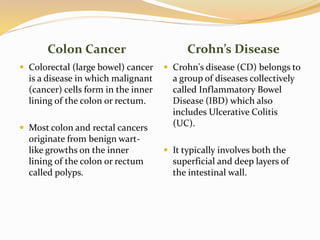
Colon Cancer Crohn’s Disease
 Colorectal (large bowel) cancer
is a disease in which malignant
(cancer) cells form in the inner
lining of the colon or rectum.
 Most colon and rectal cancers
originate from benign wart-
like growths on the inner
lining of the colon or rectum
called polyps.
 Crohn's disease (CD) belongs to
a group of diseases collectively
called Inflammatory Bowel
Disease (IBD) which also
includes Ulcerative Colitis
(UC).
 It typically involves both the
superficial and deep layers of
the intestinal wall.
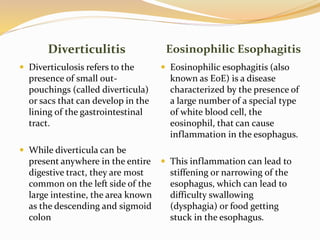
Diverticulitis Eosinophilic Esophagitis
 Diverticulosis refers to the
presence of small out-
pouchings (called diverticula)
or sacs that can develop in the
lining of the gastrointestinal
tract.
 While diverticula can be
present anywhere in the entire
digestive tract, they are most
common on the left side of the
large intestine, the area known
as the descending and sigmoid
colon
 Eosinophilic esophagitis (also
known as EoE) is a disease
characterized by the presence of
a large number of a special type
of white blood cell, the
eosinophil, that can cause
inflammation in the esophagus.
 This inflammation can lead to
stiffening or narrowing of the
esophagus, which can lead to
difficulty swallowing
(dysphagia) or food getting
stuck in the esophagus.
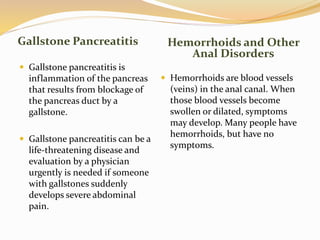
Gallstone Pancreatitis Hemorrhoids and Other
Anal Disorders
 Gallstone pancreatitis is
inflammation of the pancreas
that results from blockage of
the pancreas duct by a
gallstone.
 Gallstone pancreatitis can be a
life-threatening disease and
evaluation by a physician
urgently is needed if someone
with gallstones suddenly
develops severe abdominal
pain.
 Hemorrhoids are blood vessels
(veins) in the anal canal. When
those blood vessels become
swollen or dilated, symptoms
may develop. Many people have
hemorrhoids, but have no
symptoms.
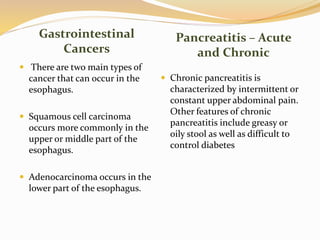
Gastrointestinal
Cancers
Pancreatitis – Acute
and Chronic
 There are two main types of
cancer that can occur in the
esophagus.
 Squamous cell carcinoma
occurs more commonly in the
upper or middle part of the
esophagus.
 Adenocarcinoma occurs in the
lower part of the esophagus.
 Chronic pancreatitis is
characterized by intermittent or
constant upper abdominal pain.
Other features of chronic
pancreatitis include greasy or
oily stool as well as difficult to
control diabetes
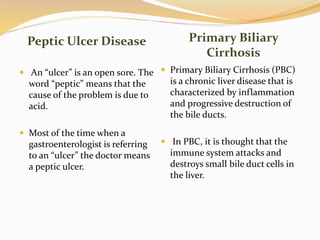
Peptic Ulcer Disease Primary Biliary
Cirrhosis
 An “ulcer” is an open sore. The
word “peptic” means that the
cause of the problem is due to
acid.
 Most of the time when a
gastroenterologist is referring
to an “ulcer” the doctor means
a peptic ulcer.
 Primary Biliary Cirrhosis (PBC)
is a chronic liver disease that is
characterized by inflammation
and progressive destruction of
the bile ducts.
 In PBC, it is thought that the
immune system attacks and
destroys small bile duct cells in
the liver.
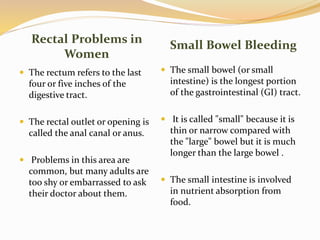
Rectal Problems in
Women
Small Bowel Bleeding
 The rectum refers to the last
four or five inches of the
digestive tract.
 The rectal outlet or opening is
called the anal canal or anus.
 Problems in this area are
common, but many adults are
too shy or embarrassed to ask
their doctor about them.
 The small bowel (or small
intestine) is the longest portion
of the gastrointestinal (GI) tract.
 It is called "small" because it is
thin or narrow compared with
the "large" bowel but it is much
longer than the large bowel .
 The small intestine is involved
in nutrient absorption from
food.
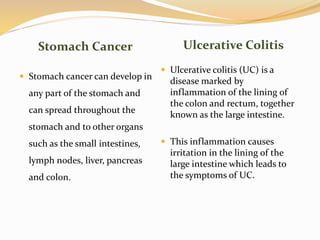
Stomach Cancer Ulcerative Colitis
 Stomach cancer can develop in
any part of the stomach and
can spread throughout the
stomach and to other organs
such as the small intestines,
lymph nodes, liver, pancreas
and colon.
 Ulcerative colitis (UC) is a
disease marked by
inflammation of the lining of
the colon and rectum, together
known as the large intestine.
 This inflammation causes
irritation in the lining of the
large intestine which leads to
the symptoms of UC.
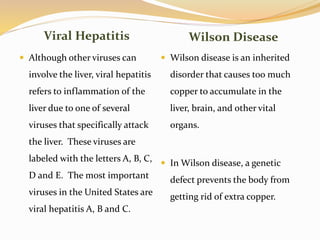
Viral Hepatitis Wilson Disease
 Although other viruses can
involve the liver, viral hepatitis
refers to inflammation of the
liver due to one of several
viruses that specifically attack
the liver. These viruses are
labeled with the letters A, B, C,
D and E. The most important
viruses in the United States are
viral hepatitis A, B and C.
 Wilson disease is an inherited
disorder that causes too much
copper to accumulate in the
liver, brain, and other vital
organs.
 In Wilson disease, a genetic
defect prevents the body from
getting rid of extra copper.
Visit:
http://gastro-specialists.com/gi-conditions-diseases
GI Conditions & Diseases

GI Conditions & Diseases

  • 1.
    Presentation prepared byGastroenterology Specialists
  • 2.
    Here, you willfind a list of many of these disorders. By clicking on the name of each, you will be led to the American College of Gastroenterology’s Patient Education & Resource Center and be able to learn more about the disease
  • 3.
    Acid Reflux Barrett’sEsophagus  Gastroesophageal reflux is a physical condition in which acid from the stomach flows backward up into the esophagus.  People will experience heartburn symptoms when excessive amounts of acid reflux into the esophagus.  Many describe heartburn as a feeling of burning discomfort, localized behind the breastbone, that moves up toward the neck and throat.  In order to understand Barrett's esophagus it is useful to understand the normal appearance of the esophagus.  In the normal esophagus, the tissue lining appears pale pink and smooth.  These flat square cells, called "squamous" (Latin for square) cells, make up the normal lining of the esophagus.
  • 4.
    Gallbladder Disorders Cirrhosisof the Liver  Gallstones are collections of cholesterol, bile pigment or a combination of the two, which can form in the gallbladder or within the bile ducts of the liver.  If gallstones form in the biliary system they can cause blockage of the bile ducts, which normally drain bile from the gallbladder and liver.  Cirrhosis of the liver refers to scarring of the liver which results in abnormal liver function as a consequence of chronic (long-term) liver injury.  Cirrhosis can be caused by many conditions including fatty liver disease, inherited disorders, drug-induced injury, bile duct disorders and autoimmune diseases.
  • 5.
    Colon Cancer Crohn’sDisease  Colorectal (large bowel) cancer is a disease in which malignant (cancer) cells form in the inner lining of the colon or rectum.  Most colon and rectal cancers originate from benign wart- like growths on the inner lining of the colon or rectum called polyps.  Crohn's disease (CD) belongs to a group of diseases collectively called Inflammatory Bowel Disease (IBD) which also includes Ulcerative Colitis (UC).  It typically involves both the superficial and deep layers of the intestinal wall.
  • 6.
    Diverticulitis Eosinophilic Esophagitis Diverticulosis refers to the presence of small out- pouchings (called diverticula) or sacs that can develop in the lining of the gastrointestinal tract.  While diverticula can be present anywhere in the entire digestive tract, they are most common on the left side of the large intestine, the area known as the descending and sigmoid colon  Eosinophilic esophagitis (also known as EoE) is a disease characterized by the presence of a large number of a special type of white blood cell, the eosinophil, that can cause inflammation in the esophagus.  This inflammation can lead to stiffening or narrowing of the esophagus, which can lead to difficulty swallowing (dysphagia) or food getting stuck in the esophagus.
  • 7.
    Gallstone Pancreatitis Hemorrhoidsand Other Anal Disorders  Gallstone pancreatitis is inflammation of the pancreas that results from blockage of the pancreas duct by a gallstone.  Gallstone pancreatitis can be a life-threatening disease and evaluation by a physician urgently is needed if someone with gallstones suddenly develops severe abdominal pain.  Hemorrhoids are blood vessels (veins) in the anal canal. When those blood vessels become swollen or dilated, symptoms may develop. Many people have hemorrhoids, but have no symptoms.
  • 8.
    Gastrointestinal Cancers Pancreatitis – Acute andChronic  There are two main types of cancer that can occur in the esophagus.  Squamous cell carcinoma occurs more commonly in the upper or middle part of the esophagus.  Adenocarcinoma occurs in the lower part of the esophagus.  Chronic pancreatitis is characterized by intermittent or constant upper abdominal pain. Other features of chronic pancreatitis include greasy or oily stool as well as difficult to control diabetes
  • 9.
    Peptic Ulcer DiseasePrimary Biliary Cirrhosis  An “ulcer” is an open sore. The word “peptic” means that the cause of the problem is due to acid.  Most of the time when a gastroenterologist is referring to an “ulcer” the doctor means a peptic ulcer.  Primary Biliary Cirrhosis (PBC) is a chronic liver disease that is characterized by inflammation and progressive destruction of the bile ducts.  In PBC, it is thought that the immune system attacks and destroys small bile duct cells in the liver.
  • 10.
    Rectal Problems in Women SmallBowel Bleeding  The rectum refers to the last four or five inches of the digestive tract.  The rectal outlet or opening is called the anal canal or anus.  Problems in this area are common, but many adults are too shy or embarrassed to ask their doctor about them.  The small bowel (or small intestine) is the longest portion of the gastrointestinal (GI) tract.  It is called "small" because it is thin or narrow compared with the "large" bowel but it is much longer than the large bowel .  The small intestine is involved in nutrient absorption from food.
  • 11.
    Stomach Cancer UlcerativeColitis  Stomach cancer can develop in any part of the stomach and can spread throughout the stomach and to other organs such as the small intestines, lymph nodes, liver, pancreas and colon.  Ulcerative colitis (UC) is a disease marked by inflammation of the lining of the colon and rectum, together known as the large intestine.  This inflammation causes irritation in the lining of the large intestine which leads to the symptoms of UC.
  • 12.
    Viral Hepatitis WilsonDisease  Although other viruses can involve the liver, viral hepatitis refers to inflammation of the liver due to one of several viruses that specifically attack the liver. These viruses are labeled with the letters A, B, C, D and E. The most important viruses in the United States are viral hepatitis A, B and C.  Wilson disease is an inherited disorder that causes too much copper to accumulate in the liver, brain, and other vital organs.  In Wilson disease, a genetic defect prevents the body from getting rid of extra copper.
  • 13.