Visit https://ebookultra.com to download the full version and
explore more ebooks
GFI Network Security and PCI Compliance Power
Tools 1st Edition Brien Posey
_____ Click the link below to download _____
https://ebookultra.com/download/gfi-network-security-
and-pci-compliance-power-tools-1st-edition-brien-posey/
Explore and download more ebooks at ebookultra.com
Here are some suggested products you might be interested in.
Click the link to download
PCI Compliance Understand and Implement Effective PCI Data
Security Standard Compliance 2nd Edition Anton Chuvakin
https://ebookultra.com/download/pci-compliance-understand-and-
implement-effective-pci-data-security-standard-compliance-2nd-edition-
anton-chuvakin/
Building Open Source Network Security Tools Components and
Techniques 1st Edition Mike Schiffman
https://ebookultra.com/download/building-open-source-network-security-
tools-components-and-techniques-1st-edition-mike-schiffman/
Cyber Security and Network Security 1st Edition Sabyasachi
Pramanik
https://ebookultra.com/download/cyber-security-and-network-
security-1st-edition-sabyasachi-pramanik/
Network Security Christos Douligeris
https://ebookultra.com/download/network-security-christos-douligeris/
Network Security Bible 1st Edition Eric Cole
https://ebookultra.com/download/network-security-bible-1st-edition-
eric-cole/
Network Security JumpStart 1st Edition Matthew Strebe
https://ebookultra.com/download/network-security-jumpstart-1st-
edition-matthew-strebe/
Network Security Hacks 1st Edition Andrew Lockhart
https://ebookultra.com/download/network-security-hacks-1st-edition-
andrew-lockhart/
Cryptography and Network Security 4th Edition William
Stallings
https://ebookultra.com/download/cryptography-and-network-security-4th-
edition-william-stallings/
The Practical Guide to HIPAA Privacy and Security
Compliance 1st Edition Kevin Beaver
https://ebookultra.com/download/the-practical-guide-to-hipaa-privacy-
and-security-compliance-1st-edition-kevin-beaver/
GFI Network Security and PCI Compliance Power Tools
1st Edition Brien Posey Digital Instant Download
Author(s): Brien Posey
ISBN(s): 9781597492850, 0080949150
Edition: 1st
File Details: PDF, 23.03 MB
Year: 2008
Language: english
Elsevier, Inc., the author(s), and any person or firm involved in the writing, editing, or production (collectively
“Makers”) of this book (“the Work”) do not guarantee or warrant the results to be obtained from the Work.
There is no guarantee of any kind, expressed or implied, regarding the Work or its contents.The Work
is sold AS IS and WITHOUT WARRANTY.You may have other legal rights, which vary from state
to state.
In no event will Makers be liable to you for damages, including any loss of profits, lost savings, or
other incidental or consequential damages arising out from the Work or its contents. Because some
states do not allow the exclusion or limitation of liability for consequential or incidental damages,
the above limitation may not apply to you.
You should always use reasonable care, including backup and other appropriate precautions, when
working with computers, networks, data, and files.
Syngress Media®
, Syngress®
,“Career Advancement Through Skill Enhancement®
,”“Ask the Author
UPDATE®
,” and “Hack Proofing®
,” are registered trademarks of Elsevier, Inc.“Syngress:The Definition
of a Serious Security Library”™,“Mission Critical™,” and “The Only Way to Stop a Hacker is to
Think Like One™” are trademarks of Elsevier, Inc. Brands and product names mentioned in this book
are trademarks or service marks of their respective companies.
PUBLISHED BY
Syngress Publishing, Inc.
Elsevier, Inc.
30 Corporate Drive
Burlington, MA 01803
GFI Network Security and PCI Compliance Power Tools
Copyright © 2009 by Elsevier, Inc.All rights reserved. Printed in the United States of America. Except as
permitted under the Copyright Act of 1976, no part of this publication may be reproduced or distributed
in any form or by any means, or stored in a database or retrieval system, without the prior written
permission of the publisher, with the exception that the program listings may be entered, stored, and
executed in a computer system, but they may not be reproduced for publication.
Printed in the United States of America
1 2 3 4 5 6 7 8 9 0
ISBN 13: 978-1-59749-285-0
Publisher: Laura Colantoni Page Layout and Art: SPI
Acquisitions Editor:Andrew Williams Copy Editor: Judith H. Eby, Michael McGee
Developmental Editor: Matthew Cater Indexer: SPI
Technical Editor:Troy Thompson Cover Designer: Michael Kavish
Project Manager:Andre Cuello
For information on rights, translations, and bulk sales, contact Matt Pedersen, Senior Sales Manager,
Corporate Sales, at Syngress Publishing; email m.pedersen@elsevier.com.
Troy Thompson has worked in network administration for over 20 years,performing
network monitoring and backup, Microsoft Exchange administration and training.
Troy has written many technology articles, tutorials, and white papers, which have
been published by leading technology publications and businesses including CNET,
Microsoft,TechRepublic, and the Security Evaluation Center.Troy is a Cisco Certified
Academy Instructor (CCAI), and has numerous other certifications including CCNA,
MCSE+I, CCAI, Network+, Security+ and A+.Troy has also traveled the world
playing music as the guitarist for Bride. Check out www.bridepub.com or view some
videos onYouTube.
Technical Editor
iii
Brien Posey is a freelance technical writer who has received Microsoft’s
MVP award five times for his work with Windows Server, IIS, Exchange
Server, and file system storage. Over the last thirteen years, Brien has
published over 4,000 articles and whitepapers for a variety of technical
publications and Websites including TechTarget, CNET,Windows IT
Professional, ZDNET,Windows Networking, and many others. He has
also written or contributed content to over 30 books.
In addition to his technical writing, Brien is the co-founder of Relevant
Technologies (www.relevanttechnologies.com) and also serves the IT
community through his ownWeb site at www.brienposey.com.
Prior to becoming a freelance author, Brien served as CIO for a
nationwide chain of hospitals and healthcare facilities, and as a network
administrator for the Department of Defense at Fort Knox. He has also
worked as a network administrator for some of the nation’s largest insurance
companies.
When Brien isn’t busy writing he enjoys exotic travel, racing speed
boats, scuba diving, and pretty much anything else that’s good for an
adrenaline rush.
Lead Author
iv
Laura Taylor is Relevant Technologies’ President and CEO. Her research
has been used by the FDIC, the FBI, the IRS, various U.S. Federal Reserve
Banks, U.S. Customs, the U.S.Treasury, the White House, and many
publicly held Fortune 500 companies. Ms.Taylor specializes in security
Certification and Accreditation (C&A) consulting and training, as well as
audits of financial institutions. She has provided information security
consulting services to some of the largest financial institutions in the
world, including the U.S. Internal Revenue Service, the U.S.Treasury,
the U.S. Governmentwide Accounting System, and National Westminster
Bank—a division of the Royal Bank of Scotland. Ms.Taylor is the author
of the bestselling FISMA Certification and Accreditation Handbook.
In assisting her customers, Ms.Taylor has a 100-percent accreditation rate
for FISMA compliance. Ms.Taylor has taught her FISMA 101 class for
both SANS and forYale University.
Before founding RelevantTechnologies, Ms.Taylor was Director of
Security Research atTEC. Ms.Taylor has also served as CIO of Schafer
Corporation, Director of Information Security at Navisite, and Director of
Certification and Accreditation for COACT. Earlier in her career, Ms.Taylor
held various positions at Sun Microsystems where she was awarded several
“Outstanding Performance” awards, and a CIS Security Award. Most recently,
Ms.Taylor received an award from a division of the U.S. Financial Manage-
ment Services Commissioner for her assistance with FISMA-compliant
Security Certification & Accreditation of highly sensitive systems. Ms.Taylor
is a Certified Information Security Manager (CISM).
Ms.Taylor has been featured in many media forums, including
ABC-TV Business Now, CNET Radio, Boston Business Journal,
Computer World, and The Montreal Gazette. Her research has been
published on numerous Web portals and magazines, including Business
Security Advisor, Forbes, SecurityWatch, eSecurityOnline, SecurityFocus,
NetworkStorageForum, ZDNet, Datamation, MidRangeComputing,
Foreword Contributor
v
and Securify. Ms.Taylor has authored over 500 research articles and papers
on information security topics and has contributed to multiple books.
A graduate of Skidmore College, Ms.Taylor is a member of the Society
of Professional Journalists, the IEEE Standards Association, the National
Security Agency’s IATFF Forum, and is the Chair of the FISMA Center’s
CCAP Exam Advisory Board.
vi
Foreword
Today, all companies, U.S. federal agencies, and nonprofit organizations have valuable data on their
servers that must be secured. One of the challenges for information technology (IT) experts is learning
how to use new products in a time-efficient manner so new implementations can go quickly and
smoothly. Learning how to set up sophisticated products is time-consuming and can be confusing.
GFI’s LANguard Network Security Scanner can report vulnerabilities so they can be mitigated before
unauthorized intruders wreak havoc on your network.To take advantage of the best things LANguard
Network Security Scanner has to offer, you’ll want to configure it on your network so it captures key
events and alerts you to potential vulnerabilities before they are exploited.
In understanding how to use this product most effectively, Brien Posey has pinpointed the most
important concepts with examples and screenshots so systems administrators and security engineers can
understand how to get the GFI security tools working quickly and effectively. Brien’s straightforward
no-nonsense writing style is devoid of difficult-to-understand technical jargon. His descriptive examples
explain how GFI’s security tools enhance the security controls already built into your server’s operating
system. Brien’s ability to explain technology so just about anyone can understand it is what has made
him today’s most popular information technology author.
I have had the pleasure of working with Brien over the years, and his understanding of technology
and his ability to explain it so that I can understand it, has made him my #1 go-to person when
I need to know how something works.With GFI Network Security and PCI Compliance PowerTools now
available for all, all IT professionals who want to take advantage of cutting-edge security tools can
learn how to strengthen their security controls, and put in place best practice security management
processes. Brien’s skill at sharing his technical knowledge in a way that anyone can understand is a
breath of fresh air in the world of pedantic, overly technical white papers that seem to purposely use
pretentious language and knotty examples for a select exclusive audience.With this very cool product,
it’s nice to have a practical guidebook to help you make the most of it.
—Laura Taylor
President and CEO, Relevant Technologies
xv
Acknowledgements
First and foremost, I want to thank my wife Taz for her patience and understanding while I was working
on this book.Taz has constantly supported me in every way imaginable throughout my career. I only
wish that words could truly express the love and gratitude that I have for her.
I would also like to thank Troy Thompson and Laura Taylor of Relevant Technologies (http://
www.relevanttechnologies.com). Both Troy and Laura have put a lot of work into this book. More
importantly, I have learned a lot from working with Laura and Troy on various IT projects over the
years.They are both extremely talented individuals, and I attribute a high degree of my overall success
to the experience that I have gained while working with them.
I also wish to express my gratitude to:
Andrew Williams, Matthew Cater, David George, and the rest of the staff at Syngress.
■
■
David Kelleher,Angelica Micallef Trigona, and Stephen Chetcuti Bonavita at GFI.
■
■
Seth Oxhandler at Coolcat Inc. (
■
■ http://coolcatinc.com)
The staff at BigSecurityStore.com
■
■
Shamir Dasgupta, Jeremy Broyles, and Billy Brown at Xpressions Interactive
■
■
(www.xpressions.com)
xvii
1
˛ Summary
˛ Solutions Fast Track
˛ Frequently Asked Questions
Chapter 1
Installing GFI
LANguard Network
Security Scanner
Solutions in this chapter:
Installing GFI LANguard Network
■
■
Security Scanner
2 Chapter 1 • Installing GFI LANguard Network Security Scanner
Introduction
When Syngress asked me to write a book on the various GFI security products, I wasn’t quite sure
what I was going to write. Most of the GFI products are fairly intuitive, and GFI always seems to do a
good job on the instruction manuals for their products, all of which can be downloaded from the GFI
Web site.
When I stopped and thought about it, I began to realize that although the various GFI instruction
manuals are both comprehensive and well written, they tend to be a little bit bloated because they
cover every feature that the various products have to offer.That’s not necessarily a bad thing (especially
for an instruction manual), but instruction manuals rarely reflect how people use the products in the
real world.
Since GFI already offers such thorough instruction manuals, I decided to write this book as a guide
to using the various products in a real-world environment.What that means is that I’m not going to
waste your time by talking about the more obscure product features, or by showing you convoluted
techniques that you would never use in practice. I’m also going to try to avoid using a lot of technical
jargon. My goal is to write a book that’s easy to read and that teaches you what you need to know, but
without wasting your time in the process.
For each of the products that this book covers, I will walk you through the installation process, and
then walk you through the most useful administrative tasks in a step-by-step manner.As I do, I will also
share with you any hints or tricks that I have found for getting better results or for accomplishing your
goals more quickly. I sincerely hope that you will find this book to be a useful reference.
Installing GFI LANguard
Network Security Scanner
Installing GFI LANguard Network Security Scanner is pretty simple and straightforward, but I wanted
to go ahead and walk you through the process just so there aren’t any surprises later on.
GFI LANguard Network Security Scanner can be installed on any of the following operating
systems:
Windows 2000 (with SP4 or higher)
■
■
Windows XP (with SP2 or higher)
■
■
Windows Server 2003
■
■
WindowsVista (with SP1 or higher)
■
■
Windows Server 2008
■
■
WindowsVista and Windows Server 2008 can be running either the X86 version or the X64
version of Windows.
Installing GFI LANguard Network Security Scanner • Chapter 1 3
GFI LANguard Network Security Scanner also requires you to be running Internet Explorer 5.1
or higher, and the Client for Microsoft Networks component, which is installed by default in every
version of Windows since Windows 95.To install GFI LANguard Network Security Scanner, perform
the following steps:
1. Download the languardnss8.exe file from the GFI Web site (www.gfi.com/downloads/
downloads.aspx?pid=lanss&lid=EN), place the file into a temporary directory, and then
double click on it.
2. Depending on the version of Windows that you are using, you may see a security warning
that asks you if you want to run this file, as shown in Figure 1.1. If you receive such a
warning, click the Run button.
Figure 1.1 If You Receive This Security Warning, Click the Run Button
Are You Owned?
Checking for Infections
The whole point of installing GFI Network Security Scanner is to help you to secure
your network. Using a security product like this one does you absolutely no good
though, if the server that will be running it has already been compromised. I recom-
mend scanning the server that you will be installing the product onto for malware
prior to performing the installation.
4 Chapter 1 • Installing GFI LANguard Network Security Scanner
3. Windows will now launch the InstallShield Wizard, which will extract the various files used
by the Setup process.
4. When the process completes,Windows will launch the Setup wizard, which will initially
display a welcome screen. Click Next to bypass the welcome screen, and you will see a
screen prompting you to accept the end user license agreement.
5. Choose the option to accept the license agreement, and click Next.
6. At this point, the Setup wizard will display the Customer Information screen that’s shown in
Figure 1.2.As you can see in the figure, you are prompted to enter a user name, a company
name, and a license key. GFI LANguard Network Security Scanner allows you to enter the
word EVALUATION (all caps) in place of a license key. If you choose to do so, you will be
able to use all of the product’s features for the next ten days. GFI offers this evaluation
feature as a way of allowing you to test drive their products. If you have purchased a license
for GFI LANguard Network Security Scanner, then the license key should be listed in the
e-mail message that you receive from GFI.
7. Click Next, and Setup will prompt you to choose an account to use for the Attendant
Service to run under. Unlike many other services, the Attendant Service cannot run using
Figure 1.2 You Have the Option of Entering the Word EVALUATION in Lieu
of a License Key
Installing GFI LANguard Network Security Scanner • Chapter 1 5
the Local System account.You can specify any account that you want, but the account
needs to be a domain member, and it must have administrative privileges for the domain.
8. When you finish entering the service account credentials, click Next, and you will see a
screen asking you if you want GFI LANguard Network Security Scanner to use a
Microsoft Access Database, or a SQL Server database.
If you want to take the easy out, go with the Microsoft Access database option. If you choose this
option, you don’t even have to install Microsoft Access.
The down side to using a Microsoft Access database is that it does not offer the performance or
scalability of a Structured Query Language (SQL) Server database. Using a Microsoft Access database
will work fine if you have a small- to medium-sized network, or if you are just installing GFI
LANguard Network Security Scanner for evaluation purposes. If you have a larger network, then
performance is typically going to suffer if you try using a Microsoft Access Database.
If you choose the SQL Server option, then you have the option of using SQL Server 2000 or
higher, or of using Microsoft Database Engine (MSDE). In case you are not familiar with MSDE, it is
Microsoft’s free version of SQL Server.
So why would Microsoft offer SQL Server for free? Well, from what I have heard, they did it
because so many of their products (and so many third-party products) require a backend database, and
in a lot of cases a full blown SQL Server would be overkill. MSDE provides you with a way of using
products that require a SQL Server database, but without having to spend good money on SQL
Server licenses or on the supporting hardware.
As great as MSDE sounds, you’ve got to remember that nobody in their right mind would buy
SQL Server if MSDE was truly as good as SQL Server. Earlier I mentioned that MSDE stood for
Microsoft Database Engine. MSDE is just that; a database engine. MSDE can host SQL databases, but
it doesn’t perform quite as well as a full blown SQL Server installation. It is also missing a lot of the
management tools, and doesn’t offer clustering or a lot of the other more advanced SQL Server
capabilities. On the upside though, it is free!
So right about now, you might be wondering where you can get your hands on a copy of MSDE.
Microsoft allows you to download it from their Web site for free.You can get the original version of
MSDE, which is really a SQL 2000 database engine at: www.microsoft.com/downloads/details.
aspx?familyid=413744D1-A0BC-479F-BAFA-E4B278EB9147&displaylang=en
There is also a SQL 2005 version of MSDE available at: www.microsoft.com/sql/editions/
express/default.mspx.Although this is technically the next version of MSDE, Microsoft has changed its
name to Microsoft SQL Server Express Edition.The most important thing that you need to know
about this release is that the original version of MSDE will not work with WindowsVista or with
Windows Server 2008.
Since most of you who are going to be installing GFI LANguard Network Security Scanner will
probably be using it in an enterprise environment, I’m going to go ahead and show you how to
configure it for use with a true SQL Server database. If you want to use MSDE or Microsoft Access to
host the database, you can easily do so by following the steps outlined in GFI’s installation instructions.
You can download a copy of the installation instructions (and a copy of the full blown instruction
manual) at: www.gfi.com/downloads/downloads.aspx?pid=lanss&lid=EN.
6 Chapter 1 • Installing GFI LANguard Network Security Scanner
In either case, I will continue guiding you through the Setup process after I show you how to
prepare SQL Server.
Installing SQL Server
For demonstration purposes, I’m going to install SQL Server 2005 Developer Edition.Assuming that
you are installing SQL Server in a production environment, you will probably be using a different
version or different edition of SQL Server, so I’m not going to spend a lot of time talking about the
installation process.At the same time, there are a couple of things that I want to point out, so I don’t
want to skip talking about the SQL Server installation process completely either.
To install SQL Server 2005 Developer Edition, follow these steps:
1. Insert your installation media, and double click on the Setup.exe file.
2. After a brief delay,Windows will launch the Setup Wizard, which asks you to accept
Microsoft’s software license.
3. Accept the license agreement, and click Next.
4. You will see a message telling you that SQL Server Component Update is about to install
a couple of components that are required for SQL Server Setup.
5. Click the Install button and the wizard will install these components.
6. When this initial component installation process completes, click Next, and Windows will
launch the Microsoft SQL Server Installation Wizard.
Tip
SQL Server offers far better performance than MS Access or MSDE databases, but
is also a lot more expensive. A lot of organizations start out using one of the less
expensive database options, but eventually decide that they want to upgrade to
SQL Server. Upgrading is not a simple proposition, so think long and hard about
which database you want to use before you perform the installation.
Tip
You do not have to use a dedicated SQL Server, but you should use a dedicated
SQL instance.
Installing GFI LANguard Network Security Scanner • Chapter 1 7
7. Click Next to bypass the wizard’s Welcome screen, and the wizard will perform a system
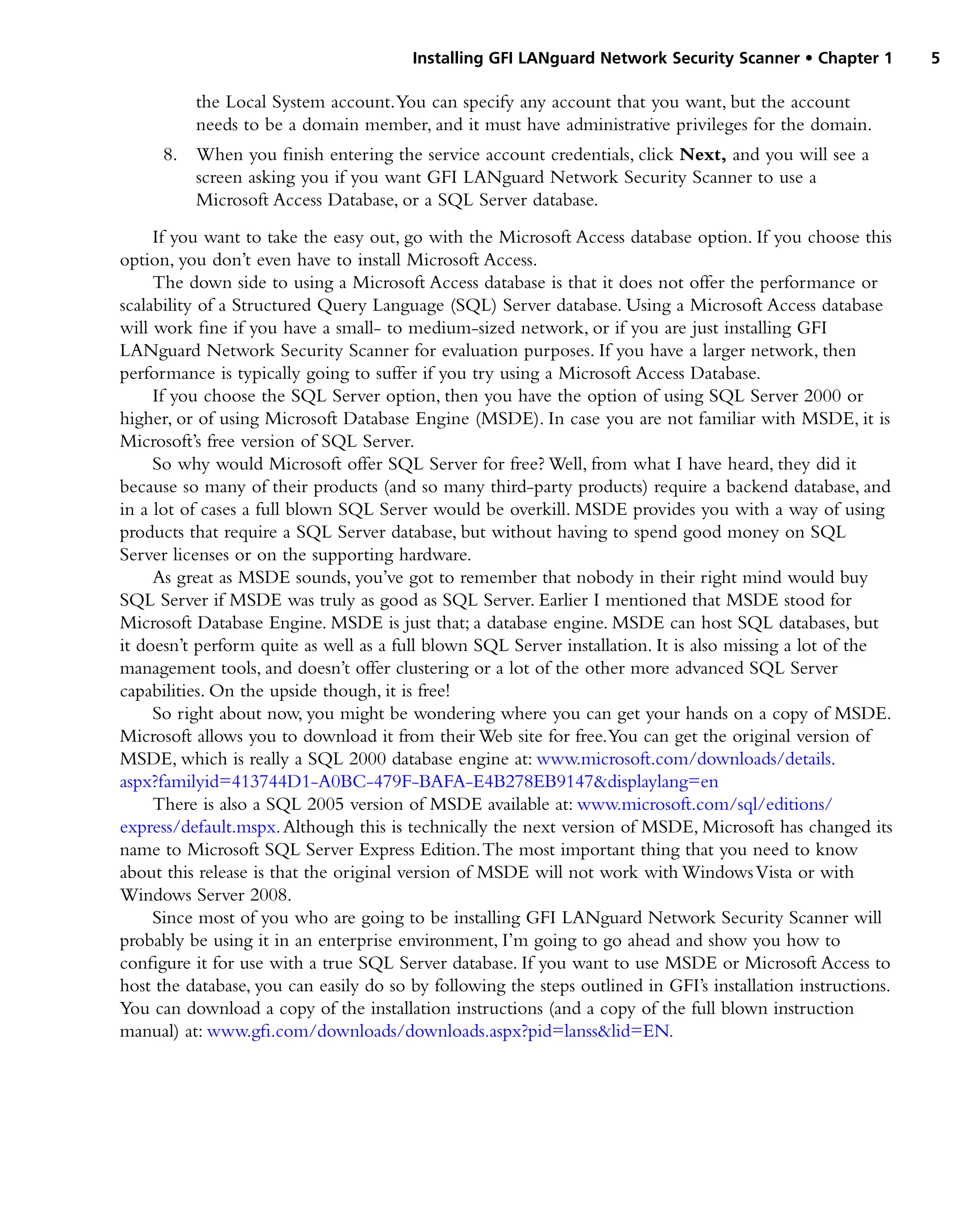
configuration check. If you look at Figure 1.3, you can see that I received a warning
message because Internet Information Server (IIS) is not installed.There are some SQL
Server features that can’t be installed unless IIS is also installed. In this case, it isn’t a big deal
because we won’t be using those features.
8. Click Next, and the wizard will prompt you to enter your name, company name, and
product key.
9. Click Next again, and Setup will ask you which components you want to install. Just go
ahead and select all of the available components (some will be grayed out), and click Next.
10. You will now see a screen asking you if you want to install SQL Server using a default
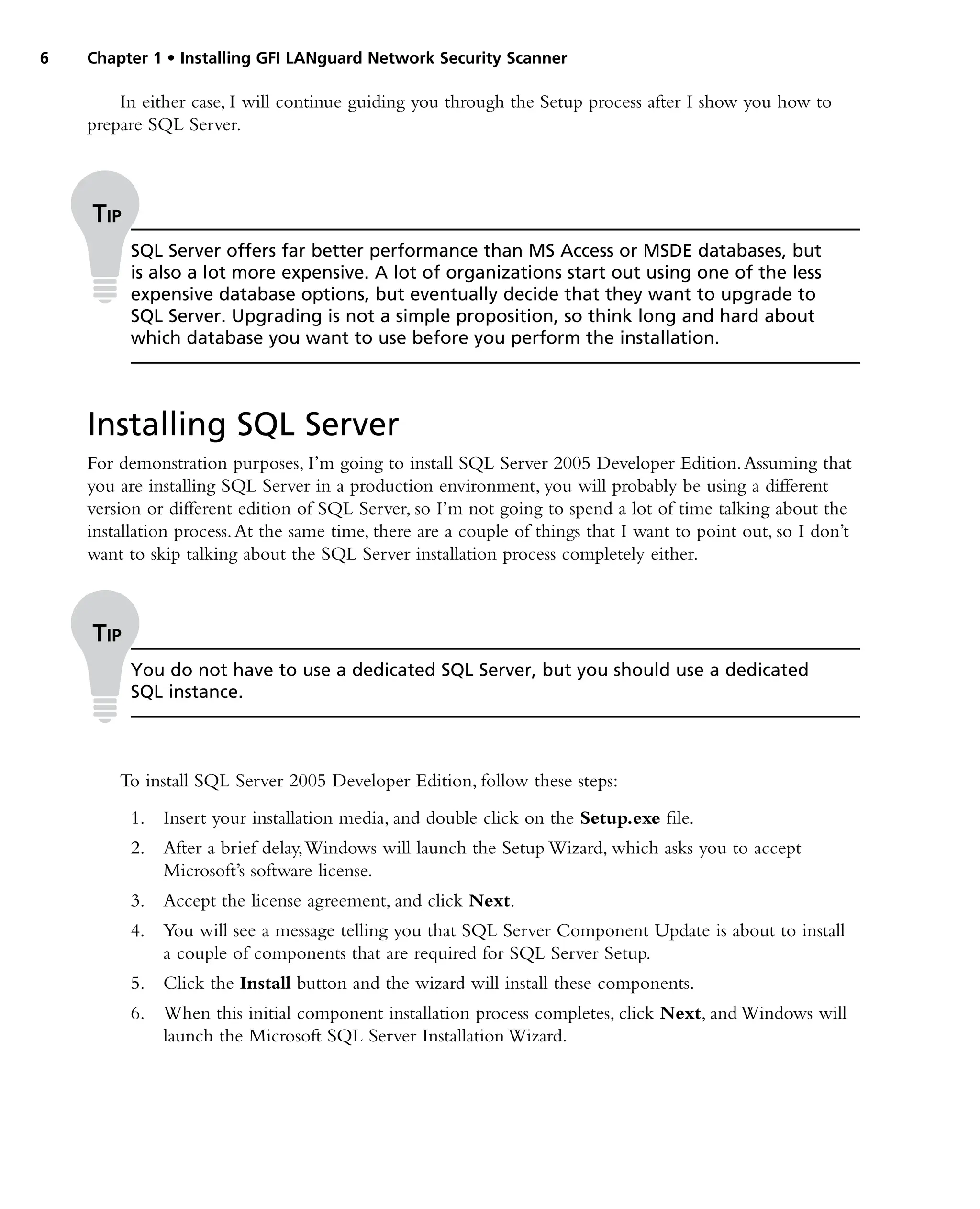
instance or a named instance. I like using a named instance, because doing so helps to identify
the purpose of the installation, and it reduces the temptation to use the installation for other
purposes. I recommend creating a named instance called GFI, as shown in Figure 1.4.
Figure 1.3 Ignore Any Warnings about IIS Not Being Installed
8 Chapter 1 • Installing GFI LANguard Network Security Scanner
11. Click Next and you will see a screen that’s similar to the one that’s shown in Figure 1.5.
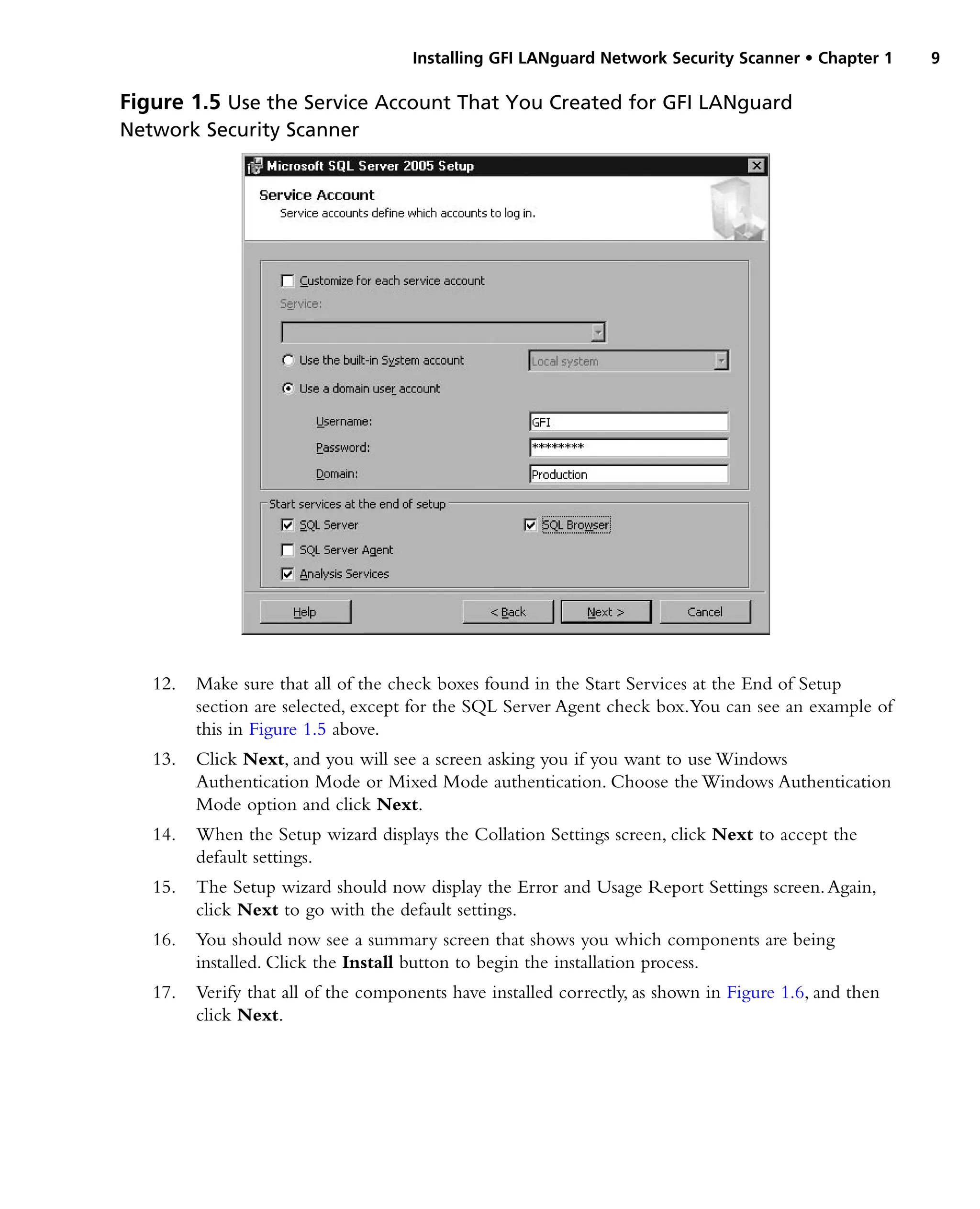
As you can see in the figure, SQL Server requires the use of a service account. Setup gives
you the choice of either using the built-in system account or using a domain account.
We have already created a domain account that is to be used as a system account for GFI
LANguard Network Security Scanner. I recommend going ahead and using this same
service account for SQL Server. Keep in mind that this service account does have domain
administrator privileges, so you will want to take the appropriate steps to keep your
SQL Server secure.
Figure 1.4 Create a Named Instance Called GFI
Installing GFI LANguard Network Security Scanner • Chapter 1 9
12. Make sure that all of the check boxes found in the Start Services at the End of Setup
section are selected, except for the SQL Server Agent check box.You can see an example of
this in Figure 1.5 above.
13. Click Next, and you will see a screen asking you if you want to use Windows
Authentication Mode or Mixed Mode authentication. Choose the Windows Authentication
Mode option and click Next.
14. When the Setup wizard displays the Collation Settings screen, click Next to accept the
default settings.
15. The Setup wizard should now display the Error and Usage Report Settings screen.Again,
click Next to go with the default settings.
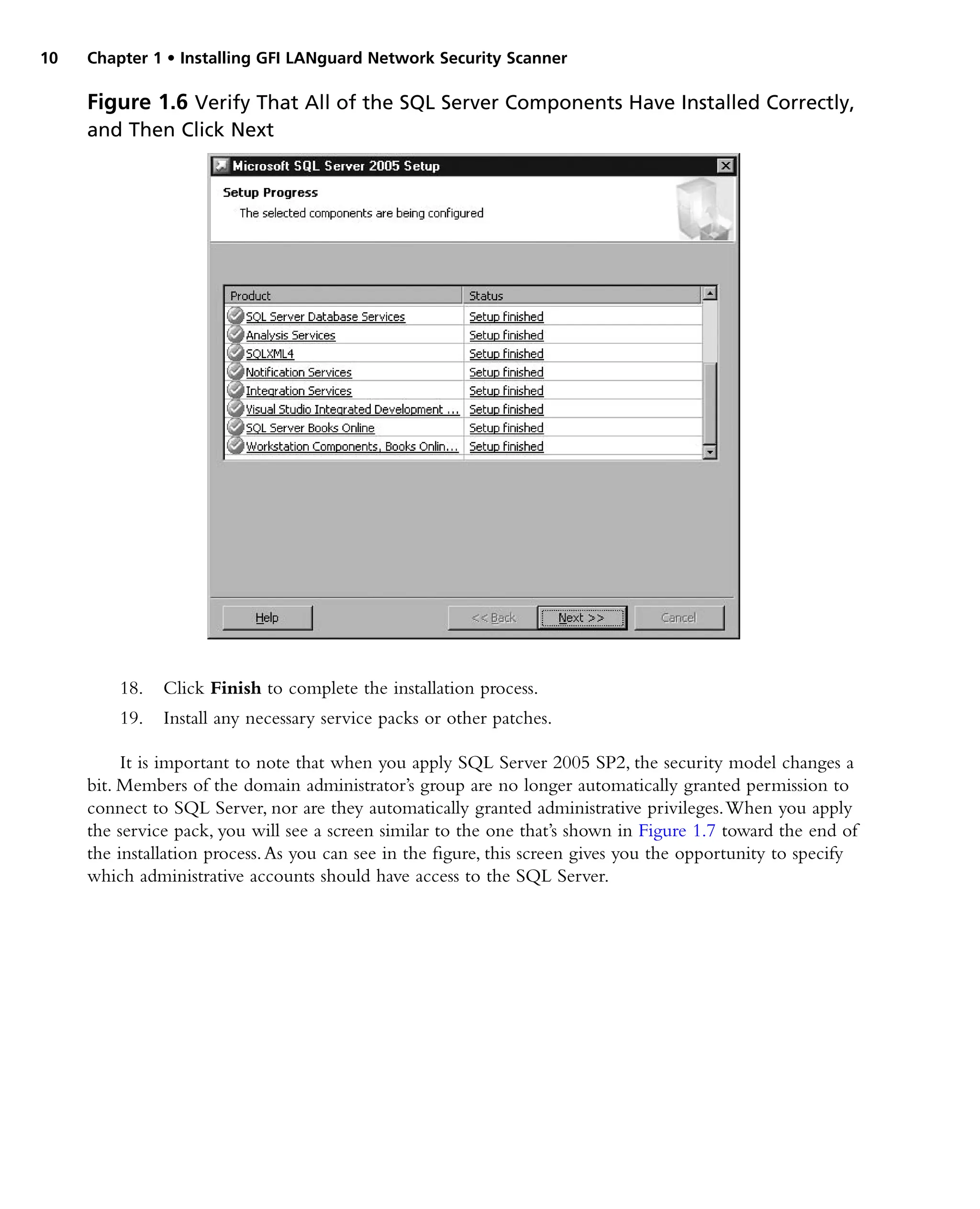
16. You should now see a summary screen that shows you which components are being
installed. Click the Install button to begin the installation process.
17. Verify that all of the components have installed correctly, as shown in Figure 1.6, and then
click Next.
Figure 1.5 Use the Service Account That You Created for GFI LANguard
Network Security Scanner
10 Chapter 1 • Installing GFI LANguard Network Security Scanner
18. Click Finish to complete the installation process.
19. Install any necessary service packs or other patches.
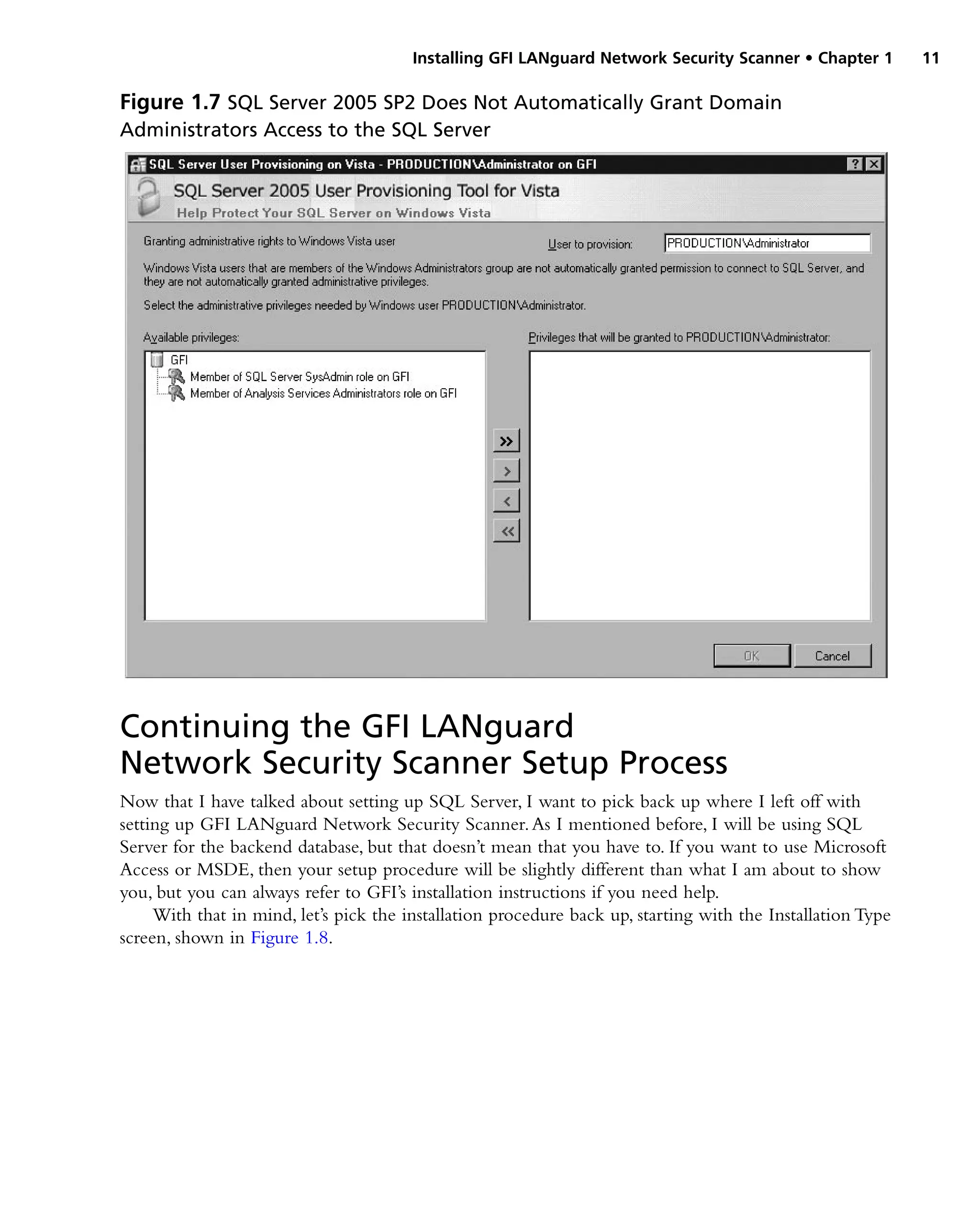
It is important to note that when you apply SQL Server 2005 SP2, the security model changes a
bit. Members of the domain administrator’s group are no longer automatically granted permission to
connect to SQL Server, nor are they automatically granted administrative privileges.When you apply
the service pack, you will see a screen similar to the one that’s shown in Figure 1.7 toward the end of
the installation process.As you can see in the figure, this screen gives you the opportunity to specify
which administrative accounts should have access to the SQL Server.
Figure 1.6 Verify That All of the SQL Server Components Have Installed Correctly,
and Then Click Next
Installing GFI LANguard Network Security Scanner • Chapter 1 11
Continuing the GFI LANguard
Network Security Scanner Setup Process
Now that I have talked about setting up SQL Server, I want to pick back up where I left off with
setting up GFI LANguard Network Security Scanner.As I mentioned before, I will be using SQL
Server for the backend database, but that doesn’t mean that you have to. If you want to use Microsoft
Access or MSDE, then your setup procedure will be slightly different than what I am about to show
you, but you can always refer to GFI’s installation instructions if you need help.
With that in mind, let’s pick the installation procedure back up, starting with the Installation Type
screen, shown in Figure 1.8.
Figure 1.7 SQL Server 2005 SP2 Does Not Automatically Grant Domain
Administrators Access to the SQL Server
12 Chapter 1 • Installing GFI LANguard Network Security Scanner
1. Choose the Microsoft SQL Server 2000 or Higher/MSDE option and click Next.
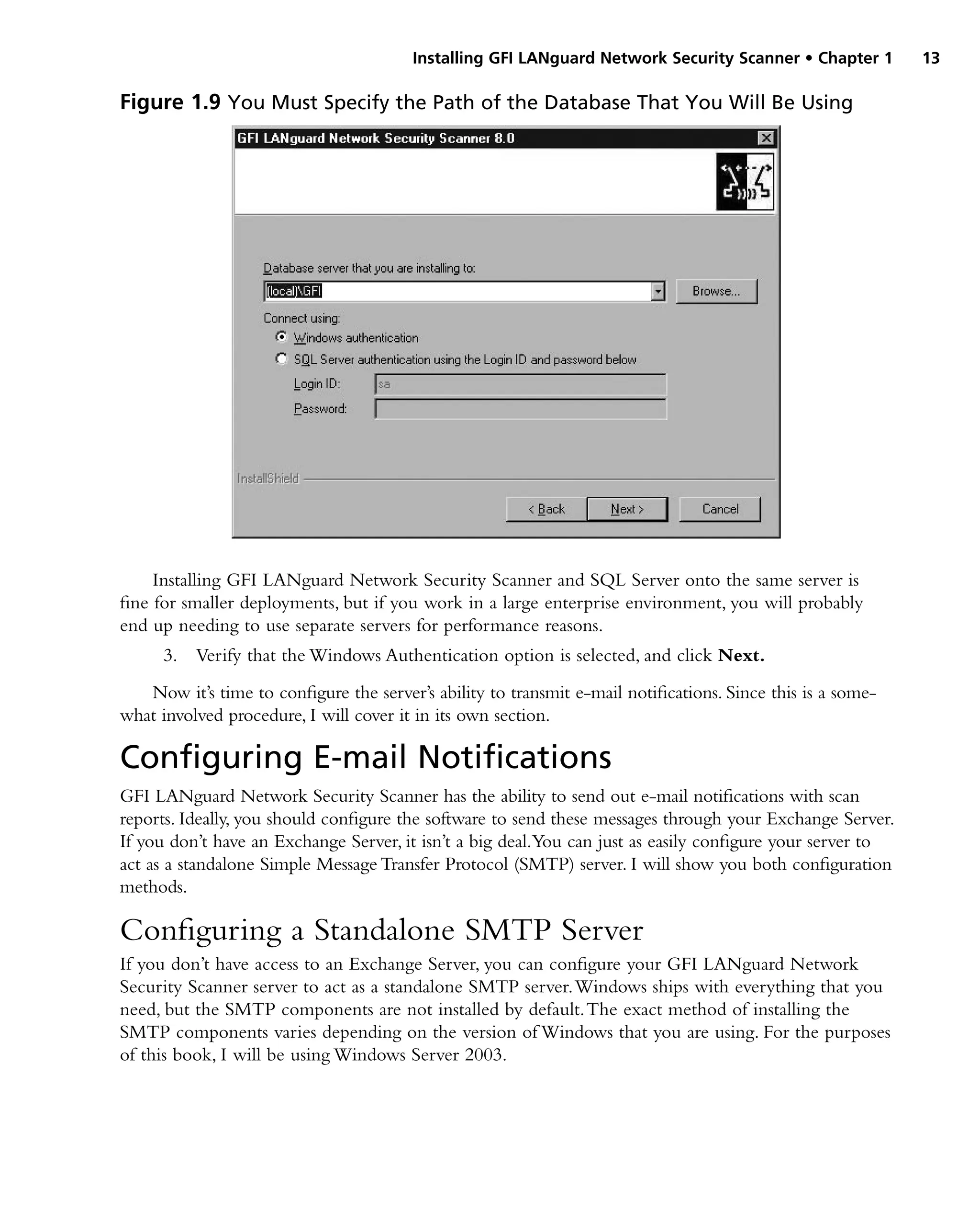
2. The following screen asks you to specify the database server that you are going to be using.
You must enter the server name in UNC format (servernameSQL server instance name).
If you installed SQL Server onto the same server that will be running GFI LANguard
Network Security Scanner, then the database path will be [local]GFI, as shown in
Figure 1.9. [local] refers to the local server, and GFI is the name of the SQL Server instance
that we installed earlier.
Figure 1.8 You Must Tell the Setup Wizard Which Type of Backend Database
You Want to Use
Installing GFI LANguard Network Security Scanner • Chapter 1 13
Installing GFI LANguard Network Security Scanner and SQL Server onto the same server is
fine for smaller deployments, but if you work in a large enterprise environment, you will probably
end up needing to use separate servers for performance reasons.
3. Verify that the Windows Authentication option is selected, and click Next.
Now it’s time to configure the server’s ability to transmit e-mail notifications. Since this is a some-
what involved procedure, I will cover it in its own section.
Configuring E-mail Notifications
GFI LANguard Network Security Scanner has the ability to send out e-mail notifications with scan
reports. Ideally, you should configure the software to send these messages through your Exchange Server.
If you don’t have an Exchange Server, it isn’t a big deal.You can just as easily configure your server to
act as a standalone Simple Message Transfer Protocol (SMTP) server. I will show you both configuration
methods.
Configuring a Standalone SMTP Server
If you don’t have access to an Exchange Server, you can configure your GFI LANguard Network
Security Scanner server to act as a standalone SMTP server.Windows ships with everything that you
need, but the SMTP components are not installed by default.The exact method of installing the
SMTP components varies depending on the version of Windows that you are using. For the purposes
of this book, I will be using Windows Server 2003.
Figure 1.9 You Must Specify the Path of the Database That You Will Be Using
14 Chapter 1 • Installing GFI LANguard Network Security Scanner
1. Begin the process by having whoever is in charge of your organization’s e-mail create a
dedicated mailbox for you that you can use for receiving server notifications. For demon‑
stration purposes, I am going to be using a mailbox with an address of Security@production.
com. I do not actually own the production.com domain, it is just the name of an internal
Active Directory domain that I use.You should use an e-mail address that reflects the mail
domain that you use in real life.
2. Once the new mailbox has been created, open the server’s Control Panel, and select the
Add or Remove Programs option.
3. When Windows displays the Add or Remove Programs dialog box, click the Add
Remove Windows Components icon.
4. After a brief delay,Windows will launch the Windows Component Wizard. Choose the
Application Server option from the list of available components. Don’t click on the
check box, just click on the words Application Server.
5. Click the Details button, and you will see the various Application Server components.
6. Click on the Internet Information Services (IIS) component. Once again, you should
click on the words, not the check box.
7. Click the Details button, and Windows will display a list of the various IIS components
that are available.
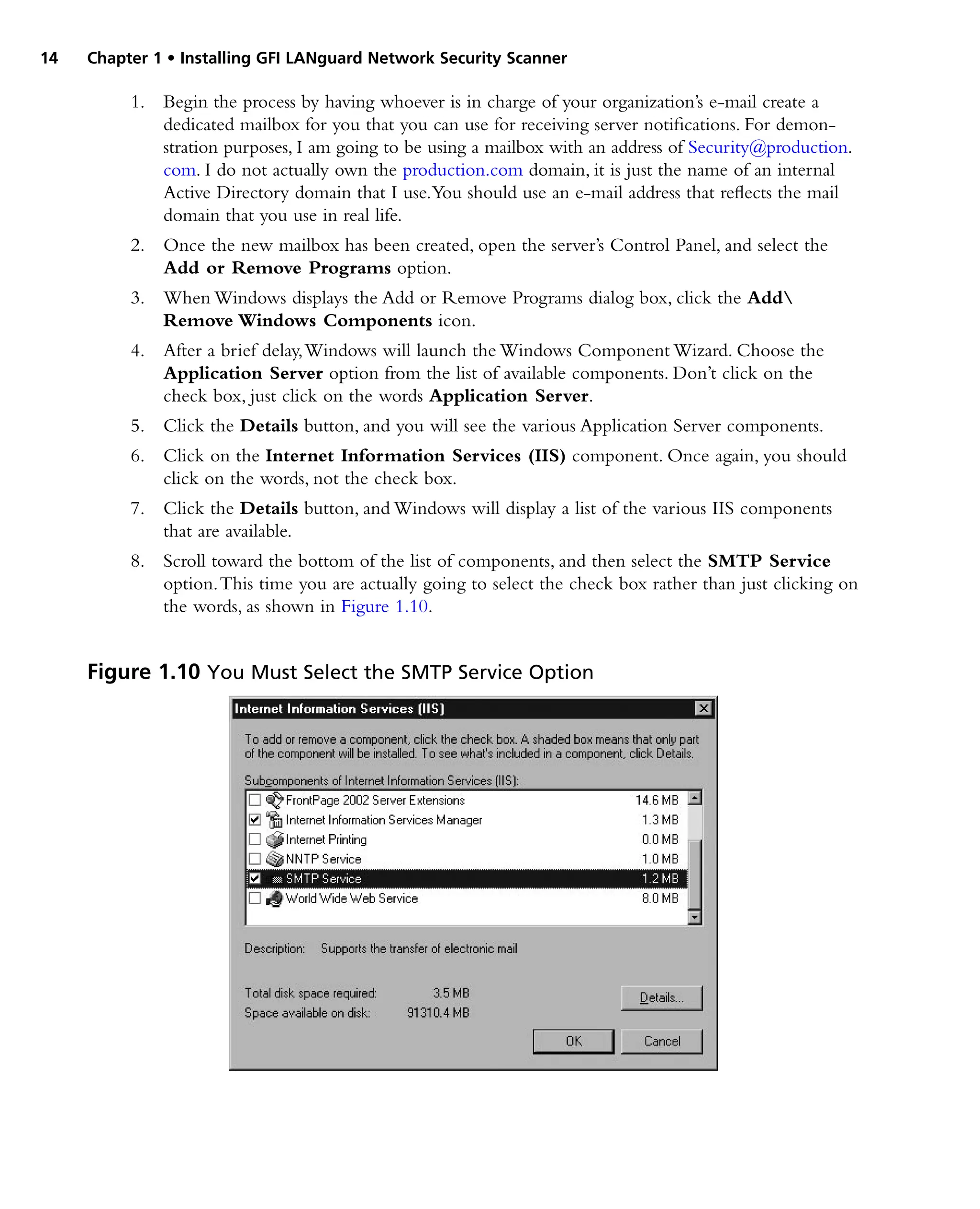
8. Scroll toward the bottom of the list of components, and then select the SMTP Service
option.This time you are actually going to select the check box rather than just clicking on
the words, as shown in Figure 1.10.
Figure 1.10 You Must Select the SMTP Service Option
Installing GFI LANguard Network Security Scanner • Chapter 1 15
9. Click OK.
10. Click OK.
11. Click Next and Windows will begin installing the necessary files. Depending on how your
server is configured, you may be prompted to insert your Windows Server 2003 installation
media.
12. When the installation process completes, click the Finish button, and close the Control
Panel.
13. Now that the SMTP Service is installed, we need to configure it. Fortunately, the configu-
ration process is pretty simple.
14. Choose the Internet Information Services (IIS) option from the server’s Administrative
Tools menu.
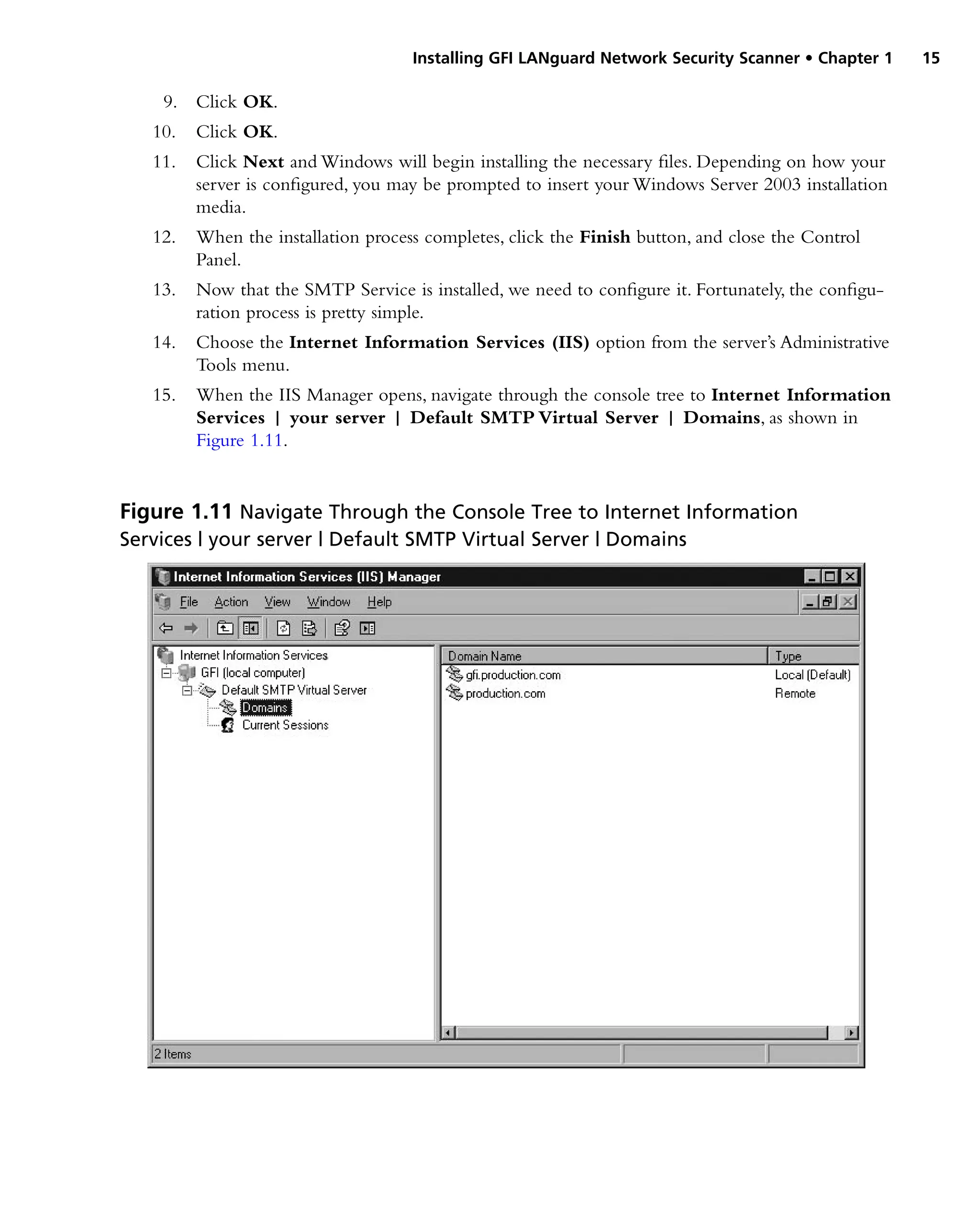
15. When the IIS Manager opens, navigate through the console tree to Internet Information
Services | your server | Default SMTP Virtual Server | Domains, as shown in
Figure 1.11.
Figure 1.11 Navigate Through the Console Tree to Internet Information
Services | your server | Default SMTP Virtual Server | Domains
16 Chapter 1 • Installing GFI LANguard Network Security Scanner
Notice in the screen capture above that when I selected the Domains container, that the pane
on the right displays two domain names.The top domain name, in this case gfi.production.com, was
placed there by default. Gfi.production.com is actually the server’s fully qualified domain name
(FQDN), but the SMTP service treats it as though it were an independent domain.
As it stands right now, the SMTP service is only capable of sending e-mail to recipients in the
gfi.production.com domain. Of course there aren’t any mailboxes in this domain, because the server
that we are configuring isn’t a full blown mail server.The SMTP component only allows us to send
mail, it does not allow for the storage of mailboxes on the server.
That being the case, we must make the SMTP Service aware of the domain that we want to send
e-mail to. In this case, we will be sending messages to an e-mail address named Security@production.
com. Since this mailbox resides in the production.com domain (or at least in an internal domain
named production.com), we need to make the SMTP Service aware of the domain’s existence. I had
already done that when I created the screen capture above.That’s why you see the production.com
domain listed in the console. Here’s how it’s done:
16. Right click on the Domains container, and choose the New | Domain options from the
resulting shortcut menus.
17. Windows will now launch the New SMTP Domain Wizard.The wizard’s initial screen asks
you if you want to specify a remote domain or an alias. Choose the Remote option, and
click Next.
18. Now enter the name of the domain that you want to send mail to, into the space provided.
19. Click Finish, and the domain that you have specified will be added to the list of domains.
20. Right click on the domain that you just added, and then select the Properties command
from the resulting shortcut menu.
21. When the domain’s properties sheet appears, select the Allow Incoming Mail to be
Relayed to this Domain check box, as shown in Figure 1.12.
Installing GFI LANguard Network Security Scanner • Chapter 1 17
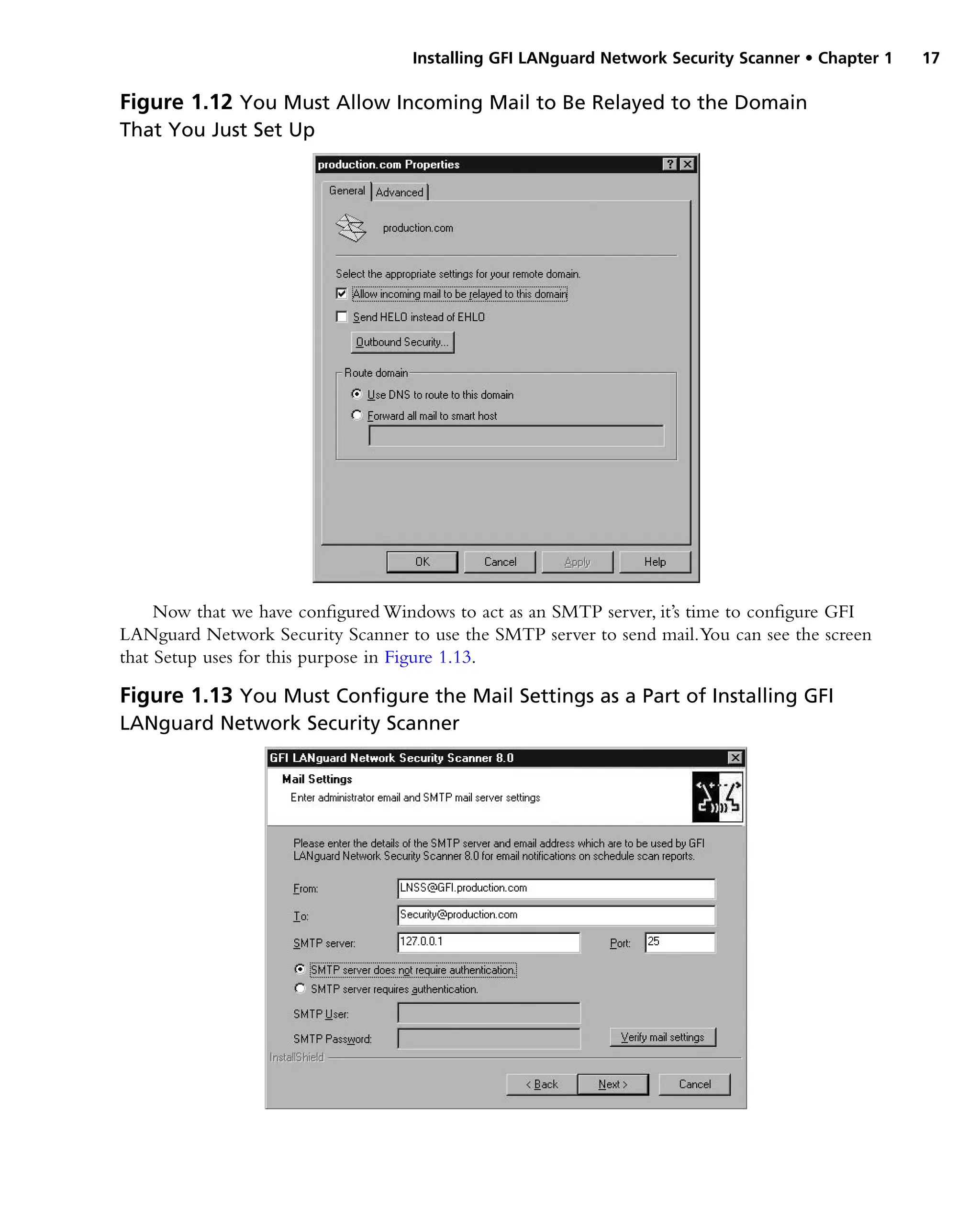
Now that we have configured Windows to act as an SMTP server, it’s time to configure GFI
LANguard Network Security Scanner to use the SMTP server to send mail.You can see the screen
that Setup uses for this purpose in Figure 1.13.
Figure 1.12 You Must Allow Incoming Mail to Be Relayed to the Domain
That You Just Set Up
Figure 1.13 You Must Configure the Mail Settings as a Part of Installing GFI
LANguard Network Security Scanner
18 Chapter 1 • Installing GFI LANguard Network Security Scanner
To configure the mail settings, follow these steps:
1. You can use any e-mail address in the From field, so long as the domain portion of the
address reflects the server’s FQDN. In this case, the server’s FQDN is gfi.production.com.
2. You must enter the destination e-mail address into the To field. Remember that you can
only send messages to e-mail addresses that use a domain that you have specified through
the IIS Manager.
3. Verify that the SMTP Server field is set to 127.0.0.1. In case you are wondering, this is
the local loopback address.You are essentially telling the server that it is the SMTP server.
As an alternative, you could enter the server’s own Internet Protocol (IP) address into this
field.
4. Make sure that the port number is set to 25. Port 25 is the port that is normally used for
SMTP traffic.
5. Select the SMTP Server Does not Require Authentication option.
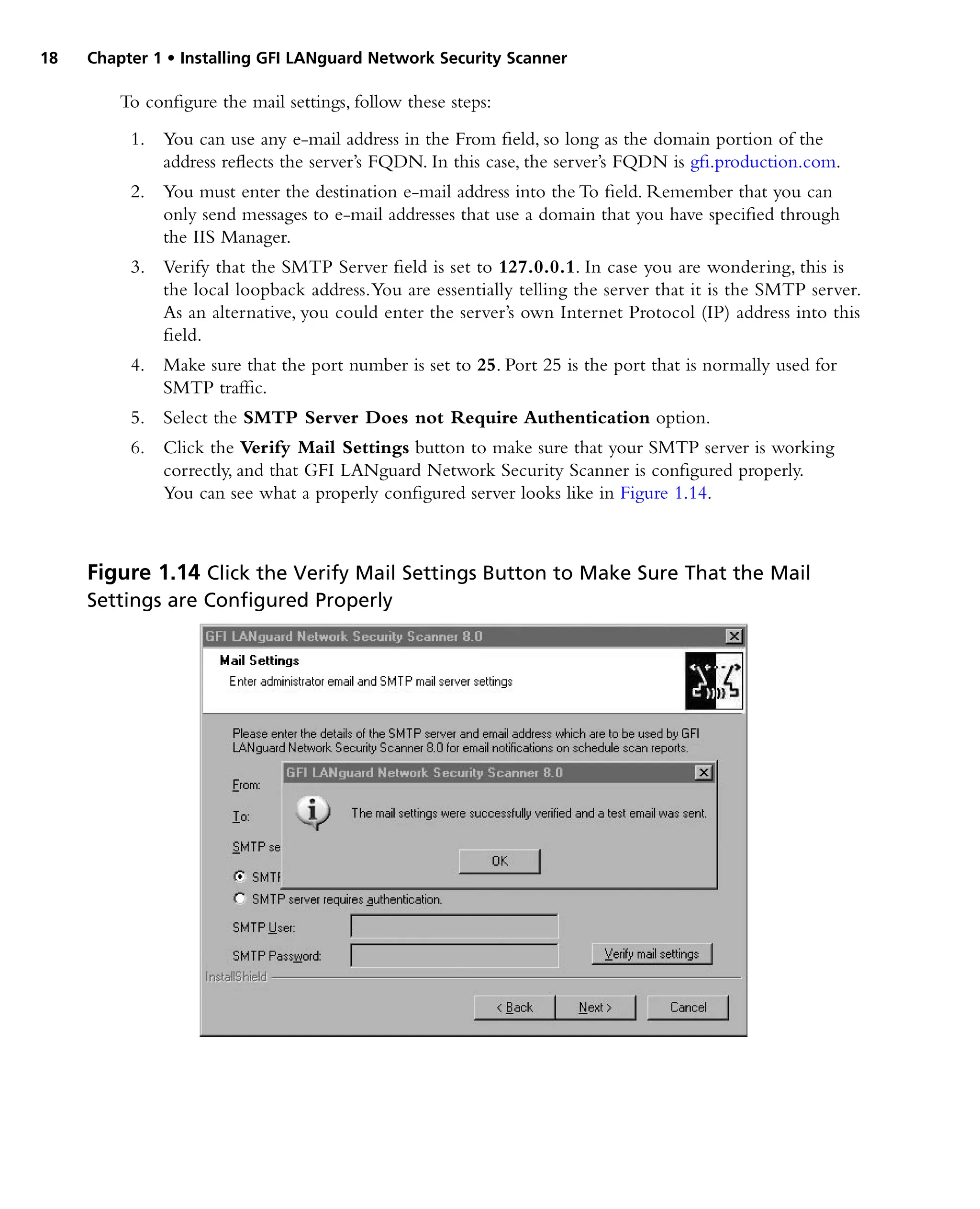
6. Click the Verify Mail Settings button to make sure that your SMTP server is working
correctly, and that GFI LANguard Network Security Scanner is configured properly.
You can see what a properly configured server looks like in Figure 1.14.
Figure 1.14 Click the Verify Mail Settings Button to Make Sure That the Mail
Settings are Configured Properly
Installing GFI LANguard Network Security Scanner • Chapter 1 19
Configuring GFI LANguard for
Use With Microsoft Exchange Server
Although I am writing this book on GFI security software, I am best known throughout the IT
community for my work with Microsoft Exchange Server.That being the case, I wanted to show you
an alternate mail settings configuration that you can use if you have an Exchange Server organization
in place.
As I mentioned earlier, my internal domain name is production.com. I therefore created an
Exchange Server mailbox with an e-mail address of Security@production.com. Since I don’t actually
own the production.com domain name, this e-mail address is only accessible from within my perimeter
network.
I’m not going to go through the steps of creating an Exchange Server mailbox, because these steps
are performed in a very different manner from one version of Exchange Server to the next. Besides, if
your company has an Exchange Server organization in place, I would think that it would be a safe
assumption that somebody in the company knows how to create a mailbox. I will tell you that my
Security@production.com mailbox resides on an Exchange 2007 server.
If your company has an Exchange Server organization in place, then the process of configuring
the mail settings for GFI LANguard Network Security Scanner will be a lot simpler than what you
saw in the previous section.That’s because in the previous section, we had to build an SMTP server
from scratch. Exchange Server is natively equipped to handle SMTP mail, so we don’t have to bother
with most of those configuration steps. In fact, the entire configuration takes place through the GFI
LANguard Network Security Scanner setup wizard.To do so, follow these steps:
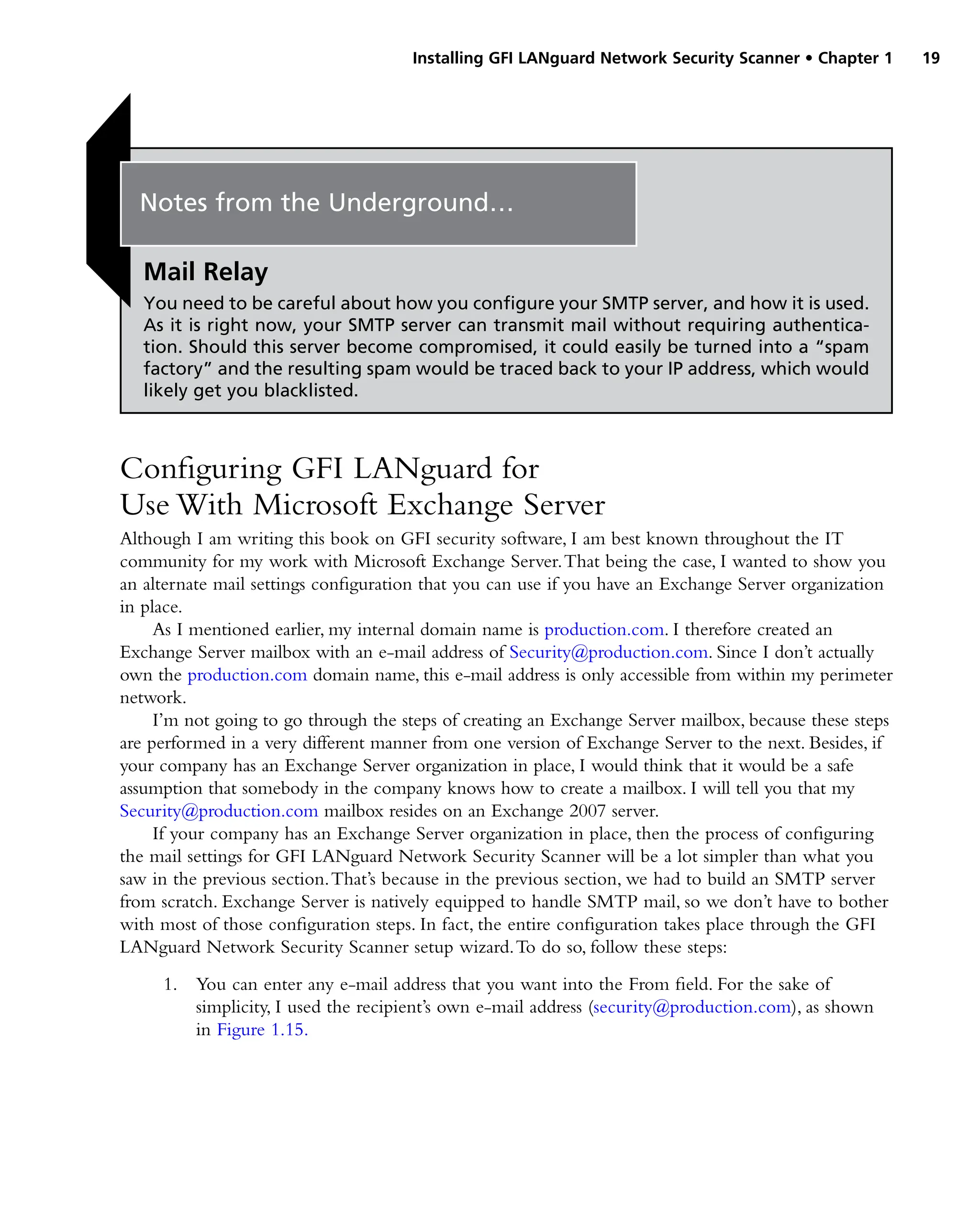
1. You can enter any e-mail address that you want into the From field. For the sake of
simplicity, I used the recipient’s own e-mail address (security@production.com), as shown
in Figure 1.15.
Notes from the Underground…
Mail Relay
You need to be careful about how you configure your SMTP server, and how it is used.
As it is right now, your SMTP server can transmit mail without requiring authentica-
tion. Should this server become compromised, it could easily be turned into a “spam
factory” and the resulting spam would be traced back to your IP address, which would
likely get you blacklisted.
20 Chapter 1 • Installing GFI LANguard Network Security Scanner
2. You must enter the e-mail address for the mailbox that you created earlier into the To field.
3. You must enter your Exchange Server’s IP address into the SMTP Server field.
4. Make sure that the Port field is set to 25.
5. Select the SMTP Server Requires Authentication option.
6. Enter the e-mail address of the recipient mailbox into the SMTP User field. Remember
that Windows allows you to substitute an e-mail address for a login name.
7. Enter the recipient’s account password into the SMTP Password field.
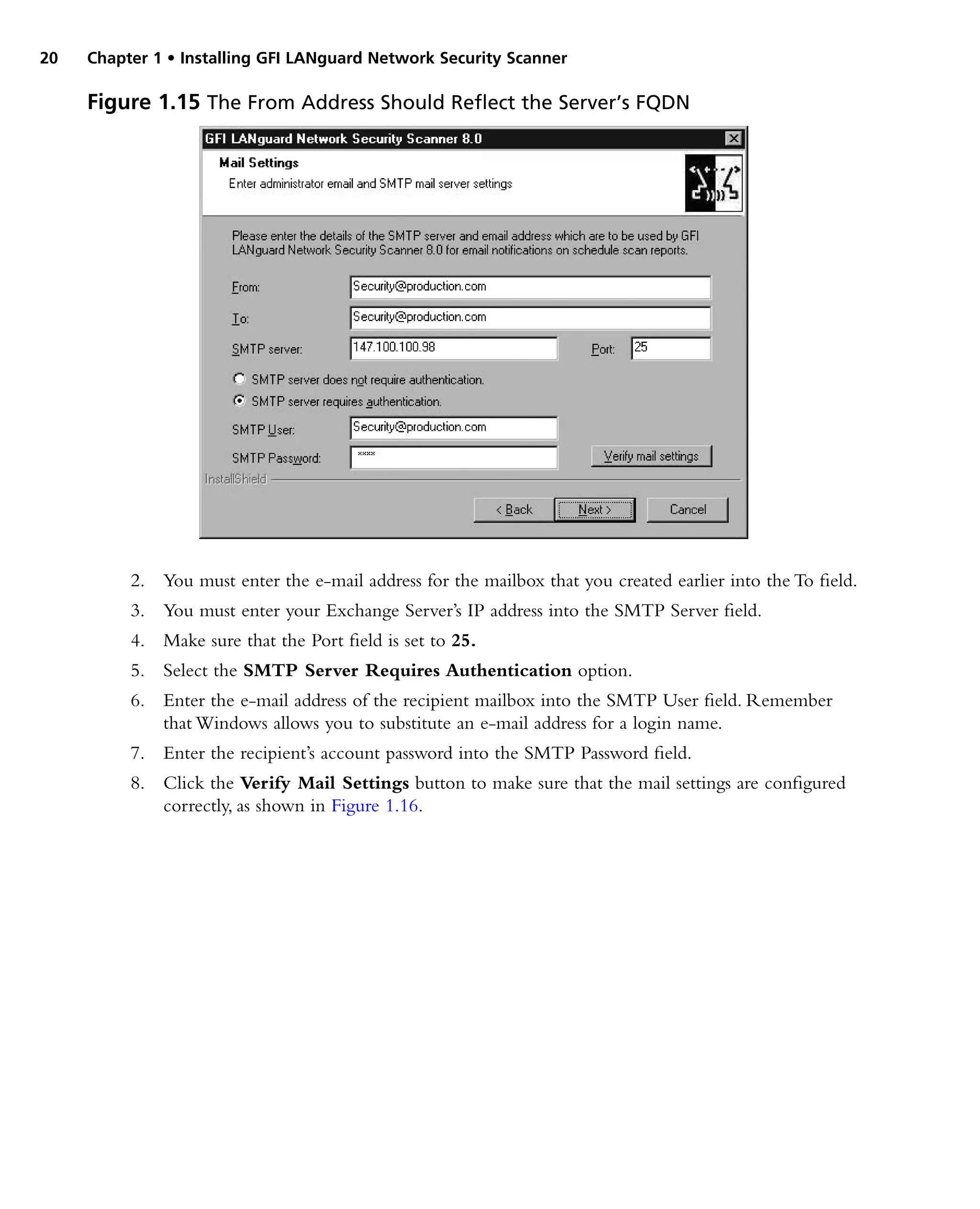
8. Click the Verify Mail Settings button to make sure that the mail settings are configured
correctly, as shown in Figure 1.16.
Figure 1.15 The From Address Should Reflect the Server’s FQDN
Installing GFI LANguard Network Security Scanner • Chapter 1 21
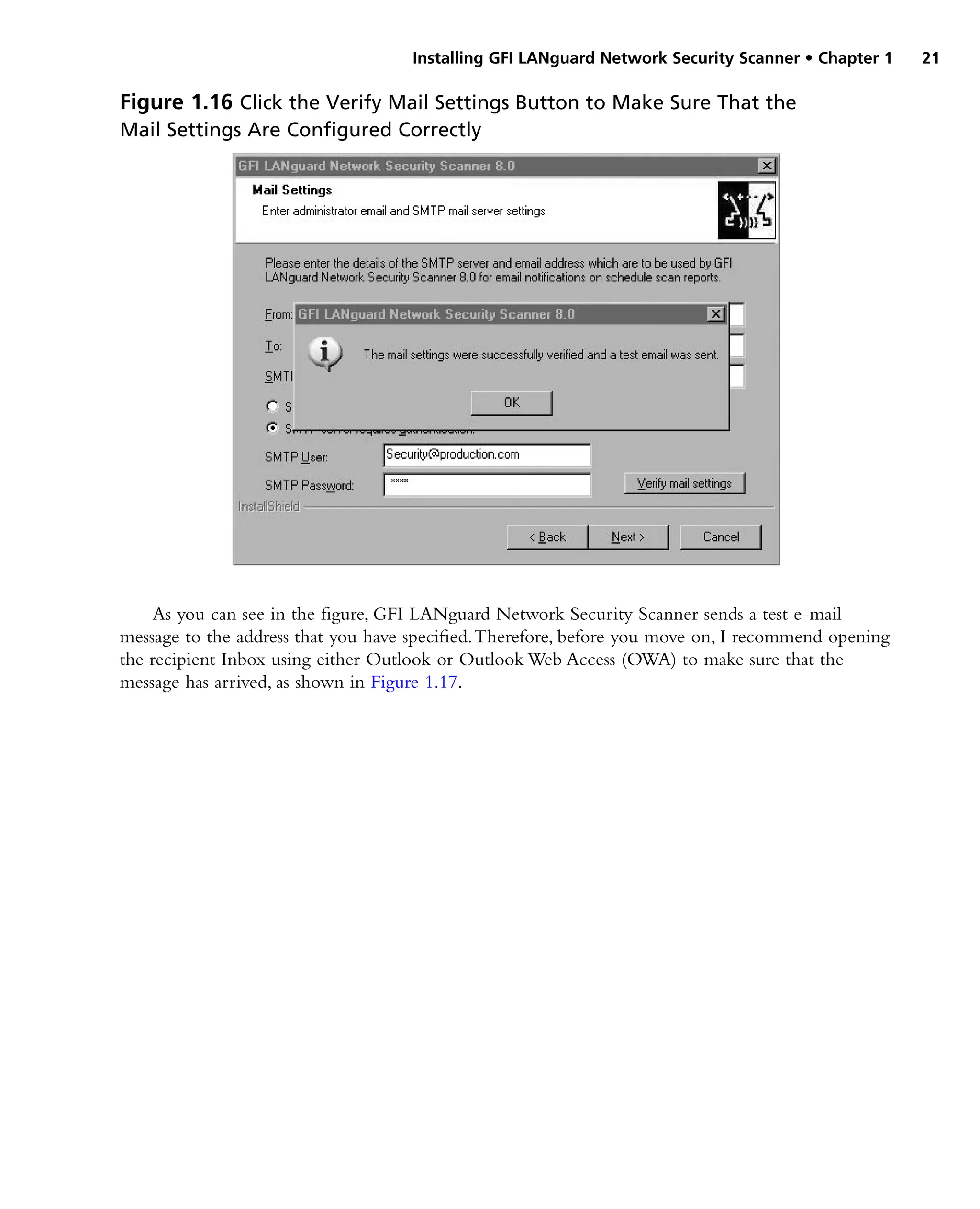
As you can see in the figure, GFI LANguard Network Security Scanner sends a test e-mail
message to the address that you have specified.Therefore, before you move on, I recommend opening
the recipient Inbox using either Outlook or Outlook Web Access (OWA) to make sure that the
message has arrived, as shown in Figure 1.17.
Figure 1.16 Click the Verify Mail Settings Button to Make Sure That the
Mail Settings Are Configured Correctly
22 Chapter 1 • Installing GFI LANguard Network Security Scanner
If you are using Exchange Server 2007, there may be one more thing that you need to do before
you will be able to receive the test message. Exchange 2007 is designed so that the hub transport only
allows secure, authenticated connections.This means that if you simply specify the IP address of a hub
transport server, the Exchange Server is going to reject the test message.
There are two ways of getting around this problem.The best option is to use the IP address of an
edge transport server as the SMTP server address. If you don’t have an edge transport server, then you
will need to allow anonymous connections to the transport pipeline.You can do this by opening the
Exchange Management Shell and entering the following command:
set-ReceiveConnector “Default <Servername>” -permissiongroups:”ExchangeUsers,
ExchangeServers,ExchangeLegacyServers,AnonymousUsers”
Figure 1.17 You Should Receive a Test Message in the Recipient’s Mailbox
Installing GFI LANguard Network Security Scanner • Chapter 1 23
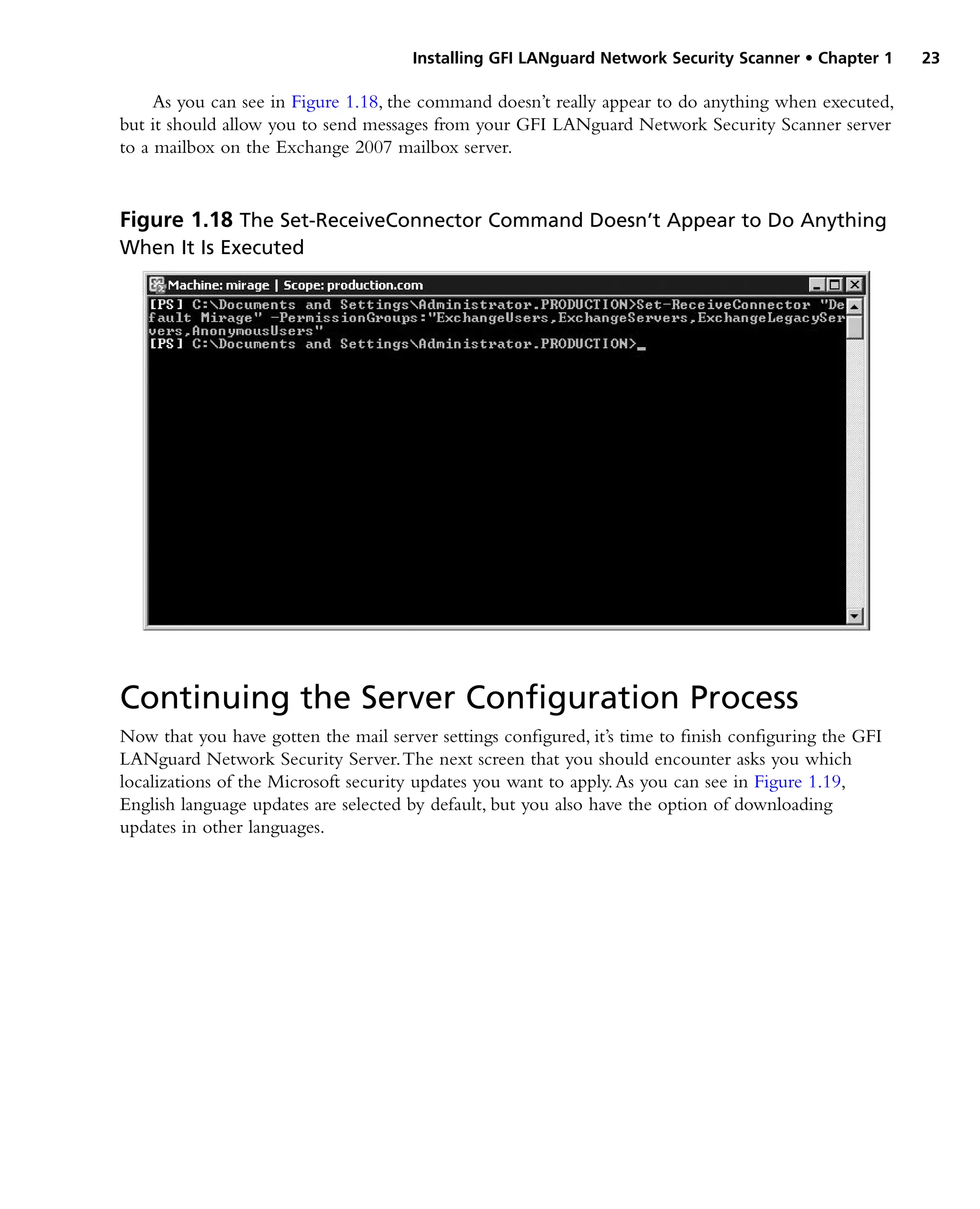
As you can see in Figure 1.18, the command doesn’t really appear to do anything when executed,
but it should allow you to send messages from your GFI LANguard Network Security Scanner server
to a mailbox on the Exchange 2007 mailbox server.
Continuing the Server Configuration Process
Now that you have gotten the mail server settings configured, it’s time to finish configuring the GFI
LANguard Network Security Server.The next screen that you should encounter asks you which
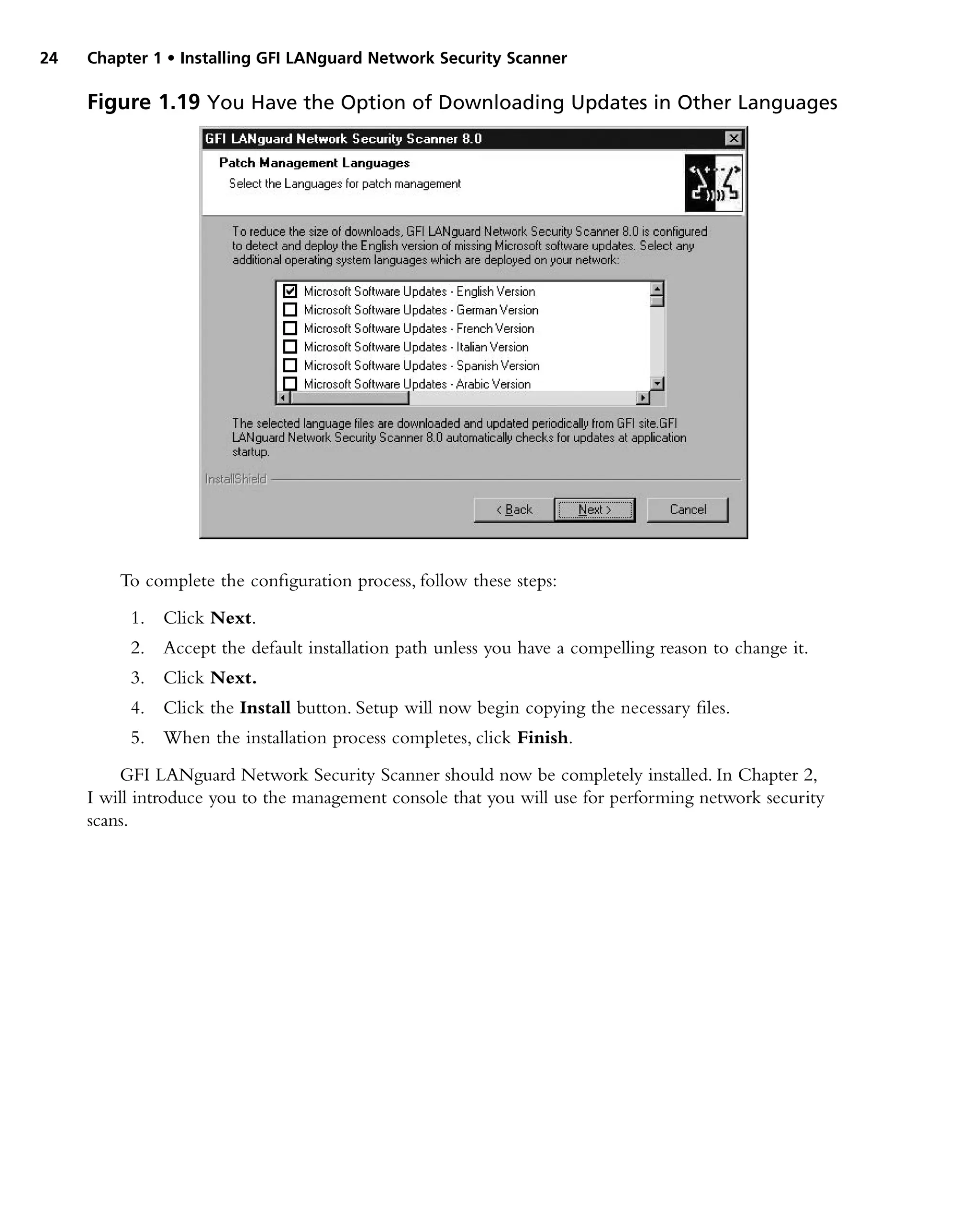
localizations of the Microsoft security updates you want to apply.As you can see in Figure 1.19,
English language updates are selected by default, but you also have the option of downloading
updates in other languages.
Figure 1.18 The Set-ReceiveConnector Command Doesn’t Appear to Do Anything
When It Is Executed
24 Chapter 1 • Installing GFI LANguard Network Security Scanner
To complete the configuration process, follow these steps:
1. Click Next.
2. Accept the default installation path unless you have a compelling reason to change it.
3. Click Next.
4. Click the Install button. Setup will now begin copying the necessary files.
5. When the installation process completes, click Finish.
GFI LANguard Network Security Scanner should now be completely installed. In Chapter 2,
I will introduce you to the management console that you will use for performing network security
scans.
Figure 1.19 You Have the Option of Downloading Updates in Other Languages
Installing GFI LANguard Network Security Scanner • Chapter 1 25
Summary
GFI LANguard Network Security Scanner isn’t one of those applications that allow you to quickly
point and click your way through the installation process.You are going to have to do some planning
as to how you want to install the software.This is particularly true in regard to how the database will
be used, and for the server’s e-mail configuration.
Solutions Fast Track
Installing GFI LANguard Network Security Scanner
Weigh your decision carefully as to which database type you want to use.
˛
˛
If you decide to use an existing SQL server, make sure that the server has the performance
˛
˛
and capacity necessary for hosting an additional database.
If your organization has its own Exchange Server, it is better to use Exchange for e-mail
˛
˛
alerts than to set up an SMTP server.
26 Chapter 1 • Installing GFI LANguard Network Security Scanner
Frequently Asked Questions
Q: I don’t have an Exchange Server, but I may want to use one later on. Is this possible?
A: Yes, the management console allows you to reconfigure your alerting options.
Q: How do I know if I need SQL Server?
A: Smaller organizations don’t have to have SQL Server. However, if your organization has more
than a hundred PCs that you will be scanning, I would recommend using SQL Server. Keep in
mind that this is just my recommendation; not GFI’s, and it certainly isn’t a requirement.
Q: The installation process seems to be taking forever. Is this normal?
A: On my lab machines, the installation process was fairly quick. Keep in mind, however, that your
server hardware has a lot to do with the speed of the installation.
Q: Can I piggyback GFI LANguard Network Security Scanner onto a server that is running other
applications?
A: It is possible, but I would recommend using a dedicated server if possible for security and
performance reasons.
Q: Can I install a SQL Server database onto the same server that is going to be running GFI
LANguard Network Security Scanner?
A: Assuming that your server has the resources to run both, then yes.
27
˛ Summary
˛ Solutions Fast Track
˛ Frequently Asked Questions
Chapter 2
An Introduction to the
GFI LANguard Network
Security Scanner
Management Console
Solutions in this chapter:
The Main Console Screen
■
■
The Configuration Screen
■
■
The Tools Screen
■
■
28 Chapter 2 • The GFI LANguard Network Security Scanner Management Console
Introduction
Now that we have worked through the installation process, I want to teach you how to use GFI
LANguard Network Security Scanner to secure your network. However, before we get started,
I want to give you a crash course in using the GFI LANguard Network Security Scanner management
console. I will be spending a lot of time on this portion of the book showing you how to perform
various tasks using the management console, so I think that it makes sense to take some time up
front to familiarize you with the console.
The Main Console Screen
You can access the management console by choosing the LANguard Network Security Scanner
command from the Start | All Programs | GFI LANguard Network Security Scanner 8.0
menu.When the management console first opens, you will see a screen similar to the one that’s
shown in Figure 2.1, asking if you want to perform a local computer scan, a complete network scan,
or a custom scan. Since we’re not quite ready to scan anything yet, click the Cancel button.You
might also have noticed in the figure, that this screen contains a check box that you can deselect if
you don’t want this screen to be displayed every time that you open the management console.
Figure 2.1 Click Cancel to Avoid Scanning Anything at This Time
The GFI LANguard Network Security Scanner Management Console • Chapter 2 29
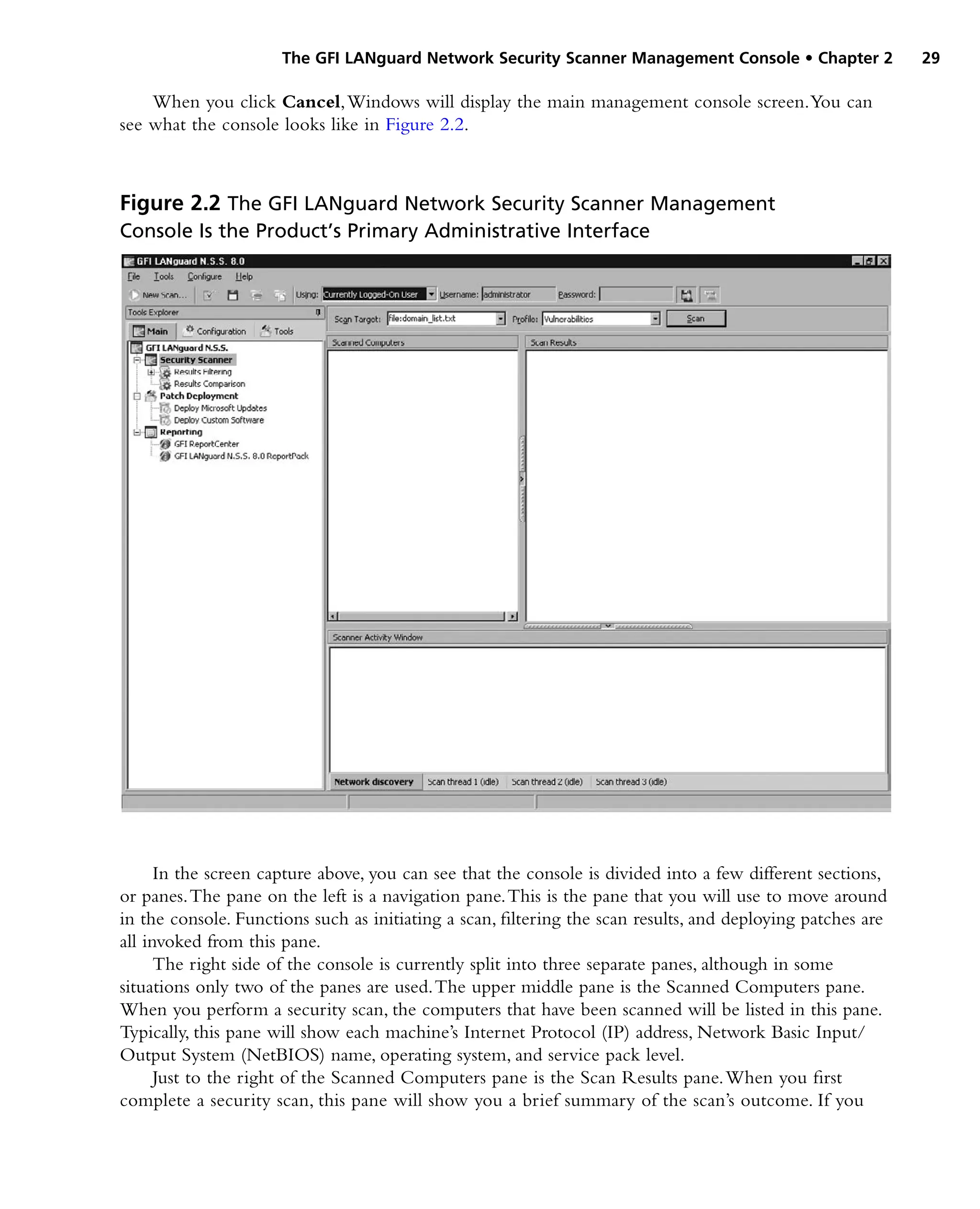
When you click Cancel,Windows will display the main management console screen.You can
see what the console looks like in Figure 2.2.
In the screen capture above, you can see that the console is divided into a few different sections,
or panes.The pane on the left is a navigation pane.This is the pane that you will use to move around
in the console. Functions such as initiating a scan, filtering the scan results, and deploying patches are
all invoked from this pane.
The right side of the console is currently split into three separate panes, although in some
situations only two of the panes are used.The upper middle pane is the Scanned Computers pane.
When you perform a security scan, the computers that have been scanned will be listed in this pane.
Typically, this pane will show each machine’s Internet Protocol (IP) address, Network Basic Input/
Output System (NetBIOS) name, operating system, and service pack level.
Just to the right of the Scanned Computers pane is the Scan Results pane.When you first
complete a security scan, this pane will show you a brief summary of the scan’s outcome. If you
Figure 2.2 The GFI LANguard Network Security Scanner Management
Console Is the Product’s Primary Administrative Interface
30 Chapter 2 • The GFI LANguard Network Security Scanner Management Console
click on an individual computer in the Scanned Computers pane, the information in the Scan
Results pane will change to display information related specifically to the currently selected machine.
The pane in the lower right portion of the management console is the Scanner Activity pane.
This pane isn’t always used, but when it is used, it will show you how the current scan is progressing.
The management console offers a lot of other functions, but it has been my experience that
99 percent of the time when you are working with the management console, you will be using the
four panes that I have just described.
The Configuration Screen
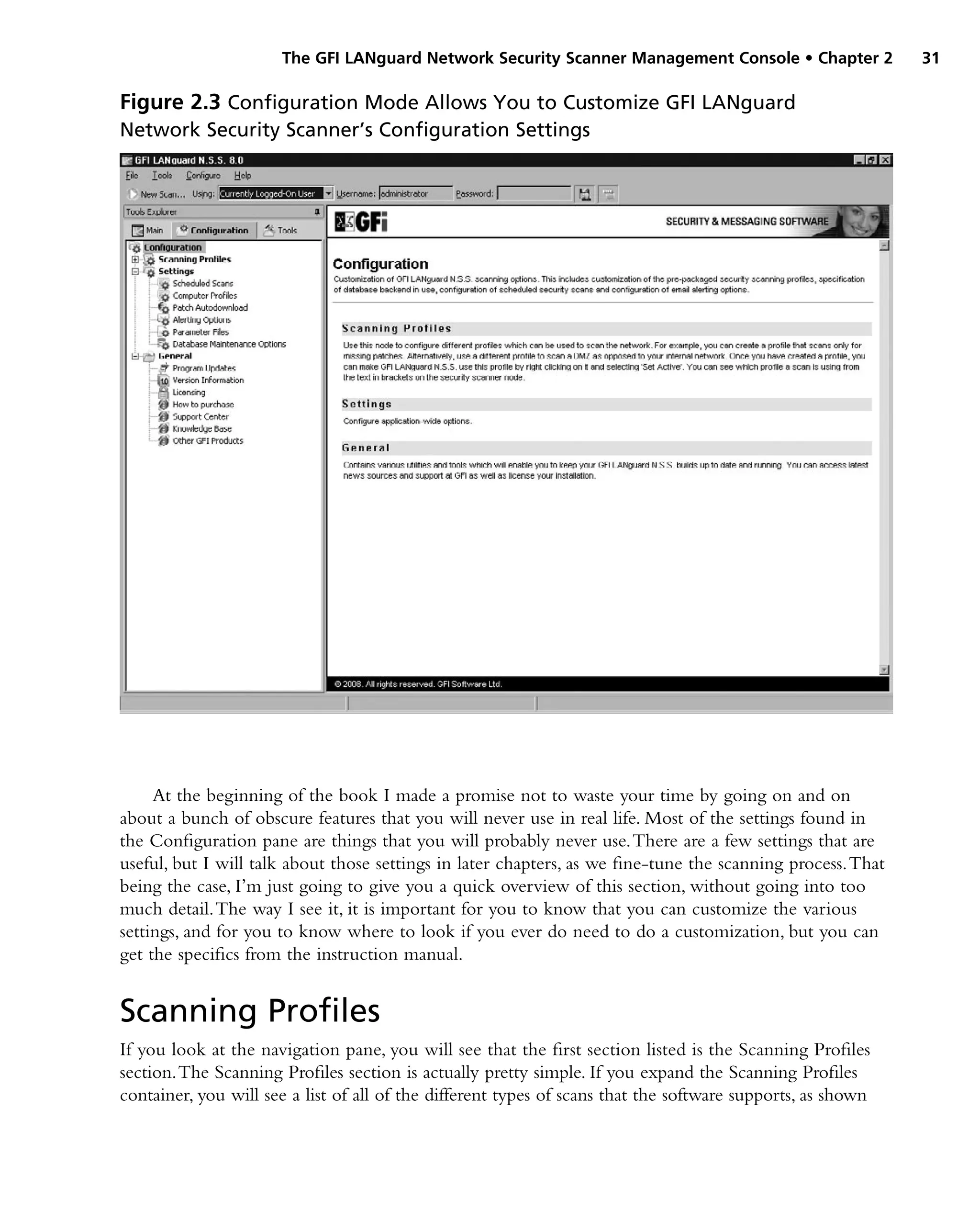
If you look just above the navigation pane, you will notice three links; Main, Configuration, and
Tools. If you click the Configuration link, it puts the console into configuration mode, as shown in
Figure 2.3.
Tools & Traps…
Screen Resolution
Most servers aren’t exactly known for using high-end video cards, or even offering
anything beyond minimal screen resolution. However, in the case of using the man-
agement console, screen resolution is relatively important. Once you begin scanning
the computers on your network and analyzing the results, you will see that the man-
agement console attempts to display a lot of information. At lower resolution levels,
a lot of this information will not fit on the screen. Your server console (or remote
server session) will need to be running a display resolution of at least 1024 x 768, but
higher resolutions work even better.
The GFI LANguard Network Security Scanner Management Console • Chapter 2 31
At the beginning of the book I made a promise not to waste your time by going on and on
about a bunch of obscure features that you will never use in real life. Most of the settings found in
the Configuration pane are things that you will probably never use.There are a few settings that are
useful, but I will talk about those settings in later chapters, as we fine-tune the scanning process.That
being the case, I’m just going to give you a quick overview of this section, without going into too
much detail.The way I see it, it is important for you to know that you can customize the various
settings, and for you to know where to look if you ever do need to do a customization, but you can
get the specifics from the instruction manual.
Scanning Profiles
If you look at the navigation pane, you will see that the first section listed is the Scanning Profiles
section.The Scanning Profiles section is actually pretty simple. If you expand the Scanning Profiles
container, you will see a list of all of the different types of scans that the software supports, as shown
Figure 2.3 Configuration Mode Allows You to Customize GFI LANguard
Network Security Scanner’s Configuration Settings
32 Chapter 2 • The GFI LANguard Network Security Scanner Management Console
in Figure 2.4. If you click on an individual scanning profile, the pane on the right will display the
various elements that make up the scan.As you can see in the figure, you can select or deselect the
various check boxes to control which elements are scanned as a part of the profile.
Figure 2.4 You Can Enable or Disable the Individual Components
of a Scanning Profile
Tip
It’s easy to miss, but there are several tabs listed above the individual elements of
the scanning profile. Each of these tabs contains more elements that you can enable
or disable.
The GFI LANguard Network Security Scanner Management Console • Chapter 2 33
The Settings Section
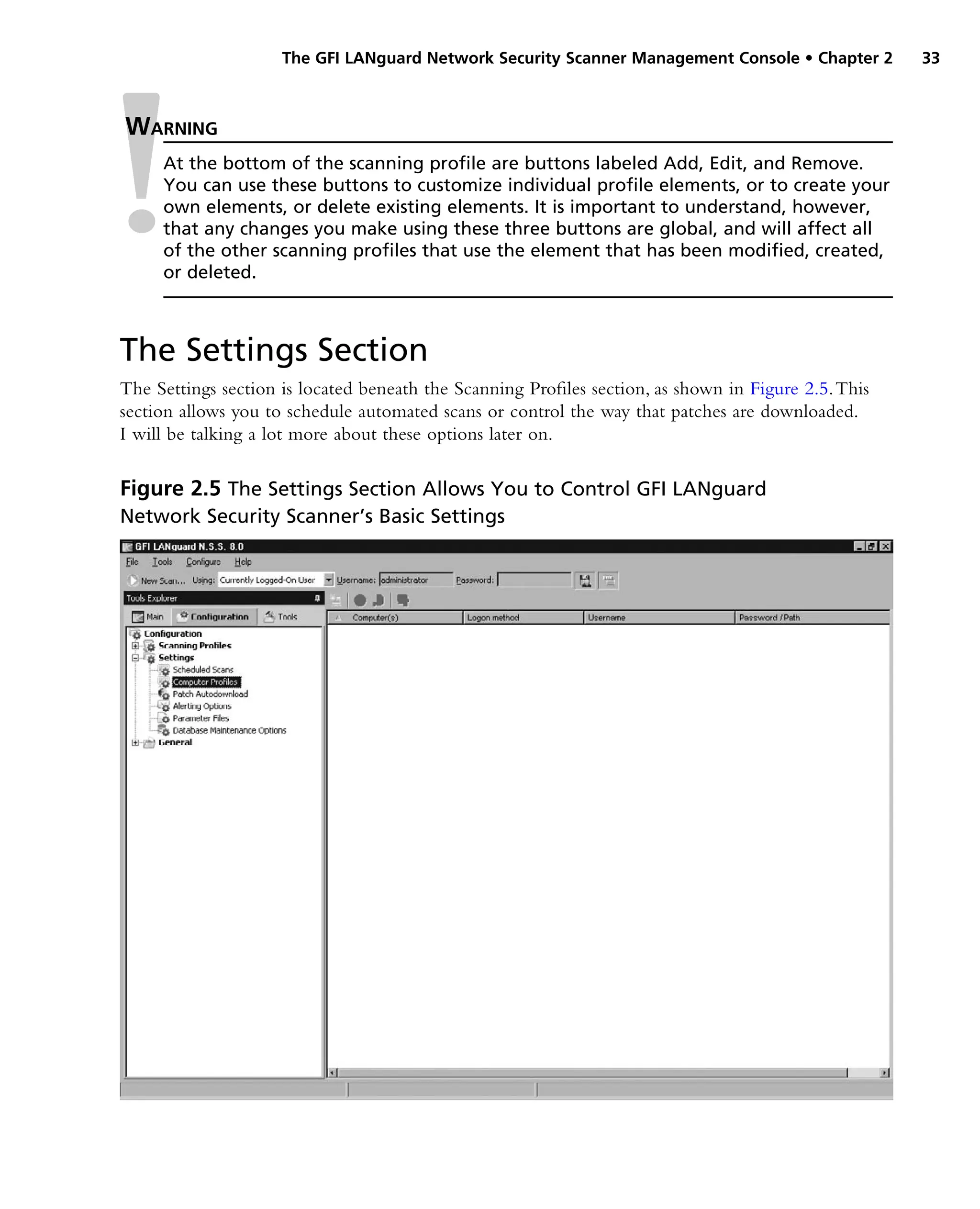
The Settings section is located beneath the Scanning Profiles section, as shown in Figure 2.5.This
section allows you to schedule automated scans or control the way that patches are downloaded.
I will be talking a lot more about these options later on.
Warning
At the bottom of the scanning profile are buttons labeled Add, Edit, and Remove.
You can use these buttons to customize individual profile elements, or to create your
own elements, or delete existing elements. It is important to understand, however,
that any changes you make using these three buttons are global, and will affect all
of the other scanning profiles that use the element that has been modified, created,
or deleted.
Figure 2.5 The Settings Section Allows You to Control GFI LANguard
Network Security Scanner’s Basic Settings
34 Chapter 2 • The GFI LANguard Network Security Scanner Management Console
This section also allows you to change some of the things that you configured during the initial
setup process, such as the various alerting and database options.
Computer Profiles
One other feature that I want to mention is the Computer Profiles option. Normally, when you
perform a network scan, GFI LANguard Network Security Scanner will have no trouble detecting
and scanning the computers on your network. However, in some cases, you may have a computer
that uses a non-standard administrative password, or that is running a non-Windows operating system
such as Linux. If you have trouble scanning such a machine, you can create a computer profile for the
machine. Creating a computer profile basically just involves specifying the target computer’s identity,
and the authentication credentials that should be used to connect to that computer.To create a
computer profile, follow these steps:
1. Right-click on the Computer Profile container, and choose the New | Computer
Profile(s) options from the resulting shortcut menus.
2. When the Computer Profile properties sheet opens, enter the name or IP address of the
target computer into the space provided.
3. Select the properties sheet’s Logon Credentials tab.
4. Specify the authentication credentials for the target computer, as shown in Figure 2.6.
5. Click OK.
Figure 2.6 A Computer Profile Allows You to Specify the Credentials
That Should Be Used for Connecting to a Specific Machine
The GFI LANguard Network Security Scanner Management Console • Chapter 2 35
The General Section
The General section of the Configuration screen, shown in Figure 2.7, is primarily designed to give
you information about the product.As you can see in the figure, this section contains links to various
purchase- and support-related Web pages.There are also some containers that you can click on to see
what updates have been applied, which version of the software you are running, or even to update
your license key.
Figure 2.7 The General Section Is Where You Go to Get Information about
the Software Version, or about Your Support and Licensing Options
The Tools Screen
The Tools screen, shown in Figure 2.8, provides you with several common diagnostic tools. Before
you get too excited, however, let me point out that these tools are all available in other forms. In fact,
many of them are included with Windows.
36 Chapter 2 • The GFI LANguard Network Security Scanner Management Console
So why did GFI decide to include these tools in LANguard Network Security Scanner? Well,
I haven’t actually asked any of the product developers, but there are at least two different reasons that
seem logical.
First, it’s handy to have a collection of diagnostic tools all in one place. Besides that, if you look
at which tools are included, you will notice that although most of these tools were originally
designed for diagnostic purposes, many of them can be used to help test your network’s security.
Another reason why I think that GFI included these tools in the management console is to
make the tools easier to use.A lot of the tools are typically used from the command line, but GFI
has provided us with a nice GUI interface to each tool. For example, the first tool on the list is
Domain Name System (DNS) lookup.You can perform a DNS lookup from within Windows by
using the NSLOOKUP command. However, if you don’t know how the command works, or if you
have a chronic case of command-line aversion, then using NSLOOKUP may not be an option.
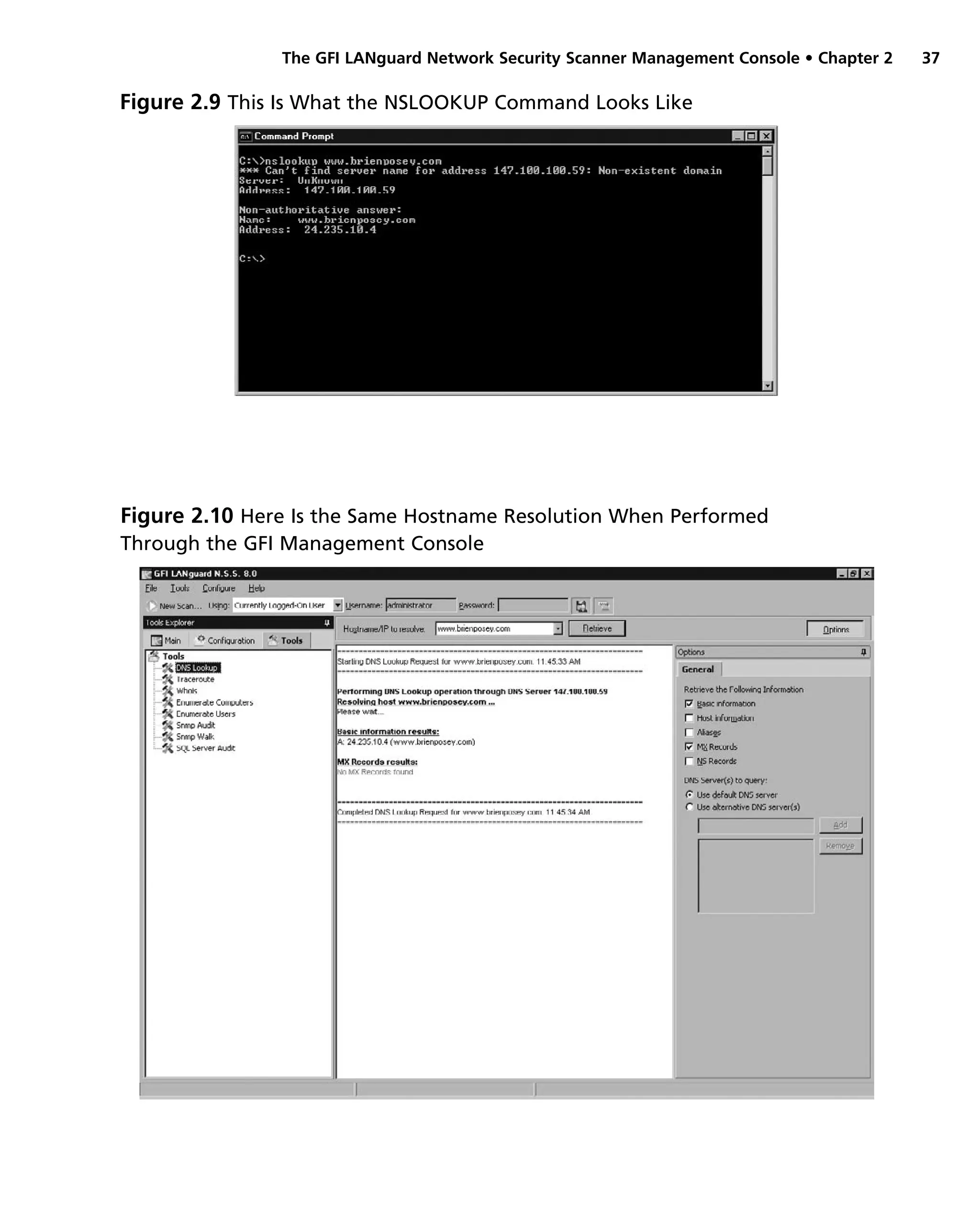
If you look at Figure 2.9, you can see what NSLOOKUP looks like when run from a command
prompt. Figure 2.10 shows the exact same host name resolution when run through the GFI
management console.As you can see, both resolutions returned the same results.The only difference
is that the management console displayed the results within the GUI.
Figure 2.8 The Tools Container Provides You with a Variety of Diagnostic Tools
The GFI LANguard Network Security Scanner Management Console • Chapter 2 37
Figure 2.10 Here Is the Same Hostname Resolution When Performed
Through the GFI Management Console
Figure 2.9 This Is What the NSLOOKUP Command Looks Like
Another Random Scribd Document
with Unrelated Content
The Project Gutenberg eBook of Spiritual
Victories Through the Light of Salvation
This ebook is for the use of anyone anywhere in the United States
and most other parts of the world at no cost and with almost no
restrictions whatsoever. You may copy it, give it away or re-use it
under the terms of the Project Gutenberg License included with this
ebook or online at www.gutenberg.org. If you are not located in the
United States, you will have to check the laws of the country where
you are located before using this eBook.
Title: Spiritual Victories Through the Light of Salvation
Author: J. Church
Release date: October 1, 2018 [eBook #58001]
Language: English
Credits: Transcribed from the 1810 Ann Kemmish edition by David
Price
*** START OF THE PROJECT GUTENBERG EBOOK SPIRITUAL
VICTORIES THROUGH THE LIGHT OF SALVATION ***
Transcribed from the 1810 Ann Kemmish edition by David Price,
email ccx074@pglaf.org
SPIRITUAL VICTORIES,
THROUGH THE
Light of Salvation.
BEING THE SUBSTANCE OF A
SERMON,
Preached on SUNDAY, March the 11th, 1810,
AT THE
OBELISK CHAPEL,
By J. CHURCH,
Minster of the Gospel.
PUBLISHED BY REQUEST.
“O House of Jacob, come ye, let us walk in the Light of the
Lord.”
SOUTHWARK:
Printed by ANN KEMMISH, King-Street, Borough.
1810.
PREFACE.
TO those Friends who requested the Publication of this Sermon—I
have only to say, I have endeavored to recollect a considerable part
of it; many ideas I have omitted, and others I have introduced, as I
had not the least intention of making this public, nor should I but for
your very pressing solicitation. I would remark by way of Preface,
that the success of Sermons, in point of usefulness, depends upon
the operations of God the divine Spirit; and these influences are
entirely sovereign. That although this Sermon was blest to you in
the hearing, it may not be so to you in the reading—nevertheless, as
the friends of immortal truth—you being in the possession of that
love (which rejoiceth in the truth) will also rejoice in every attempt
to exalt the Person of Jesus as the truth; to comfort and establish
Believers in the truth, and to encourage all the heralds of truth, to
be faithful unto death. I have sent forth the truth in a very plain
style; to you who know her excellencies she will shine with unfading
charms; while you adore the God of all grace—and I subscribe
myself,
Your willing Servant in the cause of truth,
J. CHURCH.
A SERMON.
Judges viith Chap. 20th Verse.
“And the three companies blew the trumpets, and brake the
pitchers, and held the lamps in their left hands, and their
trumpets in their right, to blow withal; and they cried, The
Sword of the Lord and of Gideon!”
The history of the church of God, in all ages past, as recorded in the
Scriptures, is intended by the Spirit to exhibit many things of vast
importance to us, on whom the ends of the world are come.
First.—The rebellion, ingratitude, and idolatry of the Israelites, give
us an awful proof of human depravity, and teach an humbling lesson
to the spiritual Israel, who have the same sinful nature, are prone to
the same sins, and would often fall into them and their
consequences, but for the grace of God.
Secondly.—The patience and long-suffering of God, particularly
marked out in this history—he bare long with them; his mercy was
extended, prolonged, and manifested to them, notwithstanding all
their provocations, in forgetting his deliverances of them in times
past, and practising the same sins he had before resented.
Thirdly.—His disapprobation of their conduct, and the means he took
to testify it, are set before us. Our God is never at a loss for means
to accomplish his wise and holy purposes of justice or mercy, as is
evident from the history before us. The blessed Spirit operating
upon the souls of his people, often by his influence reproves their
consciences of sin, as it is so opposite to the purity of that divine
nature, or holy principle he has blessed them with. Sin, committed
by a believer, is a transgression of the law, or dictates of faith; for
there is no sin, condemned under the first covenant, but what,
under the covenant of grace, is pointed out in more odious colours.
—Hence the idolatry, rebellion, and ingratitude of the believer, are
seen and lamented by him as a child of God; and as God the Spirit
communicates light to his understanding, to discover it as sinful, he
perpetually testifies that his sins are more sinful than those who
know not God.
Fourthly.—The inseparable connection between sin and sorrow, is felt
by all, both elect and non-elect. By nations, families, and
individuals, the moral and penal evils of the Fall, will be, must be,
and are felt by all. The non-elect feel it in many awful forms, as
transgressors, in the curse of the ground, in the calamities of war, in
all the dreadful horrors of a guilty conscience, and in the wrath of a
sin-avenging God. Nations feel it universally; this is evident by the
calamities which befell the land of Canaan—so the 6th Chapter
begins: “And the children of Israel did evil in the sight of the Lord;
and the Lord delivered them into the hand of Midian.” Their sin was
resented in this form, by the Lord—the prevailing of their enemies,
which forced them to hide in dens, caves, mountains, and strong
holds—their enemies destroyed the increase of their country, and
reduced them almost to a famine; “and Israel was greatly
impoverished because of the Midianites” and people of Arabia.
Fifthly.—The tender mercy of God the Saviour appears as
remarkable in their deliverance; in the remembrance of his covenant
of old, with their fore-fathers; his good hand was seen in bringing
them out of trouble, although they had brought these troubles on
themselves—what a solemn, but gracious proof; “O! Israel, thou
hast destroyed thyself! but in me is thine help.” And what
encouragement does this give to poor backsliders to return to Jesus,
their first husband; for although they have brought these troubles on
themselves, yet Jesus is ready to deliver them! What a striking
account does the pious Nehemiah give of the conduct of the
Israelites, and the goodness of God to man—9th chap. 28th verse;
“But after they had rest, they did evil again before thee, therefore
thou leftest them in the hands of their enemies, so that they had
dominion over them; yet when they cried unto thee thou heardest
them from heaven; and many times thou didst deliver them,
according to thy tender mercies.”
Sixthly.—I remark again, that our God has ever manifested himself a
God, hearing prayer: the children of Israel cried unto the Lord, and
the Lord sent a prophet to them; and after reproving them, we have
an account of a deliverer, raised up by the Lord himself. What
encouragement does this give to us in all our trials, without and
within, whether in body, soul, circumstances, family, or nation. God
has even condescended to hear the cries of many who had no grace,
yet, led by the light of nature to call on him in trouble; and will he
turn a deaf ear to his saints in trouble? surely not. Believer, the
remedy’s before thee—PRAY.
In taking one more view of this history, we must admire the conduct
of God in over-turning all the schemes of men, their wisdom,
counsel, and power: that in providence as well as in grace, his
wisdom, power, and faithfulness, might be clearly seen and adored
by his people. His wisdom in the permission of the Fall, and its
awful consequences, seems to go before, and make way for the
displays of his love, mercy, power, and faithfulness. This is seen in
his dispensations, generally, and particularly in grace & providence.
How often has infinite wisdom permitted heavy troubles to come on
the Church, to wean her from the creature—to shew her the value of
Jesus, as a deliverer—and to lead her to him by many intreaties;
that while we feel our strength perfect weakness, we may the more
clearly discover the good hand of our God, in our support and
deliverance, and give him the glory due to his name for it. The
principal end God has in view in all his dispensations, is his own
glory—this is the first cause and last grand end of all things—“for of
him, and through him, and to him, are all things.” Had the victory
we are considering been gained by well disciplined men, led on by
wise, noble, valiant generals, who had often been successful in war
—had this been the case, the creature would have been extolled,
and God nearly forgotten. But this victory was a display of the
power of Jehovah—his hand clearly seen, his mercy displayed, and
all the honor given to him to whom it is due. The means, the feeble
means the Lord made use of were simply, a weak un-armed man,
with only three hundred men, led by him, with lamps, trumpets, and
pitchers—to carnal reason a very unlikely method to conquer two
hundred thousand Midianites, well skilled in the art of war. But this
was God’s method, and we have a right to submit our wisdom to
God’s plan; “for my thoughts are not as your thoughts, nor my ways
as your ways, saith the Lord; for as the heavens are high above the
earth, so are my ways above your ways.” And this victory, through
such feeble means, is a confirmation of this truth—the angel
Jehovah Jesus, appeared to Gideon as he was threshing wheat, in a
secret place, to hide it from the enemy; and assured him, that
however mean himself and family were, he should deliver Israel
from their present servitude. Gideon, astonished at such an
appearance, such a salutation, and such a declaration, began to ask,
“How this could be?” The blessed Jesus tells him, “Surely I will be
with thee.” Gideon, like the rest of God’s people, could not give God
the credit of God, nor take him at his word—he could not honor him
by believing on him, and prays, “If I have found grace in thy sight,
shew me a sign that thou talkest with me.”—As believers in Jesus,
we are called to walk by faith, and not by sight, as seeing him who
is invisible, or out of sight—depending on his word, oath, and
faithfulness, as the word of a covenant God, who cannot lie: this is
honoring Jesus—yet God condescended to give Gideon the request
of his lips; and to confirm his faith, he, with a rod, touched the rock,
and caused fire to come out of it, and, consume the slain Kid and
unleavened cakes, all moistened with the broth, which Gideon, at his
command, had put thereon. Gideon was fearful and apprehensive of
immediate death, as he had seen an angel; but the Lord kindly
assured him that he was in no danger.—How strange and groundless
the fears of God’s people—frequently they take covenant-love
dispensations as tokens of wrath; forgetting it is written, “I will no
more be wroth with thee, nor forsake thee.”—We are seldom
satisfied with the wise and gracious conduct of our God; when we
have no sign or clear evidences we murmur—when we have we
often fear they are not of a right kind. Well may saints be called
children, seeing they possess the weakness of them.
After this, Gideon built an altar, and called it Jehovah Shalom—
believing what the Lord had declared, “that he would send peace to
Israel.” It is worthy of observation, that the people of God only rear
up altars to the Lord, as they believe in him—there is no praying or
praising but by faith in Jesus; this leads the soul out to God, and
“without faith it is impossible to please God.” Gideon then testified
his zeal for the service of God, and in God’s strength he threw down
the altar of Baal, and cut down the grove that was by it. This shews
the effect of faith in Jesus; it is a faith which worketh by love to
God’s service, and produces a zeal for his glory. This alarms Satan,
who stirs up persecution against all who love the Redeemer’s cause,
as in the instance of Gideon—his fellow-citizens sought his life, for
opposing their idolatry; but Joash, his father, remonstrated with
them, that it did not become the people of God to plead for Baal;
and that if Baal was truly God, he ought to exert his power in
punishing those who had broken down his altar; and he called his
son Jerubbaal, that is, let Baal contend with himself (if he can).
Understanding the Midianites had crossed Jordan, Westward, and
were encamped in the valley of Jezreel, at no great distance—filled
with the Spirit of God, as a spirit of courage, Gideon sounded a
trumpet, and assembled his friends, to the number of thirty-two
thousand men. But, alas! what was this little army to meet and
encounter with two hundred thousand! Perhaps his heart might fail
him once more—he begs another, even a double sign. We must
never forget that God has said “Open thy mouth wide; ask great
things;”—the Lord graciously answers him, and by bedewing a fleece
of wool, while the adjacent ground was dry—and again bedewing
the ground, while the fleece of wool was dry, the Lord confirmed his
doubtful mind. Thus assured of victory Gideon marched his forces
directly towards the Midianites. What the army thought we know
not, in their march, knowing their fewness and the vast army of the
other—but every natural gift is of the Holy-Ghost, as the God of
nature and providence, as well as every spiritual one; and all the
wisdom and courage of warriors are the work of God the Spirit, and
no man has any of these gifts inherent in himself, they are the
peculiar gifts of God, to answer his holy purposes. And now
Gideon’s faith is put to a double trial. If God gives his people grace,
he tries that grace, especially the grace of faith. At the well of
Harod God ordered him to warn his army, that every one who was
timorous should return home, and there returned home twenty-two
thousand! so that Gideon was left but with ten thousand. God was
wisely securing the honor of this victory to himself—hence he
assigns this reason, “lest Israel vaunt themselves and say, Not the
Lord, but mine hand hath done this:” and so it is in our salvation—
God has wisely permitted man to become as weak as he was
wicked, that he might take occasion to honor the riches of his grace,
in saving those who could not save themselves: and how often is
this seen in his providential dealings, when brought into
circumstances of sore trial, and every door shut up? then it is that
the Lord’s hand is more clearly seen, and the glory redounds to him.
His glory is great in our salvation—this made the ancients say,
“When the bricks are doubled, then comes Moses;” that is, “Man’s
greatest extremity is God’s opportunity.”
Gideon’s faith is tried again: “The people are yet too many for me,”
saith the Lord.—He was then ordered to cause all of his people to
drink out of the river, without using any vessel. On this trial only
three hundred lapped the water, putting their hands to their mouths;
the rest bowed on their knees to drink water. This was emblematic
of their spirits and minds—some, apparently careless of their
country, took their ease at the water-side—the three hundred, set
upon the battle, (which they saw God’s hand was in), they only
lapped the little out of their hands they had hastily caught up. What
an emblem of the different characters that compose the visible
church of Jesus—some who only have a name to live, and are dead!
who are taking their ease in Zion, and resting beside the waters of
creature comforts; while the humble and zealous believer is using
the world as a traveller at an Inn, knowing that he is but a stranger
and a pilgrim here below; and that as he is engaged in a warfare, it
will not be for God’s glory to load himself with thick clay. The Lord
then says, “By the three hundred men that lapped will I save
Israel.”—These three hundred were ordered to provide victuals for
some days; and each a trumpet, a lamp, and a pitcher. We hear
nothing of arms; but, just before the victory, Gideon and Phurah his
servant, went into the Midianitish camp, at night, as directed of
God. Here, for the confirmation of his faith, and once more, to
assure him of success, he heard a soldier in the host tell his comrade
of a strange dream he had, of a barley cake rolling from the hill, and
over-turning his tent. The other explained the dream, and said,
“This is no other than the Sword of Gideon, the son of Joash, a man
of Israel, for into his hand hath God delivered the Midianites.”—
Doubtless the Midianites had heard before that the God of Israel had
raised up one to oppose them; but they were not intimidated with
that, perhaps only laughed at the weakness of the Israelites, in
placing any dependence on their God—as Satan and the world,
pharisees, and hypocrites, laughing at believers, walking by faith,
and not by sight; it will be the believer’s turn to laugh another day,
when their enemies shall gnaw their tongues in anguish, and say,
We fools counted their lives madness, and their end without honor.
Gideon was now encouraged, divided his army into three companies,
and ordered them to imitate him in all he did—16th verse; “And he
divided the three hundred into companies,” one hundred in each
company, partly to make the better figure; a shew of an army, with
right and left wing, and partly that they might fall upon the camp of
Midian in different parts—and he put a trumpet in every man’s hand
—they that returned of the trumpeters having left their trumpets
behind, so that there was a sufficient number of trumpets for three
hundred men; and these were put into their hands, that when they
blew together the noise would be very great, and it would seem, by
the noise, like a great army, and so terrify their enemies. “With
empty pitchers, and lamps within the pitchers:” the pitchers were of
earth, and so very easily broken, and made a great noise in clashing
together one against another; and these were empty of water, or
otherwise would not have been fit to put lamps into—and the lamps
put into them were not of oil, for then when the pitchers were
broken the oil would have run out—but were a kind of torches, made
of rosin, wax, pitch, and such like things; and these were put in the
pitchers to preserve them from the wind, and conceal them from the
enemy till just as they came upon them, and then they held them
out—which, in a dark night, would make a terrible blaze, as before
this they were of use to light them down the hill to the camp.
Gideon stood forward first, and as he acted so were they to act; and
as they were acting so they were to exclaim, “The Sword of the Lord
and of Gideon!” or, for the Lord and for Gideon. The name Jehovah,
these heathens might often have heard as the God of Israel, and
would now sound dreadful to them; and the name of Gideon also:—
this was the reason why Gideon is added, and not out of arrogance
and vanity, but put after the name of the Lord, as being only an
instrument the Lord thought fit to make use of; but all the glory
belonged to the Lord.
Verse 19.—So Gideon, and the three hundred men that were with
him, which was one of the three companies his army was divided
into, came unto the out-side of the camp, in the beginning of the
middle watch, (the second watch). In early times the Jews divided
their nights into three watches; Gideon choose the middle—had he
come the first, all might not have been in bed—had he come the
last, some might have been rising; but he took this time, a little after
midnight in the dead of the night, when the whole army was fast
asleep—and the three companies blew the trumpets, and brake the
pitchers, and held the lamps in their left hands, and the trumpets in
their right hands, to blow withal—and they cried, The Sword of the
Lord, and of Gideon! The noise, and the blaze of light were very
surprising to the host of Midian, just awaking out of their sleep,
perhaps—an awful emblem of the surprise a soul experiences, when
it leaves the body without a hope, and without a God!—a greater
emblem of that period, when the midnight cry shall be made—when
the arch-angels trumpet shall wake the dead!—shake the vast
creation when the blaze of a burning world, and the sword of
vindictive justice shall be seen.—“The host of Midian ran, and cried,
and fled.”—Such shall the terror be in that dread moment. See this
finely represented by the excellent Admiral Kempenfelt, who was
drowned in the Royal George, and who composed some excellent
verses on the Last Day. I will only mention these two verses, as
suitable to this subject, and will be acceptable to the believer, while
it is a terror to those Midianites who will experience the horrors of
that day.—
Hark! ’tis the trump of God
Sounds thro’ the worlds abroad—
Time is no more!
Horrors invest the skies!
Graves burst and myriads rise!
Nature, in agonies,
Yields up her store.
Chang’d in a moment’s space!
See the affrighted race
Shrink and despair!
Now they attempt to flee—
Curse immortality?
And view their misery
Dreadfully near!
But while the Midianites fled, the Israelites stood every man in his
place;—so it will be at the final consummation of all things. Clothed
in the righteousness of Jesus, we shall stand in our lot, and see a
burning world, and the misery of the damned. But while Jesus
descends as our salvation we shall glorify, and for ever admire him.
—This will surely be thy experience and thy privilege, O believer, as
sure as ever the Holy Spirit has brought you, in time, to believe on
him, to seek him, rejoice in him, and live to his praise.
To close the history of Gideon—we find, that the Midianites in the
dark, and in their terror, took their friends for their foes, and killed
one another—one hundred and twenty thousand Midianites were
slain; fifteen thousand got over Jordan with Zebah and Zalmunna,
their kings.—Gideon pursued them at their heels. His men being
faint he desired the elders of Penuel and Succoth, as he passed, to
give them victuals; but they, accounting him a fool to pursue such
an army with such an handful of men, refused his troops
refreshment, which he, afterwards, justly resented.—After his
victories the Israelites offered him the government of their country,
which he as piously declined, and told them the Lord, alone, was
their rightful sovereign.—Thus was Midian conquered in such a
manner that they lifted up their heads no more, to threaten or
overcome the Israelites.—After judging Israel seventy years, Gideon
dies, leaving behind him seventy sons, all of whom were basely
murdered by Abimelech.
We cannot close this history of pious, valiant, honored Gideon,
without taking a view of the grand design of God the Holy Ghost, in
this, as well as in many more instances of renowned warriors, pious
judges, and noble deliverers.—I humbly conceive in the history of
Gideon is sweetly exhibited the adorable Redeemer, as the Christ of
God, as the Deliverer of his saints, as the Saviour of sinners, as the
Judge of Israel, and the glorious leader of his people. His poverty
and meanness, set forth the abasement and humiliation of him who
was rich, yet, for our sakes, became poor, in every sense of the
word. Gideon’s call to his work, sets forth Christ’s call to save
sinners, which he willingly accepted for the sake of his Israel. Hence
the Father, in the Covenant, is represented as saying, “I have called
thee in righteousness; thou art my servant, in whom I will be
glorified.” So the Redeemer says, “Now the Lord God, and his Spirit
hath sent me—the Spirit of the Lord is upon me, because he hath
anointed me to preach the Gospel.” The miraculous confirmation of
Gideon’s call, leads us to remark the miracles of our blessed Jesus,
as proofs of his Divinity, and to confirm his Messiahship as the sent
of the Father; not forgetting the Father’s testimony at his baptism
and transfiguration. The zeal Gideon shewed for the service of God,
reminds us of him who once said, “The zeal of thy house hath eaten
me up;” and who drove the buyers and sellers out of his Father’s
house.—By a few weak, unarmed men, Gideon did wonders. What a
type of him who, by a few poor illiterate preachers, sounding the
Gospel trumpet, and displaying the light and fire from their earthen
vessels, foiled sin and Satan, and the lying and delusive systems of
Scribes, Pharisees, and idolatrous Priests, in the Jewish and Gentile
world.—As Gideon invited others to share in his victories, so does
our glorious Immanuel, Christ; having obtained peace by the blood
of his cross, and wrought out a complete obedience, he invites his
friends, and bids them an hearty welcome, with an “Eat, O
friends.”—Gideon mildly pacified the unreasonable Ephraimites—and
how mildly does our Jesus often pacify our rebellious spirits, when
he overcomes us with sweet discoveries of his covenant love, tender
mercy, covenant faithfulness, and finished work.—Gideon resented
the cruelty of the men of Penuel, for refusing his men refreshment—
he, tore flesh, killed their chief men, and destroyed their tower—a
striking emblem how Christ will deal with mystical Babylon, and with
all who deny his poor people help in time of need—(see the 25th
Matthew) “When I was hungry ye gave me no meat—and these shall
go away into everlasting punishment, but the righteous into life
eternal.”—After his victories he arrives to great honor; and our Jesus
is highly exalted. Gideon judges Israel; and all judgment is
committed to Jesus.—Gideon asks a present of those for whom he
had done so much; and Jesus says, “My son, give me thine heart!”—
and by Paul, “I beseech you by the mercies you have received, to
dedicate yourselves to God, which is your reasonable service.”
I cannot pass by this history without enlarging a little more, which I
shall do, God leading me, only to make a few remarks, in a spiritual
way, upon that part which I first read as a text; and I hope, without
any injustice to the subject, or straining it, or putting a sense on it,
that was never intended, there can be no impropriety in my leading
the minds of my hearers from the lesser to a greater subject; and I
must give it as my most decided opinion, that the greatest part of
the Old Testament circumstances were really designed to hold forth
something of Jesus, and the salvation of the Gospel. To exhibit from
the text the Person and Work of the Son of God—to point out the
qualifications and work of Gospel ministers, with an application of
the text to the whole body of God’s elect, in the present state of
things, is my design. The Person of Jesus, as God-Man Mediator,
and the Redemption of men, by him, was exhibited to the Old
Testament saints, by many figures; these, the excellent Milton stiles
Religious Rights of Sacrifices; informing men, by types and shadows,
of that destined Seed to bruise the Serpent—by what means he shall
atchieve deliverance.—Our blessed Lord owns many of the shadows:
the Apostle, or rather the Holy-Ghost by the Apostle, applies many
others; the Brazen Serpent, Solomon’s Temple, the Prophet Jonah in
the Whale’s belly, the Smitten Rock, the Vail of the Temple, the
divided Waves of the Sea, the Cloud by Day and the Pillar of Fire by
Night, with a vast many other emblems. Nor can I see why our
blessed Jesus should not be pointed out to the faith and hope of
God’s saints, by the lamp and pitcher, while he, at the same time
sounded the trumpet of free grace and eternal mercy, which was “a
savour of life unto some, and of death unto others.” May not the
pitcher be an emblem of his earthen nature, and the lamp within, of
his divinity—and by virtue of union of the two natures, our God is
manifest in the flesh—married our nature, conferred an honor upon
poor sinners that he never conferred on the angels. This was Job’s
triumph, “in my flesh shall I see God.” He took part of the children’s
flesh and blood; he was truly human—bone of our bone and flesh of
our flesh. God sent forth his Son, made of a woman, without the
intervention of a human father, but by the miraculous impregnation
of the Holy-Ghost; so that his human nature appears to be the joint
work of the Trinity—the Father provides it—“a body hast thou
prepared me,”—the Son assumed it—“he took on him the form of a
servant;”—the Spirit formed it—“that holy thing that shall be born of
thee shall be called the Son of God—thus the word was made flesh
and dwelt among us.” The lamp within the pitcher may be an
emblem of his Godhead, as the light of life—he wrapped up his
divinity in his manhood—here it was he concealed his glory: well
may the Prophet exclaim, “Verily thou art a God that hidest thyself,
O God of Israel the Saviour.” What a mystery! a child born—“the
everlasting Father, the mighty God.” How great is the mystery of
godliness! Angels are amazed, saints admire, and sinners triumph—
a God in every perfection, a Man in every faculty—God-Man—the
fœderal head—the representative of his Church—the second Adam—
a public person—that as Adam the first, was the head of all, as
sinners, so Jesus should be the head of all his elect. How striking is
the language of Milton, when he represents the Almighty Father thus
addressing his eternal Son—
Be thou, in Adam’s room, the head of all mankind,
Tho’ Adam’s son; as in him perish all men,
So, in thee, as from a second root shall be restor’d
As many as are restor’d—without thee none.
This divinity often blazed through his humanity, in the miracles he
wrought, which were done by his own eternal power and Godhead—
the words he spoke, the tidings he foretold, but particularly his
transfiguration on the Mount, when the light of his divinity shone so
luminous, that his whole body, and even his raiment appeared like
the sun in a case of chrystal. Peter calls it an excellent glory—St.
John says we beheld his glory—the Evangelists say of those with him
on Mount Tabor—and when they were awake, they saw his glory.
The lamp may be a fine emblem of Jesus, as the light of life; this is
peculiar to him as God, and as God-Man. The light is the most
striking emblem of God Jesus; it is the life and beauty of every thing
else—it hath a kind of omnipotency in it—a peculiar brightness and
purity. He is the light of reason to all—he is the light of grace in the
covenant—the light of truth in the word—the light of life in the souls
of the elect, and the light of heaven in glory—the Lamb is the light
thereof; the Lord is thine everlasting light, and thy God thy glory:
this is the lamp of salvation, the light of the Gentiles and the glory of
his true Israel—such Jesus is, and such his grace. O! may he shine
on you!—this will engage your hearts to love, admire, adore, and
praise his name for ever and ever.—As all the fulness of the Godhead
dwells in Jesus, so all the blessings of an everlasting covenant is
treasured up in him—all that we can possibly stand in need of, for
time and eternity—blessed with all spiritual blessings in heavenly
places in Christ Jesus; for God giveth not the Spirit by measure to
him—all the fulness of blessings are in him, for his dear people’s
use; hence, says one, “Out of his fulness have we all received, and
grace for grace.” These gifts could only flow to us through his
obedience and death—the gift of the Spirit—access to God—spiritual
knowledge and eternal glory. Not that the Redeemer is to be
considered as purchasing these blessings; they were all given as the
free, unmerited gift, of God—but it was necessary that Jesus should
obey and suffer, that these gifts should flow to us in a way of justice
and holiness, while the mercy and compassion of God was
displayed. Hence he says, “If I go not away the Comforter will not
come unto you; but if I depart I will send him unto you—it is
therefore expedient for you that I go away;” as it was necessary that
the pitchers should be broken, that the blaze of light might appear—
First, to overturn the enemies of Israel—Secondly, to deliver the
people from their oppression—so, by the sufferings and death of the
human nature of Christ, he overturned the kingdom of Satan, took
away his power, and delivered his people from the law, the guilt of
sin, and the powers of darkness—he, by his death, slew death, and
him who had the power of death; and who hoped he should be the
executioner of the penal sentence of the law, was disappointed—in
seeing the great Deliverance that was brought about in such a
wonderful way, he was foiled and spoiled, the curse of the law falling
on Christ—enduring the curse which we had deserved—standing in
our place, he fulfilled the law for us, by his holy life—made an
atonement by his awful, though glorious death—sanctified the grave
by his burial—and rose for the justification of all that believe in him.
Here was the overcoming the sharpness of death, and the opening
the kingdom of heaven to all believers; and upon his ascension to
heaven, and sitting on the right hand of the Father, he obtained the
gift of the Holy-Ghost, which was shed abroad on the Apostles; and
all spiritual good for poor sinners. Thus, through the breaking the
earthen pitcher, a light is made manifest; all covenant blessings flow
to us, in a way honorable to God, and safe to man—and now we
rejoice, that by him all that believe are justified from all things; and
that the blood of Jesus cleanseth us from all sin. But can we forget
the trumpet of his voice of love and mercy, which he so often
sounded during his public ministry? With what declarations of
blessedness did he begin his sermon on the Mount—what sweet
invitations did he give to poor condemned, sin-burthened souls, in
these words, “Come unto me, all ye that labour and are heavy laden.
—If any man thirst, let him come unto me and drink.—Behold the
man—look unto me—Come ye to the waters.—All things are ready,
come unto the marriage.—Behold the Lamb of God.” This is the
inviting voice of the trumpet of the Gospel, as preached by the Lord
Jesus—and though so melodious to a poor sinner; what solemn
awful sounds were sometimes heard from his gracious and holy lips!
—and how great the truth afterwards declared, that the ministry of
Jesus is a savour of life unto life, or of death unto death. Hence, he
said, “Wo unto you, Scribes, Pharisees, Hypocrites! Except your
righteousness exceed the Pharisees, ye cannot be saved!—Except
you repent, you shall likewise perish!—and because you say, we see,
your sin remaineth.—For judgment am I come into this world, that
those who see not might see; and those who boast of their light
might be made blind.”
The victory, of Gideon was a display of the sublime perfections of
Deity; and surely we see them more clear, and more glorified in the
work of a sinner’s salvation: eternal love is the spring—infinite
wisdom lays the plan—almighty power executes it—while mercy,
grace, and compassion, justice and holiness, sovereignty and truth,
appear glorious. Yes,
Here the whole Deity is known,
Nor dares a creature guess
Which of the Glories brightest shone,
The Justice or the Grace!
Secondly.—May not the pitcher, lamp, and trumpet, be an emblem of
Gospel ministers, and their office in the Church of Jesus Christ? We
have this treasure in earthen vessels—the Gospel is a treasure,
because it exhibits the riches of God and of Christ, in mercy, love,
grace, wisdom, and power; which are unsearchable, substantial, and
satisfying—the repository, cabinet, or pitcher in which this treasure
is, are earthen vessels. Most Divines are of opinion that the Apostle
refers to the circumstance we are considering. It is our mercy the
Gospel is put into such vessels—an Angel, commissioned from the
high throne of God, however lofty his language, however kind his
message, yet would not be a proper person to preach to the Church
of God—Ministers must be men of like passions with the Church;
have the same depraved nature; be taught by the same Spirit; have
the same trials in body, soul, and circumstances; or how could they
sympathize with the Church? Now, that all the excellency of the
power of the word might be of the Holy-Ghost, (which is the grand
design of God) he has kindly put this treasure of the Gospel in
earthen vessels, brittle shells, baked earth—to shew the frailty of the
bodies of the best of men—“Your fathers! where are they?” and “Do
the Prophets live for ever?” This is to shew the outward meanness
of those instruments the Lord makes use of; but few rich, honorable,
or noble, are called to the work; and frequently the most useful have
been poor illiterate common mechanics. God is determined to stain
the pride of human glory—to this end he has chosen the base, the
foolish, the weak, to accomplish the most noble purposes—earthen
vessels, that they might not be too much exalted, least, if they fall
they should get the more injury. God will have all the glory of a
man’s salvation, and the power is to be attributed to him alone, and
not to the eloquence or oratory, learning or piety, gift, or even grace
of the speaker; they, as earthen vessels, are not to be put too low,
least they should be spurned and kicked. God has put an honor on
them, and they are to be honored and esteemed for their work’s
sake: in the pulpit they are to know none; but aim at the glory of
Christ and the good of his people—to keep back nothing that is
profitable—to conceal no doctrine—to be ashamed of no ordinance—
to connive at no error—to have no man’s person in admiration, but
aim at the exaltation of free, rich grace, in the plan of salvation.
They are called earthen vessels, to shew the mighty power of God in
their support, being so weak in themselves; and the protection and
wonderful deliverances of them in times of trouble. Hence the
Apostle, personating them, says, “We are troubled on every side;”
that is, by every one, saint and sinner; yet not so distressed as to be
without hope or comfort—We are perplexed and know not what to
do, nor which way to take; but not in despair of the Lord appearing
and working salvation for us.—Persecuted, but not forsaken by our
God—Cast down we sometimes are as an earthen vessel which may
be cast out of man’s hand, in order to be dashed to pieces; but not
destroyed—we are still safe in the hands of Christ, and kept by the
power of God—and, indeed to what else can all this be ascribed?
’Tis surprising that earthen vessels should bear so much, and not fall
or be dashed to pieces; for I think that Ministers have greater trials,
greater enemies, greater sins, and of course, greater sorrows, than
any other believers. The lamp in the pitcher, may be an emblem of
that light which is peculiar to God’s Ministers—not only the common
operations of the Spirit upon them, to constitute them believers in
Jesus, but the light given them for the use of others—a greater
degree of internal knowledge. Hence the exhortation, “Let your light
so shine before men, that they may see your good works—Ye are
the light of the world.” There is a knowledge essential to them as
Ministers, and this is not human learning, though that is not to be
despised, but it is the influence of the Spirit upon the mind, giving
them to see, clearer than others, the plan of salvation, the depravity
of human nature, the exceeding sinfulness of sin, the nature of the
law, the glories of the Saviour, the danger of a form of godliness,
without the power; the temptation, subtilty, and art of the Devil; the
vanity of the world; and the dangerous tendency of all errors. These
things ought to be well known by us as Ministers, that we may
contend earnestly for the faith once delivered to the saints. What
the Lord has taught us, experimentally, that we are to declare—as
we have heard, so have we seen—of sin, the law, the Saviour, the
world, Satan, and error. Hence the Apostle John says, “that which
we have heard, which we have seen, and our hands have handled of
the word of life; for the life was manifested, and we have seen it,
and bear witness, and shew unto you that eternal life which was
with the Father, and was manifested unto us.—That which we have
heard and seen declare we unto you, that ye also may have
fellowship with us.”—This lamp, or light, is manifest by an ability to
speak forth what they see and have been taught. It is given them
for the use of the Church. Hence the Apostle says, “A measure of
the Spirit is given to every man to profit withal;” every Minister of
the Gospel, for some purpose in the Church; and it is a sad pity for
good men to fall out by the way, seeing God has allotted every man
his peculiar work; and one Minister never can do the work of
another; yet Satan is always setting brother against brother.—Some
are calculated to alarm, some to warn, some to comfort, some to
open dark mysteries, some to establish.—Paul was raised up to plant
churches, where the Gospel had never been before—Apollos to
water, comfort, establish, and build up those who had been planted.
Ministers differ in their abilities—some have greater and some less;
but these all worketh that self same Spirit, who divideth to his
Ministers severally as he will, for the perfecting of the saints, for the
edifying of the body of Christ, till we all come in the unity of the
faith, and of the knowledge of the Son of God.—This is the design of
the Gospel Ministry. The breaking of these pitchers, that the light
might appear, may be emblematic of the various trials and heart-
breaking circumstances they meet with here below; and the more
they are broken the clearer they shine—this is true of all believers,
as well as Ministers in general.—May not the trumpets be an emblem
of their message to God’s saints, which must give a certain sound?
How necessary a Minister should be at a point about his own state.
Only observe the preaching of those who are not—what legality—
what ifs and buts—what a mixture of felt Law and unfelt Gospel—
what dealing in terrors of death, hell, and damnation! How dismal
the sound—how gloomy the countenance—how awful and
tremendous the language in prayer, while in such legal bondage.
Hence they sometimes begin with, Most dreadful God!—Most terrible
Jehovah! How different the ideas and language of a soul in Gospel
liberty—Blessed Lord—Gracious Father—Precious Immanuel—Friend
of Sinners—Lord Jesus—My Father—My reconciled covenant,
indulgent God. This is very different from the terrific language of
those who are under the Law, for the Law always genders to
bondage. Such men cannot give a certain sound—it is a sound of
pardon, of life, of peace, of holiness, of good-will, and covenant-
love, and mercy. We are to preach, and proclaim pardon to rebels,
mercy to the miserable, deliverance to captives, peace to those who
are convinced of their enmity—the trumpet of God is sounding
abroad the language of mercy—salvation through blood; and while
this comforts the saints it starves the hypocrite, confounds the
Pharisee, and becomes the savor of death to all that hate it.—As the
lamp gave light to the Israelites, and the trumpet was understood by
them at the same time, it confused and over-turned the host of
Midian; and sure I am that a faithful testimony for God and his truth,
will never be out of the consciences of men, whether saints or
enemies, in heaven and hell. Men cannot endure sound doctrine;
they hate the light—they oppose those who preach it; and the worst
term of reproach they can now load them with, or cast on them, is
that of Antinomian, although those very characters know in their
own souls they are not so.—But those Ministers that dare to be
faithful to God and truth, are the only men who handle the Law,
lawfully, hold it forth in its true spirituality, and point the sinner to
look to Jesus as the end of it; and who can look further than the
end?—Fear not, O ye Ministers of my God; arise! shine on!—set the
trumpet to the mouth—proclaim a free-grace Gospel, and leave all
consequences to God. Shine on, ye stars in the hands of your God!
Ye are the light of the world—take no notice of the slanders of
Legalists, moderate Divines, Arminians, Baxterians, Arians, Deists,
and Socinians. By your preaching, praying, and living, shew that
one is your master, even Jesus!—Permit me to introduce an Eastern
Fable, as it is calculated to illustrate this point: “The Owls and Bats
once joined in a petition to Jupiter, against the Sun; humbly
shewing, that his beams were so troublesome that they could not fly
abroad, for at least twelve hours out of the twenty-four. Jupiter
seeing Phœbus shortly after, informed him of the petition he had
received, adding, I shall, however, take no notice of the petition; and
Welcome to our website – the ideal destination for book lovers and
knowledge seekers. With a mission to inspire endlessly, we offer a
vast collection of books, ranging from classic literary works to
specialized publications, self-development books, and children's
literature. Each book is a new journey of discovery, expanding
knowledge and enriching the soul of the reade
Our website is not just a platform for buying books, but a bridge
connecting readers to the timeless values of culture and wisdom. With
an elegant, user-friendly interface and an intelligent search system,
we are committed to providing a quick and convenient shopping
experience. Additionally, our special promotions and home delivery
services ensure that you save time and fully enjoy the joy of reading.
Let us accompany you on the journey of exploring knowledge and
personal growth!
ebookultra.com


GFI Network Security and PCI Compliance Power Tools 1st Edition Brien Posey

  • 1.
    Visit https://ebookultra.com todownload the full version and explore more ebooks GFI Network Security and PCI Compliance Power Tools 1st Edition Brien Posey _____ Click the link below to download _____ https://ebookultra.com/download/gfi-network-security- and-pci-compliance-power-tools-1st-edition-brien-posey/ Explore and download more ebooks at ebookultra.com
  • 2.
    Here are somesuggested products you might be interested in. Click the link to download PCI Compliance Understand and Implement Effective PCI Data Security Standard Compliance 2nd Edition Anton Chuvakin https://ebookultra.com/download/pci-compliance-understand-and- implement-effective-pci-data-security-standard-compliance-2nd-edition- anton-chuvakin/ Building Open Source Network Security Tools Components and Techniques 1st Edition Mike Schiffman https://ebookultra.com/download/building-open-source-network-security- tools-components-and-techniques-1st-edition-mike-schiffman/ Cyber Security and Network Security 1st Edition Sabyasachi Pramanik https://ebookultra.com/download/cyber-security-and-network- security-1st-edition-sabyasachi-pramanik/ Network Security Christos Douligeris https://ebookultra.com/download/network-security-christos-douligeris/
  • 3.
    Network Security Bible1st Edition Eric Cole https://ebookultra.com/download/network-security-bible-1st-edition- eric-cole/ Network Security JumpStart 1st Edition Matthew Strebe https://ebookultra.com/download/network-security-jumpstart-1st- edition-matthew-strebe/ Network Security Hacks 1st Edition Andrew Lockhart https://ebookultra.com/download/network-security-hacks-1st-edition- andrew-lockhart/ Cryptography and Network Security 4th Edition William Stallings https://ebookultra.com/download/cryptography-and-network-security-4th- edition-william-stallings/ The Practical Guide to HIPAA Privacy and Security Compliance 1st Edition Kevin Beaver https://ebookultra.com/download/the-practical-guide-to-hipaa-privacy- and-security-compliance-1st-edition-kevin-beaver/
  • 5.
    GFI Network Securityand PCI Compliance Power Tools 1st Edition Brien Posey Digital Instant Download Author(s): Brien Posey ISBN(s): 9781597492850, 0080949150 Edition: 1st File Details: PDF, 23.03 MB Year: 2008 Language: english
  • 7.
    Elsevier, Inc., theauthor(s), and any person or firm involved in the writing, editing, or production (collectively “Makers”) of this book (“the Work”) do not guarantee or warrant the results to be obtained from the Work. There is no guarantee of any kind, expressed or implied, regarding the Work or its contents.The Work is sold AS IS and WITHOUT WARRANTY.You may have other legal rights, which vary from state to state. In no event will Makers be liable to you for damages, including any loss of profits, lost savings, or other incidental or consequential damages arising out from the Work or its contents. Because some states do not allow the exclusion or limitation of liability for consequential or incidental damages, the above limitation may not apply to you. You should always use reasonable care, including backup and other appropriate precautions, when working with computers, networks, data, and files. Syngress Media® , Syngress® ,“Career Advancement Through Skill Enhancement® ,”“Ask the Author UPDATE® ,” and “Hack Proofing® ,” are registered trademarks of Elsevier, Inc.“Syngress:The Definition of a Serious Security Library”™,“Mission Critical™,” and “The Only Way to Stop a Hacker is to Think Like One™” are trademarks of Elsevier, Inc. Brands and product names mentioned in this book are trademarks or service marks of their respective companies. PUBLISHED BY Syngress Publishing, Inc. Elsevier, Inc. 30 Corporate Drive Burlington, MA 01803 GFI Network Security and PCI Compliance Power Tools Copyright © 2009 by Elsevier, Inc.All rights reserved. Printed in the United States of America. Except as permitted under the Copyright Act of 1976, no part of this publication may be reproduced or distributed in any form or by any means, or stored in a database or retrieval system, without the prior written permission of the publisher, with the exception that the program listings may be entered, stored, and executed in a computer system, but they may not be reproduced for publication. Printed in the United States of America 1 2 3 4 5 6 7 8 9 0 ISBN 13: 978-1-59749-285-0 Publisher: Laura Colantoni Page Layout and Art: SPI Acquisitions Editor:Andrew Williams Copy Editor: Judith H. Eby, Michael McGee Developmental Editor: Matthew Cater Indexer: SPI Technical Editor:Troy Thompson Cover Designer: Michael Kavish Project Manager:Andre Cuello For information on rights, translations, and bulk sales, contact Matt Pedersen, Senior Sales Manager, Corporate Sales, at Syngress Publishing; email m.pedersen@elsevier.com.
  • 8.
    Troy Thompson hasworked in network administration for over 20 years,performing network monitoring and backup, Microsoft Exchange administration and training. Troy has written many technology articles, tutorials, and white papers, which have been published by leading technology publications and businesses including CNET, Microsoft,TechRepublic, and the Security Evaluation Center.Troy is a Cisco Certified Academy Instructor (CCAI), and has numerous other certifications including CCNA, MCSE+I, CCAI, Network+, Security+ and A+.Troy has also traveled the world playing music as the guitarist for Bride. Check out www.bridepub.com or view some videos onYouTube. Technical Editor iii
  • 9.
    Brien Posey isa freelance technical writer who has received Microsoft’s MVP award five times for his work with Windows Server, IIS, Exchange Server, and file system storage. Over the last thirteen years, Brien has published over 4,000 articles and whitepapers for a variety of technical publications and Websites including TechTarget, CNET,Windows IT Professional, ZDNET,Windows Networking, and many others. He has also written or contributed content to over 30 books. In addition to his technical writing, Brien is the co-founder of Relevant Technologies (www.relevanttechnologies.com) and also serves the IT community through his ownWeb site at www.brienposey.com. Prior to becoming a freelance author, Brien served as CIO for a nationwide chain of hospitals and healthcare facilities, and as a network administrator for the Department of Defense at Fort Knox. He has also worked as a network administrator for some of the nation’s largest insurance companies. When Brien isn’t busy writing he enjoys exotic travel, racing speed boats, scuba diving, and pretty much anything else that’s good for an adrenaline rush. Lead Author iv
  • 10.
    Laura Taylor isRelevant Technologies’ President and CEO. Her research has been used by the FDIC, the FBI, the IRS, various U.S. Federal Reserve Banks, U.S. Customs, the U.S.Treasury, the White House, and many publicly held Fortune 500 companies. Ms.Taylor specializes in security Certification and Accreditation (C&A) consulting and training, as well as audits of financial institutions. She has provided information security consulting services to some of the largest financial institutions in the world, including the U.S. Internal Revenue Service, the U.S.Treasury, the U.S. Governmentwide Accounting System, and National Westminster Bank—a division of the Royal Bank of Scotland. Ms.Taylor is the author of the bestselling FISMA Certification and Accreditation Handbook. In assisting her customers, Ms.Taylor has a 100-percent accreditation rate for FISMA compliance. Ms.Taylor has taught her FISMA 101 class for both SANS and forYale University. Before founding RelevantTechnologies, Ms.Taylor was Director of Security Research atTEC. Ms.Taylor has also served as CIO of Schafer Corporation, Director of Information Security at Navisite, and Director of Certification and Accreditation for COACT. Earlier in her career, Ms.Taylor held various positions at Sun Microsystems where she was awarded several “Outstanding Performance” awards, and a CIS Security Award. Most recently, Ms.Taylor received an award from a division of the U.S. Financial Manage- ment Services Commissioner for her assistance with FISMA-compliant Security Certification & Accreditation of highly sensitive systems. Ms.Taylor is a Certified Information Security Manager (CISM). Ms.Taylor has been featured in many media forums, including ABC-TV Business Now, CNET Radio, Boston Business Journal, Computer World, and The Montreal Gazette. Her research has been published on numerous Web portals and magazines, including Business Security Advisor, Forbes, SecurityWatch, eSecurityOnline, SecurityFocus, NetworkStorageForum, ZDNet, Datamation, MidRangeComputing, Foreword Contributor v
  • 11.
    and Securify. Ms.Taylorhas authored over 500 research articles and papers on information security topics and has contributed to multiple books. A graduate of Skidmore College, Ms.Taylor is a member of the Society of Professional Journalists, the IEEE Standards Association, the National Security Agency’s IATFF Forum, and is the Chair of the FISMA Center’s CCAP Exam Advisory Board. vi
  • 12.
    Foreword Today, all companies,U.S. federal agencies, and nonprofit organizations have valuable data on their servers that must be secured. One of the challenges for information technology (IT) experts is learning how to use new products in a time-efficient manner so new implementations can go quickly and smoothly. Learning how to set up sophisticated products is time-consuming and can be confusing. GFI’s LANguard Network Security Scanner can report vulnerabilities so they can be mitigated before unauthorized intruders wreak havoc on your network.To take advantage of the best things LANguard Network Security Scanner has to offer, you’ll want to configure it on your network so it captures key events and alerts you to potential vulnerabilities before they are exploited. In understanding how to use this product most effectively, Brien Posey has pinpointed the most important concepts with examples and screenshots so systems administrators and security engineers can understand how to get the GFI security tools working quickly and effectively. Brien’s straightforward no-nonsense writing style is devoid of difficult-to-understand technical jargon. His descriptive examples explain how GFI’s security tools enhance the security controls already built into your server’s operating system. Brien’s ability to explain technology so just about anyone can understand it is what has made him today’s most popular information technology author. I have had the pleasure of working with Brien over the years, and his understanding of technology and his ability to explain it so that I can understand it, has made him my #1 go-to person when I need to know how something works.With GFI Network Security and PCI Compliance PowerTools now available for all, all IT professionals who want to take advantage of cutting-edge security tools can learn how to strengthen their security controls, and put in place best practice security management processes. Brien’s skill at sharing his technical knowledge in a way that anyone can understand is a breath of fresh air in the world of pedantic, overly technical white papers that seem to purposely use pretentious language and knotty examples for a select exclusive audience.With this very cool product, it’s nice to have a practical guidebook to help you make the most of it. —Laura Taylor President and CEO, Relevant Technologies xv
  • 13.
    Acknowledgements First and foremost,I want to thank my wife Taz for her patience and understanding while I was working on this book.Taz has constantly supported me in every way imaginable throughout my career. I only wish that words could truly express the love and gratitude that I have for her. I would also like to thank Troy Thompson and Laura Taylor of Relevant Technologies (http:// www.relevanttechnologies.com). Both Troy and Laura have put a lot of work into this book. More importantly, I have learned a lot from working with Laura and Troy on various IT projects over the years.They are both extremely talented individuals, and I attribute a high degree of my overall success to the experience that I have gained while working with them. I also wish to express my gratitude to: Andrew Williams, Matthew Cater, David George, and the rest of the staff at Syngress. ■ ■ David Kelleher,Angelica Micallef Trigona, and Stephen Chetcuti Bonavita at GFI. ■ ■ Seth Oxhandler at Coolcat Inc. ( ■ ■ http://coolcatinc.com) The staff at BigSecurityStore.com ■ ■ Shamir Dasgupta, Jeremy Broyles, and Billy Brown at Xpressions Interactive ■ ■ (www.xpressions.com) xvii
  • 14.
    1 ˛ Summary ˛ SolutionsFast Track ˛ Frequently Asked Questions Chapter 1 Installing GFI LANguard Network Security Scanner Solutions in this chapter: Installing GFI LANguard Network ■ ■ Security Scanner
  • 15.
    2 Chapter 1• Installing GFI LANguard Network Security Scanner Introduction When Syngress asked me to write a book on the various GFI security products, I wasn’t quite sure what I was going to write. Most of the GFI products are fairly intuitive, and GFI always seems to do a good job on the instruction manuals for their products, all of which can be downloaded from the GFI Web site. When I stopped and thought about it, I began to realize that although the various GFI instruction manuals are both comprehensive and well written, they tend to be a little bit bloated because they cover every feature that the various products have to offer.That’s not necessarily a bad thing (especially for an instruction manual), but instruction manuals rarely reflect how people use the products in the real world. Since GFI already offers such thorough instruction manuals, I decided to write this book as a guide to using the various products in a real-world environment.What that means is that I’m not going to waste your time by talking about the more obscure product features, or by showing you convoluted techniques that you would never use in practice. I’m also going to try to avoid using a lot of technical jargon. My goal is to write a book that’s easy to read and that teaches you what you need to know, but without wasting your time in the process. For each of the products that this book covers, I will walk you through the installation process, and then walk you through the most useful administrative tasks in a step-by-step manner.As I do, I will also share with you any hints or tricks that I have found for getting better results or for accomplishing your goals more quickly. I sincerely hope that you will find this book to be a useful reference. Installing GFI LANguard Network Security Scanner Installing GFI LANguard Network Security Scanner is pretty simple and straightforward, but I wanted to go ahead and walk you through the process just so there aren’t any surprises later on. GFI LANguard Network Security Scanner can be installed on any of the following operating systems: Windows 2000 (with SP4 or higher) ■ ■ Windows XP (with SP2 or higher) ■ ■ Windows Server 2003 ■ ■ WindowsVista (with SP1 or higher) ■ ■ Windows Server 2008 ■ ■ WindowsVista and Windows Server 2008 can be running either the X86 version or the X64 version of Windows.
  • 16.
    Installing GFI LANguardNetwork Security Scanner • Chapter 1 3 GFI LANguard Network Security Scanner also requires you to be running Internet Explorer 5.1 or higher, and the Client for Microsoft Networks component, which is installed by default in every version of Windows since Windows 95.To install GFI LANguard Network Security Scanner, perform the following steps: 1. Download the languardnss8.exe file from the GFI Web site (www.gfi.com/downloads/ downloads.aspx?pid=lanss&lid=EN), place the file into a temporary directory, and then double click on it. 2. Depending on the version of Windows that you are using, you may see a security warning that asks you if you want to run this file, as shown in Figure 1.1. If you receive such a warning, click the Run button. Figure 1.1 If You Receive This Security Warning, Click the Run Button Are You Owned? Checking for Infections The whole point of installing GFI Network Security Scanner is to help you to secure your network. Using a security product like this one does you absolutely no good though, if the server that will be running it has already been compromised. I recom- mend scanning the server that you will be installing the product onto for malware prior to performing the installation.
  • 17.
    4 Chapter 1• Installing GFI LANguard Network Security Scanner 3. Windows will now launch the InstallShield Wizard, which will extract the various files used by the Setup process. 4. When the process completes,Windows will launch the Setup wizard, which will initially display a welcome screen. Click Next to bypass the welcome screen, and you will see a screen prompting you to accept the end user license agreement. 5. Choose the option to accept the license agreement, and click Next. 6. At this point, the Setup wizard will display the Customer Information screen that’s shown in Figure 1.2.As you can see in the figure, you are prompted to enter a user name, a company name, and a license key. GFI LANguard Network Security Scanner allows you to enter the word EVALUATION (all caps) in place of a license key. If you choose to do so, you will be able to use all of the product’s features for the next ten days. GFI offers this evaluation feature as a way of allowing you to test drive their products. If you have purchased a license for GFI LANguard Network Security Scanner, then the license key should be listed in the e-mail message that you receive from GFI. 7. Click Next, and Setup will prompt you to choose an account to use for the Attendant Service to run under. Unlike many other services, the Attendant Service cannot run using Figure 1.2 You Have the Option of Entering the Word EVALUATION in Lieu of a License Key
  • 18.
    Installing GFI LANguardNetwork Security Scanner • Chapter 1 5 the Local System account.You can specify any account that you want, but the account needs to be a domain member, and it must have administrative privileges for the domain. 8. When you finish entering the service account credentials, click Next, and you will see a screen asking you if you want GFI LANguard Network Security Scanner to use a Microsoft Access Database, or a SQL Server database. If you want to take the easy out, go with the Microsoft Access database option. If you choose this option, you don’t even have to install Microsoft Access. The down side to using a Microsoft Access database is that it does not offer the performance or scalability of a Structured Query Language (SQL) Server database. Using a Microsoft Access database will work fine if you have a small- to medium-sized network, or if you are just installing GFI LANguard Network Security Scanner for evaluation purposes. If you have a larger network, then performance is typically going to suffer if you try using a Microsoft Access Database. If you choose the SQL Server option, then you have the option of using SQL Server 2000 or higher, or of using Microsoft Database Engine (MSDE). In case you are not familiar with MSDE, it is Microsoft’s free version of SQL Server. So why would Microsoft offer SQL Server for free? Well, from what I have heard, they did it because so many of their products (and so many third-party products) require a backend database, and in a lot of cases a full blown SQL Server would be overkill. MSDE provides you with a way of using products that require a SQL Server database, but without having to spend good money on SQL Server licenses or on the supporting hardware. As great as MSDE sounds, you’ve got to remember that nobody in their right mind would buy SQL Server if MSDE was truly as good as SQL Server. Earlier I mentioned that MSDE stood for Microsoft Database Engine. MSDE is just that; a database engine. MSDE can host SQL databases, but it doesn’t perform quite as well as a full blown SQL Server installation. It is also missing a lot of the management tools, and doesn’t offer clustering or a lot of the other more advanced SQL Server capabilities. On the upside though, it is free! So right about now, you might be wondering where you can get your hands on a copy of MSDE. Microsoft allows you to download it from their Web site for free.You can get the original version of MSDE, which is really a SQL 2000 database engine at: www.microsoft.com/downloads/details. aspx?familyid=413744D1-A0BC-479F-BAFA-E4B278EB9147&displaylang=en There is also a SQL 2005 version of MSDE available at: www.microsoft.com/sql/editions/ express/default.mspx.Although this is technically the next version of MSDE, Microsoft has changed its name to Microsoft SQL Server Express Edition.The most important thing that you need to know about this release is that the original version of MSDE will not work with WindowsVista or with Windows Server 2008. Since most of you who are going to be installing GFI LANguard Network Security Scanner will probably be using it in an enterprise environment, I’m going to go ahead and show you how to configure it for use with a true SQL Server database. If you want to use MSDE or Microsoft Access to host the database, you can easily do so by following the steps outlined in GFI’s installation instructions. You can download a copy of the installation instructions (and a copy of the full blown instruction manual) at: www.gfi.com/downloads/downloads.aspx?pid=lanss&lid=EN.
  • 19.
    6 Chapter 1• Installing GFI LANguard Network Security Scanner In either case, I will continue guiding you through the Setup process after I show you how to prepare SQL Server. Installing SQL Server For demonstration purposes, I’m going to install SQL Server 2005 Developer Edition.Assuming that you are installing SQL Server in a production environment, you will probably be using a different version or different edition of SQL Server, so I’m not going to spend a lot of time talking about the installation process.At the same time, there are a couple of things that I want to point out, so I don’t want to skip talking about the SQL Server installation process completely either. To install SQL Server 2005 Developer Edition, follow these steps: 1. Insert your installation media, and double click on the Setup.exe file. 2. After a brief delay,Windows will launch the Setup Wizard, which asks you to accept Microsoft’s software license. 3. Accept the license agreement, and click Next. 4. You will see a message telling you that SQL Server Component Update is about to install a couple of components that are required for SQL Server Setup. 5. Click the Install button and the wizard will install these components. 6. When this initial component installation process completes, click Next, and Windows will launch the Microsoft SQL Server Installation Wizard. Tip SQL Server offers far better performance than MS Access or MSDE databases, but is also a lot more expensive. A lot of organizations start out using one of the less expensive database options, but eventually decide that they want to upgrade to SQL Server. Upgrading is not a simple proposition, so think long and hard about which database you want to use before you perform the installation. Tip You do not have to use a dedicated SQL Server, but you should use a dedicated SQL instance.
  • 20.
    Installing GFI LANguardNetwork Security Scanner • Chapter 1 7 7. Click Next to bypass the wizard’s Welcome screen, and the wizard will perform a system configuration check. If you look at Figure 1.3, you can see that I received a warning message because Internet Information Server (IIS) is not installed.There are some SQL Server features that can’t be installed unless IIS is also installed. In this case, it isn’t a big deal because we won’t be using those features. 8. Click Next, and the wizard will prompt you to enter your name, company name, and product key. 9. Click Next again, and Setup will ask you which components you want to install. Just go ahead and select all of the available components (some will be grayed out), and click Next. 10. You will now see a screen asking you if you want to install SQL Server using a default instance or a named instance. I like using a named instance, because doing so helps to identify the purpose of the installation, and it reduces the temptation to use the installation for other purposes. I recommend creating a named instance called GFI, as shown in Figure 1.4. Figure 1.3 Ignore Any Warnings about IIS Not Being Installed
  • 21.
    8 Chapter 1• Installing GFI LANguard Network Security Scanner 11. Click Next and you will see a screen that’s similar to the one that’s shown in Figure 1.5. As you can see in the figure, SQL Server requires the use of a service account. Setup gives you the choice of either using the built-in system account or using a domain account. We have already created a domain account that is to be used as a system account for GFI LANguard Network Security Scanner. I recommend going ahead and using this same service account for SQL Server. Keep in mind that this service account does have domain administrator privileges, so you will want to take the appropriate steps to keep your SQL Server secure. Figure 1.4 Create a Named Instance Called GFI
  • 22.
    Installing GFI LANguardNetwork Security Scanner • Chapter 1 9 12. Make sure that all of the check boxes found in the Start Services at the End of Setup section are selected, except for the SQL Server Agent check box.You can see an example of this in Figure 1.5 above. 13. Click Next, and you will see a screen asking you if you want to use Windows Authentication Mode or Mixed Mode authentication. Choose the Windows Authentication Mode option and click Next. 14. When the Setup wizard displays the Collation Settings screen, click Next to accept the default settings. 15. The Setup wizard should now display the Error and Usage Report Settings screen.Again, click Next to go with the default settings. 16. You should now see a summary screen that shows you which components are being installed. Click the Install button to begin the installation process. 17. Verify that all of the components have installed correctly, as shown in Figure 1.6, and then click Next. Figure 1.5 Use the Service Account That You Created for GFI LANguard Network Security Scanner
  • 23.
    10 Chapter 1• Installing GFI LANguard Network Security Scanner 18. Click Finish to complete the installation process. 19. Install any necessary service packs or other patches. It is important to note that when you apply SQL Server 2005 SP2, the security model changes a bit. Members of the domain administrator’s group are no longer automatically granted permission to connect to SQL Server, nor are they automatically granted administrative privileges.When you apply the service pack, you will see a screen similar to the one that’s shown in Figure 1.7 toward the end of the installation process.As you can see in the figure, this screen gives you the opportunity to specify which administrative accounts should have access to the SQL Server. Figure 1.6 Verify That All of the SQL Server Components Have Installed Correctly, and Then Click Next
  • 24.
    Installing GFI LANguardNetwork Security Scanner • Chapter 1 11 Continuing the GFI LANguard Network Security Scanner Setup Process Now that I have talked about setting up SQL Server, I want to pick back up where I left off with setting up GFI LANguard Network Security Scanner.As I mentioned before, I will be using SQL Server for the backend database, but that doesn’t mean that you have to. If you want to use Microsoft Access or MSDE, then your setup procedure will be slightly different than what I am about to show you, but you can always refer to GFI’s installation instructions if you need help. With that in mind, let’s pick the installation procedure back up, starting with the Installation Type screen, shown in Figure 1.8. Figure 1.7 SQL Server 2005 SP2 Does Not Automatically Grant Domain Administrators Access to the SQL Server
  • 25.
    12 Chapter 1• Installing GFI LANguard Network Security Scanner 1. Choose the Microsoft SQL Server 2000 or Higher/MSDE option and click Next. 2. The following screen asks you to specify the database server that you are going to be using. You must enter the server name in UNC format (servernameSQL server instance name). If you installed SQL Server onto the same server that will be running GFI LANguard Network Security Scanner, then the database path will be [local]GFI, as shown in Figure 1.9. [local] refers to the local server, and GFI is the name of the SQL Server instance that we installed earlier. Figure 1.8 You Must Tell the Setup Wizard Which Type of Backend Database You Want to Use
  • 26.
    Installing GFI LANguardNetwork Security Scanner • Chapter 1 13 Installing GFI LANguard Network Security Scanner and SQL Server onto the same server is fine for smaller deployments, but if you work in a large enterprise environment, you will probably end up needing to use separate servers for performance reasons. 3. Verify that the Windows Authentication option is selected, and click Next. Now it’s time to configure the server’s ability to transmit e-mail notifications. Since this is a some- what involved procedure, I will cover it in its own section. Configuring E-mail Notifications GFI LANguard Network Security Scanner has the ability to send out e-mail notifications with scan reports. Ideally, you should configure the software to send these messages through your Exchange Server. If you don’t have an Exchange Server, it isn’t a big deal.You can just as easily configure your server to act as a standalone Simple Message Transfer Protocol (SMTP) server. I will show you both configuration methods. Configuring a Standalone SMTP Server If you don’t have access to an Exchange Server, you can configure your GFI LANguard Network Security Scanner server to act as a standalone SMTP server.Windows ships with everything that you need, but the SMTP components are not installed by default.The exact method of installing the SMTP components varies depending on the version of Windows that you are using. For the purposes of this book, I will be using Windows Server 2003. Figure 1.9 You Must Specify the Path of the Database That You Will Be Using
  • 27.
    14 Chapter 1• Installing GFI LANguard Network Security Scanner 1. Begin the process by having whoever is in charge of your organization’s e-mail create a dedicated mailbox for you that you can use for receiving server notifications. For demon‑ stration purposes, I am going to be using a mailbox with an address of Security@production. com. I do not actually own the production.com domain, it is just the name of an internal Active Directory domain that I use.You should use an e-mail address that reflects the mail domain that you use in real life. 2. Once the new mailbox has been created, open the server’s Control Panel, and select the Add or Remove Programs option. 3. When Windows displays the Add or Remove Programs dialog box, click the Add Remove Windows Components icon. 4. After a brief delay,Windows will launch the Windows Component Wizard. Choose the Application Server option from the list of available components. Don’t click on the check box, just click on the words Application Server. 5. Click the Details button, and you will see the various Application Server components. 6. Click on the Internet Information Services (IIS) component. Once again, you should click on the words, not the check box. 7. Click the Details button, and Windows will display a list of the various IIS components that are available. 8. Scroll toward the bottom of the list of components, and then select the SMTP Service option.This time you are actually going to select the check box rather than just clicking on the words, as shown in Figure 1.10. Figure 1.10 You Must Select the SMTP Service Option
  • 28.
    Installing GFI LANguardNetwork Security Scanner • Chapter 1 15 9. Click OK. 10. Click OK. 11. Click Next and Windows will begin installing the necessary files. Depending on how your server is configured, you may be prompted to insert your Windows Server 2003 installation media. 12. When the installation process completes, click the Finish button, and close the Control Panel. 13. Now that the SMTP Service is installed, we need to configure it. Fortunately, the configu- ration process is pretty simple. 14. Choose the Internet Information Services (IIS) option from the server’s Administrative Tools menu. 15. When the IIS Manager opens, navigate through the console tree to Internet Information Services | your server | Default SMTP Virtual Server | Domains, as shown in Figure 1.11. Figure 1.11 Navigate Through the Console Tree to Internet Information Services | your server | Default SMTP Virtual Server | Domains
  • 29.
    16 Chapter 1• Installing GFI LANguard Network Security Scanner Notice in the screen capture above that when I selected the Domains container, that the pane on the right displays two domain names.The top domain name, in this case gfi.production.com, was placed there by default. Gfi.production.com is actually the server’s fully qualified domain name (FQDN), but the SMTP service treats it as though it were an independent domain. As it stands right now, the SMTP service is only capable of sending e-mail to recipients in the gfi.production.com domain. Of course there aren’t any mailboxes in this domain, because the server that we are configuring isn’t a full blown mail server.The SMTP component only allows us to send mail, it does not allow for the storage of mailboxes on the server. That being the case, we must make the SMTP Service aware of the domain that we want to send e-mail to. In this case, we will be sending messages to an e-mail address named Security@production. com. Since this mailbox resides in the production.com domain (or at least in an internal domain named production.com), we need to make the SMTP Service aware of the domain’s existence. I had already done that when I created the screen capture above.That’s why you see the production.com domain listed in the console. Here’s how it’s done: 16. Right click on the Domains container, and choose the New | Domain options from the resulting shortcut menus. 17. Windows will now launch the New SMTP Domain Wizard.The wizard’s initial screen asks you if you want to specify a remote domain or an alias. Choose the Remote option, and click Next. 18. Now enter the name of the domain that you want to send mail to, into the space provided. 19. Click Finish, and the domain that you have specified will be added to the list of domains. 20. Right click on the domain that you just added, and then select the Properties command from the resulting shortcut menu. 21. When the domain’s properties sheet appears, select the Allow Incoming Mail to be Relayed to this Domain check box, as shown in Figure 1.12.
  • 30.
    Installing GFI LANguardNetwork Security Scanner • Chapter 1 17 Now that we have configured Windows to act as an SMTP server, it’s time to configure GFI LANguard Network Security Scanner to use the SMTP server to send mail.You can see the screen that Setup uses for this purpose in Figure 1.13. Figure 1.12 You Must Allow Incoming Mail to Be Relayed to the Domain That You Just Set Up Figure 1.13 You Must Configure the Mail Settings as a Part of Installing GFI LANguard Network Security Scanner
  • 31.
    18 Chapter 1• Installing GFI LANguard Network Security Scanner To configure the mail settings, follow these steps: 1. You can use any e-mail address in the From field, so long as the domain portion of the address reflects the server’s FQDN. In this case, the server’s FQDN is gfi.production.com. 2. You must enter the destination e-mail address into the To field. Remember that you can only send messages to e-mail addresses that use a domain that you have specified through the IIS Manager. 3. Verify that the SMTP Server field is set to 127.0.0.1. In case you are wondering, this is the local loopback address.You are essentially telling the server that it is the SMTP server. As an alternative, you could enter the server’s own Internet Protocol (IP) address into this field. 4. Make sure that the port number is set to 25. Port 25 is the port that is normally used for SMTP traffic. 5. Select the SMTP Server Does not Require Authentication option. 6. Click the Verify Mail Settings button to make sure that your SMTP server is working correctly, and that GFI LANguard Network Security Scanner is configured properly. You can see what a properly configured server looks like in Figure 1.14. Figure 1.14 Click the Verify Mail Settings Button to Make Sure That the Mail Settings are Configured Properly
  • 32.
    Installing GFI LANguardNetwork Security Scanner • Chapter 1 19 Configuring GFI LANguard for Use With Microsoft Exchange Server Although I am writing this book on GFI security software, I am best known throughout the IT community for my work with Microsoft Exchange Server.That being the case, I wanted to show you an alternate mail settings configuration that you can use if you have an Exchange Server organization in place. As I mentioned earlier, my internal domain name is production.com. I therefore created an Exchange Server mailbox with an e-mail address of Security@production.com. Since I don’t actually own the production.com domain name, this e-mail address is only accessible from within my perimeter network. I’m not going to go through the steps of creating an Exchange Server mailbox, because these steps are performed in a very different manner from one version of Exchange Server to the next. Besides, if your company has an Exchange Server organization in place, I would think that it would be a safe assumption that somebody in the company knows how to create a mailbox. I will tell you that my Security@production.com mailbox resides on an Exchange 2007 server. If your company has an Exchange Server organization in place, then the process of configuring the mail settings for GFI LANguard Network Security Scanner will be a lot simpler than what you saw in the previous section.That’s because in the previous section, we had to build an SMTP server from scratch. Exchange Server is natively equipped to handle SMTP mail, so we don’t have to bother with most of those configuration steps. In fact, the entire configuration takes place through the GFI LANguard Network Security Scanner setup wizard.To do so, follow these steps: 1. You can enter any e-mail address that you want into the From field. For the sake of simplicity, I used the recipient’s own e-mail address (security@production.com), as shown in Figure 1.15. Notes from the Underground… Mail Relay You need to be careful about how you configure your SMTP server, and how it is used. As it is right now, your SMTP server can transmit mail without requiring authentica- tion. Should this server become compromised, it could easily be turned into a “spam factory” and the resulting spam would be traced back to your IP address, which would likely get you blacklisted.
  • 33.
    20 Chapter 1• Installing GFI LANguard Network Security Scanner 2. You must enter the e-mail address for the mailbox that you created earlier into the To field. 3. You must enter your Exchange Server’s IP address into the SMTP Server field. 4. Make sure that the Port field is set to 25. 5. Select the SMTP Server Requires Authentication option. 6. Enter the e-mail address of the recipient mailbox into the SMTP User field. Remember that Windows allows you to substitute an e-mail address for a login name. 7. Enter the recipient’s account password into the SMTP Password field. 8. Click the Verify Mail Settings button to make sure that the mail settings are configured correctly, as shown in Figure 1.16. Figure 1.15 The From Address Should Reflect the Server’s FQDN
  • 34.
    Installing GFI LANguardNetwork Security Scanner • Chapter 1 21 As you can see in the figure, GFI LANguard Network Security Scanner sends a test e-mail message to the address that you have specified.Therefore, before you move on, I recommend opening the recipient Inbox using either Outlook or Outlook Web Access (OWA) to make sure that the message has arrived, as shown in Figure 1.17. Figure 1.16 Click the Verify Mail Settings Button to Make Sure That the Mail Settings Are Configured Correctly
  • 35.
    22 Chapter 1• Installing GFI LANguard Network Security Scanner If you are using Exchange Server 2007, there may be one more thing that you need to do before you will be able to receive the test message. Exchange 2007 is designed so that the hub transport only allows secure, authenticated connections.This means that if you simply specify the IP address of a hub transport server, the Exchange Server is going to reject the test message. There are two ways of getting around this problem.The best option is to use the IP address of an edge transport server as the SMTP server address. If you don’t have an edge transport server, then you will need to allow anonymous connections to the transport pipeline.You can do this by opening the Exchange Management Shell and entering the following command: set-ReceiveConnector “Default <Servername>” -permissiongroups:”ExchangeUsers, ExchangeServers,ExchangeLegacyServers,AnonymousUsers” Figure 1.17 You Should Receive a Test Message in the Recipient’s Mailbox
  • 36.
    Installing GFI LANguardNetwork Security Scanner • Chapter 1 23 As you can see in Figure 1.18, the command doesn’t really appear to do anything when executed, but it should allow you to send messages from your GFI LANguard Network Security Scanner server to a mailbox on the Exchange 2007 mailbox server. Continuing the Server Configuration Process Now that you have gotten the mail server settings configured, it’s time to finish configuring the GFI LANguard Network Security Server.The next screen that you should encounter asks you which localizations of the Microsoft security updates you want to apply.As you can see in Figure 1.19, English language updates are selected by default, but you also have the option of downloading updates in other languages. Figure 1.18 The Set-ReceiveConnector Command Doesn’t Appear to Do Anything When It Is Executed
  • 37.
    24 Chapter 1• Installing GFI LANguard Network Security Scanner To complete the configuration process, follow these steps: 1. Click Next. 2. Accept the default installation path unless you have a compelling reason to change it. 3. Click Next. 4. Click the Install button. Setup will now begin copying the necessary files. 5. When the installation process completes, click Finish. GFI LANguard Network Security Scanner should now be completely installed. In Chapter 2, I will introduce you to the management console that you will use for performing network security scans. Figure 1.19 You Have the Option of Downloading Updates in Other Languages
  • 38.
    Installing GFI LANguardNetwork Security Scanner • Chapter 1 25 Summary GFI LANguard Network Security Scanner isn’t one of those applications that allow you to quickly point and click your way through the installation process.You are going to have to do some planning as to how you want to install the software.This is particularly true in regard to how the database will be used, and for the server’s e-mail configuration. Solutions Fast Track Installing GFI LANguard Network Security Scanner Weigh your decision carefully as to which database type you want to use. ˛ ˛ If you decide to use an existing SQL server, make sure that the server has the performance ˛ ˛ and capacity necessary for hosting an additional database. If your organization has its own Exchange Server, it is better to use Exchange for e-mail ˛ ˛ alerts than to set up an SMTP server.
  • 39.
    26 Chapter 1• Installing GFI LANguard Network Security Scanner Frequently Asked Questions Q: I don’t have an Exchange Server, but I may want to use one later on. Is this possible? A: Yes, the management console allows you to reconfigure your alerting options. Q: How do I know if I need SQL Server? A: Smaller organizations don’t have to have SQL Server. However, if your organization has more than a hundred PCs that you will be scanning, I would recommend using SQL Server. Keep in mind that this is just my recommendation; not GFI’s, and it certainly isn’t a requirement. Q: The installation process seems to be taking forever. Is this normal? A: On my lab machines, the installation process was fairly quick. Keep in mind, however, that your server hardware has a lot to do with the speed of the installation. Q: Can I piggyback GFI LANguard Network Security Scanner onto a server that is running other applications? A: It is possible, but I would recommend using a dedicated server if possible for security and performance reasons. Q: Can I install a SQL Server database onto the same server that is going to be running GFI LANguard Network Security Scanner? A: Assuming that your server has the resources to run both, then yes.
  • 40.
    27 ˛ Summary ˛ SolutionsFast Track ˛ Frequently Asked Questions Chapter 2 An Introduction to the GFI LANguard Network Security Scanner Management Console Solutions in this chapter: The Main Console Screen ■ ■ The Configuration Screen ■ ■ The Tools Screen ■ ■
  • 41.
    28 Chapter 2• The GFI LANguard Network Security Scanner Management Console Introduction Now that we have worked through the installation process, I want to teach you how to use GFI LANguard Network Security Scanner to secure your network. However, before we get started, I want to give you a crash course in using the GFI LANguard Network Security Scanner management console. I will be spending a lot of time on this portion of the book showing you how to perform various tasks using the management console, so I think that it makes sense to take some time up front to familiarize you with the console. The Main Console Screen You can access the management console by choosing the LANguard Network Security Scanner command from the Start | All Programs | GFI LANguard Network Security Scanner 8.0 menu.When the management console first opens, you will see a screen similar to the one that’s shown in Figure 2.1, asking if you want to perform a local computer scan, a complete network scan, or a custom scan. Since we’re not quite ready to scan anything yet, click the Cancel button.You might also have noticed in the figure, that this screen contains a check box that you can deselect if you don’t want this screen to be displayed every time that you open the management console. Figure 2.1 Click Cancel to Avoid Scanning Anything at This Time
  • 42.
    The GFI LANguardNetwork Security Scanner Management Console • Chapter 2 29 When you click Cancel,Windows will display the main management console screen.You can see what the console looks like in Figure 2.2. In the screen capture above, you can see that the console is divided into a few different sections, or panes.The pane on the left is a navigation pane.This is the pane that you will use to move around in the console. Functions such as initiating a scan, filtering the scan results, and deploying patches are all invoked from this pane. The right side of the console is currently split into three separate panes, although in some situations only two of the panes are used.The upper middle pane is the Scanned Computers pane. When you perform a security scan, the computers that have been scanned will be listed in this pane. Typically, this pane will show each machine’s Internet Protocol (IP) address, Network Basic Input/ Output System (NetBIOS) name, operating system, and service pack level. Just to the right of the Scanned Computers pane is the Scan Results pane.When you first complete a security scan, this pane will show you a brief summary of the scan’s outcome. If you Figure 2.2 The GFI LANguard Network Security Scanner Management Console Is the Product’s Primary Administrative Interface
  • 43.
    30 Chapter 2• The GFI LANguard Network Security Scanner Management Console click on an individual computer in the Scanned Computers pane, the information in the Scan Results pane will change to display information related specifically to the currently selected machine. The pane in the lower right portion of the management console is the Scanner Activity pane. This pane isn’t always used, but when it is used, it will show you how the current scan is progressing. The management console offers a lot of other functions, but it has been my experience that 99 percent of the time when you are working with the management console, you will be using the four panes that I have just described. The Configuration Screen If you look just above the navigation pane, you will notice three links; Main, Configuration, and Tools. If you click the Configuration link, it puts the console into configuration mode, as shown in Figure 2.3. Tools & Traps… Screen Resolution Most servers aren’t exactly known for using high-end video cards, or even offering anything beyond minimal screen resolution. However, in the case of using the man- agement console, screen resolution is relatively important. Once you begin scanning the computers on your network and analyzing the results, you will see that the man- agement console attempts to display a lot of information. At lower resolution levels, a lot of this information will not fit on the screen. Your server console (or remote server session) will need to be running a display resolution of at least 1024 x 768, but higher resolutions work even better.
  • 44.
    The GFI LANguardNetwork Security Scanner Management Console • Chapter 2 31 At the beginning of the book I made a promise not to waste your time by going on and on about a bunch of obscure features that you will never use in real life. Most of the settings found in the Configuration pane are things that you will probably never use.There are a few settings that are useful, but I will talk about those settings in later chapters, as we fine-tune the scanning process.That being the case, I’m just going to give you a quick overview of this section, without going into too much detail.The way I see it, it is important for you to know that you can customize the various settings, and for you to know where to look if you ever do need to do a customization, but you can get the specifics from the instruction manual. Scanning Profiles If you look at the navigation pane, you will see that the first section listed is the Scanning Profiles section.The Scanning Profiles section is actually pretty simple. If you expand the Scanning Profiles container, you will see a list of all of the different types of scans that the software supports, as shown Figure 2.3 Configuration Mode Allows You to Customize GFI LANguard Network Security Scanner’s Configuration Settings
  • 45.
    32 Chapter 2• The GFI LANguard Network Security Scanner Management Console in Figure 2.4. If you click on an individual scanning profile, the pane on the right will display the various elements that make up the scan.As you can see in the figure, you can select or deselect the various check boxes to control which elements are scanned as a part of the profile. Figure 2.4 You Can Enable or Disable the Individual Components of a Scanning Profile Tip It’s easy to miss, but there are several tabs listed above the individual elements of the scanning profile. Each of these tabs contains more elements that you can enable or disable.
  • 46.
    The GFI LANguardNetwork Security Scanner Management Console • Chapter 2 33 The Settings Section The Settings section is located beneath the Scanning Profiles section, as shown in Figure 2.5.This section allows you to schedule automated scans or control the way that patches are downloaded. I will be talking a lot more about these options later on. Warning At the bottom of the scanning profile are buttons labeled Add, Edit, and Remove. You can use these buttons to customize individual profile elements, or to create your own elements, or delete existing elements. It is important to understand, however, that any changes you make using these three buttons are global, and will affect all of the other scanning profiles that use the element that has been modified, created, or deleted. Figure 2.5 The Settings Section Allows You to Control GFI LANguard Network Security Scanner’s Basic Settings
  • 47.
    34 Chapter 2• The GFI LANguard Network Security Scanner Management Console This section also allows you to change some of the things that you configured during the initial setup process, such as the various alerting and database options. Computer Profiles One other feature that I want to mention is the Computer Profiles option. Normally, when you perform a network scan, GFI LANguard Network Security Scanner will have no trouble detecting and scanning the computers on your network. However, in some cases, you may have a computer that uses a non-standard administrative password, or that is running a non-Windows operating system such as Linux. If you have trouble scanning such a machine, you can create a computer profile for the machine. Creating a computer profile basically just involves specifying the target computer’s identity, and the authentication credentials that should be used to connect to that computer.To create a computer profile, follow these steps: 1. Right-click on the Computer Profile container, and choose the New | Computer Profile(s) options from the resulting shortcut menus. 2. When the Computer Profile properties sheet opens, enter the name or IP address of the target computer into the space provided. 3. Select the properties sheet’s Logon Credentials tab. 4. Specify the authentication credentials for the target computer, as shown in Figure 2.6. 5. Click OK. Figure 2.6 A Computer Profile Allows You to Specify the Credentials That Should Be Used for Connecting to a Specific Machine
  • 48.
    The GFI LANguardNetwork Security Scanner Management Console • Chapter 2 35 The General Section The General section of the Configuration screen, shown in Figure 2.7, is primarily designed to give you information about the product.As you can see in the figure, this section contains links to various purchase- and support-related Web pages.There are also some containers that you can click on to see what updates have been applied, which version of the software you are running, or even to update your license key. Figure 2.7 The General Section Is Where You Go to Get Information about the Software Version, or about Your Support and Licensing Options The Tools Screen The Tools screen, shown in Figure 2.8, provides you with several common diagnostic tools. Before you get too excited, however, let me point out that these tools are all available in other forms. In fact, many of them are included with Windows.
  • 49.
    36 Chapter 2• The GFI LANguard Network Security Scanner Management Console So why did GFI decide to include these tools in LANguard Network Security Scanner? Well, I haven’t actually asked any of the product developers, but there are at least two different reasons that seem logical. First, it’s handy to have a collection of diagnostic tools all in one place. Besides that, if you look at which tools are included, you will notice that although most of these tools were originally designed for diagnostic purposes, many of them can be used to help test your network’s security. Another reason why I think that GFI included these tools in the management console is to make the tools easier to use.A lot of the tools are typically used from the command line, but GFI has provided us with a nice GUI interface to each tool. For example, the first tool on the list is Domain Name System (DNS) lookup.You can perform a DNS lookup from within Windows by using the NSLOOKUP command. However, if you don’t know how the command works, or if you have a chronic case of command-line aversion, then using NSLOOKUP may not be an option. If you look at Figure 2.9, you can see what NSLOOKUP looks like when run from a command prompt. Figure 2.10 shows the exact same host name resolution when run through the GFI management console.As you can see, both resolutions returned the same results.The only difference is that the management console displayed the results within the GUI. Figure 2.8 The Tools Container Provides You with a Variety of Diagnostic Tools
  • 50.
    The GFI LANguardNetwork Security Scanner Management Console • Chapter 2 37 Figure 2.10 Here Is the Same Hostname Resolution When Performed Through the GFI Management Console Figure 2.9 This Is What the NSLOOKUP Command Looks Like
  • 51.
    Another Random ScribdDocument with Unrelated Content
  • 55.
    The Project GutenbergeBook of Spiritual Victories Through the Light of Salvation
  • 56.
    This ebook isfor the use of anyone anywhere in the United States and most other parts of the world at no cost and with almost no restrictions whatsoever. You may copy it, give it away or re-use it under the terms of the Project Gutenberg License included with this ebook or online at www.gutenberg.org. If you are not located in the United States, you will have to check the laws of the country where you are located before using this eBook. Title: Spiritual Victories Through the Light of Salvation Author: J. Church Release date: October 1, 2018 [eBook #58001] Language: English Credits: Transcribed from the 1810 Ann Kemmish edition by David Price *** START OF THE PROJECT GUTENBERG EBOOK SPIRITUAL VICTORIES THROUGH THE LIGHT OF SALVATION ***
  • 57.
    Transcribed from the1810 Ann Kemmish edition by David Price, email ccx074@pglaf.org SPIRITUAL VICTORIES, THROUGH THE Light of Salvation. BEING THE SUBSTANCE OF A SERMON, Preached on SUNDAY, March the 11th, 1810, AT THE OBELISK CHAPEL, By J. CHURCH, Minster of the Gospel. PUBLISHED BY REQUEST. “O House of Jacob, come ye, let us walk in the Light of the Lord.”
  • 58.
    SOUTHWARK: Printed by ANNKEMMISH, King-Street, Borough. 1810.
  • 59.
    PREFACE. TO those Friendswho requested the Publication of this Sermon—I have only to say, I have endeavored to recollect a considerable part of it; many ideas I have omitted, and others I have introduced, as I had not the least intention of making this public, nor should I but for your very pressing solicitation. I would remark by way of Preface, that the success of Sermons, in point of usefulness, depends upon the operations of God the divine Spirit; and these influences are entirely sovereign. That although this Sermon was blest to you in the hearing, it may not be so to you in the reading—nevertheless, as the friends of immortal truth—you being in the possession of that love (which rejoiceth in the truth) will also rejoice in every attempt to exalt the Person of Jesus as the truth; to comfort and establish Believers in the truth, and to encourage all the heralds of truth, to be faithful unto death. I have sent forth the truth in a very plain style; to you who know her excellencies she will shine with unfading charms; while you adore the God of all grace—and I subscribe myself, Your willing Servant in the cause of truth, J. CHURCH.
  • 60.
    A SERMON. Judges viithChap. 20th Verse. “And the three companies blew the trumpets, and brake the pitchers, and held the lamps in their left hands, and their trumpets in their right, to blow withal; and they cried, The Sword of the Lord and of Gideon!” The history of the church of God, in all ages past, as recorded in the Scriptures, is intended by the Spirit to exhibit many things of vast importance to us, on whom the ends of the world are come. First.—The rebellion, ingratitude, and idolatry of the Israelites, give us an awful proof of human depravity, and teach an humbling lesson to the spiritual Israel, who have the same sinful nature, are prone to the same sins, and would often fall into them and their consequences, but for the grace of God. Secondly.—The patience and long-suffering of God, particularly marked out in this history—he bare long with them; his mercy was extended, prolonged, and manifested to them, notwithstanding all their provocations, in forgetting his deliverances of them in times past, and practising the same sins he had before resented. Thirdly.—His disapprobation of their conduct, and the means he took to testify it, are set before us. Our God is never at a loss for means to accomplish his wise and holy purposes of justice or mercy, as is evident from the history before us. The blessed Spirit operating upon the souls of his people, often by his influence reproves their consciences of sin, as it is so opposite to the purity of that divine
  • 61.
    nature, or holyprinciple he has blessed them with. Sin, committed by a believer, is a transgression of the law, or dictates of faith; for there is no sin, condemned under the first covenant, but what, under the covenant of grace, is pointed out in more odious colours. —Hence the idolatry, rebellion, and ingratitude of the believer, are seen and lamented by him as a child of God; and as God the Spirit communicates light to his understanding, to discover it as sinful, he perpetually testifies that his sins are more sinful than those who know not God. Fourthly.—The inseparable connection between sin and sorrow, is felt by all, both elect and non-elect. By nations, families, and individuals, the moral and penal evils of the Fall, will be, must be, and are felt by all. The non-elect feel it in many awful forms, as transgressors, in the curse of the ground, in the calamities of war, in all the dreadful horrors of a guilty conscience, and in the wrath of a sin-avenging God. Nations feel it universally; this is evident by the calamities which befell the land of Canaan—so the 6th Chapter begins: “And the children of Israel did evil in the sight of the Lord; and the Lord delivered them into the hand of Midian.” Their sin was resented in this form, by the Lord—the prevailing of their enemies, which forced them to hide in dens, caves, mountains, and strong holds—their enemies destroyed the increase of their country, and reduced them almost to a famine; “and Israel was greatly impoverished because of the Midianites” and people of Arabia. Fifthly.—The tender mercy of God the Saviour appears as remarkable in their deliverance; in the remembrance of his covenant of old, with their fore-fathers; his good hand was seen in bringing them out of trouble, although they had brought these troubles on themselves—what a solemn, but gracious proof; “O! Israel, thou hast destroyed thyself! but in me is thine help.” And what encouragement does this give to poor backsliders to return to Jesus, their first husband; for although they have brought these troubles on themselves, yet Jesus is ready to deliver them! What a striking account does the pious Nehemiah give of the conduct of the
  • 62.
    Israelites, and thegoodness of God to man—9th chap. 28th verse; “But after they had rest, they did evil again before thee, therefore thou leftest them in the hands of their enemies, so that they had dominion over them; yet when they cried unto thee thou heardest them from heaven; and many times thou didst deliver them, according to thy tender mercies.” Sixthly.—I remark again, that our God has ever manifested himself a God, hearing prayer: the children of Israel cried unto the Lord, and the Lord sent a prophet to them; and after reproving them, we have an account of a deliverer, raised up by the Lord himself. What encouragement does this give to us in all our trials, without and within, whether in body, soul, circumstances, family, or nation. God has even condescended to hear the cries of many who had no grace, yet, led by the light of nature to call on him in trouble; and will he turn a deaf ear to his saints in trouble? surely not. Believer, the remedy’s before thee—PRAY. In taking one more view of this history, we must admire the conduct of God in over-turning all the schemes of men, their wisdom, counsel, and power: that in providence as well as in grace, his wisdom, power, and faithfulness, might be clearly seen and adored by his people. His wisdom in the permission of the Fall, and its awful consequences, seems to go before, and make way for the displays of his love, mercy, power, and faithfulness. This is seen in his dispensations, generally, and particularly in grace & providence. How often has infinite wisdom permitted heavy troubles to come on the Church, to wean her from the creature—to shew her the value of Jesus, as a deliverer—and to lead her to him by many intreaties; that while we feel our strength perfect weakness, we may the more clearly discover the good hand of our God, in our support and deliverance, and give him the glory due to his name for it. The principal end God has in view in all his dispensations, is his own glory—this is the first cause and last grand end of all things—“for of him, and through him, and to him, are all things.” Had the victory we are considering been gained by well disciplined men, led on by
  • 63.
    wise, noble, valiantgenerals, who had often been successful in war —had this been the case, the creature would have been extolled, and God nearly forgotten. But this victory was a display of the power of Jehovah—his hand clearly seen, his mercy displayed, and all the honor given to him to whom it is due. The means, the feeble means the Lord made use of were simply, a weak un-armed man, with only three hundred men, led by him, with lamps, trumpets, and pitchers—to carnal reason a very unlikely method to conquer two hundred thousand Midianites, well skilled in the art of war. But this was God’s method, and we have a right to submit our wisdom to God’s plan; “for my thoughts are not as your thoughts, nor my ways as your ways, saith the Lord; for as the heavens are high above the earth, so are my ways above your ways.” And this victory, through such feeble means, is a confirmation of this truth—the angel Jehovah Jesus, appeared to Gideon as he was threshing wheat, in a secret place, to hide it from the enemy; and assured him, that however mean himself and family were, he should deliver Israel from their present servitude. Gideon, astonished at such an appearance, such a salutation, and such a declaration, began to ask, “How this could be?” The blessed Jesus tells him, “Surely I will be with thee.” Gideon, like the rest of God’s people, could not give God the credit of God, nor take him at his word—he could not honor him by believing on him, and prays, “If I have found grace in thy sight, shew me a sign that thou talkest with me.”—As believers in Jesus, we are called to walk by faith, and not by sight, as seeing him who is invisible, or out of sight—depending on his word, oath, and faithfulness, as the word of a covenant God, who cannot lie: this is honoring Jesus—yet God condescended to give Gideon the request of his lips; and to confirm his faith, he, with a rod, touched the rock, and caused fire to come out of it, and, consume the slain Kid and unleavened cakes, all moistened with the broth, which Gideon, at his command, had put thereon. Gideon was fearful and apprehensive of immediate death, as he had seen an angel; but the Lord kindly assured him that he was in no danger.—How strange and groundless the fears of God’s people—frequently they take covenant-love dispensations as tokens of wrath; forgetting it is written, “I will no
  • 64.
    more be wrothwith thee, nor forsake thee.”—We are seldom satisfied with the wise and gracious conduct of our God; when we have no sign or clear evidences we murmur—when we have we often fear they are not of a right kind. Well may saints be called children, seeing they possess the weakness of them. After this, Gideon built an altar, and called it Jehovah Shalom— believing what the Lord had declared, “that he would send peace to Israel.” It is worthy of observation, that the people of God only rear up altars to the Lord, as they believe in him—there is no praying or praising but by faith in Jesus; this leads the soul out to God, and “without faith it is impossible to please God.” Gideon then testified his zeal for the service of God, and in God’s strength he threw down the altar of Baal, and cut down the grove that was by it. This shews the effect of faith in Jesus; it is a faith which worketh by love to God’s service, and produces a zeal for his glory. This alarms Satan, who stirs up persecution against all who love the Redeemer’s cause, as in the instance of Gideon—his fellow-citizens sought his life, for opposing their idolatry; but Joash, his father, remonstrated with them, that it did not become the people of God to plead for Baal; and that if Baal was truly God, he ought to exert his power in punishing those who had broken down his altar; and he called his son Jerubbaal, that is, let Baal contend with himself (if he can). Understanding the Midianites had crossed Jordan, Westward, and were encamped in the valley of Jezreel, at no great distance—filled with the Spirit of God, as a spirit of courage, Gideon sounded a trumpet, and assembled his friends, to the number of thirty-two thousand men. But, alas! what was this little army to meet and encounter with two hundred thousand! Perhaps his heart might fail him once more—he begs another, even a double sign. We must never forget that God has said “Open thy mouth wide; ask great things;”—the Lord graciously answers him, and by bedewing a fleece of wool, while the adjacent ground was dry—and again bedewing the ground, while the fleece of wool was dry, the Lord confirmed his doubtful mind. Thus assured of victory Gideon marched his forces
  • 65.
    directly towards theMidianites. What the army thought we know not, in their march, knowing their fewness and the vast army of the other—but every natural gift is of the Holy-Ghost, as the God of nature and providence, as well as every spiritual one; and all the wisdom and courage of warriors are the work of God the Spirit, and no man has any of these gifts inherent in himself, they are the peculiar gifts of God, to answer his holy purposes. And now Gideon’s faith is put to a double trial. If God gives his people grace, he tries that grace, especially the grace of faith. At the well of Harod God ordered him to warn his army, that every one who was timorous should return home, and there returned home twenty-two thousand! so that Gideon was left but with ten thousand. God was wisely securing the honor of this victory to himself—hence he assigns this reason, “lest Israel vaunt themselves and say, Not the Lord, but mine hand hath done this:” and so it is in our salvation— God has wisely permitted man to become as weak as he was wicked, that he might take occasion to honor the riches of his grace, in saving those who could not save themselves: and how often is this seen in his providential dealings, when brought into circumstances of sore trial, and every door shut up? then it is that the Lord’s hand is more clearly seen, and the glory redounds to him. His glory is great in our salvation—this made the ancients say, “When the bricks are doubled, then comes Moses;” that is, “Man’s greatest extremity is God’s opportunity.” Gideon’s faith is tried again: “The people are yet too many for me,” saith the Lord.—He was then ordered to cause all of his people to drink out of the river, without using any vessel. On this trial only three hundred lapped the water, putting their hands to their mouths; the rest bowed on their knees to drink water. This was emblematic of their spirits and minds—some, apparently careless of their country, took their ease at the water-side—the three hundred, set upon the battle, (which they saw God’s hand was in), they only lapped the little out of their hands they had hastily caught up. What an emblem of the different characters that compose the visible church of Jesus—some who only have a name to live, and are dead!
  • 66.
    who are takingtheir ease in Zion, and resting beside the waters of creature comforts; while the humble and zealous believer is using the world as a traveller at an Inn, knowing that he is but a stranger and a pilgrim here below; and that as he is engaged in a warfare, it will not be for God’s glory to load himself with thick clay. The Lord then says, “By the three hundred men that lapped will I save Israel.”—These three hundred were ordered to provide victuals for some days; and each a trumpet, a lamp, and a pitcher. We hear nothing of arms; but, just before the victory, Gideon and Phurah his servant, went into the Midianitish camp, at night, as directed of God. Here, for the confirmation of his faith, and once more, to assure him of success, he heard a soldier in the host tell his comrade of a strange dream he had, of a barley cake rolling from the hill, and over-turning his tent. The other explained the dream, and said, “This is no other than the Sword of Gideon, the son of Joash, a man of Israel, for into his hand hath God delivered the Midianites.”— Doubtless the Midianites had heard before that the God of Israel had raised up one to oppose them; but they were not intimidated with that, perhaps only laughed at the weakness of the Israelites, in placing any dependence on their God—as Satan and the world, pharisees, and hypocrites, laughing at believers, walking by faith, and not by sight; it will be the believer’s turn to laugh another day, when their enemies shall gnaw their tongues in anguish, and say, We fools counted their lives madness, and their end without honor. Gideon was now encouraged, divided his army into three companies, and ordered them to imitate him in all he did—16th verse; “And he divided the three hundred into companies,” one hundred in each company, partly to make the better figure; a shew of an army, with right and left wing, and partly that they might fall upon the camp of Midian in different parts—and he put a trumpet in every man’s hand —they that returned of the trumpeters having left their trumpets behind, so that there was a sufficient number of trumpets for three hundred men; and these were put into their hands, that when they blew together the noise would be very great, and it would seem, by the noise, like a great army, and so terrify their enemies. “With
  • 67.
    empty pitchers, andlamps within the pitchers:” the pitchers were of earth, and so very easily broken, and made a great noise in clashing together one against another; and these were empty of water, or otherwise would not have been fit to put lamps into—and the lamps put into them were not of oil, for then when the pitchers were broken the oil would have run out—but were a kind of torches, made of rosin, wax, pitch, and such like things; and these were put in the pitchers to preserve them from the wind, and conceal them from the enemy till just as they came upon them, and then they held them out—which, in a dark night, would make a terrible blaze, as before this they were of use to light them down the hill to the camp. Gideon stood forward first, and as he acted so were they to act; and as they were acting so they were to exclaim, “The Sword of the Lord and of Gideon!” or, for the Lord and for Gideon. The name Jehovah, these heathens might often have heard as the God of Israel, and would now sound dreadful to them; and the name of Gideon also:— this was the reason why Gideon is added, and not out of arrogance and vanity, but put after the name of the Lord, as being only an instrument the Lord thought fit to make use of; but all the glory belonged to the Lord. Verse 19.—So Gideon, and the three hundred men that were with him, which was one of the three companies his army was divided into, came unto the out-side of the camp, in the beginning of the middle watch, (the second watch). In early times the Jews divided their nights into three watches; Gideon choose the middle—had he come the first, all might not have been in bed—had he come the last, some might have been rising; but he took this time, a little after midnight in the dead of the night, when the whole army was fast asleep—and the three companies blew the trumpets, and brake the pitchers, and held the lamps in their left hands, and the trumpets in their right hands, to blow withal—and they cried, The Sword of the Lord, and of Gideon! The noise, and the blaze of light were very surprising to the host of Midian, just awaking out of their sleep, perhaps—an awful emblem of the surprise a soul experiences, when it leaves the body without a hope, and without a God!—a greater
  • 68.
    emblem of thatperiod, when the midnight cry shall be made—when the arch-angels trumpet shall wake the dead!—shake the vast creation when the blaze of a burning world, and the sword of vindictive justice shall be seen.—“The host of Midian ran, and cried, and fled.”—Such shall the terror be in that dread moment. See this finely represented by the excellent Admiral Kempenfelt, who was drowned in the Royal George, and who composed some excellent verses on the Last Day. I will only mention these two verses, as suitable to this subject, and will be acceptable to the believer, while it is a terror to those Midianites who will experience the horrors of that day.— Hark! ’tis the trump of God Sounds thro’ the worlds abroad— Time is no more! Horrors invest the skies! Graves burst and myriads rise! Nature, in agonies, Yields up her store. Chang’d in a moment’s space! See the affrighted race Shrink and despair! Now they attempt to flee— Curse immortality? And view their misery Dreadfully near! But while the Midianites fled, the Israelites stood every man in his place;—so it will be at the final consummation of all things. Clothed in the righteousness of Jesus, we shall stand in our lot, and see a burning world, and the misery of the damned. But while Jesus descends as our salvation we shall glorify, and for ever admire him. —This will surely be thy experience and thy privilege, O believer, as sure as ever the Holy Spirit has brought you, in time, to believe on him, to seek him, rejoice in him, and live to his praise.
  • 69.
    To close thehistory of Gideon—we find, that the Midianites in the dark, and in their terror, took their friends for their foes, and killed one another—one hundred and twenty thousand Midianites were slain; fifteen thousand got over Jordan with Zebah and Zalmunna, their kings.—Gideon pursued them at their heels. His men being faint he desired the elders of Penuel and Succoth, as he passed, to give them victuals; but they, accounting him a fool to pursue such an army with such an handful of men, refused his troops refreshment, which he, afterwards, justly resented.—After his victories the Israelites offered him the government of their country, which he as piously declined, and told them the Lord, alone, was their rightful sovereign.—Thus was Midian conquered in such a manner that they lifted up their heads no more, to threaten or overcome the Israelites.—After judging Israel seventy years, Gideon dies, leaving behind him seventy sons, all of whom were basely murdered by Abimelech. We cannot close this history of pious, valiant, honored Gideon, without taking a view of the grand design of God the Holy Ghost, in this, as well as in many more instances of renowned warriors, pious judges, and noble deliverers.—I humbly conceive in the history of Gideon is sweetly exhibited the adorable Redeemer, as the Christ of God, as the Deliverer of his saints, as the Saviour of sinners, as the Judge of Israel, and the glorious leader of his people. His poverty and meanness, set forth the abasement and humiliation of him who was rich, yet, for our sakes, became poor, in every sense of the word. Gideon’s call to his work, sets forth Christ’s call to save sinners, which he willingly accepted for the sake of his Israel. Hence the Father, in the Covenant, is represented as saying, “I have called thee in righteousness; thou art my servant, in whom I will be glorified.” So the Redeemer says, “Now the Lord God, and his Spirit hath sent me—the Spirit of the Lord is upon me, because he hath anointed me to preach the Gospel.” The miraculous confirmation of Gideon’s call, leads us to remark the miracles of our blessed Jesus, as proofs of his Divinity, and to confirm his Messiahship as the sent of the Father; not forgetting the Father’s testimony at his baptism
  • 70.
    and transfiguration. Thezeal Gideon shewed for the service of God, reminds us of him who once said, “The zeal of thy house hath eaten me up;” and who drove the buyers and sellers out of his Father’s house.—By a few weak, unarmed men, Gideon did wonders. What a type of him who, by a few poor illiterate preachers, sounding the Gospel trumpet, and displaying the light and fire from their earthen vessels, foiled sin and Satan, and the lying and delusive systems of Scribes, Pharisees, and idolatrous Priests, in the Jewish and Gentile world.—As Gideon invited others to share in his victories, so does our glorious Immanuel, Christ; having obtained peace by the blood of his cross, and wrought out a complete obedience, he invites his friends, and bids them an hearty welcome, with an “Eat, O friends.”—Gideon mildly pacified the unreasonable Ephraimites—and how mildly does our Jesus often pacify our rebellious spirits, when he overcomes us with sweet discoveries of his covenant love, tender mercy, covenant faithfulness, and finished work.—Gideon resented the cruelty of the men of Penuel, for refusing his men refreshment— he, tore flesh, killed their chief men, and destroyed their tower—a striking emblem how Christ will deal with mystical Babylon, and with all who deny his poor people help in time of need—(see the 25th Matthew) “When I was hungry ye gave me no meat—and these shall go away into everlasting punishment, but the righteous into life eternal.”—After his victories he arrives to great honor; and our Jesus is highly exalted. Gideon judges Israel; and all judgment is committed to Jesus.—Gideon asks a present of those for whom he had done so much; and Jesus says, “My son, give me thine heart!”— and by Paul, “I beseech you by the mercies you have received, to dedicate yourselves to God, which is your reasonable service.” I cannot pass by this history without enlarging a little more, which I shall do, God leading me, only to make a few remarks, in a spiritual way, upon that part which I first read as a text; and I hope, without any injustice to the subject, or straining it, or putting a sense on it, that was never intended, there can be no impropriety in my leading the minds of my hearers from the lesser to a greater subject; and I must give it as my most decided opinion, that the greatest part of
  • 71.
    the Old Testamentcircumstances were really designed to hold forth something of Jesus, and the salvation of the Gospel. To exhibit from the text the Person and Work of the Son of God—to point out the qualifications and work of Gospel ministers, with an application of the text to the whole body of God’s elect, in the present state of things, is my design. The Person of Jesus, as God-Man Mediator, and the Redemption of men, by him, was exhibited to the Old Testament saints, by many figures; these, the excellent Milton stiles Religious Rights of Sacrifices; informing men, by types and shadows, of that destined Seed to bruise the Serpent—by what means he shall atchieve deliverance.—Our blessed Lord owns many of the shadows: the Apostle, or rather the Holy-Ghost by the Apostle, applies many others; the Brazen Serpent, Solomon’s Temple, the Prophet Jonah in the Whale’s belly, the Smitten Rock, the Vail of the Temple, the divided Waves of the Sea, the Cloud by Day and the Pillar of Fire by Night, with a vast many other emblems. Nor can I see why our blessed Jesus should not be pointed out to the faith and hope of God’s saints, by the lamp and pitcher, while he, at the same time sounded the trumpet of free grace and eternal mercy, which was “a savour of life unto some, and of death unto others.” May not the pitcher be an emblem of his earthen nature, and the lamp within, of his divinity—and by virtue of union of the two natures, our God is manifest in the flesh—married our nature, conferred an honor upon poor sinners that he never conferred on the angels. This was Job’s triumph, “in my flesh shall I see God.” He took part of the children’s flesh and blood; he was truly human—bone of our bone and flesh of our flesh. God sent forth his Son, made of a woman, without the intervention of a human father, but by the miraculous impregnation of the Holy-Ghost; so that his human nature appears to be the joint work of the Trinity—the Father provides it—“a body hast thou prepared me,”—the Son assumed it—“he took on him the form of a servant;”—the Spirit formed it—“that holy thing that shall be born of thee shall be called the Son of God—thus the word was made flesh and dwelt among us.” The lamp within the pitcher may be an emblem of his Godhead, as the light of life—he wrapped up his divinity in his manhood—here it was he concealed his glory: well
  • 72.
    may the Prophetexclaim, “Verily thou art a God that hidest thyself, O God of Israel the Saviour.” What a mystery! a child born—“the everlasting Father, the mighty God.” How great is the mystery of godliness! Angels are amazed, saints admire, and sinners triumph— a God in every perfection, a Man in every faculty—God-Man—the fœderal head—the representative of his Church—the second Adam— a public person—that as Adam the first, was the head of all, as sinners, so Jesus should be the head of all his elect. How striking is the language of Milton, when he represents the Almighty Father thus addressing his eternal Son— Be thou, in Adam’s room, the head of all mankind, Tho’ Adam’s son; as in him perish all men, So, in thee, as from a second root shall be restor’d As many as are restor’d—without thee none. This divinity often blazed through his humanity, in the miracles he wrought, which were done by his own eternal power and Godhead— the words he spoke, the tidings he foretold, but particularly his transfiguration on the Mount, when the light of his divinity shone so luminous, that his whole body, and even his raiment appeared like the sun in a case of chrystal. Peter calls it an excellent glory—St. John says we beheld his glory—the Evangelists say of those with him on Mount Tabor—and when they were awake, they saw his glory. The lamp may be a fine emblem of Jesus, as the light of life; this is peculiar to him as God, and as God-Man. The light is the most striking emblem of God Jesus; it is the life and beauty of every thing else—it hath a kind of omnipotency in it—a peculiar brightness and purity. He is the light of reason to all—he is the light of grace in the covenant—the light of truth in the word—the light of life in the souls of the elect, and the light of heaven in glory—the Lamb is the light thereof; the Lord is thine everlasting light, and thy God thy glory: this is the lamp of salvation, the light of the Gentiles and the glory of his true Israel—such Jesus is, and such his grace. O! may he shine on you!—this will engage your hearts to love, admire, adore, and praise his name for ever and ever.—As all the fulness of the Godhead
  • 73.
    dwells in Jesus,so all the blessings of an everlasting covenant is treasured up in him—all that we can possibly stand in need of, for time and eternity—blessed with all spiritual blessings in heavenly places in Christ Jesus; for God giveth not the Spirit by measure to him—all the fulness of blessings are in him, for his dear people’s use; hence, says one, “Out of his fulness have we all received, and grace for grace.” These gifts could only flow to us through his obedience and death—the gift of the Spirit—access to God—spiritual knowledge and eternal glory. Not that the Redeemer is to be considered as purchasing these blessings; they were all given as the free, unmerited gift, of God—but it was necessary that Jesus should obey and suffer, that these gifts should flow to us in a way of justice and holiness, while the mercy and compassion of God was displayed. Hence he says, “If I go not away the Comforter will not come unto you; but if I depart I will send him unto you—it is therefore expedient for you that I go away;” as it was necessary that the pitchers should be broken, that the blaze of light might appear— First, to overturn the enemies of Israel—Secondly, to deliver the people from their oppression—so, by the sufferings and death of the human nature of Christ, he overturned the kingdom of Satan, took away his power, and delivered his people from the law, the guilt of sin, and the powers of darkness—he, by his death, slew death, and him who had the power of death; and who hoped he should be the executioner of the penal sentence of the law, was disappointed—in seeing the great Deliverance that was brought about in such a wonderful way, he was foiled and spoiled, the curse of the law falling on Christ—enduring the curse which we had deserved—standing in our place, he fulfilled the law for us, by his holy life—made an atonement by his awful, though glorious death—sanctified the grave by his burial—and rose for the justification of all that believe in him. Here was the overcoming the sharpness of death, and the opening the kingdom of heaven to all believers; and upon his ascension to heaven, and sitting on the right hand of the Father, he obtained the gift of the Holy-Ghost, which was shed abroad on the Apostles; and all spiritual good for poor sinners. Thus, through the breaking the earthen pitcher, a light is made manifest; all covenant blessings flow
  • 74.
    to us, ina way honorable to God, and safe to man—and now we rejoice, that by him all that believe are justified from all things; and that the blood of Jesus cleanseth us from all sin. But can we forget the trumpet of his voice of love and mercy, which he so often sounded during his public ministry? With what declarations of blessedness did he begin his sermon on the Mount—what sweet invitations did he give to poor condemned, sin-burthened souls, in these words, “Come unto me, all ye that labour and are heavy laden. —If any man thirst, let him come unto me and drink.—Behold the man—look unto me—Come ye to the waters.—All things are ready, come unto the marriage.—Behold the Lamb of God.” This is the inviting voice of the trumpet of the Gospel, as preached by the Lord Jesus—and though so melodious to a poor sinner; what solemn awful sounds were sometimes heard from his gracious and holy lips! —and how great the truth afterwards declared, that the ministry of Jesus is a savour of life unto life, or of death unto death. Hence, he said, “Wo unto you, Scribes, Pharisees, Hypocrites! Except your righteousness exceed the Pharisees, ye cannot be saved!—Except you repent, you shall likewise perish!—and because you say, we see, your sin remaineth.—For judgment am I come into this world, that those who see not might see; and those who boast of their light might be made blind.” The victory, of Gideon was a display of the sublime perfections of Deity; and surely we see them more clear, and more glorified in the work of a sinner’s salvation: eternal love is the spring—infinite wisdom lays the plan—almighty power executes it—while mercy, grace, and compassion, justice and holiness, sovereignty and truth, appear glorious. Yes, Here the whole Deity is known, Nor dares a creature guess Which of the Glories brightest shone, The Justice or the Grace!
  • 75.
    Secondly.—May not thepitcher, lamp, and trumpet, be an emblem of Gospel ministers, and their office in the Church of Jesus Christ? We have this treasure in earthen vessels—the Gospel is a treasure, because it exhibits the riches of God and of Christ, in mercy, love, grace, wisdom, and power; which are unsearchable, substantial, and satisfying—the repository, cabinet, or pitcher in which this treasure is, are earthen vessels. Most Divines are of opinion that the Apostle refers to the circumstance we are considering. It is our mercy the Gospel is put into such vessels—an Angel, commissioned from the high throne of God, however lofty his language, however kind his message, yet would not be a proper person to preach to the Church of God—Ministers must be men of like passions with the Church; have the same depraved nature; be taught by the same Spirit; have the same trials in body, soul, and circumstances; or how could they sympathize with the Church? Now, that all the excellency of the power of the word might be of the Holy-Ghost, (which is the grand design of God) he has kindly put this treasure of the Gospel in earthen vessels, brittle shells, baked earth—to shew the frailty of the bodies of the best of men—“Your fathers! where are they?” and “Do the Prophets live for ever?” This is to shew the outward meanness of those instruments the Lord makes use of; but few rich, honorable, or noble, are called to the work; and frequently the most useful have been poor illiterate common mechanics. God is determined to stain the pride of human glory—to this end he has chosen the base, the foolish, the weak, to accomplish the most noble purposes—earthen vessels, that they might not be too much exalted, least, if they fall they should get the more injury. God will have all the glory of a man’s salvation, and the power is to be attributed to him alone, and not to the eloquence or oratory, learning or piety, gift, or even grace of the speaker; they, as earthen vessels, are not to be put too low, least they should be spurned and kicked. God has put an honor on them, and they are to be honored and esteemed for their work’s sake: in the pulpit they are to know none; but aim at the glory of Christ and the good of his people—to keep back nothing that is profitable—to conceal no doctrine—to be ashamed of no ordinance— to connive at no error—to have no man’s person in admiration, but
  • 76.
    aim at theexaltation of free, rich grace, in the plan of salvation. They are called earthen vessels, to shew the mighty power of God in their support, being so weak in themselves; and the protection and wonderful deliverances of them in times of trouble. Hence the Apostle, personating them, says, “We are troubled on every side;” that is, by every one, saint and sinner; yet not so distressed as to be without hope or comfort—We are perplexed and know not what to do, nor which way to take; but not in despair of the Lord appearing and working salvation for us.—Persecuted, but not forsaken by our God—Cast down we sometimes are as an earthen vessel which may be cast out of man’s hand, in order to be dashed to pieces; but not destroyed—we are still safe in the hands of Christ, and kept by the power of God—and, indeed to what else can all this be ascribed? ’Tis surprising that earthen vessels should bear so much, and not fall or be dashed to pieces; for I think that Ministers have greater trials, greater enemies, greater sins, and of course, greater sorrows, than any other believers. The lamp in the pitcher, may be an emblem of that light which is peculiar to God’s Ministers—not only the common operations of the Spirit upon them, to constitute them believers in Jesus, but the light given them for the use of others—a greater degree of internal knowledge. Hence the exhortation, “Let your light so shine before men, that they may see your good works—Ye are the light of the world.” There is a knowledge essential to them as Ministers, and this is not human learning, though that is not to be despised, but it is the influence of the Spirit upon the mind, giving them to see, clearer than others, the plan of salvation, the depravity of human nature, the exceeding sinfulness of sin, the nature of the law, the glories of the Saviour, the danger of a form of godliness, without the power; the temptation, subtilty, and art of the Devil; the vanity of the world; and the dangerous tendency of all errors. These things ought to be well known by us as Ministers, that we may contend earnestly for the faith once delivered to the saints. What the Lord has taught us, experimentally, that we are to declare—as we have heard, so have we seen—of sin, the law, the Saviour, the world, Satan, and error. Hence the Apostle John says, “that which we have heard, which we have seen, and our hands have handled of
  • 77.
    the word oflife; for the life was manifested, and we have seen it, and bear witness, and shew unto you that eternal life which was with the Father, and was manifested unto us.—That which we have heard and seen declare we unto you, that ye also may have fellowship with us.”—This lamp, or light, is manifest by an ability to speak forth what they see and have been taught. It is given them for the use of the Church. Hence the Apostle says, “A measure of the Spirit is given to every man to profit withal;” every Minister of the Gospel, for some purpose in the Church; and it is a sad pity for good men to fall out by the way, seeing God has allotted every man his peculiar work; and one Minister never can do the work of another; yet Satan is always setting brother against brother.—Some are calculated to alarm, some to warn, some to comfort, some to open dark mysteries, some to establish.—Paul was raised up to plant churches, where the Gospel had never been before—Apollos to water, comfort, establish, and build up those who had been planted. Ministers differ in their abilities—some have greater and some less; but these all worketh that self same Spirit, who divideth to his Ministers severally as he will, for the perfecting of the saints, for the edifying of the body of Christ, till we all come in the unity of the faith, and of the knowledge of the Son of God.—This is the design of the Gospel Ministry. The breaking of these pitchers, that the light might appear, may be emblematic of the various trials and heart- breaking circumstances they meet with here below; and the more they are broken the clearer they shine—this is true of all believers, as well as Ministers in general.—May not the trumpets be an emblem of their message to God’s saints, which must give a certain sound? How necessary a Minister should be at a point about his own state. Only observe the preaching of those who are not—what legality— what ifs and buts—what a mixture of felt Law and unfelt Gospel— what dealing in terrors of death, hell, and damnation! How dismal the sound—how gloomy the countenance—how awful and tremendous the language in prayer, while in such legal bondage. Hence they sometimes begin with, Most dreadful God!—Most terrible Jehovah! How different the ideas and language of a soul in Gospel liberty—Blessed Lord—Gracious Father—Precious Immanuel—Friend
  • 78.
    of Sinners—Lord Jesus—MyFather—My reconciled covenant, indulgent God. This is very different from the terrific language of those who are under the Law, for the Law always genders to bondage. Such men cannot give a certain sound—it is a sound of pardon, of life, of peace, of holiness, of good-will, and covenant- love, and mercy. We are to preach, and proclaim pardon to rebels, mercy to the miserable, deliverance to captives, peace to those who are convinced of their enmity—the trumpet of God is sounding abroad the language of mercy—salvation through blood; and while this comforts the saints it starves the hypocrite, confounds the Pharisee, and becomes the savor of death to all that hate it.—As the lamp gave light to the Israelites, and the trumpet was understood by them at the same time, it confused and over-turned the host of Midian; and sure I am that a faithful testimony for God and his truth, will never be out of the consciences of men, whether saints or enemies, in heaven and hell. Men cannot endure sound doctrine; they hate the light—they oppose those who preach it; and the worst term of reproach they can now load them with, or cast on them, is that of Antinomian, although those very characters know in their own souls they are not so.—But those Ministers that dare to be faithful to God and truth, are the only men who handle the Law, lawfully, hold it forth in its true spirituality, and point the sinner to look to Jesus as the end of it; and who can look further than the end?—Fear not, O ye Ministers of my God; arise! shine on!—set the trumpet to the mouth—proclaim a free-grace Gospel, and leave all consequences to God. Shine on, ye stars in the hands of your God! Ye are the light of the world—take no notice of the slanders of Legalists, moderate Divines, Arminians, Baxterians, Arians, Deists, and Socinians. By your preaching, praying, and living, shew that one is your master, even Jesus!—Permit me to introduce an Eastern Fable, as it is calculated to illustrate this point: “The Owls and Bats once joined in a petition to Jupiter, against the Sun; humbly shewing, that his beams were so troublesome that they could not fly abroad, for at least twelve hours out of the twenty-four. Jupiter seeing Phœbus shortly after, informed him of the petition he had received, adding, I shall, however, take no notice of the petition; and
  • 79.
    Welcome to ourwebsite – the ideal destination for book lovers and knowledge seekers. With a mission to inspire endlessly, we offer a vast collection of books, ranging from classic literary works to specialized publications, self-development books, and children's literature. Each book is a new journey of discovery, expanding knowledge and enriching the soul of the reade Our website is not just a platform for buying books, but a bridge connecting readers to the timeless values of culture and wisdom. With an elegant, user-friendly interface and an intelligent search system, we are committed to providing a quick and convenient shopping experience. Additionally, our special promotions and home delivery services ensure that you save time and fully enjoy the joy of reading. Let us accompany you on the journey of exploring knowledge and personal growth! ebookultra.com