







Getting the Most From
Modern Java
Presented by Simon Ritter, Deputy CTO | Azul Systems Inc.
JDK 12
Switch Expressions
3
• First preview feature in the OpenJDK
• Switch construct was a statement
‒ No concept of generating a result that could be assigned
• Rather clunky syntax
‒ Every case statement needs to be separated
‒ Must remember break (default is to fall through)
‒ Scope of local variables is not intuitive
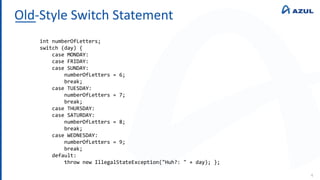
Old-Style Switch Statement
4
int numberOfLetters;
switch (day) {
case MONDAY:
case FRIDAY:
case SUNDAY:
numberOfLetters = 6;
break;
case TUESDAY:
numberOfLetters = 7;
break;
case THURSDAY:
case SATURDAY:
numberOfLetters = 8;
break;
case WEDNESDAY:
numberOfLetters = 9;
break;
default:
throw new IllegalStateException("Huh?: " + day); };
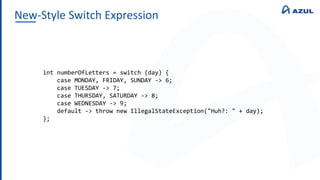
New-Style Switch Expression
int numberOfLetters = switch (day) {
case MONDAY, FRIDAY, SUNDAY -> 6;
case TUESDAY -> 7;
case THURSDAY, SATURDAY -> 8;
case WEDNESDAY -> 9;
default -> throw new IllegalStateException("Huh?: " + day);
};
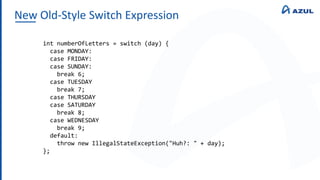
New Old-Style Switch Expression
int numberOfLetters = switch (day) {
case MONDAY:
case FRIDAY:
case SUNDAY:
break 6;
case TUESDAY
break 7;
case THURSDAY
case SATURDAY
break 8;
case WEDNESDAY
break 9;
default:
throw new IllegalStateException("Huh?: " + day);
};
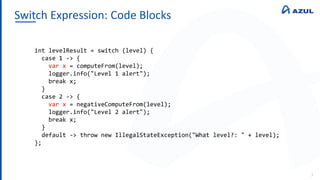
Switch Expression: Code Blocks
7
int levelResult = switch (level) {
case 1 -> {
var x = computeFrom(level);
logger.info("Level 1 alert");
break x;
}
case 2 -> {
var x = negativeComputeFrom(level);
logger.info("Level 2 alert");
break x;
}
default -> throw new IllegalStateException("What level?: " + level);
};
JDK 13
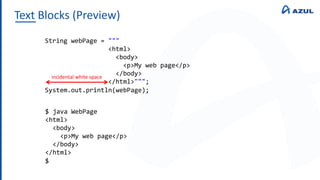
Text Blocks (Preview)
String webPage = """
<html>
<body>
<p>My web page</p>
</body>
</html>""";
System.out.println(webPage);
$ java WebPage
<html>
<body>
<p>My web page</p>
</body>
</html>
$
incidental white space
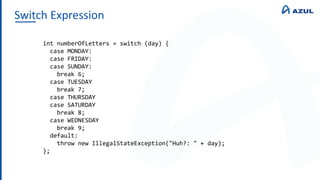
Switch Expression
int numberOfLetters = switch (day) {
case MONDAY:
case FRIDAY:
case SUNDAY:
break 6;
case TUESDAY
break 7;
case THURSDAY
case SATURDAY
break 8;
case WEDNESDAY
break 9;
default:
throw new IllegalStateException("Huh?: " + day);
};
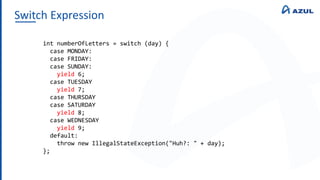
Switch Expression
int numberOfLetters = switch (day) {
case MONDAY:
case FRIDAY:
case SUNDAY:
yield 6;
case TUESDAY
yield 7;
case THURSDAY
case SATURDAY
yield 8;
case WEDNESDAY
yield 9;
default:
throw new IllegalStateException("Huh?: " + day);
};
JDK 14
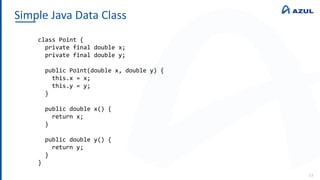
Simple Java Data Class
13
class Point {
private final double x;
private final double y;
public Point(double x, double y) {
this.x = x;
this.y = y;
}
public double x() {
return x;
}
public double y() {
return y;
}
}
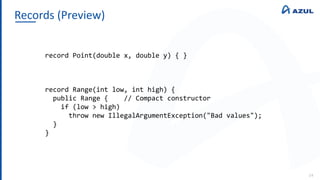
Records (Preview)
14
record Point(double x, double y) { }
record Range(int low, int high) {
public Range { // Compact constructor
if (low > high)
throw new IllegalArgumentException("Bad values");
}
}
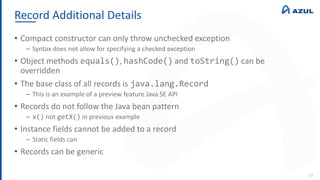
Record Additional Details
15
• Compact constructor can only throw unchecked exception
‒ Syntax does not allow for specifying a checked exception
• Object methods equals(), hashCode() and toString() can be
overridden
• The base class of all records is java.lang.Record
‒ This is an example of a preview feature Java SE API
• Records do not follow the Java bean pattern
‒ x() not getX() in previous example
• Instance fields cannot be added to a record
‒ Static fields can
• Records can be generic
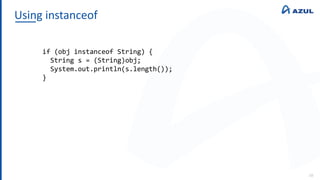
Using instanceof
16
if (obj instanceof String) {
String s = (String)obj;
System.out.println(s.length());
}
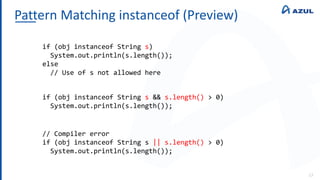
Pattern Matching instanceof (Preview)
17
if (obj instanceof String s)
System.out.println(s.length());
else
// Use of s not allowed here
if (obj instanceof String s && s.length() > 0)
System.out.println(s.length());
// Compiler error
if (obj instanceof String s || s.length() > 0)
System.out.println(s.length());
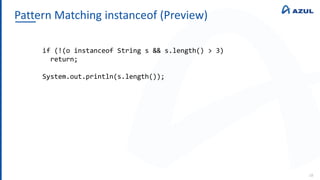
Pattern Matching instanceof (Preview)
18
if (!(o instanceof String s && s.length() > 3)
return;
System.out.println(s.length());
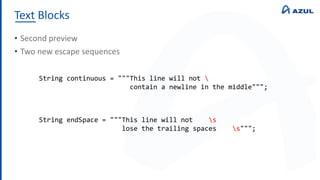
Text Blocks
• Second preview
• Two new escape sequences
String continuous = """This line will not 
contain a newline in the middle""";
String endSpace = """This line will not s
lose the trailing spaces s""";
JDK 15
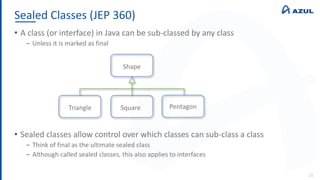
Sealed Classes (JEP 360)
21
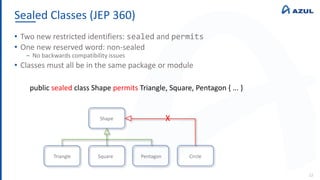
• A class (or interface) in Java can be sub-classed by any class
‒ Unless it is marked as final
• Sealed classes allow control over which classes can sub-class a class
‒ Think of final as the ultimate sealed class
‒ Although called sealed classes, this also applies to interfaces
Shape
Triangle Square Pentagon
Sealed Classes (JEP 360)
22
• Two new restricted identifiers: sealed and permits
• One new reserved word: non-sealed
‒ No backwards compatibility issues
• Classes must all be in the same package or module
public sealed class Shape permits Triangle, Square, Pentagon { ... }
Shape
Triangle Square Pentagon Circle
X
Sealed Classes (JEP 360)
23
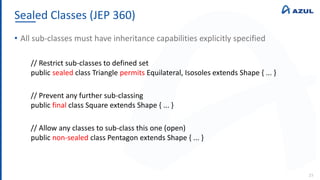
• All sub-classes must have inheritance capabilities explicitly specified
// Restrict sub-classes to defined set
public sealed class Triangle permits Equilateral, Isosoles extends Shape { ... }
// Prevent any further sub-classing
public final class Square extends Shape { ... }
// Allow any classes to sub-class this one (open)
public non-sealed class Pentagon extends Shape { ... }
Records (Second Preview)
24
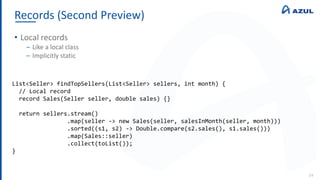
• Local records
‒ Like a local class
‒ Implicitly static
List<Seller> findTopSellers(List<Seller> sellers, int month) {
// Local record
record Sales(Seller seller, double sales) {}
return sellers.stream()
.map(seller -> new Sales(seller, salesInMonth(seller, month)))
.sorted((s1, s2) -> Double.compare(s2.sales(), s1.sales()))
.map(Sales::seller)
.collect(toList());
}
JDK 16
JDK 16 Features
26
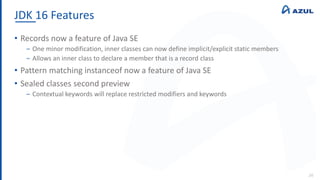
• Records now a feature of Java SE
‒ One minor modification, inner classes can now define implicit/explicit static members
‒ Allows an inner class to declare a member that is a record class
• Pattern matching instanceof now a feature of Java SE
• Sealed classes second preview
‒ Contextual keywords will replace restricted modifiers and keywords
Summary
Moving Java Forward Faster
28
• The six-month release cycle is working really well
‒ New features being delivered faster than ever
• Preview features and incubator modules
‒ Allow for evaluation and feedback before making part of the formal standard
• More to come
‒ Amber, Valhalla, Loom
• Java continues to deliver features developers want and need
• Zulu builds of OpenJDK
‒ Free from azul.com/downloads/zulu-community
THANK YOU!

Getting the Most From Modern Java

  • 1.
    Getting the MostFrom Modern Java Presented by Simon Ritter, Deputy CTO | Azul Systems Inc.
  • 2.
  • 3.
    Switch Expressions 3 • Firstpreview feature in the OpenJDK • Switch construct was a statement ‒ No concept of generating a result that could be assigned • Rather clunky syntax ‒ Every case statement needs to be separated ‒ Must remember break (default is to fall through) ‒ Scope of local variables is not intuitive
  • 4.
    Old-Style Switch Statement 4 intnumberOfLetters; switch (day) { case MONDAY: case FRIDAY: case SUNDAY: numberOfLetters = 6; break; case TUESDAY: numberOfLetters = 7; break; case THURSDAY: case SATURDAY: numberOfLetters = 8; break; case WEDNESDAY: numberOfLetters = 9; break; default: throw new IllegalStateException("Huh?: " + day); };
  • 5.
    New-Style Switch Expression intnumberOfLetters = switch (day) { case MONDAY, FRIDAY, SUNDAY -> 6; case TUESDAY -> 7; case THURSDAY, SATURDAY -> 8; case WEDNESDAY -> 9; default -> throw new IllegalStateException("Huh?: " + day); };
  • 6.
    New Old-Style SwitchExpression int numberOfLetters = switch (day) { case MONDAY: case FRIDAY: case SUNDAY: break 6; case TUESDAY break 7; case THURSDAY case SATURDAY break 8; case WEDNESDAY break 9; default: throw new IllegalStateException("Huh?: " + day); };
  • 7.
    Switch Expression: CodeBlocks 7 int levelResult = switch (level) { case 1 -> { var x = computeFrom(level); logger.info("Level 1 alert"); break x; } case 2 -> { var x = negativeComputeFrom(level); logger.info("Level 2 alert"); break x; } default -> throw new IllegalStateException("What level?: " + level); };
  • 8.
  • 9.
    Text Blocks (Preview) StringwebPage = """ <html> <body> <p>My web page</p> </body> </html>"""; System.out.println(webPage); $ java WebPage <html> <body> <p>My web page</p> </body> </html> $ incidental white space
  • 10.
    Switch Expression int numberOfLetters= switch (day) { case MONDAY: case FRIDAY: case SUNDAY: break 6; case TUESDAY break 7; case THURSDAY case SATURDAY break 8; case WEDNESDAY break 9; default: throw new IllegalStateException("Huh?: " + day); };
  • 11.
    Switch Expression int numberOfLetters= switch (day) { case MONDAY: case FRIDAY: case SUNDAY: yield 6; case TUESDAY yield 7; case THURSDAY case SATURDAY yield 8; case WEDNESDAY yield 9; default: throw new IllegalStateException("Huh?: " + day); };
  • 12.
  • 13.
    Simple Java DataClass 13 class Point { private final double x; private final double y; public Point(double x, double y) { this.x = x; this.y = y; } public double x() { return x; } public double y() { return y; } }
  • 14.
    Records (Preview) 14 record Point(doublex, double y) { } record Range(int low, int high) { public Range { // Compact constructor if (low > high) throw new IllegalArgumentException("Bad values"); } }
  • 15.
    Record Additional Details 15 •Compact constructor can only throw unchecked exception ‒ Syntax does not allow for specifying a checked exception • Object methods equals(), hashCode() and toString() can be overridden • The base class of all records is java.lang.Record ‒ This is an example of a preview feature Java SE API • Records do not follow the Java bean pattern ‒ x() not getX() in previous example • Instance fields cannot be added to a record ‒ Static fields can • Records can be generic
  • 16.
    Using instanceof 16 if (objinstanceof String) { String s = (String)obj; System.out.println(s.length()); }
  • 17.
    Pattern Matching instanceof(Preview) 17 if (obj instanceof String s) System.out.println(s.length()); else // Use of s not allowed here if (obj instanceof String s && s.length() > 0) System.out.println(s.length()); // Compiler error if (obj instanceof String s || s.length() > 0) System.out.println(s.length());
  • 18.
    Pattern Matching instanceof(Preview) 18 if (!(o instanceof String s && s.length() > 3) return; System.out.println(s.length());
  • 19.
    Text Blocks • Secondpreview • Two new escape sequences String continuous = """This line will not contain a newline in the middle"""; String endSpace = """This line will not s lose the trailing spaces s""";
  • 20.
  • 21.
    Sealed Classes (JEP360) 21 • A class (or interface) in Java can be sub-classed by any class ‒ Unless it is marked as final • Sealed classes allow control over which classes can sub-class a class ‒ Think of final as the ultimate sealed class ‒ Although called sealed classes, this also applies to interfaces Shape Triangle Square Pentagon
  • 22.
    Sealed Classes (JEP360) 22 • Two new restricted identifiers: sealed and permits • One new reserved word: non-sealed ‒ No backwards compatibility issues • Classes must all be in the same package or module public sealed class Shape permits Triangle, Square, Pentagon { ... } Shape Triangle Square Pentagon Circle X
  • 23.
    Sealed Classes (JEP360) 23 • All sub-classes must have inheritance capabilities explicitly specified // Restrict sub-classes to defined set public sealed class Triangle permits Equilateral, Isosoles extends Shape { ... } // Prevent any further sub-classing public final class Square extends Shape { ... } // Allow any classes to sub-class this one (open) public non-sealed class Pentagon extends Shape { ... }
  • 24.
    Records (Second Preview) 24 •Local records ‒ Like a local class ‒ Implicitly static List<Seller> findTopSellers(List<Seller> sellers, int month) { // Local record record Sales(Seller seller, double sales) {} return sellers.stream() .map(seller -> new Sales(seller, salesInMonth(seller, month))) .sorted((s1, s2) -> Double.compare(s2.sales(), s1.sales())) .map(Sales::seller) .collect(toList()); }
  • 25.
  • 26.
    JDK 16 Features 26 •Records now a feature of Java SE ‒ One minor modification, inner classes can now define implicit/explicit static members ‒ Allows an inner class to declare a member that is a record class • Pattern matching instanceof now a feature of Java SE • Sealed classes second preview ‒ Contextual keywords will replace restricted modifiers and keywords
  • 27.
  • 28.
    Moving Java ForwardFaster 28 • The six-month release cycle is working really well ‒ New features being delivered faster than ever • Preview features and incubator modules ‒ Allow for evaluation and feedback before making part of the formal standard • More to come ‒ Amber, Valhalla, Loom • Java continues to deliver features developers want and need • Zulu builds of OpenJDK ‒ Free from azul.com/downloads/zulu-community
  • 29.