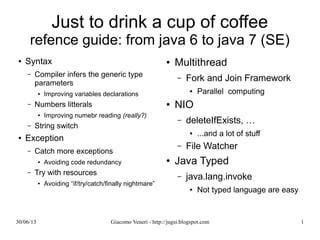
Just to drink a cup of coffee
refence guide: from java 6 to java 7 (SE)
Syntax
Compiler infers the generic type parameters
Improving variables declarations
Numbers litterals
Improving numebr reading (really?)
String switch
Exception
Catch more exceptions
Avoiding code redundancy
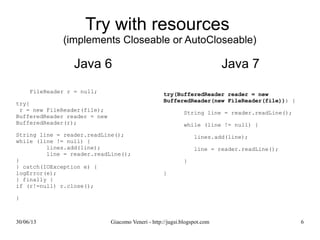
Try with resources
Avoiding “if/try/catch/finally nightmare”
Multithread
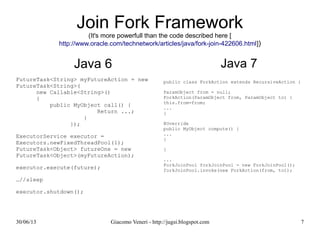
Fork and Join Framework
Parallel computing
NIO
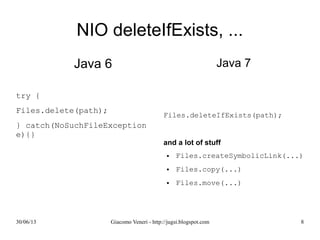
deleteIfExists, …
...and a lot of stuff
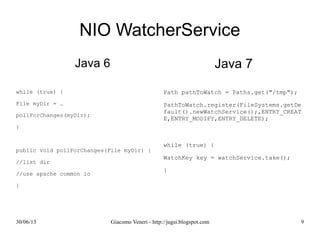
File Watcher
Java Typed
java.lang.invoke
Not typed language are easy
Compiler infer the generic type parameters
Java 6
bject> objects = new LinkedList<MyObject>();
Java 7
List<MyObject> objects = new Lin
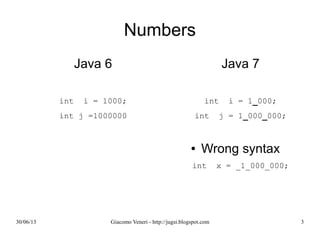
Numbers
Java 6
int i = 1000;
int j =1000000
Java 7
int i = 1_000;
int j = 1_000_000;
Wrong syntax
int x = _1_000_000;
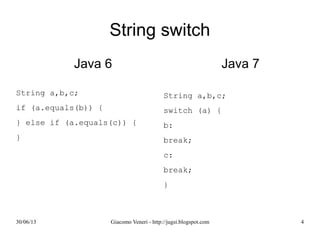
String switch
Java 6
String a,b,c;
if (a.equals(b)) {
} else if (a.equals(c)) {
}
Java 7
String a,b,c;
switch (a) {
b:
break;
c:
break;
}
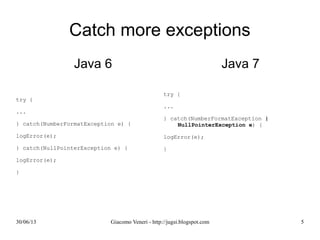
Catch more exceptions
Java 6
try {
...
} catch(NumberFormatException e) {
logError(e);
} catch(NullPointerException e) {
logError(e);
}
Java 7
try {
...
} catch(NumberFormatException |
logError(e);
}
Try with resources
(implements Closeable or AutoCloseable)
Java 6
FileReader r = null;
try{
r = new FileReader(file);
BufferedReader reader = new BufferedReader(r);
String line = reader.readLine();
while (line != null) {
lines.add(line);
line = reader.readLine();
}
} catch(IOException e) {
logError(e);
} finally {
if (r!=null) r.close();
}
Java 7
try(BufferedReader reader = new BufferedReader(
String line = reader.readLine();
while (line != null) {
lines.add(line);
line = reader.readLine();
}
}
Join Fork Framework
more powerfull than the code described here [http://www.oracle.com/technetwork/articles/java/fork-join-422606.ht
Java 6
FutureTask<String> myFutureAction = new FutureTask<String>(
new Callable<String>()
{
public MyObject call() {
Return ...;
}
});
ExecutorService executor = Executors.newFixedThreadPool(1);
FutureTask<Object> futureOne = new FutureTask<Object>(myFutureAction);
executor.execute(future);
…//sleep
executor.shutdown();
Java 7
public class ForkAction extends RecursiveAct
ParamObject from = null;
ForkAction(ParamObject from, ParamObject to)
this.from=from;
...
}
@Override
public MyObject compute() {
...
}
}
...
ForkJoinPool forkJoinPool = new ForkJoinPool
forkJoinPool.invoke(new ForkAction(from, to)
NIO deleteIfExists, ...
Java 6
try {
Files.delete(path);
} catch(NoSuchFileException e){}
Java 7
Files.deleteIfExists(path);
and a lot of stuff
Files.createSymbolicLink(...)
Files.copy(...)
Files.move(...)
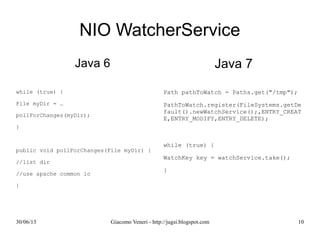
NIO WatcherService
Java 6
while (true) {
File myDir = …
pollForChanges(myDir);
}
public void pollForChanges(File myDir) {
//list dir
//use apache common io
}
Java 7
Path pathToWatch = Paths.get("/tmp");
PathToWatch.register(FileSystems.getDefault(
while (true) {
WatchKey key = watchService.take();
}
NIO WatcherService
Java 6
while (true) {
File myDir = …
pollForChanges(myDir);
}
public void pollForChanges(File myDir) {
//list dir
//use apache common io
}
Java 7
Path pathToWatch = Paths.get("/tmp");
PathToWatch.register(FileSystems.getDefault(
while (true) {
WatchKey key = watchService.take();
}
java.lang.invoke
Java 6
class MyClass {
public void myMethod(int i, String j) {
...
}
}
...
Class<?>[] argTypes = new Class[] { int.class, String.class };
meth = MyClass.class. getDeclaredMethod("myMethod", argTypes);
meth.invoke(new MyClass(), 2, "EFG");
Java 7
class MyClass {
public void myMethod(int i, String j) {
...
}
}
...
MethodHandle mh;
MethodType desc = MethodType.methodType(v
mh = MethodHandles.lookup().findVirtual(M
mh.invokeExact(new MyClass(), 1, "ABCDE")

From Java 6 to Java 7 reference

  • 1.
    Just to drinka cup of coffee refence guide: from java 6 to java 7 (SE) Syntax Compiler infers the generic type parameters Improving variables declarations Numbers litterals Improving numebr reading (really?) String switch Exception Catch more exceptions Avoiding code redundancy Try with resources Avoiding “if/try/catch/finally nightmare” Multithread Fork and Join Framework Parallel computing NIO deleteIfExists, … ...and a lot of stuff File Watcher Java Typed java.lang.invoke Not typed language are easy
  • 2.
    Compiler infer thegeneric type parameters Java 6 bject> objects = new LinkedList<MyObject>(); Java 7 List<MyObject> objects = new Lin
  • 3.
    Numbers Java 6 int i= 1000; int j =1000000 Java 7 int i = 1_000; int j = 1_000_000; Wrong syntax int x = _1_000_000;
  • 4.
    String switch Java 6 Stringa,b,c; if (a.equals(b)) { } else if (a.equals(c)) { } Java 7 String a,b,c; switch (a) { b: break; c: break; }
  • 5.
    Catch more exceptions Java6 try { ... } catch(NumberFormatException e) { logError(e); } catch(NullPointerException e) { logError(e); } Java 7 try { ... } catch(NumberFormatException | logError(e); }
  • 6.
    Try with resources (implementsCloseable or AutoCloseable) Java 6 FileReader r = null; try{ r = new FileReader(file); BufferedReader reader = new BufferedReader(r); String line = reader.readLine(); while (line != null) { lines.add(line); line = reader.readLine(); } } catch(IOException e) { logError(e); } finally { if (r!=null) r.close(); } Java 7 try(BufferedReader reader = new BufferedReader( String line = reader.readLine(); while (line != null) { lines.add(line); line = reader.readLine(); } }
  • 7.
    Join Fork Framework morepowerfull than the code described here [http://www.oracle.com/technetwork/articles/java/fork-join-422606.ht Java 6 FutureTask<String> myFutureAction = new FutureTask<String>( new Callable<String>() { public MyObject call() { Return ...; } }); ExecutorService executor = Executors.newFixedThreadPool(1); FutureTask<Object> futureOne = new FutureTask<Object>(myFutureAction); executor.execute(future); …//sleep executor.shutdown(); Java 7 public class ForkAction extends RecursiveAct ParamObject from = null; ForkAction(ParamObject from, ParamObject to) this.from=from; ... } @Override public MyObject compute() { ... } } ... ForkJoinPool forkJoinPool = new ForkJoinPool forkJoinPool.invoke(new ForkAction(from, to)
  • 8.
    NIO deleteIfExists, ... Java6 try { Files.delete(path); } catch(NoSuchFileException e){} Java 7 Files.deleteIfExists(path); and a lot of stuff Files.createSymbolicLink(...) Files.copy(...) Files.move(...)
  • 9.
    NIO WatcherService Java 6 while(true) { File myDir = … pollForChanges(myDir); } public void pollForChanges(File myDir) { //list dir //use apache common io } Java 7 Path pathToWatch = Paths.get("/tmp"); PathToWatch.register(FileSystems.getDefault( while (true) { WatchKey key = watchService.take(); }
  • 10.
    NIO WatcherService Java 6 while(true) { File myDir = … pollForChanges(myDir); } public void pollForChanges(File myDir) { //list dir //use apache common io } Java 7 Path pathToWatch = Paths.get("/tmp"); PathToWatch.register(FileSystems.getDefault( while (true) { WatchKey key = watchService.take(); }
  • 11.
    java.lang.invoke Java 6 class MyClass{ public void myMethod(int i, String j) { ... } } ... Class<?>[] argTypes = new Class[] { int.class, String.class }; meth = MyClass.class. getDeclaredMethod("myMethod", argTypes); meth.invoke(new MyClass(), 2, "EFG"); Java 7 class MyClass { public void myMethod(int i, String j) { ... } } ... MethodHandle mh; MethodType desc = MethodType.methodType(v mh = MethodHandles.lookup().findVirtual(M mh.invokeExact(new MyClass(), 1, "ABCDE")