Getting The Most From
Modern Java
Presented by Simon Ritter, Deputy CTO | Azul Systems Inc.
Introduction
2
•Six-month release cadence
•Seven releases since JDK 9
•More features being delivered faster than ever before
Java has changed…
…a lot
Incubator Modules
3
• Defined by JEP 11
• Non-final APIs and non-final tools
‒ Deliver to developers to solicit feedback
‒ Can result in changes or even removal
‒ First example: HTTP/2 API (Introduced in JDK 9, final in JDK 11)
Preview Features
4
• Defined by JEP 12
• New feature of the Java language, JVM or Java SE APIs
‒ Fully specified, fully implemented but not permanent
‒ Solicit developer real-world use and experience
‒ May lead to becoming a permanent feature in future release
• Must be explicitly enabled
‒ javac --release 14 --enable-preview ...
‒ java --enable-preview ...
• Preview APIs
‒ May be required for a preview language feature
‒ Part of the Java SE API (java or javax namespace)
JDK 12
Switch Expressions (Preview)
6
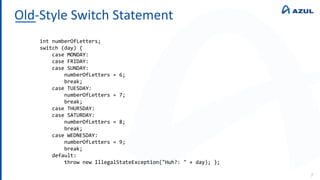
• Switch construct was a statement
‒ No concept of generating a result that could be assigned
• Rather clunky syntax
‒ Every case statement needs to be separated
‒ Must remember break (default is to fall through)
‒ Scope of local variables is not intuitive
Old-Style Switch Statement
7
int numberOfLetters;
switch (day) {
case MONDAY:
case FRIDAY:
case SUNDAY:
numberOfLetters = 6;
break;
case TUESDAY:
numberOfLetters = 7;
break;
case THURSDAY:
case SATURDAY:
numberOfLetters = 8;
break;
case WEDNESDAY:
numberOfLetters = 9;
break;
default:
throw new IllegalStateException("Huh?: " + day); };
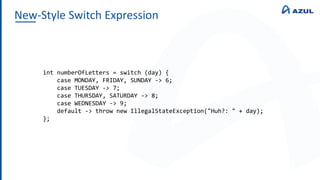
New-Style Switch Expression
int numberOfLetters = switch (day) {
case MONDAY, FRIDAY, SUNDAY -> 6;
case TUESDAY -> 7;
case THURSDAY, SATURDAY -> 8;
case WEDNESDAY -> 9;
default -> throw new IllegalStateException("Huh?: " + day);
};
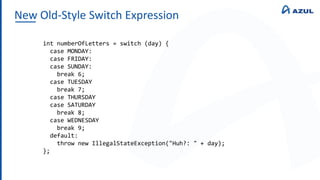
New Old-Style Switch Expression
int numberOfLetters = switch (day) {
case MONDAY:
case FRIDAY:
case SUNDAY:
break 6;
case TUESDAY
break 7;
case THURSDAY
case SATURDAY
break 8;
case WEDNESDAY
break 9;
default:
throw new IllegalStateException("Huh?: " + day);
};
Streams
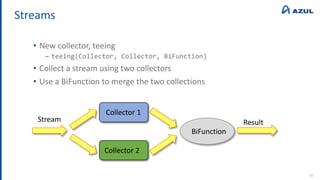
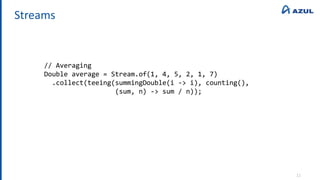
• New collector, teeing
‒ teeing(Collector, Collector, BiFunction)
• Collect a stream using two collectors
• Use a BiFunction to merge the two collections
10
Collector 1
Collector 2
BiFunction
Stream Result
Streams
11
// Averaging
Double average = Stream.of(1, 4, 5, 2, 1, 7)
.collect(teeing(summingDouble(i -> i), counting(),
(sum, n) -> sum / n));
JDK 13
Text Blocks (Preview)
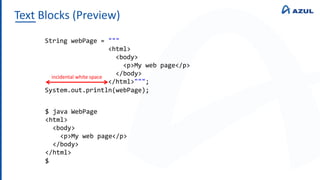
String webPage = """
<html>
<body>
<p>My web page</p>
</body>
</html>""";
System.out.println(webPage);
$ java WebPage
<html>
<body>
<p>My web page</p>
</body>
</html>
$
incidental white space
Text Blocks (Preview)
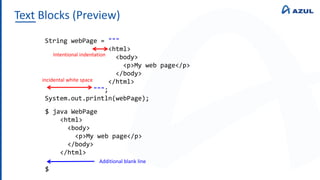
String webPage = """
<html>
<body>
<p>My web page</p>
</body>
</html>
""";
System.out.println(webPage);
$ java WebPage
<html>
<body>
<p>My web page</p>
</body>
</html>
$
Additional blank line
incidental white space
Intentional indentation
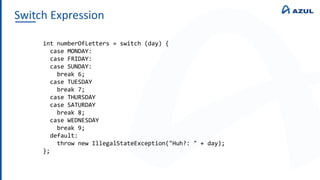
Switch Expression
int numberOfLetters = switch (day) {
case MONDAY:
case FRIDAY:
case SUNDAY:
break 6;
case TUESDAY
break 7;
case THURSDAY
case SATURDAY
break 8;
case WEDNESDAY
break 9;
default:
throw new IllegalStateException("Huh?: " + day);
};
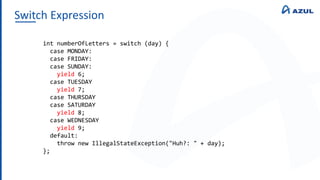
Switch Expression
int numberOfLetters = switch (day) {
case MONDAY:
case FRIDAY:
case SUNDAY:
yield 6;
case TUESDAY
yield 7;
case THURSDAY
case SATURDAY
yield 8;
case WEDNESDAY
yield 9;
default:
throw new IllegalStateException("Huh?: " + day);
};
JDK 14
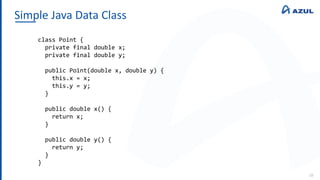
Simple Java Data Class
18
class Point {
private final double x;
private final double y;
public Point(double x, double y) {
this.x = x;
this.y = y;
}
public double x() {
return x;
}
public double y() {
return y;
}
}
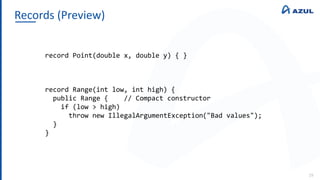
Records (Preview)
19
record Point(double x, double y) { }
record Range(int low, int high) {
public Range { // Compact constructor
if (low > high)
throw new IllegalArgumentException("Bad values");
}
}
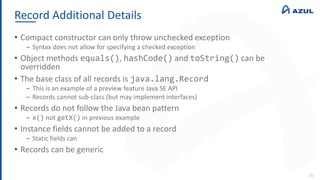
Record Additional Details
20
• Compact constructor can only throw unchecked exception
‒ Syntax does not allow for specifying a checked exception
• Object methods equals(), hashCode() and toString() can be
overridden
• The base class of all records is java.lang.Record
‒ This is an example of a preview feature Java SE API
‒ Records cannot sub-class (but may implement interfaces)
• Records do not follow the Java bean pattern
‒ x() not getX() in previous example
• Instance fields cannot be added to a record
‒ Static fields can
• Records can be generic
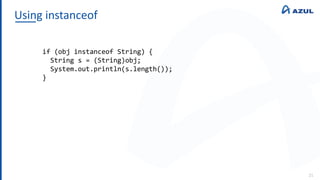
Using instanceof
21
if (obj instanceof String) {
String s = (String)obj;
System.out.println(s.length());
}
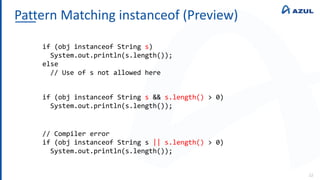
Pattern Matching instanceof (Preview)
22
if (obj instanceof String s)
System.out.println(s.length());
else
// Use of s not allowed here
if (obj instanceof String s && s.length() > 0)
System.out.println(s.length());
// Compiler error
if (obj instanceof String s || s.length() > 0)
System.out.println(s.length());
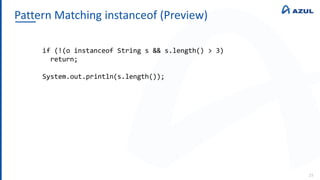
Pattern Matching instanceof (Preview)
23
if (!(o instanceof String s && s.length() > 3)
return;
System.out.println(s.length());
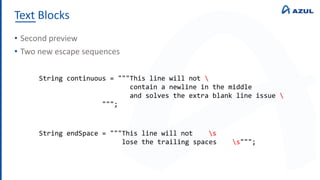
Text Blocks
• Second preview
• Two new escape sequences
String continuous = """This line will not 
contain a newline in the middle
and solves the extra blank line issue 
""";
String endSpace = """This line will not s
lose the trailing spaces s""";
Helpful NullPointerException
25
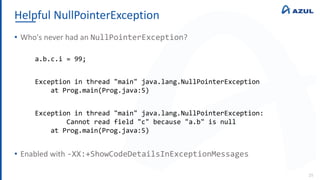
• Who's never had an NullPointerException?
• Enabled with -XX:+ShowCodeDetailsInExceptionMessages
a.b.c.i = 99;
Exception in thread "main" java.lang.NullPointerException
at Prog.main(Prog.java:5)
Exception in thread "main" java.lang.NullPointerException:
Cannot read field "c" because "a.b" is null
at Prog.main(Prog.java:5)
JDK 15
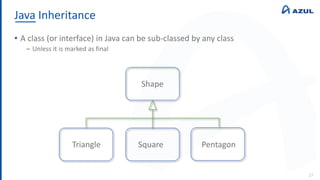
Java Inheritance
27
• A class (or interface) in Java can be sub-classed by any class
‒ Unless it is marked as final
Shape
Triangle Square Pentagon
Sealed Classes (JEP 360)
28
• Preview feature
• Sealed classes allow control over which classes can sub-class a class
‒ Think of final as the ultimate sealed class
• Although called sealed classes, this also applies to interfaces
Sealed Classes (JEP 360)
29
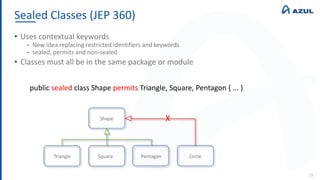
• Uses contextual keywords
‒ New idea replacing restricted identifiers and keywords
‒ sealed, permits and non-sealed
• Classes must all be in the same package or module
public sealed class Shape permits Triangle, Square, Pentagon { ... }
Shape
Triangle Square Pentagon Circle
X
Sealed Classes (JEP 360)
30
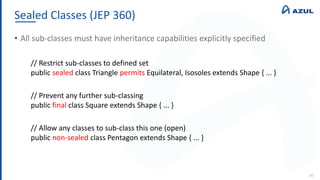
• All sub-classes must have inheritance capabilities explicitly specified
// Restrict sub-classes to defined set
public sealed class Triangle permits Equilateral, Isosoles extends Shape { ... }
// Prevent any further sub-classing
public final class Square extends Shape { ... }
// Allow any classes to sub-class this one (open)
public non-sealed class Pentagon extends Shape { ... }
Contextual Keyword Humour
31
int non = 2;
int sealed = 1;
var var = non-sealed;
Hidden Classes (JEP 371)
32
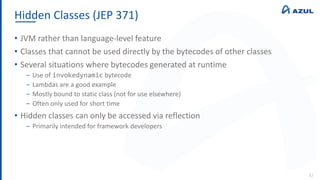
• JVM rather than language-level feature
• Classes that cannot be used directly by the bytecodes of other classes
• Several situations where bytecodes generated at runtime
‒ Use of invokedynamic bytecode
‒ Lambdas are a good example
‒ Mostly bound to static class (not for use elsewhere)
‒ Often only used for short time
• Hidden classes can only be accessed via reflection
‒ Primarily intended for framework developers
Records (Second Preview)
33
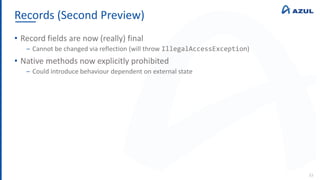
• Record fields are now (really) final
‒ Cannot be changed via reflection (will throw IllegalAccessException)
• Native methods now explicitly prohibited
‒ Could introduce behaviour dependent on external state
Records (Second Preview)
34
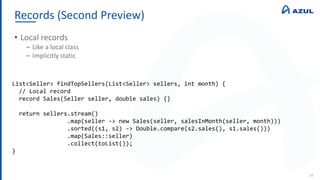
• Local records
‒ Like a local class
‒ Implicitly static
List<Seller> findTopSellers(List<Seller> sellers, int month) {
// Local record
record Sales(Seller seller, double sales) {}
return sellers.stream()
.map(seller -> new Sales(seller, salesInMonth(seller, month)))
.sorted((s1, s2) -> Double.compare(s2.sales(), s1.sales()))
.map(Sales::seller)
.collect(toList());
}
Records (Second Preview)
35
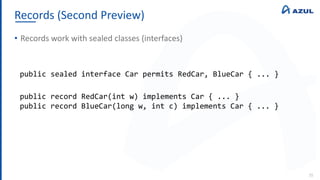
• Records work with sealed classes (interfaces)
public sealed interface Car permits RedCar, BlueCar { ... }
public record RedCar(int w) implements Car { ... }
public record BlueCar(long w, int c) implements Car { ... }
JDK 16
Pattern Matching instanceof (JEP 394)
37
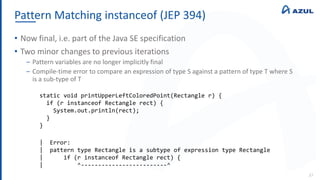
• Now final, i.e. part of the Java SE specification
• Two minor changes to previous iterations
‒ Pattern variables are no longer implicitly final
‒ Compile-time error to compare an expression of type S against a pattern of type T where S
is a sub-type of T
static void printUpperLeftColoredPoint(Rectangle r) {
if (r instanceof Rectangle rect) {
System.out.println(rect);
}
}
| Error:
| pattern type Rectangle is a subtype of expression type Rectangle
| if (r instanceof Rectangle rect) {
| ^-------------------------^
Add UNIX-Domain Socket Channels
38
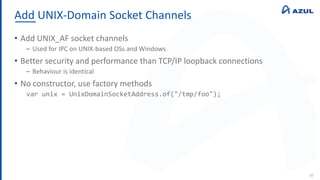
• Add UNIX_AF socket channels
‒ Used for IPC on UNIX-based OSs and Windows
• Better security and performance than TCP/IP loopback connections
‒ Behaviour is identical
• No constructor, use factory methods
var unix = UnixDomainSocketAddress.of("/tmp/foo");
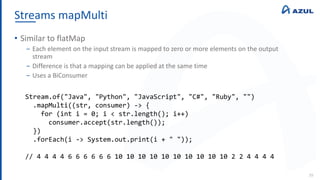
Streams mapMulti
39
• Similar to flatMap
‒ Each element on the input stream is mapped to zero or more elements on the output
stream
‒ Difference is that a mapping can be applied at the same time
‒ Uses a BiConsumer
Stream.of("Java", "Python", "JavaScript", "C#", "Ruby", "")
.mapMulti((str, consumer) -> {
for (int i = 0; i < str.length(); i++)
consumer.accept(str.length());
})
.forEach(i -> System.out.print(i + " "));
// 4 4 4 4 6 6 6 6 6 6 10 10 10 10 10 10 10 10 10 10 2 2 4 4 4 4
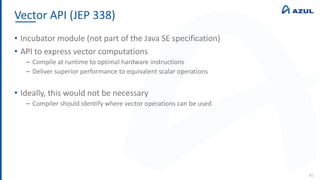
Vector API (JEP 338)
40
• Incubator module (not part of the Java SE specification)
• API to express vector computations
‒ Compile at runtime to optimal hardware instructions
‒ Deliver superior performance to equivalent scalar operations
• Ideally, this would not be necessary
‒ Compiler should identify where vector operations can be used
Vector API (JEP 338)
41
void scalarComputation(float[] a, float[] b, float[] c) {
for (int i = 0; i < a.length; i++)
c[i] = (a[i] * a[i] + b[i] * b[i]) * -1.0f;
}
static final VectorSpecies<Float> SPECIES = FloatVector.SPECIES_256;
void vectorComputation(float[] a, float[] b, float[] c) {
for (int i = 0; i < a.length; i += SPECIES.length()) {
var m = SPECIES.indexInRange(i, a.length);
var va = FloatVector.fromArray(SPECIES, a, i, m);
var vb = FloatVector.fromArray(SPECIES, b, i, m);
var vc = va.mul(va).
add(vb.mul(vb)).
neg();
vc.intoArray(c, i, m);
}
}
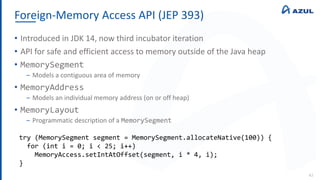
Foreign-Memory Access API (JEP 393)
42
• Introduced in JDK 14, now third incubator iteration
• API for safe and efficient access to memory outside of the Java heap
• MemorySegment
‒ Models a contiguous area of memory
• MemoryAddress
‒ Models an individual memory address (on or off heap)
• MemoryLayout
‒ Programmatic description of a MemorySegment
try (MemorySegment segment = MemorySegment.allocateNative(100)) {
for (int i = 0; i < 25; i++)
MemoryAccess.setIntAtOffset(segment, i * 4, i);
}
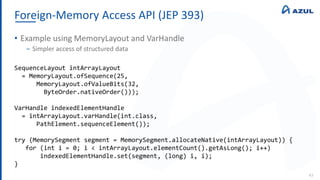
Foreign-Memory Access API (JEP 393)
43
• Example using MemoryLayout and VarHandle
‒ Simpler access of structured data
SequenceLayout intArrayLayout
= MemoryLayout.ofSequence(25,
MemoryLayout.ofValueBits(32,
ByteOrder.nativeOrder()));
VarHandle indexedElementHandle
= intArrayLayout.varHandle(int.class,
PathElement.sequenceElement());
try (MemorySegment segment = MemorySegment.allocateNative(intArrayLayout)) {
for (int i = 0; i < intArrayLayout.elementCount().getAsLong(); i++)
indexedElementHandle.set(segment, (long) i, i);
}
Foreign Linker API (JEP 389): Incubator
44
• Provides statically-typed, pure-Java access to native code
‒ Works in conjunction with the Foreign Memory Access API
‒ Initially targeted at C native code. C++ should follow
• More powerful when combined with Project Panama jextract command
public static void main(String[] args) throws Throwable {
var linker = CLinker.getInstance();
var lookup = LibraryLookup.ofDefault();
// get a native method handle for 'getpid' function
var getpid = linker.downcallHandle(lookup.lookup("getpid").get(),
MethodType.methodType(int.class),
FunctionDescriptor.of(CLinker.C_INT));
System.out.println((int)getpid.invokeExact());
}
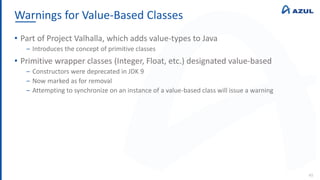
Warnings for Value-Based Classes
45
• Part of Project Valhalla, which adds value-types to Java
‒ Introduces the concept of primitive classes
• Primitive wrapper classes (Integer, Float, etc.) designated value-based
‒ Constructors were deprecated in JDK 9
‒ Now marked as for removal
‒ Attempting to synchronize on an instance of a value-based class will issue a warning
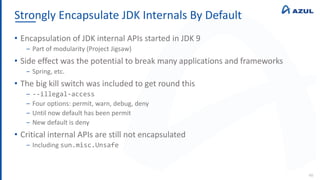
Strongly Encapsulate JDK Internals By Default
46
• Encapsulation of JDK internal APIs started in JDK 9
‒ Part of modularity (Project Jigsaw)
• Side effect was the potential to break many applications and frameworks
‒ Spring, etc.
• The big kill switch was included to get round this
‒ --illegal-access
‒ Four options: permit, warn, debug, deny
‒ Until now default has been permit
‒ New default is deny
• Critical internal APIs are still not encapsulated
‒ Including sun.misc.Unsafe
Summary
Zulu Enterprise
48
• Enhanced build of OpenJDK source code
 Fully TCK tested
 JDK 6, 7, 8, 11 and 13
 TLS1.3, Flight Recorder backports
• Wide platform support:
 Intel 64-bit Windows, Mac, Linux
 Intel 32-bit Windows and Linux
• Real drop-in replacement for Oracle JDK
 Many enterprise customers
 No reports of any compatibility issues
Conclusions
49
• The six-month release cycle is working well
• JDK 12 to JDK 16 contains lots of great new features
• Start preparing for JDK 17, the next LTS
‒ Test with JDK 16
• Use Zulu builds of OpenJDK if you want to deploy to production
Questions?

Modern_Java_Workshop manjunath np hj slave

  • 1.
    Getting The MostFrom Modern Java Presented by Simon Ritter, Deputy CTO | Azul Systems Inc.
  • 2.
    Introduction 2 •Six-month release cadence •Sevenreleases since JDK 9 •More features being delivered faster than ever before Java has changed… …a lot
  • 3.
    Incubator Modules 3 • Definedby JEP 11 • Non-final APIs and non-final tools ‒ Deliver to developers to solicit feedback ‒ Can result in changes or even removal ‒ First example: HTTP/2 API (Introduced in JDK 9, final in JDK 11)
  • 4.
    Preview Features 4 • Definedby JEP 12 • New feature of the Java language, JVM or Java SE APIs ‒ Fully specified, fully implemented but not permanent ‒ Solicit developer real-world use and experience ‒ May lead to becoming a permanent feature in future release • Must be explicitly enabled ‒ javac --release 14 --enable-preview ... ‒ java --enable-preview ... • Preview APIs ‒ May be required for a preview language feature ‒ Part of the Java SE API (java or javax namespace)
  • 5.
  • 6.
    Switch Expressions (Preview) 6 •Switch construct was a statement ‒ No concept of generating a result that could be assigned • Rather clunky syntax ‒ Every case statement needs to be separated ‒ Must remember break (default is to fall through) ‒ Scope of local variables is not intuitive
  • 7.
    Old-Style Switch Statement 7 intnumberOfLetters; switch (day) { case MONDAY: case FRIDAY: case SUNDAY: numberOfLetters = 6; break; case TUESDAY: numberOfLetters = 7; break; case THURSDAY: case SATURDAY: numberOfLetters = 8; break; case WEDNESDAY: numberOfLetters = 9; break; default: throw new IllegalStateException("Huh?: " + day); };
  • 8.
    New-Style Switch Expression intnumberOfLetters = switch (day) { case MONDAY, FRIDAY, SUNDAY -> 6; case TUESDAY -> 7; case THURSDAY, SATURDAY -> 8; case WEDNESDAY -> 9; default -> throw new IllegalStateException("Huh?: " + day); };
  • 9.
    New Old-Style SwitchExpression int numberOfLetters = switch (day) { case MONDAY: case FRIDAY: case SUNDAY: break 6; case TUESDAY break 7; case THURSDAY case SATURDAY break 8; case WEDNESDAY break 9; default: throw new IllegalStateException("Huh?: " + day); };
  • 10.
    Streams • New collector,teeing ‒ teeing(Collector, Collector, BiFunction) • Collect a stream using two collectors • Use a BiFunction to merge the two collections 10 Collector 1 Collector 2 BiFunction Stream Result
  • 11.
    Streams 11 // Averaging Double average= Stream.of(1, 4, 5, 2, 1, 7) .collect(teeing(summingDouble(i -> i), counting(), (sum, n) -> sum / n));
  • 12.
  • 13.
    Text Blocks (Preview) StringwebPage = """ <html> <body> <p>My web page</p> </body> </html>"""; System.out.println(webPage); $ java WebPage <html> <body> <p>My web page</p> </body> </html> $ incidental white space
  • 14.
    Text Blocks (Preview) StringwebPage = """ <html> <body> <p>My web page</p> </body> </html> """; System.out.println(webPage); $ java WebPage <html> <body> <p>My web page</p> </body> </html> $ Additional blank line incidental white space Intentional indentation
  • 15.
    Switch Expression int numberOfLetters= switch (day) { case MONDAY: case FRIDAY: case SUNDAY: break 6; case TUESDAY break 7; case THURSDAY case SATURDAY break 8; case WEDNESDAY break 9; default: throw new IllegalStateException("Huh?: " + day); };
  • 16.
    Switch Expression int numberOfLetters= switch (day) { case MONDAY: case FRIDAY: case SUNDAY: yield 6; case TUESDAY yield 7; case THURSDAY case SATURDAY yield 8; case WEDNESDAY yield 9; default: throw new IllegalStateException("Huh?: " + day); };
  • 17.
  • 18.
    Simple Java DataClass 18 class Point { private final double x; private final double y; public Point(double x, double y) { this.x = x; this.y = y; } public double x() { return x; } public double y() { return y; } }
  • 19.
    Records (Preview) 19 record Point(doublex, double y) { } record Range(int low, int high) { public Range { // Compact constructor if (low > high) throw new IllegalArgumentException("Bad values"); } }
  • 20.
    Record Additional Details 20 •Compact constructor can only throw unchecked exception ‒ Syntax does not allow for specifying a checked exception • Object methods equals(), hashCode() and toString() can be overridden • The base class of all records is java.lang.Record ‒ This is an example of a preview feature Java SE API ‒ Records cannot sub-class (but may implement interfaces) • Records do not follow the Java bean pattern ‒ x() not getX() in previous example • Instance fields cannot be added to a record ‒ Static fields can • Records can be generic
  • 21.
    Using instanceof 21 if (objinstanceof String) { String s = (String)obj; System.out.println(s.length()); }
  • 22.
    Pattern Matching instanceof(Preview) 22 if (obj instanceof String s) System.out.println(s.length()); else // Use of s not allowed here if (obj instanceof String s && s.length() > 0) System.out.println(s.length()); // Compiler error if (obj instanceof String s || s.length() > 0) System.out.println(s.length());
  • 23.
    Pattern Matching instanceof(Preview) 23 if (!(o instanceof String s && s.length() > 3) return; System.out.println(s.length());
  • 24.
    Text Blocks • Secondpreview • Two new escape sequences String continuous = """This line will not contain a newline in the middle and solves the extra blank line issue """; String endSpace = """This line will not s lose the trailing spaces s""";
  • 25.
    Helpful NullPointerException 25 • Who'snever had an NullPointerException? • Enabled with -XX:+ShowCodeDetailsInExceptionMessages a.b.c.i = 99; Exception in thread "main" java.lang.NullPointerException at Prog.main(Prog.java:5) Exception in thread "main" java.lang.NullPointerException: Cannot read field "c" because "a.b" is null at Prog.main(Prog.java:5)
  • 26.
  • 27.
    Java Inheritance 27 • Aclass (or interface) in Java can be sub-classed by any class ‒ Unless it is marked as final Shape Triangle Square Pentagon
  • 28.
    Sealed Classes (JEP360) 28 • Preview feature • Sealed classes allow control over which classes can sub-class a class ‒ Think of final as the ultimate sealed class • Although called sealed classes, this also applies to interfaces
  • 29.
    Sealed Classes (JEP360) 29 • Uses contextual keywords ‒ New idea replacing restricted identifiers and keywords ‒ sealed, permits and non-sealed • Classes must all be in the same package or module public sealed class Shape permits Triangle, Square, Pentagon { ... } Shape Triangle Square Pentagon Circle X
  • 30.
    Sealed Classes (JEP360) 30 • All sub-classes must have inheritance capabilities explicitly specified // Restrict sub-classes to defined set public sealed class Triangle permits Equilateral, Isosoles extends Shape { ... } // Prevent any further sub-classing public final class Square extends Shape { ... } // Allow any classes to sub-class this one (open) public non-sealed class Pentagon extends Shape { ... }
  • 31.
    Contextual Keyword Humour 31 intnon = 2; int sealed = 1; var var = non-sealed;
  • 32.
    Hidden Classes (JEP371) 32 • JVM rather than language-level feature • Classes that cannot be used directly by the bytecodes of other classes • Several situations where bytecodes generated at runtime ‒ Use of invokedynamic bytecode ‒ Lambdas are a good example ‒ Mostly bound to static class (not for use elsewhere) ‒ Often only used for short time • Hidden classes can only be accessed via reflection ‒ Primarily intended for framework developers
  • 33.
    Records (Second Preview) 33 •Record fields are now (really) final ‒ Cannot be changed via reflection (will throw IllegalAccessException) • Native methods now explicitly prohibited ‒ Could introduce behaviour dependent on external state
  • 34.
    Records (Second Preview) 34 •Local records ‒ Like a local class ‒ Implicitly static List<Seller> findTopSellers(List<Seller> sellers, int month) { // Local record record Sales(Seller seller, double sales) {} return sellers.stream() .map(seller -> new Sales(seller, salesInMonth(seller, month))) .sorted((s1, s2) -> Double.compare(s2.sales(), s1.sales())) .map(Sales::seller) .collect(toList()); }
  • 35.
    Records (Second Preview) 35 •Records work with sealed classes (interfaces) public sealed interface Car permits RedCar, BlueCar { ... } public record RedCar(int w) implements Car { ... } public record BlueCar(long w, int c) implements Car { ... }
  • 36.
  • 37.
    Pattern Matching instanceof(JEP 394) 37 • Now final, i.e. part of the Java SE specification • Two minor changes to previous iterations ‒ Pattern variables are no longer implicitly final ‒ Compile-time error to compare an expression of type S against a pattern of type T where S is a sub-type of T static void printUpperLeftColoredPoint(Rectangle r) { if (r instanceof Rectangle rect) { System.out.println(rect); } } | Error: | pattern type Rectangle is a subtype of expression type Rectangle | if (r instanceof Rectangle rect) { | ^-------------------------^
  • 38.
    Add UNIX-Domain SocketChannels 38 • Add UNIX_AF socket channels ‒ Used for IPC on UNIX-based OSs and Windows • Better security and performance than TCP/IP loopback connections ‒ Behaviour is identical • No constructor, use factory methods var unix = UnixDomainSocketAddress.of("/tmp/foo");
  • 39.
    Streams mapMulti 39 • Similarto flatMap ‒ Each element on the input stream is mapped to zero or more elements on the output stream ‒ Difference is that a mapping can be applied at the same time ‒ Uses a BiConsumer Stream.of("Java", "Python", "JavaScript", "C#", "Ruby", "") .mapMulti((str, consumer) -> { for (int i = 0; i < str.length(); i++) consumer.accept(str.length()); }) .forEach(i -> System.out.print(i + " ")); // 4 4 4 4 6 6 6 6 6 6 10 10 10 10 10 10 10 10 10 10 2 2 4 4 4 4
  • 40.
    Vector API (JEP338) 40 • Incubator module (not part of the Java SE specification) • API to express vector computations ‒ Compile at runtime to optimal hardware instructions ‒ Deliver superior performance to equivalent scalar operations • Ideally, this would not be necessary ‒ Compiler should identify where vector operations can be used
  • 41.
    Vector API (JEP338) 41 void scalarComputation(float[] a, float[] b, float[] c) { for (int i = 0; i < a.length; i++) c[i] = (a[i] * a[i] + b[i] * b[i]) * -1.0f; } static final VectorSpecies<Float> SPECIES = FloatVector.SPECIES_256; void vectorComputation(float[] a, float[] b, float[] c) { for (int i = 0; i < a.length; i += SPECIES.length()) { var m = SPECIES.indexInRange(i, a.length); var va = FloatVector.fromArray(SPECIES, a, i, m); var vb = FloatVector.fromArray(SPECIES, b, i, m); var vc = va.mul(va). add(vb.mul(vb)). neg(); vc.intoArray(c, i, m); } }
  • 42.
    Foreign-Memory Access API(JEP 393) 42 • Introduced in JDK 14, now third incubator iteration • API for safe and efficient access to memory outside of the Java heap • MemorySegment ‒ Models a contiguous area of memory • MemoryAddress ‒ Models an individual memory address (on or off heap) • MemoryLayout ‒ Programmatic description of a MemorySegment try (MemorySegment segment = MemorySegment.allocateNative(100)) { for (int i = 0; i < 25; i++) MemoryAccess.setIntAtOffset(segment, i * 4, i); }
  • 43.
    Foreign-Memory Access API(JEP 393) 43 • Example using MemoryLayout and VarHandle ‒ Simpler access of structured data SequenceLayout intArrayLayout = MemoryLayout.ofSequence(25, MemoryLayout.ofValueBits(32, ByteOrder.nativeOrder())); VarHandle indexedElementHandle = intArrayLayout.varHandle(int.class, PathElement.sequenceElement()); try (MemorySegment segment = MemorySegment.allocateNative(intArrayLayout)) { for (int i = 0; i < intArrayLayout.elementCount().getAsLong(); i++) indexedElementHandle.set(segment, (long) i, i); }
  • 44.
    Foreign Linker API(JEP 389): Incubator 44 • Provides statically-typed, pure-Java access to native code ‒ Works in conjunction with the Foreign Memory Access API ‒ Initially targeted at C native code. C++ should follow • More powerful when combined with Project Panama jextract command public static void main(String[] args) throws Throwable { var linker = CLinker.getInstance(); var lookup = LibraryLookup.ofDefault(); // get a native method handle for 'getpid' function var getpid = linker.downcallHandle(lookup.lookup("getpid").get(), MethodType.methodType(int.class), FunctionDescriptor.of(CLinker.C_INT)); System.out.println((int)getpid.invokeExact()); }
  • 45.
    Warnings for Value-BasedClasses 45 • Part of Project Valhalla, which adds value-types to Java ‒ Introduces the concept of primitive classes • Primitive wrapper classes (Integer, Float, etc.) designated value-based ‒ Constructors were deprecated in JDK 9 ‒ Now marked as for removal ‒ Attempting to synchronize on an instance of a value-based class will issue a warning
  • 46.
    Strongly Encapsulate JDKInternals By Default 46 • Encapsulation of JDK internal APIs started in JDK 9 ‒ Part of modularity (Project Jigsaw) • Side effect was the potential to break many applications and frameworks ‒ Spring, etc. • The big kill switch was included to get round this ‒ --illegal-access ‒ Four options: permit, warn, debug, deny ‒ Until now default has been permit ‒ New default is deny • Critical internal APIs are still not encapsulated ‒ Including sun.misc.Unsafe
  • 47.
  • 48.
    Zulu Enterprise 48 • Enhancedbuild of OpenJDK source code  Fully TCK tested  JDK 6, 7, 8, 11 and 13  TLS1.3, Flight Recorder backports • Wide platform support:  Intel 64-bit Windows, Mac, Linux  Intel 32-bit Windows and Linux • Real drop-in replacement for Oracle JDK  Many enterprise customers  No reports of any compatibility issues
  • 49.
    Conclusions 49 • The six-monthrelease cycle is working well • JDK 12 to JDK 16 contains lots of great new features • Start preparing for JDK 17, the next LTS ‒ Test with JDK 16 • Use Zulu builds of OpenJDK if you want to deploy to production
  • 50.