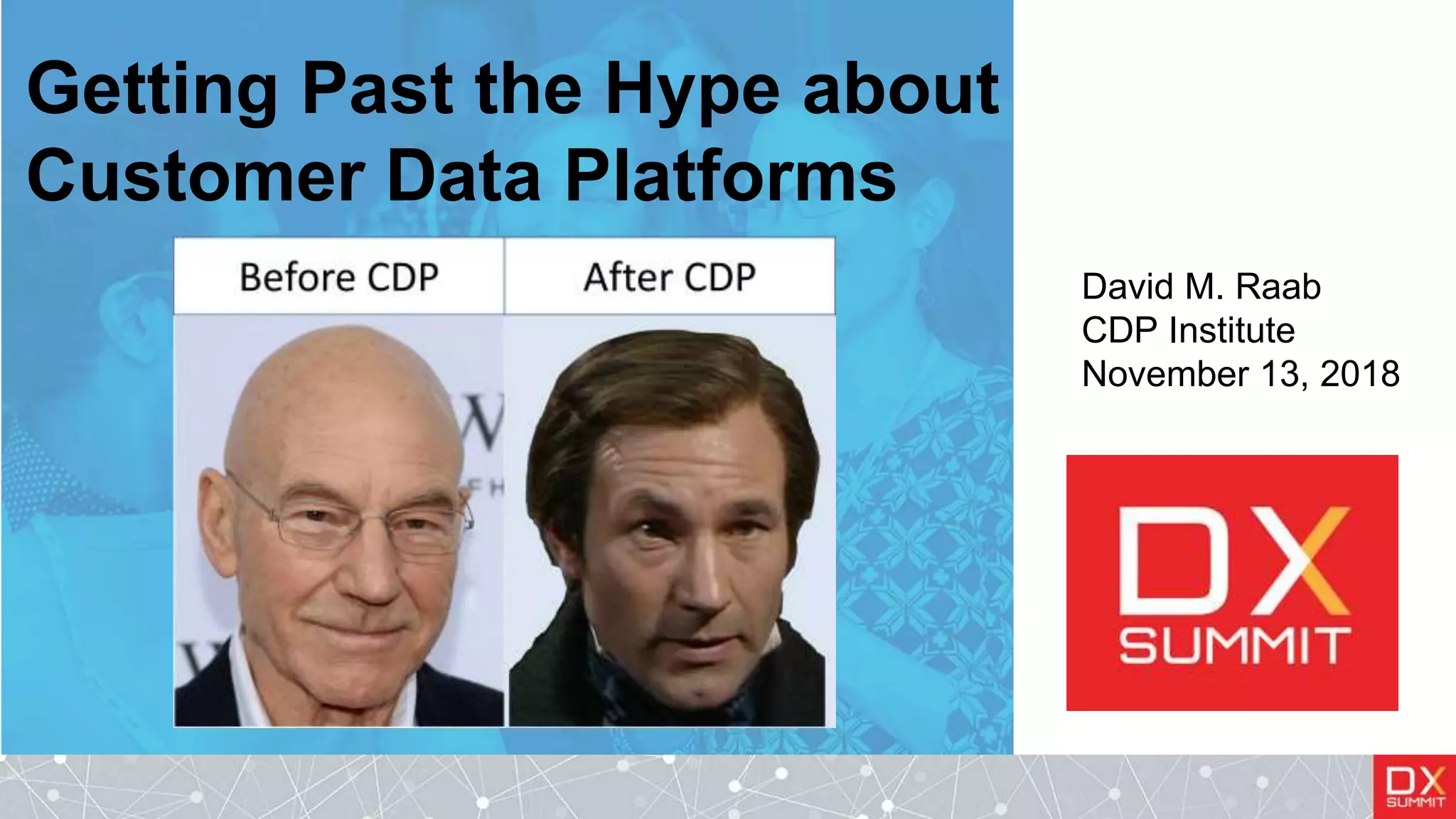
Getting Past the Hype about
Customer Data Platforms
David M. Raab
CDP Institute
November 13, 2018
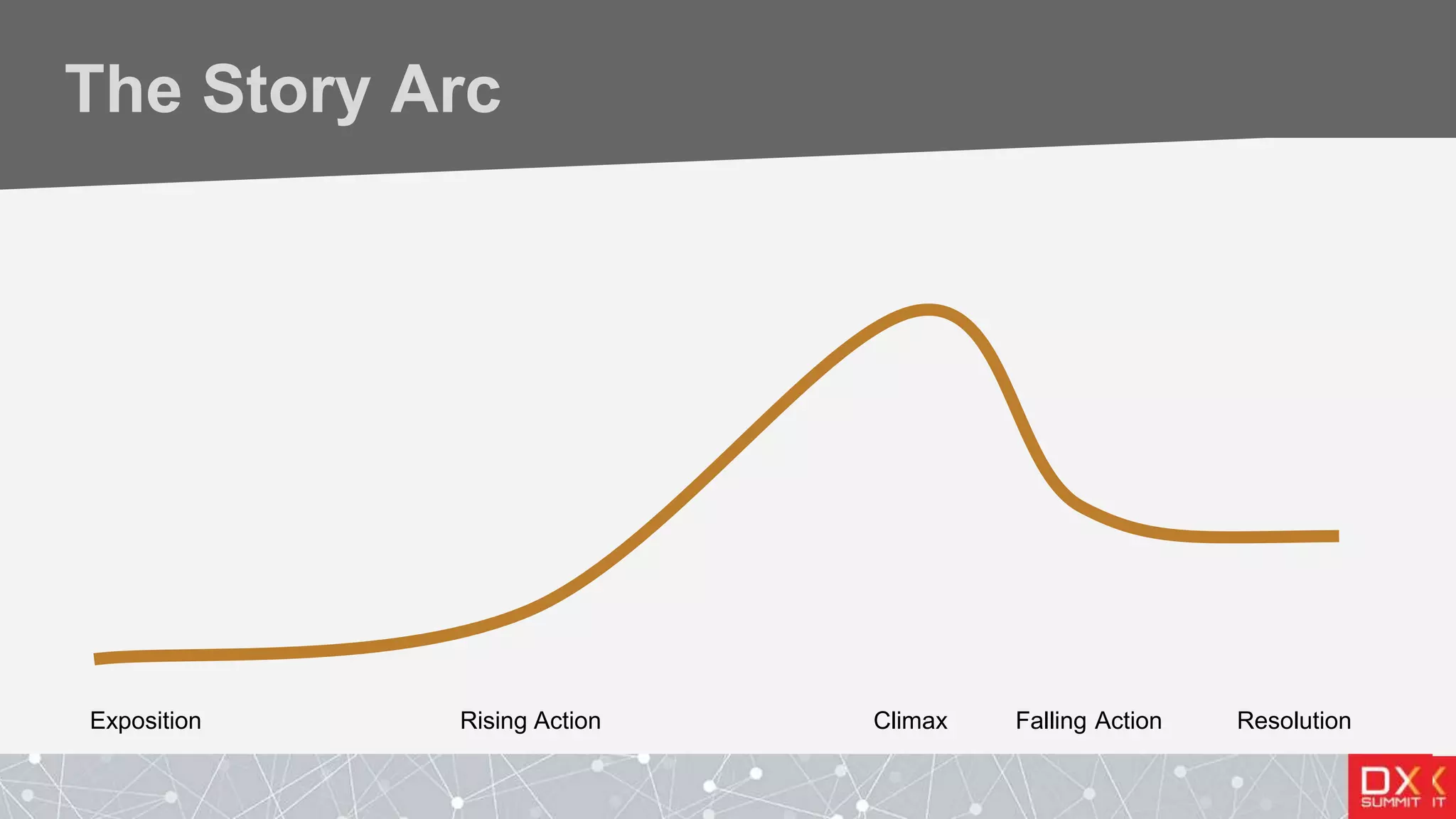
The Story Arc
Exposition Rising Action Climax Falling Action Resolution
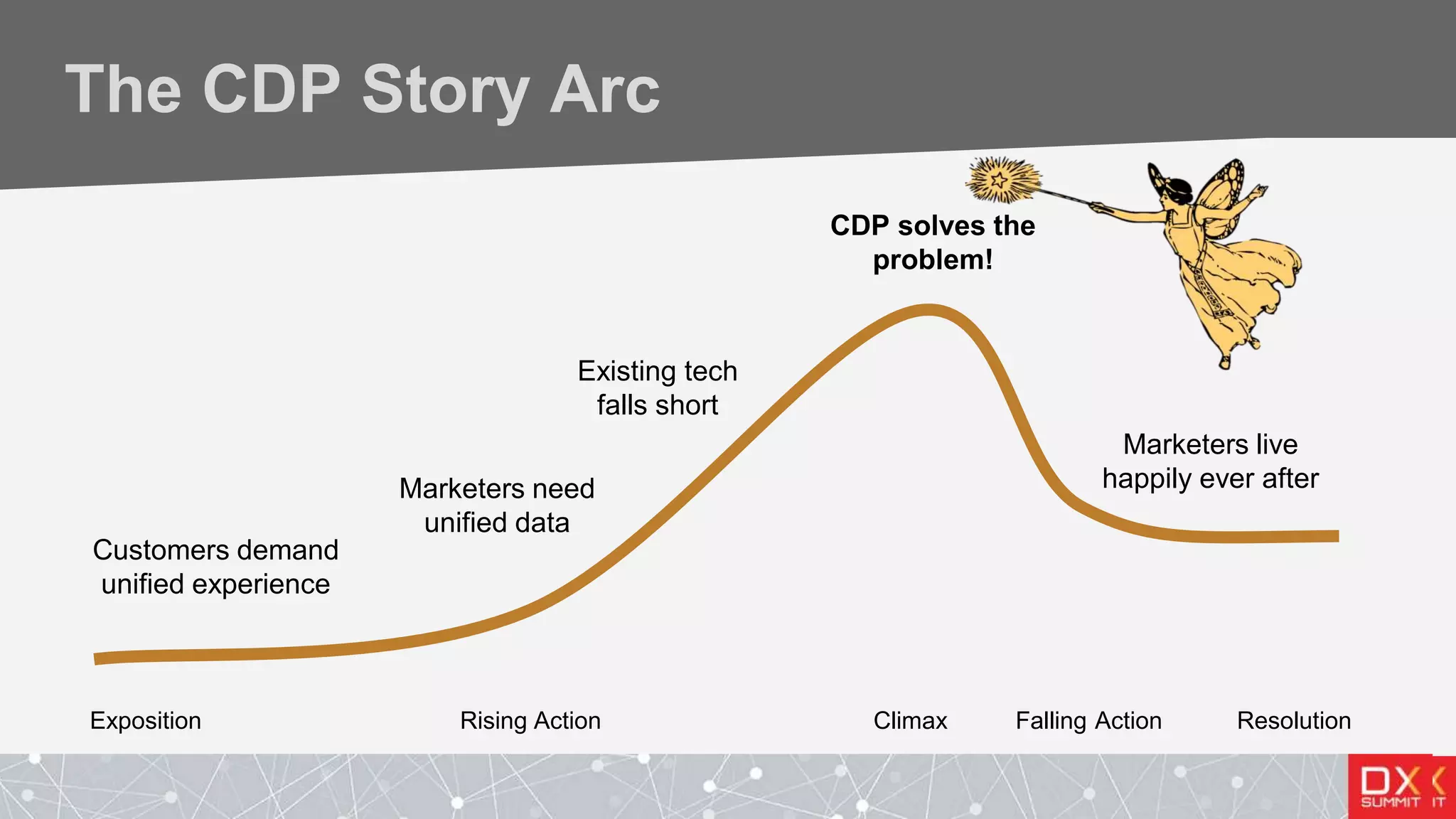
The CDP Story Arc
Exposition Rising Action Climax Falling Action Resolution
Customers demand
unified experience
Marketers need
unified data
Existing tech
falls short
CDP solves the
problem!
Marketers live
happily ever after
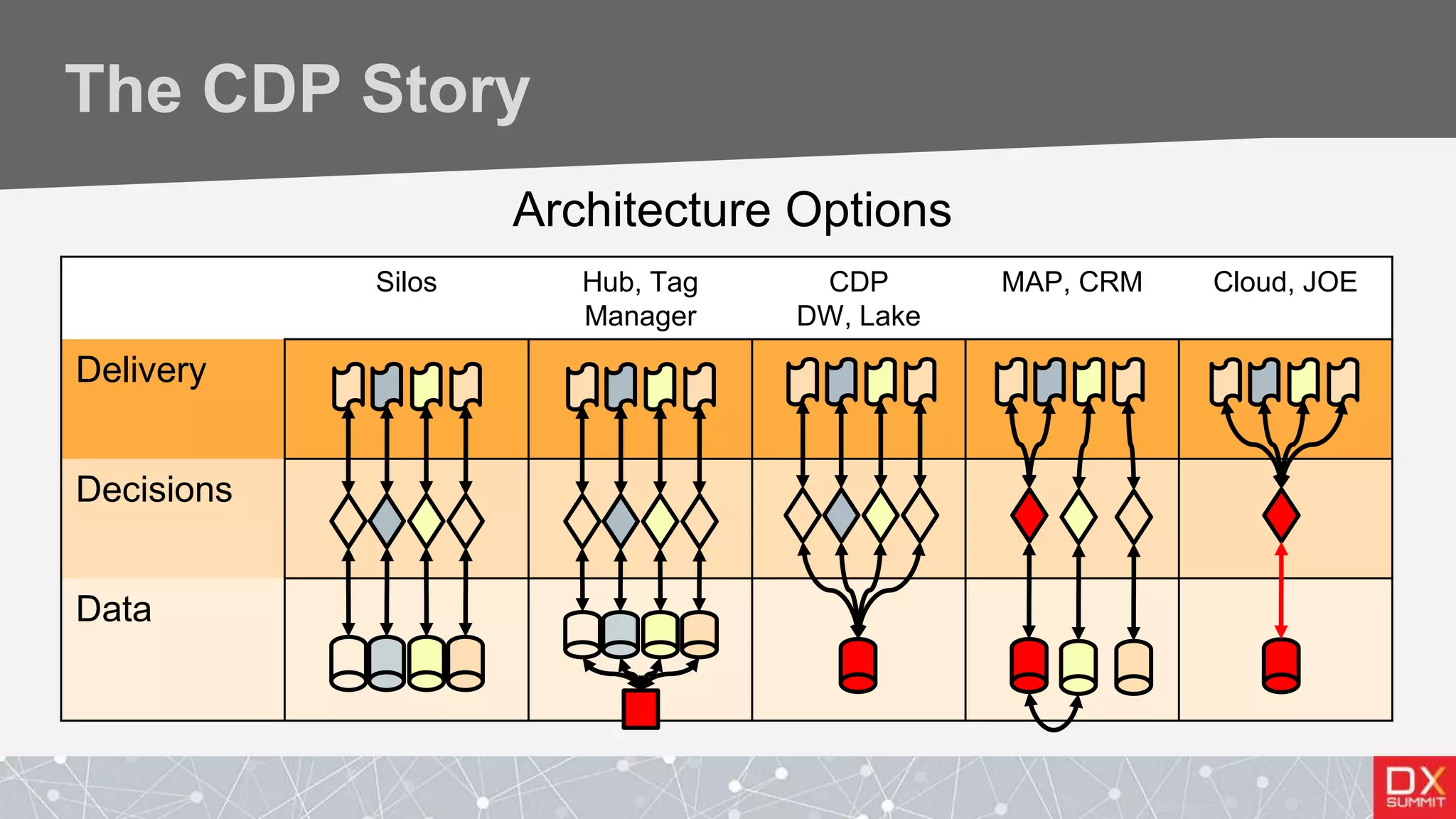
The CDP Story
Architecture Options
Silos Hub, Tag
Manager
CDP
DW, Lake
MAP, CRM Cloud, JOE
Delivery
Decisions
Data
The CDP Story
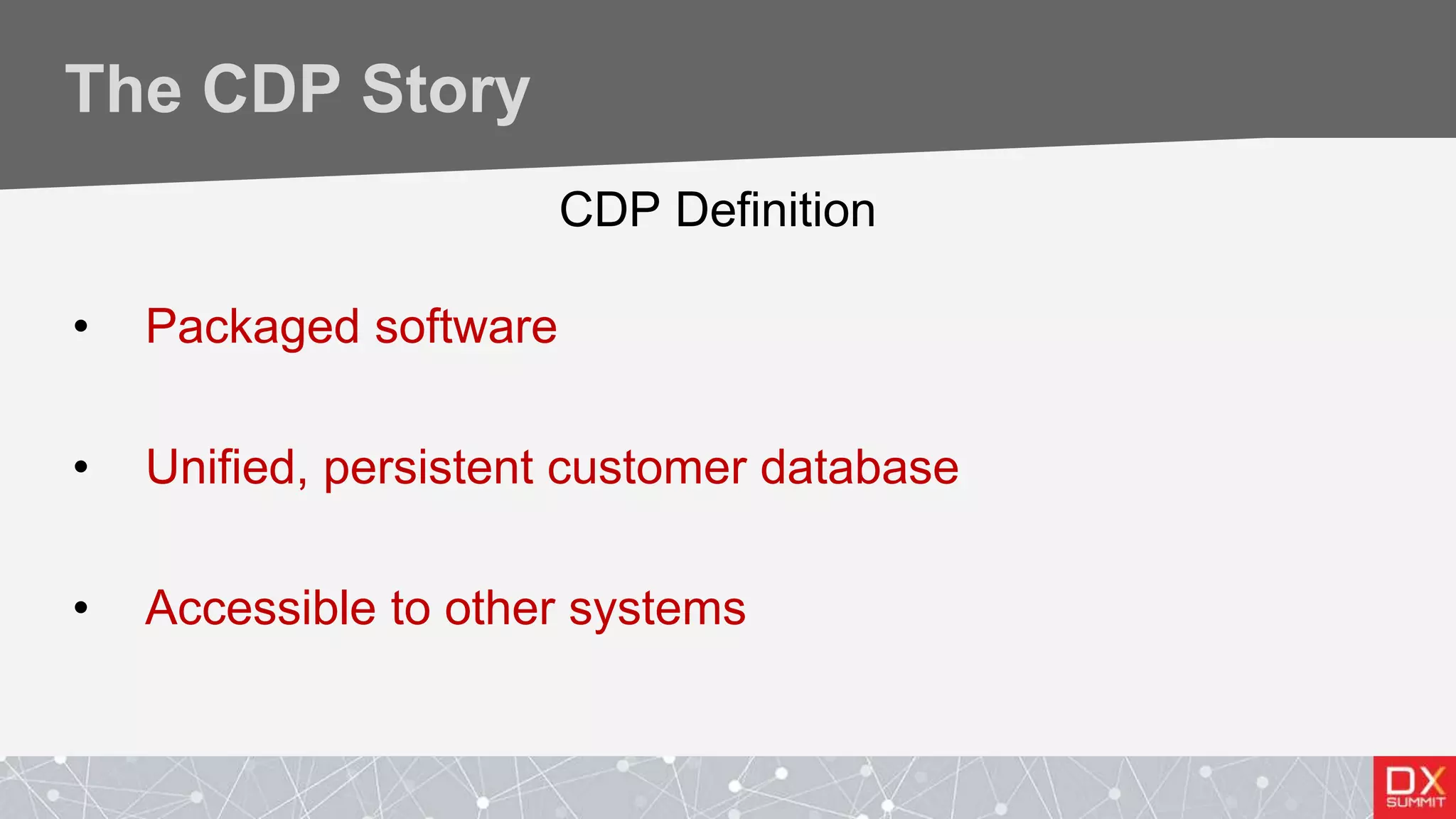
CDP Definition
• Packaged software
• Unified, persistent customer database
• Accessible to other systems
The CDP Story
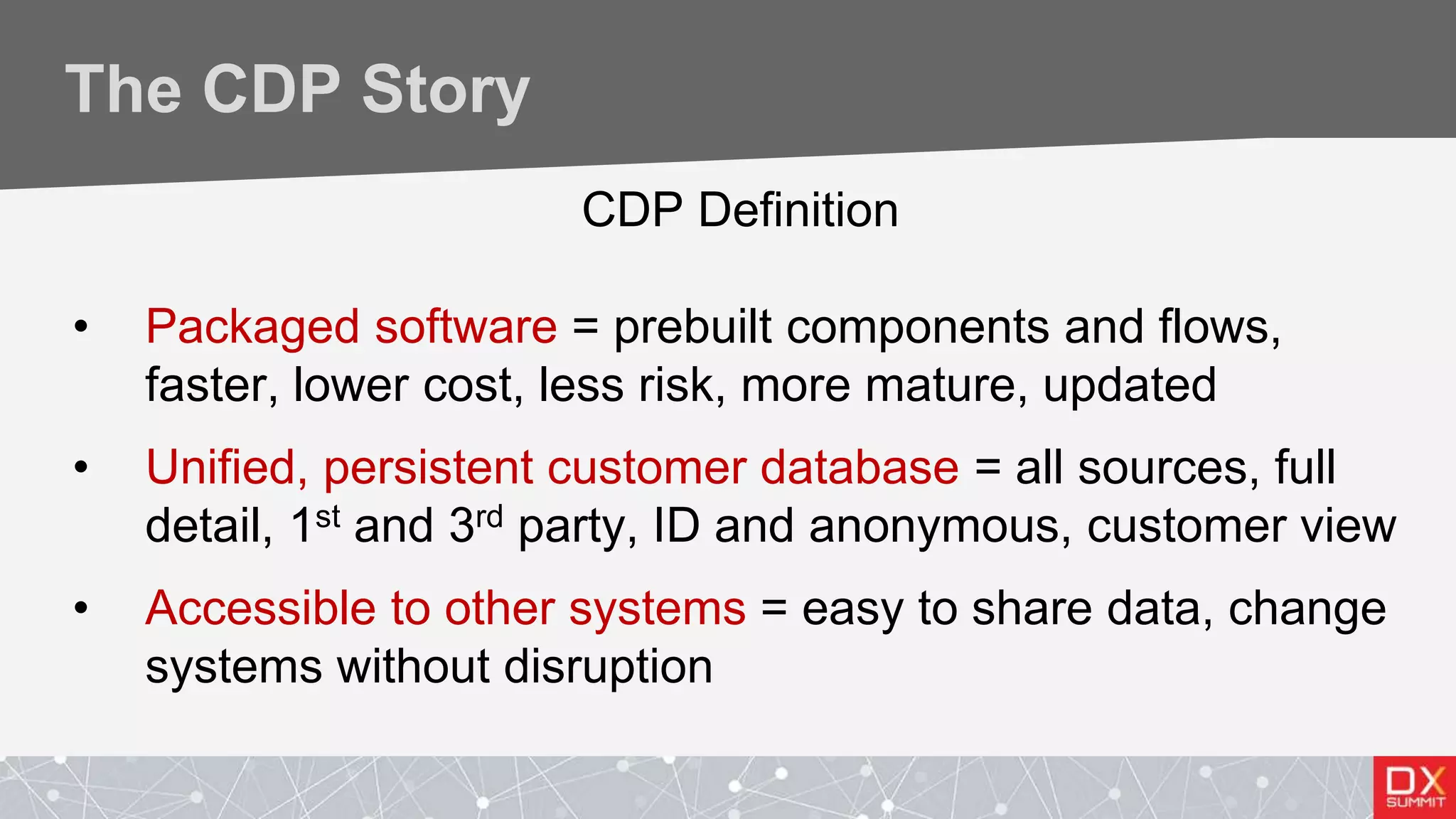
CDP Definition
• Packaged software = prebuilt components and flows,
faster, lower cost, less risk, more mature, updated
• Unified, persistent customer database = all sources, full
detail, 1st and 3rd party, ID and anonymous, customer view
• Accessible to other systems = easy to share data, change
systems without disruption
The CDP Story
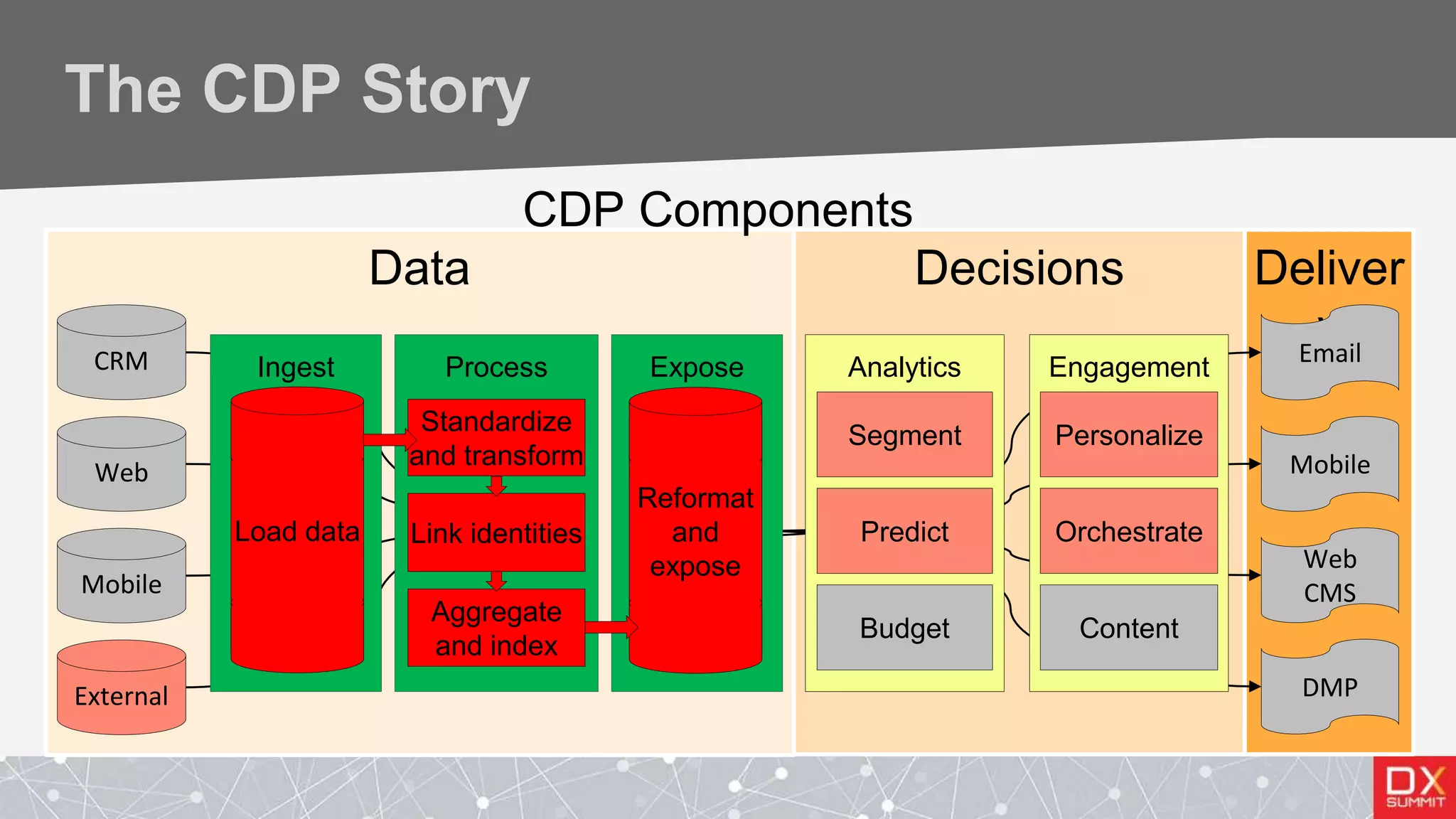
Data Decisions Deliver
y
DMP
Web
CMS
Mobile
Email
External
Mobile
Web
CRM ExposeIngest Process
Standardize
and transform
Link identities
Aggregate
and index
Reformat
and
expose
Load data
Analytics Engagement
Segment
Predict
Personalize
Orchestrate
Budget Content
CDP Components
The CDP Story
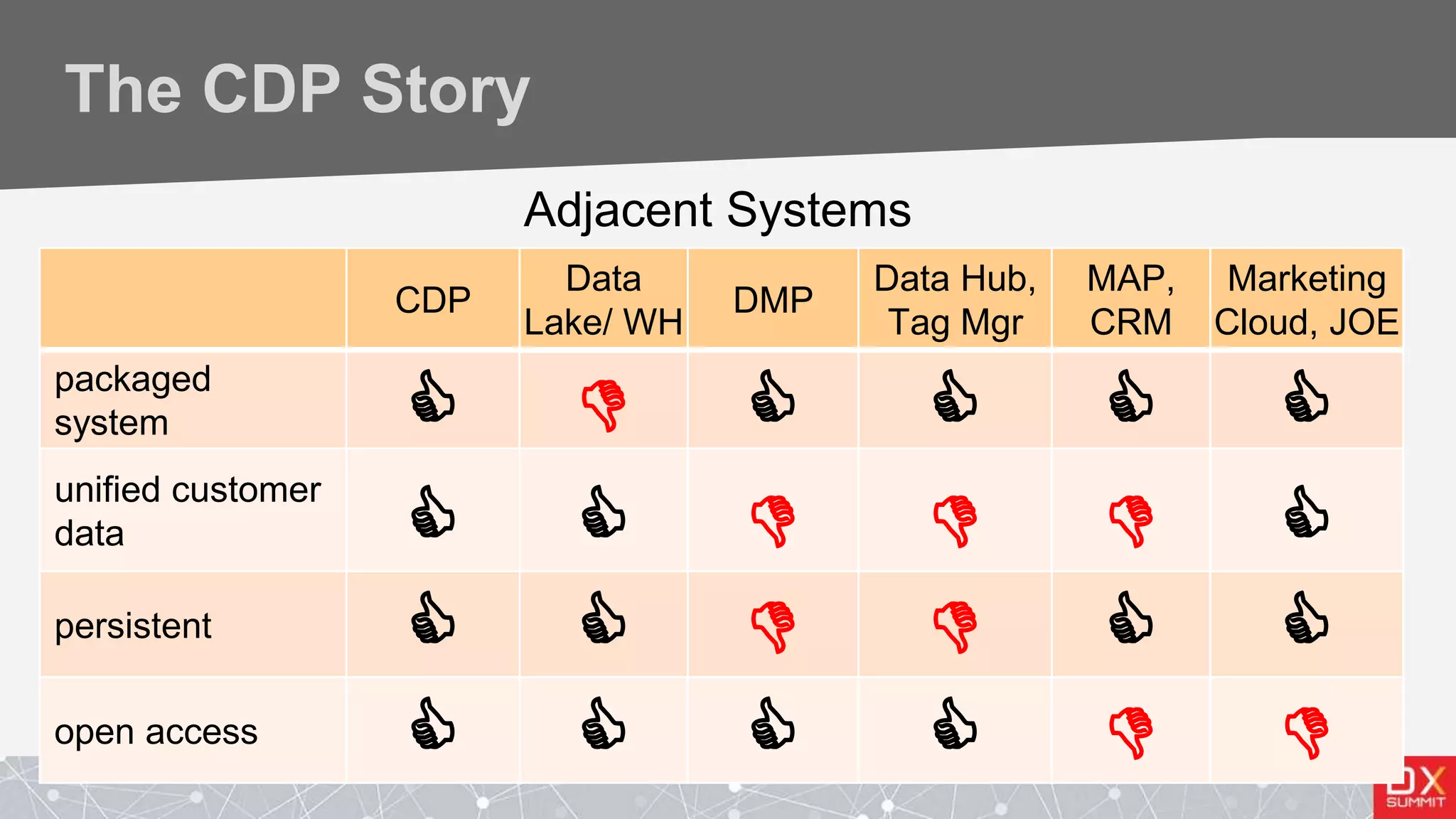
Adjacent Systems
CDP
Data
Lake/ WH
DMP
Data Hub,
Tag Mgr
MAP,
CRM
Marketing
Cloud, JOE
packaged
system      
unified customer
data      
persistent      
open access      
The CDP Story
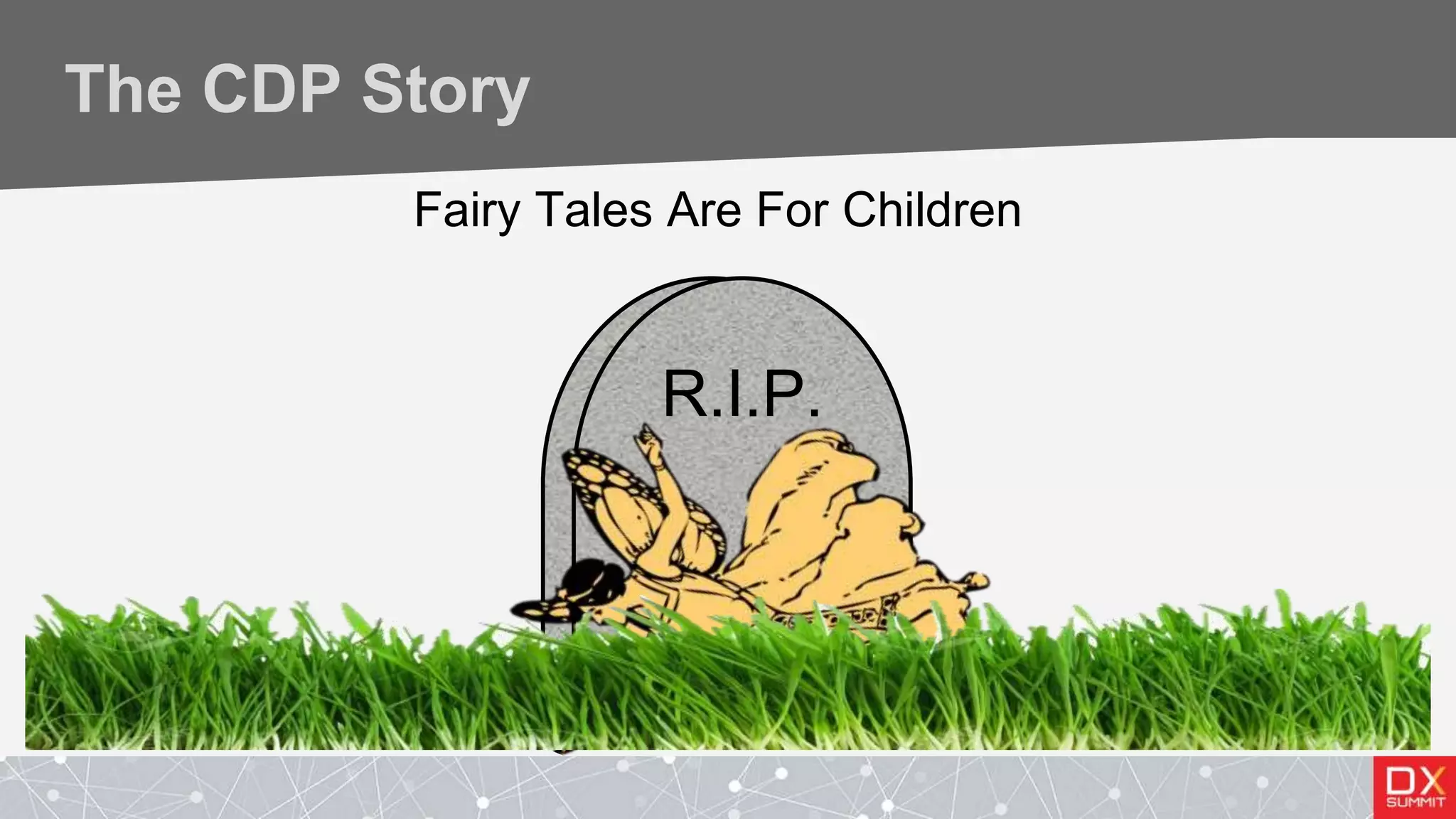
Fairy Tales Are For Children
R.I.
P.
R.I.P.
The CDP Reality
Myth: Purpose of CDP is to coordinate
customer experience across all channels.
Reality: Most common CDP application is
analytics. Single-channel personalization
comes next.
The CDP Reality
Myth: CDP value depends on connecting all
systems.
Reality: Many use cases work with a few
systems or even just one.
The CDP Reality
Myth: CDPs are for marketing only.
Reality: All customer-facing departments can
benefit.
The CDP Reality
Myth: CDPs manage only first party,
identified data.
Reality: Many CDPs use third party data and
anonymous data.
The CDP Reality
Myth: CDPs is a new technology.
Reality: CDP is (mostly) a packaging of
existing technology.
The CDP Reality
Myth: CDPs are not needed if you have a
Data Warehouse.
Reality: CDPs include unstructured data not
usually found in a Data Warehouse.
The CDP Reality
Myth: CDPs are not needed if you have a
Data Lake.
Reality: CDPs provide more data preparation
than a typical Data Lake.
The CDP Reality
Myth: Stand-alone CDPs are the only way to
create unified customer data.
Reality: Other solutions exist. CDP is a
function as well as a type of system.
The CDP Reality
Myth: CDPs are all the same.
Reality: CDPs vary widely in scope and
vertical specialty. Some differentiators: real
time; offline channels; on premises; 3rd party
data; analytics & engagement.
The CDP Reality
Myth: CDPs have no shared features.
Reality: All CDPs meet the definition:
• ingest and retain full detail
• create unified customer profiles
• expose the results
The CDP Reality
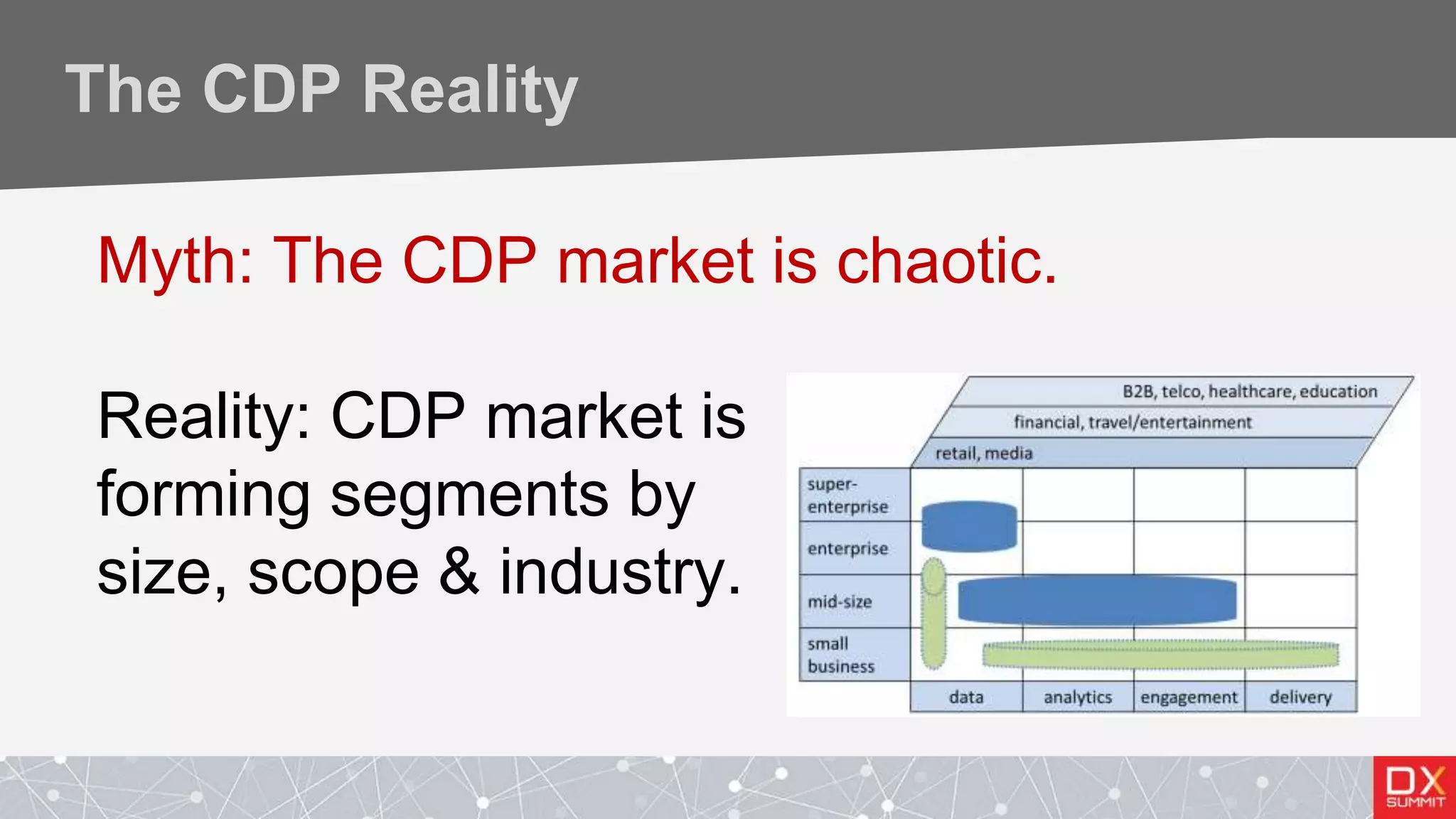
Myth: The CDP market is chaotic.
Reality: CDP market is
forming segments by
size, scope & industry.
The CDP Reality
Myth: Identity resolution is a core CDP
capability.
Reality: Some CDPs offer integrated ID
resolution. Some expect IDs to be provided
on inputs. Some rely on third party systems.
The CDP Reality
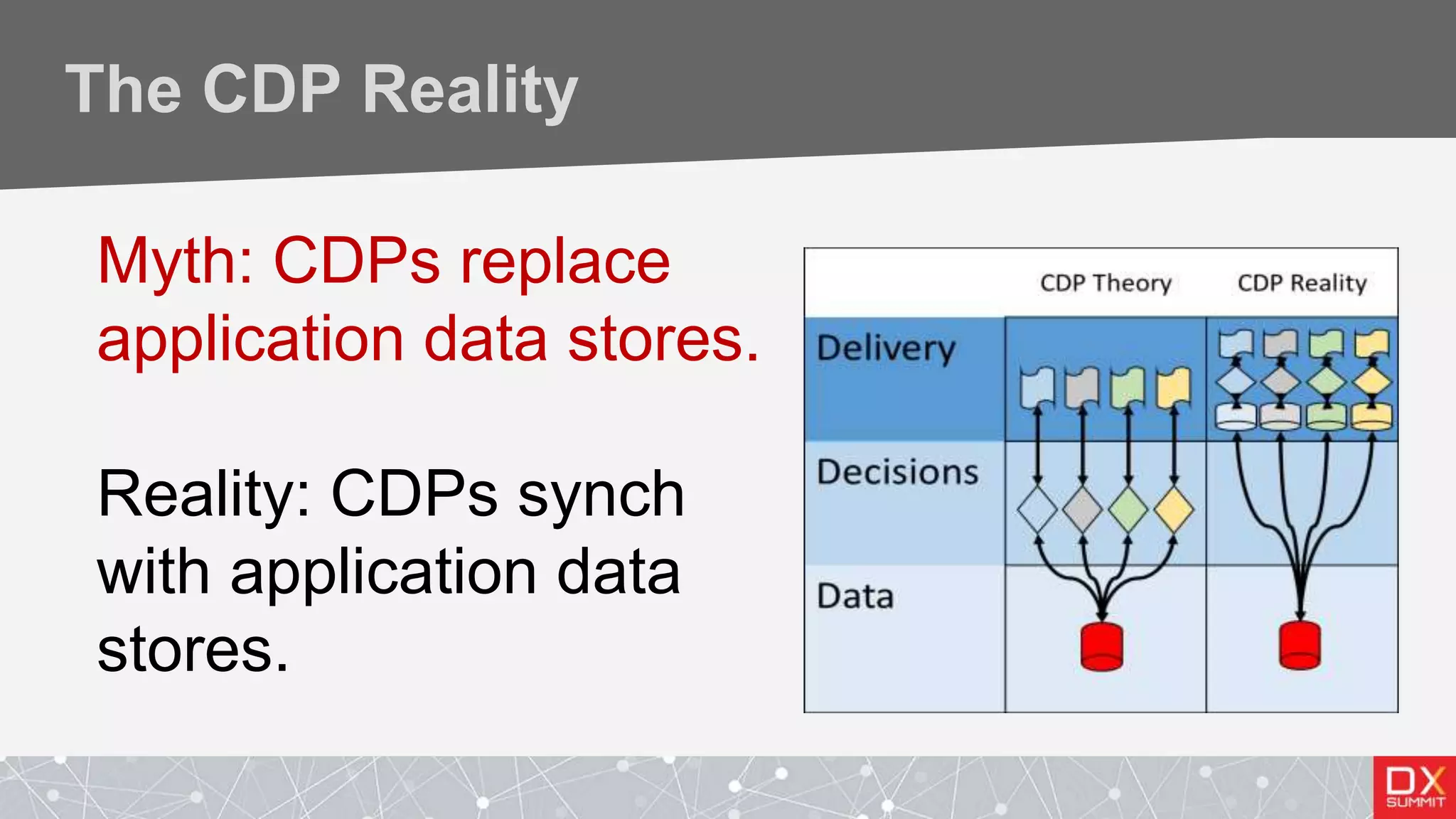
Myth: CDPs replace
application data stores.
Reality: CDPs synch
with application data
stores.
The CDP Reality
Myth: CDPs don’t need IT support.
Reality: IT is still involved, and should be.
Vendors often do some tech work.
The CDP Reality
Myth: CDP is a silver bullet that solves all
customer data problems.
Reality: Organization, budget, skills, time,
and existing systems can all be major
obstacles.
What We’ve Learned
What We’ve Learned
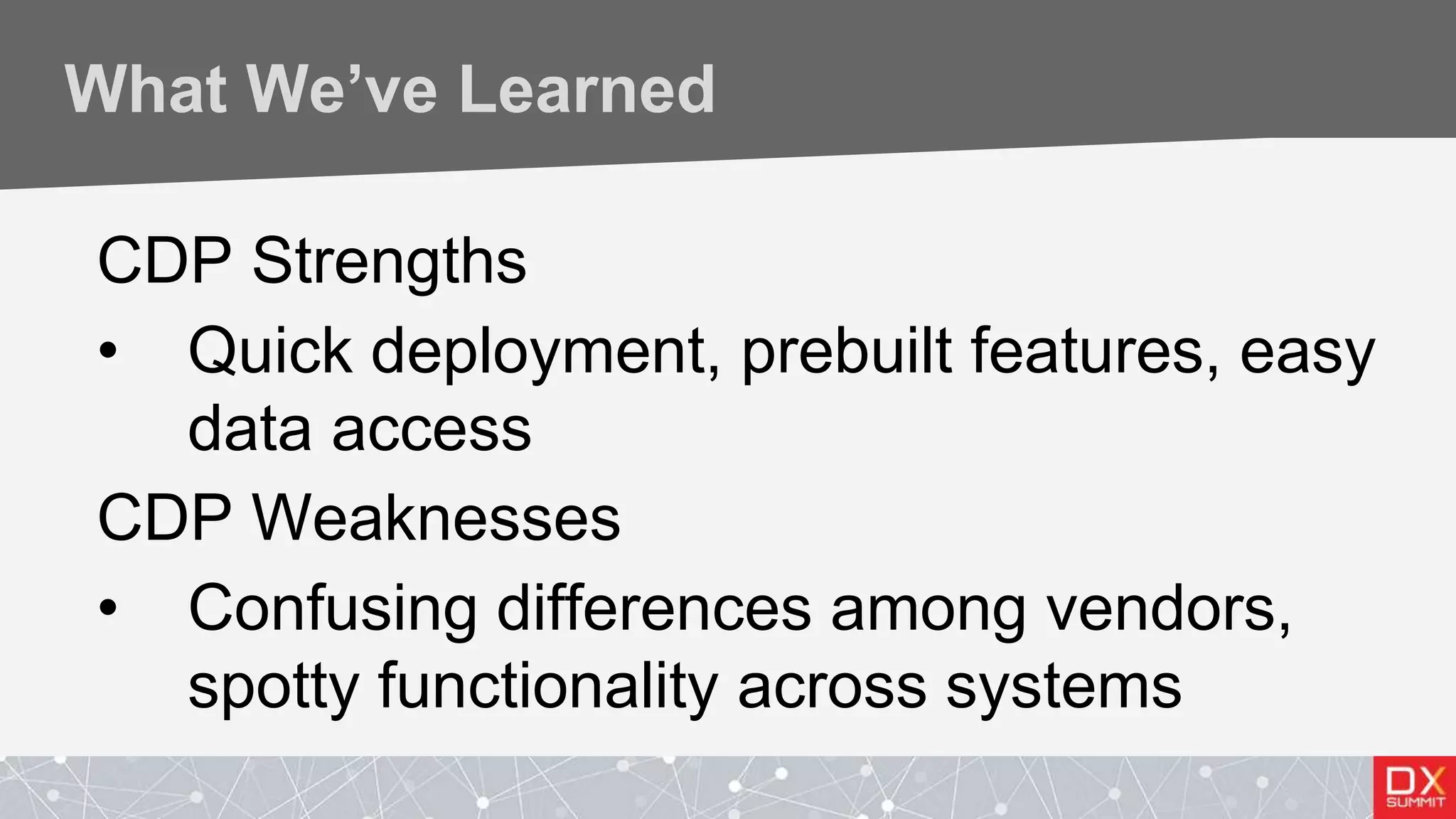
CDP Strengths
• Quick deployment, prebuilt features, easy
data access
CDP Weaknesses
• Confusing differences among vendors,
spotty functionality across systems
What We’ve Learned
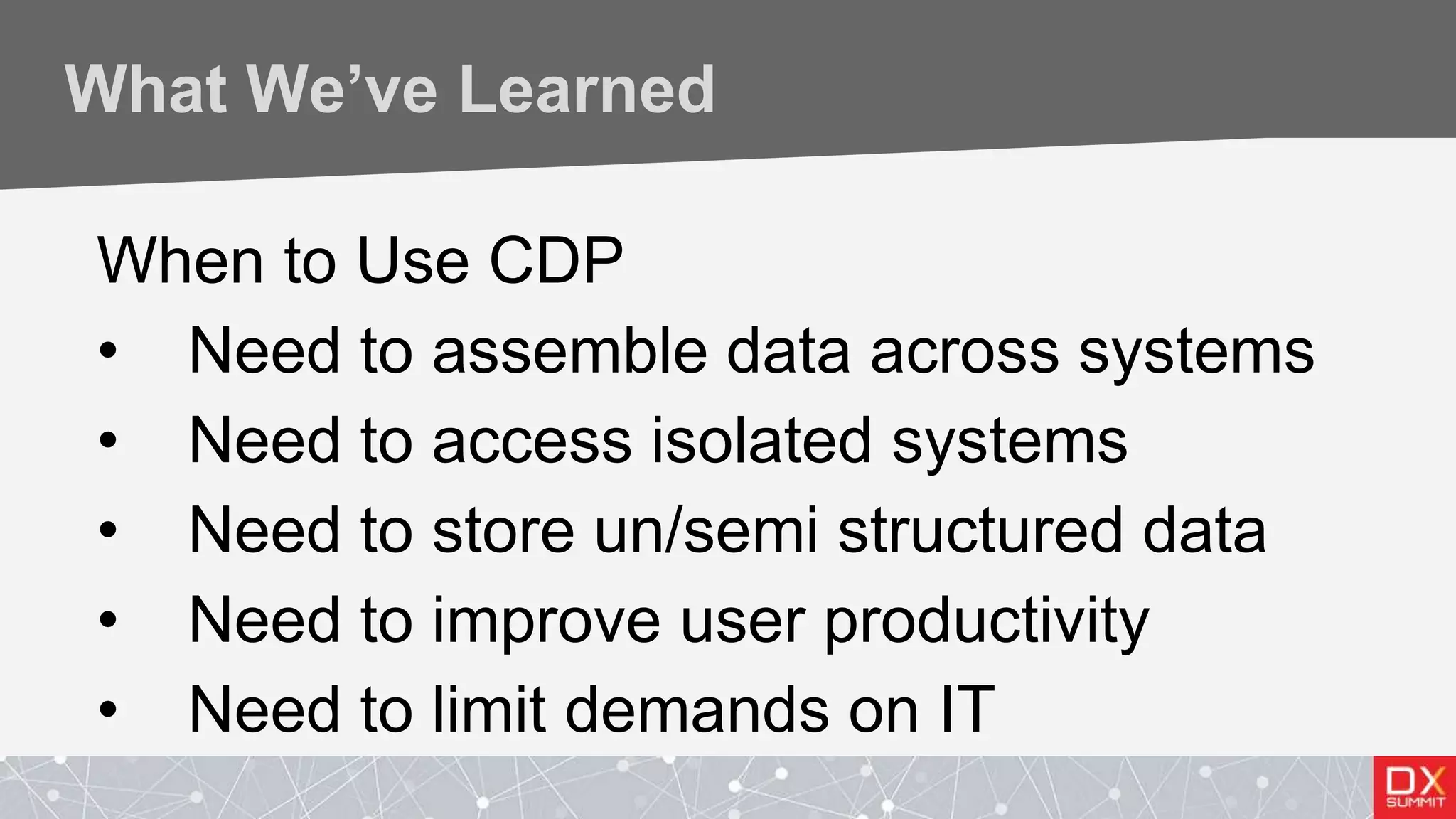
When to Use CDP
• Need to assemble data across systems
• Need to access isolated systems
• Need to store un/semi structured data
• Need to improve user productivity
• Need to limit demands on IT
What We’ve Learned
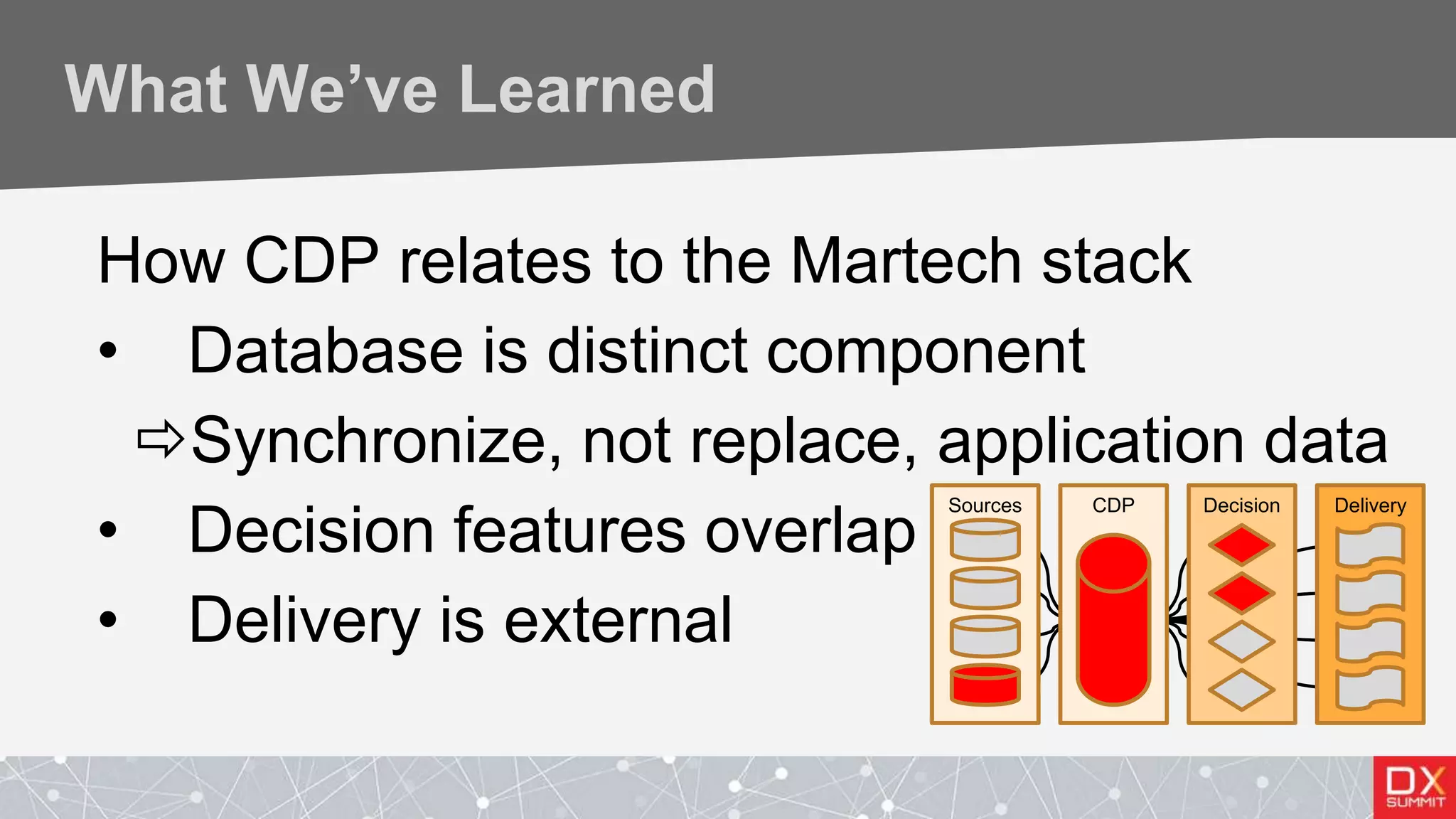
How CDP relates to the Martech stack
• Database is distinct component
Synchronize, not replace, application data
• Decision features overlap
• Delivery is external
Sources CDP DeliveryDecision
s
What We’ve Learned
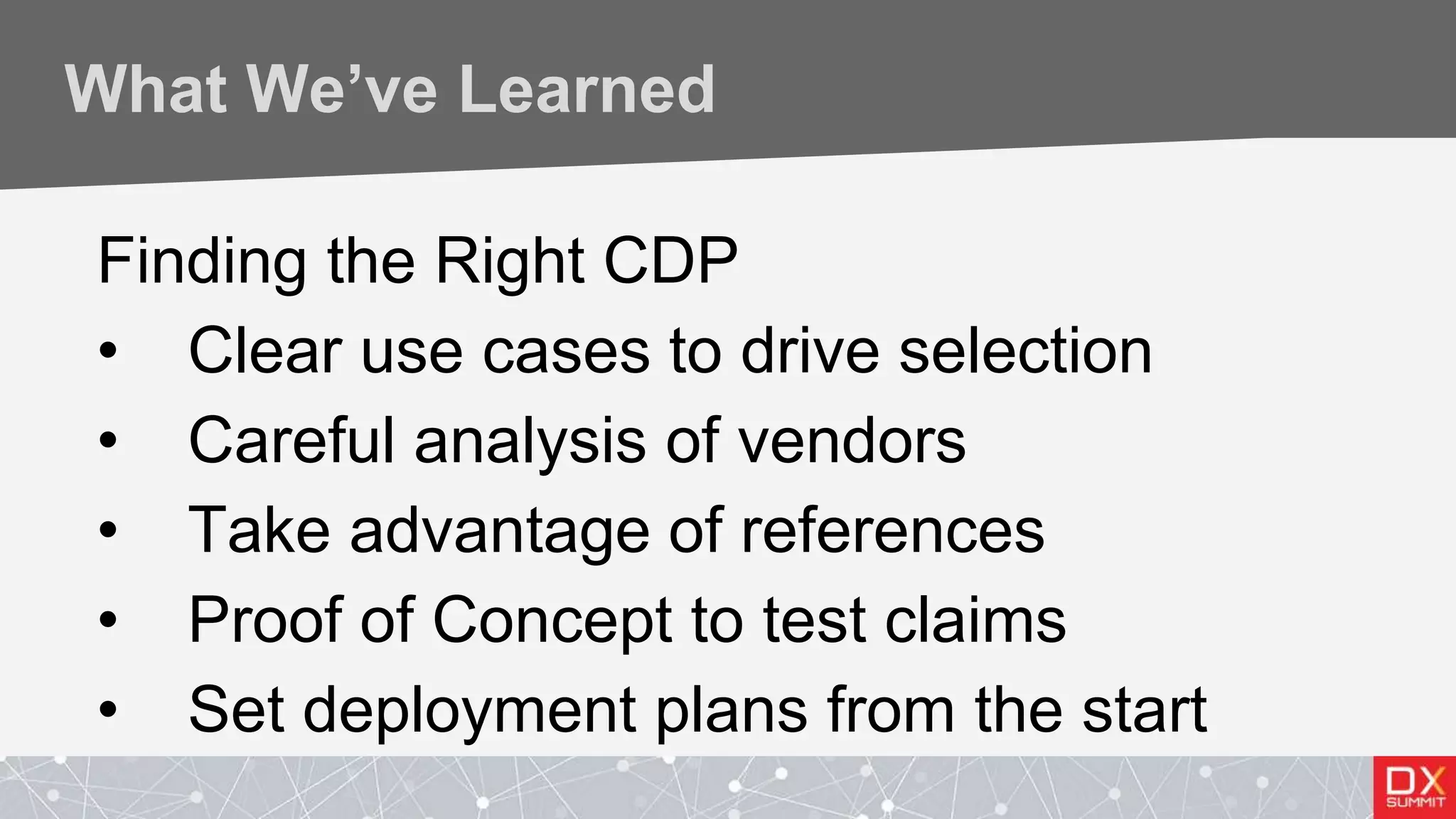
Finding the Right CDP
• Clear use cases to drive selection
• Careful analysis of vendors
• Take advantage of references
• Proof of Concept to test claims
• Set deployment plans from the start
What We’ve Learned
Success Requirements
• Pick the right system!
• Quality data available and accessible
• Adequate analysis and delivery systems
• Organization, budget, staff, etc.
What We’ve Learned
Summary
• Yes, there’s hype
• But CDP value is no fairy tale
• Be realistic and take advantage
Thank you!
draab@cdpinstitute.org
www.cdpinstitute.org

Getting Past the Hype about Customer Data Platforms - David Raab

  • 1.
    Getting Past theHype about Customer Data Platforms David M. Raab CDP Institute November 13, 2018
  • 2.
    The Story Arc ExpositionRising Action Climax Falling Action Resolution
  • 3.
    The CDP StoryArc Exposition Rising Action Climax Falling Action Resolution Customers demand unified experience Marketers need unified data Existing tech falls short CDP solves the problem! Marketers live happily ever after
  • 4.
    The CDP Story ArchitectureOptions Silos Hub, Tag Manager CDP DW, Lake MAP, CRM Cloud, JOE Delivery Decisions Data
  • 5.
    The CDP Story CDPDefinition • Packaged software • Unified, persistent customer database • Accessible to other systems
  • 6.
    The CDP Story CDPDefinition • Packaged software = prebuilt components and flows, faster, lower cost, less risk, more mature, updated • Unified, persistent customer database = all sources, full detail, 1st and 3rd party, ID and anonymous, customer view • Accessible to other systems = easy to share data, change systems without disruption
  • 7.
    The CDP Story DataDecisions Deliver y DMP Web CMS Mobile Email External Mobile Web CRM ExposeIngest Process Standardize and transform Link identities Aggregate and index Reformat and expose Load data Analytics Engagement Segment Predict Personalize Orchestrate Budget Content CDP Components
  • 8.
    The CDP Story AdjacentSystems CDP Data Lake/ WH DMP Data Hub, Tag Mgr MAP, CRM Marketing Cloud, JOE packaged system       unified customer data       persistent       open access      
  • 9.
    The CDP Story FairyTales Are For Children R.I. P. R.I.P.
  • 10.
    The CDP Reality Myth:Purpose of CDP is to coordinate customer experience across all channels. Reality: Most common CDP application is analytics. Single-channel personalization comes next.
  • 11.
    The CDP Reality Myth:CDP value depends on connecting all systems. Reality: Many use cases work with a few systems or even just one.
  • 12.
    The CDP Reality Myth:CDPs are for marketing only. Reality: All customer-facing departments can benefit.
  • 13.
    The CDP Reality Myth:CDPs manage only first party, identified data. Reality: Many CDPs use third party data and anonymous data.
  • 14.
    The CDP Reality Myth:CDPs is a new technology. Reality: CDP is (mostly) a packaging of existing technology.
  • 15.
    The CDP Reality Myth:CDPs are not needed if you have a Data Warehouse. Reality: CDPs include unstructured data not usually found in a Data Warehouse.
  • 16.
    The CDP Reality Myth:CDPs are not needed if you have a Data Lake. Reality: CDPs provide more data preparation than a typical Data Lake.
  • 17.
    The CDP Reality Myth:Stand-alone CDPs are the only way to create unified customer data. Reality: Other solutions exist. CDP is a function as well as a type of system.
  • 18.
    The CDP Reality Myth:CDPs are all the same. Reality: CDPs vary widely in scope and vertical specialty. Some differentiators: real time; offline channels; on premises; 3rd party data; analytics & engagement.
  • 19.
    The CDP Reality Myth:CDPs have no shared features. Reality: All CDPs meet the definition: • ingest and retain full detail • create unified customer profiles • expose the results
  • 20.
    The CDP Reality Myth:The CDP market is chaotic. Reality: CDP market is forming segments by size, scope & industry.
  • 21.
    The CDP Reality Myth:Identity resolution is a core CDP capability. Reality: Some CDPs offer integrated ID resolution. Some expect IDs to be provided on inputs. Some rely on third party systems.
  • 22.
    The CDP Reality Myth:CDPs replace application data stores. Reality: CDPs synch with application data stores.
  • 23.
    The CDP Reality Myth:CDPs don’t need IT support. Reality: IT is still involved, and should be. Vendors often do some tech work.
  • 24.
    The CDP Reality Myth:CDP is a silver bullet that solves all customer data problems. Reality: Organization, budget, skills, time, and existing systems can all be major obstacles.
  • 25.
  • 26.
    What We’ve Learned CDPStrengths • Quick deployment, prebuilt features, easy data access CDP Weaknesses • Confusing differences among vendors, spotty functionality across systems
  • 27.
    What We’ve Learned Whento Use CDP • Need to assemble data across systems • Need to access isolated systems • Need to store un/semi structured data • Need to improve user productivity • Need to limit demands on IT
  • 28.
    What We’ve Learned HowCDP relates to the Martech stack • Database is distinct component Synchronize, not replace, application data • Decision features overlap • Delivery is external Sources CDP DeliveryDecision s
  • 29.
    What We’ve Learned Findingthe Right CDP • Clear use cases to drive selection • Careful analysis of vendors • Take advantage of references • Proof of Concept to test claims • Set deployment plans from the start
  • 30.
    What We’ve Learned SuccessRequirements • Pick the right system! • Quality data available and accessible • Adequate analysis and delivery systems • Organization, budget, staff, etc.
  • 31.
    What We’ve Learned Summary •Yes, there’s hype • But CDP value is no fairy tale • Be realistic and take advantage
  • 32.