Gerunds and infinitives Explanation
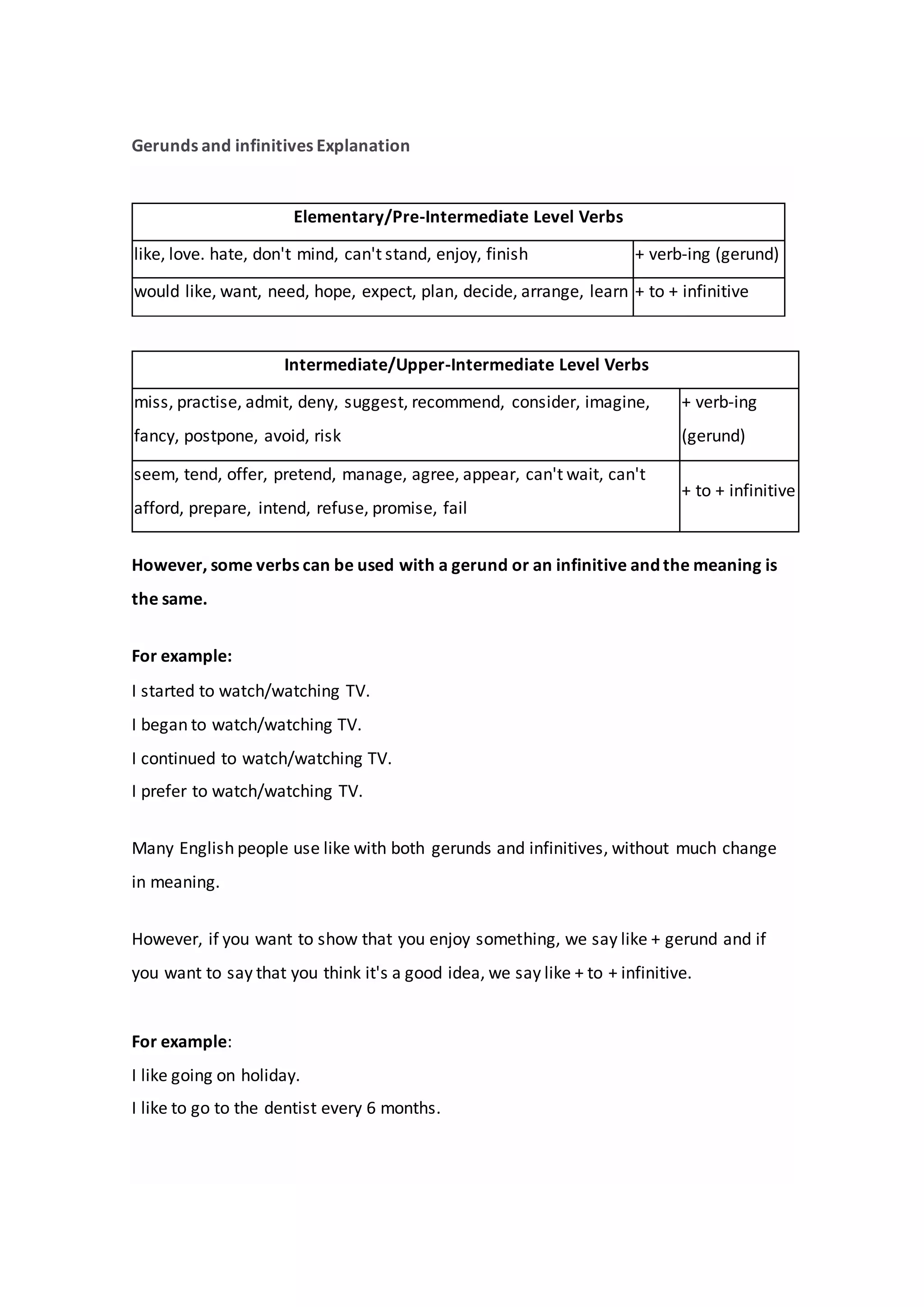
Elementary/Pre-Intermediate Level Verbs
like, love. hate, don't mind, can't stand, enjoy, finish + verb-ing (gerund)
would like, want, need, hope, expect, plan, decide, arrange, learn + to + infinitive
Intermediate/Upper-Intermediate Level Verbs
miss, practise, admit, deny, suggest, recommend, consider, imagine,
fancy, postpone, avoid, risk
+ verb-ing
(gerund)
seem, tend, offer, pretend, manage, agree, appear, can't wait, can't
afford, prepare, intend, refuse, promise, fail
+ to + infinitive
However, some verbs can be used with a gerund or an infinitive and the meaning is
the same.
For example:
I started to watch/watching TV.
I began to watch/watching TV.
I continued to watch/watching TV.
I prefer to watch/watching TV.
Many English people use like with both gerunds and infinitives, without much change
in meaning.
However, if you want to show that you enjoy something, we say like + gerund and if
you want to say that you think it's a good idea, we say like + to + infinitive.
For example:
I like going on holiday.
I like to go to the dentist every 6 months.
After prepositions and adjectives
Preposition + Gerund
After a preposition, we always use a noun or the -ing form of a verb - the gerund.
For example:
I'm very good at speaking English.
I went home after finishing my work.
Adjective + Infinitive
After many common adjectives, we often use "to + verb" - the infinitive.
For example:
It's rude to eat with your mouth open.
Problems
Don't forget that "to" can also be a preposition, not just part of the infinitive.
For example:
I'm looking forward to seeing you this weekend.
I'm used to getting up early in the morning.
I object to smoking in public.
He confessed to stealing the money.
Verbs which can use gerunds or infinitives
Some verbs can be used with a gerund or an infinitive, but the meaning changes.
For example: I stopped working to answer the phone.
I stopped working. = I was working, then I stopped.
I stopped to answer the phone. = this is the reason I stopped.
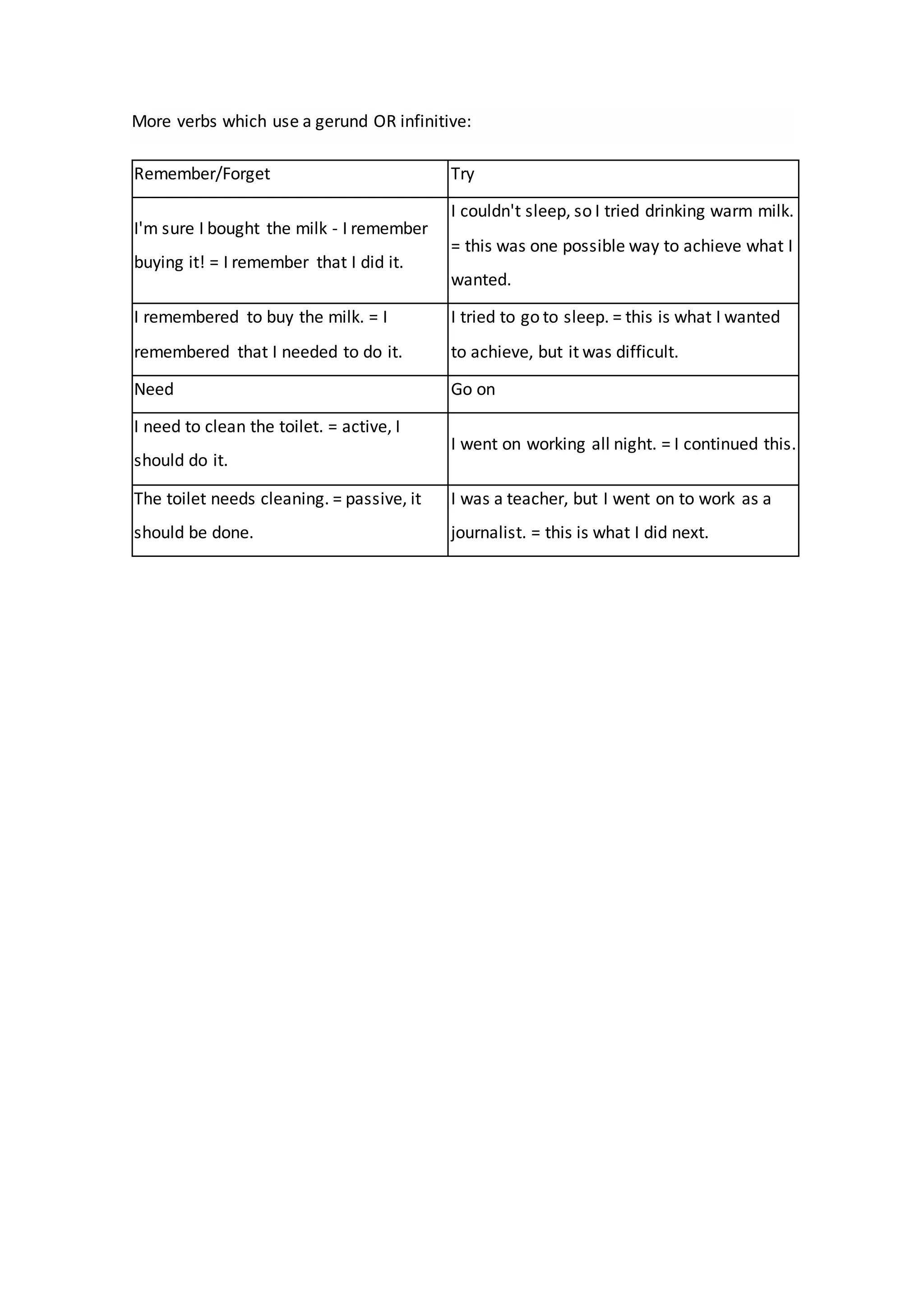
More verbs which use a gerund OR infinitive:
Remember/Forget Try
I'm sure I bought the milk - I remember
buying it! = I remember that I did it.
I couldn't sleep, so I tried drinking warm milk.
= this was one possible way to achieve what I
wanted.
I remembered to buy the milk. = I
remembered that I needed to do it.
I tried to go to sleep. = this is what I wanted
to achieve, but it was difficult.
Need Go on
I need to clean the toilet. = active, I
should do it.
I went on working all night. = I continued this.
The toilet needs cleaning. = passive, it
should be done.
I was a teacher, but I went on to work as a
journalist. = this is what I did next.

Gerunds and infinitives explanation

  • 1.
    Gerunds and infinitivesExplanation Elementary/Pre-Intermediate Level Verbs like, love. hate, don't mind, can't stand, enjoy, finish + verb-ing (gerund) would like, want, need, hope, expect, plan, decide, arrange, learn + to + infinitive Intermediate/Upper-Intermediate Level Verbs miss, practise, admit, deny, suggest, recommend, consider, imagine, fancy, postpone, avoid, risk + verb-ing (gerund) seem, tend, offer, pretend, manage, agree, appear, can't wait, can't afford, prepare, intend, refuse, promise, fail + to + infinitive However, some verbs can be used with a gerund or an infinitive and the meaning is the same. For example: I started to watch/watching TV. I began to watch/watching TV. I continued to watch/watching TV. I prefer to watch/watching TV. Many English people use like with both gerunds and infinitives, without much change in meaning. However, if you want to show that you enjoy something, we say like + gerund and if you want to say that you think it's a good idea, we say like + to + infinitive. For example: I like going on holiday. I like to go to the dentist every 6 months.
  • 2.
    After prepositions andadjectives Preposition + Gerund After a preposition, we always use a noun or the -ing form of a verb - the gerund. For example: I'm very good at speaking English. I went home after finishing my work. Adjective + Infinitive After many common adjectives, we often use "to + verb" - the infinitive. For example: It's rude to eat with your mouth open. Problems Don't forget that "to" can also be a preposition, not just part of the infinitive. For example: I'm looking forward to seeing you this weekend. I'm used to getting up early in the morning. I object to smoking in public. He confessed to stealing the money. Verbs which can use gerunds or infinitives Some verbs can be used with a gerund or an infinitive, but the meaning changes. For example: I stopped working to answer the phone. I stopped working. = I was working, then I stopped. I stopped to answer the phone. = this is the reason I stopped.
  • 3.
    More verbs whichuse a gerund OR infinitive: Remember/Forget Try I'm sure I bought the milk - I remember buying it! = I remember that I did it. I couldn't sleep, so I tried drinking warm milk. = this was one possible way to achieve what I wanted. I remembered to buy the milk. = I remembered that I needed to do it. I tried to go to sleep. = this is what I wanted to achieve, but it was difficult. Need Go on I need to clean the toilet. = active, I should do it. I went on working all night. = I continued this. The toilet needs cleaning. = passive, it should be done. I was a teacher, but I went on to work as a journalist. = this is what I did next.