AGREE OR DISAGREE
Prepared by Ebru Kırıkoğlu
AGREEING
• If you agree with someone about an opinion, you can
simply say "I agree" or "You're right.”
• For example, A: I think we need more time.
B: I agree. / You’re right.
• The words "so" and "too" are often used in expressions of
positive agreement. Note that "too" usually comes at the
end of the sentence, and "so” at the beginning.
AGREEING
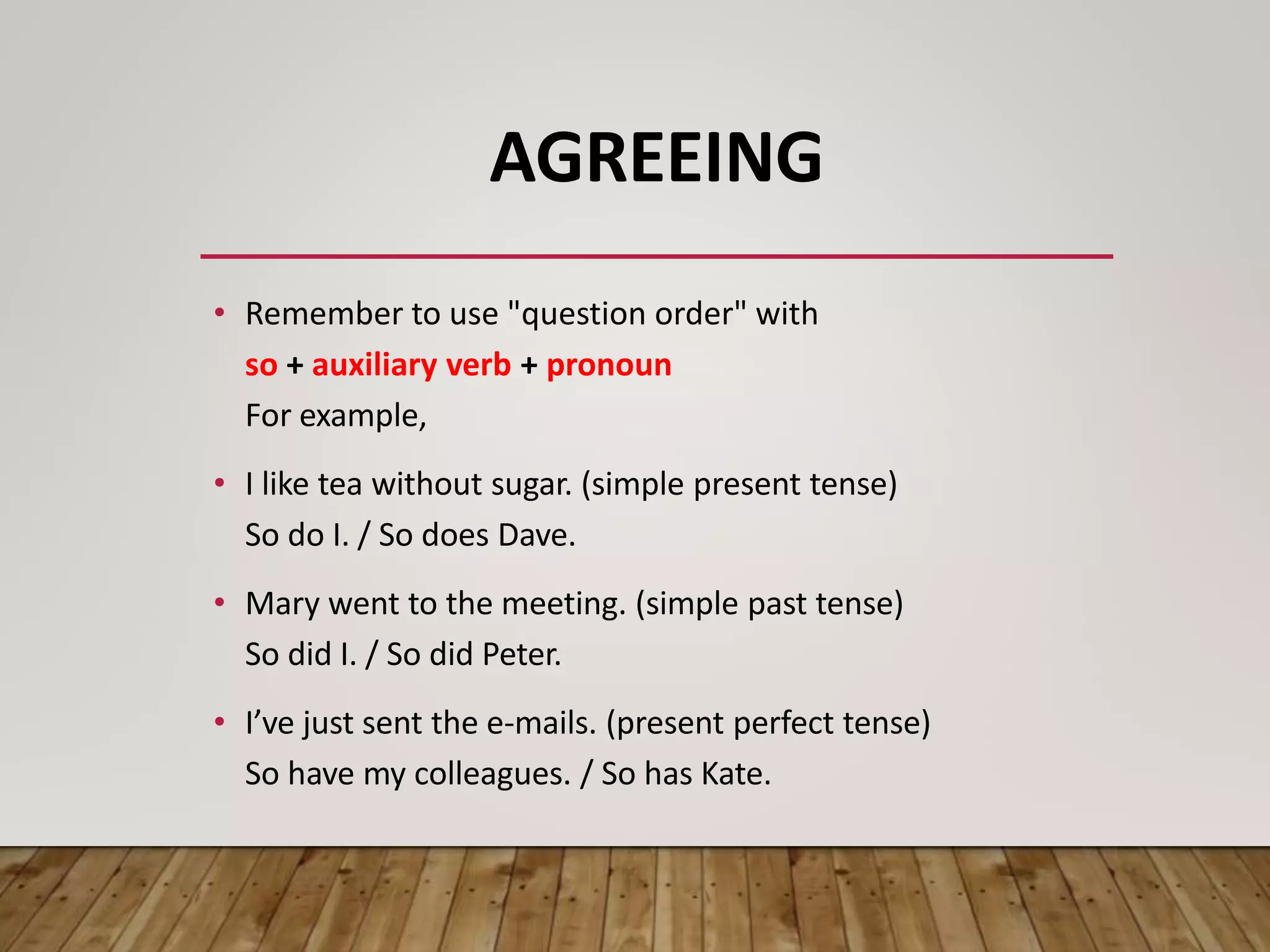
• Remember to use "question order" with
so + auxiliary verb + pronoun
For example,
• I like tea without sugar. (simple present tense)
So do I. / So does Dave.
• Mary went to the meeting. (simple past tense)
So did I. / So did Peter.
• I’ve just sent the e-mails. (present perfect tense)
So have my colleagues. / So has Kate.
AGREEING
• You can write the same sentences with too
• I like tea without sugar. (simple present tense)
I do too. / Me too.
Dave does too.
• Mary went to the meeting. (simple past tense)
I did too. / Me too.
Peter did too.
• I’ve just sent the e-mails. (present perfect tense)
My colleagues have too.
Kate has too.
AGREEING
• Agree with the following positive statements.
1. A: My mother will make a birthday cake.
B: ___________________ my mother.
2. A: I’m really hungry.
B: ___________________ I. / __________________ too.
3. A: She’s seen Bohemian Rhapsody twice.
B: ___________________ most of my friends.
4. A: My roommate is sleeping now.
B: ___________________ the baby. / ____________________ too.
AGREEING
• The words ”neither" or ”nor" are often used in expressions of
negative agreement.
• Remember to use "question order" with
neither / nor + auxiliary verb + pronoun
• I don’t like coffee with sugar. (simple present tense)
Neither do I. / Neither does Dave.
• Mary didn’t go to the party. (simple past tense)
Nor did I. / Nor did Peter.
• I haven’t eaten anything yet. (present perfect tense)
Neither have my colleagues. / Nor has Kate.
AGREEING
• You can write the same sentences with either
• I don’t like coffee with sugar. (simple present tense)
I don’t either. / Dave doesn’t either.
• Mary didn’t go to the party. (simple past tense)
I didn’t either. / Peter didn’t either.
• I haven’t eaten anything yet. (present perfect tense)
My colleagues haven’t either. / Kate hasn’t either.
• Note that either is used with "negative" auxiliary verbs.
AGREEING
• Agree with the following negative statements.
1. A: My mother can’t stand metal music.
B: _______________________ mine.
2. A: I don’t like junk food.
B: I ______________________________.
3. A: She’s never been abroad.
B: _______________________ my best friend.
4. A: Pam isn’t going out tonight.
B: Her brother ___________________________.
DISAGREEING
• To express disagreement, you may simply say
"I disagree" or "I don't think so”.
For example,
A: I think it will snow tomorrow.
B: I don’t think so.
• You may also disagree by stating the opposite opinion, sometimes
stressing a word for emphasis.
For example,
A: I don’t like mint ice cream.
B: Well, I do.
DISAGREEING
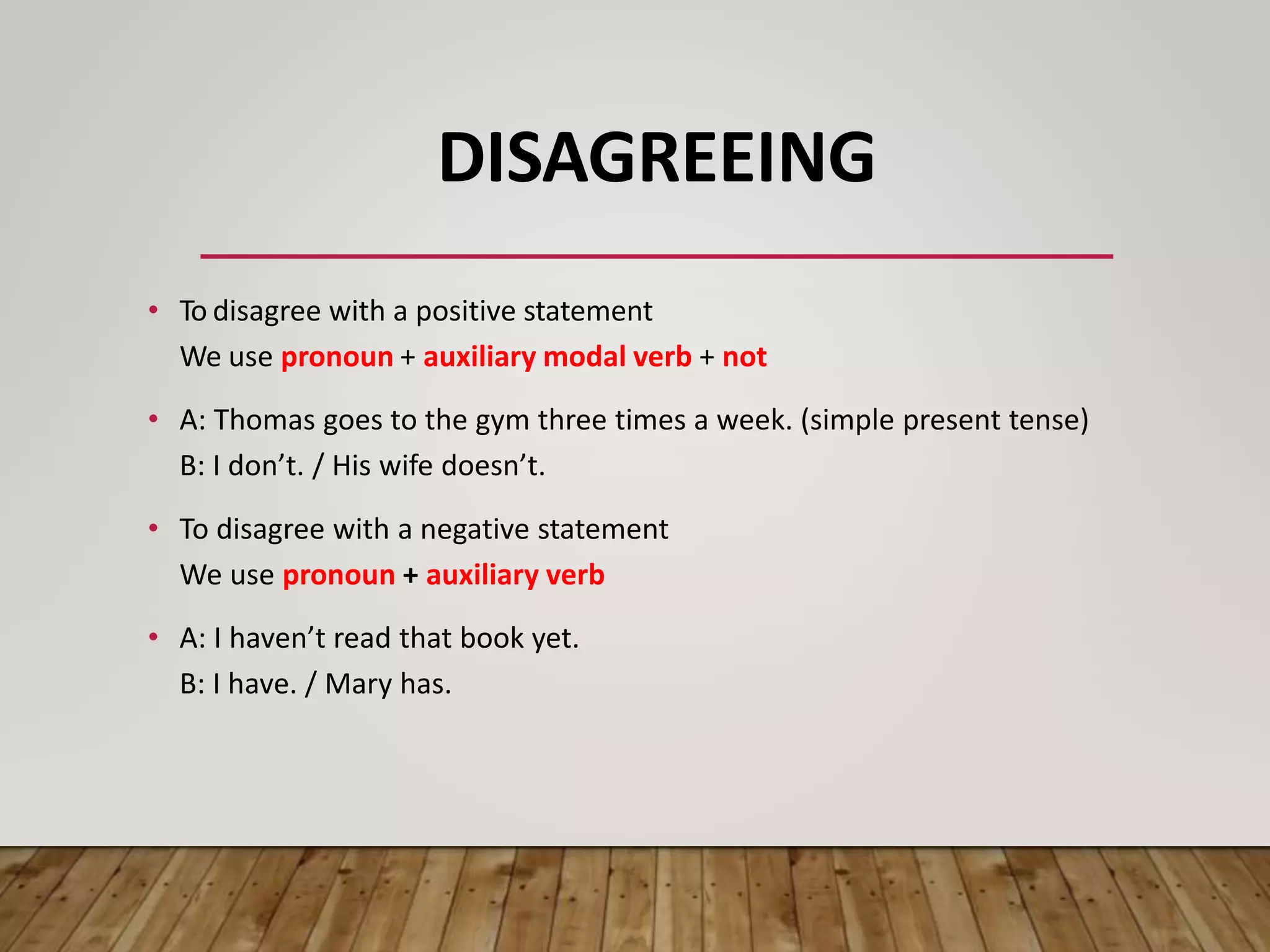
• To disagree with a positive statement
We use pronoun + auxiliary modal verb + not
• A: Thomas goes to the gym three times a week. (simple present tense)
B: I don’t. / His wife doesn’t.
• To disagree with a negative statement
We use pronoun + auxiliary verb
• A: I haven’t read that book yet.
B: I have. / Mary has.

Agree or disagree

  • 1.
    AGREE OR DISAGREE Preparedby Ebru Kırıkoğlu
  • 2.
    AGREEING • If youagree with someone about an opinion, you can simply say "I agree" or "You're right.” • For example, A: I think we need more time. B: I agree. / You’re right. • The words "so" and "too" are often used in expressions of positive agreement. Note that "too" usually comes at the end of the sentence, and "so” at the beginning.
  • 3.
    AGREEING • Remember touse "question order" with so + auxiliary verb + pronoun For example, • I like tea without sugar. (simple present tense) So do I. / So does Dave. • Mary went to the meeting. (simple past tense) So did I. / So did Peter. • I’ve just sent the e-mails. (present perfect tense) So have my colleagues. / So has Kate.
  • 4.
    AGREEING • You canwrite the same sentences with too • I like tea without sugar. (simple present tense) I do too. / Me too. Dave does too. • Mary went to the meeting. (simple past tense) I did too. / Me too. Peter did too. • I’ve just sent the e-mails. (present perfect tense) My colleagues have too. Kate has too.
  • 5.
    AGREEING • Agree withthe following positive statements. 1. A: My mother will make a birthday cake. B: ___________________ my mother. 2. A: I’m really hungry. B: ___________________ I. / __________________ too. 3. A: She’s seen Bohemian Rhapsody twice. B: ___________________ most of my friends. 4. A: My roommate is sleeping now. B: ___________________ the baby. / ____________________ too.
  • 6.
    AGREEING • The words”neither" or ”nor" are often used in expressions of negative agreement. • Remember to use "question order" with neither / nor + auxiliary verb + pronoun • I don’t like coffee with sugar. (simple present tense) Neither do I. / Neither does Dave. • Mary didn’t go to the party. (simple past tense) Nor did I. / Nor did Peter. • I haven’t eaten anything yet. (present perfect tense) Neither have my colleagues. / Nor has Kate.
  • 7.
    AGREEING • You canwrite the same sentences with either • I don’t like coffee with sugar. (simple present tense) I don’t either. / Dave doesn’t either. • Mary didn’t go to the party. (simple past tense) I didn’t either. / Peter didn’t either. • I haven’t eaten anything yet. (present perfect tense) My colleagues haven’t either. / Kate hasn’t either. • Note that either is used with "negative" auxiliary verbs.
  • 8.
    AGREEING • Agree withthe following negative statements. 1. A: My mother can’t stand metal music. B: _______________________ mine. 2. A: I don’t like junk food. B: I ______________________________. 3. A: She’s never been abroad. B: _______________________ my best friend. 4. A: Pam isn’t going out tonight. B: Her brother ___________________________.
  • 9.
    DISAGREEING • To expressdisagreement, you may simply say "I disagree" or "I don't think so”. For example, A: I think it will snow tomorrow. B: I don’t think so. • You may also disagree by stating the opposite opinion, sometimes stressing a word for emphasis. For example, A: I don’t like mint ice cream. B: Well, I do.
  • 10.
    DISAGREEING • To disagreewith a positive statement We use pronoun + auxiliary modal verb + not • A: Thomas goes to the gym three times a week. (simple present tense) B: I don’t. / His wife doesn’t. • To disagree with a negative statement We use pronoun + auxiliary verb • A: I haven’t read that book yet. B: I have. / Mary has.