Genomics Education
Partnership:
First implementation in a Molecular Biology Course
May-June 2014
Ana Maria Barral
National University, CA.
National University
• Private, non-profit university (1971)
• Comprehensive: Associate, Bachelors, & Masters Degrees
• 19 campuses in CA, administrative offices in San Diego
• Accelerated courses (4-8 weeks), one at a time.
• Mostly non-traditional students:
• Working students, often with families
• Returning students
• Veterans & active military
• Minorities
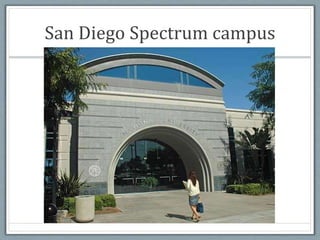
San Diego Spectrum campus
• Part of the BS Biology sequence, follows Genetics
• 8 week lecture + lab, GEP implemented for lab
• Total of 10 class meetings, 4.5 hours each (lab).
• Although 10-12 hours of annotation were planned, total
hours spent in-class were 20-25 hours, plus student
individual time.
• Lecture included a scaffolded written project on a Drosophila
gene to support the GEP project.
GEP in a Molecular Biology lab
course (BIO407A)
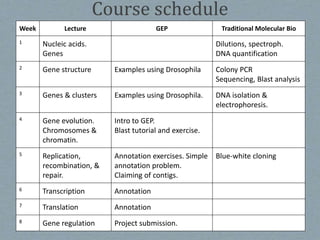
Course schedule
Week Lecture GEP Traditional Molecular Bio
1 Nucleic acids.
Genes
Dilutions, spectroph.
DNA quantification
2 Gene structure Examples using Drosophila Colony PCR
Sequencing, Blast analysis
3 Genes & clusters Examples using Drosophila. DNA isolation &
electrophoresis.
4 Gene evolution.
Chromosomes &
chromatin.
Intro to GEP.
Blast tutorial and exercise.
5 Replication,
recombination, &
repair.
Annotation exercises. Simple
annotation problem.
Claiming of contigs.
Blue-white cloning
6 Transcription Annotation
7 Translation Annotation
8 Gene regulation Project submission.
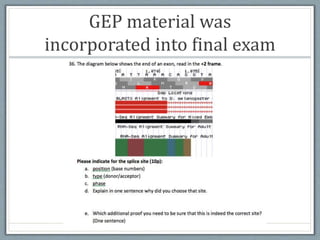
GEP material was
incorporated into final exam
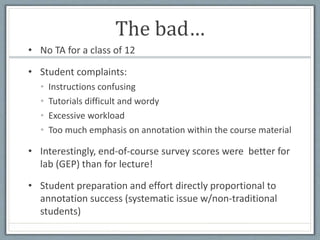
The bad…
• No TA for a class of 12
• Student complaints:
• Instructions confusing
• Tutorials difficult and wordy
• Excessive workload
• Too much emphasis on annotation within the course material
• Interestingly, end-of-course survey scores were better for
lab (GEP) than for lecture!
• Student preparation and effort directly proportional to
annotation success (systematic issue w/non-traditional
students)
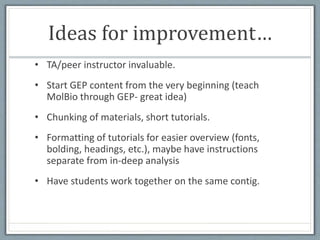
Ideas for improvement…
• TA/peer instructor invaluable.
• Start GEP content from the very beginning (teach
MolBio through GEP- great idea)
• Chunking of materials, short tutorials.
• Formatting of tutorials for easier overview (fonts,
bolding, headings, etc.), maybe have instructions
separate from in-deep analysis
• Have students work together on the same contig.
Additional observations
• “So are we working for free for Washington
University?” Lack of clarity about research and
project ownership.
• Desire for more visual aids and help videos
(youtube generation)
• GEP project abstract- it may be useful to put faces
to names (Welcome video by GEP group?)
The Good
• Student engagement was palpable.
• Student surveys scored high (>4) for critical
thinking, deeper knowledge of the material, apply
the knowledge to real life.
• “It was refreshing to have a professor give me the
opportunity to work on such a meaningful task like
the WU project. Even though it was extremely
challenging at times, it was nice to know that I was
working for something more than just a grade.”
Thank you all, especially Sally
and Wilson !

GEP implementation at NU

  • 1.
    Genomics Education Partnership: First implementationin a Molecular Biology Course May-June 2014 Ana Maria Barral National University, CA.
  • 2.
    National University • Private,non-profit university (1971) • Comprehensive: Associate, Bachelors, & Masters Degrees • 19 campuses in CA, administrative offices in San Diego • Accelerated courses (4-8 weeks), one at a time. • Mostly non-traditional students: • Working students, often with families • Returning students • Veterans & active military • Minorities
  • 3.
  • 4.
    • Part ofthe BS Biology sequence, follows Genetics • 8 week lecture + lab, GEP implemented for lab • Total of 10 class meetings, 4.5 hours each (lab). • Although 10-12 hours of annotation were planned, total hours spent in-class were 20-25 hours, plus student individual time. • Lecture included a scaffolded written project on a Drosophila gene to support the GEP project. GEP in a Molecular Biology lab course (BIO407A)
  • 5.
    Course schedule Week LectureGEP Traditional Molecular Bio 1 Nucleic acids. Genes Dilutions, spectroph. DNA quantification 2 Gene structure Examples using Drosophila Colony PCR Sequencing, Blast analysis 3 Genes & clusters Examples using Drosophila. DNA isolation & electrophoresis. 4 Gene evolution. Chromosomes & chromatin. Intro to GEP. Blast tutorial and exercise. 5 Replication, recombination, & repair. Annotation exercises. Simple annotation problem. Claiming of contigs. Blue-white cloning 6 Transcription Annotation 7 Translation Annotation 8 Gene regulation Project submission.
  • 6.
  • 7.
    The bad… • NoTA for a class of 12 • Student complaints: • Instructions confusing • Tutorials difficult and wordy • Excessive workload • Too much emphasis on annotation within the course material • Interestingly, end-of-course survey scores were better for lab (GEP) than for lecture! • Student preparation and effort directly proportional to annotation success (systematic issue w/non-traditional students)
  • 8.
    Ideas for improvement… •TA/peer instructor invaluable. • Start GEP content from the very beginning (teach MolBio through GEP- great idea) • Chunking of materials, short tutorials. • Formatting of tutorials for easier overview (fonts, bolding, headings, etc.), maybe have instructions separate from in-deep analysis • Have students work together on the same contig.
  • 9.
    Additional observations • “Soare we working for free for Washington University?” Lack of clarity about research and project ownership. • Desire for more visual aids and help videos (youtube generation) • GEP project abstract- it may be useful to put faces to names (Welcome video by GEP group?)
  • 10.
    The Good • Studentengagement was palpable. • Student surveys scored high (>4) for critical thinking, deeper knowledge of the material, apply the knowledge to real life. • “It was refreshing to have a professor give me the opportunity to work on such a meaningful task like the WU project. Even though it was extremely challenging at times, it was nice to know that I was working for something more than just a grade.”
  • 11.
    Thank you all,especially Sally and Wilson !