Crowdsourcing
Antibiotic Discovery
The Small World InitiativeTM (SWI)
Ana Maria Barral
National University, CA
Workshop goals
1. Describe the history of SWI and its
current framework
2. To present examples of SWI courses
3. To discuss how to join
4. To evaluate if SWI could be a match for
your school
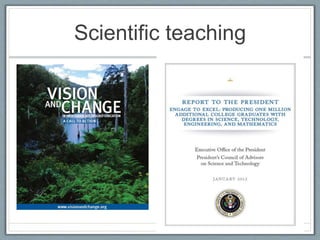
Scientific teaching
Addressing the STEM
workforce needs
Focus on 1st two years of college for one million more
STEM professionals because…
• <40% of college students intending to major in STEM
complete a STEM degree
• Even fewer for certain ethnic minority groups
• 1st two years actively discourage students from
pursuing STEM degrees
• they are common to all types of colleges and
universities
• retaining more STEM majors is the lowest-cost, fastest
policy option to meet the labor force needs
“Engage to Excel”Recommendations
1. Use evidence-based teaching practices.
2. Replace lab courses with research courses.
3. Launch a national experiment in math education.
4. Diversify pathways to STEM careers using stakeholder
partnerships.
5. Create a Presidential council on STEM ed.
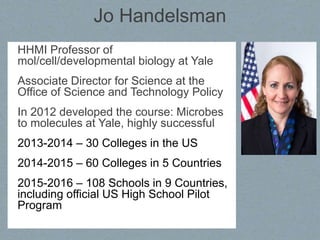
Jo Handelsman
HHMI Professor of
mol/cell/developmental biology at Yale
Associate Director for Science at the
Office of Science and Technology Policy
In 2012 developed the course: Microbes
to molecules at Yale, highly successful
2013-2014 – 30 Colleges in the US
2014-2015 – 60 Colleges in 5 Countries
2015-2016 – 108 Schools in 9 Countries,
including official US High School Pilot
Program
Goal of SWI
Engage students in research to improve STEM
career retention
Train students to think like scientists
Inspire the scientists of tomorrow
With research courses, students are are more likely :
■ to persist in STEM majors
■ to receive better grades
■ to complete degrees more quickly
Based on results from multiple studies
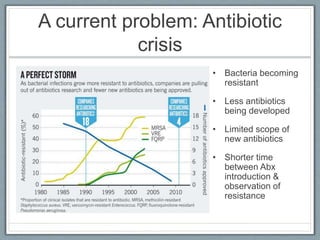
A current problem: Antibiotic
crisis
• Bacteria becoming
resistant
• Less antibiotics
being developed
• Limited scope of
new antibiotics
• Shorter time
between Abx
introduction &
observation of
resistance
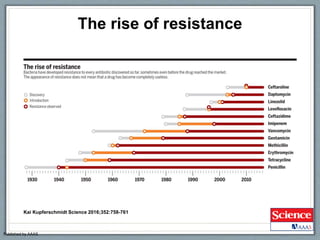
The rise of resistance
Kai Kupferschmidt Science 2016;352:758-761
Published by AAAS
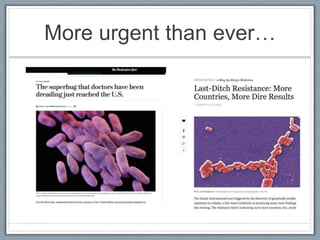
More urgent than ever…
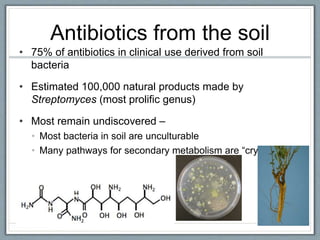
Antibiotics from the soil
• 75% of antibiotics in clinical use derived from soil
bacteria
• Estimated 100,000 natural products made by
Streptomyces (most prolific genus)
• Most remain undiscovered –
• Most bacteria in soil are unculturable
• Many pathways for secondary metabolism are “cryptic”
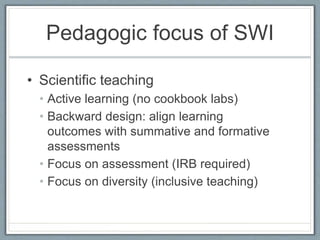
Pedagogic focus of SWI
• Scientific teaching
• Active learning (no cookbook labs)
• Backward design: align learning
outcomes with summative and formative
assessments
• Focus on assessment (IRB required)
• Focus on diversity (inclusive teaching)
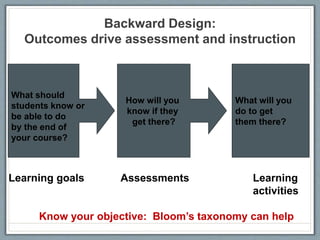
Backward Design:
Outcomes drive assessment and instruction
What should
students know or
be able to do
by the end of
your course?
How will you
know if they
get there?
What will you
do to get
them there?
Learning goals Assessments Learning
activities
Know your objective: Bloom’s taxonomy can help
“Ongoing assessment plays a key role –
possibly the most important role –
in shaping classroom standards and
increasing learning gains.”
Black and Wiliam, 1998
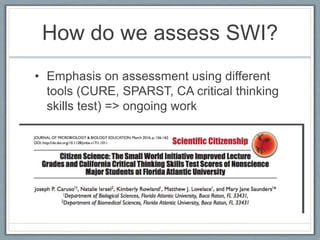
How do we assess SWI?
• Emphasis on assessment using different
tools (CURE, SPARST, CA critical thinking
skills test) => ongoing work
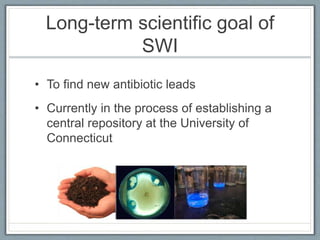
Long-term scientific goal of
SWI
• To find new antibiotic leads
• Currently in the process of establishing a
central repository at the University of
Connecticut
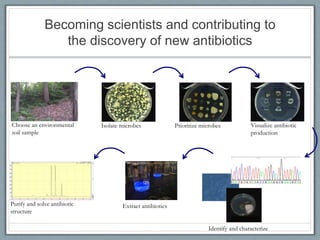
Becoming scientists and contributing to
the discovery of new antibiotics
Choose an environmental
soil sample
Isolate microbes Visualize antibiotic
production
Purify and solve antibiotic
structure
Prioritize microbes
Identify and characterize
Extract antibiotics
Course materials
• Curriculum adaptable to different courses:
o microbiology
o general biology (majors/non majors)
o molecular biology
• Modules can be also implemented.
• Lab manual (modular, customizable)
• Instructor manual
• Lab protocols, best practices
• Online student data repository
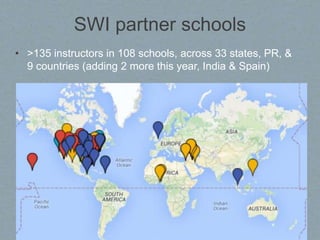
SWI partner schools
• >135 instructors in 108 schools, across 33 states, PR, &
9 countries (adding 2 more this year, India & Spain)
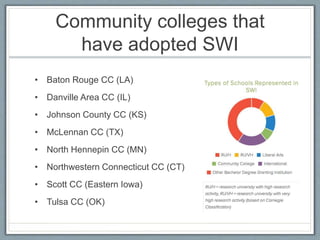
Community colleges that
have adopted SWI
• Baton Rouge CC (LA)
• Danville Area CC (IL)
• Johnson County CC (KS)
• McLennan CC (TX)
• North Hennepin CC (MN)
• Northwestern Connecticut CC (CT)
• Scott CC (Eastern Iowa)
• Tulsa CC (OK)
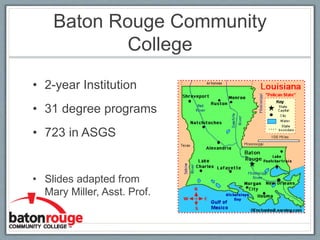
Baton Rouge Community
College
• 2-year Institution
• 31 degree programs
• 723 in ASGS
• Slides adapted from
Mary Miller, Asst. Prof.
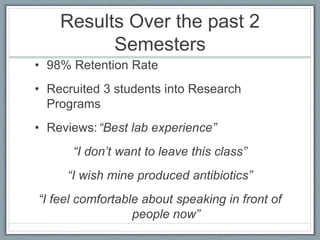
Results Over the past 2
Semesters
• 98% Retention Rate
• Recruited 3 students into Research
Programs
• Reviews:“Best lab experience”
“I don’t want to leave this class”
“I wish mine produced antibiotics”
“I feel comfortable about speaking in front of
people now”
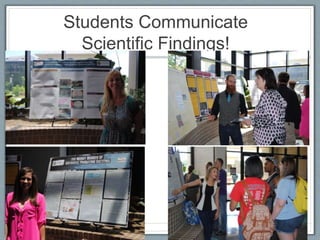
Students Communicate
Scientific Findings!
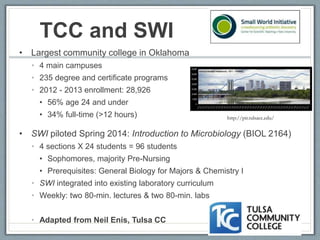
TCC and SWI
• Largest community college in Oklahoma
• 4 main campuses
• 235 degree and certificate programs
• 2012 - 2013 enrollment: 28,926
• 56% age 24 and under
• 34% full-time (>12 hours)
• SWI piloted Spring 2014: Introduction to Microbiology (BIOL 2164)
• 4 sections X 24 students = 96 students
• Sophomores, majority Pre-Nursing
• Prerequisites: General Biology for Majors & Chemistry I
• SWI integrated into existing laboratory curriculum
• Weekly: two 80-min. lectures & two 80-min. labs
• Adapted from Neil Enis, Tulsa CC
http://pir.tulsacc.edu/
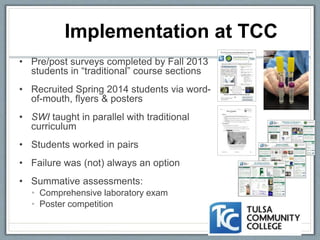
• Pre/post surveys completed by Fall 2013
students in “traditional” course sections
• Recruited Spring 2014 students via word-
of-mouth, flyers & posters
• SWI taught in parallel with traditional
curriculum
• Students worked in pairs
• Failure was (not) always an option
• Summative assessments:
• Comprehensive laboratory exam
• Poster competition
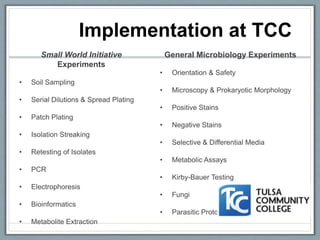
Implementation at TCC
Small World Initiative
Experiments
• Soil Sampling
• Serial Dilutions & Spread Plating
• Patch Plating
• Isolation Streaking
• Retesting of Isolates
• PCR
• Electrophoresis
• Bioinformatics
• Metabolite Extraction
General Microbiology Experiments
• Orientation & Safety
• Microscopy & Prokaryotic Morphology
• Positive Stains
• Negative Stains
• Selective & Differential Media
• Metabolic Assays
• Kirby-Bauer Testing
• Fungi
• Parasitic Protozoa
Implementation at TCC
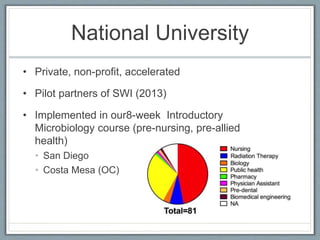
National University
• Private, non-profit, accelerated
• Pilot partners of SWI (2013)
• Implemented in our8-week Introductory
Microbiology course (pre-nursing, pre-allied
health)
• San Diego
• Costa Mesa (OC)
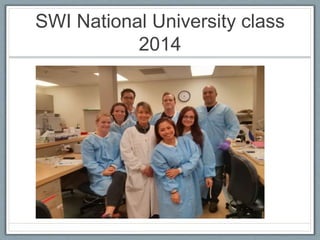
SWI National University class
2014
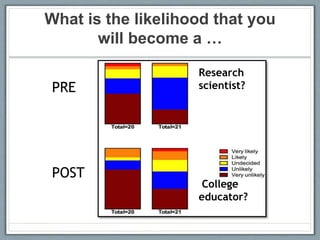
What is the likelihood that you
will become a …
Research
scientist?
College
educator?
PRE
POST
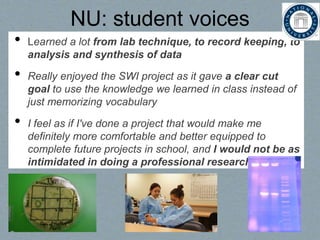
NU: student voices
• Learned a lot from lab technique, to record keeping, to
analysis and synthesis of data
• Really enjoyed the SWI project as it gave a clear cut
goal to use the knowledge we learned in class instead of
just memorizing vocabulary
• I feel as if I've done a project that would make me
definitely more comfortable and better equipped to
complete future projects in school, and I would not be as
intimidated in doing a professional research project
SWI now
• SWI is its own nonprofit now
• President: Erika Kurt
• Website: http://www.smallworldinitiative.org/
• To join, please fill an online application form
available on SWI's website. Annual training
workshops (this year June 21-26 at UConn). On a
case-by-base basis, certain instructors may be
permitted to waive the in-person training.
SWI in your school?
• Course to implement: new or existing?
• What subject?
• Enrollment?
• Training?
• IRB?
• Instrumentation?
Acknowledgments
• Erika Kurt (SWI)
• Nichole Broderick (Uconn)
• Mary Miller (BRCC)
• Neil Enis (TCC)
• Huda Makhluf (NU)
• Jo Handelsman
• ASM
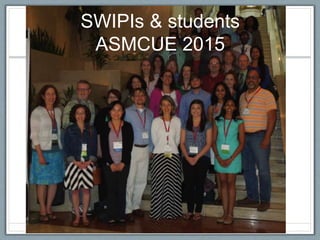
SWIPIs & students
ASMCUE 2015
Connect with us!
• Find us on Facebook! Group and page.
• Follow us on Twitter @Team_SWI
• Follow us on Instagram @Team_SWI
• If at the ASM 2016 General Meeting, visit our
events

The Small World Initiative

  • 1.
    Crowdsourcing Antibiotic Discovery The SmallWorld InitiativeTM (SWI) Ana Maria Barral National University, CA
  • 2.
    Workshop goals 1. Describethe history of SWI and its current framework 2. To present examples of SWI courses 3. To discuss how to join 4. To evaluate if SWI could be a match for your school
  • 3.
  • 4.
    Addressing the STEM workforceneeds Focus on 1st two years of college for one million more STEM professionals because… • <40% of college students intending to major in STEM complete a STEM degree • Even fewer for certain ethnic minority groups • 1st two years actively discourage students from pursuing STEM degrees • they are common to all types of colleges and universities • retaining more STEM majors is the lowest-cost, fastest policy option to meet the labor force needs
  • 5.
    “Engage to Excel”Recommendations 1.Use evidence-based teaching practices. 2. Replace lab courses with research courses. 3. Launch a national experiment in math education. 4. Diversify pathways to STEM careers using stakeholder partnerships. 5. Create a Presidential council on STEM ed.
  • 6.
    Jo Handelsman HHMI Professorof mol/cell/developmental biology at Yale Associate Director for Science at the Office of Science and Technology Policy In 2012 developed the course: Microbes to molecules at Yale, highly successful 2013-2014 – 30 Colleges in the US 2014-2015 – 60 Colleges in 5 Countries 2015-2016 – 108 Schools in 9 Countries, including official US High School Pilot Program
  • 7.
    Goal of SWI Engagestudents in research to improve STEM career retention Train students to think like scientists Inspire the scientists of tomorrow With research courses, students are are more likely : ■ to persist in STEM majors ■ to receive better grades ■ to complete degrees more quickly Based on results from multiple studies
  • 8.
    A current problem:Antibiotic crisis • Bacteria becoming resistant • Less antibiotics being developed • Limited scope of new antibiotics • Shorter time between Abx introduction & observation of resistance
  • 9.
    The rise ofresistance Kai Kupferschmidt Science 2016;352:758-761 Published by AAAS
  • 10.
  • 11.
    Antibiotics from thesoil • 75% of antibiotics in clinical use derived from soil bacteria • Estimated 100,000 natural products made by Streptomyces (most prolific genus) • Most remain undiscovered – • Most bacteria in soil are unculturable • Many pathways for secondary metabolism are “cryptic”
  • 12.
    Pedagogic focus ofSWI • Scientific teaching • Active learning (no cookbook labs) • Backward design: align learning outcomes with summative and formative assessments • Focus on assessment (IRB required) • Focus on diversity (inclusive teaching)
  • 13.
    Backward Design: Outcomes driveassessment and instruction What should students know or be able to do by the end of your course? How will you know if they get there? What will you do to get them there? Learning goals Assessments Learning activities Know your objective: Bloom’s taxonomy can help
  • 14.
    “Ongoing assessment playsa key role – possibly the most important role – in shaping classroom standards and increasing learning gains.” Black and Wiliam, 1998
  • 15.
    How do weassess SWI? • Emphasis on assessment using different tools (CURE, SPARST, CA critical thinking skills test) => ongoing work
  • 16.
    Long-term scientific goalof SWI • To find new antibiotic leads • Currently in the process of establishing a central repository at the University of Connecticut
  • 17.
    Becoming scientists andcontributing to the discovery of new antibiotics Choose an environmental soil sample Isolate microbes Visualize antibiotic production Purify and solve antibiotic structure Prioritize microbes Identify and characterize Extract antibiotics
  • 18.
    Course materials • Curriculumadaptable to different courses: o microbiology o general biology (majors/non majors) o molecular biology • Modules can be also implemented. • Lab manual (modular, customizable) • Instructor manual • Lab protocols, best practices • Online student data repository
  • 19.
    SWI partner schools •>135 instructors in 108 schools, across 33 states, PR, & 9 countries (adding 2 more this year, India & Spain)
  • 20.
    Community colleges that haveadopted SWI • Baton Rouge CC (LA) • Danville Area CC (IL) • Johnson County CC (KS) • McLennan CC (TX) • North Hennepin CC (MN) • Northwestern Connecticut CC (CT) • Scott CC (Eastern Iowa) • Tulsa CC (OK)
  • 21.
    Baton Rouge Community College •2-year Institution • 31 degree programs • 723 in ASGS • Slides adapted from Mary Miller, Asst. Prof.
  • 22.
    Results Over thepast 2 Semesters • 98% Retention Rate • Recruited 3 students into Research Programs • Reviews:“Best lab experience” “I don’t want to leave this class” “I wish mine produced antibiotics” “I feel comfortable about speaking in front of people now”
  • 23.
  • 24.
    TCC and SWI •Largest community college in Oklahoma • 4 main campuses • 235 degree and certificate programs • 2012 - 2013 enrollment: 28,926 • 56% age 24 and under • 34% full-time (>12 hours) • SWI piloted Spring 2014: Introduction to Microbiology (BIOL 2164) • 4 sections X 24 students = 96 students • Sophomores, majority Pre-Nursing • Prerequisites: General Biology for Majors & Chemistry I • SWI integrated into existing laboratory curriculum • Weekly: two 80-min. lectures & two 80-min. labs • Adapted from Neil Enis, Tulsa CC http://pir.tulsacc.edu/
  • 25.
    • Pre/post surveyscompleted by Fall 2013 students in “traditional” course sections • Recruited Spring 2014 students via word- of-mouth, flyers & posters • SWI taught in parallel with traditional curriculum • Students worked in pairs • Failure was (not) always an option • Summative assessments: • Comprehensive laboratory exam • Poster competition Implementation at TCC
  • 26.
    Small World Initiative Experiments •Soil Sampling • Serial Dilutions & Spread Plating • Patch Plating • Isolation Streaking • Retesting of Isolates • PCR • Electrophoresis • Bioinformatics • Metabolite Extraction General Microbiology Experiments • Orientation & Safety • Microscopy & Prokaryotic Morphology • Positive Stains • Negative Stains • Selective & Differential Media • Metabolic Assays • Kirby-Bauer Testing • Fungi • Parasitic Protozoa Implementation at TCC
  • 27.
    National University • Private,non-profit, accelerated • Pilot partners of SWI (2013) • Implemented in our8-week Introductory Microbiology course (pre-nursing, pre-allied health) • San Diego • Costa Mesa (OC)
  • 28.
  • 29.
    What is thelikelihood that you will become a … Research scientist? College educator? PRE POST
  • 30.
    NU: student voices •Learned a lot from lab technique, to record keeping, to analysis and synthesis of data • Really enjoyed the SWI project as it gave a clear cut goal to use the knowledge we learned in class instead of just memorizing vocabulary • I feel as if I've done a project that would make me definitely more comfortable and better equipped to complete future projects in school, and I would not be as intimidated in doing a professional research project
  • 31.
    SWI now • SWIis its own nonprofit now • President: Erika Kurt • Website: http://www.smallworldinitiative.org/ • To join, please fill an online application form available on SWI's website. Annual training workshops (this year June 21-26 at UConn). On a case-by-base basis, certain instructors may be permitted to waive the in-person training.
  • 32.
    SWI in yourschool? • Course to implement: new or existing? • What subject? • Enrollment? • Training? • IRB? • Instrumentation?
  • 33.
    Acknowledgments • Erika Kurt(SWI) • Nichole Broderick (Uconn) • Mary Miller (BRCC) • Neil Enis (TCC) • Huda Makhluf (NU) • Jo Handelsman • ASM
  • 34.
  • 35.
    Connect with us! •Find us on Facebook! Group and page. • Follow us on Twitter @Team_SWI • Follow us on Instagram @Team_SWI • If at the ASM 2016 General Meeting, visit our events