Geometry{Shapes, Lines and Angles}
IntroductionGeometry is all about…ShapesLinesAngles
AnglesQuestion:What is an “angle”?Answer:An angle is the amount of rotation needed to turn from one direction to look in a different direction
AnglesQuestion:How do we measure the size of an angle?Answer:Using a protractor
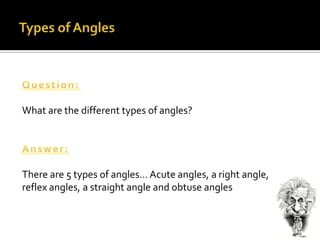
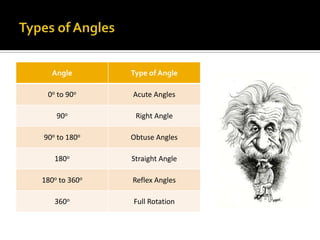
Types of AnglesQuestion:What are the different types of angles?Answer:There are 5 types of angles… Acute angles, a right angle, reflex angles, a straight angle and obtuse angles
Types of Angles
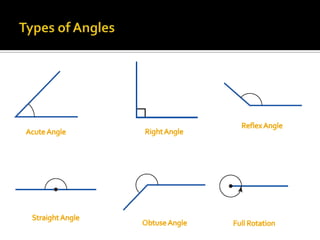
Types of AnglesReflex AngleRight AngleAcute AngleStraight AngleObtuse AngleFull Rotation
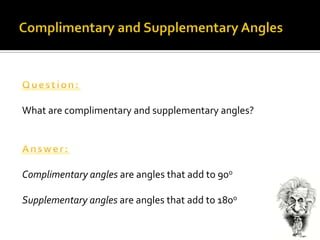
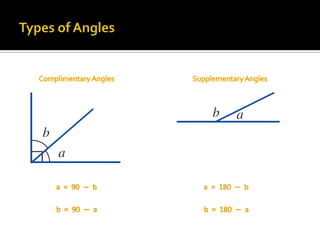
Complimentary and Supplementary AnglesQuestion:What are complimentary and supplementary angles?Answer:Complimentary angles are angles that add to 90oSupplementary angles are angles that add to 180o
Types of AnglesComplimentary AnglesSupplementary Anglesa  =  90  −  b  a  =  180  −  b  b  =  90  −  a  b  =  180  −  a  
Let’s see how we are going so far…So that you can check if you understand the information that you have just been explained to you, have a go at the following questions from your textbook…Exercise 5A – Questions 2, 3 (a to e) and 4* Please remember to check your answer when you finish each question and get help from your teacher as soon as you can not work out how to do a question!
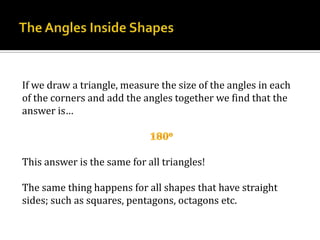
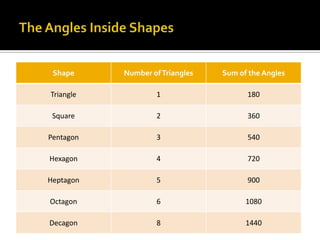
The Angles Inside ShapesIf we draw a triangle, measure the size of the angles in each of the corners and add the angles together we find that the answer is…180oThis answer is the same for all triangles!The same thing happens for all shapes that have straight sides; such as squares, pentagons, octagons etc.
The Angles Inside Shapes
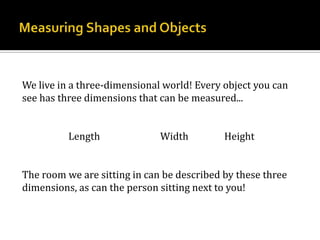
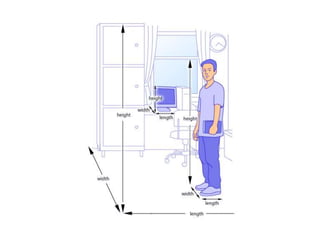
Measuring Shapes and ObjectsWe live in a three-dimensional world! Every object you can see has three dimensions that can be measured...Length		Width		HeightThe room we are sitting in can be described by these three dimensions, as can the person sitting next to you!
3 – Dimensional ShapesAn object is called a 2 – dimensional object (i.e. a 2D object) if its size can be measured in only two directions...length and width
length and height
width and height A 3– dimensional object (i.e. a 3D object)has a length, a width and a height.
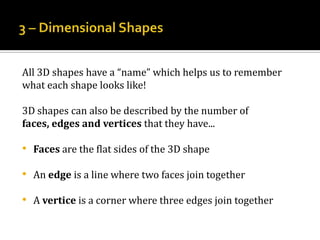
3 – Dimensional ShapesAll 3D shapes have a “name” which helps us to remember what each shape looks like! 3D shapes can also be described by the number of faces, edges and vertices that they have...Faces are the flat sides of the 3D shape
An edge is a line where two faces join together  

Geometry Notes PowerPoint

  • 1.
  • 2.
    IntroductionGeometry is allabout…ShapesLinesAngles
  • 3.
    AnglesQuestion:What is an“angle”?Answer:An angle is the amount of rotation needed to turn from one direction to look in a different direction
  • 4.
    AnglesQuestion:How do wemeasure the size of an angle?Answer:Using a protractor
  • 5.
    Types of AnglesQuestion:Whatare the different types of angles?Answer:There are 5 types of angles… Acute angles, a right angle, reflex angles, a straight angle and obtuse angles
  • 7.
  • 8.
    Types of AnglesReflexAngleRight AngleAcute AngleStraight AngleObtuse AngleFull Rotation
  • 9.
    Complimentary and SupplementaryAnglesQuestion:What are complimentary and supplementary angles?Answer:Complimentary angles are angles that add to 90oSupplementary angles are angles that add to 180o
  • 10.
    Types of AnglesComplimentaryAnglesSupplementary Anglesa = 90 − b  a = 180 − b  b = 90 − a  b = 180 − a  
  • 11.
    Let’s see howwe are going so far…So that you can check if you understand the information that you have just been explained to you, have a go at the following questions from your textbook…Exercise 5A – Questions 2, 3 (a to e) and 4* Please remember to check your answer when you finish each question and get help from your teacher as soon as you can not work out how to do a question!
  • 12.
    The Angles InsideShapesIf we draw a triangle, measure the size of the angles in each of the corners and add the angles together we find that the answer is…180oThis answer is the same for all triangles!The same thing happens for all shapes that have straight sides; such as squares, pentagons, octagons etc.
  • 13.
  • 14.
    Measuring Shapes andObjectsWe live in a three-dimensional world! Every object you can see has three dimensions that can be measured...Length Width HeightThe room we are sitting in can be described by these three dimensions, as can the person sitting next to you!
  • 16.
    3 – DimensionalShapesAn object is called a 2 – dimensional object (i.e. a 2D object) if its size can be measured in only two directions...length and width
  • 17.
  • 18.
    width and heightA 3– dimensional object (i.e. a 3D object)has a length, a width and a height.
  • 19.
    3 – DimensionalShapesAll 3D shapes have a “name” which helps us to remember what each shape looks like! 3D shapes can also be described by the number of faces, edges and vertices that they have...Faces are the flat sides of the 3D shape
  • 20.
    An edge isa line where two faces join together