ME 111: Engineering Drawing
Lecture 2
01-08-2011
Geometric Constructions
Indian Institute of Technology Guwahati
Guwahati – 781039
Geometric Construction
• Construction of primitive geometric
forms (points, lines and planes etc.)
that serve as the building blocks for
more complicated geometric shapes.
• Defining the position of the object in
space
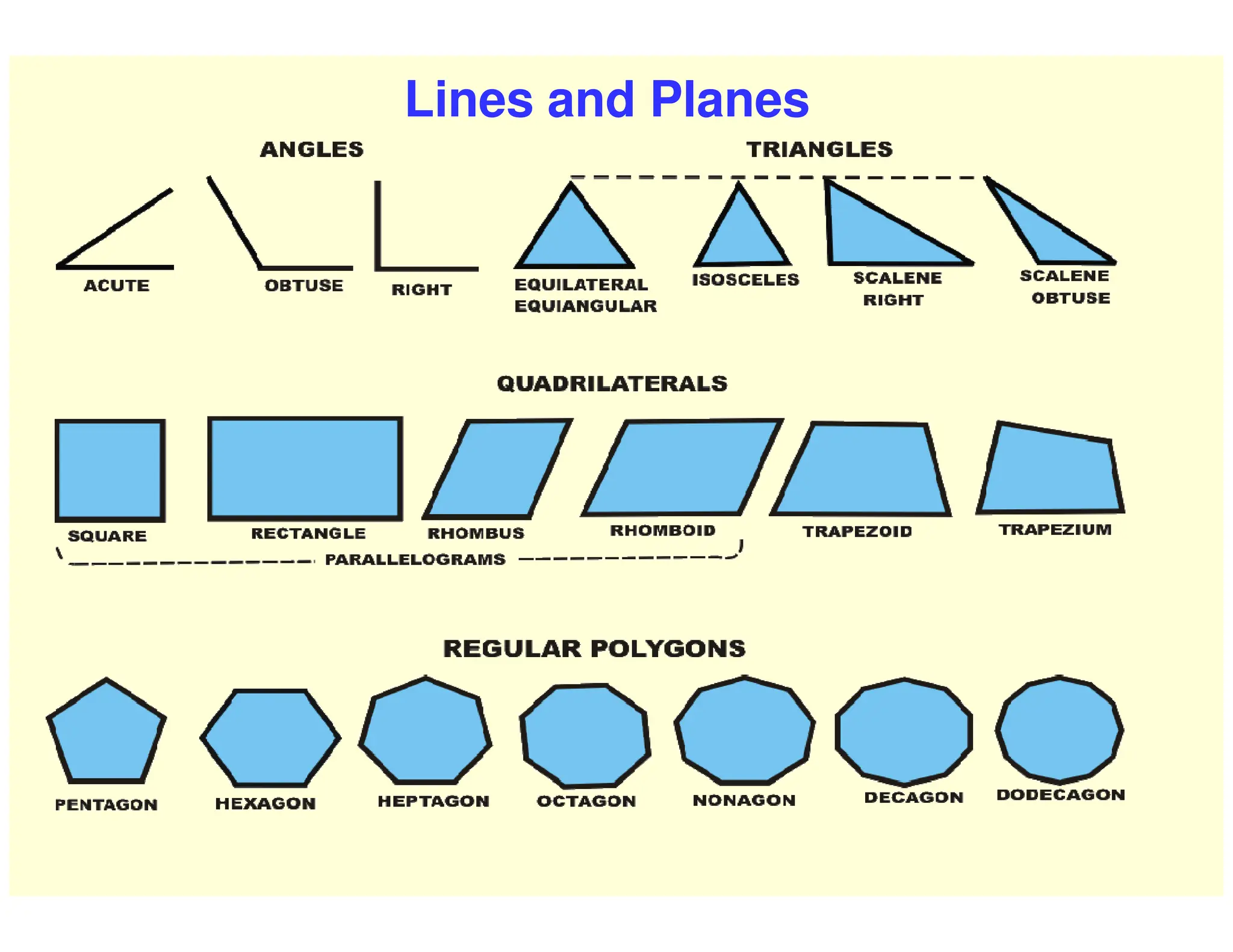
Lines and Planes
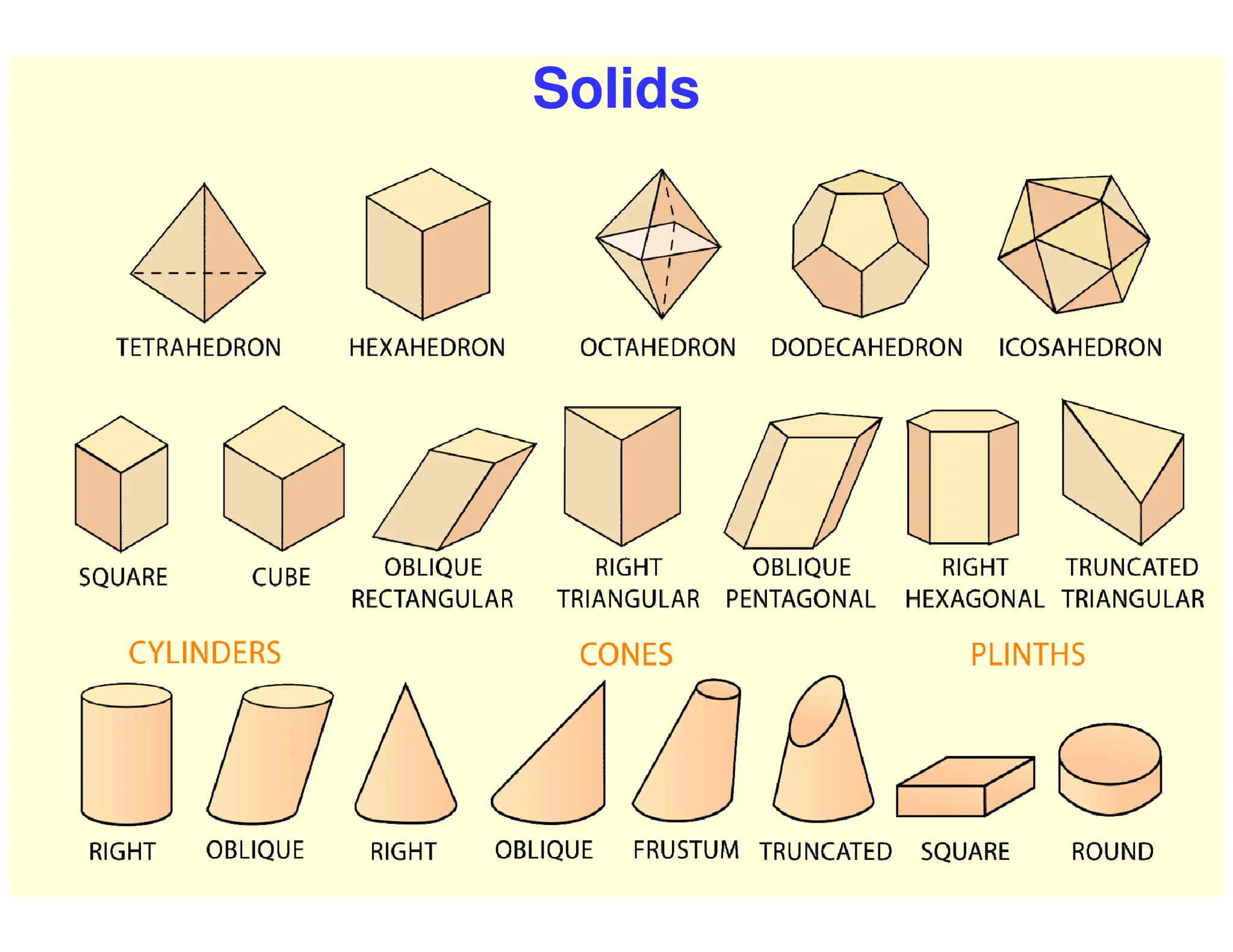
Solids
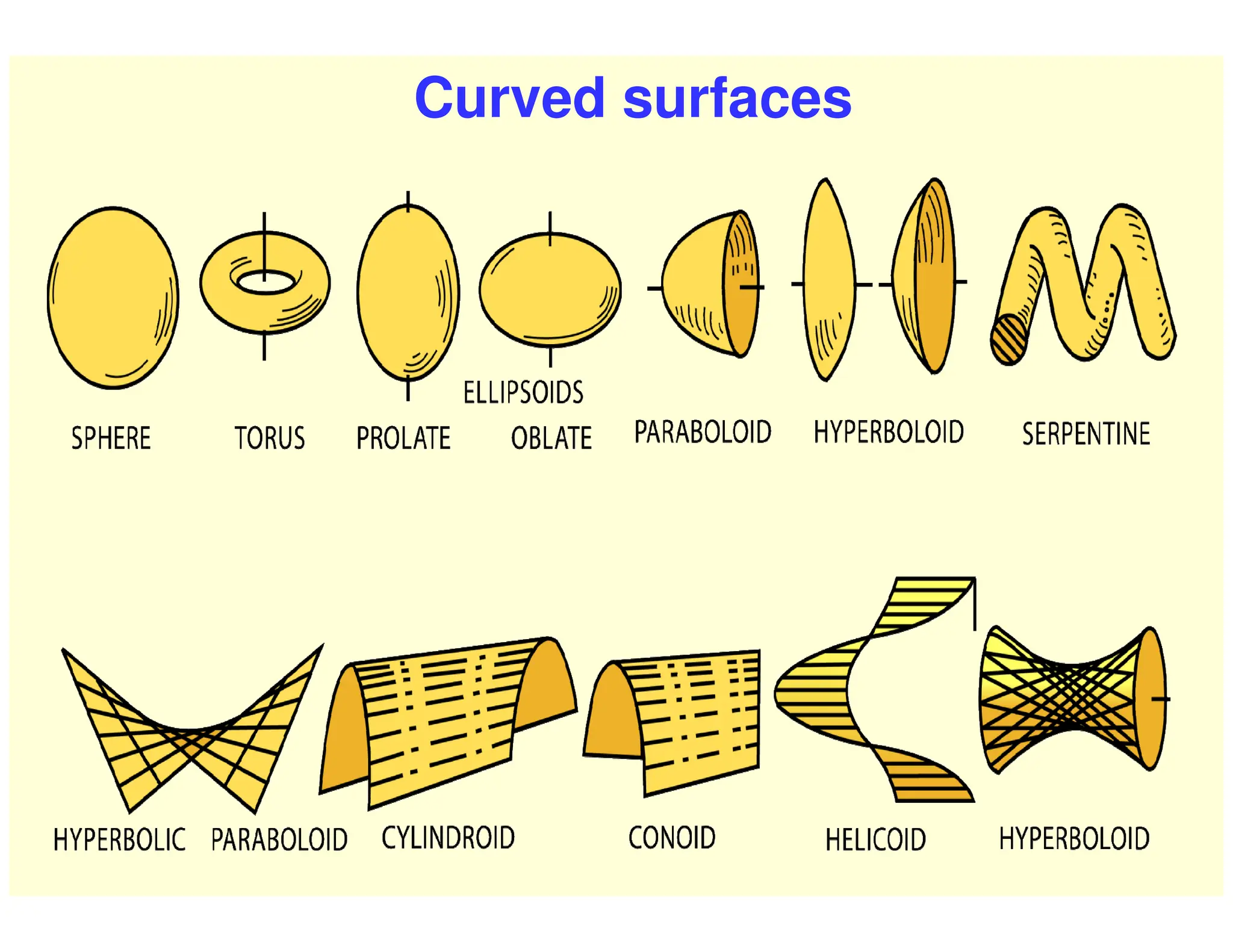
Curved surfaces
Primitive geometric forms
• Point
• Line
• Plane
• Solid
• Solid
• ……etc
The basic 2-D geometric primitives, from which
other more complex geometric forms are
derived.
Points,
Points,
Lines,
Circles, and
Arcs.
Point
A theoretical location that has neither
width, height, nor depth.
Describes exact location in space.
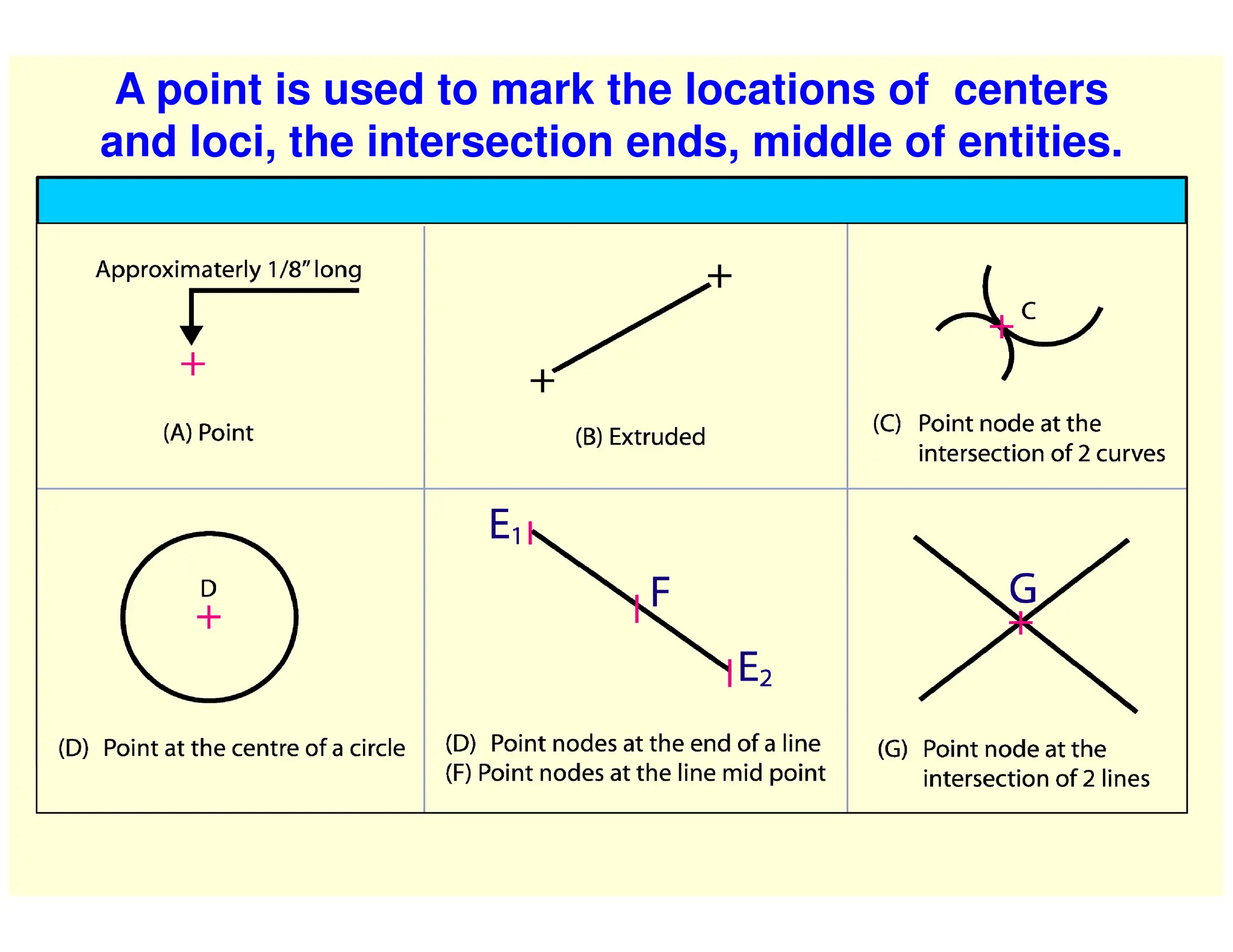
A point is represented in technical drawing
as a small cross made of dashes that are
approximately 3 mm long.
A point is used to mark the locations of centers
and loci, the intersection ends, middle of entities.
Line
A geometric primitive that has length and
direction, but no thickness.
It may be straight, curved or a combination of
these.
Lines also have important relationship or
conditions, such as parallel, intersecting, and
tangent.
Lines – specific length and non-specific length.
Ray – Straight line that extends to infinity from
a specified point.
Relationship of one line to another line or arc
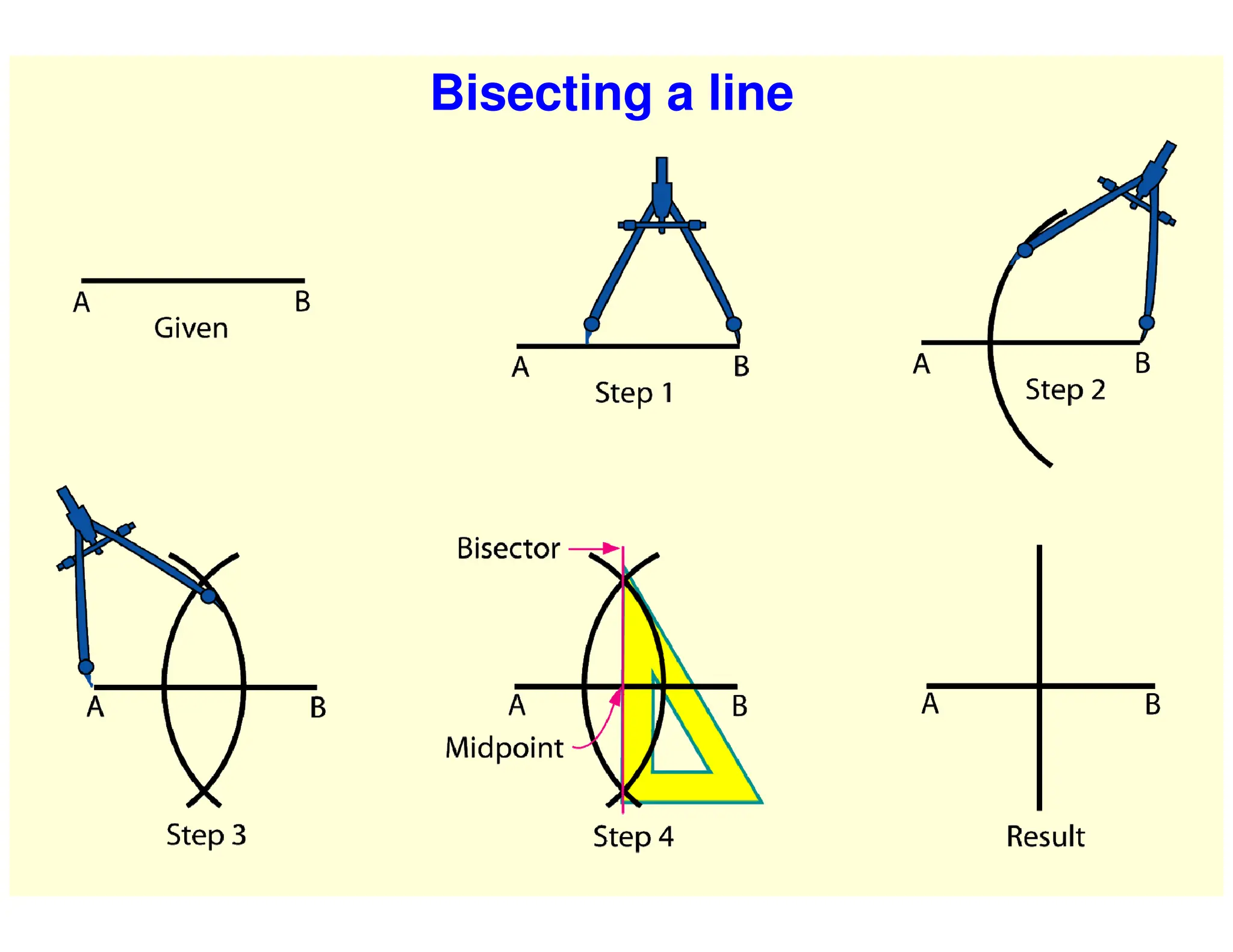
Bisecting a line
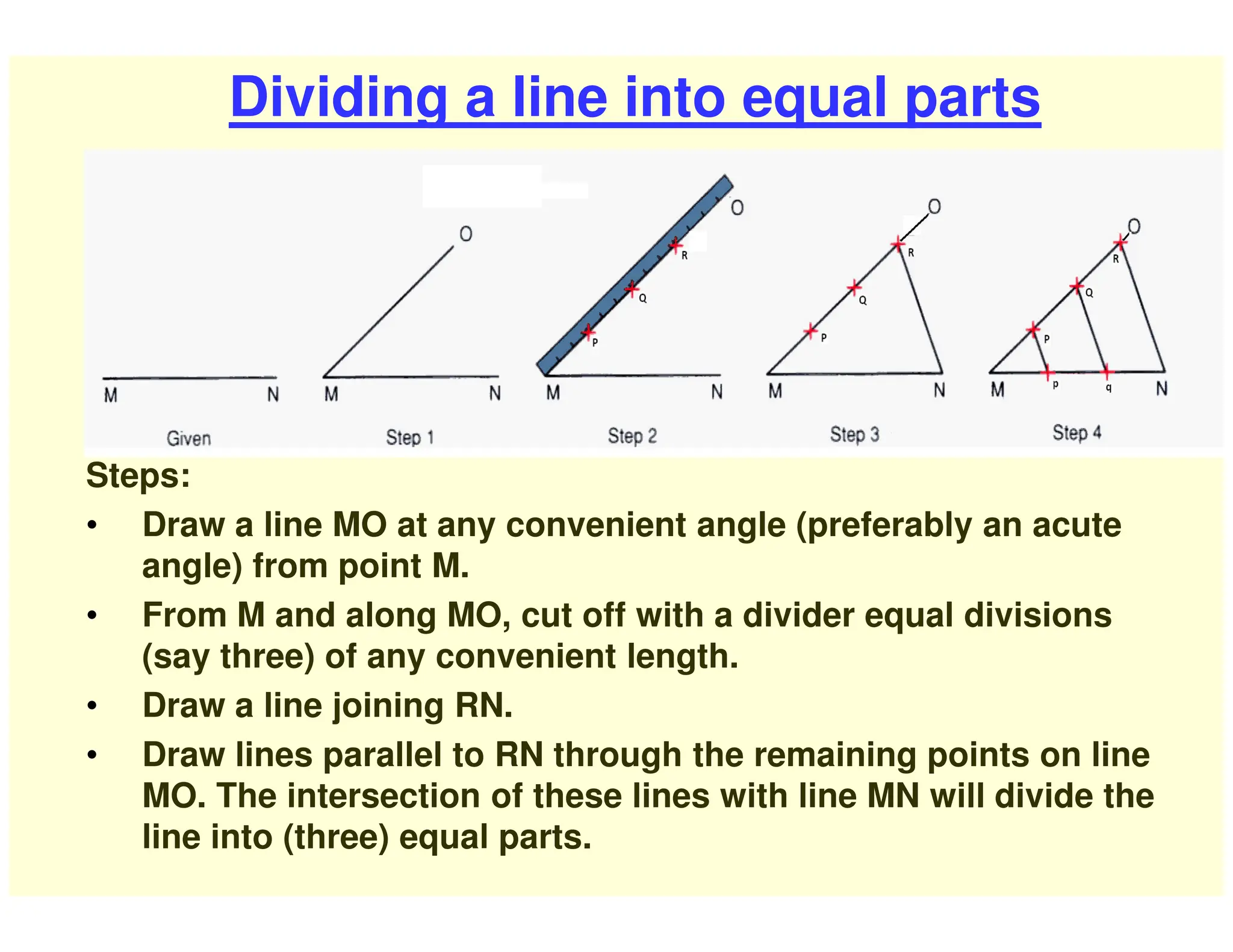
Dividing a line into equal parts
Steps:
Steps:
• Draw a line MO at any convenient angle (preferably an acute
angle) from point M.
• From M and along MO, cut off with a divider equal divisions
(say three) of any convenient length.
• Draw a line joining RN.
• Draw lines parallel to RN through the remaining points on line
MO. The intersection of these lines with line MN will divide the
line into (three) equal parts.
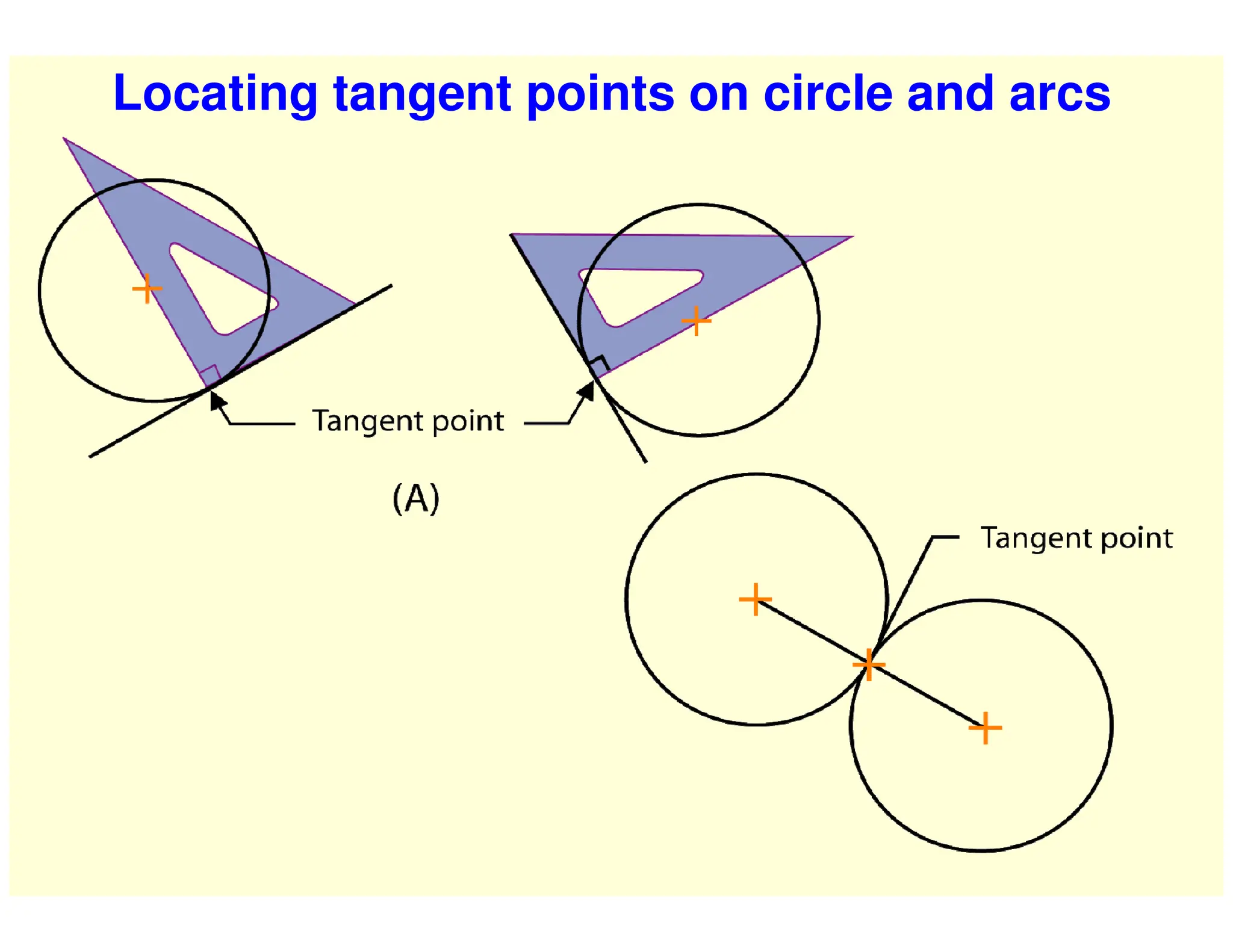
Planar tangent condition exists when two
geometric forms meet at a single point and do
not intersect.
Locating tangent points on circle and arcs
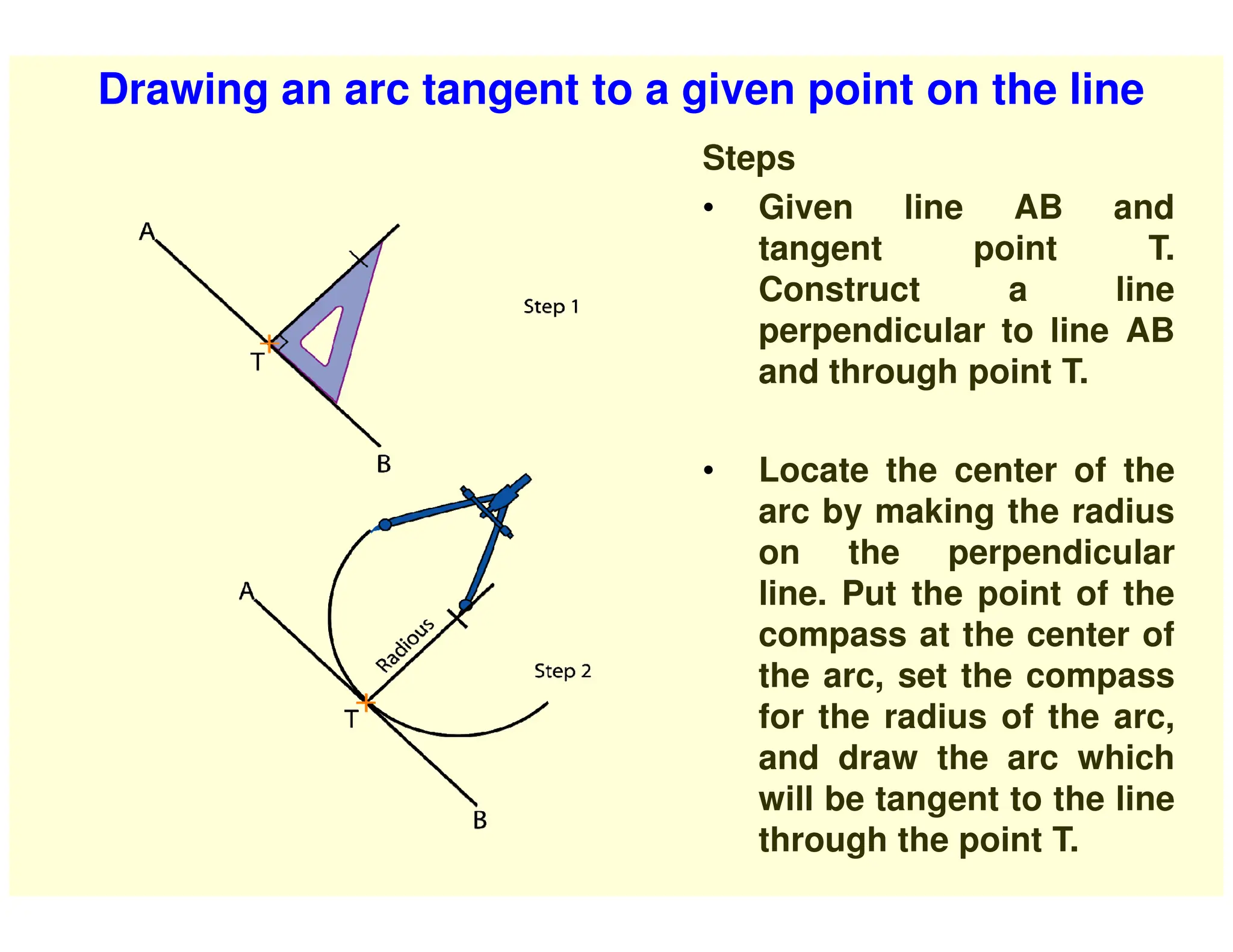
Drawing an arc tangent to a given point on the line
Steps
• Given line AB and
tangent point T.
Construct a line
perpendicular to line AB
and through point T.
• Locate the center of the
arc by making the radius
on the perpendicular
line. Put the point of the
compass at the center of
the arc, set the compass
for the radius of the arc,
and draw the arc which
will be tangent to the line
through the point T.
Drawing an arc, tangent to two lines
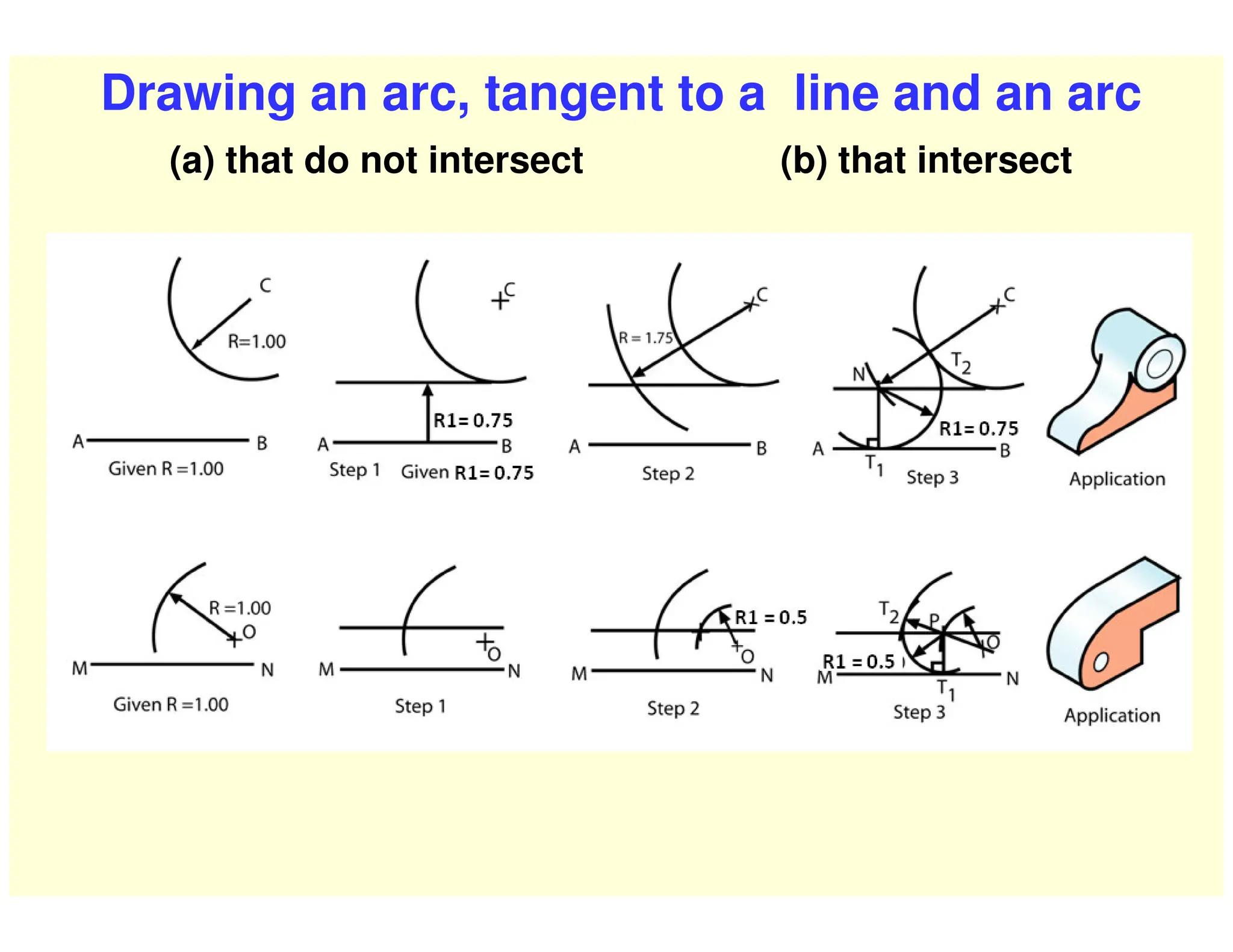
Drawing an arc, tangent to a line and an arc
(a) that do not intersect (b) that intersect
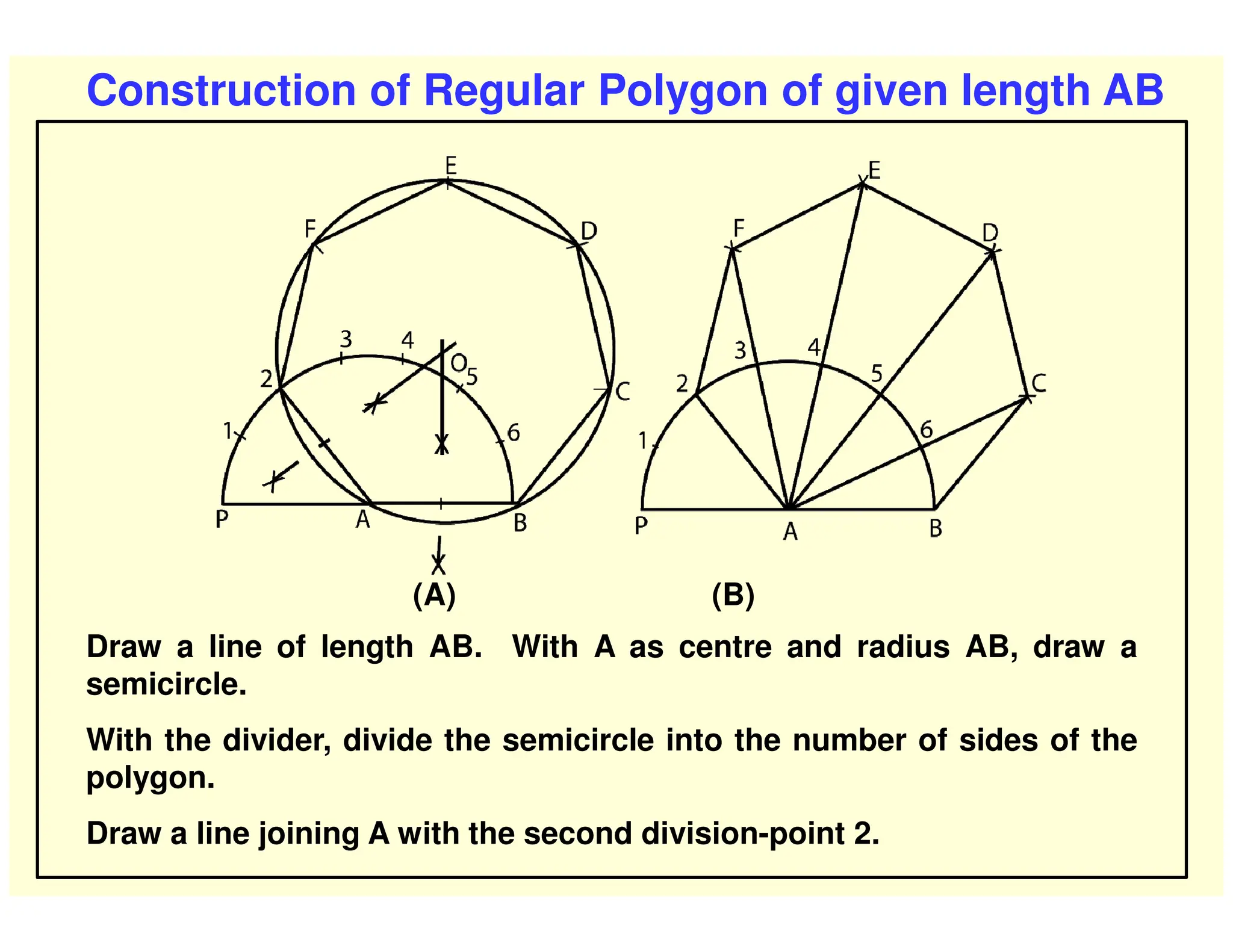
Construction of Regular Polygon of given length AB
Draw a line of length AB. With A as centre and radius AB, draw a
semicircle.
With the divider, divide the semicircle into the number of sides of the
polygon.
Draw a line joining A with the second division-point 2.
(A) (B)
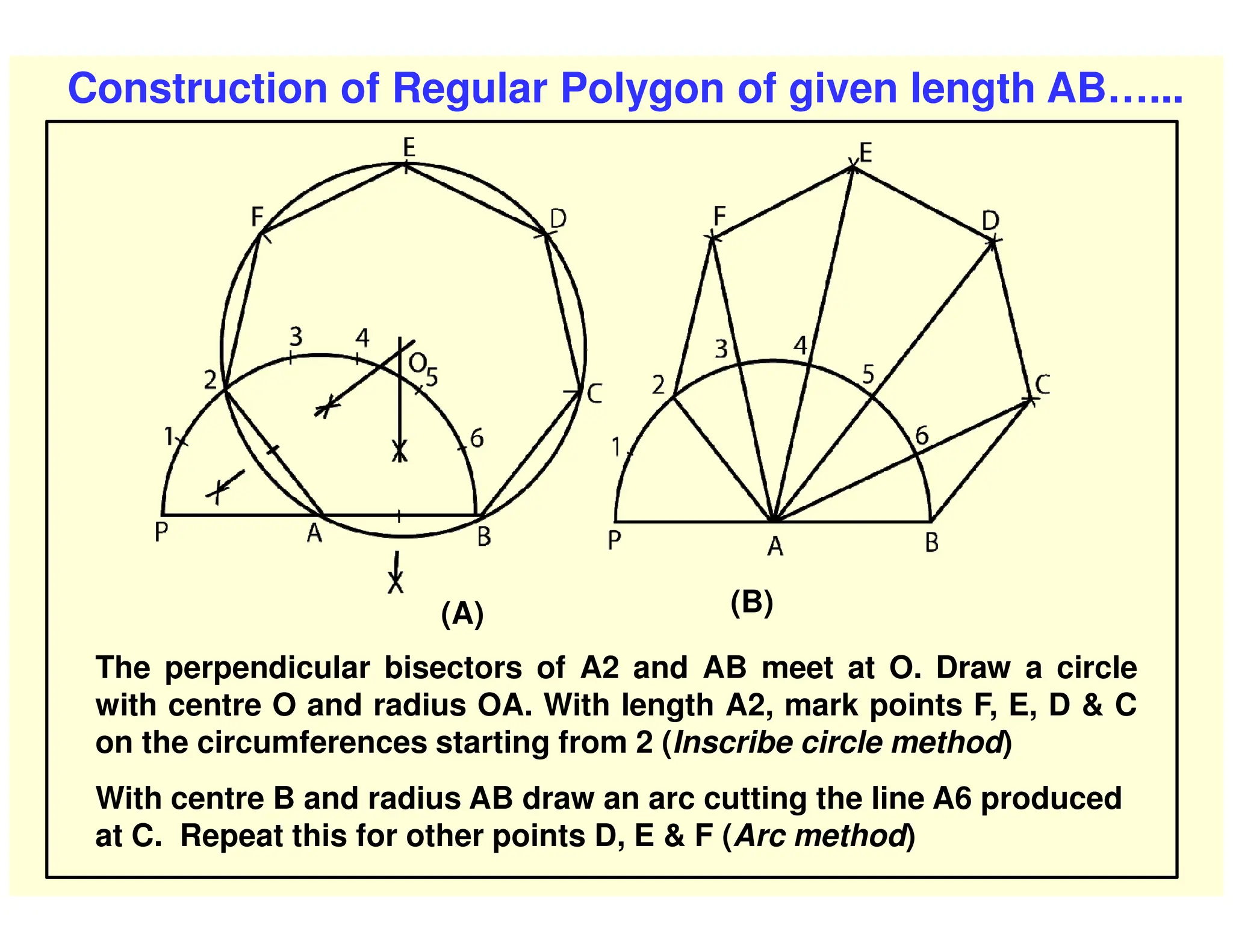
Construction of Regular Polygon of given length AB…...
The perpendicular bisectors of A2 and AB meet at O. Draw a circle
with centre O and radius OA. With length A2, mark points F, E, D & C
on the circumferences starting from 2 (Inscribe circle method)
With centre B and radius AB draw an arc cutting the line A6 produced
at C. Repeat this for other points D, E & F (Arc method)
(B)
(A)
General method of drawing any polygon
Draw AB = given length of polygon
At B, Draw BP perpendicular & = AB
Draw Straight line AP
With center B and radius AB, draw arc AP.
The perpendicular bisector of AB meets st.
line AP and arc AP in 4 and 6 respectively.
Draw circles with centers as 4, 5,&6 and
radii as 4B, 5B, & 6B and inscribe a square,
pentagon, & hexagon in the respective
circles.
Mark point 7, 8, etc with 6-7,7-8,etc. = 4-5 to
get the centers of circles of heptagon and
octagon, etc.
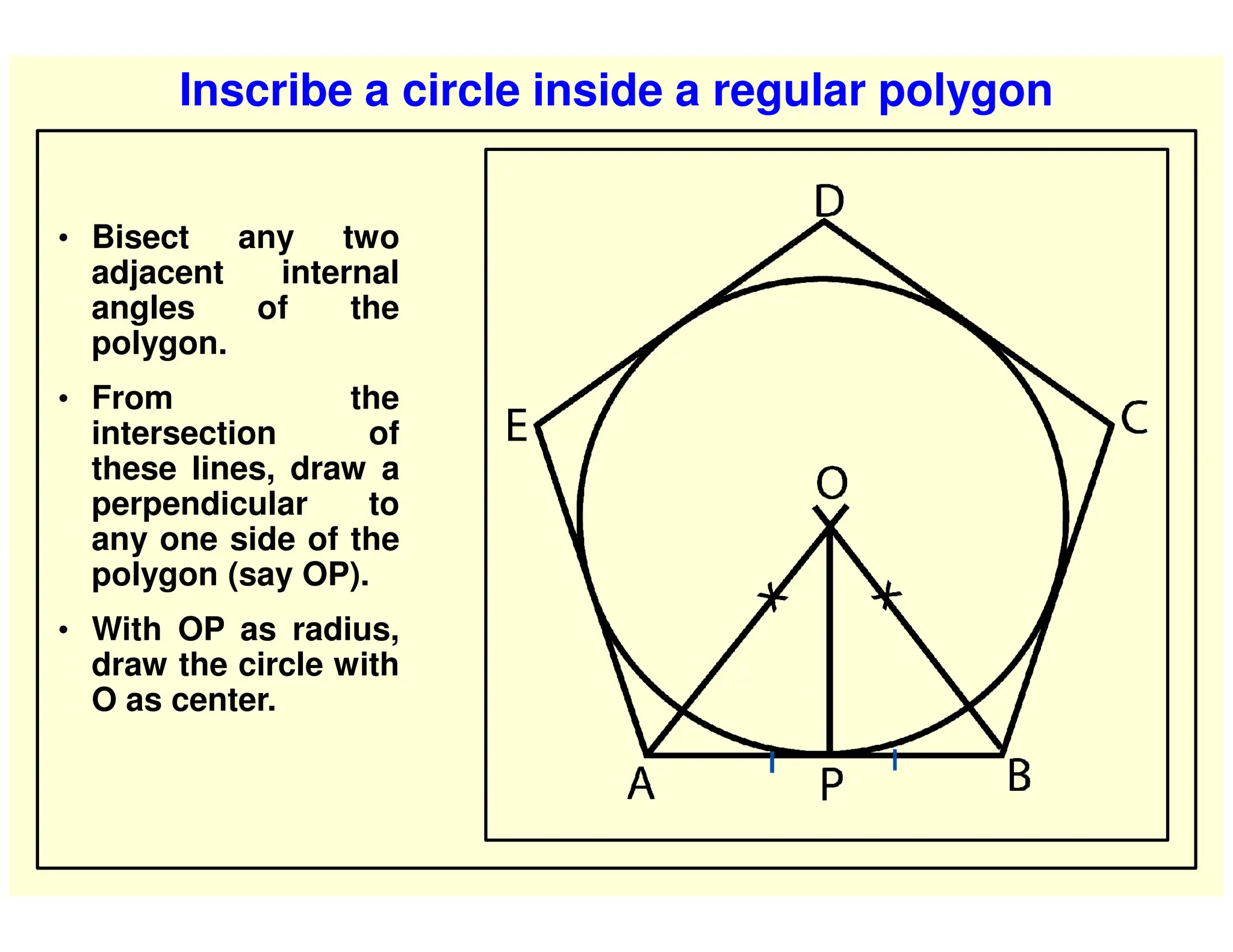
Inscribe a circle inside a regular polygon
• Bisect any two
adjacent internal
angles of the
polygon.
• From the
intersection of
these lines, draw a
these lines, draw a
perpendicular to
any one side of the
polygon (say OP).
• With OP as radius,
draw the circle with
O as center.
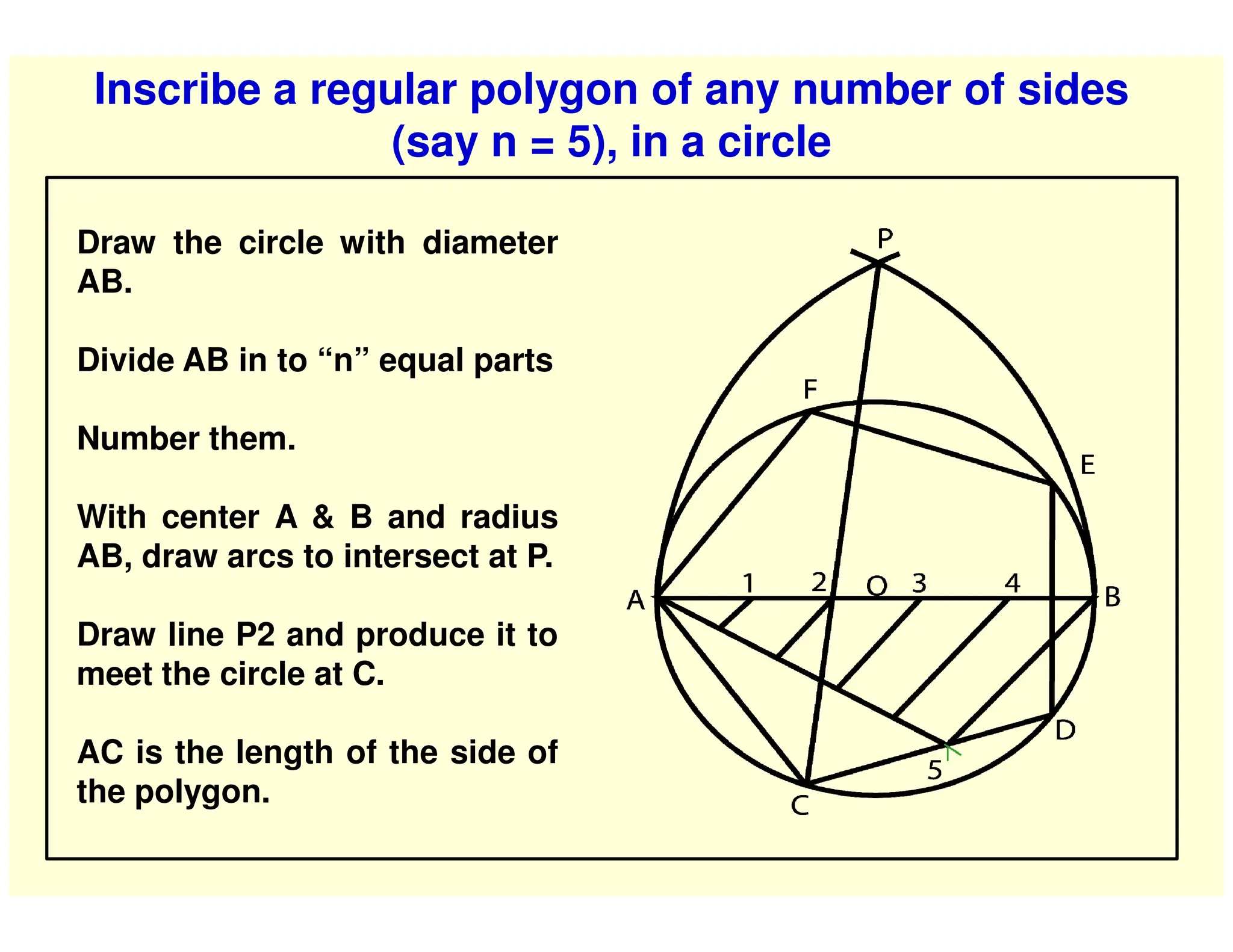
Inscribe a regular polygon of any number of sides
(say n = 5), in a circle
Draw the circle with diameter
AB.
Divide AB in to “n” equal parts
Number them.
With center A & B and radius
AB, draw arcs to intersect at P.
Draw line P2 and produce it to
meet the circle at C.
AC is the length of the side of
the polygon.
Inside a regular polygon, draw the same number of equal
circles as the side of the polygon, each circle touching
one side of the polygon and two of the other circles.
Draw bisectors of all
the angles of the
the angles of the
polygon, meeting at O,
thus dividing the
polygon into the same
number of triangles.
In each triangle
inscribe a circle.
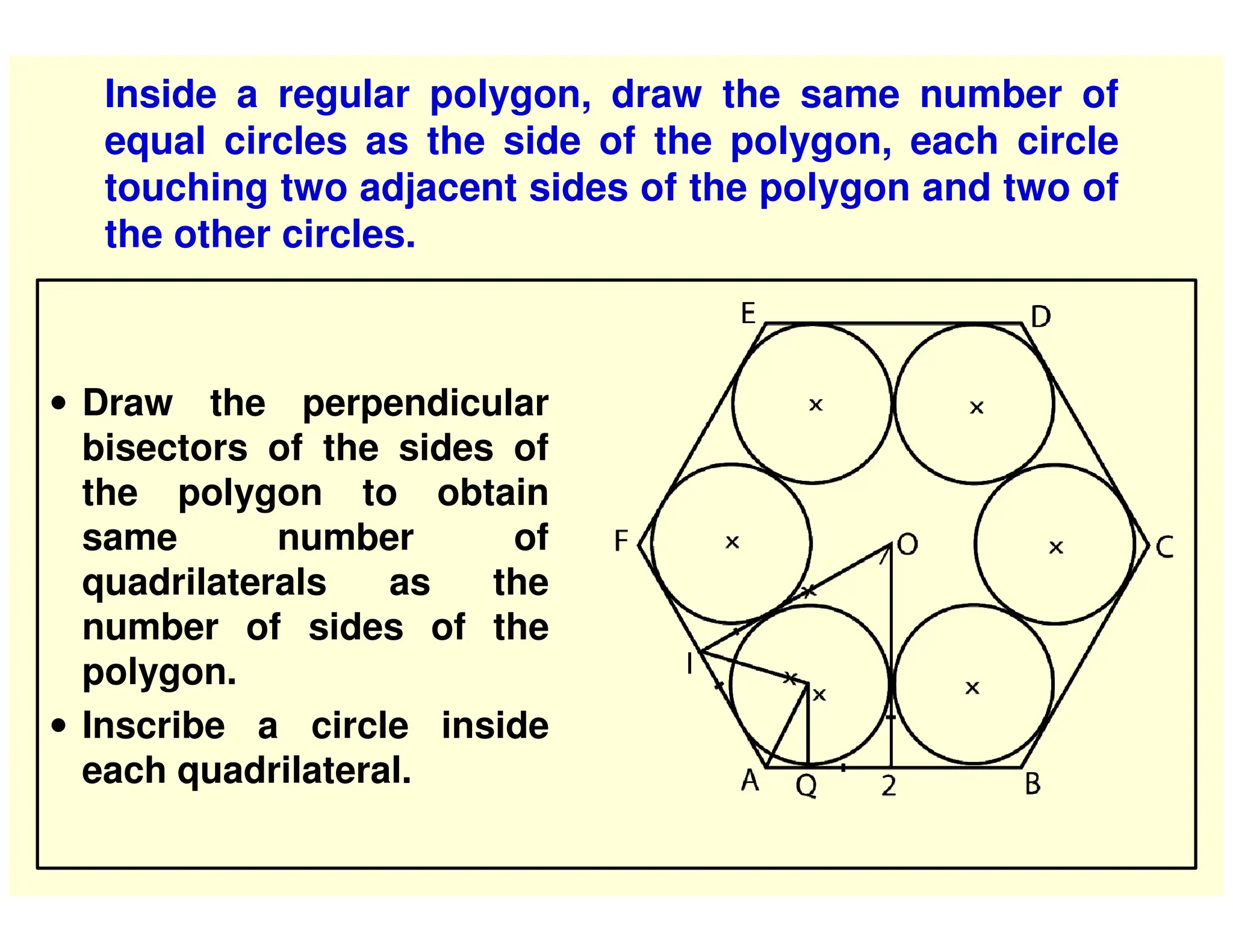
Inside a regular polygon, draw the same number of
equal circles as the side of the polygon, each circle
touching two adjacent sides of the polygon and two of
the other circles.
Draw the perpendicular
bisectors of the sides of
the polygon to obtain
same number of
quadrilaterals as the
number of sides of the
polygon.
Inscribe a circle inside
each quadrilateral.
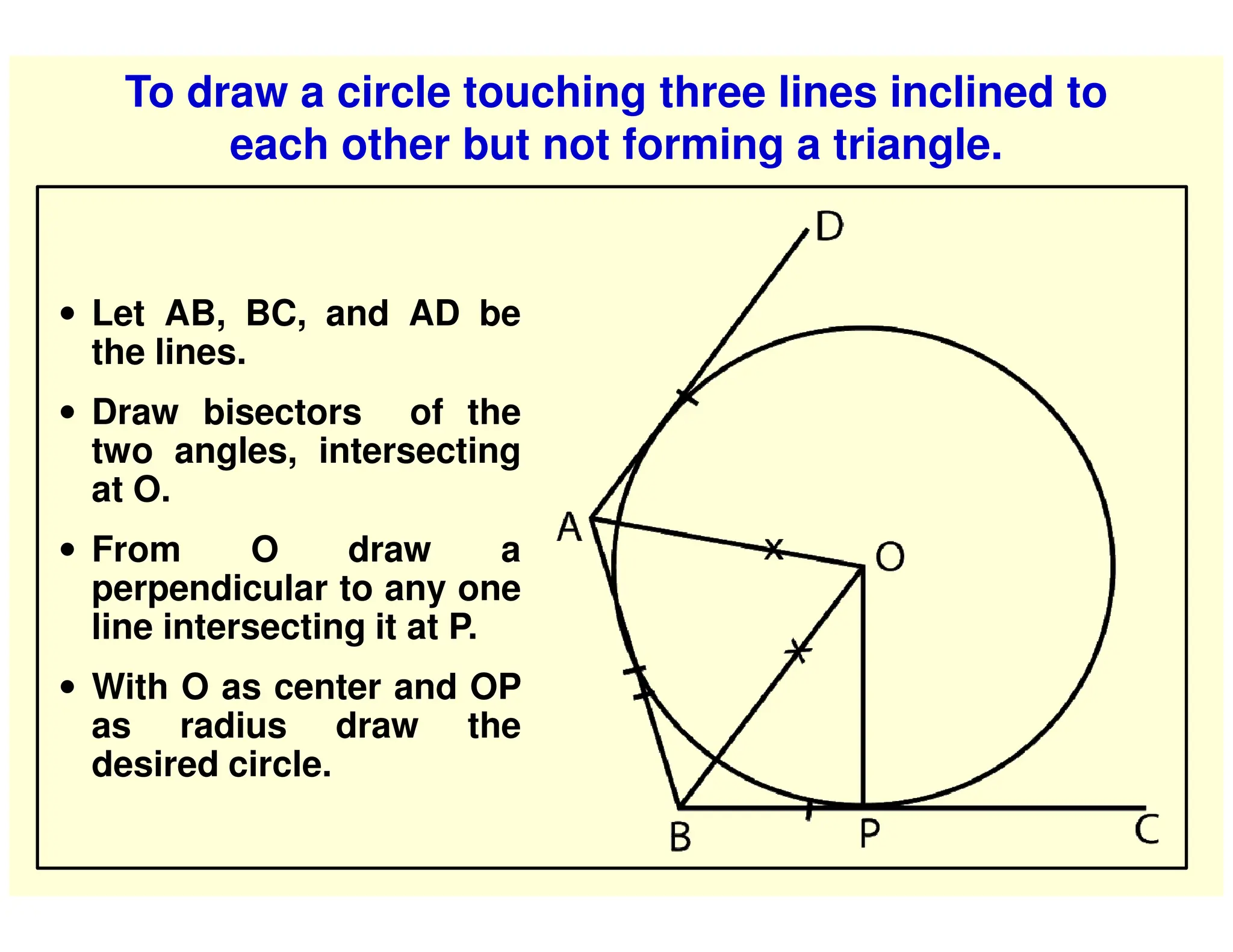
To draw a circle touching three lines inclined to
each other but not forming a triangle.
Let AB, BC, and AD be
the lines.
Draw bisectors of the
two angles, intersecting
at O.
at O.
From O draw a
perpendicular to any one
line intersecting it at P.
With O as center and OP
as radius draw the
desired circle.
Outside a regular polygon, draw the same number of
equal circles as the side of the polygon, each circle
touching one side of the polygon and two of the other
circles.
Draw bisectors of two
adjacent angles and
produce them outside
the polygon.
the polygon.
Draw a circle touching
the extended
bisectors and the side
AB (in this case) and
repeat the same for
other sides.
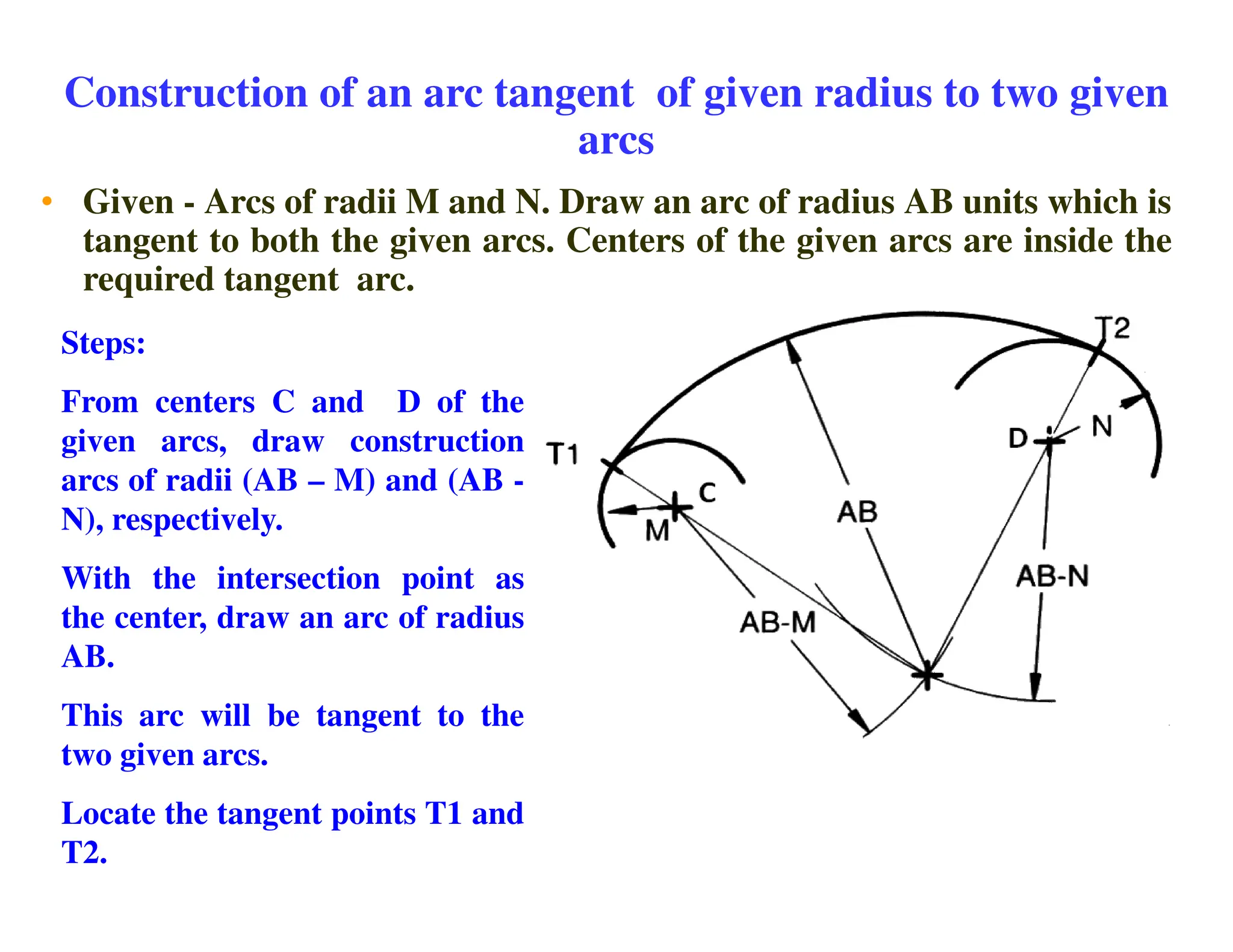
Construction of an arc tangent of given radius to two given
arcs
• Given - Arcs of radii M and N. Draw an arc of radius AB units which is
tangent to both the given arcs. Centers of the given arcs are inside the
required tangent arc.
Steps:
From centers C and D of the
given arcs, draw construction
arcs of radii (AB – M) and (AB -
N), respectively.
With the intersection point as
the center, draw an arc of radius
AB.
This arc will be tangent to the
two given arcs.
Locate the tangent points T1 and
T2.
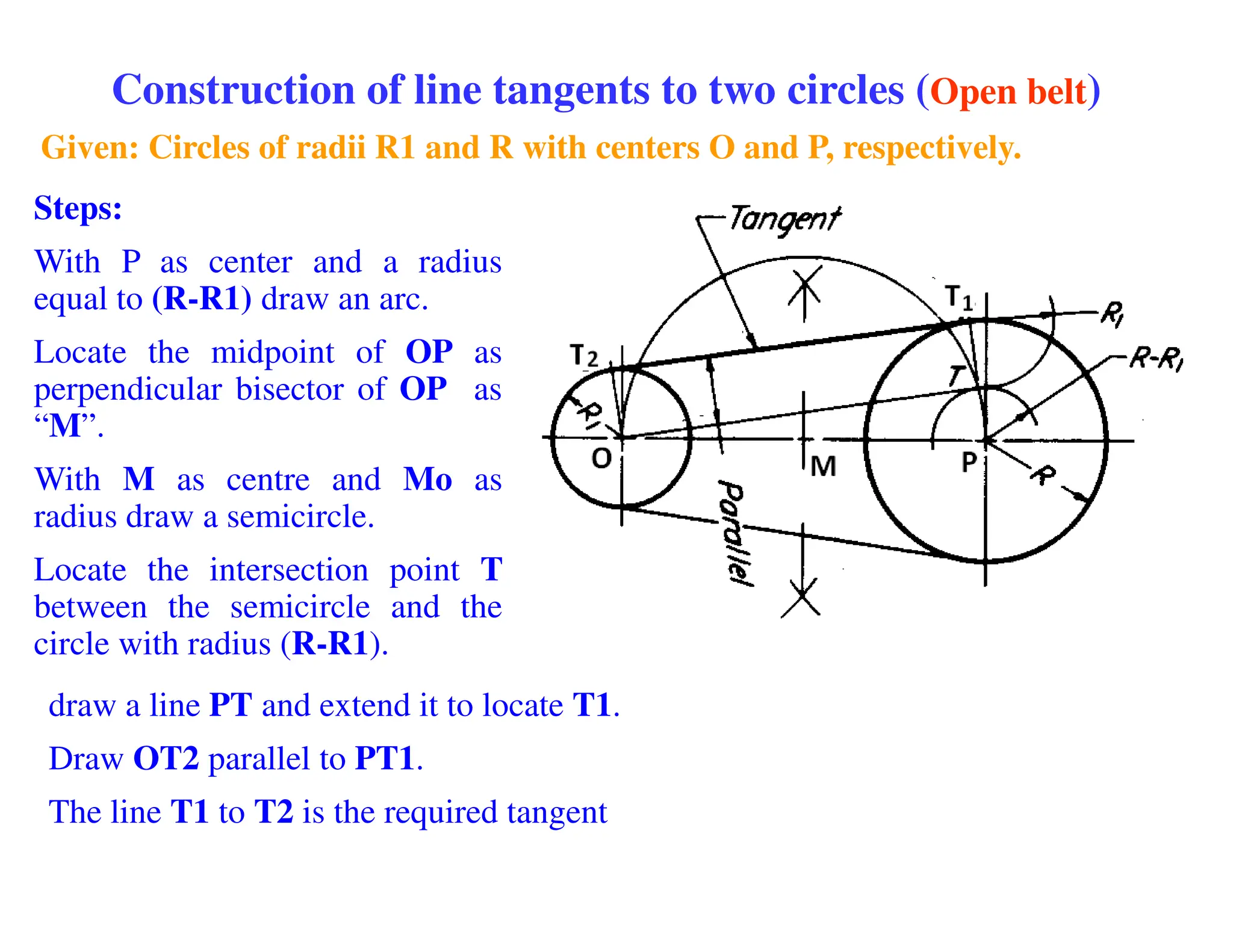
Construction of line tangents to two circles (Open belt)
Given: Circles of radii R1 and R with centers O and P, respectively.
Steps:
With P as center and a radius
equal to (R-R1) draw an arc.
Locate the midpoint of OP as
perpendicular bisector of OP as
“M”.
With M as centre and Mo as
radius draw a semicircle.
Locate the intersection point T
between the semicircle and the
circle with radius (R-R1).
draw a line PT and extend it to locate T1.
Draw OT2 parallel to PT1.
The line T1 to T2 is the required tangent
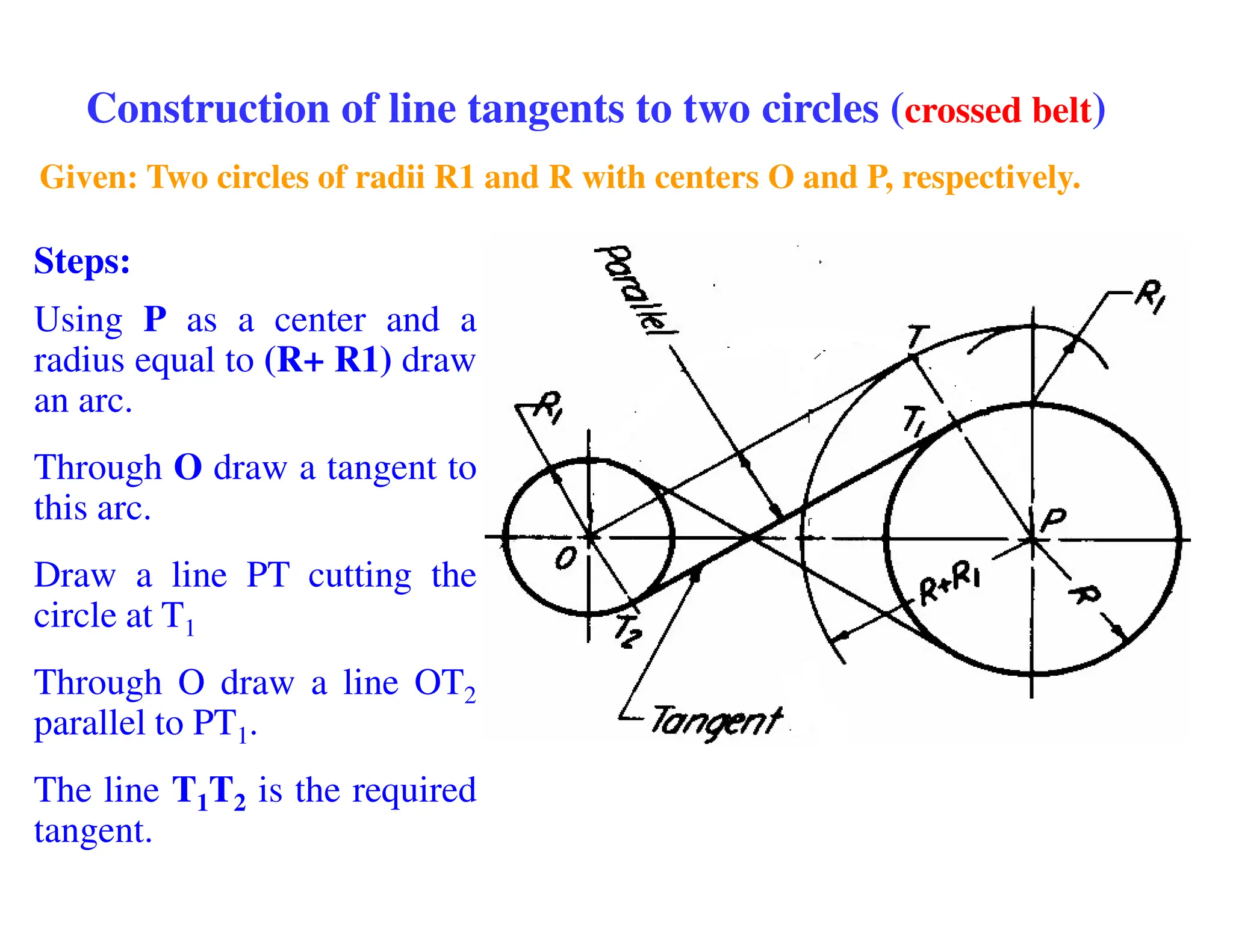
Construction of line tangents to two circles (crossed belt)
Given: Two circles of radii R1 and R with centers O and P, respectively.
Steps:
Using P as a center and a
radius equal to (R+ R1) draw
an arc.
Through O draw a tangent to
this arc.
Draw a line PT cutting the
circle at T1
Through O draw a line OT2
parallel to PT1.
The line T1T2 is the required
tangent.
8/8/2011 31

Geometrical drawing engineering drawings

  • 1.
    ME 111: EngineeringDrawing Lecture 2 01-08-2011 Geometric Constructions Indian Institute of Technology Guwahati Guwahati – 781039
  • 2.
    Geometric Construction • Constructionof primitive geometric forms (points, lines and planes etc.) that serve as the building blocks for more complicated geometric shapes. more complicated geometric shapes. • Defining the position of the object in space
  • 3.
  • 4.
  • 5.
  • 6.
    Primitive geometric forms •Point • Line • Plane • Solid • Solid • ……etc
  • 7.
    The basic 2-Dgeometric primitives, from which other more complex geometric forms are derived. Points, Points, Lines, Circles, and Arcs.
  • 8.
    Point A theoretical locationthat has neither width, height, nor depth. Describes exact location in space. Describes exact location in space. A point is represented in technical drawing as a small cross made of dashes that are approximately 3 mm long.
  • 9.
    A point isused to mark the locations of centers and loci, the intersection ends, middle of entities.
  • 10.
    Line A geometric primitivethat has length and direction, but no thickness. It may be straight, curved or a combination of these. Lines also have important relationship or Lines also have important relationship or conditions, such as parallel, intersecting, and tangent. Lines – specific length and non-specific length. Ray – Straight line that extends to infinity from a specified point.
  • 11.
    Relationship of oneline to another line or arc
  • 12.
  • 13.
    Dividing a lineinto equal parts Steps: Steps: • Draw a line MO at any convenient angle (preferably an acute angle) from point M. • From M and along MO, cut off with a divider equal divisions (say three) of any convenient length. • Draw a line joining RN. • Draw lines parallel to RN through the remaining points on line MO. The intersection of these lines with line MN will divide the line into (three) equal parts.
  • 14.
    Planar tangent conditionexists when two geometric forms meet at a single point and do not intersect.
  • 15.
    Locating tangent pointson circle and arcs
  • 16.
    Drawing an arctangent to a given point on the line Steps • Given line AB and tangent point T. Construct a line perpendicular to line AB and through point T. • Locate the center of the • Locate the center of the arc by making the radius on the perpendicular line. Put the point of the compass at the center of the arc, set the compass for the radius of the arc, and draw the arc which will be tangent to the line through the point T.
  • 17.
    Drawing an arc,tangent to two lines
  • 18.
    Drawing an arc,tangent to a line and an arc (a) that do not intersect (b) that intersect
  • 19.
    Construction of RegularPolygon of given length AB Draw a line of length AB. With A as centre and radius AB, draw a semicircle. With the divider, divide the semicircle into the number of sides of the polygon. Draw a line joining A with the second division-point 2. (A) (B)
  • 20.
    Construction of RegularPolygon of given length AB…... The perpendicular bisectors of A2 and AB meet at O. Draw a circle with centre O and radius OA. With length A2, mark points F, E, D & C on the circumferences starting from 2 (Inscribe circle method) With centre B and radius AB draw an arc cutting the line A6 produced at C. Repeat this for other points D, E & F (Arc method) (B) (A)
  • 21.
    General method ofdrawing any polygon Draw AB = given length of polygon At B, Draw BP perpendicular & = AB Draw Straight line AP With center B and radius AB, draw arc AP. The perpendicular bisector of AB meets st. line AP and arc AP in 4 and 6 respectively. Draw circles with centers as 4, 5,&6 and radii as 4B, 5B, & 6B and inscribe a square, pentagon, & hexagon in the respective circles. Mark point 7, 8, etc with 6-7,7-8,etc. = 4-5 to get the centers of circles of heptagon and octagon, etc.
  • 22.
    Inscribe a circleinside a regular polygon • Bisect any two adjacent internal angles of the polygon. • From the intersection of these lines, draw a these lines, draw a perpendicular to any one side of the polygon (say OP). • With OP as radius, draw the circle with O as center.
  • 23.
    Inscribe a regularpolygon of any number of sides (say n = 5), in a circle Draw the circle with diameter AB. Divide AB in to “n” equal parts Number them. With center A & B and radius AB, draw arcs to intersect at P. Draw line P2 and produce it to meet the circle at C. AC is the length of the side of the polygon.
  • 24.
    Inside a regularpolygon, draw the same number of equal circles as the side of the polygon, each circle touching one side of the polygon and two of the other circles. Draw bisectors of all the angles of the the angles of the polygon, meeting at O, thus dividing the polygon into the same number of triangles. In each triangle inscribe a circle.
  • 25.
    Inside a regularpolygon, draw the same number of equal circles as the side of the polygon, each circle touching two adjacent sides of the polygon and two of the other circles. Draw the perpendicular bisectors of the sides of the polygon to obtain the polygon to obtain same number of quadrilaterals as the number of sides of the polygon. Inscribe a circle inside each quadrilateral.
  • 26.
    To draw acircle touching three lines inclined to each other but not forming a triangle. Let AB, BC, and AD be the lines. Draw bisectors of the two angles, intersecting at O. at O. From O draw a perpendicular to any one line intersecting it at P. With O as center and OP as radius draw the desired circle.
  • 27.
    Outside a regularpolygon, draw the same number of equal circles as the side of the polygon, each circle touching one side of the polygon and two of the other circles. Draw bisectors of two adjacent angles and produce them outside the polygon. the polygon. Draw a circle touching the extended bisectors and the side AB (in this case) and repeat the same for other sides.
  • 28.
    Construction of anarc tangent of given radius to two given arcs • Given - Arcs of radii M and N. Draw an arc of radius AB units which is tangent to both the given arcs. Centers of the given arcs are inside the required tangent arc. Steps: From centers C and D of the given arcs, draw construction arcs of radii (AB – M) and (AB - arcs of radii (AB – M) and (AB - N), respectively. With the intersection point as the center, draw an arc of radius AB. This arc will be tangent to the two given arcs. Locate the tangent points T1 and T2.
  • 29.
    Construction of linetangents to two circles (Open belt) Given: Circles of radii R1 and R with centers O and P, respectively. Steps: With P as center and a radius equal to (R-R1) draw an arc. Locate the midpoint of OP as perpendicular bisector of OP as “M”. With M as centre and Mo as With M as centre and Mo as radius draw a semicircle. Locate the intersection point T between the semicircle and the circle with radius (R-R1). draw a line PT and extend it to locate T1. Draw OT2 parallel to PT1. The line T1 to T2 is the required tangent
  • 30.
    Construction of linetangents to two circles (crossed belt) Given: Two circles of radii R1 and R with centers O and P, respectively. Steps: Using P as a center and a radius equal to (R+ R1) draw an arc. Through O draw a tangent to Through O draw a tangent to this arc. Draw a line PT cutting the circle at T1 Through O draw a line OT2 parallel to PT1. The line T1T2 is the required tangent.
  • 31.