Social sciences
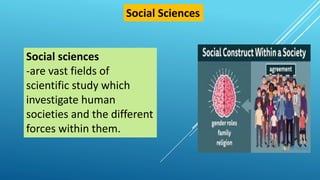
-are vast fields of
scientific study which
investigate human
societies and the different
forces within them.
Social Sciences
• These diverse fields examine how people interact
and develop their culture. Social sciences
• are comprised of several disciplines, including
history, political science, sociology, psychology,
economics, geography, demography,
anthropology and linguistics
Social sciences
Economics
studies the allocation of scarce resources and the
production and exchange of goods and services within
society.
• Microeconomics, which focuses on the actions of
individual consumers and producers, and
• Macroeconomics, which explores the actions and
output of the aggregate economy.
BRANCHES OF THE SOCIAL SCIENCES
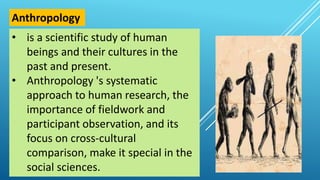
• is a scientific study of human
beings and their cultures in the
past and present.
• Anthropology 's systematic
approach to human research, the
importance of fieldwork and
participant observation, and its
focus on cross-cultural
comparison, make it special in the
social sciences.
Anthropology
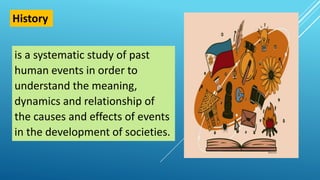
is a systematic study of past
human events in order to
understand the meaning,
dynamics and relationship of
the causes and effects of events
in the development of societies.
History
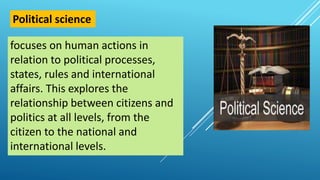
focuses on human actions in
relation to political processes,
states, rules and international
affairs. This explores the
relationship between citizens and
politics at all levels, from the
citizen to the national and
international levels.
Political science
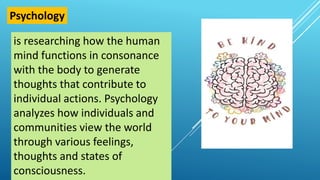
is researching how the human
mind functions in consonance
with the body to generate
thoughts that contribute to
individual actions. Psychology
analyzes how individuals and
communities view the world
through various feelings,
thoughts and states of
consciousness.
Psychology
• is a systematic study of people’s behavior in
groups. It is derived from the Latin word socio
which means “people together” and Greek word
logos which means “the study of.”
• As a discipline of the social science, it attempts to
understand why and how people interact with
each other and how the function as a society or
social subgroups.
Sociology
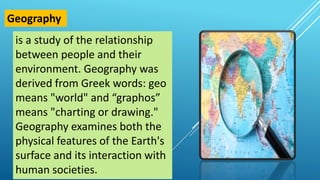
is a study of the relationship
between people and their
environment. Geography was
derived from Greek words: geo
means "world" and “graphos”
means "charting or drawing."
Geography examines both the
physical features of the Earth's
surface and its interaction with
human societies.
Geography
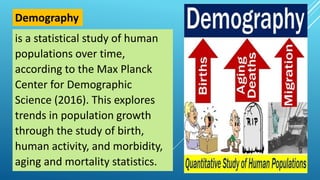
is a statistical study of human
populations over time,
according to the Max Planck
Center for Demographic
Science (2016). This explores
trends in population growth
through the study of birth,
human activity, and morbidity,
aging and mortality statistics.
Demography
Applied social sciences
is the application of social
science theories, concepts,
methods, and findings to
problems identified in the
wider society (D. Jary & J.
Jary 2000).
Applied social Sciences
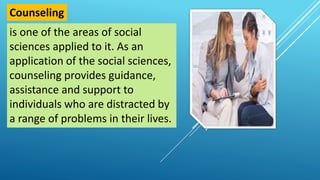
is one of the areas of social
sciences applied to it. As an
application of the social sciences,
counseling provides guidance,
assistance and support to
individuals who are distracted by
a range of problems in their lives.
Counseling
Social research is another technical
practice in the social sciences related to
it. Having been trained in social sciences
to interact and understand social realities,
an applied social sciences practitioner has
a good theoretical and conceptual
foundation for social work practice.
Social Work
Applied social sciences provide
appropriate instruction for
employment in the
communications field. One
example of a career in the
advertising industry is in the
field of mass media.
Communication Studies
Social Sciences vs Applied Social Sciences
•Social science is a scientific study that deals with
the study of social behavior in society. For
example, economy, sociology, and political science.
•Applied science is a scientific study that can be
used for application in different fields in order to
achieve social change. For Example, study about
slums, their problems, their social structure which
gave rise to these problems.

1. Social Science.pptx

  • 1.
    Social sciences -are vastfields of scientific study which investigate human societies and the different forces within them. Social Sciences
  • 2.
    • These diversefields examine how people interact and develop their culture. Social sciences • are comprised of several disciplines, including history, political science, sociology, psychology, economics, geography, demography, anthropology and linguistics Social sciences
  • 3.
    Economics studies the allocationof scarce resources and the production and exchange of goods and services within society. • Microeconomics, which focuses on the actions of individual consumers and producers, and • Macroeconomics, which explores the actions and output of the aggregate economy. BRANCHES OF THE SOCIAL SCIENCES
  • 4.
    • is ascientific study of human beings and their cultures in the past and present. • Anthropology 's systematic approach to human research, the importance of fieldwork and participant observation, and its focus on cross-cultural comparison, make it special in the social sciences. Anthropology
  • 5.
    is a systematicstudy of past human events in order to understand the meaning, dynamics and relationship of the causes and effects of events in the development of societies. History
  • 6.
    focuses on humanactions in relation to political processes, states, rules and international affairs. This explores the relationship between citizens and politics at all levels, from the citizen to the national and international levels. Political science
  • 7.
    is researching howthe human mind functions in consonance with the body to generate thoughts that contribute to individual actions. Psychology analyzes how individuals and communities view the world through various feelings, thoughts and states of consciousness. Psychology
  • 8.
    • is asystematic study of people’s behavior in groups. It is derived from the Latin word socio which means “people together” and Greek word logos which means “the study of.” • As a discipline of the social science, it attempts to understand why and how people interact with each other and how the function as a society or social subgroups. Sociology
  • 9.
    is a studyof the relationship between people and their environment. Geography was derived from Greek words: geo means "world" and “graphos” means "charting or drawing." Geography examines both the physical features of the Earth's surface and its interaction with human societies. Geography
  • 10.
    is a statisticalstudy of human populations over time, according to the Max Planck Center for Demographic Science (2016). This explores trends in population growth through the study of birth, human activity, and morbidity, aging and mortality statistics. Demography
  • 11.
    Applied social sciences isthe application of social science theories, concepts, methods, and findings to problems identified in the wider society (D. Jary & J. Jary 2000). Applied social Sciences
  • 12.
    is one ofthe areas of social sciences applied to it. As an application of the social sciences, counseling provides guidance, assistance and support to individuals who are distracted by a range of problems in their lives. Counseling
  • 13.
    Social research isanother technical practice in the social sciences related to it. Having been trained in social sciences to interact and understand social realities, an applied social sciences practitioner has a good theoretical and conceptual foundation for social work practice. Social Work
  • 14.
    Applied social sciencesprovide appropriate instruction for employment in the communications field. One example of a career in the advertising industry is in the field of mass media. Communication Studies
  • 15.
    Social Sciences vsApplied Social Sciences •Social science is a scientific study that deals with the study of social behavior in society. For example, economy, sociology, and political science. •Applied science is a scientific study that can be used for application in different fields in order to achieve social change. For Example, study about slums, their problems, their social structure which gave rise to these problems.