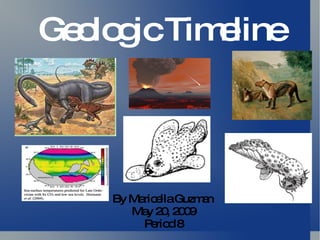
Geologic Timeline By Maricella Guzman May 20, 2009 Period 8
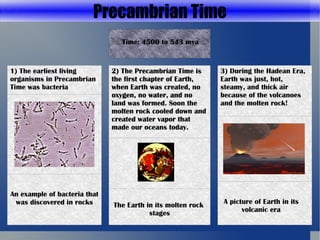
Time: 4500 to 543 mya 1) The earliest living organisms in Precambrian Time was bacteria 2) The Precambrian Time is the first chapter of Earth, when Earth was created, no oxygen, no water, and no land was formed. Soon the molten rock cooled down and created water vapor that made our oceans today.  3) During the Hadean Era, Earth was just, hot, steamy, and thick air because of the volcanoes and the molten rock! 2) The Precambrian Time is the first chapter of Earth, when Earth was created, no oxygen, no water, and no land was formed. Soon the molten rock cooled down and created water vapor that made our oceans today.  A picture of Earth in its volcanic era An example of bacteria that was discovered in rocks
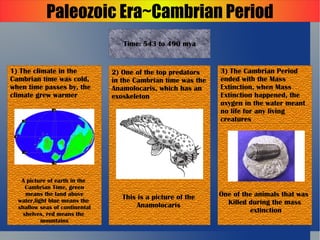
1) The climate in the  Cambrian time was cold, when time passes by, the climate grew warmer 2) One of the top predators in the Cambrian time was the Anamolocaris, which has an exoskeleton  3) The Cambrian Period ended with the Mass Extinction, when Mass Extinction happened, the oxygen in the water meant no life for any living creatures A picture of earth in the  Cambrian Time, green means the land above water,light blue means the  shallow seas of continental shelves, red means the  mountains One of the animals that was  Killed during the mass extinction
1) Continents today, Southern Europe, Africa, South Africa, Antarctica, and Australia, was formed together as Gondwanaland.  2) The climate in the Ordovician Period was cold because of the Ordovician Ice Age  2) The climate in the Ordovician Period was cold because of the Ordovician Ice Age  3) Organisms in the Ordovician Period are new species and replaced the Cambrian Species, invertebrates increased 300 more families in the Ordovician Period A Lophoporates, an animal that  Sucks food from water using its tentacles This Picture represents Gondwanaland, splitting  apart from each other
1) By the end of the Silurian Period, Gondwanaland drifted south and created the super continent, Laurrasia.  2) Coral Reefs first appeared on Earth 3) During the Silurian Period, there was many rapid climate changes This drawing shows  Eurypterids, Rhynchonelid Brachiopods, and  Trillobites An example of the Silurian  Sea floor This is a picture of the  Eurypterid
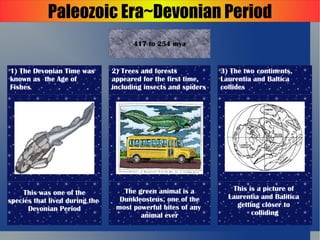
1) The Devonian Time was  known as  the Age of Fishes 2) Trees and forests appeared for the first time, including insects and spiders 1) The Devonian Time was  known as  the Age of Fishes 3) The two continents, Laurentia and Baltica collides This is a picture of  Laurentia and Balitica  getting closer to  colliding The green animal is a Dunkleosteus, one of the most powerful bites of any  animal ever This was one of the species that lived during the  Devonian Period
1) East Gondwanaland  Drifted towards the South Pole 2) At the beginning of the period, the climate was warm, but it constantly changes 3) The first reptiles appeared during this period, the swamps had crocodiles, eels, and salamander like forms This was one of the species that lived during the  Devonian Period The yellow shows the  Glacial Spreading, while the  green shows normal  temperature The Earth during the year 329 mya in the  Carboniferous Period This a picture of the  gigantic rhizodont fish, which is can reach up to  7 meters long
1) Pangaea collided a.k.a. “Pacman Continent” 1) Pangaea collided a.k.a. “Pacman Continent” 2) In the Permian Period, it was still in grip of a n ice age, glaciers continued to cover Gondwanaland 3) The great forest of the fern like plants, shifted to gymnosperms The upper two earth  images indicates Gondwana, and Laurasia coming closer to each other The Petalodontiforme, one of the salt water  fishes in the Permian  Period The shallow sea,swarmed  with so much life, like algae, foraminifers, sponges, and coral
1) Around Pangaea, it was surrounded by the huge ocean Panthalassia 1) Around Pangaea, it was surrounded by the huge ocean Panthalassia 3) The Triassic Period was introduced to the first dinosaurs, and mammals 2) The reptiles became so  Successful, that it is called  The Age of Reptiles This is one of the first Dinosaurs, Rauisuchian  Thecodont Postosuchus This displays a section of the Triassic Period in 210 This is a picture of the  marine reptile, ichtyosaur
1) Dinosaurs were the main dominant animals for 150 million years 1) Dinosaurs were the main dominant animals for 150 million years 1) Dinosaurs were the main dominant animals for 150 million years 2) The first bird appeared, the archaeopteryx, a.k.a. Ancient winged thing 2) The Cycads were so abundant and diverse, that the Jurassic Period was called the “Age of Cycads” Earth during the year, 170 mya This is one of the  Archaeopteryx birds, the  black words tell you a  description about the bird This plant is an example of the  Cycad
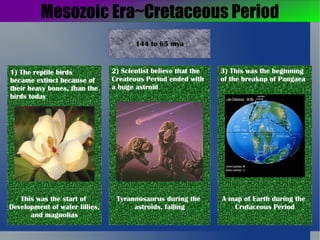
1) The reptile birds became extinct because of their heavy bones, than the birds today 2) Scientist believe that the Createous Period ended with a huge astroid 1) The reptile birds became extinct because of their heavy bones, than the birds today 3) This was the beginning of the breakup of Pangaea This was the start of  Development of water lillies, and magnolias Tyrannosaurus during the  astroids, falling A map of Earth during the  Crutaceous Period
1) Mammals became the dominant animals on Earth 1) Mammals became the dominant animals on Earth 2) During the Tertiary Period, whales evolved 2) During the Tertiary Period, whales evolved 3) The Cenozoic Era became the “Age of Mammals”  This is a baleen whales ear  that lived during the  Tertiary Period This is the homonid ,  our  ancestors from a long time ago The angiosperms which  was beneficial to insects
1) The Quaternary Period is the current period of today 1) The Quaternary Period is the current period of today 1) The Quaternary Period is the current period of today 2) Earths climate cooled down, which caused a series of Ice Ages 1) The Quaternary Period is the current period of today 3) Some animals, Mammoths, rhinoceros, bison, and reindeer, grew thick coats to keep them warm from the cold weather This was one of the animals that lived during the  Quarternary Period,  The Phenacodus The rhinoceros that lives  today and at the beginning  of the period  An image of Earth during present time today
Works Cited http://www.seorf.ohiou.edu/~tstork/compass.rose/earth.history.02/Earth%20Web%20Page/Jurassic.2.html http://www.terradaily.com/reports/Scientists_Rebuild_Ancient_Proteins_To_Reveal_Primordial_Earth_Temperature_999.html http://www.geocraft.com/WVFossils/Carboniferous_climate.html http://www.britannica.com/EBchecked/topic/131719/Condylarthra http://student.britannica.com/elementary/art/print?id=1702&articleTypeId=0 http://www.hmnh.org/archives/category/timeline/paleozoic/devonian/ http://www.palaeos.com/Mesozoic/Triassic/Triassic.htm http://www.dinosaurfact.net/Cretaceous.php http://www.kidcyber.com.au/topics/dinoCret.htm http://www.bbm.me.uk/portsdown/PH_065_Palaeo.htm http://www.emc.maricopa.edu/faculty/farabee/BIOBK/BioBookPaleo4.html http://www.gsi.ir/Training/Lang_en/Page_66/GroupId_01-08/DataId_548/Action_Pn4/training.html http://www.cotf.edu/ete/modules/msese/earthsysflr/cambrian.html http://www.fossils-facts-and-finds.com/cambrian_period.html http://donsmaps.com/bcmammoth.html http://www.daviddarling.info/encyclopedia/C/Cretaceous.html http://virtual.clemson.edu/geomusem/bcgm3486.htm http://www.enotes.com/earth-science/cambrian-period http://www.palaeos.com/Paleozoic/Ordovician/Ordovician.htm http://www.palaeos.com/Paleozoic/Ordovician/Ordovician.htm

Geologic Timeline

  • 1.
    Geologic Timeline ByMaricella Guzman May 20, 2009 Period 8
  • 2.
    Time: 4500 to543 mya 1) The earliest living organisms in Precambrian Time was bacteria 2) The Precambrian Time is the first chapter of Earth, when Earth was created, no oxygen, no water, and no land was formed. Soon the molten rock cooled down and created water vapor that made our oceans today. 3) During the Hadean Era, Earth was just, hot, steamy, and thick air because of the volcanoes and the molten rock! 2) The Precambrian Time is the first chapter of Earth, when Earth was created, no oxygen, no water, and no land was formed. Soon the molten rock cooled down and created water vapor that made our oceans today. A picture of Earth in its volcanic era An example of bacteria that was discovered in rocks
  • 3.
    1) The climatein the Cambrian time was cold, when time passes by, the climate grew warmer 2) One of the top predators in the Cambrian time was the Anamolocaris, which has an exoskeleton 3) The Cambrian Period ended with the Mass Extinction, when Mass Extinction happened, the oxygen in the water meant no life for any living creatures A picture of earth in the Cambrian Time, green means the land above water,light blue means the shallow seas of continental shelves, red means the mountains One of the animals that was Killed during the mass extinction
  • 4.
    1) Continents today,Southern Europe, Africa, South Africa, Antarctica, and Australia, was formed together as Gondwanaland. 2) The climate in the Ordovician Period was cold because of the Ordovician Ice Age 2) The climate in the Ordovician Period was cold because of the Ordovician Ice Age 3) Organisms in the Ordovician Period are new species and replaced the Cambrian Species, invertebrates increased 300 more families in the Ordovician Period A Lophoporates, an animal that Sucks food from water using its tentacles This Picture represents Gondwanaland, splitting apart from each other
  • 5.
    1) By theend of the Silurian Period, Gondwanaland drifted south and created the super continent, Laurrasia. 2) Coral Reefs first appeared on Earth 3) During the Silurian Period, there was many rapid climate changes This drawing shows Eurypterids, Rhynchonelid Brachiopods, and Trillobites An example of the Silurian Sea floor This is a picture of the Eurypterid
  • 6.
    1) The DevonianTime was known as the Age of Fishes 2) Trees and forests appeared for the first time, including insects and spiders 1) The Devonian Time was known as the Age of Fishes 3) The two continents, Laurentia and Baltica collides This is a picture of Laurentia and Balitica getting closer to colliding The green animal is a Dunkleosteus, one of the most powerful bites of any animal ever This was one of the species that lived during the Devonian Period
  • 7.
    1) East Gondwanaland Drifted towards the South Pole 2) At the beginning of the period, the climate was warm, but it constantly changes 3) The first reptiles appeared during this period, the swamps had crocodiles, eels, and salamander like forms This was one of the species that lived during the Devonian Period The yellow shows the Glacial Spreading, while the green shows normal temperature The Earth during the year 329 mya in the Carboniferous Period This a picture of the gigantic rhizodont fish, which is can reach up to 7 meters long
  • 8.
    1) Pangaea collideda.k.a. “Pacman Continent” 1) Pangaea collided a.k.a. “Pacman Continent” 2) In the Permian Period, it was still in grip of a n ice age, glaciers continued to cover Gondwanaland 3) The great forest of the fern like plants, shifted to gymnosperms The upper two earth images indicates Gondwana, and Laurasia coming closer to each other The Petalodontiforme, one of the salt water fishes in the Permian Period The shallow sea,swarmed with so much life, like algae, foraminifers, sponges, and coral
  • 9.
    1) Around Pangaea,it was surrounded by the huge ocean Panthalassia 1) Around Pangaea, it was surrounded by the huge ocean Panthalassia 3) The Triassic Period was introduced to the first dinosaurs, and mammals 2) The reptiles became so Successful, that it is called The Age of Reptiles This is one of the first Dinosaurs, Rauisuchian Thecodont Postosuchus This displays a section of the Triassic Period in 210 This is a picture of the marine reptile, ichtyosaur
  • 10.
    1) Dinosaurs werethe main dominant animals for 150 million years 1) Dinosaurs were the main dominant animals for 150 million years 1) Dinosaurs were the main dominant animals for 150 million years 2) The first bird appeared, the archaeopteryx, a.k.a. Ancient winged thing 2) The Cycads were so abundant and diverse, that the Jurassic Period was called the “Age of Cycads” Earth during the year, 170 mya This is one of the Archaeopteryx birds, the black words tell you a description about the bird This plant is an example of the Cycad
  • 11.
    1) The reptilebirds became extinct because of their heavy bones, than the birds today 2) Scientist believe that the Createous Period ended with a huge astroid 1) The reptile birds became extinct because of their heavy bones, than the birds today 3) This was the beginning of the breakup of Pangaea This was the start of Development of water lillies, and magnolias Tyrannosaurus during the astroids, falling A map of Earth during the Crutaceous Period
  • 12.
    1) Mammals becamethe dominant animals on Earth 1) Mammals became the dominant animals on Earth 2) During the Tertiary Period, whales evolved 2) During the Tertiary Period, whales evolved 3) The Cenozoic Era became the “Age of Mammals” This is a baleen whales ear that lived during the Tertiary Period This is the homonid , our ancestors from a long time ago The angiosperms which was beneficial to insects
  • 13.
    1) The QuaternaryPeriod is the current period of today 1) The Quaternary Period is the current period of today 1) The Quaternary Period is the current period of today 2) Earths climate cooled down, which caused a series of Ice Ages 1) The Quaternary Period is the current period of today 3) Some animals, Mammoths, rhinoceros, bison, and reindeer, grew thick coats to keep them warm from the cold weather This was one of the animals that lived during the Quarternary Period, The Phenacodus The rhinoceros that lives today and at the beginning of the period An image of Earth during present time today
  • 14.
    Works Cited http://www.seorf.ohiou.edu/~tstork/compass.rose/earth.history.02/Earth%20Web%20Page/Jurassic.2.htmlhttp://www.terradaily.com/reports/Scientists_Rebuild_Ancient_Proteins_To_Reveal_Primordial_Earth_Temperature_999.html http://www.geocraft.com/WVFossils/Carboniferous_climate.html http://www.britannica.com/EBchecked/topic/131719/Condylarthra http://student.britannica.com/elementary/art/print?id=1702&articleTypeId=0 http://www.hmnh.org/archives/category/timeline/paleozoic/devonian/ http://www.palaeos.com/Mesozoic/Triassic/Triassic.htm http://www.dinosaurfact.net/Cretaceous.php http://www.kidcyber.com.au/topics/dinoCret.htm http://www.bbm.me.uk/portsdown/PH_065_Palaeo.htm http://www.emc.maricopa.edu/faculty/farabee/BIOBK/BioBookPaleo4.html http://www.gsi.ir/Training/Lang_en/Page_66/GroupId_01-08/DataId_548/Action_Pn4/training.html http://www.cotf.edu/ete/modules/msese/earthsysflr/cambrian.html http://www.fossils-facts-and-finds.com/cambrian_period.html http://donsmaps.com/bcmammoth.html http://www.daviddarling.info/encyclopedia/C/Cretaceous.html http://virtual.clemson.edu/geomusem/bcgm3486.htm http://www.enotes.com/earth-science/cambrian-period http://www.palaeos.com/Paleozoic/Ordovician/Ordovician.htm http://www.palaeos.com/Paleozoic/Ordovician/Ordovician.htm