Genre Theory 
Milly Clark
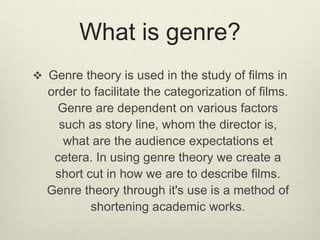
What is genre? 
 Genre theory is used in the study of films in 
order to facilitate the categorization of films. 
Genre are dependent on various factors 
such as story line, whom the director is, 
what are the audience expectations et 
cetera. In using genre theory we create a 
short cut in how we are to describe films. 
Genre theory through it's use is a method of 
shortening academic works.
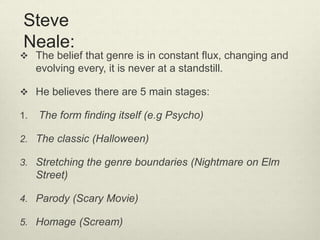
Steve 
Neale: 
 The belief that genre is in constant flux, changing and 
evolving every, it is never at a standstill. 
 He believes there are 5 main stages: 
1. The form finding itself (e.g Psycho) 
2. The classic (Halloween) 
3. Stretching the genre boundaries (Nightmare on Elm 
Street) 
4. Parody (Scary Movie) 
5. Homage (Scream)
Robert Stam: 
 Robert Stam said that genre is hard to define and categorize 
and that the concept of genre is made up from critics and 
theorists. 
 He highlighted four main problems with the classification of 
genre: 
1. Extension (too broad or too narrow in requirements) 
2. Normavitism (preconcieved idea of criteria for genre 
membership) 
3. Monolithic (as if an item belongs only to one genre) 
4. Biologism (a kind of essentialism in which genres are 
seen as evolving through life cycle)
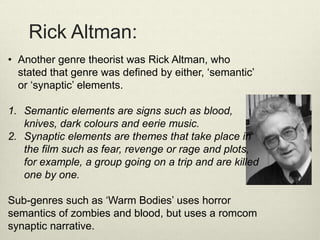
Rick Altman: 
• Another genre theorist was Rick Altman, who 
stated that genre was defined by either, ‘semantic’ 
or ‘synaptic’ elements. 
1. Semantic elements are signs such as blood, 
knives, dark colours and eerie music. 
2. Synaptic elements are themes that take place in 
the film such as fear, revenge or rage and plots, 
for example, a group going on a trip and are killed 
one by one. 
Sub-genres such as ‘Warm Bodies’ uses horror 
semantics of zombies and blood, but uses a romcom 
synaptic narrative.
Bordwell: 
 Bordwell (1989), however, suggested that 
nothing will make a film fit into a genre, there 
is never an empirical answer for it. 
 This is because every person in an 
audience has differentiating creation, 
imagination and perception, therefore will 
respond and form an opinion to it 
individually. 
 No genre can be drawn by line or 
description.
This research into genre theory has 
broadened my knowledge on the 
controversial topic of classification in the 
film industry. Beforehand I was unaware 
of the many views of theories, but since 
looking at multiple theorists, I can now 
apply and use their beliefs in my own 
coursework and final cut project.

Genre Theory

  • 1.
  • 2.
    What is genre?  Genre theory is used in the study of films in order to facilitate the categorization of films. Genre are dependent on various factors such as story line, whom the director is, what are the audience expectations et cetera. In using genre theory we create a short cut in how we are to describe films. Genre theory through it's use is a method of shortening academic works.
  • 3.
    Steve Neale: The belief that genre is in constant flux, changing and evolving every, it is never at a standstill.  He believes there are 5 main stages: 1. The form finding itself (e.g Psycho) 2. The classic (Halloween) 3. Stretching the genre boundaries (Nightmare on Elm Street) 4. Parody (Scary Movie) 5. Homage (Scream)
  • 4.
    Robert Stam: Robert Stam said that genre is hard to define and categorize and that the concept of genre is made up from critics and theorists.  He highlighted four main problems with the classification of genre: 1. Extension (too broad or too narrow in requirements) 2. Normavitism (preconcieved idea of criteria for genre membership) 3. Monolithic (as if an item belongs only to one genre) 4. Biologism (a kind of essentialism in which genres are seen as evolving through life cycle)
  • 5.
    Rick Altman: •Another genre theorist was Rick Altman, who stated that genre was defined by either, ‘semantic’ or ‘synaptic’ elements. 1. Semantic elements are signs such as blood, knives, dark colours and eerie music. 2. Synaptic elements are themes that take place in the film such as fear, revenge or rage and plots, for example, a group going on a trip and are killed one by one. Sub-genres such as ‘Warm Bodies’ uses horror semantics of zombies and blood, but uses a romcom synaptic narrative.
  • 6.
    Bordwell:  Bordwell(1989), however, suggested that nothing will make a film fit into a genre, there is never an empirical answer for it.  This is because every person in an audience has differentiating creation, imagination and perception, therefore will respond and form an opinion to it individually.  No genre can be drawn by line or description.
  • 7.
    This research intogenre theory has broadened my knowledge on the controversial topic of classification in the film industry. Beforehand I was unaware of the many views of theories, but since looking at multiple theorists, I can now apply and use their beliefs in my own coursework and final cut project.