General, Organic, and Biological Chemistry: Structures of Life, 5/e
Karen C. Timberlake
© 2016 Pearson Education, Inc.
Ryan A.Bersamin
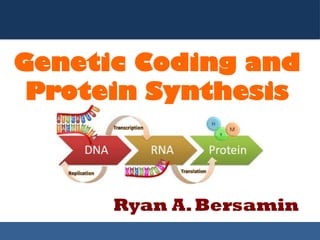
Genetic Coding and
Protein Synthesis
General, Organic, and Biological Chemistry: Structures of Life, 5/e
Karen C. Timberlake
© 2016 Pearson Education, Inc.
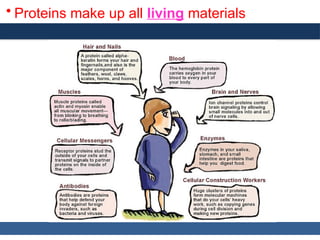
• Proteins make up all living materials
General, Organic, and Biological Chemistry: Structures of Life, 5/e
Karen C. Timberlake
© 2016 Pearson Education, Inc.
Proteins
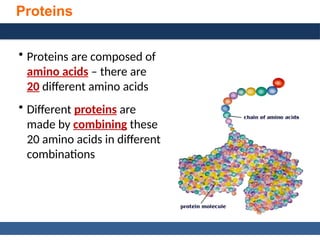
• Proteins are composed of
amino acids – there are
20 different amino acids
• Different proteins are
made by combining these
20 amino acids in different
combinations
General, Organic, and Biological Chemistry: Structures of Life, 5/e
Karen C. Timberlake
© 2016 Pearson Education, Inc.
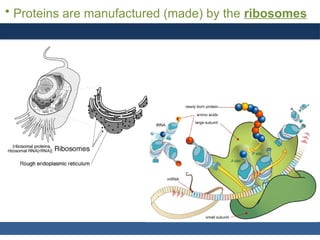
• Proteins are manufactured (made) by the ribosomes
General, Organic, and Biological Chemistry: Structures of Life, 5/e
Karen C. Timberlake
© 2016 Pearson Education, Inc.
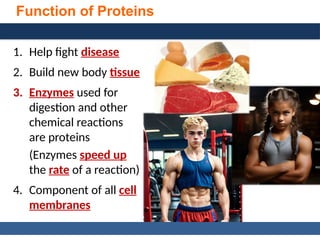
Function of Proteins
1. Help fight disease
2. Build new body tissue
3. Enzymes used for
digestion and other
chemical reactions
are proteins
(Enzymes speed up
the rate of a reaction)
4. Component of all cell
membranes
General, Organic, and Biological Chemistry: Structures of Life, 5/e
Karen C. Timberlake
© 2016 Pearson Education, Inc.
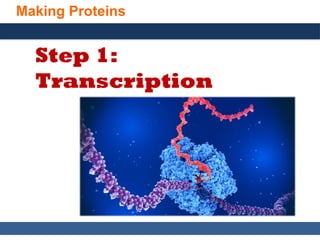
Making Proteins
Step 1:
Transcription
General, Organic, and Biological Chemistry: Structures of Life, 5/e
Karen C. Timberlake
© 2016 Pearson Education, Inc.
Making a Protein—Transcription
• First Step: Copying of genetic information from DNA to RNA
called Transcription
Why? DNA has the genetic code for the protein that needs to be
made, but proteins are made by the ribosomes
—ribosomes are outside the nucleus
in the cytoplasm.
DNA is too large to leave
the nucleus
(double stranded),
but RNA can leave
the nucleus
(single stranded).
General, Organic, and Biological Chemistry: Structures of Life, 5/e
Karen C. Timberlake
© 2016 Pearson Education, Inc.
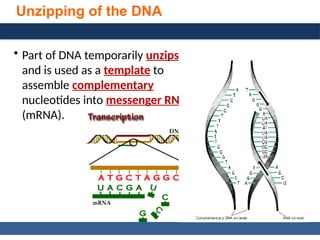
Unzipping of the DNA
• Part of DNA temporarily unzips
and is used as a template to
assemble complementary
nucleotides into messenger RNA
(mRNA).
General, Organic, and Biological Chemistry: Structures of Life, 5/e
Karen C. Timberlake
© 2016 Pearson Education, Inc.
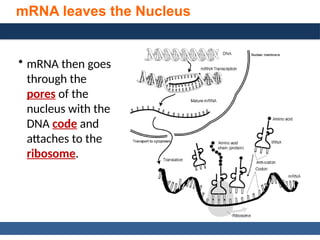
mRNA leaves the Nucleus
• mRNA then goes
through the
pores of the
nucleus with the
DNA code and
attaches to the
ribosome.
General, Organic, and Biological Chemistry: Structures of Life, 5/e
Karen C. Timberlake
© 2016 Pearson Education, Inc.
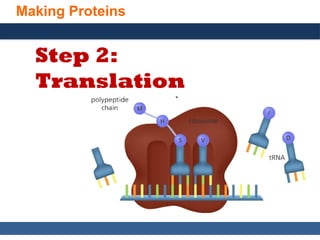
Making Proteins
Step 2:
Translation
General, Organic, and Biological Chemistry: Structures of Life, 5/e
Karen C. Timberlake
© 2016 Pearson Education, Inc.
How to Translate mRNA to Amino Acids
(DECODING THE GENETIC CODE)
General, Organic, and Biological Chemistry: Structures of Life, 5/e
Karen C. Timberlake
© 2016 Pearson Education, Inc.
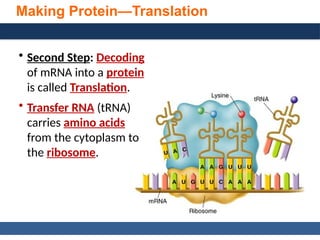
Making Protein—Translation
• Second Step: Decoding
of mRNA into a protein
is called Translation.
• Transfer RNA (tRNA)
carries amino acids
from the cytoplasm to
the ribosome.
General, Organic, and Biological Chemistry: Structures of Life, 5/e
Karen C. Timberlake
© 2016 Pearson Education, Inc.
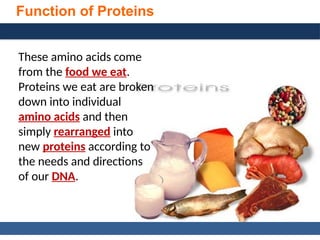
Function of Proteins
These amino acids come
from the food we eat.
Proteins we eat are broken
down into individual
amino acids and then
simply rearranged into
new proteins according to
the needs and directions
of our DNA.
General, Organic, and Biological Chemistry: Structures of Life, 5/e
Karen C. Timberlake
© 2016 Pearson Education, Inc.
The Transfer-RNA
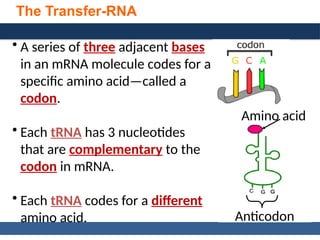
• A series of three adjacent bases
in an mRNA molecule codes for a
specific amino acid—called a
codon.
• Each tRNA has 3 nucleotides
that are complementary to the
codon in mRNA.
• Each tRNA codes for a different
amino acid.
Amino acid
Anticodon
General, Organic, and Biological Chemistry: Structures of Life, 5/e
Karen C. Timberlake
© 2016 Pearson Education, Inc.
The Messenger-RNA
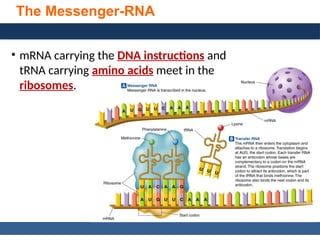
• mRNA carrying the DNA instructions and
tRNA carrying amino acids meet in the
ribosomes.
General, Organic, and Biological Chemistry: Structures of Life, 5/e
Karen C. Timberlake
© 2016 Pearson Education, Inc.
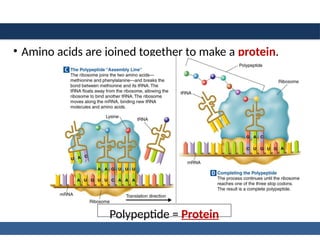
• Amino acids are joined together to make a protein.
Polypeptide = Protein
General, Organic, and Biological Chemistry: Structures of Life, 5/e
Karen C. Timberlake
© 2016 Pearson Education, Inc.
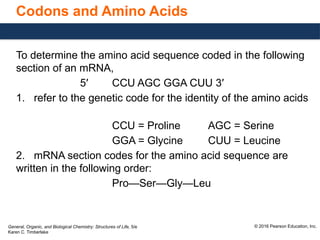
Codons and Amino Acids
To determine the amino acid sequence coded in the following
section of an mRNA,
5′ CCU AGC GGA CUU 3′
1. refer to the genetic code for the identity of the amino acids
CCU = Proline AGC = Serine
GGA = Glycine CUU = Leucine
2. mRNA section codes for the amino acid sequence are
written in the following order:
Pro—Ser—Gly—Leu
General, Organic, and Biological Chemistry: Structures of Life, 5/e
Karen C. Timberlake
© 2016 Pearson Education, Inc.
Codons and Amino Acids
To determine the amino acid sequence coded in the following
section of an mRNA,
5′ CCU AGC GGA CUU 3′
1. refer to the genetic code for the identity of the amino acids
CCU = Proline AGC = Serine
GGA = Glycine CUU = Leucine
2. mRNA section codes for the amino acid sequence are
written in the following order:
Pro—Ser—Gly—Leu
General, Organic, and Biological Chemistry: Structures of Life, 5/e
Karen C. Timberlake
© 2016 Pearson Education, Inc.
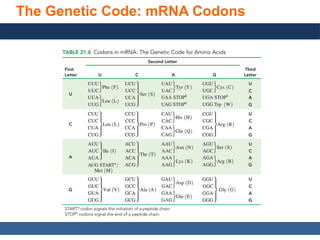
The Genetic Code: mRNA Codons
General, Organic, and Biological Chemistry: Structures of Life, 5/e
Karen C. Timberlake
© 2016 Pearson Education, Inc.
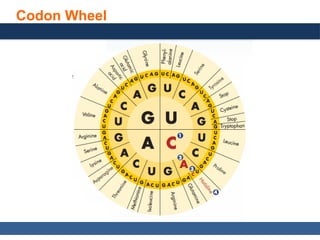
Codon Wheel
General, Organic, and Biological Chemistry: Structures of Life, 5/e
Karen C. Timberlake
© 2016 Pearson Education, Inc.
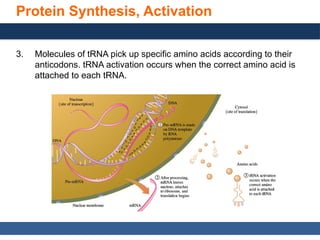
Protein Synthesis, Activation
3. Molecules of tRNA pick up specific amino acids according to their
anticodons. tRNA activation occurs when the correct amino acid is
attached to each tRNA.
General, Organic, and Biological Chemistry: Structures of Life, 5/e
Karen C. Timberlake
© 2016 Pearson Education, Inc.
Protein Synthesis
General, Organic, and Biological Chemistry: Structures of Life, 5/e
Karen C. Timberlake
© 2016 Pearson Education, Inc.
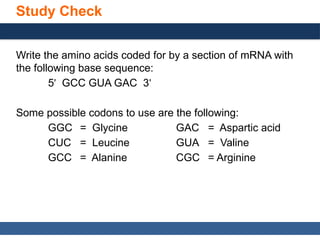
Study Check
Write the amino acids coded for by a section of mRNA with
the following base sequence:
5 GCC GUA GAC 3
ʹ ʹ
Some possible codons to use are the following:
GGC = Glycine GAC = Aspartic acid
CUC = Leucine GUA = Valine
GCC = Alanine CGC = Arginine
General, Organic, and Biological Chemistry: Structures of Life, 5/e
Karen C. Timberlake
© 2016 Pearson Education, Inc.
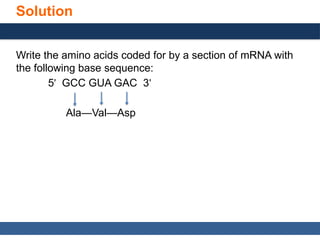
Solution
Write the amino acids coded for by a section of mRNA with
the following base sequence:
5 GCC GUA GAC 3
ʹ ʹ
Ala—Val—Asp
General, Organic, and Biological Chemistry: Structures of Life, 5/e
Karen C. Timberlake
© 2016 Pearson Education, Inc.
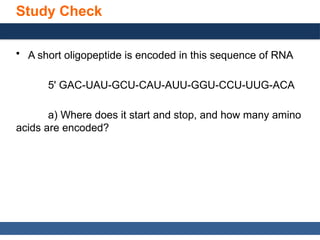
Study Check
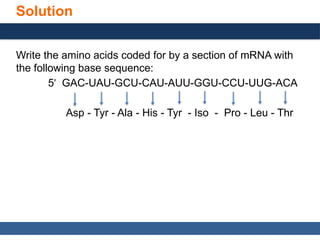
• A short oligopeptide is encoded in this sequence of RNA
5' GAC-UAU-GCU-CAU-AUU-GGU-CCU-UUG-ACA
a) Where does it start and stop, and how many amino
acids are encoded?
General, Organic, and Biological Chemistry: Structures of Life, 5/e
Karen C. Timberlake
© 2016 Pearson Education, Inc.
Solution
Write the amino acids coded for by a section of mRNA with
the following base sequence:
5 GAC-UAU-GCU-CAU-AUU-GGU-CCU-UUG-ACA
ʹ
Asp - Tyr - Ala - His - Tyr - Iso - Pro - Leu - Thr
General, Organic, and Biological Chemistry: Structures of Life, 5/e
Karen C. Timberlake
© 2016 Pearson Education, Inc.
DNA vs RNA
General, Organic, and Biological Chemistry: Structures of Life, 5/e
Karen C. Timberlake
© 2016 Pearson Education, Inc.
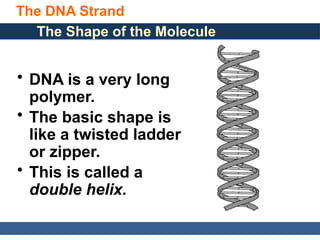
The DNA Strand
The Shape of the Molecule
• DNA is a very long
polymer.
• The basic shape is
like a twisted ladder
or zipper.
• This is called a
double helix.
General, Organic, and Biological Chemistry: Structures of Life, 5/e
Karen C. Timberlake
© 2016 Pearson Education, Inc.
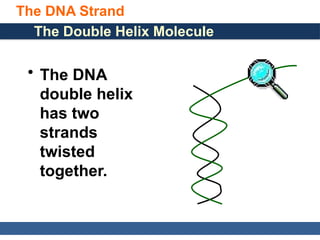
The DNA Strand
The Double Helix Molecule
• The DNA
double helix
has two
strands
twisted
together.
General, Organic, and Biological Chemistry: Structures of Life, 5/e
Karen C. Timberlake
© 2016 Pearson Education, Inc.
The DNA Strand
30
One Strand of DNA
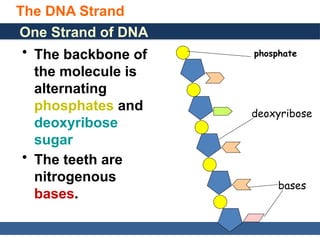
• The backbone of
the molecule is
alternating
phosphates and
deoxyribose
sugar
• The teeth are
nitrogenous
bases.
phosphate
deoxyribose
bases
General, Organic, and Biological Chemistry: Structures of Life, 5/e
Karen C. Timberlake
© 2016 Pearson Education, Inc.
The DNA Strand
31
Nucleotides
C C
C
O
Phosphate
O
C
C
O -P O
O
O
O -P O
O
O
O -P O
O
O
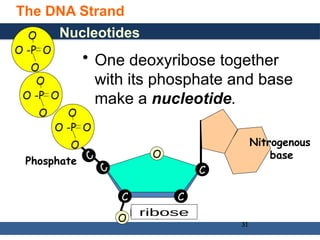
• One deoxyribose together
with its phosphate and base
make a nucleotide.
Nitrogenous
base
Deoxyribose
General, Organic, and Biological Chemistry: Structures of Life, 5/e
Karen C. Timberlake
© 2016 Pearson Education, Inc.
The DNA Strand
32
One Strand of DNA
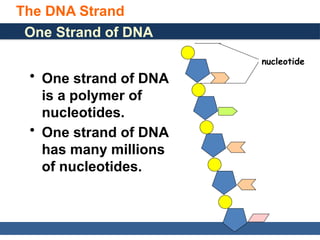
• One strand of DNA
is a polymer of
nucleotides.
• One strand of DNA
has many millions
of nucleotides.
nucleotide
General, Organic, and Biological Chemistry: Structures of Life, 5/e
Karen C. Timberlake
© 2016 Pearson Education, Inc.
The DNA Strand
33
Two Stranded DNA
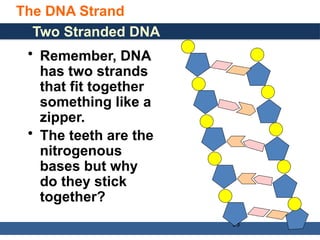
• Remember, DNA
has two strands
that fit together
something like a
zipper.
• The teeth are the
nitrogenous
bases but why
do they stick
together?
General, Organic, and Biological Chemistry: Structures of Life, 5/e
Karen C. Timberlake
© 2016 Pearson Education, Inc.
The DNA Strand
34
34
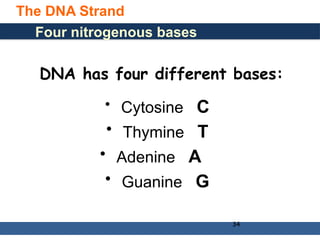
Four nitrogenous bases
• Cytosine C
• Thymine T
• Adenine A
• Guanine G
DNA has four different bases:
General, Organic, and Biological Chemistry: Structures of Life, 5/e
Karen C. Timberlake
© 2016 Pearson Education, Inc.
The DNA Strand
35
35
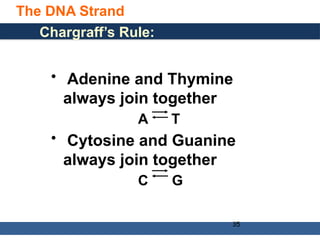
Chargraff’s Rule:
• Adenine and Thymine
always join together
A T
• Cytosine and Guanine
always join together
C G
General, Organic, and Biological Chemistry: Structures of Life, 5/e
Karen C. Timberlake
© 2016 Pearson Education, Inc.
Have a
great day
ahead!!!
Have a
great day
ahead!!!

Genetic Code Protein Synthesisssssssssssss

  • 1.
    General, Organic, andBiological Chemistry: Structures of Life, 5/e Karen C. Timberlake © 2016 Pearson Education, Inc. Ryan A.Bersamin Genetic Coding and Protein Synthesis
  • 2.
    General, Organic, andBiological Chemistry: Structures of Life, 5/e Karen C. Timberlake © 2016 Pearson Education, Inc. • Proteins make up all living materials
  • 3.
    General, Organic, andBiological Chemistry: Structures of Life, 5/e Karen C. Timberlake © 2016 Pearson Education, Inc. Proteins • Proteins are composed of amino acids – there are 20 different amino acids • Different proteins are made by combining these 20 amino acids in different combinations
  • 4.
    General, Organic, andBiological Chemistry: Structures of Life, 5/e Karen C. Timberlake © 2016 Pearson Education, Inc. • Proteins are manufactured (made) by the ribosomes
  • 5.
    General, Organic, andBiological Chemistry: Structures of Life, 5/e Karen C. Timberlake © 2016 Pearson Education, Inc. Function of Proteins 1. Help fight disease 2. Build new body tissue 3. Enzymes used for digestion and other chemical reactions are proteins (Enzymes speed up the rate of a reaction) 4. Component of all cell membranes
  • 6.
    General, Organic, andBiological Chemistry: Structures of Life, 5/e Karen C. Timberlake © 2016 Pearson Education, Inc. Making Proteins Step 1: Transcription
  • 7.
    General, Organic, andBiological Chemistry: Structures of Life, 5/e Karen C. Timberlake © 2016 Pearson Education, Inc. Making a Protein—Transcription • First Step: Copying of genetic information from DNA to RNA called Transcription Why? DNA has the genetic code for the protein that needs to be made, but proteins are made by the ribosomes —ribosomes are outside the nucleus in the cytoplasm. DNA is too large to leave the nucleus (double stranded), but RNA can leave the nucleus (single stranded).
  • 8.
    General, Organic, andBiological Chemistry: Structures of Life, 5/e Karen C. Timberlake © 2016 Pearson Education, Inc. Unzipping of the DNA • Part of DNA temporarily unzips and is used as a template to assemble complementary nucleotides into messenger RNA (mRNA).
  • 9.
    General, Organic, andBiological Chemistry: Structures of Life, 5/e Karen C. Timberlake © 2016 Pearson Education, Inc. mRNA leaves the Nucleus • mRNA then goes through the pores of the nucleus with the DNA code and attaches to the ribosome.
  • 10.
    General, Organic, andBiological Chemistry: Structures of Life, 5/e Karen C. Timberlake © 2016 Pearson Education, Inc. Making Proteins Step 2: Translation
  • 11.
    General, Organic, andBiological Chemistry: Structures of Life, 5/e Karen C. Timberlake © 2016 Pearson Education, Inc. How to Translate mRNA to Amino Acids (DECODING THE GENETIC CODE)
  • 12.
    General, Organic, andBiological Chemistry: Structures of Life, 5/e Karen C. Timberlake © 2016 Pearson Education, Inc. Making Protein—Translation • Second Step: Decoding of mRNA into a protein is called Translation. • Transfer RNA (tRNA) carries amino acids from the cytoplasm to the ribosome.
  • 13.
    General, Organic, andBiological Chemistry: Structures of Life, 5/e Karen C. Timberlake © 2016 Pearson Education, Inc. Function of Proteins These amino acids come from the food we eat. Proteins we eat are broken down into individual amino acids and then simply rearranged into new proteins according to the needs and directions of our DNA.
  • 14.
    General, Organic, andBiological Chemistry: Structures of Life, 5/e Karen C. Timberlake © 2016 Pearson Education, Inc. The Transfer-RNA • A series of three adjacent bases in an mRNA molecule codes for a specific amino acid—called a codon. • Each tRNA has 3 nucleotides that are complementary to the codon in mRNA. • Each tRNA codes for a different amino acid. Amino acid Anticodon
  • 15.
    General, Organic, andBiological Chemistry: Structures of Life, 5/e Karen C. Timberlake © 2016 Pearson Education, Inc. The Messenger-RNA • mRNA carrying the DNA instructions and tRNA carrying amino acids meet in the ribosomes.
  • 16.
    General, Organic, andBiological Chemistry: Structures of Life, 5/e Karen C. Timberlake © 2016 Pearson Education, Inc. • Amino acids are joined together to make a protein. Polypeptide = Protein
  • 17.
    General, Organic, andBiological Chemistry: Structures of Life, 5/e Karen C. Timberlake © 2016 Pearson Education, Inc. Codons and Amino Acids To determine the amino acid sequence coded in the following section of an mRNA, 5′ CCU AGC GGA CUU 3′ 1. refer to the genetic code for the identity of the amino acids CCU = Proline AGC = Serine GGA = Glycine CUU = Leucine 2. mRNA section codes for the amino acid sequence are written in the following order: Pro—Ser—Gly—Leu
  • 18.
    General, Organic, andBiological Chemistry: Structures of Life, 5/e Karen C. Timberlake © 2016 Pearson Education, Inc. Codons and Amino Acids To determine the amino acid sequence coded in the following section of an mRNA, 5′ CCU AGC GGA CUU 3′ 1. refer to the genetic code for the identity of the amino acids CCU = Proline AGC = Serine GGA = Glycine CUU = Leucine 2. mRNA section codes for the amino acid sequence are written in the following order: Pro—Ser—Gly—Leu
  • 19.
    General, Organic, andBiological Chemistry: Structures of Life, 5/e Karen C. Timberlake © 2016 Pearson Education, Inc. The Genetic Code: mRNA Codons
  • 20.
    General, Organic, andBiological Chemistry: Structures of Life, 5/e Karen C. Timberlake © 2016 Pearson Education, Inc. Codon Wheel
  • 21.
    General, Organic, andBiological Chemistry: Structures of Life, 5/e Karen C. Timberlake © 2016 Pearson Education, Inc. Protein Synthesis, Activation 3. Molecules of tRNA pick up specific amino acids according to their anticodons. tRNA activation occurs when the correct amino acid is attached to each tRNA.
  • 22.
    General, Organic, andBiological Chemistry: Structures of Life, 5/e Karen C. Timberlake © 2016 Pearson Education, Inc. Protein Synthesis
  • 23.
    General, Organic, andBiological Chemistry: Structures of Life, 5/e Karen C. Timberlake © 2016 Pearson Education, Inc. Study Check Write the amino acids coded for by a section of mRNA with the following base sequence: 5 GCC GUA GAC 3 ʹ ʹ Some possible codons to use are the following: GGC = Glycine GAC = Aspartic acid CUC = Leucine GUA = Valine GCC = Alanine CGC = Arginine
  • 24.
    General, Organic, andBiological Chemistry: Structures of Life, 5/e Karen C. Timberlake © 2016 Pearson Education, Inc. Solution Write the amino acids coded for by a section of mRNA with the following base sequence: 5 GCC GUA GAC 3 ʹ ʹ Ala—Val—Asp
  • 25.
    General, Organic, andBiological Chemistry: Structures of Life, 5/e Karen C. Timberlake © 2016 Pearson Education, Inc. Study Check • A short oligopeptide is encoded in this sequence of RNA 5' GAC-UAU-GCU-CAU-AUU-GGU-CCU-UUG-ACA a) Where does it start and stop, and how many amino acids are encoded?
  • 26.
    General, Organic, andBiological Chemistry: Structures of Life, 5/e Karen C. Timberlake © 2016 Pearson Education, Inc. Solution Write the amino acids coded for by a section of mRNA with the following base sequence: 5 GAC-UAU-GCU-CAU-AUU-GGU-CCU-UUG-ACA ʹ Asp - Tyr - Ala - His - Tyr - Iso - Pro - Leu - Thr
  • 27.
    General, Organic, andBiological Chemistry: Structures of Life, 5/e Karen C. Timberlake © 2016 Pearson Education, Inc. DNA vs RNA
  • 28.
    General, Organic, andBiological Chemistry: Structures of Life, 5/e Karen C. Timberlake © 2016 Pearson Education, Inc. The DNA Strand The Shape of the Molecule • DNA is a very long polymer. • The basic shape is like a twisted ladder or zipper. • This is called a double helix.
  • 29.
    General, Organic, andBiological Chemistry: Structures of Life, 5/e Karen C. Timberlake © 2016 Pearson Education, Inc. The DNA Strand The Double Helix Molecule • The DNA double helix has two strands twisted together.
  • 30.
    General, Organic, andBiological Chemistry: Structures of Life, 5/e Karen C. Timberlake © 2016 Pearson Education, Inc. The DNA Strand 30 One Strand of DNA • The backbone of the molecule is alternating phosphates and deoxyribose sugar • The teeth are nitrogenous bases. phosphate deoxyribose bases
  • 31.
    General, Organic, andBiological Chemistry: Structures of Life, 5/e Karen C. Timberlake © 2016 Pearson Education, Inc. The DNA Strand 31 Nucleotides C C C O Phosphate O C C O -P O O O O -P O O O O -P O O O • One deoxyribose together with its phosphate and base make a nucleotide. Nitrogenous base Deoxyribose
  • 32.
    General, Organic, andBiological Chemistry: Structures of Life, 5/e Karen C. Timberlake © 2016 Pearson Education, Inc. The DNA Strand 32 One Strand of DNA • One strand of DNA is a polymer of nucleotides. • One strand of DNA has many millions of nucleotides. nucleotide
  • 33.
    General, Organic, andBiological Chemistry: Structures of Life, 5/e Karen C. Timberlake © 2016 Pearson Education, Inc. The DNA Strand 33 Two Stranded DNA • Remember, DNA has two strands that fit together something like a zipper. • The teeth are the nitrogenous bases but why do they stick together?
  • 34.
    General, Organic, andBiological Chemistry: Structures of Life, 5/e Karen C. Timberlake © 2016 Pearson Education, Inc. The DNA Strand 34 34 Four nitrogenous bases • Cytosine C • Thymine T • Adenine A • Guanine G DNA has four different bases:
  • 35.
    General, Organic, andBiological Chemistry: Structures of Life, 5/e Karen C. Timberlake © 2016 Pearson Education, Inc. The DNA Strand 35 35 Chargraff’s Rule: • Adenine and Thymine always join together A T • Cytosine and Guanine always join together C G
  • 36.
    General, Organic, andBiological Chemistry: Structures of Life, 5/e Karen C. Timberlake © 2016 Pearson Education, Inc. Have a great day ahead!!! Have a great day ahead!!!