



Unleashing Innovation:
Exploring Generative AI
in the Enterprise
Balancing the Scales: Weighing the Benefits and Challenges of
Integrating Generative AI in Organisations
Hermes Romero
walirian
UNLEASHING INNOVATION:
EXPLORING GENERATIVE AI
IN THE ENTERPRISE
Balancing the Scales: Weighing the Benefits and Drawbacks of
Integrating Generative AI in Business Operations
Hermes Romero
1
Title: Unleashing Innovation: Exploring Generative AI in the Enterprise
Copyright © 2023 by Hermes Romero / Walirian Investments LTD
All rights reserved. No part of this book may be reproduced or used in any form or by
any means, electronic or mechanical, including photocopying, recording, or by any
information storage and retrieval system, without written permission from the publisher,
except for the inclusion of brief quotations in a review.
Published by WALIRIAN INVESTMENTS LTD, 85 Great Portland Street, London W1W
7LT United Kingdom
First Edition: July 2023
ISBN: 978-1-7394948-0-3
2
Introduction 7
What is Generative AI? 10
Understanding the concepts 15
Transformer Models vs neural networks 15
LLM 18
Prompts 18
Supervised vs Unsupervised learning 21
GPT 23
Unimodal vs Multimodal 23
Dataset 25
Parameters 26
Compute 29
Tokens 31
Training 32
Fine-tuning 33
Overfitting and Underfitting 34
Mode Collapse 35
Bias 35
Toxicity 37
Hallucinations 39
Attention or self-attention 40
Inference 41
Randomness and Variation 42
SSI score 43
RLHF 44
Memorization 45
Layers 46
Most representative LLM Models 49
OpenAI 49
Google 56
Meta 59
Amazon 60
AI21 Labs 61
NVidia 61
Open Source models 62
List of Foundational Models 66
Text to Image generation models 69
DALL-E 2 69
Stable Diffusion 70
3
Midjourney 70
Adobe Firefly 71
Other Image generators 71
Music generation models 73
MusicLM 73
Jukebox 73
MuseNet 73
AIVA 73
Other Music AI music generators 74
Voice generation models 76
Industry specific models 79
Aurora genAI (Intel) 79
Finance models 80
Biotechnology models 80
Top-tier Generative AI chatbots 82
ChatGPT 82
Google Bard 82
Microsoft Bing Chat 83
GitHub Copilot 84
Some applications of generative AI in the enterprise 86
Increasing cost efficiencies 87
Enhancing quality in service and products 88
Boosting customer experience 89
Accelerating innovation 90
Augmenting sales 91
Industry specific applications 94
Healthcare 94
Finance 96
Gaming 98
E-commerce and product development 99
Advertising 101
Architecture and interior design 104
Manufacturing 105
Journalism and media 105
Legal 107
Insurance 107
Learning 108
Departamental applications, improving productivity and efficiency 111
Human resources department 114
Finance department 115
Marketing department 116
4
Business Communications and PR 118
Sales department 118
Operations department 121
Risk and Legal 121
Information Technologies Unit 123
Other areas of applicability for generative AI 128
Drug design 128
Material science 128
Chip design 129
Parts design 129
Protein design 129
Training models with your data 132
Limitations and challenges 136
Data Requirements and Quality 136
Interpretability and Explainability 137
Bias and Fairness 139
Control and Governance 141
Ethical Use 142
Adversarial Attacks and Security 143
Resource Intensiveness 144
Data privacy and GDPR Considerations 146
Intellectual property and copyright 150
Misinformation and Deepfakes 152
Job Displacement and socioeconomic implications 153
Implementing Generative AI Strategies 158
Methodology 159
Using ChatGPT, bard and similar tools within the enterprise 163
Using ChatGPT advanced capabilities 164
Some advice? 167
Play but be ready 167
Buy vs Build 167
Don’t go crazy, still expensive technology 168
Start small 169
When choosing one of the existing commercial models: 169
Adopt tools like ChatGPT, but keep yourself and your team aware of its side effects 170
Embrace the opportunity 171
Conclusions 174
5
6
Introduction
In recent years, a groundbreaking technology has emerged that has the potential to
revolutionize how businesses operate and innovate. Generative Artificial Intelligence
(AI), also known as Gen AI, powered by sophisticated machine learning algorithms,
holds the promise of transforming the way enterprises approach problem-solving,
content creation, customer experiences, and more. By leveraging the capabilities of this
technology, companies can unlock new opportunities, drive efficiency, and fuel their
growth in a rapidly evolving digital landscape.
This book explores the transformative power of generative AI in the context of the
enterprise. We delve into the practical applications and implications of using generative
AI technologies, examining how they can enable businesses to thrive in an increasingly
competitive marketplace. Throughout this journey, we will explore the advantages and
challenges associated with the adoption of generative AI, shedding light on both its
potential benefits and considerations.
In this book, we aim to equip business leaders, professionals, and technology
enthusiasts with a comprehensive understanding of generative AI in the enterprise. By
exploring its applications, pros, and cons, we hope to inspire innovation, foster informed
decision-making, and propel businesses towards a future where generative AI becomes
an indispensable ally in their quest for growth and success.
7
Understand AI – don’t fight it
8
9
What is Generative AI?
Generative AI, also known as Generative Adversarial Networks (GANs), is a branch of
artificial intelligence that focuses on generating new data, such as images, texts, music,
etc. based on patterns and examples from existing data. It involves using machine
learning techniques to create models that can generate original and realistic outputs.
In a typical generative AI setup, there are two main components: the generator and the
discriminator. The generator's role is to produce new data based on a given input or a
set of learned features. The discriminator, on the other hand, tries to distinguish
between the generated data and real data. Both components are trained simultaneously
in a competitive manner, where the generator aims to generate content that can fool the
discriminator, while the discriminator aims to accurately identify real data from
generated data.
Through an iterative training process, the generator gradually improves its ability to
generate data that closely resembles the real examples it was trained on. This iterative
feedback loop between the generator and the discriminator helps the generative AI
system to refine its output and create more realistic and coherent content over time.
Generative AI has been applied in various fields, including image synthesis, video
generation, text generation, music composition, and more. It has shown great potential
for creative applications, data augmentation, and simulation, and it continues to
advance the capabilities of AI in generating new and original content.
Generative AI has evolved to become a disruptive force in enterprise applications.
Here’s a brief overview of this progression:
Early Machine Learning Techniques
The roots of generative AI can be traced back to early machine learning
techniques that aimed to develop algorithms capable of generating new data
based on patterns learned from existing data. Early approaches included simple
rule-based systems and probabilistic models.
Variational Autoencoders (VAEs) and Generative Adversarial Networks
(GANs)
In 2014, Ian Goodfellow as part of the Google Brain research team, introduced
Generative Adversarial Networks (GANs). As we said earlier, GANs consist of
10
two neural networks, a generator and a discriminator, which compete against
each other to produce realistic data. GANs demonstrated significant
breakthroughs in generating high-quality images, leading to advancements in
computer vision and creative applications, before it was applied to large
language models and text generation in particular.
In addition to GANs, VAEs also play a significant role in generative AI by
enabling the generation of new data samples that closely resembles the training
data distribution.
Recurrent Neural Networks (RNNs) and Long Short-Term Memory (LSTM)
RNNs, particularly with LSTM units, emerged as powerful models for generating
sequential data. LSTM networks demonstrated the ability to capture long-term
dependencies in data, making them suitable for tasks such as natural language
processing, speech recognition, and music composition.
Transformer Models and Attention Mechanism
The Transformer model was first introduced in 2017 revolutionizing language
processing tasks. Using self-attention mechanisms the Transformers capture
global dependencies in data, enabling them to generate coherent and
contextually relevant sequences.
Large Language Models (LLMs)
The previous steps led to the development of LLMs, such as OpenAI's GPT
series, and generative AI gained even more attention. LLMs are trained on
massive amounts of text data and can generate human-like responses, write
articles, compose poetry, and perform a wide range of natural language tasks.
These models showcase the power of generative AI in understanding and
generating human language. We will see LLMs models later in this book in more
detail.
Applications in Enterprise
Enterprises are starting to explore the potential of generative AI for various
applications. Content generation, customer service chatbots, personalized
marketing, data analysis, and creative design are just a few examples where
generative AI has found its footing. These applications have the potential to
11
streamline processes, enhance customer experiences, and drive innovation in
enterprise settings. We will get deeper into the applications of generative AI in
the enterprise in the coming chapters.
Industry-Specific Solutions
Generative AI has also a huge potential for industry-specific solutions. For
instance, in healthcare, generative AI is used to generate synthetic medical
images or predict disease outcomes. In finance, it helps with algorithmic trading
and portfolio optimization. These industry-specific solutions are just the tip of the
iceberg and showcase the versatility and disruptive potential of generative AI in
different domains, not just image or text generation.
Integration with productivity tools
Exciting developments are underway as generative AI is being seamlessly
integrated into popular tools such as Microsoft Office and Google Docs, with the
aim of enhancing productivity in our daily tasks. These integrations, which have
been announced and are currently in progress, hold the potential to revolutionize
how we work. While the precise extent of their impact on employee productivity is
yet to be fully determined, it is certain that these integrations will bring about
significant changes and improvements. The transformative capabilities of
generative AI embedded within these widely used tools are poised to unlock new
levels of efficiency, effectiveness, and innovation in our day-to-day work.
New search experience
In addition to its integration with productivity tools, generative AI is also making
its way into the web search experience, revolutionizing the fundamental way we
search for content across the World Wide Web. Although still in its early stages,
this development holds great promise and has the potential to bring about
transformative changes in the user experience. The adoption of this innovative
approach to information retrieval will have far-reaching effects, impacting various
aspects of content generation, website visibility, and even the online advertising
industry. As generative AI becomes more prevalent in search, we can expect
significant shifts in how we access and interact with online information.
To gain an understanding of how this transformative search experience may
appear, you can explore Microsoft Bing Chat and Google Bard. These platforms
12
offer a glimpse into the potential future of search, where generative AI plays a
central role. As the adoption of generative AI in search continues to evolve, we
can anticipate further enhancements and potential shifts based on the outcomes
observed by early adopters and the innovation spurred by a competitive
landscape. Moreover, with upcoming introductions from search engines like
Baidu and others, the search domain is poised for dynamic advancements that
will shape the way we discover and interact with online content.
The progression of Generative AI has been remarkable, transitioning from its early
stages as experimental technology to becoming a disruptive force within enterprise
applications. Despite its relative youth, it has showcased its transformative capabilities
and garnering recognition for its immense potential in various industries. The journey of
Generative AI exemplifies its remarkable growth and the impactful role it will play in
revolutionizing how enterprises operate and innovate.
In conclusion, the evolution of generative AI is characterized by rapid advancements in
deep learning, neural networks, and model architectures, fueled by intense competition
within the industry. As researchers and developers continue to push the boundaries, the
transformative potential of generative AI in enterprise applications will become more
and more evident. Generative AI will continue to disrupt and reshape various sectors,
fostering innovation and unlocking new levels of efficiency in the foreseeable future. The
ongoing progress presents a fascinating journey ahead, with endless possibilities for
transformative solutions and applications across industries.
13
14
Understanding the concepts
Transformer Models vs neural networks
Transformer models are neural networks that learn context and meaning by tracking
relationships in sequential data like the words in a sentence. They apply an evolving set
of mathematical techniques called attention or self-attention to detect subtle ways even
distant data elements in a series influence and relate to each other.
LLMs, like GPT, are based on the transformer architecture, which utilizes those
mentioned self-attention mechanisms to capture the relationships between words or
tokens in a sequence. Transformer based models excel at capturing long-range
dependencies and contextual information, making them well-suited for natural language
processing tasks.
Contextual Understanding
These models are designed to understand and generate text in a contextual manner.
They consider the entire input sequence and capture dependencies between tokens,
enabling them to generate coherent and contextually appropriate responses.
On the other side, traditional neural network-based models often process data in a fixed
window or local context. They may lack the same level of contextual understanding as
transformers, especially when dealing with longer sequences or dependencies that
span beyond the local context.
Pre-training and Transfer learning
Transformer models are often pre-trained on large-scale corpora using unsupervised
learning objectives. This pre-training allows them to learn language patterns and world
knowledge from vast amounts of text data, making them adept at generating text in a
wide range of domains. While traditional neural network-based models typically require
supervised training, where the models are trained on labeled data specific to the task at
hand. They may not benefit from the same pre-training and transfer learning capabilities
15
as transformer models, which limits their ability to generalize across different domains or
tasks.
Application Scope
LLMs, due to their language generation capabilities, are particularly suitable for natural
language processing tasks such as text generation, question-answering,
summarization, and language translation.
On the contrary, traditional neural network-based models find application in various
domains, including computer vision (image classification, object detection), speech
recognition, audio processing, and more.
It's worth noting that LLMs can be considered as a specific type of neural
network-based model, as they utilize the transformer architecture, which is a neural
network design. However, the term "neural network-based models" is more general and
encompasses a broader range of models that employ different architectures beyond
transformers, catering to various types of data and tasks.
Some examples of transformer based models include:
● GPT (Generative Pre-trained Transformer): GPT is a series of transformer-based
models developed by OpenAI. Notable versions include GPT-1, GPT-2, and
GPT-3. These models have been trained on massive amounts of text data and
are capable of generating coherent and contextually relevant text.
● BERT (Bidirectional Encoder Representations from Transformers): BERT is a
transformer-based model developed by Google. It has achieved state-of-the-art
performance on various natural language processing (NLP) tasks, including
question-answering, sentiment analysis, and named entity recognition.
● RoBERTa (Robustly Optimized BERT Pretraining Approach): RoBERTa is an
optimized variant of BERT. It addresses some limitations of BERT's training
methodology and achieves even better performance on a range of NLP tasks.
● T5 (Text-to-Text Transfer Transformer): T5 is a transformer-based model
developed by Google. It is designed for a text-to-text framework, where different
NLP tasks are framed as text generation tasks. T5 has demonstrated strong
performance across various NLP benchmarks.
● Transformer-XL: Transformer-XL is a variant of the transformer architecture that
addresses the limitations of the original transformer model in handling long-range
16
dependencies. It achieves better performance on tasks involving long
sequences, such as language modeling and machine translation.
● GPT-Neo: GPT-Neo is an open-source, lightweight version of GPT developed by
EleutherAI. It aims to provide powerful language generation capabilities while
being more accessible and computationally efficient compared to the larger-scale
models.
Some non transformer based models:
● Feedforward Neural Networks (FNN): Also known as multi-layer perceptrons
(MLPs), FNNs are the most basic type of neural network. They consist of an
input layer, one or more hidden layers with nonlinear activation functions, and an
output layer. FNNs are widely used for tasks such as classification and
regression.
● Convolutional Neural Networks (CNN): CNNs are primarily used for image
processing tasks. They employ convolutional layers that apply filters to capture
local patterns and spatial relationships in images. CNNs have achieved
remarkable success in computer vision applications like object recognition and
image classification.
● Recurrent Neural Networks (RNN): RNNs are designed to process sequential
data by utilizing recurrent connections. They have a feedback mechanism that
allows information to persist, making them suitable for tasks involving sequences,
such as language modeling, speech recognition, and machine translation.
● Long Short-Term Memory (LSTM) Networks: LSTMs are a specialized type of
RNN that addresses the vanishing gradient problem and can effectively capture
long-term dependencies in sequences. LSTMs have been widely used in
applications such as natural language processing, speech recognition, and
sentiment analysis.
● Autoencoders: Autoencoders are unsupervised learning models that aim to
learn efficient representations of input data. They consist of an encoder that
compresses the input data into a latent representation and a decoder that
reconstructs the original data from the latent representation. Autoencoders have
applications in dimensionality reduction, anomaly detection, and generative
modeling.
17
LLM
A Large Language Model (LLM) refers to a type of artificial intelligence model designed
to process and generate human-like text based on a vast amount of training data. LLMs
are typically based on deep learning techniques, specifically using recurrent neural
networks (RNNs) or transformer architectures.
LLMs are trained on a massive corpus of text data, such as books, articles, websites, or
other sources of written language. The training process involves exposing the model to
this large dataset, allowing it to learn the statistical patterns, grammar, context, and
semantic relationships present in the text.
The primary purpose of LLMs is to generate coherent and contextually appropriate text
given a specific prompt or input. These models have demonstrated remarkable
capabilities in natural language processing tasks such as translation, text completion,
summarization, question-answering, and even engaging in human-like conversations.
As we will see later in this book, notable examples of LLMs include OpenAI's GPT
(Generative Pre-trained Transformer) models, such as GPT-3, which have gained
significant attention for their ability to generate highly realistic and contextually relevant
text.
LLMs have the potential to be powerful tools for various applications, including content
generation, virtual assistants, language understanding, and aiding human-computer
interactions. However, LLMs also have limitations and can produce responses that are
plausible-sounding but factually incorrect or inappropriate. Therefore, careful
consideration and human oversight are necessary when utilizing LLMs to ensure the
reliability and ethical use of generated text.
Prompts
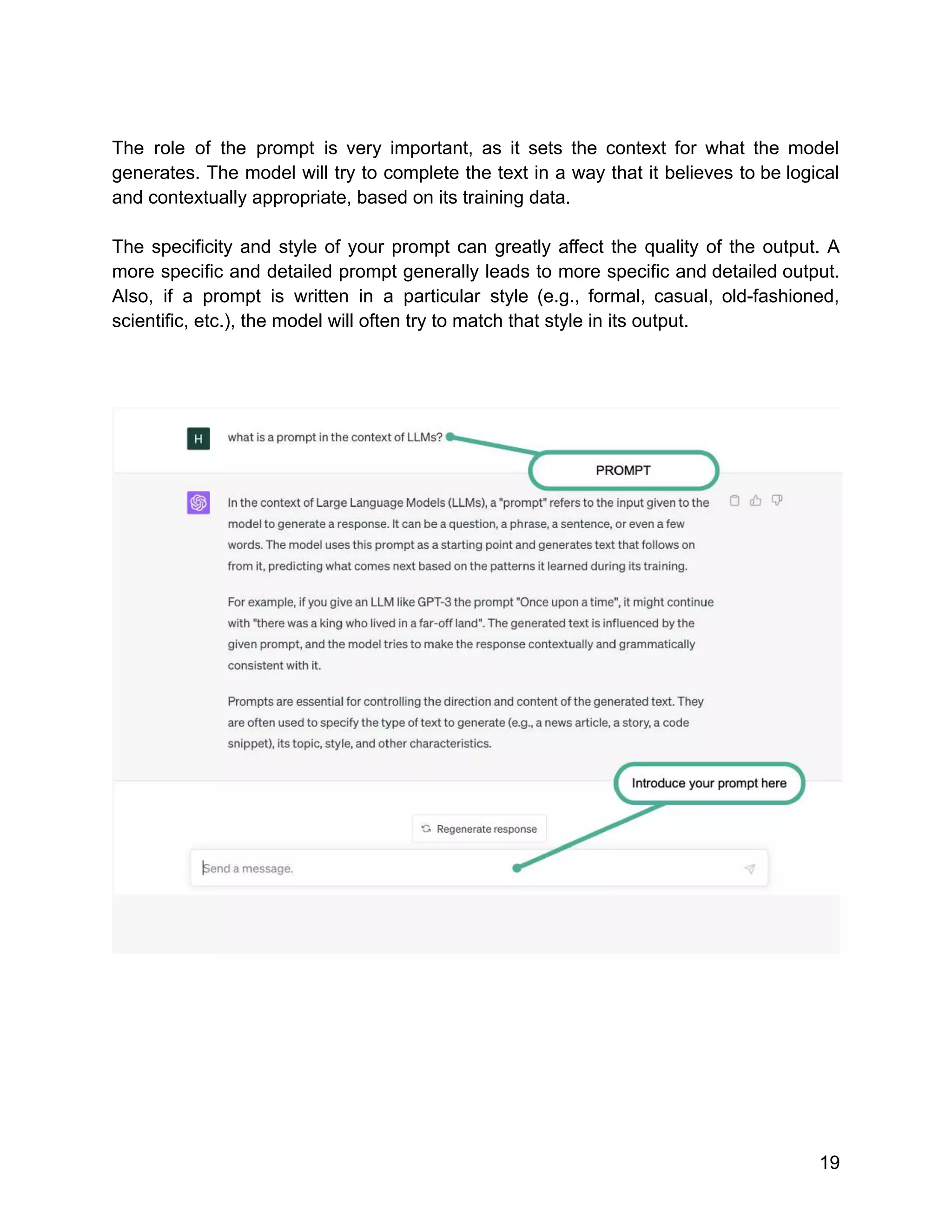
A prompt in the context of Generative AI models, including Large Language Models
(LLMs) like GPT, is the initial input that is given to the model to generate a response. It's
essentially the text or command that "prompts" the model to produce output.
For example, if you input "Tell me a joke" into the model, that's the prompt. The model
then uses this input, as well as its training on a massive dataset of text, to generate a
fitting output, like "Why don't scientists trust atoms? Because they make up everything!"
18
The role of the prompt is very important, as it sets the context for what the model
generates. The model will try to complete the text in a way that it believes to be logical
and contextually appropriate, based on its training data.
The specificity and style of your prompt can greatly affect the quality of the output. A
more specific and detailed prompt generally leads to more specific and detailed output.
Also, if a prompt is written in a particular style (e.g., formal, casual, old-fashioned,
scientific, etc.), the model will often try to match that style in its output.
19
Does the same prompt generate the same response?
Generally, the model is designed to introduce randomness and variation, which means
that when you provide the same prompt, it will generate different responses. However,
we will explore this further later on.
Does prompts help to retrain LLM models?
Usually prompts are not directly used to retrain Large Language Models (LLMs) like
GPT-3 or GPT-4. Retraining an LLM typically involves feeding it a large dataset of text,
such as books, articles, and websites, and having the model learn the statistical
patterns of that data.
The prompts you give to the model during interactive use (like asking it to write a poem
or answer a question) do not typically go back into the training data. However, they can
be used for something called "fine-tuning," which is a process that follows initial model
training; we will see that in more detail later.
In any scenario, there is a theoretical possibility of using prompts to retrain LLM models
(Prompt recycling). This can be achieved through parameter-efficient methods, allowing
the models to learn task-specific soft prompts that influence their behavior. However, the
decision of whether to utilize prompts or not depends on the model architecture and
their understanding of the model's nature and intended purpose. Ultimately, it is up to
the model architect to determine if incorporating prompts aligns with the desired
outcomes and objectives of the model.
As a result of the prompt recycling, these learned prompts are closely linked to a
specific static model, meaning that if the model gets updated, new prompts must also
be relearned, and that would be expensive, time consuming and difficult to manage.
What Prompt Engineering means
Overall, prompt engineering is about understanding how an AI model interprets and
responds to different kinds of input, and using that understanding to get the model to
generate the desired output.
We have seen that a prompt can be as simple as a question or a statement, or more
complex with context and framing. The goal of prompt engineering is to maximize the
effectiveness of the model in understanding the input and providing the desired
response more accurately.
20
For example, let's say we want the model to generate a story about a dog named Bella
who loves to chase squirrels.
A simple prompt might be:
"Tell me a story about a dog."
The AI could respond to this prompt with a story about any dog, doing any kind of
activity. It is a very open-ended prompt, and the response may not be what we intended.
Now, let's consider a more engineered prompt:
"Write a story about a playful dog named Bella who loves to chase squirrels in
the park."
This prompt is much more specific. It mentions the dog's name, her character trait
(playful), and her favorite activity (chasing squirrels in the park). This gives the AI more
to work with, and it's far more likely that the generated output will align with our
expectations.
Prompt engineering can involve various strategies, including:
● Adding more context or details to the prompt.
● Phrasing the prompt as a question or a command.
● Framing the prompt to guide the model's "tone" of response.
Supervised vs Unsupervised learning
Supervised Learning
Supervised learning is a machine learning approach where the model learns from
labeled training data. In supervised learning, the dataset used for training consists of
input data (features) along with corresponding output labels or target values. The goal
of supervised learning is to train a model that can make predictions or classify new,
unseen data accurately based on the patterns learned from the labeled training data.
Key characteristics of supervised learning:
21
1. Labeled Training Data: Supervised learning requires a dataset with labeled
examples, where each example includes both input features and the
corresponding correct output labels or target values.
2. Learning to Predict: The model is trained to learn the relationship between input
features and the target variable, enabling it to make predictions or classify new
instances accurately.
3. Evaluation with Test Data: The model's performance is evaluated using a
separate test dataset that contains labeled examples not seen during training.
This evaluation helps assess the model's generalization capabilities.
Unsupervised Learning
Unsupervised learning is a machine learning approach where the model learns from
unlabeled data without any explicit target variable or labels. The goal of unsupervised
learning is to discover underlying patterns, structures, or relationships in the data, often
in the form of clusters, dimensions, or representations, without any predefined notion of
what the output should be.
Key characteristics of unsupervised learning:
1. Unlabeled Training Data: Unsupervised learning uses unlabeled data, where only
input features are provided without corresponding output labels or target values.
2. Learning from Data Patterns: The model seeks to identify patterns, similarities, or
structures in the data without explicit guidance from labeled examples.
3. Exploration and Discoveries: Unsupervised learning allows for exploration,
discovering hidden insights, grouping similar data points, or dimensionality
reduction techniques to reveal important features.
Main Differences
1. Supervised learning requires labeled training data, while unsupervised learning
operates on unlabeled data.
2. Supervised learning focuses on learning the relationship between input features
and target labels to make predictions or classifications. Unsupervised learning
aims to discover patterns, structures, or relationships within the data.
3. In supervised learning, the model's performance can be evaluated and compared
using labeled test data, whereas unsupervised learning often relies on other
evaluation metrics like clustering quality or qualitative assessments.
22
It's important to note that there are also other learning paradigms, such as
semi-supervised learning, reinforcement learning, and more, each with its own
characteristics and use cases.
GPT
GPT stands for "Generative Pre-trained Transformer." It is a type of language model
that utilizes a deep learning architecture known as a Transformer. GPT models, such as
GPT-3 or GPT-4, are developed by OpenAI and have gained significant attention for
their ability to generate human-like text and perform a wide range of natural language
processing tasks.
The key feature of GPT models is that they are pre-trained on large amounts of text
data from the internet. This pre-training phase involves predicting the next word in a
sentence given the context of the previous words, which helps the model learn
grammar, syntax, and semantic patterns from the data. By training on such vast
quantities of text, GPT models acquire a broad understanding of language and develop
the ability to generate coherent and contextually relevant responses.
Once pre-training is completed, the models can be fine-tuned on specific tasks or
domains by providing them with additional training on more focused datasets. This
fine-tuning process allows GPT models to perform tasks like text completion, question
answering, text summarization, language translation, and much more.
As we pointed before, GPT based models have demonstrated impressive language
generation capabilities and are used in various applications, including chatbots, content
generation, virtual assistants, and language understanding tasks. Their ability to
generate coherent and contextually appropriate responses has made them valuable
tools in the field of natural language processing and AI-driven conversational systems.
Unimodal vs Multimodal
Unimodal
In simpler terms, unimodal refers to a system or approach that deals with just
one type of data or information. In the world of AI and machine learning, it means
working with and understanding data from a single source or modality. This could
23
be text, images, audio, or any other specific form of data. The focus is on
analyzing and processing data from that one particular source, without
considering other types of information.
Advantages of Unimodal Approaches:
● Simplified Processing: Unimodal approaches often involve simpler
processing pipelines since they deal with only one type of data, making it
easier to handle and analyze the information.
● Specialized Analysis: By focusing on a single modality, unimodal
approaches can employ specialized techniques tailored to the specific
characteristics and properties of that modality, potentially leading to more
accurate and efficient analysis.
Limitations of Unimodal Approaches:
● Limited Context: Unimodal approaches may miss out on rich contextual
information that can be derived from multiple modalities. For example,
analyzing an image without considering accompanying text may result in a
less comprehensive understanding.
● Incomplete Picture: When dealing with complex scenarios or tasks that
require a holistic understanding, unimodal approaches may provide an
incomplete picture since they are limited to a single modality.
Multimodal
Multimodal refers to a system or approach that incorporates and analyzes
multiple modalities or types of data. It involves processing and integrating
information from different sources, such as text, images, audio, etc.
Advantages of Multimodal Approaches:
1. Rich Contextual Understanding: Multimodal approaches leverage multiple
modalities to gain a more comprehensive understanding of the data,
capturing different perspectives and contextual cues. This can enhance
the accuracy and depth of analysis.
2. Cross-Modal Complementarity: Combining multiple modalities allows for
the fusion of complementary information. For example, combining text and
images in a multimodal model can enhance the understanding and
interpretation of visual content.
24
Limitations of Multimodal Approaches:
1. Increased Complexity: Multimodal approaches tend to be more complex
due to the need for integrating and processing multiple modalities. This
complexity can require more computational resources and sophisticated
algorithms.
2. Data Alignment Challenges: Integrating and aligning data from different
modalities can be challenging, especially when modalities have different
characteristics or formats. Ensuring synchronization and correspondence
between modalities can be a non-trivial task.
Overall, while unimodal approaches are simpler and can be effective for specific tasks
within a single modality, multimodal approaches have the advantage of capturing richer
contextual information and leveraging the complementary nature of different modalities.
Multimodal approaches are particularly useful in tasks such as image captioning, video
understanding, sentiment analysis, and human-computer interaction, where the
integration of multiple modalities leads to a more comprehensive and accurate analysis.
Dataset
In the context of generative AI, a dataset refers to a collection of information used to
train and evaluate the model. This information is typically composed of examples of the
kind of output the model is expected to generate.
For instance, if the goal is to create a language model like GPT, the dataset would
include a vast amount of text data. This could come from books, websites, or any other
written material. The model learns from this data, picking up patterns in sentence
structure, grammar, and word usage, which it then uses to generate new, similar text.
However, datasets aren't limited to text. For a generative AI model designed to create
images, the dataset would consist of a collection of images. For a music composition
model, it might be a library of melodies or musical scores.
It's important to remember that the quality and diversity of the dataset can significantly
impact the performance of the AI model. A well-curated dataset that represents a broad
range of examples will help create a more robust and versatile model. Conversely, a
25
dataset that's too narrow or biased can lead to a model that generates skewed or limited
output.
For a list of curated open source datasets that can be used for train your own machine
learning models take a look at: https://paperswithcode.com/datasets
Parameters
Refer to the internal variables or weights that the model learns during the training
process. Parameters are essential components of deep learning models, including
LLMs, as they determine the model's behavior and its ability to generate language.
LLMs, such as GPT-3, consist of multiple layers of neurons organized in a deep neural
network architecture. Each neuron in the network has associated parameters that
control its behavior and influence the model's overall output. These parameters are
learned through the training, where the model adjusts its internal weights based on the
input data and the desired output.
The number of parameters in an LLM is typically large, numbering in billions. The high
number of parameters enables the model to capture complex language patterns and
improve its ability to generate coherent and contextually appropriate responses.
During training, the parameters are updated using optimization algorithms like
stochastic gradient descent or its variants. The objective is to minimize a loss function
that measures the difference between the model's output and the desired output. By
iteratively adjusting the parameters based on the training data, the model gradually
improves its ability to generate high-quality text.
In summary, parameters represent the internal variables or weights that the model
learns during training. These parameters influence the model's behavior, language
generation capabilities, and its ability to understand and respond to input text.
26
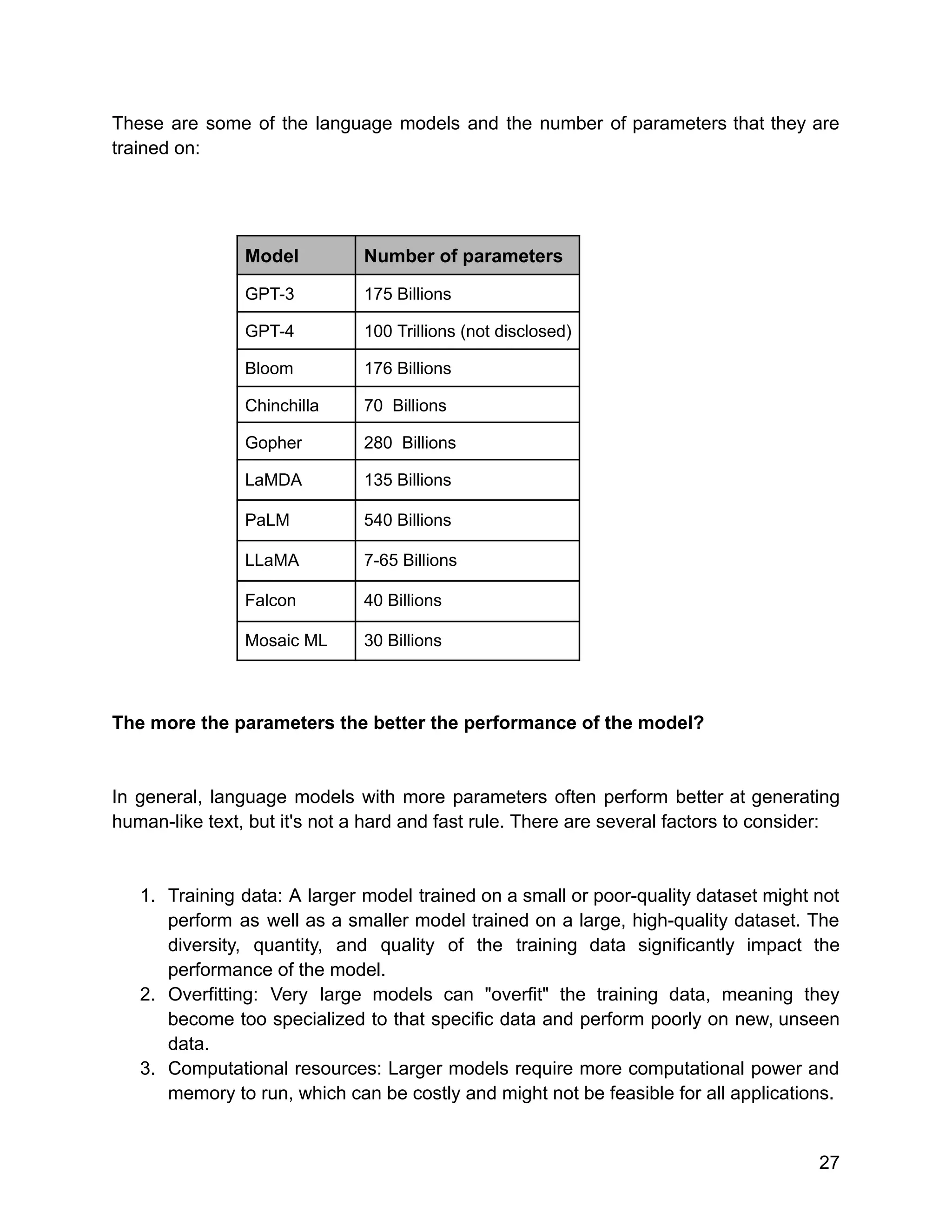
These are some of the language models and the number of parameters that they are
trained on:
Model Number of parameters
GPT-3 175 Billions
GPT-4 100 Trillions (not disclosed)
Bloom 176 Billions
Chinchilla 70 Billions
Gopher 280 Billions
LaMDA 135 Billions
PaLM 540 Billions
LLaMA 7-65 Billions
Falcon 40 Billions
Mosaic ML 30 Billions
The more the parameters the better the performance of the model?
In general, language models with more parameters often perform better at generating
human-like text, but it's not a hard and fast rule. There are several factors to consider:
1. Training data: A larger model trained on a small or poor-quality dataset might not
perform as well as a smaller model trained on a large, high-quality dataset. The
diversity, quantity, and quality of the training data significantly impact the
performance of the model.
2. Overfitting: Very large models can "overfit" the training data, meaning they
become too specialized to that specific data and perform poorly on new, unseen
data.
3. Computational resources: Larger models require more computational power and
memory to run, which can be costly and might not be feasible for all applications.
27
4. Diminishing returns: At some point, adding more parameters may result in only
minor improvements or even decrease the performance due to
over-parameterization.
5. Ethics and Safety: Larger models can be more challenging to control and may
generate inappropriate or harmful content, or exhibit biased behavior. Therefore,
careful testing and monitoring are required.
6. Fine-tuning and task-specific performance: Depending on the specific task,
fine-tuning a smaller model on a relevant, task-specific dataset might outperform
a larger, general-purpose model.
In a 2022 DeepMind's paper research they suggest that simply increasing the size of
language models is not necessarily the most effective or efficient way to improve their
performance. This contradicts the established approach put forth by OpenAI's Kaplan in
2020, which led to the creation of increasingly large models like GPT-3 and
Megatron-Turing NLG.
However, DeepMind argues that a critical aspect of scaling language models has been
overlooked - the quantity of training data. Their study ("Training Compute-Optimal Large
Language Models") posits that, given a fixed compute budget, it is just as important to
increase the number of training tokens (the amount of data the model is trained on) as it
is to increase model size.
DeepMind supports their theory with the results from their model, Chinchilla, which is
four times smaller than Gopher, but trained on four times more data. Despite its smaller
size, Chinchilla outperformed larger models, demonstrating that current large language
models are "significantly undertrained".
This research also suggests that smaller, more optimally trained models like Chinchilla
could be more accessible to smaller companies and institutions with limited resources,
extending the benefits of improved performance to a wider audience.
In short, while more parameters often lead to better performance in generating text, it's
just one aspect of building and deploying effective, safe, and efficient language models.
28
Compute
Compute refers to the computational resources required to train models. This includes
aspects such as processing power, memory, and storage, among others. The term is
often used to refer to the overall capacity of a system to perform complex calculations
that are necessary for training these models.
Key points:
● Processing Power: Training LLMs requires a significant amount of processing
power. This often means utilizing specialized hardware such as Graphics
Processing Units (GPUs) or Tensor Processing Units (TPUs) that are capable of
performing the numerous parallel calculations required for tasks such as matrix
multiplications which are common in machine learning models.
● Memory: LLMs often have a large number of parameters, and storing these
parameters during training requires a substantial amount of memory. In addition,
during training, additional memory is required to store intermediate values for
backpropagation.
● Storage: The data used to train LLMs can be quite large, requiring a significant
amount of storage. Furthermore, trained models also need to be stored.
● Energy Consumption: The extensive computation required to train LLMs leads
to significant energy consumption. This is a growing concern in the field of AI, as
the environmental impact of training large models can be substantial.
● Cost: All of the above factors contribute to the overall cost of computation. This
includes the cost of the hardware itself, as well as ongoing costs such as
electricity and cooling.
Given that compute budget is typically a constraining factor, pre-determined and
independent, the size of the model and the quantity of training tokens are unavoidably
dictated by the organization's financial ability to invest in superior hardware.
FLOPs
In the context of a generative AI model study, or comparison, when they refer to a "fixed
FLOPs budget", they mean that there's a limit to the total amount of computations
(measured in Floating Point Operations Per Second, or FLOPs) that can be performed
given the available resources. Balancing the size of the model and the number of
29
training tokens refers to optimizing how these limited resources are utilized to achieve
the best possible performance.
GPU
GPU stands for Graphics Processing Unit. While originally designed for rendering
images and videos in computer graphics applications, GPUs have found a significant
use case in the field of AI and machine learning. This is due to their ability to perform
parallel processing, that is, executing multiple computations simultaneously.
Deep learning and other machine learning algorithms involve a large number of matrix
and vector operations. These operations can be computed in parallel, which is where
GPUs come in handy due to their inherently parallel architecture. A GPU consists of
many cores (often hundreds or thousands) that can perform computations
simultaneously, making them highly efficient for the computational needs of AI
algorithms.
GPUs, therefore, enable faster processing of machine learning tasks compared to
traditional Central Processing Units (CPUs), which are designed to handle sequential
tasks. This is why GPUs are commonly used for training complex neural networks,
accelerating research, and reducing the time needed to obtain results.
Notable companies that manufacture GPUs include Nvidia, AMD, and more recently
Intel.
TPU
TPU stands for Tensor Processing Unit. It's a type of hardware developed by Google
specifically to accelerate machine learning workloads. They are designed to speed up
and scale up specific tasks, such as training neural networks, which are at the core of
modern AI and deep learning algorithms.
Unlike traditional processors (like CPUs) that handle a wide variety of tasks, TPUs are
application-specific integrated circuits (ASICs). This means they're custom-built to
execute specific types of calculations extremely efficiently. In the case of TPUs, these
calculations are tensor operations, which are a key part of many machine learning
algorithms. Hence the name, Tensor Processing Unit.
30
Google uses TPUs extensively in their data centers and also makes them available to
external developers through their Google Cloud services.
Tokens
A token is a unit of text that the model reads, processes, and generates. It can
represent a word, a character, or even a subword depending on how the model has
been trained.
Imagine that you are reading a book word by word. Each word you read could be
considered a token. Now, instead of reading, imagine you're writing a story word by
word. Each word you write could also be a token.
In language models, tokens are typically chunks of text. For example, in the sentence
"ChatGPT is awesome!", the model might see each word and the punctuation mark at
the end as separate tokens: ["ChatGPT", "is", "awesome", "!"].
These models are often trained and operate within a maximum token limit due to
computational constraints. For instance, GPT-3 works with a maximum of 2048 tokens.
This means the model can consider and generate text up to 2048 tokens long, which
includes the input and output tokens.
In terms of tokens, GPT-4 has two context lengths which decide the limits of tokens
used in a single API request. The GPT-4-8K window allows tokens up to 8,192 tokens,
and the GPT-4-32K window has a limit of up to 32,768 tokens (up to 50 pages) at one
time.
So, tokens are the building blocks that AI models use to understand and generate text.
GPT-3 and similar models actually use a tokenization strategy that splits text into
chunks that can be as small as one character or as large as one word. This approach is
based on a method called Byte-Pair Encoding (BPE), which helps manage the tradeoff
between having too many tokens (like a character-based approach) and too few tokens
(like a word-based approach).
Here's a simplified explanation: Let's say you're reading a book, and you come across
the word "unhappiness". Instead of treating "unhappiness" as a single token, the BPE
method might split it into smaller tokens like ["un", "happiness"] or even ["un", "happy",
"ness"], depending on what token divisions it has learned are most useful. This is
31
because the model has learned that "un-" is a common prefix and "-ness" is a common
suffix in English, and "happy" is a common word.
So, while individual characters can be tokens in GPT-3 and similar models, in practice,
most tokens represent subwords or whole words thanks to the BPE method. This
approach makes the model more efficient and flexible in handling a wide variety of
words and word parts.
Vocabulary
The term vocabulary refers to the set of unique tokens, or symbols that the model is
trained to recognize and use.
The vocabulary plays a crucial role in defining the expressive capability of the model.
The larger and more diverse the vocabulary, the more capable the model is in
understanding and generating diverse and rich language. However, having a larger
vocabulary also increases the complexity of the model and can require more resources
for training.
In other types of generative models, such as those used for generating images or
music, the concept of "vocabulary" might be interpreted differently, but the underlying
principle remains the same: it's about the set of unique elements that the model is
trained to recognize and generate.
Training
Training refers to the process of teaching a generative model to understand patterns in
data and generate new data that closely mimics the input data.
32
This process involves feeding the model a large dataset and allowing it to learn the
underlying structure and characteristics of this data. The model's goal is to understand
the distribution of data in the training dataset so that it can generate new samples from
the same distribution.
For example, in the case of a text-based generative AI model like GPT-4, the training
process involves feeding the model a large amount of text data. The model learns from
this data by trying to predict the next word in a sentence given the previous words. Over
time, the model improves its ability to generate text that is syntactically and semantically
similar to the input data it was trained on.
In general, the quality of a generative AI model's output heavily depends on the quality
and quantity of the training data it has been provided. More diverse and representative
training data typically leads to a model that can generate more realistic and varied
output.
While GPT-4 was trained on a 45GB data corpus and GPT-3 on 17GB, there are other
LLMs demonstrating that more training data doesn't necessarily translate to higher
quality. It may be that focusing on fine-tuning the model is more important than the
volumes of data used in training.
Fine-tuning
Fine-tuning is the process that comes after the initial training of the AI model on a large
dataset. Fine-tuning is performed to adapt the general capabilities of the model to more
specific tasks or to adjust the model's behavior according to specific criteria, and is one
of the most important processes in generative AI.
To understand this, imagine the general training process as teaching a student a broad
range of topics in school. This is like training an AI model on a large dataset, where it
learns a lot about language, facts, reasoning, etc.
However, once this general education is over, the student might decide to specialize in a
particular field, like medicine or law. To do so, they would need to go to medical school
or law school, where they will 'fine-tune' their knowledge and skills to excel in these
specific fields.
Similarly, after a generative AI model has been trained on a large dataset, it can be
fine-tuned on a smaller, more specific dataset. For instance, if we wanted the model to
generate medical advice, we might fine-tune it on a dataset of medical textbooks. If we
33
wanted the model to generate legal documents, we might fine-tune it on a dataset of
legal texts.
Fine-tuning is also used to align the AI's behavior with societal norms and ethical
considerations. For example, fine-tuning can help prevent the model from generating
inappropriate or harmful content. In this sense, fine-tuning serves as a way of instilling
certain values or guidelines in the AI system.
Does fine-tune require retraining the entire model?
No, there's no need to retrain the entire model. Fine-tuning involves utilizing the
pretrained weights from the general model and further training it with your specific data.
This approach usually focuses on training only the models responsible for the specific
task at hand, such as classification, rather than training the entire data representation
model. These task-specific models, often consisting of just a few densely connected
layers, can be trained much more efficiently compared to the representation model. By
fine-tuning in this manner, you can achieve desired performance without the need for
extensive and costly training of the entire model from scratch.
If the model is re-trained do you have to fine tune again?
If a generative AI model undergoes retraining, fine-tuning is typically necessary.
Similarly, when transitioning from one model version to another, like moving from GPT-3
to GPT-4 or a newer version, fine-tuning becomes necessary. For instance, if you have
fine-tuned the GPT-3 model using your proprietary data to align with your business
needs, and later decide to upgrade to GPT-4 or a more recent version, you would need
to go through the fine-tuning process again. This ensures that the model is adjusted and
refined based on the updated architecture and characteristics of the new version,
allowing it to continue generating outputs that meet your specific requirements.
Overfitting and Underfitting
Overfitting occurs when a model learns the training data too well and performs poorly on
new, unseen data. Underfitting occurs when the model fails to learn the underlying
patterns in the data. Both overfitting and underfitting are common problems that we
need to take care of when training generative models.
34
Mode Collapse
This is a specific problem in Generative Adversarial Networks (GANs), GANs can face
an issue known as "mode collapse," where the generator starts to produce only a
limited variety of samples, or even the same sample repeatedly, regardless of the
changes in the input noise vector. The input noise vector is the random seed used to
generate new data instances.
Imagine you're playing a game of 'pretend' with your friend. You're the one coming up
with stories (like the generator in our model), and your friend is guessing whether your
story is made up or real (like the discriminator).
Now, suppose you found a particular story that your friend always believes. So, you
keep repeating that story or just changing a tiny bit each time. This would be similar to
what happens in GANs "mode collapse". The 'story maker' part of the model finds a
'story' that the 'story guesser' always believes, so it keeps telling that one over and over.
This is a problem because we want our 'story maker' to come up with lots of different
and exciting stories, not just keep repeating the same one!.
This is problematic because it means the GAN is not effectively learning the full
complexity and diversity of the original data. Instead, it's taking the easy route by
repeatedly generating instances that have fooled the discriminator before. This results
in less useful outputs and limits the ability of the GAN to generate novel, diverse data
instances, which is one of the primary goals of a GAN in the first place.
Avoiding mode collapse is one of the challenges in training GANs and researchers are
constantly seeking new methods and techniques to mitigate this issue and improve the
diversity and quality of the generated data.
Bias
Bias in the context of generative AI refers to the tendency of these models to lean
35
towards specific types of output or predictions. This bias often results from the data that
the model was trained on.
For example, if a language model has been trained on a large amount of English
literature, it might be more likely to generate text in a similar style or use certain phrases
that are common in that literature. This is a type of bias because the model is favoring a
specific kind of output.
However, bias can also emerge in more problematic ways. If the training data includes
discriminatory language or stereotypes, the model can learn and replicate these biases.
For instance, it might associate certain jobs or roles with a specific gender or make
assumptions based on race. These are harmful biases that AI researchers work hard to
mitigate.
There are also different types of biases in generative AI models. Some of these are:
● Data Bias: This refers to biases that arise from the training data itself. If the
training data is not diverse or representative enough, the model may learn and
perpetuate biases present in the data.
● Algorithmic Bias: This occurs when biases are introduced during the design or
implementation of the generative AI algorithm. It can result from the choice of
model architecture, training methods, or objective functions.
● Cultural Bias: Cultural biases can emerge in generative AI models, reflecting
societal norms, stereotypes, or prejudices that are present in the training data or
the broader cultural context.
● Contextual Bias: Contextual biases arise when generative AI models generate
outputs that are biased based on the context in which they are used. The model
may produce different responses or outcomes depending on factors such as user
demographics, location, or other contextual information.
● Personalization Bias: Personalization bias occurs when generative AI models
tailor their outputs to specific individuals or user groups, potentially reinforcing
existing beliefs or preferences and limiting exposure to diverse perspectives.
Some of the approaches and techniques for bias detection includes:
● Pre-training Evaluation: Before fine-tuning or deploying a generative AI model,
an evaluation can be conducted to assess the model's potential biases. This
involves analyzing the model's outputs on a range of test inputs to identify any
patterns of bias.
36
● Corpus Analysis: Analyzing the training data corpus can help detect potential
biases in the input data. This involves examining the distribution of attributes
such as gender, race, or other sensitive attributes in the training data and
assessing if any biases are present.
● Counterfactual Evaluation: Counterfactual evaluation involves modifying the
input data to create counterfactual scenarios and evaluating how the model
responds. By comparing the model's outputs in different scenarios, biases can be
identified.
● User Feedback: Collecting feedback from diverse users can provide valuable
insights into potential biases in generative AI models. User feedback can help
identify instances where the model's outputs may exhibit biases or unfairness.
● Bias Metrics and Indicators: Developing metrics and indicators specifically
designed to measure bias in generative AI outputs can be an effective approach.
These metrics can quantify various forms of biases, allowing for more objective
evaluation and comparison across different models.
It's important to note that bias detection should be an ongoing and iterative process.
Regular monitoring, feedback collection, and continuous evaluation are essential to
identify and address biases.
Toxicity
Toxicity generally refers to the harmful, offensive, or inappropriate content that an AI
might generate.
Let's take an example. If you and your friends are playing a game where you create
sentences or stories, you would expect everyone to say things that are kind and
respectful. Now, imagine one of your friends starts saying mean, rude, or inappropriate
things. That wouldn't be nice, right? That's what we call 'toxicity' in real life.
In a similar way, generative AI systems are like your friends in the game. They can
generate sentences or stories based on what they've learned. However, if an AI system
has learned from information that includes mean, rude, or inappropriate language, it
might end up using that kind of language in its output. That's what we call 'toxicity' in the
context of AI.
Just like we teach people to be nice and respectful, we should also teach AI systems
the same. This way, they won't produce any toxic or harmful content.
37
Dealing with toxicity in generative AI models is a complex task and the models are not
perfect. The goal is to make them as safe and useful as possible, while avoiding
generating harmful or inappropriate content.
How typically a generative AI model deals with toxicity?
Through a process that involves training, fine-tuning, and post-generation filtering.
We have previously gone through the fine-tuning process and how this process works
for bias, the same principles for fine-tuning apply, to at some degree, avoid toxic content
generation.
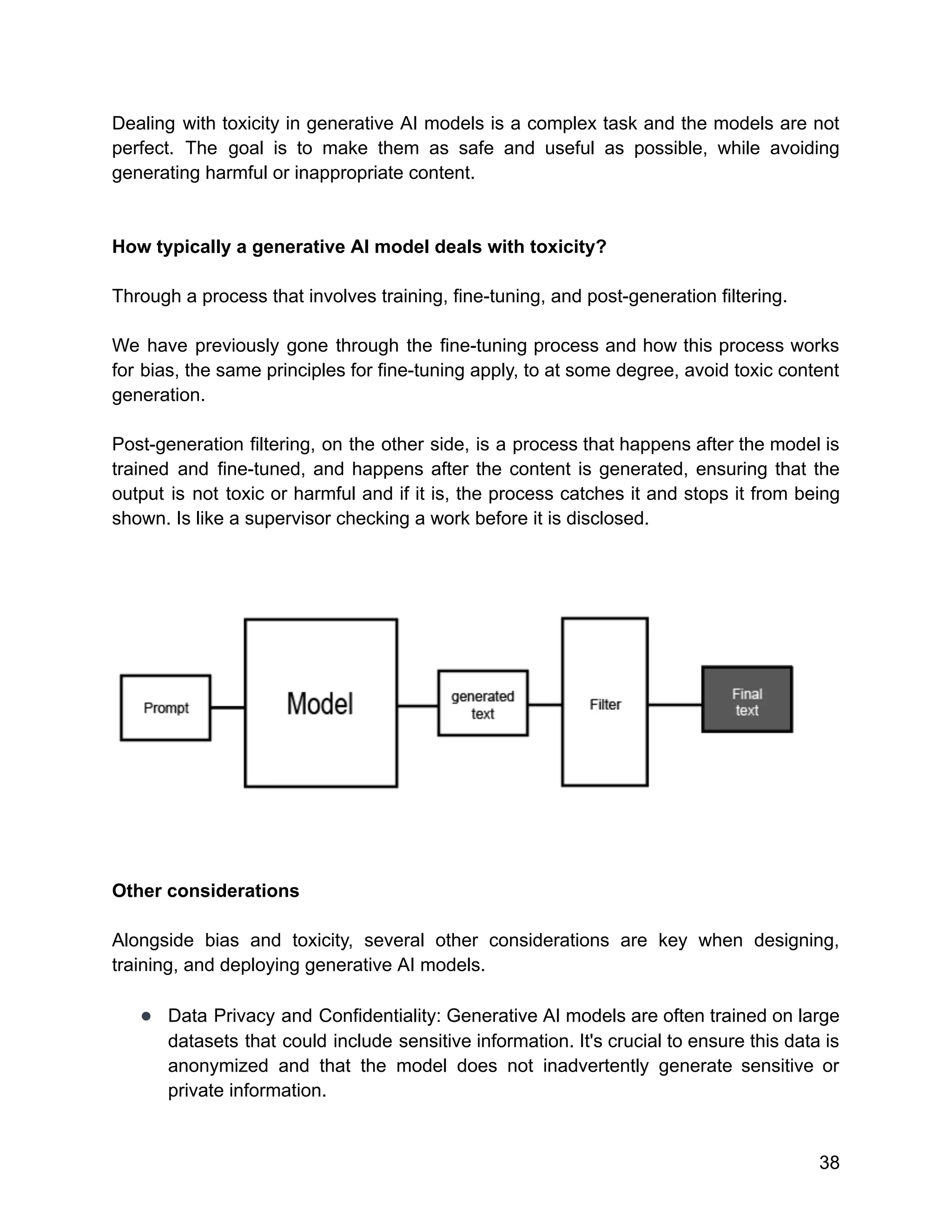
Post-generation filtering, on the other side, is a process that happens after the model is
trained and fine-tuned, and happens after the content is generated, ensuring that the
output is not toxic or harmful and if it is, the process catches it and stops it from being
shown. Is like a supervisor checking a work before it is disclosed.
Other considerations
Alongside bias and toxicity, several other considerations are key when designing,
training, and deploying generative AI models.
● Data Privacy and Confidentiality: Generative AI models are often trained on large
datasets that could include sensitive information. It's crucial to ensure this data is
anonymized and that the model does not inadvertently generate sensitive or
private information.
38
● Interpretability and Transparency: It's important for users (and the developers
themselves) to understand why an AI model makes the decisions it does. This
helps build trust in the model and allows for more effective troubleshooting.
● Robustness and Generalization: The AI should be able to handle a wide range of
inputs and scenarios, including those it may not have encountered during
training. It should also be resilient to attempts at tricking or misleading it.
● Fairness: The model should treat all individuals and groups fairly. It should not
favor one group over another based on characteristics such as race, gender,
age, etc.
● Factual Accuracy: The information generated by the model should be as
accurate as possible. Misinformation can lead to confusion or harm.
● Control and Customization: Users should be able to easily control the behavior of
the AI and customize it to their needs and preferences.
● Safeguard Measures: The model should have safeguards against generating
inappropriate or harmful content, even if a user tries to prompt it to do so.
● Accountability: There should be mechanisms in place for holding the AI and its
developers accountable for the outcomes it produces.
Hallucinations
Refers to a situation where the AI model generates information or details that are not
present or suggested in the input data. In other words, the AI is creating or "imagining"
content that isn't grounded in its training data or the prompt given.
For instance, if you were to give a generative AI a sentence to complete, like "The cat
sat on the...", it might continue with "...blue mat". If the color of the mat was not
specified in the initial input or the training data, the AI model is "hallucinating" the color
blue.
While this capacity can sometimes be beneficial for creative tasks, it can also be a
downside if the model starts producing false or misleading information, which is a
challenge when striving for accurate and reliable AI-generated content. Dealing with
hallucinations is an active area of research and development.
Here are a few approaches that are commonly used to address hallucinations:
● Train the model with more data to improve their accuracy and reduce the
likelihood of hallucinations.
39
● Fine-tuning and Data Filtering: Fine-tuning the generative AI model with
specific data and applying data filtering techniques can help reduce
hallucinations. By training the model on curated and high-quality data, the
likelihood of generating false or misleading information can be minimized.
● Confidence Scoring: Assigning confidence scores to the generated outputs can
help identify and filter out hallucinations. The model can be designed to generate
outputs with varying levels of confidence, and only outputs with high confidence
scores can be considered reliable.
● Post-processing and Filtering Mechanisms: Implementing post-processing
techniques, such as rule-based filters or language constraints, can help identify
and filter out hallucinatory outputs. These mechanisms can be designed to reject
or modify outputs that deviate too far from factual or plausible information.
● Human-in-the-Loop Validation: Incorporating human validation or review
processes can be an effective way to identify and eliminate hallucinations.
Human reviewers can verify the accuracy and reliability of the generated outputs,
ensuring that hallucinatory content is not propagated.
● Adversarial Training: Adversarial training involves exposing the generative AI
model to perturbed or manipulated inputs to improve its resilience against
generating hallucinations. By training the model to resist generating misleading
or false information, hallucinations can be reduced.
Attention or self-attention
In models like Transformers and GPT, attention is a mechanism that determines how
the model should focus on different parts of the input data when generating an output. It
helps the model to prioritize certain aspects of the input when deciding what to generate
next.
In a nutshell, the attention mechanism allows the model to "pay attention" to relevant
information and "ignore" less important information. This is especially useful in tasks like
text generation, where the meaning of a word often depends on its context.
Here's a simplified explanation:
Let's say you're telling a story, and you mention a cat early on. Later, you say, "She was
very playful." Even though you haven't said the word "cat" in a while, you understand
that "she" probably refers to the cat. An attention mechanism helps the AI model
40
understand these kinds of connections in a similar way. It helps the model "pay
attention" to the important parts of the story, even if they happened a while ago.
In more technical terms, attention in these models calculates a weight for each input
token based on its relevance for predicting the next token. The tokens that are deemed
more important get higher attention scores. These scores are used to create a weighted
sum that is used in predicting the next token in the sequence.
Inference
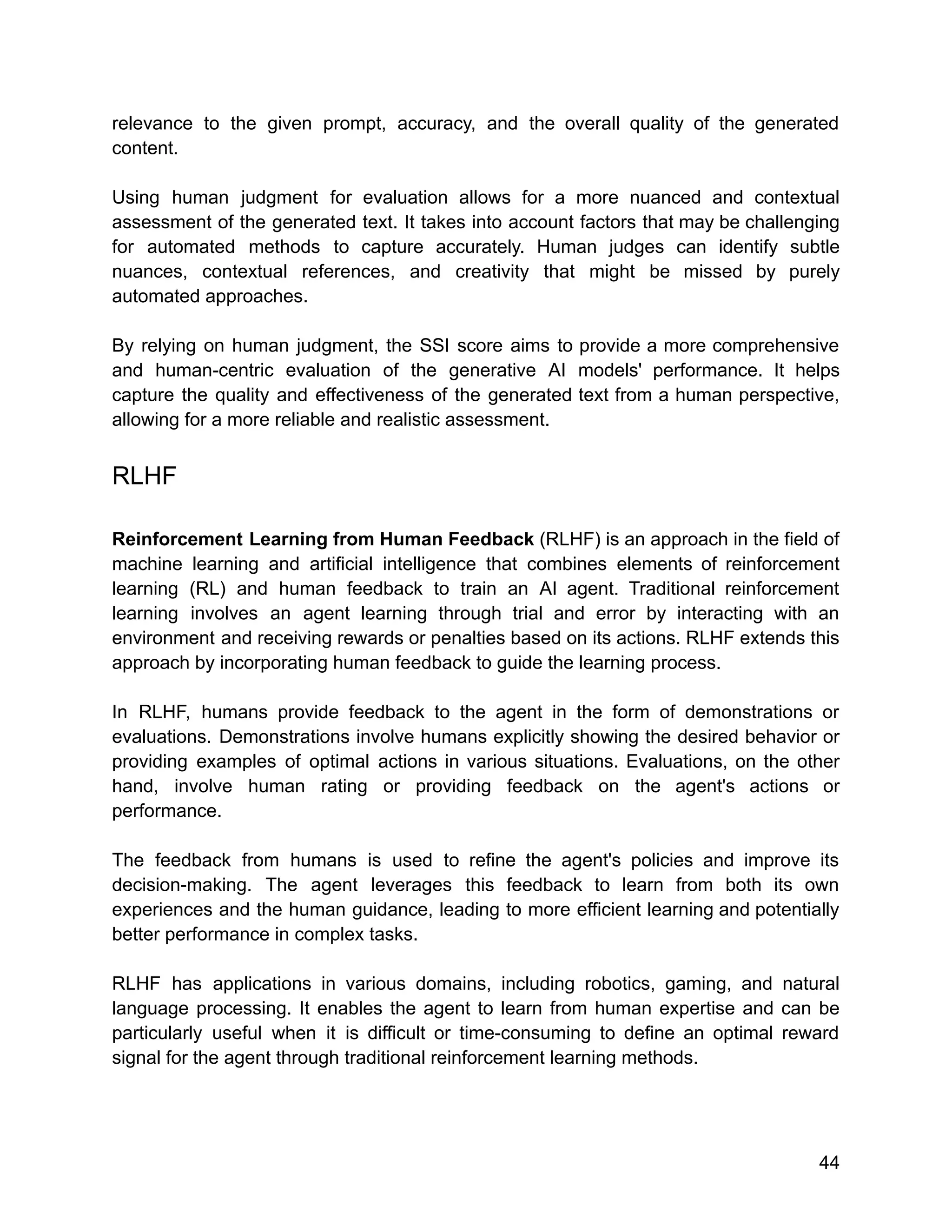
Refers to the process by which the trained AI model generates output given some input.
Let's say you've trained a language model on a huge amount of text data. After this
training phase, the model has learned the structure, patterns, and semantics of the
language. Now, when you provide a new input to this model (like the start of a
sentence), the model will use its learned knowledge to generate or 'infer' the next part of
the sentence, thus creating new text that wasn't in its original training data but is similar
in style and coherence.
So, in simple terms, inference is the stage where the AI model applies what it has
learned during training to new data. In the case of a generative AI model, it's creating
new output that's similar to its training data.
41
Imagine if you've been reading a lot of books about dinosaurs. You've learned what they
look like, what they eat, where they lived, and so on. This is like the training part for an
AI.
Now, let's say your friend asks you to draw a picture of a dinosaur or tell a story about a
dinosaur. You'll use all the knowledge you learned from the books to draw the picture or
tell the story. This is like the inference part for an AI.
Just like you use what you learned from the dinosaur books to draw a picture or tell a
story, an AI uses what it learned from its training data to generate new outputs.
Randomness and Variation
Randomness and variation refer to the fact that AI models don't always produce the
exact same output for the same input. Instead, they introduce some level of
randomness to generate varied responses.
For instance, think about a game of "I Spy" where you need to find something green.
There could be many green items around you – a tree, a toy dinosaur, a leaf, a drawing.
So, each time you play the game, you could "spy" something different even though the
clue "something green" is the same.
Similarly, if you ask an AI model a question, it might not always give the exact same
answer each time, even though the question is the same. This is because of the
randomness and variation built into it. It's like the AI is playing its own kind of "I Spy"
game with the information it knows, and it can pick a different "green thing" each time,
so to speak. This makes the AI model more interesting, flexible and creative, but also
more unpredictable.
This characteristic can also lead to occasional mistakes. Fundamentally, the models
can't distinguish between what's correct and what's not. They aim to provide answers
that appear reasonable and in line with the data they've learned from.
42
So, for instance, a model might not always select the most probable next word, but
rather the second or third most probable one. If this is overdone, the responses can
become nonsensical, which is why Large Language Models (LLMs) constantly evaluate
and adjust themselves. The response a chatbot gives is partly influenced by the input it
receives, which is why you can request these models to simplify or complicate their
answers.
SSI score
The Sensibility, Specificity, and Interestingness (SSI) score is a measure used to
evaluate the quality and performance of a text generation model, particularly in the
context of natural language generation.
Sensibility refers to the degree to which the generated text makes sense and is
grammatically correct. It assesses whether the output is coherent and aligns with the
given context or prompt.
Specificity measures the extent to which the generated text accurately addresses or
focuses on the intended topic or information. It evaluates whether the model stays
on-topic and provides relevant details.
Interestingness gauges the level of novelty, creativity, or engagement in the generated
text. It determines whether the output is unique, engaging, or adds value beyond a
simple factual representation.
The SSI score combines these three aspects to provide an overall assessment of the
quality and effectiveness of the generated text. By considering sensibility, specificity,
and interestingness, the SSI score aims to capture a holistic view of the generated
content and its relevance to the given task or context.
The SSI score is a human-judged metric, which means that human evaluators or judges
are involved in assessing and assigning the scores. Instead of relying solely on
automated or algorithmic methods, the evaluation of the generated text is done by
humans who have the ability to understand and interpret the nuances of language.
Human judges are typically provided with specific guidelines or criteria to evaluate the
sensibility, specificity, and interestingness of the generated text. They read and analyze
the outputs generated by the model and assign scores based on their subjective
judgment and expertise. The judges consider factors such as grammar, coherence,
43
relevance to the given prompt, accuracy, and the overall quality of the generated
content.
Using human judgment for evaluation allows for a more nuanced and contextual
assessment of the generated text. It takes into account factors that may be challenging
for automated methods to capture accurately. Human judges can identify subtle
nuances, contextual references, and creativity that might be missed by purely
automated approaches.
By relying on human judgment, the SSI score aims to provide a more comprehensive
and human-centric evaluation of the generative AI models' performance. It helps
capture the quality and effectiveness of the generated text from a human perspective,
allowing for a more reliable and realistic assessment.
RLHF
Reinforcement Learning from Human Feedback (RLHF) is an approach in the field of
machine learning and artificial intelligence that combines elements of reinforcement
learning (RL) and human feedback to train an AI agent. Traditional reinforcement
learning involves an agent learning through trial and error by interacting with an
environment and receiving rewards or penalties based on its actions. RLHF extends this
approach by incorporating human feedback to guide the learning process.
In RLHF, humans provide feedback to the agent in the form of demonstrations or
evaluations. Demonstrations involve humans explicitly showing the desired behavior or
providing examples of optimal actions in various situations. Evaluations, on the other
hand, involve human rating or providing feedback on the agent's actions or
performance.
The feedback from humans is used to refine the agent's policies and improve its
decision-making. The agent leverages this feedback to learn from both its own
experiences and the human guidance, leading to more efficient learning and potentially
better performance in complex tasks.
RLHF has applications in various domains, including robotics, gaming, and natural
language processing. It enables the agent to learn from human expertise and can be
particularly useful when it is difficult or time-consuming to define an optimal reward
signal for the agent through traditional reinforcement learning methods.
44
One significant hurdle in RLHF is the scalability and expense associated with obtaining
human feedback. Compared to unsupervised learning, acquiring human feedback can
be a time-consuming and costly process. Moreover, the quality and consistency of
human feedback may vary depending on factors such as the task, interface, and
individual preferences of the humans involved. Despite the feasibility of obtaining
human feedback, RLHF models may still exhibit undesired behaviors that escape
human feedback or take advantage of loopholes in the reward system. This highlights
the challenges of ensuring alignment with desired objectives and maintaining
robustness in RLHF approaches.
Memorization
Memorization refers to the model's ability to retain and reproduce specific pieces of
information from the data it was trained on.
For example, if an LLM was trained on a dataset that includes the sentence "Paris is the
capital of France," the model might "memorize" this fact. Then, when asked "What is the
capital of France?" The model can provide the correct answer because it "remembers"
this information from its training data.
However, it's important to clarify that this kind of "memorization" isn't the same as
human memory. The model doesn't actually understand or consciously remember
information like a human would. Instead, it learns patterns in the data during training
and uses those patterns to generate responses.
The problem arises when models memorize sensitive information, like personal details
in the data they were trained on. This can be a privacy concern, as the model could
potentially reproduce that sensitive information in its responses.
Minimizing memorization in large language models (LLMs) is a challenging but crucial
aspect of their development, especially considering privacy concerns.
Here are some techniques that can be used:
● Differential Privacy: This method introduces random noise into the training
process, making it harder for the model to learn specifics about the individual
data instances.
45
● Data Sanitization: Before training, the data can be sanitized to remove sensitive
information. This could be anything from personally identifiable information (PII)
to proprietary details.
● Frequentist or Bayesian Regularization: These methods control the complexity
of the model and prevent it from learning the training data too well, hence
reducing overfitting and memorization.
● Distillation: This is a process where a smaller model (student) is trained to
reproduce the behavior of a larger model (teacher). The student model is less
capable of memorization due to its smaller size.
● Use of Synthetic or Augmented Data: By using synthetic or augmented data,
the risk of the model memorizing sensitive real-world data is minimized.
Remember, these methods have their own trade-offs and may not completely eliminate
the risk of memorization. They should be used in combination, along with careful testing
and monitoring.
Layers
Refers to the architecture of neural networks.
Neural networks are inspired by the human brain and are made up of interconnected
nodes, or "neurons," which are organized into layers. These layers can be broken down
into three main types:
Input Layer: This is the first layer of the network where data (like text, images, or
sound) enters the system.
Hidden Layer(s): These are the layers between the input and output layers. The
term "deep" in deep learning refers to the presence of multiple hidden layers in a
neural network. Each hidden layer is responsible for learning and extracting
different features from the data.
Output Layer: This is the final layer where the network provides its prediction or
classification based on the input data and the learned features.
46
In generative AI models like GPT (Generative Pretrained Transformer), there are
multiple layers of transformers, and each layer helps in understanding the context of
data, creating representations, and generating outputs.
47
48
Most representative LLM Models
OpenAI
GPT-1
Introduced by OpenAI in 2018, GPT-1, is the first iteration of the Generative Pre-trained
Transformer (GPT) model
GPT-1 was primarily trained in an unsupervised manner, for language modeling tasks.
As we said before, it was trained on a large corpus of internet text, learning to predict
the next word in a sequence of words given the preceding context. This training enabled
GPT-1 to develop an understanding of grammar, syntax, and semantic relationships in
natural language. His 117 million parameters contributed to its ability to capture complex
language patterns and generate coherent text responses.
Excelled in understanding and generating text in context. It could take into account the
preceding words or tokens to generate appropriate and contextually relevant responses.
Along with that, was delivered allowing it to be fine-tuned on specific downstream tasks
with smaller, task-specific datasets. This made it adaptable to a range of natural
language processing tasks, such as text completion, summarization, and question
answering.
While subsequent iterations of GPT models have introduced significant advancements,
GPT-1 laid the foundation for the success and development of subsequent models in
the GPT series.
GPT-2
GPT-2, the successor to GPT-1, introduced several notable features and improvements
over its predecessor.
GPT-2 was significantly larger than GPT-1, with 1.5 billion parameters compared to
GPT-1's 117 million parameters. This increase in size enhanced the model's capacity to
capture more complex language patterns and generate more coherent and contextually
appropriate responses.
49
Demonstrated improved language generation capabilities. It produced text that was
more coherent and exhibited a higher level of understanding compared to GPT-1. Also
introduced the concept of "prompts," allowing users to provide an initial input to guide
the generated text towards a specific topic or style. This feature provided more control
and customization options for generating desired outputs.
Showcased the ability to perform zero-shot and few-shot learning. This means that the
model was able to generate reasonable responses for tasks it was not specifically
trained on, as well as adapt to new tasks with minimal examples or instructions. At the
same time, In this new version of the GPT series, OpenAI, incorporated a modified
training approach that included more diverse and higher-quality data. This resulted in
the model being exposed to a broader range of linguistic patterns and improved its
language understanding capabilities.
GPT-2's release garnered significant attention due to concerns about potential misuse
of the model for generating fake news or malicious content. As a result, OpenAI initially
limited the release of the full model and instead released a smaller version.
GPT-3
After GPT-2, it was the subsequent version, GPT-3, that truly propelled the excitement
and widespread adoption of generative AI to new heights.
GPT-3 set a new benchmark in terms of model size, with a staggering 175 billion
parameters, making it significantly larger than GPT-2's 1.5 billion parameters. This
increase in model size allowed GPT-3 to capture even more complex language patterns
and exhibit a higher level of language understanding. Exhibited remarkable
advancements in language generation, demonstrating a higher level of coherence,
context sensitivity, and the ability to generate more human-like text compared to the
previous versions.
Showed an improved understanding of context, allowing it to generate more accurate
and relevant responses based on given inputs (prompts), and outperformed the ability
to maintain coherent and consistent conversations over longer interactions.
GPT-3 is available in various model sizes, ranging from few-shot models to much larger
models with billions of parameters. This allows users to choose the model size based
on specific requirements, balancing trade-offs between computational resources and
50
performance. These models are available to choose from OpenAI’s API, while chatGPT
uses the most powerful model, davinci, by default.
Model Description Max tokens Training data
text-curie-001 Very capable, faster and lower cost
than Davinci.
2049 tokens Up to Oct 2019
text-baggage-001 Capable of straightforward tasks, very
fast, and lower cost.
text-ada-001 Capable of very simple tasks, usually
the fastest model in the GPT-3 series,
and lowest cost.
davinci Most capable GPT-3 model. Can do
any task the other models can do,
often with higher quality.
curie Very capable, but faster and lower cost
than Davinci
babbage Capable of straightforward tasks, very
fast, and lower cost
ada Capable of very simple tasks, usually
the fastest model in the GPT-3 series,
and lowest cost
*Source OpenAI’s documentation
Despite its impressive capabilities, GPT-3 still struggles with certain types of reasoning,
such as understanding nuanced or commonsense-based questions and could
occasionally provide incorrect or nonsensical responses, highlighting some of the
limitations of large-scale language models.
GPT-3 has represented a significant leap forward in terms of model size, language
generation quality, and versatility. Its massive scale and improved language
understanding made it a powerful tool for a wide range of natural language processing
tasks, further demonstrating the potential of large-scale language models.
51
GPT-3.5
Introduced in March 2022, takes a step beyond GPT-3, embodying more advancements
to closely mimic human cognition and comprehend human emotions. One of its key
enhancements is its capability to curtail toxic output, an issue previously associated with
GPT-3.
GPT-3.5 features Reinforcement Learning with Human Feedback (RLHF) during the
fine-tuning phase of large models, making it more adept at sentiment analysis. The
RLHF technique utilizes human responses to guide the machine's learning and growth
process during its training. The primary aim of RLHF is to infuse knowledge into the
models, enabling more precise expertise, sentiment-analyzed output, and multitasking
capabilities. The renowned ChatGPT, rolled out in November 2022, relied on the
fine-tuning of GPT-3.5 to execute numerous tasks concurrently with high accuracy.
GPT-3.5 available models
Model Description Max tokens Training data
gpt-3.5-turbo Most capable GPT-3.5 model and
optimized for chat at 1/10th the cost of
text-davinci-003. Will be updated with
our latest model iteration.
4097 tokens Up to June 2021
gpt-3.5-turbo-0301 Snapshot of gpt-3.5-turbo from March
1st 2023. Unlike gpt-3.5-turbo, this
model will not receive updates, and will
be deprecated 3 months after a new
version is released
text-davinci-003 Can do any language task with better
quality, longer output, and consistent
instruction-following than the curie,
babbage, or ada models. Also supports
inserting completions within text.
text-davinci-002 Similar capabilities to text-davinci-003
but trained with supervised fine-tuning
instead of reinforcement learning
code-davinci-002 Optimized for code-completion tasks
*Source OpenAI’s documentation
52
GPT-4
GPT-4 is substantially larger than GPT-3 and GPT-3.5, with a higher number of
parameters. This makes it possible for GPT-4 to process and create content that is
more accurate and rich in context. GPT-4 has 45 gigabytes of training data as opposed
to GPT-3’s 17 gigabytes, and therefore provides results that are substantially more
accurate than GPT-3.
Another difference between the two is that GPT-3 is unimodal, meaning it can only
accept text inputs. It can process and generate various text forms, such as formal and
informal language, but can’t handle images or other data types. GPT-4, on the other
hand, is multimodal. It can accept and produce text and image inputs and outputs,
making it much more diverse.
GPT-4 exhibits human-level performance on various professional and academic
benchmarks. It has passed a simulated bar exam with a score around the top 10% of
test takers. GPT-4 also exhibited consistent performance across all subspecialties, with
accuracy rates ranging from 63.6% to 83.3%.
While the disparity between GPT-4 and GPT-3.5 models may not be substantial for
simpler tasks, the true differentiating factor emerges in more intricate reasoning
scenarios. GPT-4 exhibits significantly enhanced capabilities compared to all prior
OpenAI’s models, enabling more sophisticated and advanced problem-solving.
In a nutshell, GPT-4:
● Is capable of accepting both visual and textual inputs to produce textual output.
● Is focused on truthfulness, GPT-4 strives to mitigate misinformation and deliver
texts rooted in facts.
● Displays an impressive ability to adapt, GPT-4 can tailor its operation according
to user instructions via prompts.
● To ensure its credibility and prevent unethical commands, GPT-4 is designed to
stay within set boundaries, resisting any attempts to overstep.
● Serving as a language virtuoso, GPT-4 proficiently communicates in 25
languages, including Mandarin, Polish, and Swahili, and maintains an 85%
accuracy rate in English.
● GPT-4 is capable of handling extended pieces of text, thanks to its ability to
manage greater context lengths.
53
GPT-4 available models
Model Description Max tokens Training data
gpt-4 More capable than any GPT-3.5 model, able
to do more complex tasks, and optimized for
chat. Will be updated with our latest model
iteration
8192 tokens
Up to June 2021
gpt-4-0314 Snapshot of gpt-4 from March 14th 2023.
Unlike gpt-4, this model will not receive
updates, and will be deprecated 3 months
after a new version is released.
gpt-4-32k Same capabilities as the base gpt-4 mode but
with 4x the context length. Will be updated
with our latest model iteration
32768 tokens
gpt-4-32k-0314 Snapshot of gpt-4-32 from March 14th 2023.
Unlike gpt-4-32k, this model will not receive
updates, and will be deprecated 3 months
after a new version is released
*Source OpenAI’s documentation
Other relevant OpenAI models
Moderation
The purpose of the Moderation models is mostly to assess content adherence to
OpenAI's usage policies. These models possess classification capabilities that analyze
content across various categories, including hate speech, threatening language,
self-harm, sexual content, content involving minors, violence, and graphic violence. The
moderation model is available through OpenAI’s API.
Embeddings
The Embeddings model creates numeric interpretations of textual content, aiming to
measure the connections between diverse parts of the text. This model is pivotal in a
range of applications, including search algorithms, data clustering, tailored
54
recommendations, anomaly identification, and categorization tasks. Access to the
embeddings model is exclusively via OpenAI’s API.
Whisper
Whisper is a versatile speech recognition model designed for various applications. It
has been extensively trained on a diverse audio dataset and serves as a multi-task
model capable of performing tasks such as multilingual speech recognition, speech
translation, and language identification.
Whisper has an open source version, and as of today, there is no difference between
the open source version and the version provided through OpenAI’s API. However,
utilizing OpanAI’s API offers the advantage of an optimized inference process, resulting
in significantly faster execution compared to other methods.
GPT versions comparison
GPT-1 GPT-2 GPT-3 GPT-3.5 GPT-4
Launch 2018 2019 2020 2022 2023
Parameters 117 million 1.5 billion 175 billion 175 billion >100 Trillion(1)
Modality Text only Text only Text only Text only Text and image
input
Dataset Bookcorpus 17 Gb 17 Gb 45 Gb
Performance Poor on
complex tasks
Human level Human level on
various
benchmarks
Accuracy Prone
hallucinations
and errors
Reliable More reliable and
factual
Layers 12 12 96 96 96
(1) Not disclosed, estimation
55
Google
Chinchilla
From DeepMind, Chinchilla is often dubbed as the nemesis of GPT-3. Constructed on
70 billion parameters and four times more data, Chinchilla outpaced Gopher, GPT-3,
Jurassic-1, and Megatron-Turing NLG on a range of evaluation tasks. What makes it
noteworthy is its efficiency, requiring relatively lower computational power for fine-tuning
and inference.
LaMDA
LaMDA, an acronym for Language Model for Dialogue Applications was developed in
the context of Google's innovative Transformer research project in Natural Language
Processing, LaMDA has made significant contributions to the field. Though it may not
be as well-known as OpenAI's GPT line of language models, it is one of the most
powerful language models in existence, serving as a cornerstone for other models.
LaMDA boasts up to 137 billion parameters and is trained on a staggering 1.56 trillion
words of public dialogue and web-based text. Its inception began with Meena in 2020, a
model trained on 341 GB of text derived from public domain social media dialogues.
This training provided a nuanced understanding of conversations based on some of the
most challenging yet authentic examples. The first generation of LaMDA was unveiled
at the Google I/O keynote in 2021, and LaMDA 2 was introduced the following year.
As we mentioned before, built on the transformer technology, LaMDA was designed to
excel in areas where prior chatbots struggled, such as maintaining consistency in
responses and generating unexpected answers. These qualities are captured by the
Sensibility, Specificity, and Interestingness (SSI) score. Instead of simply meeting
expectations, the model was trained to predict the next segments of a sentence,
essentially acting as an improvisational word generator that fills in the gaps with
appealing details. This capability was later expanded to other applications, enabling the
creation of longer, conversation-like responses.
LaMDA, like other machine learning-based systems, generates multiple responses
instead of a single one, and selects the optimal response using internal ranking
systems. Thus, rather than following a singular pathway to an answer, it produces
56
several potential responses, with another model determining the highest-scoring one
based on the SSI metric.
SSI is a human-judged metric, but Google has shown that it can be approximated by
another model, as demonstrated with the Meena experiments. This SSI-evaluating
model is trained on human-generated responses to random samples from evaluation
datasets, enhanced with further training in areas like safety and helpfulness. LaMDA is
also designed to maintain role consistency in its responses.
PaLM
More extensive and sophisticated than LaMDA, PaLM, delivers an advanced processing
system that assures improved accuracy. It rests on a novel AI framework known as
Pathways (see below) and is trained using cutting-edge ML infrastructure for large
model training. This infrastructure employs TPU v4 chips that offer twice the
computational power of the previous TPU version, thereby providing 10x the bandwidth
per chip at scale in comparison to traditional GPU-based large-scale training systems.
Created by Google’s Brain team and DeepMind in 2022, PaLM has been assessed
across hundreds of language understanding and generation tasks. It was found to
deliver state-of-the-art few-shot performance across the majority of these tasks,
outshining others by considerable margins in many instances.
Trained using a combination of English and multilingual datasets (encompassing over
200 languages and 20 programming languages) including high-quality web documents,
books, Wikipedia articles, conversations, and GitHub code.
Presented in 2023, PaLM 2, the engine behind Google’s Bard AI and Google
workspace, is already demonstrating its versatility across multiple tasks. Some of its
capabilities include:
● Comprehension, creation, and translation of natural language: PaLM 2 is
adept at understanding and producing natural language, encompassing text,
code, and other forms of human communication. It has proficiency in over 200
languages.
● Code writing: The model can write code in a variety of programming languages,
such as Python, Java, and C++.
57
● Generation of audio, video, and image: Beyond language translation and code
generation, PaLM 2 can produce audio files, videos, and images.
● Logical reasoning: PaLM 2 is capable of reasoning about worldly scenarios and
making logical deductions.
● Text summarization: The model has the ability to summarize texts, creating
succinct and informative overviews.
● Answering questions: PaLM 2 can answer questions, even those that are
open-ended, difficult, or unusual, in a comprehensive and enlightening manner.
● Understanding idiomatic expressions and grammatical subtleties: The
model has a grasp on idioms, phrases, and colloquial expressions, interpreting
them in context.
Just like OpenAI's suite of models, Google's PaLM 2 offers an API that allows seamless
interaction and integration with your products and processes.
Pathways architecture
Pathways is an innovative approach to AI, designed to tackle existing weaknesses and
integrate strengths of current models. Here's a breakdown of how it addresses AI's
current challenges:
● Single-task models: Current AI models are generally trained for a single task.
Pathways, in contrast, aims to train a single model to handle thousands or even
millions of tasks, much like human learning where knowledge from previous
tasks aids in learning new ones.
● Multi-sensory approach: Most contemporary AI systems process one type of
information at a time, such as text, images, or speech. Pathways could enable
multimodal models that integrate vision, auditory, and language understanding
simultaneously, reducing errors and biases. It can even handle abstract forms of
data, potentially unearthing valuable patterns in complex systems like climate
dynamics.
● Efficiency: Today's models are "dense," meaning the entire neural network
activates for each task, irrespective of its complexity. Pathways aims to develop
"sparse" models, where only relevant parts of the network activate as needed.
This approach is not only faster but also more energy-efficient.
Pathways thus promises a significant leap forward from the era of single-purpose AI
models to more general-purpose intelligent systems that can adapt to new challenges
58
and requirements. While being mindful of AI Principles, it is being crafted to respond
swiftly to future global challenges, even those we haven't yet anticipated.
Meta
OPT
The Open Pretrained Transformer (OPT) is a formidable counterpart to GPT-3, with a
massive parameter count of 175 billion. By being trained on open-source datasets, OPT
encourages extensive community involvement. The package released includes not only
the pre-trained models but also the training code. As of now, OPT is only available for
research purposes under a noncommercial license. Notably, it was trained and
implemented using 16 NVIDIA V100 GPUs, requiring significantly less computational
resources than other models of its class. It is important to note that the model has a
non-commercial restrictive license.
LLaMA
LLaMA, introduced by Meta AI in February 2023, takes a distinct approach to scale its
performance by focusing on increasing the volume of training data rather than the
number of parameters (65 billion). The rationale behind this strategy is rooted in the
understanding that the primary cost associated with large language models (LLMs) lies
in the inference process during model usage, rather than the computational cost of the
training phase. In essence, LLaMA derives its power from fine-tuning the model rather
than the training itself.
The training of LLaMA involved harnessing an extensive collection of publicly available
data, amounting to a staggering 1.4 trillion tokens. The sources of this data encompass
webpages scraped by CommonCrawl, open source repositories from GitHub, Wikipedia
articles in 20 different languages, public domain books sourced from Project Gutenberg,
the LaTeX source code of scientific papers uploaded to ArXiv, and the wealth of
questions and answers obtained from Stack Exchange websites.
By leveraging this vast and diverse corpus of training data, LLaMA aspires to enhance
its comprehension of language and augment its capacity to generate coherent and
contextually appropriate responses.
59
The code employed for training the model was made publicly available under the
open-source GPL 3 license. To ensure controlled access, management of the model's
weights was conducted through an application process. Access to this is granted on a
case-by-case basis, primarily to academic researchers, individuals associated with
government, civil society, and academia organizations, as well as industry research
laboratories worldwide. LLaMA and the subsequent derivations like Alpaca are intended
only for academic research and any commercial use is prohibited.
Amazon
AlexaTM
With 20 billion parameters, AlexaTM 20B is a sequence-to-sequence language model
that is renowned for its leading-edge few-shot learning capabilities. A distinguishing
feature is its encoder-decoder structure, specifically engineered to boost machine
translation performance.
In this model, the encoder generates an interpretation of the input that the decoder then
utilizes to accomplish a specific task. This type of architecture is particularly powerful
for tasks such as machine translation or text summarization, areas in which AlexaTM
20B has outperformed GPT-3.
The training process of AlexaTM 20B stands out, too. Amazon employed a combination
of denoising and causal-language-modeling (CLM) tasks. The denoising tasks
challenge the model to identify missing segments and reconstruct a complete input
version, while the CLM tasks train the model to continue an input text in a meaningful
way.
AlexaTM 20B's crowning achievement lies in its few-shot-learning abilities. It can
generalize tasks to other languages given an input representing a specific intent in a
certain language, which allows the creation of new features across different languages
without the need for extensive training workflows. As a result, AlexaTM 20B was able to
attain state-of-the-art performance in few-shot-learning tasks across all supported
language pairs on the Flores-101 dataset.
Currently, AlexaTM 20B supports languages including Arabic, English, French, German,
Hindi, Italian, Japanese, Marathi, Portuguese, Spanish, Tamil, and Telugu. This ability
60
can significantly narrow the gap between language models for languages with high and
low resources.
AI21 Labs
AI21 Labs, founded in 2017 by Yoav Shoham, Ori Goshen, and Prof. Amnon Shashua
from Stanford University, is a company that focuses on creating AI systems renowned
for their remarkable capability to comprehend and produce natural language.
Jurassic-1
Boasting 178 billion parameters, Jurassic-1 surpasses GPT-3 in size by a margin of 3
billion parameters. Its ability extends to identifying 250,000 lexical units. The training
dataset for the mammoth-sized Jurassic-1, referred to as Jumbo, consists of 300 billion
tokens sourced from English-language sites like Wikipedia, news outlets,
StackExchange, and OpenSubtitles.
Jurassic-2
The Jurassic-2 series features base language models in three distinct scales: Large,
Grande, and Jumbo, in addition to instruction-tuned language models for both Jumbo
and Grande sizes.
By incorporating advanced pre-training techniques and the most recent data up until
mid-2022, the Jumbo model of J2 has achieved an impressive win rate of 86.8% on
HELM, as per AI21 Labs' internal evaluations. This positions it as a leading choice in the
realm of Large Language Models (LLMs). Furthermore, it caters to multiple non-English
languages, such as Spanish, French, German, Portuguese, Italian, and Dutch.
NVidia
Megatron-Turing Natural Language Generation (NLG)
The joint venture between NVIDIA and Microsoft has given rise to one of the largest
language models, endowed with 530 billion parameters. This power-packed English
61
language model was trained on the Selene supercomputer, which is based on the
NVIDIA DGX SuperPOD, using innovative parallelism techniques.
The MT-NLG model, equipped with 105 transformer-based layers, enhances the
performance of previous top-tier models in zero-shot, one-shot, and few-shot scenarios.
It showcases unparalleled precision across a wide variety of natural language tasks.
These include, but are not limited to, completion prediction, reading comprehension,
commonsense reasoning, natural language inferences, and word sense disambiguation.
Open Source models
The list below encompasses the most significant large language models (LLMs)
that were open-source at the time of authoring this book. However, it's essential
to note that the landscape of open-source LLMs evolves constantly, with new
models being introduced almost daily.
Check out the latest open source models and performance through this link:
https://huggingface.co/spaces/HuggingFaceH4/open_llm_leaderboard
BERT
BERT, an acronym for Bidirectional Encoder Representations from Transformers, is a
product of Google's foray into developing a neural network-based method for NLP
pre-training. It is available in two variants: the Base version with 12 transformer layers
and 110 million trainable parameters, and the Large version sporting 24 layers and 340
million trainable parameters.
During the research phase, the BERT framework demonstrated unprecedented success
in 11 different tasks related to understanding natural language, such as disambiguating
polysemous words, sentence classification, semantic role labeling, and sentiment
analysis. Following its debut in 2019, Google has integrated BERT into its search
engine.
BERT's architecture has been the subject of optimization and specialization efforts by
numerous organizations, research groups, and internal divisions of Google. They
62
employ supervised training to tailor BERT's architecture to their specific needs, whether
by refining it for greater efficiency (adjusting the learning rate, for instance), or training it
with certain contextual representations for specific tasks. Examples include:
● patentBERT: a BERT variant fine-tuned for patent classification
● docBERT: a BERT model tailored for document classification
● bioBERT: a pre-trained language model for biomedical text mining
● VideoBERT: a visual-linguistic model for unsupervised learning using copious
unlabeled data from Youtube
● SciBERT: a pre-trained BERT model tailored for scientific text
● G-BERT: a BERT model trained with medical codes using graph neural networks
(GNN) and fine-tuned for medical recommendations
● TinyBERT by Huawei: a scaled-down BERT version which learns from the
original BERT, using transformer distillation for better efficiency. Despite being
7.5 times smaller and 9.4 times faster at inference, TinyBERT has demonstrated
competitive performance compared to BERT-base.
● DistilBERT by HuggingFace: a more efficient version of BERT, distilled from
BERT and then stripped down for better efficiency. It is touted as a smaller,
faster, and cheaper version of BERT.
BERT is viewed as a foundational generation of language models and has paved the
way for further developments such as the creation of successors like Roberta.
Falcon
The Falcon-40B model, a causal decoder-only model with 40 billion parameters, was
developed by the Technology Innovation Institute (TII), a part of the Advanced
Technology Research Council (ATRC) under the Abu Dhabi Government. This model
was trained using an enhanced version of the RefinedWeb dataset, combined with
curated corpora, amounting to 1,000 billion tokens.
The Falcon-7B/40B models are top-of-the-line for their size, and they outpace most
other models on NLP benchmarks. These models were constructed from the ground up
with a custom data pipeline and a distributed training library. The architecture is
uniquely designed for inference and features FlashAttention and multi query. As per the
OpenLLM leaderboard, Falcon-40B is the superior open-source model currently
available, surpassing other models like LLaMA, StableLM, RedPajama, MPT, and more.
63
Falcon-40B, in its raw, pre-trained form, is typically recommended for further fine-tuning
to suit specific use cases. A separate version, the Falcon-40B-Instruct model, is
specifically designed to interpret general instructions in a chat format.
The Falcon-7B, a smaller version of Falcon with 7 billion parameters, is the ideal model
for developers seeking to experiment and learn due to its manageable size and robust
capabilities.
Bloom
Formulated by an assembly of more than 1000 AI researchers, Bloom is an
open-source multilingual language model. Viewed as a premier alternative to GPT-3, it's
trained on 176 billion parameters. BLOOM uses a Transformer architecture composed
of an input embeddings layer, 70 Transformer blocks, and an output language-modeling
layer.
Gopher
Another remarkable product of DeepMind is Gopher, armed with 280 billion parameters.
Gopher excels at answering questions related to science and humanities with a superior
performance compared to other language models. Notably, it can compete with models
25 times its size and solve logical reasoning problems akin to GPT-3.
GLaM
GLaM, another remarkable invention from Google, is a mixture of experts (MoE) model.
This means it comprises various submodels each specializing in different inputs. One of
the largest models available, GLaM has 1.2 trillion parameters spread across 64 experts
per MoE layer. During inference, only 97 billion parameters are activated per token
prediction.
64
GPT-Neo
GPT-Neo, developed by the community-focused research organization EleutherAI, is an
open-source language model that falls under the GPT (Generative Pre-trained
Transformer) family. This model is designed in alignment with the GPT architecture and
functions as an autoregressive language model, predicting the next token based on an
input string of text. The model titled GPT-Neo 20B, with 20 billion parameters, mirrors
the GPT-3 architecture and offers an efficient and accessible alternative to large-scale
models like GPT-3.
Pythia
Also from EleutherAI, Pythia is a comprehensive suite of 16 models, with parameters
ranging from 12 million to 12 billion. Additionally, it provides 154 partially trained
checkpoints, all designed to facilitate structured scientific research on large language
models that are transparent and freely accessible.
Created with a specific focus on research, Pythia leverages interpretability analysis and
scaling laws to examine the evolution and development of knowledge during the training
process of autoregressive transformers.
OpenLLaMA
OpenLLaMA is an open-source recreation of Meta AI's LLaMA 7B, trained using the
RedPajama dataset and licensed permissively.
MPT-7B (Mosaic ML)
MPT-7B, the first model in the MosaicML Foundation Series, is a GPT-style language
model. It's been trained on a dataset of 1 trillion tokens, curated by MosaicML, and
delivers performance on par with LLaMa 7B in evaluation metrics. What sets MPT-7B
apart is its combination of the most recent LLM modeling techniques, including Flash
65
Attention for efficiency, Alibi for context length extrapolation, and stability enhancements
to reduce the occurrence of loss spikes. This model is open-source, available for
commercial use, and offers several variants, including an impressive model fine-tuned
for a 64K context length.
In June 2023, MosaicML announced the launch of their second open source large
model, MPT-30B, a 30 billion parameter model that claims to surpass OpenAI's GPT-3
in quality.
Other models
● NeMo — GPT-2B-001 (Nvidia)
● Cerebras-GPT (Cerebras)
● Flamingo (Google/Deepmind)
● OpenFlamingo
● FLAN (Google)
● GLM (General Language Model)
● h2oGPT (h2o.ai)
● HuggingGPT (Microsoft)
● OpenAssistant
● Polyglot (EleutherAI)
● RedPajama-INCITE 3B and 7B (Together)
● Replit-Code (Replit)
● The RWKV Language Model
● Segment Anything (Meta)
● StableLM (StabilityAI)
● StartCoder (BigCode)
● XGLM (Meta)
List of Foundational Models
● GPT-J (6B) (EleutherAI)
● GPT-Neo (1.3B, 2.7B, 20B) (EleutherAI)
● Pythia (1B, 1.4B, 2.8B, 6.9B, 12B) (EleutherAI)
66
● Polyglot (1.3B, 3.8B, 5.8B) (EleutherAI)
● J1/Jurassic-1 (7.5B, 17B, 178B) (AI21)
● J2/Jurassic-2 (Large, Grande, and Jumbo) (AI21)
● LLaMa (7B, 13B, 33B, 65B) (Meta)
● OPT (1.3B, 2.7B, 13B, 30B, 66B, 175B) (Meta)
● Fairseq (1.3B, 2.7B, 6.7B, 13B) (Meta)
● GLM-130B YaLM (100B) (Yandex)
● YaLM (100B) (Yandex)
● UL2 20B (Google)
● PanGu-α (200B) (Huawei)
● Cohere (Medium, XLarge)
● Claude (instant-v1.0, v1.2) (Anthropic)
● CodeGen (2B, 6B, 16B) (Salesforce)
● NeMo (1.3B, 5B, 20B) (NVIDIA)
● RWKV (14B)
● BLOOM (1B, 3B, 7B)
● GPT-4 (OpenAI)
● GPT-3.5 (OpenAI)
● GPT-3 (ada, babbage, curie, davinci) (OpenAI)
● Codex (cushman, davinci) (OpenAI)
● T5 (11B) (Google)
● CPM-Bee (10B)
● Cerebras-GPT
67
68
Text to Image generation models
A text-to-image model is a type of machine learning model capable of transforming a
natural language description into a corresponding image. These models were first
developed in the mid-2010s, following breakthroughs in deep neural network
technologies. Leading text-to-image models like OpenAI's DALL-E 2, Google Brain's
Imagen, StabilityAI's Stable Diffusion and MidJourney have started producing outputs
almost equivalent to real photographs or human-created artwork.
Typically, a text-to-image model comprises two key components: a language model that
converts the input text into a hidden representation, and a generative image model that
crafts an image based on that representation. The most successful models have
generally been trained on vast quantities of text and image data obtained from the web.
DALL-E 2
DALL-E is a neural network-based model developed by OpenAI that combines
techniques from generative adversarial networks (GANs) and transformers to generate
images from textual descriptions. It stands for "Diverse Approximations of a Latent
Log-Likelihood - Encoder."
DALL-E is known for its ability to generate unique and creative images based on textual
prompts. It can take a text description as input and produce a corresponding image that
aligns with the given description. What makes DALL-E particularly remarkable is its
capability to generate highly detailed and imaginative images of objects and scenes that
may not exist in the real world.
The model was trained on a large dataset that pairs textual descriptions with
corresponding images. During training, DALL-E learns to map textual prompts to a
latent space and then decodes the latent representations to generate images. The
generated images exhibit a wide range of styles, shapes, and colors, often featuring
novel and visually striking concepts.
DALL-E showcases the potential of combining deep learning and generative modeling
techniques to bridge the gap between natural language understanding and image
generation. It has sparked interest in the field of AI and has led to explorations in
various creative applications, including art, design, and visual storytelling.
69
Stable Diffusion
Built by StabiltyAI and launched in 2022, is employed to create intricate images based
on textual descriptions. However, its versatility allows it to be utilized in other areas like
inpainting, outpainting, and text-prompt-guided image-to-image transformations.
Stable Diffusion functions use a latent diffusion model, which is a type of deep
generative neural network. Its code and model weights have been made publicly
accessible under the Creative ML OpenRAIL-M license, and it is compatible with most
consumer-grade hardware equipped with a decent GPU of at least 8 GB VRAM. This
approach diverges from previous proprietary text-to-image models like DALL-E and
Midjourney, which were only available through cloud services. This inclusive license
permits both commercial and non-commercial applications.
Stable Diffusion was trained using paired images and captions derived from the publicly
accessible dataset LAION-5B. Originally from web-scraped Common Crawl data, this
dataset classifies 5 billion image-text pairs based on language.
Midjourney
Midjourney, an AI-powered program and service, is developed and hosted by the
independent research lab, Midjourney, Inc., based in San Francisco.
Recognized as possibly the premier AI image generator currently available, Midjourney
is capable of producing highly realistic and lifelike images. Its popularity has grown
significantly over recent months, especially following the release of Midjourney v5. Now,
the team is gearing up to launch its new product, Midjourney v6.
The forthcoming version promises to create images with a maximum resolution of
2048x2048 pixels and exhibit a more nuanced understanding of text inputs.
As of now, Midjourney can be accessed solely through its official Discord server, either
by messaging the bot directly or by inviting it to another server. Users generate images
by using the /imagine command, along with their desired text prompt. The bot then
provides four generated images, from which users can choose their preferred ones for
upscaling. In addition, Midjourney is in the process of developing a web interface for an
enhanced user experience.
70
Please note that Midjourney is no longer free to use, except during occasional
promotional periods when free usage is permitted.
Across this book you will find several examples of images generated by MidJourney and
the prompts used to generate them.
Adobe Firefly
Adobe Firefly is a family of generative AI models designed to jump-start creativity and
accelerate workflows in Adobe products.
Enables creators the use of text prompts to expedite the production of diverse content
such as images, audio, vectors, and videos.
Unlike many standalone AI art generators, Adobe Firefly sets itself apart by its planned
integration with existing Adobe tools and services. This integration will allow users to
incorporate generative AI directly into their current workflows.
Adobe Firefly forms part of an upcoming series of Adobe Sensei generative AI services
that will be incorporated across Adobe's cloud platforms, offering a unique and
synergistic blend of creativity and technology.
By the close of May 2023, Adobe Firefly AI had become a new addition to Photoshop,
enabling users to craft images using their own textual descriptions through a feature
known as Generative Fill.
Other Image generators
Much like the ever-growing list of LLM models we mentioned before, the number of
relevant models and services is increasing daily. So, by the time you read this, there will
likely be additional noteworthy models to consider.
● Bing Image creator (powered by OpenAI’s DALLe)
● Artbreeder
● Ganbreeder
● Deep dream generator
● Artiphoria
71
72
Music generation models
MusicLM
Developed by Google this system can produce music of any genre based on a text
description. Despite this impressive achievement, Google has decided to withhold its
immediate release due to potential risks.
Jukebox
OpenAI’s Jukebox, was released in April 2020, designed to generate raw audio music
based on inputs such as genre, artist, or lyrics.
Unlike the swift global traction other OpenAI’s tools gained, Jukebox has not garnered a
similar breadth of interest. This might be attributed to its lack of a user-friendly web
application and the time and computational power it demands - it takes about nine hours
to render a single minute of audio. Despite this, the model is available for exploration in
its code form on the OpenAI website, where an elaborate explanation of the encoding
and decoding process is provided.
MuseNet
Also from OpenAI, MuseNet has the capability to produce musical pieces that last for 4
minutes, incorporating up to 10 different instruments. Musenet learned to recognize
harmony, rhythm, and stylistic trends by predicting the upcoming token in hundreds of
thousands of MIDI files, same as the GPT models that we talked about earlier in this
book, and specifically GPT-2, a large-scale transformer model trained via unsupervised
learning to anticipate the following token in any given sequence, in this case a MIDI
note.
AIVA
AIVA Technologies, a deep-tech startup based in Luxembourg, was established in
February 2016 by a trio of entrepreneur-musicians. They use AI to generate music, with
73
their principal product, AIVA - the Artificial Intelligence Virtual Artist - capable of
composing emotive soundtracks for films, advertisements, video games, trailers, and
television programs. Their aim is "to elevate AIVA to the ranks of the greatest
composers in history, while providing the world with custom-made music". Remarkably,
AIVA is the first-ever AI globally to be officially recognized as a Composer by a rights
society, possessing the legal right to own copyrights and earn royalties for the music it
produces.
AIVA leverages both deep learning and reinforcement learning, resembling the Large
Language Models (LLMs) we've previously discussed. However, the specific algorithm
that AIVA employs to craft music has been kept secret, making its precise inner
workings a mystery.
Other Music AI music generators
● Amper Music (acquired by shutterstock)
● Soundful
● Ecrett Music
● Soundraw
● Boomy
● Amadeus Code
● Melobytes
Numerous online platforms assert that they can produce music in real time through the
use of generative AI. However, they often fall short of detailing their process, leaving
users in the dark about whether a generative AI model is being used, the specific model
type, or the training methods employed for the model.
74
75
Voice generation models
It's crucial to differentiate between two distinct technologies: Text-to-Speech synthesis
(TTS) and Neural Codec Language Models.
Text-to-Speech systems (TTS) convert written words into spoken language, offering
various customization choices like selecting between a set of a given male or female
voices, different accents, speed of speech, and other vocal traits. These systems
evolved from early synthesizer voices and have now reached a stage where they
produce incredibly lifelike results. So much so that distinguishing a real voice from a
computer-generated one has become a challenging task. Some notable players in the
TTS area are Amazon Polly, Murf.ai, Beyondwords, Play.ht Voice Cloning, Lyrebird AI,
Resemble.ai, Respeecher, and Speechify.
On the other hand, Neural Codec Language Models can convincingly emulate a
person's voice using a brief audio sample. Once it learns a specific voice, the system
can generate audio of that individual uttering any text while striving to maintain the
speaker's emotional inflection.
Microsoft's VALL-E is currently the most significant model in this domain. This
technology could potentially revolutionize high-quality text-to-speech applications and
speech editing, where a recording can be edited and changed from a text transcript,
effectively making the person say something different from the original recording.
Microsoft's VALL-E is based on a technology known as EnCodec, announced by Meta
in October 2022. Unlike traditional text-to-speech techniques that usually synthesize
speech by manipulating waveforms, VALL-E generates discrete audio codec codes from
text and acoustic prompts. It essentially analyzes a person's voice, breaks that
information into discrete units (referred to as "tokens") using EnCodec, and matches
these to what it has learned about how that voice would sound when uttering phrases
outside of the three-second sample.
However, with VALL-E's ability to synthesize speech while preserving the speaker's
identity, there are potential risks, such as voice spoofing or impersonating a specific
speaker. Experiments with this model are conducted assuming the user agrees to be
the target speaker in speech synthesis. If the model is applied to unknown speakers in
real life, it should include a protocol to ensure the speaker consents to the use of their
voice and a synthesized speech detection model.
76
Microsoft used a big collection of audio files, named LibriLight, to teach VALL-E how to
mimic speech. This collection, put together by Meta, has more than 60,000 hours of
people speaking English. It includes voices of over 7,000 different speakers and mostly
comes from free audiobooks from LibriVox.
Meta just revealed their new product, Voicebox, which is a generative text-to-speech
tool that aims to revolutionize spoken language in the same way ChatGPT transformed
text generation. Described by Meta as "a non-autoregressive flow-matching model
trained to infill speech, given audio context and text," Voicebox has been trained on over
50,000 hours of raw audio. The company specifically used speech recordings and
transcripts from a large collection of public domain audiobooks in several languages,
including English, French, Spanish, German, Polish, and Portuguese.
Google has also made a splash with the announcement of their new development,
AudioPaLM, designed to advance audio generation and comprehension. Developed by
a team of Google researchers, AudioPaLM is a large language model skilled in both
understanding and generating speech. It merges the strengths of two established
models, namely the PaLM-2 model and the AudioLM model, creating a combined
multimodal structure capable of dealing with both text and speech. This integration
enables AudioPaLM to manage a wide array of applications, from voice recognition to
voice-to-text conversion.
77
78
Industry specific models
As companies get more used to generative AI technology, new specific uses for it will
pop up that focus on fixing problems in certain industries. This can be done by using
already available models and fine tuning them to work with data specific to an industry.
Or, it can involve using models that are available for commercial purposes and training
them on a set of data that is unique to a certain industry.
An example of this is Med-PaLM 2, which leverages the power of Google's PaLM
Model, fine-tuned specifically for the medical field. This allows it to provide more
accurate and safe responses to medical queries. Med-PaLM 2 set a precedent as the
first LLM to exhibit expert-level performance on the MedQA dataset, based on
USMLE-style questions, with an accuracy surpassing 85%. Additionally, it was the
inaugural AI system to achieve a passing score on the MedMCQA dataset, which
comprises Indian AIIMS and NEET medical examination questions, scoring an
impressive 72.3%.
Models such as Med-PaLM 2, tailored for specific industries, are emerging as a crucial
part of the rapidly expanding realm of generative AI technologies.
Potential applications could also involve aiding in crafting short and long responses, as
well as summarizing documentation and insights drawn from internal datasets and
extensive bodies of scientific knowledge.
We'll soon see new models made just for certain industries. These might be based on
existing models via fine-tuning or built from scratch. This is likely where we'll really see
how companies are starting to use generative AI.
Aurora genAI (Intel)
Intel has recently announced Aurora genAI, an AI model designed for science with a
massive one trillion parameters.
With support from Intel's Aurora Supercomputer, the Aurora-GenAI model aims to train
scientific and general data, focusing on scientific fields. We look forward to seeing how
the model will handle sensitive topics like politics, social issues, and climate change.
The project, a collaboration with Argonne National Laboratory and HPE, is still in
progress and is just a commitment at this point.
79
Finance models
BloombergGPT represents a model specifically educated with Bloomberg's proprietary,
industry-specific financial data to cater to a broad spectrum of natural language
processing tasks within the finance sector. This exclusive data was combined with a
public dataset consisting of 345 billion tokens, thus compiling a vast training corpus
exceeding 700 billion tokens. Utilizing a chunk of this corpus, the team successfully
trained a language model with 50-billion parameters, which solely decodes on a causal
basis. The performance of the resulting model was confirmed using existing financial
NLP benchmarks, a range of Bloomberg's internal benchmarks, as well as wide-ranging
general-purpose NLP tasks from well-known benchmarks.
Similarly, there's FinGPT, an end-to-end open-source framework designed for creating
large language models (FinLLMs) tailored to economics.
Biotechnology models
LLMs have demonstrated potential in various areas of biotechnology too, such as
protein creation and modification. ProGen is an example of this, a language model
capable of generating protein sequences with predictable functionality across large
protein families, comparable to constructing coherent and meaningful sentences on a
variety of subjects in natural language.
ProGen was trained on over 280 million protein sequences from more than 19,000
families, and is enhanced with control tags that define protein characteristics.
80
81
Top-tier Generative AI chatbots
ChatGPT
ChatGPT is a sophisticated AI program developed by OpenAI. It's designed to generate
human-like text based on the prompts or questions you give it. It works by predicting
what comes next in a conversation, which makes it good at understanding context and
providing relevant responses.
ChatGPT latest versión is based on GPT-3.5, but GPT-4 is also available through the
paid subscription at the time of this writing.
What's caused the hype around ChatGPT? Well, there are a few reasons:
Firstly, it's incredibly good at mimicking human conversation. It can answer questions,
write essays, tell jokes, and even create poetry. This has led to all kinds of uses, from
helping people draft emails, to tutoring in various subjects, to simply having a chat when
you're bored.
Secondly, it's one of the first AI models of its kind to be so accessible and easy to use.
Anyone can try out ChatGPT for free online, which has led to a lot of people discovering
and sharing its capabilities.
Finally, it's seen as a glimpse into the future of AI. The fact that an AI can understand
and generate human-like text is a big deal. It shows the potential of AI to take on more
complex tasks and roles in society. So, a lot of the excitement is about what this
technology could do in the future.
Google Bard
Bard, Google's conversational AI chat service, aims to function similarly to ChatGPT but
with the distinction that it retrieves information from the web. Similar to other large
language models (LLMs), Bard is capable of generating code, answering math
problems, and assisting with writing tasks.
82
The unveiling of Bard took place on February 6 2023, as announced by Sundar Pichai,
CEO of Google and Alphabet. Although Bard was introduced as a completely new
concept, it initially relied on Google's LaMDA, which we discussed previously, Bard is
now powered by PaLM 2. With PaLM 2, Bard offers improved efficiency, higher
performance, and resolution of previous issues.
During the Google I/O event, it was announced that Bard would initially support
Japanese and Korean languages and was on track to expand its language support to
include an additional 40 languages in the near future.
It is worth mentioning that Bard encountered some challenges during its launch, with a
demo showcasing inaccurate information about the James Webb Space Telescope.
There are multiple comparatives over ChatGPT vs Bard out there. As of now, a broad
viewpoint suggests that ChatGPT is further advanced, performs better, and possibly
exhibits less bias. This could be attributed to the fact that more resources and time have
been devoted to fine-tuning ChatGPT. However, given Google's vast financial
resources, ability for innovation and huge historical data, there's a chance they could
take the lead in this race.
Microsoft Bing Chat
In early February 2023, Microsoft rolled out a fresh version of Bing, featuring a notable
AI chatbot, which uses the same technology as ChatGPT, powered by OpenAI's GPT-4
model.
Even though it's based on the previously discussed GPT-4, it behaves differently from
ChatGPT. It presents results as human-like responses but includes footnotes linking to
the original sources and provides the latest information. So, it's more of a blend
between a regular search engine and the conversational style of ChatGPT.
Bing Chat is also capable of assisting with creative tasks like penning a poem, story, or
song, and can even transform text into images using Bing's Image Creator within the
same platform, which is powered by OpenAI’s DaLL-E.
The close collaboration between Microsoft and OpenAI can be traced back to Microsoft
being one of the largest investors in OpenAI. This partnership could generate billions in
annual revenue due to increasing workloads in Azure. Microsoft is incorporating the
83
technology into its Bing search engine, sales and marketing software, GitHub coding
tools, Microsoft 365 productivity suite, and Azure cloud services.
GitHub Copilot
GitHub Copilot, while not technically a chatbot, is worth noting as it's a widely used tool
powered by a large language model (LLM) and it's specifically designed to enhance
productivity in the software industry.
GitHub Copilot is a smart coding assistant that helps by offering suggestions as the
developer writes code. It can either offer ideas based on the code the developer has
started writing, or from a plain language comment about what you want the code to do.
It's powered by OpenAI Codex, OpenAI’s LLM model specifically trained for coding.
The training for GitHub Copilot involves all languages from public code repositories. The
quality of the suggestions it gives can depend on how much and what kind of training
data is available for a specific language. For example, JavaScript is widely used in
public repositories, so GitHub Copilot is really good at suggesting JavaScript code. If a
language isn't used as much in public repositories, the suggestions might not be as
many or as good.
GitHub Copilot can be used embedded in Visual Studio Code, Visual Studio, Vim,
Neovim, and the JetBrains suite of IDEs as an extension.
84
85
Some applications of generative AI in the enterprise
There's no question that Generative AI is set to revolutionize the AI field. It will elevate
assistive technology, speed up app development, and bring powerful tools to those
without a tech background.
Up until now, areas involving direct interaction like customer service have seen minimal
tech advancements. Generative AI is about to shake this up, taking on tasks involving
interaction in a way that mirrors human behavior. Sometimes, it's hard to tell the
difference. That's not to say that these tools are meant to replace human input. Quite
the contrary, they are often most effective when working alongside people, boosting
their abilities, and helping them to get things done quicker and better.
Generative AI is also pushing the boundaries of what we thought was unique to us:
creativity. The technology uses its inputs (the data it's been fed and user prompts) and
experiences (interactions with users that help it learn new info and what's right/wrong) to
create entirely new content. While people may argue for years to come whether this
counts as real creativity, most would agree that these tools are likely to inspire more
human creativity by giving us a starting point for our ideas.
Let's explore some instances where generative AI technologies can be beneficial,
focusing on aspects like:
● Increasing cost efficiencies
● Enhancing quality
● Boosting customer experience
● Accelerating innovation
● Augmenting sales
Generative AI can contribute a lot into these instances, but its implementation
requires careful consideration and validation to ensure the accuracy, reliability,
and ethical use of generated outputs. On top of that, ongoing monitoring and
human oversight are crucial to maintain quality and address any potential issues
that may arise from the use of generative AI in enterprise contexts.
86
Increasing cost efficiencies
Generative AI can boost efficiency and savings by automating content creation and
process tasks, tailoring marketing efforts, and streamlining supply chains. It can also
enhance fraud detection and risk management by spotting suspicious patterns in large
data sets. Plus, AI-powered chatbots can provide automated customer support,
reducing the need for human intervention and cutting personnel costs.
Content Generation and Automation: Automating content generation processes, such
as writing articles, product descriptions, or customer support responses. By leveraging
generative AI, companies can reduce the time and resources required for manual
content creation and content review, leading to cost savings.
Personalized Marketing and Recommendations: Tailoring marketing campaigns and
recommendations to individual customers. By analyzing customer data and
preferences, generative AI models can generate personalized messages and product
recommendations, improving the effectiveness of marketing efforts and potentially
increasing conversion rates while minimizing unnecessary marketing spend.
Process Automation and Streamlining: Automating repetitive and time-consuming
tasks in business processes. For instance, it can automate data entry, report
generation, or document processing, reducing manual labor costs and improving
operational efficiency.
Fraud Detection and Risk Management: Generative AI models can assist in detecting
anomalies and patterns associated with fraudulent activities or risks. By analyzing large
volumes of data and identifying suspicious patterns, generative AI can enhance fraud
detection, reducing financial losses and helping to lower costs in expensive manual
auditing or investigation processes.
Supply Chain Optimization: Optimizing supply chain operations by analyzing data on
inventory levels, demand forecasts, and production schedules. By generating optimized
plans and recommendations, generative AI can help minimize inventory costs,
streamline logistics, and improve overall supply chain efficiency.
Customer Service and Chatbots: AI-powered chatbots, fine-tuned for specific
purposes, can provide automated customer support, addressing common inquiries and
issues. This reduces the need for human intervention in routine customer interactions,
87
enabling companies to scale their customer service operations while reducing personnel
costs.
Enhancing quality in service and products
In general, Generative AI has the potential to enhance quality within businesses by
taking over repetitive tasks and sparking fresh ideas. It could aid companies in devising
new products, services, and even business strategies. Furthermore, it could boost
customer experience through the generation of personalized content and
recommendations.
On the operations front, generative AI can streamline processes, reducing errors, and
increasing efficiency. It could also play a role in optimizing the supply chain by making
predictions and pinpointing possible areas of congestion.
Content Creation: As we pointed earlier by generating high-quality content such as
articles, reports, or creative pieces. Providing valuable suggestions, enhancing
language coherence, and helping maintain consistent quality standards, resulting in
well-crafted and engaging content.
Design and Creativity: Assisting designers in design processes, such as generating
visual assets, product designs, or user interfaces. Will help designers explore innovative
design possibilities, optimize layouts, and improve overall design quality.
Personalized Experiences: By analyzing individual preferences, browsing behavior,
and historical data, generative AI can generate tailored recommendations, personalized
product offerings, and customized interactions, resulting in enhanced customer
satisfaction and quality of service.
Quality Assurance and Testing: Automating certain aspects of testing and verification.
For example, in software development, simulating user interactions, performing
regression testing, or identifying potential bugs, thereby improving software quality and
reducing human error.
Natural Language Processing: Contributing to improving the quality of natural
language processing (NLP) applications, such as sentiment analysis, chatbots,
language translation, and speech recognition.
88
Data Analysis and Insights: Generative AI can analyze large volumes of data to
uncover valuable insights and patterns. By generating meaningful visualizations, data
summaries, and trend analysis, generative AI can support decision-making processes,
drive data-driven strategies, and enhance the quality of business intelligence.
Boosting customer experience
In the past, business leaders often hesitated to use automation, fearing that customers
would be frustrated with bot-human interactions. This was a valid concern with earlier,
more rigid bots. But now that has changed.
The advanced conversational skills of generative AI chatbots make them a great fit for
customer interaction. They not only improve the conversational experience but can also
aid customer service agents with suggested responses. Hence, using generative AI and
LLMs is a logical choice for brands looking to deliver quicker and more effective
support.
However, when using LLM models for chatbots or other content generation tools, it's
crucial to carefully fine-tune them to match your company's specific information and
processes. They should also align with the corporate culture and sentiment you want to
convey in each interaction.
Apart from the Personalized Recommendations and Content discussed earlier we
can also include:
Real Time Natural Language Processing (NLP) Applications: Companies can
provide instant and accurate responses to customer inquiries, offer personalized
support, and engage in natural and human-like conversations.
Non Real-time Customer Communications: By dynamically generating personalized
messages, emails, or newsletters based on your customer preferences and
segmentation, generative AI enhances the relevance and engagement of
communication, resulting in a more tailored and satisfying experience.
Voice and Speech Recognition: Transcribing speech, understanding intent, and
providing relevant responses, generative AI can help create seamless voice
experiences, such as voice-activated assistants or voice-controlled applications.
89
Social Media Engagement: Generating specific social media engaging content,
suggesting optimal posting times, and identifying trending topics. These actions will help
to enhance your social media presence creating a more interactive and immersive
customer experience.
Augment Self-Service Capabilities: With AI-powered self-service, chatbots and online
help centers that provide correct and helpful information, customers can find answers to
their questions on their own. This not only saves money but also helps us fix problems
faster and more easily. As a result, customers have a better, faster and more efficient
experience.
Accelerating innovation
Generative AI can help you foster a culture of innovation, streamline processes, gain
valuable insights, and accelerate the development and implementation of innovative
ideas.
However, human creativity, expertise, and judgment should remain essential in the
innovation process. These new AI powered tools should be used to support, facilitate
and accelerate the process in conjunction with human ingenuity.
Idea Generation and Exploration: Assisting in the generation of new ideas and
exploring innovative concepts, companies can prompt the models with specific criteria
or parameters, allowing them to generate a wide range of ideas and potential solutions.
Design and Prototyping: Can aid in the design and prototyping phase of product
development. It can generate design alternatives, optimize product parameters, and
simulate virtual prototypes, helping companies iterate faster and explore a broader
range of design possibilities, ultimately accelerating the innovation process.
Data Analysis and Insights: As we have discussed before, Generative AI can analyze
large volumes of data, extract patterns, and provide valuable insights. By doing this,
companies can identify market trends, consumer preferences, and emerging patterns,
which can fuel innovation and guide strategic decision-making.
Process Optimization: Generative AI models can potentially analyze existing
processes, identify inefficiencies, and propose optimizations. Also by automating
repetitive tasks, streamlining workflows, and suggesting process improvements, helping
companies innovate by enhancing operational efficiency and reducing time-to-market.
90
Simulation and Scenario Planning: Simulating scenarios and conducting predictive
analyses. By generating simulated environments and running various scenarios,
companies can assess potential outcomes, evaluate risks, and make informed
decisions, accelerating the innovation cycle.
Market and Competitive Intelligence: Can analyze market trends, competitive
landscapes, and customer insights. By generating real-time market intelligence,
competitor analysis, and customer sentiment analysis, generative AI enables
companies to stay informed, identify gaps, and respond quickly, facilitating innovation
and maintaining a competitive edge.
Research and Development: Supporting research and development efforts by
analyzing vast amounts of scientific literature, research papers, and patents. By
uncovering hidden insights, identifying connections, and suggesting potential research
directions, generative AI can aid scientists and researchers in accelerating the
discovery and innovation process.
Augmenting sales
Personalized Recommendations: As described earlier, analyzing customer data,
preferences, and purchase history to generate personalized product recommendations.
By offering tailored suggestions, we can enhance cross-selling and upselling
opportunities, leading to increased sales.
Targeted Marketing Campaigns: Creating targeted marketing campaigns by analyzing
customer segments, behavior, and preferences. By generating personalized messages,
promotions, and offers, we will be able to deliver more relevant and impactful marketing
communications, increasing the likelihood of conversion and sales.
Dynamic Pricing Optimization: Generative AI models can analyze market data,
competitor pricing, and customer demand to optimize pricing strategies. By generating
dynamic pricing recommendations, we can set optimal prices, improve competitiveness,
and maximize revenue while considering market conditions and customer behavior.
Sales Support and Lead Qualification: Assisting sales representatives by providing
relevant insights, lead scoring, and sales intelligence. By analyzing customer data and
identifying promising leads, generative AI helps prioritize sales efforts, improve lead
qualification, and optimize sales performance. Also helping the sales team to write
91
emails and communicate more effectively, creating compelling sales presentations and
proposals, etc..
Sales Forecasting and Demand Planning: By analyzing historical sales data, market
trends, competitor strategies and external factors to generate accurate sales forecasts
and demand predictions. As a collateral effect, by using these techniques we can also
optimize inventory management, allocate resources effectively, and avoid stock outs or
overstocking.
92
93
Industry specific applications
Tools like ChatGPT are remarkable and have played a significant role in demonstrating
the capabilities of advanced AI. However, this is just the tip of the iceberg; the potential
applications of generative AI in enterprise settings are far more extensive and
sophisticated.
Brian Burke, Research Vice President for Technology Innovation at Gartner, states,
“Early foundation models like ChatGPT focus on the ability of generative AI to augment
creative work, but by 2025, we expect more than 30% — up from zero today — of new
drugs and materials to be systematically discovered using generative AI techniques,
chatGPT is just one of numerous industry use cases”
Healthcare
Generative AI can greatly change the healthcare field. It can give doctors and other
medical workers ways to look at health data, diagnose patients with better accuracy,
and give them treatment plans that are more specific to their needs. Among others, it is
worth mentioning the capacity of generating synthetic medical images to train diagnostic
models, automate treatment processes, generate patient data for research purposes, or
simply helping in documentation tasks by automatically fixing errors, such as spelling
mistakes, ensuring that the correct data is accurately entered into the system.
Diagnosis and screening
When used along with predictions made from studying patterns, it can help find and
name different illnesses sooner which can help patients get better faster. AI looks at lots
of data and finds illnesses based on what it's been taught. AI that can generate content
helps doctors and other health workers make faster, more precise diagnoses and come
up with treatment plans quicker.
Personalized medicine
Can generate content that looks at a ton of health data to find trends, guess what will
happen next, and improve health and wellbeing. Doctors can use this to make better
94
treatment and aftercare plans that are specific to each patient, which can make
treatments work better. Not only can this lead to patients getting better, but it can also
make healthcare cost less overall.
Increasing enrollment
Generative AI can help get more people signed up for health plans, especially when
sign-up periods are open. It can do this by giving out helpful information and reminders
when needed. For example, it can let people know about changes in their policies or
what steps they need to take next. This can make people feel more involved and make
sure they get everything done on time.
Drug discovery
Looking at data from different sources, like clinical trials to find potential targets for new
medicine and guess which mixtures might work best. This could make creating new
medicine faster and get new treatments out to people quicker and cheaper.
Reorganise and Interpret unstructured medical data
Medical data that's not neatly organized, like electronic health records, doctor's notes,
and medical pictures like X-rays and MRIs, can cause problems when trying to organize
and understand it. Generative AI can find and analyze any messy data from different
places and tidy it up. This makes it easier for healthcare providers to understand the full
picture.
Powering the next generation of medical robots
Generative AI will usher in a new era of medical robots. Today's hospital robots perform
tasks like suturing wounds and offering surgical guidance based on health data.
However, with the advent of Generative AI, these future robots will have the ability to
interpret a wide range of health conditions and respond appropriately.
95
Predictive equipment maintenance
Hospitals and other healthcare facilities can use generative AI to predict when medical
equipment might fail so they can better handle their maintenance and repairs
proactively, reducing equipment downtime.
Finance
The finance sector is progressively integrating generative AI models for various
operations. For example, Morgan Stanley harnesses the power of OpenAI-driven
chatbots to aid their financial advisors, drawing from the firm's internal research and
historical data. Furthermore, Bloomberg has introduced its financially-tuned generative
model, BloombergGPT, including sentiment analysis, news classification, among other
financial functions.
Generative AI tools can also be used to generate synthetic financial data for risk
analysis and portfolio management, sentiment analysis and these other applications:
Conversational finance
Within the sphere of financial dialogue, generative AI models have the ability to craft
responses that sound more natural and pertinent to the context, owing to their training
on understanding and producing human-like speech patterns. Consequently, these
models can substantially boost the effectiveness and user experience of financial AI
communication systems, by facilitating interactions with users that are precise,
engaging, and nuanced.
Among others, the benefits of financial dialogue to customers include: enhanced
customer service, tailored financial guidance, finance alerts, etc…
Document analysis
Like in other industries, generative AI can serve as a powerful tool for processing,
summarizing, and distilling valuable insights from a vast array of financial documents,
structured or unstructured, like annual reports, financial statements, and earnings calls.
96
Financial analysis and forecasting
When trained on historical financial data, it can detect intricate patterns and
correlations, making it possible to perform predictive analysis on upcoming trends, asset
values, and economic markers.
These models, with the right fine-tuning, are capable of creating diverse scenarios by
imitating market states, macroeconomic aspects, and other variables, delivering key
insights into possible risks and opportunities.
Financial report generation
Generative AI can autonomously generate structured, concise, and detailed financial
reports using the provided data. These reports could include:
● Balance sheets
● Income statements
● Cash flow statements
The automation facilitated by generative AI models not only makes the reporting
process more efficient and minimizes manual tasks but also guarantees consistency,
precision, and punctual report delivery.
Additionally, generative AI models can be employed to create customized financial
reports or visual representations adapted to unique user requirements, like for example
compliance authorities, or government agencies, thereby enhancing their usefulness for
businesses and financial experts.
Fraud detection
Fraud detection has been one of the most predominant areas using AI for years.
Generative AI can aid in financial fraud detection by creating synthetic instances of
fraudulent transactions or behaviors. These simulated examples can boost the training
and enrichment of existing machine learning algorithms to better discern between
legitimate and fraudulent trends in financial data.
97
Can help to generate an enhanced comprehension of fraud patterns boosting these
models to spot suspicious actions more accurately and efficiently, leading to swifter
fraud detection and prevention.
Portfolio and risk management
One of the most interesting applications of generative AI is enhancing portfolio
management. By scrutinizing historical financial data and simulating a range of
investment scenarios, these models can assist wealth managers and investors in
crafting the ideal asset distribution strategy, considering factors like:
● Risk acceptance
● Projected returns
● Investment timelines
The AI models can simulate different market scenarios, economic landscapes, and
occurrences to comprehend potential effects on portfolio efficacy. This empowers
finance professionals to refine their investment tactics, maximize returns adjusted for
risk, and make more insightful choices in managing their portfolios.
Gaming
Generative AI holds the promise to transform the landscape of game design and
development. The utilization of generative AI for automatic generation of game content
and for trying out various design iterations enables developers to save time and
resources while simultaneously elevating the caliber and diversity of their games.
While the integration of generative AI in gaming does prompt crucial ethical and
regulatory discussions, the capacity of generative AI to enrich the gaming experience is
undeniable.
Generate 2D and 3D content
The gaming industry allocates approximately $70 billion annually towards content
production. As the complexity of games increases, so does the need for more intricate
98
design work. Generative AI has the potential to significantly cut costs and accelerate the
process of creating 2D and 3D content for games.. A variety of companies are active in
this domain, such as Scenario, Kaedim, Sloyd, 3dfy.ai, and the Israel-based startup
Genie Labs.
Text to game
Several companies are expanding the scope of the generative process beyond mere
assets to complete, albeit brief, games. This transformation varies across game genres,
ranging from hyper casual to casual mobile games, and extending up to AAA level
games. Non-stealth companies functioning in this sector include Latitude, Ludo, which
specializes in 2D games, and the Israeli startup, Sefi AI.
Rapid prototyping and creative boards
Generative AI tools provide game developers with the ability to swiftly and effortlessly
generate new game assets, characters, and environments, eliminating the need for
hours of manual design and construction. This can significantly speed up the
prototyping process, allowing developers to more rapidly experiment with new concepts
and ideas. Moreover, generative AI can be utilized to establish interactive creative
boards, facilitating an environment where game developers can swiftly visualize and
refine their game concepts and ideas in a cooperative, interactive manner.
E-commerce and product development
Generating product descriptions
A major application of Generative AI in e-commerce involves the creation of product
descriptions. LLMs can evaluate product information and craft descriptions that can be
employed on e-commerce sites. For instance, such a tool can scrutinize a product's
attributes, advantages, and specifications to generate an engaging product description
that can improve the customer experience.
99
Product images
By training Generative Adversarial Networks (GANs) on a collection of existing product
images, the generator network can be taught to produce new, realistic product images
that can be utilized for e-commerce or marketing purposes. This method can conserve
time and resources for brands and merchants that would otherwise be expended on
product photography and image manipulation.
Recommendations
This technology can also be harnessed to generate personalized product suggestions
for customers. By examining customer data, including browsing history and purchasing
habits, Generative AI algorithms can construct product recommendations specifically
catered to the unique preferences of each customer, or group of customers. This
methodology can assist businesses in boosting customer loyalty and stimulating sales.
In line with this, Instacart is enhancing its app to allow customers to inquire about food
and receive creative, shop-friendly responses. By combining ChatGPT with Instacart's
own AI and product data from over 75,000 partner stores, customers can find ideas for
open-ended shopping queries, such as "How do I make delicious fish tacos?" or "What
is a healthy lunch for my kids?" The "Ask Instacart" feature is expected to roll out later
this year.
Another example is Shopify's customer app, Shop, used by over 100 million shoppers,
leveraging the ChatGPT API to power its new shopping assistant. The assistant offers
personalized recommendations when shoppers search for products. It aims to
streamline in-app shopping by scanning millions of products to find what the shoppers
want—or help them discover something new.
Designing new products
Companies can employ GANs to model new products derived from existing ones,
facilitating a quick and efficient creation of new, innovative items. Generative design has
found application in industries that value both aesthetics and structural functionality.
This strategy can help brands remain competitive and satisfy consumer demand for
fresh and enhanced products. One example of this approach is the NY based company
Nervous System.
100
Advertising
Undeniably, generative AI is already making significant strides in the advertising and
marketing sector. By aiding content creation and delivering a more personalized
customer experience, these technologies have been, and will continue to be, a driving
force behind innovation and cost efficiency in the industry.
Generally speaking generative AI will help to get rid of the hard work that comes with
creating content, as well as the guesswork and waiting that come with looking at data.
With this technology, we can create product descriptions that are accurate, fun to read,
and work well with search engines.
Marketing teams can focus on important tasks, like running big campaigns, putting
ideas into action, and building relationships with customers, while AI handles the more
basic tasks. AI that can generate responses could really change how marketing teams
work, by allowing them to focus more on the customer, which is where their attention
should be.
Personalisation
The use of generative AI for personalization can serve as the magic ingredient that
customizes content and experiences to align with individual preferences and desires.
This will help to deliver an enhanced customer experience, leading to loyalty, retention,
and amplified return on investment.
When content aligns with customer interests and needs, delivering personalized content
becomes a gold mine, spurring engagement and propelling compelling messages that
demand action. This can help businesses quickly create content that is very specific to
their customers' interests, much like a popular song connects with its listeners.
To make this work, companies must ensure they have access to high-quality,
audience-appropriate data. Additionally, we should consistently test and refine
personalized content to maximize its impact on their target audience, like a well-tuned
marketing machine.
101
Real-time actionable insights
For example, smart captioning, which includes swift text descriptions of visual data such
as cohort tables and fallout charts. This will enable marketers to obtain and deliver
answers more quickly and efficiently.
Customer service
Generative AI is augmenting the way we interact with our customers by providing more
automation and simultaneously elevating the level of personalization. As a result, our
customers will receive answers to their questions more promptly and effectively, leading
to increased customer satisfaction, retention, and opportunities for cross-selling and
upselling.
Conversational AI is being used in automatic customer service roles through chatbots
and messaging apps that are available to help customers any time of the day or night.
Automatic email replies to common customer questions and needs, personalized
suggestions and solutions given to customers by self-help websites that have built-in
LLM models, all based on their questions and past actions. This helps serve a wide
range of people by providing support in different languages.
Text generation
As we've talked about before, generative AI and more specifically LLM models, can be
used in many different ways to create text for marketing. This can help with many tasks,
such as creating content for marketing emails, social media posts, or blog articles,
writing scripts and stories for videos and ads, or making easy-to-understand and
appealing descriptions for products.
This can potentially be incorporated into both automated and manual procedures,
offering significant cost savings, while also ensuring the accuracy of the text. When
discussing manual processes, they can be enhanced by AI-generated suggestions or
templates, easing the workload on staff and allowing them to focus on more complex
tasks. Essentially, the integration of text generation into processes can optimize
efficiency and elevate the standard of output.
102
Creating visual content
By using the image-creating models we've discussed earlier in this book, we can
produce pictures that are ideal for presentations, product descriptions, or creating
personalized images for customers based on their preferences and historical data. In
the near future (some video generation tools have been announced while writing this
book), new tools for creating videos will emerge, enhancing customer experiences and
significantly reducing the time spent on generating visual content. This will ultimately
help to decrease costs and expedite the process.
Search engine optimization (SEO)
When making content that works well with search engines, marketers can use tools
powered by this type of AI to come up with ideas for what to write about, find good
keywords to use, search for similar content titles, understand what people are looking
for, and decide how to structure their content.
The rapid advancement and adoption of these technologies, especially in content
generation, are shaping the future of search engines. Given the sheer volume of content
that can be produced by AI, it's plausible to assume that search engines might adapt
their algorithms to keep pace. Instead of focusing primarily on the content itself, they
may start to give more weight to other factors.
For instance, the uniqueness and credibility of the source, user engagement with the
content, social signals, the authority of the domain, and the overall user experience
might become increasingly crucial. While the quality of the content will always be
important, these additional variables could become significant ranking factors.
That's why it's crucial for brands to start considering these potential changes and
diversify our strategies beyond just content creation. For example, we could invest more
in social media, user experience design, and developing a reputable and authoritative
domain. While good SEO content remains essential, it should be part of a broader, more
multifaceted strategy to improve search engine rankings. This way, our brands and
products can maintain and potentially enhance their visibility in search engine results,
even as the algorithms evolve.
103
Architecture and interior design
GANs are being experimented with for their potential to automate layout designs with
minimal human involvement. Although these technologies are in their infancy, they show
promise in speeding up the building process. These models are trained using publicly
available layout data, allowing them to learn the standard plot shapes and use this
knowledge to create new designs.
However, most of these models currently generate bitmap images rather than vector
images, which means they can't be directly utilized in CAD software. But it's only a
matter of time before we start seeing models specifically trained to generate vector
images from pictures or simple text prompts.
The next phase of this process could involve the automatic placement of doors,
windows, and room organization. The model would utilize training data from real-world
apartment and house layouts and consider various factors such as the direction of
sunlight, number of bedrooms, and certain constraints like minimum bedroom size to
generate a functional layout.
Lastly, the model could also assist in positioning furniture automatically within the
generated layouts. This entire process could revolutionize architectural design and
construction, making it quicker and more efficient.
Generative AI tools, such as DaLLe and Midjourney, are currently being utilized in the
field of interior design to spawn ideas and foster experimentation. We've witnessed
some of these innovative experiments on social media platforms like Instagram.
However, to align these tools with the specific aesthetic goals in mind, requires a bit of a
learning curve. This may involve tweaking elements like lighting conditions, mood,
angles, and more. Some designers describe the creative process using these tools to
an immediate and unique method of idea generation that's hard to surpass.
Moreover, these image generation tools can serve as sources of inspiration for house
construction as well. Websites like thishousedoesnotexist.org demonstrate this by
showcasing generated house and interior designs as well as other visual
representations of ideas, all based on text prompts. Despite controversies surrounding
the use of Intellectual Property (IP) to train these models, the impact of these tools on
the creative process is undeniably profound.
AI-powered tools, such as Interior AI, give users the ability to upload a photo of a
specific room, identify its function, and select from a range of predefined styles. The
104
platform then offers various views of the room, eliminating the need for mockup designs
or physically rearranging furniture. This concept mirrors augmented reality used by
companies like Houzz or IKEA, where digital versions of furniture items are overlaid
onto physical spaces. It's likely that, in time, image generation tools like DaLLe or
Midjourney will be incorporated into these utilities to enhance their creative possibilities.
A recent addition to the tools that will facilitate the creative process for architecture and
interior design is Stability AI’s latest product Stable Doodle and its sketch-to-image
service.
Manufacturing
Generative AI can optimize specific aspects of supply chain processes. For instance, it
can improve demand and supply forecasting by producing insights from sales data,
industry trends, seasonal patterns, and other key factors. These models continuously
learn and adjust to shifts in customer behaviors, market disruptions, and other
unexpected events.
When it comes to warehousing and inventory management design, it can help
businesses strike a balance between the cost of holding inventory and service levels.
This is achieved by generating and analyzing various inventory scenarios, which can
ultimately enhance the overall efficiency of the supply chain.
In transportation, generative AI can help reduce costs and environmental impact by
generating and analyzing various routing options. Thanks to AI-powered routing
algorithms, the supply chain can maintain flexibility and responsiveness, effectively
adjusting to demand changes or disruptions.
Journalism and media
Generative AI has vast potential in the media environment, enhancing content creation
quality and efficiency. However, it also comes with challenges, including errors, legal
concerns, and unpolished features. For future developments in publishing to be
beneficial, some of the main use cases are:
Summarization and Teaser Generation: Generating concise summaries or teasers to
entice users to read full articles.
105
Customization of Reports: Tailoring agency reports to specific target audiences,
enhancing relevance and informational content.
Content Personalization and Recommendations: Real-time, or near real-time,
personalized content recommendations based on users' preferences and reading
habits, thereby increasing engagement and satisfaction.
SEO Ghostwriting: Generating SEO-friendly content by inserting relevant keywords,
meta tags, and other essential elements.
Augmented Writing: Providing suggestions for improving grammar, style, and wording,
leading to better content quality and efficiency.
Content Discovery and Research: Aiding in research by identifying relevant
information, thereby allowing content managers to focus more on data analysis and
interpretation.
Creating Podcasts and Audiobooks: Using text to speech we can produce audio
content from existing texts, enabling content accessibility on various platforms and for
different audiences.
Automated Image Captioning: Creating automated contextually fitting captions for
images in articles, enhancing the overall impact and information conveyance.
Supplementing Content with AI Illustrations: Using Image Generation tools
generating suitable visuals by analyzing article content, saving time and resources for
graphics creation.
Automated Translation: By utilizing the translation capabilities of LLMs, we can
establish automated processes that automatically publish our content in different
languages, thereby significantly expanding our market.
The journalism sector particularly highlights the challenges posed by LLMs in terms of
information verification. The need for comprehensible and reliable sources becomes
even more critical as automated content generation can obscure the origins of
information. There's also the risk of accelerating the spread of fake news, given our
newfound ability to quickly generate convincing, yet potentially false or misleading
information. This makes discerning truth from fiction considerably more difficult, and it
could erode societal trust in media and institutions. To counteract this, we must
106
implement measures to fight against AI-generated misinformation and promote the
responsible, transparent use of AI. Human oversight in fact-checking will remain pivotal
in future content creation. As the threat of fake news amplifies, news consumers will
gravitate towards trustworthy information sources. This challenge can then transform
into an opportunity, allowing us to demonstrate the reliability of our information to our
audience.
Legal
In the legal sector, practitioners such as lawyers, paralegals, and other professionals
can utilize Generative AI and more specifically LLMs, proficiency in sifting through vast
volumes of legal documents and datasets. With an in-depth comprehension of this legal
corpus, LLMs can be tailored to respond to intricate legal questions.
In the months following the launch of ChatGPT, law firms and legal tech entities were
already introducing novel applications of generative AI tools. Nonetheless,
notwithstanding all its advantages, significant hurdles need to be taken into account
when considering the incorporation of LLMs into the legal realm.
The production of inaccurate or misleading legal documents often comes up in
discussions about machine learning models (LLMs) in legal work, as AI replaces human
discernment. However, it's only a matter of time before these biases are refined in
subsequent versions of the models.
Insurance
24/7 available advanced chatbots powered by LLMs can play a pivotal role in educating
customers about the nuances of the insurance process. They can provide
comprehensive information, compare policies, and suggest the ones that best match
individual customers' requirements. These bots can help demystify complex insurance
jargon, making the policy selection process more accessible to customers.
Reminding customers about impending payments and facilitating the entire payment
process, making it hassle-free and efficient.
107
Managing claims effectively, tracking the status, issuing reminders for premium due
dates, and following up on pending matters. This automation can significantly reduce
processing time and increase overall operational efficiency.
Generative AI can also provide timely and appropriate recommendations based on the
customer's preferences and history. Can analyze data to determine the optimal policy
pricing.
Learning
Generative AI will have a significant impact in the learning industry from content
generation through process and client automation up to potentially replacing teachers
by virtual tutors.
Undoubtedly will help in tailoring education to individual learner's needs, by analyzing a
learner's performance, learning style, pace, and areas of struggle to provide
personalized resources, problem sets, and tasks that cater to their specific needs. This
results in a more engaged and effective learning experience.
The introduction of automated Virtual Tutors can revolutionize education. These AI tools
will answer student queries 24/7, providing real-time, detailed feedback. They will be
capable of explaining complex concepts in a manner tailored to each learner's profile,
guiding learners through problem-solving processes, and even offering hints when
learners encounter difficulties. Ultimately, they will provide a unique, tailor-made
one-on-one tutoring experience, something difficult to achieve when handling a large
volume of students.
Of course as we have seen in other areas and industries, the process of creating
interactive learning content such as quizzes, puzzles, or games enhancing learner
engagement, will become easier and therefore content generators will focus on creating
more quality content that makes learning more enjoyable and less monotonous.
Another possibility is to create Adaptive Assessments that adjust their difficulty based
on the learner's abilities. This feature can help in accurately gauging a learner's
understanding and identifying gaps in knowledge.
In vocational training or skills-based learning, generative AI can create virtual
simulations for hands-on practice. These realistic scenarios help learners to understand
108
real-world applications of their knowledge and skills, preparing them for actual work
environments.
Automating the process of updating the content continuously based on the latest
research, industry trends, and user feedback, we can ensure that the learners are
always up-to-date with the most recent and relevant information.
These are just some of the potential applications for generative AI in the learning
industry. Given these applications, it's clear that the use of generative AI is going to
have a major impact on aspects like the quality and personalisation of content, cost
reduction, processes, and more.
Language learning certainly warrants a distinct mention in this context due to the
profound influence that LLMs are anticipated to exert on this specific segment of the
industry. Take, for instance, Speak - an AI-driven language learning application
designed to expedite spoken fluency. Currently the fastest-expanding English
application in South Korea, Speak is already harnessing the Whisper API to fuel a novel
AI speaking companion product, with plans for swift global deployment. The superior
accuracy of Whisper, applicable to language learners at all stages, enables truly
open-ended conversational practice and highly precise feedback.
109
110
Departamental applications, improving productivity and
efficiency
We'll share now a few examples of how our companies can benefit from using
generative AI models. There are many different areas where these models can be
useful, and as the technology keeps getting better, we'll find even more ways to use it in
the near future.
Chatbots
Language models, especially those focused on 'chat' or 'conversation', called
conversational AI, can be used to improve any process that usually needs a human to
respond quickly. They work by giving automatic answers based on a knowledge base,
frequently asked questions, or any other set of specialist knowledge.
These new kinds of chatbots aren't just for talking with customers - they can also be
used to be more efficient in other areas of a business, like human resources or legal
teams, or any other department that provides help or advice to the rest of the company.
The new generation chatbots can make things run more smoothly, speed up response
times, and make sure everyone gets the same level of service.
The multilingual capacity of the underlying language models that power up the last
generation of chatbots can allow our company to automatically provide customer
service in multiple languages faster and with a fraction of the cost.
Snap Inc., the company behind Snapchat, has recently unveiled a new feature named
My AI for Snapchat+. This experimental feature, powered by ChatGPT API, provides
Snapchat users with a friendly, customizable chatbot. This chatbot is designed to give
recommendations and can even quickly generate a haiku for a user's friends. With
Snapchat being a daily communication and messaging platform for its 750 million
monthly users, this feature is a promising enhancement.
111
Text Generation
Text generation tools can expedite the process of producing content, communications,
contracts, etc., with remarkable quality and speed. The human resources department
can efficiently draft personnel policies, contracts, and personalized content for
employees. The procurement and legal departments can swiftly create drafts for
contracts. The product and marketing teams can generate a variety of product-related
content, including blog articles, product descriptions, social media posts, and email
campaigns, tailoring them to specific audiences.
Another practical application of text generation is in the creation of comprehensible and
user-friendly reports from internal data. The complex information can be transformed
into easy-to-read documents, making it more digestible for the intended audience.
As said before, the inherent multilingual capability of these language models can
facilitate text generation in various languages.
Language Translation
LLM models can be used in language translation tasks, enabling companies to translate
text between different languages accurately and quickly. This is valuable for global
businesses, e-commerce platforms, and companies operating in multilingual
environments.
Data analysis and interpretation from unstructured data
Generative AI models have the capacity to analyze vast amounts of text-based data,
including customer reviews, surveys, social media posts, and reports, extracting insights
and data points in the process. By employing these techniques, we can identify trends,
conduct sentiment analysis, model topics, and pull out pertinent information from
unstructured data. This information can then be structured and incorporated into
relational, document, or search databases for various purposes, including data analysis
and AI/ML training, as required.
112
Summarization
Summarize lengthy documents, reports, or articles, allowing employees to quickly grasp
the key points and make informed decisions. They can also assist in analyzing legal
documents, contracts, and compliance-related materials.
Natural language processing (NLP)
The latest language models have greatly improved what natural language processing
systems can do. They provide deeper insights from sentiment analysis, intent
recognition, entity recognition, entity-relationship recognition, and question-answering
systems. These applications can significantly improve automation processes and
enhance the way we retrieve information.
Research and development
Generative AI can assist researchers in exploring scientific literature, generating
hypotheses, and providing insights in various fields like medicine, biology, chemistry,
and finance. They can accelerate the discovery process and support data-driven
decision-making.
Synthetic data
Creating synthetic, or artificial, data is useful in many areas of a company. This can
include generating data to train AI models, or creating sample data for software
developers. By making synthetic data, we make sure we protect the privacy of the
original data used to teach a model, or that is shown to people who shouldn't have
access. Making data that follows data protection rules ensures our system aligns with
GDPR and other data protection laws. An example is with medical data - it can be made
artificially for research and tests, while keeping patient identities secret. This makes
sure any medical records used for training models or for other purposes stay private.
113
Human resources department
Candidate Screening and Selection: LLM models using entity and entity-relationship
recognition can assist in automating the initial screening of job applications and
resumes. They can help identify relevant qualifications, skills, and experience, allowing
HR departments to streamline the candidate selection process and focus on the most
promising applicants. Sentiment and intent analysis, when applied to introductory
resume letters, can also help identify personality traits in a given set of applicants.
Employee Onboarding and Training: developing personalized onboarding materials
and training resources for new employees. We can generate informative content,
interactive modules, and virtual training simulations, enabling our HR departments to
deliver consistent and engaging onboarding experiences.
An example of this type of implementation is Quizlet, Quizlet is a worldwide education
platform, utilized by over 60 million students who aim to study, rehearse, and master
their subjects. Quizlet has collaborated with OpenAI over the past three years, using
GPT-3 for various applications such as vocabulary learning and practice tests. With the
introduction of the ChatGPT API, Quizlet is unveiling Q-Chat, a fully customizable AI
tutor. Q-Chat provides adaptive questions related to the students' study materials in an
engaging and enjoyable chat interface.
Employee Engagement and Satisfaction: With large language models, we can make
the process of employee engagement smoother by creating surveys, feedback forms,
and questionnaires that assess how satisfied employees are. Once we've collected the
responses, we can use these AI models to study the answers, spot patterns in how
people feel, and gain useful information that can help us make employees' experiences
better and address any issues they've pointed out.
Policy and Compliance Communication: LLM models can assist in crafting clear and
concise policy documents, employee handbooks, and compliance-related materials.
They can help ensure that HR policies and procedures are effectively communicated to
employees, minimizing misunderstandings and ensuring compliance.
Performance Evaluation and Feedback: Increasing the level of automation in
performance evaluations by providing standardized evaluation criteria, generating
performance review templates, and offering suggested feedback based on objective
metrics and employee data. This ultimately can help to create a system that aims for
continuous assessment and feedback.
114
HR Analytics and Insights: We can also analyze HR-related data, like employee
surveys, performance metrics, and feedback, to make data-driven decisions and
develop effective strategies. This provides insights into workforce trends, diversity and
inclusion, employee satisfaction, turnover rates, and talent management.
Employee Self-Service and Chatbots: Conversational AI can power employee
self-service portals and chatbots, enabling employees to access HR-related information,
submit requests, and receive automated responses to common inquiries. This reduces
the administrative burden on HR departments and provides employees with quick and
convenient access to HR services.
Finance department
Financial Data Analysis: When combined with entity and entity-relationship
techniques, LLM models can help analyze large volumes of financial data - including
financial statements, transaction records, market reports, and economic indicators.
These models can extract valuable insights, identify patterns, and provide data-driven
recommendations, all of which can assist in financial decision-making. These
techniques can also assist with financial forecasting and planning through scenario
analysis and sensitivity modeling.
LLM models can speed up and assist the financial department in financial reports and
presentations generation for internal stakeholders, board meetings, and investor
relations.
Risk Assessment and Fraud Detection: Advanced generative AI models, fine-tuned
for risk and fraud detection, can assist in assessing and mitigating financial risks. They
achieve this by analyzing historical data, market trends, and risk indicators.
Furthermore, they can help detect fraudulent activities by identifying suspicious
patterns, anomalies, or inconsistencies in financial transactions.
Compliance and Regulatory Reporting: LLM models can aid in ensuring compliance
with financial regulations and reporting requirements. They can help automate the
extraction and analysis of data for regulatory reporting, reducing errors, and enhancing
the accuracy and efficiency of compliance processes. Potentially, with the right
fine-tuning, all financial information can be combined and integrated into a
comprehensive report automatically generated.
115
Other Financial Document Generation: Not only for compliance and regulatory
purposes, these models can generate other reports, such as financial statements,
investment reports, shareholder communications, and audit reports. Ultimately, they can
assist in producing more accurate and professional-looking financial documents,
thereby saving the finance department time and effort.
Cost Optimization and Expense Management: When fine-tuned for cost optimization
and expense management, these models can be used to identify and analyze spending
patterns, reveal areas of inefficiency, and suggest cost-saving measures. They can also
provide insights on budget allocation, supplier negotiations, and resource optimization.
Market and Competitive Analysis: LLM models can aid in market and competitive
analysis by analyzing industry reports, news articles, and market trends. They can
provide insights into competitor strategies, market dynamics, and potential investment
opportunities, assisting the finance department in making informed decisions.
Marketing department
There are concerns among some marketers that as AI becomes more advanced in the
field of marketing, it could lead to job losses or even completely replace human workers.
However, while Generative AI is indeed an incredibly powerful tool that can be highly
useful in marketing, the importance of human judgment in understanding consumers
and what drives them can't be overstated, and we don't see that changing. Current AI
models are still in their early stages and need significant human supervision to ensure
they have the necessary level of sophistication and context awareness.
However, Generative AI's potential to remove monotonous and time-intensive tasks,
reduce mistakes made by humans, and speed up the progress of projects are some of
its most significant advantages. When AI is incorporated to boost creativity during the
brainstorming stage, it can help designers and developers view projects from a new
perspective.
Content Creation: This is likely one of the main areas where LLM models can be
directly applied. As we've previously seen, these models can easily generate blog
articles, social media posts, product descriptions, and email campaigns. However, that
doesn't mean we should exclude human creativity. These models can assist by quickly
providing creative suggestions, optimizing language, and tailoring your content to
specific target audiences.
116
Personalized Messaging: By analyzing customer data, preferences, and behavior, we
can create personalized marketing messages. This includes automatically generating
customized product recommendations, tailored promotional offers, and individualized
communication to boost customer engagement and conversions.
Market Research and Trend Analysis: Identifying and analyzing market trends,
consumer sentiment, and competitor strategies. LLM models can process large volumes
of data from social media, customer reviews, surveys, and industry reports to provide
valuable insights that inform marketing strategies and campaigns.
Social Media Management: Another trending marketing use of LLM models is assisting
in social media management by generating engaging and relevant posts, responding to
customer inquiries, and monitoring brand mentions. They can ultimately help automate
social media activities, improve response times, and maintain consistent brand
messaging.
Brand Monitoring and Reputation Management: Analyze online content and
sentiment to monitor brand mentions, track customer sentiment, and identify potential
reputation risks. Creating automated real-time alerts, sentiment analysis, and actionable
insights to help manage brand reputation effectively.
SEO Optimization: As previously mentioned, another trending capability of LLM
models is aiding in the optimization of content for search engines. They do this by
generating SEO-friendly meta tags, suggesting titles, and providing keyword
recommendations. These tools can help marketers improve website visibility, drive
organic traffic, and enhance search engine rankings. However, as we pointed out
before, it's crucial to monitor how the SEO industry evolves in the medium to long term.
As the use of these tools becomes more widespread, they will inevitably impact search
engine algorithms.
Customer Insights and Segmentation: Uncover actionable insights from customer
data for better customer segmentation and targeting. This makes it easier to identify
customer preferences, buying patterns, and engagement metrics.
Ad Copy and Campaign Optimization: Optimizing ad copy, headlines, and
call-to-action statements for better performance will become easier. LLM models can
easily generate variations for A/B testing, provide data-driven recommendations to
improve ad engagement, click-through rates, and conversion rates.
117
Business Communications and PR
Just like in marketing, Generative AI is also becoming a great tool for internal and
external business communication across industries. By using these models to power
business communication, we can promote better communication practices through
automation. Generative AI can help improve how we create and deliver business
messages in several ways.
As mentioned earlier, Generative AI can help make communication more personalized
for both customers and employees. It can automate communication-related tasks and
provide real-time research and important insights on how messages are received.
These insights can then guide us on how to craft and send out communication based on
an individual's preference for personalization.
Sales department
Lead generation
More traditional, non-generative AI models are already widely used in the industry for
lead generation, cross-sell, and up-sell. Generative AI models will help to augment the
current capacities of these models, or to automate part, or all, of the sales funnel
process.
By examining a range of customer information, including their activity on the website,
their past purchases, and overall data profile. For instance, if a customer often visits
pages related to outdoor camping equipment, the model can identify this interest and
mark them as a potential lead for a camping gear company.
Further, these models can rank these leads based on the probability of them making a
purchase, allowing the sales team to focus their efforts more efficiently. So, if the
camping gear enthusiast has a history of making purchases related to outdoor activities,
the model may prioritize them over another lead with less buying history.
Finally, AI models can provide sales teams with key insights that can be used for
customized marketing. For example, the model might discover that the camping
enthusiast particularly enjoys winter camping, allowing the sales team to tailor their
approach and offer products specifically relevant to that interest. These models help in
118
making the outreach process more targeted and efficient, ultimately enhancing the sales
strategy.
Although these strategies do not necessarily have to be powered by generative AI
models, generative AI can complement these strategies by enhancing the accuracy of
predictions, generating real-time engaging messages, images or videos, and facilitating
the sales team's understanding of what is working and what is not - all without the need
for sophisticated business intelligence tools.
Also as mentioned previously, as an example, when using in conjunction with
permission marketing strategies using email, LLMs can generate messages tailored to
every individual to maximize and optimize the interaction, leading to bigger click-through
rates and conversions.
Sales conversation transcription and analysis
Analyzing and extracting valuable insights from transcriptions of customer calls and
conversations can significantly elevate the performance of your sales team. Here's
typically how this process would work:
1. Transcribing Conversations: Calls and customer interactions are recorded and
then transcribed into text using speech-to-text tools. Once we have transcribed
these conversations, we feed the transcriptions into the LLM.
2. Analyzing Transcriptions: The LLM can analyze these transcriptions to identify
patterns, keywords, sentiment, and more. For example, it might recognize that
customers often ask about a particular feature or express specific concerns.
3. Summarizing Conversations: By interpreting the context and content of these
transcriptions, LLMs can provide a summary of the key points from each
conversation. This can save the sales team a significant amount of time and
ensure nothing important is overlooked.
4. Identifying Sales Strategies: Based on the patterns and trends identified in
these summaries, the LLM can suggest sales strategies that are likely to be
effective. For instance, if many customers express a similar concern, the sales
team might focus on addressing this concern in their sales pitches.
5. Continuous Learning and Improvement: The LLM can continue to learn from
new conversations, refining its understanding and improving the quality of its
summaries and recommendations over time.
119
This ultimately will lead to a more efficient and targeted sales process, as the sales
team can focus on strategies that resonate most with their customers, based on real
data from their conversations.
Sales Forecasting
By analyzing historical sales data, market trends, and customer insights, LLM models
can provide accurate sales projections, identify potential bottlenecks, and assist in
making data-driven decisions to optimize sales performance. And all of this can be done
without resorting to data mining or traditional complex business intelligence techniques -
instead, your team will ask for this information using just plain language, making this
information more accessible and understandable.
Customer Relationship Management integration
LLM models can potentially be integrated with CRM systems to enhance customer data
analysis, lead scoring, and sales opportunity identification. They're typically fed with the
information gathered from lead generation and conversation transcriptions that we
mentioned earlier. Furthermore, they can assist sales teams in effectively managing
customer relationships, especially when it comes to maintaining optimal
communications with leads and existing customers.
Sales force training, coaching and onboarding
Undoubtedly, here’s another use case where LLM models can be of great help to sales
teams when training and coaching them by providing interactive modules that simulate
real customer sales interactions, role-playing scenarios, and personalized feedback.
And more than that, analyze the sales technique used by the trainee, helping
professionals enhance their skills and performance.
Competitor analysis
When fine-tuned with the appropriate data and given access to updated public
information about competitors, these models can assist in analyzing competitor
120
strategies. They can create a gap analysis between our business and the competitors,
perform a SWOT analysis, and more.
Operations department
Production error anomalies
Using a Generative AI model trained with images for anomaly detection, using
unsupervised learning. The model can be used on the production line to analyze new
images of products. If a product is normal and without defects, the model should be able
to recreate it accurately. But if the product has a defect (an anomaly), the model will
struggle to generate an accurate image, as it's something it hasn't seen in the training
phase. This discrepancy between the model's generation and the actual image is a
signal that the product may contain a defect.
The model can also be programmed to not just detect anomalies, but to provide
rationales for the issues detected. For example, it can highlight the areas in the image
that most contributed to the anomaly score.
This technique is already used in some industries like car assembly lines, where photos
of different parts of the vehicle are taken and then compared with generated images to
identify the defects and alert the operators to inspect the potential defects.
Enhance productivity in customer service areas
By using Generative AI models, we can automate routine tasks in customer service and
provide a more personalized and proactive service. Similar to what we mentioned
before about sales teams, we can also improve the skills of customer service agents
with better training materials and simulators, leading to a more efficient and effective
customer service department.
Risk and Legal
Generative AI models and more particularly LLMs, can significantly aid in creating and
analyzing contracts in different ways:
121
Contract Creation: Generating drafts of contracts based on input parameters such as
the type of agreement, parties involved, nature of service or product, etc. This not only
saves time but also ensures a level of consistency and accuracy in the contract drafting
process.
Contract review and clause Identification: Models can be fine-tuned to identify and
highlight specific clauses of interest in a contract, such as penalties, values owed,
termination clauses, and other important details. By inputting what clauses to look for,
the model can scan through the contract and provide a summary of these crucial points.
Comparative Document Analysis: When negotiating contracts, it can be beneficial to
compare the proposed contract with previous ones to identify deviations or new clauses.
An LLM model can perform a comparative analysis between documents to highlight
these differences, making the negotiation process more efficient.
Risk Assessment: Beyond identifying specific clauses, a generative AI can be trained
to provide a risk assessment of contracts. By looking for potentially harmful or
unfavorable clauses, AI can support legal teams in mitigating risks before finalizing
contracts.
Summarization and change detection in regulatory documents
Document Summarization: Reading through extensive regulatory documents and
generating a concise summary, pulling out key points, requirements, and changes. This
allows users to understand the main points without having to read through the entire
document.
Change Detection: When regulatory bodies release updated versions of documents, it
can be time-consuming to manually identify changes. LLM models can compare the
new document with the previous version and highlight any additions, deletions, or
alterations, making it easier to stay on top of updates.
Change Analysis: Beyond just identifying changes, models can analyze the
implications of these changes. This might involve cross-referencing other documents or
using contextual understanding to explain what the change means in practical terms.
122
Legal chatbots
As mentioned earlier, Large Language Models (LLMs) can sift through vast amounts of
legal data, including public and private company information, to answer specific queries.
By training the model specifically on legal language, it can understand and extract
relevant information from complex legal documents.
Typically, legal departments in companies are often tasked with answering fundamental
legal questions. These could be automated through the use of specialized legal
chatbots, freeing up the legal department to focus on more complex and critical tasks.
These legal chatbots should be capable of answering questions such as: "What are the
company's obligations under this contract?" or "What does the law say about this
issue?" Upon receiving a question, the chatbot should analyze the relevant documents
and provide a summarized response.
In summary, the use of specific chatbots, trained on a company's proprietary legal
corpus, can significantly reduce the time and effort required to find and analyze legal
information, thereby increasing efficiency and accuracy
Information Technologies Unit
Help desk chatbots
By capturing internal databases of helpdesk requests and responses, and structuring
them in a way that can be used to fine-tune Large Language Models (LLMs), IT
departments will be able to automate the handling of IT questions and requests more
effectively. This would optimize resources and reduce response times.
We expect that sooner than later, these capabilities will be supported by leading
helpdesk software companies, which will manage the technical aspects of
implementation and fine-tuning using your company's historical data.
Generate and maintain documentation
LLM models can significantly help in generating or maintaining documentation about
systems and/or processes that are up-to-date. Some examples include:
123
Automating Documentation Generation: With proper training, LLMs can take in raw
input data about a system or a process (such as system parameters, configurations, log
files, etc.) and generate a draft of the documentation, explaining how the system works,
how to use it, and even potential troubleshooting steps. These models can also help in
maintaining a consistent format and structure across all documentation, making it easier
to read and understand.
Keeping Documentation Up to Date: As systems and processes change over time,
LLMs can be used to update the documentation. Analyzing the differences between the
current system or process and the existing documentation, and then generating the
necessary updates.
Simplifying Technical Language: Another interesting use is to help in making
documentation more accessible to non-technical users by simplifying complex technical
language, jargon, and concepts into simpler, more understandable terms.
Writing, refactoring and reviewing code
Writing draft code: Generating code snippets based on the developer's input. This
could be particularly useful for less experienced developers or those working with
unfamiliar languages or libraries. This capability will ultimately reduce the learning curve
for new less experienced coders.
Accelerating and scaling development: One of the most notable capacities of code
LLMs is that they can generate boilerplate code, automate routine tasks, and offer
coding suggestions, thereby accelerating the development process. They can also scale
the development by providing support to multiple developers simultaneously. One of the
most prominent examples of this is GitHub Copilot, which can be integrated with IDEs
like Visual Studio Code and JetBrains, thereby elevating developers' productivity to a
new level.
Rewriting and refactoring code: LLMs can suggest ways to refactor or rewrite existing
code to make it cleaner, more efficient, or compatible with a different programming
language. For example, it could help convert Python code into Java or vice versa.
Documentation: Proper documentation is crucial for maintaining and understanding
code. As mentioned before, LLMs can automatically generate documentation for code,
ensuring that methods, classes, and functions are accurately and adequately described.
124
This can save developers a significant amount of time and effort, while simultaneously
ensuring code maintainability.
Code reviews: Code reviews is also another interesting way of applying LLMs in the
software development life cycle (SDLC) context, when used to automate the initial
stages of code reviews by identifying obvious errors, issues with coding standards, or
suggesting improvements.
Creating synthetic data
We've mentioned this previously, but it's worth reiterating in the context of the IT
department, particularly software development. The ability of LLMs to create synthetic
data is extremely useful. This feature comes into play when real data can't be used for
reasons related to security or regulations such as GDPR. In these situations, fake data
that aligns with a particular business case can be generated.
Architecting and designing new systems and/or software applications
Writing software requirements: Can assist in writing precise and understandable
software requirements. Can take the initial, possibly vague, requirements from
stakeholders and convert them into detailed, clear, and standardized software
requirements. These models can even provide suggestions to ensure all possible
scenarios are covered.
Architecting new systems: LLMs, when trained on a diverse set of system
architectures, can suggest optimal designs based on the given requirements. They can
consider various factors like scalability, performance, cost, and reliability to provide a
high-level system architecture. However, it's important to note that these suggestions
would still require validation from experienced system architects.
Designing software applications: Just like in previously mentioned contexts, LLMs
can aid in designing software applications. It can suggest the most suitable design
patterns, algorithms, or data structures based on a given set of requirements. It can also
help generate diagramming pseudo-code to illustrate the suggested design.
Data structures for analytics: Help in the process of determining how to automate
tasks like collecting, formatting, or purifying data, how data should be organized, such
as the entities and attributes in a relational database. Also, providing guidelines on
125
designing visuals like charts, graphs, or infographics, including the necessary data and
recommending the content to include in reports to ensure they are actionable for various
audiences, like executives, department leaders, and managers.
126
127
Other areas of applicability for generative AI
Drug design
The process of bringing a new drug to market is lengthy and costly. According to a study
conducted in 2010, the average cost from the initial discovery stage to the point of
market introduction is around $1.8 billion. The drug discovery phase alone, which
typically spans three to six years, accounts for about a third of this total cost.
Generative AI has shown immense promise in accelerating this process and reducing
the associated costs. Using generative AI, pharmaceutical companies have been able
to design drugs for various applications in a matter of months rather than years. This
ability to quickly generate and test new drug compounds has the potential to
dramatically streamline the drug discovery process, cutting down both the time and
financial investment required.
Moreover, generative AI can help to predict how these new compounds will interact with
biological systems, further speeding up the initial testing phases. Thus, the integration
of generative AI into the drug discovery process represents a significant opportunity for
the pharmaceutical industry to enhance efficiency, drive innovation, and ultimately,
deliver life-saving medications to patients more rapidly.
Material science
Generative AI is making substantial impacts across various sectors, including
automotive, aerospace, defense, medical, electronics, and energy. It is revolutionizing
the creation of new materials by focusing on desired physical properties through a
process known as “inverse design”.
Unlike the traditional method, which relies on chance to discover a material with the
necessary properties, inverse design begins by defining the needed properties and then
uses AI to identify materials that are likely to exhibit those characteristics.
For instance, this method can lead to the discovery of materials with enhanced
conductivity or stronger magnetic attraction than current materials used in energy and
transportation sectors. In addition, it can also aid in finding materials that exhibit
128
superior corrosion resistance, which is particularly beneficial in environments where
durability and longevity are paramount.
This proactive, goal-oriented approach to materials discovery has the potential to
dramatically accelerate innovation, reduce development costs, and lead to better
products across a wide range of industries.
Chip design
Generative AI is harnessing the power of reinforcement learning, a specific machine
learning technique, to expedite the process of component placement in semiconductor
chip design, also known as floorplanning. Traditionally, this complex task required
human experts and took weeks to complete due to the intricate nature of chip layouts.
However, with generative AI, this procedure has been drastically streamlined, reducing
the product-development life cycle time from weeks to mere hours. This significant time
saving can result in greater efficiency, faster time-to-market, and potentially significant
cost savings, revolutionizing the semiconductor industry.
Parts design
Is also making a significant impact in sectors such as manufacturing, automotive,
aerospace, and defense, by enabling the creation of parts that are precisely tailored to
meet specific objectives and restrictions. These could be related to performance criteria,
material choice, or manufacturing techniques.
Take the automotive industry, for instance. By leveraging generative design, car
manufacturers can experiment with and implement lighter, more efficient designs. This
directly contributes to their mission of producing vehicles that are more fuel efficient,
enhancing sustainability while simultaneously boosting performance.
Protein design
The application of AI to protein design is gaining significant traction due to the progress
made in algorithm development and hardware capabilities.
129
Protein science has been especially prepared to leverage these advancements because
of the vast amount of effort dedicated over the past half-century to the curation and
annotation of biological data.
Protein design is a process that involves creating new proteins with certain
functionalities, which can be used in a variety of applications such as therapeutic drugs,
biofuels, and biomaterials. Generative AI technologies significantly enhance this
process by accelerating the design and evaluation of potential proteins.
Firstly, generative AI enables the exploration and generation of a vast number of protein
designs quickly and efficiently. This scalability means researchers can evaluate more
potential designs than would be feasible using traditional methods. Moreover, the AI can
effectively navigate the enormous space of potential protein sequences, uncovering
novel designs that might not be immediately apparent to human researchers.
Secondly, generative AI models, trained on large datasets of known proteins and their
properties, are capable of predicting the properties of a protein from its sequence. For
instance, they can predict how a protein will fold or its binding affinity to a specific target.
Using this predictive power, these models can create new proteins with desired
properties. This ability to learn from data allows the AI to identify the underlying patterns
that govern protein structure and function.
Finally, generative AI can be used in an iterative design process, whereby initial designs
are tested, and the results are used to improve the model and guide the creation of the
next set of designs. This can lead to the rapid convergence of optimal protein designs.
Therefore, generative AI can make protein design more efficient, innovative, and
effective, leading to the accelerated development of new proteins for a wide array of
applications.
130
131
Training models with your data
You may have now realized that if you train a model with your own data, you could
potentially develop a service similar to ChatGPT. It could answer questions around a
specific area of your business, such as common Human Resources inquiries.
Furthermore, you could create a tool for your clients to ask questions about your
accrued expertise over the years.
It's important to distinguish between training and fine-tuning a generative AI model. As
we've previously discussed, training such a model is costly and time-consuming.
OpenAI has stated that the cost to build GPT-4 was around 100 million dollars.
Here are some of the challenges one might encounter when training your own
generative AI model:
Data Quantity and Quality: Generative models require a vast amount of
high-quality data to learn effectively. Gathering such data can be time-consuming
and expensive. Also, ensuring that data is diverse and representative is crucial,
or else the model may produce biased or narrow outputs. Most open-source
models, and even some commercial ones, are trained using open-source data
sources. These can include resources such as Wikipedia, Github, Common
Crawl, or EleutherAI's 'The Pile'.
Computational Resources: The training of complex generative models, such as
the ones that we are presenting in this book, requires substantial computational
power, leading to significant costs and energy use. The growing excitement
around generative AI models is causing a huge increase in hardware demand.
Consequently, there's a notable shortage of Nvidia GPUs and networking
equipment from both Broadcom and Nvidia.
Evaluation of Generated Outputs: Evaluating the quality of generated samples
can be tricky as there is no single correct answer, unlike supervised learning
tasks.
Controlling the Output: Generative models can sometimes produce
unpredictable results. Controlling overfitting and underfitting, along with avoiding
'mode collapse', is challenging and requires a lot of expertise and experience in
this field
132
Legal and Ethical Considerations: The trained models can create deep fakes,
generate misleading news, or produce other types of harmful content. The legal
and ethical implications of training and using these models are a significant
concern and require a lengthy and resource-intensive fine-tuning process,
sometimes involving thousands of people.
That said, if you still can afford the level of investment and personnel involved in training
your own model, it's likely best to start with one of the preexisting open source models
and expand it with your own data. These models usually come with very detailed
instructions on how to train them and the resources needed, making them a better
starting point than starting from scratch. At the time of writing, Falcon is the most
powerful open source language model on the market and is probably the best option to
start with. However, there are also other interesting model approaches like those based
on LLaMA, these are more focused on fine-tuning than on training the model itself and
are therefore less resource-intensive.
Fine-tuning an existing pretrained model
Way more interesting than training your own model is to fine-tune an existing model,
and this is already available as an option on the API versions of OpenAI’s and more
recently Google models, fine-tuning is way less expensive and requires less expertise.
Fine-tuning either a commercial or open-source model fundamentally follows the same
process, but the challenge lies in selecting and preparing the data we are using for
fine-tuning. This involves considering not only the quality and quantity of data, but also
its format. For Language Learning Models (LLMs), fine-tuning involves feeding the
model with a series of questions and answers. This means it's not as simple as
supplying all the PDFs, manuals, and procedures your company has amassed over the
years. You'll need to classify and format this information into a question-answer
structure, typically in plain text formats like CSV.
Aware of these challenges, some companies have started providing services and tools
to address them. For instance, H2O's WizardLM is designed to transform documents
into question-answer pairs suitable for this purpose. It's likely that more tools and
services will soon emerge to further assist in these tasks.
A common question that arises when fine-tuning commercial models, such as those
from OpenAI, is whether the company will use our data for further improvements or
133
fine-tuning of their models. The answer is a resounding 'no,' and this has been
emphatically clarified in their documentation, forums, and so forth.
* Image extracted from OpenAI’s website
134
135
Limitations and challenges
Taking into account that the Generative AI technologies are relatively new these
technologies come with certain limitations and challenges. Addressing these limitations
and challenges requires a multidisciplinary approach, involving collaboration between
data scientists, domain experts, ethicists, and legal professionals. Transparency,
accountability, and responsible governance frameworks are vital to overcome these
challenges and harness the potential of generative AI in a way that aligns with ethical
and legal considerations.
Data Requirements and Quality
As we have seen previously Generative AI models require large amounts of high-quality
data for effective training and fine-tuning. Obtaining and curating such datasets can be
challenging, especially when dealing with proprietary or sensitive enterprise data.
Insufficient or biased training data can lead to suboptimal results and potential ethical
concerns.
Mitigations
Data Anonymization and/or Aggregation: Ensure that sensitive or proprietary
data is anonymized or aggregated to protect individual identities or proprietary
information while still providing enough diversity for effective training.
Synthetic Data Generation: Consider generating synthetic data that closely
resembles real-world data but does not contain sensitive or proprietary
information. This approach can help mitigate the challenges of obtaining real
data while preserving privacy and data integrity.
Data Augmentation Techniques: Apply data augmentation techniques to
increase the diversity and quantity of available training data. These techniques
can include variations in data samples, transformations, or combinations to
provide a more comprehensive representation of the underlying patterns.
Transfer Learning and Pre-trained Models: Leverage pre-existing generative
AI models or pre-trained models to benefit from their knowledge and transfer it to
your specific use case. This can reduce the dependency on large-scale
proprietary datasets and accelerate the training process.
136
Active Learning and Iterative Feedback: Employ active learning techniques to
selectively label or acquire additional data points that are most informative for the
generative AI model. Utilize feedback loops and user interactions to continuously
improve the training data and refine the model's performance.
Bias Detection and Mitigation: Implement processes to detect and mitigate
biases within the training data. Conduct thorough analyses to identify potential
biases and employ techniques such as debiasing algorithms or fairness-aware
training methods to reduce biases in the generative AI outputs. We will see this
later in more detail.
External Data Sources and Open Datasets: Explore publicly available datasets
or external data sources that align with your use case to supplement and
enhance your training data. Ensure compliance with legal and ethical
considerations when incorporating external data sources.
Data Governance and Compliance: Establish robust data governance policies
and frameworks to ensure compliance with relevant data protection regulations.
Implement data management practices that prioritize privacy, security, and ethical
considerations throughout the data lifecycle.
Ongoing Evaluation and Model Monitoring: Continuously assess the
performance and behavior of the generative AI model to identify potential issues
arising from data quality or bias. Implement monitoring systems to track the
model's outputs and regularly review and update the training data to maintain
high quality and ethical standards.
Interpretability and Explainability
Generative AI models can be complex and difficult to interpret. Understanding how the
model generates its outputs or explaining the decision-making process can be
challenging. Lack of interpretability can hinder trust and adoption in certain applications,
particularly when regulatory compliance or transparency is essential.
Mitigations
Model Explainability Techniques: Employ model-specific explainability
techniques to gain insights into the decision-making process of the generative AI
137
model. Methods such as feature importance analysis, attention visualization, or
saliency mapping can provide interpretability to understand the model's internal
workings.
Rule-based or Hybrid Models: Consider developing rule-based or hybrid
models that combine generative AI capabilities with explicit rules or logic. This
approach can offer more transparent decision-making processes, enabling easier
interpretation and understanding of the model's outputs.
Simplified Models or Surrogate Models: Create simplified or surrogate models
that approximate the behavior of the generative AI model. These simplified
models may sacrifice some accuracy but can provide more interpretable outputs,
aiding in understanding the underlying patterns and decision rules.
Prototyping and Testing: Conduct thorough prototyping and testing during the
development phase to analyze and interpret the model's outputs. Iterative
evaluation and feedback loops involving domain experts can help uncover
insights, identify biases, and enhance the interpretability of the generative AI
model.
Documentation and Reporting: Document the model's architecture, training
process, and decision-making rationale to facilitate interpretation. Provide
comprehensive reports that explain the inputs, transformations, and
computations involved in generating outputs. Clear documentation helps
stakeholders, regulators, or auditors understand the model's behavior.
User Interaction and Feedback: Incorporate user interaction and feedback
mechanisms into the generative AI system. Allow users to provide feedback,
question the generated outputs, or seek explanations. This iterative process can
improve trust, identify potential biases, and enhance the interpretability of the
system.
External Model Auditing: Engage third-party experts or auditors to conduct
independent assessments of the generative AI model's interpretability. External
audits can provide additional insights and ensure transparency in the
decision-making process.
Regulatory Compliance and Standards: Stay informed about regulatory
requirements related to interpretability, transparency, and compliance in your
138
specific domain. Ensure that the generative AI model meets the necessary
standards and guidelines to maintain transparency and regulatory compliance.
Education and Communication: Educate stakeholders, including users,
employees, and decision-makers, about the limitations and challenges of
interpreting generative AI models. Facilitate discussions and provide training to
enhance understanding and encourage informed decision-making based on the
model's outputs.
Research and Development: Invest in ongoing research and development
efforts focused on improving the interpretability of generative AI models.
Participate in open research initiatives and collaborations to advance the field of
interpretable AI and contribute to best practices.
Bias and Fairness
We have seen before that Generative AI models can inherit biases from the training
data, leading to biased outputs or decisions. Biases in content generation, language
translation, or customer recommendations can have significant ethical implications. It
requires careful attention and mitigation strategies to ensure fairness and avoid
perpetuating biases.
Mitigations
Diverse and Representative Training Data: Ensure that the training data used
for generative AI models is diverse and representative of the population it intends
to serve. Incorporate data from different demographics, cultural backgrounds,
and perspectives to minimize biases and promote fairness.
Bias Detection and Evaluation: Implement rigorous processes for detecting
and evaluating biases in generative AI models. Analyze the training data and
model outputs for potential biases, using techniques such as fairness metrics,
statistical analysis, or manual review. Regularly monitor and assess the
performance of the model to identify and address biases.
Data Pre-processing and Cleaning: Pre-process and clean the training data to
mitigate biases. Remove or balance out specific attributes that may introduce
139
biases, such as gender, race, or other sensitive features. Apply techniques like
data augmentation or resampling to address imbalances in the dataset.
Bias Mitigation Techniques: Employ techniques specifically designed to
mitigate biases in generative AI models. These may include adversarial training,
fairness-aware learning, or debiasing algorithms that aim to reduce or eliminate
biased outputs. Regularly evaluate the effectiveness of these techniques and
iterate as needed.
User Feedback and Iterative Improvement: Establish mechanisms for users to
provide feedback on generated outputs. Actively seek input from diverse user
groups to identify and address potential biases in real-world scenarios. Use this
feedback to continuously improve the model's fairness and minimize biases over
time.
Ethical Guidelines and Policies: Develop clear ethical guidelines and policies
that explicitly address bias mitigation in generative AI systems. Ensure that these
guidelines are followed throughout the development, deployment, and ongoing
use of the models. Promote awareness and understanding of these policies
among stakeholders.
Interdisciplinary Collaboration: Foster collaboration between data scientists,
domain experts, ethicists, and diversity and inclusion specialists. Encourage
interdisciplinary discussions and collaborations to identify and mitigate biases
effectively. Different perspectives can help uncover hidden biases and design
more inclusive generative AI models.
External Auditing and Evaluation: Engage independent third-party auditors or
experts to conduct external evaluations of generative AI models for biases.
External scrutiny can provide an objective assessment of biases and offer
insights into areas of improvement.
Regular Model Review and Updates: Continuously review and update
generative AI models to address biases and improve fairness. Stay updated with
the latest research and industry best practices for bias mitigation and integrate
them into model development and maintenance.
140
Control and Governance
Generative AI models can sometimes produce outputs that are undesirable or
inappropriate. Maintaining control over the generated content becomes crucial,
especially in enterprise applications where brand reputation and compliance are
paramount. Implementing mechanisms for content moderation, filtering, and user
feedback loops are essential to ensure responsible and safe use of generative AI.
Mitigations
Content Moderation Policies: Develop and implement clear content moderation
policies that define acceptable boundaries for generated content. Establish
guidelines and rules to filter out inappropriate or undesirable outputs, ensuring
alignment with brand values and compliance requirements.
Filtering and Post-Processing Techniques: Apply filtering and post-processing
techniques to remove or modify generated content that falls outside the
acceptable boundaries. This can involve profanity filters, context-based filtering,
or rule-based checks to ensure content meets predefined standards.
User Feedback and Reporting Mechanisms: Implement user feedback
mechanisms to allow users to report problematic or inappropriate generated
content. Actively monitor and address user concerns, and use this feedback to
continuously improve the system and mitigate risks.
Human-in-the-Loop Approaches: Introduce human review and intervention as
part of the content generation process. Incorporate human reviewers or
moderators who can review and validate the generated content before it is
shared or published. Human oversight can help ensure content aligns with
desired standards and avoids potential risks.
Pre-Release Testing and Quality Assurance: Conduct thorough testing and
quality assurance processes to identify and rectify any issues related to
undesirable or inappropriate outputs. Implement rigorous testing methodologies
and simulate various scenarios to proactively identify potential risks before
deploying generative AI models in production.
141
Compliance with Regulatory and Legal Standards: Ensure that the generated
content complies with relevant regulatory and legal standards, such as data
protection, intellectual property, and content licensing regulations. Stay updated
with evolving regulations and adapt the system accordingly.
Regular Audits and Compliance Checks: Conduct regular audits to assess the
compliance of generative AI systems with internal policies, industry standards,
and legal requirements. Evaluate the effectiveness of content moderation
mechanisms and identify areas for improvement.
Ethical Use
Generative AI technologies raise ethical considerations related to privacy, consent, and
other ethical considerations. Generating content based on personal or sensitive
information can violate privacy regulations or ethical guidelines. We must establish a
robust framework for ethical use of these tools.
Mitigations
Ethical AI Guidelines and Standards: Develop and follow ethical AI guidelines
and standards that explicitly address biases in generative AI models. Ensure that
these guidelines emphasize fairness, inclusivity, and the avoidance of
discriminatory outcomes.
Ethical Review Boards: Establish internal ethical review boards or committees
to assess and evaluate the ethical implications of generative AI projects. Involve
stakeholders from various domains, including legal, privacy, and ethics, to ensure
a comprehensive review and address potential ethical concerns.
Ongoing Monitoring and Accountability: Continuously monitor and evaluate
the usage of generative AI technologies to ensure compliance with ethical
frameworks and privacy guidelines. Implement mechanisms for accountability,
allowing individuals to raise concerns or report potential violations.
Misinformation: Establish ethical guidelines specifically addressing the creation
and dissemination of fake content. Emphasize responsible and ethical AI
practices, discouraging the creation or manipulation of content with malicious
intent.
142
Adversarial Attacks and Security
Models are vulnerable to adversarial attacks, where malicious actors attempt to
manipulate the output or exploit vulnerabilities. Attacks can involve injecting biased
data, manipulating input signals, or generating misleading information. Ensuring the
security and resilience of generative AI systems is crucial, requiring continuous
monitoring, threat detection, and mitigation strategies.
Mitigations
Robust Model Training: Use robust training techniques to make generative AI
models more resilient to adversarial attacks. Employ methods such as
adversarial training, ensemble learning, or regularization techniques to enhance
model robustness and reduce vulnerabilities.
Data Validation and Preprocessing: Implement rigorous data validation and
preprocessing steps to identify and filter out malicious or adversarial inputs.
Conduct thorough data quality checks, anomaly detection, and outlier removal to
ensure the integrity and reliability of the training data.
Adversarial Detection and Defense: Deploy specialized techniques to detect
and defend against adversarial attacks. Utilize anomaly detection algorithms,
adversarial sample detection, or signature-based systems to identify and mitigate
malicious inputs or outputs.
Input and Output Validation: Implement strict input and output validation
mechanisms to verify the integrity and authenticity of the data. Employ
checksums, digital signatures, or data verification techniques to detect tampering
attempts and ensure the trustworthiness of generated content.
Model Monitoring and Anomaly Detection: Continuously monitor generative AI
models for any deviations or unexpected behaviors. Establish anomaly detection
systems that can identify unusual patterns or outputs that may indicate
adversarial attacks. Promptly investigate and respond to any detected anomalies.
143
Regular Model Updates and Patches: Stay updated with the latest security
patches, bug fixes, and model updates provided by the framework or library used
for generative AI. Timely implementation of updates can address known
vulnerabilities and strengthen the security of the system.
Secure Infrastructure and Data Handling: Ensure the security of the
infrastructure and data handling processes involved in generative AI systems.
Implement secure coding practices, access controls, encryption, and other
security measures to protect the models and the data they use or generate.
Adversarial Training and Evaluation: Train generative AI models using
adversarial examples and test their resilience against known attack methods.
Conduct extensive evaluation and testing to assess the model's ability to
withstand adversarial attacks and refine the system accordingly.
Red Team Testing: Employ red team testing or third-party security audits to
proactively identify vulnerabilities and weaknesses in generative AI systems.
Engage security experts to simulate adversarial attacks and assess the system's
resilience. Address identified vulnerabilities through remediation and further
hardening of the system.
Regular Security Training and Awareness: Provide security training and
awareness programs for developers, data scientists, and other stakeholders
involved in generative AI projects. Foster a security-conscious culture and
educate personnel on potential threats, attack vectors, and best practices for
secure development and deployment.
Resource Intensiveness
We have seen that training and deploying generative AI models are computationally
intensive and resource-demanding. Large-scale models may require substantial
computational power and infrastructure. Deploying and scaling these models within
enterprise environments might require substantial investment in hardware, cloud
services, and specialized expertise.
Mitigations
144
Infrastructure Optimization: Optimize the infrastructure and computing
resources to efficiently train and deploy generative AI models. Explore
techniques like distributed training, parallel processing, or model compression to
reduce the computational requirements and optimize resource utilization.
Cloud Computing Services: Leverage cloud computing platforms to access
scalable and cost-effective resources for training and deploying generative AI
models. Cloud providers offer flexible options for scaling up or down based on
demand, reducing the need for significant upfront hardware investments.
Model Architecture and Optimization: Design and optimize the model
architecture to strike a balance between computational requirements and
performance. Explore techniques such as model pruning, quantization, or
low-rank approximation to reduce the model's size and computational complexity
without compromising quality.
Transfer Learning and Pre-trained Models: Utilize pre-trained models or
transfer learning techniques to leverage existing knowledge and reduce the need
for extensive training from scratch. Transfer learning allows reusing pre-trained
weights or features, accelerating the training process and reducing computational
demands.
Hardware Acceleration: Consider leveraging specialized hardware accelerators,
such as GPUs (Graphics Processing Units) or TPUs (Tensor Processing Units),
to speed up training and inference tasks. These hardware accelerators are
designed to handle computationally intensive workloads efficiently.
Resource Monitoring and Scaling: Monitor resource usage during training and
deployment to identify bottlenecks or underutilized resources. Scale up or down
based on demand to ensure optimal resource allocation and cost-effectiveness.
Outsourcing and Managed Services: Explore outsourcing options or managed
services that provide expertise in training and deploying generative AI models.
Collaborate with external partners or service providers who specialize in
generative AI to leverage their infrastructure, expertise, and knowledge.
Incremental Training and Deployment: Consider incremental training and
deployment strategies, where models are initially trained on smaller datasets or
with fewer resources and then gradually scaled up as needed. This approach
allows for iterative improvement and cost-effective utilization of resources.
145
Collaboration and Knowledge Sharing: Foster collaboration and knowledge
sharing within the organization or with external partners who have experience in
generative AI. Sharing resources, best practices, and lessons learned can help
optimize resource usage and avoid redundant efforts.
Cost-Benefit Analysis: Conduct a thorough cost-benefit analysis to evaluate the
potential return on investment (ROI) of adopting generative AI models. Consider
the computational requirements, infrastructure costs, and potential benefits in
terms of improved efficiency, productivity, or customer experiences.
Data privacy and GDPR Considerations
Generative AI technologies raise several concerns in the context of the General Data
Protection Regulation (GDPR). These models often require extensive training data,
which may include personal or sensitive information. The use of such data must comply
with GDPR principles, including lawful and fair processing, purpose limitation, data
minimization, and ensuring the security and confidentiality of personal data. Enterprises
must carefully evaluate the data they use to train generative AI models and implement
appropriate safeguards to protect individuals' privacy rights.
Mitigations
Lawful Basis and Consent: Ensure that the use of personal data for training
generative AI models is based on a lawful basis as defined by the GDPR. Obtain
appropriate consent from individuals whose data is used, clearly communicating
the purpose and scope of data usage. Provide options for users to control the
extent of data usage and allow them to withdraw consent if desired. Familiarize
yourself with the legal requirements for data protection, data subject rights, and
cross-border data transfers when using generative AI technologies.
Data Minimization: Adopt a data minimization approach, where only the
necessary and relevant data is collected and used for training generative AI
models. Minimize the collection and retention of personal or sensitive information
to reduce privacy risks.
146
Anonymization and Pseudonymization: Implement strong anonymization and
pseudonymization techniques to protect the privacy of individuals in the training
data. Remove or encrypt personally identifiable information to ensure that
individuals cannot be directly identified.
Purpose Limitation: Clearly define and document the purpose for which the
data is collected and used in generative AI models. Ensure that the use of data is
limited to the specified purpose and avoid repurposing the data for other
unintended uses.
Data Security and Confidentiality: Implement robust security measures to
protect the personal data used in generative AI models. Apply encryption, access
controls, secure storage, and transfer mechanisms to safeguard the
confidentiality and integrity of the data.
Data Protection Impact Assessments (DPIAs): Conduct DPIAs to assess the
potential privacy risks associated with training generative AI models using
personal or sensitive data. Identify and mitigate any risks or concerns identified
during the assessment. Ensure that appropriate safeguards are in place to
protect personal data throughout the entire lifecycle of the generative AI process.
Privacy by Design and Default: Apply privacy by design and default principles
when developing and deploying generative AI systems. Embed privacy
safeguards and practices into the system architecture from the outset to ensure
compliance with GDPR requirements.
Data Retention and Deletion: Establish clear policies and procedures for the
retention and deletion of personal data used in generative AI models. Define
appropriate retention periods and ensure that data is securely deleted when it is
no longer necessary.
Vendor and Third-Party Management: Ensure that vendors or third parties
involved in the generative AI ecosystem comply with GDPR regulations.
Implement contractual agreements, privacy clauses, and due diligence
processes to assess and monitor their data handling practices.
Transparency and User Rights: Inform individuals about the use of their data in
generative AI models and their rights under the GDPR. Provide clear and easily
accessible privacy notices, allowing individuals to exercise their rights, including
the right to access, rectify, and delete their personal data. Outline the data
147
collection, usage, retention, and disposal practices associated with generative AI
models. Clearly communicate these policies to users and stakeholders to foster
transparency and trust.
Regular Security Audits: Conduct regular security audits to assess the integrity
and security of the data used in generative AI models. Implement measures to
protect against unauthorized access, data breaches, or misuse of personal
information.
Profiling and Automated Decision-Making
Generative AI models may engage in profiling, which involves automated processing of
personal data to analyze or predict individuals' preferences, behavior, or characteristics.
Profiling can have legal implications under GDPR, requiring specific safeguards and
individuals' rights to be respected, such as the right to object or the right to human
intervention in decision-making.
Mitigations
Transparent Profiling Policies: Develop and communicate clear policies
regarding profiling activities in generative AI models. Explain the purpose,
methods, and potential implications of profiling to individuals whose data is used.
Ensure transparency about the types of data processed, the algorithms
employed, and the potential impact on individuals' rights.
Legitimate Interests Assessment: Conduct a legitimate interests assessment
(LIA) to establish the legal basis for profiling activities in generative AI models.
Assess and document the necessity, proportionality, and impact on individuals'
rights and freedoms. Implement appropriate safeguards to mitigate risks and
protect individuals' interests.
Consent for Profiling: Obtain explicit and informed consent from individuals for
the profiling activities performed by generative AI models. Clearly explain the
purpose and consequences of profiling, and provide individuals with the choice to
opt-in or opt-out of such activities.
Right to Object: Respect individuals' right to object to profiling. Establish
mechanisms to enable individuals to easily express their objection to the use of
148
their personal data for profiling purposes. Provide clear instructions on how to
exercise this right and promptly address objections.
Human Intervention and Decision-Making: Incorporate mechanisms that allow
for human intervention and decision-making in cases where profiling outcomes
significantly impact individuals or involve automated decision-making with legal
or similar effects. Ensure that individuals have the right to request human review
or intervention in relevant situations.
Algorithmic Transparency and Explainability
Data Protection regulations emphasize the importance of individuals understanding the
logic, significance, and consequences of automated processing. However, generative AI
models, especially complex deep learning models, can be challenging to interpret or
explain. Balancing the need for transparency and explainability with the intricacies of
generative AI technology is an ongoing challenge for enterprises.
Mitigations
We've already covered most of the solutions in the section discussing interpretability
and explainability. However, here are a few additional strategies primarily aimed at
enhancing the transparency of our model for our clients and users in the context of
GDPR.
User-Facing Explanations: Provide user-facing explanations of how generative
AI models work and what factors influence their outputs. Present explanations in
a clear and understandable manner, avoiding technical jargon, and focusing on
the practical implications and significance of the generated content.
External Audits and Evaluations: Seek third-party audits or evaluations to
assess the interpretability and transparency of our generative AI models in the
context of GDPR.
Regulatory Compliance Frameworks: Stay informed about emerging
regulatory guidelines or frameworks related to explainability and transparency in
AI. Align with industry best practices and regulatory expectations to ensure
compliance with evolving requirements in data protection laws.
149
Intellectual property and copyright
It is crucial for organizations to have a clear understanding of IP laws and seek legal
guidance to navigate the complexities associated with IP rights when working with
generative AI models. Respecting intellectual property and ensuring compliance with
relevant laws and agreements helps protect the rights of content creators and fosters a
responsible and ethical approach to Generative AI deployment.
Mitigations
Clear Ownership and Licensing: Clearly define and establish ownership rights
of the generative AI models. This can be achieved through proper documentation
and agreements, specifying the ownership and licensing terms for the models.
Ensure that these terms are communicated and agreed upon by all parties
involved.
Non-Disclosure Agreements (NDAs): Implement NDAs with individuals or
organizations involved in the development, training, or access to the generative
AI models. NDAs can help protect sensitive information and restrict unauthorized
disclosure or use of intellectual property.
Watermarking and Tracking: Apply digital watermarks or other tracking
mechanisms to the output generated by the AI models. This can help identify the
source and ownership of the generated content, making it easier to enforce
intellectual property rights and deter unauthorized usage.
Access Controls and Permissions: Implement strict access controls and
permissions for the generative AI models. Limit access to authorized individuals
or organizations, and ensure that usage is monitored and audited to prevent
misuse or unauthorized distribution.
Ethical Guidelines and Best Practices: Develop and adhere to ethical
guidelines and best practices for the use of generative AI models. This includes
respecting copyright laws, avoiding plagiarism, and being transparent about the
source and ownership of the generated content.
150
Collaboration and Licensing Agreements: Consider entering into collaboration
or licensing agreements with other parties to define the terms of usage, sharing,
and commercialization of the generative AI models. These agreements can
provide legal protection and ensure fair compensation for intellectual property
rights.
Regular Monitoring and Enforcement: Continuously monitor and enforce
intellectual property rights associated with the generative AI models. This may
involve monitoring online platforms, conducting periodic audits, and taking legal
action against infringement when necessary.
Originality Assessment: Implement mechanisms to assess the originality and
uniqueness of generated content. Conduct thorough checks to identify any
potential infringement or close resemblances to existing copyrighted works.
Perform due diligence to avoid generating content that infringes upon others'
intellectual property rights.
Education and Awareness: Educate users, developers, and stakeholders about
intellectual property rights and the importance of respecting and protecting them.
This can help foster a culture of respect for intellectual property and encourage
responsible use of generative AI models.
Explore Alternative Solutions: Provide alternative options to leverage
Generative AI models without directly using proprietary data. For example, using
pre-trained models or utilizing data augmentation techniques to generate
synthetic data.
Dispute Resolution Mechanisms: Establish mechanisms for handling
intellectual property disputes that may arise from the use of generative AI.
Develop processes to handle takedown requests, infringement claims, or
licensing negotiations in a fair and efficient manner.
One Example of some of those techniques to provide an additional control for IP is
Adobe: Adobe is introducing additional measures alongside the latest release of
Photoshop to enhance authenticity and trust in digital imagery. One of these measures
is the provision of a free, open-source tool called Content Credentials. This tool enables
creators to attach labels to an image's metadata, confirming whether the image has
been modified using AI. Content Credentials is part of the Content Authenticity Initiative
(CAI), a coalition consisting of over 1,000 companies focused on promoting
151
transparency and trust in online photos and videos. Adobe initiated CAI in 2019, and it
boasts prominent members such as Microsoft, Stability AI, Synthesia, and other industry
leaders in artificial intelligence and technology.
Misinformation and Deepfakes
Generative AI has the potential to generate realistic fake content, including fake news
articles, manipulated images, or deepfake videos. This poses significant risks to
individuals, organizations, and society at large. We need to develop robust detection
mechanisms, educate users about the existence of generated content, and combat the
spread of misinformation and malicious use of generative AI.
Mitigations
Robust Detection Systems: Develop and deploy advanced detection
mechanisms to identify and flag generated fake content. Utilize techniques such
as content analysis, image forensics, or deepfake detection algorithms to
enhance the ability to distinguish between genuine and generated content.
Fact-Checking and Verification: Encourage the adoption of fact-checking
practices to verify the authenticity of content. Promote the use of reliable
sources, cross-referencing, and independent fact-checking organizations to
ensure the accuracy and credibility of information.
Responsible Sharing and Attribution: Encourage responsible sharing of
content by promoting the importance of verifying information before
dissemination. Advocate for proper attribution of sources to enhance
transparency and accountability in the digital ecosystem.
Collaboration with Social Media Platforms: Collaborate with social media
platforms to develop policies and tools for flagging and mitigating the spread of
fake content generated by AI systems. Explore the implementation of content
verification processes and algorithms to identify and remove maliciously
generated content.
Research and Development: Invest in ongoing research and development to
advance techniques for detecting and combating generated fake content.
Support interdisciplinary collaborations to address the evolving challenges of
fake content detection and mitigation.
152
Continuous Monitoring and Adaptation: Stay vigilant and adapt to emerging
threats and advancements in generative AI technology. Regularly update
detection mechanisms, guidelines, and mitigation strategies to address new
forms of generated fake content and combat evolving techniques used to deceive
or manipulate.
Job Displacement and socioeconomic implications
The adoption of generative AI technologies can have socioeconomic implications,
including job displacement or changes in the nature of work, and those for sure, will
have an impact in our organizations. Ensuring a fair transition, upskilling and reskilling
initiatives, and addressing potential inequalities that may arise due to the
implementation of generative AI is important.
Goldman Sachs predicts that in the coming years, generative AI, such as ChatGPT, has
the potential to disrupt approximately 300 million full-time jobs worldwide, although not
necessarily replacing them entirely. The impact of AI is expected to be more significant
on white-collar professions, according to experts.
The adoption of AI technologies has the potential to increase productivity for certain
workers, reduce time spent on mundane tasks, lead to higher wages, and potentially
even enable a shorter workweek. However, it is important to note that other workers
may experience increased competition, lower wages, or the possibility of job
displacement as these technologies advance.
Today, it is difficult to know the job displacement effect of generative AI, especially
because we are still in the very early stages. However, here are some areas that can be
affected:
Content Creators: Writers, journalists, copywriters, and content producers may
see changes in their roles as generative AI can assist in content generation, such
as writing articles, product descriptions, or social media posts.
Translators: Generative AI technologies can impact the translation industry by
automating certain translation tasks. Translators may need to adapt to new tools
and workflows to collaborate effectively with generative AI systems.
153
Customer Support Representatives: Generative AI-powered chatbots and
virtual assistants can automate customer support interactions, potentially
reducing the need for manual intervention. Customer support representatives
may focus more on handling complex or specialized customer inquiries.
Data Analysts: Generative AI can assist in data analysis, pattern recognition,
and generating insights from large datasets. Data analysts may need to develop
new skills to work alongside generative AI models and interpret their outputs.
Designers: Graphic designers, UI/UX designers, and artists may work in tandem
with generative AI tools to enhance their creative process, automate repetitive
design tasks, or explore new possibilities in design generation.
Marketing Professionals: Marketers may leverage generative AI for content
creation, campaign optimization, personalization, and customer segmentation.
They may need to adapt their strategies to incorporate generative AI-generated
insights and recommendations.
Legal Professionals: Legal research, document analysis, and contract drafting
can benefit from generative AI technologies. Legal professionals may need to
incorporate AI-powered tools into their workflow to streamline processes and
enhance efficiency.
Analysts and Forecasters: Generative AI models can support analysts and
forecasters in generating predictions, scenario planning, and risk analysis. These
professionals may collaborate with generative AI systems to refine their forecasts
and interpret model outputs.
Creatives in Media and Entertainment: Generative AI technologies can impact
the creative processes in media and entertainment, including music composition,
video editing, and visual effects. Creatives may explore new ways to collaborate
with AI systems to enhance their artistic outputs.
Compliance and Regulatory Experts: Generative AI can assist in compliance
monitoring, risk assessment, and identifying potential regulatory violations.
Compliance experts may need to incorporate AI-powered tools to enhance their
analysis and decision-making processes.
HR Professionals: HR professionals may utilize generative AI technologies for
candidate screening, employee assessments, HR analytics and Human
154
Resources help desk. They may need to adapt their practices to incorporate
AI-driven insights while ensuring ethical considerations and fairness in HR
processes.
Researchers and Innovators: Researchers in various fields may utilize
generative AI technologies to augment their work, such as generating
hypotheses, exploring new ideas, or accelerating experimentation processes.
They may collaborate with AI models to enhance their research outcomes.
It's important to note that the impact of generative AI on these roles can vary depending
on the specific use cases, organizational context, and level of integration. Adaptation,
upskilling, and exploring new opportunities for value creation can help individuals in
these roles embrace the potential benefits of generative AI technologies.
Mitigations
Just Transition Programs: Implement just transition programs that focus on
supporting individuals affected by job displacement or changes in the nature of
work due to generative AI adoption. Offer retraining, upskilling, and reskilling
initiatives to facilitate smooth transitions and help individuals adapt to new roles
or industries.
Job Impact Assessments: Conduct thorough assessments of the potential
impact of generative AI on employment and job roles within the organization and
the broader economy. Identify areas where jobs may be affected and proactively
develop strategies to mitigate any negative consequences.
Collaborative Workforce Planning: Engage in collaborative workforce planning
efforts involving employees, unions, and other stakeholders. Foster open
communication channels to gather insights and perspectives on the potential
impact of generative AI and collectively develop strategies to address
employment challenges.
Skills Development Initiatives: Invest in skills development initiatives that equip
employees with the necessary capabilities to work alongside generative AI
technologies. Promote lifelong learning, provide training programs, and offer
155
opportunities for employees to acquire new skills that are in demand in the
evolving job market.
Reskilling and Upskilling Programs: Develop reskilling and upskilling
programs that specifically target individuals whose roles may be affected by
generative AI adoption. Offer training in areas that complement or enhance the
capabilities of generative AI technologies, enabling employees to transition into
new roles or take on higher-value tasks.
Job Redesign and Augmentation: Explore opportunities for job redesign and
augmentation, leveraging generative AI technologies to enhance productivity and
enable employees to focus on higher-level tasks that require human creativity,
critical thinking, and emotional intelligence.
Inclusive Hiring and Diversity: Promote inclusive hiring practices and diversity
in the workforce to ensure that the benefits of generative AI adoption are
distributed equitably. Avoid reinforcing existing biases and actively seek to
address potential inequalities in access to opportunities arising from the use of
generative AI.
Social Safety Nets: Implement social safety nets and support mechanisms to
assist individuals who may face challenges in the labor market due to generative
AI adoption.
Stakeholder Engagement: Engage in dialogue with affected stakeholders,
including employees, unions, local communities, and policymakers. Seek their
input, address concerns, and collaboratively develop policies and initiatives that
prioritize the well-being and livelihoods of individuals impacted by generative AI
adoption.
Continuous Monitoring and Evaluation: Continuously monitor the
socioeconomic impact of generative AI adoption, gather feedback from
stakeholders, and evaluate the effectiveness of mitigation strategies. Adjust and
refine initiatives as needed to address emerging challenges and ensure a fair
and inclusive transition.
156
157
Implementing Generative AI Strategies
There are two main approaches to start implementing generative AI in the company, the
first one refers to leveraging the use of existing generative AI based tools to augment
our capabilities and productivity. The second one will be more focused on creating
strategies around building or fine-tuning generative AI models with our own data.
For both we should:
Identify the Use Case: Start by identifying the tasks or processes that could benefit
from automation or enhancement using generative AI. These could range from
customer support, content creation, data analysis, to software development. Look for
opportunities in cost savings, drive innovation, sales augmentation, process
optimisation and automatisation etc.. go through the different areas in your business to
identify the potential ideas we talked about previously in this book.
Assess impact in our business value chain: This entails pinpointing which aspects or
sectors of our business — ones crucial to our products or services — could be impacted
by generative AI technologies. Staying informed about industry use cases, proof of
concept (POC) examples, and potentially disruptive industry solutions is vital. It's
important to understand how these developments could impact our business both now
and in the future.
What is our stance and strategy? For instance, are we carefully observing the
progression of this technology, actively investing in preliminary projects, or considering it
as a foundation for a new venture? Should our approach differ across various sectors
within our enterprise?
Legal framework: What legal obligations and industry standards we must comply with
in order to preserve the trust of our stakeholders?
Promoting innovation: At the same time, fostering mindful innovation throughout the
organization is crucial. This can be achieved by establishing safe boundaries and
providing isolated environments for experimentation, many of which are easily
accessible through cloud services, or engaging with specialized consulting firms.
Product portfolio: See if there are products that can benefit from generative AI, you
can classify the benefits from these three perspectives:
1. Improving the development of the product
158
2. Generative AI as part of the product proposition
3. Differentiating from the competition using generative AI
Create internal policies: Formulate and execute definitive internal guidelines on the
utilization of widely accessible generative AI tools such as ChatGPT, Google Bard, and
similar present and future technologies/tools within the enterprise.
Educate and Train Staff: It's crucial to educate and train staff members about the use
of generative AI models and tools, its benefits, and how to use these new tools
effectively.
Methodology
Whether you're planning to use or implement generative AI tools within your processes,
or if it makes sense for your business to build, train, or fine-tune a generative AI model,
you should:
Define Clear Objectives: Clearly articulate the goals and objectives of your
generative AI initiatives. As mentioned previously, identify the specific problem
areas or opportunities where generative AI can add value to your organization.
Establish measurable success criteria to track the impact and effectiveness of the
implementation.
Quantify benefits: Once use cases are identified, the potential benefits should
be quantified. This might involve estimating how much time could be saved
through automation, how much sales could be increased through improved
marketing content, or how much customer satisfaction could be improved
through better service.
Consider costs: Implementing generative AI is not without cost. There will be
costs associated with developing or acquiring the technology, training it on your
data, integrating it into your existing systems, maintaining it over time, and
possibly training staff to use it.
Conduct a cost-benefit analysis: Once the potential benefits and costs are
understood, they should be compared to determine if the use of generative AI is
likely to provide a net benefit. This analysis should also consider the strategic
value of AI, such as the potential to gain a competitive advantage or to innovate
in your product or service offerings.
159
Build a Cross-Functional Team: Assemble a diverse team of experts from
different disciplines, including data scientists, domain experts, IT professionals,
and business stakeholders. Foster collaboration and ensure representation from
various perspectives to drive successful implementation.
Change Management and User Adoption: Develop a change management
strategy to facilitate user adoption and acceptance of generative AI initiatives.
Provide training, education, and support to employees to familiarize them with
the technology and its potential benefits. Communicate the value proposition and
address any concerns or misconceptions about the implementation.
Continuous Monitoring and Improvement: Establish mechanisms for
continuous monitoring, evaluation, and improvement of generative AI initiatives.
Monitor the performance, impact, and ethical implications of any works using
generative AI models in real-world scenarios. Regularly update and refine
processes based on feedback, new data, and emerging technologies.
Collaboration and Partnerships: Seek opportunities for collaboration and
partnerships with external experts, research institutions, and AI communities.
Engage in knowledge exchange, attend industry events, and leverage external
expertise to stay abreast of the latest developments and best practices in
generative AI.
Assess risks and challenges: Identify potential risks and challenges to
consider. These could include technical challenges, security risks, potential
impacts on jobs, and ethical considerations.
If you choose to build, train, or fine-tune your own models, then:
Data Strategy and Infrastructure: Develop a comprehensive data strategy that
addresses data collection, preprocessing, storage, and security. Ensure you have
access to high-quality, relevant, and diverse datasets for training or tine-tuning
generative AI models. Invest in a robust infrastructure that can handle the
computational requirements of generative AI, including storage, processing
power, and scalability.
Model Selection and Training: Select appropriate generative AI models based
on the specific use case and available resources. Consider factors such as
model performance, interpretability, scalability, and compatibility with your
160
existing technology stack. Allocate sufficient time and resources for model
training, optimization, and validation.
Address Data Privacy and Ethics: Prioritize data privacy and ethics throughout
the implementation process. Ensure compliance with relevant regulations and
industry best practices. Implement measures to protect sensitive data, establish
protocols for informed consent, and mitigate the risk of biases or unintended
consequences.
Iterative Development and Evaluation: Embrace an iterative approach to
development and evaluation of generative AI initiatives. Test and refine the
models, feedback loops, and system integrations to optimize performance and
address any issues.
161
162
Using ChatGPT, bard and similar tools within the enterprise
As we pointed out before, more generally, when using these tools, or any similar ones
that may emerge in the near future, consider creating:
Transparent User Guidelines: Provide clear guidelines and instructions to users
on how to interact with generative AI systems responsibly. Educate users about
the capabilities and limitations of the system, and communicate expectations for
appropriate usage. Encourage users to provide feedback and report any issues
they encounter.
Ethical and Responsible Use Frameworks: Establish an ethical framework or
guidelines that outline responsible use of generative AI technologies within the
organization. Promote a culture of responsible AI use and ensure all
stakeholders are aware of their roles and responsibilities in maintaining control
over generated content.
User Education and Awareness: Educate users or individuals interacting with
generative AI systems about the limitations and challenges of interpretability.
Promote awareness of the complexities involved in generative AI and
communicate the efforts made to ensure transparency and responsible use.
Misinformation and deep fakes: Raise awareness among users about the
existence of generated content and the potential risks associated with it. Educate
individuals about the implications of fake content and provide guidelines on how
to verify information and recognize signs of manipulation.
As mentioned earlier, the unique norms and values of a company may not be captured
when using these tools without custom fine-tuning or employing a proxy. To guarantee
that your company's culture and values are factored in, these mechanisms should be
implemented for better alignment.
163
Using ChatGPT advanced capabilities
We need to consider that there is not just one way of leveraging the use of ChatGPT,
these are the four primary methods of accessing and utilizing ChatGPT as of now:
Direct Access: Users can directly interact with ChatGPT by logging in and using
the AI app on the OpenAI’s web platform.
Indirect Access: ChatGPT is indirectly utilized as an embedded feature within a
third party web application, one example is the chat feature in Microsoft Bing
search engine.
App-to-ChatGPT Integration: Users can connect ChatGPT to other applications
through the API, allowing interaction between your own application and
ChatGPT.
ChatGPT-to-App Integration: The newest addition which involves accessing
external applications directly from within ChatGPT through the use of plugins.
OpenAI’s API
By leveraging OpenAI's API, we now have the ability to connect our applications to
ChatGPT, thereby expanding our software's capabilities without the need for extensive
programming or coding efforts. For instance, a sales software provider could easily
empower their users to generate impressive sales emails by incorporating the ChatGPT
API. This integration is enabling a wide range of Natural Language Processing (NLP)
functionalities.
The potential uses of ChatGPT are expanding exponentially. Application providers are
already integrating the ChatGPT API into their ecosystem, which is becoming an
appealing prospect for software developers. This is due to the additional features it
brings to their applications and the prestige associated with the renowned ChatGPT
technology. The same can be applied to our internally developed software tools; we can
greatly enhance our tools through improved automation, more productivity, and
functionality, thus providing our companies with a unique competitive advantage.
164
ChatGPT plugins
ChatGPT plugins serve as extensions to the AI chatbot, enhancing its functionality. To
access this feature, you'll need a ChatGPT Plus subscription and ChatGPT-4 access via
the platform's store. OpenAI develops some of these plugins, but most are created by
third-party developers, offering a wide variety of features.
With hundreds of plugins available, each is designed to facilitate specific tasks. They
range from assisting you in crafting an ideal prompt to aiding in arranging flight and
restaurant reservations. Essentially, these plugins can enrich and extend your
interaction with the chatbot.
As for the cost, while most ChatGPT plugins are available at no extra charge, a paid
subscription to ChatGPT Plus is required to utilize them.
ChatGPT plugins can essentially enhance LLM applications through a
retrieval-augmented approach. For example, when the browsing plugin is activated in
the ChatGPT interface, the LLM gains the capability to scour the internet, gather current
information, and use this data to formulate a comprehensive response.
App makers of all kinds are eagerly anticipating this incredible opportunity. If you think
this is interesting for your organization, all you need to do is develop your own plugin,
submit it for consideration, and once approved by OpenAI, you will be joining the
ChatGPT ecosystem.
165
166
Some advice?
Play but be ready
Adopting these new technologies requires a delicate balance of preparation and the
willingness to experiment. As with any transformative technology, it's critical to approach
generative AI with an informed perspective and a clear strategy.
Playing with the technology, in terms of testing and experimenting, is a necessary part
of this adoption process. It will allow our organization to explore the potentials,
understand the intricacies, and discern the opportunities and challenges that come with
generative AI. Experimentation helps to generate insights into how these technologies
can be tailored to meet specific business needs and objectives.
In essence, this journey should be seen as a dance between playful exploration and
strategic preparedness. This approach will reduce the risks associated with new
technology adoption but also enhances the chances of reaping the maximum benefits of
generative AI.
Buy vs Build
As we have seen before the key decision in adopting generative AI is choosing between
creating and training your own model or leveraging an existing foundational model.
Given the significant expenses associated with building, training, and maintaining
models, it often makes more sense to select an existing model that aligns with your
business needs and customizing it, rather than starting from the ground up.
Also, as these technologies are still in their infancy, sourcing expertise can be
challenging. Thus, it is often more strategic to collaborate with specialized consulting
firms or those who specifically deal with generative AI solutions. They can provide the
necessary guidance and assistance to help your business effectively harness the
capabilities of generative AI.
167
Don’t go crazy, still expensive technology
AI chatbots cost money every time you use them and that is a problem.
The hefty computational requirements of AI are why OpenAI has refrained from using its
more potent language model, GPT-4, in the free version of ChatGPT, which continues to
operate on the less potent GPT-3.5 model. The foundational dataset for ChatGPT hasn't
been updated since September 2021, making it ineffective for exploring or discussing
contemporary events. Moreover, even those who pay a $20 monthly fee for GPT-4 can
only send a maximum of 25 messages every three hours due to the high operational
costs. Furthermore, this model is slower to respond.
These cost factors might explain why Google hasn't integrated an AI chatbot into its
primary search engine, which handles billions of queries daily. When Google launched
its Bard chatbot in March 2023, it chose not to employ its most extensive language
model PALM, later they corrected that given the comparisons made with the rival
ChatGPT. A single conversation with the latest version of BARD could be up to a
thousand times pricier than a simple Google search.
In a recent report on artificial intelligence, the Biden administration expressed concern
about the computational costs associated with generative AI, emphasizing its potential
environmental impact. The report highlighted the urgent need to develop sustainable
systems to address this issue.
Undoubtedly, the next generation of generative AI models will prioritize performance
while optimizing resource requirements. This trend may follow the path paved by
smaller models that focus more on the fine-tune phase than in the training itself. As this
evolution unfolds, it is expected that training custom models and deploying tools like
ChatGPT will become more affordable, potentially reaching a price point comparable to
traditional search technologies.
Despite the cost implications, many individuals and companies will still be drawn to the
allure of generative AI tools due to their significant advantages over human labor. While
expensive, they present a more cost-effective alternative to human resources.
168
Start small
Does then make sense to build and train your own generative AI model?
In most cases not, unless you intend to compete with large foundational models or build
an industry-specific model tailored for specific purposes.
Is true that the next wave in Generative AI models is expected to focus on
industry-specific applications. The decision to develop an industry-specific model
depends on the regulations governing your market, client expectations, and competition
within the industry.
For other cases and companies operating with tight budgets, a viable approach would
be to perform fine-tuning using your own data while ensuring data privacy during model
training. Additionally, integrating APIs from established commercial models into your
processes and products can prove to be sufficient, cost-effective, and yield a faster
return on investment (ROI).
There is also a hybrid approach, which involves leveraging the use of one of the most
advanced open-source pretrained models available, like Falcon, MosaicML, Dolly 2.0,
Chinchilla, etc, and then fine-tuning it appropriately without exposing your data.
When choosing one of the existing commercial models:
Ensure that the provider does not utilize your data for training or fine-tuning their
general service, thus preventing the exposure of your organization's knowledge and
intellectual property. Additionally, verify the security measures implemented by the
provider to safeguard your data. Even if the fine-tuning data is not used for training the
model, a potential security breach could still expose your data if it is uploaded to the
provider's platform. To mitigate this risk, it is advisable to rely on commercial models
offered by reputable cloud infrastructure providers, as they have proven to be strong
and mature in terms of security.
Undoubtedly, OpenAI is at the forefront with its most advanced model, ChatGPT, which
has generated considerable hype in the market. However, as a relatively young and
169
smaller company compared to the major cloud providers, OpenAI's security and support
levels may not meet the standards your company demands. In contrast, industry giants
such as Google, Microsoft, and Amazon are better positioned in terms of security,
service levels, and support.
Adopt tools like ChatGPT, but keep yourself and your team aware
of its side effects
Should we allow our employees to use generally available generative AI tools like
chatGPT, Midjourney, etc…?
Due to the social pressure generated by popular Generative AI tools like ChatGPT or
Midjourney, coupled with alarmist concerns from the media industry regarding security
and social implications associated with the new generation of AI tools, certain
organizations and countries have chosen to simply ban ChatGPT. Such decisions,
particularly at a country level, will undoubtedly have unexpected consequences, as they
create a significant divide between countries and companies that permit the use of this
technology and those that prohibit it. Ultimately, as more and more tools and
integrations emerge in the near future, some of which may go unnoticed by users, it
becomes akin to trying to put gates around an open field.
By now, you may have reached the conclusion that these technologies will bring
significant innovation and productivity gains to various parts of our organizations.
Therefore, it makes sense to explore and experiment with them. In general, and
considering the majority of opinions, it is advisable to allow our employees to use these
advanced tools. However, it is important to take certain factors into consideration:
Training and Familiarization: Provide appropriate training and guidance to
employees on how to effectively and responsibly use generative AI tools.
Familiarize them with any ethical considerations, privacy concerns, and
guidelines for handling generated content.
Data Privacy and Security: Ensure that the usage of these tools complies with
data privacy regulations and implement robust security measures to protect
confidential information. Utilizing proxy applications that interact with your users,
filter the input and output to detect and prevent potential breaches in data
protection and intellectual property can help automate these safeguards.
170
Risk Management: Assess the potential risks associated with using generative
AI tools, such as the generation of inappropriate or biased content. Implement
content moderation mechanisms or proxies and establish policies for responsible
usage to mitigate these risks.
Legal and Compliance Considerations: Evaluate any legal implications or
industry-specific regulations that may impact the use of generative AI tools within
your organization. Ensure compliance with intellectual property rights, copyright
laws, and other relevant regulations.
Purpose and Relevance: Assess whether the use of generative AI tools aligns
with the organization's goals and objectives. Evaluate how these tools can
contribute to employee productivity, enhance business processes, or improve
customer experiences.
Ethical and Social Implications: Reflect on the ethical concerns associated
with generative AI tools, such as bias, misinformation, or unintended
consequences. Establish ethical guidelines and policies to address these
concerns and ensure responsible usage by employees.
Monitoring and Accountability: Implement mechanisms to monitor the usage
of generative AI tools, ensuring adherence to established policies and guidelines.
Establish accountability structures and provide channels for reporting any
potential issues or concerns.
Given the impact that generative AI derived tools will have in our organizations,
Ultimately, the decision to allow our employees to use generative AI tools should involve
a balance between the potential benefits and risks. Open communication, clear policies,
and ongoing evaluation of the impact on employees, customers, and the organization as
a whole are crucial in making an informed decision.
Embrace the opportunity
Undeniably, Generative AI technologies offer us immense opportunities, as
demonstrated by their potential to revolutionize entire sectors. To be at the forefront of
your industry half a decade from now, it is crucial to have a solid, convincing generative
AI plan in place today.
171
Precedence Research has reported that the worldwide market for generative AI stood at
USD 10.79 billion in 2022 and is projected to surge to approximately USD 118.06 billion
by 2032, showcasing a CAGR of 27.02% between 2023 and 2032.
It's clear that Generative AI provides a myriad of avenues to enhance our products and
services. However, this should not be seen as an exhaustive list of possibilities. The
field of generative AI is currently in a state of rapid growth and evolution. Hence, it's
essential to stay informed about its latest developments. Collaborating with a specialist
who can guide you through the specifics of how your business can leverage these
technologies, and highlight key areas to monitor for future advancements, is highly
recommended.
172
173
Conclusions
As we wrap up our exploration around generative AI technologies, we can envision a
future where all these amazing tools will be around us pretty much everywhere. But how
we adopt and apply these to our organizations is up to us, striking a balance by
embracing the benefits while responsibly addressing the challenges it presents.
Conversational AI use cases will continue expanding across various business domains
and industries, from content marketing to intelligent search options, AI avatars, and
decision intelligence. The next challenge for product leaders in software and tech
providers will be making investment decisions on integrating and enhancing the top use
cases to speed up time to market and improve outcomes.
More specialized models and AI tools tailored to specific industries or business cases
will emerge. These models will be developed with a particular industry in mind, such as
finance, energy, sustainability, media, agriculture, etc. The focus will be on addressing
the unique challenges and requirements of these specific sectors, providing targeted
solutions and insights.
Throughout your typical day, you will use various software tools that seamlessly
incorporate generative AI capabilities. Whether you're working on designing graphics,
developing marketing campaigns, answering emails, or analyzing data, these tools will
provide intelligent suggestions and generate ideas that ultimately will enhance your
productivity and creativity.
In the entertainment industry, generative AI, is and will continue to revolutionize content
creation. From movies and TV shows to music and art, AI tools will generate stunning
visuals, compose music, and even write scripts, opening up endless possibilities for
creativity.
The process to train generative AI models will become much simpler. We won't need the
massive resources currently required, which will make the process more affordable. As
a result, every company will have their own models, much like the databases every
company uses now. New open source and commercially available models will appear
making these systems more accessible, affordable and customizable.
An extensive ecosystem will evolve to manage potential pitfalls like misinformation,
bias, toxicity, and hallucinations. This will include cutting-edge tools and methodologies
for checking accuracy and bias, as well as robust regulations and ethical guidelines to
174
ensure transparent and responsible AI behavior. These systems will likely also include a
community of researchers, developers, and AI ethics officers working constantly.
We're going to see a slew of innovative tools designed to automate and streamline the
management of generative AI tasks. They'll help coordinate AI tasks across different
platforms, models and systems, ensuring smooth operation. With these tools, managing
complex AI tasks, and end to end processes, will be as simple as a few clicks.
175
walirian
This book presents and exploration of the impact and potential
of generative AI in the business landscape. This compelling read takes
readers on a journey through the world of generative AI, explaining its
fundamental concepts, and showcasing its transformative power when
applied in an enterprise setting.
The book delves into the technical aspects of generative AI,
explaining its workings in an accessible way.
It sheds light on how these models analyze large volumes of data
to generate insights, identify trends, conduct sentiment analysis,
and extract relevant information from unstructured data.
It also addresses the challenges and considerations when
implementing generative AI, including ethical concerns, data privacy,
and the need for custom fine-tuning to align with company values
and norms. It provides practical guidance on how to overcome these
challenges, ensuring a successful AI transformation in the enterprise.
"Unleashing Innovation: Exploring Generative AI in the Enterprise" is a
must-read for business leaders, IT professionals, and anyone
interested in understanding the revolutionary potential of generative AI
in the business world.
Sponsored By:

UNLEASHING INNOVATION Exploring Generative AI in the Enterprise.pdf

  • 1.
    Unleashing Innovation: Exploring GenerativeAI in the Enterprise Balancing the Scales: Weighing the Benefits and Challenges of Integrating Generative AI in Organisations Hermes Romero walirian
  • 2.
    UNLEASHING INNOVATION: EXPLORING GENERATIVEAI IN THE ENTERPRISE Balancing the Scales: Weighing the Benefits and Drawbacks of Integrating Generative AI in Business Operations Hermes Romero 1
  • 3.
    Title: Unleashing Innovation:Exploring Generative AI in the Enterprise Copyright © 2023 by Hermes Romero / Walirian Investments LTD All rights reserved. No part of this book may be reproduced or used in any form or by any means, electronic or mechanical, including photocopying, recording, or by any information storage and retrieval system, without written permission from the publisher, except for the inclusion of brief quotations in a review. Published by WALIRIAN INVESTMENTS LTD, 85 Great Portland Street, London W1W 7LT United Kingdom First Edition: July 2023 ISBN: 978-1-7394948-0-3 2
  • 4.
    Introduction 7 What isGenerative AI? 10 Understanding the concepts 15 Transformer Models vs neural networks 15 LLM 18 Prompts 18 Supervised vs Unsupervised learning 21 GPT 23 Unimodal vs Multimodal 23 Dataset 25 Parameters 26 Compute 29 Tokens 31 Training 32 Fine-tuning 33 Overfitting and Underfitting 34 Mode Collapse 35 Bias 35 Toxicity 37 Hallucinations 39 Attention or self-attention 40 Inference 41 Randomness and Variation 42 SSI score 43 RLHF 44 Memorization 45 Layers 46 Most representative LLM Models 49 OpenAI 49 Google 56 Meta 59 Amazon 60 AI21 Labs 61 NVidia 61 Open Source models 62 List of Foundational Models 66 Text to Image generation models 69 DALL-E 2 69 Stable Diffusion 70 3
  • 5.
    Midjourney 70 Adobe Firefly71 Other Image generators 71 Music generation models 73 MusicLM 73 Jukebox 73 MuseNet 73 AIVA 73 Other Music AI music generators 74 Voice generation models 76 Industry specific models 79 Aurora genAI (Intel) 79 Finance models 80 Biotechnology models 80 Top-tier Generative AI chatbots 82 ChatGPT 82 Google Bard 82 Microsoft Bing Chat 83 GitHub Copilot 84 Some applications of generative AI in the enterprise 86 Increasing cost efficiencies 87 Enhancing quality in service and products 88 Boosting customer experience 89 Accelerating innovation 90 Augmenting sales 91 Industry specific applications 94 Healthcare 94 Finance 96 Gaming 98 E-commerce and product development 99 Advertising 101 Architecture and interior design 104 Manufacturing 105 Journalism and media 105 Legal 107 Insurance 107 Learning 108 Departamental applications, improving productivity and efficiency 111 Human resources department 114 Finance department 115 Marketing department 116 4
  • 6.
    Business Communications andPR 118 Sales department 118 Operations department 121 Risk and Legal 121 Information Technologies Unit 123 Other areas of applicability for generative AI 128 Drug design 128 Material science 128 Chip design 129 Parts design 129 Protein design 129 Training models with your data 132 Limitations and challenges 136 Data Requirements and Quality 136 Interpretability and Explainability 137 Bias and Fairness 139 Control and Governance 141 Ethical Use 142 Adversarial Attacks and Security 143 Resource Intensiveness 144 Data privacy and GDPR Considerations 146 Intellectual property and copyright 150 Misinformation and Deepfakes 152 Job Displacement and socioeconomic implications 153 Implementing Generative AI Strategies 158 Methodology 159 Using ChatGPT, bard and similar tools within the enterprise 163 Using ChatGPT advanced capabilities 164 Some advice? 167 Play but be ready 167 Buy vs Build 167 Don’t go crazy, still expensive technology 168 Start small 169 When choosing one of the existing commercial models: 169 Adopt tools like ChatGPT, but keep yourself and your team aware of its side effects 170 Embrace the opportunity 171 Conclusions 174 5
  • 7.
  • 8.
    Introduction In recent years,a groundbreaking technology has emerged that has the potential to revolutionize how businesses operate and innovate. Generative Artificial Intelligence (AI), also known as Gen AI, powered by sophisticated machine learning algorithms, holds the promise of transforming the way enterprises approach problem-solving, content creation, customer experiences, and more. By leveraging the capabilities of this technology, companies can unlock new opportunities, drive efficiency, and fuel their growth in a rapidly evolving digital landscape. This book explores the transformative power of generative AI in the context of the enterprise. We delve into the practical applications and implications of using generative AI technologies, examining how they can enable businesses to thrive in an increasingly competitive marketplace. Throughout this journey, we will explore the advantages and challenges associated with the adoption of generative AI, shedding light on both its potential benefits and considerations. In this book, we aim to equip business leaders, professionals, and technology enthusiasts with a comprehensive understanding of generative AI in the enterprise. By exploring its applications, pros, and cons, we hope to inspire innovation, foster informed decision-making, and propel businesses towards a future where generative AI becomes an indispensable ally in their quest for growth and success. 7
  • 9.
    Understand AI –don’t fight it 8
  • 10.
  • 11.
    What is GenerativeAI? Generative AI, also known as Generative Adversarial Networks (GANs), is a branch of artificial intelligence that focuses on generating new data, such as images, texts, music, etc. based on patterns and examples from existing data. It involves using machine learning techniques to create models that can generate original and realistic outputs. In a typical generative AI setup, there are two main components: the generator and the discriminator. The generator's role is to produce new data based on a given input or a set of learned features. The discriminator, on the other hand, tries to distinguish between the generated data and real data. Both components are trained simultaneously in a competitive manner, where the generator aims to generate content that can fool the discriminator, while the discriminator aims to accurately identify real data from generated data. Through an iterative training process, the generator gradually improves its ability to generate data that closely resembles the real examples it was trained on. This iterative feedback loop between the generator and the discriminator helps the generative AI system to refine its output and create more realistic and coherent content over time. Generative AI has been applied in various fields, including image synthesis, video generation, text generation, music composition, and more. It has shown great potential for creative applications, data augmentation, and simulation, and it continues to advance the capabilities of AI in generating new and original content. Generative AI has evolved to become a disruptive force in enterprise applications. Here’s a brief overview of this progression: Early Machine Learning Techniques The roots of generative AI can be traced back to early machine learning techniques that aimed to develop algorithms capable of generating new data based on patterns learned from existing data. Early approaches included simple rule-based systems and probabilistic models. Variational Autoencoders (VAEs) and Generative Adversarial Networks (GANs) In 2014, Ian Goodfellow as part of the Google Brain research team, introduced Generative Adversarial Networks (GANs). As we said earlier, GANs consist of 10
  • 12.
    two neural networks,a generator and a discriminator, which compete against each other to produce realistic data. GANs demonstrated significant breakthroughs in generating high-quality images, leading to advancements in computer vision and creative applications, before it was applied to large language models and text generation in particular. In addition to GANs, VAEs also play a significant role in generative AI by enabling the generation of new data samples that closely resembles the training data distribution. Recurrent Neural Networks (RNNs) and Long Short-Term Memory (LSTM) RNNs, particularly with LSTM units, emerged as powerful models for generating sequential data. LSTM networks demonstrated the ability to capture long-term dependencies in data, making them suitable for tasks such as natural language processing, speech recognition, and music composition. Transformer Models and Attention Mechanism The Transformer model was first introduced in 2017 revolutionizing language processing tasks. Using self-attention mechanisms the Transformers capture global dependencies in data, enabling them to generate coherent and contextually relevant sequences. Large Language Models (LLMs) The previous steps led to the development of LLMs, such as OpenAI's GPT series, and generative AI gained even more attention. LLMs are trained on massive amounts of text data and can generate human-like responses, write articles, compose poetry, and perform a wide range of natural language tasks. These models showcase the power of generative AI in understanding and generating human language. We will see LLMs models later in this book in more detail. Applications in Enterprise Enterprises are starting to explore the potential of generative AI for various applications. Content generation, customer service chatbots, personalized marketing, data analysis, and creative design are just a few examples where generative AI has found its footing. These applications have the potential to 11
  • 13.
    streamline processes, enhancecustomer experiences, and drive innovation in enterprise settings. We will get deeper into the applications of generative AI in the enterprise in the coming chapters. Industry-Specific Solutions Generative AI has also a huge potential for industry-specific solutions. For instance, in healthcare, generative AI is used to generate synthetic medical images or predict disease outcomes. In finance, it helps with algorithmic trading and portfolio optimization. These industry-specific solutions are just the tip of the iceberg and showcase the versatility and disruptive potential of generative AI in different domains, not just image or text generation. Integration with productivity tools Exciting developments are underway as generative AI is being seamlessly integrated into popular tools such as Microsoft Office and Google Docs, with the aim of enhancing productivity in our daily tasks. These integrations, which have been announced and are currently in progress, hold the potential to revolutionize how we work. While the precise extent of their impact on employee productivity is yet to be fully determined, it is certain that these integrations will bring about significant changes and improvements. The transformative capabilities of generative AI embedded within these widely used tools are poised to unlock new levels of efficiency, effectiveness, and innovation in our day-to-day work. New search experience In addition to its integration with productivity tools, generative AI is also making its way into the web search experience, revolutionizing the fundamental way we search for content across the World Wide Web. Although still in its early stages, this development holds great promise and has the potential to bring about transformative changes in the user experience. The adoption of this innovative approach to information retrieval will have far-reaching effects, impacting various aspects of content generation, website visibility, and even the online advertising industry. As generative AI becomes more prevalent in search, we can expect significant shifts in how we access and interact with online information. To gain an understanding of how this transformative search experience may appear, you can explore Microsoft Bing Chat and Google Bard. These platforms 12
  • 14.
    offer a glimpseinto the potential future of search, where generative AI plays a central role. As the adoption of generative AI in search continues to evolve, we can anticipate further enhancements and potential shifts based on the outcomes observed by early adopters and the innovation spurred by a competitive landscape. Moreover, with upcoming introductions from search engines like Baidu and others, the search domain is poised for dynamic advancements that will shape the way we discover and interact with online content. The progression of Generative AI has been remarkable, transitioning from its early stages as experimental technology to becoming a disruptive force within enterprise applications. Despite its relative youth, it has showcased its transformative capabilities and garnering recognition for its immense potential in various industries. The journey of Generative AI exemplifies its remarkable growth and the impactful role it will play in revolutionizing how enterprises operate and innovate. In conclusion, the evolution of generative AI is characterized by rapid advancements in deep learning, neural networks, and model architectures, fueled by intense competition within the industry. As researchers and developers continue to push the boundaries, the transformative potential of generative AI in enterprise applications will become more and more evident. Generative AI will continue to disrupt and reshape various sectors, fostering innovation and unlocking new levels of efficiency in the foreseeable future. The ongoing progress presents a fascinating journey ahead, with endless possibilities for transformative solutions and applications across industries. 13
  • 15.
  • 16.
    Understanding the concepts TransformerModels vs neural networks Transformer models are neural networks that learn context and meaning by tracking relationships in sequential data like the words in a sentence. They apply an evolving set of mathematical techniques called attention or self-attention to detect subtle ways even distant data elements in a series influence and relate to each other. LLMs, like GPT, are based on the transformer architecture, which utilizes those mentioned self-attention mechanisms to capture the relationships between words or tokens in a sequence. Transformer based models excel at capturing long-range dependencies and contextual information, making them well-suited for natural language processing tasks. Contextual Understanding These models are designed to understand and generate text in a contextual manner. They consider the entire input sequence and capture dependencies between tokens, enabling them to generate coherent and contextually appropriate responses. On the other side, traditional neural network-based models often process data in a fixed window or local context. They may lack the same level of contextual understanding as transformers, especially when dealing with longer sequences or dependencies that span beyond the local context. Pre-training and Transfer learning Transformer models are often pre-trained on large-scale corpora using unsupervised learning objectives. This pre-training allows them to learn language patterns and world knowledge from vast amounts of text data, making them adept at generating text in a wide range of domains. While traditional neural network-based models typically require supervised training, where the models are trained on labeled data specific to the task at hand. They may not benefit from the same pre-training and transfer learning capabilities 15
  • 17.
    as transformer models,which limits their ability to generalize across different domains or tasks. Application Scope LLMs, due to their language generation capabilities, are particularly suitable for natural language processing tasks such as text generation, question-answering, summarization, and language translation. On the contrary, traditional neural network-based models find application in various domains, including computer vision (image classification, object detection), speech recognition, audio processing, and more. It's worth noting that LLMs can be considered as a specific type of neural network-based model, as they utilize the transformer architecture, which is a neural network design. However, the term "neural network-based models" is more general and encompasses a broader range of models that employ different architectures beyond transformers, catering to various types of data and tasks. Some examples of transformer based models include: ● GPT (Generative Pre-trained Transformer): GPT is a series of transformer-based models developed by OpenAI. Notable versions include GPT-1, GPT-2, and GPT-3. These models have been trained on massive amounts of text data and are capable of generating coherent and contextually relevant text. ● BERT (Bidirectional Encoder Representations from Transformers): BERT is a transformer-based model developed by Google. It has achieved state-of-the-art performance on various natural language processing (NLP) tasks, including question-answering, sentiment analysis, and named entity recognition. ● RoBERTa (Robustly Optimized BERT Pretraining Approach): RoBERTa is an optimized variant of BERT. It addresses some limitations of BERT's training methodology and achieves even better performance on a range of NLP tasks. ● T5 (Text-to-Text Transfer Transformer): T5 is a transformer-based model developed by Google. It is designed for a text-to-text framework, where different NLP tasks are framed as text generation tasks. T5 has demonstrated strong performance across various NLP benchmarks. ● Transformer-XL: Transformer-XL is a variant of the transformer architecture that addresses the limitations of the original transformer model in handling long-range 16
  • 18.
    dependencies. It achievesbetter performance on tasks involving long sequences, such as language modeling and machine translation. ● GPT-Neo: GPT-Neo is an open-source, lightweight version of GPT developed by EleutherAI. It aims to provide powerful language generation capabilities while being more accessible and computationally efficient compared to the larger-scale models. Some non transformer based models: ● Feedforward Neural Networks (FNN): Also known as multi-layer perceptrons (MLPs), FNNs are the most basic type of neural network. They consist of an input layer, one or more hidden layers with nonlinear activation functions, and an output layer. FNNs are widely used for tasks such as classification and regression. ● Convolutional Neural Networks (CNN): CNNs are primarily used for image processing tasks. They employ convolutional layers that apply filters to capture local patterns and spatial relationships in images. CNNs have achieved remarkable success in computer vision applications like object recognition and image classification. ● Recurrent Neural Networks (RNN): RNNs are designed to process sequential data by utilizing recurrent connections. They have a feedback mechanism that allows information to persist, making them suitable for tasks involving sequences, such as language modeling, speech recognition, and machine translation. ● Long Short-Term Memory (LSTM) Networks: LSTMs are a specialized type of RNN that addresses the vanishing gradient problem and can effectively capture long-term dependencies in sequences. LSTMs have been widely used in applications such as natural language processing, speech recognition, and sentiment analysis. ● Autoencoders: Autoencoders are unsupervised learning models that aim to learn efficient representations of input data. They consist of an encoder that compresses the input data into a latent representation and a decoder that reconstructs the original data from the latent representation. Autoencoders have applications in dimensionality reduction, anomaly detection, and generative modeling. 17
  • 19.
    LLM A Large LanguageModel (LLM) refers to a type of artificial intelligence model designed to process and generate human-like text based on a vast amount of training data. LLMs are typically based on deep learning techniques, specifically using recurrent neural networks (RNNs) or transformer architectures. LLMs are trained on a massive corpus of text data, such as books, articles, websites, or other sources of written language. The training process involves exposing the model to this large dataset, allowing it to learn the statistical patterns, grammar, context, and semantic relationships present in the text. The primary purpose of LLMs is to generate coherent and contextually appropriate text given a specific prompt or input. These models have demonstrated remarkable capabilities in natural language processing tasks such as translation, text completion, summarization, question-answering, and even engaging in human-like conversations. As we will see later in this book, notable examples of LLMs include OpenAI's GPT (Generative Pre-trained Transformer) models, such as GPT-3, which have gained significant attention for their ability to generate highly realistic and contextually relevant text. LLMs have the potential to be powerful tools for various applications, including content generation, virtual assistants, language understanding, and aiding human-computer interactions. However, LLMs also have limitations and can produce responses that are plausible-sounding but factually incorrect or inappropriate. Therefore, careful consideration and human oversight are necessary when utilizing LLMs to ensure the reliability and ethical use of generated text. Prompts A prompt in the context of Generative AI models, including Large Language Models (LLMs) like GPT, is the initial input that is given to the model to generate a response. It's essentially the text or command that "prompts" the model to produce output. For example, if you input "Tell me a joke" into the model, that's the prompt. The model then uses this input, as well as its training on a massive dataset of text, to generate a fitting output, like "Why don't scientists trust atoms? Because they make up everything!" 18
  • 20.
    The role ofthe prompt is very important, as it sets the context for what the model generates. The model will try to complete the text in a way that it believes to be logical and contextually appropriate, based on its training data. The specificity and style of your prompt can greatly affect the quality of the output. A more specific and detailed prompt generally leads to more specific and detailed output. Also, if a prompt is written in a particular style (e.g., formal, casual, old-fashioned, scientific, etc.), the model will often try to match that style in its output. 19
  • 21.
    Does the sameprompt generate the same response? Generally, the model is designed to introduce randomness and variation, which means that when you provide the same prompt, it will generate different responses. However, we will explore this further later on. Does prompts help to retrain LLM models? Usually prompts are not directly used to retrain Large Language Models (LLMs) like GPT-3 or GPT-4. Retraining an LLM typically involves feeding it a large dataset of text, such as books, articles, and websites, and having the model learn the statistical patterns of that data. The prompts you give to the model during interactive use (like asking it to write a poem or answer a question) do not typically go back into the training data. However, they can be used for something called "fine-tuning," which is a process that follows initial model training; we will see that in more detail later. In any scenario, there is a theoretical possibility of using prompts to retrain LLM models (Prompt recycling). This can be achieved through parameter-efficient methods, allowing the models to learn task-specific soft prompts that influence their behavior. However, the decision of whether to utilize prompts or not depends on the model architecture and their understanding of the model's nature and intended purpose. Ultimately, it is up to the model architect to determine if incorporating prompts aligns with the desired outcomes and objectives of the model. As a result of the prompt recycling, these learned prompts are closely linked to a specific static model, meaning that if the model gets updated, new prompts must also be relearned, and that would be expensive, time consuming and difficult to manage. What Prompt Engineering means Overall, prompt engineering is about understanding how an AI model interprets and responds to different kinds of input, and using that understanding to get the model to generate the desired output. We have seen that a prompt can be as simple as a question or a statement, or more complex with context and framing. The goal of prompt engineering is to maximize the effectiveness of the model in understanding the input and providing the desired response more accurately. 20
  • 22.
    For example, let'ssay we want the model to generate a story about a dog named Bella who loves to chase squirrels. A simple prompt might be: "Tell me a story about a dog." The AI could respond to this prompt with a story about any dog, doing any kind of activity. It is a very open-ended prompt, and the response may not be what we intended. Now, let's consider a more engineered prompt: "Write a story about a playful dog named Bella who loves to chase squirrels in the park." This prompt is much more specific. It mentions the dog's name, her character trait (playful), and her favorite activity (chasing squirrels in the park). This gives the AI more to work with, and it's far more likely that the generated output will align with our expectations. Prompt engineering can involve various strategies, including: ● Adding more context or details to the prompt. ● Phrasing the prompt as a question or a command. ● Framing the prompt to guide the model's "tone" of response. Supervised vs Unsupervised learning Supervised Learning Supervised learning is a machine learning approach where the model learns from labeled training data. In supervised learning, the dataset used for training consists of input data (features) along with corresponding output labels or target values. The goal of supervised learning is to train a model that can make predictions or classify new, unseen data accurately based on the patterns learned from the labeled training data. Key characteristics of supervised learning: 21
  • 23.
    1. Labeled TrainingData: Supervised learning requires a dataset with labeled examples, where each example includes both input features and the corresponding correct output labels or target values. 2. Learning to Predict: The model is trained to learn the relationship between input features and the target variable, enabling it to make predictions or classify new instances accurately. 3. Evaluation with Test Data: The model's performance is evaluated using a separate test dataset that contains labeled examples not seen during training. This evaluation helps assess the model's generalization capabilities. Unsupervised Learning Unsupervised learning is a machine learning approach where the model learns from unlabeled data without any explicit target variable or labels. The goal of unsupervised learning is to discover underlying patterns, structures, or relationships in the data, often in the form of clusters, dimensions, or representations, without any predefined notion of what the output should be. Key characteristics of unsupervised learning: 1. Unlabeled Training Data: Unsupervised learning uses unlabeled data, where only input features are provided without corresponding output labels or target values. 2. Learning from Data Patterns: The model seeks to identify patterns, similarities, or structures in the data without explicit guidance from labeled examples. 3. Exploration and Discoveries: Unsupervised learning allows for exploration, discovering hidden insights, grouping similar data points, or dimensionality reduction techniques to reveal important features. Main Differences 1. Supervised learning requires labeled training data, while unsupervised learning operates on unlabeled data. 2. Supervised learning focuses on learning the relationship between input features and target labels to make predictions or classifications. Unsupervised learning aims to discover patterns, structures, or relationships within the data. 3. In supervised learning, the model's performance can be evaluated and compared using labeled test data, whereas unsupervised learning often relies on other evaluation metrics like clustering quality or qualitative assessments. 22
  • 24.
    It's important tonote that there are also other learning paradigms, such as semi-supervised learning, reinforcement learning, and more, each with its own characteristics and use cases. GPT GPT stands for "Generative Pre-trained Transformer." It is a type of language model that utilizes a deep learning architecture known as a Transformer. GPT models, such as GPT-3 or GPT-4, are developed by OpenAI and have gained significant attention for their ability to generate human-like text and perform a wide range of natural language processing tasks. The key feature of GPT models is that they are pre-trained on large amounts of text data from the internet. This pre-training phase involves predicting the next word in a sentence given the context of the previous words, which helps the model learn grammar, syntax, and semantic patterns from the data. By training on such vast quantities of text, GPT models acquire a broad understanding of language and develop the ability to generate coherent and contextually relevant responses. Once pre-training is completed, the models can be fine-tuned on specific tasks or domains by providing them with additional training on more focused datasets. This fine-tuning process allows GPT models to perform tasks like text completion, question answering, text summarization, language translation, and much more. As we pointed before, GPT based models have demonstrated impressive language generation capabilities and are used in various applications, including chatbots, content generation, virtual assistants, and language understanding tasks. Their ability to generate coherent and contextually appropriate responses has made them valuable tools in the field of natural language processing and AI-driven conversational systems. Unimodal vs Multimodal Unimodal In simpler terms, unimodal refers to a system or approach that deals with just one type of data or information. In the world of AI and machine learning, it means working with and understanding data from a single source or modality. This could 23
  • 25.
    be text, images,audio, or any other specific form of data. The focus is on analyzing and processing data from that one particular source, without considering other types of information. Advantages of Unimodal Approaches: ● Simplified Processing: Unimodal approaches often involve simpler processing pipelines since they deal with only one type of data, making it easier to handle and analyze the information. ● Specialized Analysis: By focusing on a single modality, unimodal approaches can employ specialized techniques tailored to the specific characteristics and properties of that modality, potentially leading to more accurate and efficient analysis. Limitations of Unimodal Approaches: ● Limited Context: Unimodal approaches may miss out on rich contextual information that can be derived from multiple modalities. For example, analyzing an image without considering accompanying text may result in a less comprehensive understanding. ● Incomplete Picture: When dealing with complex scenarios or tasks that require a holistic understanding, unimodal approaches may provide an incomplete picture since they are limited to a single modality. Multimodal Multimodal refers to a system or approach that incorporates and analyzes multiple modalities or types of data. It involves processing and integrating information from different sources, such as text, images, audio, etc. Advantages of Multimodal Approaches: 1. Rich Contextual Understanding: Multimodal approaches leverage multiple modalities to gain a more comprehensive understanding of the data, capturing different perspectives and contextual cues. This can enhance the accuracy and depth of analysis. 2. Cross-Modal Complementarity: Combining multiple modalities allows for the fusion of complementary information. For example, combining text and images in a multimodal model can enhance the understanding and interpretation of visual content. 24
  • 26.
    Limitations of MultimodalApproaches: 1. Increased Complexity: Multimodal approaches tend to be more complex due to the need for integrating and processing multiple modalities. This complexity can require more computational resources and sophisticated algorithms. 2. Data Alignment Challenges: Integrating and aligning data from different modalities can be challenging, especially when modalities have different characteristics or formats. Ensuring synchronization and correspondence between modalities can be a non-trivial task. Overall, while unimodal approaches are simpler and can be effective for specific tasks within a single modality, multimodal approaches have the advantage of capturing richer contextual information and leveraging the complementary nature of different modalities. Multimodal approaches are particularly useful in tasks such as image captioning, video understanding, sentiment analysis, and human-computer interaction, where the integration of multiple modalities leads to a more comprehensive and accurate analysis. Dataset In the context of generative AI, a dataset refers to a collection of information used to train and evaluate the model. This information is typically composed of examples of the kind of output the model is expected to generate. For instance, if the goal is to create a language model like GPT, the dataset would include a vast amount of text data. This could come from books, websites, or any other written material. The model learns from this data, picking up patterns in sentence structure, grammar, and word usage, which it then uses to generate new, similar text. However, datasets aren't limited to text. For a generative AI model designed to create images, the dataset would consist of a collection of images. For a music composition model, it might be a library of melodies or musical scores. It's important to remember that the quality and diversity of the dataset can significantly impact the performance of the AI model. A well-curated dataset that represents a broad range of examples will help create a more robust and versatile model. Conversely, a 25
  • 27.
    dataset that's toonarrow or biased can lead to a model that generates skewed or limited output. For a list of curated open source datasets that can be used for train your own machine learning models take a look at: https://paperswithcode.com/datasets Parameters Refer to the internal variables or weights that the model learns during the training process. Parameters are essential components of deep learning models, including LLMs, as they determine the model's behavior and its ability to generate language. LLMs, such as GPT-3, consist of multiple layers of neurons organized in a deep neural network architecture. Each neuron in the network has associated parameters that control its behavior and influence the model's overall output. These parameters are learned through the training, where the model adjusts its internal weights based on the input data and the desired output. The number of parameters in an LLM is typically large, numbering in billions. The high number of parameters enables the model to capture complex language patterns and improve its ability to generate coherent and contextually appropriate responses. During training, the parameters are updated using optimization algorithms like stochastic gradient descent or its variants. The objective is to minimize a loss function that measures the difference between the model's output and the desired output. By iteratively adjusting the parameters based on the training data, the model gradually improves its ability to generate high-quality text. In summary, parameters represent the internal variables or weights that the model learns during training. These parameters influence the model's behavior, language generation capabilities, and its ability to understand and respond to input text. 26
  • 28.
    These are someof the language models and the number of parameters that they are trained on: Model Number of parameters GPT-3 175 Billions GPT-4 100 Trillions (not disclosed) Bloom 176 Billions Chinchilla 70 Billions Gopher 280 Billions LaMDA 135 Billions PaLM 540 Billions LLaMA 7-65 Billions Falcon 40 Billions Mosaic ML 30 Billions The more the parameters the better the performance of the model? In general, language models with more parameters often perform better at generating human-like text, but it's not a hard and fast rule. There are several factors to consider: 1. Training data: A larger model trained on a small or poor-quality dataset might not perform as well as a smaller model trained on a large, high-quality dataset. The diversity, quantity, and quality of the training data significantly impact the performance of the model. 2. Overfitting: Very large models can "overfit" the training data, meaning they become too specialized to that specific data and perform poorly on new, unseen data. 3. Computational resources: Larger models require more computational power and memory to run, which can be costly and might not be feasible for all applications. 27
  • 29.
    4. Diminishing returns:At some point, adding more parameters may result in only minor improvements or even decrease the performance due to over-parameterization. 5. Ethics and Safety: Larger models can be more challenging to control and may generate inappropriate or harmful content, or exhibit biased behavior. Therefore, careful testing and monitoring are required. 6. Fine-tuning and task-specific performance: Depending on the specific task, fine-tuning a smaller model on a relevant, task-specific dataset might outperform a larger, general-purpose model. In a 2022 DeepMind's paper research they suggest that simply increasing the size of language models is not necessarily the most effective or efficient way to improve their performance. This contradicts the established approach put forth by OpenAI's Kaplan in 2020, which led to the creation of increasingly large models like GPT-3 and Megatron-Turing NLG. However, DeepMind argues that a critical aspect of scaling language models has been overlooked - the quantity of training data. Their study ("Training Compute-Optimal Large Language Models") posits that, given a fixed compute budget, it is just as important to increase the number of training tokens (the amount of data the model is trained on) as it is to increase model size. DeepMind supports their theory with the results from their model, Chinchilla, which is four times smaller than Gopher, but trained on four times more data. Despite its smaller size, Chinchilla outperformed larger models, demonstrating that current large language models are "significantly undertrained". This research also suggests that smaller, more optimally trained models like Chinchilla could be more accessible to smaller companies and institutions with limited resources, extending the benefits of improved performance to a wider audience. In short, while more parameters often lead to better performance in generating text, it's just one aspect of building and deploying effective, safe, and efficient language models. 28
  • 30.
    Compute Compute refers tothe computational resources required to train models. This includes aspects such as processing power, memory, and storage, among others. The term is often used to refer to the overall capacity of a system to perform complex calculations that are necessary for training these models. Key points: ● Processing Power: Training LLMs requires a significant amount of processing power. This often means utilizing specialized hardware such as Graphics Processing Units (GPUs) or Tensor Processing Units (TPUs) that are capable of performing the numerous parallel calculations required for tasks such as matrix multiplications which are common in machine learning models. ● Memory: LLMs often have a large number of parameters, and storing these parameters during training requires a substantial amount of memory. In addition, during training, additional memory is required to store intermediate values for backpropagation. ● Storage: The data used to train LLMs can be quite large, requiring a significant amount of storage. Furthermore, trained models also need to be stored. ● Energy Consumption: The extensive computation required to train LLMs leads to significant energy consumption. This is a growing concern in the field of AI, as the environmental impact of training large models can be substantial. ● Cost: All of the above factors contribute to the overall cost of computation. This includes the cost of the hardware itself, as well as ongoing costs such as electricity and cooling. Given that compute budget is typically a constraining factor, pre-determined and independent, the size of the model and the quantity of training tokens are unavoidably dictated by the organization's financial ability to invest in superior hardware. FLOPs In the context of a generative AI model study, or comparison, when they refer to a "fixed FLOPs budget", they mean that there's a limit to the total amount of computations (measured in Floating Point Operations Per Second, or FLOPs) that can be performed given the available resources. Balancing the size of the model and the number of 29
  • 31.
    training tokens refersto optimizing how these limited resources are utilized to achieve the best possible performance. GPU GPU stands for Graphics Processing Unit. While originally designed for rendering images and videos in computer graphics applications, GPUs have found a significant use case in the field of AI and machine learning. This is due to their ability to perform parallel processing, that is, executing multiple computations simultaneously. Deep learning and other machine learning algorithms involve a large number of matrix and vector operations. These operations can be computed in parallel, which is where GPUs come in handy due to their inherently parallel architecture. A GPU consists of many cores (often hundreds or thousands) that can perform computations simultaneously, making them highly efficient for the computational needs of AI algorithms. GPUs, therefore, enable faster processing of machine learning tasks compared to traditional Central Processing Units (CPUs), which are designed to handle sequential tasks. This is why GPUs are commonly used for training complex neural networks, accelerating research, and reducing the time needed to obtain results. Notable companies that manufacture GPUs include Nvidia, AMD, and more recently Intel. TPU TPU stands for Tensor Processing Unit. It's a type of hardware developed by Google specifically to accelerate machine learning workloads. They are designed to speed up and scale up specific tasks, such as training neural networks, which are at the core of modern AI and deep learning algorithms. Unlike traditional processors (like CPUs) that handle a wide variety of tasks, TPUs are application-specific integrated circuits (ASICs). This means they're custom-built to execute specific types of calculations extremely efficiently. In the case of TPUs, these calculations are tensor operations, which are a key part of many machine learning algorithms. Hence the name, Tensor Processing Unit. 30
  • 32.
    Google uses TPUsextensively in their data centers and also makes them available to external developers through their Google Cloud services. Tokens A token is a unit of text that the model reads, processes, and generates. It can represent a word, a character, or even a subword depending on how the model has been trained. Imagine that you are reading a book word by word. Each word you read could be considered a token. Now, instead of reading, imagine you're writing a story word by word. Each word you write could also be a token. In language models, tokens are typically chunks of text. For example, in the sentence "ChatGPT is awesome!", the model might see each word and the punctuation mark at the end as separate tokens: ["ChatGPT", "is", "awesome", "!"]. These models are often trained and operate within a maximum token limit due to computational constraints. For instance, GPT-3 works with a maximum of 2048 tokens. This means the model can consider and generate text up to 2048 tokens long, which includes the input and output tokens. In terms of tokens, GPT-4 has two context lengths which decide the limits of tokens used in a single API request. The GPT-4-8K window allows tokens up to 8,192 tokens, and the GPT-4-32K window has a limit of up to 32,768 tokens (up to 50 pages) at one time. So, tokens are the building blocks that AI models use to understand and generate text. GPT-3 and similar models actually use a tokenization strategy that splits text into chunks that can be as small as one character or as large as one word. This approach is based on a method called Byte-Pair Encoding (BPE), which helps manage the tradeoff between having too many tokens (like a character-based approach) and too few tokens (like a word-based approach). Here's a simplified explanation: Let's say you're reading a book, and you come across the word "unhappiness". Instead of treating "unhappiness" as a single token, the BPE method might split it into smaller tokens like ["un", "happiness"] or even ["un", "happy", "ness"], depending on what token divisions it has learned are most useful. This is 31
  • 33.
    because the modelhas learned that "un-" is a common prefix and "-ness" is a common suffix in English, and "happy" is a common word. So, while individual characters can be tokens in GPT-3 and similar models, in practice, most tokens represent subwords or whole words thanks to the BPE method. This approach makes the model more efficient and flexible in handling a wide variety of words and word parts. Vocabulary The term vocabulary refers to the set of unique tokens, or symbols that the model is trained to recognize and use. The vocabulary plays a crucial role in defining the expressive capability of the model. The larger and more diverse the vocabulary, the more capable the model is in understanding and generating diverse and rich language. However, having a larger vocabulary also increases the complexity of the model and can require more resources for training. In other types of generative models, such as those used for generating images or music, the concept of "vocabulary" might be interpreted differently, but the underlying principle remains the same: it's about the set of unique elements that the model is trained to recognize and generate. Training Training refers to the process of teaching a generative model to understand patterns in data and generate new data that closely mimics the input data. 32
  • 34.
    This process involvesfeeding the model a large dataset and allowing it to learn the underlying structure and characteristics of this data. The model's goal is to understand the distribution of data in the training dataset so that it can generate new samples from the same distribution. For example, in the case of a text-based generative AI model like GPT-4, the training process involves feeding the model a large amount of text data. The model learns from this data by trying to predict the next word in a sentence given the previous words. Over time, the model improves its ability to generate text that is syntactically and semantically similar to the input data it was trained on. In general, the quality of a generative AI model's output heavily depends on the quality and quantity of the training data it has been provided. More diverse and representative training data typically leads to a model that can generate more realistic and varied output. While GPT-4 was trained on a 45GB data corpus and GPT-3 on 17GB, there are other LLMs demonstrating that more training data doesn't necessarily translate to higher quality. It may be that focusing on fine-tuning the model is more important than the volumes of data used in training. Fine-tuning Fine-tuning is the process that comes after the initial training of the AI model on a large dataset. Fine-tuning is performed to adapt the general capabilities of the model to more specific tasks or to adjust the model's behavior according to specific criteria, and is one of the most important processes in generative AI. To understand this, imagine the general training process as teaching a student a broad range of topics in school. This is like training an AI model on a large dataset, where it learns a lot about language, facts, reasoning, etc. However, once this general education is over, the student might decide to specialize in a particular field, like medicine or law. To do so, they would need to go to medical school or law school, where they will 'fine-tune' their knowledge and skills to excel in these specific fields. Similarly, after a generative AI model has been trained on a large dataset, it can be fine-tuned on a smaller, more specific dataset. For instance, if we wanted the model to generate medical advice, we might fine-tune it on a dataset of medical textbooks. If we 33
  • 35.
    wanted the modelto generate legal documents, we might fine-tune it on a dataset of legal texts. Fine-tuning is also used to align the AI's behavior with societal norms and ethical considerations. For example, fine-tuning can help prevent the model from generating inappropriate or harmful content. In this sense, fine-tuning serves as a way of instilling certain values or guidelines in the AI system. Does fine-tune require retraining the entire model? No, there's no need to retrain the entire model. Fine-tuning involves utilizing the pretrained weights from the general model and further training it with your specific data. This approach usually focuses on training only the models responsible for the specific task at hand, such as classification, rather than training the entire data representation model. These task-specific models, often consisting of just a few densely connected layers, can be trained much more efficiently compared to the representation model. By fine-tuning in this manner, you can achieve desired performance without the need for extensive and costly training of the entire model from scratch. If the model is re-trained do you have to fine tune again? If a generative AI model undergoes retraining, fine-tuning is typically necessary. Similarly, when transitioning from one model version to another, like moving from GPT-3 to GPT-4 or a newer version, fine-tuning becomes necessary. For instance, if you have fine-tuned the GPT-3 model using your proprietary data to align with your business needs, and later decide to upgrade to GPT-4 or a more recent version, you would need to go through the fine-tuning process again. This ensures that the model is adjusted and refined based on the updated architecture and characteristics of the new version, allowing it to continue generating outputs that meet your specific requirements. Overfitting and Underfitting Overfitting occurs when a model learns the training data too well and performs poorly on new, unseen data. Underfitting occurs when the model fails to learn the underlying patterns in the data. Both overfitting and underfitting are common problems that we need to take care of when training generative models. 34
  • 36.
    Mode Collapse This isa specific problem in Generative Adversarial Networks (GANs), GANs can face an issue known as "mode collapse," where the generator starts to produce only a limited variety of samples, or even the same sample repeatedly, regardless of the changes in the input noise vector. The input noise vector is the random seed used to generate new data instances. Imagine you're playing a game of 'pretend' with your friend. You're the one coming up with stories (like the generator in our model), and your friend is guessing whether your story is made up or real (like the discriminator). Now, suppose you found a particular story that your friend always believes. So, you keep repeating that story or just changing a tiny bit each time. This would be similar to what happens in GANs "mode collapse". The 'story maker' part of the model finds a 'story' that the 'story guesser' always believes, so it keeps telling that one over and over. This is a problem because we want our 'story maker' to come up with lots of different and exciting stories, not just keep repeating the same one!. This is problematic because it means the GAN is not effectively learning the full complexity and diversity of the original data. Instead, it's taking the easy route by repeatedly generating instances that have fooled the discriminator before. This results in less useful outputs and limits the ability of the GAN to generate novel, diverse data instances, which is one of the primary goals of a GAN in the first place. Avoiding mode collapse is one of the challenges in training GANs and researchers are constantly seeking new methods and techniques to mitigate this issue and improve the diversity and quality of the generated data. Bias Bias in the context of generative AI refers to the tendency of these models to lean 35
  • 37.
    towards specific typesof output or predictions. This bias often results from the data that the model was trained on. For example, if a language model has been trained on a large amount of English literature, it might be more likely to generate text in a similar style or use certain phrases that are common in that literature. This is a type of bias because the model is favoring a specific kind of output. However, bias can also emerge in more problematic ways. If the training data includes discriminatory language or stereotypes, the model can learn and replicate these biases. For instance, it might associate certain jobs or roles with a specific gender or make assumptions based on race. These are harmful biases that AI researchers work hard to mitigate. There are also different types of biases in generative AI models. Some of these are: ● Data Bias: This refers to biases that arise from the training data itself. If the training data is not diverse or representative enough, the model may learn and perpetuate biases present in the data. ● Algorithmic Bias: This occurs when biases are introduced during the design or implementation of the generative AI algorithm. It can result from the choice of model architecture, training methods, or objective functions. ● Cultural Bias: Cultural biases can emerge in generative AI models, reflecting societal norms, stereotypes, or prejudices that are present in the training data or the broader cultural context. ● Contextual Bias: Contextual biases arise when generative AI models generate outputs that are biased based on the context in which they are used. The model may produce different responses or outcomes depending on factors such as user demographics, location, or other contextual information. ● Personalization Bias: Personalization bias occurs when generative AI models tailor their outputs to specific individuals or user groups, potentially reinforcing existing beliefs or preferences and limiting exposure to diverse perspectives. Some of the approaches and techniques for bias detection includes: ● Pre-training Evaluation: Before fine-tuning or deploying a generative AI model, an evaluation can be conducted to assess the model's potential biases. This involves analyzing the model's outputs on a range of test inputs to identify any patterns of bias. 36
  • 38.
    ● Corpus Analysis:Analyzing the training data corpus can help detect potential biases in the input data. This involves examining the distribution of attributes such as gender, race, or other sensitive attributes in the training data and assessing if any biases are present. ● Counterfactual Evaluation: Counterfactual evaluation involves modifying the input data to create counterfactual scenarios and evaluating how the model responds. By comparing the model's outputs in different scenarios, biases can be identified. ● User Feedback: Collecting feedback from diverse users can provide valuable insights into potential biases in generative AI models. User feedback can help identify instances where the model's outputs may exhibit biases or unfairness. ● Bias Metrics and Indicators: Developing metrics and indicators specifically designed to measure bias in generative AI outputs can be an effective approach. These metrics can quantify various forms of biases, allowing for more objective evaluation and comparison across different models. It's important to note that bias detection should be an ongoing and iterative process. Regular monitoring, feedback collection, and continuous evaluation are essential to identify and address biases. Toxicity Toxicity generally refers to the harmful, offensive, or inappropriate content that an AI might generate. Let's take an example. If you and your friends are playing a game where you create sentences or stories, you would expect everyone to say things that are kind and respectful. Now, imagine one of your friends starts saying mean, rude, or inappropriate things. That wouldn't be nice, right? That's what we call 'toxicity' in real life. In a similar way, generative AI systems are like your friends in the game. They can generate sentences or stories based on what they've learned. However, if an AI system has learned from information that includes mean, rude, or inappropriate language, it might end up using that kind of language in its output. That's what we call 'toxicity' in the context of AI. Just like we teach people to be nice and respectful, we should also teach AI systems the same. This way, they won't produce any toxic or harmful content. 37
  • 39.
    Dealing with toxicityin generative AI models is a complex task and the models are not perfect. The goal is to make them as safe and useful as possible, while avoiding generating harmful or inappropriate content. How typically a generative AI model deals with toxicity? Through a process that involves training, fine-tuning, and post-generation filtering. We have previously gone through the fine-tuning process and how this process works for bias, the same principles for fine-tuning apply, to at some degree, avoid toxic content generation. Post-generation filtering, on the other side, is a process that happens after the model is trained and fine-tuned, and happens after the content is generated, ensuring that the output is not toxic or harmful and if it is, the process catches it and stops it from being shown. Is like a supervisor checking a work before it is disclosed. Other considerations Alongside bias and toxicity, several other considerations are key when designing, training, and deploying generative AI models. ● Data Privacy and Confidentiality: Generative AI models are often trained on large datasets that could include sensitive information. It's crucial to ensure this data is anonymized and that the model does not inadvertently generate sensitive or private information. 38
  • 40.
    ● Interpretability andTransparency: It's important for users (and the developers themselves) to understand why an AI model makes the decisions it does. This helps build trust in the model and allows for more effective troubleshooting. ● Robustness and Generalization: The AI should be able to handle a wide range of inputs and scenarios, including those it may not have encountered during training. It should also be resilient to attempts at tricking or misleading it. ● Fairness: The model should treat all individuals and groups fairly. It should not favor one group over another based on characteristics such as race, gender, age, etc. ● Factual Accuracy: The information generated by the model should be as accurate as possible. Misinformation can lead to confusion or harm. ● Control and Customization: Users should be able to easily control the behavior of the AI and customize it to their needs and preferences. ● Safeguard Measures: The model should have safeguards against generating inappropriate or harmful content, even if a user tries to prompt it to do so. ● Accountability: There should be mechanisms in place for holding the AI and its developers accountable for the outcomes it produces. Hallucinations Refers to a situation where the AI model generates information or details that are not present or suggested in the input data. In other words, the AI is creating or "imagining" content that isn't grounded in its training data or the prompt given. For instance, if you were to give a generative AI a sentence to complete, like "The cat sat on the...", it might continue with "...blue mat". If the color of the mat was not specified in the initial input or the training data, the AI model is "hallucinating" the color blue. While this capacity can sometimes be beneficial for creative tasks, it can also be a downside if the model starts producing false or misleading information, which is a challenge when striving for accurate and reliable AI-generated content. Dealing with hallucinations is an active area of research and development. Here are a few approaches that are commonly used to address hallucinations: ● Train the model with more data to improve their accuracy and reduce the likelihood of hallucinations. 39
  • 41.
    ● Fine-tuning andData Filtering: Fine-tuning the generative AI model with specific data and applying data filtering techniques can help reduce hallucinations. By training the model on curated and high-quality data, the likelihood of generating false or misleading information can be minimized. ● Confidence Scoring: Assigning confidence scores to the generated outputs can help identify and filter out hallucinations. The model can be designed to generate outputs with varying levels of confidence, and only outputs with high confidence scores can be considered reliable. ● Post-processing and Filtering Mechanisms: Implementing post-processing techniques, such as rule-based filters or language constraints, can help identify and filter out hallucinatory outputs. These mechanisms can be designed to reject or modify outputs that deviate too far from factual or plausible information. ● Human-in-the-Loop Validation: Incorporating human validation or review processes can be an effective way to identify and eliminate hallucinations. Human reviewers can verify the accuracy and reliability of the generated outputs, ensuring that hallucinatory content is not propagated. ● Adversarial Training: Adversarial training involves exposing the generative AI model to perturbed or manipulated inputs to improve its resilience against generating hallucinations. By training the model to resist generating misleading or false information, hallucinations can be reduced. Attention or self-attention In models like Transformers and GPT, attention is a mechanism that determines how the model should focus on different parts of the input data when generating an output. It helps the model to prioritize certain aspects of the input when deciding what to generate next. In a nutshell, the attention mechanism allows the model to "pay attention" to relevant information and "ignore" less important information. This is especially useful in tasks like text generation, where the meaning of a word often depends on its context. Here's a simplified explanation: Let's say you're telling a story, and you mention a cat early on. Later, you say, "She was very playful." Even though you haven't said the word "cat" in a while, you understand that "she" probably refers to the cat. An attention mechanism helps the AI model 40
  • 42.
    understand these kindsof connections in a similar way. It helps the model "pay attention" to the important parts of the story, even if they happened a while ago. In more technical terms, attention in these models calculates a weight for each input token based on its relevance for predicting the next token. The tokens that are deemed more important get higher attention scores. These scores are used to create a weighted sum that is used in predicting the next token in the sequence. Inference Refers to the process by which the trained AI model generates output given some input. Let's say you've trained a language model on a huge amount of text data. After this training phase, the model has learned the structure, patterns, and semantics of the language. Now, when you provide a new input to this model (like the start of a sentence), the model will use its learned knowledge to generate or 'infer' the next part of the sentence, thus creating new text that wasn't in its original training data but is similar in style and coherence. So, in simple terms, inference is the stage where the AI model applies what it has learned during training to new data. In the case of a generative AI model, it's creating new output that's similar to its training data. 41
  • 43.
    Imagine if you'vebeen reading a lot of books about dinosaurs. You've learned what they look like, what they eat, where they lived, and so on. This is like the training part for an AI. Now, let's say your friend asks you to draw a picture of a dinosaur or tell a story about a dinosaur. You'll use all the knowledge you learned from the books to draw the picture or tell the story. This is like the inference part for an AI. Just like you use what you learned from the dinosaur books to draw a picture or tell a story, an AI uses what it learned from its training data to generate new outputs. Randomness and Variation Randomness and variation refer to the fact that AI models don't always produce the exact same output for the same input. Instead, they introduce some level of randomness to generate varied responses. For instance, think about a game of "I Spy" where you need to find something green. There could be many green items around you – a tree, a toy dinosaur, a leaf, a drawing. So, each time you play the game, you could "spy" something different even though the clue "something green" is the same. Similarly, if you ask an AI model a question, it might not always give the exact same answer each time, even though the question is the same. This is because of the randomness and variation built into it. It's like the AI is playing its own kind of "I Spy" game with the information it knows, and it can pick a different "green thing" each time, so to speak. This makes the AI model more interesting, flexible and creative, but also more unpredictable. This characteristic can also lead to occasional mistakes. Fundamentally, the models can't distinguish between what's correct and what's not. They aim to provide answers that appear reasonable and in line with the data they've learned from. 42
  • 44.
    So, for instance,a model might not always select the most probable next word, but rather the second or third most probable one. If this is overdone, the responses can become nonsensical, which is why Large Language Models (LLMs) constantly evaluate and adjust themselves. The response a chatbot gives is partly influenced by the input it receives, which is why you can request these models to simplify or complicate their answers. SSI score The Sensibility, Specificity, and Interestingness (SSI) score is a measure used to evaluate the quality and performance of a text generation model, particularly in the context of natural language generation. Sensibility refers to the degree to which the generated text makes sense and is grammatically correct. It assesses whether the output is coherent and aligns with the given context or prompt. Specificity measures the extent to which the generated text accurately addresses or focuses on the intended topic or information. It evaluates whether the model stays on-topic and provides relevant details. Interestingness gauges the level of novelty, creativity, or engagement in the generated text. It determines whether the output is unique, engaging, or adds value beyond a simple factual representation. The SSI score combines these three aspects to provide an overall assessment of the quality and effectiveness of the generated text. By considering sensibility, specificity, and interestingness, the SSI score aims to capture a holistic view of the generated content and its relevance to the given task or context. The SSI score is a human-judged metric, which means that human evaluators or judges are involved in assessing and assigning the scores. Instead of relying solely on automated or algorithmic methods, the evaluation of the generated text is done by humans who have the ability to understand and interpret the nuances of language. Human judges are typically provided with specific guidelines or criteria to evaluate the sensibility, specificity, and interestingness of the generated text. They read and analyze the outputs generated by the model and assign scores based on their subjective judgment and expertise. The judges consider factors such as grammar, coherence, 43
  • 45.
    relevance to thegiven prompt, accuracy, and the overall quality of the generated content. Using human judgment for evaluation allows for a more nuanced and contextual assessment of the generated text. It takes into account factors that may be challenging for automated methods to capture accurately. Human judges can identify subtle nuances, contextual references, and creativity that might be missed by purely automated approaches. By relying on human judgment, the SSI score aims to provide a more comprehensive and human-centric evaluation of the generative AI models' performance. It helps capture the quality and effectiveness of the generated text from a human perspective, allowing for a more reliable and realistic assessment. RLHF Reinforcement Learning from Human Feedback (RLHF) is an approach in the field of machine learning and artificial intelligence that combines elements of reinforcement learning (RL) and human feedback to train an AI agent. Traditional reinforcement learning involves an agent learning through trial and error by interacting with an environment and receiving rewards or penalties based on its actions. RLHF extends this approach by incorporating human feedback to guide the learning process. In RLHF, humans provide feedback to the agent in the form of demonstrations or evaluations. Demonstrations involve humans explicitly showing the desired behavior or providing examples of optimal actions in various situations. Evaluations, on the other hand, involve human rating or providing feedback on the agent's actions or performance. The feedback from humans is used to refine the agent's policies and improve its decision-making. The agent leverages this feedback to learn from both its own experiences and the human guidance, leading to more efficient learning and potentially better performance in complex tasks. RLHF has applications in various domains, including robotics, gaming, and natural language processing. It enables the agent to learn from human expertise and can be particularly useful when it is difficult or time-consuming to define an optimal reward signal for the agent through traditional reinforcement learning methods. 44
  • 46.
    One significant hurdlein RLHF is the scalability and expense associated with obtaining human feedback. Compared to unsupervised learning, acquiring human feedback can be a time-consuming and costly process. Moreover, the quality and consistency of human feedback may vary depending on factors such as the task, interface, and individual preferences of the humans involved. Despite the feasibility of obtaining human feedback, RLHF models may still exhibit undesired behaviors that escape human feedback or take advantage of loopholes in the reward system. This highlights the challenges of ensuring alignment with desired objectives and maintaining robustness in RLHF approaches. Memorization Memorization refers to the model's ability to retain and reproduce specific pieces of information from the data it was trained on. For example, if an LLM was trained on a dataset that includes the sentence "Paris is the capital of France," the model might "memorize" this fact. Then, when asked "What is the capital of France?" The model can provide the correct answer because it "remembers" this information from its training data. However, it's important to clarify that this kind of "memorization" isn't the same as human memory. The model doesn't actually understand or consciously remember information like a human would. Instead, it learns patterns in the data during training and uses those patterns to generate responses. The problem arises when models memorize sensitive information, like personal details in the data they were trained on. This can be a privacy concern, as the model could potentially reproduce that sensitive information in its responses. Minimizing memorization in large language models (LLMs) is a challenging but crucial aspect of their development, especially considering privacy concerns. Here are some techniques that can be used: ● Differential Privacy: This method introduces random noise into the training process, making it harder for the model to learn specifics about the individual data instances. 45
  • 47.
    ● Data Sanitization:Before training, the data can be sanitized to remove sensitive information. This could be anything from personally identifiable information (PII) to proprietary details. ● Frequentist or Bayesian Regularization: These methods control the complexity of the model and prevent it from learning the training data too well, hence reducing overfitting and memorization. ● Distillation: This is a process where a smaller model (student) is trained to reproduce the behavior of a larger model (teacher). The student model is less capable of memorization due to its smaller size. ● Use of Synthetic or Augmented Data: By using synthetic or augmented data, the risk of the model memorizing sensitive real-world data is minimized. Remember, these methods have their own trade-offs and may not completely eliminate the risk of memorization. They should be used in combination, along with careful testing and monitoring. Layers Refers to the architecture of neural networks. Neural networks are inspired by the human brain and are made up of interconnected nodes, or "neurons," which are organized into layers. These layers can be broken down into three main types: Input Layer: This is the first layer of the network where data (like text, images, or sound) enters the system. Hidden Layer(s): These are the layers between the input and output layers. The term "deep" in deep learning refers to the presence of multiple hidden layers in a neural network. Each hidden layer is responsible for learning and extracting different features from the data. Output Layer: This is the final layer where the network provides its prediction or classification based on the input data and the learned features. 46
  • 48.
    In generative AImodels like GPT (Generative Pretrained Transformer), there are multiple layers of transformers, and each layer helps in understanding the context of data, creating representations, and generating outputs. 47
  • 49.
  • 50.
    Most representative LLMModels OpenAI GPT-1 Introduced by OpenAI in 2018, GPT-1, is the first iteration of the Generative Pre-trained Transformer (GPT) model GPT-1 was primarily trained in an unsupervised manner, for language modeling tasks. As we said before, it was trained on a large corpus of internet text, learning to predict the next word in a sequence of words given the preceding context. This training enabled GPT-1 to develop an understanding of grammar, syntax, and semantic relationships in natural language. His 117 million parameters contributed to its ability to capture complex language patterns and generate coherent text responses. Excelled in understanding and generating text in context. It could take into account the preceding words or tokens to generate appropriate and contextually relevant responses. Along with that, was delivered allowing it to be fine-tuned on specific downstream tasks with smaller, task-specific datasets. This made it adaptable to a range of natural language processing tasks, such as text completion, summarization, and question answering. While subsequent iterations of GPT models have introduced significant advancements, GPT-1 laid the foundation for the success and development of subsequent models in the GPT series. GPT-2 GPT-2, the successor to GPT-1, introduced several notable features and improvements over its predecessor. GPT-2 was significantly larger than GPT-1, with 1.5 billion parameters compared to GPT-1's 117 million parameters. This increase in size enhanced the model's capacity to capture more complex language patterns and generate more coherent and contextually appropriate responses. 49
  • 51.
    Demonstrated improved languagegeneration capabilities. It produced text that was more coherent and exhibited a higher level of understanding compared to GPT-1. Also introduced the concept of "prompts," allowing users to provide an initial input to guide the generated text towards a specific topic or style. This feature provided more control and customization options for generating desired outputs. Showcased the ability to perform zero-shot and few-shot learning. This means that the model was able to generate reasonable responses for tasks it was not specifically trained on, as well as adapt to new tasks with minimal examples or instructions. At the same time, In this new version of the GPT series, OpenAI, incorporated a modified training approach that included more diverse and higher-quality data. This resulted in the model being exposed to a broader range of linguistic patterns and improved its language understanding capabilities. GPT-2's release garnered significant attention due to concerns about potential misuse of the model for generating fake news or malicious content. As a result, OpenAI initially limited the release of the full model and instead released a smaller version. GPT-3 After GPT-2, it was the subsequent version, GPT-3, that truly propelled the excitement and widespread adoption of generative AI to new heights. GPT-3 set a new benchmark in terms of model size, with a staggering 175 billion parameters, making it significantly larger than GPT-2's 1.5 billion parameters. This increase in model size allowed GPT-3 to capture even more complex language patterns and exhibit a higher level of language understanding. Exhibited remarkable advancements in language generation, demonstrating a higher level of coherence, context sensitivity, and the ability to generate more human-like text compared to the previous versions. Showed an improved understanding of context, allowing it to generate more accurate and relevant responses based on given inputs (prompts), and outperformed the ability to maintain coherent and consistent conversations over longer interactions. GPT-3 is available in various model sizes, ranging from few-shot models to much larger models with billions of parameters. This allows users to choose the model size based on specific requirements, balancing trade-offs between computational resources and 50
  • 52.
    performance. These modelsare available to choose from OpenAI’s API, while chatGPT uses the most powerful model, davinci, by default. Model Description Max tokens Training data text-curie-001 Very capable, faster and lower cost than Davinci. 2049 tokens Up to Oct 2019 text-baggage-001 Capable of straightforward tasks, very fast, and lower cost. text-ada-001 Capable of very simple tasks, usually the fastest model in the GPT-3 series, and lowest cost. davinci Most capable GPT-3 model. Can do any task the other models can do, often with higher quality. curie Very capable, but faster and lower cost than Davinci babbage Capable of straightforward tasks, very fast, and lower cost ada Capable of very simple tasks, usually the fastest model in the GPT-3 series, and lowest cost *Source OpenAI’s documentation Despite its impressive capabilities, GPT-3 still struggles with certain types of reasoning, such as understanding nuanced or commonsense-based questions and could occasionally provide incorrect or nonsensical responses, highlighting some of the limitations of large-scale language models. GPT-3 has represented a significant leap forward in terms of model size, language generation quality, and versatility. Its massive scale and improved language understanding made it a powerful tool for a wide range of natural language processing tasks, further demonstrating the potential of large-scale language models. 51
  • 53.
    GPT-3.5 Introduced in March2022, takes a step beyond GPT-3, embodying more advancements to closely mimic human cognition and comprehend human emotions. One of its key enhancements is its capability to curtail toxic output, an issue previously associated with GPT-3. GPT-3.5 features Reinforcement Learning with Human Feedback (RLHF) during the fine-tuning phase of large models, making it more adept at sentiment analysis. The RLHF technique utilizes human responses to guide the machine's learning and growth process during its training. The primary aim of RLHF is to infuse knowledge into the models, enabling more precise expertise, sentiment-analyzed output, and multitasking capabilities. The renowned ChatGPT, rolled out in November 2022, relied on the fine-tuning of GPT-3.5 to execute numerous tasks concurrently with high accuracy. GPT-3.5 available models Model Description Max tokens Training data gpt-3.5-turbo Most capable GPT-3.5 model and optimized for chat at 1/10th the cost of text-davinci-003. Will be updated with our latest model iteration. 4097 tokens Up to June 2021 gpt-3.5-turbo-0301 Snapshot of gpt-3.5-turbo from March 1st 2023. Unlike gpt-3.5-turbo, this model will not receive updates, and will be deprecated 3 months after a new version is released text-davinci-003 Can do any language task with better quality, longer output, and consistent instruction-following than the curie, babbage, or ada models. Also supports inserting completions within text. text-davinci-002 Similar capabilities to text-davinci-003 but trained with supervised fine-tuning instead of reinforcement learning code-davinci-002 Optimized for code-completion tasks *Source OpenAI’s documentation 52
  • 54.
    GPT-4 GPT-4 is substantiallylarger than GPT-3 and GPT-3.5, with a higher number of parameters. This makes it possible for GPT-4 to process and create content that is more accurate and rich in context. GPT-4 has 45 gigabytes of training data as opposed to GPT-3’s 17 gigabytes, and therefore provides results that are substantially more accurate than GPT-3. Another difference between the two is that GPT-3 is unimodal, meaning it can only accept text inputs. It can process and generate various text forms, such as formal and informal language, but can’t handle images or other data types. GPT-4, on the other hand, is multimodal. It can accept and produce text and image inputs and outputs, making it much more diverse. GPT-4 exhibits human-level performance on various professional and academic benchmarks. It has passed a simulated bar exam with a score around the top 10% of test takers. GPT-4 also exhibited consistent performance across all subspecialties, with accuracy rates ranging from 63.6% to 83.3%. While the disparity between GPT-4 and GPT-3.5 models may not be substantial for simpler tasks, the true differentiating factor emerges in more intricate reasoning scenarios. GPT-4 exhibits significantly enhanced capabilities compared to all prior OpenAI’s models, enabling more sophisticated and advanced problem-solving. In a nutshell, GPT-4: ● Is capable of accepting both visual and textual inputs to produce textual output. ● Is focused on truthfulness, GPT-4 strives to mitigate misinformation and deliver texts rooted in facts. ● Displays an impressive ability to adapt, GPT-4 can tailor its operation according to user instructions via prompts. ● To ensure its credibility and prevent unethical commands, GPT-4 is designed to stay within set boundaries, resisting any attempts to overstep. ● Serving as a language virtuoso, GPT-4 proficiently communicates in 25 languages, including Mandarin, Polish, and Swahili, and maintains an 85% accuracy rate in English. ● GPT-4 is capable of handling extended pieces of text, thanks to its ability to manage greater context lengths. 53
  • 55.
    GPT-4 available models ModelDescription Max tokens Training data gpt-4 More capable than any GPT-3.5 model, able to do more complex tasks, and optimized for chat. Will be updated with our latest model iteration 8192 tokens Up to June 2021 gpt-4-0314 Snapshot of gpt-4 from March 14th 2023. Unlike gpt-4, this model will not receive updates, and will be deprecated 3 months after a new version is released. gpt-4-32k Same capabilities as the base gpt-4 mode but with 4x the context length. Will be updated with our latest model iteration 32768 tokens gpt-4-32k-0314 Snapshot of gpt-4-32 from March 14th 2023. Unlike gpt-4-32k, this model will not receive updates, and will be deprecated 3 months after a new version is released *Source OpenAI’s documentation Other relevant OpenAI models Moderation The purpose of the Moderation models is mostly to assess content adherence to OpenAI's usage policies. These models possess classification capabilities that analyze content across various categories, including hate speech, threatening language, self-harm, sexual content, content involving minors, violence, and graphic violence. The moderation model is available through OpenAI’s API. Embeddings The Embeddings model creates numeric interpretations of textual content, aiming to measure the connections between diverse parts of the text. This model is pivotal in a range of applications, including search algorithms, data clustering, tailored 54
  • 56.
    recommendations, anomaly identification,and categorization tasks. Access to the embeddings model is exclusively via OpenAI’s API. Whisper Whisper is a versatile speech recognition model designed for various applications. It has been extensively trained on a diverse audio dataset and serves as a multi-task model capable of performing tasks such as multilingual speech recognition, speech translation, and language identification. Whisper has an open source version, and as of today, there is no difference between the open source version and the version provided through OpenAI’s API. However, utilizing OpanAI’s API offers the advantage of an optimized inference process, resulting in significantly faster execution compared to other methods. GPT versions comparison GPT-1 GPT-2 GPT-3 GPT-3.5 GPT-4 Launch 2018 2019 2020 2022 2023 Parameters 117 million 1.5 billion 175 billion 175 billion >100 Trillion(1) Modality Text only Text only Text only Text only Text and image input Dataset Bookcorpus 17 Gb 17 Gb 45 Gb Performance Poor on complex tasks Human level Human level on various benchmarks Accuracy Prone hallucinations and errors Reliable More reliable and factual Layers 12 12 96 96 96 (1) Not disclosed, estimation 55
  • 57.
    Google Chinchilla From DeepMind, Chinchillais often dubbed as the nemesis of GPT-3. Constructed on 70 billion parameters and four times more data, Chinchilla outpaced Gopher, GPT-3, Jurassic-1, and Megatron-Turing NLG on a range of evaluation tasks. What makes it noteworthy is its efficiency, requiring relatively lower computational power for fine-tuning and inference. LaMDA LaMDA, an acronym for Language Model for Dialogue Applications was developed in the context of Google's innovative Transformer research project in Natural Language Processing, LaMDA has made significant contributions to the field. Though it may not be as well-known as OpenAI's GPT line of language models, it is one of the most powerful language models in existence, serving as a cornerstone for other models. LaMDA boasts up to 137 billion parameters and is trained on a staggering 1.56 trillion words of public dialogue and web-based text. Its inception began with Meena in 2020, a model trained on 341 GB of text derived from public domain social media dialogues. This training provided a nuanced understanding of conversations based on some of the most challenging yet authentic examples. The first generation of LaMDA was unveiled at the Google I/O keynote in 2021, and LaMDA 2 was introduced the following year. As we mentioned before, built on the transformer technology, LaMDA was designed to excel in areas where prior chatbots struggled, such as maintaining consistency in responses and generating unexpected answers. These qualities are captured by the Sensibility, Specificity, and Interestingness (SSI) score. Instead of simply meeting expectations, the model was trained to predict the next segments of a sentence, essentially acting as an improvisational word generator that fills in the gaps with appealing details. This capability was later expanded to other applications, enabling the creation of longer, conversation-like responses. LaMDA, like other machine learning-based systems, generates multiple responses instead of a single one, and selects the optimal response using internal ranking systems. Thus, rather than following a singular pathway to an answer, it produces 56
  • 58.
    several potential responses,with another model determining the highest-scoring one based on the SSI metric. SSI is a human-judged metric, but Google has shown that it can be approximated by another model, as demonstrated with the Meena experiments. This SSI-evaluating model is trained on human-generated responses to random samples from evaluation datasets, enhanced with further training in areas like safety and helpfulness. LaMDA is also designed to maintain role consistency in its responses. PaLM More extensive and sophisticated than LaMDA, PaLM, delivers an advanced processing system that assures improved accuracy. It rests on a novel AI framework known as Pathways (see below) and is trained using cutting-edge ML infrastructure for large model training. This infrastructure employs TPU v4 chips that offer twice the computational power of the previous TPU version, thereby providing 10x the bandwidth per chip at scale in comparison to traditional GPU-based large-scale training systems. Created by Google’s Brain team and DeepMind in 2022, PaLM has been assessed across hundreds of language understanding and generation tasks. It was found to deliver state-of-the-art few-shot performance across the majority of these tasks, outshining others by considerable margins in many instances. Trained using a combination of English and multilingual datasets (encompassing over 200 languages and 20 programming languages) including high-quality web documents, books, Wikipedia articles, conversations, and GitHub code. Presented in 2023, PaLM 2, the engine behind Google’s Bard AI and Google workspace, is already demonstrating its versatility across multiple tasks. Some of its capabilities include: ● Comprehension, creation, and translation of natural language: PaLM 2 is adept at understanding and producing natural language, encompassing text, code, and other forms of human communication. It has proficiency in over 200 languages. ● Code writing: The model can write code in a variety of programming languages, such as Python, Java, and C++. 57
  • 59.
    ● Generation ofaudio, video, and image: Beyond language translation and code generation, PaLM 2 can produce audio files, videos, and images. ● Logical reasoning: PaLM 2 is capable of reasoning about worldly scenarios and making logical deductions. ● Text summarization: The model has the ability to summarize texts, creating succinct and informative overviews. ● Answering questions: PaLM 2 can answer questions, even those that are open-ended, difficult, or unusual, in a comprehensive and enlightening manner. ● Understanding idiomatic expressions and grammatical subtleties: The model has a grasp on idioms, phrases, and colloquial expressions, interpreting them in context. Just like OpenAI's suite of models, Google's PaLM 2 offers an API that allows seamless interaction and integration with your products and processes. Pathways architecture Pathways is an innovative approach to AI, designed to tackle existing weaknesses and integrate strengths of current models. Here's a breakdown of how it addresses AI's current challenges: ● Single-task models: Current AI models are generally trained for a single task. Pathways, in contrast, aims to train a single model to handle thousands or even millions of tasks, much like human learning where knowledge from previous tasks aids in learning new ones. ● Multi-sensory approach: Most contemporary AI systems process one type of information at a time, such as text, images, or speech. Pathways could enable multimodal models that integrate vision, auditory, and language understanding simultaneously, reducing errors and biases. It can even handle abstract forms of data, potentially unearthing valuable patterns in complex systems like climate dynamics. ● Efficiency: Today's models are "dense," meaning the entire neural network activates for each task, irrespective of its complexity. Pathways aims to develop "sparse" models, where only relevant parts of the network activate as needed. This approach is not only faster but also more energy-efficient. Pathways thus promises a significant leap forward from the era of single-purpose AI models to more general-purpose intelligent systems that can adapt to new challenges 58
  • 60.
    and requirements. Whilebeing mindful of AI Principles, it is being crafted to respond swiftly to future global challenges, even those we haven't yet anticipated. Meta OPT The Open Pretrained Transformer (OPT) is a formidable counterpart to GPT-3, with a massive parameter count of 175 billion. By being trained on open-source datasets, OPT encourages extensive community involvement. The package released includes not only the pre-trained models but also the training code. As of now, OPT is only available for research purposes under a noncommercial license. Notably, it was trained and implemented using 16 NVIDIA V100 GPUs, requiring significantly less computational resources than other models of its class. It is important to note that the model has a non-commercial restrictive license. LLaMA LLaMA, introduced by Meta AI in February 2023, takes a distinct approach to scale its performance by focusing on increasing the volume of training data rather than the number of parameters (65 billion). The rationale behind this strategy is rooted in the understanding that the primary cost associated with large language models (LLMs) lies in the inference process during model usage, rather than the computational cost of the training phase. In essence, LLaMA derives its power from fine-tuning the model rather than the training itself. The training of LLaMA involved harnessing an extensive collection of publicly available data, amounting to a staggering 1.4 trillion tokens. The sources of this data encompass webpages scraped by CommonCrawl, open source repositories from GitHub, Wikipedia articles in 20 different languages, public domain books sourced from Project Gutenberg, the LaTeX source code of scientific papers uploaded to ArXiv, and the wealth of questions and answers obtained from Stack Exchange websites. By leveraging this vast and diverse corpus of training data, LLaMA aspires to enhance its comprehension of language and augment its capacity to generate coherent and contextually appropriate responses. 59
  • 61.
    The code employedfor training the model was made publicly available under the open-source GPL 3 license. To ensure controlled access, management of the model's weights was conducted through an application process. Access to this is granted on a case-by-case basis, primarily to academic researchers, individuals associated with government, civil society, and academia organizations, as well as industry research laboratories worldwide. LLaMA and the subsequent derivations like Alpaca are intended only for academic research and any commercial use is prohibited. Amazon AlexaTM With 20 billion parameters, AlexaTM 20B is a sequence-to-sequence language model that is renowned for its leading-edge few-shot learning capabilities. A distinguishing feature is its encoder-decoder structure, specifically engineered to boost machine translation performance. In this model, the encoder generates an interpretation of the input that the decoder then utilizes to accomplish a specific task. This type of architecture is particularly powerful for tasks such as machine translation or text summarization, areas in which AlexaTM 20B has outperformed GPT-3. The training process of AlexaTM 20B stands out, too. Amazon employed a combination of denoising and causal-language-modeling (CLM) tasks. The denoising tasks challenge the model to identify missing segments and reconstruct a complete input version, while the CLM tasks train the model to continue an input text in a meaningful way. AlexaTM 20B's crowning achievement lies in its few-shot-learning abilities. It can generalize tasks to other languages given an input representing a specific intent in a certain language, which allows the creation of new features across different languages without the need for extensive training workflows. As a result, AlexaTM 20B was able to attain state-of-the-art performance in few-shot-learning tasks across all supported language pairs on the Flores-101 dataset. Currently, AlexaTM 20B supports languages including Arabic, English, French, German, Hindi, Italian, Japanese, Marathi, Portuguese, Spanish, Tamil, and Telugu. This ability 60
  • 62.
    can significantly narrowthe gap between language models for languages with high and low resources. AI21 Labs AI21 Labs, founded in 2017 by Yoav Shoham, Ori Goshen, and Prof. Amnon Shashua from Stanford University, is a company that focuses on creating AI systems renowned for their remarkable capability to comprehend and produce natural language. Jurassic-1 Boasting 178 billion parameters, Jurassic-1 surpasses GPT-3 in size by a margin of 3 billion parameters. Its ability extends to identifying 250,000 lexical units. The training dataset for the mammoth-sized Jurassic-1, referred to as Jumbo, consists of 300 billion tokens sourced from English-language sites like Wikipedia, news outlets, StackExchange, and OpenSubtitles. Jurassic-2 The Jurassic-2 series features base language models in three distinct scales: Large, Grande, and Jumbo, in addition to instruction-tuned language models for both Jumbo and Grande sizes. By incorporating advanced pre-training techniques and the most recent data up until mid-2022, the Jumbo model of J2 has achieved an impressive win rate of 86.8% on HELM, as per AI21 Labs' internal evaluations. This positions it as a leading choice in the realm of Large Language Models (LLMs). Furthermore, it caters to multiple non-English languages, such as Spanish, French, German, Portuguese, Italian, and Dutch. NVidia Megatron-Turing Natural Language Generation (NLG) The joint venture between NVIDIA and Microsoft has given rise to one of the largest language models, endowed with 530 billion parameters. This power-packed English 61
  • 63.
    language model wastrained on the Selene supercomputer, which is based on the NVIDIA DGX SuperPOD, using innovative parallelism techniques. The MT-NLG model, equipped with 105 transformer-based layers, enhances the performance of previous top-tier models in zero-shot, one-shot, and few-shot scenarios. It showcases unparalleled precision across a wide variety of natural language tasks. These include, but are not limited to, completion prediction, reading comprehension, commonsense reasoning, natural language inferences, and word sense disambiguation. Open Source models The list below encompasses the most significant large language models (LLMs) that were open-source at the time of authoring this book. However, it's essential to note that the landscape of open-source LLMs evolves constantly, with new models being introduced almost daily. Check out the latest open source models and performance through this link: https://huggingface.co/spaces/HuggingFaceH4/open_llm_leaderboard BERT BERT, an acronym for Bidirectional Encoder Representations from Transformers, is a product of Google's foray into developing a neural network-based method for NLP pre-training. It is available in two variants: the Base version with 12 transformer layers and 110 million trainable parameters, and the Large version sporting 24 layers and 340 million trainable parameters. During the research phase, the BERT framework demonstrated unprecedented success in 11 different tasks related to understanding natural language, such as disambiguating polysemous words, sentence classification, semantic role labeling, and sentiment analysis. Following its debut in 2019, Google has integrated BERT into its search engine. BERT's architecture has been the subject of optimization and specialization efforts by numerous organizations, research groups, and internal divisions of Google. They 62
  • 64.
    employ supervised trainingto tailor BERT's architecture to their specific needs, whether by refining it for greater efficiency (adjusting the learning rate, for instance), or training it with certain contextual representations for specific tasks. Examples include: ● patentBERT: a BERT variant fine-tuned for patent classification ● docBERT: a BERT model tailored for document classification ● bioBERT: a pre-trained language model for biomedical text mining ● VideoBERT: a visual-linguistic model for unsupervised learning using copious unlabeled data from Youtube ● SciBERT: a pre-trained BERT model tailored for scientific text ● G-BERT: a BERT model trained with medical codes using graph neural networks (GNN) and fine-tuned for medical recommendations ● TinyBERT by Huawei: a scaled-down BERT version which learns from the original BERT, using transformer distillation for better efficiency. Despite being 7.5 times smaller and 9.4 times faster at inference, TinyBERT has demonstrated competitive performance compared to BERT-base. ● DistilBERT by HuggingFace: a more efficient version of BERT, distilled from BERT and then stripped down for better efficiency. It is touted as a smaller, faster, and cheaper version of BERT. BERT is viewed as a foundational generation of language models and has paved the way for further developments such as the creation of successors like Roberta. Falcon The Falcon-40B model, a causal decoder-only model with 40 billion parameters, was developed by the Technology Innovation Institute (TII), a part of the Advanced Technology Research Council (ATRC) under the Abu Dhabi Government. This model was trained using an enhanced version of the RefinedWeb dataset, combined with curated corpora, amounting to 1,000 billion tokens. The Falcon-7B/40B models are top-of-the-line for their size, and they outpace most other models on NLP benchmarks. These models were constructed from the ground up with a custom data pipeline and a distributed training library. The architecture is uniquely designed for inference and features FlashAttention and multi query. As per the OpenLLM leaderboard, Falcon-40B is the superior open-source model currently available, surpassing other models like LLaMA, StableLM, RedPajama, MPT, and more. 63
  • 65.
    Falcon-40B, in itsraw, pre-trained form, is typically recommended for further fine-tuning to suit specific use cases. A separate version, the Falcon-40B-Instruct model, is specifically designed to interpret general instructions in a chat format. The Falcon-7B, a smaller version of Falcon with 7 billion parameters, is the ideal model for developers seeking to experiment and learn due to its manageable size and robust capabilities. Bloom Formulated by an assembly of more than 1000 AI researchers, Bloom is an open-source multilingual language model. Viewed as a premier alternative to GPT-3, it's trained on 176 billion parameters. BLOOM uses a Transformer architecture composed of an input embeddings layer, 70 Transformer blocks, and an output language-modeling layer. Gopher Another remarkable product of DeepMind is Gopher, armed with 280 billion parameters. Gopher excels at answering questions related to science and humanities with a superior performance compared to other language models. Notably, it can compete with models 25 times its size and solve logical reasoning problems akin to GPT-3. GLaM GLaM, another remarkable invention from Google, is a mixture of experts (MoE) model. This means it comprises various submodels each specializing in different inputs. One of the largest models available, GLaM has 1.2 trillion parameters spread across 64 experts per MoE layer. During inference, only 97 billion parameters are activated per token prediction. 64
  • 66.
    GPT-Neo GPT-Neo, developed bythe community-focused research organization EleutherAI, is an open-source language model that falls under the GPT (Generative Pre-trained Transformer) family. This model is designed in alignment with the GPT architecture and functions as an autoregressive language model, predicting the next token based on an input string of text. The model titled GPT-Neo 20B, with 20 billion parameters, mirrors the GPT-3 architecture and offers an efficient and accessible alternative to large-scale models like GPT-3. Pythia Also from EleutherAI, Pythia is a comprehensive suite of 16 models, with parameters ranging from 12 million to 12 billion. Additionally, it provides 154 partially trained checkpoints, all designed to facilitate structured scientific research on large language models that are transparent and freely accessible. Created with a specific focus on research, Pythia leverages interpretability analysis and scaling laws to examine the evolution and development of knowledge during the training process of autoregressive transformers. OpenLLaMA OpenLLaMA is an open-source recreation of Meta AI's LLaMA 7B, trained using the RedPajama dataset and licensed permissively. MPT-7B (Mosaic ML) MPT-7B, the first model in the MosaicML Foundation Series, is a GPT-style language model. It's been trained on a dataset of 1 trillion tokens, curated by MosaicML, and delivers performance on par with LLaMa 7B in evaluation metrics. What sets MPT-7B apart is its combination of the most recent LLM modeling techniques, including Flash 65
  • 67.
    Attention for efficiency,Alibi for context length extrapolation, and stability enhancements to reduce the occurrence of loss spikes. This model is open-source, available for commercial use, and offers several variants, including an impressive model fine-tuned for a 64K context length. In June 2023, MosaicML announced the launch of their second open source large model, MPT-30B, a 30 billion parameter model that claims to surpass OpenAI's GPT-3 in quality. Other models ● NeMo — GPT-2B-001 (Nvidia) ● Cerebras-GPT (Cerebras) ● Flamingo (Google/Deepmind) ● OpenFlamingo ● FLAN (Google) ● GLM (General Language Model) ● h2oGPT (h2o.ai) ● HuggingGPT (Microsoft) ● OpenAssistant ● Polyglot (EleutherAI) ● RedPajama-INCITE 3B and 7B (Together) ● Replit-Code (Replit) ● The RWKV Language Model ● Segment Anything (Meta) ● StableLM (StabilityAI) ● StartCoder (BigCode) ● XGLM (Meta) List of Foundational Models ● GPT-J (6B) (EleutherAI) ● GPT-Neo (1.3B, 2.7B, 20B) (EleutherAI) ● Pythia (1B, 1.4B, 2.8B, 6.9B, 12B) (EleutherAI) 66
  • 68.
    ● Polyglot (1.3B,3.8B, 5.8B) (EleutherAI) ● J1/Jurassic-1 (7.5B, 17B, 178B) (AI21) ● J2/Jurassic-2 (Large, Grande, and Jumbo) (AI21) ● LLaMa (7B, 13B, 33B, 65B) (Meta) ● OPT (1.3B, 2.7B, 13B, 30B, 66B, 175B) (Meta) ● Fairseq (1.3B, 2.7B, 6.7B, 13B) (Meta) ● GLM-130B YaLM (100B) (Yandex) ● YaLM (100B) (Yandex) ● UL2 20B (Google) ● PanGu-α (200B) (Huawei) ● Cohere (Medium, XLarge) ● Claude (instant-v1.0, v1.2) (Anthropic) ● CodeGen (2B, 6B, 16B) (Salesforce) ● NeMo (1.3B, 5B, 20B) (NVIDIA) ● RWKV (14B) ● BLOOM (1B, 3B, 7B) ● GPT-4 (OpenAI) ● GPT-3.5 (OpenAI) ● GPT-3 (ada, babbage, curie, davinci) (OpenAI) ● Codex (cushman, davinci) (OpenAI) ● T5 (11B) (Google) ● CPM-Bee (10B) ● Cerebras-GPT 67
  • 69.
  • 70.
    Text to Imagegeneration models A text-to-image model is a type of machine learning model capable of transforming a natural language description into a corresponding image. These models were first developed in the mid-2010s, following breakthroughs in deep neural network technologies. Leading text-to-image models like OpenAI's DALL-E 2, Google Brain's Imagen, StabilityAI's Stable Diffusion and MidJourney have started producing outputs almost equivalent to real photographs or human-created artwork. Typically, a text-to-image model comprises two key components: a language model that converts the input text into a hidden representation, and a generative image model that crafts an image based on that representation. The most successful models have generally been trained on vast quantities of text and image data obtained from the web. DALL-E 2 DALL-E is a neural network-based model developed by OpenAI that combines techniques from generative adversarial networks (GANs) and transformers to generate images from textual descriptions. It stands for "Diverse Approximations of a Latent Log-Likelihood - Encoder." DALL-E is known for its ability to generate unique and creative images based on textual prompts. It can take a text description as input and produce a corresponding image that aligns with the given description. What makes DALL-E particularly remarkable is its capability to generate highly detailed and imaginative images of objects and scenes that may not exist in the real world. The model was trained on a large dataset that pairs textual descriptions with corresponding images. During training, DALL-E learns to map textual prompts to a latent space and then decodes the latent representations to generate images. The generated images exhibit a wide range of styles, shapes, and colors, often featuring novel and visually striking concepts. DALL-E showcases the potential of combining deep learning and generative modeling techniques to bridge the gap between natural language understanding and image generation. It has sparked interest in the field of AI and has led to explorations in various creative applications, including art, design, and visual storytelling. 69
  • 71.
    Stable Diffusion Built byStabiltyAI and launched in 2022, is employed to create intricate images based on textual descriptions. However, its versatility allows it to be utilized in other areas like inpainting, outpainting, and text-prompt-guided image-to-image transformations. Stable Diffusion functions use a latent diffusion model, which is a type of deep generative neural network. Its code and model weights have been made publicly accessible under the Creative ML OpenRAIL-M license, and it is compatible with most consumer-grade hardware equipped with a decent GPU of at least 8 GB VRAM. This approach diverges from previous proprietary text-to-image models like DALL-E and Midjourney, which were only available through cloud services. This inclusive license permits both commercial and non-commercial applications. Stable Diffusion was trained using paired images and captions derived from the publicly accessible dataset LAION-5B. Originally from web-scraped Common Crawl data, this dataset classifies 5 billion image-text pairs based on language. Midjourney Midjourney, an AI-powered program and service, is developed and hosted by the independent research lab, Midjourney, Inc., based in San Francisco. Recognized as possibly the premier AI image generator currently available, Midjourney is capable of producing highly realistic and lifelike images. Its popularity has grown significantly over recent months, especially following the release of Midjourney v5. Now, the team is gearing up to launch its new product, Midjourney v6. The forthcoming version promises to create images with a maximum resolution of 2048x2048 pixels and exhibit a more nuanced understanding of text inputs. As of now, Midjourney can be accessed solely through its official Discord server, either by messaging the bot directly or by inviting it to another server. Users generate images by using the /imagine command, along with their desired text prompt. The bot then provides four generated images, from which users can choose their preferred ones for upscaling. In addition, Midjourney is in the process of developing a web interface for an enhanced user experience. 70
  • 72.
    Please note thatMidjourney is no longer free to use, except during occasional promotional periods when free usage is permitted. Across this book you will find several examples of images generated by MidJourney and the prompts used to generate them. Adobe Firefly Adobe Firefly is a family of generative AI models designed to jump-start creativity and accelerate workflows in Adobe products. Enables creators the use of text prompts to expedite the production of diverse content such as images, audio, vectors, and videos. Unlike many standalone AI art generators, Adobe Firefly sets itself apart by its planned integration with existing Adobe tools and services. This integration will allow users to incorporate generative AI directly into their current workflows. Adobe Firefly forms part of an upcoming series of Adobe Sensei generative AI services that will be incorporated across Adobe's cloud platforms, offering a unique and synergistic blend of creativity and technology. By the close of May 2023, Adobe Firefly AI had become a new addition to Photoshop, enabling users to craft images using their own textual descriptions through a feature known as Generative Fill. Other Image generators Much like the ever-growing list of LLM models we mentioned before, the number of relevant models and services is increasing daily. So, by the time you read this, there will likely be additional noteworthy models to consider. ● Bing Image creator (powered by OpenAI’s DALLe) ● Artbreeder ● Ganbreeder ● Deep dream generator ● Artiphoria 71
  • 73.
  • 74.
    Music generation models MusicLM Developedby Google this system can produce music of any genre based on a text description. Despite this impressive achievement, Google has decided to withhold its immediate release due to potential risks. Jukebox OpenAI’s Jukebox, was released in April 2020, designed to generate raw audio music based on inputs such as genre, artist, or lyrics. Unlike the swift global traction other OpenAI’s tools gained, Jukebox has not garnered a similar breadth of interest. This might be attributed to its lack of a user-friendly web application and the time and computational power it demands - it takes about nine hours to render a single minute of audio. Despite this, the model is available for exploration in its code form on the OpenAI website, where an elaborate explanation of the encoding and decoding process is provided. MuseNet Also from OpenAI, MuseNet has the capability to produce musical pieces that last for 4 minutes, incorporating up to 10 different instruments. Musenet learned to recognize harmony, rhythm, and stylistic trends by predicting the upcoming token in hundreds of thousands of MIDI files, same as the GPT models that we talked about earlier in this book, and specifically GPT-2, a large-scale transformer model trained via unsupervised learning to anticipate the following token in any given sequence, in this case a MIDI note. AIVA AIVA Technologies, a deep-tech startup based in Luxembourg, was established in February 2016 by a trio of entrepreneur-musicians. They use AI to generate music, with 73
  • 75.
    their principal product,AIVA - the Artificial Intelligence Virtual Artist - capable of composing emotive soundtracks for films, advertisements, video games, trailers, and television programs. Their aim is "to elevate AIVA to the ranks of the greatest composers in history, while providing the world with custom-made music". Remarkably, AIVA is the first-ever AI globally to be officially recognized as a Composer by a rights society, possessing the legal right to own copyrights and earn royalties for the music it produces. AIVA leverages both deep learning and reinforcement learning, resembling the Large Language Models (LLMs) we've previously discussed. However, the specific algorithm that AIVA employs to craft music has been kept secret, making its precise inner workings a mystery. Other Music AI music generators ● Amper Music (acquired by shutterstock) ● Soundful ● Ecrett Music ● Soundraw ● Boomy ● Amadeus Code ● Melobytes Numerous online platforms assert that they can produce music in real time through the use of generative AI. However, they often fall short of detailing their process, leaving users in the dark about whether a generative AI model is being used, the specific model type, or the training methods employed for the model. 74
  • 76.
  • 77.
    Voice generation models It'scrucial to differentiate between two distinct technologies: Text-to-Speech synthesis (TTS) and Neural Codec Language Models. Text-to-Speech systems (TTS) convert written words into spoken language, offering various customization choices like selecting between a set of a given male or female voices, different accents, speed of speech, and other vocal traits. These systems evolved from early synthesizer voices and have now reached a stage where they produce incredibly lifelike results. So much so that distinguishing a real voice from a computer-generated one has become a challenging task. Some notable players in the TTS area are Amazon Polly, Murf.ai, Beyondwords, Play.ht Voice Cloning, Lyrebird AI, Resemble.ai, Respeecher, and Speechify. On the other hand, Neural Codec Language Models can convincingly emulate a person's voice using a brief audio sample. Once it learns a specific voice, the system can generate audio of that individual uttering any text while striving to maintain the speaker's emotional inflection. Microsoft's VALL-E is currently the most significant model in this domain. This technology could potentially revolutionize high-quality text-to-speech applications and speech editing, where a recording can be edited and changed from a text transcript, effectively making the person say something different from the original recording. Microsoft's VALL-E is based on a technology known as EnCodec, announced by Meta in October 2022. Unlike traditional text-to-speech techniques that usually synthesize speech by manipulating waveforms, VALL-E generates discrete audio codec codes from text and acoustic prompts. It essentially analyzes a person's voice, breaks that information into discrete units (referred to as "tokens") using EnCodec, and matches these to what it has learned about how that voice would sound when uttering phrases outside of the three-second sample. However, with VALL-E's ability to synthesize speech while preserving the speaker's identity, there are potential risks, such as voice spoofing or impersonating a specific speaker. Experiments with this model are conducted assuming the user agrees to be the target speaker in speech synthesis. If the model is applied to unknown speakers in real life, it should include a protocol to ensure the speaker consents to the use of their voice and a synthesized speech detection model. 76
  • 78.
    Microsoft used abig collection of audio files, named LibriLight, to teach VALL-E how to mimic speech. This collection, put together by Meta, has more than 60,000 hours of people speaking English. It includes voices of over 7,000 different speakers and mostly comes from free audiobooks from LibriVox. Meta just revealed their new product, Voicebox, which is a generative text-to-speech tool that aims to revolutionize spoken language in the same way ChatGPT transformed text generation. Described by Meta as "a non-autoregressive flow-matching model trained to infill speech, given audio context and text," Voicebox has been trained on over 50,000 hours of raw audio. The company specifically used speech recordings and transcripts from a large collection of public domain audiobooks in several languages, including English, French, Spanish, German, Polish, and Portuguese. Google has also made a splash with the announcement of their new development, AudioPaLM, designed to advance audio generation and comprehension. Developed by a team of Google researchers, AudioPaLM is a large language model skilled in both understanding and generating speech. It merges the strengths of two established models, namely the PaLM-2 model and the AudioLM model, creating a combined multimodal structure capable of dealing with both text and speech. This integration enables AudioPaLM to manage a wide array of applications, from voice recognition to voice-to-text conversion. 77
  • 79.
  • 80.
    Industry specific models Ascompanies get more used to generative AI technology, new specific uses for it will pop up that focus on fixing problems in certain industries. This can be done by using already available models and fine tuning them to work with data specific to an industry. Or, it can involve using models that are available for commercial purposes and training them on a set of data that is unique to a certain industry. An example of this is Med-PaLM 2, which leverages the power of Google's PaLM Model, fine-tuned specifically for the medical field. This allows it to provide more accurate and safe responses to medical queries. Med-PaLM 2 set a precedent as the first LLM to exhibit expert-level performance on the MedQA dataset, based on USMLE-style questions, with an accuracy surpassing 85%. Additionally, it was the inaugural AI system to achieve a passing score on the MedMCQA dataset, which comprises Indian AIIMS and NEET medical examination questions, scoring an impressive 72.3%. Models such as Med-PaLM 2, tailored for specific industries, are emerging as a crucial part of the rapidly expanding realm of generative AI technologies. Potential applications could also involve aiding in crafting short and long responses, as well as summarizing documentation and insights drawn from internal datasets and extensive bodies of scientific knowledge. We'll soon see new models made just for certain industries. These might be based on existing models via fine-tuning or built from scratch. This is likely where we'll really see how companies are starting to use generative AI. Aurora genAI (Intel) Intel has recently announced Aurora genAI, an AI model designed for science with a massive one trillion parameters. With support from Intel's Aurora Supercomputer, the Aurora-GenAI model aims to train scientific and general data, focusing on scientific fields. We look forward to seeing how the model will handle sensitive topics like politics, social issues, and climate change. The project, a collaboration with Argonne National Laboratory and HPE, is still in progress and is just a commitment at this point. 79
  • 81.
    Finance models BloombergGPT representsa model specifically educated with Bloomberg's proprietary, industry-specific financial data to cater to a broad spectrum of natural language processing tasks within the finance sector. This exclusive data was combined with a public dataset consisting of 345 billion tokens, thus compiling a vast training corpus exceeding 700 billion tokens. Utilizing a chunk of this corpus, the team successfully trained a language model with 50-billion parameters, which solely decodes on a causal basis. The performance of the resulting model was confirmed using existing financial NLP benchmarks, a range of Bloomberg's internal benchmarks, as well as wide-ranging general-purpose NLP tasks from well-known benchmarks. Similarly, there's FinGPT, an end-to-end open-source framework designed for creating large language models (FinLLMs) tailored to economics. Biotechnology models LLMs have demonstrated potential in various areas of biotechnology too, such as protein creation and modification. ProGen is an example of this, a language model capable of generating protein sequences with predictable functionality across large protein families, comparable to constructing coherent and meaningful sentences on a variety of subjects in natural language. ProGen was trained on over 280 million protein sequences from more than 19,000 families, and is enhanced with control tags that define protein characteristics. 80
  • 82.
  • 83.
    Top-tier Generative AIchatbots ChatGPT ChatGPT is a sophisticated AI program developed by OpenAI. It's designed to generate human-like text based on the prompts or questions you give it. It works by predicting what comes next in a conversation, which makes it good at understanding context and providing relevant responses. ChatGPT latest versión is based on GPT-3.5, but GPT-4 is also available through the paid subscription at the time of this writing. What's caused the hype around ChatGPT? Well, there are a few reasons: Firstly, it's incredibly good at mimicking human conversation. It can answer questions, write essays, tell jokes, and even create poetry. This has led to all kinds of uses, from helping people draft emails, to tutoring in various subjects, to simply having a chat when you're bored. Secondly, it's one of the first AI models of its kind to be so accessible and easy to use. Anyone can try out ChatGPT for free online, which has led to a lot of people discovering and sharing its capabilities. Finally, it's seen as a glimpse into the future of AI. The fact that an AI can understand and generate human-like text is a big deal. It shows the potential of AI to take on more complex tasks and roles in society. So, a lot of the excitement is about what this technology could do in the future. Google Bard Bard, Google's conversational AI chat service, aims to function similarly to ChatGPT but with the distinction that it retrieves information from the web. Similar to other large language models (LLMs), Bard is capable of generating code, answering math problems, and assisting with writing tasks. 82
  • 84.
    The unveiling ofBard took place on February 6 2023, as announced by Sundar Pichai, CEO of Google and Alphabet. Although Bard was introduced as a completely new concept, it initially relied on Google's LaMDA, which we discussed previously, Bard is now powered by PaLM 2. With PaLM 2, Bard offers improved efficiency, higher performance, and resolution of previous issues. During the Google I/O event, it was announced that Bard would initially support Japanese and Korean languages and was on track to expand its language support to include an additional 40 languages in the near future. It is worth mentioning that Bard encountered some challenges during its launch, with a demo showcasing inaccurate information about the James Webb Space Telescope. There are multiple comparatives over ChatGPT vs Bard out there. As of now, a broad viewpoint suggests that ChatGPT is further advanced, performs better, and possibly exhibits less bias. This could be attributed to the fact that more resources and time have been devoted to fine-tuning ChatGPT. However, given Google's vast financial resources, ability for innovation and huge historical data, there's a chance they could take the lead in this race. Microsoft Bing Chat In early February 2023, Microsoft rolled out a fresh version of Bing, featuring a notable AI chatbot, which uses the same technology as ChatGPT, powered by OpenAI's GPT-4 model. Even though it's based on the previously discussed GPT-4, it behaves differently from ChatGPT. It presents results as human-like responses but includes footnotes linking to the original sources and provides the latest information. So, it's more of a blend between a regular search engine and the conversational style of ChatGPT. Bing Chat is also capable of assisting with creative tasks like penning a poem, story, or song, and can even transform text into images using Bing's Image Creator within the same platform, which is powered by OpenAI’s DaLL-E. The close collaboration between Microsoft and OpenAI can be traced back to Microsoft being one of the largest investors in OpenAI. This partnership could generate billions in annual revenue due to increasing workloads in Azure. Microsoft is incorporating the 83
  • 85.
    technology into itsBing search engine, sales and marketing software, GitHub coding tools, Microsoft 365 productivity suite, and Azure cloud services. GitHub Copilot GitHub Copilot, while not technically a chatbot, is worth noting as it's a widely used tool powered by a large language model (LLM) and it's specifically designed to enhance productivity in the software industry. GitHub Copilot is a smart coding assistant that helps by offering suggestions as the developer writes code. It can either offer ideas based on the code the developer has started writing, or from a plain language comment about what you want the code to do. It's powered by OpenAI Codex, OpenAI’s LLM model specifically trained for coding. The training for GitHub Copilot involves all languages from public code repositories. The quality of the suggestions it gives can depend on how much and what kind of training data is available for a specific language. For example, JavaScript is widely used in public repositories, so GitHub Copilot is really good at suggesting JavaScript code. If a language isn't used as much in public repositories, the suggestions might not be as many or as good. GitHub Copilot can be used embedded in Visual Studio Code, Visual Studio, Vim, Neovim, and the JetBrains suite of IDEs as an extension. 84
  • 86.
  • 87.
    Some applications ofgenerative AI in the enterprise There's no question that Generative AI is set to revolutionize the AI field. It will elevate assistive technology, speed up app development, and bring powerful tools to those without a tech background. Up until now, areas involving direct interaction like customer service have seen minimal tech advancements. Generative AI is about to shake this up, taking on tasks involving interaction in a way that mirrors human behavior. Sometimes, it's hard to tell the difference. That's not to say that these tools are meant to replace human input. Quite the contrary, they are often most effective when working alongside people, boosting their abilities, and helping them to get things done quicker and better. Generative AI is also pushing the boundaries of what we thought was unique to us: creativity. The technology uses its inputs (the data it's been fed and user prompts) and experiences (interactions with users that help it learn new info and what's right/wrong) to create entirely new content. While people may argue for years to come whether this counts as real creativity, most would agree that these tools are likely to inspire more human creativity by giving us a starting point for our ideas. Let's explore some instances where generative AI technologies can be beneficial, focusing on aspects like: ● Increasing cost efficiencies ● Enhancing quality ● Boosting customer experience ● Accelerating innovation ● Augmenting sales Generative AI can contribute a lot into these instances, but its implementation requires careful consideration and validation to ensure the accuracy, reliability, and ethical use of generated outputs. On top of that, ongoing monitoring and human oversight are crucial to maintain quality and address any potential issues that may arise from the use of generative AI in enterprise contexts. 86
  • 88.
    Increasing cost efficiencies GenerativeAI can boost efficiency and savings by automating content creation and process tasks, tailoring marketing efforts, and streamlining supply chains. It can also enhance fraud detection and risk management by spotting suspicious patterns in large data sets. Plus, AI-powered chatbots can provide automated customer support, reducing the need for human intervention and cutting personnel costs. Content Generation and Automation: Automating content generation processes, such as writing articles, product descriptions, or customer support responses. By leveraging generative AI, companies can reduce the time and resources required for manual content creation and content review, leading to cost savings. Personalized Marketing and Recommendations: Tailoring marketing campaigns and recommendations to individual customers. By analyzing customer data and preferences, generative AI models can generate personalized messages and product recommendations, improving the effectiveness of marketing efforts and potentially increasing conversion rates while minimizing unnecessary marketing spend. Process Automation and Streamlining: Automating repetitive and time-consuming tasks in business processes. For instance, it can automate data entry, report generation, or document processing, reducing manual labor costs and improving operational efficiency. Fraud Detection and Risk Management: Generative AI models can assist in detecting anomalies and patterns associated with fraudulent activities or risks. By analyzing large volumes of data and identifying suspicious patterns, generative AI can enhance fraud detection, reducing financial losses and helping to lower costs in expensive manual auditing or investigation processes. Supply Chain Optimization: Optimizing supply chain operations by analyzing data on inventory levels, demand forecasts, and production schedules. By generating optimized plans and recommendations, generative AI can help minimize inventory costs, streamline logistics, and improve overall supply chain efficiency. Customer Service and Chatbots: AI-powered chatbots, fine-tuned for specific purposes, can provide automated customer support, addressing common inquiries and issues. This reduces the need for human intervention in routine customer interactions, 87
  • 89.
    enabling companies toscale their customer service operations while reducing personnel costs. Enhancing quality in service and products In general, Generative AI has the potential to enhance quality within businesses by taking over repetitive tasks and sparking fresh ideas. It could aid companies in devising new products, services, and even business strategies. Furthermore, it could boost customer experience through the generation of personalized content and recommendations. On the operations front, generative AI can streamline processes, reducing errors, and increasing efficiency. It could also play a role in optimizing the supply chain by making predictions and pinpointing possible areas of congestion. Content Creation: As we pointed earlier by generating high-quality content such as articles, reports, or creative pieces. Providing valuable suggestions, enhancing language coherence, and helping maintain consistent quality standards, resulting in well-crafted and engaging content. Design and Creativity: Assisting designers in design processes, such as generating visual assets, product designs, or user interfaces. Will help designers explore innovative design possibilities, optimize layouts, and improve overall design quality. Personalized Experiences: By analyzing individual preferences, browsing behavior, and historical data, generative AI can generate tailored recommendations, personalized product offerings, and customized interactions, resulting in enhanced customer satisfaction and quality of service. Quality Assurance and Testing: Automating certain aspects of testing and verification. For example, in software development, simulating user interactions, performing regression testing, or identifying potential bugs, thereby improving software quality and reducing human error. Natural Language Processing: Contributing to improving the quality of natural language processing (NLP) applications, such as sentiment analysis, chatbots, language translation, and speech recognition. 88
  • 90.
    Data Analysis andInsights: Generative AI can analyze large volumes of data to uncover valuable insights and patterns. By generating meaningful visualizations, data summaries, and trend analysis, generative AI can support decision-making processes, drive data-driven strategies, and enhance the quality of business intelligence. Boosting customer experience In the past, business leaders often hesitated to use automation, fearing that customers would be frustrated with bot-human interactions. This was a valid concern with earlier, more rigid bots. But now that has changed. The advanced conversational skills of generative AI chatbots make them a great fit for customer interaction. They not only improve the conversational experience but can also aid customer service agents with suggested responses. Hence, using generative AI and LLMs is a logical choice for brands looking to deliver quicker and more effective support. However, when using LLM models for chatbots or other content generation tools, it's crucial to carefully fine-tune them to match your company's specific information and processes. They should also align with the corporate culture and sentiment you want to convey in each interaction. Apart from the Personalized Recommendations and Content discussed earlier we can also include: Real Time Natural Language Processing (NLP) Applications: Companies can provide instant and accurate responses to customer inquiries, offer personalized support, and engage in natural and human-like conversations. Non Real-time Customer Communications: By dynamically generating personalized messages, emails, or newsletters based on your customer preferences and segmentation, generative AI enhances the relevance and engagement of communication, resulting in a more tailored and satisfying experience. Voice and Speech Recognition: Transcribing speech, understanding intent, and providing relevant responses, generative AI can help create seamless voice experiences, such as voice-activated assistants or voice-controlled applications. 89
  • 91.
    Social Media Engagement:Generating specific social media engaging content, suggesting optimal posting times, and identifying trending topics. These actions will help to enhance your social media presence creating a more interactive and immersive customer experience. Augment Self-Service Capabilities: With AI-powered self-service, chatbots and online help centers that provide correct and helpful information, customers can find answers to their questions on their own. This not only saves money but also helps us fix problems faster and more easily. As a result, customers have a better, faster and more efficient experience. Accelerating innovation Generative AI can help you foster a culture of innovation, streamline processes, gain valuable insights, and accelerate the development and implementation of innovative ideas. However, human creativity, expertise, and judgment should remain essential in the innovation process. These new AI powered tools should be used to support, facilitate and accelerate the process in conjunction with human ingenuity. Idea Generation and Exploration: Assisting in the generation of new ideas and exploring innovative concepts, companies can prompt the models with specific criteria or parameters, allowing them to generate a wide range of ideas and potential solutions. Design and Prototyping: Can aid in the design and prototyping phase of product development. It can generate design alternatives, optimize product parameters, and simulate virtual prototypes, helping companies iterate faster and explore a broader range of design possibilities, ultimately accelerating the innovation process. Data Analysis and Insights: As we have discussed before, Generative AI can analyze large volumes of data, extract patterns, and provide valuable insights. By doing this, companies can identify market trends, consumer preferences, and emerging patterns, which can fuel innovation and guide strategic decision-making. Process Optimization: Generative AI models can potentially analyze existing processes, identify inefficiencies, and propose optimizations. Also by automating repetitive tasks, streamlining workflows, and suggesting process improvements, helping companies innovate by enhancing operational efficiency and reducing time-to-market. 90
  • 92.
    Simulation and ScenarioPlanning: Simulating scenarios and conducting predictive analyses. By generating simulated environments and running various scenarios, companies can assess potential outcomes, evaluate risks, and make informed decisions, accelerating the innovation cycle. Market and Competitive Intelligence: Can analyze market trends, competitive landscapes, and customer insights. By generating real-time market intelligence, competitor analysis, and customer sentiment analysis, generative AI enables companies to stay informed, identify gaps, and respond quickly, facilitating innovation and maintaining a competitive edge. Research and Development: Supporting research and development efforts by analyzing vast amounts of scientific literature, research papers, and patents. By uncovering hidden insights, identifying connections, and suggesting potential research directions, generative AI can aid scientists and researchers in accelerating the discovery and innovation process. Augmenting sales Personalized Recommendations: As described earlier, analyzing customer data, preferences, and purchase history to generate personalized product recommendations. By offering tailored suggestions, we can enhance cross-selling and upselling opportunities, leading to increased sales. Targeted Marketing Campaigns: Creating targeted marketing campaigns by analyzing customer segments, behavior, and preferences. By generating personalized messages, promotions, and offers, we will be able to deliver more relevant and impactful marketing communications, increasing the likelihood of conversion and sales. Dynamic Pricing Optimization: Generative AI models can analyze market data, competitor pricing, and customer demand to optimize pricing strategies. By generating dynamic pricing recommendations, we can set optimal prices, improve competitiveness, and maximize revenue while considering market conditions and customer behavior. Sales Support and Lead Qualification: Assisting sales representatives by providing relevant insights, lead scoring, and sales intelligence. By analyzing customer data and identifying promising leads, generative AI helps prioritize sales efforts, improve lead qualification, and optimize sales performance. Also helping the sales team to write 91
  • 93.
    emails and communicatemore effectively, creating compelling sales presentations and proposals, etc.. Sales Forecasting and Demand Planning: By analyzing historical sales data, market trends, competitor strategies and external factors to generate accurate sales forecasts and demand predictions. As a collateral effect, by using these techniques we can also optimize inventory management, allocate resources effectively, and avoid stock outs or overstocking. 92
  • 94.
  • 95.
    Industry specific applications Toolslike ChatGPT are remarkable and have played a significant role in demonstrating the capabilities of advanced AI. However, this is just the tip of the iceberg; the potential applications of generative AI in enterprise settings are far more extensive and sophisticated. Brian Burke, Research Vice President for Technology Innovation at Gartner, states, “Early foundation models like ChatGPT focus on the ability of generative AI to augment creative work, but by 2025, we expect more than 30% — up from zero today — of new drugs and materials to be systematically discovered using generative AI techniques, chatGPT is just one of numerous industry use cases” Healthcare Generative AI can greatly change the healthcare field. It can give doctors and other medical workers ways to look at health data, diagnose patients with better accuracy, and give them treatment plans that are more specific to their needs. Among others, it is worth mentioning the capacity of generating synthetic medical images to train diagnostic models, automate treatment processes, generate patient data for research purposes, or simply helping in documentation tasks by automatically fixing errors, such as spelling mistakes, ensuring that the correct data is accurately entered into the system. Diagnosis and screening When used along with predictions made from studying patterns, it can help find and name different illnesses sooner which can help patients get better faster. AI looks at lots of data and finds illnesses based on what it's been taught. AI that can generate content helps doctors and other health workers make faster, more precise diagnoses and come up with treatment plans quicker. Personalized medicine Can generate content that looks at a ton of health data to find trends, guess what will happen next, and improve health and wellbeing. Doctors can use this to make better 94
  • 96.
    treatment and aftercareplans that are specific to each patient, which can make treatments work better. Not only can this lead to patients getting better, but it can also make healthcare cost less overall. Increasing enrollment Generative AI can help get more people signed up for health plans, especially when sign-up periods are open. It can do this by giving out helpful information and reminders when needed. For example, it can let people know about changes in their policies or what steps they need to take next. This can make people feel more involved and make sure they get everything done on time. Drug discovery Looking at data from different sources, like clinical trials to find potential targets for new medicine and guess which mixtures might work best. This could make creating new medicine faster and get new treatments out to people quicker and cheaper. Reorganise and Interpret unstructured medical data Medical data that's not neatly organized, like electronic health records, doctor's notes, and medical pictures like X-rays and MRIs, can cause problems when trying to organize and understand it. Generative AI can find and analyze any messy data from different places and tidy it up. This makes it easier for healthcare providers to understand the full picture. Powering the next generation of medical robots Generative AI will usher in a new era of medical robots. Today's hospital robots perform tasks like suturing wounds and offering surgical guidance based on health data. However, with the advent of Generative AI, these future robots will have the ability to interpret a wide range of health conditions and respond appropriately. 95
  • 97.
    Predictive equipment maintenance Hospitalsand other healthcare facilities can use generative AI to predict when medical equipment might fail so they can better handle their maintenance and repairs proactively, reducing equipment downtime. Finance The finance sector is progressively integrating generative AI models for various operations. For example, Morgan Stanley harnesses the power of OpenAI-driven chatbots to aid their financial advisors, drawing from the firm's internal research and historical data. Furthermore, Bloomberg has introduced its financially-tuned generative model, BloombergGPT, including sentiment analysis, news classification, among other financial functions. Generative AI tools can also be used to generate synthetic financial data for risk analysis and portfolio management, sentiment analysis and these other applications: Conversational finance Within the sphere of financial dialogue, generative AI models have the ability to craft responses that sound more natural and pertinent to the context, owing to their training on understanding and producing human-like speech patterns. Consequently, these models can substantially boost the effectiveness and user experience of financial AI communication systems, by facilitating interactions with users that are precise, engaging, and nuanced. Among others, the benefits of financial dialogue to customers include: enhanced customer service, tailored financial guidance, finance alerts, etc… Document analysis Like in other industries, generative AI can serve as a powerful tool for processing, summarizing, and distilling valuable insights from a vast array of financial documents, structured or unstructured, like annual reports, financial statements, and earnings calls. 96
  • 98.
    Financial analysis andforecasting When trained on historical financial data, it can detect intricate patterns and correlations, making it possible to perform predictive analysis on upcoming trends, asset values, and economic markers. These models, with the right fine-tuning, are capable of creating diverse scenarios by imitating market states, macroeconomic aspects, and other variables, delivering key insights into possible risks and opportunities. Financial report generation Generative AI can autonomously generate structured, concise, and detailed financial reports using the provided data. These reports could include: ● Balance sheets ● Income statements ● Cash flow statements The automation facilitated by generative AI models not only makes the reporting process more efficient and minimizes manual tasks but also guarantees consistency, precision, and punctual report delivery. Additionally, generative AI models can be employed to create customized financial reports or visual representations adapted to unique user requirements, like for example compliance authorities, or government agencies, thereby enhancing their usefulness for businesses and financial experts. Fraud detection Fraud detection has been one of the most predominant areas using AI for years. Generative AI can aid in financial fraud detection by creating synthetic instances of fraudulent transactions or behaviors. These simulated examples can boost the training and enrichment of existing machine learning algorithms to better discern between legitimate and fraudulent trends in financial data. 97
  • 99.
    Can help togenerate an enhanced comprehension of fraud patterns boosting these models to spot suspicious actions more accurately and efficiently, leading to swifter fraud detection and prevention. Portfolio and risk management One of the most interesting applications of generative AI is enhancing portfolio management. By scrutinizing historical financial data and simulating a range of investment scenarios, these models can assist wealth managers and investors in crafting the ideal asset distribution strategy, considering factors like: ● Risk acceptance ● Projected returns ● Investment timelines The AI models can simulate different market scenarios, economic landscapes, and occurrences to comprehend potential effects on portfolio efficacy. This empowers finance professionals to refine their investment tactics, maximize returns adjusted for risk, and make more insightful choices in managing their portfolios. Gaming Generative AI holds the promise to transform the landscape of game design and development. The utilization of generative AI for automatic generation of game content and for trying out various design iterations enables developers to save time and resources while simultaneously elevating the caliber and diversity of their games. While the integration of generative AI in gaming does prompt crucial ethical and regulatory discussions, the capacity of generative AI to enrich the gaming experience is undeniable. Generate 2D and 3D content The gaming industry allocates approximately $70 billion annually towards content production. As the complexity of games increases, so does the need for more intricate 98
  • 100.
    design work. GenerativeAI has the potential to significantly cut costs and accelerate the process of creating 2D and 3D content for games.. A variety of companies are active in this domain, such as Scenario, Kaedim, Sloyd, 3dfy.ai, and the Israel-based startup Genie Labs. Text to game Several companies are expanding the scope of the generative process beyond mere assets to complete, albeit brief, games. This transformation varies across game genres, ranging from hyper casual to casual mobile games, and extending up to AAA level games. Non-stealth companies functioning in this sector include Latitude, Ludo, which specializes in 2D games, and the Israeli startup, Sefi AI. Rapid prototyping and creative boards Generative AI tools provide game developers with the ability to swiftly and effortlessly generate new game assets, characters, and environments, eliminating the need for hours of manual design and construction. This can significantly speed up the prototyping process, allowing developers to more rapidly experiment with new concepts and ideas. Moreover, generative AI can be utilized to establish interactive creative boards, facilitating an environment where game developers can swiftly visualize and refine their game concepts and ideas in a cooperative, interactive manner. E-commerce and product development Generating product descriptions A major application of Generative AI in e-commerce involves the creation of product descriptions. LLMs can evaluate product information and craft descriptions that can be employed on e-commerce sites. For instance, such a tool can scrutinize a product's attributes, advantages, and specifications to generate an engaging product description that can improve the customer experience. 99
  • 101.
    Product images By trainingGenerative Adversarial Networks (GANs) on a collection of existing product images, the generator network can be taught to produce new, realistic product images that can be utilized for e-commerce or marketing purposes. This method can conserve time and resources for brands and merchants that would otherwise be expended on product photography and image manipulation. Recommendations This technology can also be harnessed to generate personalized product suggestions for customers. By examining customer data, including browsing history and purchasing habits, Generative AI algorithms can construct product recommendations specifically catered to the unique preferences of each customer, or group of customers. This methodology can assist businesses in boosting customer loyalty and stimulating sales. In line with this, Instacart is enhancing its app to allow customers to inquire about food and receive creative, shop-friendly responses. By combining ChatGPT with Instacart's own AI and product data from over 75,000 partner stores, customers can find ideas for open-ended shopping queries, such as "How do I make delicious fish tacos?" or "What is a healthy lunch for my kids?" The "Ask Instacart" feature is expected to roll out later this year. Another example is Shopify's customer app, Shop, used by over 100 million shoppers, leveraging the ChatGPT API to power its new shopping assistant. The assistant offers personalized recommendations when shoppers search for products. It aims to streamline in-app shopping by scanning millions of products to find what the shoppers want—or help them discover something new. Designing new products Companies can employ GANs to model new products derived from existing ones, facilitating a quick and efficient creation of new, innovative items. Generative design has found application in industries that value both aesthetics and structural functionality. This strategy can help brands remain competitive and satisfy consumer demand for fresh and enhanced products. One example of this approach is the NY based company Nervous System. 100
  • 102.
    Advertising Undeniably, generative AIis already making significant strides in the advertising and marketing sector. By aiding content creation and delivering a more personalized customer experience, these technologies have been, and will continue to be, a driving force behind innovation and cost efficiency in the industry. Generally speaking generative AI will help to get rid of the hard work that comes with creating content, as well as the guesswork and waiting that come with looking at data. With this technology, we can create product descriptions that are accurate, fun to read, and work well with search engines. Marketing teams can focus on important tasks, like running big campaigns, putting ideas into action, and building relationships with customers, while AI handles the more basic tasks. AI that can generate responses could really change how marketing teams work, by allowing them to focus more on the customer, which is where their attention should be. Personalisation The use of generative AI for personalization can serve as the magic ingredient that customizes content and experiences to align with individual preferences and desires. This will help to deliver an enhanced customer experience, leading to loyalty, retention, and amplified return on investment. When content aligns with customer interests and needs, delivering personalized content becomes a gold mine, spurring engagement and propelling compelling messages that demand action. This can help businesses quickly create content that is very specific to their customers' interests, much like a popular song connects with its listeners. To make this work, companies must ensure they have access to high-quality, audience-appropriate data. Additionally, we should consistently test and refine personalized content to maximize its impact on their target audience, like a well-tuned marketing machine. 101
  • 103.
    Real-time actionable insights Forexample, smart captioning, which includes swift text descriptions of visual data such as cohort tables and fallout charts. This will enable marketers to obtain and deliver answers more quickly and efficiently. Customer service Generative AI is augmenting the way we interact with our customers by providing more automation and simultaneously elevating the level of personalization. As a result, our customers will receive answers to their questions more promptly and effectively, leading to increased customer satisfaction, retention, and opportunities for cross-selling and upselling. Conversational AI is being used in automatic customer service roles through chatbots and messaging apps that are available to help customers any time of the day or night. Automatic email replies to common customer questions and needs, personalized suggestions and solutions given to customers by self-help websites that have built-in LLM models, all based on their questions and past actions. This helps serve a wide range of people by providing support in different languages. Text generation As we've talked about before, generative AI and more specifically LLM models, can be used in many different ways to create text for marketing. This can help with many tasks, such as creating content for marketing emails, social media posts, or blog articles, writing scripts and stories for videos and ads, or making easy-to-understand and appealing descriptions for products. This can potentially be incorporated into both automated and manual procedures, offering significant cost savings, while also ensuring the accuracy of the text. When discussing manual processes, they can be enhanced by AI-generated suggestions or templates, easing the workload on staff and allowing them to focus on more complex tasks. Essentially, the integration of text generation into processes can optimize efficiency and elevate the standard of output. 102
  • 104.
    Creating visual content Byusing the image-creating models we've discussed earlier in this book, we can produce pictures that are ideal for presentations, product descriptions, or creating personalized images for customers based on their preferences and historical data. In the near future (some video generation tools have been announced while writing this book), new tools for creating videos will emerge, enhancing customer experiences and significantly reducing the time spent on generating visual content. This will ultimately help to decrease costs and expedite the process. Search engine optimization (SEO) When making content that works well with search engines, marketers can use tools powered by this type of AI to come up with ideas for what to write about, find good keywords to use, search for similar content titles, understand what people are looking for, and decide how to structure their content. The rapid advancement and adoption of these technologies, especially in content generation, are shaping the future of search engines. Given the sheer volume of content that can be produced by AI, it's plausible to assume that search engines might adapt their algorithms to keep pace. Instead of focusing primarily on the content itself, they may start to give more weight to other factors. For instance, the uniqueness and credibility of the source, user engagement with the content, social signals, the authority of the domain, and the overall user experience might become increasingly crucial. While the quality of the content will always be important, these additional variables could become significant ranking factors. That's why it's crucial for brands to start considering these potential changes and diversify our strategies beyond just content creation. For example, we could invest more in social media, user experience design, and developing a reputable and authoritative domain. While good SEO content remains essential, it should be part of a broader, more multifaceted strategy to improve search engine rankings. This way, our brands and products can maintain and potentially enhance their visibility in search engine results, even as the algorithms evolve. 103
  • 105.
    Architecture and interiordesign GANs are being experimented with for their potential to automate layout designs with minimal human involvement. Although these technologies are in their infancy, they show promise in speeding up the building process. These models are trained using publicly available layout data, allowing them to learn the standard plot shapes and use this knowledge to create new designs. However, most of these models currently generate bitmap images rather than vector images, which means they can't be directly utilized in CAD software. But it's only a matter of time before we start seeing models specifically trained to generate vector images from pictures or simple text prompts. The next phase of this process could involve the automatic placement of doors, windows, and room organization. The model would utilize training data from real-world apartment and house layouts and consider various factors such as the direction of sunlight, number of bedrooms, and certain constraints like minimum bedroom size to generate a functional layout. Lastly, the model could also assist in positioning furniture automatically within the generated layouts. This entire process could revolutionize architectural design and construction, making it quicker and more efficient. Generative AI tools, such as DaLLe and Midjourney, are currently being utilized in the field of interior design to spawn ideas and foster experimentation. We've witnessed some of these innovative experiments on social media platforms like Instagram. However, to align these tools with the specific aesthetic goals in mind, requires a bit of a learning curve. This may involve tweaking elements like lighting conditions, mood, angles, and more. Some designers describe the creative process using these tools to an immediate and unique method of idea generation that's hard to surpass. Moreover, these image generation tools can serve as sources of inspiration for house construction as well. Websites like thishousedoesnotexist.org demonstrate this by showcasing generated house and interior designs as well as other visual representations of ideas, all based on text prompts. Despite controversies surrounding the use of Intellectual Property (IP) to train these models, the impact of these tools on the creative process is undeniably profound. AI-powered tools, such as Interior AI, give users the ability to upload a photo of a specific room, identify its function, and select from a range of predefined styles. The 104
  • 106.
    platform then offersvarious views of the room, eliminating the need for mockup designs or physically rearranging furniture. This concept mirrors augmented reality used by companies like Houzz or IKEA, where digital versions of furniture items are overlaid onto physical spaces. It's likely that, in time, image generation tools like DaLLe or Midjourney will be incorporated into these utilities to enhance their creative possibilities. A recent addition to the tools that will facilitate the creative process for architecture and interior design is Stability AI’s latest product Stable Doodle and its sketch-to-image service. Manufacturing Generative AI can optimize specific aspects of supply chain processes. For instance, it can improve demand and supply forecasting by producing insights from sales data, industry trends, seasonal patterns, and other key factors. These models continuously learn and adjust to shifts in customer behaviors, market disruptions, and other unexpected events. When it comes to warehousing and inventory management design, it can help businesses strike a balance between the cost of holding inventory and service levels. This is achieved by generating and analyzing various inventory scenarios, which can ultimately enhance the overall efficiency of the supply chain. In transportation, generative AI can help reduce costs and environmental impact by generating and analyzing various routing options. Thanks to AI-powered routing algorithms, the supply chain can maintain flexibility and responsiveness, effectively adjusting to demand changes or disruptions. Journalism and media Generative AI has vast potential in the media environment, enhancing content creation quality and efficiency. However, it also comes with challenges, including errors, legal concerns, and unpolished features. For future developments in publishing to be beneficial, some of the main use cases are: Summarization and Teaser Generation: Generating concise summaries or teasers to entice users to read full articles. 105
  • 107.
    Customization of Reports:Tailoring agency reports to specific target audiences, enhancing relevance and informational content. Content Personalization and Recommendations: Real-time, or near real-time, personalized content recommendations based on users' preferences and reading habits, thereby increasing engagement and satisfaction. SEO Ghostwriting: Generating SEO-friendly content by inserting relevant keywords, meta tags, and other essential elements. Augmented Writing: Providing suggestions for improving grammar, style, and wording, leading to better content quality and efficiency. Content Discovery and Research: Aiding in research by identifying relevant information, thereby allowing content managers to focus more on data analysis and interpretation. Creating Podcasts and Audiobooks: Using text to speech we can produce audio content from existing texts, enabling content accessibility on various platforms and for different audiences. Automated Image Captioning: Creating automated contextually fitting captions for images in articles, enhancing the overall impact and information conveyance. Supplementing Content with AI Illustrations: Using Image Generation tools generating suitable visuals by analyzing article content, saving time and resources for graphics creation. Automated Translation: By utilizing the translation capabilities of LLMs, we can establish automated processes that automatically publish our content in different languages, thereby significantly expanding our market. The journalism sector particularly highlights the challenges posed by LLMs in terms of information verification. The need for comprehensible and reliable sources becomes even more critical as automated content generation can obscure the origins of information. There's also the risk of accelerating the spread of fake news, given our newfound ability to quickly generate convincing, yet potentially false or misleading information. This makes discerning truth from fiction considerably more difficult, and it could erode societal trust in media and institutions. To counteract this, we must 106
  • 108.
    implement measures tofight against AI-generated misinformation and promote the responsible, transparent use of AI. Human oversight in fact-checking will remain pivotal in future content creation. As the threat of fake news amplifies, news consumers will gravitate towards trustworthy information sources. This challenge can then transform into an opportunity, allowing us to demonstrate the reliability of our information to our audience. Legal In the legal sector, practitioners such as lawyers, paralegals, and other professionals can utilize Generative AI and more specifically LLMs, proficiency in sifting through vast volumes of legal documents and datasets. With an in-depth comprehension of this legal corpus, LLMs can be tailored to respond to intricate legal questions. In the months following the launch of ChatGPT, law firms and legal tech entities were already introducing novel applications of generative AI tools. Nonetheless, notwithstanding all its advantages, significant hurdles need to be taken into account when considering the incorporation of LLMs into the legal realm. The production of inaccurate or misleading legal documents often comes up in discussions about machine learning models (LLMs) in legal work, as AI replaces human discernment. However, it's only a matter of time before these biases are refined in subsequent versions of the models. Insurance 24/7 available advanced chatbots powered by LLMs can play a pivotal role in educating customers about the nuances of the insurance process. They can provide comprehensive information, compare policies, and suggest the ones that best match individual customers' requirements. These bots can help demystify complex insurance jargon, making the policy selection process more accessible to customers. Reminding customers about impending payments and facilitating the entire payment process, making it hassle-free and efficient. 107
  • 109.
    Managing claims effectively,tracking the status, issuing reminders for premium due dates, and following up on pending matters. This automation can significantly reduce processing time and increase overall operational efficiency. Generative AI can also provide timely and appropriate recommendations based on the customer's preferences and history. Can analyze data to determine the optimal policy pricing. Learning Generative AI will have a significant impact in the learning industry from content generation through process and client automation up to potentially replacing teachers by virtual tutors. Undoubtedly will help in tailoring education to individual learner's needs, by analyzing a learner's performance, learning style, pace, and areas of struggle to provide personalized resources, problem sets, and tasks that cater to their specific needs. This results in a more engaged and effective learning experience. The introduction of automated Virtual Tutors can revolutionize education. These AI tools will answer student queries 24/7, providing real-time, detailed feedback. They will be capable of explaining complex concepts in a manner tailored to each learner's profile, guiding learners through problem-solving processes, and even offering hints when learners encounter difficulties. Ultimately, they will provide a unique, tailor-made one-on-one tutoring experience, something difficult to achieve when handling a large volume of students. Of course as we have seen in other areas and industries, the process of creating interactive learning content such as quizzes, puzzles, or games enhancing learner engagement, will become easier and therefore content generators will focus on creating more quality content that makes learning more enjoyable and less monotonous. Another possibility is to create Adaptive Assessments that adjust their difficulty based on the learner's abilities. This feature can help in accurately gauging a learner's understanding and identifying gaps in knowledge. In vocational training or skills-based learning, generative AI can create virtual simulations for hands-on practice. These realistic scenarios help learners to understand 108
  • 110.
    real-world applications oftheir knowledge and skills, preparing them for actual work environments. Automating the process of updating the content continuously based on the latest research, industry trends, and user feedback, we can ensure that the learners are always up-to-date with the most recent and relevant information. These are just some of the potential applications for generative AI in the learning industry. Given these applications, it's clear that the use of generative AI is going to have a major impact on aspects like the quality and personalisation of content, cost reduction, processes, and more. Language learning certainly warrants a distinct mention in this context due to the profound influence that LLMs are anticipated to exert on this specific segment of the industry. Take, for instance, Speak - an AI-driven language learning application designed to expedite spoken fluency. Currently the fastest-expanding English application in South Korea, Speak is already harnessing the Whisper API to fuel a novel AI speaking companion product, with plans for swift global deployment. The superior accuracy of Whisper, applicable to language learners at all stages, enables truly open-ended conversational practice and highly precise feedback. 109
  • 111.
  • 112.
    Departamental applications, improvingproductivity and efficiency We'll share now a few examples of how our companies can benefit from using generative AI models. There are many different areas where these models can be useful, and as the technology keeps getting better, we'll find even more ways to use it in the near future. Chatbots Language models, especially those focused on 'chat' or 'conversation', called conversational AI, can be used to improve any process that usually needs a human to respond quickly. They work by giving automatic answers based on a knowledge base, frequently asked questions, or any other set of specialist knowledge. These new kinds of chatbots aren't just for talking with customers - they can also be used to be more efficient in other areas of a business, like human resources or legal teams, or any other department that provides help or advice to the rest of the company. The new generation chatbots can make things run more smoothly, speed up response times, and make sure everyone gets the same level of service. The multilingual capacity of the underlying language models that power up the last generation of chatbots can allow our company to automatically provide customer service in multiple languages faster and with a fraction of the cost. Snap Inc., the company behind Snapchat, has recently unveiled a new feature named My AI for Snapchat+. This experimental feature, powered by ChatGPT API, provides Snapchat users with a friendly, customizable chatbot. This chatbot is designed to give recommendations and can even quickly generate a haiku for a user's friends. With Snapchat being a daily communication and messaging platform for its 750 million monthly users, this feature is a promising enhancement. 111
  • 113.
    Text Generation Text generationtools can expedite the process of producing content, communications, contracts, etc., with remarkable quality and speed. The human resources department can efficiently draft personnel policies, contracts, and personalized content for employees. The procurement and legal departments can swiftly create drafts for contracts. The product and marketing teams can generate a variety of product-related content, including blog articles, product descriptions, social media posts, and email campaigns, tailoring them to specific audiences. Another practical application of text generation is in the creation of comprehensible and user-friendly reports from internal data. The complex information can be transformed into easy-to-read documents, making it more digestible for the intended audience. As said before, the inherent multilingual capability of these language models can facilitate text generation in various languages. Language Translation LLM models can be used in language translation tasks, enabling companies to translate text between different languages accurately and quickly. This is valuable for global businesses, e-commerce platforms, and companies operating in multilingual environments. Data analysis and interpretation from unstructured data Generative AI models have the capacity to analyze vast amounts of text-based data, including customer reviews, surveys, social media posts, and reports, extracting insights and data points in the process. By employing these techniques, we can identify trends, conduct sentiment analysis, model topics, and pull out pertinent information from unstructured data. This information can then be structured and incorporated into relational, document, or search databases for various purposes, including data analysis and AI/ML training, as required. 112
  • 114.
    Summarization Summarize lengthy documents,reports, or articles, allowing employees to quickly grasp the key points and make informed decisions. They can also assist in analyzing legal documents, contracts, and compliance-related materials. Natural language processing (NLP) The latest language models have greatly improved what natural language processing systems can do. They provide deeper insights from sentiment analysis, intent recognition, entity recognition, entity-relationship recognition, and question-answering systems. These applications can significantly improve automation processes and enhance the way we retrieve information. Research and development Generative AI can assist researchers in exploring scientific literature, generating hypotheses, and providing insights in various fields like medicine, biology, chemistry, and finance. They can accelerate the discovery process and support data-driven decision-making. Synthetic data Creating synthetic, or artificial, data is useful in many areas of a company. This can include generating data to train AI models, or creating sample data for software developers. By making synthetic data, we make sure we protect the privacy of the original data used to teach a model, or that is shown to people who shouldn't have access. Making data that follows data protection rules ensures our system aligns with GDPR and other data protection laws. An example is with medical data - it can be made artificially for research and tests, while keeping patient identities secret. This makes sure any medical records used for training models or for other purposes stay private. 113
  • 115.
    Human resources department CandidateScreening and Selection: LLM models using entity and entity-relationship recognition can assist in automating the initial screening of job applications and resumes. They can help identify relevant qualifications, skills, and experience, allowing HR departments to streamline the candidate selection process and focus on the most promising applicants. Sentiment and intent analysis, when applied to introductory resume letters, can also help identify personality traits in a given set of applicants. Employee Onboarding and Training: developing personalized onboarding materials and training resources for new employees. We can generate informative content, interactive modules, and virtual training simulations, enabling our HR departments to deliver consistent and engaging onboarding experiences. An example of this type of implementation is Quizlet, Quizlet is a worldwide education platform, utilized by over 60 million students who aim to study, rehearse, and master their subjects. Quizlet has collaborated with OpenAI over the past three years, using GPT-3 for various applications such as vocabulary learning and practice tests. With the introduction of the ChatGPT API, Quizlet is unveiling Q-Chat, a fully customizable AI tutor. Q-Chat provides adaptive questions related to the students' study materials in an engaging and enjoyable chat interface. Employee Engagement and Satisfaction: With large language models, we can make the process of employee engagement smoother by creating surveys, feedback forms, and questionnaires that assess how satisfied employees are. Once we've collected the responses, we can use these AI models to study the answers, spot patterns in how people feel, and gain useful information that can help us make employees' experiences better and address any issues they've pointed out. Policy and Compliance Communication: LLM models can assist in crafting clear and concise policy documents, employee handbooks, and compliance-related materials. They can help ensure that HR policies and procedures are effectively communicated to employees, minimizing misunderstandings and ensuring compliance. Performance Evaluation and Feedback: Increasing the level of automation in performance evaluations by providing standardized evaluation criteria, generating performance review templates, and offering suggested feedback based on objective metrics and employee data. This ultimately can help to create a system that aims for continuous assessment and feedback. 114
  • 116.
    HR Analytics andInsights: We can also analyze HR-related data, like employee surveys, performance metrics, and feedback, to make data-driven decisions and develop effective strategies. This provides insights into workforce trends, diversity and inclusion, employee satisfaction, turnover rates, and talent management. Employee Self-Service and Chatbots: Conversational AI can power employee self-service portals and chatbots, enabling employees to access HR-related information, submit requests, and receive automated responses to common inquiries. This reduces the administrative burden on HR departments and provides employees with quick and convenient access to HR services. Finance department Financial Data Analysis: When combined with entity and entity-relationship techniques, LLM models can help analyze large volumes of financial data - including financial statements, transaction records, market reports, and economic indicators. These models can extract valuable insights, identify patterns, and provide data-driven recommendations, all of which can assist in financial decision-making. These techniques can also assist with financial forecasting and planning through scenario analysis and sensitivity modeling. LLM models can speed up and assist the financial department in financial reports and presentations generation for internal stakeholders, board meetings, and investor relations. Risk Assessment and Fraud Detection: Advanced generative AI models, fine-tuned for risk and fraud detection, can assist in assessing and mitigating financial risks. They achieve this by analyzing historical data, market trends, and risk indicators. Furthermore, they can help detect fraudulent activities by identifying suspicious patterns, anomalies, or inconsistencies in financial transactions. Compliance and Regulatory Reporting: LLM models can aid in ensuring compliance with financial regulations and reporting requirements. They can help automate the extraction and analysis of data for regulatory reporting, reducing errors, and enhancing the accuracy and efficiency of compliance processes. Potentially, with the right fine-tuning, all financial information can be combined and integrated into a comprehensive report automatically generated. 115
  • 117.
    Other Financial DocumentGeneration: Not only for compliance and regulatory purposes, these models can generate other reports, such as financial statements, investment reports, shareholder communications, and audit reports. Ultimately, they can assist in producing more accurate and professional-looking financial documents, thereby saving the finance department time and effort. Cost Optimization and Expense Management: When fine-tuned for cost optimization and expense management, these models can be used to identify and analyze spending patterns, reveal areas of inefficiency, and suggest cost-saving measures. They can also provide insights on budget allocation, supplier negotiations, and resource optimization. Market and Competitive Analysis: LLM models can aid in market and competitive analysis by analyzing industry reports, news articles, and market trends. They can provide insights into competitor strategies, market dynamics, and potential investment opportunities, assisting the finance department in making informed decisions. Marketing department There are concerns among some marketers that as AI becomes more advanced in the field of marketing, it could lead to job losses or even completely replace human workers. However, while Generative AI is indeed an incredibly powerful tool that can be highly useful in marketing, the importance of human judgment in understanding consumers and what drives them can't be overstated, and we don't see that changing. Current AI models are still in their early stages and need significant human supervision to ensure they have the necessary level of sophistication and context awareness. However, Generative AI's potential to remove monotonous and time-intensive tasks, reduce mistakes made by humans, and speed up the progress of projects are some of its most significant advantages. When AI is incorporated to boost creativity during the brainstorming stage, it can help designers and developers view projects from a new perspective. Content Creation: This is likely one of the main areas where LLM models can be directly applied. As we've previously seen, these models can easily generate blog articles, social media posts, product descriptions, and email campaigns. However, that doesn't mean we should exclude human creativity. These models can assist by quickly providing creative suggestions, optimizing language, and tailoring your content to specific target audiences. 116
  • 118.
    Personalized Messaging: Byanalyzing customer data, preferences, and behavior, we can create personalized marketing messages. This includes automatically generating customized product recommendations, tailored promotional offers, and individualized communication to boost customer engagement and conversions. Market Research and Trend Analysis: Identifying and analyzing market trends, consumer sentiment, and competitor strategies. LLM models can process large volumes of data from social media, customer reviews, surveys, and industry reports to provide valuable insights that inform marketing strategies and campaigns. Social Media Management: Another trending marketing use of LLM models is assisting in social media management by generating engaging and relevant posts, responding to customer inquiries, and monitoring brand mentions. They can ultimately help automate social media activities, improve response times, and maintain consistent brand messaging. Brand Monitoring and Reputation Management: Analyze online content and sentiment to monitor brand mentions, track customer sentiment, and identify potential reputation risks. Creating automated real-time alerts, sentiment analysis, and actionable insights to help manage brand reputation effectively. SEO Optimization: As previously mentioned, another trending capability of LLM models is aiding in the optimization of content for search engines. They do this by generating SEO-friendly meta tags, suggesting titles, and providing keyword recommendations. These tools can help marketers improve website visibility, drive organic traffic, and enhance search engine rankings. However, as we pointed out before, it's crucial to monitor how the SEO industry evolves in the medium to long term. As the use of these tools becomes more widespread, they will inevitably impact search engine algorithms. Customer Insights and Segmentation: Uncover actionable insights from customer data for better customer segmentation and targeting. This makes it easier to identify customer preferences, buying patterns, and engagement metrics. Ad Copy and Campaign Optimization: Optimizing ad copy, headlines, and call-to-action statements for better performance will become easier. LLM models can easily generate variations for A/B testing, provide data-driven recommendations to improve ad engagement, click-through rates, and conversion rates. 117
  • 119.
    Business Communications andPR Just like in marketing, Generative AI is also becoming a great tool for internal and external business communication across industries. By using these models to power business communication, we can promote better communication practices through automation. Generative AI can help improve how we create and deliver business messages in several ways. As mentioned earlier, Generative AI can help make communication more personalized for both customers and employees. It can automate communication-related tasks and provide real-time research and important insights on how messages are received. These insights can then guide us on how to craft and send out communication based on an individual's preference for personalization. Sales department Lead generation More traditional, non-generative AI models are already widely used in the industry for lead generation, cross-sell, and up-sell. Generative AI models will help to augment the current capacities of these models, or to automate part, or all, of the sales funnel process. By examining a range of customer information, including their activity on the website, their past purchases, and overall data profile. For instance, if a customer often visits pages related to outdoor camping equipment, the model can identify this interest and mark them as a potential lead for a camping gear company. Further, these models can rank these leads based on the probability of them making a purchase, allowing the sales team to focus their efforts more efficiently. So, if the camping gear enthusiast has a history of making purchases related to outdoor activities, the model may prioritize them over another lead with less buying history. Finally, AI models can provide sales teams with key insights that can be used for customized marketing. For example, the model might discover that the camping enthusiast particularly enjoys winter camping, allowing the sales team to tailor their approach and offer products specifically relevant to that interest. These models help in 118
  • 120.
    making the outreachprocess more targeted and efficient, ultimately enhancing the sales strategy. Although these strategies do not necessarily have to be powered by generative AI models, generative AI can complement these strategies by enhancing the accuracy of predictions, generating real-time engaging messages, images or videos, and facilitating the sales team's understanding of what is working and what is not - all without the need for sophisticated business intelligence tools. Also as mentioned previously, as an example, when using in conjunction with permission marketing strategies using email, LLMs can generate messages tailored to every individual to maximize and optimize the interaction, leading to bigger click-through rates and conversions. Sales conversation transcription and analysis Analyzing and extracting valuable insights from transcriptions of customer calls and conversations can significantly elevate the performance of your sales team. Here's typically how this process would work: 1. Transcribing Conversations: Calls and customer interactions are recorded and then transcribed into text using speech-to-text tools. Once we have transcribed these conversations, we feed the transcriptions into the LLM. 2. Analyzing Transcriptions: The LLM can analyze these transcriptions to identify patterns, keywords, sentiment, and more. For example, it might recognize that customers often ask about a particular feature or express specific concerns. 3. Summarizing Conversations: By interpreting the context and content of these transcriptions, LLMs can provide a summary of the key points from each conversation. This can save the sales team a significant amount of time and ensure nothing important is overlooked. 4. Identifying Sales Strategies: Based on the patterns and trends identified in these summaries, the LLM can suggest sales strategies that are likely to be effective. For instance, if many customers express a similar concern, the sales team might focus on addressing this concern in their sales pitches. 5. Continuous Learning and Improvement: The LLM can continue to learn from new conversations, refining its understanding and improving the quality of its summaries and recommendations over time. 119
  • 121.
    This ultimately willlead to a more efficient and targeted sales process, as the sales team can focus on strategies that resonate most with their customers, based on real data from their conversations. Sales Forecasting By analyzing historical sales data, market trends, and customer insights, LLM models can provide accurate sales projections, identify potential bottlenecks, and assist in making data-driven decisions to optimize sales performance. And all of this can be done without resorting to data mining or traditional complex business intelligence techniques - instead, your team will ask for this information using just plain language, making this information more accessible and understandable. Customer Relationship Management integration LLM models can potentially be integrated with CRM systems to enhance customer data analysis, lead scoring, and sales opportunity identification. They're typically fed with the information gathered from lead generation and conversation transcriptions that we mentioned earlier. Furthermore, they can assist sales teams in effectively managing customer relationships, especially when it comes to maintaining optimal communications with leads and existing customers. Sales force training, coaching and onboarding Undoubtedly, here’s another use case where LLM models can be of great help to sales teams when training and coaching them by providing interactive modules that simulate real customer sales interactions, role-playing scenarios, and personalized feedback. And more than that, analyze the sales technique used by the trainee, helping professionals enhance their skills and performance. Competitor analysis When fine-tuned with the appropriate data and given access to updated public information about competitors, these models can assist in analyzing competitor 120
  • 122.
    strategies. They cancreate a gap analysis between our business and the competitors, perform a SWOT analysis, and more. Operations department Production error anomalies Using a Generative AI model trained with images for anomaly detection, using unsupervised learning. The model can be used on the production line to analyze new images of products. If a product is normal and without defects, the model should be able to recreate it accurately. But if the product has a defect (an anomaly), the model will struggle to generate an accurate image, as it's something it hasn't seen in the training phase. This discrepancy between the model's generation and the actual image is a signal that the product may contain a defect. The model can also be programmed to not just detect anomalies, but to provide rationales for the issues detected. For example, it can highlight the areas in the image that most contributed to the anomaly score. This technique is already used in some industries like car assembly lines, where photos of different parts of the vehicle are taken and then compared with generated images to identify the defects and alert the operators to inspect the potential defects. Enhance productivity in customer service areas By using Generative AI models, we can automate routine tasks in customer service and provide a more personalized and proactive service. Similar to what we mentioned before about sales teams, we can also improve the skills of customer service agents with better training materials and simulators, leading to a more efficient and effective customer service department. Risk and Legal Generative AI models and more particularly LLMs, can significantly aid in creating and analyzing contracts in different ways: 121
  • 123.
    Contract Creation: Generatingdrafts of contracts based on input parameters such as the type of agreement, parties involved, nature of service or product, etc. This not only saves time but also ensures a level of consistency and accuracy in the contract drafting process. Contract review and clause Identification: Models can be fine-tuned to identify and highlight specific clauses of interest in a contract, such as penalties, values owed, termination clauses, and other important details. By inputting what clauses to look for, the model can scan through the contract and provide a summary of these crucial points. Comparative Document Analysis: When negotiating contracts, it can be beneficial to compare the proposed contract with previous ones to identify deviations or new clauses. An LLM model can perform a comparative analysis between documents to highlight these differences, making the negotiation process more efficient. Risk Assessment: Beyond identifying specific clauses, a generative AI can be trained to provide a risk assessment of contracts. By looking for potentially harmful or unfavorable clauses, AI can support legal teams in mitigating risks before finalizing contracts. Summarization and change detection in regulatory documents Document Summarization: Reading through extensive regulatory documents and generating a concise summary, pulling out key points, requirements, and changes. This allows users to understand the main points without having to read through the entire document. Change Detection: When regulatory bodies release updated versions of documents, it can be time-consuming to manually identify changes. LLM models can compare the new document with the previous version and highlight any additions, deletions, or alterations, making it easier to stay on top of updates. Change Analysis: Beyond just identifying changes, models can analyze the implications of these changes. This might involve cross-referencing other documents or using contextual understanding to explain what the change means in practical terms. 122
  • 124.
    Legal chatbots As mentionedearlier, Large Language Models (LLMs) can sift through vast amounts of legal data, including public and private company information, to answer specific queries. By training the model specifically on legal language, it can understand and extract relevant information from complex legal documents. Typically, legal departments in companies are often tasked with answering fundamental legal questions. These could be automated through the use of specialized legal chatbots, freeing up the legal department to focus on more complex and critical tasks. These legal chatbots should be capable of answering questions such as: "What are the company's obligations under this contract?" or "What does the law say about this issue?" Upon receiving a question, the chatbot should analyze the relevant documents and provide a summarized response. In summary, the use of specific chatbots, trained on a company's proprietary legal corpus, can significantly reduce the time and effort required to find and analyze legal information, thereby increasing efficiency and accuracy Information Technologies Unit Help desk chatbots By capturing internal databases of helpdesk requests and responses, and structuring them in a way that can be used to fine-tune Large Language Models (LLMs), IT departments will be able to automate the handling of IT questions and requests more effectively. This would optimize resources and reduce response times. We expect that sooner than later, these capabilities will be supported by leading helpdesk software companies, which will manage the technical aspects of implementation and fine-tuning using your company's historical data. Generate and maintain documentation LLM models can significantly help in generating or maintaining documentation about systems and/or processes that are up-to-date. Some examples include: 123
  • 125.
    Automating Documentation Generation:With proper training, LLMs can take in raw input data about a system or a process (such as system parameters, configurations, log files, etc.) and generate a draft of the documentation, explaining how the system works, how to use it, and even potential troubleshooting steps. These models can also help in maintaining a consistent format and structure across all documentation, making it easier to read and understand. Keeping Documentation Up to Date: As systems and processes change over time, LLMs can be used to update the documentation. Analyzing the differences between the current system or process and the existing documentation, and then generating the necessary updates. Simplifying Technical Language: Another interesting use is to help in making documentation more accessible to non-technical users by simplifying complex technical language, jargon, and concepts into simpler, more understandable terms. Writing, refactoring and reviewing code Writing draft code: Generating code snippets based on the developer's input. This could be particularly useful for less experienced developers or those working with unfamiliar languages or libraries. This capability will ultimately reduce the learning curve for new less experienced coders. Accelerating and scaling development: One of the most notable capacities of code LLMs is that they can generate boilerplate code, automate routine tasks, and offer coding suggestions, thereby accelerating the development process. They can also scale the development by providing support to multiple developers simultaneously. One of the most prominent examples of this is GitHub Copilot, which can be integrated with IDEs like Visual Studio Code and JetBrains, thereby elevating developers' productivity to a new level. Rewriting and refactoring code: LLMs can suggest ways to refactor or rewrite existing code to make it cleaner, more efficient, or compatible with a different programming language. For example, it could help convert Python code into Java or vice versa. Documentation: Proper documentation is crucial for maintaining and understanding code. As mentioned before, LLMs can automatically generate documentation for code, ensuring that methods, classes, and functions are accurately and adequately described. 124
  • 126.
    This can savedevelopers a significant amount of time and effort, while simultaneously ensuring code maintainability. Code reviews: Code reviews is also another interesting way of applying LLMs in the software development life cycle (SDLC) context, when used to automate the initial stages of code reviews by identifying obvious errors, issues with coding standards, or suggesting improvements. Creating synthetic data We've mentioned this previously, but it's worth reiterating in the context of the IT department, particularly software development. The ability of LLMs to create synthetic data is extremely useful. This feature comes into play when real data can't be used for reasons related to security or regulations such as GDPR. In these situations, fake data that aligns with a particular business case can be generated. Architecting and designing new systems and/or software applications Writing software requirements: Can assist in writing precise and understandable software requirements. Can take the initial, possibly vague, requirements from stakeholders and convert them into detailed, clear, and standardized software requirements. These models can even provide suggestions to ensure all possible scenarios are covered. Architecting new systems: LLMs, when trained on a diverse set of system architectures, can suggest optimal designs based on the given requirements. They can consider various factors like scalability, performance, cost, and reliability to provide a high-level system architecture. However, it's important to note that these suggestions would still require validation from experienced system architects. Designing software applications: Just like in previously mentioned contexts, LLMs can aid in designing software applications. It can suggest the most suitable design patterns, algorithms, or data structures based on a given set of requirements. It can also help generate diagramming pseudo-code to illustrate the suggested design. Data structures for analytics: Help in the process of determining how to automate tasks like collecting, formatting, or purifying data, how data should be organized, such as the entities and attributes in a relational database. Also, providing guidelines on 125
  • 127.
    designing visuals likecharts, graphs, or infographics, including the necessary data and recommending the content to include in reports to ensure they are actionable for various audiences, like executives, department leaders, and managers. 126
  • 128.
  • 129.
    Other areas ofapplicability for generative AI Drug design The process of bringing a new drug to market is lengthy and costly. According to a study conducted in 2010, the average cost from the initial discovery stage to the point of market introduction is around $1.8 billion. The drug discovery phase alone, which typically spans three to six years, accounts for about a third of this total cost. Generative AI has shown immense promise in accelerating this process and reducing the associated costs. Using generative AI, pharmaceutical companies have been able to design drugs for various applications in a matter of months rather than years. This ability to quickly generate and test new drug compounds has the potential to dramatically streamline the drug discovery process, cutting down both the time and financial investment required. Moreover, generative AI can help to predict how these new compounds will interact with biological systems, further speeding up the initial testing phases. Thus, the integration of generative AI into the drug discovery process represents a significant opportunity for the pharmaceutical industry to enhance efficiency, drive innovation, and ultimately, deliver life-saving medications to patients more rapidly. Material science Generative AI is making substantial impacts across various sectors, including automotive, aerospace, defense, medical, electronics, and energy. It is revolutionizing the creation of new materials by focusing on desired physical properties through a process known as “inverse design”. Unlike the traditional method, which relies on chance to discover a material with the necessary properties, inverse design begins by defining the needed properties and then uses AI to identify materials that are likely to exhibit those characteristics. For instance, this method can lead to the discovery of materials with enhanced conductivity or stronger magnetic attraction than current materials used in energy and transportation sectors. In addition, it can also aid in finding materials that exhibit 128
  • 130.
    superior corrosion resistance,which is particularly beneficial in environments where durability and longevity are paramount. This proactive, goal-oriented approach to materials discovery has the potential to dramatically accelerate innovation, reduce development costs, and lead to better products across a wide range of industries. Chip design Generative AI is harnessing the power of reinforcement learning, a specific machine learning technique, to expedite the process of component placement in semiconductor chip design, also known as floorplanning. Traditionally, this complex task required human experts and took weeks to complete due to the intricate nature of chip layouts. However, with generative AI, this procedure has been drastically streamlined, reducing the product-development life cycle time from weeks to mere hours. This significant time saving can result in greater efficiency, faster time-to-market, and potentially significant cost savings, revolutionizing the semiconductor industry. Parts design Is also making a significant impact in sectors such as manufacturing, automotive, aerospace, and defense, by enabling the creation of parts that are precisely tailored to meet specific objectives and restrictions. These could be related to performance criteria, material choice, or manufacturing techniques. Take the automotive industry, for instance. By leveraging generative design, car manufacturers can experiment with and implement lighter, more efficient designs. This directly contributes to their mission of producing vehicles that are more fuel efficient, enhancing sustainability while simultaneously boosting performance. Protein design The application of AI to protein design is gaining significant traction due to the progress made in algorithm development and hardware capabilities. 129
  • 131.
    Protein science hasbeen especially prepared to leverage these advancements because of the vast amount of effort dedicated over the past half-century to the curation and annotation of biological data. Protein design is a process that involves creating new proteins with certain functionalities, which can be used in a variety of applications such as therapeutic drugs, biofuels, and biomaterials. Generative AI technologies significantly enhance this process by accelerating the design and evaluation of potential proteins. Firstly, generative AI enables the exploration and generation of a vast number of protein designs quickly and efficiently. This scalability means researchers can evaluate more potential designs than would be feasible using traditional methods. Moreover, the AI can effectively navigate the enormous space of potential protein sequences, uncovering novel designs that might not be immediately apparent to human researchers. Secondly, generative AI models, trained on large datasets of known proteins and their properties, are capable of predicting the properties of a protein from its sequence. For instance, they can predict how a protein will fold or its binding affinity to a specific target. Using this predictive power, these models can create new proteins with desired properties. This ability to learn from data allows the AI to identify the underlying patterns that govern protein structure and function. Finally, generative AI can be used in an iterative design process, whereby initial designs are tested, and the results are used to improve the model and guide the creation of the next set of designs. This can lead to the rapid convergence of optimal protein designs. Therefore, generative AI can make protein design more efficient, innovative, and effective, leading to the accelerated development of new proteins for a wide array of applications. 130
  • 132.
  • 133.
    Training models withyour data You may have now realized that if you train a model with your own data, you could potentially develop a service similar to ChatGPT. It could answer questions around a specific area of your business, such as common Human Resources inquiries. Furthermore, you could create a tool for your clients to ask questions about your accrued expertise over the years. It's important to distinguish between training and fine-tuning a generative AI model. As we've previously discussed, training such a model is costly and time-consuming. OpenAI has stated that the cost to build GPT-4 was around 100 million dollars. Here are some of the challenges one might encounter when training your own generative AI model: Data Quantity and Quality: Generative models require a vast amount of high-quality data to learn effectively. Gathering such data can be time-consuming and expensive. Also, ensuring that data is diverse and representative is crucial, or else the model may produce biased or narrow outputs. Most open-source models, and even some commercial ones, are trained using open-source data sources. These can include resources such as Wikipedia, Github, Common Crawl, or EleutherAI's 'The Pile'. Computational Resources: The training of complex generative models, such as the ones that we are presenting in this book, requires substantial computational power, leading to significant costs and energy use. The growing excitement around generative AI models is causing a huge increase in hardware demand. Consequently, there's a notable shortage of Nvidia GPUs and networking equipment from both Broadcom and Nvidia. Evaluation of Generated Outputs: Evaluating the quality of generated samples can be tricky as there is no single correct answer, unlike supervised learning tasks. Controlling the Output: Generative models can sometimes produce unpredictable results. Controlling overfitting and underfitting, along with avoiding 'mode collapse', is challenging and requires a lot of expertise and experience in this field 132
  • 134.
    Legal and EthicalConsiderations: The trained models can create deep fakes, generate misleading news, or produce other types of harmful content. The legal and ethical implications of training and using these models are a significant concern and require a lengthy and resource-intensive fine-tuning process, sometimes involving thousands of people. That said, if you still can afford the level of investment and personnel involved in training your own model, it's likely best to start with one of the preexisting open source models and expand it with your own data. These models usually come with very detailed instructions on how to train them and the resources needed, making them a better starting point than starting from scratch. At the time of writing, Falcon is the most powerful open source language model on the market and is probably the best option to start with. However, there are also other interesting model approaches like those based on LLaMA, these are more focused on fine-tuning than on training the model itself and are therefore less resource-intensive. Fine-tuning an existing pretrained model Way more interesting than training your own model is to fine-tune an existing model, and this is already available as an option on the API versions of OpenAI’s and more recently Google models, fine-tuning is way less expensive and requires less expertise. Fine-tuning either a commercial or open-source model fundamentally follows the same process, but the challenge lies in selecting and preparing the data we are using for fine-tuning. This involves considering not only the quality and quantity of data, but also its format. For Language Learning Models (LLMs), fine-tuning involves feeding the model with a series of questions and answers. This means it's not as simple as supplying all the PDFs, manuals, and procedures your company has amassed over the years. You'll need to classify and format this information into a question-answer structure, typically in plain text formats like CSV. Aware of these challenges, some companies have started providing services and tools to address them. For instance, H2O's WizardLM is designed to transform documents into question-answer pairs suitable for this purpose. It's likely that more tools and services will soon emerge to further assist in these tasks. A common question that arises when fine-tuning commercial models, such as those from OpenAI, is whether the company will use our data for further improvements or 133
  • 135.
    fine-tuning of theirmodels. The answer is a resounding 'no,' and this has been emphatically clarified in their documentation, forums, and so forth. * Image extracted from OpenAI’s website 134
  • 136.
  • 137.
    Limitations and challenges Takinginto account that the Generative AI technologies are relatively new these technologies come with certain limitations and challenges. Addressing these limitations and challenges requires a multidisciplinary approach, involving collaboration between data scientists, domain experts, ethicists, and legal professionals. Transparency, accountability, and responsible governance frameworks are vital to overcome these challenges and harness the potential of generative AI in a way that aligns with ethical and legal considerations. Data Requirements and Quality As we have seen previously Generative AI models require large amounts of high-quality data for effective training and fine-tuning. Obtaining and curating such datasets can be challenging, especially when dealing with proprietary or sensitive enterprise data. Insufficient or biased training data can lead to suboptimal results and potential ethical concerns. Mitigations Data Anonymization and/or Aggregation: Ensure that sensitive or proprietary data is anonymized or aggregated to protect individual identities or proprietary information while still providing enough diversity for effective training. Synthetic Data Generation: Consider generating synthetic data that closely resembles real-world data but does not contain sensitive or proprietary information. This approach can help mitigate the challenges of obtaining real data while preserving privacy and data integrity. Data Augmentation Techniques: Apply data augmentation techniques to increase the diversity and quantity of available training data. These techniques can include variations in data samples, transformations, or combinations to provide a more comprehensive representation of the underlying patterns. Transfer Learning and Pre-trained Models: Leverage pre-existing generative AI models or pre-trained models to benefit from their knowledge and transfer it to your specific use case. This can reduce the dependency on large-scale proprietary datasets and accelerate the training process. 136
  • 138.
    Active Learning andIterative Feedback: Employ active learning techniques to selectively label or acquire additional data points that are most informative for the generative AI model. Utilize feedback loops and user interactions to continuously improve the training data and refine the model's performance. Bias Detection and Mitigation: Implement processes to detect and mitigate biases within the training data. Conduct thorough analyses to identify potential biases and employ techniques such as debiasing algorithms or fairness-aware training methods to reduce biases in the generative AI outputs. We will see this later in more detail. External Data Sources and Open Datasets: Explore publicly available datasets or external data sources that align with your use case to supplement and enhance your training data. Ensure compliance with legal and ethical considerations when incorporating external data sources. Data Governance and Compliance: Establish robust data governance policies and frameworks to ensure compliance with relevant data protection regulations. Implement data management practices that prioritize privacy, security, and ethical considerations throughout the data lifecycle. Ongoing Evaluation and Model Monitoring: Continuously assess the performance and behavior of the generative AI model to identify potential issues arising from data quality or bias. Implement monitoring systems to track the model's outputs and regularly review and update the training data to maintain high quality and ethical standards. Interpretability and Explainability Generative AI models can be complex and difficult to interpret. Understanding how the model generates its outputs or explaining the decision-making process can be challenging. Lack of interpretability can hinder trust and adoption in certain applications, particularly when regulatory compliance or transparency is essential. Mitigations Model Explainability Techniques: Employ model-specific explainability techniques to gain insights into the decision-making process of the generative AI 137
  • 139.
    model. Methods suchas feature importance analysis, attention visualization, or saliency mapping can provide interpretability to understand the model's internal workings. Rule-based or Hybrid Models: Consider developing rule-based or hybrid models that combine generative AI capabilities with explicit rules or logic. This approach can offer more transparent decision-making processes, enabling easier interpretation and understanding of the model's outputs. Simplified Models or Surrogate Models: Create simplified or surrogate models that approximate the behavior of the generative AI model. These simplified models may sacrifice some accuracy but can provide more interpretable outputs, aiding in understanding the underlying patterns and decision rules. Prototyping and Testing: Conduct thorough prototyping and testing during the development phase to analyze and interpret the model's outputs. Iterative evaluation and feedback loops involving domain experts can help uncover insights, identify biases, and enhance the interpretability of the generative AI model. Documentation and Reporting: Document the model's architecture, training process, and decision-making rationale to facilitate interpretation. Provide comprehensive reports that explain the inputs, transformations, and computations involved in generating outputs. Clear documentation helps stakeholders, regulators, or auditors understand the model's behavior. User Interaction and Feedback: Incorporate user interaction and feedback mechanisms into the generative AI system. Allow users to provide feedback, question the generated outputs, or seek explanations. This iterative process can improve trust, identify potential biases, and enhance the interpretability of the system. External Model Auditing: Engage third-party experts or auditors to conduct independent assessments of the generative AI model's interpretability. External audits can provide additional insights and ensure transparency in the decision-making process. Regulatory Compliance and Standards: Stay informed about regulatory requirements related to interpretability, transparency, and compliance in your 138
  • 140.
    specific domain. Ensurethat the generative AI model meets the necessary standards and guidelines to maintain transparency and regulatory compliance. Education and Communication: Educate stakeholders, including users, employees, and decision-makers, about the limitations and challenges of interpreting generative AI models. Facilitate discussions and provide training to enhance understanding and encourage informed decision-making based on the model's outputs. Research and Development: Invest in ongoing research and development efforts focused on improving the interpretability of generative AI models. Participate in open research initiatives and collaborations to advance the field of interpretable AI and contribute to best practices. Bias and Fairness We have seen before that Generative AI models can inherit biases from the training data, leading to biased outputs or decisions. Biases in content generation, language translation, or customer recommendations can have significant ethical implications. It requires careful attention and mitigation strategies to ensure fairness and avoid perpetuating biases. Mitigations Diverse and Representative Training Data: Ensure that the training data used for generative AI models is diverse and representative of the population it intends to serve. Incorporate data from different demographics, cultural backgrounds, and perspectives to minimize biases and promote fairness. Bias Detection and Evaluation: Implement rigorous processes for detecting and evaluating biases in generative AI models. Analyze the training data and model outputs for potential biases, using techniques such as fairness metrics, statistical analysis, or manual review. Regularly monitor and assess the performance of the model to identify and address biases. Data Pre-processing and Cleaning: Pre-process and clean the training data to mitigate biases. Remove or balance out specific attributes that may introduce 139
  • 141.
    biases, such asgender, race, or other sensitive features. Apply techniques like data augmentation or resampling to address imbalances in the dataset. Bias Mitigation Techniques: Employ techniques specifically designed to mitigate biases in generative AI models. These may include adversarial training, fairness-aware learning, or debiasing algorithms that aim to reduce or eliminate biased outputs. Regularly evaluate the effectiveness of these techniques and iterate as needed. User Feedback and Iterative Improvement: Establish mechanisms for users to provide feedback on generated outputs. Actively seek input from diverse user groups to identify and address potential biases in real-world scenarios. Use this feedback to continuously improve the model's fairness and minimize biases over time. Ethical Guidelines and Policies: Develop clear ethical guidelines and policies that explicitly address bias mitigation in generative AI systems. Ensure that these guidelines are followed throughout the development, deployment, and ongoing use of the models. Promote awareness and understanding of these policies among stakeholders. Interdisciplinary Collaboration: Foster collaboration between data scientists, domain experts, ethicists, and diversity and inclusion specialists. Encourage interdisciplinary discussions and collaborations to identify and mitigate biases effectively. Different perspectives can help uncover hidden biases and design more inclusive generative AI models. External Auditing and Evaluation: Engage independent third-party auditors or experts to conduct external evaluations of generative AI models for biases. External scrutiny can provide an objective assessment of biases and offer insights into areas of improvement. Regular Model Review and Updates: Continuously review and update generative AI models to address biases and improve fairness. Stay updated with the latest research and industry best practices for bias mitigation and integrate them into model development and maintenance. 140
  • 142.
    Control and Governance GenerativeAI models can sometimes produce outputs that are undesirable or inappropriate. Maintaining control over the generated content becomes crucial, especially in enterprise applications where brand reputation and compliance are paramount. Implementing mechanisms for content moderation, filtering, and user feedback loops are essential to ensure responsible and safe use of generative AI. Mitigations Content Moderation Policies: Develop and implement clear content moderation policies that define acceptable boundaries for generated content. Establish guidelines and rules to filter out inappropriate or undesirable outputs, ensuring alignment with brand values and compliance requirements. Filtering and Post-Processing Techniques: Apply filtering and post-processing techniques to remove or modify generated content that falls outside the acceptable boundaries. This can involve profanity filters, context-based filtering, or rule-based checks to ensure content meets predefined standards. User Feedback and Reporting Mechanisms: Implement user feedback mechanisms to allow users to report problematic or inappropriate generated content. Actively monitor and address user concerns, and use this feedback to continuously improve the system and mitigate risks. Human-in-the-Loop Approaches: Introduce human review and intervention as part of the content generation process. Incorporate human reviewers or moderators who can review and validate the generated content before it is shared or published. Human oversight can help ensure content aligns with desired standards and avoids potential risks. Pre-Release Testing and Quality Assurance: Conduct thorough testing and quality assurance processes to identify and rectify any issues related to undesirable or inappropriate outputs. Implement rigorous testing methodologies and simulate various scenarios to proactively identify potential risks before deploying generative AI models in production. 141
  • 143.
    Compliance with Regulatoryand Legal Standards: Ensure that the generated content complies with relevant regulatory and legal standards, such as data protection, intellectual property, and content licensing regulations. Stay updated with evolving regulations and adapt the system accordingly. Regular Audits and Compliance Checks: Conduct regular audits to assess the compliance of generative AI systems with internal policies, industry standards, and legal requirements. Evaluate the effectiveness of content moderation mechanisms and identify areas for improvement. Ethical Use Generative AI technologies raise ethical considerations related to privacy, consent, and other ethical considerations. Generating content based on personal or sensitive information can violate privacy regulations or ethical guidelines. We must establish a robust framework for ethical use of these tools. Mitigations Ethical AI Guidelines and Standards: Develop and follow ethical AI guidelines and standards that explicitly address biases in generative AI models. Ensure that these guidelines emphasize fairness, inclusivity, and the avoidance of discriminatory outcomes. Ethical Review Boards: Establish internal ethical review boards or committees to assess and evaluate the ethical implications of generative AI projects. Involve stakeholders from various domains, including legal, privacy, and ethics, to ensure a comprehensive review and address potential ethical concerns. Ongoing Monitoring and Accountability: Continuously monitor and evaluate the usage of generative AI technologies to ensure compliance with ethical frameworks and privacy guidelines. Implement mechanisms for accountability, allowing individuals to raise concerns or report potential violations. Misinformation: Establish ethical guidelines specifically addressing the creation and dissemination of fake content. Emphasize responsible and ethical AI practices, discouraging the creation or manipulation of content with malicious intent. 142
  • 144.
    Adversarial Attacks andSecurity Models are vulnerable to adversarial attacks, where malicious actors attempt to manipulate the output or exploit vulnerabilities. Attacks can involve injecting biased data, manipulating input signals, or generating misleading information. Ensuring the security and resilience of generative AI systems is crucial, requiring continuous monitoring, threat detection, and mitigation strategies. Mitigations Robust Model Training: Use robust training techniques to make generative AI models more resilient to adversarial attacks. Employ methods such as adversarial training, ensemble learning, or regularization techniques to enhance model robustness and reduce vulnerabilities. Data Validation and Preprocessing: Implement rigorous data validation and preprocessing steps to identify and filter out malicious or adversarial inputs. Conduct thorough data quality checks, anomaly detection, and outlier removal to ensure the integrity and reliability of the training data. Adversarial Detection and Defense: Deploy specialized techniques to detect and defend against adversarial attacks. Utilize anomaly detection algorithms, adversarial sample detection, or signature-based systems to identify and mitigate malicious inputs or outputs. Input and Output Validation: Implement strict input and output validation mechanisms to verify the integrity and authenticity of the data. Employ checksums, digital signatures, or data verification techniques to detect tampering attempts and ensure the trustworthiness of generated content. Model Monitoring and Anomaly Detection: Continuously monitor generative AI models for any deviations or unexpected behaviors. Establish anomaly detection systems that can identify unusual patterns or outputs that may indicate adversarial attacks. Promptly investigate and respond to any detected anomalies. 143
  • 145.
    Regular Model Updatesand Patches: Stay updated with the latest security patches, bug fixes, and model updates provided by the framework or library used for generative AI. Timely implementation of updates can address known vulnerabilities and strengthen the security of the system. Secure Infrastructure and Data Handling: Ensure the security of the infrastructure and data handling processes involved in generative AI systems. Implement secure coding practices, access controls, encryption, and other security measures to protect the models and the data they use or generate. Adversarial Training and Evaluation: Train generative AI models using adversarial examples and test their resilience against known attack methods. Conduct extensive evaluation and testing to assess the model's ability to withstand adversarial attacks and refine the system accordingly. Red Team Testing: Employ red team testing or third-party security audits to proactively identify vulnerabilities and weaknesses in generative AI systems. Engage security experts to simulate adversarial attacks and assess the system's resilience. Address identified vulnerabilities through remediation and further hardening of the system. Regular Security Training and Awareness: Provide security training and awareness programs for developers, data scientists, and other stakeholders involved in generative AI projects. Foster a security-conscious culture and educate personnel on potential threats, attack vectors, and best practices for secure development and deployment. Resource Intensiveness We have seen that training and deploying generative AI models are computationally intensive and resource-demanding. Large-scale models may require substantial computational power and infrastructure. Deploying and scaling these models within enterprise environments might require substantial investment in hardware, cloud services, and specialized expertise. Mitigations 144
  • 146.
    Infrastructure Optimization: Optimizethe infrastructure and computing resources to efficiently train and deploy generative AI models. Explore techniques like distributed training, parallel processing, or model compression to reduce the computational requirements and optimize resource utilization. Cloud Computing Services: Leverage cloud computing platforms to access scalable and cost-effective resources for training and deploying generative AI models. Cloud providers offer flexible options for scaling up or down based on demand, reducing the need for significant upfront hardware investments. Model Architecture and Optimization: Design and optimize the model architecture to strike a balance between computational requirements and performance. Explore techniques such as model pruning, quantization, or low-rank approximation to reduce the model's size and computational complexity without compromising quality. Transfer Learning and Pre-trained Models: Utilize pre-trained models or transfer learning techniques to leverage existing knowledge and reduce the need for extensive training from scratch. Transfer learning allows reusing pre-trained weights or features, accelerating the training process and reducing computational demands. Hardware Acceleration: Consider leveraging specialized hardware accelerators, such as GPUs (Graphics Processing Units) or TPUs (Tensor Processing Units), to speed up training and inference tasks. These hardware accelerators are designed to handle computationally intensive workloads efficiently. Resource Monitoring and Scaling: Monitor resource usage during training and deployment to identify bottlenecks or underutilized resources. Scale up or down based on demand to ensure optimal resource allocation and cost-effectiveness. Outsourcing and Managed Services: Explore outsourcing options or managed services that provide expertise in training and deploying generative AI models. Collaborate with external partners or service providers who specialize in generative AI to leverage their infrastructure, expertise, and knowledge. Incremental Training and Deployment: Consider incremental training and deployment strategies, where models are initially trained on smaller datasets or with fewer resources and then gradually scaled up as needed. This approach allows for iterative improvement and cost-effective utilization of resources. 145
  • 147.
    Collaboration and KnowledgeSharing: Foster collaboration and knowledge sharing within the organization or with external partners who have experience in generative AI. Sharing resources, best practices, and lessons learned can help optimize resource usage and avoid redundant efforts. Cost-Benefit Analysis: Conduct a thorough cost-benefit analysis to evaluate the potential return on investment (ROI) of adopting generative AI models. Consider the computational requirements, infrastructure costs, and potential benefits in terms of improved efficiency, productivity, or customer experiences. Data privacy and GDPR Considerations Generative AI technologies raise several concerns in the context of the General Data Protection Regulation (GDPR). These models often require extensive training data, which may include personal or sensitive information. The use of such data must comply with GDPR principles, including lawful and fair processing, purpose limitation, data minimization, and ensuring the security and confidentiality of personal data. Enterprises must carefully evaluate the data they use to train generative AI models and implement appropriate safeguards to protect individuals' privacy rights. Mitigations Lawful Basis and Consent: Ensure that the use of personal data for training generative AI models is based on a lawful basis as defined by the GDPR. Obtain appropriate consent from individuals whose data is used, clearly communicating the purpose and scope of data usage. Provide options for users to control the extent of data usage and allow them to withdraw consent if desired. Familiarize yourself with the legal requirements for data protection, data subject rights, and cross-border data transfers when using generative AI technologies. Data Minimization: Adopt a data minimization approach, where only the necessary and relevant data is collected and used for training generative AI models. Minimize the collection and retention of personal or sensitive information to reduce privacy risks. 146
  • 148.
    Anonymization and Pseudonymization:Implement strong anonymization and pseudonymization techniques to protect the privacy of individuals in the training data. Remove or encrypt personally identifiable information to ensure that individuals cannot be directly identified. Purpose Limitation: Clearly define and document the purpose for which the data is collected and used in generative AI models. Ensure that the use of data is limited to the specified purpose and avoid repurposing the data for other unintended uses. Data Security and Confidentiality: Implement robust security measures to protect the personal data used in generative AI models. Apply encryption, access controls, secure storage, and transfer mechanisms to safeguard the confidentiality and integrity of the data. Data Protection Impact Assessments (DPIAs): Conduct DPIAs to assess the potential privacy risks associated with training generative AI models using personal or sensitive data. Identify and mitigate any risks or concerns identified during the assessment. Ensure that appropriate safeguards are in place to protect personal data throughout the entire lifecycle of the generative AI process. Privacy by Design and Default: Apply privacy by design and default principles when developing and deploying generative AI systems. Embed privacy safeguards and practices into the system architecture from the outset to ensure compliance with GDPR requirements. Data Retention and Deletion: Establish clear policies and procedures for the retention and deletion of personal data used in generative AI models. Define appropriate retention periods and ensure that data is securely deleted when it is no longer necessary. Vendor and Third-Party Management: Ensure that vendors or third parties involved in the generative AI ecosystem comply with GDPR regulations. Implement contractual agreements, privacy clauses, and due diligence processes to assess and monitor their data handling practices. Transparency and User Rights: Inform individuals about the use of their data in generative AI models and their rights under the GDPR. Provide clear and easily accessible privacy notices, allowing individuals to exercise their rights, including the right to access, rectify, and delete their personal data. Outline the data 147
  • 149.
    collection, usage, retention,and disposal practices associated with generative AI models. Clearly communicate these policies to users and stakeholders to foster transparency and trust. Regular Security Audits: Conduct regular security audits to assess the integrity and security of the data used in generative AI models. Implement measures to protect against unauthorized access, data breaches, or misuse of personal information. Profiling and Automated Decision-Making Generative AI models may engage in profiling, which involves automated processing of personal data to analyze or predict individuals' preferences, behavior, or characteristics. Profiling can have legal implications under GDPR, requiring specific safeguards and individuals' rights to be respected, such as the right to object or the right to human intervention in decision-making. Mitigations Transparent Profiling Policies: Develop and communicate clear policies regarding profiling activities in generative AI models. Explain the purpose, methods, and potential implications of profiling to individuals whose data is used. Ensure transparency about the types of data processed, the algorithms employed, and the potential impact on individuals' rights. Legitimate Interests Assessment: Conduct a legitimate interests assessment (LIA) to establish the legal basis for profiling activities in generative AI models. Assess and document the necessity, proportionality, and impact on individuals' rights and freedoms. Implement appropriate safeguards to mitigate risks and protect individuals' interests. Consent for Profiling: Obtain explicit and informed consent from individuals for the profiling activities performed by generative AI models. Clearly explain the purpose and consequences of profiling, and provide individuals with the choice to opt-in or opt-out of such activities. Right to Object: Respect individuals' right to object to profiling. Establish mechanisms to enable individuals to easily express their objection to the use of 148
  • 150.
    their personal datafor profiling purposes. Provide clear instructions on how to exercise this right and promptly address objections. Human Intervention and Decision-Making: Incorporate mechanisms that allow for human intervention and decision-making in cases where profiling outcomes significantly impact individuals or involve automated decision-making with legal or similar effects. Ensure that individuals have the right to request human review or intervention in relevant situations. Algorithmic Transparency and Explainability Data Protection regulations emphasize the importance of individuals understanding the logic, significance, and consequences of automated processing. However, generative AI models, especially complex deep learning models, can be challenging to interpret or explain. Balancing the need for transparency and explainability with the intricacies of generative AI technology is an ongoing challenge for enterprises. Mitigations We've already covered most of the solutions in the section discussing interpretability and explainability. However, here are a few additional strategies primarily aimed at enhancing the transparency of our model for our clients and users in the context of GDPR. User-Facing Explanations: Provide user-facing explanations of how generative AI models work and what factors influence their outputs. Present explanations in a clear and understandable manner, avoiding technical jargon, and focusing on the practical implications and significance of the generated content. External Audits and Evaluations: Seek third-party audits or evaluations to assess the interpretability and transparency of our generative AI models in the context of GDPR. Regulatory Compliance Frameworks: Stay informed about emerging regulatory guidelines or frameworks related to explainability and transparency in AI. Align with industry best practices and regulatory expectations to ensure compliance with evolving requirements in data protection laws. 149
  • 151.
    Intellectual property andcopyright It is crucial for organizations to have a clear understanding of IP laws and seek legal guidance to navigate the complexities associated with IP rights when working with generative AI models. Respecting intellectual property and ensuring compliance with relevant laws and agreements helps protect the rights of content creators and fosters a responsible and ethical approach to Generative AI deployment. Mitigations Clear Ownership and Licensing: Clearly define and establish ownership rights of the generative AI models. This can be achieved through proper documentation and agreements, specifying the ownership and licensing terms for the models. Ensure that these terms are communicated and agreed upon by all parties involved. Non-Disclosure Agreements (NDAs): Implement NDAs with individuals or organizations involved in the development, training, or access to the generative AI models. NDAs can help protect sensitive information and restrict unauthorized disclosure or use of intellectual property. Watermarking and Tracking: Apply digital watermarks or other tracking mechanisms to the output generated by the AI models. This can help identify the source and ownership of the generated content, making it easier to enforce intellectual property rights and deter unauthorized usage. Access Controls and Permissions: Implement strict access controls and permissions for the generative AI models. Limit access to authorized individuals or organizations, and ensure that usage is monitored and audited to prevent misuse or unauthorized distribution. Ethical Guidelines and Best Practices: Develop and adhere to ethical guidelines and best practices for the use of generative AI models. This includes respecting copyright laws, avoiding plagiarism, and being transparent about the source and ownership of the generated content. 150
  • 152.
    Collaboration and LicensingAgreements: Consider entering into collaboration or licensing agreements with other parties to define the terms of usage, sharing, and commercialization of the generative AI models. These agreements can provide legal protection and ensure fair compensation for intellectual property rights. Regular Monitoring and Enforcement: Continuously monitor and enforce intellectual property rights associated with the generative AI models. This may involve monitoring online platforms, conducting periodic audits, and taking legal action against infringement when necessary. Originality Assessment: Implement mechanisms to assess the originality and uniqueness of generated content. Conduct thorough checks to identify any potential infringement or close resemblances to existing copyrighted works. Perform due diligence to avoid generating content that infringes upon others' intellectual property rights. Education and Awareness: Educate users, developers, and stakeholders about intellectual property rights and the importance of respecting and protecting them. This can help foster a culture of respect for intellectual property and encourage responsible use of generative AI models. Explore Alternative Solutions: Provide alternative options to leverage Generative AI models without directly using proprietary data. For example, using pre-trained models or utilizing data augmentation techniques to generate synthetic data. Dispute Resolution Mechanisms: Establish mechanisms for handling intellectual property disputes that may arise from the use of generative AI. Develop processes to handle takedown requests, infringement claims, or licensing negotiations in a fair and efficient manner. One Example of some of those techniques to provide an additional control for IP is Adobe: Adobe is introducing additional measures alongside the latest release of Photoshop to enhance authenticity and trust in digital imagery. One of these measures is the provision of a free, open-source tool called Content Credentials. This tool enables creators to attach labels to an image's metadata, confirming whether the image has been modified using AI. Content Credentials is part of the Content Authenticity Initiative (CAI), a coalition consisting of over 1,000 companies focused on promoting 151
  • 153.
    transparency and trustin online photos and videos. Adobe initiated CAI in 2019, and it boasts prominent members such as Microsoft, Stability AI, Synthesia, and other industry leaders in artificial intelligence and technology. Misinformation and Deepfakes Generative AI has the potential to generate realistic fake content, including fake news articles, manipulated images, or deepfake videos. This poses significant risks to individuals, organizations, and society at large. We need to develop robust detection mechanisms, educate users about the existence of generated content, and combat the spread of misinformation and malicious use of generative AI. Mitigations Robust Detection Systems: Develop and deploy advanced detection mechanisms to identify and flag generated fake content. Utilize techniques such as content analysis, image forensics, or deepfake detection algorithms to enhance the ability to distinguish between genuine and generated content. Fact-Checking and Verification: Encourage the adoption of fact-checking practices to verify the authenticity of content. Promote the use of reliable sources, cross-referencing, and independent fact-checking organizations to ensure the accuracy and credibility of information. Responsible Sharing and Attribution: Encourage responsible sharing of content by promoting the importance of verifying information before dissemination. Advocate for proper attribution of sources to enhance transparency and accountability in the digital ecosystem. Collaboration with Social Media Platforms: Collaborate with social media platforms to develop policies and tools for flagging and mitigating the spread of fake content generated by AI systems. Explore the implementation of content verification processes and algorithms to identify and remove maliciously generated content. Research and Development: Invest in ongoing research and development to advance techniques for detecting and combating generated fake content. Support interdisciplinary collaborations to address the evolving challenges of fake content detection and mitigation. 152
  • 154.
    Continuous Monitoring andAdaptation: Stay vigilant and adapt to emerging threats and advancements in generative AI technology. Regularly update detection mechanisms, guidelines, and mitigation strategies to address new forms of generated fake content and combat evolving techniques used to deceive or manipulate. Job Displacement and socioeconomic implications The adoption of generative AI technologies can have socioeconomic implications, including job displacement or changes in the nature of work, and those for sure, will have an impact in our organizations. Ensuring a fair transition, upskilling and reskilling initiatives, and addressing potential inequalities that may arise due to the implementation of generative AI is important. Goldman Sachs predicts that in the coming years, generative AI, such as ChatGPT, has the potential to disrupt approximately 300 million full-time jobs worldwide, although not necessarily replacing them entirely. The impact of AI is expected to be more significant on white-collar professions, according to experts. The adoption of AI technologies has the potential to increase productivity for certain workers, reduce time spent on mundane tasks, lead to higher wages, and potentially even enable a shorter workweek. However, it is important to note that other workers may experience increased competition, lower wages, or the possibility of job displacement as these technologies advance. Today, it is difficult to know the job displacement effect of generative AI, especially because we are still in the very early stages. However, here are some areas that can be affected: Content Creators: Writers, journalists, copywriters, and content producers may see changes in their roles as generative AI can assist in content generation, such as writing articles, product descriptions, or social media posts. Translators: Generative AI technologies can impact the translation industry by automating certain translation tasks. Translators may need to adapt to new tools and workflows to collaborate effectively with generative AI systems. 153
  • 155.
    Customer Support Representatives:Generative AI-powered chatbots and virtual assistants can automate customer support interactions, potentially reducing the need for manual intervention. Customer support representatives may focus more on handling complex or specialized customer inquiries. Data Analysts: Generative AI can assist in data analysis, pattern recognition, and generating insights from large datasets. Data analysts may need to develop new skills to work alongside generative AI models and interpret their outputs. Designers: Graphic designers, UI/UX designers, and artists may work in tandem with generative AI tools to enhance their creative process, automate repetitive design tasks, or explore new possibilities in design generation. Marketing Professionals: Marketers may leverage generative AI for content creation, campaign optimization, personalization, and customer segmentation. They may need to adapt their strategies to incorporate generative AI-generated insights and recommendations. Legal Professionals: Legal research, document analysis, and contract drafting can benefit from generative AI technologies. Legal professionals may need to incorporate AI-powered tools into their workflow to streamline processes and enhance efficiency. Analysts and Forecasters: Generative AI models can support analysts and forecasters in generating predictions, scenario planning, and risk analysis. These professionals may collaborate with generative AI systems to refine their forecasts and interpret model outputs. Creatives in Media and Entertainment: Generative AI technologies can impact the creative processes in media and entertainment, including music composition, video editing, and visual effects. Creatives may explore new ways to collaborate with AI systems to enhance their artistic outputs. Compliance and Regulatory Experts: Generative AI can assist in compliance monitoring, risk assessment, and identifying potential regulatory violations. Compliance experts may need to incorporate AI-powered tools to enhance their analysis and decision-making processes. HR Professionals: HR professionals may utilize generative AI technologies for candidate screening, employee assessments, HR analytics and Human 154
  • 156.
    Resources help desk.They may need to adapt their practices to incorporate AI-driven insights while ensuring ethical considerations and fairness in HR processes. Researchers and Innovators: Researchers in various fields may utilize generative AI technologies to augment their work, such as generating hypotheses, exploring new ideas, or accelerating experimentation processes. They may collaborate with AI models to enhance their research outcomes. It's important to note that the impact of generative AI on these roles can vary depending on the specific use cases, organizational context, and level of integration. Adaptation, upskilling, and exploring new opportunities for value creation can help individuals in these roles embrace the potential benefits of generative AI technologies. Mitigations Just Transition Programs: Implement just transition programs that focus on supporting individuals affected by job displacement or changes in the nature of work due to generative AI adoption. Offer retraining, upskilling, and reskilling initiatives to facilitate smooth transitions and help individuals adapt to new roles or industries. Job Impact Assessments: Conduct thorough assessments of the potential impact of generative AI on employment and job roles within the organization and the broader economy. Identify areas where jobs may be affected and proactively develop strategies to mitigate any negative consequences. Collaborative Workforce Planning: Engage in collaborative workforce planning efforts involving employees, unions, and other stakeholders. Foster open communication channels to gather insights and perspectives on the potential impact of generative AI and collectively develop strategies to address employment challenges. Skills Development Initiatives: Invest in skills development initiatives that equip employees with the necessary capabilities to work alongside generative AI technologies. Promote lifelong learning, provide training programs, and offer 155
  • 157.
    opportunities for employeesto acquire new skills that are in demand in the evolving job market. Reskilling and Upskilling Programs: Develop reskilling and upskilling programs that specifically target individuals whose roles may be affected by generative AI adoption. Offer training in areas that complement or enhance the capabilities of generative AI technologies, enabling employees to transition into new roles or take on higher-value tasks. Job Redesign and Augmentation: Explore opportunities for job redesign and augmentation, leveraging generative AI technologies to enhance productivity and enable employees to focus on higher-level tasks that require human creativity, critical thinking, and emotional intelligence. Inclusive Hiring and Diversity: Promote inclusive hiring practices and diversity in the workforce to ensure that the benefits of generative AI adoption are distributed equitably. Avoid reinforcing existing biases and actively seek to address potential inequalities in access to opportunities arising from the use of generative AI. Social Safety Nets: Implement social safety nets and support mechanisms to assist individuals who may face challenges in the labor market due to generative AI adoption. Stakeholder Engagement: Engage in dialogue with affected stakeholders, including employees, unions, local communities, and policymakers. Seek their input, address concerns, and collaboratively develop policies and initiatives that prioritize the well-being and livelihoods of individuals impacted by generative AI adoption. Continuous Monitoring and Evaluation: Continuously monitor the socioeconomic impact of generative AI adoption, gather feedback from stakeholders, and evaluate the effectiveness of mitigation strategies. Adjust and refine initiatives as needed to address emerging challenges and ensure a fair and inclusive transition. 156
  • 158.
  • 159.
    Implementing Generative AIStrategies There are two main approaches to start implementing generative AI in the company, the first one refers to leveraging the use of existing generative AI based tools to augment our capabilities and productivity. The second one will be more focused on creating strategies around building or fine-tuning generative AI models with our own data. For both we should: Identify the Use Case: Start by identifying the tasks or processes that could benefit from automation or enhancement using generative AI. These could range from customer support, content creation, data analysis, to software development. Look for opportunities in cost savings, drive innovation, sales augmentation, process optimisation and automatisation etc.. go through the different areas in your business to identify the potential ideas we talked about previously in this book. Assess impact in our business value chain: This entails pinpointing which aspects or sectors of our business — ones crucial to our products or services — could be impacted by generative AI technologies. Staying informed about industry use cases, proof of concept (POC) examples, and potentially disruptive industry solutions is vital. It's important to understand how these developments could impact our business both now and in the future. What is our stance and strategy? For instance, are we carefully observing the progression of this technology, actively investing in preliminary projects, or considering it as a foundation for a new venture? Should our approach differ across various sectors within our enterprise? Legal framework: What legal obligations and industry standards we must comply with in order to preserve the trust of our stakeholders? Promoting innovation: At the same time, fostering mindful innovation throughout the organization is crucial. This can be achieved by establishing safe boundaries and providing isolated environments for experimentation, many of which are easily accessible through cloud services, or engaging with specialized consulting firms. Product portfolio: See if there are products that can benefit from generative AI, you can classify the benefits from these three perspectives: 1. Improving the development of the product 158
  • 160.
    2. Generative AIas part of the product proposition 3. Differentiating from the competition using generative AI Create internal policies: Formulate and execute definitive internal guidelines on the utilization of widely accessible generative AI tools such as ChatGPT, Google Bard, and similar present and future technologies/tools within the enterprise. Educate and Train Staff: It's crucial to educate and train staff members about the use of generative AI models and tools, its benefits, and how to use these new tools effectively. Methodology Whether you're planning to use or implement generative AI tools within your processes, or if it makes sense for your business to build, train, or fine-tune a generative AI model, you should: Define Clear Objectives: Clearly articulate the goals and objectives of your generative AI initiatives. As mentioned previously, identify the specific problem areas or opportunities where generative AI can add value to your organization. Establish measurable success criteria to track the impact and effectiveness of the implementation. Quantify benefits: Once use cases are identified, the potential benefits should be quantified. This might involve estimating how much time could be saved through automation, how much sales could be increased through improved marketing content, or how much customer satisfaction could be improved through better service. Consider costs: Implementing generative AI is not without cost. There will be costs associated with developing or acquiring the technology, training it on your data, integrating it into your existing systems, maintaining it over time, and possibly training staff to use it. Conduct a cost-benefit analysis: Once the potential benefits and costs are understood, they should be compared to determine if the use of generative AI is likely to provide a net benefit. This analysis should also consider the strategic value of AI, such as the potential to gain a competitive advantage or to innovate in your product or service offerings. 159
  • 161.
    Build a Cross-FunctionalTeam: Assemble a diverse team of experts from different disciplines, including data scientists, domain experts, IT professionals, and business stakeholders. Foster collaboration and ensure representation from various perspectives to drive successful implementation. Change Management and User Adoption: Develop a change management strategy to facilitate user adoption and acceptance of generative AI initiatives. Provide training, education, and support to employees to familiarize them with the technology and its potential benefits. Communicate the value proposition and address any concerns or misconceptions about the implementation. Continuous Monitoring and Improvement: Establish mechanisms for continuous monitoring, evaluation, and improvement of generative AI initiatives. Monitor the performance, impact, and ethical implications of any works using generative AI models in real-world scenarios. Regularly update and refine processes based on feedback, new data, and emerging technologies. Collaboration and Partnerships: Seek opportunities for collaboration and partnerships with external experts, research institutions, and AI communities. Engage in knowledge exchange, attend industry events, and leverage external expertise to stay abreast of the latest developments and best practices in generative AI. Assess risks and challenges: Identify potential risks and challenges to consider. These could include technical challenges, security risks, potential impacts on jobs, and ethical considerations. If you choose to build, train, or fine-tune your own models, then: Data Strategy and Infrastructure: Develop a comprehensive data strategy that addresses data collection, preprocessing, storage, and security. Ensure you have access to high-quality, relevant, and diverse datasets for training or tine-tuning generative AI models. Invest in a robust infrastructure that can handle the computational requirements of generative AI, including storage, processing power, and scalability. Model Selection and Training: Select appropriate generative AI models based on the specific use case and available resources. Consider factors such as model performance, interpretability, scalability, and compatibility with your 160
  • 162.
    existing technology stack.Allocate sufficient time and resources for model training, optimization, and validation. Address Data Privacy and Ethics: Prioritize data privacy and ethics throughout the implementation process. Ensure compliance with relevant regulations and industry best practices. Implement measures to protect sensitive data, establish protocols for informed consent, and mitigate the risk of biases or unintended consequences. Iterative Development and Evaluation: Embrace an iterative approach to development and evaluation of generative AI initiatives. Test and refine the models, feedback loops, and system integrations to optimize performance and address any issues. 161
  • 163.
  • 164.
    Using ChatGPT, bardand similar tools within the enterprise As we pointed out before, more generally, when using these tools, or any similar ones that may emerge in the near future, consider creating: Transparent User Guidelines: Provide clear guidelines and instructions to users on how to interact with generative AI systems responsibly. Educate users about the capabilities and limitations of the system, and communicate expectations for appropriate usage. Encourage users to provide feedback and report any issues they encounter. Ethical and Responsible Use Frameworks: Establish an ethical framework or guidelines that outline responsible use of generative AI technologies within the organization. Promote a culture of responsible AI use and ensure all stakeholders are aware of their roles and responsibilities in maintaining control over generated content. User Education and Awareness: Educate users or individuals interacting with generative AI systems about the limitations and challenges of interpretability. Promote awareness of the complexities involved in generative AI and communicate the efforts made to ensure transparency and responsible use. Misinformation and deep fakes: Raise awareness among users about the existence of generated content and the potential risks associated with it. Educate individuals about the implications of fake content and provide guidelines on how to verify information and recognize signs of manipulation. As mentioned earlier, the unique norms and values of a company may not be captured when using these tools without custom fine-tuning or employing a proxy. To guarantee that your company's culture and values are factored in, these mechanisms should be implemented for better alignment. 163
  • 165.
    Using ChatGPT advancedcapabilities We need to consider that there is not just one way of leveraging the use of ChatGPT, these are the four primary methods of accessing and utilizing ChatGPT as of now: Direct Access: Users can directly interact with ChatGPT by logging in and using the AI app on the OpenAI’s web platform. Indirect Access: ChatGPT is indirectly utilized as an embedded feature within a third party web application, one example is the chat feature in Microsoft Bing search engine. App-to-ChatGPT Integration: Users can connect ChatGPT to other applications through the API, allowing interaction between your own application and ChatGPT. ChatGPT-to-App Integration: The newest addition which involves accessing external applications directly from within ChatGPT through the use of plugins. OpenAI’s API By leveraging OpenAI's API, we now have the ability to connect our applications to ChatGPT, thereby expanding our software's capabilities without the need for extensive programming or coding efforts. For instance, a sales software provider could easily empower their users to generate impressive sales emails by incorporating the ChatGPT API. This integration is enabling a wide range of Natural Language Processing (NLP) functionalities. The potential uses of ChatGPT are expanding exponentially. Application providers are already integrating the ChatGPT API into their ecosystem, which is becoming an appealing prospect for software developers. This is due to the additional features it brings to their applications and the prestige associated with the renowned ChatGPT technology. The same can be applied to our internally developed software tools; we can greatly enhance our tools through improved automation, more productivity, and functionality, thus providing our companies with a unique competitive advantage. 164
  • 166.
    ChatGPT plugins ChatGPT pluginsserve as extensions to the AI chatbot, enhancing its functionality. To access this feature, you'll need a ChatGPT Plus subscription and ChatGPT-4 access via the platform's store. OpenAI develops some of these plugins, but most are created by third-party developers, offering a wide variety of features. With hundreds of plugins available, each is designed to facilitate specific tasks. They range from assisting you in crafting an ideal prompt to aiding in arranging flight and restaurant reservations. Essentially, these plugins can enrich and extend your interaction with the chatbot. As for the cost, while most ChatGPT plugins are available at no extra charge, a paid subscription to ChatGPT Plus is required to utilize them. ChatGPT plugins can essentially enhance LLM applications through a retrieval-augmented approach. For example, when the browsing plugin is activated in the ChatGPT interface, the LLM gains the capability to scour the internet, gather current information, and use this data to formulate a comprehensive response. App makers of all kinds are eagerly anticipating this incredible opportunity. If you think this is interesting for your organization, all you need to do is develop your own plugin, submit it for consideration, and once approved by OpenAI, you will be joining the ChatGPT ecosystem. 165
  • 167.
  • 168.
    Some advice? Play butbe ready Adopting these new technologies requires a delicate balance of preparation and the willingness to experiment. As with any transformative technology, it's critical to approach generative AI with an informed perspective and a clear strategy. Playing with the technology, in terms of testing and experimenting, is a necessary part of this adoption process. It will allow our organization to explore the potentials, understand the intricacies, and discern the opportunities and challenges that come with generative AI. Experimentation helps to generate insights into how these technologies can be tailored to meet specific business needs and objectives. In essence, this journey should be seen as a dance between playful exploration and strategic preparedness. This approach will reduce the risks associated with new technology adoption but also enhances the chances of reaping the maximum benefits of generative AI. Buy vs Build As we have seen before the key decision in adopting generative AI is choosing between creating and training your own model or leveraging an existing foundational model. Given the significant expenses associated with building, training, and maintaining models, it often makes more sense to select an existing model that aligns with your business needs and customizing it, rather than starting from the ground up. Also, as these technologies are still in their infancy, sourcing expertise can be challenging. Thus, it is often more strategic to collaborate with specialized consulting firms or those who specifically deal with generative AI solutions. They can provide the necessary guidance and assistance to help your business effectively harness the capabilities of generative AI. 167
  • 169.
    Don’t go crazy,still expensive technology AI chatbots cost money every time you use them and that is a problem. The hefty computational requirements of AI are why OpenAI has refrained from using its more potent language model, GPT-4, in the free version of ChatGPT, which continues to operate on the less potent GPT-3.5 model. The foundational dataset for ChatGPT hasn't been updated since September 2021, making it ineffective for exploring or discussing contemporary events. Moreover, even those who pay a $20 monthly fee for GPT-4 can only send a maximum of 25 messages every three hours due to the high operational costs. Furthermore, this model is slower to respond. These cost factors might explain why Google hasn't integrated an AI chatbot into its primary search engine, which handles billions of queries daily. When Google launched its Bard chatbot in March 2023, it chose not to employ its most extensive language model PALM, later they corrected that given the comparisons made with the rival ChatGPT. A single conversation with the latest version of BARD could be up to a thousand times pricier than a simple Google search. In a recent report on artificial intelligence, the Biden administration expressed concern about the computational costs associated with generative AI, emphasizing its potential environmental impact. The report highlighted the urgent need to develop sustainable systems to address this issue. Undoubtedly, the next generation of generative AI models will prioritize performance while optimizing resource requirements. This trend may follow the path paved by smaller models that focus more on the fine-tune phase than in the training itself. As this evolution unfolds, it is expected that training custom models and deploying tools like ChatGPT will become more affordable, potentially reaching a price point comparable to traditional search technologies. Despite the cost implications, many individuals and companies will still be drawn to the allure of generative AI tools due to their significant advantages over human labor. While expensive, they present a more cost-effective alternative to human resources. 168
  • 170.
    Start small Does thenmake sense to build and train your own generative AI model? In most cases not, unless you intend to compete with large foundational models or build an industry-specific model tailored for specific purposes. Is true that the next wave in Generative AI models is expected to focus on industry-specific applications. The decision to develop an industry-specific model depends on the regulations governing your market, client expectations, and competition within the industry. For other cases and companies operating with tight budgets, a viable approach would be to perform fine-tuning using your own data while ensuring data privacy during model training. Additionally, integrating APIs from established commercial models into your processes and products can prove to be sufficient, cost-effective, and yield a faster return on investment (ROI). There is also a hybrid approach, which involves leveraging the use of one of the most advanced open-source pretrained models available, like Falcon, MosaicML, Dolly 2.0, Chinchilla, etc, and then fine-tuning it appropriately without exposing your data. When choosing one of the existing commercial models: Ensure that the provider does not utilize your data for training or fine-tuning their general service, thus preventing the exposure of your organization's knowledge and intellectual property. Additionally, verify the security measures implemented by the provider to safeguard your data. Even if the fine-tuning data is not used for training the model, a potential security breach could still expose your data if it is uploaded to the provider's platform. To mitigate this risk, it is advisable to rely on commercial models offered by reputable cloud infrastructure providers, as they have proven to be strong and mature in terms of security. Undoubtedly, OpenAI is at the forefront with its most advanced model, ChatGPT, which has generated considerable hype in the market. However, as a relatively young and 169
  • 171.
    smaller company comparedto the major cloud providers, OpenAI's security and support levels may not meet the standards your company demands. In contrast, industry giants such as Google, Microsoft, and Amazon are better positioned in terms of security, service levels, and support. Adopt tools like ChatGPT, but keep yourself and your team aware of its side effects Should we allow our employees to use generally available generative AI tools like chatGPT, Midjourney, etc…? Due to the social pressure generated by popular Generative AI tools like ChatGPT or Midjourney, coupled with alarmist concerns from the media industry regarding security and social implications associated with the new generation of AI tools, certain organizations and countries have chosen to simply ban ChatGPT. Such decisions, particularly at a country level, will undoubtedly have unexpected consequences, as they create a significant divide between countries and companies that permit the use of this technology and those that prohibit it. Ultimately, as more and more tools and integrations emerge in the near future, some of which may go unnoticed by users, it becomes akin to trying to put gates around an open field. By now, you may have reached the conclusion that these technologies will bring significant innovation and productivity gains to various parts of our organizations. Therefore, it makes sense to explore and experiment with them. In general, and considering the majority of opinions, it is advisable to allow our employees to use these advanced tools. However, it is important to take certain factors into consideration: Training and Familiarization: Provide appropriate training and guidance to employees on how to effectively and responsibly use generative AI tools. Familiarize them with any ethical considerations, privacy concerns, and guidelines for handling generated content. Data Privacy and Security: Ensure that the usage of these tools complies with data privacy regulations and implement robust security measures to protect confidential information. Utilizing proxy applications that interact with your users, filter the input and output to detect and prevent potential breaches in data protection and intellectual property can help automate these safeguards. 170
  • 172.
    Risk Management: Assessthe potential risks associated with using generative AI tools, such as the generation of inappropriate or biased content. Implement content moderation mechanisms or proxies and establish policies for responsible usage to mitigate these risks. Legal and Compliance Considerations: Evaluate any legal implications or industry-specific regulations that may impact the use of generative AI tools within your organization. Ensure compliance with intellectual property rights, copyright laws, and other relevant regulations. Purpose and Relevance: Assess whether the use of generative AI tools aligns with the organization's goals and objectives. Evaluate how these tools can contribute to employee productivity, enhance business processes, or improve customer experiences. Ethical and Social Implications: Reflect on the ethical concerns associated with generative AI tools, such as bias, misinformation, or unintended consequences. Establish ethical guidelines and policies to address these concerns and ensure responsible usage by employees. Monitoring and Accountability: Implement mechanisms to monitor the usage of generative AI tools, ensuring adherence to established policies and guidelines. Establish accountability structures and provide channels for reporting any potential issues or concerns. Given the impact that generative AI derived tools will have in our organizations, Ultimately, the decision to allow our employees to use generative AI tools should involve a balance between the potential benefits and risks. Open communication, clear policies, and ongoing evaluation of the impact on employees, customers, and the organization as a whole are crucial in making an informed decision. Embrace the opportunity Undeniably, Generative AI technologies offer us immense opportunities, as demonstrated by their potential to revolutionize entire sectors. To be at the forefront of your industry half a decade from now, it is crucial to have a solid, convincing generative AI plan in place today. 171
  • 173.
    Precedence Research hasreported that the worldwide market for generative AI stood at USD 10.79 billion in 2022 and is projected to surge to approximately USD 118.06 billion by 2032, showcasing a CAGR of 27.02% between 2023 and 2032. It's clear that Generative AI provides a myriad of avenues to enhance our products and services. However, this should not be seen as an exhaustive list of possibilities. The field of generative AI is currently in a state of rapid growth and evolution. Hence, it's essential to stay informed about its latest developments. Collaborating with a specialist who can guide you through the specifics of how your business can leverage these technologies, and highlight key areas to monitor for future advancements, is highly recommended. 172
  • 174.
  • 175.
    Conclusions As we wrapup our exploration around generative AI technologies, we can envision a future where all these amazing tools will be around us pretty much everywhere. But how we adopt and apply these to our organizations is up to us, striking a balance by embracing the benefits while responsibly addressing the challenges it presents. Conversational AI use cases will continue expanding across various business domains and industries, from content marketing to intelligent search options, AI avatars, and decision intelligence. The next challenge for product leaders in software and tech providers will be making investment decisions on integrating and enhancing the top use cases to speed up time to market and improve outcomes. More specialized models and AI tools tailored to specific industries or business cases will emerge. These models will be developed with a particular industry in mind, such as finance, energy, sustainability, media, agriculture, etc. The focus will be on addressing the unique challenges and requirements of these specific sectors, providing targeted solutions and insights. Throughout your typical day, you will use various software tools that seamlessly incorporate generative AI capabilities. Whether you're working on designing graphics, developing marketing campaigns, answering emails, or analyzing data, these tools will provide intelligent suggestions and generate ideas that ultimately will enhance your productivity and creativity. In the entertainment industry, generative AI, is and will continue to revolutionize content creation. From movies and TV shows to music and art, AI tools will generate stunning visuals, compose music, and even write scripts, opening up endless possibilities for creativity. The process to train generative AI models will become much simpler. We won't need the massive resources currently required, which will make the process more affordable. As a result, every company will have their own models, much like the databases every company uses now. New open source and commercially available models will appear making these systems more accessible, affordable and customizable. An extensive ecosystem will evolve to manage potential pitfalls like misinformation, bias, toxicity, and hallucinations. This will include cutting-edge tools and methodologies for checking accuracy and bias, as well as robust regulations and ethical guidelines to 174
  • 176.
    ensure transparent andresponsible AI behavior. These systems will likely also include a community of researchers, developers, and AI ethics officers working constantly. We're going to see a slew of innovative tools designed to automate and streamline the management of generative AI tasks. They'll help coordinate AI tasks across different platforms, models and systems, ensuring smooth operation. With these tools, managing complex AI tasks, and end to end processes, will be as simple as a few clicks. 175
  • 177.
    walirian This book presentsand exploration of the impact and potential of generative AI in the business landscape. This compelling read takes readers on a journey through the world of generative AI, explaining its fundamental concepts, and showcasing its transformative power when applied in an enterprise setting. The book delves into the technical aspects of generative AI, explaining its workings in an accessible way. It sheds light on how these models analyze large volumes of data to generate insights, identify trends, conduct sentiment analysis, and extract relevant information from unstructured data. It also addresses the challenges and considerations when implementing generative AI, including ethical concerns, data privacy, and the need for custom fine-tuning to align with company values and norms. It provides practical guidance on how to overcome these challenges, ensuring a successful AI transformation in the enterprise. "Unleashing Innovation: Exploring Generative AI in the Enterprise" is a must-read for business leaders, IT professionals, and anyone interested in understanding the revolutionary potential of generative AI in the business world. Sponsored By: