Department of
ARTIFICIAL INTELLIGENCE & DATA SCIENCE
M.Tech. 3rd
Semester
TECHNICAL SEMINAR
“Introduction to Generative AI”
Presented by
ALMAS
SG22ADS003
Under the guidance
Dr. VIRUPAKSHAPPA
INDEX
 INTRODUCTION
 OBJECTIVES
 OVERVIEW OF GENERATIVE AI
 LAYERS OF GENERATIVE AI
 TYPES OF LLMS
 APPLICATIONS
 ADVANTAGES
 DISADVANTAGES
INTRODUCTION
 Generative AI, or genAI, refers to systems that can generate new content, be it
text, images, music, or even videos.
 Generative AI focuses on creating new content similar to human creations
 Using deep learning techniques and advanced architectures like Generative
Adversarial Networks (GANs) and Variational Auto encoders (VAEs) to
understand underlying patterns and structures. They then generate new diverse
content forms such as images, text, audio, and video
OBJECTIVES
 Exploration of Creativity: Investigate how generative AI can mimic and augment
human creativity across various domains such as art, music, literature, and design.
 Advancement of Personalization: generative AI to personalize user experiences in
areas such as recommendation systems, personalized content generation, and
adaptive interfaces.
 Understanding of Human Perception: Utilize generative AI to gain insights into
human perception , exploring how individuals interpret and respond to generated
content.
OVERVIEW OF GENERATIVE AI
 Generative Artifical Intelligence (GAI) describes algorithms (such as
ChatGPT, Midjourney, Bard, DALL E, etc.) that can be used to create new
content, including audio, code, images, text, simulations, and videos.
 Generative AI models use neural networks to identify the patterns and
structures within existing data to generate new and original content.
 The current boom of Generative AI has its origins rooted deeply in advance
of Natural Language Processing (NLP), which is a subfield within AI which
focuses on how computers process and analyse large amounts of natural
language data.
LAYERS OF GENERATIVE AI
1. APPLICATION LAYER
2. MODEL LAYER
3. INFRASTRUCTURE
LAYER
Fig: Layers of GPT architecture
1)APPLICATIONS LAYER:
The generative AI tech stack’s application layer facilitates seamless human-machine collaboration and
makes AI models approachable and user-friendly.
IT HAS TWO TYPES:
1)DATA PLATFORMS AND AP MANAGEMENT LAYER
2)ORCHESTRATION LAYER
2)MODEL LAYER
A model hub, fine-tuned models, LLM Foundation models, and Machine Learning
Foundation models are all included in the model layer. The core of generative AI is made up
of foundation models. These models based on deep learning may be modified for a variety of
applications and come pre-trained to produce particular kinds of material.
3)INFRASTRUCTURE LAYER
The infrastructure layer of the Generative AI enterprise architecture model comprises cloud
platforms and hardware that handle inference as well as training workloads. Conventional
computer hardware cannot manage the vast volumes of data needed to produce content in
generative AI systems.
TYPES OF LARGE LANGUAGE MODELS
(LLM)
 BERT (Bidirectional Encoder Representations from Transformers) BY GOOGLE
 GPT -3 (Generative Pre-trained Transformer 3) by OPEN AI
 LaMDA (Language Model for Dialogue Applications) BY GOOGLE
 GPT-4 OpenAI’s Generative Pre-trained Transformer 4 (GPT4) BY
OPEN AI
 GOOGLE - BARD
 BLOOM (open source)
APPLICATIONS OF GENERATIVE AI
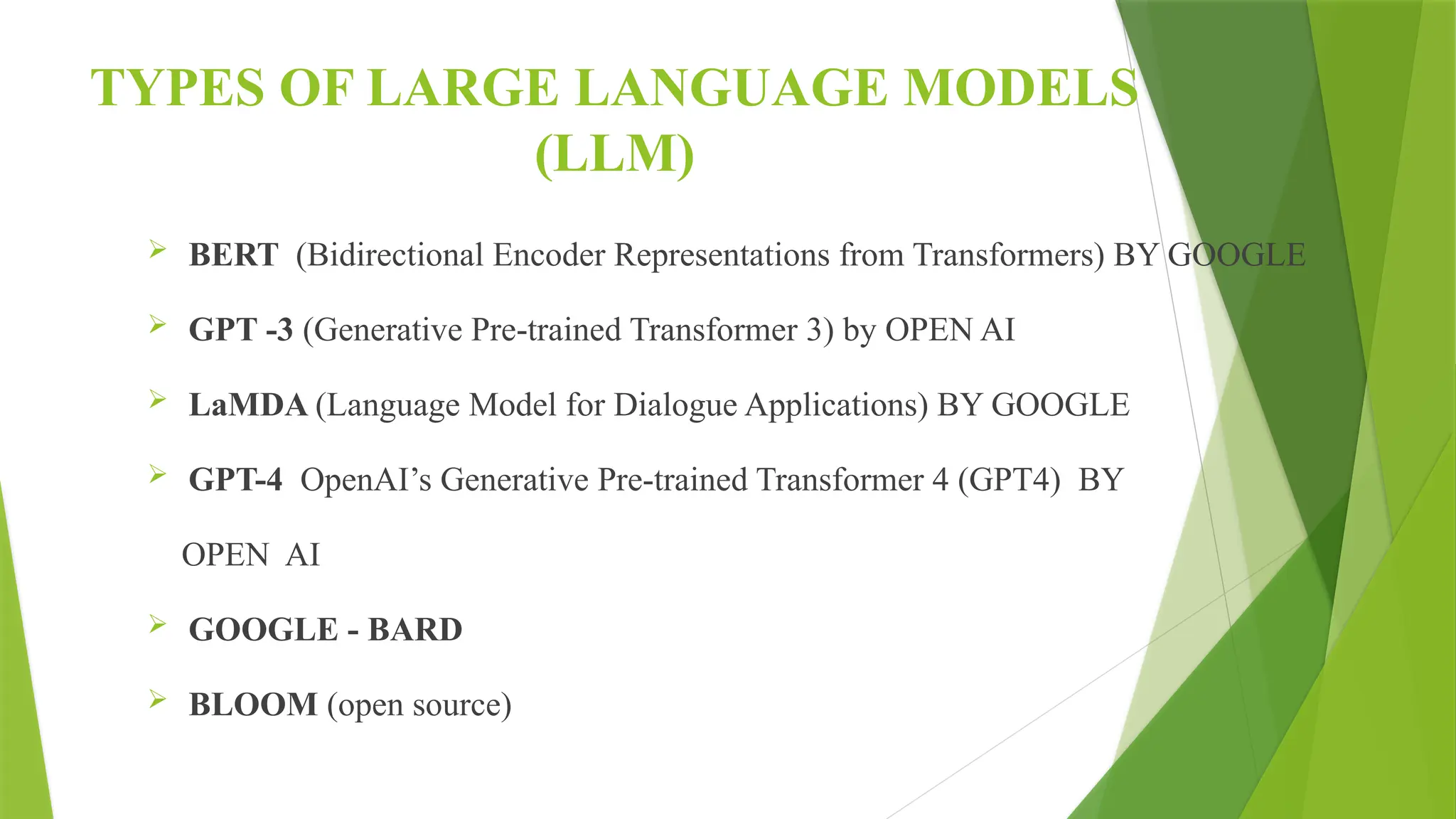
 IMAGE GENERATION: The most prominent use case of generative AI is
creating fake images that look like real ones.
 The above figure shows generated realistic images of people that don’t exist.
Source
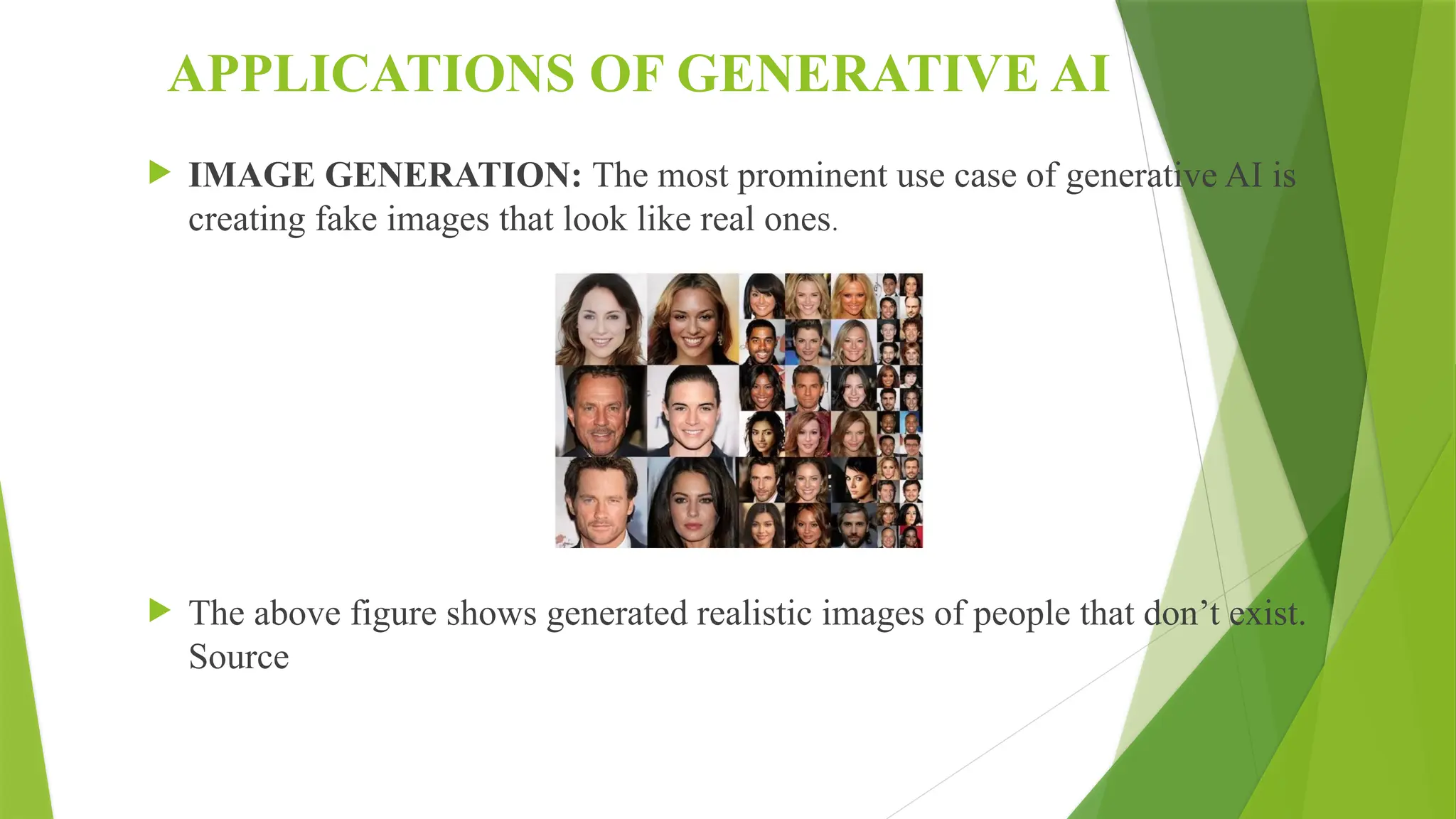
 IMAGE-TO-IMAGE TRANSLATION: Here generative AI transforms one
type of image into another.
 The above figure is a photo in the Van Gogh painting style using GoArt from
Fotor
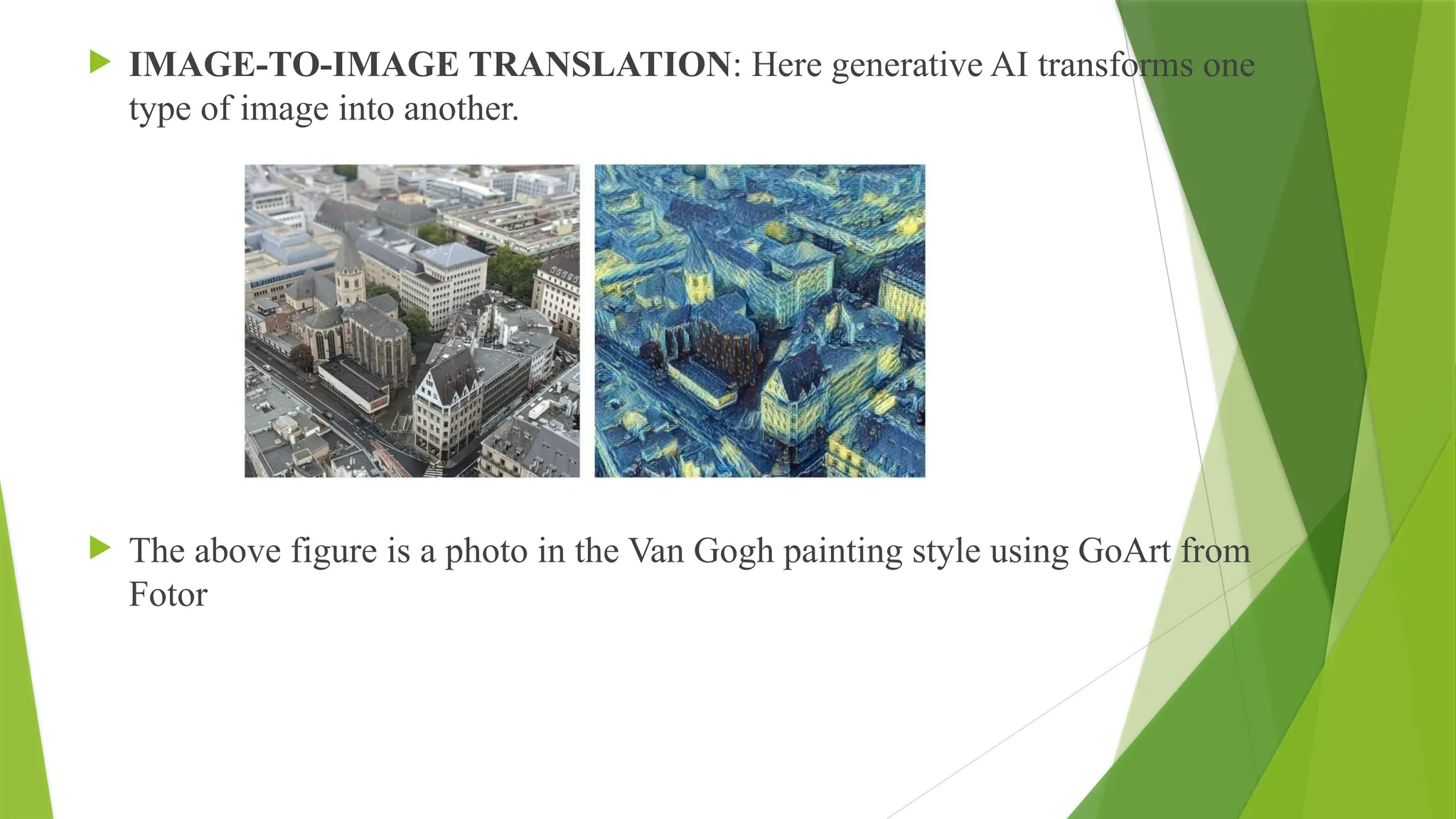
 SKETCHES-TO-REALISTIC IMAGES: A user starts with a sparse sketch and
the desired object category, and the network then recommends its completion(s)
and shows a corresponding synthesized image.
 The above figure shows a DeepFaceDrawing: Deep Generation of Face Images
from Sketches
ADVANTAGES OF GENERATIVE AI
1. Creativity Enhancement
2. Data Augmentation
3. Personalization
4. Exploratory Analysis
5. Cost Reduction
DISADVANTAGES OF GENERATIVE AI
1. Ethical Concerns: Generative AI can be misused for creating
deepfakes, fake news, or other forms of disinformation
2. Quality Control: Generated content may not always meet quality
standards or may contain errors
3. Security Risks: Generative AI models can be vulnerable to attacks
THANK YOU

GENERATIVE AI ALMAS engineering - Copy-1.pptx

  • 1.
    Department of ARTIFICIAL INTELLIGENCE& DATA SCIENCE M.Tech. 3rd Semester TECHNICAL SEMINAR “Introduction to Generative AI” Presented by ALMAS SG22ADS003 Under the guidance Dr. VIRUPAKSHAPPA
  • 2.
    INDEX  INTRODUCTION  OBJECTIVES OVERVIEW OF GENERATIVE AI  LAYERS OF GENERATIVE AI  TYPES OF LLMS  APPLICATIONS  ADVANTAGES  DISADVANTAGES
  • 3.
    INTRODUCTION  Generative AI,or genAI, refers to systems that can generate new content, be it text, images, music, or even videos.  Generative AI focuses on creating new content similar to human creations  Using deep learning techniques and advanced architectures like Generative Adversarial Networks (GANs) and Variational Auto encoders (VAEs) to understand underlying patterns and structures. They then generate new diverse content forms such as images, text, audio, and video
  • 4.
    OBJECTIVES  Exploration ofCreativity: Investigate how generative AI can mimic and augment human creativity across various domains such as art, music, literature, and design.  Advancement of Personalization: generative AI to personalize user experiences in areas such as recommendation systems, personalized content generation, and adaptive interfaces.  Understanding of Human Perception: Utilize generative AI to gain insights into human perception , exploring how individuals interpret and respond to generated content.
  • 5.
    OVERVIEW OF GENERATIVEAI  Generative Artifical Intelligence (GAI) describes algorithms (such as ChatGPT, Midjourney, Bard, DALL E, etc.) that can be used to create new content, including audio, code, images, text, simulations, and videos.  Generative AI models use neural networks to identify the patterns and structures within existing data to generate new and original content.  The current boom of Generative AI has its origins rooted deeply in advance of Natural Language Processing (NLP), which is a subfield within AI which focuses on how computers process and analyse large amounts of natural language data.
  • 6.
    LAYERS OF GENERATIVEAI 1. APPLICATION LAYER 2. MODEL LAYER 3. INFRASTRUCTURE LAYER Fig: Layers of GPT architecture
  • 7.
    1)APPLICATIONS LAYER: The generativeAI tech stack’s application layer facilitates seamless human-machine collaboration and makes AI models approachable and user-friendly. IT HAS TWO TYPES: 1)DATA PLATFORMS AND AP MANAGEMENT LAYER 2)ORCHESTRATION LAYER
  • 8.
    2)MODEL LAYER A modelhub, fine-tuned models, LLM Foundation models, and Machine Learning Foundation models are all included in the model layer. The core of generative AI is made up of foundation models. These models based on deep learning may be modified for a variety of applications and come pre-trained to produce particular kinds of material. 3)INFRASTRUCTURE LAYER The infrastructure layer of the Generative AI enterprise architecture model comprises cloud platforms and hardware that handle inference as well as training workloads. Conventional computer hardware cannot manage the vast volumes of data needed to produce content in generative AI systems.
  • 9.
    TYPES OF LARGELANGUAGE MODELS (LLM)  BERT (Bidirectional Encoder Representations from Transformers) BY GOOGLE  GPT -3 (Generative Pre-trained Transformer 3) by OPEN AI  LaMDA (Language Model for Dialogue Applications) BY GOOGLE  GPT-4 OpenAI’s Generative Pre-trained Transformer 4 (GPT4) BY OPEN AI  GOOGLE - BARD  BLOOM (open source)
  • 10.
    APPLICATIONS OF GENERATIVEAI  IMAGE GENERATION: The most prominent use case of generative AI is creating fake images that look like real ones.  The above figure shows generated realistic images of people that don’t exist. Source
  • 11.
     IMAGE-TO-IMAGE TRANSLATION:Here generative AI transforms one type of image into another.  The above figure is a photo in the Van Gogh painting style using GoArt from Fotor
  • 12.
     SKETCHES-TO-REALISTIC IMAGES:A user starts with a sparse sketch and the desired object category, and the network then recommends its completion(s) and shows a corresponding synthesized image.  The above figure shows a DeepFaceDrawing: Deep Generation of Face Images from Sketches
  • 13.
    ADVANTAGES OF GENERATIVEAI 1. Creativity Enhancement 2. Data Augmentation 3. Personalization 4. Exploratory Analysis 5. Cost Reduction
  • 14.
    DISADVANTAGES OF GENERATIVEAI 1. Ethical Concerns: Generative AI can be misused for creating deepfakes, fake news, or other forms of disinformation 2. Quality Control: Generated content may not always meet quality standards or may contain errors 3. Security Risks: Generative AI models can be vulnerable to attacks
  • 15.