Generative AI: Top Use Cases, Solutions, and
How to Implement Them
Imagine a machine not just answering your questions but designing your logo,
drafting your contracts, composing your music, writing your code, and assisting
doctors with their diagnoses for the next big breakthrough in medicine —it’s
happening right now, courtesy of Generative AI.
In just a few years, Generative AI has transformed from a curiosity into an
indispensable tool thanks to rapid advances in AI development — and, in the
process, has begun to change the way we think about industry, creativity, and
human and machine collaboration. If you’re a technologist, business strategist or
a technology enthusiast attempting to navigate this tidal wave of AI, one thing is
certain: Generative AI is not a fad — it’s a new paradigm.
But amid the deluge of headlines, hype, and jargon, it can be hard to separate
signal from noise. What models matter? What is the actual business value?
How do you get this stuff done in the real world — securely, ethically, at scale?
We’re going behind the buzzwords to provide a comprehensive, formatted, and
actionable deep dive into Generative AI in 2025 — from how it functions to the
architectures driving it to real-world breakthroughs across sectors including
health, finance, media, and manufacturing. You will learn the tools, the how-to’s,
mapper print, risks, and most importantly.. the opportunities this information holds
for innovation in your business or product.
So if you’re looking for the most comprehensive, no-fluff guide on Generative AI
available today—you’ve landed in the right place.
Let’s dive in.
Definition & Overview
What Is Generative AI?
Generative AI is a subset of artificial intelligence that focuses on creating new
content—text, images, music, or code—by learning patterns from existing data.
Whereas traditional AI processes data to extrapolate future predictions or
classifications from it, generative AI models can generate new content that looks
like the data it has been trained on.
For example, a generative AI model trained on thousands of paintings can
produce a new artwork in the style of the originals, or a model trained on human
speech can generate realistic-sounding audio clips. This feature has unlocked a
variety of use cases commercially, ranging from automating the creation of
content through to assisting in drug discovery.
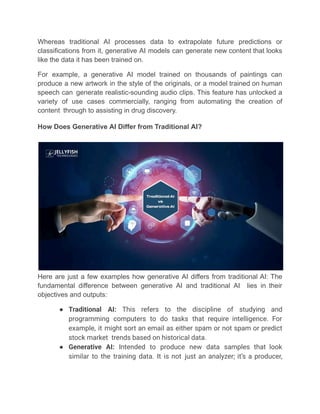
How Does Generative AI Differ from Traditional AI?
Here are just a few examples how generative AI differs from traditional AI: The
fundamental difference between generative AI and traditional AI lies in their
objectives and outputs:
●​ Traditional AI: This refers to the discipline of studying and
programming computers to do tasks that require intelligence. For
example, it might sort an email as either spam or not spam or predict
stock market trends based on historical data.
●​ Generative AI: Intended to produce new data samples that look
similar to the training data. It is not just an analyzer; it’s a producer,
such as creating a new piece of music that is indistinguishable
from that composed by a human.
In other words, classic AI is about learning from existing data, but generative AI
is concerned with inventing new data.
A Brief History of Generative AI
Significant milestones have marked the journey of generative AI:
●​ 1950s-1960s: Early concepts like the Markov chains were used to
model sequences, laying the groundwork for generative models.
●​ 1961: Joseph Weizenbaum developed ELIZA, one of the first chatbots,
which used pattern matching and substitution methodology to
simulate conversation.
●​ 1980s-1990s: Introduction of probabilistic models like Hidden Markov
Models (HMMs) and Gaussian Mixture Models (GMMs) for speech and
handwriting generation.
●​ 2014: Ian Goodfellow introduced Generative Adversarial Networks
(GANs), a groundbreaking approach where two neural networks
compete to produce more realistic data.
●​ 2017: The transformer architecture was introduced, revolutionizing
natural language processing and developing models like GPT
(Generative Pre-trained Transformer).
●​ 2022-Present: Rapid advancements in large language models (LLMs)
and diffusion models have led to tools like ChatGPT, DALL·E, and
Midjourney, making generative AI accessible to the public and
businesses.
These advances have turned generative AI from a niche academic pursuit into a
significant force in AI and a key driver of much of the technology we use today –
from art and entertainment to health care.
The creation of new, original content by generative AI has not only broadened the
scope of what’s possible with machines. Still, it has raised important questions
about creativity, authenticity, and ethics in the digital age. Understanding its
foundations becomes more crucial as we delve deeper into its applications and
implications.
How Generative AI Works: Concepts & Architectures
To understand what generative artificial intelligence is—how it makes things, from
realistic images to human-like text—we must delve into its underlying principles
and the architectures that enable it.
Core Concepts Behind Generative AI
1. Generative Modeling
In generative modeling, AI systems are trained to learn the patterns of and
relationships between data, so they generate new examples of similar data. For
example, a model trained on thousands of landscape photos can produce
entirely new, and realistic-looking landscape images.
2. Latent Spaces
Latent spaces are compressed data representations, distilling complex features
into simpler forms. Generative models traverse these spaces to make
interpolations and create new points. For example, walking in the latent space in
image generation can smoothly morph a cat image into a dog image.
3. Prompt Engineering
Prompt engineering is the art of creating inputs (prompts) to generative models
that steer them towards generating desired outputs. The quality and structure of
the prompt can also have a great influence on the model’s response, so this is a
key skill in wielding generative AI effectively.
Overview of Generative AI Architectures
1. Generative Adversarial Networks (GANs)
Created by Ian Goodfellow in 2014, GANs consist of two neural networks: one
called the generator that manufactures data and one called the discriminator that
measures it for authenticity. The competitive process undertaken by GANs allows
them to generate realistic images, and as such, they have gained popularity in
the art and design community.
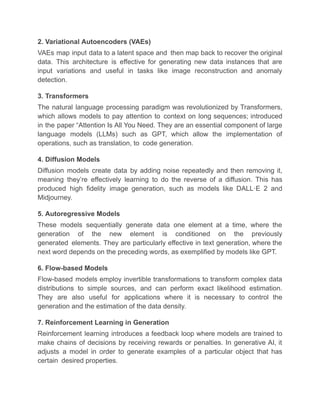
2. Variational Autoencoders (VAEs)
VAEs map input data to a latent space and then map back to recover the original
data. This architecture is effective for generating new data instances that are
input variations and useful in tasks like image reconstruction and anomaly
detection.
3. Transformers
The natural language processing paradigm was revolutionized by Transformers,
which allows models to pay attention to context on long sequences; introduced
in the paper “Attention Is All You Need. They are an essential component of large
language models (LLMs) such as GPT, which allow the implementation of
operations, such as translation, to code generation.
4. Diffusion Models
Diffusion models create data by adding noise repeatedly and then removing it,
meaning they’re effectively learning to do the reverse of a diffusion. This has
produced high fidelity image generation, such as models like DALL·E 2 and
Midjourney.
5. Autoregressive Models
These models sequentially generate data one element at a time, where the
generation of the new element is conditioned on the previously
generated elements. They are particularly effective in text generation, where the
next word depends on the preceding words, as exemplified by models like GPT.
6. Flow-based Models
Flow-based models employ invertible transformations to transform complex data
distributions to simple sources, and can perform exact likelihood estimation.
They are also useful for applications where it is necessary to control the
generation and the estimation of the data density.
7. Reinforcement Learning in Generation
Reinforcement learning introduces a feedback loop where models are trained to
make chains of decisions by receiving rewards or penalties. In generative AI, it
adjusts a model in order to generate examples of a particular object that has
certain desired properties.
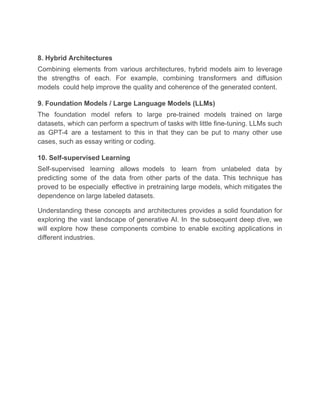
8. Hybrid Architectures
Combining elements from various architectures, hybrid models aim to leverage
the strengths of each. For example, combining transformers and diffusion
models could help improve the quality and coherence of the generated content.
9. Foundation Models / Large Language Models (LLMs)
The foundation model refers to large pre-trained models trained on large
datasets, which can perform a spectrum of tasks with little fine-tuning. LLMs such
as GPT-4 are a testament to this in that they can be put to many other use
cases, such as essay writing or coding.
10. Self-supervised Learning
Self-supervised learning allows models to learn from unlabeled data by
predicting some of the data from other parts of the data. This technique has
proved to be especially effective in pretraining large models, which mitigates the
dependence on large labeled datasets.
Understanding these concepts and architectures provides a solid foundation for
exploring the vast landscape of generative AI. In the subsequent deep dive, we
will explore how these components combine to enable exciting applications in
different industries.

Generative AI: Top Use Cases, Solutions, and How to Implement Them

  • 1.
    Generative AI: TopUse Cases, Solutions, and How to Implement Them Imagine a machine not just answering your questions but designing your logo, drafting your contracts, composing your music, writing your code, and assisting doctors with their diagnoses for the next big breakthrough in medicine —it’s happening right now, courtesy of Generative AI. In just a few years, Generative AI has transformed from a curiosity into an indispensable tool thanks to rapid advances in AI development — and, in the process, has begun to change the way we think about industry, creativity, and human and machine collaboration. If you’re a technologist, business strategist or a technology enthusiast attempting to navigate this tidal wave of AI, one thing is certain: Generative AI is not a fad — it’s a new paradigm. But amid the deluge of headlines, hype, and jargon, it can be hard to separate signal from noise. What models matter? What is the actual business value? How do you get this stuff done in the real world — securely, ethically, at scale? We’re going behind the buzzwords to provide a comprehensive, formatted, and actionable deep dive into Generative AI in 2025 — from how it functions to the architectures driving it to real-world breakthroughs across sectors including health, finance, media, and manufacturing. You will learn the tools, the how-to’s, mapper print, risks, and most importantly.. the opportunities this information holds for innovation in your business or product. So if you’re looking for the most comprehensive, no-fluff guide on Generative AI available today—you’ve landed in the right place. Let’s dive in. Definition & Overview What Is Generative AI? Generative AI is a subset of artificial intelligence that focuses on creating new content—text, images, music, or code—by learning patterns from existing data.
  • 2.
    Whereas traditional AIprocesses data to extrapolate future predictions or classifications from it, generative AI models can generate new content that looks like the data it has been trained on. For example, a generative AI model trained on thousands of paintings can produce a new artwork in the style of the originals, or a model trained on human speech can generate realistic-sounding audio clips. This feature has unlocked a variety of use cases commercially, ranging from automating the creation of content through to assisting in drug discovery. How Does Generative AI Differ from Traditional AI? Here are just a few examples how generative AI differs from traditional AI: The fundamental difference between generative AI and traditional AI lies in their objectives and outputs: ●​ Traditional AI: This refers to the discipline of studying and programming computers to do tasks that require intelligence. For example, it might sort an email as either spam or not spam or predict stock market trends based on historical data. ●​ Generative AI: Intended to produce new data samples that look similar to the training data. It is not just an analyzer; it’s a producer,
  • 3.
    such as creatinga new piece of music that is indistinguishable from that composed by a human. In other words, classic AI is about learning from existing data, but generative AI is concerned with inventing new data. A Brief History of Generative AI Significant milestones have marked the journey of generative AI: ●​ 1950s-1960s: Early concepts like the Markov chains were used to model sequences, laying the groundwork for generative models. ●​ 1961: Joseph Weizenbaum developed ELIZA, one of the first chatbots, which used pattern matching and substitution methodology to simulate conversation. ●​ 1980s-1990s: Introduction of probabilistic models like Hidden Markov Models (HMMs) and Gaussian Mixture Models (GMMs) for speech and handwriting generation. ●​ 2014: Ian Goodfellow introduced Generative Adversarial Networks (GANs), a groundbreaking approach where two neural networks compete to produce more realistic data. ●​ 2017: The transformer architecture was introduced, revolutionizing natural language processing and developing models like GPT (Generative Pre-trained Transformer). ●​ 2022-Present: Rapid advancements in large language models (LLMs) and diffusion models have led to tools like ChatGPT, DALL·E, and Midjourney, making generative AI accessible to the public and businesses. These advances have turned generative AI from a niche academic pursuit into a significant force in AI and a key driver of much of the technology we use today – from art and entertainment to health care. The creation of new, original content by generative AI has not only broadened the scope of what’s possible with machines. Still, it has raised important questions about creativity, authenticity, and ethics in the digital age. Understanding its foundations becomes more crucial as we delve deeper into its applications and implications.
  • 4.
    How Generative AIWorks: Concepts & Architectures To understand what generative artificial intelligence is—how it makes things, from realistic images to human-like text—we must delve into its underlying principles and the architectures that enable it. Core Concepts Behind Generative AI 1. Generative Modeling In generative modeling, AI systems are trained to learn the patterns of and relationships between data, so they generate new examples of similar data. For example, a model trained on thousands of landscape photos can produce entirely new, and realistic-looking landscape images. 2. Latent Spaces Latent spaces are compressed data representations, distilling complex features into simpler forms. Generative models traverse these spaces to make interpolations and create new points. For example, walking in the latent space in image generation can smoothly morph a cat image into a dog image. 3. Prompt Engineering Prompt engineering is the art of creating inputs (prompts) to generative models that steer them towards generating desired outputs. The quality and structure of the prompt can also have a great influence on the model’s response, so this is a key skill in wielding generative AI effectively. Overview of Generative AI Architectures 1. Generative Adversarial Networks (GANs) Created by Ian Goodfellow in 2014, GANs consist of two neural networks: one called the generator that manufactures data and one called the discriminator that measures it for authenticity. The competitive process undertaken by GANs allows them to generate realistic images, and as such, they have gained popularity in the art and design community.
  • 5.
    2. Variational Autoencoders(VAEs) VAEs map input data to a latent space and then map back to recover the original data. This architecture is effective for generating new data instances that are input variations and useful in tasks like image reconstruction and anomaly detection. 3. Transformers The natural language processing paradigm was revolutionized by Transformers, which allows models to pay attention to context on long sequences; introduced in the paper “Attention Is All You Need. They are an essential component of large language models (LLMs) such as GPT, which allow the implementation of operations, such as translation, to code generation. 4. Diffusion Models Diffusion models create data by adding noise repeatedly and then removing it, meaning they’re effectively learning to do the reverse of a diffusion. This has produced high fidelity image generation, such as models like DALL·E 2 and Midjourney. 5. Autoregressive Models These models sequentially generate data one element at a time, where the generation of the new element is conditioned on the previously generated elements. They are particularly effective in text generation, where the next word depends on the preceding words, as exemplified by models like GPT. 6. Flow-based Models Flow-based models employ invertible transformations to transform complex data distributions to simple sources, and can perform exact likelihood estimation. They are also useful for applications where it is necessary to control the generation and the estimation of the data density. 7. Reinforcement Learning in Generation Reinforcement learning introduces a feedback loop where models are trained to make chains of decisions by receiving rewards or penalties. In generative AI, it adjusts a model in order to generate examples of a particular object that has certain desired properties.
  • 6.
    8. Hybrid Architectures Combiningelements from various architectures, hybrid models aim to leverage the strengths of each. For example, combining transformers and diffusion models could help improve the quality and coherence of the generated content. 9. Foundation Models / Large Language Models (LLMs) The foundation model refers to large pre-trained models trained on large datasets, which can perform a spectrum of tasks with little fine-tuning. LLMs such as GPT-4 are a testament to this in that they can be put to many other use cases, such as essay writing or coding. 10. Self-supervised Learning Self-supervised learning allows models to learn from unlabeled data by predicting some of the data from other parts of the data. This technique has proved to be especially effective in pretraining large models, which mitigates the dependence on large labeled datasets. Understanding these concepts and architectures provides a solid foundation for exploring the vast landscape of generative AI. In the subsequent deep dive, we will explore how these components combine to enable exciting applications in different industries.