Introduction to Generative AI
Exploring the Future of Artificial
Intelligence
Your Name
Date
What is Generative AI?
• Definition: Generative AI refers to algorithms
(like GANs and VAEs) that can generate new
data similar to the data they were trained on.
• Significance: Revolutionizing creative
industries, improving healthcare outcomes,
and enhancing business processes.
The Evolution of Generative AI
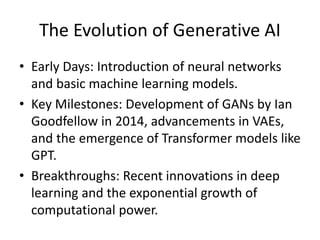
• Early Days: Introduction of neural networks
and basic machine learning models.
• Key Milestones: Development of GANs by Ian
Goodfellow in 2014, advancements in VAEs,
and the emergence of Transformer models like
GPT.
• Breakthroughs: Recent innovations in deep
learning and the exponential growth of
computational power.
Mechanisms of Generative AI
• GANs (Generative Adversarial Networks):
Consists of a generator and a discriminator
working in tandem.
• VAEs (Variational Autoencoders): Encodes
data into a latent space and decodes it to
generate new data.
• Transformer Models: Uses self-attention
mechanisms for tasks like text generation.
Applications in Various Fields
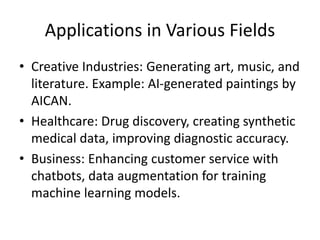
• Creative Industries: Generating art, music, and
literature. Example: AI-generated paintings by
AICAN.
• Healthcare: Drug discovery, creating synthetic
medical data, improving diagnostic accuracy.
• Business: Enhancing customer service with
chatbots, data augmentation for training
machine learning models.
Real-world Examples
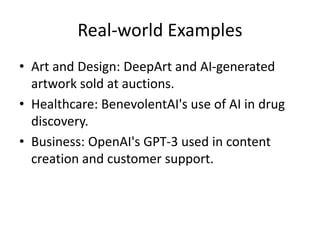
• Art and Design: DeepArt and AI-generated
artwork sold at auctions.
• Healthcare: BenevolentAI's use of AI in drug
discovery.
• Business: OpenAI's GPT-3 used in content
creation and customer support.
Benefits and Challenges
• Advantages:
• - Innovation: Enables new forms of creative
expression.
• - Efficiency: Automates complex processes,
saving time and resources.
• - Personalization: Creates personalized
content and experiences.
• Challenges:
Ethics in Generative AI
• Ethical Implications: Addressing issues of
accountability, transparency, and fairness.
• Responsible Use: Developing guidelines and
regulations to ensure ethical AI deployment.
• Bias Mitigation: Strategies to identify and
reduce biases in AI models.
Future Trends and Developments
• Emerging Trends: Advances in unsupervised
learning, more powerful and efficient models.
• Predictions: Widespread adoption in various
sectors, improved human-AI collaboration,
more ethical and unbiased AI systems.
Conclusion
• Recap: Reviewed the definition, evolution,
mechanisms, applications, advantages,
challenges, ethical considerations, and future
trends of Generative AI.
• Impact: Emphasized the transformative
potential of Generative AI in various fields.
Questions and Answers
• Invite the audience to ask questions.
• Provide your contact information for follow-up
queries.

Generative_AI_Presentation_Detailed.pptx

  • 1.
    Introduction to GenerativeAI Exploring the Future of Artificial Intelligence Your Name Date
  • 2.
    What is GenerativeAI? • Definition: Generative AI refers to algorithms (like GANs and VAEs) that can generate new data similar to the data they were trained on. • Significance: Revolutionizing creative industries, improving healthcare outcomes, and enhancing business processes.
  • 3.
    The Evolution ofGenerative AI • Early Days: Introduction of neural networks and basic machine learning models. • Key Milestones: Development of GANs by Ian Goodfellow in 2014, advancements in VAEs, and the emergence of Transformer models like GPT. • Breakthroughs: Recent innovations in deep learning and the exponential growth of computational power.
  • 4.
    Mechanisms of GenerativeAI • GANs (Generative Adversarial Networks): Consists of a generator and a discriminator working in tandem. • VAEs (Variational Autoencoders): Encodes data into a latent space and decodes it to generate new data. • Transformer Models: Uses self-attention mechanisms for tasks like text generation.
  • 5.
    Applications in VariousFields • Creative Industries: Generating art, music, and literature. Example: AI-generated paintings by AICAN. • Healthcare: Drug discovery, creating synthetic medical data, improving diagnostic accuracy. • Business: Enhancing customer service with chatbots, data augmentation for training machine learning models.
  • 6.
    Real-world Examples • Artand Design: DeepArt and AI-generated artwork sold at auctions. • Healthcare: BenevolentAI's use of AI in drug discovery. • Business: OpenAI's GPT-3 used in content creation and customer support.
  • 7.
    Benefits and Challenges •Advantages: • - Innovation: Enables new forms of creative expression. • - Efficiency: Automates complex processes, saving time and resources. • - Personalization: Creates personalized content and experiences. • Challenges:
  • 8.
    Ethics in GenerativeAI • Ethical Implications: Addressing issues of accountability, transparency, and fairness. • Responsible Use: Developing guidelines and regulations to ensure ethical AI deployment. • Bias Mitigation: Strategies to identify and reduce biases in AI models.
  • 9.
    Future Trends andDevelopments • Emerging Trends: Advances in unsupervised learning, more powerful and efficient models. • Predictions: Widespread adoption in various sectors, improved human-AI collaboration, more ethical and unbiased AI systems.
  • 10.
    Conclusion • Recap: Reviewedthe definition, evolution, mechanisms, applications, advantages, challenges, ethical considerations, and future trends of Generative AI. • Impact: Emphasized the transformative potential of Generative AI in various fields.
  • 11.
    Questions and Answers •Invite the audience to ask questions. • Provide your contact information for follow-up queries.