Introduc)on	to	
Genera)ve	Adversarial	Nets	
Stefan	Mathe
Roadmap	
1.  What	are	genera)ve	models?	
2.  Mo)va)on	
3.  A	Taxonomy	of	genera)ve	models	
4.  Genera)ve	Adversarial	Nets	(GANs)	
1.  Model	Defini)on	
2.  Theore)cal	Guarantees	
3.  Generaliza)ons	
4.  Evalua)on	
5.  Conclusions
What	are	Genera)ve	Models?	
•  Input:	a	training	set	of	samples	drawn	from	a	
distribu)on	​𝑝↓data 	
•  Output:	an	es)mate	of	​𝑝↓data 		
– How	do	we	represent	it?
Represen)ng	​𝑝↓𝑑𝑎𝑡𝑎 	
as	a	probability	
density	func)on	
as	a	sample	
generator	
training	
samples	
model	
generated	
samples
Mo)va)on
Why	study	genera)ve	models?	
•  Model	Based	Reinforcement	Learning	
•  Semi-supervised	Learning	
•  Handling	mul)-modal	outputs	
•  Generate	realis)c	samples	
– Single	image	super-resolu)on	
– Crea)ng	art	
– HandwriTen	Digit	Genera)on	
– Image-to-image	transla)on
Single	Image	Super-Resolu)on	
Ledig	et	al.	(2016)	
original	 bicubic	interpola)on	 SRResNet	 SRGAN	
SRResNet:	Super-resolu)on	ResNet	
SRGAN:	Super-resolu)on	SRGAN	 mul)-modal	response	=>	not	blurry!
Crea)ng	Art:	Interac)ve	GAN	(iGAN)	
Zhu	et	al.	(2016)	
hTps://www.youtube.com/watch?v=9c4z6YsBGQ0
Crea)ng	Art:	Interac)ve	GAN	(iGAN)	
Zhu	et	al.	(2016)	
hTps://www.youtube.com/watch?v=9c4z6YsBGQ0
HandwriTen	Digit	Genera)on	
Kingma	and	Welling	(2013)	
hTp://dpkingma.com/sgvb_mnist_demo/demo.html
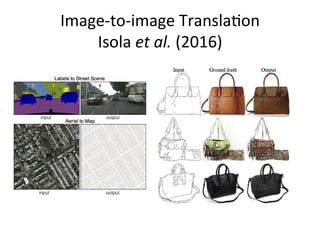
Image-to-image	Transla)on	
Isola	et	al.	(2016)
A	Taxonomy	of	Genera)ve	
Models
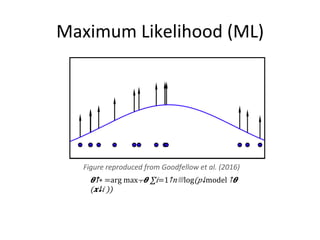
Maximum	Likelihood	(ML)	
​𝜽↑∗ =​​arg max┬𝜽 ⁠∑𝑖=1↑𝑛▒log(​​𝑝↓model ↑𝜽 
(​𝒙↓𝑖 ))  	
Figure	reproduced	from	Goodfellow	et	al.	(2016)
ML	and	the	
	Kullback	Leibler	(KL)	divergence	
•  Our	training	samples	define	an	empirical	
distribu)on	​​𝑝 ↓data 	
​​𝑝 ↓data (𝑥)=∑𝑖=1↑𝑛▒​1↓​𝑥↓𝑖  (𝑥) 	
​𝜽↑∗ =​​arg min┬𝜽 ⁠​𝐷↓𝐾𝐿 (​​𝑝 ↓data ‖​
𝑝↓model  ) 	
•  ML	is	equivalent	to	minimizing	the	KL	
divergence	between	​​𝑝 ↓data 	and	​𝑝↓model 
A	Taxonomy	of	Genera)ve	Models	
Genera)ve	Model		
Explicit	Density	 Implicit	Density	
Tractable	
Density	
Approximate	
Density	
Direct	Sampling	
Markov	Chain	
Sampling	
Fully	Visible	
Belief	Nets	
(FVBN)	
Nonlinear	
ICA	
Varia)onal	
Autoencoder	
(VAE)	
Boltzmann	
Machine	
Genera)ve	
Adversarial	
Nets	(GAN)	
Genera)ve	
Stochas)c	
Networks	(GSN)	
Adapted	from	Goodfellow	et	al.	(2014)	
state-of-the-art
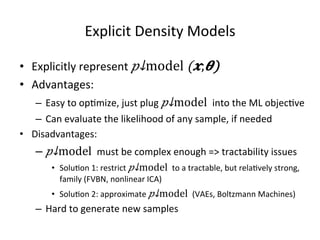
Explicit	Density	Models	
•  Explicitly	represent	​𝑝↓model (𝒙;𝜽)	
•  Advantages:	
–  Easy	to	op)mize,	just	plug	​𝑝↓model 	into	the	ML	objec)ve	
–  Can	evaluate	the	likelihood	of	any	sample,	if	needed	
•  Disadvantages:	
– ​𝑝↓model 	must	be	complex	enough	=>	tractability	issues	
•  Solu)on	1:	restrict	​𝑝↓model 	to	a	tractable,	but	rela)vely	strong,	
family	(FVBN,	nonlinear	ICA)	
•  Solu)on	2:	approximate	​𝑝↓model 	(VAEs,	Boltzmann	Machines)	
–  Hard	to	generate	new	samples
Implicit	Density	Models	
•  Interact	indirectly	with	​𝑝↓model (𝒙;𝜽)	by	sampling	
•  Advantages:	
–  Sampling	is	straighiorward	
•  Disadvantages:	
–  Likelihood	is	expensive	to	compute	
•  Sampling	procedures	
–  Itera)ve	(GSNs):	
•  Learn	the	denoising	distribu)on	(ojen	unimodal)	via	ML	
•  Pick	a	training	sample,	apply	noise	and	denoise	repeatedly	
•  Ajer	enough	itera)ons,	we	get	a	sample	from	​𝑝↓data (𝒙)	
–  Direct	(GANs)	
•  Sample	in	a	single	step	
•  Objec)ve	func)ons
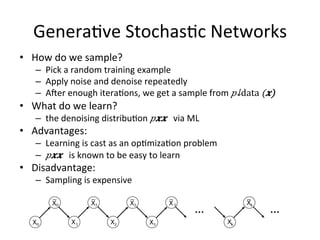
Genera)ve	Stochas)c	Networks	
•  How	do	we	sample?	
–  Pick	a	random	training	example	
–  Apply	noise	and	denoise	repeatedly	
–  Ajer	enough	itera)ons,	we	get	a	sample	from	​𝑝↓data (𝒙)	
•  What	do	we	learn?	
–  the	denoising	distribu)on	𝑝​𝒙⁠​𝒙  	via	ML	
•  Advantages:	
–  Learning	is	cast	as	an	op)miza)on	problem	
–  𝑝​𝒙⁠​𝒙  	is	known	to	be	easy	to	learn	
•  Disadvantage:	
–  Sampling	is	expensive
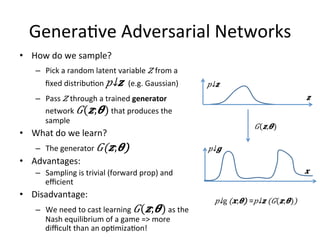
Genera)ve	Adversarial	Networks	
​𝑝↓g (𝒙;𝜽)	=​𝑝↓𝒛 (𝐺(𝒛;𝜽))		
​𝑝↓𝒛 	
𝒛	
​𝑝↓𝒈 	
𝒙	
𝐺(𝒛,𝜽) 	
•  How	do	we	sample?	
–  Pick	a	random	latent	variable	𝑧	from	a	
fixed	distribu)on	​𝑝↓𝒛 	(e.g.	Gaussian)	
–  Pass	𝑧	through	a	trained	generator	
network	𝐺(𝒛;𝜽)	that	produces	the	
sample	
•  What	do	we	learn?	
–  The	generator	𝐺(𝒛;𝜽)	
•  Advantages:	
–  Sampling	is	trivial	(forward	prop)	and	
efficient	
•  Disadvantage:	
–  We	need	to	cast	learning	𝐺(𝒛;𝜽)	as	the	
Nash	equilibrium	of	a	game	=>	more	
difficult	than	an	op)miza)on!
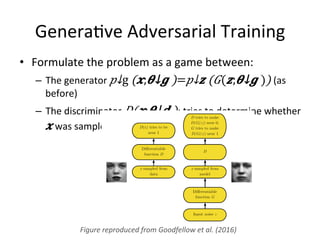
Genera)ve	Adversarial	Training	
•  Formulate	the	problem	as	a	game	between:	
–  The	generator	​𝑝↓g (𝒙;​𝜽↓𝒈 )=​𝑝↓𝒛 (𝐺(𝒛;​𝜽↓𝒈 ))	(as	
before)	
–  The	discriminator	𝐷(𝒙;​𝜽↓𝒅 ):	tries	to	determine	whether	
𝒙	was	sampled	from	​𝑝↓data 	
Figure	reproduced	from	Goodfellow	et	al.	(2016)
Genera)ve	Adversarial	Training	
​​𝜽↓𝒈 ↑∗ =​​argmin┬​𝜽↓𝒈  ⁠​​max┬​𝜽↓𝒅  ⁠​𝔼↓𝑥~​𝑝↓data  [​log⁠𝐷(𝒙;​𝜽↓𝒅 ) ]  +​𝔼↓𝑧~​𝑝↓𝐳  [​
log⁠(1−𝐷(𝐺(𝒛;​𝜽↓𝒈 )) ]	
•  Formally:	
Figure	reproduced	from	Goodfellow	et	al.	(2014)
Genera)ve	Adversarial	Training	
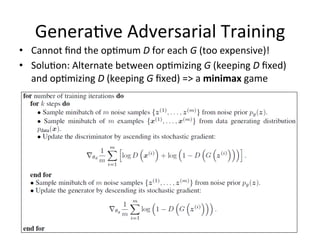
•  Cannot	find	the	op)mum	D	for	each	G	(too	expensive)!	
•  Solu)on:	Alternate	between	op)mizing	G	(keeping	D	fixed)	
and	op)mizing	D	(keeping	G	fixed)	=>	a	minimax	game
Convergence	Guarantees	
•  Only	available	for	infinite	capacity	models	
1.  Minimax	game	has	a	global	minimum	at	​𝑝↓g =​
𝑝↓data 		
2.  If	𝐷	is	allowed	to	reach	its	op)mum	in	the	inner	
loop	in	the	algorithm,	then	​𝑝↓g →​𝑝↓data 	
•  We	don’t	yet	have	sufficient	theore)cal	
support	for	the	success	of	these	models!
The	Minimax	Game	(Generalized)	
•  D	minimizes	​𝐽↑(𝐷) (​𝜽↓𝒈 ,​𝜽↓𝒅 ) w.r.t.	​𝜽↓𝒅 	and	
updates	​𝜽↓𝒅 	
•  G	minimizes	​𝐽↑(𝐺) (​𝜽↓𝒈 ,​𝜽↓𝒅 ) w.r.t.	​𝜽↓𝒈 	and	
updates	​𝜽↓𝒈 		
•  For	D,	we	always	use	the	cross	entropy:	

​​𝐽↑(𝐷) =⁠−​𝔼↓𝑥~​𝑝↓data  [​log⁠𝐷(𝒙;​𝜽↓𝒅 ) ]−​
𝔼↓𝑧~​𝑝↓𝐳  [​log⁠(1−𝐷(𝐺(𝒛;​𝜽↓𝒈 )) ] 	
	
•  For	G,	in	the	minimax	game:
Heuris)c	non-satura)ng	game	
•  Problem	with	minimax:	when	𝐷	rejects	generated	
samples,	G	has	no	gradient!	
•  Solu)on:	flip	the	target	of	the	cross-entropy	for	G	

​​𝐽↑(𝐺) =⁠​𝔼↓𝑧~​𝑝↓𝐳  [​log⁠(𝐷(𝐺(𝒛;​𝜽↓𝒈 )) ] 	
	
•  G	minimizes:	​𝐷↓𝐾𝐿 (​𝑝↓model ‖​𝑝↓data  )−​2𝐷↓𝐽𝑆 
(​𝑝↓data ‖​𝑝↓model  )	
•  L	Not	nice	(but	it	works!):	
–  No	longer	a	0-sum	game	
–  Gets	us	even	further	from	the	theore)cal	guarantees	
•  Recent	work	by	Arjovski	et.	al.	(2017)	removes	
the	need	for	such	tricks	J	(not	presented	here)
Maximum	likelihood	game	
•  It	can	be	shown	that	the	minimax	game	
op)mizes	the	Jensen-Shannon	(JS)	divergence	
between	​𝑝↓data 	and	​𝑝↓model 	
•  We	can	make	the	model	op)mize	the	KL	
divergence	if	we	set	
​​𝐽↑(𝐺) =⁠​−𝔼↓𝑧~​𝑝↓𝐳  [​log⁠(​𝜌↑−1 (𝐺(𝒛;​𝜽↓𝒈 )) ] 
Quan)ta)ve	Evalua)on	
•  How	to	compare	models?	
–  Problem:	log	likelihood	not	easy	to	compute	for	genera)ve	
machines	
–  Solu)on:	es)mate	via	Parzen	Windowing	
•  At	least	comparable	to	other	methods	on	MNIST,	
TFD
Qualita)ve	Comparison	
•  Non-trivial,	sharp	solu)ons	(not	memorizing	data)	
MNIST	 TFD	
CIFAR-10	(fully	connected)	 CIFAR-10	(conv	D,	deconv.	G)
What	makes	GANs	work?	
(Give	sharper	results	than	VAEs)	
•  Ini)al	hypothesis:	
–  because	they	minimize	JS	instead	of	KL	
–  KL	is	not	symmetric,	minimizing	JS	similar	to	reverse	KL	
•  Not	true!	
–  ML	GANs	s)ll	generate	sharp	results	
–  GANs	prefer	far	fewer	modes	than	G’s	capacity	would	allow	
•  Mistery	solved	recently	by	Arjovski	et.	al.	(2017)”:	
–  Both	JS	and	KL	induce	convergence	issues			
–  There	is	a	probability	measure	to	use	
Figure	reproduced	from	Goodfellow	et	al.	(2016)
The	Convergence	Problem	
•  We	only	have	theore)cal	guarantees	for	convergence	in	
func)on	space	
•  Typical	failure:	mode	collapse	(the	Helve4ca	Scenario)	
•  Hypothesis:	maximin	different	from	minimax,	but	the	
associated	games	(simultaneous	descent)	are	almost	
iden)cal!	
​​min┬​𝜽↓𝒈  ⁠​​max┬​𝜽↓𝒅  ⁠𝑉(​𝜽↓𝒈 ,​𝜽↓𝒅 )   ≠	​​max┬​𝜽↓𝒅  ⁠​​min┬​𝜽↓𝒈  ⁠𝑉(​𝜽↓𝒈 ,​𝜽↓
Figure	reproduced	from	Goodfellow	et	al.	(2016)
Conclusions	
•  Contribu)on:	GANs	completely	break	away	from	the	ML	
approach	by	switching	to	an	adversarial	mini-max	game	
formula)on	
•  Strengths:	
–  Easy	and	efficient	sample	genera)on	process	
–  Simple	training	algorithm	
–  No	need	for	a	noise	model	
–  State-of-the	art	results	(qualita)vely	the	best)	
•  Weaknesses:	
–  No	explicit	likelihood	representa)on	
–  Convergence	problems	(Helve)ca	scenario)	
–  Model	comparison	issues	(Parzen	Windows,	high	variance)	
–  We	don’t	know	why	they	work	(no	theore)cal	guarantees)	
•  But	see:	Arjovski	et.	al.	(2017)”	for	a	recent	and	elegant	
solu)on	for	the	former	two!
Stop	GAN	Violence!	
While	the	costs	of	human	violence	have	aFracted	a	great	deal	of	aFenGon	from	
the	research	community,	the	effects	of	the	network-on-network	(NoN)	violence	
popularised	by	GeneraGve	Adversarial	Networks	have	yet	to	be	addressed.	In	this	
work,	we	quanGfy	the	financial,	social,	spiritual,	cultural,	grammaGcal	and	
dermatological	impact	of	this	aggression	and	address	the	issue	by	proposing	a	
more	peaceful	approach	which	we	term	GeneraGve	Unadversarial	Networks	
(GUNs).	Under	this	framework,	we	simultaneously	train	two	models:	a	generator	
G	that	does	its	best	to	capture	whichever	data	distribuGon	it	feels	it	can	manage,	
and	a	moGvator	M	that	helps	G	to	achieve	its	dream.	FighGng	is	strictly	verboten	
and	both	models	evolve	by	learning	to	respect	their	differences.	The	framework	is	
both	theoreGcally	and	electrically	grounded	in	game	theory,	and	can	be	viewed	
as	a	winner-shares-all	two-player	game	in	which	both	players	work	as	a	team	to	
achieve	the	best	score.	Experiments	show	that	by	working	in	harmony,	the	
proposed	model	is	able	to	claim	both	the	moral	and	log-likelihood	high	ground.	
Our	work	builds	on	a	rich	history	of	carefully	argued	posiGon-papers,	published	as	
anonymous	YouTube	comments,	which	prove	that	the	opGmal	soluGon	to	NoN	
violence	is	more	GUNs.	
Albanie	et	al.	arXiv:1703.02528,	2017
Resources	
•  Code	and	pretrained	model:	
– hTps://github.com/goodfeli/adversarial	
•  Tutorial:	
– hTps://arxiv.org/pdf/1701.00160.pdf
References	
•  [1]	I.	Goodfellow,	J.	Pouget-Abadie,	M.	Mirza,	B.	Xu,	D.	Warde-Farley,	S.	
Ozair,	A.	Courville	and	Y.	Bengio.	“Genera)ve	Adversarial	Nets”,	NIPS,	
2014.	
•  [2]	I.	Goodfellow,	”Genera)ve	Adversarial	Networks”,	NIPS	2016	Tutorial	
•  [3]	M.	Arjovsky,	S.	Chintala,	L.	BoTou,	“Wasserstein	GAN”,	ArXiV	
1701.07875v2,	2017	
•  [4]	S.	Albanie,	S.	Ehrhardt,	J.	F.	Henriques,	“Stopping	GAN	Violence:	
Genera)ve	Unadversarial	Networks”,	ArXiV	1703.02528v1,	2017

Generative Adversarial Nets.pdf