COMPUTATIONAL METHODS
Calendar Days
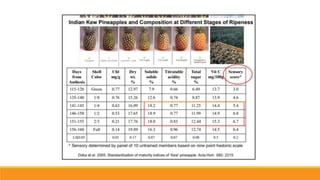
110-146 days after the date of flowering
PHYSICAL METHODS
Fruitlet Flatness
The pineapple has numerous individual fruitlets, which mature from
the bottom part of the fruit to the top. As the fruitlets mature, they become flatter. A pineapple
is typically mature and ready for harvest when the lower one-quarter to one-half of the fruitlets
are flat.
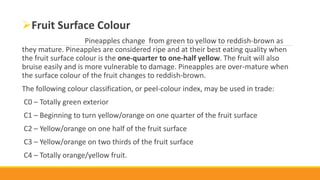
Fruit Surface Colour
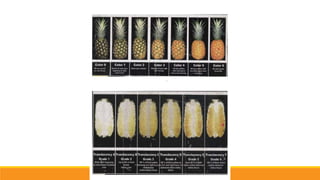
Pineapples change from green to yellow to reddish-brown as
they mature. Pineapples are considered ripe and at their best eating quality when
the fruit surface colour is the one-quarter to one-half yellow. The fruit will also
bruise easily and is more vulnerable to damage. Pineapples are over-mature when
the surface colour of the fruit changes to reddish-brown.
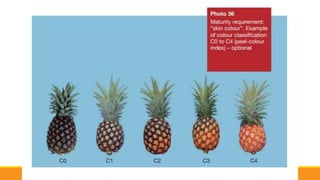
The following colour classification, or peel-colour index, may be used in trade:
C0 – Totally green exterior
C1 – Beginning to turn yellow/orange on one quarter of the fruit surface
C2 – Yellow/orange on one half of the fruit surface
C3 – Yellow/orange on two thirds of the fruit surface
C4 – Totally orange/yellow fruit.
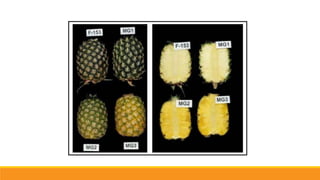
Internal Appearance
Random samples of fruit should be sliced horizontally at the point of the largest width.
Immature pineapple fruit have a white flesh colour, and are slightly clear in appearance while mature or
ripe fruit have a yellowish-white flesh. Fruit are over-mature when more than half of the cross sectional
area of the fruit is transparent
Specific Gravity
The specific gravity of the fruit was determined by measuring
fruit weight in air(w1)and water(w2). The specific gravity of a ripe
pineapple is found between 0.93-0.98
𝑆𝑝𝑒𝑐𝑖𝑓𝑖𝑐 𝐺𝑟𝑎𝑣𝑖𝑡𝑦 =
𝑤1
𝑤1 − 𝑤2
CHEMICAL METHODS
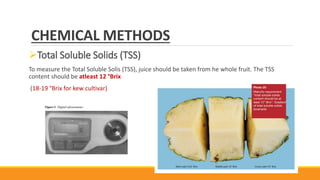
Total Soluble Solids (TSS)
To measure the Total Soluble Solis (TSS), juice should be taken from he whole fruit. The TSS
content should be atleast 12 °Brix
(18-19 °Brix for kew cultivar)
Titratable Acidity
Titratable acidity (TA) can be determined by titrating a known volume of
fruit juice with 0.1 N NaOH (sodium hydroxide) to an end point of pH =
8.2 as indicated by phenolphthalein indicator or by using a pH meter.
The TA, is expressed as percentile citric acid and the value obtained for
properly matured pineapple is 0.5 to 1.6% (0.77-0.83% forKew)
TSS:Acid Ratio
The Acid :TSS blend brings better taste of pineapple and it is said to be
the most reliable indication if maturity. During ripening the pineapple showing
a TSS:Acid ratio of 23-25 are matured enough for harvest
Ascorbic Acid Content
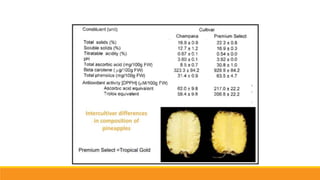
Ascorbic acid should fall between 20-65 mg/100grm of fresh weight depending on the
cultivar and stage of maturity
PHYSIOLOGICAL METHODS
Respiration Rate
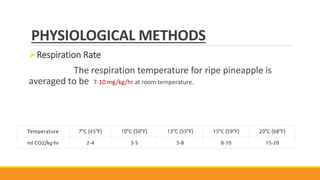
The respiration temperature for ripe pineapple is
averaged to be 7-10 mg/kg/hr at room temperature.
Rates of Ethylene Production
Less than 0.2 µl C2H4/kg·hr at 20°C (68°F)
NON DESTRUCTIVE METHOD
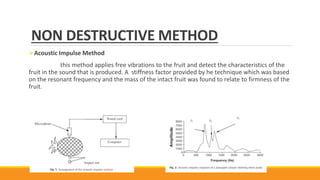
Acoustic Impulse Method
this method applies free vibrations to the fruit and detect the characteristics of the
fruit in the sound that is produced. A stiffness factor provided by he technique which was based
on the resonant frequency and the mass of the intact fruit was found to relate to firmness of the
fruit.
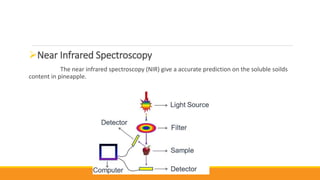
Near Infrared Spectroscopy
The near infrared spectroscopy (NIR) give a accurate prediction on the soluble soilds
content in pineapple.
maturity indices of pineapple

maturity indices of pineapple

  • 2.
    COMPUTATIONAL METHODS Calendar Days 110-146days after the date of flowering
  • 3.
    PHYSICAL METHODS Fruitlet Flatness Thepineapple has numerous individual fruitlets, which mature from the bottom part of the fruit to the top. As the fruitlets mature, they become flatter. A pineapple is typically mature and ready for harvest when the lower one-quarter to one-half of the fruitlets are flat.
  • 4.
    Fruit Surface Colour Pineappleschange from green to yellow to reddish-brown as they mature. Pineapples are considered ripe and at their best eating quality when the fruit surface colour is the one-quarter to one-half yellow. The fruit will also bruise easily and is more vulnerable to damage. Pineapples are over-mature when the surface colour of the fruit changes to reddish-brown. The following colour classification, or peel-colour index, may be used in trade: C0 – Totally green exterior C1 – Beginning to turn yellow/orange on one quarter of the fruit surface C2 – Yellow/orange on one half of the fruit surface C3 – Yellow/orange on two thirds of the fruit surface C4 – Totally orange/yellow fruit.
  • 7.
    Internal Appearance Random samplesof fruit should be sliced horizontally at the point of the largest width. Immature pineapple fruit have a white flesh colour, and are slightly clear in appearance while mature or ripe fruit have a yellowish-white flesh. Fruit are over-mature when more than half of the cross sectional area of the fruit is transparent Specific Gravity The specific gravity of the fruit was determined by measuring fruit weight in air(w1)and water(w2). The specific gravity of a ripe pineapple is found between 0.93-0.98 𝑆𝑝𝑒𝑐𝑖𝑓𝑖𝑐 𝐺𝑟𝑎𝑣𝑖𝑡𝑦 = 𝑤1 𝑤1 − 𝑤2
  • 9.
    CHEMICAL METHODS Total SolubleSolids (TSS) To measure the Total Soluble Solis (TSS), juice should be taken from he whole fruit. The TSS content should be atleast 12 °Brix (18-19 °Brix for kew cultivar)
  • 10.
    Titratable Acidity Titratable acidity(TA) can be determined by titrating a known volume of fruit juice with 0.1 N NaOH (sodium hydroxide) to an end point of pH = 8.2 as indicated by phenolphthalein indicator or by using a pH meter. The TA, is expressed as percentile citric acid and the value obtained for properly matured pineapple is 0.5 to 1.6% (0.77-0.83% forKew) TSS:Acid Ratio The Acid :TSS blend brings better taste of pineapple and it is said to be the most reliable indication if maturity. During ripening the pineapple showing a TSS:Acid ratio of 23-25 are matured enough for harvest
  • 11.
    Ascorbic Acid Content Ascorbicacid should fall between 20-65 mg/100grm of fresh weight depending on the cultivar and stage of maturity
  • 14.
    PHYSIOLOGICAL METHODS Respiration Rate Therespiration temperature for ripe pineapple is averaged to be 7-10 mg/kg/hr at room temperature.
  • 15.
    Rates of EthyleneProduction Less than 0.2 µl C2H4/kg·hr at 20°C (68°F)
  • 16.
    NON DESTRUCTIVE METHOD AcousticImpulse Method this method applies free vibrations to the fruit and detect the characteristics of the fruit in the sound that is produced. A stiffness factor provided by he technique which was based on the resonant frequency and the mass of the intact fruit was found to relate to firmness of the fruit.
  • 17.
    Near Infrared Spectroscopy Thenear infrared spectroscopy (NIR) give a accurate prediction on the soluble soilds content in pineapple.