General Physical
Examination
MR. SICHONGO CHRISPIN
Aims of GPE
 Assess patient's general condition
 Detect manifestations of internal & systemic
diseases
Examining a Patient: Diagnostic clues
 Diagnostic process has 3 components:
 History taking – Clues are the symptoms
 Physical exam - Clues are the signs
 Investigations - Clues are test results
Examining a Patient:
General Principles & Etiquettes
 Meet, greet, introduce
 Consent
 Explain to patient
 Be polite: say “please” & “thank you”
 Patient Comfort
Examining a Patient:
Examination environment
 Hand Washing
 Proper light
 Privacy & Confidentiality
 Use curtains & shades
 Presence of a chaperon when examining female patients
 Correct position of clinician & Patient
 Ideally examiner should be on right side of patient
 Proper Exposure
 Ensure your hands are warm
Components of GPE
Systematic approach
 General Appearance
 Height & Weight
 Vital Signs
 Skin & Hair
 Head & Neck
 Lymph Nodes
 Hands
 Edema
 Feet
Head to Toe
General Appearance
 OBSERVE your patient
 During the communication make judgment about the patient’s
general appearance
 Well presented
 Well spoken
 Clean
 Intelligence and level of education
General Appearance
 Age & Physique
 Posture & Attitude
 Look of Patient: Healthy/ill
 Mental & Emotional State
 Odour
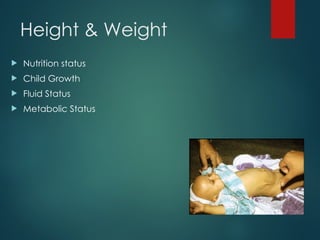
Height & Weight
 Nutrition status
 Child Growth
 Fluid Status
 Metabolic Status
Vital Signs: Pulse
 Rate:
 beats/min
 Rhythm:
 Regular
 Irregular
Pulse: Technique
 Radial pulse commonly used to assess heart
rate
 Palpate with index & middle fingers
 Rhythm regular & rate normal: count for 30
seconds & multiply by 2
 Rate unusually fast or slow: count for 60
seconds
 Rhythm irregular: evaluate heart rate by
cardiac auscultation
Vital Signs: Respiratory
Rate
 Count respirations with your hand on pulse
 Count for at least 30 sec: multiply by 2
 Normal Adult R/R: 14-18
Vital Signs: Blood Pressure
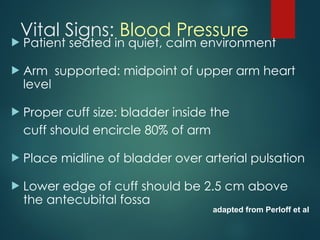
 Patient seated in quiet, calm environment
 Arm supported: midpoint of upper arm heart
level
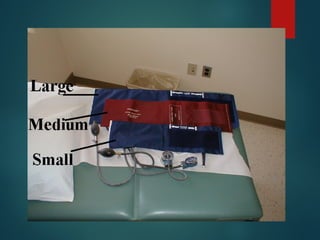
 Proper cuff size: bladder inside the
cuff should encircle 80% of arm
 Place midline of bladder over arterial pulsation
 Lower edge of cuff should be 2.5 cm above
the antecubital fossa
adapted from Perloff et al
Blood Pressure: Palpatory method
Method
 Inflate cuff while palpating the radial pulse
 Note reading at which pulse disappears & then
reappears during deflation
 This is Systolic Pressure
• Inflate bladder to pressure 20-30 mm above
level determined by palpation
• Deflate bladder at 2 mm/sec: listen for
appearance of Korotkoff sounds
• Note manometer readings at:
– Appearance of repetitive sounds: Systolic
– Disappearance of these sounds: Diastolic
• After last Korotkoff sound, deflate cuff slowly
for another 10 mm, then rapidly & completely
deflate
Blood Pressure: Auscultatory method
Blood Pressure
• Record systolic & diastolic pressures, to the nearest
2 mm Hg
• Measure blood pressure in both arms at first visit
• Measure in different positions (lying, sitting, standing)
if indicated
Vital Signs: Temperature
 Wash the thermometer before use
 Shake mercury down
 Wash after use
 For oral: ask patient to breath through nose
& keep lips firmly closed
 Keep thermometer for at least one minute
Vital Signs: Temperature
 Conscious Adults: Oral / Axillary
 Young Children: Groin/ Rectal
 Oral/ Rectal Temperature 0.5°C > Axillary/
Groin
 Normal: 36.6-37.2°C
 Febrile: >37.2°C
Pallor
 Conjunctiva
 Oral mucous membrane
 Nails
 Palms
Normal
Normal
Pale
Pale
Conjunctivitis
Conjunctivitis
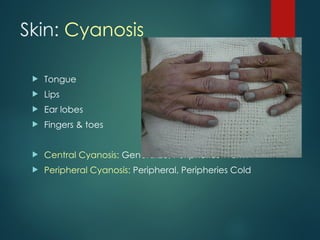
Skin: Cyanosis
 Tongue
 Lips
 Ear lobes
 Fingers & toes
 Central Cyanosis: Generalize, Peripheries Warm
 Peripheral Cyanosis: Peripheral, Peripheries Cold
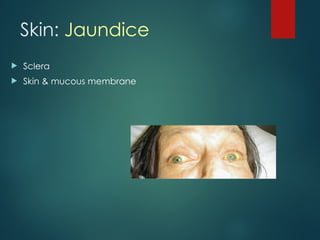
Skin: Jaundice
 Sclera
 Skin & mucous membrane
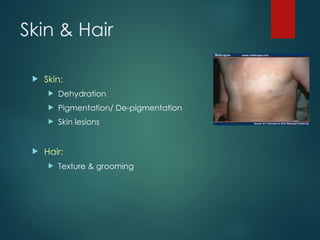
Skin & Hair
 Skin:
 Dehydration
 Pigmentation/ De-pigmentation
 Skin lesions
 Hair:
 Texture & grooming
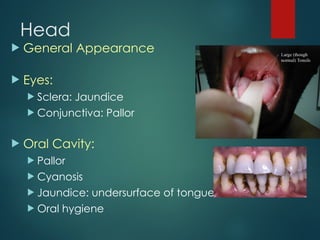
Head
 General Appearance
 Eyes:
 Sclera: Jaundice
 Conjunctiva: Pallor
 Oral Cavity:
 Pallor
 Cyanosis
 Jaundice: undersurface of tongue
 Oral hygiene
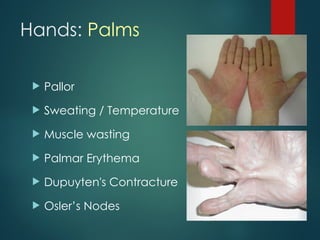
Hands: Palms
 Pallor
 Sweating / Temperature
 Muscle wasting
 Palmar Erythema
 Dupuyten's Contracture
 Osler’s Nodes
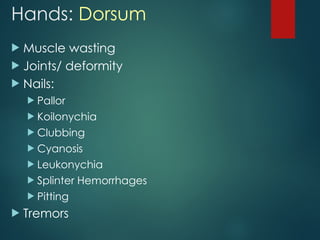
Hands: Dorsum
 Muscle wasting
 Joints/ deformity
 Nails:
 Pallor
 Koilonychia
 Clubbing
 Cyanosis
 Leukonychia
 Splinter Hemorrhages
 Pitting
 Tremors
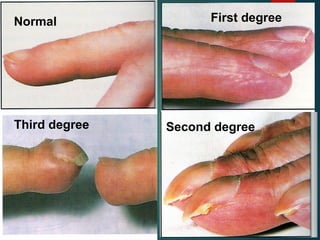
Normal First degree
Second degree
Third degree
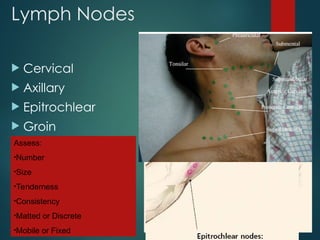
Lymph Nodes
 Cervical
 Axillary
 Epitrochlear
 Groin
Assess:
•Number
•Size
•Tenderness
•Consistency
•Matted or Discrete
•Mobile or Fixed
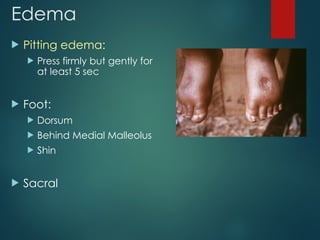
Edema
 Pitting edema:
 Press firmly but gently for
at least 5 sec
 Foot:
 Dorsum
 Behind Medial Malleolus
 Shin
 Sacral
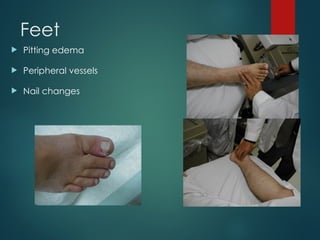
Feet
 Pitting edema
 Peripheral vessels
 Nail changes
GPE: Check List
 General Appearance:
 Age & Physique
 Posture & Attitude
 Look of Patient: Healthy/Ill
 Mental & Emotional State
 Height & Weight
 Vital Signs:
 Pulse
 BP
 Temperature
 Respiratory Rate
 Hands:
 Palmar
 Dorsum
 Head / Face:
 Eyes
 Oral Cavity
 Lymph Nodes:
 Cervical
 Axillary
 Groin
 Edema
 Feet
Twalumba , Zikomo

1 GENERAL EXAMINATION_CUST Mr Ntanga .ppt

  • 1.
  • 2.
    Aims of GPE Assess patient's general condition  Detect manifestations of internal & systemic diseases
  • 3.
    Examining a Patient:Diagnostic clues  Diagnostic process has 3 components:  History taking – Clues are the symptoms  Physical exam - Clues are the signs  Investigations - Clues are test results
  • 4.
    Examining a Patient: GeneralPrinciples & Etiquettes  Meet, greet, introduce  Consent  Explain to patient  Be polite: say “please” & “thank you”  Patient Comfort
  • 5.
    Examining a Patient: Examinationenvironment  Hand Washing  Proper light  Privacy & Confidentiality  Use curtains & shades  Presence of a chaperon when examining female patients  Correct position of clinician & Patient  Ideally examiner should be on right side of patient  Proper Exposure  Ensure your hands are warm
  • 6.
    Components of GPE Systematicapproach  General Appearance  Height & Weight  Vital Signs  Skin & Hair  Head & Neck  Lymph Nodes  Hands  Edema  Feet Head to Toe
  • 7.
    General Appearance  OBSERVEyour patient  During the communication make judgment about the patient’s general appearance  Well presented  Well spoken  Clean  Intelligence and level of education
  • 8.
    General Appearance  Age& Physique  Posture & Attitude  Look of Patient: Healthy/ill  Mental & Emotional State  Odour
  • 9.
    Height & Weight Nutrition status  Child Growth  Fluid Status  Metabolic Status
  • 10.
    Vital Signs: Pulse Rate:  beats/min  Rhythm:  Regular  Irregular
  • 11.
    Pulse: Technique  Radialpulse commonly used to assess heart rate  Palpate with index & middle fingers  Rhythm regular & rate normal: count for 30 seconds & multiply by 2  Rate unusually fast or slow: count for 60 seconds  Rhythm irregular: evaluate heart rate by cardiac auscultation
  • 12.
    Vital Signs: Respiratory Rate Count respirations with your hand on pulse  Count for at least 30 sec: multiply by 2  Normal Adult R/R: 14-18
  • 13.
    Vital Signs: BloodPressure  Patient seated in quiet, calm environment  Arm supported: midpoint of upper arm heart level  Proper cuff size: bladder inside the cuff should encircle 80% of arm  Place midline of bladder over arterial pulsation  Lower edge of cuff should be 2.5 cm above the antecubital fossa adapted from Perloff et al
  • 15.
    Blood Pressure: Palpatorymethod Method  Inflate cuff while palpating the radial pulse  Note reading at which pulse disappears & then reappears during deflation  This is Systolic Pressure
  • 16.
    • Inflate bladderto pressure 20-30 mm above level determined by palpation • Deflate bladder at 2 mm/sec: listen for appearance of Korotkoff sounds • Note manometer readings at: – Appearance of repetitive sounds: Systolic – Disappearance of these sounds: Diastolic • After last Korotkoff sound, deflate cuff slowly for another 10 mm, then rapidly & completely deflate Blood Pressure: Auscultatory method
  • 17.
    Blood Pressure • Recordsystolic & diastolic pressures, to the nearest 2 mm Hg • Measure blood pressure in both arms at first visit • Measure in different positions (lying, sitting, standing) if indicated
  • 18.
    Vital Signs: Temperature Wash the thermometer before use  Shake mercury down  Wash after use  For oral: ask patient to breath through nose & keep lips firmly closed  Keep thermometer for at least one minute
  • 19.
    Vital Signs: Temperature Conscious Adults: Oral / Axillary  Young Children: Groin/ Rectal  Oral/ Rectal Temperature 0.5°C > Axillary/ Groin  Normal: 36.6-37.2°C  Febrile: >37.2°C
  • 20.
    Pallor  Conjunctiva  Oralmucous membrane  Nails  Palms Normal Normal Pale Pale Conjunctivitis Conjunctivitis
  • 21.
    Skin: Cyanosis  Tongue Lips  Ear lobes  Fingers & toes  Central Cyanosis: Generalize, Peripheries Warm  Peripheral Cyanosis: Peripheral, Peripheries Cold
  • 22.
    Skin: Jaundice  Sclera Skin & mucous membrane
  • 23.
    Skin & Hair Skin:  Dehydration  Pigmentation/ De-pigmentation  Skin lesions  Hair:  Texture & grooming
  • 24.
    Head  General Appearance Eyes:  Sclera: Jaundice  Conjunctiva: Pallor  Oral Cavity:  Pallor  Cyanosis  Jaundice: undersurface of tongue  Oral hygiene
  • 25.
    Hands: Palms  Pallor Sweating / Temperature  Muscle wasting  Palmar Erythema  Dupuyten's Contracture  Osler’s Nodes
  • 26.
    Hands: Dorsum  Musclewasting  Joints/ deformity  Nails:  Pallor  Koilonychia  Clubbing  Cyanosis  Leukonychia  Splinter Hemorrhages  Pitting  Tremors
  • 27.
    Normal First degree Seconddegree Third degree
  • 28.
    Lymph Nodes  Cervical Axillary  Epitrochlear  Groin Assess: •Number •Size •Tenderness •Consistency •Matted or Discrete •Mobile or Fixed
  • 29.
    Edema  Pitting edema: Press firmly but gently for at least 5 sec  Foot:  Dorsum  Behind Medial Malleolus  Shin  Sacral
  • 30.
    Feet  Pitting edema Peripheral vessels  Nail changes
  • 31.
    GPE: Check List General Appearance:  Age & Physique  Posture & Attitude  Look of Patient: Healthy/Ill  Mental & Emotional State  Height & Weight  Vital Signs:  Pulse  BP  Temperature  Respiratory Rate  Hands:  Palmar  Dorsum  Head / Face:  Eyes  Oral Cavity  Lymph Nodes:  Cervical  Axillary  Groin  Edema  Feet
  • 32.